Civic Agriculture and
Food Systems Minor
College of Agriculture and Life Sciences
atVirginia Tech
Contributing Departments
•	Agricultural Leadership &
Community Education
•	Animal & Poultry Sciences
•	Crops Soils & Environmental Sciences
•	Entomology
•	Horticulture
•	Human Nutrition, Foods & Exercise
•	Plant Pathology, Physiology
& Weed Science
Community Partners
•	VA Tech Dining Services
•	Dining Services Garden at Kentland
•	Heifer International
•	HaleY Community Garden
•	Glade Road Growing
•	Blacksburg Farmers Market
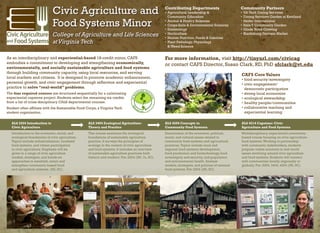
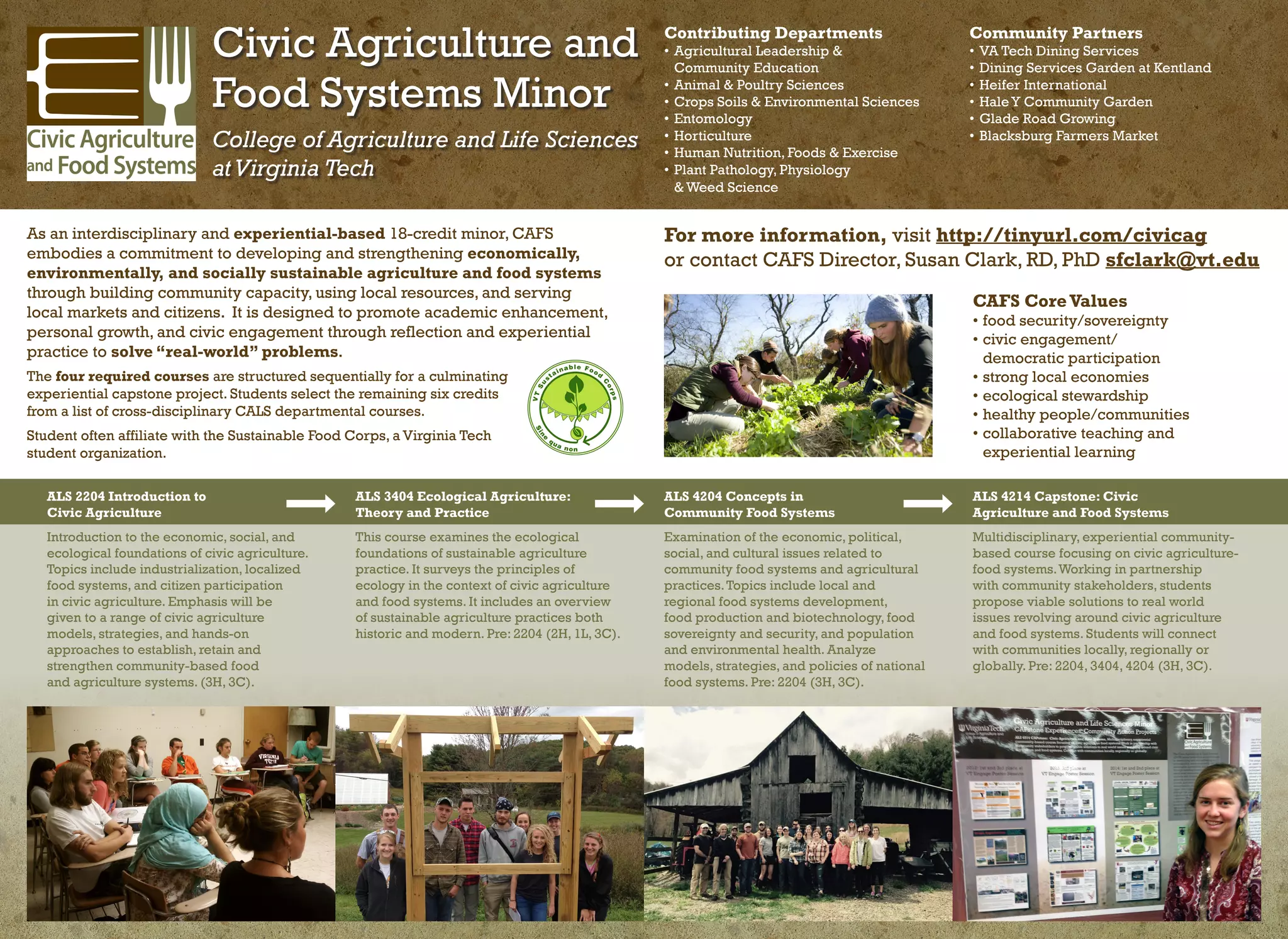
As an interdisciplinary and experiential-based 18-credit minor, CAFS
embodies a commitment to developing and strengthening economically,
environmentally, and socially sustainable agriculture and food systems
through building community capacity, using local resources, and serving
local markets and citizens. It is designed to promote academic enhancement,
personal growth, and civic engagement through reflection and experiential
practice to solve “real-world” problems.
The four required courses are structured sequentially for a culminating
experiential capstone project. Students select the remaining six credits
from a list of cross-disciplinary CALS departmental courses.
Student often affiliate with the Sustainable Food Corps, a Virginia Tech
student organization.
CAFS CoreValues
•	food security/sovereignty
•	civic engagement/
democratic participation
•	strong local economies
•	ecological stewardship
•	healthy people/communities
•	collaborative teaching and
experiential learning
ALS 2204 Introduction to
Civic Agriculture
Introduction to the economic, social, and
ecological foundations of civic agriculture.
Topics include industrialization, localized
food systems, and citizen participation
in civic agriculture. Emphasis will be
given to a range of civic agriculture
models, strategies, and hands-on
approaches to establish, retain and
strengthen community-based food
and agriculture systems. (3H, 3C).
ALS 3404 Ecological Agriculture:
Theory and Practice
This course examines the ecological
foundations of sustainable agriculture
practice. It surveys the principles of
ecology in the context of civic agriculture
and food systems. It includes an overview
of sustainable agriculture practices both
historic and modern. Pre: 2204 (2H, 1L, 3C).
ALS 4204 Concepts in
Community Food Systems
Examination of the economic, political,
social, and cultural issues related to
community food systems and agricultural
practices.Topics include local and
regional food systems development,
food production and biotechnology, food
sovereignty and security, and population
and environmental health. Analyze
models, strategies, and policies of national
food systems. Pre: 2204 (3H, 3C).
ALS 4214 Capstone: Civic
Agriculture and Food Systems
Multidisciplinary, experiential community-
based course focusing on civic agriculture-
food systems.Working in partnership
with community stakeholders, students
propose viable solutions to real world
issues revolving around civic agriculture
and food systems. Students will connect
with communities locally, regionally or
globally. Pre: 2204, 3404, 4204 (3H, 3C).
For more information, visit http://tinyurl.com/civicag
or contact CAFS Director, Susan Clark, RD, PhD sfclark@vt.edu

CAFSRecruitmentPosterPrintwrote overthisidfile

  • 1.
    Civic Agriculture and FoodSystems Minor College of Agriculture and Life Sciences atVirginia Tech Contributing Departments • Agricultural Leadership & Community Education • Animal & Poultry Sciences • Crops Soils & Environmental Sciences • Entomology • Horticulture • Human Nutrition, Foods & Exercise • Plant Pathology, Physiology & Weed Science Community Partners • VA Tech Dining Services • Dining Services Garden at Kentland • Heifer International • HaleY Community Garden • Glade Road Growing • Blacksburg Farmers Market As an interdisciplinary and experiential-based 18-credit minor, CAFS embodies a commitment to developing and strengthening economically, environmentally, and socially sustainable agriculture and food systems through building community capacity, using local resources, and serving local markets and citizens. It is designed to promote academic enhancement, personal growth, and civic engagement through reflection and experiential practice to solve “real-world” problems. The four required courses are structured sequentially for a culminating experiential capstone project. Students select the remaining six credits from a list of cross-disciplinary CALS departmental courses. Student often affiliate with the Sustainable Food Corps, a Virginia Tech student organization. CAFS CoreValues • food security/sovereignty • civic engagement/ democratic participation • strong local economies • ecological stewardship • healthy people/communities • collaborative teaching and experiential learning ALS 2204 Introduction to Civic Agriculture Introduction to the economic, social, and ecological foundations of civic agriculture. Topics include industrialization, localized food systems, and citizen participation in civic agriculture. Emphasis will be given to a range of civic agriculture models, strategies, and hands-on approaches to establish, retain and strengthen community-based food and agriculture systems. (3H, 3C). ALS 3404 Ecological Agriculture: Theory and Practice This course examines the ecological foundations of sustainable agriculture practice. It surveys the principles of ecology in the context of civic agriculture and food systems. It includes an overview of sustainable agriculture practices both historic and modern. Pre: 2204 (2H, 1L, 3C). ALS 4204 Concepts in Community Food Systems Examination of the economic, political, social, and cultural issues related to community food systems and agricultural practices.Topics include local and regional food systems development, food production and biotechnology, food sovereignty and security, and population and environmental health. Analyze models, strategies, and policies of national food systems. Pre: 2204 (3H, 3C). ALS 4214 Capstone: Civic Agriculture and Food Systems Multidisciplinary, experiential community- based course focusing on civic agriculture- food systems.Working in partnership with community stakeholders, students propose viable solutions to real world issues revolving around civic agriculture and food systems. Students will connect with communities locally, regionally or globally. Pre: 2204, 3404, 4204 (3H, 3C). For more information, visit http://tinyurl.com/civicag or contact CAFS Director, Susan Clark, RD, PhD sfclark@vt.edu