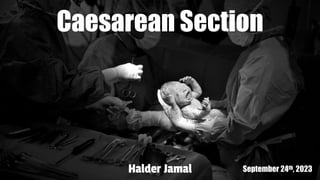
Halder Jamal September 24th, 2023
Caesarean Section
VBAC-TOLAC
Complications
Post-Operative Care
Surgery
Preparation
Incisions
Why?
Categories
Caesarean Section
Caesarean Section
• A surgical procedure in which delivery is done via a
laparotomy & a hysterotomy.
• WHO: globally, 1 of 5 babies delivered by C/S,
expected to rise to 1 of 3 by 2030.
• Roman law (Lex Caesarea) in 715 BC
• Caedere is a latin word = to cut
• The first woman surviving a C/S was
around 1500, in Switzerland, done by
Jakob Nufer on his wife for prolonged
obstructed labour.
• Thereafter, it had a high mortality and
was performed only when the mother
was already dead or considered to be
beyond help.
• Inés Ramírez is supposably the only
women who did C/S on herself on
march 5th, 2000, and succeeded (she
and her baby survived)
From antiquity to nowadays
Inés Ramírez Pérez:
"I couldn't stand the pain
anymore. If my baby was
going to die, then I decided I
would have to die, too. But if
he was going to grow up, I
was going to see him grow
up, and I was going to be with
my child. I thought that God
would save both our lives."
Categories
• Emergency C/S (category 1)
• Urgent C/S (category 2, 3)
• Elective C/S (category 4)
• Caesarean Hysterectomy
• Emergency Caesarean Hysterectomy
Why?
• Either for fetal or maternal interest or both.
• Often ≥ 2 risk factors.
• No list can be fully comprehensive.
Indications
• Previous C/S: 2 LSCS or 1 classical C/S
• Dystocia
• Maternal medical conditions
• Mal-presentations
• Suspected fetal compromise
• Multifetal gestation
• Fetal disease
• Placental disorders (previa, accreta)
• Cephalopelvic disproportion
Abdominal Incisions
Pfannenstiel
Midline Vertical
Maylard
Joel-Cohen
Midline Vertical Pfannenstiel
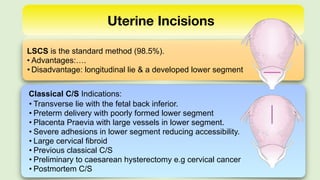
Uterine Incisions
LSCS is the standard method (98.5%).
• Advantages:….
• Disadvantage: longitudinal lie & a developed lower segment
Classical C/S Indications:
Uterine Incisions
• Transverse lie with the fetal back inferior.
• Preterm delivery with poorly formed lower segment
• Placenta Praevia with large vessels in lower segment.
• Severe adhesions in lower segment reducing accessibility.
• Large cervical fibroid
• Previous classical C/S
• Preliminary to caesarean hysterectomy e.g cervical cancer
• Postmortem C/S
Preparation
• Hx
• Ex
• Ix: US, CBC, Blood group, FBS, GUE, LFT, RFT, Virology.
• Informed written consent for surgery, anesthesia &
transfusion.
• Ensure availability of blood & neonatal resuscitation
• Fasting: 6-8 h for foods, 2 h for liquids.
• Stop anti-thrombotics (antiplatelets & anticoagulants)
accordingly.
• Anesthesia: mainly regional (spinal/epidural), but can also
use general anesthesia or local infiltration.
• Positioning: supine position 15 degree tilting to left lateral
position.
• Foley’s catheter should be put.
• Medications: injection of PPI, start antibiotics, oxytocin 5
IU infused IV slowly.
• youtu.be/VkxwN8xQz80?si=hdT6YiiRy2cEEh6h
Surgery
Post-Operative Care
• Send the patient to ward if stable or HDU/ICU if complicated.
• Observation Chart: consciousness, vitals, bleeding, uterus.
• Fluids or Transfusion.
• Prophylactic antibiotics: cephalosporins, metronidazole.
• Analgesics.
• Wound care.
• Breastfeeding.
• Vitamin C (dietary or medication).
• Start oral intake: when bowel sounds positive (often 4-6 h)
• Remove catheter: when she can move lower limbs.
• Remove wound dressing: after 24 h
• Remove stitches: after 7-10 days.
• Go home: after 24-48 h if no problems
• Shower: after 72 h
• Do housewife activities: after 7 days.
• Start sexual intercourse: after 40 days (puerperium)
• Exercise: after 3 months
• Heavy lifting: after 6 months
Frequently asked questions; when can I:
Complications
Maternal:
• Intra-operative:
• Post-operative:
• Early:
• Late:
Fetal:
• Iatrogenic prematurity
• Accidental scalpel injury.
Intra-operative:
• Hemorrhage; Atony, Lateral extension of incision, broad ligament hematoma.
• Extension to cervix or vagina
• Placenta accreta seen with placenta previa often ends up with hysterectomy.
• Nearby organ injuries; Bladder, Bowel, Ureteral
Post-operative:
• Early:
• Late:
Complications
Intra-operative:
Post-operative:
• Early:
• PPH & Shock
• Anesthetic hazards: N&V, Hypotension, Aspiration, spinal headache.
• Infections: endometritis, UTI, peritonitis, pneumonia, septic pelvic thrombophlebitis.
• GIT: Constipation, Intestinal obstruction (paralytic ileus or mechanical)
• DVT & PE.
• Wound: infection, dehiscence, evisceration, delayed healing, bleeding.
• Late:
Complications
Intra-operative:
Post-operative:
• Early:
• Late:
• General surgical; Incisional hernia, intestinal obstructions, keloid scar.
• Gynecological; Menstrual irregularities, chronic pelvic/back pain.
• Obstetrical; scar rupture, placenta previa/accreta, scar ectopic.
Complications
Vaginal Birth After Cesarean (VBAC): Successful vaginal delivery
rate is up to 80% in carefully selected patients.
Criteria for a trial of labor a after caesarean (TOLAC) include:
• Patient consent
• 1 LSCS
• No repeat indication of C/S
• Clinically adequate pelvis.
• Advanced staff for TOLAC & emergency C/S when needed.
VBAC-TOLAC
Caesarean Section (C/S).pdf

Caesarean Section (C/S).pdf

  • 1.
    Halder Jamal September24th, 2023 Caesarean Section
  • 2.
  • 3.
    Caesarean Section • Asurgical procedure in which delivery is done via a laparotomy & a hysterotomy. • WHO: globally, 1 of 5 babies delivered by C/S, expected to rise to 1 of 3 by 2030.
  • 4.
    • Roman law(Lex Caesarea) in 715 BC • Caedere is a latin word = to cut • The first woman surviving a C/S was around 1500, in Switzerland, done by Jakob Nufer on his wife for prolonged obstructed labour. • Thereafter, it had a high mortality and was performed only when the mother was already dead or considered to be beyond help. • Inés Ramírez is supposably the only women who did C/S on herself on march 5th, 2000, and succeeded (she and her baby survived) From antiquity to nowadays
  • 5.
    Inés Ramírez Pérez: "Icouldn't stand the pain anymore. If my baby was going to die, then I decided I would have to die, too. But if he was going to grow up, I was going to see him grow up, and I was going to be with my child. I thought that God would save both our lives."
  • 6.
    Categories • Emergency C/S(category 1) • Urgent C/S (category 2, 3) • Elective C/S (category 4) • Caesarean Hysterectomy • Emergency Caesarean Hysterectomy
  • 7.
    Why? • Either forfetal or maternal interest or both. • Often ≥ 2 risk factors. • No list can be fully comprehensive.
  • 8.
    Indications • Previous C/S:2 LSCS or 1 classical C/S • Dystocia • Maternal medical conditions • Mal-presentations • Suspected fetal compromise • Multifetal gestation • Fetal disease • Placental disorders (previa, accreta) • Cephalopelvic disproportion
  • 9.
  • 10.
  • 11.
  • 12.
  • 13.
    LSCS is thestandard method (98.5%). • Advantages:…. • Disadvantage: longitudinal lie & a developed lower segment Classical C/S Indications: Uterine Incisions • Transverse lie with the fetal back inferior. • Preterm delivery with poorly formed lower segment • Placenta Praevia with large vessels in lower segment. • Severe adhesions in lower segment reducing accessibility. • Large cervical fibroid • Previous classical C/S • Preliminary to caesarean hysterectomy e.g cervical cancer • Postmortem C/S
  • 14.
    Preparation • Hx • Ex •Ix: US, CBC, Blood group, FBS, GUE, LFT, RFT, Virology. • Informed written consent for surgery, anesthesia & transfusion. • Ensure availability of blood & neonatal resuscitation • Fasting: 6-8 h for foods, 2 h for liquids. • Stop anti-thrombotics (antiplatelets & anticoagulants) accordingly.
  • 15.
    • Anesthesia: mainlyregional (spinal/epidural), but can also use general anesthesia or local infiltration. • Positioning: supine position 15 degree tilting to left lateral position. • Foley’s catheter should be put. • Medications: injection of PPI, start antibiotics, oxytocin 5 IU infused IV slowly. • youtu.be/VkxwN8xQz80?si=hdT6YiiRy2cEEh6h Surgery
  • 16.
    Post-Operative Care • Sendthe patient to ward if stable or HDU/ICU if complicated. • Observation Chart: consciousness, vitals, bleeding, uterus. • Fluids or Transfusion. • Prophylactic antibiotics: cephalosporins, metronidazole. • Analgesics. • Wound care. • Breastfeeding. • Vitamin C (dietary or medication).
  • 17.
    • Start oralintake: when bowel sounds positive (often 4-6 h) • Remove catheter: when she can move lower limbs. • Remove wound dressing: after 24 h • Remove stitches: after 7-10 days. • Go home: after 24-48 h if no problems • Shower: after 72 h • Do housewife activities: after 7 days. • Start sexual intercourse: after 40 days (puerperium) • Exercise: after 3 months • Heavy lifting: after 6 months Frequently asked questions; when can I:
  • 18.
    Complications Maternal: • Intra-operative: • Post-operative: •Early: • Late: Fetal: • Iatrogenic prematurity • Accidental scalpel injury.
  • 19.
    Intra-operative: • Hemorrhage; Atony,Lateral extension of incision, broad ligament hematoma. • Extension to cervix or vagina • Placenta accreta seen with placenta previa often ends up with hysterectomy. • Nearby organ injuries; Bladder, Bowel, Ureteral Post-operative: • Early: • Late: Complications
  • 20.
    Intra-operative: Post-operative: • Early: • PPH& Shock • Anesthetic hazards: N&V, Hypotension, Aspiration, spinal headache. • Infections: endometritis, UTI, peritonitis, pneumonia, septic pelvic thrombophlebitis. • GIT: Constipation, Intestinal obstruction (paralytic ileus or mechanical) • DVT & PE. • Wound: infection, dehiscence, evisceration, delayed healing, bleeding. • Late: Complications
  • 21.
    Intra-operative: Post-operative: • Early: • Late: •General surgical; Incisional hernia, intestinal obstructions, keloid scar. • Gynecological; Menstrual irregularities, chronic pelvic/back pain. • Obstetrical; scar rupture, placenta previa/accreta, scar ectopic. Complications
  • 22.
    Vaginal Birth AfterCesarean (VBAC): Successful vaginal delivery rate is up to 80% in carefully selected patients. Criteria for a trial of labor a after caesarean (TOLAC) include: • Patient consent • 1 LSCS • No repeat indication of C/S • Clinically adequate pelvis. • Advanced staff for TOLAC & emergency C/S when needed. VBAC-TOLAC