IIIIIIIIIIILIIIIIIIM11111IIIIIIIIIIIIIIIIIIIIIIIIIIIIIII111111IIIIIIIIIIIII
CA2DB2 4167 5- 05
{62A564BF-C3C7-48C8-8141-0932700FA149}
{141560} {54-130828:080813} {080813}
APPELLANT'S
BRIEF
No. B241675
COURT OF APPEAL OF THE STATE OF CALIFORNIA
SECOND APPELLATE DISTRICT, DIVISION EIGHT
STEPHEN M. GAGGERO, Plaintiff and Appellant,
V.
KNAPP, PETERSEN & CLARK, STEVEN RAY GARCIA; STEPHEN
M. HARRIS; ANDRE JARDINI, Defendants and Respondents.
Appeal from the Superior Court of California, County of Los Angeles
Los Angeles Superior Court Case No. BC286925
Honorable Robert L. Hess, Dept. 24
APPELLANT'S OPENING BRIEF
David Blake Chatfield, State Bar No. 88991
WESTLAKE LAW GROUP
2625 Townsgate Road, Suite 330
Westlake Village, California 91361
Telephone: 805-267-1220
Facsimile: 805-26_/- 1211
Attorneys for Appellant
STEPHEN M. GAGGERO
No. B241675
COURT OF APPEAL OF THE STATE OF CALIFORNIA
SECOND APPELLATE DISTRICT, DIVISION EIGHT
STEPHEN M. GAGGERO, Plaintiff and Appellant,
V.
KNAPP, PETERSEN & CLARK, STEVEN RAY GARCIA; STEPHEN
M. HARRIS; ANDRE JARDINI, Defendants and Respondents.
Appeal from the Superior Court of California, County of Los Angeles
Los Angeles Superior Court Case No. BC286925
Honorable Robert L. Hess, Dept. 24
O_
APPELLANT'S OPENING BRIEF
David Blake Chatfield, State Bar No. 88991
WESTLAKE LAW GROUP
2625 Townsgate Road, Suite 330
Westlake Village, California 91361
Telephone: 805-267-1220
Facsimile: 805-267-1211
Attorneys for Appellant
STEPHEN M. GAGGERO
TO BE FILED IN THE COURT OF APPEAL APP-008
COURT OFAPpEAL_ Second APPELLATE DISTRICT, DIVISION Eight co_ o=,_p_ c_,e_:
B241675
ATrORN EY OR PARTY _hlT HOUT A1_TQRNEY {Nam_ _tate Bar nurnbe/.'ar_ a_dress)
DavidBlake Chatfield (Bar # 88991.)
-- Westlake Law Grou p . , ,
2625 Yownsgal_eRd., Suite 330
Westlake Village, CA 91361
rELEmO,E,O: (805)267- ! 220 FAXNO.fOpS,0: (805) 267-1211
E_._A_ADORESSrO._,;_,_:davidblakec@yahoo.com
ATTORNEYFoR(t4ame); Appellant Stephen Ivl. Gaggei'o
APPELLANTmETmONER: Stephen M_ Gaggero, et al.
RESPONDENTmEAL PARTY _NINTEREST: Knapp, Petersen & Clarke, et al.
CERTIFICATE OF INTERESTED ENTITLES OR PERSONS
(Checkone): _ iNITIAL CERTIFICATE _ SUPPLEMENTAL CERTIFICATE
S_oed_ Court case Nt_w_ber:
BC286925:
FOR COUk:f USE ONLY
Notice: Please read rules 8.208 and 8.488 before completing this form. Youmay use this formf0r the initial
certificate in an appeal whenyou file YOUr brief Or a prebriefing motion, application oropposition to such a
.motion or application in the Court of Appeal and when you file a petition for an extraordinary wr t. Y0u may
also usethis form as a supplemental certificate when you learn of changed or additional infonnationthatmUst
be disclosed.
1. This form is being submitted on behalf of the following pfirty (name): Appellant Stephen M. Gaggero
2 a.l_ There are no interested entities or persons that must be listed in this certificate under rule 8.208.
b. _] Interested entities or persons required to be listed under rule 8.208 are as follows:
I Full name of interested Nature of interestentity or person (Explain):
(1) Terra Mar Trust
(2)
(3)
(4)
(5)
[_ Continued on attachment 2.
The undersigned certifies that the above-listed persons:or entities (corporations, partnerships, firms, or any other
association, but not including government entitie s or their agencies) have either (1) an ownership Interest of 10 percent or
more in the party if itis an entity; or (2) a financial or other interest in the outcome of the proceeding that the justices
should consider in determining whether to disqualify themselves, as defined in rule 8.208(e)(2);
Date: August 8, 2013
David BlaKe Chatfield
(1YPE ce PRINT NAME) (SIC-,NATUR E OF PARTY OR AI_ORNEY_ "/
/ /
Page I of I
Foan,_provea f= Optk:nal Use
Jud_al Coundl ol Callomia
A,_P*0CB [Re_ JanuaPj 1. 2009]
CERTIFICATE OF INTERESTED ENTITLES OR PERSONS /c=. R_._o.'Co_,._=,sa.2oaa.,=aa
Le.xisNexis_Automated _ali_nia Judicial CozmcilForms
O
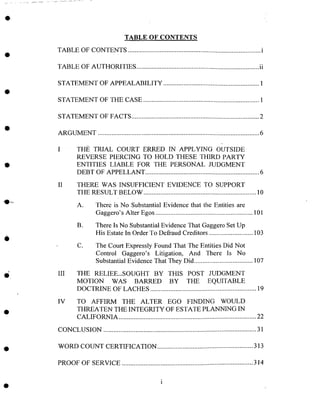
TABLE OF CONTENTS
TABLE OF CONTENTS ............................................................................... i
TABLE OF AUTHORITIES ......................................................................... ii
STATEMENT OF APPEALABILITY ......................................................... 1
STATEMENT OF THE CASE ..................................................................... 1
STATEMENT OF FACTS ............................................................................ 2
ARGUMENT ....................................................................... ......................... 6
I THE TRIAL COURT ERRED IN APPLYING OUTSIDE
REVERSE PIERCING TO HOLD THESE THIRD PARTY
ENTITLES LIABLE FOR THE PERSONAL JUDGMENT
DEBT OF APPELLANT .................................................................... 6
II THERE WAS INSUFFICIENT EVIDENCE TO SUPPORT
THE RESULT BELOW ................................................................... 10
A. There is No Substantial Evidence that the Entities are
Gaggero's Alter Egos .......................................................... 101
B. There Is No Substantial Evidence That Gaggero Set Up
His Estate In Order To Defraud Creditors .......................... 103
C. The Court Expressly Found That The Entities Did Not
Control Gaggero's Litigation, And There Is No
Substantial Evidence That They Did ................................... 107
IIl THE RELIEF_SOUGHT BY THIS POST JUDGMENT
MOTION WAS BARRED BY THE EQUITABLE
DOCTRINE OF LACHES ............................................................... 19
IV TO AFFIRM THE ALTER EGO FINDING WOULD
THREATEN THE INTEGRITY OF ESTATE PLANNING IN
CALIFORNIA .................................................................................. 22
CONCLUSION ........................................................................................... 31
WORD COUNT CERTIFICATION ......................................................... 313
PROOF OF SERVICE .............................................................................. 314
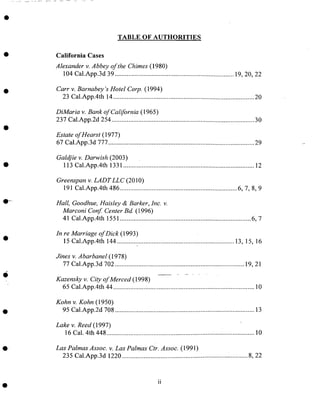
TABLE OF AUTHORITIES
California Cases
Alexander v. Abbey of the Chimes (1980)
104 Cal.App.3d 39 ....................................................................... 19, 20, 22
Carrv. Barnabey's Hotel Corp. (1994)
23 Cal.App.4th 14 .................................................................................... 20
DiMaria v. Bank of California (1965)
237 Cal.App.2d 254 ..................................................................................... 30
Estate of Hearst (1977)
67 Cal.App.3d 777 ....................................................................................... 29
Galdjie v. Darwish (2003)
113 Cal.App.4th 1331 .............................................................................. 12
Greenspan v. LADT LLC (2010)
191 Cal.App.4th 486 ...................................................................... 6, 7, 8, 9
Hall, Goodhue, Haisley & Barker, Inc. v.
Marconi Conf. Center Bd (1996)
41 Cal.App.4th 1551 .............................................................................. 6, 7
In re Marriage of Dick (1993)
15 Cal.App.4th 144 ...................................................................... 13, 15, 16
Jines v. Abarbanel (1978)
77 Cal.App.3d 702 ............................................................................. 19, 21
Kazensky v. City of Merced (1998)
65 Cal.App.4th 44 .................................................................................... 10
Kohn v. Kohn (1950)
95 Cal.App.2d 708 ................................................................................... 13
Lake v. Reed (1997)
16 Cal. 4th 448 .................................................................... i................... 10
Las Palmas Assoc. v. Las Palmas Ctr. Assoc. (1991)
235 Cal.App.3d 1220 ............................................................... •........... 8, 22
Laycock v. Hammer (2006)
141 Cal.App.4th 25 .................................................................................. 30
Mesler v. Bragg Management Co. (1985)
39 Cal.3d 290 ........................................................................................... 13
Minifie v. Rowley (1922)
187 Cal. 481 ......................................................................................... _...23
Misik v. D 'Arco (2011)
197 Cal.App.4th 1065 ........................................................................ 10, 11
Motores De Mexicali, S. A. v. Superior Court (1958)
51 Cal.2d 172 ........................................................................................... 17
NEC Electronics Inc. v. Hurt (1989)
208 Cal.App.3d 772 ........................................................................... 17, 18
Postal Instant Press, Inc. v. Kaswa Corp. (2008)
162 Cal.App.4th 1510 ........................................................................ 6, 7, 8
Sonora Diamond Corp. v. Sup. Ct. (2000)
83 Cal.App.4th 523 .................................................................................. 11
Triplett v. Farmers Ins. Exchange (1994)
24 Cal.App.4th 1415 ................................................................ 7, 10, 17, 30
Wight v. Street (1935)
3 Cal.2d 146 ......................................................................... i................... 24
Wollersheim v. Church of Scientology (1999)
69 Cal .App.4th 1012 ................................................................................ 10
Zoran Corp. v. Chen (2010)
185 Cal.App.4th 799 ................................................................................ 11
Federal Cases
Wechsler v. Macke International Trade, Inc. (Fed. Cir. 2007)
486 F.3d 1286 .......................................................................................... 22
iii
California Statutes
Code of Civil Procedure § 187 ............................................................ 6, 7, 10
Code of Civil Procedure § 904.1 ................................................................... 1
Corporations Code § 202 ............................................................................. 24
Corporations Code § 17002 ......................................................................... 24
Evidence Code § 452 ..................................................................................... 2
Evidence Code § 453 ..................................................................................... 2
Evidence Code § 1220 ................................................................................... 4
Probate Code § 700, et seq .......................................................................... 28
Probate Code § 15203 ................................................................................. 24
Federal Statutes
26 U.S.C. § 671, et seq ................................................................................ 29
26 U.S.C. § 2702 ........................................................................................... 3
Secondary Authorities
34 Am.Jur.2d Federal Taxation ............................................................... 3, 28
34A Am.Jur.2d Federal Taxation ................................................................ 28
15 Cal.Jur.3d Corporations .......................................................................... 18
Bogert, The Law of Trusts and Trustees (Thomson West 2013) ........... 3, 16
Campbell, International Taxation of Low-Tax Transactions - 2nd Edn:
Anguilla. (Juris 2011) .............................................................................. 28
Lee, "Offshore Asset Protection Trusts: Testing the Limits of Judicial
Tolerance in Estate Planning", 15 Bankr.Dev.J. 451 (1999) ................... 27
Ross and Cohen, California Practice Guide: Probate (Rutter 2013) ......... 28
"'Tax havens' agree to clampdown on tax avoidance and evasion", BBC
News (June 15, 2013) .............................................................................. 28
iv
No. B241675
COURT OF APPEAL OF THE STATE OF CALIFORNIA
SECOND APPELLATE DISTRICT, DIVISION EIGHT
STEPHEN M. GAGGERO, Plaintiff and Appellant,
V.
KNAPP, PETERSEN & CLARK, STEVEN RAY GARCIA; STEPHEN
M. HARRIS; ANDRE JARD1NI, Defendants and Respondents.
Appeal from the Superior Court of California, County of Los Angeles
Los Angeles Superior Court Case No. BC286925
Honorable Robert L. Hess, Dept. 24
APPELLANT'S OPENING BRIEF
STATEMENT OF APPEALABILITY
This appeal is from an order amending a judgment to add judgment
debtors, and substantially affecting the rights and liabilities of the parties
arising from the judgment, and is authorized by Code of Civil Procedure
section 904.1 (a)(2).
STATEMENT OF THE CASE
Judgment was entered in favor of respondents Knapp, Petersen &
Clarke, Stephen-Ray Garcia, Stephen M. Harris, and Andre Jardini and
against appellant Stephen M. Gaggero in February 2008. (JA2 421-423.) 1
1 For the sake of consistency, Gaggero's record citations are in the
same format used by the other ten appellants in their opening brief: Citations
to "JA", "Trial RT" and "Opn." refer to the joint appendix, reporter's
Respondents were thereafter awarded $1,327,674.40 in attorney fees and
costs from Gaggero in an amended judgment. (JA7 1884-1889.) This court
affirmed the judgment in May 2010, and respondents were thereafter
awarded $193,245.90 in appellate fees and costs plus $320,591.78 in interest
in a second amended judgment. (CT 1 114-116.)
In April 2012, respondents filed a motion to further amend the
February 2008 judgment to add ten Entities 2 as judgment debtors based on
the ground that they were Gaggero's alter egos and were thus the real parties
in interest. (CT1 24-CT3 376.) Gaggero and the Entities separately opposed
the motion. (CT3 379-396, 39%422.)
On May 29, 2012, after oral argument, the trial court granted
respondents' motion and amended the judgment to add the ten Entities as
judgment debtors. (CT3 540-542.) Gaggero and the Entities filed this appeal
on June 1, 2012. (CT3 543-545.)
STATEMENT OF FACTS
Appellant Stephen Gaggero was a successful real estate investor and
developer who owned a number of properties in the Los Angeles area by the
mid-1990s. In 1997, he transferred title to several of those properties to
transcript and opinion from Gaggero's prior appeal, B207567. Citations to
"CT" and "RT" refer to the clerk's transcript and the reporter's transcript in
the present appeal. Gaggero respectfully asks the Court to take judicial
notice of the briefing, record and decision in that appeal pursuant to Evidence
Code sections 452, subdivision (d), and 453.
2 The entities are Pacific Coast Management, Inc., 511 OFW L.P.,
Gingerbread Court L.P., Malibu Broadbeach, L.P., Marina Glencoe L.P., Blu
House L.L.C., Boardwalk Sunset L.L.C., and Joseph Praske as Trustee of the
the Giganin Trust ("Giganin"), the Arenzano Trust ("Arenzano") and the
Aquasante Foundation ("Aquasante"). They have also appealed the May 29
order and judgment. This brief shall refer to them collectively as the
"Entities".
various limited liability companies and limited partnerships which had been
created on the advice of his estateplanning attorney, JosephPraske, for the
benefit of his family. (Trial RT1 602-604; Trial RT5 2720; CT1 124-125;
CT3 411.) Respondentsestimated their value as of 1997 at $35 million to
$40 million, though they did not account for mortgages or other
encumbrances. (CT1 28, 31; CT3 432.) Respondents have conceded that
Gaggero no longer owned the properties after he transferred them to those
Entities. (CT1 28:2-6, 29:21-22, 31:8-11, 31:11-12, 31:18-20, 32:4-5, 36:2-
6, 40:4-6, 42:15-16; CT3 428:15-17, 430:20-21,432:5-7, 432:9-10, 432:11-
12.) Pursuant to Praske's estateplanning advice, Gaggero then transferred
his ownership interest in the Entities to trusts which Praske hadalso created
aspart of his estateplan, including Arenzano and Aquasante.(CT2 191-193,
360-CT3 370.) Respondents have conceded both that Gaggero no longer
owned the LLC's or LP's after the transfers. (CT1 28:6-8, 29:1-4, 29:21-22,
31:12-18, 33:13-15, 36:2-6, 42:15-16; CT3 432:3-5, 432:7-9, 432:9-10,
432:11-12.) He separately transferred his residence in Ventura to Giganin.
(CT2 193-196.) Respondents have conceded that Giganin is a Qualified
PersonalResidenceTrust ("QPRT") within the meaning of 26 U.S.C. § 2702,
subd. (a)(3)(A). (CT1 31; CT2 193-194.)3
In August 2000, Gaggero hired respondentsto representhim in five
lawsuits in which he was a party. (JA2 521-534; Trial RT2 610-615.) In
January 2002, appellant substituted respondentsout of his cases.(Trial RT3
908-909, 1278-1279, 1288-1289; Trial RT8 4616; Trial RT10 5750.) In
December 2002 he filed this action against them for legal malpractice and
3A QPRT is anirrevocable trust which takesownership of the settlor's
personal residence, allowing him to live there for a fixed period of years
before title passesto the beneficiaries. (26 U.S.C. § 2702, subd.(a)(3)(A); 34
Am.Jur.2d Federal Taxation ¶40203; Bogert, The Law of Trusts and Trustees
(Thomson West 2013) § 1201.)
breach of contract. (JA7 1934;CT1 19.)The casewastried in the summer of
2007, until respondents successfully moved for entry of judgment on
September 10 of that year. (Trial RT10 5737-5738; JA1 147;JA2 366.)
The court subsequently wrote a 32-page statement of decision,
disparaging Gaggero's ethics and credibility at far greater length than was
necessaryto justify its decision. (CT1 60-91.) On February 5, 2008, the court
enteredjudgment in favor of respondents and against Gaggero. (JA2 421-
423.) In May 2008, the judgment was amended to include an award of
$1,327,674.40 in fees and costs, based on the parties' retainer agreement.
(JA7 1884-1889.) In May 2010, this court affirmed the amendedjudgment.
(Opn. at 21-23.) In December 2010, the judgment was amended a second
time to award respondentsafurther $513,837.68 in interestandappellate fees
and costs.(CT1 114-116.)
In April 2012, respondentsbrought a motion to amendtheir February
2008 judgment a third time by adding the ten Entities asjudgment debtors.
(CT1 24-CT3 376.) TheseEntities consist of a managementcorporation of
which appellant is not a shareholder, officer, or employee; four limited
partnerships in which appellant is not a general or limited partner; two
limited liability companies in which appellant is not a member or manager;
and three irrevocable4 trusts of which he was the settlor but is neither the
4 Respondents' own papers contained sworn testimony by Gaggero
and Praskethat the trusts were all irrevocable. (CT1 31; CT2 193-194; CT3
373,469-471,473, 481.) As the proponents of that evidence, respondents
judicially admitted its truth. (Evid. Code, § 1220; Fassberg Const. Co. v.
Housing Authority of City of Los Angeles (2007) 152 Cal.App.4th 720, 752.)
The admission has a "conclusive effect" and "removes the matter as an issue
in the case." (Gelfo v. Lockheed Martin Corp. (2006) 140 Cal.App.4th 34,
47-48.) They offered no evidence that any of the trusts is revocable. But even
if they had, their admissions would trump it. (In re Vincent B. (1981) 125
Cal.App.3d 752, 757.)
trustee nor abeneficiary. 5(CT3 395, 411-413.)
Respondents' motion did not claim that it was based on any
information they had obtained after the judgment was entered in February
2008, or even after the trial endedin September2007. They did not so much
as try to explain why they had waited until April 2012 before bringing it.
During the 2007 trial, their questions and arguments showed not only that
they already had all the information that they later used in their alter-ego
motion but also that they were already disputing the Entities' separateness
from Gaggero. (Trial RT4 1836-1839, 2132-2134; Trial RT5 2769-2773;
Trial RT6 3005, 3067-3068; Trial RT9 4814-4816.)
Respondentsalleged in their motion that the amendmentwas proper
becausethe Entities were Gaggero's alter egos and thus actually the real
parties in interest in this action. (CT1 24-42.) Gaggero and the Entities
opposed the motion on the grounds that it sought outside reverse piercing
that the court was not authorized to do (CT3 387-89, 404-07) it lacked
sufficient evidence of alter ego (CT3 389-92, 407-09) and it was barred on
estoppel grounds. (CT3 392-94.)
The motion was heard and granted on May 29, 2012. (RT 1-28.) The
court ordered the judgment amended to add the ten Entities"as judgment
debtors. (RT 25-28; CT3 540-42.) On June 1,2012, appellant andthe Entities
appealedthis order. (CT3 543-45.)
//
//
5 Though nominally a foundation, Aquasante is one of the irrevocable
trusts. (CT1 31:23-24; CT2 193:8-16.)
ARGUMENT
I
THE TRIAL COURT ERRED IN APPLYING OUTSIDE REVERSE
PIERCING TO HOLD THESE THIRD PARTY ENTITIES LIABLE
FOR THE PERSONAL JUDGMENT DEBT OF APPELLANT
A trial court's decision to add ajudgment debtor is reviewed for abuse
of discretion. (Greenspan v. LADTLLC (2010) 191 Cal.App.4th 486, 508
("Greenspan").) A trial court has discretion to use all means necessary to
carry its jurisdiction into effect - including, in some circumstances, by
amending a judgment to name the original debtor's alter egos as additional
judgment debtors. (C.C.P. § 187; Hall, Goodhue, Haisley & Barker, Inc. v.
Marconi Conf. Center Bd. (1996) 41 Cal.App.4th 1551, 1554.) That
discretion is broad, but it does have limits. One limit is that the court may not
perform outside reverse veil piercing - the transfer of liability from an
individual to business entitles that he owns. Postal Instant Press, Inc. v.
Kaswa Corp. (2008) 162 Cal.App.4th 1510, 1512-13, 1518 ("PIP");
Greenspan, supra, 191 Cal.App.4th at 513.) Respondents conceded many
times that Gaggero does not own the Entities or their assets (CT1 28:2-8,
29:1-4, 29:21-22, 31:8-11, 31:11-12, 31:12-18, 31:18-20, 32:4-5, 33:13-15,
36:2-6, 40:4-6, 42:15-16; CT3 428:15-17 430:20-21, 432:3-5, 432:5-7,
432:7-9, 432:9-10, 432:11-12), so even if California law allowed reverse
piercing, the court would have had no discretion to impose it here. Gaggero_s
lack of any ownership in the Entities makes the court's abuse of its discretion
even more clear. Its ruling was wrong, both legally and factually.
Gaggero explained in his opposition that California law forbids
outside reverse piercing (CT3 387-89), but the trial court ignored the
governing case law, deemed all of the Entities his alter egos, and held them
liable for his personal debt. (CT3 540-42; RT 12-14, 16-28.) The court erred
in granting the motion to amend.
Code of Civil Procedure section 187 "has never been construed to
allow imposition of liability on an entity which was never a party to the
action." (Triplett v. Farmers Ins. Exchange (1994) 24 Cal.App.4th 1415,
1420.) Cases using "section 187 to add new parties as additional judgment
debtors have always been rooted in the 'alter ego' concept that the original
party and the new party were one and the same." (Id.) "Amendment of a
judgment to add an alter ego is an equitable procedure based on the theory
that the court is not amending the judgment to add a new defendant but is
merely inserting the correct name of the real defendant." (Hall, Goodhue,
Haisley & Barker, Inc. v. Marconi Conf. Center Bd., supra, 41 Cal.App.4th
at 1555 [citations omitted].)
There is no dispute that the Entities were not parties to the underlying
case, or to the retainer agreement between Gaggero and respondents. Nor is
there any dispute that the judgment was entered only against Gaggero, as
were the fee and cost awards: (JA2 421-23; JA7 1884-89; CT1 114-116.)
Thus, respondents' motion to amend undeniably sought to impose liability
for appellant's personal judgment debt on ten Entities who had never been a
part of this action, or of the events leading up to it.
It is also well settled that the alter ego doctrine may not be applied in
reverse to hold business entities liable for the debt of their owner. (PIP,
supra, 162 Cal.App.4th at 1512-13; Greenspan, supra, 191 Cal.App.4th at
513.) It necessarily follows that courts likewise cannot use reverse piercing.
to hold entities liable for the debts of someone who is not their owner. Even
by itself, respondents' concession that Gaggero did not own any of the
Entities would defeat the judgment. But there's more. There was no evidence
that Gaggero is a shareholder, officer, or employee of the defendant
corporation, that he is a member or manager of the LLC's, that he is a limited
or general partner of the LP's, or that he is a trustee or beneficiary of any of
the trusts. There is simply no nexus between Gaggero and the Entities that
could justify adding them to thejudgment.
California courts are not authorized to amend ajudgment against an
individual to add an entity as a judgment debtor under a reverse alter ego
theory. "[A] third party creditor may not pierce the corporate veil to reach
corporate assetsto satisfy a shareholder's personal liability." (PIP, supra,
162 Cal.App.4th at pp. 1512-13.) The holding was later explained thusly:
"In Postal Instant Press, Inc. v. Kaswa Corp. (2008) 162
Cal.App.4th 1510, 77 Cal.Rptr.3 d 96, the Court of Appeal held
that "outside reverse" piercing of the corporate veil is not
permitted in California, that is, the corporate veil will not be
pierced to satisfy the debt of an individual shareholder. R_ither,
the court explained, the alter ego doctrine will only be applied
to hold an individual shareholder liable for a corporate debt
where the individual has disregarded the corporate
form." (Greenspan, supra, (2010) 191 Cal.App.4th at 513-14.)
Courts likewise cannot make entities liable for the debts of an
individual under the single-enterprise rule, since that rule requires common
ownership over both the original and additional judgment debtors (Las
Palmas Assoc. v. Las Palmas Ctr. Assoc. (1991)235 Cal.App.3d 1220, 1249-
1251) and since an individual has no owner.
Yet, respondents' motion to amend the judgment to add the Entities
as judgment debtors only makes sense if it sought reverse application of the
alter ego doctrine - and perhaps not even then. Not only did respondents
disregard the clear judicial prohibition against outside reverse piercing
delineated in PIP and Greenspan, it accepted respondents' claim that these
cases in fact supported their request for such reverse piercing. (CT1 34-35,
40, 41-42.) The trial court erroneously agreed, and relying expressly on
Greenspan the court held that it was authorized to perform the reverse
piercing sought by respondents here. (CT1 40-42; CT3 428-431; RT 12-14,
24-28.)
The court's ruling was error on two critical points. First, as noted
above, Greenspan unequivocally affirmed the prior holding of PIP that a trial
court is not authorized to use outside reverse piercing to satisfy the debts of
individuals; rather, the alter ego doctrine may only be applied in certain
circumstances against a corporation's owners and/or sister corporations to
satisfy a corporate debt. (Greenspan, supra, (2010) 191 Cal.App.4th at 513-
14.)
Second, Greenspan did not involve a request for reverse piercing to
hold a third party liable for the debt of an individual. Greenspan involved the
standard application of alter ego - a request to hold the owners-and affiliates
of two corporations liable for the debt of those corporations - along with use
of the single-enterprise rule to hold liable a sister company which had the
same owner as the original judgment debtor and which was used
interchangeably with the owner and the original debtor to shield the owner
from his debts. (Id.) Since Greenspan did not involve reverse piercing, it
provides no support for the trial court's decision that it had the power to order
the reverse application of alter ego here.
Contrary to the argument of respondents and the finding of the trial
court, California law expressly prohibits reverse application of the alter ego
doctrine in order to hold a third party liable for the personal debts of an
individual. The trial court was not authorized to grant the motion to amend
on this basis, and the court abused its discretion by doing so. The order
amending the judgment to add the Entities as judgment debtors must be
reversed.
//
//
II
THE EVIDENCE WAS INSUFFICIENT
TO SUPPORT THE RESULT BELOW
Even if California law permitted reverse application of the alter ego
doctrine, which it does not, the evidence presented to the trial court would
not support making the Entities additional judgment debtors.
This court must determine whether the factual findings upon which
the trial court based its decision are supported by substantial evidence.
(Wollersheim v. Church of Scientology (1999) 69 Cal.App.4th 1012, 1014-
15.) "Evidence is substantial if any reasonable trier of fact could have
considered it reasonable, credible and of solid value." (Kazensky v. City of
Merced (1998) 65 Cal.App.4th 44, 53 [citations omitted].) Conflicts in the
evidence or reasonable inferences drawn therefrom must be resolved in favor
of the decision, but a decision may be overturned "if the evidence before the
trial court is insufficient as a matter of law to sustain those findings." (Lake
v. Reed (1997) 16 Cal. 4th 448,457 [citations omitted].)
Under Code of Civil Procedure section 187, "[t]he court may exercise
its authority to imPose liability upon an alter ego who had control of the
litigation, and was therefore represented in it." (Misik v. D'Arco (2011)
197 Cal.App.4th 1065, 1073.) However, this "requires both (1) that the new
party be the alter ego of the old party and (2) that the new party had
controlled the litigation, thereby having had the opportunity to litigate, in
order to satisfy due process concerns. The due process considerations are in
addition to, not in lieu of the threshold alter ego issues." ( Triplett v. Farmers
Ins. Exchange, supra, 24 Cal.App.4th at 1421 [emphasis added].) Here, the
evidence fell far short of supporting any of these findings.
//
//
10
A. There is No Substantial Evidence that the Entities are
Gaggero's Alter Egos.
The first requirement was that respondents had to prove the Entities
were Gaggero's alter egos. This is itselfa two-part inquiry. The party seeking
to invoke the alter ego doctrine must first show "a unity of interest and
ownership" between the entity and individual such that their separate
personalities do not exist, and then must also show that adherence to the
fiction of separateness would sanction a fraud or promote injustice. (Misik v.
D'Arco, supra, 197 Cal.App.4th at 1073; Sonora DiamondCorp. v. Sup. Ct.
(2000) 83 Cal.App.4th 523,538.)
In determining whether the appropriate separateness exits, courts have
traditionally looked at certain factors such as: "commingling of funds and
other assets of the two entities, the holding out by one entity that it is liable
for the debts of the other, identical equitable ownership in the two
entities,...and use of one as a mere shell or conduit for the affairs of the
other," also "inadequate capitalization, disregard of corporate formalities,
lack of segregation of corporate records, and identical directors and officers."
(Id. at 538-39 [citations omitted].) The list of factors "is not exhaustive, and
"[n]o single factor is determinative." (Zoran Corp. v. Chen (2010) 185
Cal.App.4th 799, 812.)
Here, respondents' motion offered no evidence to establish the
requisite unity of interest and ownership between Gaggero and the Entities,
let alone substantial evidence. They provided no evidence of who owned any
of the Entities. They offered no financial records for any of the Entities.
Aside from the initial property transfers in 1997 and 1998 and some
payments from PCM for Gaggero's services and - with his own money - to
cover some of his expenses 6, respondents did not document a single
6 See Part IV, below.
11
transaction of any kind that any of the Entities had ever carried out with
anyone, let alone with Gaggero. Their repeated concessions that Gaggero no
longer owns the Entities or their assets proves that there was no such unity
of ownership.
The best respondents could do was to cite Galdjie v. Darwish (2003)
113 Cal.App.4th 1331, 1339 for the claim that "equitable ownership in a trust
is sufficient to meet the ownership requirement for purposes of alter ego
liability." (CT1 35:5-6.) But Galdjie says no such thing. It wasn't e;een about
alter-ego liability, so it says nothing about how the requirements for such
liability can be met. Like so much else in respondents', papers, this claim was
pure fiction.
This argument also presupposes that Gaggero is the equitable owner
of each of the Entities. Respondents twice claimed that he was (CT1 35:5-6,
37:10-12), but they did not try to support this claim or even define the term.
• Merely calling Gaggero an "equitable owner" does not overcome the facts -
which respondents repeatedly conceded - that he no longer owned his assets
after he transferred them to the LP's and LLC's, or that he no longer owned
any interest in the LP's or LLC's after transferring those interests to the
trusts.
Respondents produced no evidence of any disregard of corporate
formalities, any failure to keep separate records, any commingling of funds
or assets, any holding out of Gaggero or the Entities as liable for one
another's debts, etc. The only facts respondents pointed to were that
appellant's estate planning attorney Praske created the Entities and continued
to operate them, that Gaggero transferred properties he had ownedto some
of those Entities when the estate was set up, and that he contracted to consult
with the management company for some of the Entities because he had the
real estate expertise Praske lacked. (CT1 140; CT2 213-215,360.) This is not
nearly enough to establish a unity of interest and ownership between
12
appellant and theseEntities.
B. There Is No Substantial Evidence That Gaggero Set Up His
Estate In Order To Defraud Creditors.
Even if this court were to find that there was substantial evidence of
unity of interest and ownership between appellant and the Entities, there must
also be substantial evidence showing an improper intent. "Traditional
piercing of the corporate veil is justified as an equitable remedy when the
shareholders have abused the corporate form to evade individual liability,
- ..circumvent a statute, or accomplish a wrongful purpose." (Mesler v. Bragg
Management Co. (1985) 39 Cal.3d 290, 300-01.) No such evidence was
presented in this case.
Respondents' improper-motive claim was based on the fact that in
1997 Gaggero transferred title to real property to the LP and LLC entities.
Thousands of people do this.every year as a routine part of estate planning.
Yet, respondents insisted with no evidentiary support that, unlike the similar
estate planning decisions made by many others, appellant's estate planning
must have been done to defraud creditors. Respondents did not begin
working for Gaggero until 2000 and did not become his creditors until 2008,
so he clearly did not set up his estate plan to defraud them.
Under a very different set a facts, Division Four of this court has noted
that "a trust created for the purpose of defrauding creditors or other persons
is illegal and may be disregarded" in disputes involving the defrauded party.
(In re Marriage of Dick (1993) 15 Cal.App.4th 144, 161.) The same is true
of fraudulently-established corporations. (Kohn v. Kohn (1950) 95
Cal.App.2d 708, 717-720.) But before a court may disregard such an entity,
it must find that the entity was actually created to defraud someone. That
finding, in turn, must be supported by substantial evidence.
13
Respondentsdid not claim that the trusts had beensetup fraudulently.
Indeed, they expressly denied that they had to prove anything of the sort.
(CT3 426:24-427:1 .)They also insistedthat the fraud issuehad"already been
determined" and was "clearly resolved" by the January 8, 2008 statementof
decision, basedon aparagraphwhich saidnothing either aboutthe estateplan
or about fraud. (CT3 427:2-13.) More fundamentally, the legitimacy of the
estateplan was not at issue during the trial becauseit was not relevant to any
of Gaggero's causesof action. (JA 1 1-25.)Further, the statementof decision
could not bind the Entities, who were still more than four yearsaway from
being addedto the case.......
The May 29 minute order (CT3 540) says nothing about a fraudulent
purpose behind any of the trusts or other Entities. Neither doesthe court's
formal oi:der, which was drafted by respondents' counsel. (CT3 541-542.)
Neither the order nor the minute order says anything about Gaggero
intending to commit fraud when he setup the estate 15yearsearlier.
During the hearing, the trial court said that Gaggero had used his
estate plan "to shield his assetsfrom creditors" in August 2000-2001 (RT
27:25-28:1) 7, but did not say he had created the plan to defraud creditors.
Protecting assetsis the very purpose of estateplanning, as long as it is done
for the estate'sbeneficiaries. So even if this was Gaggero's goal it would not
justify the result below. What matters is whether his intent was fraudulent.
There is no evidence that it was.
The court als0 said that Gaggero "has this substantial judgment
against him, and he has attempted to use these devices to put his assets
beyond the reach of legitimate creditors, and we have had a full and fair
opportunity to litigate this." (RT 26:3-7.) But Gaggero had transferred his
7The court said that Gaggero had said this during cross-examination.
(RT 28:1-3.) He did not.
14
assetsto the Entities between 1997and 1998- more than a decadebefore the
judgment was entered. To infer that a debt he incurred in 2008 is what
motivated him to createanestateplan in 1997 is ludicrous.
The court gave no hint of which "legitimate creditors" Gaggero was
supposedly trying to thwart when Praskeset up his estatein the 1990s.Those
creditors could not have included any of the respondents, who first began
working for him morethan two yearslater andwho only becamehis creditors
eight years after that. Respondents likewise identified no such creditors.
Their papers say nothing about anyone else having claims against Gaggero
_when.he set up the estate. There is no evidence that any prior creditors had
ever brought a fraudulent-transfer action involving any aspectof the estate
plan or otherwise claimed that the plan was designedto defraud them.
The only creditor from that period the record reveals is the Venice
North Beach Committee ("VNBC"), which was awarded about $100,000 in
attorney fees and costs from Gaggero in 1995 - a judgment that was on
appeal when he setup his estate.(Trial RT2 613-14; CT 130.) That judgment
was the result of errors by Sherman Stacey, Gaggero's attorney in that case
- as he later proved by winning a malpractice judgment in the amount of
$350,000 against Stacey, in a case where respondents represented him. (Trial
RT5 2480.) 8 The trial court acknowledged the judgment in Gaggero's favor
and that Gaggero had paid VNBC in full. (JA2 404 fn. 18, 407.) The trial
court did not find that the estate plan was designed to thwart VNBC, and
respondents' motion did noi claim that it was. There is no reason to think he
parted with over $35 million in assets to evade a $100,000 debt.
Marriage of Dick, supra, is instructive about what type of showing is
required. To take but two examples: The husband in that case owned an
s The VNBC judgment had grown to $170,000, including interest, fees
and costs, by the time of the Stacey verdict in 2001. (Trial RT3 1608.)
15
English manor house on the Isle of Jersey, which had been his principal
residenceuntil recently. (15 Cal.App.4th at p. 162.)He told the court that the
house belonged to a trust of which he was not even the settlor, let alone a
beneficiary. 9 But he had previously told the government of Jersey that the
house was his, and records of its purchase showed that he had created a
corporate entity to buy it for him in order to create the appearanceof a
separateownership. (Id.) The husband also used one of the largesthousesin
metropolitan Denver, which he claimed was owned by an entity called
Alkobel in which he supposedlyhad no ownership stake. (Id. at p. 163.) But
even after the supposedsaleto Alkobel, he had obtained a.loanby telling the
bank that he was still the property's sole owner. (Id.)
The evidence in the present casereveals no such trickery. It certainly
gives no reasonto believe Gaggerowas trying to defraud creditors when he
set up his estatein the 1990s.At most, it shows that (1) he hascreditors who
came along many years after he had set up the estate; (2) he owes them
money; and (3) at least for now, he cannot afford to pay them in full.
None of this means that Gaggero defrauded anyone in 1997 or 1998,
or that the Entities in the estate are responsible for his debts. That would only
be true if they had been set up with the intent to defraud creditors. Before it
could deem the Entities Gaggero's alter egos, the trial court had to find such
intent. It didn't. In order to get an alter-ego finding, respondents had to prove
such intent. They didn't even allege such intent, much less prove it. Instead,
respondents and the court-simply inferred such intent from the complexity of
the estate and the fact that, fifteen years later, Gaggero cannot presently
9 There is no hint that the trust was analogous to a QPRT like Giganin,
which permits the settlor to continue living in a residence after transferring
it. (Bogert, The Law of Trusts and Trustees (Thomson West 2013) § 1201.)
Dick's insistence that he was not the trust's settlor is a further reason why his
relationship with that trust is distinguishable from Gaggero's relationship
with Giganin.
16
afford to pay a seven-figure judgment in full. That inference is manifestly
unreasonable,and it cannot take the place of substantial evidence.
C. The Court Expressly Found That The Entities Did Not
Control Gaggero's Litigation, And There Is No Substantial
Evidence That They Did.
However, even if this court were to find that there was substantial
evidence of unity of interest and an improper intent, there must also be
substantial evidence to prove it was the Entities that actually controlled the
underlying litigation. (Triplett v. Farmers Ins. Exchange, supra, 24
e .... "..
Cal.App.4th at 1421 .) Again, no such evidence was presented here.
A trial court may not add a new judgment debtor - even if it really is
the original debtor's alter ego -unless it controlled the underlying litigation.
(Id.; NEC Electronics Inc. v. Hurt (1989) 208 Cal.App.3d 772,778-79.) Here,
the trial court found that the original judgment debtor, Gaggero, alone
controlled the litigation. (CT3 540.) This finding was not only correct, but
was also precisely the one respondents had asked for. (CT1 28:10-11, 29:18-
19, 36:23, 37:21-22, 38:1-4; CT3 424:10-11,428:25-26.) l° The court simply
had no discretion to impose alter-ego liability given Gaggero's control of his
own lawsuit.
Even where alter ego is proven, it is improper to add a new party who
was never afforded the due process right to litigate their interests in the
underlying action. (Motores De Mexicali, S. A. v. Superior Court (1958) 51
Cal.2d 172, 176.) Respondents produced no evidence that the Entities
exercised any control over the litigation, let alone had the ability to represent
10Respondents actually admitted that only an alter ego who controlled
the underlying litigation can be added as a judgment debtor. (CT 1 34:18-20.)
But in the next breath, without acknowledging the contradiction, they
claimed the Entities could be added because Gaggero controlled them. (CT1
34:20-23) Such sleight of hand permeated their motion. (See Part IV, below.)
17
their interestsat trial or at anyother proceeding. To the contrary, respondents
argued it was Gaggero who controlled the Entities, thereby conceding the
Entities had no control over the litigation. (CT1 28:10-11, 29:18-19, 36:23,
37:21-22, 38:1-4; CT3 424:10-11,428:25-26.) The trial court also found it
was appellant who controlled the litigation, not the Entities. (RT 12-14, 16-
28.)
Finally, these Entities all have shareholders, members, partners,
beneficiaries, and other innocent creditors whose interests were clearly not
the sameasappellant's interestsin the underlying litigation. (CT3 411-413.)
It is again improper to add a new debtor whose interests.arenot the sameas
those of the original party. (NEC Electronics Inc. v. Hurt, supra, 208
Cal.App.3d at 780-81; see also 15 Cal..lur.3d Corporations § 30, Extent of
application of alter-ego doctrine ["the corporate veil will not be pierced
where to do so would create an injustice as where to disregard the corporate
entity would inflict an obligation on an innocent corporation or on its
minority stockholders", footnotes omitted].) This case, like NEC, "contrasts
with the usual scenario where the interests of the corporate defendant and its
alter ego are similar so that the trial strategy of the corporate defendant
effectively represents the interests of the alter ego." (Id. at 780.) Here, it is
undisputed the Entities had no control over the litigation, and no ability to
litigate their differing interests, thus adding them under any theory would
violate their due process rights.
At the end of the day, there was no substantial evidence to support the
trial court's finding that the Entities were Gaggero's alter egos, and in fact
the court held that it was Gaggero and not the Entities who controlled the
underlying litigation so the Entities were not the real parties in interest. Thus,
even if the prohibition on reverse piercing were ignored, the evidence is
insufficient as a matter of law to sustain the trial court's finding of alter ego.
The order amending the judgment must be reversed.
18
III
THE RELIEF SOUGHT BY THIS POST JUDGMENT MOTION
WAS BARRED BY THE EQUITABLE DOCTRINE OF LACHES
Respondents' motion to amend the judgment to add these Entities was
filed in April of 2012. Yet, they demonstrably had the facts relating to
Gaggero and his estate planning, including these Entities, by the time the
case was tried in the summer of 2007. Nearly all of their evidence consisted
of deposition and/or trial transcripts from the present case or from the even
earlier case ofGaggero v. Yura, L.A.S.C. No. BC239810, which was tried in
2005 _.(CT1 44-54.) Their evidence also included the statement of decision,
appellate opinion and prior amended judgments in this case, none of which
contained any new facts about Gaggero or the Entities. (CT1 60-91, 93-111,
114-116.) They also used an excerpt from Praske's 2009 third-party debtor
exam, but nothing in that transcript revealed anything material about
Gaggero's relationship with any of the Entities. (CT2 357-CT3 377.)
Records of discovery disputes they had with Gaggero in 2011 and 2012
likewise revealed no new material information. (CT2 291-306, 322-354.) All
that remained were some basic public records about several of the Entities
which respondents had recently downloaded from the wcbsites of the
California and Nevada secretaries of state but which contained information
that had been just as available back in 2007. (CT2 309-319.)
A judgment creditor who seeks to add new debtors after judgment has
been entered must show that he was unable to seek such relief more promptly.
(Alexander v. Abbey of the Chimes (1980) 104 Cal.App.3d 39, 48.) And he
may not do so at all if he had the necessary information before the original
judgment was entered. (Jines v. Abarbanel (1978) 77 Cal.App.3d 702, 717.)
Respondents offered no explanation for why they waited so many years to
assert it was the Entities that were the real parties in interest.
19
Gaggero's opposition explained that respondents' delay in bringing
their motion was further grounds for its denial. (CT3 392-394.) In their reply,
respondents argued only they had waited because they did not know if
Gaggero's appeal would succeed I1 and because they later had a discovery
dispute with him. (CT3 427-428.) Yet the trial court ignored the issue
entirely. Since the evidence clearly shows that respondents had all the
relevant information before the judgment was entered and since they offered
no plausible excuse for delaying, the trial court was required to reject the
motion on the ground of laches.
"Amendment of a judgment to add am alter ego is an equitable
procedure." (Carr v. Barnabey's Hotel Corp. (1994) 23 Cal.App.4th 14, 21 .)
In order "to justify the addition of new defendants, plaintiff must have acted
with due diligence to bring them in as parties." (Alexander v. Abbey of the
Chimes, supra, 104 Cal.App.3d at 48 [citations omitted].) A request may be
refused where "after ascertaining the facts the complainant failed promptly
to seek redress." (Id. [citations omitted].) No one factor is determinative in
assessing if the delay was unreasonable, but "the length of time which has
elapsed from the time when the complainant knew or should have known of
the facts.., is an important element where no reason is suggested for the
delay." (Id. [citations omitted].)
In this case, respondents waited until April of 2012 to request the
equitable relief of an amendment to add the Entities as judgment debtors.
Respondents did not claim they had learned any material information shortly
before they filed their alter-ego motion, or even at any time after their motion
for judgment was granted in September of 2007. As we have seen, nearly all
_ The pending appeal did not stop respondents from taking Praske's
third-party debtor examination on June 9, 2009. (CT2 357-CT3 377) They
did not even try to explain why they were willing to take that step while they
risked losing the appeal but could not bring their alter-ego motion.
20
of the evidence they offered in support of their alter-ego motion pre-dates the
September 10, 2007 order granting their motion for judgment and none the
few exhibits which are newer than that added any material information. The
record is clear that respondents simply sat on the relevant information for
years before finally deciding to act on it.
The evidence is undisputed that Gaggero's estate planning took place
in 1997, three years before he hired respondents as his lawyers. Respondents
had full knowledge of his estate plan when they represented him from August
2000 through January 2002. This action was filed in December 2002, giving
respondents years to conduct discovery about these Entities if they deemed
it relevant. There is no evidence that they bothered, and the trial transcript
shows that they had all the relevant information by the end of the trial in
September 2007.
Judgment was entered in February 2008. A judgment creditor may not
add new judgment debtors if he had the necessary information to add them
before the judgment was entered. (Jines v. Abarbanel, supra, 77 Cal.App.3d
at 717.) Respondents failed to do so, and instead delayed more than four
more years before bringing their alter-ego motion, alleging for the first time
in April 2012 that the Entities were in fact the real parties in interest in this
case.
Respondents offered no explanation for why they waited so long to
bring these third parties in the case, when they had the necessary facts in their
possession during the eight years the case was pending. This is analogous to
the situation in Alexander v. Abbey of the Chimes, supra, where the moving
party knew or should have known of the facts relating to the alter ego claim
at or shortly after the time the case commenced, but waited until several years
after the judgment was final to seek to add an alter ego judgment debtor. The
court held "in the absence of any reasonable explanation for nearly a seven-
year delay in moving for amendment, the trial court abused its discretion in
21
granting this belated motion for amendment of the judgment." (Alexander v,
Abbey of the Chimes, supra, 104 Cal.App.3d at 48-49.)
The same result is mandated here. Respondents had full knowledge of
the relevant facts since mid-2007 at the latest, but waited over four years after
their judgment was entered to bring their motion to amend - a period during
which they twice successfully moved to amend it for other reasons. (JA7
1884-1889; CT1 114-116.) The motion should have been denied on the
ground that respondents were estopped from seeking such relief as a result
of their unexplained and unreasonable delay. The trial court abused its
discretion in granting respondents' belated motion to amend, and the order
must be reversed.
IV
TO AFFIRM THE ALTER EGO FINDING WOULD THREATEN
THE INTEGRITY OF ESTATE PLANNING IN CALIFORNIA
"California courts generally treat the alter ego doctrine as a drastic
remedy and disregard the corporate form only reluctantly and cautiously."
(Wechsler v. Macke International Trade, Inc. (Fed. Cir. 2007) 486 F.3d 1286,
t295, citing Las Palmas Assocs. v. Las Palmas Ctr. Assocs., supra, 235
Cal.App.3 d at 1249.) The trial court displayed neither reluctance nor caution.
Instead, it eagerly accepted all of respondents' arguments without regard for
the weakness - or,_mor.e..accurately, the absence - of their evidence.
With no evidence that could support a reasonable inference that
Gaggero's estate plan was in any way improper, respondents resorted to
insinuation and innuendo. Their strategy was distressingly effective. But
estate planning only works because courts are expected to reject such
specious challenges. Ifa settlor's foes can defeat even the most thorough and
irrevocable estate plan with smoke and mirrors, then no settlor can be
confident his estate plan will be secure. Estate planning itself will be crippled
22
in California if attacks like respondents' are allowed to succeed.
Respondents' strategy was straightforward. First, they used three filll
pages of their motion to remind the court just how much it disliked and
distrusted Mr. Gaggero, cataloging findings and comments the court had
made about him years earlier at trial and in its statement of decision. (CT1
28:1-29:11, 33:12-34:6.) Not one of those findings or comments had
anything to do with how the Entities are run, so they shed no light at all on
whether any of them was Gaggero's alter ego. Their only purpose was to fan
the flames.
, Next, respondents presented a variety of innocuous facts about the
estate plan, peppered with innuendo, unsupported conclusions, and outright
falsehoods designed to suggest deception despite the lack of any supporting
evidence. They persuaded the trial court to infer wrongdoing, but all they
actually showed was that Gaggero's estate isrelatively large and complex.
Of course, an estate's size and complexity have nothing to do with whether
it is somehow the settlor's alter ego. If respondents' showing was sufficient
here, then similar showings will be sufficient whenever anyone challenges a
complex estate plan. If this court affirms the alter-ego finding, then no estate
plan will ever be safe in a California court.
Respondents began their attack with a lengthy diatribe aimed at Mr.
Gaggero personally, with hardly a mention of any of the Entities in his estate.
(CT1 28:1-29:26.) It quoted selectively from the January 8, 2008 statement
of decision, reminding the court of the impressions it had formed of Mr.
Gaggero during the trial and the many aspersions it had cast at him more than
four years earlier. (CT1 28:19-24, 29:5-11.)
Whether the Entities are Gaggero's alter egos is a question about their
financial relationships with him. (Minifie v. Rowley (1922) 187 Cal. 481,
487.) Assassinating his character did nothing to illuminate those
relationships, no matter how receptive the court may have been to
23
respondents' strategy. Respondents' tactic merely diverted the court's
attention from the lack of substantial evidence. (See Part II, above.) Their
attacks shed no light at all on how the Entities operate. The only plausible
reason for this extended diatribe was to rekindle the court's disdain for
Gaggero personally in the hope that it would carry over to the Entities in his
estate. 12
Merely reciting respondents' arguments is enough to show how
devoid of merit they truly were.
They complained, for example, that Gaggero's estate plan was so
complex that it involved multiple Entities and "took ,several months to
implement". (CT1 36:1-7.) But as respondents note, Gaggero's estate is
relatively large and owns multiple properties. Large estates are often
complex. If complexity suggests wrongdoing, then every large estate plan is
in trouble.
Another innocuous point respondents used to their advantage is that
several of the LP's and LLC's had been created for the purpose of owning
real property. (CT1 33:4-5 [as to the Entities generally], 38:23-24 [as to the
Entities generally], 39:2-3 [as to Blu House], 39:3-5 [as to Boardwalk
Sunset], 39:15-17 [as to Malibu Broadbeach and Marina Glencoe], 39:18-19
[as to Malibu Broadbeach], 39:21-22 [as to Marina Glencoe], 39:27-40:1 [as
to 511 OFW and Gingerbread Court], 40:1-2 [as to 511 OFW], 40:3-4 [as to
Gingerbread Court].) But owning property is a perfectly normal and
legitimate business purpose, especially for an entity set up as part of an estate
plan. (Corp. Code § 202(b)(1)(A); Corp. Code § 17002(a); Prob. Code §
15203; Wightv. Street(1935)3 Cal.2d 146, 149-150 [approving trust created
to hold property for benefit of settlor's daughter].) Even so, respondents also
12 Gaggero does not list the many accusations against him here, since
doing so would serve no purpose.
24
insisted, without evidence, that the sameEntities had no business purpose,
and cited the supposed lack of such purpose as further evidence that they
were shams. (CT1 29:22-24, 41:12-14; CT3 424:17-20, 430:11-14.)
Respondents also complained that Pacific Coast Management- which
they claimed, without evidence, is "owned by Gaggero's trusts"- issues
checks for his personal expenses. (CT1 32:5-9.) In their words, PCM "pays
his utility bills, food expenses, dog's veterinary bills, and provides him with
a car." (CT1 32:7-8.) But they presented those facts out of context in order
to suggest that PCM was financing Gaggero's his expenses with its own
money. Just a few pages later, they admitted that PCM actually paid these
bills with Gaggero's money rather than its own. In their own words,
"Gaggero provides PCM money and PCM writes checks on his behalf." (CT1
38:4-5.)
They even used Gaggero's own testimony to prove their point:
"Checks were written by PCM. I paid for it. I give PCM the money.
PCM writes the checks. They write checks for me. They pay my
utilities. They pay my credit card, they pay for my dog's vet bills. I
mean PCM manages my life. They are a management company for
me personally." (CT1 38:5-8, citing CT2 261:22-28.)
That's exactly what management companies are supposed to do for
their clients. Since an alter-ego relationship involves the improper mingling
of financial affairs, the concession that PCM uses Gaggero's money instead
of its own to pay his expenses dooms the claim that it is his alter ego. _3
_3It also directly contradicts the stance respondents took at trial, where
they won by successfully objecting to this very evidence and then using its
absence to claim they should not have to reimburse Gaggero for payments
that had been made with PCM checks. (Trial RT6 3141-3144; CT 1 86.) They
took the same position in Gaggero's appeal from the original judgment. (See
pages 31-39 of respondents' brief in the prior appeal.) They even persuaded
this Court to rule against Gaggero on that basis. (Opn. at 21-23.)
25
Not content just with actively misleading the trial court about PCM's
role, respondents then set up a false contradiction between Gaggero's
testimony and their own distorted portrayal of his relationship with PCM.
They argued that
"Although PCM pays for all of Gaggero's personal expenses and
'manages his life', Gaggero could not answer basic questions are
relating [sic] the entity. Gaggero did not know whether PCM had
Articles of Incorporation, whether they were officers or directors, if
he was a director 14, and when it was formed." (CT1 38:11-14, citing
CT2 255-257.)
But this would only suggest a contradiction if Gaggero's affairs
actually were mingled with PCM's. It is entirely consistent with the evidence
that they are not. Why should a business's client know such details about its
structure and history? That Gaggero did not have the answers supports his
position. Only respondents' spin could suggest otherwise.
Respondents also complained that "Because Gaggero transferred all
ownership interest in his assets to various entities, trusts and foundation he
refuses to respond to post-judgment discovery asserting he has 'no attachable
interest.'" (CT1 33:13-15.) The implication, of course, is that Gaggero's
assertion was false. But as the former owner of those assets, Gaggero
genuinely does not have an attachable interest in them. Respondents
acknowledged as much in his prior appeal, when they told this court that
"As a trust beneficiary, Gaggero has 'no legal title or ownership
interest in the trust assets.' [Citation]. He is not the real party in
interest and has no standing to sue on behalf of the trust. [Citations]."
(See RB in appeal B207567 at p. 35.)
_4 Here again, respondents actively distorted Gaggero's testimony in
order to sway the trial court. All he had been asked - by the same lawyer who
later supervised the alter-ego motion (compare CT2 248, 249:23 with CT1
24:1) - was whether he had been a director in 2000 or 2001. He replied that
he did not know the correct terminology to describe his role. (CT2 255:6-
16.)
26
Respondents used that argument to defeat Gaggero's claim that he
could recover costs that were paid via PCM checks, so they not only know it
is true but actually used its truth to their advantage in this very court. Even
so, their alter-ego motion insisted that the claim was false and that Gaggero
actually does have the very type of interest they previously conceded he does
not have.
According to respondents, the fact that Gaggero and Praske
sometimes used the terms "Gaggero's personal estate" or "Gaggero's estate"
showed that he still had improper ownership or control. (CT1 37:13-20.) But
what else were they supposed to call it? When a case name-refers to, say, the
"Estate of Smith", Smith is already dead. Even so, by respondents' logic, that
choice of words must mean that Smith owns and controls his assets even
from beyond the grave. To call this suggestion absurd would give it far too
much credence. It is no more credible when the settlor is still alive. What's
more, this argument is based on the wording of declarations which were
drafted by respondents themselves and presented to Gaggero and Praske for
their signatures. (CT2 285-288.) Respondents successfully used their own
choice of words against Gaggero to persuade the court that his estate plan
was a sham.
Respondents breathlessly told the court that Arenzano was an offshore
trust established under the laws of Anguilla (CT1 32:1-2; CT3 424:9-10,
429:14; RT 6:2-9), insinuating that the creation of an offshore trust must
mean the settlor is trying to defraud creditors. But "[t]he use of offshore trusts
to plan for one's financial future is not by itself necessarily problematic[.]"
(David C. Lee, "Offshore Asset Protection Trusts: Testing the Limits of
Judicial Tolerance in Estate Planning", 15 Bankr.Dev.J. 451,454 (1999).)
Since respondents could cite no facts or law to justify that conclusion, they
added - again with no support - that Anguilla is "known for its strong asset
protection laws" (CT1 32:2), as if offshore trusts should instead be based
27
where such protections are weak. (See 34A Am.Jur.2d Federal Taxation ¶
105,208["A trust settlor should seekanoffshore financial center" with, inter
alia, "a favorable trust law"].) 15They complained the trust instruments were
confidential and had never been filed with any court (RT 6), even though
trust instruments and other estate-planning documentsaren't supposed to be
filed with a court and even though they are presumptively confidential.
(Prob.Code §§ 700-735; Ross and Cohen, California Practice Guide:
Probate (Rutter 2013) ¶ 2:116 ["inter vivos trust property is administered
outside probate (unless the decedent trustor provided otherwise)".])16
Respondents also complained that Gaggero continued to live in his
personal residence even after he transferred it to Giganin, suggesting that a
legitimate transfer would have required him to move out. (CT1 28:6-8, 31:8-
11, 31:24-26, 33:1-2; CT3 428:21-22.)But respondents also admitted that
Giganin is a QPRT. (CT1 31:25.) The very purpose ofa QPRT is to own the
settlor's residence for a period of time while he continues to live there. (34
15 There are no published California cases which involve offshore
trusts based in Anguilla - a British Dependency which is actually known for
having favorable tax lawsl (See Campbell, International Taxation of Low-
Tax Transactions - 2nd Edn: Anguilla. (Juris 2011); " 'Tax havens' agree to
clampdown on tax avoidance and evasion", BBC News (June 15, 2013) at
www.bbc.co.uk/news/uk-politics-22915954.) Among the jurisdictions most
commonly deemed favorable sites for offshore trusts are Belize, the Cayman
Islands, the Channel Islands, the Cook Islands, Cyprus, Gibraltar, Great
Britain, the Isle of Man, and Turks and Caicos. (34A Am.Jur.2d Federal
Taxation ¶ 105,207.)
16At the May 29 hearing, respondents also told the court that the trust
instruments contained "independent confidentiality provisions". (RT 6:10-
11.) But respondents freely admitted that they had never seen those
instruments. (RT 6:6-14.) This appears to be a claim their counsel made up
on the spot, untroubled by whether there was evidence to support it. But
even if there were such provisions they would not matter, since respondents
did not even try to explain why they would be improper.
28
Am.Jur.2d Federal Taxation ¶ 40203.) Respondents failed to offer even a
scintilla of evidence that this arrangementwas improper.
One piece of evidence on which respondents relied heavily was the
testimony of JamesWaiters, Gaggero's former accountant, that the estate's
gains and losses "flowed through" Gaggero's tax returns. (SeeCT1 36:21-
22 (citing CT2 241:4-6) and CT3 424:11-14.) But that is routinely true of
grantor trusts (26 U.S.C. §§ 671-677), which are a common estate-planning
device andquite unremarkable. (Estate of Hearst (1977) 67 Cal.App.3d 777,
783-784.) Respondents offered no evidence at all that the accountant's
testimony supported an alter-ego finding or suggested anything improper.
Respondents bolstered their argument by describing claims Gaggero
had supposedly made about the strength of his estate plan (CT1 28:14
["Gaggero has ... boldly touted his estate plan impenetrable"], 29:10-11
["Gaggero unabashedly asserted that his assets were impervious to
execution"]), as if the plan's strength somehow suggests that it is fraudulent.
That inference is simply not reasonable. What's more, they cite no evidence
that Gaggero ever said anything of the sort. But even if he did it would not
matter. It's only natural to answer someone threatening to pursue his estate
by explaining why their plan wouldn't work.
Another frequent complaint of respondents is that Praske continues to
serve as trustee of the trusts and to manage the LLC's and LP's. (CT 1 32:10-
14, 33:2-6,.39:7-8; CT3 428:23-25,429:26-28, 432:13-17.) They never even
tried to explain why this fact was improper or suspicious. Why shouldn't
Praske fill this role? If he should not do it, who else should? They offered
neither law nor logic to justify their insinuation. Estate-planning attorneys
often administer the entities they establish, but that fact does not suggest that
the settlor somehow still owns them. After all, Gaggero had forever lost the
ability to reclaim his former assets by making the trusts irrevocable.
29
(DiMaria v. Bank of California (1965) 237 Cal.App.2d 254, 258-259;
Laycock v. Hammer (2006) 141 Cal.App.4th 25, 30-31.)
The linchpin of respondents' argument was their claim that it was
Gaggero, not Praske, who actually controlled the estate. (See, e.g., CT1
32:14-24, 37:5-12.) Even if this was true it wouldn't matter, since alter-ego
liability requires proof of both ownership and control (Triplett v. Farmers
Ins. Exchange, supra, 24 Cal.App.4 th at 1421) and since respondents
conceded ad nauseam that Gaggero did not own the Entities or their assets.
(CT1 28:2-8, 29:1-4, 29:21-22, 31:8-11, 31:11-12, 31:12-18, 31:18-20, 32:4-
5, 33:13-15, 36:2-6, 40:4-6, 42:15-16; CT3 428:15-1.7..430:20-21,432:3-5,
432:5-7, 432:7-9, 432:9-10, 432:11-12)
More fundamentally, respondents' showing was built on
misrepresentations and falsehoods rather than an honest review of the
evidence. Their lack of probative supporting evidence is staggering. They
cited the fact that Praske, who is not a real estate expert, engaged Gaggero to
manage the Entities' assets in order to claim that it is Gaggero who gives
orders to Praske and that Praske supposedly just gives advice. (CT1 32:14-
24, 37:5-12; CT3 432:18-20.) These claims were all based on active
misrepresentations of the record.
Praske and Gaggero both testified that Gaggero is authorized to
manage the assets subject to Praske's approval, and that Praske approves
Gaggero's decisions when he deems them to be in the interests of the Entities.
But Gaggero's recommendations are designed to further the Entities"
interests, not his own, and Praske testified that he would reject any
recommendation that was not in the best interests of the Entities. (CT2 205-
218.) While respondents make much of the fact that Gaggero assesses how
the properties should be used, what new properties to purchase, etc., and that
he has negotiated on their behalf(CT 1 32:14-24), none of their evidence even
hints that these actions were for his own benefit rather than the estate's - or
3O
Z
that a different person with the same background would ever have made even
one of those decisions differently.
If respondents have proved anything, it is that Gaggero was right in
1997 to worry about future creditors trying to extract money from his estate
and to take extensive precautions. If a settlor must either leave his estate
exposed or risk having his precautions deemed proof that the estate is
fraudulent, then there is no way to make estate plans secure.
CONCLUSION
"" _ Whether a trust or business entity is an individual's alter ego is about
more than appearances, and whether a motion is time-barred is about more
than how adamantly a party pursues it. Such rulings must instead reflect the
reality of how the Entities actually operate and how their finances relate to
the alleged alter egos, as well as on how long the moving party delays and
on whether the law even allows the relief they seek.
If a creditor can add new judgment debtors just by filing cleverly-
written papers which create the illusion of fraud, then no estate plan - and
indeed, no corporation or other business entity - will ever be safe, no matter
how meticulously it follows the rules.
All respondents did to persuade the court, without substantial
evidence, to improperly engage in outside reverse piercing was to present
innocuous, unremarkable facts about the Entities and "spin" them
aggressively to create the appearance Gaggero was somehow using them to
pull off a massive fraud to evade a debt he incurred eleven years after his
estate plan was put in place. In so doing, they not only persuaded the trial
court that Gaggero's entire estate plan is a sham, but also to perform improper
reverse-piercing and even to completely disregard their four-year delay in
bringing their motion. In California, a judgment against an individual may
31
not be amended to include entities, especially where the individual has no
legal control over the entities :and the entities did not participate in the
litigation_
FOr all these reasons, appellant Stephen M. Gaggero respectfully asks
this eourtl to reverse the trial court's alter-ego findings and the amended
judgment which named the Entities as additional judgment' debtors.
Dated; August 8,2013 WESTLAKE LAW GROUP
..,,_e{i/_/,/.,.-_>,.,........)
David Blake Chatfield
attorneys for a_el)_nt
STEPHEN M. G_At:3GERO
32
WORDCOUNT CERTIFICATION
Pursuantlto Ca!. RUles of court, Rule 8.204(c)(1), ! certify that the
word count for Appellant!s Opening Brief is 9,669 words, as counted by
Microsoft Word which Was.the computer software pr0gram used to produce
this bricfi
Dated: August 8, 2013 WESTLAKE LA W GROUP
David Blake Chatfidld
Attorneys for Ap)'ellant
STEPHEN M: GAGGERO
33
PROOF OF SERVICE
I am a resident of the State of California, over tile age of eighteen
years, an¢ not a party to the Within act!on. My business address is 2625
7['ownsgate Road, SUite 330, Westlake Village, California 91361.
on August 8, 2013, I SerVed tile foregoing document(s) described as:
APPELLANT'S OPENING BRIEF
X BY MAIL I placed the, above document(s) in a sealed envelope with
postage thereon fully prepaid, in the united States mail at Westlake
Village, California, addressedas set forth below.
Randall A. Miller
Miller LLP
5i5 South Flower Street_ Siaite 2150
:Los •Angeles, CA 90071
Clerk of the Superior Court
Superior Court of Los Angeles County
111 North Hill Street
Los Angeles; CA 9001
Edward A.- Hoffman
-11755 Wilshirc Blvd., Suite 1250
LosAngeleS, CA '90025
Clerk of the Supreme Court
Supreme Court of California
350 McAllister Street
San Francisco, CA 94102
(Four Copies)
I declare under penalty of Perjury under tile laws of the State of
California that the above is true and correct.
Executed On August.8, :2013, at Los Angeles, California.
1/_,_ /-) --- / ,
// 7, ....../£
//yj). 'O,..., !
David Blake Chatfield
34

Ca2 db241675 05

  • 1.
    IIIIIIIIIIILIIIIIIIM11111IIIIIIIIIIIIIIIIIIIIIIIIIIIIIII111111IIIIIIIIIIIII CA2DB2 4167 5-05 {62A564BF-C3C7-48C8-8141-0932700FA149} {141560} {54-130828:080813} {080813} APPELLANT'S BRIEF
  • 2.
    No. B241675 COURT OFAPPEAL OF THE STATE OF CALIFORNIA SECOND APPELLATE DISTRICT, DIVISION EIGHT STEPHEN M. GAGGERO, Plaintiff and Appellant, V. KNAPP, PETERSEN & CLARK, STEVEN RAY GARCIA; STEPHEN M. HARRIS; ANDRE JARDINI, Defendants and Respondents. Appeal from the Superior Court of California, County of Los Angeles Los Angeles Superior Court Case No. BC286925 Honorable Robert L. Hess, Dept. 24 APPELLANT'S OPENING BRIEF David Blake Chatfield, State Bar No. 88991 WESTLAKE LAW GROUP 2625 Townsgate Road, Suite 330 Westlake Village, California 91361 Telephone: 805-267-1220 Facsimile: 805-26_/- 1211 Attorneys for Appellant STEPHEN M. GAGGERO
  • 3.
    No. B241675 COURT OFAPPEAL OF THE STATE OF CALIFORNIA SECOND APPELLATE DISTRICT, DIVISION EIGHT STEPHEN M. GAGGERO, Plaintiff and Appellant, V. KNAPP, PETERSEN & CLARK, STEVEN RAY GARCIA; STEPHEN M. HARRIS; ANDRE JARDINI, Defendants and Respondents. Appeal from the Superior Court of California, County of Los Angeles Los Angeles Superior Court Case No. BC286925 Honorable Robert L. Hess, Dept. 24 O_ APPELLANT'S OPENING BRIEF David Blake Chatfield, State Bar No. 88991 WESTLAKE LAW GROUP 2625 Townsgate Road, Suite 330 Westlake Village, California 91361 Telephone: 805-267-1220 Facsimile: 805-267-1211 Attorneys for Appellant STEPHEN M. GAGGERO
  • 4.
    TO BE FILEDIN THE COURT OF APPEAL APP-008 COURT OFAPpEAL_ Second APPELLATE DISTRICT, DIVISION Eight co_ o=,_p_ c_,e_: B241675 ATrORN EY OR PARTY _hlT HOUT A1_TQRNEY {Nam_ _tate Bar nurnbe/.'ar_ a_dress) DavidBlake Chatfield (Bar # 88991.) -- Westlake Law Grou p . , , 2625 Yownsgal_eRd., Suite 330 Westlake Village, CA 91361 rELEmO,E,O: (805)267- ! 220 FAXNO.fOpS,0: (805) 267-1211 E_._A_ADORESSrO._,;_,_:davidblakec@yahoo.com ATTORNEYFoR(t4ame); Appellant Stephen Ivl. Gaggei'o APPELLANTmETmONER: Stephen M_ Gaggero, et al. RESPONDENTmEAL PARTY _NINTEREST: Knapp, Petersen & Clarke, et al. CERTIFICATE OF INTERESTED ENTITLES OR PERSONS (Checkone): _ iNITIAL CERTIFICATE _ SUPPLEMENTAL CERTIFICATE S_oed_ Court case Nt_w_ber: BC286925: FOR COUk:f USE ONLY Notice: Please read rules 8.208 and 8.488 before completing this form. Youmay use this formf0r the initial certificate in an appeal whenyou file YOUr brief Or a prebriefing motion, application oropposition to such a .motion or application in the Court of Appeal and when you file a petition for an extraordinary wr t. Y0u may also usethis form as a supplemental certificate when you learn of changed or additional infonnationthatmUst be disclosed. 1. This form is being submitted on behalf of the following pfirty (name): Appellant Stephen M. Gaggero 2 a.l_ There are no interested entities or persons that must be listed in this certificate under rule 8.208. b. _] Interested entities or persons required to be listed under rule 8.208 are as follows: I Full name of interested Nature of interestentity or person (Explain): (1) Terra Mar Trust (2) (3) (4) (5) [_ Continued on attachment 2. The undersigned certifies that the above-listed persons:or entities (corporations, partnerships, firms, or any other association, but not including government entitie s or their agencies) have either (1) an ownership Interest of 10 percent or more in the party if itis an entity; or (2) a financial or other interest in the outcome of the proceeding that the justices should consider in determining whether to disqualify themselves, as defined in rule 8.208(e)(2); Date: August 8, 2013 David BlaKe Chatfield (1YPE ce PRINT NAME) (SIC-,NATUR E OF PARTY OR AI_ORNEY_ "/ / / Page I of I Foan,_provea f= Optk:nal Use Jud_al Coundl ol Callomia A,_P*0CB [Re_ JanuaPj 1. 2009] CERTIFICATE OF INTERESTED ENTITLES OR PERSONS /c=. R_._o.'Co_,._=,sa.2oaa.,=aa Le.xisNexis_Automated _ali_nia Judicial CozmcilForms
  • 5.
    O TABLE OF CONTENTS TABLEOF CONTENTS ............................................................................... i TABLE OF AUTHORITIES ......................................................................... ii STATEMENT OF APPEALABILITY ......................................................... 1 STATEMENT OF THE CASE ..................................................................... 1 STATEMENT OF FACTS ............................................................................ 2 ARGUMENT ....................................................................... ......................... 6 I THE TRIAL COURT ERRED IN APPLYING OUTSIDE REVERSE PIERCING TO HOLD THESE THIRD PARTY ENTITLES LIABLE FOR THE PERSONAL JUDGMENT DEBT OF APPELLANT .................................................................... 6 II THERE WAS INSUFFICIENT EVIDENCE TO SUPPORT THE RESULT BELOW ................................................................... 10 A. There is No Substantial Evidence that the Entities are Gaggero's Alter Egos .......................................................... 101 B. There Is No Substantial Evidence That Gaggero Set Up His Estate In Order To Defraud Creditors .......................... 103 C. The Court Expressly Found That The Entities Did Not Control Gaggero's Litigation, And There Is No Substantial Evidence That They Did ................................... 107 IIl THE RELIEF_SOUGHT BY THIS POST JUDGMENT MOTION WAS BARRED BY THE EQUITABLE DOCTRINE OF LACHES ............................................................... 19 IV TO AFFIRM THE ALTER EGO FINDING WOULD THREATEN THE INTEGRITY OF ESTATE PLANNING IN CALIFORNIA .................................................................................. 22 CONCLUSION ........................................................................................... 31 WORD COUNT CERTIFICATION ......................................................... 313 PROOF OF SERVICE .............................................................................. 314
  • 6.
    TABLE OF AUTHORITIES CaliforniaCases Alexander v. Abbey of the Chimes (1980) 104 Cal.App.3d 39 ....................................................................... 19, 20, 22 Carrv. Barnabey's Hotel Corp. (1994) 23 Cal.App.4th 14 .................................................................................... 20 DiMaria v. Bank of California (1965) 237 Cal.App.2d 254 ..................................................................................... 30 Estate of Hearst (1977) 67 Cal.App.3d 777 ....................................................................................... 29 Galdjie v. Darwish (2003) 113 Cal.App.4th 1331 .............................................................................. 12 Greenspan v. LADT LLC (2010) 191 Cal.App.4th 486 ...................................................................... 6, 7, 8, 9 Hall, Goodhue, Haisley & Barker, Inc. v. Marconi Conf. Center Bd (1996) 41 Cal.App.4th 1551 .............................................................................. 6, 7 In re Marriage of Dick (1993) 15 Cal.App.4th 144 ...................................................................... 13, 15, 16 Jines v. Abarbanel (1978) 77 Cal.App.3d 702 ............................................................................. 19, 21 Kazensky v. City of Merced (1998) 65 Cal.App.4th 44 .................................................................................... 10 Kohn v. Kohn (1950) 95 Cal.App.2d 708 ................................................................................... 13 Lake v. Reed (1997) 16 Cal. 4th 448 .................................................................... i................... 10 Las Palmas Assoc. v. Las Palmas Ctr. Assoc. (1991) 235 Cal.App.3d 1220 ............................................................... •........... 8, 22
  • 7.
    Laycock v. Hammer(2006) 141 Cal.App.4th 25 .................................................................................. 30 Mesler v. Bragg Management Co. (1985) 39 Cal.3d 290 ........................................................................................... 13 Minifie v. Rowley (1922) 187 Cal. 481 ......................................................................................... _...23 Misik v. D 'Arco (2011) 197 Cal.App.4th 1065 ........................................................................ 10, 11 Motores De Mexicali, S. A. v. Superior Court (1958) 51 Cal.2d 172 ........................................................................................... 17 NEC Electronics Inc. v. Hurt (1989) 208 Cal.App.3d 772 ........................................................................... 17, 18 Postal Instant Press, Inc. v. Kaswa Corp. (2008) 162 Cal.App.4th 1510 ........................................................................ 6, 7, 8 Sonora Diamond Corp. v. Sup. Ct. (2000) 83 Cal.App.4th 523 .................................................................................. 11 Triplett v. Farmers Ins. Exchange (1994) 24 Cal.App.4th 1415 ................................................................ 7, 10, 17, 30 Wight v. Street (1935) 3 Cal.2d 146 ......................................................................... i................... 24 Wollersheim v. Church of Scientology (1999) 69 Cal .App.4th 1012 ................................................................................ 10 Zoran Corp. v. Chen (2010) 185 Cal.App.4th 799 ................................................................................ 11 Federal Cases Wechsler v. Macke International Trade, Inc. (Fed. Cir. 2007) 486 F.3d 1286 .......................................................................................... 22 iii
  • 8.
    California Statutes Code ofCivil Procedure § 187 ............................................................ 6, 7, 10 Code of Civil Procedure § 904.1 ................................................................... 1 Corporations Code § 202 ............................................................................. 24 Corporations Code § 17002 ......................................................................... 24 Evidence Code § 452 ..................................................................................... 2 Evidence Code § 453 ..................................................................................... 2 Evidence Code § 1220 ................................................................................... 4 Probate Code § 700, et seq .......................................................................... 28 Probate Code § 15203 ................................................................................. 24 Federal Statutes 26 U.S.C. § 671, et seq ................................................................................ 29 26 U.S.C. § 2702 ........................................................................................... 3 Secondary Authorities 34 Am.Jur.2d Federal Taxation ............................................................... 3, 28 34A Am.Jur.2d Federal Taxation ................................................................ 28 15 Cal.Jur.3d Corporations .......................................................................... 18 Bogert, The Law of Trusts and Trustees (Thomson West 2013) ........... 3, 16 Campbell, International Taxation of Low-Tax Transactions - 2nd Edn: Anguilla. (Juris 2011) .............................................................................. 28 Lee, "Offshore Asset Protection Trusts: Testing the Limits of Judicial Tolerance in Estate Planning", 15 Bankr.Dev.J. 451 (1999) ................... 27 Ross and Cohen, California Practice Guide: Probate (Rutter 2013) ......... 28 "'Tax havens' agree to clampdown on tax avoidance and evasion", BBC News (June 15, 2013) .............................................................................. 28 iv
  • 9.
    No. B241675 COURT OFAPPEAL OF THE STATE OF CALIFORNIA SECOND APPELLATE DISTRICT, DIVISION EIGHT STEPHEN M. GAGGERO, Plaintiff and Appellant, V. KNAPP, PETERSEN & CLARK, STEVEN RAY GARCIA; STEPHEN M. HARRIS; ANDRE JARD1NI, Defendants and Respondents. Appeal from the Superior Court of California, County of Los Angeles Los Angeles Superior Court Case No. BC286925 Honorable Robert L. Hess, Dept. 24 APPELLANT'S OPENING BRIEF STATEMENT OF APPEALABILITY This appeal is from an order amending a judgment to add judgment debtors, and substantially affecting the rights and liabilities of the parties arising from the judgment, and is authorized by Code of Civil Procedure section 904.1 (a)(2). STATEMENT OF THE CASE Judgment was entered in favor of respondents Knapp, Petersen & Clarke, Stephen-Ray Garcia, Stephen M. Harris, and Andre Jardini and against appellant Stephen M. Gaggero in February 2008. (JA2 421-423.) 1 1 For the sake of consistency, Gaggero's record citations are in the same format used by the other ten appellants in their opening brief: Citations to "JA", "Trial RT" and "Opn." refer to the joint appendix, reporter's
  • 10.
    Respondents were thereafterawarded $1,327,674.40 in attorney fees and costs from Gaggero in an amended judgment. (JA7 1884-1889.) This court affirmed the judgment in May 2010, and respondents were thereafter awarded $193,245.90 in appellate fees and costs plus $320,591.78 in interest in a second amended judgment. (CT 1 114-116.) In April 2012, respondents filed a motion to further amend the February 2008 judgment to add ten Entities 2 as judgment debtors based on the ground that they were Gaggero's alter egos and were thus the real parties in interest. (CT1 24-CT3 376.) Gaggero and the Entities separately opposed the motion. (CT3 379-396, 39%422.) On May 29, 2012, after oral argument, the trial court granted respondents' motion and amended the judgment to add the ten Entities as judgment debtors. (CT3 540-542.) Gaggero and the Entities filed this appeal on June 1, 2012. (CT3 543-545.) STATEMENT OF FACTS Appellant Stephen Gaggero was a successful real estate investor and developer who owned a number of properties in the Los Angeles area by the mid-1990s. In 1997, he transferred title to several of those properties to transcript and opinion from Gaggero's prior appeal, B207567. Citations to "CT" and "RT" refer to the clerk's transcript and the reporter's transcript in the present appeal. Gaggero respectfully asks the Court to take judicial notice of the briefing, record and decision in that appeal pursuant to Evidence Code sections 452, subdivision (d), and 453. 2 The entities are Pacific Coast Management, Inc., 511 OFW L.P., Gingerbread Court L.P., Malibu Broadbeach, L.P., Marina Glencoe L.P., Blu House L.L.C., Boardwalk Sunset L.L.C., and Joseph Praske as Trustee of the the Giganin Trust ("Giganin"), the Arenzano Trust ("Arenzano") and the Aquasante Foundation ("Aquasante"). They have also appealed the May 29 order and judgment. This brief shall refer to them collectively as the "Entities".
  • 11.
    various limited liabilitycompanies and limited partnerships which had been created on the advice of his estateplanning attorney, JosephPraske, for the benefit of his family. (Trial RT1 602-604; Trial RT5 2720; CT1 124-125; CT3 411.) Respondentsestimated their value as of 1997 at $35 million to $40 million, though they did not account for mortgages or other encumbrances. (CT1 28, 31; CT3 432.) Respondents have conceded that Gaggero no longer owned the properties after he transferred them to those Entities. (CT1 28:2-6, 29:21-22, 31:8-11, 31:11-12, 31:18-20, 32:4-5, 36:2- 6, 40:4-6, 42:15-16; CT3 428:15-17, 430:20-21,432:5-7, 432:9-10, 432:11- 12.) Pursuant to Praske's estateplanning advice, Gaggero then transferred his ownership interest in the Entities to trusts which Praske hadalso created aspart of his estateplan, including Arenzano and Aquasante.(CT2 191-193, 360-CT3 370.) Respondents have conceded both that Gaggero no longer owned the LLC's or LP's after the transfers. (CT1 28:6-8, 29:1-4, 29:21-22, 31:12-18, 33:13-15, 36:2-6, 42:15-16; CT3 432:3-5, 432:7-9, 432:9-10, 432:11-12.) He separately transferred his residence in Ventura to Giganin. (CT2 193-196.) Respondents have conceded that Giganin is a Qualified PersonalResidenceTrust ("QPRT") within the meaning of 26 U.S.C. § 2702, subd. (a)(3)(A). (CT1 31; CT2 193-194.)3 In August 2000, Gaggero hired respondentsto representhim in five lawsuits in which he was a party. (JA2 521-534; Trial RT2 610-615.) In January 2002, appellant substituted respondentsout of his cases.(Trial RT3 908-909, 1278-1279, 1288-1289; Trial RT8 4616; Trial RT10 5750.) In December 2002 he filed this action against them for legal malpractice and 3A QPRT is anirrevocable trust which takesownership of the settlor's personal residence, allowing him to live there for a fixed period of years before title passesto the beneficiaries. (26 U.S.C. § 2702, subd.(a)(3)(A); 34 Am.Jur.2d Federal Taxation ¶40203; Bogert, The Law of Trusts and Trustees (Thomson West 2013) § 1201.)
  • 12.
    breach of contract.(JA7 1934;CT1 19.)The casewastried in the summer of 2007, until respondents successfully moved for entry of judgment on September 10 of that year. (Trial RT10 5737-5738; JA1 147;JA2 366.) The court subsequently wrote a 32-page statement of decision, disparaging Gaggero's ethics and credibility at far greater length than was necessaryto justify its decision. (CT1 60-91.) On February 5, 2008, the court enteredjudgment in favor of respondents and against Gaggero. (JA2 421- 423.) In May 2008, the judgment was amended to include an award of $1,327,674.40 in fees and costs, based on the parties' retainer agreement. (JA7 1884-1889.) In May 2010, this court affirmed the amendedjudgment. (Opn. at 21-23.) In December 2010, the judgment was amended a second time to award respondentsafurther $513,837.68 in interestandappellate fees and costs.(CT1 114-116.) In April 2012, respondentsbrought a motion to amendtheir February 2008 judgment a third time by adding the ten Entities asjudgment debtors. (CT1 24-CT3 376.) TheseEntities consist of a managementcorporation of which appellant is not a shareholder, officer, or employee; four limited partnerships in which appellant is not a general or limited partner; two limited liability companies in which appellant is not a member or manager; and three irrevocable4 trusts of which he was the settlor but is neither the 4 Respondents' own papers contained sworn testimony by Gaggero and Praskethat the trusts were all irrevocable. (CT1 31; CT2 193-194; CT3 373,469-471,473, 481.) As the proponents of that evidence, respondents judicially admitted its truth. (Evid. Code, § 1220; Fassberg Const. Co. v. Housing Authority of City of Los Angeles (2007) 152 Cal.App.4th 720, 752.) The admission has a "conclusive effect" and "removes the matter as an issue in the case." (Gelfo v. Lockheed Martin Corp. (2006) 140 Cal.App.4th 34, 47-48.) They offered no evidence that any of the trusts is revocable. But even if they had, their admissions would trump it. (In re Vincent B. (1981) 125 Cal.App.3d 752, 757.)
  • 13.
    trustee nor abeneficiary.5(CT3 395, 411-413.) Respondents' motion did not claim that it was based on any information they had obtained after the judgment was entered in February 2008, or even after the trial endedin September2007. They did not so much as try to explain why they had waited until April 2012 before bringing it. During the 2007 trial, their questions and arguments showed not only that they already had all the information that they later used in their alter-ego motion but also that they were already disputing the Entities' separateness from Gaggero. (Trial RT4 1836-1839, 2132-2134; Trial RT5 2769-2773; Trial RT6 3005, 3067-3068; Trial RT9 4814-4816.) Respondentsalleged in their motion that the amendmentwas proper becausethe Entities were Gaggero's alter egos and thus actually the real parties in interest in this action. (CT1 24-42.) Gaggero and the Entities opposed the motion on the grounds that it sought outside reverse piercing that the court was not authorized to do (CT3 387-89, 404-07) it lacked sufficient evidence of alter ego (CT3 389-92, 407-09) and it was barred on estoppel grounds. (CT3 392-94.) The motion was heard and granted on May 29, 2012. (RT 1-28.) The court ordered the judgment amended to add the ten Entities"as judgment debtors. (RT 25-28; CT3 540-42.) On June 1,2012, appellant andthe Entities appealedthis order. (CT3 543-45.) // // 5 Though nominally a foundation, Aquasante is one of the irrevocable trusts. (CT1 31:23-24; CT2 193:8-16.)
  • 14.
    ARGUMENT I THE TRIAL COURTERRED IN APPLYING OUTSIDE REVERSE PIERCING TO HOLD THESE THIRD PARTY ENTITIES LIABLE FOR THE PERSONAL JUDGMENT DEBT OF APPELLANT A trial court's decision to add ajudgment debtor is reviewed for abuse of discretion. (Greenspan v. LADTLLC (2010) 191 Cal.App.4th 486, 508 ("Greenspan").) A trial court has discretion to use all means necessary to carry its jurisdiction into effect - including, in some circumstances, by amending a judgment to name the original debtor's alter egos as additional judgment debtors. (C.C.P. § 187; Hall, Goodhue, Haisley & Barker, Inc. v. Marconi Conf. Center Bd. (1996) 41 Cal.App.4th 1551, 1554.) That discretion is broad, but it does have limits. One limit is that the court may not perform outside reverse veil piercing - the transfer of liability from an individual to business entitles that he owns. Postal Instant Press, Inc. v. Kaswa Corp. (2008) 162 Cal.App.4th 1510, 1512-13, 1518 ("PIP"); Greenspan, supra, 191 Cal.App.4th at 513.) Respondents conceded many times that Gaggero does not own the Entities or their assets (CT1 28:2-8, 29:1-4, 29:21-22, 31:8-11, 31:11-12, 31:12-18, 31:18-20, 32:4-5, 33:13-15, 36:2-6, 40:4-6, 42:15-16; CT3 428:15-17 430:20-21, 432:3-5, 432:5-7, 432:7-9, 432:9-10, 432:11-12), so even if California law allowed reverse piercing, the court would have had no discretion to impose it here. Gaggero_s lack of any ownership in the Entities makes the court's abuse of its discretion even more clear. Its ruling was wrong, both legally and factually. Gaggero explained in his opposition that California law forbids outside reverse piercing (CT3 387-89), but the trial court ignored the governing case law, deemed all of the Entities his alter egos, and held them liable for his personal debt. (CT3 540-42; RT 12-14, 16-28.) The court erred in granting the motion to amend.
  • 15.
    Code of CivilProcedure section 187 "has never been construed to allow imposition of liability on an entity which was never a party to the action." (Triplett v. Farmers Ins. Exchange (1994) 24 Cal.App.4th 1415, 1420.) Cases using "section 187 to add new parties as additional judgment debtors have always been rooted in the 'alter ego' concept that the original party and the new party were one and the same." (Id.) "Amendment of a judgment to add an alter ego is an equitable procedure based on the theory that the court is not amending the judgment to add a new defendant but is merely inserting the correct name of the real defendant." (Hall, Goodhue, Haisley & Barker, Inc. v. Marconi Conf. Center Bd., supra, 41 Cal.App.4th at 1555 [citations omitted].) There is no dispute that the Entities were not parties to the underlying case, or to the retainer agreement between Gaggero and respondents. Nor is there any dispute that the judgment was entered only against Gaggero, as were the fee and cost awards: (JA2 421-23; JA7 1884-89; CT1 114-116.) Thus, respondents' motion to amend undeniably sought to impose liability for appellant's personal judgment debt on ten Entities who had never been a part of this action, or of the events leading up to it. It is also well settled that the alter ego doctrine may not be applied in reverse to hold business entities liable for the debt of their owner. (PIP, supra, 162 Cal.App.4th at 1512-13; Greenspan, supra, 191 Cal.App.4th at 513.) It necessarily follows that courts likewise cannot use reverse piercing. to hold entities liable for the debts of someone who is not their owner. Even by itself, respondents' concession that Gaggero did not own any of the Entities would defeat the judgment. But there's more. There was no evidence that Gaggero is a shareholder, officer, or employee of the defendant corporation, that he is a member or manager of the LLC's, that he is a limited or general partner of the LP's, or that he is a trustee or beneficiary of any of the trusts. There is simply no nexus between Gaggero and the Entities that
  • 16.
    could justify addingthem to thejudgment. California courts are not authorized to amend ajudgment against an individual to add an entity as a judgment debtor under a reverse alter ego theory. "[A] third party creditor may not pierce the corporate veil to reach corporate assetsto satisfy a shareholder's personal liability." (PIP, supra, 162 Cal.App.4th at pp. 1512-13.) The holding was later explained thusly: "In Postal Instant Press, Inc. v. Kaswa Corp. (2008) 162 Cal.App.4th 1510, 77 Cal.Rptr.3 d 96, the Court of Appeal held that "outside reverse" piercing of the corporate veil is not permitted in California, that is, the corporate veil will not be pierced to satisfy the debt of an individual shareholder. R_ither, the court explained, the alter ego doctrine will only be applied to hold an individual shareholder liable for a corporate debt where the individual has disregarded the corporate form." (Greenspan, supra, (2010) 191 Cal.App.4th at 513-14.) Courts likewise cannot make entities liable for the debts of an individual under the single-enterprise rule, since that rule requires common ownership over both the original and additional judgment debtors (Las Palmas Assoc. v. Las Palmas Ctr. Assoc. (1991)235 Cal.App.3d 1220, 1249- 1251) and since an individual has no owner. Yet, respondents' motion to amend the judgment to add the Entities as judgment debtors only makes sense if it sought reverse application of the alter ego doctrine - and perhaps not even then. Not only did respondents disregard the clear judicial prohibition against outside reverse piercing delineated in PIP and Greenspan, it accepted respondents' claim that these cases in fact supported their request for such reverse piercing. (CT1 34-35, 40, 41-42.) The trial court erroneously agreed, and relying expressly on Greenspan the court held that it was authorized to perform the reverse piercing sought by respondents here. (CT1 40-42; CT3 428-431; RT 12-14, 24-28.)
  • 17.
    The court's rulingwas error on two critical points. First, as noted above, Greenspan unequivocally affirmed the prior holding of PIP that a trial court is not authorized to use outside reverse piercing to satisfy the debts of individuals; rather, the alter ego doctrine may only be applied in certain circumstances against a corporation's owners and/or sister corporations to satisfy a corporate debt. (Greenspan, supra, (2010) 191 Cal.App.4th at 513- 14.) Second, Greenspan did not involve a request for reverse piercing to hold a third party liable for the debt of an individual. Greenspan involved the standard application of alter ego - a request to hold the owners-and affiliates of two corporations liable for the debt of those corporations - along with use of the single-enterprise rule to hold liable a sister company which had the same owner as the original judgment debtor and which was used interchangeably with the owner and the original debtor to shield the owner from his debts. (Id.) Since Greenspan did not involve reverse piercing, it provides no support for the trial court's decision that it had the power to order the reverse application of alter ego here. Contrary to the argument of respondents and the finding of the trial court, California law expressly prohibits reverse application of the alter ego doctrine in order to hold a third party liable for the personal debts of an individual. The trial court was not authorized to grant the motion to amend on this basis, and the court abused its discretion by doing so. The order amending the judgment to add the Entities as judgment debtors must be reversed. // //
  • 18.
    II THE EVIDENCE WASINSUFFICIENT TO SUPPORT THE RESULT BELOW Even if California law permitted reverse application of the alter ego doctrine, which it does not, the evidence presented to the trial court would not support making the Entities additional judgment debtors. This court must determine whether the factual findings upon which the trial court based its decision are supported by substantial evidence. (Wollersheim v. Church of Scientology (1999) 69 Cal.App.4th 1012, 1014- 15.) "Evidence is substantial if any reasonable trier of fact could have considered it reasonable, credible and of solid value." (Kazensky v. City of Merced (1998) 65 Cal.App.4th 44, 53 [citations omitted].) Conflicts in the evidence or reasonable inferences drawn therefrom must be resolved in favor of the decision, but a decision may be overturned "if the evidence before the trial court is insufficient as a matter of law to sustain those findings." (Lake v. Reed (1997) 16 Cal. 4th 448,457 [citations omitted].) Under Code of Civil Procedure section 187, "[t]he court may exercise its authority to imPose liability upon an alter ego who had control of the litigation, and was therefore represented in it." (Misik v. D'Arco (2011) 197 Cal.App.4th 1065, 1073.) However, this "requires both (1) that the new party be the alter ego of the old party and (2) that the new party had controlled the litigation, thereby having had the opportunity to litigate, in order to satisfy due process concerns. The due process considerations are in addition to, not in lieu of the threshold alter ego issues." ( Triplett v. Farmers Ins. Exchange, supra, 24 Cal.App.4th at 1421 [emphasis added].) Here, the evidence fell far short of supporting any of these findings. // // 10
  • 19.
    A. There isNo Substantial Evidence that the Entities are Gaggero's Alter Egos. The first requirement was that respondents had to prove the Entities were Gaggero's alter egos. This is itselfa two-part inquiry. The party seeking to invoke the alter ego doctrine must first show "a unity of interest and ownership" between the entity and individual such that their separate personalities do not exist, and then must also show that adherence to the fiction of separateness would sanction a fraud or promote injustice. (Misik v. D'Arco, supra, 197 Cal.App.4th at 1073; Sonora DiamondCorp. v. Sup. Ct. (2000) 83 Cal.App.4th 523,538.) In determining whether the appropriate separateness exits, courts have traditionally looked at certain factors such as: "commingling of funds and other assets of the two entities, the holding out by one entity that it is liable for the debts of the other, identical equitable ownership in the two entities,...and use of one as a mere shell or conduit for the affairs of the other," also "inadequate capitalization, disregard of corporate formalities, lack of segregation of corporate records, and identical directors and officers." (Id. at 538-39 [citations omitted].) The list of factors "is not exhaustive, and "[n]o single factor is determinative." (Zoran Corp. v. Chen (2010) 185 Cal.App.4th 799, 812.) Here, respondents' motion offered no evidence to establish the requisite unity of interest and ownership between Gaggero and the Entities, let alone substantial evidence. They provided no evidence of who owned any of the Entities. They offered no financial records for any of the Entities. Aside from the initial property transfers in 1997 and 1998 and some payments from PCM for Gaggero's services and - with his own money - to cover some of his expenses 6, respondents did not document a single 6 See Part IV, below. 11
  • 20.
    transaction of anykind that any of the Entities had ever carried out with anyone, let alone with Gaggero. Their repeated concessions that Gaggero no longer owns the Entities or their assets proves that there was no such unity of ownership. The best respondents could do was to cite Galdjie v. Darwish (2003) 113 Cal.App.4th 1331, 1339 for the claim that "equitable ownership in a trust is sufficient to meet the ownership requirement for purposes of alter ego liability." (CT1 35:5-6.) But Galdjie says no such thing. It wasn't e;een about alter-ego liability, so it says nothing about how the requirements for such liability can be met. Like so much else in respondents', papers, this claim was pure fiction. This argument also presupposes that Gaggero is the equitable owner of each of the Entities. Respondents twice claimed that he was (CT1 35:5-6, 37:10-12), but they did not try to support this claim or even define the term. • Merely calling Gaggero an "equitable owner" does not overcome the facts - which respondents repeatedly conceded - that he no longer owned his assets after he transferred them to the LP's and LLC's, or that he no longer owned any interest in the LP's or LLC's after transferring those interests to the trusts. Respondents produced no evidence of any disregard of corporate formalities, any failure to keep separate records, any commingling of funds or assets, any holding out of Gaggero or the Entities as liable for one another's debts, etc. The only facts respondents pointed to were that appellant's estate planning attorney Praske created the Entities and continued to operate them, that Gaggero transferred properties he had ownedto some of those Entities when the estate was set up, and that he contracted to consult with the management company for some of the Entities because he had the real estate expertise Praske lacked. (CT1 140; CT2 213-215,360.) This is not nearly enough to establish a unity of interest and ownership between 12
  • 21.
    appellant and theseEntities. B.There Is No Substantial Evidence That Gaggero Set Up His Estate In Order To Defraud Creditors. Even if this court were to find that there was substantial evidence of unity of interest and ownership between appellant and the Entities, there must also be substantial evidence showing an improper intent. "Traditional piercing of the corporate veil is justified as an equitable remedy when the shareholders have abused the corporate form to evade individual liability, - ..circumvent a statute, or accomplish a wrongful purpose." (Mesler v. Bragg Management Co. (1985) 39 Cal.3d 290, 300-01.) No such evidence was presented in this case. Respondents' improper-motive claim was based on the fact that in 1997 Gaggero transferred title to real property to the LP and LLC entities. Thousands of people do this.every year as a routine part of estate planning. Yet, respondents insisted with no evidentiary support that, unlike the similar estate planning decisions made by many others, appellant's estate planning must have been done to defraud creditors. Respondents did not begin working for Gaggero until 2000 and did not become his creditors until 2008, so he clearly did not set up his estate plan to defraud them. Under a very different set a facts, Division Four of this court has noted that "a trust created for the purpose of defrauding creditors or other persons is illegal and may be disregarded" in disputes involving the defrauded party. (In re Marriage of Dick (1993) 15 Cal.App.4th 144, 161.) The same is true of fraudulently-established corporations. (Kohn v. Kohn (1950) 95 Cal.App.2d 708, 717-720.) But before a court may disregard such an entity, it must find that the entity was actually created to defraud someone. That finding, in turn, must be supported by substantial evidence. 13
  • 22.
    Respondentsdid not claimthat the trusts had beensetup fraudulently. Indeed, they expressly denied that they had to prove anything of the sort. (CT3 426:24-427:1 .)They also insistedthat the fraud issuehad"already been determined" and was "clearly resolved" by the January 8, 2008 statementof decision, basedon aparagraphwhich saidnothing either aboutthe estateplan or about fraud. (CT3 427:2-13.) More fundamentally, the legitimacy of the estateplan was not at issue during the trial becauseit was not relevant to any of Gaggero's causesof action. (JA 1 1-25.)Further, the statementof decision could not bind the Entities, who were still more than four yearsaway from being addedto the case....... The May 29 minute order (CT3 540) says nothing about a fraudulent purpose behind any of the trusts or other Entities. Neither doesthe court's formal oi:der, which was drafted by respondents' counsel. (CT3 541-542.) Neither the order nor the minute order says anything about Gaggero intending to commit fraud when he setup the estate 15yearsearlier. During the hearing, the trial court said that Gaggero had used his estate plan "to shield his assetsfrom creditors" in August 2000-2001 (RT 27:25-28:1) 7, but did not say he had created the plan to defraud creditors. Protecting assetsis the very purpose of estateplanning, as long as it is done for the estate'sbeneficiaries. So even if this was Gaggero's goal it would not justify the result below. What matters is whether his intent was fraudulent. There is no evidence that it was. The court als0 said that Gaggero "has this substantial judgment against him, and he has attempted to use these devices to put his assets beyond the reach of legitimate creditors, and we have had a full and fair opportunity to litigate this." (RT 26:3-7.) But Gaggero had transferred his 7The court said that Gaggero had said this during cross-examination. (RT 28:1-3.) He did not. 14
  • 23.
    assetsto the Entitiesbetween 1997and 1998- more than a decadebefore the judgment was entered. To infer that a debt he incurred in 2008 is what motivated him to createanestateplan in 1997 is ludicrous. The court gave no hint of which "legitimate creditors" Gaggero was supposedly trying to thwart when Praskeset up his estatein the 1990s.Those creditors could not have included any of the respondents, who first began working for him morethan two yearslater andwho only becamehis creditors eight years after that. Respondents likewise identified no such creditors. Their papers say nothing about anyone else having claims against Gaggero _when.he set up the estate. There is no evidence that any prior creditors had ever brought a fraudulent-transfer action involving any aspectof the estate plan or otherwise claimed that the plan was designedto defraud them. The only creditor from that period the record reveals is the Venice North Beach Committee ("VNBC"), which was awarded about $100,000 in attorney fees and costs from Gaggero in 1995 - a judgment that was on appeal when he setup his estate.(Trial RT2 613-14; CT 130.) That judgment was the result of errors by Sherman Stacey, Gaggero's attorney in that case - as he later proved by winning a malpractice judgment in the amount of $350,000 against Stacey, in a case where respondents represented him. (Trial RT5 2480.) 8 The trial court acknowledged the judgment in Gaggero's favor and that Gaggero had paid VNBC in full. (JA2 404 fn. 18, 407.) The trial court did not find that the estate plan was designed to thwart VNBC, and respondents' motion did noi claim that it was. There is no reason to think he parted with over $35 million in assets to evade a $100,000 debt. Marriage of Dick, supra, is instructive about what type of showing is required. To take but two examples: The husband in that case owned an s The VNBC judgment had grown to $170,000, including interest, fees and costs, by the time of the Stacey verdict in 2001. (Trial RT3 1608.) 15
  • 24.
    English manor houseon the Isle of Jersey, which had been his principal residenceuntil recently. (15 Cal.App.4th at p. 162.)He told the court that the house belonged to a trust of which he was not even the settlor, let alone a beneficiary. 9 But he had previously told the government of Jersey that the house was his, and records of its purchase showed that he had created a corporate entity to buy it for him in order to create the appearanceof a separateownership. (Id.) The husband also used one of the largesthousesin metropolitan Denver, which he claimed was owned by an entity called Alkobel in which he supposedlyhad no ownership stake. (Id. at p. 163.) But even after the supposedsaleto Alkobel, he had obtained a.loanby telling the bank that he was still the property's sole owner. (Id.) The evidence in the present casereveals no such trickery. It certainly gives no reasonto believe Gaggerowas trying to defraud creditors when he set up his estatein the 1990s.At most, it shows that (1) he hascreditors who came along many years after he had set up the estate; (2) he owes them money; and (3) at least for now, he cannot afford to pay them in full. None of this means that Gaggero defrauded anyone in 1997 or 1998, or that the Entities in the estate are responsible for his debts. That would only be true if they had been set up with the intent to defraud creditors. Before it could deem the Entities Gaggero's alter egos, the trial court had to find such intent. It didn't. In order to get an alter-ego finding, respondents had to prove such intent. They didn't even allege such intent, much less prove it. Instead, respondents and the court-simply inferred such intent from the complexity of the estate and the fact that, fifteen years later, Gaggero cannot presently 9 There is no hint that the trust was analogous to a QPRT like Giganin, which permits the settlor to continue living in a residence after transferring it. (Bogert, The Law of Trusts and Trustees (Thomson West 2013) § 1201.) Dick's insistence that he was not the trust's settlor is a further reason why his relationship with that trust is distinguishable from Gaggero's relationship with Giganin. 16
  • 25.
    afford to paya seven-figure judgment in full. That inference is manifestly unreasonable,and it cannot take the place of substantial evidence. C. The Court Expressly Found That The Entities Did Not Control Gaggero's Litigation, And There Is No Substantial Evidence That They Did. However, even if this court were to find that there was substantial evidence of unity of interest and an improper intent, there must also be substantial evidence to prove it was the Entities that actually controlled the underlying litigation. (Triplett v. Farmers Ins. Exchange, supra, 24 e .... ".. Cal.App.4th at 1421 .) Again, no such evidence was presented here. A trial court may not add a new judgment debtor - even if it really is the original debtor's alter ego -unless it controlled the underlying litigation. (Id.; NEC Electronics Inc. v. Hurt (1989) 208 Cal.App.3d 772,778-79.) Here, the trial court found that the original judgment debtor, Gaggero, alone controlled the litigation. (CT3 540.) This finding was not only correct, but was also precisely the one respondents had asked for. (CT1 28:10-11, 29:18- 19, 36:23, 37:21-22, 38:1-4; CT3 424:10-11,428:25-26.) l° The court simply had no discretion to impose alter-ego liability given Gaggero's control of his own lawsuit. Even where alter ego is proven, it is improper to add a new party who was never afforded the due process right to litigate their interests in the underlying action. (Motores De Mexicali, S. A. v. Superior Court (1958) 51 Cal.2d 172, 176.) Respondents produced no evidence that the Entities exercised any control over the litigation, let alone had the ability to represent 10Respondents actually admitted that only an alter ego who controlled the underlying litigation can be added as a judgment debtor. (CT 1 34:18-20.) But in the next breath, without acknowledging the contradiction, they claimed the Entities could be added because Gaggero controlled them. (CT1 34:20-23) Such sleight of hand permeated their motion. (See Part IV, below.) 17
  • 26.
    their interestsat trialor at anyother proceeding. To the contrary, respondents argued it was Gaggero who controlled the Entities, thereby conceding the Entities had no control over the litigation. (CT1 28:10-11, 29:18-19, 36:23, 37:21-22, 38:1-4; CT3 424:10-11,428:25-26.) The trial court also found it was appellant who controlled the litigation, not the Entities. (RT 12-14, 16- 28.) Finally, these Entities all have shareholders, members, partners, beneficiaries, and other innocent creditors whose interests were clearly not the sameasappellant's interestsin the underlying litigation. (CT3 411-413.) It is again improper to add a new debtor whose interests.arenot the sameas those of the original party. (NEC Electronics Inc. v. Hurt, supra, 208 Cal.App.3d at 780-81; see also 15 Cal..lur.3d Corporations § 30, Extent of application of alter-ego doctrine ["the corporate veil will not be pierced where to do so would create an injustice as where to disregard the corporate entity would inflict an obligation on an innocent corporation or on its minority stockholders", footnotes omitted].) This case, like NEC, "contrasts with the usual scenario where the interests of the corporate defendant and its alter ego are similar so that the trial strategy of the corporate defendant effectively represents the interests of the alter ego." (Id. at 780.) Here, it is undisputed the Entities had no control over the litigation, and no ability to litigate their differing interests, thus adding them under any theory would violate their due process rights. At the end of the day, there was no substantial evidence to support the trial court's finding that the Entities were Gaggero's alter egos, and in fact the court held that it was Gaggero and not the Entities who controlled the underlying litigation so the Entities were not the real parties in interest. Thus, even if the prohibition on reverse piercing were ignored, the evidence is insufficient as a matter of law to sustain the trial court's finding of alter ego. The order amending the judgment must be reversed. 18
  • 27.
    III THE RELIEF SOUGHTBY THIS POST JUDGMENT MOTION WAS BARRED BY THE EQUITABLE DOCTRINE OF LACHES Respondents' motion to amend the judgment to add these Entities was filed in April of 2012. Yet, they demonstrably had the facts relating to Gaggero and his estate planning, including these Entities, by the time the case was tried in the summer of 2007. Nearly all of their evidence consisted of deposition and/or trial transcripts from the present case or from the even earlier case ofGaggero v. Yura, L.A.S.C. No. BC239810, which was tried in 2005 _.(CT1 44-54.) Their evidence also included the statement of decision, appellate opinion and prior amended judgments in this case, none of which contained any new facts about Gaggero or the Entities. (CT1 60-91, 93-111, 114-116.) They also used an excerpt from Praske's 2009 third-party debtor exam, but nothing in that transcript revealed anything material about Gaggero's relationship with any of the Entities. (CT2 357-CT3 377.) Records of discovery disputes they had with Gaggero in 2011 and 2012 likewise revealed no new material information. (CT2 291-306, 322-354.) All that remained were some basic public records about several of the Entities which respondents had recently downloaded from the wcbsites of the California and Nevada secretaries of state but which contained information that had been just as available back in 2007. (CT2 309-319.) A judgment creditor who seeks to add new debtors after judgment has been entered must show that he was unable to seek such relief more promptly. (Alexander v. Abbey of the Chimes (1980) 104 Cal.App.3d 39, 48.) And he may not do so at all if he had the necessary information before the original judgment was entered. (Jines v. Abarbanel (1978) 77 Cal.App.3d 702, 717.) Respondents offered no explanation for why they waited so many years to assert it was the Entities that were the real parties in interest. 19
  • 28.
    Gaggero's opposition explainedthat respondents' delay in bringing their motion was further grounds for its denial. (CT3 392-394.) In their reply, respondents argued only they had waited because they did not know if Gaggero's appeal would succeed I1 and because they later had a discovery dispute with him. (CT3 427-428.) Yet the trial court ignored the issue entirely. Since the evidence clearly shows that respondents had all the relevant information before the judgment was entered and since they offered no plausible excuse for delaying, the trial court was required to reject the motion on the ground of laches. "Amendment of a judgment to add am alter ego is an equitable procedure." (Carr v. Barnabey's Hotel Corp. (1994) 23 Cal.App.4th 14, 21 .) In order "to justify the addition of new defendants, plaintiff must have acted with due diligence to bring them in as parties." (Alexander v. Abbey of the Chimes, supra, 104 Cal.App.3d at 48 [citations omitted].) A request may be refused where "after ascertaining the facts the complainant failed promptly to seek redress." (Id. [citations omitted].) No one factor is determinative in assessing if the delay was unreasonable, but "the length of time which has elapsed from the time when the complainant knew or should have known of the facts.., is an important element where no reason is suggested for the delay." (Id. [citations omitted].) In this case, respondents waited until April of 2012 to request the equitable relief of an amendment to add the Entities as judgment debtors. Respondents did not claim they had learned any material information shortly before they filed their alter-ego motion, or even at any time after their motion for judgment was granted in September of 2007. As we have seen, nearly all _ The pending appeal did not stop respondents from taking Praske's third-party debtor examination on June 9, 2009. (CT2 357-CT3 377) They did not even try to explain why they were willing to take that step while they risked losing the appeal but could not bring their alter-ego motion. 20
  • 29.
    of the evidencethey offered in support of their alter-ego motion pre-dates the September 10, 2007 order granting their motion for judgment and none the few exhibits which are newer than that added any material information. The record is clear that respondents simply sat on the relevant information for years before finally deciding to act on it. The evidence is undisputed that Gaggero's estate planning took place in 1997, three years before he hired respondents as his lawyers. Respondents had full knowledge of his estate plan when they represented him from August 2000 through January 2002. This action was filed in December 2002, giving respondents years to conduct discovery about these Entities if they deemed it relevant. There is no evidence that they bothered, and the trial transcript shows that they had all the relevant information by the end of the trial in September 2007. Judgment was entered in February 2008. A judgment creditor may not add new judgment debtors if he had the necessary information to add them before the judgment was entered. (Jines v. Abarbanel, supra, 77 Cal.App.3d at 717.) Respondents failed to do so, and instead delayed more than four more years before bringing their alter-ego motion, alleging for the first time in April 2012 that the Entities were in fact the real parties in interest in this case. Respondents offered no explanation for why they waited so long to bring these third parties in the case, when they had the necessary facts in their possession during the eight years the case was pending. This is analogous to the situation in Alexander v. Abbey of the Chimes, supra, where the moving party knew or should have known of the facts relating to the alter ego claim at or shortly after the time the case commenced, but waited until several years after the judgment was final to seek to add an alter ego judgment debtor. The court held "in the absence of any reasonable explanation for nearly a seven- year delay in moving for amendment, the trial court abused its discretion in 21
  • 30.
    granting this belatedmotion for amendment of the judgment." (Alexander v, Abbey of the Chimes, supra, 104 Cal.App.3d at 48-49.) The same result is mandated here. Respondents had full knowledge of the relevant facts since mid-2007 at the latest, but waited over four years after their judgment was entered to bring their motion to amend - a period during which they twice successfully moved to amend it for other reasons. (JA7 1884-1889; CT1 114-116.) The motion should have been denied on the ground that respondents were estopped from seeking such relief as a result of their unexplained and unreasonable delay. The trial court abused its discretion in granting respondents' belated motion to amend, and the order must be reversed. IV TO AFFIRM THE ALTER EGO FINDING WOULD THREATEN THE INTEGRITY OF ESTATE PLANNING IN CALIFORNIA "California courts generally treat the alter ego doctrine as a drastic remedy and disregard the corporate form only reluctantly and cautiously." (Wechsler v. Macke International Trade, Inc. (Fed. Cir. 2007) 486 F.3d 1286, t295, citing Las Palmas Assocs. v. Las Palmas Ctr. Assocs., supra, 235 Cal.App.3 d at 1249.) The trial court displayed neither reluctance nor caution. Instead, it eagerly accepted all of respondents' arguments without regard for the weakness - or,_mor.e..accurately, the absence - of their evidence. With no evidence that could support a reasonable inference that Gaggero's estate plan was in any way improper, respondents resorted to insinuation and innuendo. Their strategy was distressingly effective. But estate planning only works because courts are expected to reject such specious challenges. Ifa settlor's foes can defeat even the most thorough and irrevocable estate plan with smoke and mirrors, then no settlor can be confident his estate plan will be secure. Estate planning itself will be crippled 22
  • 31.
    in California ifattacks like respondents' are allowed to succeed. Respondents' strategy was straightforward. First, they used three filll pages of their motion to remind the court just how much it disliked and distrusted Mr. Gaggero, cataloging findings and comments the court had made about him years earlier at trial and in its statement of decision. (CT1 28:1-29:11, 33:12-34:6.) Not one of those findings or comments had anything to do with how the Entities are run, so they shed no light at all on whether any of them was Gaggero's alter ego. Their only purpose was to fan the flames. , Next, respondents presented a variety of innocuous facts about the estate plan, peppered with innuendo, unsupported conclusions, and outright falsehoods designed to suggest deception despite the lack of any supporting evidence. They persuaded the trial court to infer wrongdoing, but all they actually showed was that Gaggero's estate isrelatively large and complex. Of course, an estate's size and complexity have nothing to do with whether it is somehow the settlor's alter ego. If respondents' showing was sufficient here, then similar showings will be sufficient whenever anyone challenges a complex estate plan. If this court affirms the alter-ego finding, then no estate plan will ever be safe in a California court. Respondents began their attack with a lengthy diatribe aimed at Mr. Gaggero personally, with hardly a mention of any of the Entities in his estate. (CT1 28:1-29:26.) It quoted selectively from the January 8, 2008 statement of decision, reminding the court of the impressions it had formed of Mr. Gaggero during the trial and the many aspersions it had cast at him more than four years earlier. (CT1 28:19-24, 29:5-11.) Whether the Entities are Gaggero's alter egos is a question about their financial relationships with him. (Minifie v. Rowley (1922) 187 Cal. 481, 487.) Assassinating his character did nothing to illuminate those relationships, no matter how receptive the court may have been to 23
  • 32.
    respondents' strategy. Respondents'tactic merely diverted the court's attention from the lack of substantial evidence. (See Part II, above.) Their attacks shed no light at all on how the Entities operate. The only plausible reason for this extended diatribe was to rekindle the court's disdain for Gaggero personally in the hope that it would carry over to the Entities in his estate. 12 Merely reciting respondents' arguments is enough to show how devoid of merit they truly were. They complained, for example, that Gaggero's estate plan was so complex that it involved multiple Entities and "took ,several months to implement". (CT1 36:1-7.) But as respondents note, Gaggero's estate is relatively large and owns multiple properties. Large estates are often complex. If complexity suggests wrongdoing, then every large estate plan is in trouble. Another innocuous point respondents used to their advantage is that several of the LP's and LLC's had been created for the purpose of owning real property. (CT1 33:4-5 [as to the Entities generally], 38:23-24 [as to the Entities generally], 39:2-3 [as to Blu House], 39:3-5 [as to Boardwalk Sunset], 39:15-17 [as to Malibu Broadbeach and Marina Glencoe], 39:18-19 [as to Malibu Broadbeach], 39:21-22 [as to Marina Glencoe], 39:27-40:1 [as to 511 OFW and Gingerbread Court], 40:1-2 [as to 511 OFW], 40:3-4 [as to Gingerbread Court].) But owning property is a perfectly normal and legitimate business purpose, especially for an entity set up as part of an estate plan. (Corp. Code § 202(b)(1)(A); Corp. Code § 17002(a); Prob. Code § 15203; Wightv. Street(1935)3 Cal.2d 146, 149-150 [approving trust created to hold property for benefit of settlor's daughter].) Even so, respondents also 12 Gaggero does not list the many accusations against him here, since doing so would serve no purpose. 24
  • 33.
    insisted, without evidence,that the sameEntities had no business purpose, and cited the supposed lack of such purpose as further evidence that they were shams. (CT1 29:22-24, 41:12-14; CT3 424:17-20, 430:11-14.) Respondents also complained that Pacific Coast Management- which they claimed, without evidence, is "owned by Gaggero's trusts"- issues checks for his personal expenses. (CT1 32:5-9.) In their words, PCM "pays his utility bills, food expenses, dog's veterinary bills, and provides him with a car." (CT1 32:7-8.) But they presented those facts out of context in order to suggest that PCM was financing Gaggero's his expenses with its own money. Just a few pages later, they admitted that PCM actually paid these bills with Gaggero's money rather than its own. In their own words, "Gaggero provides PCM money and PCM writes checks on his behalf." (CT1 38:4-5.) They even used Gaggero's own testimony to prove their point: "Checks were written by PCM. I paid for it. I give PCM the money. PCM writes the checks. They write checks for me. They pay my utilities. They pay my credit card, they pay for my dog's vet bills. I mean PCM manages my life. They are a management company for me personally." (CT1 38:5-8, citing CT2 261:22-28.) That's exactly what management companies are supposed to do for their clients. Since an alter-ego relationship involves the improper mingling of financial affairs, the concession that PCM uses Gaggero's money instead of its own to pay his expenses dooms the claim that it is his alter ego. _3 _3It also directly contradicts the stance respondents took at trial, where they won by successfully objecting to this very evidence and then using its absence to claim they should not have to reimburse Gaggero for payments that had been made with PCM checks. (Trial RT6 3141-3144; CT 1 86.) They took the same position in Gaggero's appeal from the original judgment. (See pages 31-39 of respondents' brief in the prior appeal.) They even persuaded this Court to rule against Gaggero on that basis. (Opn. at 21-23.) 25
  • 34.
    Not content justwith actively misleading the trial court about PCM's role, respondents then set up a false contradiction between Gaggero's testimony and their own distorted portrayal of his relationship with PCM. They argued that "Although PCM pays for all of Gaggero's personal expenses and 'manages his life', Gaggero could not answer basic questions are relating [sic] the entity. Gaggero did not know whether PCM had Articles of Incorporation, whether they were officers or directors, if he was a director 14, and when it was formed." (CT1 38:11-14, citing CT2 255-257.) But this would only suggest a contradiction if Gaggero's affairs actually were mingled with PCM's. It is entirely consistent with the evidence that they are not. Why should a business's client know such details about its structure and history? That Gaggero did not have the answers supports his position. Only respondents' spin could suggest otherwise. Respondents also complained that "Because Gaggero transferred all ownership interest in his assets to various entities, trusts and foundation he refuses to respond to post-judgment discovery asserting he has 'no attachable interest.'" (CT1 33:13-15.) The implication, of course, is that Gaggero's assertion was false. But as the former owner of those assets, Gaggero genuinely does not have an attachable interest in them. Respondents acknowledged as much in his prior appeal, when they told this court that "As a trust beneficiary, Gaggero has 'no legal title or ownership interest in the trust assets.' [Citation]. He is not the real party in interest and has no standing to sue on behalf of the trust. [Citations]." (See RB in appeal B207567 at p. 35.) _4 Here again, respondents actively distorted Gaggero's testimony in order to sway the trial court. All he had been asked - by the same lawyer who later supervised the alter-ego motion (compare CT2 248, 249:23 with CT1 24:1) - was whether he had been a director in 2000 or 2001. He replied that he did not know the correct terminology to describe his role. (CT2 255:6- 16.) 26
  • 35.
    Respondents used thatargument to defeat Gaggero's claim that he could recover costs that were paid via PCM checks, so they not only know it is true but actually used its truth to their advantage in this very court. Even so, their alter-ego motion insisted that the claim was false and that Gaggero actually does have the very type of interest they previously conceded he does not have. According to respondents, the fact that Gaggero and Praske sometimes used the terms "Gaggero's personal estate" or "Gaggero's estate" showed that he still had improper ownership or control. (CT1 37:13-20.) But what else were they supposed to call it? When a case name-refers to, say, the "Estate of Smith", Smith is already dead. Even so, by respondents' logic, that choice of words must mean that Smith owns and controls his assets even from beyond the grave. To call this suggestion absurd would give it far too much credence. It is no more credible when the settlor is still alive. What's more, this argument is based on the wording of declarations which were drafted by respondents themselves and presented to Gaggero and Praske for their signatures. (CT2 285-288.) Respondents successfully used their own choice of words against Gaggero to persuade the court that his estate plan was a sham. Respondents breathlessly told the court that Arenzano was an offshore trust established under the laws of Anguilla (CT1 32:1-2; CT3 424:9-10, 429:14; RT 6:2-9), insinuating that the creation of an offshore trust must mean the settlor is trying to defraud creditors. But "[t]he use of offshore trusts to plan for one's financial future is not by itself necessarily problematic[.]" (David C. Lee, "Offshore Asset Protection Trusts: Testing the Limits of Judicial Tolerance in Estate Planning", 15 Bankr.Dev.J. 451,454 (1999).) Since respondents could cite no facts or law to justify that conclusion, they added - again with no support - that Anguilla is "known for its strong asset protection laws" (CT1 32:2), as if offshore trusts should instead be based 27
  • 36.
    where such protectionsare weak. (See 34A Am.Jur.2d Federal Taxation ¶ 105,208["A trust settlor should seekanoffshore financial center" with, inter alia, "a favorable trust law"].) 15They complained the trust instruments were confidential and had never been filed with any court (RT 6), even though trust instruments and other estate-planning documentsaren't supposed to be filed with a court and even though they are presumptively confidential. (Prob.Code §§ 700-735; Ross and Cohen, California Practice Guide: Probate (Rutter 2013) ¶ 2:116 ["inter vivos trust property is administered outside probate (unless the decedent trustor provided otherwise)".])16 Respondents also complained that Gaggero continued to live in his personal residence even after he transferred it to Giganin, suggesting that a legitimate transfer would have required him to move out. (CT1 28:6-8, 31:8- 11, 31:24-26, 33:1-2; CT3 428:21-22.)But respondents also admitted that Giganin is a QPRT. (CT1 31:25.) The very purpose ofa QPRT is to own the settlor's residence for a period of time while he continues to live there. (34 15 There are no published California cases which involve offshore trusts based in Anguilla - a British Dependency which is actually known for having favorable tax lawsl (See Campbell, International Taxation of Low- Tax Transactions - 2nd Edn: Anguilla. (Juris 2011); " 'Tax havens' agree to clampdown on tax avoidance and evasion", BBC News (June 15, 2013) at www.bbc.co.uk/news/uk-politics-22915954.) Among the jurisdictions most commonly deemed favorable sites for offshore trusts are Belize, the Cayman Islands, the Channel Islands, the Cook Islands, Cyprus, Gibraltar, Great Britain, the Isle of Man, and Turks and Caicos. (34A Am.Jur.2d Federal Taxation ¶ 105,207.) 16At the May 29 hearing, respondents also told the court that the trust instruments contained "independent confidentiality provisions". (RT 6:10- 11.) But respondents freely admitted that they had never seen those instruments. (RT 6:6-14.) This appears to be a claim their counsel made up on the spot, untroubled by whether there was evidence to support it. But even if there were such provisions they would not matter, since respondents did not even try to explain why they would be improper. 28
  • 37.
    Am.Jur.2d Federal Taxation¶ 40203.) Respondents failed to offer even a scintilla of evidence that this arrangementwas improper. One piece of evidence on which respondents relied heavily was the testimony of JamesWaiters, Gaggero's former accountant, that the estate's gains and losses "flowed through" Gaggero's tax returns. (SeeCT1 36:21- 22 (citing CT2 241:4-6) and CT3 424:11-14.) But that is routinely true of grantor trusts (26 U.S.C. §§ 671-677), which are a common estate-planning device andquite unremarkable. (Estate of Hearst (1977) 67 Cal.App.3d 777, 783-784.) Respondents offered no evidence at all that the accountant's testimony supported an alter-ego finding or suggested anything improper. Respondents bolstered their argument by describing claims Gaggero had supposedly made about the strength of his estate plan (CT1 28:14 ["Gaggero has ... boldly touted his estate plan impenetrable"], 29:10-11 ["Gaggero unabashedly asserted that his assets were impervious to execution"]), as if the plan's strength somehow suggests that it is fraudulent. That inference is simply not reasonable. What's more, they cite no evidence that Gaggero ever said anything of the sort. But even if he did it would not matter. It's only natural to answer someone threatening to pursue his estate by explaining why their plan wouldn't work. Another frequent complaint of respondents is that Praske continues to serve as trustee of the trusts and to manage the LLC's and LP's. (CT 1 32:10- 14, 33:2-6,.39:7-8; CT3 428:23-25,429:26-28, 432:13-17.) They never even tried to explain why this fact was improper or suspicious. Why shouldn't Praske fill this role? If he should not do it, who else should? They offered neither law nor logic to justify their insinuation. Estate-planning attorneys often administer the entities they establish, but that fact does not suggest that the settlor somehow still owns them. After all, Gaggero had forever lost the ability to reclaim his former assets by making the trusts irrevocable. 29
  • 38.
    (DiMaria v. Bankof California (1965) 237 Cal.App.2d 254, 258-259; Laycock v. Hammer (2006) 141 Cal.App.4th 25, 30-31.) The linchpin of respondents' argument was their claim that it was Gaggero, not Praske, who actually controlled the estate. (See, e.g., CT1 32:14-24, 37:5-12.) Even if this was true it wouldn't matter, since alter-ego liability requires proof of both ownership and control (Triplett v. Farmers Ins. Exchange, supra, 24 Cal.App.4 th at 1421) and since respondents conceded ad nauseam that Gaggero did not own the Entities or their assets. (CT1 28:2-8, 29:1-4, 29:21-22, 31:8-11, 31:11-12, 31:12-18, 31:18-20, 32:4- 5, 33:13-15, 36:2-6, 40:4-6, 42:15-16; CT3 428:15-1.7..430:20-21,432:3-5, 432:5-7, 432:7-9, 432:9-10, 432:11-12) More fundamentally, respondents' showing was built on misrepresentations and falsehoods rather than an honest review of the evidence. Their lack of probative supporting evidence is staggering. They cited the fact that Praske, who is not a real estate expert, engaged Gaggero to manage the Entities' assets in order to claim that it is Gaggero who gives orders to Praske and that Praske supposedly just gives advice. (CT1 32:14- 24, 37:5-12; CT3 432:18-20.) These claims were all based on active misrepresentations of the record. Praske and Gaggero both testified that Gaggero is authorized to manage the assets subject to Praske's approval, and that Praske approves Gaggero's decisions when he deems them to be in the interests of the Entities. But Gaggero's recommendations are designed to further the Entities" interests, not his own, and Praske testified that he would reject any recommendation that was not in the best interests of the Entities. (CT2 205- 218.) While respondents make much of the fact that Gaggero assesses how the properties should be used, what new properties to purchase, etc., and that he has negotiated on their behalf(CT 1 32:14-24), none of their evidence even hints that these actions were for his own benefit rather than the estate's - or 3O
  • 39.
    Z that a differentperson with the same background would ever have made even one of those decisions differently. If respondents have proved anything, it is that Gaggero was right in 1997 to worry about future creditors trying to extract money from his estate and to take extensive precautions. If a settlor must either leave his estate exposed or risk having his precautions deemed proof that the estate is fraudulent, then there is no way to make estate plans secure. CONCLUSION "" _ Whether a trust or business entity is an individual's alter ego is about more than appearances, and whether a motion is time-barred is about more than how adamantly a party pursues it. Such rulings must instead reflect the reality of how the Entities actually operate and how their finances relate to the alleged alter egos, as well as on how long the moving party delays and on whether the law even allows the relief they seek. If a creditor can add new judgment debtors just by filing cleverly- written papers which create the illusion of fraud, then no estate plan - and indeed, no corporation or other business entity - will ever be safe, no matter how meticulously it follows the rules. All respondents did to persuade the court, without substantial evidence, to improperly engage in outside reverse piercing was to present innocuous, unremarkable facts about the Entities and "spin" them aggressively to create the appearance Gaggero was somehow using them to pull off a massive fraud to evade a debt he incurred eleven years after his estate plan was put in place. In so doing, they not only persuaded the trial court that Gaggero's entire estate plan is a sham, but also to perform improper reverse-piercing and even to completely disregard their four-year delay in bringing their motion. In California, a judgment against an individual may 31
  • 40.
    not be amendedto include entities, especially where the individual has no legal control over the entities :and the entities did not participate in the litigation_ FOr all these reasons, appellant Stephen M. Gaggero respectfully asks this eourtl to reverse the trial court's alter-ego findings and the amended judgment which named the Entities as additional judgment' debtors. Dated; August 8,2013 WESTLAKE LAW GROUP ..,,_e{i/_/,/.,.-_>,.,........) David Blake Chatfield attorneys for a_el)_nt STEPHEN M. G_At:3GERO 32
  • 41.
    WORDCOUNT CERTIFICATION Pursuantlto Ca!.RUles of court, Rule 8.204(c)(1), ! certify that the word count for Appellant!s Opening Brief is 9,669 words, as counted by Microsoft Word which Was.the computer software pr0gram used to produce this bricfi Dated: August 8, 2013 WESTLAKE LA W GROUP David Blake Chatfidld Attorneys for Ap)'ellant STEPHEN M: GAGGERO 33
  • 42.
    PROOF OF SERVICE Iam a resident of the State of California, over tile age of eighteen years, an¢ not a party to the Within act!on. My business address is 2625 7['ownsgate Road, SUite 330, Westlake Village, California 91361. on August 8, 2013, I SerVed tile foregoing document(s) described as: APPELLANT'S OPENING BRIEF X BY MAIL I placed the, above document(s) in a sealed envelope with postage thereon fully prepaid, in the united States mail at Westlake Village, California, addressedas set forth below. Randall A. Miller Miller LLP 5i5 South Flower Street_ Siaite 2150 :Los •Angeles, CA 90071 Clerk of the Superior Court Superior Court of Los Angeles County 111 North Hill Street Los Angeles; CA 9001 Edward A.- Hoffman -11755 Wilshirc Blvd., Suite 1250 LosAngeleS, CA '90025 Clerk of the Supreme Court Supreme Court of California 350 McAllister Street San Francisco, CA 94102 (Four Copies) I declare under penalty of Perjury under tile laws of the State of California that the above is true and correct. Executed On August.8, :2013, at Los Angeles, California. 1/_,_ /-) --- / , // 7, ....../£ //yj). 'O,..., ! David Blake Chatfield 34