IIIIIIIIIII]11fllllIIIIIIIIIIIIIIIIIIIIIIIIIIIIIIIIIIIIIIIZIIII
CA2DB241675-06
{A8187BC7-1135-4F4A-894A-92C4C6EB2ECA}
{145490} {30-131223:141852} {122013}
RESPONDENT'S
BRIEF
Case No. B241675
IN THE COURT OF APPEAL OF THE STATE OF CALIFORNIA
SECOND APPELLATE DISTRICT
DIVISION EIGHT
STEPHEN M. GAGGERO,
Plaintiff and Appellant,
VS.
KNAPP, PETERSEN & CLARKE; STEVEN RAY GARCLA;
STEPHEN M. HARRIS; and ANDRE JARDINI,
Defendants and Respondents.
PACIFIC COAST MANAGEMENT, INC.; GINGERBREAD COURT LP;
511 OFW LP; MALIBU BROADBEACH LP; MARINA GLENCOE LP;
BLU HOUSE LLC; BOARDWALK SUNSET LLC; and JOSEPH
PRASKE as Trustee of THE GIGANIN TRUST, THE ARENZANO
TRUST, and THE AQUASANTE FOUNDATION
Additional Judgment Debtors and Appellants.
Appeal from the Los Angeles County Superior Court
Case No BC286925
Honorable Robert L. Hess, Judge
RESPONDENTS' BRIEF
Randall A. Miller (SBN 116036)
Steven S. Wang (SBN 184979)
MILLER LLP
515 South Flower Street, Suite 2150
Los Angeles, CA 90071-2201
Telephone: 800.720.2126
Facsimile: 888.749.5812
Attorneys for Defendants and Respondents
TO BE FILED IN THE COURT OF APPEAL
APP-008
COURT OF APPEAL, Second APPELLATE DLSTRICT, DIVISION Eight c_. = _ c.., _._o_
B241675
supea_ C.ot_ c.n_ Nurnne,:A'i-rORNEY OR PARTY WITHOUT ATTORNE_ (Narr_, _ Bar ,'_rc, er. a_d eddre_J:
RANDALL A. MILLER (SBN 116036), STEVEN S. WANG (SBN 184979)
-- Miller LLP
515 S. Flower Street, Suite 2150
Los Angeles, California 90071
r_t_.E.o_ 213-496-6400 FAXNO.g_,.._j:
E-M,_L_ORESS(_n=.0: steven @mi]lerUp.com
ArrO_YFOR¢_.,,_:Knapp, Petersen, Clarke, et al.
APPELLANT/PETITIONER:Stephen M. Gaggero
RESPONDENT/REALPARTYININTEREST:Knapp, Petersen, Clarke, ct al.
CERTIFICATE OF INTERESTED ENTITLES OR PERSONS
(Check one): _ INITIAL CERTIFICATE r7 SUPPLEMENTAL CERTIFICATE
BC286925
FOR COU_T USE ONL Y
Notice: Please read rules 8.208 and 8.488 before completing this form. You may use this form for the Initial
certificate in an appeal when you file your brief or a prebdeflng motion, application, or opposition to such a
motion or application tn the Court of Appeal, and when you file a petition for an extraordinary writ. You may
also use this form as a supplemental certificate when you learn of changed or additional information that must
be disclosed.
1. This form is being submitted on behalf of the following psrly (name): K.napp, Petersen, Clarke, etal.
2, a. _ There are no interested entities or persons that must be listed In this certificate under rule 8.208.
b, _ Interested entities or persons required to be listed under rule 8.208 are as follows:
I Full name of Interested I Nature of Interest
|
entity or person I (Explain):
(1)
(2)
(3)
(4)
(5)
Continued on attachment 2.
The undersigned certifies that the above-listed persons or entitles (corporations, partnerships, firms, or any other
assoc_stion, but not including government entitles or their agencies) have either (1) an ownership Interest of 10 percent or
more In the party If It is an entity; or (2) a financial or other interest in the outcome of the proceeding that the Justices
should consider in determining whether to disqualify themselves, as defined In rule 8.208(e)(2).
Date: December 19, 2013
Steven S. Wang, Esq.
(WPE OR PPJNTNAME)
_ _,-_ u,,, CERTIFICATE OF INTERESTED ENTITLES OR PERSONS _. _,_ c_ ._ 8.,_.a,_a
Judicial CO_7O7 of C,._a www. ¢,_n_ka_ ca,gay
APP-O0S{Ray,Januaryt. 2009]
Table of Contents
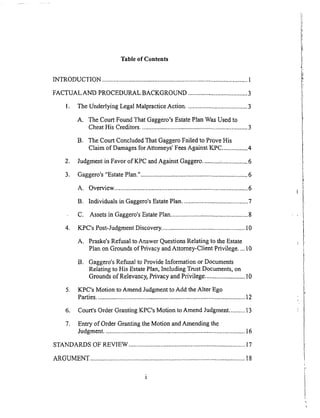
INTRODUCTION ........................................................................................... 1
FACTUAL AND PROCEDURAL BACKGROUND ..................................... 3
1. The Underlying Legal Malpractice Action ...................................... 3
A. The Court Found That Gaggero's Estate Plan Was Used to
Cheat His Creditors ................................................................... 3
B. The Court Concluded That Oaggero Failed to Prove His
Claim of Damages for Attorneys' Fees Against KPC ................ 4
2. Judgment in Favor of KPC and Against Gaggero ........... :................ 6
3. Gaggero's "Estate Plan.". .................................................................. 6
A. Overview .................................................................................... 6
B. Individuals in Gaggero's Estate Plan ......................................... 7
C. Assets in Gaggero's Estate Plan ................................................ 8
4. KPC's Post-Judgment Discovery. ................................................... 10
A. Praske's Refusal to Answer Questions Relating to the Estate
Plan on Grounds of Privacy and Attorney-Client Privilege .... 10
B. Gaggero's Refusal to Provide Information or Documents
Relating to His Estate Plan, Including Trust Documents, on
Grounds of Relevancy, Privacy and Privilege ......................... 10
5. KPC's Motion to Amend Judgment to Add the Alter Ego
Parties ............................................................................................. 12
6. Court's Order Granting KPC's Motion to Amend Judgment .......... 13
7. Entry of Order Granting the Motion and Amending the
Judgment ........................................................................................ 16
STANDARDS OF REVIEW ......................................................................... 17
ARGUMENT ................................................................................................. 18
.
.
.
o
,
.
°
°
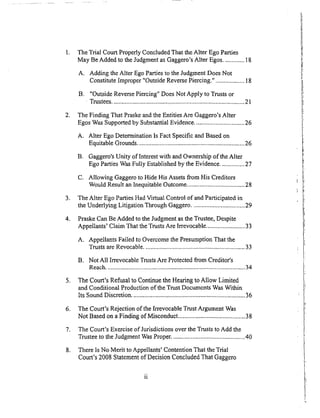
The Trial Court Properly Concluded That the Alter Ego Parties
May Be Added to the Judgment as Gaggero's Alter Egos ............. 18
A. Adding the Alter Ego Parties to the Judgment Does Not
Constitute Improper "Outside Reverse Piercing." .................. 18
B. "Outside Reverse Piercing" Does Not Apply to Trusts or
Trustees .................................... ,.............................................. 21
The Finding That Praske and the Entities Are Gaggero's Alter
Egos Was Supported by Substantial Evidence ............................... 26
A. Alter Ego Determination Is Fact Specific and Based on
Equitable Grounds .................................................................26
B. Gaggero's Unity of Interest with and Ownership of the Alter
Ego Parties Was Fully Established by the Evidence ............... 27
C. Allowing Gaggero to Hide His Assets from His Creditors
Would Result an Inequitable Outcome .................................... 28
The Alter Ego Parties Had Virtual Control of and Participated in
the Underlying Litigation Through Gaggero ................................. 29
Praske Can Be Added to the Judgment as the Trustee, Despite
Appellants' Claim That the Trusts Are Irrevocable ........................ 33
A. Appellants Failed to Overcome the Presumption That the
Trusts are Revocable ............................................................... 33
B. Not All Irrevocable Trusts Are Protected from Creditor's
Reach ....................................................................................... 34
The Court's Refusal to Continue the Hearing to Allow Limited
and Conditional Production of the Trust Documents Was Within
Its Sound Discretion ....................................................................... 36
The Court's Rejection of the Irrevocable Trust Argument Was
Not Based on a Finding of Misconduct .......................................... 38
The Court's Exercise of Jurisdictions over the Trusts to Add the
Trustee to the Judgment Was Proper. ............................................. 40
There Is NoMerit to Appellants' Contention That the Trial
Court's 2008 Statement of Decision Concluded That Gaggero
andtheAlter EgoPartiesAre Financially Separate,or That KPC
Is Now Bound by Such a Finding .................................................. 41
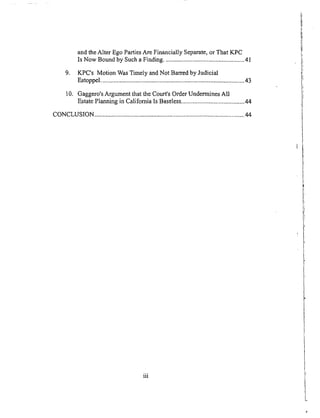
9. KPC's Motion Was Timely and Not Barred by Judicial
Estoppel .......................................................................................... 43
10. Gaggero's Argument that the Court's Order Undermines All
Estate Planning in California Is Baseless ....................................... 44
CONCLUSION ................................................................................44
iii
Table of Authorities
State Cases
Ammco Ornamental Iron, Inc. v. Wing
(1994) 26 Cal.App.4th 409 ...................................................................... 35
Assoc. Vendors, Inc. v. Oakland Meat Co.
(1962) 210 Ca|.App.2d 825 ..................................................................... 26
Bank of America v. Angel View Crippled Children's Foundation
(1999) 72 Cal.App.4th 45l ...................................................................... 34
Crook v. Conteras
(2002) 95 Cal.App.4th 1194 .................................................................... 33
Galdjie v. Darwish
(2003) 113 Cal.App.4th 1331 ............................................................ 21, 22
Greenspan v. LADT, LLC
(2010) 191 Cal.App.4th 486 ............................................................. Passim
Hall, Goodhue, Haisley & Baker, Inc. v. Marconi Conf. Center Bd.
(1996) 41 Cal.App.4th 1551 .................................................................... 43
Heifetz v. Bank of America
(1957) 147 Cal.App.2d 776 ..................................................................... 33
Hill v. Conover
(1961) 191 Cal.App.2d 171 ..................................................................... 35
In re Marriage of Falcone
(2008) 164 Cal.App.4th 814 .................................................................... 17
In re Marriage of Hoffmeister
(1984) 16.1 Cal.App.3d 1163 ................................................................... 18
J.B. Aguerre, Inc. v. American Cruar. & Liab. Ins. Co.
(1997) 59 Cal.App.4th 6 .......................................................................... 39
Kazensky v. City of Merced
(1998) 65 Cal.App.4th 44 ........................................................................ 17
iv
Las Palmas Associates v. Las Palmas Center Associates
(199l) 235 Cal.App.3d 1220 ................................................................... 26
Laycock v. Hammer
(2006) 141 Cal.App.4th 25 ...................................................................... 36
Mesler v. Bragg Management Co.
(1985) 39 Cal.3d 290 ..................................................................... l, 17, 26
Misik v. D'Arco
(2011) 197 Cal.App.4th 1065 .................................................................. 17
NEC Electronics, Inc. v. Hurt
(1989) 208 Cal.App.3d 772 ......................................................... 17, 18, 30
Ohmer v. Superior Court
(1983) 148 Cal.App.3d 661 ..................................................................... 17
People ex rel. Dept. Pub. Wks. v. Busick
(1968) 259 Cal.App.2d 744 ..................................................................... 38
Postal Instant Press, Inc. v. Kaswa Corp.
(2008) 162 Cal.App.4th 1510 ............................................................. 18-20
Sammis v. Stafford
(1996) '18 Cal.App.4th 1935 .................................................................... 17
Santa Clara County Local Transportation Authority v. Guardino
(1995) 11 Cal.4th 220 .............................................................................. 38
Steinhart v. County of L.A.
(2010) 47 Cal.4th 1298 ............................................................................ 24
Stewart v. Towse
(1988) 203 Cal.App.3d 425 ..................................................................... 40
Stoltenberg v. Newman
(2009) 179 Cal.App.4th 287 .................................................................... 21
Taylor v. Newton
(1953) 117 Cal.App.2d 752 ..................................................................... 20
Torrey Pines Bank v. Hoffman
(1991) 231 Cal.App.3d 308 ..................................................................... 23
Faliyee v. Department of Motor Vehicles
(1999) 74 Cal.App.4th 1026 .................................................................... 17
Vikco Ins. Services, Inc. v. Ohio Indem. Co.
(1999) 70 Cal.App.4th 55 ........................................................................ 38
Wollersheim v. Church of Scientology
(1999) 69 Cal.App.4th 1012 .................................................................... 17
Wood v. Elling Corp.
(1977) 20 Cal.3d 353 ............................................................................... 23
Zoran Corp. v. Chen
(2010) 185 Cal.App.4th 799 .................................................................... 27
Federal Cases
Fleet Credit Corp. v. TML Bus Sales, Inc.
(9th Cir. 1995) 65 E3d 11 .......... ;............................................................. 21
In re Moses
(9 t" Cir. 1999) 167 F.3d 470 ..................................................................... 34
In re Schwarzkopf
(9th Cir. 2010) 626 E3d 1032 ...................................................... 21-25, 36
In re Turner
(Bartkr. N.D.Cal. 2005) 335 B.R. 140 ..................................................... 20
State Statutes
Code Cir. Proc.,§ 187 ................................................................................ 18
Corps. Code, § 16306 .................................................................................. 25
Corps. Code, § 16956 .................................................................................. 25
Prob. Code, § 15203 .................................................................................... 36
vi
Prob.Code,§ 15400....................................................................................33
Prob.Code,§ 17000..............................................................................40,41
Prob.Code,§ 15304..............................................................................34, 35
Prob.Code,§ 15400....................................................................................33
Prob.Code,§ 17000....................................................................................40
StateRules
Cal.Rulesof Court,Rule3.1332................................................................17
SecondarySources
Rest. 2d Trusts § 99(5) ................................................................................ 35
vii
INTRODUCTION
The essence of the alter ego doctrine is that
justice be done ....
'[L]iability is imposed to reach an equitable
result.' ... Thus the corporate form will be
disregarded ... when the ends of justice so
requires.
(Mesler v. BraggManagement Co. (1985) 39 Cal.3d 290, 301.)
Over sixteen years ago, appellant Stephen M, Gaggero hatched a
plan to hide all his personal assets so that he essentially became judgment
proof, and set upon blazing a trail of lawsuits unburdened by the potential
of any adverse judgments. As part of an "estate plan" designed to shield his
personal assets from the reach of his future creditors, Gaggero transferred
all of his personal assets worth between $35,000,000 to $40,000,000 into
various limited liability companies, limited partnerships, and corporations,
which were then placed into ownership of three self-settled trusts.
By 1999, Gaggero had absolutely nothing in his personal name.
Nonetheless, Gaggero exerted full control over all of the assets in the trust
estates as the "asset manager" of a management company for properties
held in the trusts, and exercised absolute authority to command payment of
money by the trustee of the trusts. Indeed, Gaggero's "estate plan" has
served a crucial dual purpose in his litigation activities over the years: (1)
as his piggybank to fund various lawsuits, and (2) as a shield to avoid
paying judgments, including a judgment in excess of $2,000,000 entered by
the court in favor of respondents Knapp, Petersen & Clarke, Steven Ray
Garcia, Stephen M. Harris, and Andre Jardini (collectively "K-PC") in the
underlying action.
In light of this information, the trial court found that appellants
Joseph Praske, as trustee of Gaggero's Arenzano Trust, Giganin Trust, and
AquasanteFoundation(collectively "theTrusts"),andPacific Coast
Management,Inc., 5l 1OFWLP,GingerbreadCourtLP,Malibu
BroadbeachLP,Marina GlencoeLP,Blu HouseLLC, andBoardwalk
SunsetLLC (collectively "theEntities")arealteregosof judgmentdebtor
Gaggero,_andgrantedKPC'smotionto amendthejudgmentto addthe
Alter Ego Parties as additional judgment debtors ("the Motion").
The Motion was supported l_y substantial evidence, including
testimony of Gaggero, his estate planning attorney and trustee Joseph
Praske, and his accountant James Waiters. The trial court found the
evidence established that Gaggero fully controlled and enjoyed the benefit
of his fortune held by the Alter Ego Parties. The court expressly rejected
Gaggero's argument that he had no control over these entities, stating "Mr.
Gaggero controlled these entities. They are his alter ego[s], the evidence
firmly persuades the court of that."
Gaggero and the Alter Ego Parties separately filed opening briefs on
this appeal. While they improperly attempt to raise numerous new
arguments, their main contentions raised in the trial court were that (1)
there is no evidence of alter ego relationship between Gaggero and the Alter
Ego Parties, (2) "outside reverse piercing" is prohibited as a matter of law,
and (3) judicial estoppel preclude KPC from asserting alter ego liability.
Each of these arguments, as well as each new argument raised on
appeal for the first time, is without merit. The court properly granted the
Motion finding that there was substantial evidence of unity of interest and
ownership between the Alter Ego Parties and Gaggero, and that it would be
inequitable to allow Gaggero to hide behind a series of sham entities
created for the sole purpose of holding his assets. The court also concluded
The Trusts and the Entities are sometimes collectively referred to
in this brief as the "Alter Ego Parties."
that theAlter EgoPartieswererepresentedin theunderlyinglitigation
throughGaggero.Thecourt'sorderamendingthejudgmentwasbasedon
soundlegalprinciples andsupportedby substantialevidence.The order
shouldbeatTmned.
FACTUAL AND PROCEDURAL BACKGROUND
1. The Underlying Legal Malpractice Action.
In or about August 2000, after his former counsel had withdrawn
because of dispute over payment of his bills, Gaggero retained KPC to
handle a number of matters. (CTI 60-62, 75.) One of these cases was
Gaggero v. Venice North Beach Coalition, a malicious prosecution lawsuit
brought by Gaggero against a group of homeowners (VNBC) that resulted
it1 a $150,000 defense judgment against Gaggero after VNBC brought a
successful anti-SLAPP motion. (CTI 96-97.) Gaggero's legal malpractice
case against KPC centered primarily around his effort to avoid his
obligation on the VNBC judgment. (CTI 101 .)
The malpractice case proceeded to a bench trial in 2007 resulting in
a detailed statement of decision and judgment in favor of K_PC, which
Gaggero appealed and this court found was fully supported by the record. 2
(CT1 94.)
A. The Court Found That Gaggero's Estate Plan Was Used
to Cheat His Creditors.
At the trial of the malpractice action, the court found that Gaggero
used a "three-pronged strategy" to avoid paying the judgment in the VNBC
case: (1) Gaggero implemented an "estate plan" that left no assets in his
2 The history of Gaggero's underlying legal malpractice action
against KPC is well documented in this court's opinion affirming
the trial court's judgment in Gaggero v. Knapp, Petersen &
Clarke (May 6, 2010, B207567) [nonpub. opn.].
own name;(2) Gaggerorefusedto paytheVNBC judgmentandusedthe
threatof bankruptcyaspartof hisattemptto makeit sodifficult to collect
thejudgmentthat VNBC would acceptadeepdiscountto collect
something;and(3) Gaggerouseda"lien strategy"to useclaimsby other
creditorsto pushVNBC downthecollectionladder. (CT1 79.) The court
observedthat "[e]very strategydevisedor advocatedby Mr. Gaggerowith
respectto theVNBC judgmentcreditorswasdesignedto makeit so
difficult andsoexpens!veto continuethefight that theywouldcapitulate,"
notingthat Gaggerohadapparentlyusedthevery samestrategyto
successfullyavoidpayingotherjudgrnentcreditors. (CT169.)
Thecourtspecifically foundthatdespiterepeatedadviceto the
contraryfrom KPC, Gaggerou_ed"threats,bluster,andultima_rns to
attemptto discouragetheVNBC creditors." (CT1 81.) Thecourtfound
that evidencepresentedat thelegalmalpracticetrial "clearly and
unequivocallysupportedtheconclusionthat althoughtherewasno legal
justification whatsoeverfor refusingto paythejudgmentin full, Mr.
Gaggeroneverhadanyintentionto payoff that obligation 100centson the
dollar. Rather,hisabsolutelysingle-mindedfocuswasondelayasatactic
to forcetheVNBC judgmentcreditorsto acceptadeeplydiscounted
payoff." (CTI 69.)
B. The Court Concluded That Gaggero Failed to Prove His
Claim of Damages for Attorneys _ Fees Against KPC.
With respect to Gaggero's claim against KPC for damages of
approximately $498,000 in fees paid to his subsequent attorneys following
KPC's withdrawal as Gaggero's counsel in an interpleader action, 3 the court
made the following findings:
3 Among the many matters handled by KPC for Gaggero was an
interpleader action filed by First Federal Bank to resolve
competing claims on approximately $l.4 million in judgment
4
• Gaggerodid not personallypay asingledimein attorneys'
feesto anyonewho representedhim theinterpleaderaction.
All theattorneys'feeswerepaid by or throughoneor more
businessentities,includingGaggero'smanagementcompany
appellantPacificCoastManagement,Inc.("PCM"), directly
to theattorneys,or thatGaggerohadtheauthorityto represent
PCM for its damages.
• There was no evidence that Gaggero was represented in a
capacity as officer, director or employee of any of these
entities.
• There was no evidence that Gaggero had any obligation to
repay any of these entities any sums which they paid to the
attorneys.
• Gaggero testified that he had no assets whatsoever, and did
not even have a checking account. When he wanted money,
he asked the trustee of a trust, who may or may not give him
some or pay a bill in the trustee's sole and unfettered
discretion. Gaggero made this arrangement hoping to
demonstrate that he had no control over any fimds, in an
attempt to put his assets outside the reach of his creditors.
Having taken this position both throughout the underlying
litigation and at this trial, the court believed the doctrine of
judicial estoppel would apply to prevent any change in
position. It therefore was appropriate to take Gaggero at his
word on this point and let him accept the consequences at the
trial. Since he paid nothing, he could recover nothing.
(CT1 86-87.)
obtained by Gaggero in a wrongful foreclosure action. (CT1 61,
81-83.)
5
Basedon thesefindings,thecourtorderedthatjudgmentbeentered
in favor of KPC andagainstGaggerooneachcauseof actionassertedin
Gaggero'soperativecomplaint. (CT191.)
2. Judgment in Favor of KPC and Against Gaggero.
OnFebruary5, 2008,thecourtenteredjudgrnentin favor of KPC,
andKPCsubsequentlyfiled amemorandumof costsanda motionfor
attorneys'fees. (CT1 110.)Thecourtawardedthe full amountof attorneys'
feessoughtby KPC, andanan_endedjudgmentwasenteredonMay 19,
2008. (CT1 110.) Theamendedjudgmentincludedanawardof attorneys'
feesin theamountof $1,202,994.50,plus costsin theamountof
$124,702.90andpost-judgmentinterestat thelegalrate. (CTI 114-I15.)
Gaggeroappealedfrom bothjudgments,whichwereaffirmedby this court
onMay 6, 2010. (CTI 110-111.)This courtalsoawardedKPC their costs
onappeal. (CT1 111.)
On December28,20I0, thetrial courtenteredanamendedjudgment
awardingKPC attorneys'feesin theamountof $1,395,718.40,andcostsin
theamountof $125,224.90,plus accruedpost-judgmentinterestin the
amountof $320,591.78.(CT1 115.)
3. Gaggero's "Estate Plan."
A. Overview.
In or about 1997, Gaggero retained an estate planning attorney,
Joseph Praske, to transfer all assets and property he personally owned
valued between $35,000,000 to $40,000,000 to various limited liability
companies, general partnerships, limited partnerships, and corporations that
were created as part of his asset protectionplan. (CT2 191-195.) At the
time of the transfer, Gaggero was the sole shareholder in the corporations
that were part of the estate plan. (CTI 129:3-9.) Gaggero also owned all of
the membership interests in the limited liability companies into which he
transferredhisassets.(CT1 130:3-6.)EveryassetthatGaggeroowned
prior to thecompletionof his estateplanwasowned100%by Gaggero,
eitherby virtue of his membershipinterestin thecompanies,sharesin the
corporations,or directtitle to theproperty. (CT1 130:10-14.)
UponGaggero'stransferof hisassetsto thevariousentities,
Gaggerochangedtheownership,stockmembership,limited partnership,
andgeneralpartnershipownershipinterestsin thosecompaniesto oneof
thethreeTrusts. (CT2 191:23-192:1.)At theendof theday,all of
Gaggero'spropertywasheldby eitheralimited partnershipor a limited
liability company,whichis in turn ownedby oneof theTrusts. (CT2
193:1-7.)
B. Individuals in Gaggero'sEstate Plan.
Stephen M. Gaggero is the settlor of the Trusts - Arenzano Trust,
Giganin Trust, and Aquasante Foundation. (CT2 192-193.) Gaggero is also
the "asset manager" of the Trusts, as well as for all the Entities owned by
the Trusts. (CT2 196:20-197:6, CT3 439:20-25.) As the asset manager,
Gaggero handles everything related to the real estate portfolio: "buying and
selling, financing, trading, everything." (CT2 196:24-197:6.) Gaggero
does not have a personal checking account, so he uses his "management
company" to write checks on his behalf. (CT2 257:17-25.)
Joseph Praske is Gaggero's estate planning attorney. (CT3 395,
CT3 411.) Praske designed and implemented the estate plan that Gaggero
has used to conceal his property. (CT1 124:19-23, CT3 411-413.) Praske is
also the trustee of the Trusts (CT2 195:16-21, CT2 236:7-9, CT3 412:12-
13), the president, secretary and director of PCM (CT2 309-310), the
manager of Boardwalk Sunset LLC and Bhi House LLC, (CT2 195:21-22),
and the general partner of the 5 t t OFW LP, Marina Glencoe LP,
GingerbreadCourtLP,andMalibuBroadbeachLP (CT2 195:22-23,CT3
520).
DavM Chatfield is Gaggero's and the Alter Ego Parties' "in-house
counsel." (CT2 258:2-23, CT2 259:8-14, 27-28, CT2 260:1-4.) Up until
the time the underlying Motion was filed, Mr. Chatfield was counsel for
Praske in his individual capacity. 4 (CT2 256:27-260:2, CT2 359- CT3 377.)
Gaggero testified in 2007 that "I think Mr. Chatfield has worked
exclusively on matters that involve me one way or another, or my assets
that I set up into entities or trusts or foundation or a management company
that manages them." (CT2 260:9-12, emphasis added.)
Although appellants steadfastly refused to produce the trust
documents, they claim that the beneficiaries of the Aquasante Foundation
and the Arenzano Trust include "any member of the Gaggero Family,"
including Gaggero himself. (CT2 205:17-206:18.) The sole beneficiary of
the Giganin Trust is Gaggero. (CT2 194:19-22.) Although Praske now
claims that there are no beneficiaries, his counsel represented to the trial
court that the Motion to Amend the Judgment could not proceed without
first giving notice to the vested and contingent remainder beneficiaries.
(RT 11:5-13.)
C. Assets in Gaggero's Estate Plan.
Pacific Coast Management, Inc. ("PCM") is the management
company for assets held by Praske as the trustee of the Trusts. (CT1
167:12-14, CT2 255:1-5.) PCM is also the "management company" for
Gaggero personally. (CT2 255:1-5.) In Gaggero's own words, PCM
manages his "assets, companies, me, my life, ... trusts, foundations," and
"pay my utilities. They pay my credit card, they pay for my dog's vet bills.
4 Nonetheless, Mr. Chatfield represented to the court at the hearing
on the Motion that he "represent the trustee who controls these
assets within these trusts." (RT 2:13-16.)
8
I meanPCM managesmy life. It isa managementcompanyfor me
personally."(CT2255:1-5,CT2 261:20-28,CT2 269:6-10.) Gaggerois the
assetmanagerfor PCM. (CT2 256:9-22.)NotwithstandingGaggero's
intimateinvolvementwith PCM, hedid not know whetherit hadarticlesof
incorporation,whethertherewereofficersor directors,if hewasadirector,
or whenit wasformed. (CT2 254:21-26,CT2 255:6-18.)
The Giganin Trust, the Arenzano Trust, and the Aquasante
Foundation are the three trusts in Gaggero's estate. (CT2 192:25-193:11.)
The Giganin Trust is qualified personal residence trust that has title to
Gaggero's 1,500 acre personal residence. (CT2 193:24-28.) The 2,000
acres adjoining his residence is owned by another one of Gaggero's trusts,
either the Arenzano Trust or the Aquasante Foundation. (CT 1 121:10-15.)
The Arenzano Trust is an off-shore trust organized under the laws of
Anguilla- known for its strong asset protection laws. (CT3 374:8-9.) The
Arenzano trust is not a California trust. (CT3 373:1-11.)
The following entities were formed as part of Gaggero's estate plan:
Blu House LLC, formed on May 23, 199 for the purpose of holding
Gaggero's real property located at 523 Ocean Front Walk, Venice,
California (CT1 134:16-21, CT2 314, CT2 365:4-366:23); Boardwalk
Sunset LLC, formed on May 23, 1997 for the purpose of holding Gaggero's
real property located at 601 Ocean Front Walk, Venice, California (CT1
134:16-21, CT2 315, CT2 367:6-CT3 368:18); Malibu BroadBeach LP,
formed on February 5, 1998 for the purpose of holding a number of
Gaggero's properties in Southern California (CT2 236:22-28, CT2 237:1-
20, CT2 316); Marina Glencoe LP, formed on February 5, 1998 for the
purpose of holding Gaggero's property in Marina del Rey, California (CT2
317, CT2 371:15-20, CT2 372:7-21); Gingerbread Court LP, formed on
March 12, 1998 for the purpose of holding Gaggero's real property located
at 517 Ocean Front Walk, Venice, California (CT2 319, CT2 363:11-365:3);
9
and511 OFWLP, formed on March 12, 1998 for the purpose of holding
Gaggero's real property located at 511 Ocean Front Walk, Venice,
California (CT2 318, CT2 360:22-362:19).
Praske is the agent for service of process for Blu House LLC (CT2
314), Boardwalk Sunset LLC (CT2 315), Marina Glencoe LP (CT3 317),
Gingerbread Court LP (CT2 319), and 511 OFW LP (CT2 318). Praske is
also the manager of Boardwalk Sunset LLC (CT3 497:2-9) and the general
partner &Marina Glencoe LP (CT3 525).
All the foregoing information on Gaggero's estate plan was provided
to the trial court by KPC in support of its motion to amend the judgrnent to
add the Alter Ego Parties. (CTI 44-CT3 377, CT3 435-537.)
4. KPC's Post-Judgment Discovery.
A. Praske's Refusal to Answer Questions Relating to the
Estate Plan on Grounds of Privacy and Attorney-Client
Privilege.
On June 8, 2009, KPC took the third party debtor examination of
Praske. (CT2 357-359.) Praske was represented at the examination by
Gaggero's attorney David Chatfield. s (CT2 359-CT3 377.) Pmske refused
to provide basic information relating to Gaggero's estate plan, including
any benefit Gaggero received for transferring his property into the Entities
and the Trusts, on grounds of attorney-client privilege and privacy rights.
(CT2 362:2-7, CT2 366:12-23, CT3 368:11-'18, CT3 372:15-24.)
B. Gaggero's Refusal to Provide Information or Documents
Relating to His Estate Plan, Including Trust Documents,
on Grounds of Relevancy, Privacy and Privilege.
Following numerous appeals filed by Gaggero and stays in the
underlying lawsuit, KPC served post-judgment discovery on Gaggero that
5 Nonetheless, appellants contend to the contrary that Praske and
Gaggero were not represented by same counsel. (See AOB 26-
27.)
10
requiredKPC to file a discoverymotionto enforce. (CT2291-306.) The
discoverymotion wasnecessarybecauseGaggerorefusedto answereven
basicinterrogatory,suchas"whatis yourhiscurrentresidenceaddress?"
(CT2 293:5-8.) At thehearingonKPC'smotionto compel,Gaggero's
counselDavid Chatfieldexplainedthat "Mr. Gaggero[is] not goingto
revealanyprivateinformationhemayhaveregardingthird parties"on
groundsof privacy. (CT2296:6-8.)
OnOctober5,2011,thetrial courtgrantedKPC'smotionto compel
further responses,whichwaspromptlyappealedby Gaggeroand
subsequentlydismissedby thiscourtin casenumberB236834. (CT2291-
306.)
In addition,citing boilerplateobjections,including objectionsbased
onprivacy andprivileges,Gaggerorefusedto produceanydocumentsin
responseto KPC'srequestfor productionof documents.(CT2 322-326.)
Similarly, GaggerostonewalledKPC'sattemptobtaindiscoveryon
Gaggero'sestateplan,stating"documentsrelatingto assetstransferred,sold
or liquidatedovera decadeagoareclearlyirrelevantto thisjudgment
enforcementandwill not beproduced."(CT2 330:16-17,CT2 332:5-16,
CT2 329-354.) Gaggeroalsoobjectedto thedocumentrequestsasserting,
inter alia, that the disclosure violated third party privacy rights, was
protected under attorney-client privilege, and/or the work-product doctrine.
(CT2 331:12-13, CT2 332:5-16, CT2 332:25-333:1, CT2 333:11-15, CT2
333:25-334:1.)
On April 30, 2012, approximately two weeks after KPC filed the
instant motion to amend the judgment, Gaggero provided supplemental
responses to KPC's document requests. (CT1 54, CT3 493-494.) Gaggero
reiterated the same objections and refused to produce any documents
related to the Trusts or his estate plan. (CT3 469:24-26, CT3 470:17-19,
CT3 471 : 10-12.) Gaggero averred that the trust and estate plan documents
11
werein Praske'ssolepossession.(CT3469:28,CT3470:1-5,21-26,CT3
471:14-19,CT3473: 14-20.)
5. KPC's Motion to Amend Judgment to Add the Alter Ego
Parties.
On April 10, 2012, KPC filed the instant Motion to add the Alter
Ego Parties to the judgment. (CT1 24.) The Motion sought to add Praske
as the trustee of the three Trusts on the basis that he is Gaggero's alter ego.
The Motion also sought to add the Entities as the alter ego of Gaggero.
(CT1 24.) The Motion was supported by declaration of counsel, request for
judicial notice, and 22 pieces of exhibits including excerpts &trial
testimony given by Gaggero in the underlying matter, and trial testimony of
Gaggero and Praske in the Gaggero v. Yura lawsuit. 6 (CTI 44-54.)
The Alter Ego Parties specially appeared to oppose the Motion.
(CT3 397-414.) While the Alter Ego Parties and Gaggero separately filed
opposition to the Motion, they raised the same three grounds for opposing
the Motion: (1) adding the Alter Ego Parties requires application of"outside
reverse piercing" which is prohibited in California, (2) KPC provided "no
evidence" that the Alter Ego Parties were Gaggero's alter egos, and (3)
judicial and collateral estoppel precluded KPC from asserting the alter ego
argument because KPC "argued and proved" at trial that the Alter Ego
Parties and Gaggero were separate. (CT3 397-414.) The trial court
ultimately rejected all of these grounds.
6 The Yura lawsuit is a currently pending litigation involving a
contract dispute between Gaggero and Yura relating to the
purchase of three ocean front properties in Santa Monica.
(Gaggero u Yura (2008), Court of Appeal, Second Appellate
District, Division Five (Appeal No. B203780) (Super. Ct. No.
BC239810).)
12
6. Court's Order Granting KPC's Motion to Amend Judgment.
On May 29, 2012, the court heard oral argument on the Motion. At
the outset, the court opined:
I have a very substantial amount of evidence on
the nature of these relationships that has been
submitted to me in connection with this motion,
and frankly it looks to me like these are
appropriate motions.
I seem to have quite a showing here that in fact,
Mr. Gaggero conlrols these -- directs the
monies [at] will.
(RT 2:1-8.)
At the hearing, counsel for the Alter Ego Parties argued for the first
tim..__&ethat the Trusts are irrevocable trusts and that K_PC was required to
follow certain procedures to access the assets of the Trusts, including giving
notice to the beneficiaries of the Trusts, (RT 3:6-24.) Counsel also argued
for the first time that the court lacked jurisdiction to hear the Motion
because the probate court had exclusive jurisdiction of trust matters under
Probate Code section 17000. (RT 3:14-16.) Counsel offered no
explanation for not raising these arguments in the opposition papers. (RT
4:19-28, 5:1-20.) KPC properly objected to these arguments as being
waived, and the court agreed. (RT 6:2-20.)
The court noted that Pmske had refused to produce the trust
documents to KPC on the ground that they were confidential. (RT 7:8-27.)
On that basis, the court ruled that Praske could not invoke the terms of the
Trusts (including whether the Trusts are irrevocable and whether there were
beneficiaries other than Gaggero) when they have refused to produce the
trust documents. (CT3 540.) The court observed that Praske's refusal to
produce the trust documents made it impossible for KPC to provide notice
to the purported trust beneficiaries. (RT 8:4-12.)
13
In finding thattheAlter EgoPartiesareGaggero'salteregos,the
courtmadethe following comments:
I think that theyhavemadeaprimafaciacase
that theseentitiesarealteregosof Mr. Gaggero
andif I dothat,thereisnodoubtthatMr.
Gaggerocontrolledtheunderlyinglitigation.
Thesearenot independententitiesasI seethem
andif theyarealteregosof Mr. Gaggero,and
Mr. Gaggerocontrolledthelitigation whichhe
undoubtedlydid, thenwhat?
(RT 17:7-14.)
IT]he exhibitsattachedto themotion contain
testimonyof bothMr. GaggeroandMr. Praske
showingthattheonly interestof thespecially
appearingpartiesis to protect100percentof
Mr. Gaggero'sassets,bothpersonaland
business.Praskeistheonly trusteeof themast
and foundationinvolvedin themotion. He is
oneof only two officersin PCM. PCMpays
everythingat Gaggero'swisheswithout
resistanceor hesitance_Praskeis alsothe
registeredagentfor serviceof processat eachof
thebusinessentities. K_PC'sevidenceshows
that Mr. Gaggero'sown accountanttestified
underpenaltyof perjurythatthegainsand
lossesfor theassetsandtheestateplan,
ultimately flow throughMr. Gaggero'stax
returns,which is moreevidenceof alterego
status.
Gaggero controlled the litigation. He did so by
the way of the financial assets of the specially
appearing parties. Their interests are aligned
with Mr.' Gaggero. Without them -- without Mr.
Gaggero they wouldn't even exist. Mr. Praske
testified that the sole purpose of the existence of
the specially appearing parties is to hold Mr.
Gaggero's assets. They are one [and] the same.
That is the bottom line.
(RT 18:10-28, RT 19:1-5.)
14
The court also specifically addressed the evidence showing that
Gaggero fully controlled the assets of the Trusts as his own, stating:
Mr. Praske is for all intents and purposes a
rubber stamp. And the testimony that you
directed me to confirm that if he makes the
recommendation, Mr. Praske does it. It is a
little hard to interpret that language any other
way.
(RT 22:18-22.)
... Gaggero says I want the trust to buy this
property and Mr. Praske says Yes, Sir, Yes, Sir,
three bags full and signs the check.
(RT 23:13-16.)
When Mr. Gaggero says jump, Mr. Praske says
how .high on his way up.
(RT 24:8-9.)
Ultimately, the court granted the Motion, stating:
I am persuaded by the showing that these
persons and entities are alter egos of Mr.
Gaggero and clearly, clearly, it would be
inequitable not to pierce the veil -- not to get out
[sic] these entities which are his alter ego.
Since he has this substantial judgment against
him, and he has attempted to use these devices
to put his assets beyond the reach of legitimate
creditors, and we have had a full and fair
opportunity to litigate this.
(RT 25:27-28, RT 26:1-7.)
Mr. Gaggero controlled these entities. They are
his alter ego, the evidence firmly persuades the
court of that.
(RT 27:21-23.)
And Mr. Gaggero is the one who set up this
system, and Mr. Gaggero is the guy who is --
you know, this is what he did. And he did it for
15
thesepurposes.Hetold meso,in thetrial, to
shieldhisassetsfrom creditors.I believethat
washistestimonyoncross-examinationatthe
trial in thiscase.
(RT27:25-28,RT28:1-3.)
7. Entry of Order Granting the Motion and Amending the
Judgment.
On the same day as the heating on the Motion, the court entered its
minute order. (CT3 540.) The minute order stated that:
Mr. Praske, represented by the same counsel
who represented Mr. Gaggero, has apparently
refused to produce the trust documents on the
grounds that they are confidential. That refusal
has resulted in [there] now being no evidentiary
[sic] for any of the factual assertions concerning
the trust which counsel has made today. In
particular, to the extent counsel suggests there
are beneficiaries and contingent beneficiaries
who are entitled to notice, the actions of Mr.
Praske, while represented by Mr. Gaggero's
counsel, have made this impossible. The offer
to provide further information is of limited
scope.
The motion of KPC sets forth a convincing
basis that the entities are the alter ego of Mr.
Gaggero, who controlled this litigation.
(c3"3540.)
The court's order granting KPC's Motion was signed on May 29,
2012 adding the Alter Ego Parties as additional judgment debtors. (CT3
541-542.)
On June 1, 2012, Gaggero and the Alter Ego Parties appealed from
the order. (CT3 543-545.)
16
STANDARDS OF REVIEW
The trial court's decision to amend a judgment to add judgment
debtors is reviewed for an abuse of discretion. (Greenspan v. LADT, LLC
(2010) 191 Cal.App.4th 486, 508 [decision to amendjudgraent lies in
sound discretion of trial court]; see also Misik v. D'Arco (2011) 197
Cal.App.4th 1065, 1073 ["[i]n order to see that justice is done, great
liberality is encouraged in the allowance of amendments brought pursuant
to Code of Civil Procedure section 187"].) Factual findings necessary to
the court's decision are reviewed to determine wlaether they are supported
by substantial evidence. (NECElectronics, lnc. v. Hurt (1989) 208
Cal.App.3d 772, 777, Wollersheim v. Church of Scientology (1999) 69
Cal.App.4th 1012, 1014-1015.)
"Evidence is substantial if any reasonable trier of fact could have
considered it reasonable, credible, and of solid value." (Kazensky v. City of
Merced (1998) 65 Cal.App.4th 44, 52-53.) In making that determination,
the court of appeal must resolve.all evidentiary conflicts and draw all
legitimate and reasonable inferences in favor of the trial court's decision.
(Valiyee v. Department of Motor Vehicles (1999) 74 Cal.App.4th 1026,
1031 ; Kazensky, supra, at p. 52.) Consistent with these principles, where
the record is silent on a particular fact, an appellate court will infer that the
trial court made all factual findings necessary to support the judgments.
(Sammis v. Stafford (1996) 48 Cal.App.4th 1935, 1942.)
The trial court's denial of a request to continue a hearing date is
reviewed under the abuse of discretion standard. (Ohmer v. Superior Court
(1983) 148 Cal.App.3d 661,666-667.) Reviewing courts must uphold a
trial court's choice not to grant a continuance unless the court has abused its
discretion in so doing. (Cal. Rules of Court, Rule 3.1332; In re Marriage of
Falcone (2008) 164 Cal.App.4th 814, 823.) Continuances are granted only
17
onanaffirmativeshowingof goodcauserequiringacontinuance. (ln re
Marriage of Hoffmeister (1984) 161 Cal.App.3d 1163, 1169.)
ARGUMENT
1. The Trial Court Properly Concluded That the Alter Ego Parties
May Be Added to the Judgment as Gaggero's Alter Egos.
Code of Civil Procedure section 187 affords courts with broad
authority to use "all means necessary" to carry its jurisdiction into effect
and to adopt "any suitable process or mode of proceeding" which may
appear most conformable to the spirit of the Code. (Code Civ. Proc., §
187.) Thus, Code of Civil Procedure section 187 allows the amendment of
a judgment "to add additional judgment debtors on the grounds that a
person or entity is the alter ego of the original judgment debtor." (NEC
Electronics, Inc., supra, 208 Cal.App.3d at p. 778.)
A. Adding the Alter Ego Parties to the Judgment Does Not
Constitute Improper "Outside Reverse Piercing."
Appellants urge that as a matter of law, it is improper to add the
Alter Ego Parties to the judgment because doing so constitutes "outside
reverse piercing" of corporate veil, which Appellants claim is prohibited in
California. As support for their position, appellants rely exclusively on
Postal Instant Press, Inc. v. Kaswa Corp. (2008) 162 Cal.App.4th 1510,
1518 ("Postal Instant Press"). Appellants are mistaken and Postal lnstant
Press does not bar the addition of the Alter Ego PaNes to the judgment.
In Postal Instant Press, the Fourth District Court of Appeal
described "'outside' or 'third part:/reverse piercing" as the situation in
which "a third party outsider seeks to reach corporate assets to satisfy
claims against an individual shareholder. ''_ (Postal lnstant Press, supra,
7 Here, the Alter Ego Parties consist not just of corporations and
limited liability companies, but also include limited partnerships
18
162Cal.App.4that p. 1518,emphasisadded.)In rejectingoutsidereverse
piercingto applya shareholder'sliability to hiscorporation,thePostal
Instant Press court criticized reverse piercing as "an unacceptable shortcut"
to pursuing claims for conversion and fraudulent conveyance already
afforded to judgment creditors. (Id. at p. 1532.) It explained that the "true
issue that outside reverse piercing seeks to address is not the misuse of the
corporate form to shield the shareholder from personal liability." (Id. at p.
1523.) Rather, the primary concern is that a ._hareholder may seek to
defraud judgment creditors by transferring personal assets to the
corporation in order to shield the assets from collection. (Ibid.)
The concern with reverse piercing, as described by the court in
Postal Instant Press, is that innocent shareholders of the corporation may
be adversely affected by requiring the corporation to pay for the debts of an
individual shareholder. (Postal Instant Press, supra, 162 Cal.App.4th at pp.
1512, 1523-1524.) The court further explained that judgment collection
procedures c_ffer adequate protection against attempts to shield assets from
creditors through the fraudulent or improper transfer of such assets to a
corpol_tion. (Id. atp. 1523.)
Here, the concerns raised by the court in Postal Instant Press are not
present. As the trial court observed, this case is no more about reverse
piercing than it is about alter ego liability. (RT 18:10-19:1-5, RT 27:21-23,
CT3 540.) The court here determined that Gaggero and the Alter Ego
Parties were essentially one and the same based upon equitable
considerations. (RT 19:5.) To be clear, the court did not amend the
judgment to add new parties, but merely to add the parties who were
essentially the same as the original judgment debtor. (Misik, supra, 97
and a trustee. These non-corporate Alter Ego Parties are not
subject to "reverse piercing" analysis. See separate discussions
in subsections B and C, infra.
19
Cal.App.4thatp. 1072[amendingajudgmentto addanalterego doesnot
addanewjudgmentdebtor,but insteadinsertsthecorrectnameof the real
debtor].)
Moreover, the record here simply does not support the notion that
there are"innocent" shareholders or members of the Entities. Despite
appellants' unsupported assertion that there may be other shareholders or
members, Gaggero admitted under oath that he is the 100 percent owner of
all the Entities that were put in the Trusts. (CT1 130:10-13.) Postallnstant
Press does not address the situation, as in this case, where an individual sets
up a series of entities for the sole purpose of evading creditors and
sheltering his assets. Because Gaggero set up his "estate plan" long before
he was a judgment debtor, traditional claims for conversion or fraudulent
conveyance are simply not available to KPC. The Postal Instant Press
court's rationale for refusing to apply outside revere piercing is not
implicated in this case.
For these reasons, Postal Instant Press is not controlling, and the
trial court was not precluded as a matter of law from adding the Alter Ego
Parties to the judgment, s Rather, the court's order amending the judgment
to add the Alter Ego Parties is fully supported by California law. (See
Taylor v. Newton (1953) 117 Cal.App.2d 752, 758-60 [corporate piercing
permitted where corporation formed for fraudulent purpose and controlled
by debtor]; In re Turner (Bankr. N.D.Cal. 2005) 335 B.R. 140, 146-147
[when an entity or series of entities with no business purpose is created and
8 The Postal Instant Press court alternatively held that, even if
outside reverse piercing of the corporate veil was possible, the
judgment creditor in that case failed to meet the requirements for
its application. (Postal Instant Press, supra, 162 Cal.App.4th at
p. 1524.) This alternate holding belies appellants' assertion that
outside reverse piercing is strictly prohibited in California
without exception.
2O
personalassetstransferredto themwith norelationshipto anybusiness
purpose,butsimply asameansof shieldingthemfrom creditors,thelaw
views themasthealteregoof theindividual debtorandwill disregardit to
preventinjustice];andFleet Credit Corp. v. TML Bus Sales, Inc. (9th Cir.
1995)'65 F.3d I 19, 120-121 [applying California law, a corporation created
by a judgment debtor to hold his assets and operated the corporation as an
extension of himself was the judgment debtor's alter ego].)
B. "Outside Reverse Piercing" Does Not Apply to Trusts or
Trustees.
In relying on Postal Instant Press to argue that none of the Alter Ego
Parties can be added to the judgment, appellants ignore a crucial distinction
between trusts and business entities. As recognized in California, a trust is
not a legal entity, (Greenspan, supra, 191 Cal.App.4th atp. 522.) Unlike a
corporation, "[l]egal title to property owned by a trust is held by the
trustee... A trust ... is simply a collection of assets and liabilities. As such,
it has no capacity to sue or be sued, or to defend an action." (Stoltenberg v.
Newman (2009) 179 Cal.App.4th 287, 293, quoting Galdjie v. Darwish
(2003) 113 Cal.App.4th 1331, 1344.) Because a trust is not a legal entity,
legal proceedings relating to a trust are properly directed at the trustee.
(Greenspan, supra, at pp. 521-522.)
Appellants have failed to cite any authority for extending the rule
against outside reverse piercing, as stated in Postal Instant Press, to trusts
or trustees. In fact, the Second District Court of Appeal in Greenspan,
supra, and the Ninth Circuit Court of Appeals in In re Schwarzkopf(9th Cir.
2010) 626 E3d 1032, recently discussed the alter ego doctrine in the
context of.trusts and trustees and concluded that alter ego doctrine may be
applied to reach trust assets.
In Greenspan, real estate developer Barry Shy created several
limited liability companies to supervise his various real estate development
21
projects. (Greenspan,supra, 191 Cal.App.4t h at p. 496,) Shy then
transferred ownership of the companies to an irrevocable trust, chose his
brother as the trustee, and acted as the "manager" of the companies. (Id. at
p. 497.) One of the issues in Greenspan was whether the judgment creditor
could add the trustee to a judgment entered against two limited liability
companies (LADT LLC and LAABC LLC) owned and managed by Shy as
the alter ego of the companies. (Id. at pp. 507-508.)
The judgment creditor in Greenspan argued that courts should not
distinguish between the domination of a corporation and the domination of
a trust. (Greenspan, supra, 191 Cal.App.4th at p. 518.) Citing a trio of
California cases as well as out-of-state authority, the Greenspan court
agreed, and held that the alter ego doctrine applies to a trustee, but not a
trust. (Ibid.) The court stated that a distinction must be made between a
trust and a trustee because a trust is not a legal entity, and "the proper
procedure for one who wishes to ensure that trust property will be available
to satisfy a judgment ... [is to] sue the trustee in his or her representative
capacity." (Id. at p. 522, quoting Galdjie, supra, 113 Cal.App.4th at p.
1349.)
Applying these principles, the Greenspan court held that the third
party judgment creditor may properly add the trustee of the trust set up by
the owner/manager of the judgment debtor entities. (Greenspan, supra, 191
Cal.App.4th at p. 522.) It further concluded that if the trustee is found to be
the alter ego of the individual owner/manager, then the individual "may be
considered the owner of the Shy Trust's assets for purposes of satisfying the
judgment." (Ibid.)
In In re Schwarzkopf the Ninth Circuit Court of Appeals, applying
California law, similarly held that the prohibition on outside reverse
corporate piercing did not apply to trusts. (In re Schwarzkopf supra. 626
E3d at p. 1038.) The court upheld the use of the alter ego theory by a
22
bankruptcytrusteeto gainaccessto theassetsof two irrevocable trusts.
(Id. at pp. 1034-1035.) There, the debtors established two irrevocable trusts
in 1992 naming their minor child as the beneficiary. (Id. at p. 1035.) The
first trust (the "Apartment Trust") was funded in 1992, and the second trust
(the "Grove Trust") was funded in 1997. (1bid.)
The Ninth Circuit held/tfiat the Apartment Trust was invalid from the
outset because the transfer of assets to fund the mast was "made for the
fraudulent purpose of avoiding the Debtors' creditors." (In re Schwarzkopf
supra, 626 F.3d at p. 1037.) The court relied on California Probate Code
section 15203, which provides that "trusts may be created for any lawful
purpose. (1bid.)
With respect to the Grove Trust, the Ninth Circuit held that alter ego
liability applied to masts, stating:
California recognizes alter ego liability where
two conditions are met: First, where "there is
such a unity of interest and ownership that the
individuality, or separateness, of the said person
and corporation has ceased;" and, second,
where "adherence to the fiction of the separate
existence of the corporation would ... sanction a
fraud or promote injustice." Wood v. Elling
Corp., 20 Cal.3d 353, 142 Cal.Rptr. 696, 572
P.2d 755,761 n. 9 (1977) .... California courts
have applied the alter ego doctrine to trusts.
See, e.g., Torrey Pines Bank v. Hoffman, 231
Cal.App.3d 308, 282 CallRptr. 354, 359 (1991)
(holding guarantors of a family mast liable for
the trust's debts under an alter ego theory).
(In re Schwarzkopf supra, 626 F.3d at p. 1038, emphasis added.)
The Ninth Circuit then discussed the rule against "outside reverse
piercing" and concluded:
In the context of trusts, however, the California
Supreme Court has allowed alter ego claims
where a mast is alleged to be a debtor's alter
23
ego. Thus,in Woodv. Elling Corp., the
California Supreme Court gave leave to amend
a complaint to assert alter ego claims,
concluding, "If it were alleged and proven that
the two trusts in question were themselves alter
egos of the [defendants], those trusts would
essentially drop out as independent legal
entities." 572 P.2d at 762. In the absence of
further guidance from California courts,
therefore, we cannot extend the prohibition on
reverse piercing to the trust context.
(ln re Schwarzkopf, supra, 626 F.3d at p. 1038.)
The Ninth Circuit then concluded that legal ownership of the alter
ego trust by the debtor is not an absolute requirement for alter ego liability.
(In reSchwarzkopfi supra, 626 F.3d atp. 1038.) In particular, the court
held that in the context of trusts, "equitable interest is traditionally
sufficient to confer ownership rights." (Id. at p. 1039.) It explained:
(Zb;d.)
Thus, under California law, trust beneficiaries
hold an equitable interest in trust property and
are "'regarded as the real owner[s] of [that]
property.'" Steinhart v. County of L.A., 47
Cal.4th 1298, 104 Cal.Rptr.3d 195, 223 P.3d 57,
72 (2010) (alterations in original; citation
omitted); see also 76 Am.Jur.2d Trusts § 258
(2010) (the creation of a trust places legal title
in the trustee and equitable title in the
beneficiary; courts will enforce a beneficiary's
equitable interest). We conclude that, under
California law, equitable ownership in a trust is
sufficient to meet the ownership requirement for
purposes of alter ego liability.
The court noted that the debtors were able to direct the trustee of the
Grove Trust to use the trust assets to pay their personal expenses and
otherwise did not treat the Grove Trust as a separate entity. (In re
24
Sehwarzkopf, supra, 626 F.3d at 1039.) The court found that the debtors,
by acting as the owners (although not as a trustee or a beneficiary), were the
"equitable owners" of the trust, and that this was a sufficient foundation for
alter ego liability. (Id. at 1038.)
C. "Outside Reverse Piercing" Does Not Apply in Context of
Limited Partnerships.
In the same way that appellants have grouped the Trusts in their
argument that none of the Alter Ego Parties can be added to the judgment,
they fail to point out that four of the Alter Ego Parties are partnerships. 9
Appellants offer no authority for their position that the prohibition against
outside reverse piercing applies to limited liability partnerships.
This is because the authorizing statutes for limited partnerships are
silent as to the ability of courts to "pierce the veil" of liability protection
based on inadequate capitalization, failure to adhere to formalities, or
similar theories. (Corps. Code, § 16306.) Corporate piercing theories are
not appropriate with regard to partnerships because no formalities are
required of limited partnerships in California and the security requirements
set forth in Corporations Code section 16956 establish the appropriate
capitalization level. (Corps. Code, § 16956.)
The significant structural differences between a corporation and a
parlmership preclude the application of reverse corporate piercing analysis
to the limited partnership Entities.
///
///
///
9 The partnership Entities are Malibu Broad Beach, LP, Marina
Glencoe, LP, Gingerbread Court, LP and 511 OFW LE
25
2. The Finding That Praske and the Entities Are Gaggero's Alter
Egos Was Supported by Substantial Evidence.
A, Alter Ego Determination Is Fact Specific and Based on
Equitable Grounds.
The alter ego doctrine is founded on equitable principles, and its
application is not made to depend upon prior decisions involving factual
situations which appear to be similar. (Las PalmasAssociates v. Las
Palmas Center Associates (199 l) 235 Cal.App.3d 1220, 1248.) The
general rule is that the conditions under which a corporate entity may be
disregarded vary according to the circumstances of each case. (Ibid.)
Whether the evidence has established that the corporate veil should be
ignored is primarily a question of fact which should not be disturbed when
supported by substantial evidence. (Ibid.)
Thus, "[t]here is no litmus test to determine when the corporate veil
will be pierced; rather the result will depend on the circumstances of each
particular case." (Mesler, supra, 39 Cal.2d at p. 300.) "[T]he doctrine is
essentially an equitable one and for that reason is particularly within the
province of the trial court. Only general rules may be laid down for
guidance." (Assoc. Vendors, Inc. v. Oakland Meat Co. (1962)210
Cal.App.2d 825, 837.)
The two general rules established by the California Supreme Court
for imposing alter ego liability are: "(1) that there be such urdtv of interest
and ownership that the separate personalities of the corporation and the
individual no longer exist, and (2) that, if the acts are treated as those of the
corporation alone, an i.nequitable result will follow." (Mesler, supra, 39
Cal.2d. at p. 300, emphasis added.)
While the alter ego analysis encompasses a host of factors, such as
commingling of assets, diversion of assets to personal use, whether the
individuals and corporation used the same office, whether they employed
26
thesameattorney,whethertheindividualsusedthecorporationto procure
labor,servicesandmerchandisefor anotherpersonor entity,or whetherthe
individualsfailed to maintainminutesoradequatecorporaterecords,no
"singlefactoris determinative,andinsteadacourtmustexamineall the
circumstancesto determinewhetherto applythedoctrine..." (Greenspan,
supra, 191 Cal.App.4th at pp. 512-513, quot2ng Zoran Corp. v. Chen (2010)
185 Cal.App.4th 799, 8 t 1-812.)
B. Gaggero's Unity of Interest with and Ownership of the
Alter Ego Parties Was Fully Established by the Evidence.
Here, the court summarized its conclusions regarding the _i_
interest and ownership between Gaggero and the Entities as follows:
"Gaggero controlled the litigation. He did so by the way of the financial
assets of the specially appearing parties. Their interests are aligned with
Mr. Gaggero. Without them -- without Mr. Gaggero they wouldn't even
exist. Mr. Praske testified that the sole purpose of the existence of the
specially appearing parties is to hold Mr. Gaggero's assets. They are one
[and] the same. That is the bottom line." (RT 18:26-19:5.)
The court's conclusion was fully supported by the evidence provided
in KPC's Motion. For instance, the Entities and the Trusts are all part of
one estate plan constituting a single enterprise and having no separate
identity. (CT1 180: 8-14.) When asked how he would take title to a
property to be purchased, Gaggero stated: "I could take this asset in my
name, transfer it to an entity, a limited liability company, a limited
partnership, a general partnership, or a corporation, and then have one of
the trusts or the foundation subsume.., that entity into the estate plan, just
like I did the other properties in 1997 and 1998." (CT1 180:8-14.) Thus,
Gaggero did not distinguish between the different Trusts in the estate plan,
or the different Entities in the estate plan. Gaggero, in purchasing a
property or asset, looked at "the liquidity of the trust at the time" in
27
determininghow to acquirethepropertywithi n his estate. (CTI 149:13-
23.) Moreover, as Gaggero is the real owner of the assets in the estate, all
gains on the properties in the Trusts and the Entities flow through Gaggero's
tax returns. (CT2 241:4-7.)
The evidence also included the way Gaggero and Praske referred to
the Trusts and the Entities. Tellingly, both Gaggero and Praske referred to
the Trusts and the Entities as constituting "Gaggero's estate plan" or
Gaggero's personal estate. (CT2 192:25-28, CT2 222:5-8.) Gaggero
referred to the Trusts as "my trust, my personal trust." (CT1 180:6-7.)
Praske also referred to the Trusts as belonging to Gaggero. (CT2 192-193.)
For example, in a declaration submitted by Praske, he stated that he is the
trustee of "Gaggero's personal estate" which has Oands well in excess of
$1,100,000. (CT2 285:7-11.)
The evidence before the court was substantial and convincing. The
court's conclusion that the Alter Ego Parties and Gaggero shared an unity of
interest and ownership was fully supported by the evidence.
C. Allowing Gaggero to Hide His Assets from His Creditors
Would Result an Inequitable Outcome.
The court also concluded that _ would result if the Alter Ego
Parties were not added to the judgment, stating: "these persons and entities
are alter egos of Mr. Gaggero and clearly, clearly, it would be inequitable
not to pierce the veil ... [Gaggero] has this substantial judgrnent against
him, and he has attempted to use these devices to put his assets beyond
reach of legitimate creditors ..." (RT 25:27-28, RT 26:1-6.)
The court's conclusion was based, among others, on Gaggero's own
testflnony admitting that his estate plan was set up solely to avoid judgment
collection by creditors. The court conmaented: "Mr. Gaggero is the one
who set up this system ... he did it for these purposes. He told me so, in the
trial, to shield his assets from creditors." (RT 27:25-28, RT 28:1-3.) In
28
light of thecourt'sfinding thatGaggerocontrolledand had full access to
the assets in the Trusts, the court's conclusion that it would be inequitable to
allow Gaggero to insist on the separateness between him and the Alter Ego
Parties was fully supported by the evidence.
Gaggero created his "estate plan" well over a decade ago,
foreclosing any claims for fraudulent conveyance by his creditors. As the
court clearly recognized, the sole purpose of Gaggero's "estate plan" is to
prevent legitimate creditors from reaching his enormous assets, all the
while serving as Gaggero's "piggybank." (RT 25:4-7.) The court was
correct in concluding that allowing Gaggero to avoid his lawful obligation
through the use of his "estate plan" set up solely to shield his personal
assets from creditors, will result in an injustice to KPC and otfier creditors
of Gaggero.
3. The Alter Ego Parties Had Virtual Control of and Participated
in the Underlying Litigation Through Gaggero.
Taking snippets of evidence of out context, appellants contend that
there was no evidence that the Alter Ego Parties controlled or were
represented in the underlying litigation. In doing so, appellants fail to
recognize the ample evidence supporting the court's finding that Gaggero's
interests were the same as those of the Alter Ego Parties, that the Alter Ego
Parties were dominated by Gaggero, and that the Alter Ego Parties were
virtually represented in the underlying litigation through Gaggero.
Under strikingly similar facts, the court in Greenspan held that when
an individual's interests are the same as the trust and companies he created,
and the individual dominated a single enterprise consisting of the trust and
companies, the "requisite control of the arbitration and the virtual
representation of the proposed judgment debtors will be necessarily
established."
explained:
(Greenspan, supra, 191 Cal.App_4th at p. 509.) The court
29
Section 187 does not require that the proposed
judgment debtors "themselves, technically
[have been] given the opportunity to convince"
the arbitrator they should have prevailed in the
arbitration.
([bid., quoting NEC Electronics lnc., supra, 208 Cal.App.3d at p. 779.)
Just as in Gaggero's estate plan, the individual in Greenspan, Barry
Shy, created several limited liability companies to supervise his various real
estate development projects, transferred the ownership of the companies to
a trust, chose his brother as the trustee, and acted as the "manager" of the
companies. (Greenspan, supra, 191 Cal.App.4th atp. 495.) The primary
issue in Greenspan was whether the judgment creditor could add Shy, the
trustee of Shy trust, and two limited liability companies (Harpo LLC and
6th St. Loft LLC) created by Shy to a judgment entered against two limited
liability companies (LADT LLC and LAABC LLC) on grounds of alter
ego liability.
In concluding that Shy dominated a single enterprise consisting of
the trust and its companies, and exercised the requisite control and
representation of the proposed judgment debtors, the G_'eenspan court
explained that the alter ego doctrine is premised on the theory that the
person in charge of a single enterprise consisting of several alter ego
entities is typically concerned with the total amount of his assets held by all
entities, not with the specific amount held by any pa_icular one.
(Greenspan, supra, 191 Cal.App.4th at p. 510,) Thus, if Shy viewed and
treated all the entities as a unitary enterprise, he would not have considered
their "distinct" interests during the arbitration because, as far as he was
concerned, their interests were identical to his own. (1-bid.)
In Greenspan. there was no dispute that Shy directed the defense in
the arbitration on behalf of himself and the two judgment debtors. The
Greenspan court concluded that because Shy's trust and entities were part
3O
of a singleenterprise,theyweredeemedto havecontrolledandwere
representedin thearbitrationthroughShy. (Greenspan,supra, 191
Cal.App.4th at pp. 509-510.)
Applying the holding in Greenspan to this case, it is clear that the
requisite control and virtual representation elements have been satisfied for
the Alter Ego Parties. Gaggero's estate plan is a single enterprise consisting
of multiple trusts, corporations, limited liability companies, and limited
partnerships - all controlled by Gaggero. Thus, Gaggero's control and
representation in the underlying lawsuit was on his behalf and on behalf of
his enterprise, i.e., the Alter Ego Parties. The trial court agreed, stating:
[T]he exhibits attached to the motion contain
testimony of both Mr, Gaggero and Mr. Praske
showing that the only interest of the specially
appearing parties is to protect 100 percent of
Mr. Gaggero's assets, both personal and
business. Praske is the only trustee of the trust
and foundation involved in the motion. He is
one of only two officers in PCM. PCM pays
everything at Gaggero's wishes without
resistance or hesitance. Praske is also the
registered agent for service of process at each of
the business entities. KPC's evidence shows
that Mr. Gaggero's own accountant testified
under penalty of perjury that the gains and
losses for the assets and the estate plan,
ultimately flow through Mr. Gaggero's tax
returns, which is more evidence of alter ego
status.
(RT 18:10-25.)
Appellants do not dispute that Gaggero controlled the litigation, and
the evidence before the court established that the interests of Gaggero and
the Alter Ego Parties were completely aligned. (RT 18:10-28, RT 19:1-5.)
Specifically, the court found that the Alter Ego Parties' "only interest" was
"to protect 100 percent of Mr. Gaggero's assets, both personal and business"
31
(RT 18:12-14), all "gains and losses for the assets and the estate plan,
ultimately flow[ed] through Mr. Gaggero's tax returns" (RT 18:22-24),
without Gaggero the Alter Ego Parties "wouldn't even exist" (RT 19:1-2),
and that Gaggero and the Alter Ego Parties were "one [and] the same" (RT
19:5).
Moreover, there was ample evidence before the court that as the
"asset manager" of the Trusts, Gaggero had complete control and use of his
assets in his estate plan. After Gaggero transferred his assets and property
from his personal portfolio to his estate plan, Praske appointed him the
manager of the Trusts and the Entities. (CT1 145:10-24, CT2 196:24-28,
CT3 439:15-25.) In this capacity, Gaggero was in charge of"refinancing,
dealing with tax issues, insurance issues, making decisions to... buy or sell
the asset, to improve the asset, overseeing any improvement to the asset,
financing, designing some ultimate disposition of the asset." (CT1 140:1 I-
19, CT2 197:1-6.) Gaggero made "determination as to the highest and best
use of all the assets, the disposition of the assets and whether they should
be retained." (CT1 145:15-20, CT3 440:6-14.) Gaggero testified that he
"always had the ability to borrow money against the assets in the trust or
pull cash directly out of the trust." (CT1 150:3-5.) According to Praske,
Gaggero was "the decision-maker" with respect to aU the real estate held in
the estate plan. (CT2 215:16-28.) With respect to real estate investments
for Gaggero's estate plan, Praske always followed Gaggero's
recommendations. (CT2 214:11-13, 215: l 6-28.) Praske's role was limited
to providing advice to Gaggero. (CT2 234: l 3-15.) Gaggero's accountant
confirmed that once Gaggero made a decision relating to the estate plan, it
was "absolutely" implemented. (CT2 233:18-234:18.)
Thus, the evidence was clear before the court that the Alter Ego
Parties were essentially and virtually represented in the underlying
litigation throug!! Gaggero. In fact, it is instructive that Gaggero is
32
separatelyassertingonthis appealthatthealteregofinding shouldbe
reversed,eventhoughasthe originaldebtorwhoseliability onthejudgment
wasalreadyfixed andestablished,Gaggerohasnostandingto appealthe
order,t° Gaggero'sown appealfrom theorderdemonstratesthat heandthe
Alter EgoPartiesareindeedoneandthesame,andthattheir interestsare
inseparablyintertwined.
4. Praske Can Be Added to the Judgment as the Trustee, Despite
Appellants' Claim That the Trusts Are Irrevocable.
Without making the trust documents available for inspection by KPC
or the court, appellants boldly assert that the assets of the Trusts cannot be
reached because the Trusts are "irrevocable." This position was soundly
rejected by the trial court, and should be rejected by this court as well.
A. Appellants Failed to Overcome the Presumption That the
Trusts are Revocable.
Revocability of a trust is determined by examining the "four comers
of the [trust] instrument." (Heifetz v. Bank of America (1957) 147
Cal.App.2d 776, 783.) "Under California law, the existence or
nonexistence of a right to revoke must be determined by examining the
trust instrument and determining from language used in the instrument
whether [the settlor] intended" to create an irrevocable trust. (Crook v.
Conteras (2002) 95 Cal.App.4th 1194, 1209.) Probate Code section 15400
further provides that "[u]nless a trust is expressly made irrevocable by the
trust instrument, the trust is revocable by the settlor." (Prob. Code, §
15400.)
Here, appellants' argument that the trustee cannot be added to the
judgment because the Trusts are irrevocable is unavailing because they
LoKPC has filed a motion to dismiss Gaggero's appeal on the basis
that Gaggero has not been personally aggrieved by the order
adding the Alter Ego Parties.
33
failed andrefusedto producetheactualtrustinstrumentsto prove that the
Trustsarein fact irrevocable. Becausea trustis presumedto berevocable
by defaultunlessexpresslymadeirrevocableby thetrustinstrument,
appellants'failure to put theactualtermsof theTrustat issueis fatal to their
"irrevocabletrust" argument.(Bankof America v. Angel l'Tew Crippled
Children's Foundation (1999) 72 Cal.App.4th 451,459.) Their
representation that the Trusts are irrevocable is of no consequence, and the
court was correct to disregard this argument.
B. Not All Irrevocable Trusts Are Protected from Creditor's
Reach.
Even assuming arguendo that the Trusts are irrevocable, appellants'
contention that the assets of an irrevocable trusts can never be reached is
incorrect as a matter of law. California law prohibits self-settled trusts and
voids such trusts to prevent individuals from placing their property beyond
the reach of their creditors while at the same time still reaping the bounties
of such property. (In reMoses (9 th Cir. 1999) 167 E3d 470, 473.)
Probate Code 15304 provides that
(a) if the settlor is a beneficiary of a trust
created by the settlor and the settlor's
interest is subject to a provision
restraining the voluntary or involuntary
transfer of the settlor's interest, the
restraint is invalid against transferees or
creditors of the settlor. The invalidity of
the restraint on transfer does not affect
the validity of the trust.
(b) if the settlor is the beneficiary of a
trust created by the settlor and the trust
instrument provides that the trustee shall
pay income or principal or both for the
education or support of the beneficiary or
gives the trustee discretion to determine
the amount of income or principal or
34
bothto bepaidto or for thebefiefit of the
settlor,atransfereeorcreditorof the
settlormayreachthemaximumamount
thatthetrusteecouldpayto or for the
benefitof thesettlorunderthetrust
instrument,notexceedingtheamountof
thesettlor'sproportionatecontributionto
thetrust.
(Prob.Code,§15304.)
Thus, if the settlor of the trust retains the power to revoke the trust in
whole or in part, the trust property is subject to the claims of creditors of
the settlor to the extent of the power of revocation during the lifetime of the
settlor.
Moreover, when a debtor is the sole beneficiary and the sole trustee
of a trust, the trust's protective benefits are lost because the trust is deemed _
terminated and the beneficiary holds trust assets free of trust. (Hill v.
Conover ( 1961) l 91 Cal.App.2d 17 l, 180; A m mco Ornamental 1ton, Inc. v.
_ng (1994) 26 Cal.App.4th 409, 417; Rest. 2d Trusts § 99, subd. (5), com.
e., pp. 228-229.) This happens because of the doctrine of merger-the
debtor now holds all the equitable interests in the trust in his capacity as the
beneficiary, and all the legal interests in his capacity as the trustee. When
the equitableand legal interests are vested in one person, there is no longer
a trust relationship and that person can fully dispose of the property as any
other person.
Here, the trial court found that Gaggero exercised full control over
the Trusts and the assets in the Trusts. (RT 18:10-28, RT 19:l-5.) The
court noted that even though Praske was technically the trustee, he was
nothing more than a mere "rubber stamp" and had no authority to go against
the wishes ofGaggero. (RT 22:19-22, RT 23:13-16, RT 24:8-9.) Under
these findings, Gaggero was the de facto trustee of the Trusts. Thus, the
35
doctrineof mergerpreventsGaggerofrom shieldingtheassetsin theTrusts,
of whichhehadabsolutecontrol,fromthereachof hiscreditors.
In addition,appellants'relianceonLaycock v. Hammer (2006) 141
Cal.App.4th 25 is misplaced because Laycock simply states the general rule
that assets of an irrevocable trust are not subject to a creditors claim. It
does not address the application of the alter ego doctrine to irrevocable
trusts. It is well-settled that a trust created for the purpose of defrauding
creditors or other persons is illegal and may be disregarded. (In re
Schwarzkopf supra, 626 E3d at 1037; Prob. Code, § 15203 ["A trust may
be created for any purpose that is not illegal or against public policy"].)
Indeed, the trusts held to be subject to alter ego liability in In re
Schwarzkopf and Greenspan were irrevocable trusts. (In re Schwarzkopf
supra, 626 F.3d at [034; Greenspan, supra, 191 Cal.App.4th at p. 497.)
Thus, the status of the trusts as irrevocable had no bearing on the
alter ego analysis made by the trial court.
5. The Court's Refusal to Continue the Hearing to Allow Limited
and Conditional Production of the Trust Documents Was
Within Its Sound Discretion.
At the hearing on the Motion, appellants' newly retained counsel,
David Esquibias, raised the argument for the first time that the probate
court had exclusive jurisdiction over mast matters, and that KPC was
required to provide notice of the Motion to the beneficiaries of the Trusts.
(CT3 379-414, RT 4:1-4.) When questioned why this .argument was not
raised in written opposition to the Motion, counsel offered no explanation:
The Court: Is there a reason, is there a reason
you are making an argument now
that apparently goes to
jurisdiction?
Mr. Esquibias: I can tell the court that I
am specially appearing for the
36
purposeof arguingjurisdiction
andnotice. I have.noexplanation
as to why it wasn't in the
opposition. I am late to this party.
(RT 4:3-5:7, emphasis added.)
After acknowledging that the new arguments were not briefed in
their opposition papers, counsel averred that it did not preclude him from
raising the arguments for the first time at the hearing. (RT 5:11-13.)
The Court: Well, why? So my question is, if
these are essential arguments, why
did you hold them back so that
they could not respond to them?
Mr. Esquibias: It was not designed to
ambush the moving party.
The Court: Is it anything other than ambush
though, at this point?
(RT 5:14-20.)
In addition to appellants' failure to raise the arguments timely, the
trial court noted that there was no evidence to support the assertions made
by Mr. Esquibias, including the existence of beneficiaries entitled to notice.
(RT 6:22-28, RT 7:28-8:12, RT 11:14-17.) In response, counsel offered to
provide information relating to the trusts contingent on (1) the court
continuing the heating, (2) giving notice to the beneficiaries, (3) obtaining a
confidentiality order, and (4) obtaining an agreement on a limited scope of
information, as appellants deemed was necessary. (RT 7:3-8, RT 9:24-10:5,
RT 10:26-28, RT I1:1, RT 11:13, RT 12:1-24.)
Appellants' contingent offer was properly rejected by the trial court:
IT]his is a situation where these issues have
been percolating for a long time, and there is a
fundamental unfairness to making KPCjump
through all these hoops to collect the judgment
and saying no, no you can't have X, Y and Z,
37
andthencomingin atthelastminutemaking
argumentsnotsetforth in thepleadingsbased
on evidencenot beforethecourtandsaying
Judgegiveusa doover.
(RT27:7-14.)
The court further stated "I am not responsible for when Mr. Praske
gets new counsel. I am not responsible for what arguments new counsel
makes or doesn't make in his opposition." (RT 26:9-10.) Concluding that
appellants had a "full and fair" opportunity to litigate the Motion, the court
rejected the untimely arguments as lacking foundation. (RT 26:6-27:15.)
As a general rule, issues or theories not properly raised or presented
before the trial court will not be considered on appeal. (Vikco Ins. Services,
Inc. v. Ohiolndem. Co. (1999) 70 Cal.App.4th 55, 66-67.) The court of
appeal does not consider points raised for the first time at oral
argument. (Santa Clara County Local Transportation Authority v.
Guardino (1995) 11 Cal.4th 220, 232, fn. 6.)
The granting or denying of a continuance is a matter within the
court's discretion, which cannot be disturbed "on appeal except upon a clear
showing of an abuse of discretion." (People ex rel. Dept. Pub. Wks. v.
Busick (1968) 259 Cal.App.2d 744, 749.)
Accordingly, the court was within its discretion to deny appellants'
request for a continuance of the hearing to produce the trust documents.
6. The Court's Rejection of the Irrevocable Trust Argument Was
Not Based on a Finding of Misconduct.
Speciously, appellants contend that their failure to win over the trial
court on their irrevocable trust argument was because the trial judge found
that appellants committed a misconduct. In characterizing the trial court's
rejection of the argument as a refusal to accept evidence of the trusts as
38
irrevocable,appellantsobscurethreeimportantfactsrelatedto their
argument.
First,thetrial courtdid notrejectanyevidence,becauseappellants
hadnot producedanyevidenceatthehearingfor thenotionthat thetrusts
areirrevocable.Appellantsflatly refusedto producethetrustdocumentsat
thehearing,eventhoughcounselhadacopyof thetrustdocumentsonhim.
(RT 9:7-10.)
Second,thecourt rejectedappellants'requestfor a continuanceonly
after providingappellants'counselanopportunityto explainwhy thetrust
argumentwaswithheld until the dayof thehearing. Counselfor appellants
wasunableto offer anyexcusefor failing to includetheargumentin
oppositionpapers. (RT4:3-5:7.) TheconsequenceofappeUants'failure to
properlyprovidesupportfor theiroppositionto theMotion wasthatthe
court did not find theargumentpersuasive.(RT 6:18-26.) The court's
rejection of the argument was not an "evidentiary sanction."
Third, appellants' purported offer to produce the trust documents was
conditional and limited as to the scope of the production. (RT 7:3-8, RT
9:24-10:5, RT 10:26-28, RT 11:1, RT 11:13, RT 12:1-24.) They did not
make an unequivocal offer to produce the trust documents - only requesting
a continuance to allow the parties to meet and confer as to the scope of the
production subject to a confidentiality order.
In the end, the court's rejection of appellants' irrevocable trust
argument is irrelevant because there was no error either way. Appellate
courts do not review the reasons for the trial court's decision - an appealed
order correct on any theory will be affirmed, even though the trial court's
reasoning may have been erroneous. (J.B. Aguerre, lnc. v. American Guam.
& Liab. Ins. Co. (1997) 59 Cal.App.4th 6, 15-16.) As discussed above, the
stares of the trust as irrevocable does not, as a matter of law, preclude an
order amending the judgment to add the trustee of the Trusts.
39
7. The Court's Exercise of Jurisdictions over the Trusts to Add
the Trustee to the Judgment Was Proper.
Probate Code section 17000 provides as follows:
(a) The superior court having jurisdiction
over the trust pursuant to this part has exclusive
jurisdiction of proceedings concerning the
internal affairs of trusts.
Co) The superior court having jurisdiction
over the trust pursuant to this part has
concurrent iudsdiction of the following:
(1) Actions and proceedings to
determine the existence of trusts.
(2) Actions and proceedings by or
against creditors or debtors of trusts.
(3) Other actions and proceedings
involving trustees and third persons.
(Prob. Code, § 17000, emphasis added.)
Thus, the statute clearly provides the superior court, as opposed to a
probate court, jurisdiction over proceedings by or against creditors or
debtors of trusts, or proceedings involving trustees and third persons. Here,
appellants erroneously argue that the court acted outside of its jurisdiction
on the ground that the ruling concerned the "internal affairs of trusts."
According to appellants, only a probate court has authority to determine
alter ego liability of a trust. Appellants cite no legal authority for their
argument that adding the trusts to the judgment amounted to judicial
proceedings concerning the trusts' "internal affairs." Rather, internal trust
affairs concern modification of the terms of the trust, changes in a
designated successor trustee, other deviation fi'om trust provisions,
authority over the trustee's acts, or the administration of the trust's financial
arrangements. (Stewart v. Towse (1988) 203 Cal.App.3d 425,429-4300
4O
Thecourthadconcurrentjurisdiction overtheTrustsin ruling that
thetrusteeshouldbeaddedto thejudgmentbecausethecourt'sorder
involved "actionsandproceedingsby ... creditors..,of trust" and"actions
andproceedingsinvolving trusteesandthird parties." (Prob.Code,§
17000,subd(b).) Clearly,with respectto theTrusts,KPC'sMotion wasto
addPraske,asthetrusteeof theTrusts,to thejudgment,not to modify any
termsof theTrusts,otheradministrationof theTrusts'intemaiaffairs.
AppellantsalsoarguethattheMotion doesnot qualify asanaction
or proceedingby Oragainsta creditorpursuantto ProbateCodesection
17000(b)(2)whichprovidesthatthesuperiorcourthasconcurrent
jurisdiction overthe trustin "actionsandproceedingsby or against
creditors...." Appellants'reasoningis thatthetrusteeisnot aparty to this
actionandthat creditorswerenot creditorsprior to thecourt'sgrantingof
theMotion. Their argumentfailsbecauseProbateCodesection
17000(b)(2)doesnot requirethatthetrusteebeapartyto theaction.
Therefore,theassertionthatthecourtdid not haveconcurrentjurisdiction
overthis issueis simply erroneous.Moresignificantly,appellantsprovide
noauthority in supportof their assertionthattheMotion wasimproper
becauseit wasnot aproceedingby a "creditor" &the trusts until after the
motion was granted.
8. There Is No Merit to Appellants' Contention That the Trial
Court's 2008 Statement of Decision Concluded That Gaggero
and the Alter Ego Parties Are Financially Separate, or That
KPC Is Now Bound by Such a Finding.
Appellants falsely claim that because Gaggero failed to meet his
burden &proof in the underlying litigation to recover damages on behalf of
PCM that it serves as conclusive proof that not only is PCM separate, but
also all the other Alter Ego Parties are separate. The trial court expressly
rejected this argument at the hearing, pointing out that the discussion in its
41
statementof decisionrelatedsolelyto Gaggero'sfailure to offer evidenceto
supporthis damages,stating:
Youaresuggestingthatthefactthatat trial Mr.
Gaggeroput onno evidencethathewassuing
onbehalfof PCM tOrecovertheattorney'sfees,
is somehowdispositive.It is not. Thatwasa
commentonthefailureof Mr. Gaggeroto
producecertainevidencein thetrial whenit was
directedto theissueof damages,his damages.
(RT 15:5-11.)
Likewise,appellants'claim thatKPC prevailedin theunderlying
trial becausethecourt foundnoreasonto believeGaggero'sdebtswerealso
theAlter EgoParties'is erroneous.Thefact supportedby the evidenceis
thatGaggerofailed to provideevidencethathehadstandingto sueon
behalf PCM. KPC did not argueandcertainlydid not provethat PCMwas
separatefrom Gaggero.Thetrial courtcorrectlyrejectedthis argument.
Lastly,appellantsimproperlyseekto attributeself-serving
statementsmadeby GaggeroandPraskein their declarationssubmittedin
the Yura lawsuit that their finances were separate to KPC, pointing out that
KPC drafted the declarations. Appellants' claim is without any foundation
as there is nothing in the record that the attorneys at KPC in fact drafted
these declarations. Moreover, even if the declarations were drafted by
KPC, appellants fail to cite to any legal authority that an attorney who
drafts a declaration for his client is somehow bound by the statements made
in the declaration and signed under penalty of perjury by the client. There
is no legal authority for such a proposition.
Simply put, testimony of Praske or Gaggero does not constitute a
"binding judicial admission" on KPC. They are binding only on the party
that signed the declaration.
42
9. KPC's Motion Was Timely and Not Barred by Judicial
Estoppel.
Appellants contend that there was an improper 55 month delay by
KPC in bringing the Motion, and that the delay resulted in a waiver of the
argument. Appellants are wrong.
A court may amend its judgment so it will properly designate the
real defendants at any time, including after judgment. (Greenspan, supra,
19l Cal.App.4th 486, 508; Hall Goodhue, Haisley & Baker, Inc. v.
Marconi Conf. Center Bd. (1996) 41 Cal.App.4th 1551, 1555.)
While testimony and information supporting the Motion was
available prior to the trial of the underlying case, there was simply no
reason for KPC to add the Alter Ego Parties as parties to the case. KPC
was defending Gaggero's legal malpractice lawsuit,' and did not file a cross-
complaint to seek any affirmative relief. KPC had no obligation or basis to
bring in other parties, let alone the Alter Ego Parties, prior to the court's
entry of judgment.
Just as importantly, alter ego liability was not an issue in the
underlying legal malpractice lawsuit, and KPC had no practical reason or
legal obligation to litigate alter ego liability. Accordingly, there was no
delay in raising the alter ego issue, and no waiver.
Moreover, appellants ignore the fact that Gaggero's appeal of the
underlying judgment in 2008 resulted in an automatic stay of enforcement
of the judgment. That stay remained until May 2010, when this court
affirmed the judgment in full. (Gaggero v. Knapp, Petersen & Clarke (May
6, 2010, B207567) [nonpub. opn.].) The trial court did not enter a final
judgment until December 28, 2010. (CTI 115.) Consequently, after
obtaining the final judgment, KPC sought to enforce its judgment through
traditional post-judgment discovery. (CT2 291-306, CT2 322-354.) It was
Gaggero's appeal of the underlying judgment that required KPC to wait
43
well overtwo yearsbeforeembarkingonanyjudgmentenforcement
measuresandprecludedKPC fromseekingto amendthejudgmentto add
judgmentdebtorsright away.
10. Gaggero's Argument that the Court's Order Undermines All
Estate Planning in California Is Baseless.
Not surprisingly, Gaggero's argument that adding the Alter Ego
Parties "would threaten the integrity of estate planning in California" is thin
on specific legal authority and relies heavily on the generic notion that there
is nothing wrong or illegal about tying up assets for estate planning
purposes. This argument is simply a red herring to divert the court's
attention from the real issue of alter ego liability. Gaggero makes no
attempt to explain why an estate plan should be immune as a matter of law
from the application of alter ego liability or distinguish those cases that
apply the alter ego doctrine in the context of trusts or other estate planning
vehicles.
CONCLUSION
For all the forgoing reasons, the trial court's order amending the
judgment to add the Alter Ego Parties should be atTu-med.
DATED: December 19, 2013 Respectfully submitted,
MILLER LLP
RANDALL A. MILS
STEVEN S. WANG
Attorneys for Defendants and
Respondents
KNAPP, PETERSEN & CLARKE,
STEVEN RAY GARCIA, STEPHEN M.
HARRIS, and ANDRE JARDINI
44
CERTI_CATE
Pursuant to the requirements of California Rules of Court, Rule 8.204(c)(1), the
undersigned counsel of record hereby certifies that the word count within this brief,
exclusive of tables, proof of service, and this certification, consists of a total of 12,747
words in accordance with the computer program's word count upon which the
undersigned relies in making this certification.
Dated: December 19, 2013
/ Steven S. Wang
PROOF OF SERVICE
I am a resident of the State of California, over the age of eighteen years, and not a party
to the within action. My business address is Miller LLP, 515 South Flower Street, Suite 2150,
Los Angeles, CA 90071-2201. On December _, 2013, I served the within documents:
RESPONDENTS' BRIEF
[] by transmitting via facsimile the document(s) listed above to the fax number(s) set
forth below on this date before 5:00 p.m.
[] by placing the document(s) listed above in a scaled envelope with postage thereon
fully prepaid, in the United States mail at Los Angeles, California addi'essed as set
forth below.
[] by causing to be personally served to the person(s) at the address(es) set forth below
on this date before 5:00 p.m.
[] by causing such document to be transmitted by electronic mail to the office of the
addressees as set forth below on this date before 5:00 p.m.
[] by causing such document(s) to be sent overnight via Federal Express; I enclosed
such document(s) in an envelope/package provided by Federal Express addressed to
the person(s) at the address (es) set forth below and I placed the envelope/package
for collection at a drop box provided by Federal Express.
SEE ATTACHED SERVICE LIST
I am readily familiar with the fu'm's practice of collection and processing correspondence
for mailing. Under that practice it would be deposited with the U.S. Postal Service on that same
day with postage thereon fully prepaid in the ordinary course of business. I am aware that on
motion of the party served, service is presumed invalid if postal cancellation date or postage
meter date is more than one day after date of deposit for mailing in affidavit.
I declare under penalty of perjury under the laws of the State of California thai the above
is true and correct.
Executed on December ..OD,2013, at Los Angeles, California.
SERVICE LIST
David Blake Chatfield, Esq.
WESTLAKE LAW GROUP
2625 Townsgate Road, Suite 330
Westlake Village, CA 91361
Edward A. Hoffi:nan, Esq.
LAW OFFICES OF EDWARD A. HOFFMAN
11755 Wilshire Blvd Ste 1250
Los Angeles, CA 90025
Attorneys for Plaintiff and Appellant,
STEPHEN M. GAGGERO
Phone: (805) 267-1220
Fax: (805) 267-1211
Email: davidblakec_,hotrn ail.com
Attorneys for PACIFIC COAST
MANAGEMENT, INC, 511 OFW LP,
GINGERBREAD COURT LP,
MALIBU BROAD BEACH LP,
MARINA GLENCOE LP, BLU
HOUSE LLC, BOARDWALK
SUNSET LLC, AND JOSEPH
PRASKE AS THE TRUSTEE OF THE
GIGANIN TRUST, ARENZANO
TRUST, AND AQUASANTE
FOUNDATION
Phone: (310) 442-3600
Fax: (310) 442-4600
Email: eah('_,hoffmanlaw.com

Ca2 db241675 06

  • 1.
  • 2.
    Case No. B241675 INTHE COURT OF APPEAL OF THE STATE OF CALIFORNIA SECOND APPELLATE DISTRICT DIVISION EIGHT STEPHEN M. GAGGERO, Plaintiff and Appellant, VS. KNAPP, PETERSEN & CLARKE; STEVEN RAY GARCLA; STEPHEN M. HARRIS; and ANDRE JARDINI, Defendants and Respondents. PACIFIC COAST MANAGEMENT, INC.; GINGERBREAD COURT LP; 511 OFW LP; MALIBU BROADBEACH LP; MARINA GLENCOE LP; BLU HOUSE LLC; BOARDWALK SUNSET LLC; and JOSEPH PRASKE as Trustee of THE GIGANIN TRUST, THE ARENZANO TRUST, and THE AQUASANTE FOUNDATION Additional Judgment Debtors and Appellants. Appeal from the Los Angeles County Superior Court Case No BC286925 Honorable Robert L. Hess, Judge RESPONDENTS' BRIEF Randall A. Miller (SBN 116036) Steven S. Wang (SBN 184979) MILLER LLP 515 South Flower Street, Suite 2150 Los Angeles, CA 90071-2201 Telephone: 800.720.2126 Facsimile: 888.749.5812 Attorneys for Defendants and Respondents
  • 3.
    TO BE FILEDIN THE COURT OF APPEAL APP-008 COURT OF APPEAL, Second APPELLATE DLSTRICT, DIVISION Eight c_. = _ c.., _._o_ B241675 supea_ C.ot_ c.n_ Nurnne,:A'i-rORNEY OR PARTY WITHOUT ATTORNE_ (Narr_, _ Bar ,'_rc, er. a_d eddre_J: RANDALL A. MILLER (SBN 116036), STEVEN S. WANG (SBN 184979) -- Miller LLP 515 S. Flower Street, Suite 2150 Los Angeles, California 90071 r_t_.E.o_ 213-496-6400 FAXNO.g_,.._j: E-M,_L_ORESS(_n=.0: steven @mi]lerUp.com ArrO_YFOR¢_.,,_:Knapp, Petersen, Clarke, et al. APPELLANT/PETITIONER:Stephen M. Gaggero RESPONDENT/REALPARTYININTEREST:Knapp, Petersen, Clarke, ct al. CERTIFICATE OF INTERESTED ENTITLES OR PERSONS (Check one): _ INITIAL CERTIFICATE r7 SUPPLEMENTAL CERTIFICATE BC286925 FOR COU_T USE ONL Y Notice: Please read rules 8.208 and 8.488 before completing this form. You may use this form for the Initial certificate in an appeal when you file your brief or a prebdeflng motion, application, or opposition to such a motion or application tn the Court of Appeal, and when you file a petition for an extraordinary writ. You may also use this form as a supplemental certificate when you learn of changed or additional information that must be disclosed. 1. This form is being submitted on behalf of the following psrly (name): K.napp, Petersen, Clarke, etal. 2, a. _ There are no interested entities or persons that must be listed In this certificate under rule 8.208. b, _ Interested entities or persons required to be listed under rule 8.208 are as follows: I Full name of Interested I Nature of Interest | entity or person I (Explain): (1) (2) (3) (4) (5) Continued on attachment 2. The undersigned certifies that the above-listed persons or entitles (corporations, partnerships, firms, or any other assoc_stion, but not including government entitles or their agencies) have either (1) an ownership Interest of 10 percent or more In the party If It is an entity; or (2) a financial or other interest in the outcome of the proceeding that the Justices should consider in determining whether to disqualify themselves, as defined In rule 8.208(e)(2). Date: December 19, 2013 Steven S. Wang, Esq. (WPE OR PPJNTNAME) _ _,-_ u,,, CERTIFICATE OF INTERESTED ENTITLES OR PERSONS _. _,_ c_ ._ 8.,_.a,_a Judicial CO_7O7 of C,._a www. ¢,_n_ka_ ca,gay APP-O0S{Ray,Januaryt. 2009]
  • 4.
    Table of Contents INTRODUCTION........................................................................................... 1 FACTUAL AND PROCEDURAL BACKGROUND ..................................... 3 1. The Underlying Legal Malpractice Action ...................................... 3 A. The Court Found That Gaggero's Estate Plan Was Used to Cheat His Creditors ................................................................... 3 B. The Court Concluded That Oaggero Failed to Prove His Claim of Damages for Attorneys' Fees Against KPC ................ 4 2. Judgment in Favor of KPC and Against Gaggero ........... :................ 6 3. Gaggero's "Estate Plan.". .................................................................. 6 A. Overview .................................................................................... 6 B. Individuals in Gaggero's Estate Plan ......................................... 7 C. Assets in Gaggero's Estate Plan ................................................ 8 4. KPC's Post-Judgment Discovery. ................................................... 10 A. Praske's Refusal to Answer Questions Relating to the Estate Plan on Grounds of Privacy and Attorney-Client Privilege .... 10 B. Gaggero's Refusal to Provide Information or Documents Relating to His Estate Plan, Including Trust Documents, on Grounds of Relevancy, Privacy and Privilege ......................... 10 5. KPC's Motion to Amend Judgment to Add the Alter Ego Parties ............................................................................................. 12 6. Court's Order Granting KPC's Motion to Amend Judgment .......... 13 7. Entry of Order Granting the Motion and Amending the Judgment ........................................................................................ 16 STANDARDS OF REVIEW ......................................................................... 17 ARGUMENT ................................................................................................. 18
  • 5.
    . . . o , . ° ° The Trial CourtProperly Concluded That the Alter Ego Parties May Be Added to the Judgment as Gaggero's Alter Egos ............. 18 A. Adding the Alter Ego Parties to the Judgment Does Not Constitute Improper "Outside Reverse Piercing." .................. 18 B. "Outside Reverse Piercing" Does Not Apply to Trusts or Trustees .................................... ,.............................................. 21 The Finding That Praske and the Entities Are Gaggero's Alter Egos Was Supported by Substantial Evidence ............................... 26 A. Alter Ego Determination Is Fact Specific and Based on Equitable Grounds .................................................................26 B. Gaggero's Unity of Interest with and Ownership of the Alter Ego Parties Was Fully Established by the Evidence ............... 27 C. Allowing Gaggero to Hide His Assets from His Creditors Would Result an Inequitable Outcome .................................... 28 The Alter Ego Parties Had Virtual Control of and Participated in the Underlying Litigation Through Gaggero ................................. 29 Praske Can Be Added to the Judgment as the Trustee, Despite Appellants' Claim That the Trusts Are Irrevocable ........................ 33 A. Appellants Failed to Overcome the Presumption That the Trusts are Revocable ............................................................... 33 B. Not All Irrevocable Trusts Are Protected from Creditor's Reach ....................................................................................... 34 The Court's Refusal to Continue the Hearing to Allow Limited and Conditional Production of the Trust Documents Was Within Its Sound Discretion ....................................................................... 36 The Court's Rejection of the Irrevocable Trust Argument Was Not Based on a Finding of Misconduct .......................................... 38 The Court's Exercise of Jurisdictions over the Trusts to Add the Trustee to the Judgment Was Proper. ............................................. 40 There Is NoMerit to Appellants' Contention That the Trial Court's 2008 Statement of Decision Concluded That Gaggero
  • 6.
    andtheAlter EgoPartiesAre FinanciallySeparate,or That KPC Is Now Bound by Such a Finding .................................................. 41 9. KPC's Motion Was Timely and Not Barred by Judicial Estoppel .......................................................................................... 43 10. Gaggero's Argument that the Court's Order Undermines All Estate Planning in California Is Baseless ....................................... 44 CONCLUSION ................................................................................44 iii
  • 7.
    Table of Authorities StateCases Ammco Ornamental Iron, Inc. v. Wing (1994) 26 Cal.App.4th 409 ...................................................................... 35 Assoc. Vendors, Inc. v. Oakland Meat Co. (1962) 210 Ca|.App.2d 825 ..................................................................... 26 Bank of America v. Angel View Crippled Children's Foundation (1999) 72 Cal.App.4th 45l ...................................................................... 34 Crook v. Conteras (2002) 95 Cal.App.4th 1194 .................................................................... 33 Galdjie v. Darwish (2003) 113 Cal.App.4th 1331 ............................................................ 21, 22 Greenspan v. LADT, LLC (2010) 191 Cal.App.4th 486 ............................................................. Passim Hall, Goodhue, Haisley & Baker, Inc. v. Marconi Conf. Center Bd. (1996) 41 Cal.App.4th 1551 .................................................................... 43 Heifetz v. Bank of America (1957) 147 Cal.App.2d 776 ..................................................................... 33 Hill v. Conover (1961) 191 Cal.App.2d 171 ..................................................................... 35 In re Marriage of Falcone (2008) 164 Cal.App.4th 814 .................................................................... 17 In re Marriage of Hoffmeister (1984) 16.1 Cal.App.3d 1163 ................................................................... 18 J.B. Aguerre, Inc. v. American Cruar. & Liab. Ins. Co. (1997) 59 Cal.App.4th 6 .......................................................................... 39 Kazensky v. City of Merced (1998) 65 Cal.App.4th 44 ........................................................................ 17 iv
  • 8.
    Las Palmas Associatesv. Las Palmas Center Associates (199l) 235 Cal.App.3d 1220 ................................................................... 26 Laycock v. Hammer (2006) 141 Cal.App.4th 25 ...................................................................... 36 Mesler v. Bragg Management Co. (1985) 39 Cal.3d 290 ..................................................................... l, 17, 26 Misik v. D'Arco (2011) 197 Cal.App.4th 1065 .................................................................. 17 NEC Electronics, Inc. v. Hurt (1989) 208 Cal.App.3d 772 ......................................................... 17, 18, 30 Ohmer v. Superior Court (1983) 148 Cal.App.3d 661 ..................................................................... 17 People ex rel. Dept. Pub. Wks. v. Busick (1968) 259 Cal.App.2d 744 ..................................................................... 38 Postal Instant Press, Inc. v. Kaswa Corp. (2008) 162 Cal.App.4th 1510 ............................................................. 18-20 Sammis v. Stafford (1996) '18 Cal.App.4th 1935 .................................................................... 17 Santa Clara County Local Transportation Authority v. Guardino (1995) 11 Cal.4th 220 .............................................................................. 38 Steinhart v. County of L.A. (2010) 47 Cal.4th 1298 ............................................................................ 24 Stewart v. Towse (1988) 203 Cal.App.3d 425 ..................................................................... 40 Stoltenberg v. Newman (2009) 179 Cal.App.4th 287 .................................................................... 21 Taylor v. Newton (1953) 117 Cal.App.2d 752 ..................................................................... 20
  • 9.
    Torrey Pines Bankv. Hoffman (1991) 231 Cal.App.3d 308 ..................................................................... 23 Faliyee v. Department of Motor Vehicles (1999) 74 Cal.App.4th 1026 .................................................................... 17 Vikco Ins. Services, Inc. v. Ohio Indem. Co. (1999) 70 Cal.App.4th 55 ........................................................................ 38 Wollersheim v. Church of Scientology (1999) 69 Cal.App.4th 1012 .................................................................... 17 Wood v. Elling Corp. (1977) 20 Cal.3d 353 ............................................................................... 23 Zoran Corp. v. Chen (2010) 185 Cal.App.4th 799 .................................................................... 27 Federal Cases Fleet Credit Corp. v. TML Bus Sales, Inc. (9th Cir. 1995) 65 E3d 11 .......... ;............................................................. 21 In re Moses (9 t" Cir. 1999) 167 F.3d 470 ..................................................................... 34 In re Schwarzkopf (9th Cir. 2010) 626 E3d 1032 ...................................................... 21-25, 36 In re Turner (Bartkr. N.D.Cal. 2005) 335 B.R. 140 ..................................................... 20 State Statutes Code Cir. Proc.,§ 187 ................................................................................ 18 Corps. Code, § 16306 .................................................................................. 25 Corps. Code, § 16956 .................................................................................. 25 Prob. Code, § 15203 .................................................................................... 36 vi
  • 10.
    Prob.Code,§ 15400....................................................................................33 Prob.Code,§ 17000..............................................................................40,41 Prob.Code,§15304..............................................................................34, 35 Prob.Code,§ 15400....................................................................................33 Prob.Code,§ 17000....................................................................................40 StateRules Cal.Rulesof Court,Rule3.1332................................................................17 SecondarySources Rest. 2d Trusts § 99(5) ................................................................................ 35 vii
  • 11.
    INTRODUCTION The essence ofthe alter ego doctrine is that justice be done .... '[L]iability is imposed to reach an equitable result.' ... Thus the corporate form will be disregarded ... when the ends of justice so requires. (Mesler v. BraggManagement Co. (1985) 39 Cal.3d 290, 301.) Over sixteen years ago, appellant Stephen M, Gaggero hatched a plan to hide all his personal assets so that he essentially became judgment proof, and set upon blazing a trail of lawsuits unburdened by the potential of any adverse judgments. As part of an "estate plan" designed to shield his personal assets from the reach of his future creditors, Gaggero transferred all of his personal assets worth between $35,000,000 to $40,000,000 into various limited liability companies, limited partnerships, and corporations, which were then placed into ownership of three self-settled trusts. By 1999, Gaggero had absolutely nothing in his personal name. Nonetheless, Gaggero exerted full control over all of the assets in the trust estates as the "asset manager" of a management company for properties held in the trusts, and exercised absolute authority to command payment of money by the trustee of the trusts. Indeed, Gaggero's "estate plan" has served a crucial dual purpose in his litigation activities over the years: (1) as his piggybank to fund various lawsuits, and (2) as a shield to avoid paying judgments, including a judgment in excess of $2,000,000 entered by the court in favor of respondents Knapp, Petersen & Clarke, Steven Ray Garcia, Stephen M. Harris, and Andre Jardini (collectively "K-PC") in the underlying action. In light of this information, the trial court found that appellants Joseph Praske, as trustee of Gaggero's Arenzano Trust, Giganin Trust, and
  • 12.
    AquasanteFoundation(collectively "theTrusts"),andPacific Coast Management,Inc.,5l 1OFWLP,GingerbreadCourtLP,Malibu BroadbeachLP,Marina GlencoeLP,Blu HouseLLC, andBoardwalk SunsetLLC (collectively "theEntities")arealteregosof judgmentdebtor Gaggero,_andgrantedKPC'smotionto amendthejudgmentto addthe Alter Ego Parties as additional judgment debtors ("the Motion"). The Motion was supported l_y substantial evidence, including testimony of Gaggero, his estate planning attorney and trustee Joseph Praske, and his accountant James Waiters. The trial court found the evidence established that Gaggero fully controlled and enjoyed the benefit of his fortune held by the Alter Ego Parties. The court expressly rejected Gaggero's argument that he had no control over these entities, stating "Mr. Gaggero controlled these entities. They are his alter ego[s], the evidence firmly persuades the court of that." Gaggero and the Alter Ego Parties separately filed opening briefs on this appeal. While they improperly attempt to raise numerous new arguments, their main contentions raised in the trial court were that (1) there is no evidence of alter ego relationship between Gaggero and the Alter Ego Parties, (2) "outside reverse piercing" is prohibited as a matter of law, and (3) judicial estoppel preclude KPC from asserting alter ego liability. Each of these arguments, as well as each new argument raised on appeal for the first time, is without merit. The court properly granted the Motion finding that there was substantial evidence of unity of interest and ownership between the Alter Ego Parties and Gaggero, and that it would be inequitable to allow Gaggero to hide behind a series of sham entities created for the sole purpose of holding his assets. The court also concluded The Trusts and the Entities are sometimes collectively referred to in this brief as the "Alter Ego Parties."
  • 13.
    that theAlter EgoPartieswererepresentedintheunderlyinglitigation throughGaggero.Thecourt'sorderamendingthejudgmentwasbasedon soundlegalprinciples andsupportedby substantialevidence.The order shouldbeatTmned. FACTUAL AND PROCEDURAL BACKGROUND 1. The Underlying Legal Malpractice Action. In or about August 2000, after his former counsel had withdrawn because of dispute over payment of his bills, Gaggero retained KPC to handle a number of matters. (CTI 60-62, 75.) One of these cases was Gaggero v. Venice North Beach Coalition, a malicious prosecution lawsuit brought by Gaggero against a group of homeowners (VNBC) that resulted it1 a $150,000 defense judgment against Gaggero after VNBC brought a successful anti-SLAPP motion. (CTI 96-97.) Gaggero's legal malpractice case against KPC centered primarily around his effort to avoid his obligation on the VNBC judgment. (CTI 101 .) The malpractice case proceeded to a bench trial in 2007 resulting in a detailed statement of decision and judgment in favor of K_PC, which Gaggero appealed and this court found was fully supported by the record. 2 (CT1 94.) A. The Court Found That Gaggero's Estate Plan Was Used to Cheat His Creditors. At the trial of the malpractice action, the court found that Gaggero used a "three-pronged strategy" to avoid paying the judgment in the VNBC case: (1) Gaggero implemented an "estate plan" that left no assets in his 2 The history of Gaggero's underlying legal malpractice action against KPC is well documented in this court's opinion affirming the trial court's judgment in Gaggero v. Knapp, Petersen & Clarke (May 6, 2010, B207567) [nonpub. opn.].
  • 14.
    own name;(2) GaggerorefusedtopaytheVNBC judgmentandusedthe threatof bankruptcyaspartof hisattemptto makeit sodifficult to collect thejudgmentthat VNBC would acceptadeepdiscountto collect something;and(3) Gaggerouseda"lien strategy"to useclaimsby other creditorsto pushVNBC downthecollectionladder. (CT1 79.) The court observedthat "[e]very strategydevisedor advocatedby Mr. Gaggerowith respectto theVNBC judgmentcreditorswasdesignedto makeit so difficult andsoexpens!veto continuethefight that theywouldcapitulate," notingthat Gaggerohadapparentlyusedthevery samestrategyto successfullyavoidpayingotherjudgrnentcreditors. (CT169.) Thecourtspecifically foundthatdespiterepeatedadviceto the contraryfrom KPC, Gaggerou_ed"threats,bluster,andultima_rns to attemptto discouragetheVNBC creditors." (CT1 81.) Thecourtfound that evidencepresentedat thelegalmalpracticetrial "clearly and unequivocallysupportedtheconclusionthat althoughtherewasno legal justification whatsoeverfor refusingto paythejudgmentin full, Mr. Gaggeroneverhadanyintentionto payoff that obligation 100centson the dollar. Rather,hisabsolutelysingle-mindedfocuswasondelayasatactic to forcetheVNBC judgmentcreditorsto acceptadeeplydiscounted payoff." (CTI 69.) B. The Court Concluded That Gaggero Failed to Prove His Claim of Damages for Attorneys _ Fees Against KPC. With respect to Gaggero's claim against KPC for damages of approximately $498,000 in fees paid to his subsequent attorneys following KPC's withdrawal as Gaggero's counsel in an interpleader action, 3 the court made the following findings: 3 Among the many matters handled by KPC for Gaggero was an interpleader action filed by First Federal Bank to resolve competing claims on approximately $l.4 million in judgment 4
  • 15.
    • Gaggerodid notpersonallypay asingledimein attorneys' feesto anyonewho representedhim theinterpleaderaction. All theattorneys'feeswerepaid by or throughoneor more businessentities,includingGaggero'smanagementcompany appellantPacificCoastManagement,Inc.("PCM"), directly to theattorneys,or thatGaggerohadtheauthorityto represent PCM for its damages. • There was no evidence that Gaggero was represented in a capacity as officer, director or employee of any of these entities. • There was no evidence that Gaggero had any obligation to repay any of these entities any sums which they paid to the attorneys. • Gaggero testified that he had no assets whatsoever, and did not even have a checking account. When he wanted money, he asked the trustee of a trust, who may or may not give him some or pay a bill in the trustee's sole and unfettered discretion. Gaggero made this arrangement hoping to demonstrate that he had no control over any fimds, in an attempt to put his assets outside the reach of his creditors. Having taken this position both throughout the underlying litigation and at this trial, the court believed the doctrine of judicial estoppel would apply to prevent any change in position. It therefore was appropriate to take Gaggero at his word on this point and let him accept the consequences at the trial. Since he paid nothing, he could recover nothing. (CT1 86-87.) obtained by Gaggero in a wrongful foreclosure action. (CT1 61, 81-83.) 5
  • 16.
    Basedon thesefindings,thecourtorderedthatjudgmentbeentered in favorof KPC andagainstGaggerooneachcauseof actionassertedin Gaggero'soperativecomplaint. (CT191.) 2. Judgment in Favor of KPC and Against Gaggero. OnFebruary5, 2008,thecourtenteredjudgrnentin favor of KPC, andKPCsubsequentlyfiled amemorandumof costsanda motionfor attorneys'fees. (CT1 110.)Thecourtawardedthe full amountof attorneys' feessoughtby KPC, andanan_endedjudgmentwasenteredonMay 19, 2008. (CT1 110.) Theamendedjudgmentincludedanawardof attorneys' feesin theamountof $1,202,994.50,plus costsin theamountof $124,702.90andpost-judgmentinterestat thelegalrate. (CTI 114-I15.) Gaggeroappealedfrom bothjudgments,whichwereaffirmedby this court onMay 6, 2010. (CTI 110-111.)This courtalsoawardedKPC their costs onappeal. (CT1 111.) On December28,20I0, thetrial courtenteredanamendedjudgment awardingKPC attorneys'feesin theamountof $1,395,718.40,andcostsin theamountof $125,224.90,plus accruedpost-judgmentinterestin the amountof $320,591.78.(CT1 115.) 3. Gaggero's "Estate Plan." A. Overview. In or about 1997, Gaggero retained an estate planning attorney, Joseph Praske, to transfer all assets and property he personally owned valued between $35,000,000 to $40,000,000 to various limited liability companies, general partnerships, limited partnerships, and corporations that were created as part of his asset protectionplan. (CT2 191-195.) At the time of the transfer, Gaggero was the sole shareholder in the corporations that were part of the estate plan. (CTI 129:3-9.) Gaggero also owned all of the membership interests in the limited liability companies into which he
  • 17.
    transferredhisassets.(CT1 130:3-6.)EveryassetthatGaggeroowned prior tothecompletionof his estateplanwasowned100%by Gaggero, eitherby virtue of his membershipinterestin thecompanies,sharesin the corporations,or directtitle to theproperty. (CT1 130:10-14.) UponGaggero'stransferof hisassetsto thevariousentities, Gaggerochangedtheownership,stockmembership,limited partnership, andgeneralpartnershipownershipinterestsin thosecompaniesto oneof thethreeTrusts. (CT2 191:23-192:1.)At theendof theday,all of Gaggero'spropertywasheldby eitheralimited partnershipor a limited liability company,whichis in turn ownedby oneof theTrusts. (CT2 193:1-7.) B. Individuals in Gaggero'sEstate Plan. Stephen M. Gaggero is the settlor of the Trusts - Arenzano Trust, Giganin Trust, and Aquasante Foundation. (CT2 192-193.) Gaggero is also the "asset manager" of the Trusts, as well as for all the Entities owned by the Trusts. (CT2 196:20-197:6, CT3 439:20-25.) As the asset manager, Gaggero handles everything related to the real estate portfolio: "buying and selling, financing, trading, everything." (CT2 196:24-197:6.) Gaggero does not have a personal checking account, so he uses his "management company" to write checks on his behalf. (CT2 257:17-25.) Joseph Praske is Gaggero's estate planning attorney. (CT3 395, CT3 411.) Praske designed and implemented the estate plan that Gaggero has used to conceal his property. (CT1 124:19-23, CT3 411-413.) Praske is also the trustee of the Trusts (CT2 195:16-21, CT2 236:7-9, CT3 412:12- 13), the president, secretary and director of PCM (CT2 309-310), the manager of Boardwalk Sunset LLC and Bhi House LLC, (CT2 195:21-22), and the general partner of the 5 t t OFW LP, Marina Glencoe LP,
  • 18.
    GingerbreadCourtLP,andMalibuBroadbeachLP (CT2 195:22-23,CT3 520). DavMChatfield is Gaggero's and the Alter Ego Parties' "in-house counsel." (CT2 258:2-23, CT2 259:8-14, 27-28, CT2 260:1-4.) Up until the time the underlying Motion was filed, Mr. Chatfield was counsel for Praske in his individual capacity. 4 (CT2 256:27-260:2, CT2 359- CT3 377.) Gaggero testified in 2007 that "I think Mr. Chatfield has worked exclusively on matters that involve me one way or another, or my assets that I set up into entities or trusts or foundation or a management company that manages them." (CT2 260:9-12, emphasis added.) Although appellants steadfastly refused to produce the trust documents, they claim that the beneficiaries of the Aquasante Foundation and the Arenzano Trust include "any member of the Gaggero Family," including Gaggero himself. (CT2 205:17-206:18.) The sole beneficiary of the Giganin Trust is Gaggero. (CT2 194:19-22.) Although Praske now claims that there are no beneficiaries, his counsel represented to the trial court that the Motion to Amend the Judgment could not proceed without first giving notice to the vested and contingent remainder beneficiaries. (RT 11:5-13.) C. Assets in Gaggero's Estate Plan. Pacific Coast Management, Inc. ("PCM") is the management company for assets held by Praske as the trustee of the Trusts. (CT1 167:12-14, CT2 255:1-5.) PCM is also the "management company" for Gaggero personally. (CT2 255:1-5.) In Gaggero's own words, PCM manages his "assets, companies, me, my life, ... trusts, foundations," and "pay my utilities. They pay my credit card, they pay for my dog's vet bills. 4 Nonetheless, Mr. Chatfield represented to the court at the hearing on the Motion that he "represent the trustee who controls these assets within these trusts." (RT 2:13-16.) 8
  • 19.
    I meanPCM managesmylife. It isa managementcompanyfor me personally."(CT2255:1-5,CT2 261:20-28,CT2 269:6-10.) Gaggerois the assetmanagerfor PCM. (CT2 256:9-22.)NotwithstandingGaggero's intimateinvolvementwith PCM, hedid not know whetherit hadarticlesof incorporation,whethertherewereofficersor directors,if hewasadirector, or whenit wasformed. (CT2 254:21-26,CT2 255:6-18.) The Giganin Trust, the Arenzano Trust, and the Aquasante Foundation are the three trusts in Gaggero's estate. (CT2 192:25-193:11.) The Giganin Trust is qualified personal residence trust that has title to Gaggero's 1,500 acre personal residence. (CT2 193:24-28.) The 2,000 acres adjoining his residence is owned by another one of Gaggero's trusts, either the Arenzano Trust or the Aquasante Foundation. (CT 1 121:10-15.) The Arenzano Trust is an off-shore trust organized under the laws of Anguilla- known for its strong asset protection laws. (CT3 374:8-9.) The Arenzano trust is not a California trust. (CT3 373:1-11.) The following entities were formed as part of Gaggero's estate plan: Blu House LLC, formed on May 23, 199 for the purpose of holding Gaggero's real property located at 523 Ocean Front Walk, Venice, California (CT1 134:16-21, CT2 314, CT2 365:4-366:23); Boardwalk Sunset LLC, formed on May 23, 1997 for the purpose of holding Gaggero's real property located at 601 Ocean Front Walk, Venice, California (CT1 134:16-21, CT2 315, CT2 367:6-CT3 368:18); Malibu BroadBeach LP, formed on February 5, 1998 for the purpose of holding a number of Gaggero's properties in Southern California (CT2 236:22-28, CT2 237:1- 20, CT2 316); Marina Glencoe LP, formed on February 5, 1998 for the purpose of holding Gaggero's property in Marina del Rey, California (CT2 317, CT2 371:15-20, CT2 372:7-21); Gingerbread Court LP, formed on March 12, 1998 for the purpose of holding Gaggero's real property located at 517 Ocean Front Walk, Venice, California (CT2 319, CT2 363:11-365:3); 9
  • 20.
    and511 OFWLP, formedon March 12, 1998 for the purpose of holding Gaggero's real property located at 511 Ocean Front Walk, Venice, California (CT2 318, CT2 360:22-362:19). Praske is the agent for service of process for Blu House LLC (CT2 314), Boardwalk Sunset LLC (CT2 315), Marina Glencoe LP (CT3 317), Gingerbread Court LP (CT2 319), and 511 OFW LP (CT2 318). Praske is also the manager of Boardwalk Sunset LLC (CT3 497:2-9) and the general partner &Marina Glencoe LP (CT3 525). All the foregoing information on Gaggero's estate plan was provided to the trial court by KPC in support of its motion to amend the judgrnent to add the Alter Ego Parties. (CTI 44-CT3 377, CT3 435-537.) 4. KPC's Post-Judgment Discovery. A. Praske's Refusal to Answer Questions Relating to the Estate Plan on Grounds of Privacy and Attorney-Client Privilege. On June 8, 2009, KPC took the third party debtor examination of Praske. (CT2 357-359.) Praske was represented at the examination by Gaggero's attorney David Chatfield. s (CT2 359-CT3 377.) Pmske refused to provide basic information relating to Gaggero's estate plan, including any benefit Gaggero received for transferring his property into the Entities and the Trusts, on grounds of attorney-client privilege and privacy rights. (CT2 362:2-7, CT2 366:12-23, CT3 368:11-'18, CT3 372:15-24.) B. Gaggero's Refusal to Provide Information or Documents Relating to His Estate Plan, Including Trust Documents, on Grounds of Relevancy, Privacy and Privilege. Following numerous appeals filed by Gaggero and stays in the underlying lawsuit, KPC served post-judgment discovery on Gaggero that 5 Nonetheless, appellants contend to the contrary that Praske and Gaggero were not represented by same counsel. (See AOB 26- 27.) 10
  • 21.
    requiredKPC to filea discoverymotionto enforce. (CT2291-306.) The discoverymotion wasnecessarybecauseGaggerorefusedto answereven basicinterrogatory,suchas"whatis yourhiscurrentresidenceaddress?" (CT2 293:5-8.) At thehearingonKPC'smotionto compel,Gaggero's counselDavid Chatfieldexplainedthat "Mr. Gaggero[is] not goingto revealanyprivateinformationhemayhaveregardingthird parties"on groundsof privacy. (CT2296:6-8.) OnOctober5,2011,thetrial courtgrantedKPC'smotionto compel further responses,whichwaspromptlyappealedby Gaggeroand subsequentlydismissedby thiscourtin casenumberB236834. (CT2291- 306.) In addition,citing boilerplateobjections,including objectionsbased onprivacy andprivileges,Gaggerorefusedto produceanydocumentsin responseto KPC'srequestfor productionof documents.(CT2 322-326.) Similarly, GaggerostonewalledKPC'sattemptobtaindiscoveryon Gaggero'sestateplan,stating"documentsrelatingto assetstransferred,sold or liquidatedovera decadeagoareclearlyirrelevantto thisjudgment enforcementandwill not beproduced."(CT2 330:16-17,CT2 332:5-16, CT2 329-354.) Gaggeroalsoobjectedto thedocumentrequestsasserting, inter alia, that the disclosure violated third party privacy rights, was protected under attorney-client privilege, and/or the work-product doctrine. (CT2 331:12-13, CT2 332:5-16, CT2 332:25-333:1, CT2 333:11-15, CT2 333:25-334:1.) On April 30, 2012, approximately two weeks after KPC filed the instant motion to amend the judgment, Gaggero provided supplemental responses to KPC's document requests. (CT1 54, CT3 493-494.) Gaggero reiterated the same objections and refused to produce any documents related to the Trusts or his estate plan. (CT3 469:24-26, CT3 470:17-19, CT3 471 : 10-12.) Gaggero averred that the trust and estate plan documents 11
  • 22.
    werein Praske'ssolepossession.(CT3469:28,CT3470:1-5,21-26,CT3 471:14-19,CT3473: 14-20.) 5.KPC's Motion to Amend Judgment to Add the Alter Ego Parties. On April 10, 2012, KPC filed the instant Motion to add the Alter Ego Parties to the judgment. (CT1 24.) The Motion sought to add Praske as the trustee of the three Trusts on the basis that he is Gaggero's alter ego. The Motion also sought to add the Entities as the alter ego of Gaggero. (CT1 24.) The Motion was supported by declaration of counsel, request for judicial notice, and 22 pieces of exhibits including excerpts &trial testimony given by Gaggero in the underlying matter, and trial testimony of Gaggero and Praske in the Gaggero v. Yura lawsuit. 6 (CTI 44-54.) The Alter Ego Parties specially appeared to oppose the Motion. (CT3 397-414.) While the Alter Ego Parties and Gaggero separately filed opposition to the Motion, they raised the same three grounds for opposing the Motion: (1) adding the Alter Ego Parties requires application of"outside reverse piercing" which is prohibited in California, (2) KPC provided "no evidence" that the Alter Ego Parties were Gaggero's alter egos, and (3) judicial and collateral estoppel precluded KPC from asserting the alter ego argument because KPC "argued and proved" at trial that the Alter Ego Parties and Gaggero were separate. (CT3 397-414.) The trial court ultimately rejected all of these grounds. 6 The Yura lawsuit is a currently pending litigation involving a contract dispute between Gaggero and Yura relating to the purchase of three ocean front properties in Santa Monica. (Gaggero u Yura (2008), Court of Appeal, Second Appellate District, Division Five (Appeal No. B203780) (Super. Ct. No. BC239810).) 12
  • 23.
    6. Court's OrderGranting KPC's Motion to Amend Judgment. On May 29, 2012, the court heard oral argument on the Motion. At the outset, the court opined: I have a very substantial amount of evidence on the nature of these relationships that has been submitted to me in connection with this motion, and frankly it looks to me like these are appropriate motions. I seem to have quite a showing here that in fact, Mr. Gaggero conlrols these -- directs the monies [at] will. (RT 2:1-8.) At the hearing, counsel for the Alter Ego Parties argued for the first tim..__&ethat the Trusts are irrevocable trusts and that K_PC was required to follow certain procedures to access the assets of the Trusts, including giving notice to the beneficiaries of the Trusts, (RT 3:6-24.) Counsel also argued for the first time that the court lacked jurisdiction to hear the Motion because the probate court had exclusive jurisdiction of trust matters under Probate Code section 17000. (RT 3:14-16.) Counsel offered no explanation for not raising these arguments in the opposition papers. (RT 4:19-28, 5:1-20.) KPC properly objected to these arguments as being waived, and the court agreed. (RT 6:2-20.) The court noted that Pmske had refused to produce the trust documents to KPC on the ground that they were confidential. (RT 7:8-27.) On that basis, the court ruled that Praske could not invoke the terms of the Trusts (including whether the Trusts are irrevocable and whether there were beneficiaries other than Gaggero) when they have refused to produce the trust documents. (CT3 540.) The court observed that Praske's refusal to produce the trust documents made it impossible for KPC to provide notice to the purported trust beneficiaries. (RT 8:4-12.) 13
  • 24.
    In finding thattheAlterEgoPartiesareGaggero'salteregos,the courtmadethe following comments: I think that theyhavemadeaprimafaciacase that theseentitiesarealteregosof Mr. Gaggero andif I dothat,thereisnodoubtthatMr. Gaggerocontrolledtheunderlyinglitigation. Thesearenot independententitiesasI seethem andif theyarealteregosof Mr. Gaggero,and Mr. Gaggerocontrolledthelitigation whichhe undoubtedlydid, thenwhat? (RT 17:7-14.) IT]he exhibitsattachedto themotion contain testimonyof bothMr. GaggeroandMr. Praske showingthattheonly interestof thespecially appearingpartiesis to protect100percentof Mr. Gaggero'sassets,bothpersonaland business.Praskeistheonly trusteeof themast and foundationinvolvedin themotion. He is oneof only two officersin PCM. PCMpays everythingat Gaggero'swisheswithout resistanceor hesitance_Praskeis alsothe registeredagentfor serviceof processat eachof thebusinessentities. K_PC'sevidenceshows that Mr. Gaggero'sown accountanttestified underpenaltyof perjurythatthegainsand lossesfor theassetsandtheestateplan, ultimately flow throughMr. Gaggero'stax returns,which is moreevidenceof alterego status. Gaggero controlled the litigation. He did so by the way of the financial assets of the specially appearing parties. Their interests are aligned with Mr.' Gaggero. Without them -- without Mr. Gaggero they wouldn't even exist. Mr. Praske testified that the sole purpose of the existence of the specially appearing parties is to hold Mr. Gaggero's assets. They are one [and] the same. That is the bottom line. (RT 18:10-28, RT 19:1-5.) 14
  • 25.
    The court alsospecifically addressed the evidence showing that Gaggero fully controlled the assets of the Trusts as his own, stating: Mr. Praske is for all intents and purposes a rubber stamp. And the testimony that you directed me to confirm that if he makes the recommendation, Mr. Praske does it. It is a little hard to interpret that language any other way. (RT 22:18-22.) ... Gaggero says I want the trust to buy this property and Mr. Praske says Yes, Sir, Yes, Sir, three bags full and signs the check. (RT 23:13-16.) When Mr. Gaggero says jump, Mr. Praske says how .high on his way up. (RT 24:8-9.) Ultimately, the court granted the Motion, stating: I am persuaded by the showing that these persons and entities are alter egos of Mr. Gaggero and clearly, clearly, it would be inequitable not to pierce the veil -- not to get out [sic] these entities which are his alter ego. Since he has this substantial judgment against him, and he has attempted to use these devices to put his assets beyond the reach of legitimate creditors, and we have had a full and fair opportunity to litigate this. (RT 25:27-28, RT 26:1-7.) Mr. Gaggero controlled these entities. They are his alter ego, the evidence firmly persuades the court of that. (RT 27:21-23.) And Mr. Gaggero is the one who set up this system, and Mr. Gaggero is the guy who is -- you know, this is what he did. And he did it for 15
  • 26.
    thesepurposes.Hetold meso,in thetrial,to shieldhisassetsfrom creditors.I believethat washistestimonyoncross-examinationatthe trial in thiscase. (RT27:25-28,RT28:1-3.) 7. Entry of Order Granting the Motion and Amending the Judgment. On the same day as the heating on the Motion, the court entered its minute order. (CT3 540.) The minute order stated that: Mr. Praske, represented by the same counsel who represented Mr. Gaggero, has apparently refused to produce the trust documents on the grounds that they are confidential. That refusal has resulted in [there] now being no evidentiary [sic] for any of the factual assertions concerning the trust which counsel has made today. In particular, to the extent counsel suggests there are beneficiaries and contingent beneficiaries who are entitled to notice, the actions of Mr. Praske, while represented by Mr. Gaggero's counsel, have made this impossible. The offer to provide further information is of limited scope. The motion of KPC sets forth a convincing basis that the entities are the alter ego of Mr. Gaggero, who controlled this litigation. (c3"3540.) The court's order granting KPC's Motion was signed on May 29, 2012 adding the Alter Ego Parties as additional judgment debtors. (CT3 541-542.) On June 1, 2012, Gaggero and the Alter Ego Parties appealed from the order. (CT3 543-545.) 16
  • 27.
    STANDARDS OF REVIEW Thetrial court's decision to amend a judgment to add judgment debtors is reviewed for an abuse of discretion. (Greenspan v. LADT, LLC (2010) 191 Cal.App.4th 486, 508 [decision to amendjudgraent lies in sound discretion of trial court]; see also Misik v. D'Arco (2011) 197 Cal.App.4th 1065, 1073 ["[i]n order to see that justice is done, great liberality is encouraged in the allowance of amendments brought pursuant to Code of Civil Procedure section 187"].) Factual findings necessary to the court's decision are reviewed to determine wlaether they are supported by substantial evidence. (NECElectronics, lnc. v. Hurt (1989) 208 Cal.App.3d 772, 777, Wollersheim v. Church of Scientology (1999) 69 Cal.App.4th 1012, 1014-1015.) "Evidence is substantial if any reasonable trier of fact could have considered it reasonable, credible, and of solid value." (Kazensky v. City of Merced (1998) 65 Cal.App.4th 44, 52-53.) In making that determination, the court of appeal must resolve.all evidentiary conflicts and draw all legitimate and reasonable inferences in favor of the trial court's decision. (Valiyee v. Department of Motor Vehicles (1999) 74 Cal.App.4th 1026, 1031 ; Kazensky, supra, at p. 52.) Consistent with these principles, where the record is silent on a particular fact, an appellate court will infer that the trial court made all factual findings necessary to support the judgments. (Sammis v. Stafford (1996) 48 Cal.App.4th 1935, 1942.) The trial court's denial of a request to continue a hearing date is reviewed under the abuse of discretion standard. (Ohmer v. Superior Court (1983) 148 Cal.App.3d 661,666-667.) Reviewing courts must uphold a trial court's choice not to grant a continuance unless the court has abused its discretion in so doing. (Cal. Rules of Court, Rule 3.1332; In re Marriage of Falcone (2008) 164 Cal.App.4th 814, 823.) Continuances are granted only 17
  • 28.
    onanaffirmativeshowingof goodcauserequiringacontinuance. (lnre Marriage of Hoffmeister (1984) 161 Cal.App.3d 1163, 1169.) ARGUMENT 1. The Trial Court Properly Concluded That the Alter Ego Parties May Be Added to the Judgment as Gaggero's Alter Egos. Code of Civil Procedure section 187 affords courts with broad authority to use "all means necessary" to carry its jurisdiction into effect and to adopt "any suitable process or mode of proceeding" which may appear most conformable to the spirit of the Code. (Code Civ. Proc., § 187.) Thus, Code of Civil Procedure section 187 allows the amendment of a judgment "to add additional judgment debtors on the grounds that a person or entity is the alter ego of the original judgment debtor." (NEC Electronics, Inc., supra, 208 Cal.App.3d at p. 778.) A. Adding the Alter Ego Parties to the Judgment Does Not Constitute Improper "Outside Reverse Piercing." Appellants urge that as a matter of law, it is improper to add the Alter Ego Parties to the judgment because doing so constitutes "outside reverse piercing" of corporate veil, which Appellants claim is prohibited in California. As support for their position, appellants rely exclusively on Postal Instant Press, Inc. v. Kaswa Corp. (2008) 162 Cal.App.4th 1510, 1518 ("Postal Instant Press"). Appellants are mistaken and Postal lnstant Press does not bar the addition of the Alter Ego PaNes to the judgment. In Postal Instant Press, the Fourth District Court of Appeal described "'outside' or 'third part:/reverse piercing" as the situation in which "a third party outsider seeks to reach corporate assets to satisfy claims against an individual shareholder. ''_ (Postal lnstant Press, supra, 7 Here, the Alter Ego Parties consist not just of corporations and limited liability companies, but also include limited partnerships 18
  • 29.
    162Cal.App.4that p. 1518,emphasisadded.)Inrejectingoutsidereverse piercingto applya shareholder'sliability to hiscorporation,thePostal Instant Press court criticized reverse piercing as "an unacceptable shortcut" to pursuing claims for conversion and fraudulent conveyance already afforded to judgment creditors. (Id. at p. 1532.) It explained that the "true issue that outside reverse piercing seeks to address is not the misuse of the corporate form to shield the shareholder from personal liability." (Id. at p. 1523.) Rather, the primary concern is that a ._hareholder may seek to defraud judgment creditors by transferring personal assets to the corporation in order to shield the assets from collection. (Ibid.) The concern with reverse piercing, as described by the court in Postal Instant Press, is that innocent shareholders of the corporation may be adversely affected by requiring the corporation to pay for the debts of an individual shareholder. (Postal Instant Press, supra, 162 Cal.App.4th at pp. 1512, 1523-1524.) The court further explained that judgment collection procedures c_ffer adequate protection against attempts to shield assets from creditors through the fraudulent or improper transfer of such assets to a corpol_tion. (Id. atp. 1523.) Here, the concerns raised by the court in Postal Instant Press are not present. As the trial court observed, this case is no more about reverse piercing than it is about alter ego liability. (RT 18:10-19:1-5, RT 27:21-23, CT3 540.) The court here determined that Gaggero and the Alter Ego Parties were essentially one and the same based upon equitable considerations. (RT 19:5.) To be clear, the court did not amend the judgment to add new parties, but merely to add the parties who were essentially the same as the original judgment debtor. (Misik, supra, 97 and a trustee. These non-corporate Alter Ego Parties are not subject to "reverse piercing" analysis. See separate discussions in subsections B and C, infra. 19
  • 30.
    Cal.App.4thatp. 1072[amendingajudgmentto addanalteregodoesnot addanewjudgmentdebtor,but insteadinsertsthecorrectnameof the real debtor].) Moreover, the record here simply does not support the notion that there are"innocent" shareholders or members of the Entities. Despite appellants' unsupported assertion that there may be other shareholders or members, Gaggero admitted under oath that he is the 100 percent owner of all the Entities that were put in the Trusts. (CT1 130:10-13.) Postallnstant Press does not address the situation, as in this case, where an individual sets up a series of entities for the sole purpose of evading creditors and sheltering his assets. Because Gaggero set up his "estate plan" long before he was a judgment debtor, traditional claims for conversion or fraudulent conveyance are simply not available to KPC. The Postal Instant Press court's rationale for refusing to apply outside revere piercing is not implicated in this case. For these reasons, Postal Instant Press is not controlling, and the trial court was not precluded as a matter of law from adding the Alter Ego Parties to the judgment, s Rather, the court's order amending the judgment to add the Alter Ego Parties is fully supported by California law. (See Taylor v. Newton (1953) 117 Cal.App.2d 752, 758-60 [corporate piercing permitted where corporation formed for fraudulent purpose and controlled by debtor]; In re Turner (Bankr. N.D.Cal. 2005) 335 B.R. 140, 146-147 [when an entity or series of entities with no business purpose is created and 8 The Postal Instant Press court alternatively held that, even if outside reverse piercing of the corporate veil was possible, the judgment creditor in that case failed to meet the requirements for its application. (Postal Instant Press, supra, 162 Cal.App.4th at p. 1524.) This alternate holding belies appellants' assertion that outside reverse piercing is strictly prohibited in California without exception. 2O
  • 31.
    personalassetstransferredto themwith norelationshiptoanybusiness purpose,butsimply asameansof shieldingthemfrom creditors,thelaw views themasthealteregoof theindividual debtorandwill disregardit to preventinjustice];andFleet Credit Corp. v. TML Bus Sales, Inc. (9th Cir. 1995)'65 F.3d I 19, 120-121 [applying California law, a corporation created by a judgment debtor to hold his assets and operated the corporation as an extension of himself was the judgment debtor's alter ego].) B. "Outside Reverse Piercing" Does Not Apply to Trusts or Trustees. In relying on Postal Instant Press to argue that none of the Alter Ego Parties can be added to the judgment, appellants ignore a crucial distinction between trusts and business entities. As recognized in California, a trust is not a legal entity, (Greenspan, supra, 191 Cal.App.4th atp. 522.) Unlike a corporation, "[l]egal title to property owned by a trust is held by the trustee... A trust ... is simply a collection of assets and liabilities. As such, it has no capacity to sue or be sued, or to defend an action." (Stoltenberg v. Newman (2009) 179 Cal.App.4th 287, 293, quoting Galdjie v. Darwish (2003) 113 Cal.App.4th 1331, 1344.) Because a trust is not a legal entity, legal proceedings relating to a trust are properly directed at the trustee. (Greenspan, supra, at pp. 521-522.) Appellants have failed to cite any authority for extending the rule against outside reverse piercing, as stated in Postal Instant Press, to trusts or trustees. In fact, the Second District Court of Appeal in Greenspan, supra, and the Ninth Circuit Court of Appeals in In re Schwarzkopf(9th Cir. 2010) 626 E3d 1032, recently discussed the alter ego doctrine in the context of.trusts and trustees and concluded that alter ego doctrine may be applied to reach trust assets. In Greenspan, real estate developer Barry Shy created several limited liability companies to supervise his various real estate development 21
  • 32.
    projects. (Greenspan,supra, 191Cal.App.4t h at p. 496,) Shy then transferred ownership of the companies to an irrevocable trust, chose his brother as the trustee, and acted as the "manager" of the companies. (Id. at p. 497.) One of the issues in Greenspan was whether the judgment creditor could add the trustee to a judgment entered against two limited liability companies (LADT LLC and LAABC LLC) owned and managed by Shy as the alter ego of the companies. (Id. at pp. 507-508.) The judgment creditor in Greenspan argued that courts should not distinguish between the domination of a corporation and the domination of a trust. (Greenspan, supra, 191 Cal.App.4th at p. 518.) Citing a trio of California cases as well as out-of-state authority, the Greenspan court agreed, and held that the alter ego doctrine applies to a trustee, but not a trust. (Ibid.) The court stated that a distinction must be made between a trust and a trustee because a trust is not a legal entity, and "the proper procedure for one who wishes to ensure that trust property will be available to satisfy a judgment ... [is to] sue the trustee in his or her representative capacity." (Id. at p. 522, quoting Galdjie, supra, 113 Cal.App.4th at p. 1349.) Applying these principles, the Greenspan court held that the third party judgment creditor may properly add the trustee of the trust set up by the owner/manager of the judgment debtor entities. (Greenspan, supra, 191 Cal.App.4th at p. 522.) It further concluded that if the trustee is found to be the alter ego of the individual owner/manager, then the individual "may be considered the owner of the Shy Trust's assets for purposes of satisfying the judgment." (Ibid.) In In re Schwarzkopf the Ninth Circuit Court of Appeals, applying California law, similarly held that the prohibition on outside reverse corporate piercing did not apply to trusts. (In re Schwarzkopf supra. 626 E3d at p. 1038.) The court upheld the use of the alter ego theory by a 22
  • 33.
    bankruptcytrusteeto gainaccessto theassetsoftwo irrevocable trusts. (Id. at pp. 1034-1035.) There, the debtors established two irrevocable trusts in 1992 naming their minor child as the beneficiary. (Id. at p. 1035.) The first trust (the "Apartment Trust") was funded in 1992, and the second trust (the "Grove Trust") was funded in 1997. (1bid.) The Ninth Circuit held/tfiat the Apartment Trust was invalid from the outset because the transfer of assets to fund the mast was "made for the fraudulent purpose of avoiding the Debtors' creditors." (In re Schwarzkopf supra, 626 F.3d at p. 1037.) The court relied on California Probate Code section 15203, which provides that "trusts may be created for any lawful purpose. (1bid.) With respect to the Grove Trust, the Ninth Circuit held that alter ego liability applied to masts, stating: California recognizes alter ego liability where two conditions are met: First, where "there is such a unity of interest and ownership that the individuality, or separateness, of the said person and corporation has ceased;" and, second, where "adherence to the fiction of the separate existence of the corporation would ... sanction a fraud or promote injustice." Wood v. Elling Corp., 20 Cal.3d 353, 142 Cal.Rptr. 696, 572 P.2d 755,761 n. 9 (1977) .... California courts have applied the alter ego doctrine to trusts. See, e.g., Torrey Pines Bank v. Hoffman, 231 Cal.App.3d 308, 282 CallRptr. 354, 359 (1991) (holding guarantors of a family mast liable for the trust's debts under an alter ego theory). (In re Schwarzkopf supra, 626 F.3d at p. 1038, emphasis added.) The Ninth Circuit then discussed the rule against "outside reverse piercing" and concluded: In the context of trusts, however, the California Supreme Court has allowed alter ego claims where a mast is alleged to be a debtor's alter 23
  • 34.
    ego. Thus,in Woodv.Elling Corp., the California Supreme Court gave leave to amend a complaint to assert alter ego claims, concluding, "If it were alleged and proven that the two trusts in question were themselves alter egos of the [defendants], those trusts would essentially drop out as independent legal entities." 572 P.2d at 762. In the absence of further guidance from California courts, therefore, we cannot extend the prohibition on reverse piercing to the trust context. (ln re Schwarzkopf, supra, 626 F.3d at p. 1038.) The Ninth Circuit then concluded that legal ownership of the alter ego trust by the debtor is not an absolute requirement for alter ego liability. (In reSchwarzkopfi supra, 626 F.3d atp. 1038.) In particular, the court held that in the context of trusts, "equitable interest is traditionally sufficient to confer ownership rights." (Id. at p. 1039.) It explained: (Zb;d.) Thus, under California law, trust beneficiaries hold an equitable interest in trust property and are "'regarded as the real owner[s] of [that] property.'" Steinhart v. County of L.A., 47 Cal.4th 1298, 104 Cal.Rptr.3d 195, 223 P.3d 57, 72 (2010) (alterations in original; citation omitted); see also 76 Am.Jur.2d Trusts § 258 (2010) (the creation of a trust places legal title in the trustee and equitable title in the beneficiary; courts will enforce a beneficiary's equitable interest). We conclude that, under California law, equitable ownership in a trust is sufficient to meet the ownership requirement for purposes of alter ego liability. The court noted that the debtors were able to direct the trustee of the Grove Trust to use the trust assets to pay their personal expenses and otherwise did not treat the Grove Trust as a separate entity. (In re 24
  • 35.
    Sehwarzkopf, supra, 626F.3d at 1039.) The court found that the debtors, by acting as the owners (although not as a trustee or a beneficiary), were the "equitable owners" of the trust, and that this was a sufficient foundation for alter ego liability. (Id. at 1038.) C. "Outside Reverse Piercing" Does Not Apply in Context of Limited Partnerships. In the same way that appellants have grouped the Trusts in their argument that none of the Alter Ego Parties can be added to the judgment, they fail to point out that four of the Alter Ego Parties are partnerships. 9 Appellants offer no authority for their position that the prohibition against outside reverse piercing applies to limited liability partnerships. This is because the authorizing statutes for limited partnerships are silent as to the ability of courts to "pierce the veil" of liability protection based on inadequate capitalization, failure to adhere to formalities, or similar theories. (Corps. Code, § 16306.) Corporate piercing theories are not appropriate with regard to partnerships because no formalities are required of limited partnerships in California and the security requirements set forth in Corporations Code section 16956 establish the appropriate capitalization level. (Corps. Code, § 16956.) The significant structural differences between a corporation and a parlmership preclude the application of reverse corporate piercing analysis to the limited partnership Entities. /// /// /// 9 The partnership Entities are Malibu Broad Beach, LP, Marina Glencoe, LP, Gingerbread Court, LP and 511 OFW LE 25
  • 36.
    2. The FindingThat Praske and the Entities Are Gaggero's Alter Egos Was Supported by Substantial Evidence. A, Alter Ego Determination Is Fact Specific and Based on Equitable Grounds. The alter ego doctrine is founded on equitable principles, and its application is not made to depend upon prior decisions involving factual situations which appear to be similar. (Las PalmasAssociates v. Las Palmas Center Associates (199 l) 235 Cal.App.3d 1220, 1248.) The general rule is that the conditions under which a corporate entity may be disregarded vary according to the circumstances of each case. (Ibid.) Whether the evidence has established that the corporate veil should be ignored is primarily a question of fact which should not be disturbed when supported by substantial evidence. (Ibid.) Thus, "[t]here is no litmus test to determine when the corporate veil will be pierced; rather the result will depend on the circumstances of each particular case." (Mesler, supra, 39 Cal.2d at p. 300.) "[T]he doctrine is essentially an equitable one and for that reason is particularly within the province of the trial court. Only general rules may be laid down for guidance." (Assoc. Vendors, Inc. v. Oakland Meat Co. (1962)210 Cal.App.2d 825, 837.) The two general rules established by the California Supreme Court for imposing alter ego liability are: "(1) that there be such urdtv of interest and ownership that the separate personalities of the corporation and the individual no longer exist, and (2) that, if the acts are treated as those of the corporation alone, an i.nequitable result will follow." (Mesler, supra, 39 Cal.2d. at p. 300, emphasis added.) While the alter ego analysis encompasses a host of factors, such as commingling of assets, diversion of assets to personal use, whether the individuals and corporation used the same office, whether they employed 26
  • 37.
    thesameattorney,whethertheindividualsusedthecorporationto procure labor,servicesandmerchandisefor anotherpersonorentity,or whetherthe individualsfailed to maintainminutesoradequatecorporaterecords,no "singlefactoris determinative,andinsteadacourtmustexamineall the circumstancesto determinewhetherto applythedoctrine..." (Greenspan, supra, 191 Cal.App.4th at pp. 512-513, quot2ng Zoran Corp. v. Chen (2010) 185 Cal.App.4th 799, 8 t 1-812.) B. Gaggero's Unity of Interest with and Ownership of the Alter Ego Parties Was Fully Established by the Evidence. Here, the court summarized its conclusions regarding the _i_ interest and ownership between Gaggero and the Entities as follows: "Gaggero controlled the litigation. He did so by the way of the financial assets of the specially appearing parties. Their interests are aligned with Mr. Gaggero. Without them -- without Mr. Gaggero they wouldn't even exist. Mr. Praske testified that the sole purpose of the existence of the specially appearing parties is to hold Mr. Gaggero's assets. They are one [and] the same. That is the bottom line." (RT 18:26-19:5.) The court's conclusion was fully supported by the evidence provided in KPC's Motion. For instance, the Entities and the Trusts are all part of one estate plan constituting a single enterprise and having no separate identity. (CT1 180: 8-14.) When asked how he would take title to a property to be purchased, Gaggero stated: "I could take this asset in my name, transfer it to an entity, a limited liability company, a limited partnership, a general partnership, or a corporation, and then have one of the trusts or the foundation subsume.., that entity into the estate plan, just like I did the other properties in 1997 and 1998." (CT1 180:8-14.) Thus, Gaggero did not distinguish between the different Trusts in the estate plan, or the different Entities in the estate plan. Gaggero, in purchasing a property or asset, looked at "the liquidity of the trust at the time" in 27
  • 38.
    determininghow to acquirethepropertywithin his estate. (CTI 149:13- 23.) Moreover, as Gaggero is the real owner of the assets in the estate, all gains on the properties in the Trusts and the Entities flow through Gaggero's tax returns. (CT2 241:4-7.) The evidence also included the way Gaggero and Praske referred to the Trusts and the Entities. Tellingly, both Gaggero and Praske referred to the Trusts and the Entities as constituting "Gaggero's estate plan" or Gaggero's personal estate. (CT2 192:25-28, CT2 222:5-8.) Gaggero referred to the Trusts as "my trust, my personal trust." (CT1 180:6-7.) Praske also referred to the Trusts as belonging to Gaggero. (CT2 192-193.) For example, in a declaration submitted by Praske, he stated that he is the trustee of "Gaggero's personal estate" which has Oands well in excess of $1,100,000. (CT2 285:7-11.) The evidence before the court was substantial and convincing. The court's conclusion that the Alter Ego Parties and Gaggero shared an unity of interest and ownership was fully supported by the evidence. C. Allowing Gaggero to Hide His Assets from His Creditors Would Result an Inequitable Outcome. The court also concluded that _ would result if the Alter Ego Parties were not added to the judgment, stating: "these persons and entities are alter egos of Mr. Gaggero and clearly, clearly, it would be inequitable not to pierce the veil ... [Gaggero] has this substantial judgrnent against him, and he has attempted to use these devices to put his assets beyond reach of legitimate creditors ..." (RT 25:27-28, RT 26:1-6.) The court's conclusion was based, among others, on Gaggero's own testflnony admitting that his estate plan was set up solely to avoid judgment collection by creditors. The court conmaented: "Mr. Gaggero is the one who set up this system ... he did it for these purposes. He told me so, in the trial, to shield his assets from creditors." (RT 27:25-28, RT 28:1-3.) In 28
  • 39.
    light of thecourt'sfindingthatGaggerocontrolledand had full access to the assets in the Trusts, the court's conclusion that it would be inequitable to allow Gaggero to insist on the separateness between him and the Alter Ego Parties was fully supported by the evidence. Gaggero created his "estate plan" well over a decade ago, foreclosing any claims for fraudulent conveyance by his creditors. As the court clearly recognized, the sole purpose of Gaggero's "estate plan" is to prevent legitimate creditors from reaching his enormous assets, all the while serving as Gaggero's "piggybank." (RT 25:4-7.) The court was correct in concluding that allowing Gaggero to avoid his lawful obligation through the use of his "estate plan" set up solely to shield his personal assets from creditors, will result in an injustice to KPC and otfier creditors of Gaggero. 3. The Alter Ego Parties Had Virtual Control of and Participated in the Underlying Litigation Through Gaggero. Taking snippets of evidence of out context, appellants contend that there was no evidence that the Alter Ego Parties controlled or were represented in the underlying litigation. In doing so, appellants fail to recognize the ample evidence supporting the court's finding that Gaggero's interests were the same as those of the Alter Ego Parties, that the Alter Ego Parties were dominated by Gaggero, and that the Alter Ego Parties were virtually represented in the underlying litigation through Gaggero. Under strikingly similar facts, the court in Greenspan held that when an individual's interests are the same as the trust and companies he created, and the individual dominated a single enterprise consisting of the trust and companies, the "requisite control of the arbitration and the virtual representation of the proposed judgment debtors will be necessarily established." explained: (Greenspan, supra, 191 Cal.App_4th at p. 509.) The court 29
  • 40.
    Section 187 doesnot require that the proposed judgment debtors "themselves, technically [have been] given the opportunity to convince" the arbitrator they should have prevailed in the arbitration. ([bid., quoting NEC Electronics lnc., supra, 208 Cal.App.3d at p. 779.) Just as in Gaggero's estate plan, the individual in Greenspan, Barry Shy, created several limited liability companies to supervise his various real estate development projects, transferred the ownership of the companies to a trust, chose his brother as the trustee, and acted as the "manager" of the companies. (Greenspan, supra, 191 Cal.App.4th atp. 495.) The primary issue in Greenspan was whether the judgment creditor could add Shy, the trustee of Shy trust, and two limited liability companies (Harpo LLC and 6th St. Loft LLC) created by Shy to a judgment entered against two limited liability companies (LADT LLC and LAABC LLC) on grounds of alter ego liability. In concluding that Shy dominated a single enterprise consisting of the trust and its companies, and exercised the requisite control and representation of the proposed judgment debtors, the G_'eenspan court explained that the alter ego doctrine is premised on the theory that the person in charge of a single enterprise consisting of several alter ego entities is typically concerned with the total amount of his assets held by all entities, not with the specific amount held by any pa_icular one. (Greenspan, supra, 191 Cal.App.4th at p. 510,) Thus, if Shy viewed and treated all the entities as a unitary enterprise, he would not have considered their "distinct" interests during the arbitration because, as far as he was concerned, their interests were identical to his own. (1-bid.) In Greenspan. there was no dispute that Shy directed the defense in the arbitration on behalf of himself and the two judgment debtors. The Greenspan court concluded that because Shy's trust and entities were part 3O
  • 41.
    of a singleenterprise,theyweredeemedtohavecontrolledandwere representedin thearbitrationthroughShy. (Greenspan,supra, 191 Cal.App.4th at pp. 509-510.) Applying the holding in Greenspan to this case, it is clear that the requisite control and virtual representation elements have been satisfied for the Alter Ego Parties. Gaggero's estate plan is a single enterprise consisting of multiple trusts, corporations, limited liability companies, and limited partnerships - all controlled by Gaggero. Thus, Gaggero's control and representation in the underlying lawsuit was on his behalf and on behalf of his enterprise, i.e., the Alter Ego Parties. The trial court agreed, stating: [T]he exhibits attached to the motion contain testimony of both Mr, Gaggero and Mr. Praske showing that the only interest of the specially appearing parties is to protect 100 percent of Mr. Gaggero's assets, both personal and business. Praske is the only trustee of the trust and foundation involved in the motion. He is one of only two officers in PCM. PCM pays everything at Gaggero's wishes without resistance or hesitance. Praske is also the registered agent for service of process at each of the business entities. KPC's evidence shows that Mr. Gaggero's own accountant testified under penalty of perjury that the gains and losses for the assets and the estate plan, ultimately flow through Mr. Gaggero's tax returns, which is more evidence of alter ego status. (RT 18:10-25.) Appellants do not dispute that Gaggero controlled the litigation, and the evidence before the court established that the interests of Gaggero and the Alter Ego Parties were completely aligned. (RT 18:10-28, RT 19:1-5.) Specifically, the court found that the Alter Ego Parties' "only interest" was "to protect 100 percent of Mr. Gaggero's assets, both personal and business" 31
  • 42.
    (RT 18:12-14), all"gains and losses for the assets and the estate plan, ultimately flow[ed] through Mr. Gaggero's tax returns" (RT 18:22-24), without Gaggero the Alter Ego Parties "wouldn't even exist" (RT 19:1-2), and that Gaggero and the Alter Ego Parties were "one [and] the same" (RT 19:5). Moreover, there was ample evidence before the court that as the "asset manager" of the Trusts, Gaggero had complete control and use of his assets in his estate plan. After Gaggero transferred his assets and property from his personal portfolio to his estate plan, Praske appointed him the manager of the Trusts and the Entities. (CT1 145:10-24, CT2 196:24-28, CT3 439:15-25.) In this capacity, Gaggero was in charge of"refinancing, dealing with tax issues, insurance issues, making decisions to... buy or sell the asset, to improve the asset, overseeing any improvement to the asset, financing, designing some ultimate disposition of the asset." (CT1 140:1 I- 19, CT2 197:1-6.) Gaggero made "determination as to the highest and best use of all the assets, the disposition of the assets and whether they should be retained." (CT1 145:15-20, CT3 440:6-14.) Gaggero testified that he "always had the ability to borrow money against the assets in the trust or pull cash directly out of the trust." (CT1 150:3-5.) According to Praske, Gaggero was "the decision-maker" with respect to aU the real estate held in the estate plan. (CT2 215:16-28.) With respect to real estate investments for Gaggero's estate plan, Praske always followed Gaggero's recommendations. (CT2 214:11-13, 215: l 6-28.) Praske's role was limited to providing advice to Gaggero. (CT2 234: l 3-15.) Gaggero's accountant confirmed that once Gaggero made a decision relating to the estate plan, it was "absolutely" implemented. (CT2 233:18-234:18.) Thus, the evidence was clear before the court that the Alter Ego Parties were essentially and virtually represented in the underlying litigation throug!! Gaggero. In fact, it is instructive that Gaggero is 32
  • 43.
    separatelyassertingonthis appealthatthealteregofinding shouldbe reversed,eventhoughastheoriginaldebtorwhoseliability onthejudgment wasalreadyfixed andestablished,Gaggerohasnostandingto appealthe order,t° Gaggero'sown appealfrom theorderdemonstratesthat heandthe Alter EgoPartiesareindeedoneandthesame,andthattheir interestsare inseparablyintertwined. 4. Praske Can Be Added to the Judgment as the Trustee, Despite Appellants' Claim That the Trusts Are Irrevocable. Without making the trust documents available for inspection by KPC or the court, appellants boldly assert that the assets of the Trusts cannot be reached because the Trusts are "irrevocable." This position was soundly rejected by the trial court, and should be rejected by this court as well. A. Appellants Failed to Overcome the Presumption That the Trusts are Revocable. Revocability of a trust is determined by examining the "four comers of the [trust] instrument." (Heifetz v. Bank of America (1957) 147 Cal.App.2d 776, 783.) "Under California law, the existence or nonexistence of a right to revoke must be determined by examining the trust instrument and determining from language used in the instrument whether [the settlor] intended" to create an irrevocable trust. (Crook v. Conteras (2002) 95 Cal.App.4th 1194, 1209.) Probate Code section 15400 further provides that "[u]nless a trust is expressly made irrevocable by the trust instrument, the trust is revocable by the settlor." (Prob. Code, § 15400.) Here, appellants' argument that the trustee cannot be added to the judgment because the Trusts are irrevocable is unavailing because they LoKPC has filed a motion to dismiss Gaggero's appeal on the basis that Gaggero has not been personally aggrieved by the order adding the Alter Ego Parties. 33
  • 44.
    failed andrefusedto producetheactualtrustinstrumentstoprove that the Trustsarein fact irrevocable. Becausea trustis presumedto berevocable by defaultunlessexpresslymadeirrevocableby thetrustinstrument, appellants'failure to put theactualtermsof theTrustat issueis fatal to their "irrevocabletrust" argument.(Bankof America v. Angel l'Tew Crippled Children's Foundation (1999) 72 Cal.App.4th 451,459.) Their representation that the Trusts are irrevocable is of no consequence, and the court was correct to disregard this argument. B. Not All Irrevocable Trusts Are Protected from Creditor's Reach. Even assuming arguendo that the Trusts are irrevocable, appellants' contention that the assets of an irrevocable trusts can never be reached is incorrect as a matter of law. California law prohibits self-settled trusts and voids such trusts to prevent individuals from placing their property beyond the reach of their creditors while at the same time still reaping the bounties of such property. (In reMoses (9 th Cir. 1999) 167 E3d 470, 473.) Probate Code 15304 provides that (a) if the settlor is a beneficiary of a trust created by the settlor and the settlor's interest is subject to a provision restraining the voluntary or involuntary transfer of the settlor's interest, the restraint is invalid against transferees or creditors of the settlor. The invalidity of the restraint on transfer does not affect the validity of the trust. (b) if the settlor is the beneficiary of a trust created by the settlor and the trust instrument provides that the trustee shall pay income or principal or both for the education or support of the beneficiary or gives the trustee discretion to determine the amount of income or principal or 34
  • 45.
    bothto bepaidto orfor thebefiefit of the settlor,atransfereeorcreditorof the settlormayreachthemaximumamount thatthetrusteecouldpayto or for the benefitof thesettlorunderthetrust instrument,notexceedingtheamountof thesettlor'sproportionatecontributionto thetrust. (Prob.Code,§15304.) Thus, if the settlor of the trust retains the power to revoke the trust in whole or in part, the trust property is subject to the claims of creditors of the settlor to the extent of the power of revocation during the lifetime of the settlor. Moreover, when a debtor is the sole beneficiary and the sole trustee of a trust, the trust's protective benefits are lost because the trust is deemed _ terminated and the beneficiary holds trust assets free of trust. (Hill v. Conover ( 1961) l 91 Cal.App.2d 17 l, 180; A m mco Ornamental 1ton, Inc. v. _ng (1994) 26 Cal.App.4th 409, 417; Rest. 2d Trusts § 99, subd. (5), com. e., pp. 228-229.) This happens because of the doctrine of merger-the debtor now holds all the equitable interests in the trust in his capacity as the beneficiary, and all the legal interests in his capacity as the trustee. When the equitableand legal interests are vested in one person, there is no longer a trust relationship and that person can fully dispose of the property as any other person. Here, the trial court found that Gaggero exercised full control over the Trusts and the assets in the Trusts. (RT 18:10-28, RT 19:l-5.) The court noted that even though Praske was technically the trustee, he was nothing more than a mere "rubber stamp" and had no authority to go against the wishes ofGaggero. (RT 22:19-22, RT 23:13-16, RT 24:8-9.) Under these findings, Gaggero was the de facto trustee of the Trusts. Thus, the 35
  • 46.
    doctrineof mergerpreventsGaggerofrom shieldingtheassetsintheTrusts, of whichhehadabsolutecontrol,fromthereachof hiscreditors. In addition,appellants'relianceonLaycock v. Hammer (2006) 141 Cal.App.4th 25 is misplaced because Laycock simply states the general rule that assets of an irrevocable trust are not subject to a creditors claim. It does not address the application of the alter ego doctrine to irrevocable trusts. It is well-settled that a trust created for the purpose of defrauding creditors or other persons is illegal and may be disregarded. (In re Schwarzkopf supra, 626 E3d at 1037; Prob. Code, § 15203 ["A trust may be created for any purpose that is not illegal or against public policy"].) Indeed, the trusts held to be subject to alter ego liability in In re Schwarzkopf and Greenspan were irrevocable trusts. (In re Schwarzkopf supra, 626 F.3d at [034; Greenspan, supra, 191 Cal.App.4th at p. 497.) Thus, the status of the trusts as irrevocable had no bearing on the alter ego analysis made by the trial court. 5. The Court's Refusal to Continue the Hearing to Allow Limited and Conditional Production of the Trust Documents Was Within Its Sound Discretion. At the hearing on the Motion, appellants' newly retained counsel, David Esquibias, raised the argument for the first time that the probate court had exclusive jurisdiction over mast matters, and that KPC was required to provide notice of the Motion to the beneficiaries of the Trusts. (CT3 379-414, RT 4:1-4.) When questioned why this .argument was not raised in written opposition to the Motion, counsel offered no explanation: The Court: Is there a reason, is there a reason you are making an argument now that apparently goes to jurisdiction? Mr. Esquibias: I can tell the court that I am specially appearing for the 36
  • 47.
    purposeof arguingjurisdiction andnotice. Ihave.noexplanation as to why it wasn't in the opposition. I am late to this party. (RT 4:3-5:7, emphasis added.) After acknowledging that the new arguments were not briefed in their opposition papers, counsel averred that it did not preclude him from raising the arguments for the first time at the hearing. (RT 5:11-13.) The Court: Well, why? So my question is, if these are essential arguments, why did you hold them back so that they could not respond to them? Mr. Esquibias: It was not designed to ambush the moving party. The Court: Is it anything other than ambush though, at this point? (RT 5:14-20.) In addition to appellants' failure to raise the arguments timely, the trial court noted that there was no evidence to support the assertions made by Mr. Esquibias, including the existence of beneficiaries entitled to notice. (RT 6:22-28, RT 7:28-8:12, RT 11:14-17.) In response, counsel offered to provide information relating to the trusts contingent on (1) the court continuing the heating, (2) giving notice to the beneficiaries, (3) obtaining a confidentiality order, and (4) obtaining an agreement on a limited scope of information, as appellants deemed was necessary. (RT 7:3-8, RT 9:24-10:5, RT 10:26-28, RT I1:1, RT 11:13, RT 12:1-24.) Appellants' contingent offer was properly rejected by the trial court: IT]his is a situation where these issues have been percolating for a long time, and there is a fundamental unfairness to making KPCjump through all these hoops to collect the judgment and saying no, no you can't have X, Y and Z, 37
  • 48.
    andthencomingin atthelastminutemaking argumentsnotsetforth inthepleadingsbased on evidencenot beforethecourtandsaying Judgegiveusa doover. (RT27:7-14.) The court further stated "I am not responsible for when Mr. Praske gets new counsel. I am not responsible for what arguments new counsel makes or doesn't make in his opposition." (RT 26:9-10.) Concluding that appellants had a "full and fair" opportunity to litigate the Motion, the court rejected the untimely arguments as lacking foundation. (RT 26:6-27:15.) As a general rule, issues or theories not properly raised or presented before the trial court will not be considered on appeal. (Vikco Ins. Services, Inc. v. Ohiolndem. Co. (1999) 70 Cal.App.4th 55, 66-67.) The court of appeal does not consider points raised for the first time at oral argument. (Santa Clara County Local Transportation Authority v. Guardino (1995) 11 Cal.4th 220, 232, fn. 6.) The granting or denying of a continuance is a matter within the court's discretion, which cannot be disturbed "on appeal except upon a clear showing of an abuse of discretion." (People ex rel. Dept. Pub. Wks. v. Busick (1968) 259 Cal.App.2d 744, 749.) Accordingly, the court was within its discretion to deny appellants' request for a continuance of the hearing to produce the trust documents. 6. The Court's Rejection of the Irrevocable Trust Argument Was Not Based on a Finding of Misconduct. Speciously, appellants contend that their failure to win over the trial court on their irrevocable trust argument was because the trial judge found that appellants committed a misconduct. In characterizing the trial court's rejection of the argument as a refusal to accept evidence of the trusts as 38
  • 49.
    irrevocable,appellantsobscurethreeimportantfactsrelatedto their argument. First,thetrial courtdidnotrejectanyevidence,becauseappellants hadnot producedanyevidenceatthehearingfor thenotionthat thetrusts areirrevocable.Appellantsflatly refusedto producethetrustdocumentsat thehearing,eventhoughcounselhadacopyof thetrustdocumentsonhim. (RT 9:7-10.) Second,thecourt rejectedappellants'requestfor a continuanceonly after providingappellants'counselanopportunityto explainwhy thetrust argumentwaswithheld until the dayof thehearing. Counselfor appellants wasunableto offer anyexcusefor failing to includetheargumentin oppositionpapers. (RT4:3-5:7.) TheconsequenceofappeUants'failure to properlyprovidesupportfor theiroppositionto theMotion wasthatthe court did not find theargumentpersuasive.(RT 6:18-26.) The court's rejection of the argument was not an "evidentiary sanction." Third, appellants' purported offer to produce the trust documents was conditional and limited as to the scope of the production. (RT 7:3-8, RT 9:24-10:5, RT 10:26-28, RT 11:1, RT 11:13, RT 12:1-24.) They did not make an unequivocal offer to produce the trust documents - only requesting a continuance to allow the parties to meet and confer as to the scope of the production subject to a confidentiality order. In the end, the court's rejection of appellants' irrevocable trust argument is irrelevant because there was no error either way. Appellate courts do not review the reasons for the trial court's decision - an appealed order correct on any theory will be affirmed, even though the trial court's reasoning may have been erroneous. (J.B. Aguerre, lnc. v. American Guam. & Liab. Ins. Co. (1997) 59 Cal.App.4th 6, 15-16.) As discussed above, the stares of the trust as irrevocable does not, as a matter of law, preclude an order amending the judgment to add the trustee of the Trusts. 39
  • 50.
    7. The Court'sExercise of Jurisdictions over the Trusts to Add the Trustee to the Judgment Was Proper. Probate Code section 17000 provides as follows: (a) The superior court having jurisdiction over the trust pursuant to this part has exclusive jurisdiction of proceedings concerning the internal affairs of trusts. Co) The superior court having jurisdiction over the trust pursuant to this part has concurrent iudsdiction of the following: (1) Actions and proceedings to determine the existence of trusts. (2) Actions and proceedings by or against creditors or debtors of trusts. (3) Other actions and proceedings involving trustees and third persons. (Prob. Code, § 17000, emphasis added.) Thus, the statute clearly provides the superior court, as opposed to a probate court, jurisdiction over proceedings by or against creditors or debtors of trusts, or proceedings involving trustees and third persons. Here, appellants erroneously argue that the court acted outside of its jurisdiction on the ground that the ruling concerned the "internal affairs of trusts." According to appellants, only a probate court has authority to determine alter ego liability of a trust. Appellants cite no legal authority for their argument that adding the trusts to the judgment amounted to judicial proceedings concerning the trusts' "internal affairs." Rather, internal trust affairs concern modification of the terms of the trust, changes in a designated successor trustee, other deviation fi'om trust provisions, authority over the trustee's acts, or the administration of the trust's financial arrangements. (Stewart v. Towse (1988) 203 Cal.App.3d 425,429-4300 4O
  • 51.
    Thecourthadconcurrentjurisdiction overtheTrustsin rulingthat thetrusteeshouldbeaddedto thejudgmentbecausethecourt'sorder involved "actionsandproceedingsby ... creditors..,of trust" and"actions andproceedingsinvolving trusteesandthird parties." (Prob.Code,§ 17000,subd(b).) Clearly,with respectto theTrusts,KPC'sMotion wasto addPraske,asthetrusteeof theTrusts,to thejudgment,not to modify any termsof theTrusts,otheradministrationof theTrusts'intemaiaffairs. AppellantsalsoarguethattheMotion doesnot qualify asanaction or proceedingby Oragainsta creditorpursuantto ProbateCodesection 17000(b)(2)whichprovidesthatthesuperiorcourthasconcurrent jurisdiction overthe trustin "actionsandproceedingsby or against creditors...." Appellants'reasoningis thatthetrusteeisnot aparty to this actionandthat creditorswerenot creditorsprior to thecourt'sgrantingof theMotion. Their argumentfailsbecauseProbateCodesection 17000(b)(2)doesnot requirethatthetrusteebeapartyto theaction. Therefore,theassertionthatthecourtdid not haveconcurrentjurisdiction overthis issueis simply erroneous.Moresignificantly,appellantsprovide noauthority in supportof their assertionthattheMotion wasimproper becauseit wasnot aproceedingby a "creditor" &the trusts until after the motion was granted. 8. There Is No Merit to Appellants' Contention That the Trial Court's 2008 Statement of Decision Concluded That Gaggero and the Alter Ego Parties Are Financially Separate, or That KPC Is Now Bound by Such a Finding. Appellants falsely claim that because Gaggero failed to meet his burden &proof in the underlying litigation to recover damages on behalf of PCM that it serves as conclusive proof that not only is PCM separate, but also all the other Alter Ego Parties are separate. The trial court expressly rejected this argument at the hearing, pointing out that the discussion in its 41
  • 52.
    statementof decisionrelatedsolelyto Gaggero'sfailureto offer evidenceto supporthis damages,stating: Youaresuggestingthatthefactthatat trial Mr. Gaggeroput onno evidencethathewassuing onbehalfof PCM tOrecovertheattorney'sfees, is somehowdispositive.It is not. Thatwasa commentonthefailureof Mr. Gaggeroto producecertainevidencein thetrial whenit was directedto theissueof damages,his damages. (RT 15:5-11.) Likewise,appellants'claim thatKPC prevailedin theunderlying trial becausethecourt foundnoreasonto believeGaggero'sdebtswerealso theAlter EgoParties'is erroneous.Thefact supportedby the evidenceis thatGaggerofailed to provideevidencethathehadstandingto sueon behalf PCM. KPC did not argueandcertainlydid not provethat PCMwas separatefrom Gaggero.Thetrial courtcorrectlyrejectedthis argument. Lastly,appellantsimproperlyseekto attributeself-serving statementsmadeby GaggeroandPraskein their declarationssubmittedin the Yura lawsuit that their finances were separate to KPC, pointing out that KPC drafted the declarations. Appellants' claim is without any foundation as there is nothing in the record that the attorneys at KPC in fact drafted these declarations. Moreover, even if the declarations were drafted by KPC, appellants fail to cite to any legal authority that an attorney who drafts a declaration for his client is somehow bound by the statements made in the declaration and signed under penalty of perjury by the client. There is no legal authority for such a proposition. Simply put, testimony of Praske or Gaggero does not constitute a "binding judicial admission" on KPC. They are binding only on the party that signed the declaration. 42
  • 53.
    9. KPC's MotionWas Timely and Not Barred by Judicial Estoppel. Appellants contend that there was an improper 55 month delay by KPC in bringing the Motion, and that the delay resulted in a waiver of the argument. Appellants are wrong. A court may amend its judgment so it will properly designate the real defendants at any time, including after judgment. (Greenspan, supra, 19l Cal.App.4th 486, 508; Hall Goodhue, Haisley & Baker, Inc. v. Marconi Conf. Center Bd. (1996) 41 Cal.App.4th 1551, 1555.) While testimony and information supporting the Motion was available prior to the trial of the underlying case, there was simply no reason for KPC to add the Alter Ego Parties as parties to the case. KPC was defending Gaggero's legal malpractice lawsuit,' and did not file a cross- complaint to seek any affirmative relief. KPC had no obligation or basis to bring in other parties, let alone the Alter Ego Parties, prior to the court's entry of judgment. Just as importantly, alter ego liability was not an issue in the underlying legal malpractice lawsuit, and KPC had no practical reason or legal obligation to litigate alter ego liability. Accordingly, there was no delay in raising the alter ego issue, and no waiver. Moreover, appellants ignore the fact that Gaggero's appeal of the underlying judgment in 2008 resulted in an automatic stay of enforcement of the judgment. That stay remained until May 2010, when this court affirmed the judgment in full. (Gaggero v. Knapp, Petersen & Clarke (May 6, 2010, B207567) [nonpub. opn.].) The trial court did not enter a final judgment until December 28, 2010. (CTI 115.) Consequently, after obtaining the final judgment, KPC sought to enforce its judgment through traditional post-judgment discovery. (CT2 291-306, CT2 322-354.) It was Gaggero's appeal of the underlying judgment that required KPC to wait 43
  • 54.
    well overtwo yearsbeforeembarkingonanyjudgmentenforcement measuresandprecludedKPCfromseekingto amendthejudgmentto add judgmentdebtorsright away. 10. Gaggero's Argument that the Court's Order Undermines All Estate Planning in California Is Baseless. Not surprisingly, Gaggero's argument that adding the Alter Ego Parties "would threaten the integrity of estate planning in California" is thin on specific legal authority and relies heavily on the generic notion that there is nothing wrong or illegal about tying up assets for estate planning purposes. This argument is simply a red herring to divert the court's attention from the real issue of alter ego liability. Gaggero makes no attempt to explain why an estate plan should be immune as a matter of law from the application of alter ego liability or distinguish those cases that apply the alter ego doctrine in the context of trusts or other estate planning vehicles. CONCLUSION For all the forgoing reasons, the trial court's order amending the judgment to add the Alter Ego Parties should be atTu-med. DATED: December 19, 2013 Respectfully submitted, MILLER LLP RANDALL A. MILS STEVEN S. WANG Attorneys for Defendants and Respondents KNAPP, PETERSEN & CLARKE, STEVEN RAY GARCIA, STEPHEN M. HARRIS, and ANDRE JARDINI 44
  • 55.
    CERTI_CATE Pursuant to therequirements of California Rules of Court, Rule 8.204(c)(1), the undersigned counsel of record hereby certifies that the word count within this brief, exclusive of tables, proof of service, and this certification, consists of a total of 12,747 words in accordance with the computer program's word count upon which the undersigned relies in making this certification. Dated: December 19, 2013 / Steven S. Wang
  • 56.
    PROOF OF SERVICE Iam a resident of the State of California, over the age of eighteen years, and not a party to the within action. My business address is Miller LLP, 515 South Flower Street, Suite 2150, Los Angeles, CA 90071-2201. On December _, 2013, I served the within documents: RESPONDENTS' BRIEF [] by transmitting via facsimile the document(s) listed above to the fax number(s) set forth below on this date before 5:00 p.m. [] by placing the document(s) listed above in a scaled envelope with postage thereon fully prepaid, in the United States mail at Los Angeles, California addi'essed as set forth below. [] by causing to be personally served to the person(s) at the address(es) set forth below on this date before 5:00 p.m. [] by causing such document to be transmitted by electronic mail to the office of the addressees as set forth below on this date before 5:00 p.m. [] by causing such document(s) to be sent overnight via Federal Express; I enclosed such document(s) in an envelope/package provided by Federal Express addressed to the person(s) at the address (es) set forth below and I placed the envelope/package for collection at a drop box provided by Federal Express. SEE ATTACHED SERVICE LIST I am readily familiar with the fu'm's practice of collection and processing correspondence for mailing. Under that practice it would be deposited with the U.S. Postal Service on that same day with postage thereon fully prepaid in the ordinary course of business. I am aware that on motion of the party served, service is presumed invalid if postal cancellation date or postage meter date is more than one day after date of deposit for mailing in affidavit. I declare under penalty of perjury under the laws of the State of California thai the above is true and correct. Executed on December ..OD,2013, at Los Angeles, California.
  • 57.
    SERVICE LIST David BlakeChatfield, Esq. WESTLAKE LAW GROUP 2625 Townsgate Road, Suite 330 Westlake Village, CA 91361 Edward A. Hoffi:nan, Esq. LAW OFFICES OF EDWARD A. HOFFMAN 11755 Wilshire Blvd Ste 1250 Los Angeles, CA 90025 Attorneys for Plaintiff and Appellant, STEPHEN M. GAGGERO Phone: (805) 267-1220 Fax: (805) 267-1211 Email: davidblakec_,hotrn ail.com Attorneys for PACIFIC COAST MANAGEMENT, INC, 511 OFW LP, GINGERBREAD COURT LP, MALIBU BROAD BEACH LP, MARINA GLENCOE LP, BLU HOUSE LLC, BOARDWALK SUNSET LLC, AND JOSEPH PRASKE AS THE TRUSTEE OF THE GIGANIN TRUST, ARENZANO TRUST, AND AQUASANTE FOUNDATION Phone: (310) 442-3600 Fax: (310) 442-4600 Email: eah('_,hoffmanlaw.com