IIIIIllIIIJJIIIIIIIJIIIIIIIIIIIIIIJJIIIIJ11111IJJJJIIIIJIllJJIIJJMIIitJill
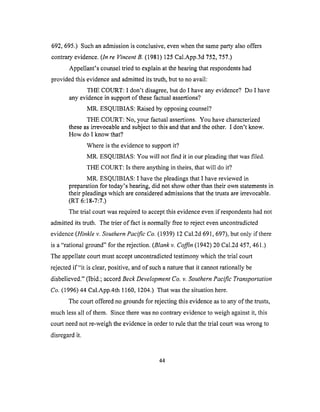
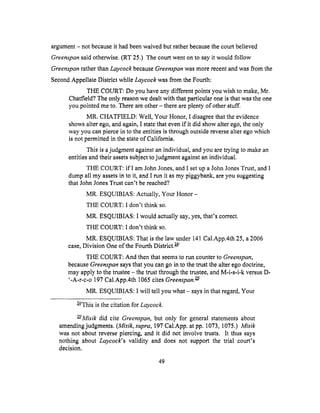
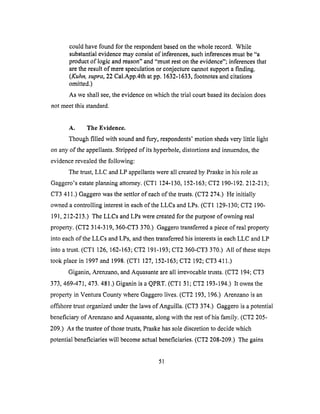
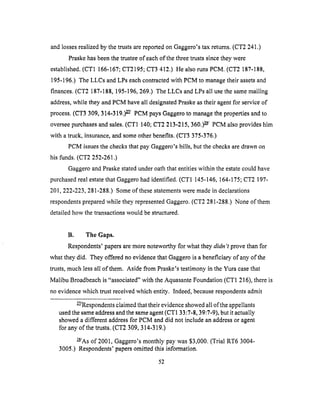
CA2DB241675-03
{286F22A3-A069-46F5-980F-6A62467A0147}
{139024} {30-130626:092836} {062413}
APPELLANT'S
BRIEF
Case No.
B241675
IN TIlE COURT OF APPEAL OF THE STATE OF CALIFORNIA
SECOND APPELLATE DISTRICT
DIVISION EIGHT
STEPHEN M, GAGGERQ,
Pla, intiff {md Appcllanl,
KNAPP, PETERSEN & CLARKE; STEVEN RAY GARCIA;
STEPHEN M. HARRIS and ANDRE JARDINI,
Defendants and Respondents;
PACIFIC COAST MANAGEMENT, 1NC,; 511 OFW LP;
GINGERBREAD COURT LP; MALIBU BROAD BEACH LP;
MARINA GLENCOE LP; BLU HOUSE LLC; BOARDWALK
SUNSET LLC; and JOSEPH PRASKE as Trustee of
THE GIGANIN TRUST, THE ARENZANO TRUST,
and TIlE AQUASANTE FOUNDATION
Additional Judgmant D_bto_,a, and Appellants
Hon. Rob¢a L, H_ss, Hon, Matthew St. GeaFge,
Hon, Murray Grass; Hon, Victor Greanberg
Superior Court of Los Angeles County
L,A,$,C, Cas_ No, BC286925
APPELLANTS _ OPENING BRIEF
EDWARD A, HOFFMAN, BRr,No, !67240
LAW OFFICES OF EDWARD A, HOFFMAN
12301 WILSHIRE BOULEVARD, SUITE 500
LOS ANGELES, CALIFORNIA 90025
(310) 442.3600
Attorney for Additional Judgment Debtors' and Appellants
B241675
IN THE COURT OF APPEAL OF THE STATE OF CALIFORNIA
SECOND APPELLATE DISTRICT
DIVISION EIGHT
STEPHEN M. GAGGERO,
Plaintiff and Appellant,
VS,
KNAPP, PETERSEN & CLARKE; STEVEN RAY GARC1A;
STEPHEN M. HARRIS and ANDRE JARDINI,
Defendants' and Respondents;
PACIFIC COAST MANAGEMENT, INC.; 511 OFW LP;
GINGERBREAD COURT LP; MALIBU BROAD BEACH LP;
MARINA GLENCOE LP; BLU HOUSE LLC; BOARDWALK
SUNSET LLC; and JOSEPH PRASKE as Trustee of
THE GIGANIN TRUST, THE ARENZANO TRUST,
and THE AQUASANTE FOUNDATION
Additional Judgment Debtors and Appellants
Hen. Robert L. Hess, Hen. Matthew St, George,
Hen. Murray Gross; Hen. Vletor Oreenberg
Superior Court of Los Angeles County
L.A.S.C. Case No. BC286925
APPELLANTS' OPENING BRIEF
EDWARD A. HOFFMAN, Bar No. 167240
LAW OFFICES OF EDWARD A. HOFFMAN
12301 WILSHIRE BOULEVARD, SUITE 500
LOS ANGELES, CALIFORNIA 90025
(310) 442-3600
Attorney for Additional Judgment Debtors and Appellants
TO BE FILED IN THE COURT OF APPEAL APP.001
Court _ ADpod Calo Numb=It:
B241675
COURT OF APPEAL, Second APPBLLATE DISTRICT, DIVISION Eight
l_Gw_lr(/I/_. HO[Illl,_JI (.[Jnr _ lb I,Z_U)
-' Law Offices of Edwttrd A, l,loffi_an
12301 Wilshire Blvd., Suite 500
l,os AItgeles, CA 90025
rt_ts_oNe_'0.: (3 10) 442-3600 ,Ax_o.ro_,,0:(310) 442-4600
_.M^'LAOO"ESStO_O,O_:ash@he ffinanlaw.com
a'rrORNEV_ORrNameJ:Pacific Coast Mtmagument, et el., Additional Judgment Debtors
APPELLANTmE'rmONER:Stephen M. Gaggero, et el.
RES_'ONt_ENTmEALPASTYININTEREST:Knapp, Petersen & Clarke, et el.
CERTIFICATE OF INTERESTED ENTITLES OR PERSONS
(Check one): _ INITIAL CERTIFICATE [] SUPPLEMENTAL CERTIFICATE
8t41edor C_JM CIIa Nun_oE
BC286925
IS_q count US8 ONL V
Notice: Please read rules 8.208 and 8.488 before completing this form. You may use this form for the Initial
certificate in an appeal when you file your brief or e prebrloflng motion, appllcat|on, or opposition to such a
motion or application In the Court of Appeal, and when you file a petition for an extraordinary writ. You may
also use this form as a supplemental certificate when you learn of changed or additional information that must
be disclosed.
1. This form is being submitted on behalf of the following party (name): Pacific Coast Management, et al._ Additional Judy.meat Debtors
2. a. [] There are no interested entities or persona that must be listed In this certificate under rule 8.208.
b. [_ Interested entities or parsons required to be listed under rule g.20fl are aa follows:
Full name of Interested
entlty or perse.
(1) TerraMar Trust
(2)
[_ Continued on attaohmant _,
Nature of Interest
(Explain):
The undersigned co.flea that the above.listed persons or ontltloa (corporations, pa_norshlpa, firms, or any other
association, but not Including government entitles or their agencies) have either (_) an ownership Interest of 10 percent or
more In the party If It Is an entity; or (2) a financial or other Interest In the outcome of the proceeding that the Justices
should consider In determining whether to dlaquall_ themselves, as defined In rule 8.208(e)(2).
Orate: June 24, 2013
Edwurd A. Hoffman
(TYPE _ PRINT NAME)
Paget 1 el 1
_o_,_uI_o=_=u= CERTIFICATE OF INTERESTED ENTITLES OR PERSONS c= R==*_Co_.,r_*==_,=_O,S,_S
Jt_ldat CO_J Ot C ¢d/omll= www.o_uttin_o, ca,gov
App-o0fi [Ra_ J_rpJarf 1,200g] Lgxi._lVa_lJr_ A utomoled Cet/ortJt';'lio Judicial C'omtcil Fuemn
TABLE OF CONTENTS
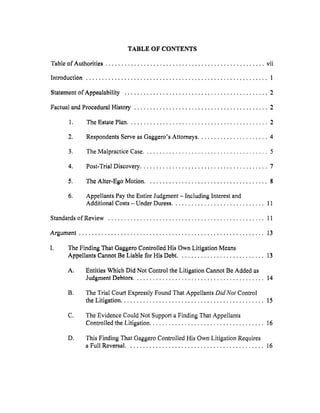
Table of Authorities vii
Introduction ......................................................... I
Statement of Appealability ............................................. 2
Factualand Procedural History .......................................... 2
I. The EstatePlan ............................................ 2
2. Respondents Serve as Gaggero's Attorneys ...................... 4
3. The Malpractice Case ....................................... 5
4. Post-Trial Discovery ........................................ 7
5. The Alter-Ego Motion ...................................... 8
6. Appellants Pay the Entire Judgment - Including Interest and
Additional Costs - Under Duress ............................. 11
Standards of Review ................................................. 11
Argument .......................................................... 13
I. The Finding That Gaggero Controlled His Own Litigation Means
Appellants Cannot Be Liable for His Debt ........................... 13
A, Entities Which Did Not Control the Litigation Cannot Be Added as
Judgment Debtors ......................................... 14
B. The Trial Court Expressly Found That Appellants DidNot Control
the Litigation ............................................. 15
C. The Evidence Could Not Support a Finding That Appellants
Controlled the Litigation .................................... 16
D. This Finding That Gaggero Controlled His Own Litigation Requires
a Full Reversal ........................................... 16
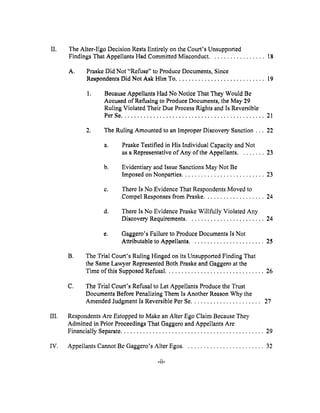
II.
III.
The Alter-Ego Decision Rests Entirely on the Court's Unsupported
Findings That Appellants Had Committed Misconduct ................. 18
A° Praskc Did Not "Refuse" to Produce Documents, Since
Respondents Did Not Ask Hhn To ............................ 19
° Because Appellants Had No Notice That They Would Be
Accused of Refusing to Produce Documents, the May 29
Ruling Violated Their Due Process Rights and Is Reversible
PerSe ............................................. 21
2, The Ruling Amounted to an Improper Discovery Sanction... 22
a. Praske Testified in His Individual Capacity and Not
as a Representative of Any of the Appellants ........ 23
b.
Evidentiary and Issue Sanctions May Not Be
Imposed on Nonparties .......................... 23
C°
There Is No Evidence That Respondents Moved to
Compel Responses from Praske ................... 24
d,
There Is No Evidence Praske Willfully Violated Any
Discovery Requirements ........................ 24
e, Gaggero's Failure to Produce Documents Is Not
Attributable to Appellants ....................... 25
B.
The Trial Court's Ruling Hinged on its Unsupported Finding That
the Same Lawyer Represented Both Praske and Gaggero at the
Time of this Supposed Refusal ............................... 26
C,
The Trial Court's Refusal to Let Appellants Produce the Trust
Documents Before Penalizing Them Is Another Reason Why the
Amended Judgment Is Reversible Per Se ...................... 27
Respondents Are Estopped to Make an Alter Ego Claim Because They
Admitted in Prior Proceedings That Gaggero and Appellants Are
Financially Separate ............................................. 29
IV. Appellants Cannot Be Gaggero's Alter Egos ......................... 32
-ii-
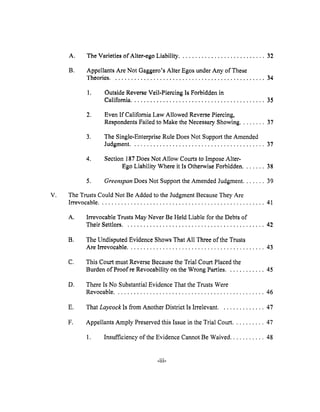
V,
A. The Varieties of Alter-ego Liability ........................... 32
B. Appellants Are Not Gaggero's Alter Egos under Any of These
Theories ................................................ 34
1, Outside Reverse Veil-Piercing ls Forbidden in
California .......................................... 35
2. Even If California Law Allowed Reverse Piercing,
Respondents Failed to Make the Necessary Showing ........ 37
3. The Single-Enterprise Rule Does Not Support the Amended
Judgment .......................................... 3"/
4. Section 187 Does Not Allow Courts to Impose Alter-
Ego Liability Where it Is Otherwise Forbidden ....... 38
5. Greenspan Does Not Support the Amended Judgment ....... 39
The Trusts Could Not Be Added to the Judgment Because They Are
Irrevocable .................................................... 41
A. Irrevocable Trusts May Never Be Held Liable for the Debts of
Their Settlors ............................................ 42
B. The Undisputed Evidence Shows That All Three of the Trusts
Are Irrevocable ........................................... 43
C. This Court must Reverse Because the Trial Court Placed the
Burden of Proof re Revoeability on the Wrong Parties ............ 45
D. There Is No Substantial Evidence That the Trusts Were
Revocable ............................................... 46
E, That Laycock Is from Another District Is Irrelevant .............. 47
F. Appellants Amply Preserved this Issue in the Trial Court .......... 47
1. Insufficiency of the Evidence Cannot Be Waived ........... 48
-iii-
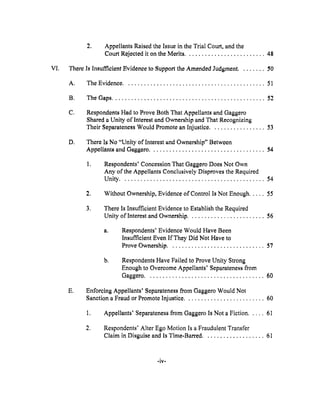
.
Appellants Raised the Issue in the Trial Court, and the
Court Rejected it on the Merits ......................... 48
V1. There ls Insufficient Evidence to Support the Amended Judgment ........ _0
A. The Evidence ............................................ 51
B. The Gaps ................................................ 52
C*
Respondents Had to Prove Both That Appellants and Gaggero
Shared a Unity of Interest and Ownership and That Recognizing
Their Separateness Would Promote an Injustice ................. 53
D_ There ls No "Unity of Interest and Ownership" Between
Appellants and Gaggero .................................... 54
Respondents' Concession That Gaggero Does Not Own
Any of the Appellants Conclusively Disproves the Required
Unity ............................................. 54
2. Without Ownership, Evidence of Control Is Not Enough ..... 55
.
There Is Insufficient Evidence to Establish the Required
Unity of Interest and Ownership ........................ 56
a° Respondents' Evidence Would Have Been
Insufficient Even If They Did Not Have to
Prove Ownership .............................. 57
b.
Respondents Have Failed to Prove Unity Strong
Enough to Overcome Appellants' Separateness from
Gaggero ..................................... 60
E. Entbreing Appellants' Separateness from Gaggero Would Not
Sanction a Fraud or Promote Injustice ......................... 60
1, Appellants' Separateness from Gaggero Is Not a Fiction ..... 61
.
Respondents' Alter Ego Motion Is a Fraudulent Transfer
Claim in Disguise and Is Time-Barred ................... 61
VII.
VIII.
IX.
X.
,
Enforcing a Statute of Limitations Neither Sanctions a
Fraud Nor Promotes an Injustice ....................... 62
F.
There Is Nothing Unjust about Making Respondents Bear the
Consequences of Their Own Business Decisions ................. 63
Q,
Respondents' Failure to Prove Their Case Means They May Not
Have Another Chance in the Trial Court ....................... 64
The Trial Court Invaded the Probate Court's Exclusive Jurisdiction Over
the Trusts' Internal Affairs ....................................... 64
That Gaggero and Appellants Are Financially Separate Is Law of the
Case ......................................................... 66
The Amended Judgment Cannot Stand Because it Directly Contradicts
the Original Judgment ........................................... 67
A.
The 2012 Finding That Appellants Are All Gaggero's Alter Egos
Cannot Be Reconciled with the 2008 Finding That PCM and
Gaggero Are Financially Separate ............................ 67
g. Having Accepted the Benefits of the Original Judgment,
Respondents May Not Contradict It ........................... 69
Respondents' 55-Month Delay Waived Their Alter-Ego Claim ........... 70
A°
A Court May Not Add New Judgment Debtors If the Creditor
Knew of the Relationship Before Judgment Was Entered .......... 71
B,
Respondents' Motion Was Based on Information They Had Before
the Judgment Against Gaggero Was Entered in Early 2008 ........ 71
C. Claimants Must Use Due Diligence When Adding Parties ......... 73
D.
That Delaying Was Convenient for Respondents Does Not
Excuse It ................................................ 74
E. Appellants Were Severely Prejudiced by Respondents' Delay ...... 74
-V-
XI. The Court Should Order Respondents to Make Appellants Whole for the
Costs They Have Incurred and the Consequential Damages They Have
Suffered Due to the Enforcement of the Amended Judgment ............. 75
Conclusion ......................................................... 77
Certificate of Word Count ............................................. 79
Proof of Service by Mail .............................................. 80
-Vi-
TABLE OF AUTHORITIES
STATE CASES
Aguilar v. Atlantic Richfield Co.
(2001) 25 Cal.4th 826 .............................................. 45, 46
Al J. Vela & Associates, Inc. v. Glendora Unified School Dist.
(1982) 129 Cal.App.3d 766 ............................................ 70
Alexander v. Abbey of the Chimes
(1980) 104 Cal.App.3d 39 ........................................... 54, 73
Ann M. v. Pacific Plaza Shopping Center
(1993) 6 Cal.4th 666 .................................................. 12
Assoc. Vendors, Inc. v. Oakland Meat Co.
(1962) 210 Cal.App.2d 825 .......................................... 62, 63
Auto Equity Sales, Inc. v. Superior Court
(1962) 57 Cal.2d 450 .................................................. 47
Baxter v. Peterson
(2007) 150 Cal.App.4th 673 ............................................ 64
Beck Development Co. v. Southern Pacific Transportation Co.
(1996) 44 Cal.App.4th 1160 ............................................ 44
Biscaro v. Stern
(2010) 181 Cal.App.4th 702 ............................................ 22
Blank v. Coffin
(1942) 20 Cal.2d 457 .................................................. 44
Bowman v. Board of Pension Commissioners
(1984) 155 Cal.App.3d 937 ............................................. 12
California State Employees' Assn. v. State Personnel Bd.
(1986) 178 Cal.App.3d 372 ............................................. 17
-vii-
Carpenter v. Jack in the Box
(2007) 151 Cal.App.4th 454 ............................................ I2
CC-California Plaza Associates v. Paller & Goldstein
(1996) 51 Cal.App.4th 1042 ............................................ 68
Chambers v. Kay
(2002) 29 Cal.4th 142 ................................................. 27
City of Los Angeles v. Morgan
(1951) 105 Cal.App.2d 726 ............................................. 21
Conley v. Matthes
(1997) 56 Cal.App.4th 1453 ............................................ 17
Crocker National Bank v. City & County of San Francisco
(1989) 49 Cal.3d 881 .................................................. 12
Crook v. Contreras
(2002) 95 Cal.App.4th 1194 ............................................ 46
Cuccia v. Superior Court
(2007) 153 Cal.App.4th 347 ............................................ 47
DiMaria v. Bank of California
(1965) 237 Cal.App.2d 254 ............................................. 42
Dow Jones Co. v. Avenel
(1984) 151 Cal.App.3d 144 ............................................. 16
Dowdall v. Superior Court
(1920) 183 Cal. 348 ................................................... 66
Elkins v. Superior Court
(2007) 41 Cal.4th 1337 ................................................ 29
Estate of Hearst
(1977) 67 Cal.App.3d 777 .............................................. 59
Estate of Mullins
(1988) 206 Cal.App.3d 924 ............................................. 65
-viii-
Estate of Teed
(1952) 112 Cal.App.2d 638 ............................................. 11
Ex Parte Tartar
(1959) 52 Cal.2d 250 .................................................. 41
Fassberg Const. Co. v. Housing Authority of City of Los Angeles
(2007) 152 Cal.App.4th 720 ............................................ 43
Gaggero v. Yura
(2003) 108 Cal.App.4th 884 ............................................ 25
Galdjie v. Darwish
(2003) 113 Cal.App.4th 1331 ............................................ 8
Gelfo v. Lockheed Martin Corp.
(2006) 140 Cal.App.4th 34 ............................................. 55
Ghirardo v. Antonioli
(1994) 8 Cal.4th 791 .................................................. 12
Gordon v. Nissan Motor Co., Ltd.
(2009) 170 Cal.App.4th 1103 ........................................... 28
Greenspan v. LADT, LLC
(2011) 191 Cal.App.4th 486 ........................................ passim
Gunderson v. Wall
(2011) 196 Cal.App.4th 1060 ........................................... 76
Hasson v. Ford Motor Co.
(1977) 19 Cal.3d 530 .................................................. 69
Heifetz v. Bank of America
(1957) 147 Cal.App.2d 776 ............................................. 46
Hinkle v. Southern Pacific Co.
(1939) 12 Cal.2d 691 .................................................. 44
In re Angela C.
(2002) 99 Cal.App.4th 389 ............................................. 28
-ix-
b_ re Enrique G,
(2006) 140 Cal.App.4th 676 ......................................... 22, 28
In re Goldberg's Estate
(1938) 10 Cal.2d 709 .................................................. 68
In re Jasmine G.
(2005) 127 Cal.App.4th 1109 ........................................... 21
In re Vincent B.
(1981) 125 CaI.App.3d 752 ............................................. 44
Jackson v. County of Los Angeles
(1997) 60 Cal.App.4th 171 ............................................. 31
dines v. Abarbanel
(1978) 77 Cal.App.3d 702 ........................................... 60, 71
Kahrs v. County of Los Angeles
(1938) 28 Cal.App.2d 46 ............................................... 45
Karlsson v. Ford Motor Co.
(2006) 140 Cal.App.4th 1202 ........................................... 25
Keeler v. Superior Court
(1956) 46 Cal.2d 596 .................................................. 39
Kelly v. New West Federal Savings
(1996) 49 Cal.App.4th 659 ............................................. 28
Kuhn v. Department of General Services
(1994) 22 Cal.App.4th 1627 ......................................... 12, 51
Lambert v. General Motors
(1998) 67 Cal.App.4th 1179 ............................................ 69
Las Palmas Assoc. v. Las Palmas Ctr. Assoc.
(1991) 235 Cal.App.3d 1220 ................................... 32, 34, 38, 54
Laycock v. Hammer
(2006) 141 Cal,App.4th 25 ......................................... passim
-X-
Levin v. Ligon
(2006) 140 Cal.App.4th 1456 ........................................... 31
Lovato v. Santa Fe Internat. Corp.
(1984) 151 Cal.App.3d 549 ............................................. 21
Marriage of Carlsson
(2008) 163 Cal.App.4th 281 ............................................ 28
Martin v. County of Los Angeles
(1996) 51 Cal.App.4th 688 ............................................. 21
McClellan v. Northridge Park Townhome Owners Assn.
(2001) 89 Cal.App.4th 746 ............................................. 11
Mclntire v. Superior Court
(1975) 52 Cal.App.3d 717 .............................................. 73
Mesler v. Bragg Management Co.
(1985) 39 Cal.3d 290 .................................................. 54
Mid-Century lns. Co. v. Gardner
(1992) 9 Cal.App.4th 1205 ............................................. 53
Minifie v. Rowley
(1922) 187 Cal. 481 ................................................... 32
Minton v. Cavaney
(1961) 56 Cal.2d 576 .................................................. 16
Misik v. D'Arco
(2011) 197 Cal.App.4th 1065 ....................................... passim
Morohoshi v. Pacific Home
(2004) 34 Cal.4th 482 ................................................. 66
Morrison Knudsen Corp. v. Hancock, Rothert & Bunshofi, LLP
(1999) 69 Cal.App.4th 223 ............................................. 57
Motores De Mexicali, S. A. v. Superior Court
(1958) 51 Cal.2d 172 .................................................. 14
-xi-
NEC Electronics Inc. v. Hurt
(1989) 208 Cal,App.3d 772 ................................... 11, 14, 16,39
Napa Valley Packing Co. v. San Francisco Relief& Red Cross Funds
(1911) 16 Cal.App. 461 ................................................ 69
New Albertsons, Inc. v. Superior Court
(2008) 168 Cal.App.4th 1403 ........................................... 24
Norgart v. Upjohn Co.
(1999) 21 Cal,4th 383 ................................................. 17
Parsons v. Bristol Development Co.
(1965) 62 Cal.2d 861 .................................................. 13
People ex rel. Lockyer v. Shamrock Foods Co.
(2000) 24 Cal.4th 415 ................................................. 12
People v. Avanessian
(1999) 76 Cal.App.4th 635 ............................................. 45
People v. Johnson
(1980) 26 Cal.3d 557 .................................................. 12
People v. Kluga
(1973) 32 Cal.App.3d 409 .............................................. 20
People v. Lujan
(2012) 211 Cal.App.4th 1499 ........................................... 39
People v. Powell
(2011) 194 Cal.App.4th 1268 ........................................... 12
People v. Shuey
(1975) 13 Cal.3d 835 .................................................. 66
People v. Stanley
(1995) 10 Cal.4th 764 ................................................. 67
Postal lnstant Press, lnc. v. Kaswa Corp.
(2008) 162 Cal.App.4th 1510 ....................................... passim
-xii-
Riddle v. Leuschner
(1959) 51 Cal.2d 574 ............................................... 55, 56
Rogers v. Bill & Vince 's, lnc.
(1963) 219 Cal.App.2d 322 ............................................. 76
San Bernardino County v. Riverside County
(1902) 135 Cal. 618 ................................................... 70
Santisas v. Goodin
(1998) 17 Cal.4th 599 ................................................. 43
Sauer v. Superior Court
(1987) 195 Cal.App.3d 213 ............................................. 13
Saxena v. Goffney
(2008) 159 Cal.App.4th 316 ......................................... 24, 25
Schoenberg v. Benner
(1967) 251 Cal.App.2d 154 ............................................. 16
Sessions v. Southern Pac. Co.
(1911) 159 Cal. 599 ................................................. i. 69
Smith v. Walter E. Heller & Co.
(1978) 82 Cal.App.3d 259 .............................................. 55
Steven W. v. Matthew S.
(1995) 33 Cal.App.4th 1108 ............................................ 50
Stockton Theatres lnc. v. Palermo
(1953) 121 Cal.App.2d 616 ............................................. 75
Tahoe National Bank v. Phillips
(1971) 4 Cal.3d 11 .................................................... 48
Tally v. Ganahl
(1907) 151 Cal. 418 ................................................... 67
Tavaglione v. Billings
(1993) 4 Cal.4th 1150 ....... , t , , • , , .......... , , ° ................ . ..... 69
-xiii-
Temple Comm. Hosp. v. Superior Court
(1999) 20 Cal.4th 464 ................................................. 24
Triplett v. Farmers Ins. Exchange
(1994) 24 Cal.App.4th 1415 ......................................... 14, 16
Vallbona v. Springer
(1996) 43 Ca1.App.4th 1525 ......................................... 13, 23
VirtualMagic Asia, Inc. v. Fil-Cartoons, Inc.
(2002) 99 Cal.App.4th 228 ............................................. 57
Wollersheim v. Church of Scientology Int 'l
(1999) 69 Cal.App.4th 1012 ......................................... 16, 53
FEDERAL CASES
Arizona v. Fulminante
(1991) 499 U.S. 279 [111 S.Ct. 1246, 113 L.Ed.2d 302] ...................... 21
Cascade Energy & Metals Corp. v. Bank
(10th Cir. 1990) 896 F.2d 1557 ....................................... 36, 63
Floyd v. I.R.S.
(10th Cir.1998) 151 F.3d 1295 ....................................... 36, 37
Holywell Corp. v. Smith
(1992) 503 U.S. 47 [112 S.Ct. 1021, 117 L.Ed.2d 196] ....................... 59
In re Barnes
(Bankr. E.D. Cal. 2002) 275 B.R. 889 .................................. 40, 42
In re Sims
(5th Cir. 1993) 994 F.2d 210 ............................................ 63
Katzir's Floor & Home Design, Inc. v. M-MLS.com
(9th Cir. 2004) 394 F3d 1143 ........................................ 16, 62
O. F. Nelson & Co. v. U.S.
(9th Cir. 1945) 149 F.2d 692 ............................................ 43
-xiv-
S.E.C. v. Hickey
(9th Cir. 2003) 322 F,3d 1123 ..................................... 40, 55, 56
STATESTATUTES
Civil Code
§ 3439.04 ........................................................... 61
§ 3439.07 ......................................................... 33,62
§ 3439.09 ............................................................ 62
Code of CivilProeedure
§ 187 ....................................................... 8,14,38,39
§ 625 ............................................................... 69
§ 631.8 ........................................................... 5,74
§ 904.1 .............................................................. 2
§ 908 ............................................................... 75
§ 917.1 ............................................................. 74
§ 2023.010 .......................................................... 22
§ 2023.030 .......................................................... 22
Evidence Code
§ 452 ................................................................ 1
§ 453 ................................................................ 1
§ 500 ............................................................... 45
§ 1220 .............................................................. 43
Probate Code
§ 15400 ............................................................. 45
§ 15403 .......................................................... 42,43
§ 17000 .......................................................... 64,65
§ 17200 ............................................................. 64
§ 18200 ............................................................. 42
Cal. Const., art. I, § 7 .................................................... 27
Cal. Const., art. VI, § 13 .................................................. 22
-XV-
STATE RULES
Cal. Rules of Court, rule 8.204 ............................................. 79
Cal. Rules of Prof. Conduct, rule 1-100 ...................................... 27
FEDEILAL STATUTES
26 U.S.C. §§ 671-677 .................................................... 60
26 U.S.C. § 2702 .................................................... 43, 59
U.S. Const., 14th Amdt ............................................ 14, 21, 27
SECONDARY SOURCES
2 A.L.R.6th ........................................................... 32
29A Am.Jur.2d Evidence ................................................. 54
34 Am.Jur.2d Federal Taxation ............................................ 59
Ahart, California Practice Guide: Enforcing Judgments
and Debts (Rutter 2012) ........................................... passim
Bogert, The Law of Trusts and Trustees (Thomson West 2013) ................ 43, 60
60 Cal.Jur.3d (2012) Trusts ............................................... 42
Eisenberg, Horvitz, and Wiener, California Practice Guide."
Civil Appeals and Writs (Rutter 2013) ................................ passim
Fletcher Cyclopedia of the Law of Corporations . .......................... 33, 55
Friedman, California Practice Guide: Corporations (Rutter 2010) ................ 38
Restatement 2d, Judgments ............................................... 15
.xvi-
Weil & Brown, California Practice Guide." Civil Procedure
Before Trial (Rutter 2013) ............................................. 24
1 Witkin, Cal. Evidence (5th ed. 2012) Hearsay, § 98 .......................... 55
9 Witkin, Cal. Procedure (4th ed 1997) Appeal, § 895 .......................... 66
8 Witkin, Cal. Procedure (5th ed. 2008) Enf. Judgm., § 479 ...................... 61
7 Witkin, Cal. Procedure (5th ed., 2008) Judgment, § 29 ........................ 11
-xvii-
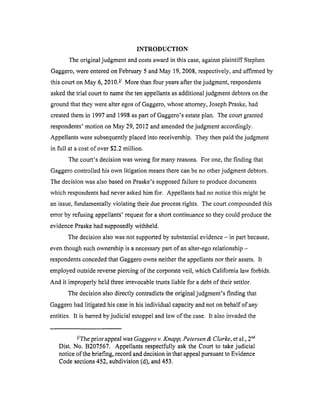
INTRODUCTION
The original judgment and costs award in this case, against plaintiff Stephen
Gaggero, were entered on February 5 and May 19, 2008, respectively, and affirmed by
this court on May 6, 2010. !/ More than four years after the judgment, respondents
asked the trial court to name the ten appellants as additional judgment debtors on the
ground that they were alter egos of Gaggero, whose attorney, Joseph Praske, had
created them in 1997 and 1998 as part of Gaggero's estate plan. The court granted
respondents' motion on May 29, 2012 and amended the judgment accordingly.
Appellants were subsequently placed into receivership. They then paid the judgment
in full at a cost of over $2.2 million.
The court's decision was wrong for many reasons. For one, the finding that
Gaggero controlled his own litigation means there can be no other judgment debtors.
The decision was also based on Praske's supposed failure to produce documents
which respondents had never asked him for. Appellants had no notice this might be
an issue, fundamentally violating their due process rights. The court compounded this
error by refusing appellants' request for a short continuance so they could produce the
evidence Praske had supposedly withheld.
The decision also was not supported by substantial evidence - in part because,
even though such ownership is a necessary part of an alter-ego relationship -
respondents conceded that Gaggero owns neither the appellants nor their assets. It
employed outside reverse piercing of the corporate veil, which California law forbids.
And it improperly held three irrevocable trusts liable for a debt of their settlor.
The decision also directly contradicts the original judgment's finding that
Gaggero had litigated his case in his individual capacity and not on behalf of any
entities. It is barred by judicial estoppel and law of the case. It also invaded the
I/
- The prior appeal was Gaggero v. Knapp, Petersen & Clarke, et al., 2 "d
Dist. No. B207567. Appellants respectfully ask the Court to take judicial
notice of the briefing, record and decision in that appeal pursuant to Evidence
Code sections 452, subdivision (d), and 453.
exclusivejurisdiction of theprobatecourtovermattersof internaltrustaffairs. And it
ignoredthe waivercausedby respondents'unjustifiable55-monthdelayin bringing
their motion.
Theseerrorshavedrawnappellantsinto adecade-oldlegaldispute,led to them
beingplacedinto receivership,andcostthemmillions of dollars. They respectfully
askthis courtto reversetrial court's baselessdecision.
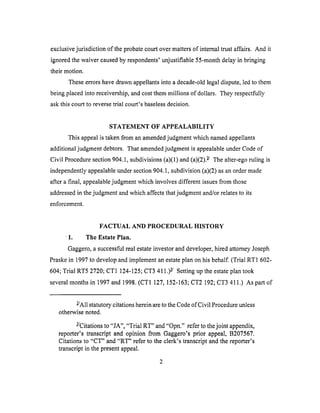
STATEMENT OF APPEALABILITY
This appeal is taken from an amended judgment which named appellants
additional judgment debtors. That amended judgment is appealable under Code of
Civil Procedure section 904.1, subdivisions (a)(1) and (a)(2). z/ The alter-ego ruling is
independently appealable under section 904.1, subdivision (a)(2) as an order made
after a final, appealable judgment which involves different issues from those
addressed in the judgment and which affects that judgment and/or relates to its
enforcement.
FACTUAL AND PROCEDURAL HISTORY
- 1. The Estate Plan.
Gaggero, a successful real estate investor and developer, hired attorney Joseph
Praske in 1997 to develop and implement an estate plan on his behalf. (Trial RT1 602-
604; Trial RT5 2720; CT1 124-125; CT3 411.) 3-/ Setting up the estate plan took
several months in 1997 and 1998. (CT1 127, 152-163; CT2 192; CT3 411.) As part of
Z/All statutory citations herein are to the Code of Civil Procedure unless
otherwise noted.
3-/Citations to "JA", "Trial RT" and "Opn." refer to the joint appendix,
reporter's transcript and opinion from Gaggero's prior appeal, B207567.
Citations to "CT" and "RT" refer to the clerk's transcript and the reporter's
transcript in the present appeal.
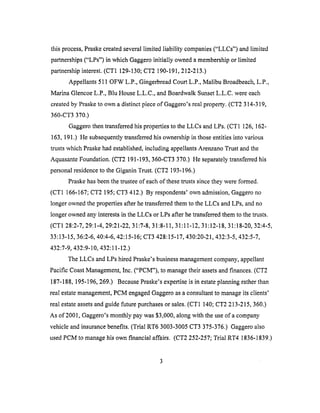
thisprocess,Praskecreatedseverallimited liability companies("LLCs") andlimited
partnerships("LPs") in which Gaggeroinitially owneda membership or limited
partnership interest. (CT1 129-130; CT2 190-191,212-213.)
Appellants 511 OFW L.P., Gingerbread Court L.P., Malibu Broadbeach, L.P.,
Marina Glencoe L.P., Blu House L.L.C., and Boardwalk Sunset L.L.C. were each
created by Praske to ov_a a distinct piece of Gaggero's real property. (CT2 314-319,
360-CT3 370.)
Gaggero then transferred his properties to the LLCs and LPs. (CT1 126, 162-
163, 191.) He subsequently transferred his ownership in those entities into various
trusts which Praske had established, including appellants Arenzano Trust and the
Aquasante Foundation. (CT2 191-193,360-CT3 370.) He separately transferred his
personal residence to the Giganin Trust. (CT2 193-196.)
Praske has been the trustee of each of these trusts since they were formed.
(CT1 166-167; CT2 195; CT3 412.) By respondents' own admission, Gaggero no
longer owned the properties after he transferred them to the LLCs and LPs, and no
longer owned any interests in the LLCs or LPs after he transferred them to the trusts.
(CT1 28:2-7, 29:1-4, 29:21-22, 31:7-8, 31:8-11, 31:11-12, 31:12-18, 31:18-20, 32:4-5,
33:13-15, 36:2-6, 40:4-6, 42:15-16; CT3 428:15-17, 430:20-21,432:3-5,432:5-7,
432:7-9, 432:9-10, 432:11-12.)
The LLCs and LPs hired Praske's business management company, appellant
Pacific Coast Management, Inc. ("PCM"), to manage their assets and finances. (CT2
187-188, 195-196, 269.) Because Praske's expertise is in estate planning rather than
real estate management, PCM engaged Gaggero as a consultant to manage its clients'
real estate assets and guide future purchases or sales. (CT1 140; CT2 213-215,360.)
As of 2001, Gaggero's monthly pay was $3,000, along with the use of a company
vehicle and insurance benefits. (Trial RT6 3003-3005 CT3 375-376.) Gaggero also
used PCM to manage his own financial affairs. (CT2 252-257; Trial RT4 1836-1839.)
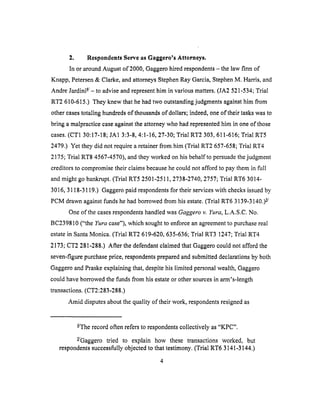
2. Respondents Serve as Gaggero's Attorneys.
In or around August of 2000, Gaggero hired respondents - the law firm of
Knapp, Petersen & Clarke, and attorneys Stephen Ray Garcia, Stephen M. Harris, and
Andre Jardini -4/- to advise and represent him in various matters. (JA2 521-534; Trial
RT2 610-615.) They knew that he had two outstanding judgments against him from
other cases totaling hundreds of thousands of dollars; indeed, one of their tasks was to
bring a malpractice case against the attorney who had represented him in one of those
cases. (CT1 30:17-18; JA1 3:3-8, 4:1-16, 27-30; TrialRT2 303, 611-616; TrialRT5
2479.) Yet they did not require a retainer from him (Trial RT2 657-658; Trial RT4
2175; Trial RT8 4567-4570), and they worked on his behalf to persuade the judgment
creditors to compromise their claims because he could not afford to pay them in full
and might go bankrupt. (Trial RT5 2501-2511, 2738-2740, 2757; Trial RT6 3014-
3016, 3118-3119.) Gaggero paid respondents for their services with checks issued by
PCM drawn against funds he had borrowed from his estate. (Trial RT6 3139-3140.) _/
One of the cases respondents handled was Gaggero v. Yura, L.A.S.C. No.
BC239810 ("the Yura case"), which sought to enforce an agreement to purchase real
estate in Santa Monica. (Trial RT2 619-620, 635-636; Trial RT3 1247; Trial RT4
2173; CT2 281-288.) After the defendant claimed that Gaggero could not afford the
seven-figure purchase price, respondents prepared and submitted declarations by both
Gaggero and Praske explaining that, despite his limited personal wealth, Gaggero
could have borrowed the funds from his estate or other sources in arm's-length
transactions. (CT2:283-288.)
Amid disputes about the quality of their work, respondents resigned as
n/The record often refers to respondents collectively as "KPC".
5-/Gaggero tried to explain how these transactions worked, but
respondents successfully objected to that testimony. (Trial RT6 3141-3144.)
4
Gaggero'sattorneysandwithdrewtheir representationin early2002,(Trial RT3 908-
909, 1278-1279,1288-1289;Trial RT8 4616;TrialRT10 5750.)
3. The Malpraetlee Case.
Gaggero brought the underlying malpractice case later that year. (JA7 1934;
CT1 19.) His second amended complaint, filed on August 13, 2003, alleged several
causes of action, including professional negligence and breach of contract. (JA 1 1-41 .)
The damages he sought lneluded, inter ella, some of the fees he had paid to
respondents and their successor counsel, and a fee award to opposing counsel that he
had been required to pay in one of respondents' fbrnaer eases. (JA1 4-5, 11-24.)
The ease was tried without a jury from July 23 to September 10, 2007, when
the trial court granted respondents' motion for judgment under section 631.8. (Trial
RT10 5737-5738; JA1 147; JA2 366.) When asked how he paid respondents' fees,
Gaggero testified that he asked Praske to advance funds from the estate and that
Praske had agreed to do so. (Trial RT6 3139-3140.)
Praske did not testify at the trial. (Trial RT1.) Even after Gaggero testified that
he did not know details of the estate plan and that Praske was the only one who did
(Trial RT5 2773), respondents did not call him to the stand.
The trial involved many issues, most of which are not germane to this appeal -
with one noteworthy exception. The damages Gaggero sought from respondents
included approximately $498,000 worth of attorney fees and costs he had paid. (JA 1
86, 89.) The payments had been made via checks which were written by appellant
PCM but drawn on Gaggero's own funds. (Trial RT4 1869, 1837-1839.) Gaggero
tried to explain why the payments were his responsibility. (Trial RT6 3141-3144.)
Respondents objected, claiming that he had refused to answer related questions at his
deposition. (Trial RT6 3142.) The court sustained this objection, excluding all
evidence about Gaggero's relationship with PCM, the trusts, and the other entities.
(Trial RT6 3142-3143.)
Gaggeromadeanoffer of proof, describingtherelationshipbetweenhimself,
PCM, thetrusts,andthe otherentitiesthathadbeencreatedaspart of hisestateplan.
In particular,hetriedto showthatPCM is a managementcompanywhich paysbills
onbehalfof its clients- includinghim - usingtheclients' own money,andthat he
had borrowedthefeesfrom trustswhich hewasrequiredto reimburse.Thetrial court
stoodby its ruling. (Trial RT7 3626-3629,3632-3633.)
On January8,2008,thecourtissueda32-pagestatementof decision.(CT1 60-
91.) Among its findings was that Gaggero could not recover any of the fees or costs
that PCM had paid because there was no evidence they had been paid with his money.
In the Court's words:
"... Mr. Gaggero did not personally pay a single dime in attorneys fees to
anyone who represented him. All the attorneys fees were paid by or through
one or more business entities, including PCM ... directly to the attorneys.
There was no evidence that Mr. Gaggero was represented in a capacity as
officer, director or employee of any of these entities, and there was no evidence
that Mr. Gaggero has any obligation to repay any of these entities any sums
which they paid to attorneys. As far as the evidence goes, the entities paid
whatever sums were expended entirely gratuitously." (CT1 86.)
The judgment was entered on February 5, 2008. (JA2 421-423.) Respondents
filed a notice of entry on February 28, 2008. (JA2 424-429.) Gaggero filed a timely
notice of appeal on April 28, 2008. (JA7 1876-1878.) That appeal was Case No.
B207567.
Respondents filed a memorandum of costs (JA2 430-432) and a motion for
attorney fees. (JA6 1552-1582.) Gaggero opposed the fee motion (JA6 1586-1616)
and filed a motion to tax costs. (JA6 1659-1680.) The trial court granted the fee
motion in its entirety and taxed only a small portion of the requested costs, resulting in
a fee award of $1,202,944.50, a costs award of $124,702.90, and an amended
judgment totaling $1,327,674.40. (JA7 1884-1889.) Gaggero's appeal from that
amended judgment was Case No. B209522.
This court consolidated Gaggero's appeals under Case No. B207567. It issued
anunpublishedopinionon May 6, 2010,affirming boththe original and amended
judgments in full. The opinion expressly upheld the findings about PCM quoted
above. (Opn. 21-23.) The remittitur was issued on August 19, 2010.
On December 28, 2010, the trial court amended the judgment a second time,
awarding respondents another $192,723.90 in attorney fees and $522 in costs against
Gaggero for the appeal, along with $320,591.78 in accrued interest. (CT1 114-116.)
4. Post-Trial Discovery.
Respondents conducted judgment-debtor discovery about Gaggero's finances.
They took Praske's third-party debtor exam on June 5, 2009. (CT2 357-CT3 377.)
The order to appear named Praske in his individual capacity and not as a
representative of any entities. It directed him to testify about his knowledge of
Gaggero's finances and about any funds or assets he possessed which were owed to
Gaggero. It did not call for any information about any of the appellants. (CT2 357-
358.)
During Praske's examination, respondents' counsel asked him for information
about appellants 511 OFW, Blu House, and Boardwalk Sunset. Praske's lawyer
instructed him not to answer those questions, objecting that the information was
outside the scope of the order to appear, was irrelevant to respondents' investigation
of Gaggero's finances, was privileged and infringed upon the rights of appellants and
other third parties. Praske followed his lawyer's advice, testifying only that Gaggero
had transferred properties to those entities in the 1990s and had retained no interest in
them. (CT2 362,366; CT3 368.) Although the examination was held in the
courthouse (CT2 359), respondents neither asked the court to resolve this dispute nor
moved to compel further responses.
Respondents also served Gaggero with written discovery, asking him, inter
alia, to produce the trust instruments for Giganin, Arenzano, and Aquasante. (CT2
329-354) Gaggero - who had testified in 2007 that Praske was the one who had this
7
information(Trial RT4 1871-1872,2133;Trial RT5 2770-2774)- statedin response
that hedid nothavethem.(CT2 333-334.)6-/Respondentsdid notmoveto compel
further responses,andinsteadbroughttheiralteregomotionjust threeweeksafterthe
responseswereserved.(CT1 24;CT3 354.)
Respondentsdid notexaminePraskeagain,eitherasanindividual or asa
representativeof anyof theappellants.Theyalsofailedto examineanyoneelseon
appellants'behalf. Theydid notsubpoenaanyrecordsfrom appellants,nor did they
subpoenarecordsconcerningappellantsfrom anythird parties.
5. The Alter-Ego Motion.
On April 10,2012,respondentsfiled amotion undersection187to deem
appellantsGaggero'salteregosandto furtheramendthejudgmentby namingthem
additionaljudgmentdebtors.(CT1 24- CT3378.)z_ Their motion conceded thirteen
times that Gaggero does not own the appellants or their assets. (CT1 28:2-7, 29:1-4,
29:21-22, 31:7-8, 31:8-11, 31:11-12, 31:12-18, 31:18-20, 32:4-5, 33:13-15, 36:2-6,
40:4-6 42:15-16.) It also admitted that Gaggero's offer of proof about PCM was
accurate (CT1 38:2-8), and provided evidence to back it up. (CT2 261:22-28.)
The exhibits did not include the trust instruments of any of the three trusts, the
partnership agreements of any of the four LPs, the operating agreements of either
6/Respondents claimed Gaggero had previously refused to produce the
documents despite a successful motion to compel. (CTI 33:18-34:6.) But that
motion involved only interrogatories, not requests for production. (CT1 33:21-
25.) By definition, interrogatories call only for answers, not for production of
documents. Even so, respondents claimed that Gaggero "did not produce any
documents in response". (CT1 33:20, emphasis in original; see also CT1
53:21-23.)
Z/This brief refers to the trusts as alter egos solely for the sake of clarity.
The trial court actually named Praske the alter ego in his capacity as trustee,
per Galdjie v. Darwish (2003) 113 Cal.App.4th 1331, 1343-1344. (CT3 541-
542.)
LLC, or PCM's articlesof incorporation. Theydid not includeanyotherinternal
recordsof anyof theappellants,either. Theydid not identify thebeneficiariesof the
trusts,the shareholdersof PCM,themembersor managersof theLLCs, or thegeneral
or limited partnersof theLPs. Theyincludedno corporateminutes,nocontracts,no
bankstatements,andnofinancial recordsof anykind involving anyof theappellants.
Therewerenodeclarationsfrom witnesseswho hadworkedfor, donebusinesswith,
or interactedin anyway with anyof the appellants.Aside from theaforementioned
questionsin thePraskeexaminationthreeyearsearlier,theevidencedid not reveal
anyattemptto getthis informationfrom anyonebutGaggero.
Theevidencerespondentsdid provideincludedtwo transcriptexcerptsfrom the
2007trial, containingjust 25pagesfrom atotal of over2,100.(CT2 249-261,266-
277.) The January8, 2008statementof decisionwasalsoanexhibit (CT1 30-80),as
werethesecondamendedjudgment(CT1 114-116)andexcerptsfrom this court's
May 6, 2010opinion in Gaggero'sappeal.(CT1 93-111.) Appellants received no
other notice of what had happened during the trial.
Also among the exhibits were a portion of Praske's 2009 third-party debtor
exam (CT2 357-CT3 377) and Gaggero's responses to post-judgment demands for
production. (CT2 322-354.) They also included Gaggero's responses to post-
judgment interrogatories and the transcript of the October 5,2011 hearing of
respondents' motion to compel further responses. (CT2 291-306, 322-236.) -8_
Respondents also provided two printouts of basic public intbrmation about PCM, the
LLPs, and the LCs. (CT2 309-311,314-319.)
Appellants opposed the motion (CT3 397-414), as did Gaggero. (CT3 379-396,
415-422.)
Respondents' reply papers conceded seven more times that Oaggero owned
-8/Their evidence did not include the interrogatories, the motion, the
opposition, the reply, the order, the supplemental responses, or any further
motion based on those responses.
neitherappellantsnortheir assets.(CT3 428:15-17,430:20-21,432:3-5,432:5-7,
432:7-9,432:9-10,432:11-12.)The additional evidence they provided filled none of
the gaps in their original showing. (CT3 423-539.) Six of the seven new exhibits were
documents from other cases. (CT3 435-436.) The seventh was Gaggero's
supplemental response to post-judgment document requests described above. (CT3
468-495.) These responses were dated and served on April 30, 2012 (CT3 493-495),
which was after the motion had been filed. (CT1 24,)
Respondents' motion was heard and granted on May 29, 2012. (RT 28; CT3
540.) At the hearing, the trial court decreed that respondents had provided "a very
substantial amount of evidence on the nature of these relationships", amounting to
"quite a showing" that Gaggero controlled all of the appellants. (RT 2:1-8.) It also
said there was "no doubt" that Gaggero - not respondents - had "controlled the
underlying litigation". (RT 17:10.)
The court insisted that it was Praske, not Gaggero, who had failed to turn over
the trust documents during discovery, claiming that he should have sought a protective
order if he did not want to produce them. (RT 7:8-8:26, 10:4-5.) On that basis, the
court held the documents' absence against appellants and said it foreclosed some of
their key factual arguments. (CT3 540.) When appellants' counsel offered to produce
the documents and asked for a short continuance, the court deemed the proposal too
little, too late and called it a delaying tactic. (RT 8:27-10:25.)
The formal May 29 order states that appellants - including Praske in his
capacity as trustee of the three trusts - "are hereby added as judgment debtors." (CT3
541-542.) -9I Appellants filed a notice of appeal three days later. (CT3 543-545.)
-9/The May 29 order was actually a third amended judgment even though
it was not labeled as such. "There is no prescribed form for a judgment. Its
sufficiency depends on whether it shows distinctly that the issues have been
adjudicated." (7 Witkin, Cal. Procedure (5th ed., 2008) Judgment, § 29, p.
569.) The court's order was labeled "Order Granting KPC's Motion to Amend
(continued...)
10
6. Appellants Pay the Entire Judgment - Including Interest and
Additional Costs - Under Duress.
On November 15, 2012, after respondents had persuaded the trial court to place
all of the appellants into receivership, four of them paid the judgment in full. By then,
the amount had grown to $2,238,509.51. (MJN Exhs. 2, 3.) I-Q/
STANDARDS OF REVIEW
Alter-ego findings are ordinarily reviewed for substantial evidence. (NEC
Electronics Inc. v. Hurt (1989) 208 Cal.App.3d 772, 776-777; McClellan v.
Northrtdge Park "Ibwnhome Owners Assn. (2001) 89 Cal.App.4th 746, 751-752.) To
be deemed substantial, evidence "must be of ponderable legal significance." (Estate of
Teed (1952) 112 Cal.App.2d 638, 644.) "It must be reasonable in nature, credible, and
of solid value; it must actually be 'substantial' proof of the essentials which the law
requires in a particular case." (Ibid.) "A decision supported by a mere scintilla of
evidence need not be affirmed on review." (Bowman v. Board of Pension
_-/(...eontinued)
Judgment to Add Judgment Debtors". (CT3 541.) It stated that the corporate,
limited partnership and LLC appellants "are hereby added as judgment
debtors" (CT3 541) and that the trustee of the three appellant trusts, "in his
capacity as the trustee", "is hereby added as a judgment debtor." (CT3 541-
542.) Because the order expressly modified the terms of the second amended
judgment, it was in itself a further amended judgment regardless of its label.
The court next formally amended the judgment on August 6, 2012,
adding interest and costs, and deemed that to be the third amended judgment.
(MJN Exh. 1.) Appellants' appeal from that amended judgment is now
pending in this court as Case No. B243062,
_/Appellants respectfully ask the court to judicially notice the trial
court's November 5, 2012 order approving the receiver's ex parte application
re payment of the judgment, and respondents' December 3, 2012 notice of
satisfaction for the limited purpose of showing that appellants paid the
judgment after being subjected to enforcement efforts by respondents.
II
Commissioners (1984) 155 Cal.App.3d 937, 944.) When assessing the sufficiency of
the evidence, an appellate court must review the entire record and cannot consider
only the evidence favorable to one party. (People v. Johnson (1980) 26 Cal.3d 557,
577.)
Where conflicting inferences may be drawn from the evidence, the appellate
court "must presume in favor of the judgment all reasonable inferences." (Kuhn v:
Department of General Services (1994) 22 Cal.App.4th 1627, 1622-1633, emphasis in
original,) "The ultimate determination is whether a reasonable trier of fact could have
found for the respondent based on the whole record." (ld. at 1633, emphases in
original, citing People v. Johnson, supra, 26 Cal.3d at pp. 577-578.) The Court of
Appeal will uphold inferences only if they are the "product of logic and reason and...
rest on the evidence." (Kuhn, supra, 22 Cal.App.4th at p. 1633.) Reasonable
inferences "do not include those which are contrary to uncontradicted evidence of
such a nature that reasonable people would not doubt it." (Ibid.)
Rulings on pure questions of law are reviewed de novo, with no deference
either to the trial court's ruling or the stated reasons therefor. (Ghirardo v. Antonioli
(1994) 8 Cal.4th 791,799.) This standard applies to questions of statutory
interpretation (People ex tel. Lockyer v. Shamrock Foods Co. (2000) 24 Cal.4th 415,
432.) Findings as to mixed questions of law and fact are reviewed de novo where
legal issues predominate. (Crocker National Bank v. City & County of San Francisco
(1989) 49 Cal.3d 881,888.)
The existence and scope of a legal duty are reviewed de novo. (Ann M. v.
Pacific Plaza Shopping Center (1993) 6 Cal.4th 666, 674.) Whether a given act is
within a court's inherent authority is also reviewed de novo. (Carpenter v. Jack in the
Box (2007) 151 Cal.App.4th 454, 460.) But the exercise of inherent authority is
reviewed for abuse of discretion. (People v. Powell (2011) 194 Cal.App.4th 1268,
1283.)
//
12
Whenthe interpretationof awritten documentis at issueandneitherside
presentedextrinsicevidenceat trial to aid in its interpretation,"the appellatecourt is
not bound by the trial court's ruling[.]" (Eisenberg, Horvitz, and Wiener, California
Practice Guide: CivilAppeals and Writs" (Rutter 2013) ("Eisenberg, et al.") § 8:66,
emphasis in original.) The meaning of such a document is a question of law and is
thus subject to interpretation de novo. (Parsons v. Bristol Development Co. (1965) 62
Cal.2d 861,865-866.)
Orders imposing discovery sanctions are reviewed for abuse of discretion.
(Vallbona v. Springer (1996) 43 Cal.App.4th 1525, 1545.) Where those sanctions are
based on factual findings, the findings are reviewed for substantial evidence. (Sauer v.
Superior Court (1987) 195 Cal.App.3d 213,227-228.)
ARGUMENT
I. THE FINDING THAT GAGGERO CONTROLLED HIS OWN
LITIGATION MEANS APPELLANTS CANNOT BE LIABLE FOR HIS
DEBT.
Much of this brief will address the finding that appellants are Gaggero's alter
egos. But this court need not even address that issue because the trial court made
another, distinct finding that fatally undermines the amended judgment: it found that
the underlying litigation was controlled not by appellants but by Gaggero. (CT3 540.)
Even actual proof of an alter ego relationship is not enough to add the alter
ego's name to a judgment. The court must also find that the alter ego controlled the
litigation. The trial court made no such finding. Instead, it expressly found that
Gaggero had controlled the litigation himself. The judgment against appellants fails
due not only to the absence of a finding that they were in control, but to the presence
of a finding that they were not. That ruling is fatal to the amended judgment and
requires a full reversal.
13
A. Entities Which Did Not Control the Litigation Cannot Be Added as
Judgment Debtors.
The California Supreme Court has held that adding a judgment debtor who did
not control the underlying litigation violates the Fourteenth Amendment's guarantee
of due process. As it explained, "[t]hat constitutional provision guarantees that any
person against whom a claim is asserted in a judicial proceeding shall have the
opportunity to be heard and to present his defenses." (Motores De Mexicali, S. A. v.
Superior Court (1958) 51 Cal.2d 172, 176.) Due process requires that anyone who is
held liable for a judgment have an opportunity to dispute the allegations which led to
that judgment. To add new debtors "without allowing them to litigate any questions
beyond their relation to the allegedly alter ego corporation would patently violate this
constitutional safeguard." (Ibid.)
"The ability under section 187 to amend a judgment to add a defendant, thereby
imposing liability on the new defendant without trial, requires both (1) that the new
party be the alter ego of the old party and (2) that the new party had controlled the
litigation, thereby having had the opportunity to litigate, in order to satisfy due process
concerns." (Triplett v. Farmers Ins. Exchange (1994) 24 Cal.App.4th 1415, 1421,
emphases in original.) These requirements "are in addition to, not in lieu of the
threshold alter ego issues." (Ibid., emphasis in original; see also Ahart, California
Practice Guide: Enforcing Judgments and Debts (Rutter 2012) ("Ahart") § 6:1568
["The amendment lies only if the nonparty alter ego controlled the underlying
litigation. Absent such control, the alter ego is a true nonparty", emphasis in
original].)
Even a genuine alter ego may become a new judgment debtor" 'only if the
individual to be charged, personally or through a representative, had control of the
litigation and occasion to conduct it with a diligence corresponding to the risk of
personal liability that was involved.' " (NEC Electronics Inc. v. Hurt, supra, 208
Cal.App.3d at pp. 778-779, quoting Rest.2d, Judgments, § 59, p. 102.) The alter ego
14
canthusbeliable if it controlledthelitigant, but not if thelitigant controlledthealter
ego. Liability canonly betransferredupthechainof command,notdown.
B. The Trial Court Expressly Found that Appellants DidNot Control
the Litigation.
The trial court did not find that any of the appellants exerted even a slight
amount of control over the litigation. It instead expressly found that
Gaggero controlled the litigation himself. (CT3 540 [holding that appellants "are the
alter ego of Mr. Gaggero, who controlled this litigation."]) And it said at leastfive
times at the May 29 hearing that Gaggero controlled the lawsuit and/or the appellants.
(RT 2:6-8 ["I seem to have quite a showing here that, in fact, Mr. Gaggero controls
these - directs these monies at will"], 17:10-11 ["there is no doubt that Mr. Gaggero
controlled the underlying litigation"], 18:26 ["Gaggero controlled the litigation"],
22:18-19 ["Mr. Praske is for all intents and purposes a rubber stamp"], 27:21 ["Mr.
Gaggero controls these entities."]) _/
This is precisely the opposite of what respondents had to prove. The finding
that Gaggero controlled his own litigation means that no one else was exerting the
necessary control to qualify as an additional judgment debtor, w/ The court's own
finding fatally undermines its contradictory alter-ego ruling.
//
//
_/Similarly, in its statement of decision, the court found that Gaggero
had litigated the case "entirely in a personal capacity" and not as part of an
entity that could recover for the services of in-house counsel. (JA2 413-414.)
_/Ofcourse, appellants do not agree that Gaggero controlled them. But
this finding underscores the court's belief that appellants did not control
Gaggero or his litigation.
15
C. The Evidence Could not Support a Finding that Appellants
Controlled the Litigation.
Even if the trial court had not found that Gaggero controlled his own litigation,
the evidence could not have supported the opposite finding. Respondents did not
claim any of the appellants ever had even the slightest bit of control over the case.
They instead argued that Gaggero had controlled the appellants. (CT1 28:10-11,
29:18-19, 36:23, 37:21-22, 38:1-4; CT3 424:10-11,428:25-26.) Respondents bore
the burden &proof, and they proved the opposite of what was required. (Wollersheim
v. Church ofScientology lnt 'l (1999) 69 Cal.App.4th 1012, 1017; Ahart, supra, §
6:1572.) _/
The requisite control entails more than mere involvement in the case. It is not
enough, for instance, to fund the litigation, appear as a witness, and cooperate, without
exerting actual control of the litigation. (Minton v. Cavaney (1961) 56 Cal.2d 576,
581.) It is also not enough to be the sole owner of a judgment debtor who hired and
fired its lawyers and who appeared at settlement conferences. (Katzir's Floor & Home
Design, Inc. v. M-MLS.com (9th Cir. 2004) 394 F3d 1143, 1149-1150.)
D. This Finding that Gaggero Controlled His own Litigation Requires
a Full Reversal.
Appellants, of course, do not challenge the finding that Gaggero controlled the
litigation. Respondents neither appealed from it nor filed a cross-appeal, it is
_/A handful of older decisions simply inferred such control from the
alter ego finding. (See, e.g., Schoenberg v. Benner (1967) 251 Cal.App.2d 154,
168; Dow Jones Co. v.Avenel(1984) 151 Cal.App.3d 144, 148-149.) But they
pre-date substantial case law that says control is a distinct requirement. (See,
e.g., Triplett v. Farmers, supra, 24 Cal.App.4th at p. 1421; NEC Electronics
Inc. v. Hurt, supra, 208 Cal.App.3d at p. 778-779.) Ahart calls the
preponderance test "undoubtedly the correct standard of proof" (Ahart, supra,
§ 6:1572a, citing Wollersheim, supra, 69 Cal.App.4th at p. 1017 [contrary rule
"would stand in stark contrast to well-settled law that the preponderance test
applies generally in the trial court."].)
16
thereforefinal andbinding onrespondentsin anyfurtherproceedingsin thetrial court.
It is too latefor respondentsto challengethefinding. "[A] respondentwho has
not appealedfrom thejudgmentmaynot urgeerroronappeal."(California State
Employees 'Assn. v. State Personnel Bd. (1986) 178 Cal.App.3d 372, 382, fla. 7.)
Even if respoI_dents had challenged the finding their challenge would fail, since they
repeatedly argued below it was Gaggero who controlled appellants and not the other
way around. So even if respondents do an about-face and claim the finding was an
error, it would be an error they invited. (Norgart v. Upjohn Co. (1999) 21 Cal.4th 383,
403.)
This finding conclusively establishes that appellants did not control the
litigation. They thus cannot be additional judgment debtors even if they somehow
really are Gaggero's alter egos. Because respondents cannot overcome this finding,
there is no reason to remand the case for further proceedings. "[W]here it appears
from the record as a matter of law there is only one proper judgment on undisputed
facts _/, we may direct the trial court to enter that judgment." (Conley v. Matthes
(1997) 56 Cal.App.4th 1453, 1459, fn. 7.) Appellants respectfully ask this court to do
just that.
//
//
_/Here, of course, the undisputed fact is that Gaggero controlled his
own litigation. It defeats respondents' claim no matter what their other
evidence might show.
17
II. THE ALTER-EGO DECISION RESTS ENTIRELY ON THE COURT'S
UNSUPPORTED FINDINGS THAT APPELLANTS HAD COMMITTED
MISCONDUCT.
The trial court explained that it rejected appellants' arguments because Praske
had refused to produce the trust instruments or identify the trusts' beneficiaries during
discovery. (CT3 540.) The court made the same accusation several times during the
hearing. (RT 8, 10, 11, 12, 26.) It insisted that, by refusing to produce the documents,
appellants were using their confidentiality "as both a sword and a shield". (RT 26:26-
27.) But there was no evidence Praske had ever been asked for any these documents,
much less that he had refused to provide them. Respondents did not even claim that
they had sought such documents from him. The trial court was simply wrong.
Even though appellants had never been asked for the trust documents, had
never been called as witnesses, and had only become involved in the case when they
received the alter-ego motion (RT 11:22-12:7), the court accused them of a long
history of discovery abuse:
"[T]his is a situation where these issues have been percolating for a long time,
and there is a fundamental unfairness to making KPC jump through all these
hoops to collect the judgment and saying no, no you can't have X, Y and Z,
and then coming in at the last minute making arguments not set forth in the
pleadings based on evidence not before the court and saying Judge give us a do
over." (RT 27:7-14.)
The court also faulted Praske for supposedly being evasive at trial: "And in
fact, I do know that Mr. Praske was extraordinarily vague when he was questioned at
trial about the identities of these beneficiaries supposed beneficiaries [sic]." (RT
26:15-18.) But Praske did not testify at the trial (Trial RT 1), and neither Gaggero nor
any other witness was ever asked to identify the beneficiaries of any of the trusts.
Here again, the record does not say what the court insisted it says.
//
//
18
A. Praske Did Not "Refuse" to Produce Documents, Since Respondents
Did Not Ask Him To.
The trial court devoted almost half of its minute order to Praske's supposed
refusal to produce documents and to the role this refusal played in its decision:
The Court notes that Mr. Praske, represented by the same counsel who
represented Mr. Gaggero, has apparently refused to produce the trust
documents on the grounds that they are confidential. That refusal has resulted
in there now being no evidentiary [sic] for any of the factual assertions
concerning the trust which counsel has made today. In particular, to the extent
counsel suggests there are beneficiaries and contingent beneficiaries who are
entitled to notice, the actions of Mr. Praske, while represented by Mr.
Gaggero's counsel, have made this impossible. (CT3 540.)
This statement echoed similar comments from the court during the hearing.
(See, e.g., RT 8:4-6 ["you or Mr. Gaggero have prccluded the other side from access
to the very information that you claim is necessary for them to give notice"]; 10:19-20
["...evidence that has previously been refused to be produced..."]; 11:15-17 ["I have
been denied that information as defense counsel has been denied that information";
"... information that has been previously withheld"]; 12:15-16 ["How would I know
without you providing everything?"])
But respondents claimed only that they had sought the documents from
Gaggero in written discovery, and that it was Gaggero who had failed to produce
them. (CT1 28:14-19, 33:13-34:6; CT3 429:13-18.) Their supporting evidence
likewise concerned only Gaggero's discovery responses. (CT1 46:1-4, 53:1-4, 53:16-
54:2, CT2 290-306, 321-354; CT3 435:21-24, 467-495.) They did not serve document
requests on Praske, either individually or on appellants' behalf.
The only evidence of Praske's role in discovery was some excerpts of his June
8, 2009 third-party judgment debtor examination. (CT2 359-CT3 377.) _/ He had been
_/Respondents also offered some of Praske's 2005 trial testimony in
Gaggero v. Yura, et al., L.A.S.C. No. BC239810 - a different case in which
he was cross-examined by different lawyers representing different clients
(continued...)
19
orderedto appearin his individual capacity.(CT2 357.) Theorderdid not call for him
to producedocuments,andit soughthistestimonyonly aboutGaggeroandnotabout
appellants.(CT2 357-358.) Respondentsstartedto askhim questionsaboutthe
internaloperationsof appellants511OFW,Blu House,andBoardwalkSunset,but he
declinedto answeron attorney-clientprivilege andothergroundsonadviceof
counsel.(CT2 360-362,366;CT3368.) Respondentsotherwiselimited their
questionsto Gaggero'srelationshipwith theappellanttrusts,LLCs andLPs,revealing
that Gaggerohadnofinancial or participatoryinteresteither with themor in the
propertiesthey owned.(CT2 362-CT3375.) PraskealsotestifiedthatPCM furnished
Gaggerowith a truck in his role asconsultantandpaidtheinsurancepremiums.(CT3
375-376.)
During the34monthsafterthey tookPraske'sexaminationandbeforethey
broughttheir alter-egomotion,respondentsdid nothingto seekanyadditional
documentsor informationfrom Praskeor theappellants.
Praske'spurportedmisdeedswerebut a figmentof thecourt's imagination.
"Judicial imaginationis, however,no substitutefor evidence."(Peoplev. Kluga
(1973) 32 Cal.App,3d 409, 418, Diss. Opn. of Kaus, J..) There is no evidence that
Praske ever refused to turn over the disputed documents. The alter-ego finding flows
entirely from this error by the trial court. The amended judgment must therefore be
reversed in its entirety.
//
l/
2/(...continued)
about different matters. (CT1 182-CT2 218.) Praske's Yura testimony
predated the original judgment in this case by more than three and a half years.
It pre-dated the alter-ego motion by almost seven years.
2O
1. Because Appellants Had no Notice that They Would Be
Accused of Refusing to Produce Documents, the May 29
Ruling Violated Their Due Process Rights and is Reversible
Per Se.
Appellants had no notice that they would need to rebut a claim that Praske had
withheld documents. They only learned of the accusation at the hearing, when the
court asked why it should believe that the trusts are irrevocable after Praske had
supposedly refused to produce evidence. (RT 6-8.) Appellants' counsel - who had not
participated in the 2007 trial and had been hired specifically to oppose the alter-ego
motion in 2012 (RT 11-12) - explained that respondents' papers contained
uncontradicted evidence that all three trusts were irrevocable. But the court focused
only on Praske's supposed misconduct. (RT 6-7.)
Failure to give an affected party notice of issues that may be decided against it
violates its Fourteenth Amendment right to due process. (Lovato v. Santa Fe lnternat.
Corp. (1984) 151 Cal.App.3d 549, 553.) A ruling that is entered without notice to the
affected parties is void. (City of Los Angeles v. Morgan (1951) 105 Cal.App.2d 726,
730.) The alter-ego findings and amended judgment are thus void to the extent they
rest on the finding that Praske had refused to produce evidence.
Imposing a penalty without even an attempt to give notice is "a mistake of
constitutional dimension." (In re Jasmine G. (2005) 127 Cal.App.4th 1109, 1115.)
Unlike a routine error in the presentation of evidence, which may be deemed harmless,
a complete failure to offer notice is a structural error which "demand[s] automatic
reversal." (Ibid.)
The United States Supreme Court has explained that "structural defects in the
constitution of the trial mechanism.., defy analysis by 'harmless-error' standards."
(Arizona v. Fulminante (1991) 499 U.S. 279, 309 [111 S.Ct. 1246, 113 L.Ed.2d 302].)
Although that holding was made in a criminal case, "California courts have applied
Fulminante outside the criminal context[.]" (In re Jasmine G., supra, 127 Cal.App.4th
at p. 1115; see also Martin v. County of Los Angeles (1996) 51 Cal.App.4th 688,698.)
21
As this court recentlyexplained,eventhoughArticle VI, section13of theCalifornia
Constitutiongenerallyallowsreversalonly on ashowingof prejudice,"someerrorsin
civil casesremainreversibleperse,primarily whentheerrorcallsinto questionthe
veryfairnessof thetrial or hearingitself." (Biscarov. Stern (2010) 181 Cal.App.4th
702, 709.)
When a trial court commits a structural error, the "appellant is not required to
specifically demonstrate prejudice" and is entitled to a reversal as a matter of law,
regardless of the strength of his opponent's evidence or arguments. (ln re Enrique G.
(2006) 140 Cal.App.4th 676, 685; Eisenberg, et al., supra, § 8:308.) "[S]tructural
error calls for reversal per se because the error prevents a reviewing court from
ascertaining what might have happened absent the error." (Biscaro v. Stern, supra,
181 Cal.App.4th at p. 709.)
The court's belief that appellants had wrongfully withheld evidence - stated
twice in the minute order (CT3 540) and three times at the hearing (RT 10:7-14) -
clearly played an outsized role in its decision. Having been given no notice, counsel
could not have supplied either the evidence or an explanation of what had happened.
And though counsel tried to solve the problem by offering to produce the trust
instruments, the court refused to give him a chance. (RT 8-11 .)
2. The Ruling Amounted to an Improper Discovery Sanction.
Although not so labeled, the trial court's holding amounted to an evidentiary
and/or issue sanction for discovery abuses. That sanction was improper.
The court's authority to impose discovery sanctions comes from section
2023.030, which allows them only for "engaging in conduct that is a misuse of the
discovery process". Section 2023.010 contains a list of conduct that qualifies, all of
which involve improperly propounding discovery or refusing to properly answer it.
While that llst is not exhaustive, it shows that courts may not sanction a party - let
alone a nonparty witness - for failing to provide evidence that had not been sought
22
from him.
"The powerto imposediscoverysanctionsis a broaddiscretionsubjectto
reversalonly for arbitrary,capricious,or whimsicalaction."(Vallbonav. Springer
(1996) 43 Cal.App.4th 1525, 1545.) But this discretion has limits. "Only two facts
are absolutely prerequisite to imposition of the sanction: (1) there must be a failure to
comply ... and (2) the failure must be wilful[.]" (Ibid.) Neither of these prerequisites
was satisfied here.
It is not even clear when the court believed Praske was supposed to produce the
trust instruments. Its comment that appellants "could have applied fbr a protective
order to that effect in a timely fashion" (RT 10) makes no sense. Why would
appellants seek protection from something that never happened. 9 What would their
motion have sought protection from? When should they have brought it.'?
If Praske had actually refused to produce the trust documents, respondents
could have proved it easily. They offered no such proof.
a. Praske Testified in His Individual Capacity and Not as
a Representative of Any of the Appellants.
The notice of Praske's third-party judgment debtor examination was issued to
him individually, not on behalf of any trusts or business entities. (CT2 357.) So even
if he really had refused a proper document request, that refusal would not have been
attributable to any of the appellants. The trial court, however, held it against all of
them.
b. Evidentlary and Issue Sanctions May Not Be Imposed
on Nonparties.
At least until the amended judgment was entered on May 29, 2012, the only
parties to the case were Gaggero and respondents. The 2009 order for Praske to
appear expressly acknowledges that he was to testify as a third person rather than as a
23
judgment debtor. (CT2 357.) So even if he really had improperly withheld documents
and even if he had done so as appellants' agent, it would have happened when the
appellants were nonparties. Monetary sanctions and contempt are the only relief
available against a nonparty witness. (Temple Comm. Hosp. v. Superior Court (1999)
20 Cal.4th 464, 476-477; Eisenberg, et al., supra, § 8:617.5.)
c. There Is No Evidence that Respondents Moved to
Compel Responses from Praske.
A court may generally impose evidentiary sanctions only if the sanctioned
party has willfully disobeyed a prior order compelling him to provide the requested
documents or information. (New Albertsons, Inc. v. Superior Court (2008) 168
Cal.App.4th 1403, 1428; Saxena v. Goffney (2008) 159 Cal.App.4th 316, 334.) "[T]he
burden is on the propounding party to enforce discovery. Otherwise, no penalty
attaches either for the responding party's failure to respond or responding
inadequately!" (Weil & Brown, California Practice Guide: Civil Procedure Before
Trial (Rutter 2013) § 8:1136.)
Even if respondents had asked Praske about the trusts and even if he had
refused to answer their questions, respondents could have immediately sought an
order directing him to respond. After all, the exam was held in the courthouse (CT2
359) precisely to make such prompt relief available. (Ahart, supra, § 6:1335.1.)
Instead, they waited almost three years - and even then they did not claim that he had
ever withheld the documents. By the time respondents filed their motion, they had
long since lost the right to challenge Praske's responses.
d. There Is No Evidence Praske Willfully Violated Any
Discovery Requirements.
The major exception to prerequisite of a successful motion to compel is for
parties who willfully give false information in their discovery responses. (Saxena,
24
supra, 159 Cal.App.4th at p. 334 ["in the absence of a violation of an order
compelling an answer or further answer, the evidence sanction may only be imposed
where the answer given is willfully false." (Emphasis in original)]; Karlsson v. Ford
Motor Co. (2006) 140 Cal.App.4th 1202, 1214-1215.)
Respondents offered no evidence that Praske gave false answers at all, much
less that he did so willfully in connection with nonexistent document requests. They
did not claim that any of his testimony was false, much less willfully so, and they
certainly didn't offer contrary evidence. The worst that could be said of Praske's
testimony is that he declined to answer three questions on the advice of counsel. (CT2
362,366; CT3 368.) Such refusal supports only the inference that be believed he did
not have to answer. (Gaggero v. Yura (2003) 108 Cal.App.4th 884, 892-893.) "The
simple failure to answer, or the giving of an evasive answer, requires the propounding
party to pursue an order compelling an answer or further answer - otherwise the right
to an answer or further answer is waived and an evidence sanction is not available."
(Saxena, supra, 159 Cal.App.4th at p. 334.)
e. Gaggero's Failure to Produce Documents is not
Attributable to Appellants.
Respondents justified their alter-ego motion in part by complaining that
Gaggero declined to give them information about appellants. (CT1 33-34, CT2 322-
326, 329-354.) According to respondents' motion, "Further post-judgment discovery
propounded to Gaggero would be similarly futile without amendment &judgment."
(CT1 34.) But even if Gaggero was wrong to withhold the information, and even if
further attempts to get the materials from him really would have been futile, that is a
statement about him and not appellants. Respondents did not even claim they had
sought the trust instruments from appellants - or anyone else besides Gaggero - and
they offered no evidence that it would have been futile to try.
The court's order says that Praske was the one who refused to produce the
25
documents.(CT3 540.) Evenif Gaggero'sactionssomehowcould support
sanctioning the trusts, that was not the basis of the court's ruling.
Had respondents subpoenaed the trust instruments from Praske, he could have
moved to quash the subpoena or sought a protective order and explained why he
should not have to comply. As it is, he never had reason nor opportunity to do either
of these things.
Nor can Gaggero's actions be imputed to Praske or any of the appellants.
There is no finding that Gaggero was acting as appellants' agent when he answered
respondents' discovery. That discovery had been served on him in his individual
capacity, before respondents had even tried to bring appellants into the case. (CT2
322-326, 329-354.)
Neither the trial court nor respondents ever explained how any of the appellants
could be held accountable for Gaggero's discovery responses. The court could only
attribute those responses to appellants by presuming that Gaggero and the appellants
were one and the same. But a court may not presume the truth of claim in order to
find that the claim is true; that is what burdens of proof are designed to prevent. Even
if we assume that Gaggero had the documents and willfully failed to turn them over,
that failure could only be held against him.
B. The Trial Court's Ruling Hinged on its Unsupported Finding that
the Same Lawyer Represented both Praske and Gaggero at the
Time of this Supposed Refusal.
The minute order says twice that Praske was represented by Gaggero's attorney
when he supposedly refused to produce the trust documents. (CT3 540.) The court
made the same observation three times during the hearing:
THE COURT: ... You see, Mr. Praske has previously been represented
by counsel for Mr. Gaggero. Sort of looks like they are joined at the hip.
In connection with this motion, this is not a situation where Mr. Praske,
26
duringtheseprecedingtimes,hashadindependentcounsel,
HehasusedMr. Gaggero'scounsel,which suggeststo me- certainly
leadsto aninferencethatthepositionstakenwereeoordlnatedpositions.(RT
10:7-14.)
Theaccusationhasno supportin therecord. Thesupposedrefusalnever
happened,sothereisno wayto saywho representedGaggeroor Praskeat thetime.
Gaggerowasrepresentedat thehearingby David Chatfield,while appellantswere
representedby David Esquibias.(CT3 379-396,397-414,RT 1.)
Sohow did respondentssuggestto thecourtthatPraskeandGaggeroshared
counsel.'?By dismissivelycalling ChatfieldandEsquibias"purportedly" separateand
by notingthattheir officesarein thesamesuite.(CT3 433:13-16.)_/ But sharing
spacedoesnot supporta reasonableinferencethatlawyersarepartof a singlefirm.
(SeeChambers v. Kay (2002) 29 Cal.4th 142, 150.) The available evidence uniformly
showed that Chatfield and Esquibias were not. They have different firm names,
different phone numbers and different fax numbers. (CT3 379, 397.) Different
assistants signed their proofs of service. (CT3 396, 414.) There is literally no
evidence that they share any of the attributes of a single law firm. (Cal. Rules Prof.
Conduct, rule 1-100(B)(1)(a).) This but one of many ways respondents persuaded the
court with appearances and innuendo instead of substantial evidence.
C. The Trial Court's Refusal to Let Appellants Produce the Trust
Documents Before Penalizing Them is Another Reason Why the
Amended Judgment is Reversible Per Se.
When a court refuses to let a party offer evidence critical to its case, it violates
that party's constitutional right to a fair hearing. (U.S. Const., 14th Amend.; Cal.
Const., art. I, § 7.) Such violations are structural errors and are irrebuttably presumed
_/These statements appear in their reply brief, and thus were not
rebutted in the oppositions.
27
to beprejudicial.(In re Angela C. (2002) 99 Cal.App.4th 389, 394-395.) Reversal for
such errors is mandatory. (In re Enrtque G., supra, 140 Cal.App.4th 676, 685.)
Once counsel realized that the court believed appellants had the burden to
produce the trust documents, he offered to do so and asked for a short continuance as
well as an order limiting their disclosure. (RT 8-10.) The court rejected hls request,
stating "You could have applied for a protective order to that effect in a timely
fashion." (WI" 10.) Of course, because respondents never asked appellants tbr the
documents, they never had any reason to seek such an order.
Even though appellants offered to produce the trust documents mere moments
after they first learned of the accusation, the court held that the papers should already
have been produced and accused appellants of obstruction. The court faulted
appellants' counsel for
"...coming in at this point in time, raising arguments orally, that were not in the
papers, asserting evidence that has previously been refused to be produced, and
then saying, well you have got to delay it Judge, this that and the other thing.
" '1 want to do all the things that Mr. Praske has not done, when he was
represented by Mr. Gaggero's counsel.' Smells like more delay." (RT 10:17-
25.)
Counsel explained that he needed only a short continuance, but the court was
unmoved, again demanding to know why the argument had not been made sooner.
(RT 10:26-11:18.) When counsel explained that there were beneficiaries who were
entitled to notice, the court complained "I have been denied that information as
defense counsel has been denied that information" and demanded to know "What, if
anything else are you offering an way of information that has been previously
withheld?" (RT 11:19-21.)
"Denying a party the right to testify or to offer evidence is reversible per se."
(Kelly v. New West Federal Savings (1996) 49 Cal.App.4th 659, 677; accord Marriage
of Carlsson (2008) 163 Cal.App.4th 281,291; Gordon v. Nissan Motor Co., Ltd.
(2009) 170 Cal.App.4th 1103, 1114-1116.) Eisenberg, et al., agree that an "erroneous
28
denialof aparty's right to testify or present evidence establishing its ease is reversible
per se." (Eisenberg, et al., supra, § 8:311.)
Courts must give "a full and t'air opportunity to the parties to present all
competent, relevant, and material evidence bearing upon any issue properly presented
for determination." (Elktns v. Superior Court (2007) 41 Cal.4th 1337, 1357-1358.)
"To this end a trial judge should not determine any issue that is presented for his
consideration until he has heard all competent, material, and relevant evidence the
parties desire to introduce.' "(Ibid.) That is precisely what the trial court failed to do
here. Appellants are entitled to a reversal.
IIl. RESPONDENTS ARE ESTOPPED TO MAKE AN ALTER EGO CLAIM
BECAUSE THEY ADMITTED IN PRIOR PROCEEDINGS THAT
GAGGERO AND APPELLANTS ARE FINANCIALLY SEPARATE.
Although they now insist that appellants' money is really Gaggero's,
respondents took the opposite position both in this case and when they were his
lawyers in Yura - and they have not claimed they were duped into doing so. Their
alter-ego motion represents a complete about-face. That gambit succeeded in the trial
court, but this court should not stand for it.
A declaration respondents drafted for Praske and then filed in Yura said:
"I am trustee over a portion of Mr. Gaggero's personal estate. As
trustee, I have agreed to authorize funds from Mr. Gaggero's personal estate in
the amount of $1,100,000 for purchase of the real property located at 938
Palisades Beach Road. The portion of Mr. Gaggero's estate over which I am
trustee has well in excess of $1,100,000 readily available." (CT2 285.)
A declaration they drafted and filed for Gaggero, after describing his own and
his family's financial resources, went on to describe the separate finances &his estate:
"10. In addition, I manage certain entities which have sufficient assets
to close the escrow on the 938 property. These entities are ready, willing and
able to commit and have committed the funds necessary to close escrow on the
938 property which is worth at least $1,650,000, by payment of $1,100,000
into escrow,
29
12. Lastly,thetrusteeandattorneyof my personalestate,JosephJ,
Praske,hasagreed to authorize the necessary funds ($1,100,000) from my
personal estate to purchase the 938 property. My estate has well in excess of
$1,100,000 at its disposal.)" (CT2 287-288.)
Respondents have never disavowed the statements, and they have never
claimed that either Praske or Gaggero misled them about these facts. They certainly
haven't accused themselves of misleading the Yura court, even innocently. Yet they
now point to these very declarations - and even to their own choice of the phrase
"personal estate"- as evidence of a supposed fraud by appellants. (CT1 37:13-20.) Of
course, respondents' papers do not mention that they wrote these declarations and
vouched for them in a court of law. And though respondents insist that the lawyers
who later argued that Gaggero and appellants are separate are part of a scheme (CTI
28:12-14, 29:1-2; CT3 422:11-13,422:21-23,433:4-18), they ignore their own history
of doing the same thing. Even if respondents actually believe the estate plan is
somehow fraudulent, they are complicit in the fraud of which they now complain.
Respondents took the same position during Gaggero's trial in the present case,
insisting that he and PCM were separate and that he therefore lacked standing to
recover money the business had advanced - in other words, that he was litigating
solely for himself. They argued there that Gaggero
"testified in his deposition, and he testified at trial, that he is merely a
consultant to PCM. He has no ownership interest. [¶] He has had no
ownership interest for a number of years .... I believe his testimony was that
somebody may have called him a director at some point in time, but he later
learned that that was not an accurate description of what he was. Okay. I have
got all the corporate documents for PCM. He is not listed as a director. [¶[] He
is not an officer. He is nothing. He has expressly, by design, disavowed any
relationship with that company." (Trial RT6 3629:8-19.)
Based on respondents' argument, the trial court expressly found that Gaggero
was separate from the estate he had created years earlier. (CT1 85-87.) It concluded
that
3O
"the only plaintiff in this actionis Mr. Gaggeroin hispersonalcapacity.No
otherpersonor entity hasjoined this actionasaplaintiff', andthereis no
credibleevidencethatMr. Gaggerohasauthorityto representanyotherperson
or entity (whetherby anassignmentor otherwise)in assertingthesedamage
claims." (CT1 85.)
RespondentsagaininsistedthatGaggerois separatefrom appellantsin this
very courtin July of 2009,duringhisappealfrom theoriginaljudgment. As they
explainedonpage35of their brief:
"(g) Gaggerolacksstanding to recover expendituresby his
trusts.
In light of Gaggero's testimony that the money used to pay his legal
bills came from a trust, only the trust has standing to bring a claim for damages.
As a trust beneficiary, Gaggero has "no legal title or ownership interest in the
trust assets." [Citation]. He is not the real party in interest and has no standing
to sue on behalf of the trust. [Citations]"
"Judicial estoppel prevents a party from asserting a position in a legal
proceeding that is contrary to a position previously taken in the same or some earlier
proceeding." (Jackson v. County of Los Angeles (1997) 60 Cal.App.4th 171, 181
[citations omitted].) This variety ofestoppel "is invoked to prevent a party from
changing its position over the course of judicial proceedings when such positional
changes have an adverse impact on the judicial process." (Ibid.)
"The dual purposes for applying this doctrine are to maintain the integrity of
the judicial system and to protect parties from opponents' unfair strategies.
Judicial estoppel is intended to prevent litigants from playing fast and loose
with the courts. It is an extraordinary reined[y] to be invoked when a party's
inconsistent behavior will otherwise result in a miscarriage of justice." (Levin
v. Ligon (2006) 140 Cal.App.4th 1456, 1468, citations and quotation marks
omit_ted.)
Appellants raised the judicial-estoppel issue in the trial court. (CT3 408.) So
did Gaggero. (CT3 392-394.) The court rejected it. (RT 15:2-16:25.) But having
previously argued that appellants are separate from Gaggero, respondents should not
have been allowed to take the opposite position.
31
IV. APPELLANTS CANNOT BE GAGGERO'S ALTER EGOS.
Sometimes when an individual disregards the separateness of a business entity
he owns by mingling its finances with his own, a court will deem it his alter ego and
hold him personally liable for its debts. (Postal Instant Press, Inc. v. Kaswa Corp.
(2008) 162 Cal.App.4th 1510, 1513, 1518 ("PIP"); Greenspan v. LADT, LLC (2011)
191 Cal.App.4th 486, 513 ("Greenspan").) Doing so, of course, is called "piercing
the corporate veil". It is a way to make a shareholder responsible for the debts of a
corporation which he has not treated as a separate entity. (2 A.L.R.6th 195.) There are
variations on this basic concept, but none of them justify the result below.
A. The Varieties of Alter-Ego Liability.
Respondents won in the trial court by blurring the distinctions between the
different types of alter-ego liability and glossing over the reasons why some are
allowed and others aren't. As a result, they won a judgment which is not permitted
under any of these varieties. At the risk of stating the obvious, appellants will briefly
describe the various forms of the alter-ego doctrine before explaining why none of
them support the May 29 judgment.
If one person owns two businesses and disregards their separate identities,
intermingling their finances with each other's and with her own in order to avoid
paying their debts, then the alter-ego doctrine says she can be liable for a judgment
against one of the businesses if she controlled the litigation. This process is ordinary
veil-piercing, and it has long been allowed under California law. (Minifie v. Rowley
(1922) 187 Cal. 481,487.)
The judgment creditor can also ask the court to find that the second business is
the alter ego of the first because their finances are intermingled and because they share
common ownership. If the second business or the owner controlled the litigation, they
can also be added as judgment debtors. This is the single-enterprise rule and it, too, is
allowed in California. (Las Palmas Assoc. v. Las Palmas Ctr. Assoc. (1991) 235
32
Cal,App.3d1220,1249-1250("Las Palmas").)
But what it the judgment is against the owner alone, and the creditor wants the
court to hold the businesses liable as additional judgment debtors? That process is
called "outside reverse veil piercing", or "reverse piercing" for short. _/ Some states
would allow it, if the businesses controlled the owner's litigation and if there were
safeguards in place to protect their other shareholders. (PIP, supra, 162 Cal.App.4th at
pp. 1521-1522.) In California, though, reverse piercing is forbidden. (ld. at pp. 1512-
1513, 1518; Greenspan, supra, 191 Cal.App.4th at p. 513.) The creditor's remedy
would instead be to execute on the owner's interest in the businesses. (PIP, supra, 162
Cal.App.4th at p. 1522.)
Suppose instead that the individual judgment debtor concededly does not own
the businesses, but the creditor wants them deemed her alter egos anyway. This
process has no name, because it does not exist. There is no sensible reason to do it.
There are no statutes, cases, principles, or theories which say it should ever be
allowed. Even so, it is what happened here.
But what if the original judgment debtor really has intermingled her finances
with those of the businesses even though she doesn't own them? Doesn't the law give
her creditor some sort of remedy? Of course it does - but not via the alter-ego
doctrine. The creditor's remedy is to allege fraudulent transfers from the original
debtor to the businesses. (Civ. Code, § 3439.07.) If he can prove the accusation, then
the businesses can be forced to pay the judgment - not because they are somehow
equivalent to the original debtor or had some control over her defense, but because of
E/It is called "outside" reverse piercing because "[t]he typical 'reverse
pierce' ease involves a corporate insider, or someone claiming through such
individual, attempting to pierce the corporate veil from within so that the
corporate entity and the individual will be considered one and the same."
(Fletcher Cyclopedia of the Law of Corporations § 41.70. "Reverse plereing
of corporate veil".)
33
their own participationin the fraud. Of course,suchaclaim mustbesupportedwith
evidenceof thetransactionsandbroughtbeforeit becomestime-barred.
B. Appellants Are not Gaggero's Alter Egos Under any of these
Theories.
Respondents were notably vague about which mechanism they were relying on,
and the trial court did not explain which one it was using. The mechanism could not
have been ordinary veil-piercing. After all, appellants clearly do not own Mr.
Gaggero, and respondents never claimed that they do.
At one point respondents hinted that they were invoking the single-enterprise
rule, (CTI 36:11-13.) But that rule does not apply here because, inter alia, it requires
common ownership between the original and additional judgment debtors. (Las
Palmas, supra, 235 Cal.App.3d at pp. 1249-1250.) Just as appellants do not own Mr.
Gaggero, neither does anyone else. Since he does not have an owner, there is no
common ownership over him and the appellants.
Respondents argued at length that appellants could be liable through reverse
piercing. (CT1 29:25-26, 40:23-42:17; CT3 424:15-24, 428:4-431:24.) _/Reverse
piercing is forbidden by California law. (PIP, supra, 162 Cal.App.4th at pp. 1512-
1513.) But even if it were allowed it would have been improper here, since
respondents conceded at least twenty times in their papers that Gaggero does not own
the appellants or their assets. (CT1 28:2-7, 29:1-4, 29:21-22, 31:7-8, 31:8-11, 31:11-
12, 31:12-18, 31:18-20, 32:4-5, 33:13-15, 36:2-6, 40:4-6, 42:15-16; CT3 428:15-17
k/They insisted that the court did not need reverse piercing in order to
add appellants to the judgment and that this was just a fallback position. (CTI
29:24-26, 40:23-28, 42:16-17; CT3 424:19-24,428:4-430:2.) They did not say
what their primary theory actually was.
34
430:20-21,432:3-5,432:5-7,432:7-9,432:9-10,432:11-12.)_/ After all, if Gaggero
ownedthe appellants,respondentscouldhavejust seizedsomeof his ownership
intereststo satisfythejudgment.
Theonly theorythatremainsis fraudulenttransfer. But respondentsmadeno
suchclaim,andthecourt madenosuchfindings. Theydid notbring a separateaction
againstappellants.And they concedethat a fraudulent-transferclaim would have
beentime-barred.(CT1 29:2-4,40:19-20,42:15.16.)
Appellantscouldnot beliable for Gaggero'sjudgmentunderanyot'these
theories,evenit"theyactuallyhadcontrolledthelitigation.
1. Outside Reverse Veil-Piercing is Forbidden in
California.
The difference between ordinary and reverse veil-piercing is straightforward:
ordinary veil-piercing makes owners liable for the debts of their businesses, while
reverse veil-piercing makes businesses liable for the debts of their owners. California
law permits the former but not the latter, allowing courts under proper circumstances
to move liability up the figurative chain of command but not down. The reason it is
forbidden is that "[o]utside reverse piercing can harm innocent shareholders and
corporate creditors, and allow judgment creditors to bypass normal judgment
collection procedures." (PIP, supra, 162 Cal.App.4th at p. 1513.)
"Traditional alter ego doctrine and reverse piercing, while having
similar goals, advance those goals by addressing very different concerns. When
a judgment debtor is a corporation, the judgment creditor cannot reach the
assets of the individual shareholders due to limitations on liability imposed by
corporate law. Traditional piercing of the corporate veil is justified as an
equitable remedy when the shareholders have abused the corporate form to
evade individual liability, circumvent a statute, or accomplish a wrongful
purpose. [Citations.]
_JRespondents made the same concession in 2009 on pages 11 and 35
of their brief in Gaggero's appeal from the original judgment.
35
"The sameabuseof thecorporateform doesnotexistwhenthe
judgmentdebtoristhe shareholder.In that situation,thecorporateform is not
beingusedto evadea shareholder'spersonalliability, becausetheshareholder
did not incurthe debtthroughthe corporateguiseandmisusethat guiseto
escapepersonalliability for thedebt.The judgment creditor can enforce the
judgment against the shareholder's assets, including shares in the corporation.
Upon acquiring the shares, the judgment creditor will have whatever rights the
shareholder had in the corporation." (ld. at p. 1522.)
As we have seen already, respondents offered no evidence - and certainly no
substantial evidence - that Gaggero owned any of the appellants, and repeatedly
conceded that he did not. But even if the evidence could have supported a finding of
ownership, PIP would still forbid shifting his liability to appellants.
Appellants pointed this out to the trial court, but to no avail. (CT3 404-407.)
The court accepted respondents' claim either that this case didn't involve reverse
piercing or that California law allows it. (CT1 29, 40-42; CT3 424, 428-431.)
Respondents argued that PIP does not always bar reverse piercing and that its
availability in a given case depends upon the facts. (CT1 42.) But the passage they
cited merely describes how reverse-piercing works in states that allow it. (ld. at p.
1524.) It does not say that the same is true in California. Instead, PIP rejects the idea
that California law ever allows reverse piercing:
"The true issue that outside reverse piercing seeks to address is not the
misuse of the corporate form to shield the shareholder from personal liability.
Rather, the issue addressed by outside reverse piercing is the shareholder's
transfer of personal assets to the corporation to shield the assets from collection
by a creditor of the shareholder. In other words, outside reverse piercing seeks
to protect the judgment creditor from the shareholder's fraudulent transfer of
assets to the corporation. But, as explained in [Cascade Energy and Metals
Corp. v. Banks (10th Cir.1990) 896 F.2d 1557] and [Floydv. 1.R.S. (10th
Cir. 1998) 151 F.3d 1295], conversion and fraudulent conveyance already
afford judgment creditors protection in that situation. Outside reverse piercing,
accomplished by the expedient means of a postjudgment motion, is an
unacceptable shortcut to pursue those remedies." (ld. at p. 1523.)
Nothing in PIP suggests that its holding is fact-specific. It says quite clearly
that reverse piercing is never available in California. Factual differences between this
36
caseandPIP do not exempt it from PIP's holding.
2. Even if California Law Allowed Reverse Piercing,
Respondents Failed to Make tile Necessary Showing.
Even if reverse piercing were allowed in California, it would not have been
proper here because the basic requirements were not met. The only evidence before
the trial court showed that Mr. Gaggero is not a shareholder, officer, or director of
PCM, that he is not a general or limited partner of any of the limited partnerships, that
he is not a member or managing member of either of the limited liability companies,
and that he is not a trustee of any of the trusts. (CT3 395, 411-413.) Respondents
conceded these points both freely and frequently. Outside reverse piercing would thus
be unavailable here even if California law permitted it.
Respondents' failure to identify the appellants' partners, shareholders,
beneficiaries, and other stakeholders is an independent reason why the evidence could
not support reverse piercing. Respondents did not seek this information from
appellants. And when appellants' counsel offered to provide it during the hearing, the
court angrily rejected his proposal because Praske had supposedly refused to hand
over the records during discovery. (RT 6-12.) The court could not decide whether the
stakeholders' interests were adequately protected unless it had some idea who they
were and what interests they held. (PIP, supra, 162 Cal.App.4th at pp. 1523-1524.)
3. The Single-Enterprise Rule Does not Support the Amended
Judgment.
Respondents suggested that appellants could be held liable without reverse-
piercing under the "single-enterprise" rule. (CT1 36:11-13.) But the trial court did not
hold that there was a single enterprise. There are no factual findings which could have
supported such a holding. And there is no evidence which could have supported such
findings. The amended judgment cannot be affirmed on this basis.
37
"Generally, alter ego liability is reserved for the parent-subsidiary relationship.
However, under the single-enterprise rule, liability can be found between sister
companies." (Las Palmas, supra, 235 Cal.App.3d at p. 1249.) Under the rule, "the
alter ego doctrine may be applied between two or more corporations under common
ownership if(I) one corporation is but an instrumentality or conduit of another in the
pursuit of a single business venture ('single enterprise'), and (ii) disregard of the
separate nature of the corporations is necessary to prevent an injustice upon one
corporation's creditors." (Friedman, California Practice Guide: Corporations (Rutter
2010) § 2:52.8, p 2-31, citing Las Palmas, supra, 235 Cal.App.3d at pp. 1249-1251.)
While ordinary veil-piercing moves liability up the chain of command from business
to owner and reverse piercing moves it down from owner to business, the single-
enterprise rule moves it laterally from one business to another.
The single-enterprise rule applies only "between sister companies." (Las
Palmas supra, 235 Cal.App.3d at p. 1249, emphasis added.) It thus cannot apply to
the debts of individuals. Since individuals have no owners, there can never be
"common ownership" between an individual and anyone else. The lack of common
ownership is fatal to respondents' single-enterprise argument.
The judgment cannot be saved by claiming Gaggero himself was the common
owner of a single enterprise made up of the AJDs. Respondents' concession that he
does not own any of the appellants is just one reason why. Another is that making
businesses liable for the debts of their owner would be outside reverse veil-piercing -
which California law forbids. (PIP, supra, 162 Cal.App.4th at pp. 1512-1513.) The
single-enterprise rule cannot shift the owner's liability to the entities.
4. Section 187 Does not Allow Courts to Impose Alter -Ego
Liability Where it Is Otherwise Forbidden.
Perhaps realizing that none of the existing alter-ego theories would support the
result they wanted, respondents repeatedly invoked section 187's statement that courts
38
mayuse"all themeansnecessary"to enforcethecourt'sjurisdiction. (CT125:9-10,
29:12-26,34:13-20;CT3 429:7-10,429:23-430:2,431:19-20.)In additionto its
prominentrole in respondents'papers,section187isthe only authoritycitedin the
judgmentdraftedby their counsel.(CT3 541:21.)
Section187codifiesthecourts' "inherentpowerto control thecourseof
litigation[.]" (Keelerv. Superior Court (1956) 46 Cal.2d 596, 600.) But that inherent
power is limited. The amended judgment far exceeded those limits.
"[C]ourts must tread carefully when exercising their inherent authority to
fashion new procedures [and] may not sanction procedures of dubious constitutional
validity." (People v. Lujan (2012) 211 Cal.App.4th 1499, 1507.) For example, section
187 does not permit courts to name additional judgment debtors who did not control
the litigation, since doing so would violate their due process rights. (NEC Electronics
lnc. v. Hurt, supra, 208 Cal.App.3d at pp. 778-779.)
Section 187 allows courts only to add new judgment debtors within the existing
alter ego framework. It does not give them authority to go beyond that framework by
adding new debtors whom the law otherwise says cannot be added.
5. Greenspan Does Not Support the Amended Judgment.
The trial court invoked Greenspan, supra, twice at the hearing, insisting that it
said a trust can be liable for the debts of its settlor. (RT 13:7-12, 25:16-21.) It was
wrong.
Greenspan was an appeal from an order denying a motion to add a trust, its
trustee, its settlor, and two other businesses owned by the settlor as new debtors after a
judgment had confirmed an arbitration award against a business owned by the trust.
(Greenspan, supra, 191 Cal.App.4th at pp. 495-496.) Division One of this court
reversed, but it did not rule that the motion should have been granted or that the
targets of the motion could actually be held liable as alter egos. The case instead
returned to the trial court for further proceedings. (Id. at pp. 528-529.)
39
Greenspan reversed the trial court partly because it had ruled incorrectly on
procedural issues that have no bearing on the present case (ld. at pp. 508-509) and
partly because it had incorrectly sustained objections to most of the judgment
creditor's evidence. (ld. at pp. 522-526.) The trial court had also erred on several
aspects of the alter-ego doctrine that had nothing to do with trusts. (ld. at pp. 509-
517.)
Part of the opinion did say that trusts can be added to judgments against
businesses owned by the trusts" on a proper factual showing. (ld. at pp. 517-522.) _-q/
That is the portion respondents relied on. (CT1 34:26-35:1; CT3 428:7-9.) But the
amended judgment in this case transferred liability in the opposite direction, from the
trusts to the businesses - and even then, without proof of ownership and only after
first transferring liability from the settlor to his irrevocable trusts. Greenspan does not
even hint that reverse-piercing of businesses is allowed where the judgment is against
a trust that owns them, let alone where it is against the settlor of the trust personally.
This case is also distinguishable from Greenspan for other reasons. For one, the
judgment creditor in Greenspan supported his motion with evidence of the alter egos'
finances gathered through extensive post-judgment discovery. (/d. at p. 506.) Here,
respondents conducted no such discovery and provided no such evidence.
More fundamentally, the original judgment in Greenspan was against a
business entity, not an individual. The business was owned by a trust which
intermingled their respective finances and those of another business it owned. (ld. at
pp. 496-497,503.) Adding the trust as a debtor involved ordinary veil-piercing, since
the owner of the business was being held liable for its debt. Adding the sister
_/Although an irrevocable trust and its assets are not owned by its
settlor (In re Barnes (Bankr. E.D. Cal. 2002) 275 B.R. 889, 895-896),
Greenspan did not address the rule that only the original debtor's owner may
be added as a new judgment debtor. (S.E.C.v. Hickey (9 thCir. 2003) 322 F.3d
1123, 1128.)
40
companywasproperunderthesingle-enterpriserule.(ld. atp. 507.) Greenspan held
the trust to the same standards as any other corporate owner.
Greenspan did not discuss whether a settlor can be liable for the debts of a
corporation which he doesn't own, since the settlor did not make that argument. He
instead opposed the motion by claiming he could not be added to the judgment on
procedural grounds. (ld. at pp. 506, 507, 514-518.)
The decision likewise does not say whether or how businesses owned by the
settlor can be part of a single enterprise with businesses owned by a trust, since that
issue also was not raised. The trial court had denied the motion as to those businesses
because it sustained their evidentiary objections, not on the merits. (/d. at pp. 522-
523.) The Court of Appeal reversed because the evidence should have been admitted,
and did not discuss whether or how the companies could have been held liable.
And while Greenspan mentions that the trust was irrevocable in its recitation of
the facts (ld. at p. 497), that status played no part in the court's analysis. There is no
indication that the court considered whether the different legal status of irrevocable
and revocable trusts mattered at all. Greenspan does not say irrevocable trusts - or
businesses they own - can be added as debtors on a judgment against their settlors.
Because a case is not authority for an issue it does not discuss (Ex Parte Tartar (1959)
52 Cal.2d 250, 258), Greenspan does not support the amended judgment against
appellants.
V. THE TRUSTS COULD NOT BE ADDED TO THE JUDGMENT
BECAUSE THEY ARE I17AT,EVOCABLE.
Three of the appellants - Giganin, Arenzano, and Aquasante - are irrevocable
trusts. (CTI 194; c'r3 373, 469-471,473,481.) Because the settlor of an irrevocable
trust can no longer reclaim the trust's assets, those assets are not available to pay his
debts and are not reachable by his creditors under any circumstances. (Laycock v.
Hammer (2006) 141 Cal.App.4th 25, 30-31 ("Laycock").) Appellants tried to explain
41
this to thetrial court (RT 3:6-10,4:1-6:7,24:7-25:26),but it rejectedtheir argument.
(RT 25:27-28:14,CT3540.) This decision was wrong as a matter of law.
A. Irrevocable Trusts May Never Be Held Liable for the Debts of their
Settlors.
A settlor's creditors can reach a trust's assets only if it is revocable. (Prob.
Code, § 18200.) The assets of an irrevocable trust are beyond their reach. (DiMaria v.
Bank of California (1965) 237 Cal.App.2d 254, 258-259; In re Barnes (Bankr. E.D.
Cal. 2002) 275 B.R. 889, 895-896; 60 Cal.Jur.3d (2012) Trusts, § 82.)
Respondents did not claim that the trusts were revocable. They argued instead
that Gaggero's conduct had somehow made their assets reachable by his creditors.
(CT1 28-29, 32-33, 36-37.) But nothing a settlor does after establishing an
irrevocable trust can make it revocable. (Laycock, supra, 141 Cal.App.4th at p. 31.)
The only way to make an irrevocable trust revocable is via a petition brought by all of
the trust's beneficiaries. (Prob. Code, § 15403.) "There are no cases that permit the
settlor of a trust to make an irrevocable trust revocable by way of conduct after the
trust has been established." (Laycock, supra, 141 Cal.App.4th at p. 30.)
The judgment in Layeock had been entered against a decedent shortly before he
died. He had established an irrevocable life insurance trust thirteen years earlier, and
the proceeds of his insurance policy were paid into that trust after his death. (Laycock,
supra 141 Cal.App.4th at p. 27.) There was evidence that the decedent had borrowed
funds from the policy and used assets of another trust to pay a personal debt. (Id. at p.
28.) His judgment creditors sought the insurance proceeds in the probate court, but
the trustee was granted summary judgment on their claim. (Id. at p. 29.)
The Court of Appeal affirmed, holding that the settlor's conduct can never
overcome a trust's irrevocability under any circumstances because "the only means of
terminating the irrevocable nature of a trust" are those set forth in Probate Code
section 15403, which have nothing to do with the actions of the settlor. (Id. at p. 30,
42
emphasisadded.)Theopinion wenton to saythat "by expresslygiving settlors'
creditorstheright to reachonly theassetsof revocabletrusts,theLegislature...has
clearly indicatedanintentionthatcreditorsareto beboundbythetermsof an
irrevocabletrustto thesameextentsettlors,beneficiariesandotherclaimantsare
boundby suchaninstrument."(ld. at p. 31.)
Appellantsmadethis argumentin thetrial court,butthe courtrejectedit
becauseit believedGreenspan, supra, had subsequently reached a contrary result. (RT
25.) But Greenspan wasn't about making a trust liable for the settlor's debts. It is
about making both the trust and the settlor liable for the debts of businesses owned by
the trust. It thus does not support the ruling here. (Santisas v. Goodin (1998) 17
Cal.4th 599, 620.) Since Probate Code section 15403 lists "the only means" of getting
around irrevocability and since making an alter-ego showing isn't on the list, the trusts
cannot be liable.
B. The Undisputed Evidence Shows that All Three of the Trusts Are
Irrevocable.
The trial court believed there was no evidence that any of the trusts was
irrevocable. But respondents' own evidence included Praske's Yura testimony and
Gaggero's verified written discovery responses stating the trusts are irrevocable. (CT1
194; CT3 373,469-471,473,481.) There was no evidence to the contrary.
Respondents did not dispute this evidence and did not even claim the trusts were
revocable. They conceded that Giganin is a Qualified Personal Residence Trust
("QPRT") (CT1 31; CT2 193-194), and QPRTs are irrevocable by definition. (26
U.S.C. § 2702(a)(3)(A); Bogert, The Law of Trusts and Trustees (Thomson West
2013) § 1201.)
These statements are binding admissions by counsel. (Evid. Code, § 1220;
Fassberg Const. Co. v. Housing Authority of City of Los Angeles (2007) 152
Ca].App.4th 720, 752; accord 0. F. Nelson & Co. v. U_S. (9 th Cir. 1945) 149 F.2d
43
692,695.) Suchanadmissionis conclusive,evenwhenthe sameparty alsooffers
contraryevidence.(In re Vincent B. (1981) 125 Cal.App.3d 752, 757.)
Appellant's counsel tried to explain at the hearing that respondents had
provided this evidence and admitted its truth, but to no avail:
THE COURT: I don't disagree, but do I have any evidence? Do I have
any evidence in support of these factual assertions?
MR. ESQUIBIAS: Raised by opposing counsel?
THE COURT: No, your factual assertions. You have characterized
these as irrevocable and subject to this and that and the other. I don't know.
How do I know that?
Where is the evidence to support it?
MR. ESQUIBIAS: You will not find it in our pleading that was filed.
THE COURT: Is there anything in theirs, that will do it?
MR. ESQUIBIAS: ! have the pleadings that I have reviewed in
preparation for today's hearing, did not show other than their own statements in
their pleadings which are considered admissions that the trusts are irrevocable.
(RT 6:18-7:7.)
The trial court was required to accept this evidence even if respondents had not
admitted its truth. The trier of fact is normally free to reject even uncontradicted
evidence (Hinkle v. Southern Pacific Co. (1939) 12 Cal.2d 691,697), but only if there
is a "rational ground" for the rejection. (Blank v. Coffin (1942) 20 Cal.2d 457,461.)
The appellate court must accept uncontradicted testimony which the trial court
rejected if"it is clear, positive, and of such a nature that it cannot rationally be
disbelieved." (Ibid.; accord Beck Development Co. v. Southern Pacific Transportation
Co. (1996) 44 Cal.App.4th 1160, 1204.) That was the situation here.
The court offered no grounds for rejecting this evidence as to any of the trusts,
much less all of them. Since there was no contrary evidence to weigh against it, this
court need not re-weigh the evidence in order to rule that the trial court was wrong to
disregard it.
44
C. This Court Must Reverse Because the Trial Court Placed the
Burden of Proof re Revocability on the Wrong Parties.
The minute order fauks appellants for refusing to provide the various trust
instruments that would show whether the trusts are revocable. (CT3 540.) Even if this
had really happened, it would not matter. The burden of proof was on respondents as
the parties seeking assets of the trusts. The trial court ruled against appellants for not
meeting a burden which was not theirs to meet.
"Except as otherwise provided by law," a party has the burden of proof as to
each fact essential to its claim or defense. (Evid. Code, § 500; accord Aguilar v.
Atlantic Richfield Co. (2001) 25 CalAth 826, 861 [burden of proof falls on "party
desiring relief"].) There is no presumption in the Evidence Code or case law that trusts
are either revocable or irrevocable, so this general rule applies here. L/ Respondents
were the panics seeking relief in their motion to amend the judgment, so they bore the
burden of proving that each appellant was subject to alter ego liability.
"[T]here is no serious dispute that in order to reach assets held by the trust", the
settlor's creditor must prove that "the trust was revocable." (Laycock, supra, 141
Cal.App.4th at p. 30.) _/ Respondents failed to meet their burden of proof because
Y/Probate Code section 15400 is often labeled "Presumption of
revocability" online and in print, but that label was created by publishers and
is not part of the statute. A descriptive heading which was not enacted into
law may not be used to interpret a statute. (People v. Avanessian (1999) 76
Cal.App.4th 635,641-642; accord Kahrs v. County of Los Angeles (1938) 28
Cal.App.2d 46, 49.) The statute itself is a default rule about how to write and
interpret trust instruments, explaining that a trust is revocable unless it is
"expressly made irrevocable by the trust instrument." It is not about
admissibility or trial procedure. Instead, it is about how to draft and interpret
such documents. It says nothing about who must offer an instrument into
evidence or what the court may presume in its absence.
_/In Laycock, the trustee bore the burden of proving that the trust was
not revocable. (Laycoek, supra, 141 Cal.App.4th at pp. 29-30.) But that is
(continued...)
45
they did not produce the trust instruments as required by Laycock, supra, 141
Cal.App.4th at p. 30. Without such evidence, they could not possibly establish that
the trusts were revocable.
Appellants were prejudiced by this error, since the court expressly based its
decision on their supposed failure to provide this evidence. (CT3 540; RT 26:11-
27:15.) It deemed the trusts' revocability a factual question which could be decided
against the parties who had failed to meet their burden of proof. Had the court
recognized that the burden of proof actually fell on respondents, it would have had to
hold the lack of evidence against them rather than against appellants. It then would
have had to rule in appellants' favor.
D. There is No Substantial Evidence that the Trusts Were Revocable.
Had the court recognized that the trusts are irrevocable, or at least realized
respondents had failed to prove otherwise, it could not have made them additional
judgment debtors. A settlor's creditors can only reach the assets of a trust by proving
it is revocable. (Heifetz v. Bank of America (1957) 147 Cal.App.2d 776, 782-784.)
But the revocability of a trust can only by proved "by examining the trust instrument
and determining from language used in the instrument" whether the settlor has the
right to revoke it. (Crook v. Contreras (2002) 95 Cal.App.4th 1194, 1206; accord
Heifetz, supra, 147 Cal.App.2d at p. 783 ["The nature and extent of the rights retained
by the trustor are to measured by the four comers of the instrument."].) Respondents
thus had the burden of producing the trust documents in court. (Laycock, supra, 141
Cal.App.4th at p. 30; accord Crook, supra, 95 Cal.App.4th at p. 1209 ["Under
2/(...continued)
because she was seeking summary judgment and thus had to prove that the
creditors could not win at trial. (/d. at p. 29, citing Aguilar, supra, 25 Cal.4th
at p. 850.) She was the one seeking relief from the court, so at that stage the
burden appropriately fell on her. Here, though, it was respondents who sought
relief.
46
California law, theexistenceornonexistenceof a right to revoke must be determined
by examining the trust instrument"].)
Respondents could have subpoenaed appellants or otherwise arranged for the
instruments to be presented to the court, but they didn't. They did not introduce any
other evidence which suggested that the trusts were revocable, either. They did not
even claim that any of the trusts were revocable, much less prove that all of them
were. And as we have seen, they conceded the point and provided ample evidence to
the contrary.
E. That Laycock Is from Another District Is Irrelevant.
The trial court rejected Laycock partly because of a perceived conflict with
Greenapan and partly because it was from the Fourth District. (RT 25.) There is no
such conflict, since Greenspan was not about making an irrevocable trust liable tbr the
debts of its settlor. And the court had no authority to reject Laycock because it
originated outside this district. "Decisions of every division of the District Courts of
Appeal are binding upon ... all the superior courts of this state[.]" (Auto Equity Sales,
Inc. v. Superior Court (1962) 57 Cal.2d 450, 455.) A trial court which disagrees with
an appellate decision "has no choice but to follow the declared law in the appellate
opinion[.]" (Cuccia v. Superior Court (2007) 153 Cal.App.4th 347, 354.)
F. Appellants Amply Preserved tills Issue In the Trial Court.
Respondents have claimed that appellants waived this issue in the trial court, w/
But the'trlal court made no waiver finding either from the bench or in its minute order.
(CT3 540.) The formal order (CT3 541-542) likewise says nothing about waiver.
The closest thing in the record to a waiver finding is the court's remark that
W/They most recently made this claim on page 3 oftheir March 27, 2013
opposition to appellants' application for an extension of their time to file this
brief.
47
appellantshad"apparentlyrefusedto producethetrustdocumentsonthegroundsthat
theyareconfidential" andthatthis supposed"refusalhasresultedin therenow being
no evidentiary[sic] for anyof the factualassertionsconcerningthetrustwhich
counselhasmadetoday." (CT3 540.) But evenifa refusalwhich actually occurred
could be deemed a waiver, a refusal which the trial court mistakenly believed had
occurred cannot.
Moreover, the holding is limited by its own terms to "factual assertions". It
does not encompass legal arguments. Indeed, the court considered and rejected
Laycock's holding on its merits during the May 29 hearing, demonstrating that it did
not consider the argument waived at all. (RT 25:4-26.)
1. Insufficiency of the Evidence Cannot Be Waived.
Respondents offered no evidence that any of the trusts was revocable, and
actually established the opposite. Their evidence was insufficient as a matter of law to
support either a finding that the trusts are revocable or an order making them liable for
Gaggero's debts. Insufficiency of the evidence cannot be waived in the trial court and
may be asserted for the first time on appeal. (Tahoe National Bank v. Phillips (1971) 4
Cal.3d 11, 23, fn. 17; Eisenberg, et al., supra, § 8:276.1.)
2. Appellants Raised the Issue in the Trial Court, and the Court
Rejected it on the Merits.
The trial court mentioned early in the May 29 hearing that appellants had not
argued in their opposition that the trusts were irrevocable (RT 5), and it asked
appellants' lawyer whether there was any evidence before it of the trusts'
irrevocability. (RT 6). But the court did not rule that the argument was untimely, or
that appellants had waived or forfeited it. Instead, as the hearing progressed, the court
considered and rejected the argument on its merits.
When counsel cited Laycock and explained its holding, the court rejected the
48
argument- notbecauseit hadbeenwaivedbut ratherbecausethe courtbelieved
Greenapan said otherwise. (RT 25.) The court went on to say it would follow
Greenspan rather than Laycock because Greenspan was more recent and was from the
Second Appellate Distriet while Laycock was from the Fourth:
THE COURT: Do you have any different points you wish to make, Mr.
Cbatfield? The only reason we dealt with that particular one is that was the one
you pointed me to. There are other - there are plenty of other stuff.
MR. CHATFIELD: Well, Your Honor, I disagree that the evidence
shows alter ego, and again, I state that even if it did show alter ego, the only
way you can pierce in to the entities is through outside reverse alter ego which
is not permitted in the state of California.
This is a judgment against an individual, and you are trying to make an
entities and their assets subject to judgment against an individual.
THE COURT: ifI am John Jones, and I set up a John Jones Trust, and I
dump all my assets in to it, and I run it as my piggybank, are you suggesting
that John Jones Trust can't be reached?
MR. ESQUIBIAS: Actually, Your Honor -
THE COURT: I don't think so.
MR. ESQUIBIAS: I would actually say, yes, that's correct.
THE COURT: I don't think so.
MR. ESQUIBIAS: That is the law under 141 Cal.App.4th 25, a 2006
case, Division One of the Fourth District. w/
TIIE COURT: And then that seems to run counter to Greenspan,
because Green_pan says that you can go in to the trust the alter ego doctrine,
may apply to the trustee - the trust through the trustee, and M-i-s-i-k versus D-
'-A-r-c-o 197 Cal.App.4th 1065 cites Greenspan. _/
MR. ESQUIBIAS: I will tell you what - says in that regard, Your
W/This is the citation for Laycock.
_/Misik did cite Greenspan, but only for general statements about
amending judgments. (Misik, supra, 197 Cal.App. at pp. 1073, 1075.) Misik
was not about reverse piercing, and it did not involve trusts. It thus says
nothing about Laycock's validity and does not support the trial court's
decision.
49
Honor, it saysthat- _/
THE COURT: I will take the 2010 case out of our district, because I
think that is the controlling authority. (RT 24-25.)
The waiver rule applies only to issues an appellant failed to raise in the trial
court. As Steven W. v. Matthew S. (1995) 33 Cal.App.4th 1108 explains, "An
appellate court will not consider procedural defects or erroneous rulings where an
objection could have been, but was not, raised in the court below." (ld. at p. 1117.)
Appellants did raise their Laycock argument in the court below. The court considered
and rejected it on the merits. It did not treat the argument as waived. There is no
reason for this court to do so either.
VI. THERE IS INSUFFICIENT EVIDENCE TO SUPPORT THE
AMENDED JUDGMENT.
Although this court must accept factual findings that are supported by
substantial evidence, the findings at issue here were not. The nature of substantial-
evidence review was aptly described in Kuhn v. Department of General Services,
supra:
There are two aspects to a review of the legal sufficiency of the
evidence, First, one must resolve all explicit conflicts in the evidence in favor
of the respondent and presume in favor of the judgment all reasonable
inferences. Second, one must determine whether the evidence thus marshaled
is substantial. While it is commonly stated that our "power" begins and ends
with a determination that there is substantial evidence, this does not mean we
must blindly seize any evidence in support of the respondent in order to affirm
the judgment. The Court of Appeal 'was not created ... merely to echo the
determinations of the trial court. A decision supported by a mere scintilla of
evidence need not be affirmed on review.' '[I]fthe word 'substantial' [is to
mean] anything at all, it clearly implies that such evidence must be of
ponderable legal significance. Obviously the word cannot be deemed
synonymous with 'any' evidence. It must be reasonable .... credible, and of
solid value....' The ultimate determination is whether a reasonable trier of fact
_/The first dash in this sentence appears to be a mention of"Laycock"
which the reporter did not know how to transcribe.
50
couldhavefound for therespondentbasedonthewholerecord. While
substantialevidencemayconsistof inferences,suchinferencesmustbe"a
productof logic andreason"and"mustreston the evidence"; inferences that
are the result of mere speculation or conjecture cannot support a finding.
(Kuhn, supra, 22 Cal.App.4th at pp. 1632-1633, footnotes and citations
omitted.)
As we shall see, the evidence on which the trial court based its decision does
not meet this standard.
A. The Evidence.
Though filled with sound and fury, respondents' motion sheds very little light
on any of the appellants. Stripped of its hyperbole, distortions and innuendos, the
evidence revealed the following:
The trust, LLC and LP appellants were all created by Praske in his role as
Gaggero's estate planning attorney. (CT1 124-130, 152-163; CT2 190-192. 212-213;
CT3 411.) Gaggero was the settlor of each of the trusts. (CT2 274.) He initially
owned a controlling interest in each ofthe LLCs and LPs. (CT1 129-130; CT2 190-
191,212-213.) The LLCs and LPs were created for the purpose of owning real
property. (CT2 314-319, 360-CT3 370.) Gaggero transferred a piece of real property
into each of the LLCs and LPs, and then transferred his interests in each LLC and LP
into a trust. (CT1 126, 162-163; CT2 191-193; CT2 360-CT3 370.) All of these steps
took place in 1997 and 1998. (CT1 127, 152-163; CT2 192; CT3 411.)
Giganin, Arenzano, and Aquasante are all irrevocable trusts. (CT2 194; CT3
373,469-471,473. 481.) Giganin is a QPRT. (CT1 31; CT2 193-194.) It owns the
property in Ventura County where Gaggero lives. (CT2 193,196.) Arenzano is an
offshore trust organized under the laws ofAnguilla. (CT3 374.) Gaggero is a potential
beneficiary of Arenzano and Aquasante, along with the rest of his family. (CT2 205-
209.) As the trustee of those trusts, Praske has sole discretion to decide which
potential beneficiaries will become actual beneficiaries. (CT2 208-209.) The gains
51
andlossesrealizedby thetrustsarereportedonGaggero'stax returns.(CT2241.)
Praskehasbeenthe trusteeof eachof thethreetrustssincetheywere
established.(CT1 166-167;CT2195;CT3 412.) He alsorunsPCM. (CT2 187-188,
195-196.)TheLLCs andLPseachcontractedwith PCM to managetheir assetsand
finances.(CT2 187-188,195-196,269.) TheLLCs andLPsall usethesamemailing
address,while theyandPCM haveall designatedPraskeastheir agentfor serviceof
process.(CT3 309,314-319.) _ PCM pays G aggero to manage the properties and to
oversee purchases and sales. (CT1 140; CT2 213-215,360.) 2/ PCM also provides him
with a truck, insurance, and some other benefits. (CT3 375-376.)
PCM issues the checks that pay Gaggero's bills, but the checks are drawn on
his funds. (CT2 252-261.)
Gaggero and Praske stated under oath that entities within the estate could have
purchased real estate that Gaggero had identified. (CT1 145-146, 164-175; CT2 197-
201,222-223, 281-288.) Some of these statements were made in declarations
respondents prepared while they represented Gaggero. (CT2 281-288.) None of them
detailed how the transactions would be structured.
B. The Gaps.
Respondents' papers are more noteworthy for what they didn't prove than for
what they did. They offered no evidence that Gaggero is a beneficiary of any of the
trusts, much less all of them. Aside from Praske's testimony in the Yura case that
Malibu Broadbeach is "associated" with the Aquasante Foundation (CT1 216), there is
no evidence which trust received which entity. Indeed, because respondents admit
_/Respondents claimed that their evidence showed all of the appellants
used the same address and the same agent (CT1 33:7-8, 39:7-9), but it actually
showed a different address for PCM and did not include an address or agent
for any of the trusts. (CT2 309, 314-319.)
_/As of 2001, Gaggero's monthly pay was $3,000. (Trial RT6 3004-
3005.) Respondents' papers omitted this information.
52
thattheestateplanmay includeadditionaltrusts and entities (CT1 33:8-11), the only
evidence that any of the three trusts named in the motion own any of these particular
LLCs or LPs is Praske's Yura testimony that Malibu Broadbeach is "associated" with
Aquasante. (CT2 216.)
Respondents did not identify the shareholders of PCM, the general or limited
partners of any of the LPs, or the members of either LLC. They also did not identify
any of the trusts' beneficiaries.
They did not introduce PCM's articles of incorporation. They likewise did not
offer the partnership agreements of any of the limited partnerships, the operating
agreement of either LLC, or the trust instruments for any of the trusts.
Respondents offered no evidence about the internal operations of any of the
appellants. There was no evidence that they commingled their funds, that they failed
to maintain distinct records or that they failed to meet any of their other obligations.
And although respondents broadly claimed that Gaggero used appellants' assets as his
own, they did not tie any of his transactions to any of the LPs, LLCs or trusts.
C. Respondents Had to Prove Both that Appellants and Gaggero
Shared a Unity of Interest and Ownership and that Recognizing
their Separateness would Promote an Injustice.
The party alleging an alter-ego relationship bears the "burden to overcome the
presumption of the separate existence of the corporate entity." (Mid-Century Ins. Co.
v. Gardner (1992) 9 Cal.App.4th 1205, 1212.) Carrying this btu'den means proving
each fact necessary to support an alter-ego finding by a preponderance of the
evidence. (Wollersheim, supra, 69 Cal.App.4th at p. 1017].)
"There are two requirements for disregarding the corporate entity: first, that
there is a sufficient unity of interest and ownership between the corporation and
the individual or organization controlling it that the separate personalities of the
individual and the corporation no longer exist; and second, that treating the acts
as those of the corporation alone will sanction a fraud, promote injustice, or
cause an inequitable result." (Misik v. D 'Arco (2011) 197 Cal.App.4th 1065,
53
1071-1072("Misild').)
"Both of theserequirementsmustbefoundto existbeforethecorporate
existencewill bedisregarded".(Alexanderv. Abbey of the Chimes (1980) 104
Cal.App.3d 39, 47.) Without substantial evidence of both prongs, the judgment must
be reversed. (Ibid.) Although "the conditions under which a corporate entity may be
disregarded vary according to the circumstances of each case" (Las Palmas, supra,
235 Cal.App.3d at p. 1248), courts have no discretion to depart from these basic
requirements. "[T]he corporate form will be disregarded only in narrowly defined
circumstances and only when the ends of justice so require." (Mesler v. Bragg
Management Co. (1985) 39 Cal.3d 290, 300-301.)
Ol
There is no "Unity of Interest and Ownership" Between Appellants
and Gaggero.
1. Respondents' Concession that Gaggero Does Not Own Any of
the Appellants Conclusively Disproves the Required Unity.
As we have seen, an alter ego finding is proper only where there is "a sufficient
unity of interest and ownership between the corporation and the individual or
organization controlling it that the separate personalities of the individual and the
corporation no longer exist[.]" (Misik, supra, 197 Cal.App.4th at pp. 1071-1072,
emphasis added.) Not only did respondents fail to prove such unity, they actually
disproved it by conceding twenty times that Gaggero does not own any &the
appellants or their assets. (CT1 28:2-7, 29:1-4, 29:21-22, 31:7-8, 31:8-11, 31:11-12,
31:12-18, 31:18-20, 32:4-5, 33:13-15, 36:2-6, 40:4-6, 42:15-16; CT3 428:15-17,
430:20-21,432:3-5,432:5-7,432:7-9,432:9-10,432:11-12.)
Of course, conceding the point even once is a binding judicial admission which
respondents can no longer dispute or deny. A judicial admission "is a voluntary
concession of fact by a party or a party's attorney during judicial proceedings." (29A
54
Am.Jur.2dEvidence,§783.) It "may ... beanallegationof a pleadingor anattorney's
concessionor stipulationto facts." (Smithv. Walter E. Heller & Co. (1978) 82
Cal.App.3d 259, 269.) It has a "conclusive effect" and "removes the matter as an
issue in the case." (GelJb v. Lockheed Martin Corp. (2006) 140 Cal.App.4th 34, 47-48,
accord 1 Witkin, Cal. Evidence (5th ed. 2012) Hearsay, § 98, p. 922 ["The judicial
admission is not merely evidence of a fact; it is a conclusive concession of the truth of
a matter and has the effect of removing it from the issues."]) A party "may not
repudiate his judicial admission on appeal." (Gelfo, supra, 140 Cal.App.4th at p. 48.)
This concession is fatal to respondents' ease because ownership is part of an
alter-ego relationship by definition. Under California law, "[o]wnership is a
prerequisite to alter ego liability, and not a mere 'factor' or 'guideline.' " (S.E.C.v.
Hickey (9 th Cir. 2003) 322 F.3d 1123, 1128, emphasis added; accord 1 Fletcher
Cyclopedia of the Law of Corporations, § 41.10.) Even by itself, respondents'
concession would require a full reversal.
But even if respondents were not bound by their concession, their claim would
still fail because they offered no evidence that Gaggero owned any of the appellants.
The lack of such evidence is not surprising in light of their concession. But it means
they failed to carry their burden of proof on this essential point.
2. Without Ownership, Evidence of Control Is not Enough.
Respondents did not confront the ownership requirement in their motion. They
instead argued at length that Gaggero controlled the appellants, and that such control
was all they had to prove. (CT1 31:7-32:24, 36:11-38:10.) But without ownership,
even complete control is not enough to establish the required unity.
In Riddle v. Leuschner (1959) 51 Cal.2d 574, the Supreme Court held that the
managing agent of a corporation whose wife and son owned it and who used its funds
as his own could not be liable as an alter ego for the company's debts. As the Court
explained,
55
"The evidenceis not sufficientto bring Leuschner,Sr.,within thefirst of these
requirements[of unity of interestandownership]. It is undisputedthatheheld
noneof the stock,andthereis noevidencethat hehadanyinterestasanowner
in thebusinessoperatedby eitherof thetwo corporationsor thathehada right
to sharein anyprofits theymight make.Instead,hereceiveda monthly salary.
Underall thecircumstances,heisto beregardedashavingbeenamanaging
employeeof thetwo companies,andhiscontrolovertheir affairsmustbe
treatedasthatwhich would beexercisedby amanagingagentratherthanthat
of ashareholderor owner.It follows thattherewasnot suchunity of 'interest
andownership'betweenLeuschner,Sr.,andthecorporationsthattheseparate
personalitiesof the corporationsandthe individual nolongerexisted[.]" (ld. at
p. 580.)
Riddle did impose alter-ego liability on the wife and son, whose conduct with
the same company was similar to the husband's and who were not managing agents
but who did own stock. (Id. at pp. 580-581.) The wife owned but a single share, and
that was enough to support an alter-ego finding as to her where none would lie as to
the husband. (Ibid.) She had exercised similar control over a second corporation
which the Court also pierced, but she held no stock in that company and was held not
to be its alter ego. (Ibid.) As Hickey explains, these results "make sense only if
ownership of stock is an absolute requirement for an alter ego finding." (Hickey,
supra, 322 F.3d at p. 1129.)
Naturally, appellants do not agree either that Gaggero controls any of them or
that respondents' evidence supports a reasonable inference that he does. But even if
respondents had conclusively proved that Gaggero controls all of the appellants, that
would not offset the fact that he does not own any of them.
3. There is Insufficient Evidence to Establish the Required
Unity of Interest and Ownership.
Respondents claimed that appellants' ownership interests were the same as
each other's, but not that they were the same as Gaggero's. (CTI 32:25.) They
offered no evidence tying his interests to theirs. Here again, even if they could prove
this point it would not be enough. They were required to prove a "unity of interest
56
and ownership". (Misik, supra, 197 Cal.App.4th at p. 1073, emphases added.)
Without ownership, even having completely identical interests would not make
appellants Gaggero's alter egos.
a. Respondents' Evidence Would Have Been Insufficient
Even if They Did Not Have to Prove Ownership.
There is no formula for proving unity of interest and ownership. The decision
must be made according to the facts of a given case.
"Among the many fhctors to be considered in applying the doctrine are one
individual's ownership of all stock in a corporation; use of the same office or
business location; commingling of funds and other assets of the individual and
the corporation; an individual holding out that he is personally liable for debts
of the corporation; identical directors and officers; failure to maintain minutes
or adequate corporate records; disregard of corporate formalities; absence of
corporate assets and inadequate capitalization; and the use of a corporation as a
mere shell, instrumentality or conduit for the business of an individual." (Ibid.)
"This long list of factors is not exhaustive. The enumerated factors may be
considered '[a]mong' others 'under the particular circumstances of each case."
(Morrison Knudsen Corp. v. Hancock, Rothert & Bunshoft, LLP (1999) 69
Cal.App.4th 223,249-250.) "No single factor is determinative, and instead a court
must examine all the circumstances to determine whether to apply the doctrine."
(VirtualMagic Asia, Inc. v. Fil-Cartoons, Inc. (2002) 99 Cal.App.4th 228, 245.)
There is no substantial evidence of any of these factors. Respondents offered
no evidence that Gaggero owns any portion of any of the appellants, much less that he
owns all of them outright. As we have seen, they repeatedly conceded that he does
not own any of them.
Respondents claimed that the appellants all use a single business address. (CT1
33:7-8, 39:7-9.) Their evidence showed that this was only true of the LCs and LLPs.
(CT2 309, 314-319.) They offered no evidence that PCM or the trusts use the same
address. They also showed no evidence that Gaggero uses it.
57
Becauserespondentsofferednofinancial recordsof anyof theappellants,there
is no evidenceof comminglingwith Gaggero. Theylikewiseofferednoevidence
eitherthat Gaggeroholdshimself out aspersonallyliable for appellants'debtsor that
theydo sofor his.
Respondentsdid not identify thedirectorsor officersof anyappellant,w/ Even
if theyhad,andevenif thelistshadbeenidentical,that woulddescribeappellants'
relationshipswith eachotherandnotwith Gaggero.
Thereis noevidencethatanyof theappellantsfailedto maintainminutesor
corporaterecords.Respondentspoint to no corporate formalities any of the appellants
disregarded; indeed, their claim was that respondents adhered to such formalities but
were Gaggero's alter egos anyway. Respondents also did not allege absence of
corporate assets or inadequate capitalization; they brought their motion precisely
because appellants did have such resources.
That leaves only "use of a corporation as a mere shell, instrumentality or
conduit for the business of an individual." Because the motion sought to shift liability
from Gaggero to the appellants, respondents would have had to prove that he was the
mere instrumentality of their business - which is the opposite of what they argued and
of what the court found. Even if they had tried to prove the opposite they would have
failed without the trust instruments, which define what powers, if any, Gaggero
retained over the trusts.
Respondents offered no evidence about any of the specific appellants. They
instead treated all ten of them as a single unit, presuming the truth of a large part of
what they were trying to prove. (CT1 31-33, 36-42; CT3 428-423.) _f Respondents did
_9/This factor only makes sense when both the original debtor and the
alleged alter ego are corporations.
_/Their papers made somewhat different legal arguments as to the
different types of appellants, but offered no facts about how the particular
trusts, LCs or LLPs operated.
58
not evenallege, much less prove, any facts specific to any of the individual trusts,
LLCs or LPs.
Seeking to justi_ this lack of specificity, respondents claimed that "Gaggero
does not distinguish between the different trusts or foundation[s] in the estate plan, nor
does he distinguish between the entities in the estate plan." (CT1 36:17-20.) But they
supported this claim only by quoting his answer to a question that did not ask him to
draw such distinctions, and instead asked for a "general source" where some funds
would have come from. (CT1 149.) Appellants cannot justly be saddled with millions
of dollars of Gaggero's debt merely because he answered the question he was asked
instead of the one respondents later pretended he'd been asked.
What's more, respondents relied on testimony about a real estate purchase that
did not happen, resulting in the Yura lawsuit. But Mlsik requires evidence of actual
"use of a corporation as a mere shell, instrumentality or conduit[.]" (Misik, supra, 197
Cal.App.4th at p. 1073.) Evidence of a hypothetical use does not meet this
requirement.
The best respondents could do was to argue that Giganin lets Gaggero live on
its property and that the trusts' gains and losses are reported on his tax returns. (CT 1
31:24-32:1, 33:1-2, 36:21-22; CT3 424:11-14, 432:24-26.) But it is perfectly normal
for the settlor ofa QPRT to live in its property, since that is what QPRTs are for. A
QPRT is distinct from the settlor but owns a residential property which he transferred
to it and continues to occupy. (34 Am.Jur.2d Federal Taxation ¶140203.) QPRTs are
expressly allowed by the internal Revenue Code. (26 U.S.C. § 2702, subdivision (c);
CT1 194.) There is nothing remotely improper about such trusts.
A settlor's liability for the taxes of a trust does not imply - or even suggest -
anything improper. This evidence merely described a grantor trust. Grantor trusts are
frequently used in estate planning (Estate of Hearst (1977) 67 Cal.App.3d 777, 783-
784) and are perfectly legitimate. (Holywell Corp. v. Smith (1992) 503 U.S. 47, 56-57
[112 S.Ct. 1021, 117 L,Ed.2d 196].) The income of many such trusts must be reported
59
onthe settlor'stax returns.(26U.S.C.§§671-677;Bogert,The Law of Trusts and
Trustees (Thomson West 2013) § 268.15.) The testimony means only that Gaggero
was obeying the tax laws. Even so, the trial court specifically cited it as "more
evidence of alter ego status." (RT 18:20-25.)
b. Respondents Have Failed to Prove Unity Strong
Enough to Overcome Appellants' Separateness from
Gaggero.
Of course, not just any "unity of interest and ownership" will do. Respondents
had to prove a unity so strong "that the separate personalities of the individual and the
corporation no longer exist[.]" (Misik, supra, 197 Cal.App.4th at p. 1072.)
Respondents failed to make such a showing, since they conceded Gaggero does
not own appellants and since they offered no evidence of what respondents' interests
actually are. The trial court had no basis to find any unity of either interest or
ownership, much less a unity of both that was strong enough to erase the separateness
between appellants and Gaggero.
E. Enforcing Appellants' Separateness from Gaggero Would Not
Sanction a Fraud or Promote Injustice.
Even complete unity of interest and ownership is not enough, by itself, to create
an alter-ego relationship. If it was, anybody who owns 100% of a corporation would
be its alter ego. (See Jines v. Abarbanel (1978) 77 Cal.App.3d 702,715-716 [absent
abuse of corporate form, doctor was not alter ego of professional corporation which he
owned and which employed him full-time].)
The law requires more than that. As the second prong of Misik explains, an
alter-ego finding also requires "that adherence to the fiction of the separate existence
of the corporation would sanction a fraud or promote injustice." (Misik, supra, 197
Cal.App.4th at 1073.) Since there is no such fiction here, there are no grounds for
such a finding.
60
1. Appellants' Separateness from Gaggero is not a Fiction.
Without a unity of interest and ownership, the separate existence of the
appellants is not a "fiction" at all. It is a fact, conclusively proved by respondents'
judicial admissions. While adhering to a fiction might promote injustice,
acknowledging a fact cmmot.
Denying respondents' motion would not "sanction a fraud or promote
injustice." It would simply limit them to enforcing their judgment against Gaggero
personally. That is an entirely just result. If he is presently unable to pay his debt,
justice does not require that third parties be forced to pay it for him.
2. Respondents' Alter Ego Motion Is a Fraudulent Transfer
Claim in Disguise and ls Time-Barred.
What respondents allege is that Gaggero gave away valuable assets in 1997 and
1998 in order to frustrate creditors. In other words, they claim that his entire estate
plan was a series of fraudulent transfers. Appellants do not agree that the transfers
were fraudulent. But even if they were, it would not matter because the claim is time-
barred.
"A single accurate definition, covering all aspects of the term 'fraudulent
transfer,' would be difficult to state. However, broadly speaking, it is a transfer by a
debtor of some property interest with the object or effect of preventing creditors from
reaching that interest to satisfy their claims." (8 Witkin, Cal. Procedure (5th ed. 2008)
Enf. Judgm., § 479, p. 516.) That the transfers occurred before Gaggero hired
respondents or became indebted to them is beside the point, since the definition
applies "whether the creditor's claim arose before or after the transfer was made or the
obligation was incurred." (Civ. Code, § 3439.04, subd. (a).)
A creditor's remedy for a fraudulent transfer is to sue the transferee directly, to
attach the transferred assets as part of a suit against the transferor, or to levy the assets
61
pursuantto ajudgmentagainstthecreditor.(Civ. Code,§ 3439.07.) Civil Code
section3439.09setsthe limitationsperiodsfor fraudulenttransferclaims. The longest
is sevenyearsfrom thetimeof the transfer.(Civ. Code,§ 3439.09,subd.(C).) Any
fraudulenttransferclaim againstappellantshadto bebroughtby 2005at thelatest.
Sinceonly acreditormaybring afraudulenttransferactionandsincerespondents
becameGaggero'screditorsin 2008,theycouldneverhavemadesuchaclaim
3. Enforcing a Statute of Limitations Neither Sanctions a Fraud
nor Promotes an Injustice.
Respondents freely admit that they brought their alter-ego motion because it
was too late to bring a fraudulent transfer lawsuit instead. (CT1 29:2-4, 40:19-20,
42:15-16.) Their grievance, then, is not that appellants received Gaggero's property
but that the Legislature set a deadline which respondents were unable to meet. The
fact that their claim is time-barred is not the kind of "injustice" alter-ego liability is
meant to address - especially since it was not caused by appellants.
Statutory time limits exist because the Legislature decided they promote
justice. To hold that enforcing them would actually promote injustice would defy the
Legislature's authority. If the Legislature believed there should be exceptions to the
limits on fraudulent-transfer claims, those exceptions would be listed in the statute.
"The injustice that allows a corporate veil to be pierced is not a general notion
of injustice." (Katzir's Floor and Home Design, Inc. v. M-MLS.com, supra, 394 F.3d
at p. 1149.) The purpose of the alter ego doctrine "is not to protect every unsatisfied
creditor, but rather to afford him protection, where some conduct amounting to bad
faith makes it inequitable [to maintain the corporate fiction]." (Assoc. Vendors, Inc. v.
Oakland Meat Co. (1962) 210 Cal.App.2d 825, 842.)
Respondents were awarded their attorneys' fees and costs based on a provision
in Gaggero's retainer agreement. That agreement was the product of "extensive
negotiation, characterized by detailed revisions to the drafts ... by Mr. Gaggero." (JA2
62
401.) As theyexplainedonthefirst pageof their brief in theprior appeal,theyhad
"negotiat[ed]a singularlydetailedretaineragreement[.]"Respondentsmadethis
contractwith theireyeswide openaboutGaggero'sfinancesandaboutappellants'
independence.Evenif theysomehowdid not know abouthis finances,theychoseto
maketheirdealwithout that information. That theynow wantto collect from him but
can't is not aninequitableresult,andit doesnot supportanalter-egofinding against
appellants.(Assoc.Vendors, supra, 210 Cal.App.2d at p. 842 ["Certainly, it is not
sufficient to merely show that a creditor will remain unsatisfied if the corporate veil is
not pierced, and thus set up such an unhappy circumstance as proof of an 'inequitable
result'"].)
Statutes of limitations are supposed to bar claims after a certain amount of time
has passed. They apply whether the affected parties consider them just or not. If a
party whose claim is time-barred could simply cry "injustice" and bring a successful
alter-ego motion instead, the limitations periods in Civil Code section 3439.09 would
be meaningless. The very purpose of those limits is to prevent creditors from doing
what respondents did here.
F. There is Nothing Unjust About Making Respondents Bear the
Consequences of their Own Business Decisions.
Courts are less likely to pierce a corporate veil when a consensual, contract-like
transaction is involved than in other scenarios. (Cascade Energy & Metals Corp. v.
Bank (10 th Cir. 1990) 896 F.2d 1557, 1577; 2/see also, e.g., In re Sims (5th Cir. 1993)
994 F.2d 210, 218-219.) This is so because contracting parties choose how they will
k/As Cascade explained: "[i]n nonconsensual cases, there is 'no
element of voluntary dealing, and the question is whether it is reasonable for
businessmen to transfer a risk of loss or injury to members of the general
public through the device of conducting business in the name of a corporation
that may be marginally financed.'" (Cascade, supra, 896 F.2d at p. 1577.)
63
allocaterisk andacceptthepremisethattheyaredealingwith eitheranindividual or
entity of limited liability. That is what respondents did when they agreed to work for
Gaggero.
The Legislature enacted ways for unhappy creditors to bring claims for
conversion and fraudulent transfer. "Outside reverse piercing, accomplished by the
expedient means of a postjudgment motion, is an unacceptable shortcut to pursue
those remedies." (PIP, supra, 162 Cal.App.4th at p. 1523.)
Respondents are experienced attorneys. They are well-versed in negotiating
deals, assessing risks, and advising on legal consequences. If they made a bad
bargain, there is nothing unjust about holding them to its terms. To rule otherwise
would erase the distinction between an "inequitable result" and an unhappy creditor.
G. Respondents' Failure to Prove Their Case Means They May not
Have Another Chance in the Trial Court.
Where a party which bears the burden of proof has a full and fair opportunity to
present its case but fails to offer sufficient evidence, the claim may not be retried on
remand. (Baxter v. Peterson (2007) 150 Cal.App.4th 673, 681.) Respondents are not
entitled to another chance to make the showings they failed to make the first time
around.
VII. THE TRIAL COLrRT INVADED THE PROBATE COURT'S
EXCLUSIVE JURISDICTION OVER THE TRUSTS' INTERNAL
AFFAIRS.
Probate Code section 17000, subdivision (a) gives the probate court "exclusive
jurisdiction of proceedings concerning the internal affairs of trusts." Such
proceedings include those to determine "the existence or nonexistence of any
immunity, power, privilege, duty, or right" under the trust. (Prob. Code, § 17200,
subd. (b)(2).) Other divisions of the superior court have concurrent jurisdiction over,
inter alia, "[a]ctions and proceedings by or against creditors or debtors of trusts" and
64
"[o]ther actionsandproceedings involving trustees and third persons." (Prob. Code, §
17000, subd. (b)(2) and (b)(3).) Whether the trusts are fully separate entities and
whether they are revocable are questions "concerning the internal affairs of trusts" and
thus were not properly before the trial court.
"Internal trust affairs.., include modification of the terms of the trust, changes
in a designated successor trustee, other deviation from trust provisions, authority over
the trustee's acts, or the administration of the trust's financial arrangements." (Estate
of Mullins (1988) 206 Cal.App,3d 924, 93 l, emphasis added.) The trial court's order
was a "deviation i_rom trust provisions" because it made the trusts' assets available to
respondents, who were not beneficiaries. It also asserted "authority over the trustee's
acts" because it held that those acts had made the trusts Gaggero's alter egos. And it
modified the "administration of the trust's financial arrangements" because it enabled
respondents to enforce their judgment against the trusts' assets, leading to orders
placing all of them into receivership.
The motion to amend the judgment did not qualify as a proceeding involving
the trustee and third persons within the meaning of Probate Code section 17000,
subdivision (b)(3), since the trustee for each of the trusts is not Gaggero but rather
Praske - who was not a party. The motion also was not a proceeding by a credttor of
the trusts which would fit within the exception of Probate Code section 17000,
subdivision (b)(2) because the trusts didn't owe respondents anything until after the
motion was granted.
The motion was about how the trusts were set up and operated. This is the very
definition of"internal affairs of trusts." Appellants pointed this out to the trial court at
the start of the hearing, but the court rebuffed the argument because it had not been
included in the written opposition. (wr 3-6.) That was yet another error. "[U]pon
being informed of the jurisdiction of the court in probate and that an account is to be
or has been filed therein for settlement", a Superior Court "should postpone the
proceeding in its own case and allow the account to be settled by the court having
65
primaryjurisdiction thereof."(Dowdall v. Superior Court (1920) 183 Cal. 348, 353.)
There is no requirement that this notice be given in writing or within a particular
timeframe. Once appellants informed the trial court of the probate court's jurisdiction
at the hearing, the trial court was required to yield.
VIII. THAT GAGGERO AND APPELLANTS ARE FINANCIALLY
SEPARATE IS LAW OF THE CASE.
"[W]here, upon an appeal, the [reviewing] court, in deciding the appeal, states
in its opinion a principle or rule of law necessary to the decision, that principle or rule
becomes the law of the case and must be adhered to throughout its subsequent
progress, both in the lower court and upon subsequent appeal[.]" (People v. Shuey
(1975) 13 Cal.3d 835, 841.) This court held in Gaggero's appeal from the original
judgment that his finances were distinct from appellants', leading it to affirm the
judgment. (Opn. at 20-23.) A contrary decision would have required a reversal.
In its 2008 statement of decision, the trial court said Gaggero could not recover
legal fees he had paid with checks from PCM because his finances were distinct from
PCM's. (CT1 86.) This court affirmed that finding. (Opn. at 20-21) The finding was
crucial to the outcome, because without it the judgment would have been in Gaggero's
favor. Respondents would not have been the prevailing parties, so they would not
have been awarded fees and costs.
Because this court affirmed Gaggero's financial separateness, that finding is
law of the case. Under the law-of-the-case doctrine, "'[t]he decision of an appellate
court, stating a rule of law necessary to the decision of the case, conclusively
establishes that rule and makes it determinative of the rights of the same parties in any
subsequent retrial or appeal in the same case.'" (Morohoshi v. Pacific Home (2004) 34
Cal.4th 482, 491, quoting 9 Witkin, Cal. Procedure (4th ed 1997) Appeal, § 895, p.
928.) Such determinations "must be followed in all subsequent proceedings in the
action, whether in the trial court or on a later appeal." (Eisenberg, et al., supra, §
66
14:172.)
The finding that Gaggero is financially separate was "necessary to the
decision" because, without it, this court would have had to reverse the judgment. It is
thus law of the case, and it bars a contrary finding now.
It is no answer to say that the original judgment was mistaken about this point
and the amended judgment merely corrects the error. Law of the case applies even
where the earlier appellate decision was wrong. (People v. Stanley (1995) 10 Cal.4th
764, 786.) "Indeed, it is only when the former rule is deemed erroneous that the
doctrine of the law of the case becomes at all important." (Tally v. Ganahl (1907) 151
Cal. 418,421.)
IX. THE AMENDED JUDGMENT CANNOT STAND BECAUSE IT
DIRECTLY CONTRADICTS THE O1/dGINAL JUDGMENT.
A. The 2012 Finding that Appellants are All Gaggero's Alter Egos
Cannot Be Reconciled with the 2008 Finding that PCM and
Gaggero Are Financially Separate.
In its January 8, 2008 statement of decision, the trial court rejected Gaggero's
claim that he was entitled to recover $498,000 in legal fees PCM had advanced due to
the absence of evidence that PCM's finances were connected to his. (JA2 412.)
Gaggero had tried to show that PCM was a management company which paid
expenses on his behalf and those of its other clients using the clients' funds rather than
its own, but the court excluded the evidence and found that PCM - which was not a
party - had made these payments "gratuitously". (CT1 86.) According to the trial
court, the absence of evidence tying Gaggero to PCM barred such a holding. (CT1 86-
87.) This court later affirmed that finding. (Opn. at 20-21.)
But the same trial court later deemed PCM and the other appellants Gaggero's
alter egos due to the (supposed)presence of precisely such evidence. That order rests
on findings which would have resulted in a judgment in Gaggero's favor had they
been made at the time. The May 29, 2012 amended judgment is thus irreconcilably in
67
conflict with theoriginaljudgment. Sincetheoriginaljudgmentis now final and
cannotbealtered,theonly wayto resolvetheconflict is by reversingtheamended
judgment.
The originaljudgmentwouldhavebeenin Gaggero'sfavor hadthetrial court
foundthat thePCM paymentsweremadewith hismoney. Respondentswouldthen
havebeenheld liable for thosepayments,andGaggerowouldhavebecomethe
judgmentcreditorratherthanthejudgmentdebtor. Therewouldbenojudgment
againstGaggeroandthusnothingappellantscouldhavebeenmadeto payfor. Even
thoughthe disputedpaymentscamefrom PCM andnot theotherappellants,had
Gaggerobeentheoriginaljudgmentcreditor, there would have been no reason to
name any additional judgment debtors later.
The only way the trial court could later deem appellants Gaggero's alter egos
was by holding that respondents had proved the very thing that would have cost them
the original judgment had it been proved at trial.
There appears to be no case law about inconsistencies between an amended
judgment and a prior final judgment in the same case. L/ There have been decisions in
which the original judgment was not yet final when a contrary amended judgment was
entered; in those cases the amended judgment prevailed over the original. (See, e.g.,
CC-California Plaza Associates v. Paller & Goldstein (1996) 51 Cal.App.4th 1042,
1048.) The finality of the original judgment makes such a ruling impossible here.
This court should hold that amended judgments must be consistent with earlier
judgments in the same case, and should reverse the amended judgment for violating
this requirement.
A similar problem arises when a jury's special verdicts are inconsistent and
3-Z/There are cases where a clerical error made an amended judgment
appear inconsistent with the earlier judgment (see, e.g., In re Goldberg's
Estate (1938) 10 Cal.2d 709, 716-717), but they are not on point because they
involved no actual conflict.
68
cannotbeharmonizedwith oneanother. Theonly wayto resolvesucha conflict on
appealis to reversethejudgment.(See,e.g.,Lambert v. General Motors (1998) 67
Cal.App.4th 1179, ! 183-1184 [special findings that truck design was not defective but
that designers were negligent]; compare Sessions v. Southern Pac. Co. (1911) 159
Cal. 599, 601-602 [disregarding special findings which conflicted both with
uncontradicted evidence and with other special findings]; cf. Napa Valley Packing Co.
v. San Francisco Relief& Red Cross Funds (1911) 16 Cal.App. 461,467-468 [where
special verdict conflicts with general verdict, special verdict prevails].) Here, though,
the original judgment against Gaggero is final. Reversing or modifying it is no longer
an option. Only the amended judgment may now be changed.
Where such conflicts arise between general and special verdicts, they must be
resolved in favor of the findings in the special verdict. (Code Civ. Proc., § 625;
Tavaglione v. Billings (1993) 4 Cal.4th 1150, 1156.) Where a general verdict is
consistent with one special finding and inconsistent with another, the general verdict
and the consistent special finding prevail over the contrary special finding. (Hasson v.
FordMotor Co. (1977) 19 Cal.3d 530, 540-541.) But when the trial court leaves the
conflicts in place, the judgment must be reversed. (Lambert, supra, 67 Cal.App.4th at
pp. 1183-1184.)
Inconsistent special verdicts are necessarily part of a single judgment. When
they are challenged on appeal they are not yet final and can both be reversed. Here,
the conflict is between an original judgment which is final and an amended judgment
which is not. The only way to resolve this conflict is by reversing those aspects &the
amended judgment which conflict with the original.
B. Having Accepted the Benefits of the Original Judgment,
Respondents May Not Contradict It.
Equity forbids a party which accepts the benefits of a ruling from later seeking
a contrary ruling. Thus, a party who accepts the benefit of part of a judgment will not
69
beheardto challenge the remainder of that judgment on appeal. (See A l J. Vela &
Associates, Inc. v. Glendora Unified School Dist. (1982) 129 Cal.App.3d 766, 769.)
Similarly, a party, which has benefitted from one pre-trial ruling may not later seek a
different, contrary ruling. (San Bernardino County v. Riverside County (1902) 135
Cal. 618, 620 ["The rule and the principle upon which the rule rests are the same
whether such judgment be the final determination of the cause or an intermediate
order made in the course of the procedure."])
This principle is different from judicial estoppel because it does not depen d
upon whether the party m'kedfor the favorable result. What matters is only that the
result existed and that the party took advantage of it.
Respondents won at trial because the court deemed Gaggero's money separate
from appellants'. Respondents accepted the benefit of the original judgment by
defending it on appeal and then enforcing it.
The trial court let respondents have Gaggero's cake and eat appellants', too.
That they later collected the entire amount from appellants, along with interest and
costs, underscores this point. Equity does not allow respondents to enforce their
judgment against appellants now by proving they should never have won in the first
place. This court should not stand for such gamesmanship. Respondents should not
succeed now by arguing against the very judgment they are trying to enforce, or by
relying on findings which fatally undermine those of the original judgment.
X. RESPONDENTS' 55-MONTH DELAY WAIVED THEIR ALTER-EGO
CLAIM.
As Gaggero explained in his opposition, the respondents' argument was based
on information they had obtained before the end of the trial in 2007. (CT3 394.) If
they believed there was reason to hold appellants liable, they should have acted on it
during the nearly five-month window after the court granted their motion for judgment
on September 10, 2007 and before judgment was entered on February 5, 2008. At a
70
bareminimum,theyshouldhaveactedwhentheyfirst soughtattorneyfeesandcosts
onMarch7, 2008.(JA2430-432;JA6 1552-1582.)
Instead,respondentswaiteduntil April of 2012beforetheybeganpursuing
appellants.(CT1 24.) By then,morethanhalf a million dollarsof statutoryinterest
hadaccruedonthejudgment. Hundredsof thousandsof dollarsmorewereaddedfor
feesandcostswhich respondentsincurredwhile trying to collect onthejudgment.
And appellantshadto payall of it.
A. A Court May Not Add New Judgment Debtors if the ereditor Knew
of the Relationship Before Judgment Was Entered.
A judgment may not be amended to include alter-ego debtors if the judgment
creditor "was aware of the alter ego relationship before the judgment was entered."
(Abaft, supra, § 6:1573, citingJines v. Abarbanel, supra, 77 Cal.App.3d at p. 717
["no legal basis for ... post-judgment order adding" an alter ego based upon facts
available to judgment creditor before trlal].)
B. Respondents' Motion Was Based on Information They Had Before
the Judgment Against Gaggero Was Entered in Early 2008.
Nearly all of respondents' evidence of the supposed relationship pre-dates the
September 10, 2007 order granting their motion for judgment. It was thus available to
them before the original judgment was entered on February 5, 2008. What remains
did not reveal anything of substance about the relationship between Gaggero and
appellants.
Respondents' primary evidence of the supposed alter-ego relationship is that
PCM "pays for all of Gaggero's personal expenses..." - which tncludes the fees he
paid to respondents between 2000 and 2002. (CTI 38:11.) They also say he could
have used appellants' resources - in 1998 or 1999 - to pay for a house in Santa
Mortice based upon declarations they wrote for him and Praske tn 2001. (CT1 36:23-
71
37:4, 37:17-20; CT2 223,283-288.) Their evidence about other transactions comes
from the 2007 trial in this case, and the 2005 Yura trial. (CT1 51:14-52:26.)
Respondents' evidence also included the trial court's January 8, 2008 statement
of decision, excerpts from this court's May 6, 2010 opinion in Gaggero's appeal, and
the December 28, 2010 second amended judgment awarding fees and costs. (CT1 60-
91, 93-111, 114-116.) But these documents merely discussed the evidence that had
been presented at the 2007 trial. They did not reveal any new information about
appellants.
The few more recent pieces of evidence provided no material information
beyond what respondents already had years earlier. The transcript of Praske's June 9,
2009 third-party debtor exam (CT2 357-CT3 377) revealed nothing of interest about
any of the appellants - and even if it had, respondents should have brought their
motion soon afterwards instead of waiting three more years. Their discovery disputes
with Gaggero in 2011 and 2012 (CT2 291-306, 322-354) likewise gave them no new
information; the very lack of information in Gaggero's answers is the reason
respondents mentioned the dispute in their motion. (CT1 33:18-34:6, 53:16-54:2.)
All that remains are the two sets of public information from the websites of the
California and Nevada secretaries of state. (CT2 309-319.) Respondents printed those
pages on April 3, 2012 (CTI 53:5-15), but did not claim that this was when they first
learned the information, or that anything prevented them from getting it sooner. They
also do not deny that the information had been publicly available all along.
The transcript of the 2007 trial proves even more clearly that respondents had
all the relevant information by then. Their counsel questioned Gaggero specifically
about whether he had set up his estate plan to avoid creditors, how Mr. Praske was
involved, and whether Gaggero had assets in his own name. (Trial RT5 2769-2773;
Trial RT6 3005.) They cross-examined him twice about PCM's history and structure
(Trial RT4 1836-1839, 2132-2134), and asked similar questions of a lawyer who had
worked for both Gaggero and PCM. (Trial RT9 4814-4816.) They also asked
72
Gaggeroif hecouldhaveobtainedmoneyfrom Prasketo paya six-figuredebtto one
of his creditors,andhesaidhecouldhave.(Trial RT6 3067-3068.)_/Even asthey
pressedhiscreditorsin 2001to settleby arguinghecouldn't afford to paythem(Trial
RT5 2501-2511,2738-2740,2757;Trial RT63014-3016,3118-3119),theirown fees
werebeingpaidwith checksfrom PCM. (Trial RT6 3139-3140.)
C. Claimants Must Use Due Diligence when Adding Parties.
"[T]o justify the addition of new defendants, plaintiff must have acted with due
diligence to bring them in as parties." (Mclntire v. Superior Court (1975) 52
Cal.App.3d 717, 721; Ahart, supra, § 6:1574.) Lengthy delays can be justified where
the evidence on which the motion was based only recently became available. But that
is not what happened here.
The judgment creditor in Alexander v. Abbey of the Chimes, supra, persuaded
the trial court that the judgment debtor's sole shareholder was its alter ego. The
shareholder was named an additional judgment debtor on that basis seven years later.
The Court of Appeal agreed that the evidence supported the alter-ego finding, but it
reversed anyway because the creditor had waited too long before seeking to amend the
judgment. As the court explained,
"Here, there is no explanation in the record for the close to seven year
delay in filing the subject motion. There is no suggestion that respondents have
ever made any effort to satisfy the judgment until this motion was filed. There
is likewise no suggestion that respondents were unaware of appellant's
connection with Abbey at the time of the filing of the complaints or at the time
of trial." (Alexander, supra, 104 Cal.App.3d at p. 48.)
There is similarly no explanation in the record for why respondents waited
more than four years after entry of their judgment against Gaggero before they moved
to add appellants. The judgment against Gaggero was entered on February 5, 2008
_/Respondents did not ask Gaggero to explain how such a transaction
would have been accomplished.
73
(JA7 1876)andaffirmedonMay 6, 2010. Yet respondentsdelayedfiling their alter-
egomotion until April 10,2012,while interestandcostscontinuedto accumulate.
(CT1 24.)
If respondentsbelievedappellantswereGaggero'salteregos,theyshouldhave
broughtanalter-egomotion oncethetrial courtgrantedtheirsection631.8motion for
judgmenton September10,2007. That iswhenit becameclearthattheywould seek
feesandcostsfrom Gaggero,whom theyknew couldnotpaya largeawardat therime
andwhoserelationshipsto appellantswerealreadyknownto them.
D. That Delaying Was Convenient for Respondents Does not Excuse It.
Respondents did not even claim that their motion was based upon evidence that
had only recently become available. When challenged to justify their delay, they
argued only that they did not know if the judgment would be reversed on appeal and
that, after it was affirmed, they had a discovery dispute with Gaggero. (CT3 427-428.)
But what matters is whether respondents were diligent, not whether waiting was
expedient for them. A duty to act in a timely manner applies whether it is convenient
or not. The diligence requirement is about fairness to the alleged alter egos, not the
convenience of the judgment creditor. That respondents preferred to wait does not
mean they were entitled to wait.
E. Appellants were Severely Prejudiced by Respondents' Delay.
Appellants were prejudiced by respondents' delay since they have been forced
to pay millions of dollars to satisfy the judgment while they pursue their appeal. If
respondents had brought their alter-ego motion during the almost five-month window
between the September 10, 2007 order granting their motion for judgment and the
actual entry of that judgment on February 5, 2008, any resulting appeal would have
been for costs only and appellants would not have had to pay the judgment unless and
until the appeal failed. (Code Civ. Proc., § 917.1, subd. (d).) Even then, they could
74
have paid the judgment two years earlier, saving approximately $400,000 in interest.
It would also have saved them hundreds of thousands of dollars more in lees and costs
that respondents have since been awarded in various amended judgments, as well as
the substantial fees and costs appellants have incurred defending their interests.
Prejudice could not be more clear.
Because respondents waited until after Gaggero's appeal was over, the May 29,
2012 judgment against appellants was not merely for costs and thus not subject to the
automatic stay of enforcement. Respondents took full advantage of this fact by
successfully moving to place appellants into receivership. Faced with the
receivership's potentially ruinous effects, appellants were obliged to pay the judgment
- which by then had grown from $1,327,674.40 to $2,238,509.51 - in full on
November 15, 2012. (MJN Exhs. 2, 3.)
XI. THE COURT SHOULD ORDER RESPONDENTS TO MAKE
APPELLANTS WHOLE FOR THE COSTS THEY HAVE INCURRED
AND THE CONSEQUENTIAL DAMAGES THEY HAVE SUFFERED
DUE TO THE ENFORCEMENT OF THE AMENDED JUDGMENT.
In addition to reversing the alter-ego findings, this court should order
respondents to make appellants whole. As section 908 explains:
"When the judgment or order is reversed or modified, the reviewing court
may direct that the parties be returned so far as possible to the positions they
occupied before the enforcement of or execution on the judgment or order.
In doing so, the reviewing court may order restitution on reasonable terms
and conditions of all property and rights lost by the erroneous judgment or
order, so far as such restitution is consistent with rights of third parties and
may direct the entry of a money judgment sufficient to compensate for
property or rights not restored. The reviewing court may take evidence and
make findings concerning such matters or may, by order, refer such matters
to the trial court for determination."
"A person whose property has been taken under a judgment 'is entitled to
restitution if the j udgment is reversed or set aside, unless restitution would be
inequitable.' " (Stockton Theatres Inc. v. Palermo (1953) 121 Cal.App.2d 616, 619.)
75
Only extreme circumstances could justify denying restitution. (See, e.g., Gunderson
v. Wall (2011) 196 Cal.App.4th 1060, 1067 [affirming refusal to make judgment
creditor pay interest on $800,000 in punitive damages because judgment debtor's
litigation tactics had made the judgment creditor pay $100,000 more than it should
have in enforce costs].) There is nothing remotely inequitable about ordering
restitution to entities which should never have become judgment debtors in the first
place.
This means more than just refunding appellants' payment of the judgment
and awarding them interest and costs. It also means reimbursing them for the
expenses they incurred and the opportunities they lost due to respondents'
enforcement efforts. These expenses include attorney fees and court costs
associated with the receiver and assignment motions and with the related appeals.
More substantially, they also include the costs and interest associated with
borrowing millions of dollars to pay the judgment. And because the appellants will
likely have to sell commercial real estate in order to repay their loan, respondents
should be ordered to compensate them for any lost rental income and to pay an
amount equal to the property's appreciation from the time of sale until the time
respondents reimburse them.
The trial court has the same authority to order restitution as this court.
(Rogers v. Bill & Vince's, lnc. (1963) 219 Cal.App.2d 322, 324-325.) But if the
decision is left to the trial court here, it will inevitably come back to this court in yet
another appeal. Appellants respectfully ask this court to order respondents to make
appellants whole, leaving the trial court only to determine how much respondents
must pay.
//
//
76
CONCLUSION
The trial court's finding that Gaggoro controlled his own litigation means that
appellants cannot be additional judgment debtors as a matler of law. The alter ego
findings stems directly from the court's unfounded belief that appellants had
withheld the trust instruments - a belief that was sprung on appellants for the first
time at the hearing, violating their due process rights. And as a matter of law, no
variety, of alter-ego liability could make appellants liable for Gaggero's debts.
The evidence was also insufficient to deem any of the appellants Gaggero's
alter egos. The amended judgment improperly reverse-pierced each of the ten
appellants, and did so in the complete absence of evidence that Gaggero owned and
controlled any of them. It also wrongly breached three irrevocable trusts and
invaded the exclusive jurisdiction of the probate court, all in order to give
respondents relief that they could and should have sought almost five years earlier,
before their delays prejudiced appellants.
The amended judgment also invades the exclusive jurisdiction of the probate
court and directly contradicts the original judgment, largely because respondents
obtained it by taking positions directly contrary to those they took before.
These errors have cost appellants dearly - by obliging them to pay
respondents more than $2.2 million, by forcing them to incur attorney fees and costs
of their own to protect their rights, and by saddling them with additional fees and
costs respondents have incurred since appellants were added to the judgment.
//
//
77
Appellants respectfully ask this court to restore them to their rightful
positions by reversing both the amended judgment and the alter-ego finding on
which it was based, and by ordering respondents to make them whole.
Dated: June 24, 2013 Respectfully submitted,
LAW OFFICES OF EDWARD A. HOFFMAN
Management, Inc. 511 OFW L.P., Gingerbread
Court L.P., Malibu Broadbeach, L.P., Marina
Glencoe L.P., Blu House L.L.C., Boardwalk
Sunset L.L.C., Joseph Praske as Trustee for
Giganin Trust, Arenzano Trust, and Aquasante
Foundation
78
CERTIFICATE OFWOl_) COUNT
(Cal.Rulesof Court, rule 8.204(e)(1))
The text of this Brief consists of 24,835 words as counted by the Core[
WordPerfect version 16.0.0.429 (also known as WordPerfect X6) word-processing
software with which it was written.
DATED: June 24, 2013 Respectfully submitted,
/
Edward A. Hoffman
Law Offices of Edward A. Hoffman
Attorney tbr Appellants Pacific Coast
Management, Inc., 511 OFW L.P.,
Gingerbread Court L.P., Malibu
Broadbeach, L.P., Marina Glencoe L.P.,
Blu House L.L.C., Boardwalk Sunset
L.I,.C., Joseph Praske as Trustee lbr
Giganin Trust, Arenzano Trust, and
Aquasante Foundation
79
PROOFOF SERVICE BY MAIL
I, Edward A. Hoffman, declare as follows:
1 am over eighteen (18) years of age and not a party to the within action. My
business address is 12301 Wilshire Boulevard, Suite 500, Los Angeles, California
90025. On June 24, 2013, I served the within
APPELLANTS' OPENING BRIEF
on each of the following, by placing a true copy thereof in a sealed envelope with
postage fully prepaid, in the United States mail at Los Angeles, California,
addressed as follows:
Randall A. Miller, Esq.
Austa Wakily, Esq.
Miller LLP
515 South Flower Street, Suite 2150
l.os Angeles, CA 90071-2201
Office of the Clerk
Supreme Court of California
350 McAllister Street
San Francisco, CA 94102-3600
(Electronic Service)
Clerk of Cotu't- Civil
Los Angeles Superior Court
111 North Hill Street
Los Angeles, CA 90012
Clerk, Department 24
Los Angeles Superior Court
111 North Hill Street
Los Angeles, CA 90012
(Courtesty copy for Delivery to the
Hon. Robert L. Hess
David Blake Chatfield
Attorney
Westlake Law Group
2625 Townsgate Rd., Suite 330
Westlake Village, CA 91361
I declare under penalty of perjury that the foregoing is true and correct and
that I signed this declaration on June 24, 2013 at Los Angeles, Calitbmia.
Edward A. Hoffinan
80

Ca2 db241675 03

  • 1.
  • 2.
    Case No. B241675 IN TIlECOURT OF APPEAL OF THE STATE OF CALIFORNIA SECOND APPELLATE DISTRICT DIVISION EIGHT STEPHEN M, GAGGERQ, Pla, intiff {md Appcllanl, KNAPP, PETERSEN & CLARKE; STEVEN RAY GARCIA; STEPHEN M. HARRIS and ANDRE JARDINI, Defendants and Respondents; PACIFIC COAST MANAGEMENT, 1NC,; 511 OFW LP; GINGERBREAD COURT LP; MALIBU BROAD BEACH LP; MARINA GLENCOE LP; BLU HOUSE LLC; BOARDWALK SUNSET LLC; and JOSEPH PRASKE as Trustee of THE GIGANIN TRUST, THE ARENZANO TRUST, and TIlE AQUASANTE FOUNDATION Additional Judgmant D_bto_,a, and Appellants Hon. Rob¢a L, H_ss, Hon, Matthew St. GeaFge, Hon, Murray Grass; Hon, Victor Greanberg Superior Court of Los Angeles County L,A,$,C, Cas_ No, BC286925 APPELLANTS _ OPENING BRIEF EDWARD A, HOFFMAN, BRr,No, !67240 LAW OFFICES OF EDWARD A, HOFFMAN 12301 WILSHIRE BOULEVARD, SUITE 500 LOS ANGELES, CALIFORNIA 90025 (310) 442.3600 Attorney for Additional Judgment Debtors' and Appellants
  • 3.
    B241675 IN THE COURTOF APPEAL OF THE STATE OF CALIFORNIA SECOND APPELLATE DISTRICT DIVISION EIGHT STEPHEN M. GAGGERO, Plaintiff and Appellant, VS, KNAPP, PETERSEN & CLARKE; STEVEN RAY GARC1A; STEPHEN M. HARRIS and ANDRE JARDINI, Defendants' and Respondents; PACIFIC COAST MANAGEMENT, INC.; 511 OFW LP; GINGERBREAD COURT LP; MALIBU BROAD BEACH LP; MARINA GLENCOE LP; BLU HOUSE LLC; BOARDWALK SUNSET LLC; and JOSEPH PRASKE as Trustee of THE GIGANIN TRUST, THE ARENZANO TRUST, and THE AQUASANTE FOUNDATION Additional Judgment Debtors and Appellants Hen. Robert L. Hess, Hen. Matthew St, George, Hen. Murray Gross; Hen. Vletor Oreenberg Superior Court of Los Angeles County L.A.S.C. Case No. BC286925 APPELLANTS' OPENING BRIEF EDWARD A. HOFFMAN, Bar No. 167240 LAW OFFICES OF EDWARD A. HOFFMAN 12301 WILSHIRE BOULEVARD, SUITE 500 LOS ANGELES, CALIFORNIA 90025 (310) 442-3600 Attorney for Additional Judgment Debtors and Appellants
  • 4.
    TO BE FILEDIN THE COURT OF APPEAL APP.001 Court _ ADpod Calo Numb=It: B241675 COURT OF APPEAL, Second APPBLLATE DISTRICT, DIVISION Eight l_Gw_lr(/I/_. HO[Illl,_JI (.[Jnr _ lb I,Z_U) -' Law Offices of Edwttrd A, l,loffi_an 12301 Wilshire Blvd., Suite 500 l,os AItgeles, CA 90025 rt_ts_oNe_'0.: (3 10) 442-3600 ,Ax_o.ro_,,0:(310) 442-4600 _.M^'LAOO"ESStO_O,O_:ash@he ffinanlaw.com a'rrORNEV_ORrNameJ:Pacific Coast Mtmagument, et el., Additional Judgment Debtors APPELLANTmE'rmONER:Stephen M. Gaggero, et el. RES_'ONt_ENTmEALPASTYININTEREST:Knapp, Petersen & Clarke, et el. CERTIFICATE OF INTERESTED ENTITLES OR PERSONS (Check one): _ INITIAL CERTIFICATE [] SUPPLEMENTAL CERTIFICATE 8t41edor C_JM CIIa Nun_oE BC286925 IS_q count US8 ONL V Notice: Please read rules 8.208 and 8.488 before completing this form. You may use this form for the Initial certificate in an appeal when you file your brief or e prebrloflng motion, appllcat|on, or opposition to such a motion or application In the Court of Appeal, and when you file a petition for an extraordinary writ. You may also use this form as a supplemental certificate when you learn of changed or additional information that must be disclosed. 1. This form is being submitted on behalf of the following party (name): Pacific Coast Management, et al._ Additional Judy.meat Debtors 2. a. [] There are no interested entities or persona that must be listed In this certificate under rule 8.208. b. [_ Interested entities or parsons required to be listed under rule g.20fl are aa follows: Full name of Interested entlty or perse. (1) TerraMar Trust (2) [_ Continued on attaohmant _, Nature of Interest (Explain): The undersigned co.flea that the above.listed persons or ontltloa (corporations, pa_norshlpa, firms, or any other association, but not Including government entitles or their agencies) have either (_) an ownership Interest of 10 percent or more In the party If It Is an entity; or (2) a financial or other Interest In the outcome of the proceeding that the Justices should consider In determining whether to dlaquall_ themselves, as defined In rule 8.208(e)(2). Orate: June 24, 2013 Edwurd A. Hoffman (TYPE _ PRINT NAME) Paget 1 el 1 _o_,_uI_o=_=u= CERTIFICATE OF INTERESTED ENTITLES OR PERSONS c= R==*_Co_.,r_*==_,=_O,S,_S Jt_ldat CO_J Ot C ¢d/omll= www.o_uttin_o, ca,gov App-o0fi [Ra_ J_rpJarf 1,200g] Lgxi._lVa_lJr_ A utomoled Cet/ortJt';'lio Judicial C'omtcil Fuemn
  • 5.
    TABLE OF CONTENTS Tableof Authorities vii Introduction ......................................................... I Statement of Appealability ............................................. 2 Factualand Procedural History .......................................... 2 I. The EstatePlan ............................................ 2 2. Respondents Serve as Gaggero's Attorneys ...................... 4 3. The Malpractice Case ....................................... 5 4. Post-Trial Discovery ........................................ 7 5. The Alter-Ego Motion ...................................... 8 6. Appellants Pay the Entire Judgment - Including Interest and Additional Costs - Under Duress ............................. 11 Standards of Review ................................................. 11 Argument .......................................................... 13 I. The Finding That Gaggero Controlled His Own Litigation Means Appellants Cannot Be Liable for His Debt ........................... 13 A, Entities Which Did Not Control the Litigation Cannot Be Added as Judgment Debtors ......................................... 14 B. The Trial Court Expressly Found That Appellants DidNot Control the Litigation ............................................. 15 C. The Evidence Could Not Support a Finding That Appellants Controlled the Litigation .................................... 16 D. This Finding That Gaggero Controlled His Own Litigation Requires a Full Reversal ........................................... 16
  • 6.
    II. III. The Alter-Ego DecisionRests Entirely on the Court's Unsupported Findings That Appellants Had Committed Misconduct ................. 18 A° Praskc Did Not "Refuse" to Produce Documents, Since Respondents Did Not Ask Hhn To ............................ 19 ° Because Appellants Had No Notice That They Would Be Accused of Refusing to Produce Documents, the May 29 Ruling Violated Their Due Process Rights and Is Reversible PerSe ............................................. 21 2, The Ruling Amounted to an Improper Discovery Sanction... 22 a. Praske Testified in His Individual Capacity and Not as a Representative of Any of the Appellants ........ 23 b. Evidentiary and Issue Sanctions May Not Be Imposed on Nonparties .......................... 23 C° There Is No Evidence That Respondents Moved to Compel Responses from Praske ................... 24 d, There Is No Evidence Praske Willfully Violated Any Discovery Requirements ........................ 24 e, Gaggero's Failure to Produce Documents Is Not Attributable to Appellants ....................... 25 B. The Trial Court's Ruling Hinged on its Unsupported Finding That the Same Lawyer Represented Both Praske and Gaggero at the Time of this Supposed Refusal ............................... 26 C, The Trial Court's Refusal to Let Appellants Produce the Trust Documents Before Penalizing Them Is Another Reason Why the Amended Judgment Is Reversible Per Se ...................... 27 Respondents Are Estopped to Make an Alter Ego Claim Because They Admitted in Prior Proceedings That Gaggero and Appellants Are Financially Separate ............................................. 29 IV. Appellants Cannot Be Gaggero's Alter Egos ......................... 32 -ii-
  • 7.
    V, A. The Varietiesof Alter-ego Liability ........................... 32 B. Appellants Are Not Gaggero's Alter Egos under Any of These Theories ................................................ 34 1, Outside Reverse Veil-Piercing ls Forbidden in California .......................................... 35 2. Even If California Law Allowed Reverse Piercing, Respondents Failed to Make the Necessary Showing ........ 37 3. The Single-Enterprise Rule Does Not Support the Amended Judgment .......................................... 3"/ 4. Section 187 Does Not Allow Courts to Impose Alter- Ego Liability Where it Is Otherwise Forbidden ....... 38 5. Greenspan Does Not Support the Amended Judgment ....... 39 The Trusts Could Not Be Added to the Judgment Because They Are Irrevocable .................................................... 41 A. Irrevocable Trusts May Never Be Held Liable for the Debts of Their Settlors ............................................ 42 B. The Undisputed Evidence Shows That All Three of the Trusts Are Irrevocable ........................................... 43 C. This Court must Reverse Because the Trial Court Placed the Burden of Proof re Revoeability on the Wrong Parties ............ 45 D. There Is No Substantial Evidence That the Trusts Were Revocable ............................................... 46 E, That Laycock Is from Another District Is Irrelevant .............. 47 F. Appellants Amply Preserved this Issue in the Trial Court .......... 47 1. Insufficiency of the Evidence Cannot Be Waived ........... 48 -iii-
  • 8.
    . Appellants Raised theIssue in the Trial Court, and the Court Rejected it on the Merits ......................... 48 V1. There ls Insufficient Evidence to Support the Amended Judgment ........ _0 A. The Evidence ............................................ 51 B. The Gaps ................................................ 52 C* Respondents Had to Prove Both That Appellants and Gaggero Shared a Unity of Interest and Ownership and That Recognizing Their Separateness Would Promote an Injustice ................. 53 D_ There ls No "Unity of Interest and Ownership" Between Appellants and Gaggero .................................... 54 Respondents' Concession That Gaggero Does Not Own Any of the Appellants Conclusively Disproves the Required Unity ............................................. 54 2. Without Ownership, Evidence of Control Is Not Enough ..... 55 . There Is Insufficient Evidence to Establish the Required Unity of Interest and Ownership ........................ 56 a° Respondents' Evidence Would Have Been Insufficient Even If They Did Not Have to Prove Ownership .............................. 57 b. Respondents Have Failed to Prove Unity Strong Enough to Overcome Appellants' Separateness from Gaggero ..................................... 60 E. Entbreing Appellants' Separateness from Gaggero Would Not Sanction a Fraud or Promote Injustice ......................... 60 1, Appellants' Separateness from Gaggero Is Not a Fiction ..... 61 . Respondents' Alter Ego Motion Is a Fraudulent Transfer Claim in Disguise and Is Time-Barred ................... 61
  • 9.
    VII. VIII. IX. X. , Enforcing a Statuteof Limitations Neither Sanctions a Fraud Nor Promotes an Injustice ....................... 62 F. There Is Nothing Unjust about Making Respondents Bear the Consequences of Their Own Business Decisions ................. 63 Q, Respondents' Failure to Prove Their Case Means They May Not Have Another Chance in the Trial Court ....................... 64 The Trial Court Invaded the Probate Court's Exclusive Jurisdiction Over the Trusts' Internal Affairs ....................................... 64 That Gaggero and Appellants Are Financially Separate Is Law of the Case ......................................................... 66 The Amended Judgment Cannot Stand Because it Directly Contradicts the Original Judgment ........................................... 67 A. The 2012 Finding That Appellants Are All Gaggero's Alter Egos Cannot Be Reconciled with the 2008 Finding That PCM and Gaggero Are Financially Separate ............................ 67 g. Having Accepted the Benefits of the Original Judgment, Respondents May Not Contradict It ........................... 69 Respondents' 55-Month Delay Waived Their Alter-Ego Claim ........... 70 A° A Court May Not Add New Judgment Debtors If the Creditor Knew of the Relationship Before Judgment Was Entered .......... 71 B, Respondents' Motion Was Based on Information They Had Before the Judgment Against Gaggero Was Entered in Early 2008 ........ 71 C. Claimants Must Use Due Diligence When Adding Parties ......... 73 D. That Delaying Was Convenient for Respondents Does Not Excuse It ................................................ 74 E. Appellants Were Severely Prejudiced by Respondents' Delay ...... 74 -V-
  • 10.
    XI. The CourtShould Order Respondents to Make Appellants Whole for the Costs They Have Incurred and the Consequential Damages They Have Suffered Due to the Enforcement of the Amended Judgment ............. 75 Conclusion ......................................................... 77 Certificate of Word Count ............................................. 79 Proof of Service by Mail .............................................. 80 -Vi-
  • 11.
    TABLE OF AUTHORITIES STATECASES Aguilar v. Atlantic Richfield Co. (2001) 25 Cal.4th 826 .............................................. 45, 46 Al J. Vela & Associates, Inc. v. Glendora Unified School Dist. (1982) 129 Cal.App.3d 766 ............................................ 70 Alexander v. Abbey of the Chimes (1980) 104 Cal.App.3d 39 ........................................... 54, 73 Ann M. v. Pacific Plaza Shopping Center (1993) 6 Cal.4th 666 .................................................. 12 Assoc. Vendors, Inc. v. Oakland Meat Co. (1962) 210 Cal.App.2d 825 .......................................... 62, 63 Auto Equity Sales, Inc. v. Superior Court (1962) 57 Cal.2d 450 .................................................. 47 Baxter v. Peterson (2007) 150 Cal.App.4th 673 ............................................ 64 Beck Development Co. v. Southern Pacific Transportation Co. (1996) 44 Cal.App.4th 1160 ............................................ 44 Biscaro v. Stern (2010) 181 Cal.App.4th 702 ............................................ 22 Blank v. Coffin (1942) 20 Cal.2d 457 .................................................. 44 Bowman v. Board of Pension Commissioners (1984) 155 Cal.App.3d 937 ............................................. 12 California State Employees' Assn. v. State Personnel Bd. (1986) 178 Cal.App.3d 372 ............................................. 17 -vii-
  • 12.
    Carpenter v. Jackin the Box (2007) 151 Cal.App.4th 454 ............................................ I2 CC-California Plaza Associates v. Paller & Goldstein (1996) 51 Cal.App.4th 1042 ............................................ 68 Chambers v. Kay (2002) 29 Cal.4th 142 ................................................. 27 City of Los Angeles v. Morgan (1951) 105 Cal.App.2d 726 ............................................. 21 Conley v. Matthes (1997) 56 Cal.App.4th 1453 ............................................ 17 Crocker National Bank v. City & County of San Francisco (1989) 49 Cal.3d 881 .................................................. 12 Crook v. Contreras (2002) 95 Cal.App.4th 1194 ............................................ 46 Cuccia v. Superior Court (2007) 153 Cal.App.4th 347 ............................................ 47 DiMaria v. Bank of California (1965) 237 Cal.App.2d 254 ............................................. 42 Dow Jones Co. v. Avenel (1984) 151 Cal.App.3d 144 ............................................. 16 Dowdall v. Superior Court (1920) 183 Cal. 348 ................................................... 66 Elkins v. Superior Court (2007) 41 Cal.4th 1337 ................................................ 29 Estate of Hearst (1977) 67 Cal.App.3d 777 .............................................. 59 Estate of Mullins (1988) 206 Cal.App.3d 924 ............................................. 65 -viii-
  • 13.
    Estate of Teed (1952)112 Cal.App.2d 638 ............................................. 11 Ex Parte Tartar (1959) 52 Cal.2d 250 .................................................. 41 Fassberg Const. Co. v. Housing Authority of City of Los Angeles (2007) 152 Cal.App.4th 720 ............................................ 43 Gaggero v. Yura (2003) 108 Cal.App.4th 884 ............................................ 25 Galdjie v. Darwish (2003) 113 Cal.App.4th 1331 ............................................ 8 Gelfo v. Lockheed Martin Corp. (2006) 140 Cal.App.4th 34 ............................................. 55 Ghirardo v. Antonioli (1994) 8 Cal.4th 791 .................................................. 12 Gordon v. Nissan Motor Co., Ltd. (2009) 170 Cal.App.4th 1103 ........................................... 28 Greenspan v. LADT, LLC (2011) 191 Cal.App.4th 486 ........................................ passim Gunderson v. Wall (2011) 196 Cal.App.4th 1060 ........................................... 76 Hasson v. Ford Motor Co. (1977) 19 Cal.3d 530 .................................................. 69 Heifetz v. Bank of America (1957) 147 Cal.App.2d 776 ............................................. 46 Hinkle v. Southern Pacific Co. (1939) 12 Cal.2d 691 .................................................. 44 In re Angela C. (2002) 99 Cal.App.4th 389 ............................................. 28 -ix-
  • 14.
    b_ re EnriqueG, (2006) 140 Cal.App.4th 676 ......................................... 22, 28 In re Goldberg's Estate (1938) 10 Cal.2d 709 .................................................. 68 In re Jasmine G. (2005) 127 Cal.App.4th 1109 ........................................... 21 In re Vincent B. (1981) 125 CaI.App.3d 752 ............................................. 44 Jackson v. County of Los Angeles (1997) 60 Cal.App.4th 171 ............................................. 31 dines v. Abarbanel (1978) 77 Cal.App.3d 702 ........................................... 60, 71 Kahrs v. County of Los Angeles (1938) 28 Cal.App.2d 46 ............................................... 45 Karlsson v. Ford Motor Co. (2006) 140 Cal.App.4th 1202 ........................................... 25 Keeler v. Superior Court (1956) 46 Cal.2d 596 .................................................. 39 Kelly v. New West Federal Savings (1996) 49 Cal.App.4th 659 ............................................. 28 Kuhn v. Department of General Services (1994) 22 Cal.App.4th 1627 ......................................... 12, 51 Lambert v. General Motors (1998) 67 Cal.App.4th 1179 ............................................ 69 Las Palmas Assoc. v. Las Palmas Ctr. Assoc. (1991) 235 Cal.App.3d 1220 ................................... 32, 34, 38, 54 Laycock v. Hammer (2006) 141 Cal,App.4th 25 ......................................... passim -X-
  • 15.
    Levin v. Ligon (2006)140 Cal.App.4th 1456 ........................................... 31 Lovato v. Santa Fe Internat. Corp. (1984) 151 Cal.App.3d 549 ............................................. 21 Marriage of Carlsson (2008) 163 Cal.App.4th 281 ............................................ 28 Martin v. County of Los Angeles (1996) 51 Cal.App.4th 688 ............................................. 21 McClellan v. Northridge Park Townhome Owners Assn. (2001) 89 Cal.App.4th 746 ............................................. 11 Mclntire v. Superior Court (1975) 52 Cal.App.3d 717 .............................................. 73 Mesler v. Bragg Management Co. (1985) 39 Cal.3d 290 .................................................. 54 Mid-Century lns. Co. v. Gardner (1992) 9 Cal.App.4th 1205 ............................................. 53 Minifie v. Rowley (1922) 187 Cal. 481 ................................................... 32 Minton v. Cavaney (1961) 56 Cal.2d 576 .................................................. 16 Misik v. D'Arco (2011) 197 Cal.App.4th 1065 ....................................... passim Morohoshi v. Pacific Home (2004) 34 Cal.4th 482 ................................................. 66 Morrison Knudsen Corp. v. Hancock, Rothert & Bunshofi, LLP (1999) 69 Cal.App.4th 223 ............................................. 57 Motores De Mexicali, S. A. v. Superior Court (1958) 51 Cal.2d 172 .................................................. 14 -xi-
  • 16.
    NEC Electronics Inc.v. Hurt (1989) 208 Cal,App.3d 772 ................................... 11, 14, 16,39 Napa Valley Packing Co. v. San Francisco Relief& Red Cross Funds (1911) 16 Cal.App. 461 ................................................ 69 New Albertsons, Inc. v. Superior Court (2008) 168 Cal.App.4th 1403 ........................................... 24 Norgart v. Upjohn Co. (1999) 21 Cal,4th 383 ................................................. 17 Parsons v. Bristol Development Co. (1965) 62 Cal.2d 861 .................................................. 13 People ex rel. Lockyer v. Shamrock Foods Co. (2000) 24 Cal.4th 415 ................................................. 12 People v. Avanessian (1999) 76 Cal.App.4th 635 ............................................. 45 People v. Johnson (1980) 26 Cal.3d 557 .................................................. 12 People v. Kluga (1973) 32 Cal.App.3d 409 .............................................. 20 People v. Lujan (2012) 211 Cal.App.4th 1499 ........................................... 39 People v. Powell (2011) 194 Cal.App.4th 1268 ........................................... 12 People v. Shuey (1975) 13 Cal.3d 835 .................................................. 66 People v. Stanley (1995) 10 Cal.4th 764 ................................................. 67 Postal lnstant Press, lnc. v. Kaswa Corp. (2008) 162 Cal.App.4th 1510 ....................................... passim -xii-
  • 17.
    Riddle v. Leuschner (1959)51 Cal.2d 574 ............................................... 55, 56 Rogers v. Bill & Vince 's, lnc. (1963) 219 Cal.App.2d 322 ............................................. 76 San Bernardino County v. Riverside County (1902) 135 Cal. 618 ................................................... 70 Santisas v. Goodin (1998) 17 Cal.4th 599 ................................................. 43 Sauer v. Superior Court (1987) 195 Cal.App.3d 213 ............................................. 13 Saxena v. Goffney (2008) 159 Cal.App.4th 316 ......................................... 24, 25 Schoenberg v. Benner (1967) 251 Cal.App.2d 154 ............................................. 16 Sessions v. Southern Pac. Co. (1911) 159 Cal. 599 ................................................. i. 69 Smith v. Walter E. Heller & Co. (1978) 82 Cal.App.3d 259 .............................................. 55 Steven W. v. Matthew S. (1995) 33 Cal.App.4th 1108 ............................................ 50 Stockton Theatres lnc. v. Palermo (1953) 121 Cal.App.2d 616 ............................................. 75 Tahoe National Bank v. Phillips (1971) 4 Cal.3d 11 .................................................... 48 Tally v. Ganahl (1907) 151 Cal. 418 ................................................... 67 Tavaglione v. Billings (1993) 4 Cal.4th 1150 ....... , t , , • , , .......... , , ° ................ . ..... 69 -xiii-
  • 18.
    Temple Comm. Hosp.v. Superior Court (1999) 20 Cal.4th 464 ................................................. 24 Triplett v. Farmers Ins. Exchange (1994) 24 Cal.App.4th 1415 ......................................... 14, 16 Vallbona v. Springer (1996) 43 Ca1.App.4th 1525 ......................................... 13, 23 VirtualMagic Asia, Inc. v. Fil-Cartoons, Inc. (2002) 99 Cal.App.4th 228 ............................................. 57 Wollersheim v. Church of Scientology Int 'l (1999) 69 Cal.App.4th 1012 ......................................... 16, 53 FEDERAL CASES Arizona v. Fulminante (1991) 499 U.S. 279 [111 S.Ct. 1246, 113 L.Ed.2d 302] ...................... 21 Cascade Energy & Metals Corp. v. Bank (10th Cir. 1990) 896 F.2d 1557 ....................................... 36, 63 Floyd v. I.R.S. (10th Cir.1998) 151 F.3d 1295 ....................................... 36, 37 Holywell Corp. v. Smith (1992) 503 U.S. 47 [112 S.Ct. 1021, 117 L.Ed.2d 196] ....................... 59 In re Barnes (Bankr. E.D. Cal. 2002) 275 B.R. 889 .................................. 40, 42 In re Sims (5th Cir. 1993) 994 F.2d 210 ............................................ 63 Katzir's Floor & Home Design, Inc. v. M-MLS.com (9th Cir. 2004) 394 F3d 1143 ........................................ 16, 62 O. F. Nelson & Co. v. U.S. (9th Cir. 1945) 149 F.2d 692 ............................................ 43 -xiv-
  • 19.
    S.E.C. v. Hickey (9thCir. 2003) 322 F,3d 1123 ..................................... 40, 55, 56 STATESTATUTES Civil Code § 3439.04 ........................................................... 61 § 3439.07 ......................................................... 33,62 § 3439.09 ............................................................ 62 Code of CivilProeedure § 187 ....................................................... 8,14,38,39 § 625 ............................................................... 69 § 631.8 ........................................................... 5,74 § 904.1 .............................................................. 2 § 908 ............................................................... 75 § 917.1 ............................................................. 74 § 2023.010 .......................................................... 22 § 2023.030 .......................................................... 22 Evidence Code § 452 ................................................................ 1 § 453 ................................................................ 1 § 500 ............................................................... 45 § 1220 .............................................................. 43 Probate Code § 15400 ............................................................. 45 § 15403 .......................................................... 42,43 § 17000 .......................................................... 64,65 § 17200 ............................................................. 64 § 18200 ............................................................. 42 Cal. Const., art. I, § 7 .................................................... 27 Cal. Const., art. VI, § 13 .................................................. 22 -XV-
  • 20.
    STATE RULES Cal. Rulesof Court, rule 8.204 ............................................. 79 Cal. Rules of Prof. Conduct, rule 1-100 ...................................... 27 FEDEILAL STATUTES 26 U.S.C. §§ 671-677 .................................................... 60 26 U.S.C. § 2702 .................................................... 43, 59 U.S. Const., 14th Amdt ............................................ 14, 21, 27 SECONDARY SOURCES 2 A.L.R.6th ........................................................... 32 29A Am.Jur.2d Evidence ................................................. 54 34 Am.Jur.2d Federal Taxation ............................................ 59 Ahart, California Practice Guide: Enforcing Judgments and Debts (Rutter 2012) ........................................... passim Bogert, The Law of Trusts and Trustees (Thomson West 2013) ................ 43, 60 60 Cal.Jur.3d (2012) Trusts ............................................... 42 Eisenberg, Horvitz, and Wiener, California Practice Guide." Civil Appeals and Writs (Rutter 2013) ................................ passim Fletcher Cyclopedia of the Law of Corporations . .......................... 33, 55 Friedman, California Practice Guide: Corporations (Rutter 2010) ................ 38 Restatement 2d, Judgments ............................................... 15 .xvi-
  • 21.
    Weil & Brown,California Practice Guide." Civil Procedure Before Trial (Rutter 2013) ............................................. 24 1 Witkin, Cal. Evidence (5th ed. 2012) Hearsay, § 98 .......................... 55 9 Witkin, Cal. Procedure (4th ed 1997) Appeal, § 895 .......................... 66 8 Witkin, Cal. Procedure (5th ed. 2008) Enf. Judgm., § 479 ...................... 61 7 Witkin, Cal. Procedure (5th ed., 2008) Judgment, § 29 ........................ 11 -xvii-
  • 22.
    INTRODUCTION The original judgmentand costs award in this case, against plaintiff Stephen Gaggero, were entered on February 5 and May 19, 2008, respectively, and affirmed by this court on May 6, 2010. !/ More than four years after the judgment, respondents asked the trial court to name the ten appellants as additional judgment debtors on the ground that they were alter egos of Gaggero, whose attorney, Joseph Praske, had created them in 1997 and 1998 as part of Gaggero's estate plan. The court granted respondents' motion on May 29, 2012 and amended the judgment accordingly. Appellants were subsequently placed into receivership. They then paid the judgment in full at a cost of over $2.2 million. The court's decision was wrong for many reasons. For one, the finding that Gaggero controlled his own litigation means there can be no other judgment debtors. The decision was also based on Praske's supposed failure to produce documents which respondents had never asked him for. Appellants had no notice this might be an issue, fundamentally violating their due process rights. The court compounded this error by refusing appellants' request for a short continuance so they could produce the evidence Praske had supposedly withheld. The decision also was not supported by substantial evidence - in part because, even though such ownership is a necessary part of an alter-ego relationship - respondents conceded that Gaggero owns neither the appellants nor their assets. It employed outside reverse piercing of the corporate veil, which California law forbids. And it improperly held three irrevocable trusts liable for a debt of their settlor. The decision also directly contradicts the original judgment's finding that Gaggero had litigated his case in his individual capacity and not on behalf of any entities. It is barred by judicial estoppel and law of the case. It also invaded the I/ - The prior appeal was Gaggero v. Knapp, Petersen & Clarke, et al., 2 "d Dist. No. B207567. Appellants respectfully ask the Court to take judicial notice of the briefing, record and decision in that appeal pursuant to Evidence Code sections 452, subdivision (d), and 453.
  • 23.
    exclusivejurisdiction of theprobatecourtovermattersofinternaltrustaffairs. And it ignoredthe waivercausedby respondents'unjustifiable55-monthdelayin bringing their motion. Theseerrorshavedrawnappellantsinto adecade-oldlegaldispute,led to them beingplacedinto receivership,andcostthemmillions of dollars. They respectfully askthis courtto reversetrial court's baselessdecision. STATEMENT OF APPEALABILITY This appeal is taken from an amended judgment which named appellants additional judgment debtors. That amended judgment is appealable under Code of Civil Procedure section 904.1, subdivisions (a)(1) and (a)(2). z/ The alter-ego ruling is independently appealable under section 904.1, subdivision (a)(2) as an order made after a final, appealable judgment which involves different issues from those addressed in the judgment and which affects that judgment and/or relates to its enforcement. FACTUAL AND PROCEDURAL HISTORY - 1. The Estate Plan. Gaggero, a successful real estate investor and developer, hired attorney Joseph Praske in 1997 to develop and implement an estate plan on his behalf. (Trial RT1 602- 604; Trial RT5 2720; CT1 124-125; CT3 411.) 3-/ Setting up the estate plan took several months in 1997 and 1998. (CT1 127, 152-163; CT2 192; CT3 411.) As part of Z/All statutory citations herein are to the Code of Civil Procedure unless otherwise noted. 3-/Citations to "JA", "Trial RT" and "Opn." refer to the joint appendix, reporter's transcript and opinion from Gaggero's prior appeal, B207567. Citations to "CT" and "RT" refer to the clerk's transcript and the reporter's transcript in the present appeal.
  • 24.
    thisprocess,Praskecreatedseverallimited liability companies("LLCs")andlimited partnerships("LPs") in which Gaggeroinitially owneda membership or limited partnership interest. (CT1 129-130; CT2 190-191,212-213.) Appellants 511 OFW L.P., Gingerbread Court L.P., Malibu Broadbeach, L.P., Marina Glencoe L.P., Blu House L.L.C., and Boardwalk Sunset L.L.C. were each created by Praske to ov_a a distinct piece of Gaggero's real property. (CT2 314-319, 360-CT3 370.) Gaggero then transferred his properties to the LLCs and LPs. (CT1 126, 162- 163, 191.) He subsequently transferred his ownership in those entities into various trusts which Praske had established, including appellants Arenzano Trust and the Aquasante Foundation. (CT2 191-193,360-CT3 370.) He separately transferred his personal residence to the Giganin Trust. (CT2 193-196.) Praske has been the trustee of each of these trusts since they were formed. (CT1 166-167; CT2 195; CT3 412.) By respondents' own admission, Gaggero no longer owned the properties after he transferred them to the LLCs and LPs, and no longer owned any interests in the LLCs or LPs after he transferred them to the trusts. (CT1 28:2-7, 29:1-4, 29:21-22, 31:7-8, 31:8-11, 31:11-12, 31:12-18, 31:18-20, 32:4-5, 33:13-15, 36:2-6, 40:4-6, 42:15-16; CT3 428:15-17, 430:20-21,432:3-5,432:5-7, 432:7-9, 432:9-10, 432:11-12.) The LLCs and LPs hired Praske's business management company, appellant Pacific Coast Management, Inc. ("PCM"), to manage their assets and finances. (CT2 187-188, 195-196, 269.) Because Praske's expertise is in estate planning rather than real estate management, PCM engaged Gaggero as a consultant to manage its clients' real estate assets and guide future purchases or sales. (CT1 140; CT2 213-215,360.) As of 2001, Gaggero's monthly pay was $3,000, along with the use of a company vehicle and insurance benefits. (Trial RT6 3003-3005 CT3 375-376.) Gaggero also used PCM to manage his own financial affairs. (CT2 252-257; Trial RT4 1836-1839.)
  • 25.
    2. Respondents Serveas Gaggero's Attorneys. In or around August of 2000, Gaggero hired respondents - the law firm of Knapp, Petersen & Clarke, and attorneys Stephen Ray Garcia, Stephen M. Harris, and Andre Jardini -4/- to advise and represent him in various matters. (JA2 521-534; Trial RT2 610-615.) They knew that he had two outstanding judgments against him from other cases totaling hundreds of thousands of dollars; indeed, one of their tasks was to bring a malpractice case against the attorney who had represented him in one of those cases. (CT1 30:17-18; JA1 3:3-8, 4:1-16, 27-30; TrialRT2 303, 611-616; TrialRT5 2479.) Yet they did not require a retainer from him (Trial RT2 657-658; Trial RT4 2175; Trial RT8 4567-4570), and they worked on his behalf to persuade the judgment creditors to compromise their claims because he could not afford to pay them in full and might go bankrupt. (Trial RT5 2501-2511, 2738-2740, 2757; Trial RT6 3014- 3016, 3118-3119.) Gaggero paid respondents for their services with checks issued by PCM drawn against funds he had borrowed from his estate. (Trial RT6 3139-3140.) _/ One of the cases respondents handled was Gaggero v. Yura, L.A.S.C. No. BC239810 ("the Yura case"), which sought to enforce an agreement to purchase real estate in Santa Monica. (Trial RT2 619-620, 635-636; Trial RT3 1247; Trial RT4 2173; CT2 281-288.) After the defendant claimed that Gaggero could not afford the seven-figure purchase price, respondents prepared and submitted declarations by both Gaggero and Praske explaining that, despite his limited personal wealth, Gaggero could have borrowed the funds from his estate or other sources in arm's-length transactions. (CT2:283-288.) Amid disputes about the quality of their work, respondents resigned as n/The record often refers to respondents collectively as "KPC". 5-/Gaggero tried to explain how these transactions worked, but respondents successfully objected to that testimony. (Trial RT6 3141-3144.) 4
  • 26.
    Gaggero'sattorneysandwithdrewtheir representationin early2002,(TrialRT3 908- 909, 1278-1279,1288-1289;Trial RT8 4616;TrialRT10 5750.) 3. The Malpraetlee Case. Gaggero brought the underlying malpractice case later that year. (JA7 1934; CT1 19.) His second amended complaint, filed on August 13, 2003, alleged several causes of action, including professional negligence and breach of contract. (JA 1 1-41 .) The damages he sought lneluded, inter ella, some of the fees he had paid to respondents and their successor counsel, and a fee award to opposing counsel that he had been required to pay in one of respondents' fbrnaer eases. (JA1 4-5, 11-24.) The ease was tried without a jury from July 23 to September 10, 2007, when the trial court granted respondents' motion for judgment under section 631.8. (Trial RT10 5737-5738; JA1 147; JA2 366.) When asked how he paid respondents' fees, Gaggero testified that he asked Praske to advance funds from the estate and that Praske had agreed to do so. (Trial RT6 3139-3140.) Praske did not testify at the trial. (Trial RT1.) Even after Gaggero testified that he did not know details of the estate plan and that Praske was the only one who did (Trial RT5 2773), respondents did not call him to the stand. The trial involved many issues, most of which are not germane to this appeal - with one noteworthy exception. The damages Gaggero sought from respondents included approximately $498,000 worth of attorney fees and costs he had paid. (JA 1 86, 89.) The payments had been made via checks which were written by appellant PCM but drawn on Gaggero's own funds. (Trial RT4 1869, 1837-1839.) Gaggero tried to explain why the payments were his responsibility. (Trial RT6 3141-3144.) Respondents objected, claiming that he had refused to answer related questions at his deposition. (Trial RT6 3142.) The court sustained this objection, excluding all evidence about Gaggero's relationship with PCM, the trusts, and the other entities. (Trial RT6 3142-3143.)
  • 27.
    Gaggeromadeanoffer of proof,describingtherelationshipbetweenhimself, PCM, thetrusts,andthe otherentitiesthathadbeencreatedaspart of hisestateplan. In particular,hetriedto showthatPCM is a managementcompanywhich paysbills onbehalfof its clients- includinghim - usingtheclients' own money,andthat he had borrowedthefeesfrom trustswhich hewasrequiredto reimburse.Thetrial court stoodby its ruling. (Trial RT7 3626-3629,3632-3633.) On January8,2008,thecourtissueda32-pagestatementof decision.(CT1 60- 91.) Among its findings was that Gaggero could not recover any of the fees or costs that PCM had paid because there was no evidence they had been paid with his money. In the Court's words: "... Mr. Gaggero did not personally pay a single dime in attorneys fees to anyone who represented him. All the attorneys fees were paid by or through one or more business entities, including PCM ... directly to the attorneys. There was no evidence that Mr. Gaggero was represented in a capacity as officer, director or employee of any of these entities, and there was no evidence that Mr. Gaggero has any obligation to repay any of these entities any sums which they paid to attorneys. As far as the evidence goes, the entities paid whatever sums were expended entirely gratuitously." (CT1 86.) The judgment was entered on February 5, 2008. (JA2 421-423.) Respondents filed a notice of entry on February 28, 2008. (JA2 424-429.) Gaggero filed a timely notice of appeal on April 28, 2008. (JA7 1876-1878.) That appeal was Case No. B207567. Respondents filed a memorandum of costs (JA2 430-432) and a motion for attorney fees. (JA6 1552-1582.) Gaggero opposed the fee motion (JA6 1586-1616) and filed a motion to tax costs. (JA6 1659-1680.) The trial court granted the fee motion in its entirety and taxed only a small portion of the requested costs, resulting in a fee award of $1,202,944.50, a costs award of $124,702.90, and an amended judgment totaling $1,327,674.40. (JA7 1884-1889.) Gaggero's appeal from that amended judgment was Case No. B209522. This court consolidated Gaggero's appeals under Case No. B207567. It issued
  • 28.
    anunpublishedopinionon May 6,2010,affirming boththe original and amended judgments in full. The opinion expressly upheld the findings about PCM quoted above. (Opn. 21-23.) The remittitur was issued on August 19, 2010. On December 28, 2010, the trial court amended the judgment a second time, awarding respondents another $192,723.90 in attorney fees and $522 in costs against Gaggero for the appeal, along with $320,591.78 in accrued interest. (CT1 114-116.) 4. Post-Trial Discovery. Respondents conducted judgment-debtor discovery about Gaggero's finances. They took Praske's third-party debtor exam on June 5, 2009. (CT2 357-CT3 377.) The order to appear named Praske in his individual capacity and not as a representative of any entities. It directed him to testify about his knowledge of Gaggero's finances and about any funds or assets he possessed which were owed to Gaggero. It did not call for any information about any of the appellants. (CT2 357- 358.) During Praske's examination, respondents' counsel asked him for information about appellants 511 OFW, Blu House, and Boardwalk Sunset. Praske's lawyer instructed him not to answer those questions, objecting that the information was outside the scope of the order to appear, was irrelevant to respondents' investigation of Gaggero's finances, was privileged and infringed upon the rights of appellants and other third parties. Praske followed his lawyer's advice, testifying only that Gaggero had transferred properties to those entities in the 1990s and had retained no interest in them. (CT2 362,366; CT3 368.) Although the examination was held in the courthouse (CT2 359), respondents neither asked the court to resolve this dispute nor moved to compel further responses. Respondents also served Gaggero with written discovery, asking him, inter alia, to produce the trust instruments for Giganin, Arenzano, and Aquasante. (CT2 329-354) Gaggero - who had testified in 2007 that Praske was the one who had this 7
  • 29.
    information(Trial RT4 1871-1872,2133;TrialRT5 2770-2774)- statedin response that hedid nothavethem.(CT2 333-334.)6-/Respondentsdid notmoveto compel further responses,andinsteadbroughttheiralteregomotionjust threeweeksafterthe responseswereserved.(CT1 24;CT3 354.) Respondentsdid notexaminePraskeagain,eitherasanindividual or asa representativeof anyof theappellants.Theyalsofailedto examineanyoneelseon appellants'behalf. Theydid notsubpoenaanyrecordsfrom appellants,nor did they subpoenarecordsconcerningappellantsfrom anythird parties. 5. The Alter-Ego Motion. On April 10,2012,respondentsfiled amotion undersection187to deem appellantsGaggero'salteregosandto furtheramendthejudgmentby namingthem additionaljudgmentdebtors.(CT1 24- CT3378.)z_ Their motion conceded thirteen times that Gaggero does not own the appellants or their assets. (CT1 28:2-7, 29:1-4, 29:21-22, 31:7-8, 31:8-11, 31:11-12, 31:12-18, 31:18-20, 32:4-5, 33:13-15, 36:2-6, 40:4-6 42:15-16.) It also admitted that Gaggero's offer of proof about PCM was accurate (CT1 38:2-8), and provided evidence to back it up. (CT2 261:22-28.) The exhibits did not include the trust instruments of any of the three trusts, the partnership agreements of any of the four LPs, the operating agreements of either 6/Respondents claimed Gaggero had previously refused to produce the documents despite a successful motion to compel. (CTI 33:18-34:6.) But that motion involved only interrogatories, not requests for production. (CT1 33:21- 25.) By definition, interrogatories call only for answers, not for production of documents. Even so, respondents claimed that Gaggero "did not produce any documents in response". (CT1 33:20, emphasis in original; see also CT1 53:21-23.) Z/This brief refers to the trusts as alter egos solely for the sake of clarity. The trial court actually named Praske the alter ego in his capacity as trustee, per Galdjie v. Darwish (2003) 113 Cal.App.4th 1331, 1343-1344. (CT3 541- 542.)
  • 30.
    LLC, or PCM'sarticlesof incorporation. Theydid not includeanyotherinternal recordsof anyof theappellants,either. Theydid not identify thebeneficiariesof the trusts,the shareholdersof PCM,themembersor managersof theLLCs, or thegeneral or limited partnersof theLPs. Theyincludedno corporateminutes,nocontracts,no bankstatements,andnofinancial recordsof anykind involving anyof theappellants. Therewerenodeclarationsfrom witnesseswho hadworkedfor, donebusinesswith, or interactedin anyway with anyof the appellants.Aside from theaforementioned questionsin thePraskeexaminationthreeyearsearlier,theevidencedid not reveal anyattemptto getthis informationfrom anyonebutGaggero. Theevidencerespondentsdid provideincludedtwo transcriptexcerptsfrom the 2007trial, containingjust 25pagesfrom atotal of over2,100.(CT2 249-261,266- 277.) The January8, 2008statementof decisionwasalsoanexhibit (CT1 30-80),as werethesecondamendedjudgment(CT1 114-116)andexcerptsfrom this court's May 6, 2010opinion in Gaggero'sappeal.(CT1 93-111.) Appellants received no other notice of what had happened during the trial. Also among the exhibits were a portion of Praske's 2009 third-party debtor exam (CT2 357-CT3 377) and Gaggero's responses to post-judgment demands for production. (CT2 322-354.) They also included Gaggero's responses to post- judgment interrogatories and the transcript of the October 5,2011 hearing of respondents' motion to compel further responses. (CT2 291-306, 322-236.) -8_ Respondents also provided two printouts of basic public intbrmation about PCM, the LLPs, and the LCs. (CT2 309-311,314-319.) Appellants opposed the motion (CT3 397-414), as did Gaggero. (CT3 379-396, 415-422.) Respondents' reply papers conceded seven more times that Oaggero owned -8/Their evidence did not include the interrogatories, the motion, the opposition, the reply, the order, the supplemental responses, or any further motion based on those responses.
  • 31.
    neitherappellantsnortheir assets.(CT3 428:15-17,430:20-21,432:3-5,432:5-7, 432:7-9,432:9-10,432:11-12.)Theadditional evidence they provided filled none of the gaps in their original showing. (CT3 423-539.) Six of the seven new exhibits were documents from other cases. (CT3 435-436.) The seventh was Gaggero's supplemental response to post-judgment document requests described above. (CT3 468-495.) These responses were dated and served on April 30, 2012 (CT3 493-495), which was after the motion had been filed. (CT1 24,) Respondents' motion was heard and granted on May 29, 2012. (RT 28; CT3 540.) At the hearing, the trial court decreed that respondents had provided "a very substantial amount of evidence on the nature of these relationships", amounting to "quite a showing" that Gaggero controlled all of the appellants. (RT 2:1-8.) It also said there was "no doubt" that Gaggero - not respondents - had "controlled the underlying litigation". (RT 17:10.) The court insisted that it was Praske, not Gaggero, who had failed to turn over the trust documents during discovery, claiming that he should have sought a protective order if he did not want to produce them. (RT 7:8-8:26, 10:4-5.) On that basis, the court held the documents' absence against appellants and said it foreclosed some of their key factual arguments. (CT3 540.) When appellants' counsel offered to produce the documents and asked for a short continuance, the court deemed the proposal too little, too late and called it a delaying tactic. (RT 8:27-10:25.) The formal May 29 order states that appellants - including Praske in his capacity as trustee of the three trusts - "are hereby added as judgment debtors." (CT3 541-542.) -9I Appellants filed a notice of appeal three days later. (CT3 543-545.) -9/The May 29 order was actually a third amended judgment even though it was not labeled as such. "There is no prescribed form for a judgment. Its sufficiency depends on whether it shows distinctly that the issues have been adjudicated." (7 Witkin, Cal. Procedure (5th ed., 2008) Judgment, § 29, p. 569.) The court's order was labeled "Order Granting KPC's Motion to Amend (continued...) 10
  • 32.
    6. Appellants Paythe Entire Judgment - Including Interest and Additional Costs - Under Duress. On November 15, 2012, after respondents had persuaded the trial court to place all of the appellants into receivership, four of them paid the judgment in full. By then, the amount had grown to $2,238,509.51. (MJN Exhs. 2, 3.) I-Q/ STANDARDS OF REVIEW Alter-ego findings are ordinarily reviewed for substantial evidence. (NEC Electronics Inc. v. Hurt (1989) 208 Cal.App.3d 772, 776-777; McClellan v. Northrtdge Park "Ibwnhome Owners Assn. (2001) 89 Cal.App.4th 746, 751-752.) To be deemed substantial, evidence "must be of ponderable legal significance." (Estate of Teed (1952) 112 Cal.App.2d 638, 644.) "It must be reasonable in nature, credible, and of solid value; it must actually be 'substantial' proof of the essentials which the law requires in a particular case." (Ibid.) "A decision supported by a mere scintilla of evidence need not be affirmed on review." (Bowman v. Board of Pension _-/(...eontinued) Judgment to Add Judgment Debtors". (CT3 541.) It stated that the corporate, limited partnership and LLC appellants "are hereby added as judgment debtors" (CT3 541) and that the trustee of the three appellant trusts, "in his capacity as the trustee", "is hereby added as a judgment debtor." (CT3 541- 542.) Because the order expressly modified the terms of the second amended judgment, it was in itself a further amended judgment regardless of its label. The court next formally amended the judgment on August 6, 2012, adding interest and costs, and deemed that to be the third amended judgment. (MJN Exh. 1.) Appellants' appeal from that amended judgment is now pending in this court as Case No. B243062, _/Appellants respectfully ask the court to judicially notice the trial court's November 5, 2012 order approving the receiver's ex parte application re payment of the judgment, and respondents' December 3, 2012 notice of satisfaction for the limited purpose of showing that appellants paid the judgment after being subjected to enforcement efforts by respondents. II
  • 33.
    Commissioners (1984) 155Cal.App.3d 937, 944.) When assessing the sufficiency of the evidence, an appellate court must review the entire record and cannot consider only the evidence favorable to one party. (People v. Johnson (1980) 26 Cal.3d 557, 577.) Where conflicting inferences may be drawn from the evidence, the appellate court "must presume in favor of the judgment all reasonable inferences." (Kuhn v: Department of General Services (1994) 22 Cal.App.4th 1627, 1622-1633, emphasis in original,) "The ultimate determination is whether a reasonable trier of fact could have found for the respondent based on the whole record." (ld. at 1633, emphases in original, citing People v. Johnson, supra, 26 Cal.3d at pp. 577-578.) The Court of Appeal will uphold inferences only if they are the "product of logic and reason and... rest on the evidence." (Kuhn, supra, 22 Cal.App.4th at p. 1633.) Reasonable inferences "do not include those which are contrary to uncontradicted evidence of such a nature that reasonable people would not doubt it." (Ibid.) Rulings on pure questions of law are reviewed de novo, with no deference either to the trial court's ruling or the stated reasons therefor. (Ghirardo v. Antonioli (1994) 8 Cal.4th 791,799.) This standard applies to questions of statutory interpretation (People ex tel. Lockyer v. Shamrock Foods Co. (2000) 24 Cal.4th 415, 432.) Findings as to mixed questions of law and fact are reviewed de novo where legal issues predominate. (Crocker National Bank v. City & County of San Francisco (1989) 49 Cal.3d 881,888.) The existence and scope of a legal duty are reviewed de novo. (Ann M. v. Pacific Plaza Shopping Center (1993) 6 Cal.4th 666, 674.) Whether a given act is within a court's inherent authority is also reviewed de novo. (Carpenter v. Jack in the Box (2007) 151 Cal.App.4th 454, 460.) But the exercise of inherent authority is reviewed for abuse of discretion. (People v. Powell (2011) 194 Cal.App.4th 1268, 1283.) // 12
  • 34.
    Whenthe interpretationof awrittendocumentis at issueandneitherside presentedextrinsicevidenceat trial to aid in its interpretation,"the appellatecourt is not bound by the trial court's ruling[.]" (Eisenberg, Horvitz, and Wiener, California Practice Guide: CivilAppeals and Writs" (Rutter 2013) ("Eisenberg, et al.") § 8:66, emphasis in original.) The meaning of such a document is a question of law and is thus subject to interpretation de novo. (Parsons v. Bristol Development Co. (1965) 62 Cal.2d 861,865-866.) Orders imposing discovery sanctions are reviewed for abuse of discretion. (Vallbona v. Springer (1996) 43 Cal.App.4th 1525, 1545.) Where those sanctions are based on factual findings, the findings are reviewed for substantial evidence. (Sauer v. Superior Court (1987) 195 Cal.App.3d 213,227-228.) ARGUMENT I. THE FINDING THAT GAGGERO CONTROLLED HIS OWN LITIGATION MEANS APPELLANTS CANNOT BE LIABLE FOR HIS DEBT. Much of this brief will address the finding that appellants are Gaggero's alter egos. But this court need not even address that issue because the trial court made another, distinct finding that fatally undermines the amended judgment: it found that the underlying litigation was controlled not by appellants but by Gaggero. (CT3 540.) Even actual proof of an alter ego relationship is not enough to add the alter ego's name to a judgment. The court must also find that the alter ego controlled the litigation. The trial court made no such finding. Instead, it expressly found that Gaggero had controlled the litigation himself. The judgment against appellants fails due not only to the absence of a finding that they were in control, but to the presence of a finding that they were not. That ruling is fatal to the amended judgment and requires a full reversal. 13
  • 35.
    A. Entities WhichDid Not Control the Litigation Cannot Be Added as Judgment Debtors. The California Supreme Court has held that adding a judgment debtor who did not control the underlying litigation violates the Fourteenth Amendment's guarantee of due process. As it explained, "[t]hat constitutional provision guarantees that any person against whom a claim is asserted in a judicial proceeding shall have the opportunity to be heard and to present his defenses." (Motores De Mexicali, S. A. v. Superior Court (1958) 51 Cal.2d 172, 176.) Due process requires that anyone who is held liable for a judgment have an opportunity to dispute the allegations which led to that judgment. To add new debtors "without allowing them to litigate any questions beyond their relation to the allegedly alter ego corporation would patently violate this constitutional safeguard." (Ibid.) "The ability under section 187 to amend a judgment to add a defendant, thereby imposing liability on the new defendant without trial, requires both (1) that the new party be the alter ego of the old party and (2) that the new party had controlled the litigation, thereby having had the opportunity to litigate, in order to satisfy due process concerns." (Triplett v. Farmers Ins. Exchange (1994) 24 Cal.App.4th 1415, 1421, emphases in original.) These requirements "are in addition to, not in lieu of the threshold alter ego issues." (Ibid., emphasis in original; see also Ahart, California Practice Guide: Enforcing Judgments and Debts (Rutter 2012) ("Ahart") § 6:1568 ["The amendment lies only if the nonparty alter ego controlled the underlying litigation. Absent such control, the alter ego is a true nonparty", emphasis in original].) Even a genuine alter ego may become a new judgment debtor" 'only if the individual to be charged, personally or through a representative, had control of the litigation and occasion to conduct it with a diligence corresponding to the risk of personal liability that was involved.' " (NEC Electronics Inc. v. Hurt, supra, 208 Cal.App.3d at pp. 778-779, quoting Rest.2d, Judgments, § 59, p. 102.) The alter ego 14
  • 36.
    canthusbeliable if itcontrolledthelitigant, but not if thelitigant controlledthealter ego. Liability canonly betransferredupthechainof command,notdown. B. The Trial Court Expressly Found that Appellants DidNot Control the Litigation. The trial court did not find that any of the appellants exerted even a slight amount of control over the litigation. It instead expressly found that Gaggero controlled the litigation himself. (CT3 540 [holding that appellants "are the alter ego of Mr. Gaggero, who controlled this litigation."]) And it said at leastfive times at the May 29 hearing that Gaggero controlled the lawsuit and/or the appellants. (RT 2:6-8 ["I seem to have quite a showing here that, in fact, Mr. Gaggero controls these - directs these monies at will"], 17:10-11 ["there is no doubt that Mr. Gaggero controlled the underlying litigation"], 18:26 ["Gaggero controlled the litigation"], 22:18-19 ["Mr. Praske is for all intents and purposes a rubber stamp"], 27:21 ["Mr. Gaggero controls these entities."]) _/ This is precisely the opposite of what respondents had to prove. The finding that Gaggero controlled his own litigation means that no one else was exerting the necessary control to qualify as an additional judgment debtor, w/ The court's own finding fatally undermines its contradictory alter-ego ruling. // // _/Similarly, in its statement of decision, the court found that Gaggero had litigated the case "entirely in a personal capacity" and not as part of an entity that could recover for the services of in-house counsel. (JA2 413-414.) _/Ofcourse, appellants do not agree that Gaggero controlled them. But this finding underscores the court's belief that appellants did not control Gaggero or his litigation. 15
  • 37.
    C. The EvidenceCould not Support a Finding that Appellants Controlled the Litigation. Even if the trial court had not found that Gaggero controlled his own litigation, the evidence could not have supported the opposite finding. Respondents did not claim any of the appellants ever had even the slightest bit of control over the case. They instead argued that Gaggero had controlled the appellants. (CT1 28:10-11, 29:18-19, 36:23, 37:21-22, 38:1-4; CT3 424:10-11,428:25-26.) Respondents bore the burden &proof, and they proved the opposite of what was required. (Wollersheim v. Church ofScientology lnt 'l (1999) 69 Cal.App.4th 1012, 1017; Ahart, supra, § 6:1572.) _/ The requisite control entails more than mere involvement in the case. It is not enough, for instance, to fund the litigation, appear as a witness, and cooperate, without exerting actual control of the litigation. (Minton v. Cavaney (1961) 56 Cal.2d 576, 581.) It is also not enough to be the sole owner of a judgment debtor who hired and fired its lawyers and who appeared at settlement conferences. (Katzir's Floor & Home Design, Inc. v. M-MLS.com (9th Cir. 2004) 394 F3d 1143, 1149-1150.) D. This Finding that Gaggero Controlled His own Litigation Requires a Full Reversal. Appellants, of course, do not challenge the finding that Gaggero controlled the litigation. Respondents neither appealed from it nor filed a cross-appeal, it is _/A handful of older decisions simply inferred such control from the alter ego finding. (See, e.g., Schoenberg v. Benner (1967) 251 Cal.App.2d 154, 168; Dow Jones Co. v.Avenel(1984) 151 Cal.App.3d 144, 148-149.) But they pre-date substantial case law that says control is a distinct requirement. (See, e.g., Triplett v. Farmers, supra, 24 Cal.App.4th at p. 1421; NEC Electronics Inc. v. Hurt, supra, 208 Cal.App.3d at p. 778-779.) Ahart calls the preponderance test "undoubtedly the correct standard of proof" (Ahart, supra, § 6:1572a, citing Wollersheim, supra, 69 Cal.App.4th at p. 1017 [contrary rule "would stand in stark contrast to well-settled law that the preponderance test applies generally in the trial court."].) 16
  • 38.
    thereforefinal andbinding onrespondentsinanyfurtherproceedingsin thetrial court. It is too latefor respondentsto challengethefinding. "[A] respondentwho has not appealedfrom thejudgmentmaynot urgeerroronappeal."(California State Employees 'Assn. v. State Personnel Bd. (1986) 178 Cal.App.3d 372, 382, fla. 7.) Even if respoI_dents had challenged the finding their challenge would fail, since they repeatedly argued below it was Gaggero who controlled appellants and not the other way around. So even if respondents do an about-face and claim the finding was an error, it would be an error they invited. (Norgart v. Upjohn Co. (1999) 21 Cal.4th 383, 403.) This finding conclusively establishes that appellants did not control the litigation. They thus cannot be additional judgment debtors even if they somehow really are Gaggero's alter egos. Because respondents cannot overcome this finding, there is no reason to remand the case for further proceedings. "[W]here it appears from the record as a matter of law there is only one proper judgment on undisputed facts _/, we may direct the trial court to enter that judgment." (Conley v. Matthes (1997) 56 Cal.App.4th 1453, 1459, fn. 7.) Appellants respectfully ask this court to do just that. // // _/Here, of course, the undisputed fact is that Gaggero controlled his own litigation. It defeats respondents' claim no matter what their other evidence might show. 17
  • 39.
    II. THE ALTER-EGODECISION RESTS ENTIRELY ON THE COURT'S UNSUPPORTED FINDINGS THAT APPELLANTS HAD COMMITTED MISCONDUCT. The trial court explained that it rejected appellants' arguments because Praske had refused to produce the trust instruments or identify the trusts' beneficiaries during discovery. (CT3 540.) The court made the same accusation several times during the hearing. (RT 8, 10, 11, 12, 26.) It insisted that, by refusing to produce the documents, appellants were using their confidentiality "as both a sword and a shield". (RT 26:26- 27.) But there was no evidence Praske had ever been asked for any these documents, much less that he had refused to provide them. Respondents did not even claim that they had sought such documents from him. The trial court was simply wrong. Even though appellants had never been asked for the trust documents, had never been called as witnesses, and had only become involved in the case when they received the alter-ego motion (RT 11:22-12:7), the court accused them of a long history of discovery abuse: "[T]his is a situation where these issues have been percolating for a long time, and there is a fundamental unfairness to making KPC jump through all these hoops to collect the judgment and saying no, no you can't have X, Y and Z, and then coming in at the last minute making arguments not set forth in the pleadings based on evidence not before the court and saying Judge give us a do over." (RT 27:7-14.) The court also faulted Praske for supposedly being evasive at trial: "And in fact, I do know that Mr. Praske was extraordinarily vague when he was questioned at trial about the identities of these beneficiaries supposed beneficiaries [sic]." (RT 26:15-18.) But Praske did not testify at the trial (Trial RT 1), and neither Gaggero nor any other witness was ever asked to identify the beneficiaries of any of the trusts. Here again, the record does not say what the court insisted it says. // // 18
  • 40.
    A. Praske DidNot "Refuse" to Produce Documents, Since Respondents Did Not Ask Him To. The trial court devoted almost half of its minute order to Praske's supposed refusal to produce documents and to the role this refusal played in its decision: The Court notes that Mr. Praske, represented by the same counsel who represented Mr. Gaggero, has apparently refused to produce the trust documents on the grounds that they are confidential. That refusal has resulted in there now being no evidentiary [sic] for any of the factual assertions concerning the trust which counsel has made today. In particular, to the extent counsel suggests there are beneficiaries and contingent beneficiaries who are entitled to notice, the actions of Mr. Praske, while represented by Mr. Gaggero's counsel, have made this impossible. (CT3 540.) This statement echoed similar comments from the court during the hearing. (See, e.g., RT 8:4-6 ["you or Mr. Gaggero have prccluded the other side from access to the very information that you claim is necessary for them to give notice"]; 10:19-20 ["...evidence that has previously been refused to be produced..."]; 11:15-17 ["I have been denied that information as defense counsel has been denied that information"; "... information that has been previously withheld"]; 12:15-16 ["How would I know without you providing everything?"]) But respondents claimed only that they had sought the documents from Gaggero in written discovery, and that it was Gaggero who had failed to produce them. (CT1 28:14-19, 33:13-34:6; CT3 429:13-18.) Their supporting evidence likewise concerned only Gaggero's discovery responses. (CT1 46:1-4, 53:1-4, 53:16- 54:2, CT2 290-306, 321-354; CT3 435:21-24, 467-495.) They did not serve document requests on Praske, either individually or on appellants' behalf. The only evidence of Praske's role in discovery was some excerpts of his June 8, 2009 third-party judgment debtor examination. (CT2 359-CT3 377.) _/ He had been _/Respondents also offered some of Praske's 2005 trial testimony in Gaggero v. Yura, et al., L.A.S.C. No. BC239810 - a different case in which he was cross-examined by different lawyers representing different clients (continued...) 19
  • 41.
    orderedto appearin hisindividual capacity.(CT2 357.) Theorderdid not call for him to producedocuments,andit soughthistestimonyonly aboutGaggeroandnotabout appellants.(CT2 357-358.) Respondentsstartedto askhim questionsaboutthe internaloperationsof appellants511OFW,Blu House,andBoardwalkSunset,but he declinedto answeron attorney-clientprivilege andothergroundsonadviceof counsel.(CT2 360-362,366;CT3368.) Respondentsotherwiselimited their questionsto Gaggero'srelationshipwith theappellanttrusts,LLCs andLPs,revealing that Gaggerohadnofinancial or participatoryinteresteither with themor in the propertiesthey owned.(CT2 362-CT3375.) PraskealsotestifiedthatPCM furnished Gaggerowith a truck in his role asconsultantandpaidtheinsurancepremiums.(CT3 375-376.) During the34monthsafterthey tookPraske'sexaminationandbeforethey broughttheir alter-egomotion,respondentsdid nothingto seekanyadditional documentsor informationfrom Praskeor theappellants. Praske'spurportedmisdeedswerebut a figmentof thecourt's imagination. "Judicial imaginationis, however,no substitutefor evidence."(Peoplev. Kluga (1973) 32 Cal.App,3d 409, 418, Diss. Opn. of Kaus, J..) There is no evidence that Praske ever refused to turn over the disputed documents. The alter-ego finding flows entirely from this error by the trial court. The amended judgment must therefore be reversed in its entirety. // l/ 2/(...continued) about different matters. (CT1 182-CT2 218.) Praske's Yura testimony predated the original judgment in this case by more than three and a half years. It pre-dated the alter-ego motion by almost seven years. 2O
  • 42.
    1. Because AppellantsHad no Notice that They Would Be Accused of Refusing to Produce Documents, the May 29 Ruling Violated Their Due Process Rights and is Reversible Per Se. Appellants had no notice that they would need to rebut a claim that Praske had withheld documents. They only learned of the accusation at the hearing, when the court asked why it should believe that the trusts are irrevocable after Praske had supposedly refused to produce evidence. (RT 6-8.) Appellants' counsel - who had not participated in the 2007 trial and had been hired specifically to oppose the alter-ego motion in 2012 (RT 11-12) - explained that respondents' papers contained uncontradicted evidence that all three trusts were irrevocable. But the court focused only on Praske's supposed misconduct. (RT 6-7.) Failure to give an affected party notice of issues that may be decided against it violates its Fourteenth Amendment right to due process. (Lovato v. Santa Fe lnternat. Corp. (1984) 151 Cal.App.3d 549, 553.) A ruling that is entered without notice to the affected parties is void. (City of Los Angeles v. Morgan (1951) 105 Cal.App.2d 726, 730.) The alter-ego findings and amended judgment are thus void to the extent they rest on the finding that Praske had refused to produce evidence. Imposing a penalty without even an attempt to give notice is "a mistake of constitutional dimension." (In re Jasmine G. (2005) 127 Cal.App.4th 1109, 1115.) Unlike a routine error in the presentation of evidence, which may be deemed harmless, a complete failure to offer notice is a structural error which "demand[s] automatic reversal." (Ibid.) The United States Supreme Court has explained that "structural defects in the constitution of the trial mechanism.., defy analysis by 'harmless-error' standards." (Arizona v. Fulminante (1991) 499 U.S. 279, 309 [111 S.Ct. 1246, 113 L.Ed.2d 302].) Although that holding was made in a criminal case, "California courts have applied Fulminante outside the criminal context[.]" (In re Jasmine G., supra, 127 Cal.App.4th at p. 1115; see also Martin v. County of Los Angeles (1996) 51 Cal.App.4th 688,698.) 21
  • 43.
    As this courtrecentlyexplained,eventhoughArticle VI, section13of theCalifornia Constitutiongenerallyallowsreversalonly on ashowingof prejudice,"someerrorsin civil casesremainreversibleperse,primarily whentheerrorcallsinto questionthe veryfairnessof thetrial or hearingitself." (Biscarov. Stern (2010) 181 Cal.App.4th 702, 709.) When a trial court commits a structural error, the "appellant is not required to specifically demonstrate prejudice" and is entitled to a reversal as a matter of law, regardless of the strength of his opponent's evidence or arguments. (ln re Enrique G. (2006) 140 Cal.App.4th 676, 685; Eisenberg, et al., supra, § 8:308.) "[S]tructural error calls for reversal per se because the error prevents a reviewing court from ascertaining what might have happened absent the error." (Biscaro v. Stern, supra, 181 Cal.App.4th at p. 709.) The court's belief that appellants had wrongfully withheld evidence - stated twice in the minute order (CT3 540) and three times at the hearing (RT 10:7-14) - clearly played an outsized role in its decision. Having been given no notice, counsel could not have supplied either the evidence or an explanation of what had happened. And though counsel tried to solve the problem by offering to produce the trust instruments, the court refused to give him a chance. (RT 8-11 .) 2. The Ruling Amounted to an Improper Discovery Sanction. Although not so labeled, the trial court's holding amounted to an evidentiary and/or issue sanction for discovery abuses. That sanction was improper. The court's authority to impose discovery sanctions comes from section 2023.030, which allows them only for "engaging in conduct that is a misuse of the discovery process". Section 2023.010 contains a list of conduct that qualifies, all of which involve improperly propounding discovery or refusing to properly answer it. While that llst is not exhaustive, it shows that courts may not sanction a party - let alone a nonparty witness - for failing to provide evidence that had not been sought 22
  • 44.
    from him. "The powertoimposediscoverysanctionsis a broaddiscretionsubjectto reversalonly for arbitrary,capricious,or whimsicalaction."(Vallbonav. Springer (1996) 43 Cal.App.4th 1525, 1545.) But this discretion has limits. "Only two facts are absolutely prerequisite to imposition of the sanction: (1) there must be a failure to comply ... and (2) the failure must be wilful[.]" (Ibid.) Neither of these prerequisites was satisfied here. It is not even clear when the court believed Praske was supposed to produce the trust instruments. Its comment that appellants "could have applied fbr a protective order to that effect in a timely fashion" (RT 10) makes no sense. Why would appellants seek protection from something that never happened. 9 What would their motion have sought protection from? When should they have brought it.'? If Praske had actually refused to produce the trust documents, respondents could have proved it easily. They offered no such proof. a. Praske Testified in His Individual Capacity and Not as a Representative of Any of the Appellants. The notice of Praske's third-party judgment debtor examination was issued to him individually, not on behalf of any trusts or business entities. (CT2 357.) So even if he really had refused a proper document request, that refusal would not have been attributable to any of the appellants. The trial court, however, held it against all of them. b. Evidentlary and Issue Sanctions May Not Be Imposed on Nonparties. At least until the amended judgment was entered on May 29, 2012, the only parties to the case were Gaggero and respondents. The 2009 order for Praske to appear expressly acknowledges that he was to testify as a third person rather than as a 23
  • 45.
    judgment debtor. (CT2357.) So even if he really had improperly withheld documents and even if he had done so as appellants' agent, it would have happened when the appellants were nonparties. Monetary sanctions and contempt are the only relief available against a nonparty witness. (Temple Comm. Hosp. v. Superior Court (1999) 20 Cal.4th 464, 476-477; Eisenberg, et al., supra, § 8:617.5.) c. There Is No Evidence that Respondents Moved to Compel Responses from Praske. A court may generally impose evidentiary sanctions only if the sanctioned party has willfully disobeyed a prior order compelling him to provide the requested documents or information. (New Albertsons, Inc. v. Superior Court (2008) 168 Cal.App.4th 1403, 1428; Saxena v. Goffney (2008) 159 Cal.App.4th 316, 334.) "[T]he burden is on the propounding party to enforce discovery. Otherwise, no penalty attaches either for the responding party's failure to respond or responding inadequately!" (Weil & Brown, California Practice Guide: Civil Procedure Before Trial (Rutter 2013) § 8:1136.) Even if respondents had asked Praske about the trusts and even if he had refused to answer their questions, respondents could have immediately sought an order directing him to respond. After all, the exam was held in the courthouse (CT2 359) precisely to make such prompt relief available. (Ahart, supra, § 6:1335.1.) Instead, they waited almost three years - and even then they did not claim that he had ever withheld the documents. By the time respondents filed their motion, they had long since lost the right to challenge Praske's responses. d. There Is No Evidence Praske Willfully Violated Any Discovery Requirements. The major exception to prerequisite of a successful motion to compel is for parties who willfully give false information in their discovery responses. (Saxena, 24
  • 46.
    supra, 159 Cal.App.4that p. 334 ["in the absence of a violation of an order compelling an answer or further answer, the evidence sanction may only be imposed where the answer given is willfully false." (Emphasis in original)]; Karlsson v. Ford Motor Co. (2006) 140 Cal.App.4th 1202, 1214-1215.) Respondents offered no evidence that Praske gave false answers at all, much less that he did so willfully in connection with nonexistent document requests. They did not claim that any of his testimony was false, much less willfully so, and they certainly didn't offer contrary evidence. The worst that could be said of Praske's testimony is that he declined to answer three questions on the advice of counsel. (CT2 362,366; CT3 368.) Such refusal supports only the inference that be believed he did not have to answer. (Gaggero v. Yura (2003) 108 Cal.App.4th 884, 892-893.) "The simple failure to answer, or the giving of an evasive answer, requires the propounding party to pursue an order compelling an answer or further answer - otherwise the right to an answer or further answer is waived and an evidence sanction is not available." (Saxena, supra, 159 Cal.App.4th at p. 334.) e. Gaggero's Failure to Produce Documents is not Attributable to Appellants. Respondents justified their alter-ego motion in part by complaining that Gaggero declined to give them information about appellants. (CT1 33-34, CT2 322- 326, 329-354.) According to respondents' motion, "Further post-judgment discovery propounded to Gaggero would be similarly futile without amendment &judgment." (CT1 34.) But even if Gaggero was wrong to withhold the information, and even if further attempts to get the materials from him really would have been futile, that is a statement about him and not appellants. Respondents did not even claim they had sought the trust instruments from appellants - or anyone else besides Gaggero - and they offered no evidence that it would have been futile to try. The court's order says that Praske was the one who refused to produce the 25
  • 47.
    documents.(CT3 540.) EvenifGaggero'sactionssomehowcould support sanctioning the trusts, that was not the basis of the court's ruling. Had respondents subpoenaed the trust instruments from Praske, he could have moved to quash the subpoena or sought a protective order and explained why he should not have to comply. As it is, he never had reason nor opportunity to do either of these things. Nor can Gaggero's actions be imputed to Praske or any of the appellants. There is no finding that Gaggero was acting as appellants' agent when he answered respondents' discovery. That discovery had been served on him in his individual capacity, before respondents had even tried to bring appellants into the case. (CT2 322-326, 329-354.) Neither the trial court nor respondents ever explained how any of the appellants could be held accountable for Gaggero's discovery responses. The court could only attribute those responses to appellants by presuming that Gaggero and the appellants were one and the same. But a court may not presume the truth of claim in order to find that the claim is true; that is what burdens of proof are designed to prevent. Even if we assume that Gaggero had the documents and willfully failed to turn them over, that failure could only be held against him. B. The Trial Court's Ruling Hinged on its Unsupported Finding that the Same Lawyer Represented both Praske and Gaggero at the Time of this Supposed Refusal. The minute order says twice that Praske was represented by Gaggero's attorney when he supposedly refused to produce the trust documents. (CT3 540.) The court made the same observation three times during the hearing: THE COURT: ... You see, Mr. Praske has previously been represented by counsel for Mr. Gaggero. Sort of looks like they are joined at the hip. In connection with this motion, this is not a situation where Mr. Praske, 26
  • 48.
    duringtheseprecedingtimes,hashadindependentcounsel, HehasusedMr. Gaggero'scounsel,which suggeststome- certainly leadsto aninferencethatthepositionstakenwereeoordlnatedpositions.(RT 10:7-14.) Theaccusationhasno supportin therecord. Thesupposedrefusalnever happened,sothereisno wayto saywho representedGaggeroor Praskeat thetime. Gaggerowasrepresentedat thehearingby David Chatfield,while appellantswere representedby David Esquibias.(CT3 379-396,397-414,RT 1.) Sohow did respondentssuggestto thecourtthatPraskeandGaggeroshared counsel.'?By dismissivelycalling ChatfieldandEsquibias"purportedly" separateand by notingthattheir officesarein thesamesuite.(CT3 433:13-16.)_/ But sharing spacedoesnot supporta reasonableinferencethatlawyersarepartof a singlefirm. (SeeChambers v. Kay (2002) 29 Cal.4th 142, 150.) The available evidence uniformly showed that Chatfield and Esquibias were not. They have different firm names, different phone numbers and different fax numbers. (CT3 379, 397.) Different assistants signed their proofs of service. (CT3 396, 414.) There is literally no evidence that they share any of the attributes of a single law firm. (Cal. Rules Prof. Conduct, rule 1-100(B)(1)(a).) This but one of many ways respondents persuaded the court with appearances and innuendo instead of substantial evidence. C. The Trial Court's Refusal to Let Appellants Produce the Trust Documents Before Penalizing Them is Another Reason Why the Amended Judgment is Reversible Per Se. When a court refuses to let a party offer evidence critical to its case, it violates that party's constitutional right to a fair hearing. (U.S. Const., 14th Amend.; Cal. Const., art. I, § 7.) Such violations are structural errors and are irrebuttably presumed _/These statements appear in their reply brief, and thus were not rebutted in the oppositions. 27
  • 49.
    to beprejudicial.(In reAngela C. (2002) 99 Cal.App.4th 389, 394-395.) Reversal for such errors is mandatory. (In re Enrtque G., supra, 140 Cal.App.4th 676, 685.) Once counsel realized that the court believed appellants had the burden to produce the trust documents, he offered to do so and asked for a short continuance as well as an order limiting their disclosure. (RT 8-10.) The court rejected hls request, stating "You could have applied for a protective order to that effect in a timely fashion." (WI" 10.) Of course, because respondents never asked appellants tbr the documents, they never had any reason to seek such an order. Even though appellants offered to produce the trust documents mere moments after they first learned of the accusation, the court held that the papers should already have been produced and accused appellants of obstruction. The court faulted appellants' counsel for "...coming in at this point in time, raising arguments orally, that were not in the papers, asserting evidence that has previously been refused to be produced, and then saying, well you have got to delay it Judge, this that and the other thing. " '1 want to do all the things that Mr. Praske has not done, when he was represented by Mr. Gaggero's counsel.' Smells like more delay." (RT 10:17- 25.) Counsel explained that he needed only a short continuance, but the court was unmoved, again demanding to know why the argument had not been made sooner. (RT 10:26-11:18.) When counsel explained that there were beneficiaries who were entitled to notice, the court complained "I have been denied that information as defense counsel has been denied that information" and demanded to know "What, if anything else are you offering an way of information that has been previously withheld?" (RT 11:19-21.) "Denying a party the right to testify or to offer evidence is reversible per se." (Kelly v. New West Federal Savings (1996) 49 Cal.App.4th 659, 677; accord Marriage of Carlsson (2008) 163 Cal.App.4th 281,291; Gordon v. Nissan Motor Co., Ltd. (2009) 170 Cal.App.4th 1103, 1114-1116.) Eisenberg, et al., agree that an "erroneous 28
  • 50.
    denialof aparty's rightto testify or present evidence establishing its ease is reversible per se." (Eisenberg, et al., supra, § 8:311.) Courts must give "a full and t'air opportunity to the parties to present all competent, relevant, and material evidence bearing upon any issue properly presented for determination." (Elktns v. Superior Court (2007) 41 Cal.4th 1337, 1357-1358.) "To this end a trial judge should not determine any issue that is presented for his consideration until he has heard all competent, material, and relevant evidence the parties desire to introduce.' "(Ibid.) That is precisely what the trial court failed to do here. Appellants are entitled to a reversal. IIl. RESPONDENTS ARE ESTOPPED TO MAKE AN ALTER EGO CLAIM BECAUSE THEY ADMITTED IN PRIOR PROCEEDINGS THAT GAGGERO AND APPELLANTS ARE FINANCIALLY SEPARATE. Although they now insist that appellants' money is really Gaggero's, respondents took the opposite position both in this case and when they were his lawyers in Yura - and they have not claimed they were duped into doing so. Their alter-ego motion represents a complete about-face. That gambit succeeded in the trial court, but this court should not stand for it. A declaration respondents drafted for Praske and then filed in Yura said: "I am trustee over a portion of Mr. Gaggero's personal estate. As trustee, I have agreed to authorize funds from Mr. Gaggero's personal estate in the amount of $1,100,000 for purchase of the real property located at 938 Palisades Beach Road. The portion of Mr. Gaggero's estate over which I am trustee has well in excess of $1,100,000 readily available." (CT2 285.) A declaration they drafted and filed for Gaggero, after describing his own and his family's financial resources, went on to describe the separate finances &his estate: "10. In addition, I manage certain entities which have sufficient assets to close the escrow on the 938 property. These entities are ready, willing and able to commit and have committed the funds necessary to close escrow on the 938 property which is worth at least $1,650,000, by payment of $1,100,000 into escrow, 29
  • 51.
    12. Lastly,thetrusteeandattorneyof mypersonalestate,JosephJ, Praske,hasagreed to authorize the necessary funds ($1,100,000) from my personal estate to purchase the 938 property. My estate has well in excess of $1,100,000 at its disposal.)" (CT2 287-288.) Respondents have never disavowed the statements, and they have never claimed that either Praske or Gaggero misled them about these facts. They certainly haven't accused themselves of misleading the Yura court, even innocently. Yet they now point to these very declarations - and even to their own choice of the phrase "personal estate"- as evidence of a supposed fraud by appellants. (CT1 37:13-20.) Of course, respondents' papers do not mention that they wrote these declarations and vouched for them in a court of law. And though respondents insist that the lawyers who later argued that Gaggero and appellants are separate are part of a scheme (CTI 28:12-14, 29:1-2; CT3 422:11-13,422:21-23,433:4-18), they ignore their own history of doing the same thing. Even if respondents actually believe the estate plan is somehow fraudulent, they are complicit in the fraud of which they now complain. Respondents took the same position during Gaggero's trial in the present case, insisting that he and PCM were separate and that he therefore lacked standing to recover money the business had advanced - in other words, that he was litigating solely for himself. They argued there that Gaggero "testified in his deposition, and he testified at trial, that he is merely a consultant to PCM. He has no ownership interest. [¶] He has had no ownership interest for a number of years .... I believe his testimony was that somebody may have called him a director at some point in time, but he later learned that that was not an accurate description of what he was. Okay. I have got all the corporate documents for PCM. He is not listed as a director. [¶[] He is not an officer. He is nothing. He has expressly, by design, disavowed any relationship with that company." (Trial RT6 3629:8-19.) Based on respondents' argument, the trial court expressly found that Gaggero was separate from the estate he had created years earlier. (CT1 85-87.) It concluded that 3O
  • 52.
    "the only plaintiffin this actionis Mr. Gaggeroin hispersonalcapacity.No otherpersonor entity hasjoined this actionasaplaintiff', andthereis no credibleevidencethatMr. Gaggerohasauthorityto representanyotherperson or entity (whetherby anassignmentor otherwise)in assertingthesedamage claims." (CT1 85.) RespondentsagaininsistedthatGaggerois separatefrom appellantsin this very courtin July of 2009,duringhisappealfrom theoriginaljudgment. As they explainedonpage35of their brief: "(g) Gaggerolacksstanding to recover expendituresby his trusts. In light of Gaggero's testimony that the money used to pay his legal bills came from a trust, only the trust has standing to bring a claim for damages. As a trust beneficiary, Gaggero has "no legal title or ownership interest in the trust assets." [Citation]. He is not the real party in interest and has no standing to sue on behalf of the trust. [Citations]" "Judicial estoppel prevents a party from asserting a position in a legal proceeding that is contrary to a position previously taken in the same or some earlier proceeding." (Jackson v. County of Los Angeles (1997) 60 Cal.App.4th 171, 181 [citations omitted].) This variety ofestoppel "is invoked to prevent a party from changing its position over the course of judicial proceedings when such positional changes have an adverse impact on the judicial process." (Ibid.) "The dual purposes for applying this doctrine are to maintain the integrity of the judicial system and to protect parties from opponents' unfair strategies. Judicial estoppel is intended to prevent litigants from playing fast and loose with the courts. It is an extraordinary reined[y] to be invoked when a party's inconsistent behavior will otherwise result in a miscarriage of justice." (Levin v. Ligon (2006) 140 Cal.App.4th 1456, 1468, citations and quotation marks omit_ted.) Appellants raised the judicial-estoppel issue in the trial court. (CT3 408.) So did Gaggero. (CT3 392-394.) The court rejected it. (RT 15:2-16:25.) But having previously argued that appellants are separate from Gaggero, respondents should not have been allowed to take the opposite position. 31
  • 53.
    IV. APPELLANTS CANNOTBE GAGGERO'S ALTER EGOS. Sometimes when an individual disregards the separateness of a business entity he owns by mingling its finances with his own, a court will deem it his alter ego and hold him personally liable for its debts. (Postal Instant Press, Inc. v. Kaswa Corp. (2008) 162 Cal.App.4th 1510, 1513, 1518 ("PIP"); Greenspan v. LADT, LLC (2011) 191 Cal.App.4th 486, 513 ("Greenspan").) Doing so, of course, is called "piercing the corporate veil". It is a way to make a shareholder responsible for the debts of a corporation which he has not treated as a separate entity. (2 A.L.R.6th 195.) There are variations on this basic concept, but none of them justify the result below. A. The Varieties of Alter-Ego Liability. Respondents won in the trial court by blurring the distinctions between the different types of alter-ego liability and glossing over the reasons why some are allowed and others aren't. As a result, they won a judgment which is not permitted under any of these varieties. At the risk of stating the obvious, appellants will briefly describe the various forms of the alter-ego doctrine before explaining why none of them support the May 29 judgment. If one person owns two businesses and disregards their separate identities, intermingling their finances with each other's and with her own in order to avoid paying their debts, then the alter-ego doctrine says she can be liable for a judgment against one of the businesses if she controlled the litigation. This process is ordinary veil-piercing, and it has long been allowed under California law. (Minifie v. Rowley (1922) 187 Cal. 481,487.) The judgment creditor can also ask the court to find that the second business is the alter ego of the first because their finances are intermingled and because they share common ownership. If the second business or the owner controlled the litigation, they can also be added as judgment debtors. This is the single-enterprise rule and it, too, is allowed in California. (Las Palmas Assoc. v. Las Palmas Ctr. Assoc. (1991) 235 32
  • 54.
    Cal,App.3d1220,1249-1250("Las Palmas").) But whatit the judgment is against the owner alone, and the creditor wants the court to hold the businesses liable as additional judgment debtors? That process is called "outside reverse veil piercing", or "reverse piercing" for short. _/ Some states would allow it, if the businesses controlled the owner's litigation and if there were safeguards in place to protect their other shareholders. (PIP, supra, 162 Cal.App.4th at pp. 1521-1522.) In California, though, reverse piercing is forbidden. (ld. at pp. 1512- 1513, 1518; Greenspan, supra, 191 Cal.App.4th at p. 513.) The creditor's remedy would instead be to execute on the owner's interest in the businesses. (PIP, supra, 162 Cal.App.4th at p. 1522.) Suppose instead that the individual judgment debtor concededly does not own the businesses, but the creditor wants them deemed her alter egos anyway. This process has no name, because it does not exist. There is no sensible reason to do it. There are no statutes, cases, principles, or theories which say it should ever be allowed. Even so, it is what happened here. But what if the original judgment debtor really has intermingled her finances with those of the businesses even though she doesn't own them? Doesn't the law give her creditor some sort of remedy? Of course it does - but not via the alter-ego doctrine. The creditor's remedy is to allege fraudulent transfers from the original debtor to the businesses. (Civ. Code, § 3439.07.) If he can prove the accusation, then the businesses can be forced to pay the judgment - not because they are somehow equivalent to the original debtor or had some control over her defense, but because of E/It is called "outside" reverse piercing because "[t]he typical 'reverse pierce' ease involves a corporate insider, or someone claiming through such individual, attempting to pierce the corporate veil from within so that the corporate entity and the individual will be considered one and the same." (Fletcher Cyclopedia of the Law of Corporations § 41.70. "Reverse plereing of corporate veil".) 33
  • 55.
    their own participationinthe fraud. Of course,suchaclaim mustbesupportedwith evidenceof thetransactionsandbroughtbeforeit becomestime-barred. B. Appellants Are not Gaggero's Alter Egos Under any of these Theories. Respondents were notably vague about which mechanism they were relying on, and the trial court did not explain which one it was using. The mechanism could not have been ordinary veil-piercing. After all, appellants clearly do not own Mr. Gaggero, and respondents never claimed that they do. At one point respondents hinted that they were invoking the single-enterprise rule, (CTI 36:11-13.) But that rule does not apply here because, inter alia, it requires common ownership between the original and additional judgment debtors. (Las Palmas, supra, 235 Cal.App.3d at pp. 1249-1250.) Just as appellants do not own Mr. Gaggero, neither does anyone else. Since he does not have an owner, there is no common ownership over him and the appellants. Respondents argued at length that appellants could be liable through reverse piercing. (CT1 29:25-26, 40:23-42:17; CT3 424:15-24, 428:4-431:24.) _/Reverse piercing is forbidden by California law. (PIP, supra, 162 Cal.App.4th at pp. 1512- 1513.) But even if it were allowed it would have been improper here, since respondents conceded at least twenty times in their papers that Gaggero does not own the appellants or their assets. (CT1 28:2-7, 29:1-4, 29:21-22, 31:7-8, 31:8-11, 31:11- 12, 31:12-18, 31:18-20, 32:4-5, 33:13-15, 36:2-6, 40:4-6, 42:15-16; CT3 428:15-17 k/They insisted that the court did not need reverse piercing in order to add appellants to the judgment and that this was just a fallback position. (CTI 29:24-26, 40:23-28, 42:16-17; CT3 424:19-24,428:4-430:2.) They did not say what their primary theory actually was. 34
  • 56.
    430:20-21,432:3-5,432:5-7,432:7-9,432:9-10,432:11-12.)_/ After all,if Gaggero ownedthe appellants,respondentscouldhavejust seizedsomeof his ownership intereststo satisfythejudgment. Theonly theorythatremainsis fraudulenttransfer. But respondentsmadeno suchclaim,andthecourt madenosuchfindings. Theydid notbring a separateaction againstappellants.And they concedethat a fraudulent-transferclaim would have beentime-barred.(CT1 29:2-4,40:19-20,42:15.16.) Appellantscouldnot beliable for Gaggero'sjudgmentunderanyot'these theories,evenit"theyactuallyhadcontrolledthelitigation. 1. Outside Reverse Veil-Piercing is Forbidden in California. The difference between ordinary and reverse veil-piercing is straightforward: ordinary veil-piercing makes owners liable for the debts of their businesses, while reverse veil-piercing makes businesses liable for the debts of their owners. California law permits the former but not the latter, allowing courts under proper circumstances to move liability up the figurative chain of command but not down. The reason it is forbidden is that "[o]utside reverse piercing can harm innocent shareholders and corporate creditors, and allow judgment creditors to bypass normal judgment collection procedures." (PIP, supra, 162 Cal.App.4th at p. 1513.) "Traditional alter ego doctrine and reverse piercing, while having similar goals, advance those goals by addressing very different concerns. When a judgment debtor is a corporation, the judgment creditor cannot reach the assets of the individual shareholders due to limitations on liability imposed by corporate law. Traditional piercing of the corporate veil is justified as an equitable remedy when the shareholders have abused the corporate form to evade individual liability, circumvent a statute, or accomplish a wrongful purpose. [Citations.] _JRespondents made the same concession in 2009 on pages 11 and 35 of their brief in Gaggero's appeal from the original judgment. 35
  • 57.
    "The sameabuseof thecorporateformdoesnotexistwhenthe judgmentdebtoristhe shareholder.In that situation,thecorporateform is not beingusedto evadea shareholder'spersonalliability, becausetheshareholder did not incurthe debtthroughthe corporateguiseandmisusethat guiseto escapepersonalliability for thedebt.The judgment creditor can enforce the judgment against the shareholder's assets, including shares in the corporation. Upon acquiring the shares, the judgment creditor will have whatever rights the shareholder had in the corporation." (ld. at p. 1522.) As we have seen already, respondents offered no evidence - and certainly no substantial evidence - that Gaggero owned any of the appellants, and repeatedly conceded that he did not. But even if the evidence could have supported a finding of ownership, PIP would still forbid shifting his liability to appellants. Appellants pointed this out to the trial court, but to no avail. (CT3 404-407.) The court accepted respondents' claim either that this case didn't involve reverse piercing or that California law allows it. (CT1 29, 40-42; CT3 424, 428-431.) Respondents argued that PIP does not always bar reverse piercing and that its availability in a given case depends upon the facts. (CT1 42.) But the passage they cited merely describes how reverse-piercing works in states that allow it. (ld. at p. 1524.) It does not say that the same is true in California. Instead, PIP rejects the idea that California law ever allows reverse piercing: "The true issue that outside reverse piercing seeks to address is not the misuse of the corporate form to shield the shareholder from personal liability. Rather, the issue addressed by outside reverse piercing is the shareholder's transfer of personal assets to the corporation to shield the assets from collection by a creditor of the shareholder. In other words, outside reverse piercing seeks to protect the judgment creditor from the shareholder's fraudulent transfer of assets to the corporation. But, as explained in [Cascade Energy and Metals Corp. v. Banks (10th Cir.1990) 896 F.2d 1557] and [Floydv. 1.R.S. (10th Cir. 1998) 151 F.3d 1295], conversion and fraudulent conveyance already afford judgment creditors protection in that situation. Outside reverse piercing, accomplished by the expedient means of a postjudgment motion, is an unacceptable shortcut to pursue those remedies." (ld. at p. 1523.) Nothing in PIP suggests that its holding is fact-specific. It says quite clearly that reverse piercing is never available in California. Factual differences between this 36
  • 58.
    caseandPIP do notexempt it from PIP's holding. 2. Even if California Law Allowed Reverse Piercing, Respondents Failed to Make tile Necessary Showing. Even if reverse piercing were allowed in California, it would not have been proper here because the basic requirements were not met. The only evidence before the trial court showed that Mr. Gaggero is not a shareholder, officer, or director of PCM, that he is not a general or limited partner of any of the limited partnerships, that he is not a member or managing member of either of the limited liability companies, and that he is not a trustee of any of the trusts. (CT3 395, 411-413.) Respondents conceded these points both freely and frequently. Outside reverse piercing would thus be unavailable here even if California law permitted it. Respondents' failure to identify the appellants' partners, shareholders, beneficiaries, and other stakeholders is an independent reason why the evidence could not support reverse piercing. Respondents did not seek this information from appellants. And when appellants' counsel offered to provide it during the hearing, the court angrily rejected his proposal because Praske had supposedly refused to hand over the records during discovery. (RT 6-12.) The court could not decide whether the stakeholders' interests were adequately protected unless it had some idea who they were and what interests they held. (PIP, supra, 162 Cal.App.4th at pp. 1523-1524.) 3. The Single-Enterprise Rule Does not Support the Amended Judgment. Respondents suggested that appellants could be held liable without reverse- piercing under the "single-enterprise" rule. (CT1 36:11-13.) But the trial court did not hold that there was a single enterprise. There are no factual findings which could have supported such a holding. And there is no evidence which could have supported such findings. The amended judgment cannot be affirmed on this basis. 37
  • 59.
    "Generally, alter egoliability is reserved for the parent-subsidiary relationship. However, under the single-enterprise rule, liability can be found between sister companies." (Las Palmas, supra, 235 Cal.App.3d at p. 1249.) Under the rule, "the alter ego doctrine may be applied between two or more corporations under common ownership if(I) one corporation is but an instrumentality or conduit of another in the pursuit of a single business venture ('single enterprise'), and (ii) disregard of the separate nature of the corporations is necessary to prevent an injustice upon one corporation's creditors." (Friedman, California Practice Guide: Corporations (Rutter 2010) § 2:52.8, p 2-31, citing Las Palmas, supra, 235 Cal.App.3d at pp. 1249-1251.) While ordinary veil-piercing moves liability up the chain of command from business to owner and reverse piercing moves it down from owner to business, the single- enterprise rule moves it laterally from one business to another. The single-enterprise rule applies only "between sister companies." (Las Palmas supra, 235 Cal.App.3d at p. 1249, emphasis added.) It thus cannot apply to the debts of individuals. Since individuals have no owners, there can never be "common ownership" between an individual and anyone else. The lack of common ownership is fatal to respondents' single-enterprise argument. The judgment cannot be saved by claiming Gaggero himself was the common owner of a single enterprise made up of the AJDs. Respondents' concession that he does not own any of the appellants is just one reason why. Another is that making businesses liable for the debts of their owner would be outside reverse veil-piercing - which California law forbids. (PIP, supra, 162 Cal.App.4th at pp. 1512-1513.) The single-enterprise rule cannot shift the owner's liability to the entities. 4. Section 187 Does not Allow Courts to Impose Alter -Ego Liability Where it Is Otherwise Forbidden. Perhaps realizing that none of the existing alter-ego theories would support the result they wanted, respondents repeatedly invoked section 187's statement that courts 38
  • 60.
    mayuse"all themeansnecessary"to enforcethecourt'sjurisdiction.(CT125:9-10, 29:12-26,34:13-20;CT3 429:7-10,429:23-430:2,431:19-20.)In additionto its prominentrole in respondents'papers,section187isthe only authoritycitedin the judgmentdraftedby their counsel.(CT3 541:21.) Section187codifiesthecourts' "inherentpowerto control thecourseof litigation[.]" (Keelerv. Superior Court (1956) 46 Cal.2d 596, 600.) But that inherent power is limited. The amended judgment far exceeded those limits. "[C]ourts must tread carefully when exercising their inherent authority to fashion new procedures [and] may not sanction procedures of dubious constitutional validity." (People v. Lujan (2012) 211 Cal.App.4th 1499, 1507.) For example, section 187 does not permit courts to name additional judgment debtors who did not control the litigation, since doing so would violate their due process rights. (NEC Electronics lnc. v. Hurt, supra, 208 Cal.App.3d at pp. 778-779.) Section 187 allows courts only to add new judgment debtors within the existing alter ego framework. It does not give them authority to go beyond that framework by adding new debtors whom the law otherwise says cannot be added. 5. Greenspan Does Not Support the Amended Judgment. The trial court invoked Greenspan, supra, twice at the hearing, insisting that it said a trust can be liable for the debts of its settlor. (RT 13:7-12, 25:16-21.) It was wrong. Greenspan was an appeal from an order denying a motion to add a trust, its trustee, its settlor, and two other businesses owned by the settlor as new debtors after a judgment had confirmed an arbitration award against a business owned by the trust. (Greenspan, supra, 191 Cal.App.4th at pp. 495-496.) Division One of this court reversed, but it did not rule that the motion should have been granted or that the targets of the motion could actually be held liable as alter egos. The case instead returned to the trial court for further proceedings. (Id. at pp. 528-529.) 39
  • 61.
    Greenspan reversed thetrial court partly because it had ruled incorrectly on procedural issues that have no bearing on the present case (ld. at pp. 508-509) and partly because it had incorrectly sustained objections to most of the judgment creditor's evidence. (ld. at pp. 522-526.) The trial court had also erred on several aspects of the alter-ego doctrine that had nothing to do with trusts. (ld. at pp. 509- 517.) Part of the opinion did say that trusts can be added to judgments against businesses owned by the trusts" on a proper factual showing. (ld. at pp. 517-522.) _-q/ That is the portion respondents relied on. (CT1 34:26-35:1; CT3 428:7-9.) But the amended judgment in this case transferred liability in the opposite direction, from the trusts to the businesses - and even then, without proof of ownership and only after first transferring liability from the settlor to his irrevocable trusts. Greenspan does not even hint that reverse-piercing of businesses is allowed where the judgment is against a trust that owns them, let alone where it is against the settlor of the trust personally. This case is also distinguishable from Greenspan for other reasons. For one, the judgment creditor in Greenspan supported his motion with evidence of the alter egos' finances gathered through extensive post-judgment discovery. (/d. at p. 506.) Here, respondents conducted no such discovery and provided no such evidence. More fundamentally, the original judgment in Greenspan was against a business entity, not an individual. The business was owned by a trust which intermingled their respective finances and those of another business it owned. (ld. at pp. 496-497,503.) Adding the trust as a debtor involved ordinary veil-piercing, since the owner of the business was being held liable for its debt. Adding the sister _/Although an irrevocable trust and its assets are not owned by its settlor (In re Barnes (Bankr. E.D. Cal. 2002) 275 B.R. 889, 895-896), Greenspan did not address the rule that only the original debtor's owner may be added as a new judgment debtor. (S.E.C.v. Hickey (9 thCir. 2003) 322 F.3d 1123, 1128.) 40
  • 62.
    companywasproperunderthesingle-enterpriserule.(ld. atp. 507.)Greenspan held the trust to the same standards as any other corporate owner. Greenspan did not discuss whether a settlor can be liable for the debts of a corporation which he doesn't own, since the settlor did not make that argument. He instead opposed the motion by claiming he could not be added to the judgment on procedural grounds. (ld. at pp. 506, 507, 514-518.) The decision likewise does not say whether or how businesses owned by the settlor can be part of a single enterprise with businesses owned by a trust, since that issue also was not raised. The trial court had denied the motion as to those businesses because it sustained their evidentiary objections, not on the merits. (/d. at pp. 522- 523.) The Court of Appeal reversed because the evidence should have been admitted, and did not discuss whether or how the companies could have been held liable. And while Greenspan mentions that the trust was irrevocable in its recitation of the facts (ld. at p. 497), that status played no part in the court's analysis. There is no indication that the court considered whether the different legal status of irrevocable and revocable trusts mattered at all. Greenspan does not say irrevocable trusts - or businesses they own - can be added as debtors on a judgment against their settlors. Because a case is not authority for an issue it does not discuss (Ex Parte Tartar (1959) 52 Cal.2d 250, 258), Greenspan does not support the amended judgment against appellants. V. THE TRUSTS COULD NOT BE ADDED TO THE JUDGMENT BECAUSE THEY ARE I17AT,EVOCABLE. Three of the appellants - Giganin, Arenzano, and Aquasante - are irrevocable trusts. (CTI 194; c'r3 373, 469-471,473,481.) Because the settlor of an irrevocable trust can no longer reclaim the trust's assets, those assets are not available to pay his debts and are not reachable by his creditors under any circumstances. (Laycock v. Hammer (2006) 141 Cal.App.4th 25, 30-31 ("Laycock").) Appellants tried to explain 41
  • 63.
    this to thetrialcourt (RT 3:6-10,4:1-6:7,24:7-25:26),but it rejectedtheir argument. (RT 25:27-28:14,CT3540.) This decision was wrong as a matter of law. A. Irrevocable Trusts May Never Be Held Liable for the Debts of their Settlors. A settlor's creditors can reach a trust's assets only if it is revocable. (Prob. Code, § 18200.) The assets of an irrevocable trust are beyond their reach. (DiMaria v. Bank of California (1965) 237 Cal.App.2d 254, 258-259; In re Barnes (Bankr. E.D. Cal. 2002) 275 B.R. 889, 895-896; 60 Cal.Jur.3d (2012) Trusts, § 82.) Respondents did not claim that the trusts were revocable. They argued instead that Gaggero's conduct had somehow made their assets reachable by his creditors. (CT1 28-29, 32-33, 36-37.) But nothing a settlor does after establishing an irrevocable trust can make it revocable. (Laycock, supra, 141 Cal.App.4th at p. 31.) The only way to make an irrevocable trust revocable is via a petition brought by all of the trust's beneficiaries. (Prob. Code, § 15403.) "There are no cases that permit the settlor of a trust to make an irrevocable trust revocable by way of conduct after the trust has been established." (Laycock, supra, 141 Cal.App.4th at p. 30.) The judgment in Layeock had been entered against a decedent shortly before he died. He had established an irrevocable life insurance trust thirteen years earlier, and the proceeds of his insurance policy were paid into that trust after his death. (Laycock, supra 141 Cal.App.4th at p. 27.) There was evidence that the decedent had borrowed funds from the policy and used assets of another trust to pay a personal debt. (Id. at p. 28.) His judgment creditors sought the insurance proceeds in the probate court, but the trustee was granted summary judgment on their claim. (Id. at p. 29.) The Court of Appeal affirmed, holding that the settlor's conduct can never overcome a trust's irrevocability under any circumstances because "the only means of terminating the irrevocable nature of a trust" are those set forth in Probate Code section 15403, which have nothing to do with the actions of the settlor. (Id. at p. 30, 42
  • 64.
    emphasisadded.)Theopinion wenton tosaythat "by expresslygiving settlors' creditorstheright to reachonly theassetsof revocabletrusts,theLegislature...has clearly indicatedanintentionthatcreditorsareto beboundbythetermsof an irrevocabletrustto thesameextentsettlors,beneficiariesandotherclaimantsare boundby suchaninstrument."(ld. at p. 31.) Appellantsmadethis argumentin thetrial court,butthe courtrejectedit becauseit believedGreenspan, supra, had subsequently reached a contrary result. (RT 25.) But Greenspan wasn't about making a trust liable for the settlor's debts. It is about making both the trust and the settlor liable for the debts of businesses owned by the trust. It thus does not support the ruling here. (Santisas v. Goodin (1998) 17 Cal.4th 599, 620.) Since Probate Code section 15403 lists "the only means" of getting around irrevocability and since making an alter-ego showing isn't on the list, the trusts cannot be liable. B. The Undisputed Evidence Shows that All Three of the Trusts Are Irrevocable. The trial court believed there was no evidence that any of the trusts was irrevocable. But respondents' own evidence included Praske's Yura testimony and Gaggero's verified written discovery responses stating the trusts are irrevocable. (CT1 194; CT3 373,469-471,473,481.) There was no evidence to the contrary. Respondents did not dispute this evidence and did not even claim the trusts were revocable. They conceded that Giganin is a Qualified Personal Residence Trust ("QPRT") (CT1 31; CT2 193-194), and QPRTs are irrevocable by definition. (26 U.S.C. § 2702(a)(3)(A); Bogert, The Law of Trusts and Trustees (Thomson West 2013) § 1201.) These statements are binding admissions by counsel. (Evid. Code, § 1220; Fassberg Const. Co. v. Housing Authority of City of Los Angeles (2007) 152 Ca].App.4th 720, 752; accord 0. F. Nelson & Co. v. U_S. (9 th Cir. 1945) 149 F.2d 43
  • 65.
    692,695.) Suchanadmissionis conclusive,evenwhenthesameparty alsooffers contraryevidence.(In re Vincent B. (1981) 125 Cal.App.3d 752, 757.) Appellant's counsel tried to explain at the hearing that respondents had provided this evidence and admitted its truth, but to no avail: THE COURT: I don't disagree, but do I have any evidence? Do I have any evidence in support of these factual assertions? MR. ESQUIBIAS: Raised by opposing counsel? THE COURT: No, your factual assertions. You have characterized these as irrevocable and subject to this and that and the other. I don't know. How do I know that? Where is the evidence to support it? MR. ESQUIBIAS: You will not find it in our pleading that was filed. THE COURT: Is there anything in theirs, that will do it? MR. ESQUIBIAS: ! have the pleadings that I have reviewed in preparation for today's hearing, did not show other than their own statements in their pleadings which are considered admissions that the trusts are irrevocable. (RT 6:18-7:7.) The trial court was required to accept this evidence even if respondents had not admitted its truth. The trier of fact is normally free to reject even uncontradicted evidence (Hinkle v. Southern Pacific Co. (1939) 12 Cal.2d 691,697), but only if there is a "rational ground" for the rejection. (Blank v. Coffin (1942) 20 Cal.2d 457,461.) The appellate court must accept uncontradicted testimony which the trial court rejected if"it is clear, positive, and of such a nature that it cannot rationally be disbelieved." (Ibid.; accord Beck Development Co. v. Southern Pacific Transportation Co. (1996) 44 Cal.App.4th 1160, 1204.) That was the situation here. The court offered no grounds for rejecting this evidence as to any of the trusts, much less all of them. Since there was no contrary evidence to weigh against it, this court need not re-weigh the evidence in order to rule that the trial court was wrong to disregard it. 44
  • 66.
    C. This CourtMust Reverse Because the Trial Court Placed the Burden of Proof re Revocability on the Wrong Parties. The minute order fauks appellants for refusing to provide the various trust instruments that would show whether the trusts are revocable. (CT3 540.) Even if this had really happened, it would not matter. The burden of proof was on respondents as the parties seeking assets of the trusts. The trial court ruled against appellants for not meeting a burden which was not theirs to meet. "Except as otherwise provided by law," a party has the burden of proof as to each fact essential to its claim or defense. (Evid. Code, § 500; accord Aguilar v. Atlantic Richfield Co. (2001) 25 CalAth 826, 861 [burden of proof falls on "party desiring relief"].) There is no presumption in the Evidence Code or case law that trusts are either revocable or irrevocable, so this general rule applies here. L/ Respondents were the panics seeking relief in their motion to amend the judgment, so they bore the burden of proving that each appellant was subject to alter ego liability. "[T]here is no serious dispute that in order to reach assets held by the trust", the settlor's creditor must prove that "the trust was revocable." (Laycock, supra, 141 Cal.App.4th at p. 30.) _/ Respondents failed to meet their burden of proof because Y/Probate Code section 15400 is often labeled "Presumption of revocability" online and in print, but that label was created by publishers and is not part of the statute. A descriptive heading which was not enacted into law may not be used to interpret a statute. (People v. Avanessian (1999) 76 Cal.App.4th 635,641-642; accord Kahrs v. County of Los Angeles (1938) 28 Cal.App.2d 46, 49.) The statute itself is a default rule about how to write and interpret trust instruments, explaining that a trust is revocable unless it is "expressly made irrevocable by the trust instrument." It is not about admissibility or trial procedure. Instead, it is about how to draft and interpret such documents. It says nothing about who must offer an instrument into evidence or what the court may presume in its absence. _/In Laycock, the trustee bore the burden of proving that the trust was not revocable. (Laycoek, supra, 141 Cal.App.4th at pp. 29-30.) But that is (continued...) 45
  • 67.
    they did notproduce the trust instruments as required by Laycock, supra, 141 Cal.App.4th at p. 30. Without such evidence, they could not possibly establish that the trusts were revocable. Appellants were prejudiced by this error, since the court expressly based its decision on their supposed failure to provide this evidence. (CT3 540; RT 26:11- 27:15.) It deemed the trusts' revocability a factual question which could be decided against the parties who had failed to meet their burden of proof. Had the court recognized that the burden of proof actually fell on respondents, it would have had to hold the lack of evidence against them rather than against appellants. It then would have had to rule in appellants' favor. D. There is No Substantial Evidence that the Trusts Were Revocable. Had the court recognized that the trusts are irrevocable, or at least realized respondents had failed to prove otherwise, it could not have made them additional judgment debtors. A settlor's creditors can only reach the assets of a trust by proving it is revocable. (Heifetz v. Bank of America (1957) 147 Cal.App.2d 776, 782-784.) But the revocability of a trust can only by proved "by examining the trust instrument and determining from language used in the instrument" whether the settlor has the right to revoke it. (Crook v. Contreras (2002) 95 Cal.App.4th 1194, 1206; accord Heifetz, supra, 147 Cal.App.2d at p. 783 ["The nature and extent of the rights retained by the trustor are to measured by the four comers of the instrument."].) Respondents thus had the burden of producing the trust documents in court. (Laycock, supra, 141 Cal.App.4th at p. 30; accord Crook, supra, 95 Cal.App.4th at p. 1209 ["Under 2/(...continued) because she was seeking summary judgment and thus had to prove that the creditors could not win at trial. (/d. at p. 29, citing Aguilar, supra, 25 Cal.4th at p. 850.) She was the one seeking relief from the court, so at that stage the burden appropriately fell on her. Here, though, it was respondents who sought relief. 46
  • 68.
    California law, theexistenceornonexistenceofa right to revoke must be determined by examining the trust instrument"].) Respondents could have subpoenaed appellants or otherwise arranged for the instruments to be presented to the court, but they didn't. They did not introduce any other evidence which suggested that the trusts were revocable, either. They did not even claim that any of the trusts were revocable, much less prove that all of them were. And as we have seen, they conceded the point and provided ample evidence to the contrary. E. That Laycock Is from Another District Is Irrelevant. The trial court rejected Laycock partly because of a perceived conflict with Greenapan and partly because it was from the Fourth District. (RT 25.) There is no such conflict, since Greenspan was not about making an irrevocable trust liable tbr the debts of its settlor. And the court had no authority to reject Laycock because it originated outside this district. "Decisions of every division of the District Courts of Appeal are binding upon ... all the superior courts of this state[.]" (Auto Equity Sales, Inc. v. Superior Court (1962) 57 Cal.2d 450, 455.) A trial court which disagrees with an appellate decision "has no choice but to follow the declared law in the appellate opinion[.]" (Cuccia v. Superior Court (2007) 153 Cal.App.4th 347, 354.) F. Appellants Amply Preserved tills Issue In the Trial Court. Respondents have claimed that appellants waived this issue in the trial court, w/ But the'trlal court made no waiver finding either from the bench or in its minute order. (CT3 540.) The formal order (CT3 541-542) likewise says nothing about waiver. The closest thing in the record to a waiver finding is the court's remark that W/They most recently made this claim on page 3 oftheir March 27, 2013 opposition to appellants' application for an extension of their time to file this brief. 47
  • 69.
    appellantshad"apparentlyrefusedto producethetrustdocumentsonthegroundsthat theyareconfidential" andthatthissupposed"refusalhasresultedin therenow being no evidentiary[sic] for anyof the factualassertionsconcerningthetrustwhich counselhasmadetoday." (CT3 540.) But evenifa refusalwhich actually occurred could be deemed a waiver, a refusal which the trial court mistakenly believed had occurred cannot. Moreover, the holding is limited by its own terms to "factual assertions". It does not encompass legal arguments. Indeed, the court considered and rejected Laycock's holding on its merits during the May 29 hearing, demonstrating that it did not consider the argument waived at all. (RT 25:4-26.) 1. Insufficiency of the Evidence Cannot Be Waived. Respondents offered no evidence that any of the trusts was revocable, and actually established the opposite. Their evidence was insufficient as a matter of law to support either a finding that the trusts are revocable or an order making them liable for Gaggero's debts. Insufficiency of the evidence cannot be waived in the trial court and may be asserted for the first time on appeal. (Tahoe National Bank v. Phillips (1971) 4 Cal.3d 11, 23, fn. 17; Eisenberg, et al., supra, § 8:276.1.) 2. Appellants Raised the Issue in the Trial Court, and the Court Rejected it on the Merits. The trial court mentioned early in the May 29 hearing that appellants had not argued in their opposition that the trusts were irrevocable (RT 5), and it asked appellants' lawyer whether there was any evidence before it of the trusts' irrevocability. (RT 6). But the court did not rule that the argument was untimely, or that appellants had waived or forfeited it. Instead, as the hearing progressed, the court considered and rejected the argument on its merits. When counsel cited Laycock and explained its holding, the court rejected the 48
  • 70.
    argument- notbecauseit hadbeenwaivedbutratherbecausethe courtbelieved Greenapan said otherwise. (RT 25.) The court went on to say it would follow Greenspan rather than Laycock because Greenspan was more recent and was from the Second Appellate Distriet while Laycock was from the Fourth: THE COURT: Do you have any different points you wish to make, Mr. Cbatfield? The only reason we dealt with that particular one is that was the one you pointed me to. There are other - there are plenty of other stuff. MR. CHATFIELD: Well, Your Honor, I disagree that the evidence shows alter ego, and again, I state that even if it did show alter ego, the only way you can pierce in to the entities is through outside reverse alter ego which is not permitted in the state of California. This is a judgment against an individual, and you are trying to make an entities and their assets subject to judgment against an individual. THE COURT: ifI am John Jones, and I set up a John Jones Trust, and I dump all my assets in to it, and I run it as my piggybank, are you suggesting that John Jones Trust can't be reached? MR. ESQUIBIAS: Actually, Your Honor - THE COURT: I don't think so. MR. ESQUIBIAS: I would actually say, yes, that's correct. THE COURT: I don't think so. MR. ESQUIBIAS: That is the law under 141 Cal.App.4th 25, a 2006 case, Division One of the Fourth District. w/ TIIE COURT: And then that seems to run counter to Greenspan, because Green_pan says that you can go in to the trust the alter ego doctrine, may apply to the trustee - the trust through the trustee, and M-i-s-i-k versus D- '-A-r-c-o 197 Cal.App.4th 1065 cites Greenspan. _/ MR. ESQUIBIAS: I will tell you what - says in that regard, Your W/This is the citation for Laycock. _/Misik did cite Greenspan, but only for general statements about amending judgments. (Misik, supra, 197 Cal.App. at pp. 1073, 1075.) Misik was not about reverse piercing, and it did not involve trusts. It thus says nothing about Laycock's validity and does not support the trial court's decision. 49
  • 71.
    Honor, it saysthat-_/ THE COURT: I will take the 2010 case out of our district, because I think that is the controlling authority. (RT 24-25.) The waiver rule applies only to issues an appellant failed to raise in the trial court. As Steven W. v. Matthew S. (1995) 33 Cal.App.4th 1108 explains, "An appellate court will not consider procedural defects or erroneous rulings where an objection could have been, but was not, raised in the court below." (ld. at p. 1117.) Appellants did raise their Laycock argument in the court below. The court considered and rejected it on the merits. It did not treat the argument as waived. There is no reason for this court to do so either. VI. THERE IS INSUFFICIENT EVIDENCE TO SUPPORT THE AMENDED JUDGMENT. Although this court must accept factual findings that are supported by substantial evidence, the findings at issue here were not. The nature of substantial- evidence review was aptly described in Kuhn v. Department of General Services, supra: There are two aspects to a review of the legal sufficiency of the evidence, First, one must resolve all explicit conflicts in the evidence in favor of the respondent and presume in favor of the judgment all reasonable inferences. Second, one must determine whether the evidence thus marshaled is substantial. While it is commonly stated that our "power" begins and ends with a determination that there is substantial evidence, this does not mean we must blindly seize any evidence in support of the respondent in order to affirm the judgment. The Court of Appeal 'was not created ... merely to echo the determinations of the trial court. A decision supported by a mere scintilla of evidence need not be affirmed on review.' '[I]fthe word 'substantial' [is to mean] anything at all, it clearly implies that such evidence must be of ponderable legal significance. Obviously the word cannot be deemed synonymous with 'any' evidence. It must be reasonable .... credible, and of solid value....' The ultimate determination is whether a reasonable trier of fact _/The first dash in this sentence appears to be a mention of"Laycock" which the reporter did not know how to transcribe. 50
  • 72.
    couldhavefound for therespondentbasedonthewholerecord.While substantialevidencemayconsistof inferences,suchinferencesmustbe"a productof logic andreason"and"mustreston the evidence"; inferences that are the result of mere speculation or conjecture cannot support a finding. (Kuhn, supra, 22 Cal.App.4th at pp. 1632-1633, footnotes and citations omitted.) As we shall see, the evidence on which the trial court based its decision does not meet this standard. A. The Evidence. Though filled with sound and fury, respondents' motion sheds very little light on any of the appellants. Stripped of its hyperbole, distortions and innuendos, the evidence revealed the following: The trust, LLC and LP appellants were all created by Praske in his role as Gaggero's estate planning attorney. (CT1 124-130, 152-163; CT2 190-192. 212-213; CT3 411.) Gaggero was the settlor of each of the trusts. (CT2 274.) He initially owned a controlling interest in each ofthe LLCs and LPs. (CT1 129-130; CT2 190- 191,212-213.) The LLCs and LPs were created for the purpose of owning real property. (CT2 314-319, 360-CT3 370.) Gaggero transferred a piece of real property into each of the LLCs and LPs, and then transferred his interests in each LLC and LP into a trust. (CT1 126, 162-163; CT2 191-193; CT2 360-CT3 370.) All of these steps took place in 1997 and 1998. (CT1 127, 152-163; CT2 192; CT3 411.) Giganin, Arenzano, and Aquasante are all irrevocable trusts. (CT2 194; CT3 373,469-471,473. 481.) Giganin is a QPRT. (CT1 31; CT2 193-194.) It owns the property in Ventura County where Gaggero lives. (CT2 193,196.) Arenzano is an offshore trust organized under the laws ofAnguilla. (CT3 374.) Gaggero is a potential beneficiary of Arenzano and Aquasante, along with the rest of his family. (CT2 205- 209.) As the trustee of those trusts, Praske has sole discretion to decide which potential beneficiaries will become actual beneficiaries. (CT2 208-209.) The gains 51
  • 73.
    andlossesrealizedby thetrustsarereportedonGaggero'stax returns.(CT2241.) Praskehasbeenthetrusteeof eachof thethreetrustssincetheywere established.(CT1 166-167;CT2195;CT3 412.) He alsorunsPCM. (CT2 187-188, 195-196.)TheLLCs andLPseachcontractedwith PCM to managetheir assetsand finances.(CT2 187-188,195-196,269.) TheLLCs andLPsall usethesamemailing address,while theyandPCM haveall designatedPraskeastheir agentfor serviceof process.(CT3 309,314-319.) _ PCM pays G aggero to manage the properties and to oversee purchases and sales. (CT1 140; CT2 213-215,360.) 2/ PCM also provides him with a truck, insurance, and some other benefits. (CT3 375-376.) PCM issues the checks that pay Gaggero's bills, but the checks are drawn on his funds. (CT2 252-261.) Gaggero and Praske stated under oath that entities within the estate could have purchased real estate that Gaggero had identified. (CT1 145-146, 164-175; CT2 197- 201,222-223, 281-288.) Some of these statements were made in declarations respondents prepared while they represented Gaggero. (CT2 281-288.) None of them detailed how the transactions would be structured. B. The Gaps. Respondents' papers are more noteworthy for what they didn't prove than for what they did. They offered no evidence that Gaggero is a beneficiary of any of the trusts, much less all of them. Aside from Praske's testimony in the Yura case that Malibu Broadbeach is "associated" with the Aquasante Foundation (CT1 216), there is no evidence which trust received which entity. Indeed, because respondents admit _/Respondents claimed that their evidence showed all of the appellants used the same address and the same agent (CT1 33:7-8, 39:7-9), but it actually showed a different address for PCM and did not include an address or agent for any of the trusts. (CT2 309, 314-319.) _/As of 2001, Gaggero's monthly pay was $3,000. (Trial RT6 3004- 3005.) Respondents' papers omitted this information. 52
  • 74.
    thattheestateplanmay includeadditionaltrusts andentities (CT1 33:8-11), the only evidence that any of the three trusts named in the motion own any of these particular LLCs or LPs is Praske's Yura testimony that Malibu Broadbeach is "associated" with Aquasante. (CT2 216.) Respondents did not identify the shareholders of PCM, the general or limited partners of any of the LPs, or the members of either LLC. They also did not identify any of the trusts' beneficiaries. They did not introduce PCM's articles of incorporation. They likewise did not offer the partnership agreements of any of the limited partnerships, the operating agreement of either LLC, or the trust instruments for any of the trusts. Respondents offered no evidence about the internal operations of any of the appellants. There was no evidence that they commingled their funds, that they failed to maintain distinct records or that they failed to meet any of their other obligations. And although respondents broadly claimed that Gaggero used appellants' assets as his own, they did not tie any of his transactions to any of the LPs, LLCs or trusts. C. Respondents Had to Prove Both that Appellants and Gaggero Shared a Unity of Interest and Ownership and that Recognizing their Separateness would Promote an Injustice. The party alleging an alter-ego relationship bears the "burden to overcome the presumption of the separate existence of the corporate entity." (Mid-Century Ins. Co. v. Gardner (1992) 9 Cal.App.4th 1205, 1212.) Carrying this btu'den means proving each fact necessary to support an alter-ego finding by a preponderance of the evidence. (Wollersheim, supra, 69 Cal.App.4th at p. 1017].) "There are two requirements for disregarding the corporate entity: first, that there is a sufficient unity of interest and ownership between the corporation and the individual or organization controlling it that the separate personalities of the individual and the corporation no longer exist; and second, that treating the acts as those of the corporation alone will sanction a fraud, promote injustice, or cause an inequitable result." (Misik v. D 'Arco (2011) 197 Cal.App.4th 1065, 53
  • 75.
    1071-1072("Misild').) "Both of theserequirementsmustbefoundtoexistbeforethecorporate existencewill bedisregarded".(Alexanderv. Abbey of the Chimes (1980) 104 Cal.App.3d 39, 47.) Without substantial evidence of both prongs, the judgment must be reversed. (Ibid.) Although "the conditions under which a corporate entity may be disregarded vary according to the circumstances of each case" (Las Palmas, supra, 235 Cal.App.3d at p. 1248), courts have no discretion to depart from these basic requirements. "[T]he corporate form will be disregarded only in narrowly defined circumstances and only when the ends of justice so require." (Mesler v. Bragg Management Co. (1985) 39 Cal.3d 290, 300-301.) Ol There is no "Unity of Interest and Ownership" Between Appellants and Gaggero. 1. Respondents' Concession that Gaggero Does Not Own Any of the Appellants Conclusively Disproves the Required Unity. As we have seen, an alter ego finding is proper only where there is "a sufficient unity of interest and ownership between the corporation and the individual or organization controlling it that the separate personalities of the individual and the corporation no longer exist[.]" (Misik, supra, 197 Cal.App.4th at pp. 1071-1072, emphasis added.) Not only did respondents fail to prove such unity, they actually disproved it by conceding twenty times that Gaggero does not own any &the appellants or their assets. (CT1 28:2-7, 29:1-4, 29:21-22, 31:7-8, 31:8-11, 31:11-12, 31:12-18, 31:18-20, 32:4-5, 33:13-15, 36:2-6, 40:4-6, 42:15-16; CT3 428:15-17, 430:20-21,432:3-5,432:5-7,432:7-9,432:9-10,432:11-12.) Of course, conceding the point even once is a binding judicial admission which respondents can no longer dispute or deny. A judicial admission "is a voluntary concession of fact by a party or a party's attorney during judicial proceedings." (29A 54
  • 76.
    Am.Jur.2dEvidence,§783.) It "may... beanallegationof a pleadingor anattorney's concessionor stipulationto facts." (Smithv. Walter E. Heller & Co. (1978) 82 Cal.App.3d 259, 269.) It has a "conclusive effect" and "removes the matter as an issue in the case." (GelJb v. Lockheed Martin Corp. (2006) 140 Cal.App.4th 34, 47-48, accord 1 Witkin, Cal. Evidence (5th ed. 2012) Hearsay, § 98, p. 922 ["The judicial admission is not merely evidence of a fact; it is a conclusive concession of the truth of a matter and has the effect of removing it from the issues."]) A party "may not repudiate his judicial admission on appeal." (Gelfo, supra, 140 Cal.App.4th at p. 48.) This concession is fatal to respondents' ease because ownership is part of an alter-ego relationship by definition. Under California law, "[o]wnership is a prerequisite to alter ego liability, and not a mere 'factor' or 'guideline.' " (S.E.C.v. Hickey (9 th Cir. 2003) 322 F.3d 1123, 1128, emphasis added; accord 1 Fletcher Cyclopedia of the Law of Corporations, § 41.10.) Even by itself, respondents' concession would require a full reversal. But even if respondents were not bound by their concession, their claim would still fail because they offered no evidence that Gaggero owned any of the appellants. The lack of such evidence is not surprising in light of their concession. But it means they failed to carry their burden of proof on this essential point. 2. Without Ownership, Evidence of Control Is not Enough. Respondents did not confront the ownership requirement in their motion. They instead argued at length that Gaggero controlled the appellants, and that such control was all they had to prove. (CT1 31:7-32:24, 36:11-38:10.) But without ownership, even complete control is not enough to establish the required unity. In Riddle v. Leuschner (1959) 51 Cal.2d 574, the Supreme Court held that the managing agent of a corporation whose wife and son owned it and who used its funds as his own could not be liable as an alter ego for the company's debts. As the Court explained, 55
  • 77.
    "The evidenceis notsufficientto bring Leuschner,Sr.,within thefirst of these requirements[of unity of interestandownership]. It is undisputedthatheheld noneof the stock,andthereis noevidencethat hehadanyinterestasanowner in thebusinessoperatedby eitherof thetwo corporationsor thathehada right to sharein anyprofits theymight make.Instead,hereceiveda monthly salary. Underall thecircumstances,heisto beregardedashavingbeenamanaging employeeof thetwo companies,andhiscontrolovertheir affairsmustbe treatedasthatwhich would beexercisedby amanagingagentratherthanthat of ashareholderor owner.It follows thattherewasnot suchunity of 'interest andownership'betweenLeuschner,Sr.,andthecorporationsthattheseparate personalitiesof the corporationsandthe individual nolongerexisted[.]" (ld. at p. 580.) Riddle did impose alter-ego liability on the wife and son, whose conduct with the same company was similar to the husband's and who were not managing agents but who did own stock. (Id. at pp. 580-581.) The wife owned but a single share, and that was enough to support an alter-ego finding as to her where none would lie as to the husband. (Ibid.) She had exercised similar control over a second corporation which the Court also pierced, but she held no stock in that company and was held not to be its alter ego. (Ibid.) As Hickey explains, these results "make sense only if ownership of stock is an absolute requirement for an alter ego finding." (Hickey, supra, 322 F.3d at p. 1129.) Naturally, appellants do not agree either that Gaggero controls any of them or that respondents' evidence supports a reasonable inference that he does. But even if respondents had conclusively proved that Gaggero controls all of the appellants, that would not offset the fact that he does not own any of them. 3. There is Insufficient Evidence to Establish the Required Unity of Interest and Ownership. Respondents claimed that appellants' ownership interests were the same as each other's, but not that they were the same as Gaggero's. (CTI 32:25.) They offered no evidence tying his interests to theirs. Here again, even if they could prove this point it would not be enough. They were required to prove a "unity of interest 56
  • 78.
    and ownership". (Misik,supra, 197 Cal.App.4th at p. 1073, emphases added.) Without ownership, even having completely identical interests would not make appellants Gaggero's alter egos. a. Respondents' Evidence Would Have Been Insufficient Even if They Did Not Have to Prove Ownership. There is no formula for proving unity of interest and ownership. The decision must be made according to the facts of a given case. "Among the many fhctors to be considered in applying the doctrine are one individual's ownership of all stock in a corporation; use of the same office or business location; commingling of funds and other assets of the individual and the corporation; an individual holding out that he is personally liable for debts of the corporation; identical directors and officers; failure to maintain minutes or adequate corporate records; disregard of corporate formalities; absence of corporate assets and inadequate capitalization; and the use of a corporation as a mere shell, instrumentality or conduit for the business of an individual." (Ibid.) "This long list of factors is not exhaustive. The enumerated factors may be considered '[a]mong' others 'under the particular circumstances of each case." (Morrison Knudsen Corp. v. Hancock, Rothert & Bunshoft, LLP (1999) 69 Cal.App.4th 223,249-250.) "No single factor is determinative, and instead a court must examine all the circumstances to determine whether to apply the doctrine." (VirtualMagic Asia, Inc. v. Fil-Cartoons, Inc. (2002) 99 Cal.App.4th 228, 245.) There is no substantial evidence of any of these factors. Respondents offered no evidence that Gaggero owns any portion of any of the appellants, much less that he owns all of them outright. As we have seen, they repeatedly conceded that he does not own any of them. Respondents claimed that the appellants all use a single business address. (CT1 33:7-8, 39:7-9.) Their evidence showed that this was only true of the LCs and LLPs. (CT2 309, 314-319.) They offered no evidence that PCM or the trusts use the same address. They also showed no evidence that Gaggero uses it. 57
  • 79.
    Becauserespondentsofferednofinancial recordsof anyoftheappellants,there is no evidenceof comminglingwith Gaggero. Theylikewiseofferednoevidence eitherthat Gaggeroholdshimself out aspersonallyliable for appellants'debtsor that theydo sofor his. Respondentsdid not identify thedirectorsor officersof anyappellant,w/ Even if theyhad,andevenif thelistshadbeenidentical,that woulddescribeappellants' relationshipswith eachotherandnotwith Gaggero. Thereis noevidencethatanyof theappellantsfailedto maintainminutesor corporaterecords.Respondentspoint to no corporate formalities any of the appellants disregarded; indeed, their claim was that respondents adhered to such formalities but were Gaggero's alter egos anyway. Respondents also did not allege absence of corporate assets or inadequate capitalization; they brought their motion precisely because appellants did have such resources. That leaves only "use of a corporation as a mere shell, instrumentality or conduit for the business of an individual." Because the motion sought to shift liability from Gaggero to the appellants, respondents would have had to prove that he was the mere instrumentality of their business - which is the opposite of what they argued and of what the court found. Even if they had tried to prove the opposite they would have failed without the trust instruments, which define what powers, if any, Gaggero retained over the trusts. Respondents offered no evidence about any of the specific appellants. They instead treated all ten of them as a single unit, presuming the truth of a large part of what they were trying to prove. (CT1 31-33, 36-42; CT3 428-423.) _f Respondents did _9/This factor only makes sense when both the original debtor and the alleged alter ego are corporations. _/Their papers made somewhat different legal arguments as to the different types of appellants, but offered no facts about how the particular trusts, LCs or LLPs operated. 58
  • 80.
    not evenallege, muchless prove, any facts specific to any of the individual trusts, LLCs or LPs. Seeking to justi_ this lack of specificity, respondents claimed that "Gaggero does not distinguish between the different trusts or foundation[s] in the estate plan, nor does he distinguish between the entities in the estate plan." (CT1 36:17-20.) But they supported this claim only by quoting his answer to a question that did not ask him to draw such distinctions, and instead asked for a "general source" where some funds would have come from. (CT1 149.) Appellants cannot justly be saddled with millions of dollars of Gaggero's debt merely because he answered the question he was asked instead of the one respondents later pretended he'd been asked. What's more, respondents relied on testimony about a real estate purchase that did not happen, resulting in the Yura lawsuit. But Mlsik requires evidence of actual "use of a corporation as a mere shell, instrumentality or conduit[.]" (Misik, supra, 197 Cal.App.4th at p. 1073.) Evidence of a hypothetical use does not meet this requirement. The best respondents could do was to argue that Giganin lets Gaggero live on its property and that the trusts' gains and losses are reported on his tax returns. (CT 1 31:24-32:1, 33:1-2, 36:21-22; CT3 424:11-14, 432:24-26.) But it is perfectly normal for the settlor ofa QPRT to live in its property, since that is what QPRTs are for. A QPRT is distinct from the settlor but owns a residential property which he transferred to it and continues to occupy. (34 Am.Jur.2d Federal Taxation ¶140203.) QPRTs are expressly allowed by the internal Revenue Code. (26 U.S.C. § 2702, subdivision (c); CT1 194.) There is nothing remotely improper about such trusts. A settlor's liability for the taxes of a trust does not imply - or even suggest - anything improper. This evidence merely described a grantor trust. Grantor trusts are frequently used in estate planning (Estate of Hearst (1977) 67 Cal.App.3d 777, 783- 784) and are perfectly legitimate. (Holywell Corp. v. Smith (1992) 503 U.S. 47, 56-57 [112 S.Ct. 1021, 117 L,Ed.2d 196].) The income of many such trusts must be reported 59
  • 81.
    onthe settlor'stax returns.(26U.S.C.§§671-677;Bogert,TheLaw of Trusts and Trustees (Thomson West 2013) § 268.15.) The testimony means only that Gaggero was obeying the tax laws. Even so, the trial court specifically cited it as "more evidence of alter ego status." (RT 18:20-25.) b. Respondents Have Failed to Prove Unity Strong Enough to Overcome Appellants' Separateness from Gaggero. Of course, not just any "unity of interest and ownership" will do. Respondents had to prove a unity so strong "that the separate personalities of the individual and the corporation no longer exist[.]" (Misik, supra, 197 Cal.App.4th at p. 1072.) Respondents failed to make such a showing, since they conceded Gaggero does not own appellants and since they offered no evidence of what respondents' interests actually are. The trial court had no basis to find any unity of either interest or ownership, much less a unity of both that was strong enough to erase the separateness between appellants and Gaggero. E. Enforcing Appellants' Separateness from Gaggero Would Not Sanction a Fraud or Promote Injustice. Even complete unity of interest and ownership is not enough, by itself, to create an alter-ego relationship. If it was, anybody who owns 100% of a corporation would be its alter ego. (See Jines v. Abarbanel (1978) 77 Cal.App.3d 702,715-716 [absent abuse of corporate form, doctor was not alter ego of professional corporation which he owned and which employed him full-time].) The law requires more than that. As the second prong of Misik explains, an alter-ego finding also requires "that adherence to the fiction of the separate existence of the corporation would sanction a fraud or promote injustice." (Misik, supra, 197 Cal.App.4th at 1073.) Since there is no such fiction here, there are no grounds for such a finding. 60
  • 82.
    1. Appellants' Separatenessfrom Gaggero is not a Fiction. Without a unity of interest and ownership, the separate existence of the appellants is not a "fiction" at all. It is a fact, conclusively proved by respondents' judicial admissions. While adhering to a fiction might promote injustice, acknowledging a fact cmmot. Denying respondents' motion would not "sanction a fraud or promote injustice." It would simply limit them to enforcing their judgment against Gaggero personally. That is an entirely just result. If he is presently unable to pay his debt, justice does not require that third parties be forced to pay it for him. 2. Respondents' Alter Ego Motion Is a Fraudulent Transfer Claim in Disguise and ls Time-Barred. What respondents allege is that Gaggero gave away valuable assets in 1997 and 1998 in order to frustrate creditors. In other words, they claim that his entire estate plan was a series of fraudulent transfers. Appellants do not agree that the transfers were fraudulent. But even if they were, it would not matter because the claim is time- barred. "A single accurate definition, covering all aspects of the term 'fraudulent transfer,' would be difficult to state. However, broadly speaking, it is a transfer by a debtor of some property interest with the object or effect of preventing creditors from reaching that interest to satisfy their claims." (8 Witkin, Cal. Procedure (5th ed. 2008) Enf. Judgm., § 479, p. 516.) That the transfers occurred before Gaggero hired respondents or became indebted to them is beside the point, since the definition applies "whether the creditor's claim arose before or after the transfer was made or the obligation was incurred." (Civ. Code, § 3439.04, subd. (a).) A creditor's remedy for a fraudulent transfer is to sue the transferee directly, to attach the transferred assets as part of a suit against the transferor, or to levy the assets 61
  • 83.
    pursuantto ajudgmentagainstthecreditor.(Civ. Code,§3439.07.) Civil Code section3439.09setsthe limitationsperiodsfor fraudulenttransferclaims. The longest is sevenyearsfrom thetimeof the transfer.(Civ. Code,§ 3439.09,subd.(C).) Any fraudulenttransferclaim againstappellantshadto bebroughtby 2005at thelatest. Sinceonly acreditormaybring afraudulenttransferactionandsincerespondents becameGaggero'screditorsin 2008,theycouldneverhavemadesuchaclaim 3. Enforcing a Statute of Limitations Neither Sanctions a Fraud nor Promotes an Injustice. Respondents freely admit that they brought their alter-ego motion because it was too late to bring a fraudulent transfer lawsuit instead. (CT1 29:2-4, 40:19-20, 42:15-16.) Their grievance, then, is not that appellants received Gaggero's property but that the Legislature set a deadline which respondents were unable to meet. The fact that their claim is time-barred is not the kind of "injustice" alter-ego liability is meant to address - especially since it was not caused by appellants. Statutory time limits exist because the Legislature decided they promote justice. To hold that enforcing them would actually promote injustice would defy the Legislature's authority. If the Legislature believed there should be exceptions to the limits on fraudulent-transfer claims, those exceptions would be listed in the statute. "The injustice that allows a corporate veil to be pierced is not a general notion of injustice." (Katzir's Floor and Home Design, Inc. v. M-MLS.com, supra, 394 F.3d at p. 1149.) The purpose of the alter ego doctrine "is not to protect every unsatisfied creditor, but rather to afford him protection, where some conduct amounting to bad faith makes it inequitable [to maintain the corporate fiction]." (Assoc. Vendors, Inc. v. Oakland Meat Co. (1962) 210 Cal.App.2d 825, 842.) Respondents were awarded their attorneys' fees and costs based on a provision in Gaggero's retainer agreement. That agreement was the product of "extensive negotiation, characterized by detailed revisions to the drafts ... by Mr. Gaggero." (JA2 62
  • 84.
    401.) As theyexplainedonthefirstpageof their brief in theprior appeal,theyhad "negotiat[ed]a singularlydetailedretaineragreement[.]"Respondentsmadethis contractwith theireyeswide openaboutGaggero'sfinancesandaboutappellants' independence.Evenif theysomehowdid not know abouthis finances,theychoseto maketheirdealwithout that information. That theynow wantto collect from him but can't is not aninequitableresult,andit doesnot supportanalter-egofinding against appellants.(Assoc.Vendors, supra, 210 Cal.App.2d at p. 842 ["Certainly, it is not sufficient to merely show that a creditor will remain unsatisfied if the corporate veil is not pierced, and thus set up such an unhappy circumstance as proof of an 'inequitable result'"].) Statutes of limitations are supposed to bar claims after a certain amount of time has passed. They apply whether the affected parties consider them just or not. If a party whose claim is time-barred could simply cry "injustice" and bring a successful alter-ego motion instead, the limitations periods in Civil Code section 3439.09 would be meaningless. The very purpose of those limits is to prevent creditors from doing what respondents did here. F. There is Nothing Unjust About Making Respondents Bear the Consequences of their Own Business Decisions. Courts are less likely to pierce a corporate veil when a consensual, contract-like transaction is involved than in other scenarios. (Cascade Energy & Metals Corp. v. Bank (10 th Cir. 1990) 896 F.2d 1557, 1577; 2/see also, e.g., In re Sims (5th Cir. 1993) 994 F.2d 210, 218-219.) This is so because contracting parties choose how they will k/As Cascade explained: "[i]n nonconsensual cases, there is 'no element of voluntary dealing, and the question is whether it is reasonable for businessmen to transfer a risk of loss or injury to members of the general public through the device of conducting business in the name of a corporation that may be marginally financed.'" (Cascade, supra, 896 F.2d at p. 1577.) 63
  • 85.
    allocaterisk andacceptthepremisethattheyaredealingwith eitheranindividualor entity of limited liability. That is what respondents did when they agreed to work for Gaggero. The Legislature enacted ways for unhappy creditors to bring claims for conversion and fraudulent transfer. "Outside reverse piercing, accomplished by the expedient means of a postjudgment motion, is an unacceptable shortcut to pursue those remedies." (PIP, supra, 162 Cal.App.4th at p. 1523.) Respondents are experienced attorneys. They are well-versed in negotiating deals, assessing risks, and advising on legal consequences. If they made a bad bargain, there is nothing unjust about holding them to its terms. To rule otherwise would erase the distinction between an "inequitable result" and an unhappy creditor. G. Respondents' Failure to Prove Their Case Means They May not Have Another Chance in the Trial Court. Where a party which bears the burden of proof has a full and fair opportunity to present its case but fails to offer sufficient evidence, the claim may not be retried on remand. (Baxter v. Peterson (2007) 150 Cal.App.4th 673, 681.) Respondents are not entitled to another chance to make the showings they failed to make the first time around. VII. THE TRIAL COLrRT INVADED THE PROBATE COURT'S EXCLUSIVE JURISDICTION OVER THE TRUSTS' INTERNAL AFFAIRS. Probate Code section 17000, subdivision (a) gives the probate court "exclusive jurisdiction of proceedings concerning the internal affairs of trusts." Such proceedings include those to determine "the existence or nonexistence of any immunity, power, privilege, duty, or right" under the trust. (Prob. Code, § 17200, subd. (b)(2).) Other divisions of the superior court have concurrent jurisdiction over, inter alia, "[a]ctions and proceedings by or against creditors or debtors of trusts" and 64
  • 86.
    "[o]ther actionsandproceedings involvingtrustees and third persons." (Prob. Code, § 17000, subd. (b)(2) and (b)(3).) Whether the trusts are fully separate entities and whether they are revocable are questions "concerning the internal affairs of trusts" and thus were not properly before the trial court. "Internal trust affairs.., include modification of the terms of the trust, changes in a designated successor trustee, other deviation from trust provisions, authority over the trustee's acts, or the administration of the trust's financial arrangements." (Estate of Mullins (1988) 206 Cal.App,3d 924, 93 l, emphasis added.) The trial court's order was a "deviation i_rom trust provisions" because it made the trusts' assets available to respondents, who were not beneficiaries. It also asserted "authority over the trustee's acts" because it held that those acts had made the trusts Gaggero's alter egos. And it modified the "administration of the trust's financial arrangements" because it enabled respondents to enforce their judgment against the trusts' assets, leading to orders placing all of them into receivership. The motion to amend the judgment did not qualify as a proceeding involving the trustee and third persons within the meaning of Probate Code section 17000, subdivision (b)(3), since the trustee for each of the trusts is not Gaggero but rather Praske - who was not a party. The motion also was not a proceeding by a credttor of the trusts which would fit within the exception of Probate Code section 17000, subdivision (b)(2) because the trusts didn't owe respondents anything until after the motion was granted. The motion was about how the trusts were set up and operated. This is the very definition of"internal affairs of trusts." Appellants pointed this out to the trial court at the start of the hearing, but the court rebuffed the argument because it had not been included in the written opposition. (wr 3-6.) That was yet another error. "[U]pon being informed of the jurisdiction of the court in probate and that an account is to be or has been filed therein for settlement", a Superior Court "should postpone the proceeding in its own case and allow the account to be settled by the court having 65
  • 87.
    primaryjurisdiction thereof."(Dowdall v.Superior Court (1920) 183 Cal. 348, 353.) There is no requirement that this notice be given in writing or within a particular timeframe. Once appellants informed the trial court of the probate court's jurisdiction at the hearing, the trial court was required to yield. VIII. THAT GAGGERO AND APPELLANTS ARE FINANCIALLY SEPARATE IS LAW OF THE CASE. "[W]here, upon an appeal, the [reviewing] court, in deciding the appeal, states in its opinion a principle or rule of law necessary to the decision, that principle or rule becomes the law of the case and must be adhered to throughout its subsequent progress, both in the lower court and upon subsequent appeal[.]" (People v. Shuey (1975) 13 Cal.3d 835, 841.) This court held in Gaggero's appeal from the original judgment that his finances were distinct from appellants', leading it to affirm the judgment. (Opn. at 20-23.) A contrary decision would have required a reversal. In its 2008 statement of decision, the trial court said Gaggero could not recover legal fees he had paid with checks from PCM because his finances were distinct from PCM's. (CT1 86.) This court affirmed that finding. (Opn. at 20-21) The finding was crucial to the outcome, because without it the judgment would have been in Gaggero's favor. Respondents would not have been the prevailing parties, so they would not have been awarded fees and costs. Because this court affirmed Gaggero's financial separateness, that finding is law of the case. Under the law-of-the-case doctrine, "'[t]he decision of an appellate court, stating a rule of law necessary to the decision of the case, conclusively establishes that rule and makes it determinative of the rights of the same parties in any subsequent retrial or appeal in the same case.'" (Morohoshi v. Pacific Home (2004) 34 Cal.4th 482, 491, quoting 9 Witkin, Cal. Procedure (4th ed 1997) Appeal, § 895, p. 928.) Such determinations "must be followed in all subsequent proceedings in the action, whether in the trial court or on a later appeal." (Eisenberg, et al., supra, § 66
  • 88.
    14:172.) The finding thatGaggero is financially separate was "necessary to the decision" because, without it, this court would have had to reverse the judgment. It is thus law of the case, and it bars a contrary finding now. It is no answer to say that the original judgment was mistaken about this point and the amended judgment merely corrects the error. Law of the case applies even where the earlier appellate decision was wrong. (People v. Stanley (1995) 10 Cal.4th 764, 786.) "Indeed, it is only when the former rule is deemed erroneous that the doctrine of the law of the case becomes at all important." (Tally v. Ganahl (1907) 151 Cal. 418,421.) IX. THE AMENDED JUDGMENT CANNOT STAND BECAUSE IT DIRECTLY CONTRADICTS THE O1/dGINAL JUDGMENT. A. The 2012 Finding that Appellants are All Gaggero's Alter Egos Cannot Be Reconciled with the 2008 Finding that PCM and Gaggero Are Financially Separate. In its January 8, 2008 statement of decision, the trial court rejected Gaggero's claim that he was entitled to recover $498,000 in legal fees PCM had advanced due to the absence of evidence that PCM's finances were connected to his. (JA2 412.) Gaggero had tried to show that PCM was a management company which paid expenses on his behalf and those of its other clients using the clients' funds rather than its own, but the court excluded the evidence and found that PCM - which was not a party - had made these payments "gratuitously". (CT1 86.) According to the trial court, the absence of evidence tying Gaggero to PCM barred such a holding. (CT1 86- 87.) This court later affirmed that finding. (Opn. at 20-21.) But the same trial court later deemed PCM and the other appellants Gaggero's alter egos due to the (supposed)presence of precisely such evidence. That order rests on findings which would have resulted in a judgment in Gaggero's favor had they been made at the time. The May 29, 2012 amended judgment is thus irreconcilably in 67
  • 89.
    conflict with theoriginaljudgment.Sincetheoriginaljudgmentis now final and cannotbealtered,theonly wayto resolvetheconflict is by reversingtheamended judgment. The originaljudgmentwouldhavebeenin Gaggero'sfavor hadthetrial court foundthat thePCM paymentsweremadewith hismoney. Respondentswouldthen havebeenheld liable for thosepayments,andGaggerowouldhavebecomethe judgmentcreditorratherthanthejudgmentdebtor. Therewouldbenojudgment againstGaggeroandthusnothingappellantscouldhavebeenmadeto payfor. Even thoughthe disputedpaymentscamefrom PCM andnot theotherappellants,had Gaggerobeentheoriginaljudgmentcreditor, there would have been no reason to name any additional judgment debtors later. The only way the trial court could later deem appellants Gaggero's alter egos was by holding that respondents had proved the very thing that would have cost them the original judgment had it been proved at trial. There appears to be no case law about inconsistencies between an amended judgment and a prior final judgment in the same case. L/ There have been decisions in which the original judgment was not yet final when a contrary amended judgment was entered; in those cases the amended judgment prevailed over the original. (See, e.g., CC-California Plaza Associates v. Paller & Goldstein (1996) 51 Cal.App.4th 1042, 1048.) The finality of the original judgment makes such a ruling impossible here. This court should hold that amended judgments must be consistent with earlier judgments in the same case, and should reverse the amended judgment for violating this requirement. A similar problem arises when a jury's special verdicts are inconsistent and 3-Z/There are cases where a clerical error made an amended judgment appear inconsistent with the earlier judgment (see, e.g., In re Goldberg's Estate (1938) 10 Cal.2d 709, 716-717), but they are not on point because they involved no actual conflict. 68
  • 90.
    cannotbeharmonizedwith oneanother. Theonlywayto resolvesucha conflict on appealis to reversethejudgment.(See,e.g.,Lambert v. General Motors (1998) 67 Cal.App.4th 1179, ! 183-1184 [special findings that truck design was not defective but that designers were negligent]; compare Sessions v. Southern Pac. Co. (1911) 159 Cal. 599, 601-602 [disregarding special findings which conflicted both with uncontradicted evidence and with other special findings]; cf. Napa Valley Packing Co. v. San Francisco Relief& Red Cross Funds (1911) 16 Cal.App. 461,467-468 [where special verdict conflicts with general verdict, special verdict prevails].) Here, though, the original judgment against Gaggero is final. Reversing or modifying it is no longer an option. Only the amended judgment may now be changed. Where such conflicts arise between general and special verdicts, they must be resolved in favor of the findings in the special verdict. (Code Civ. Proc., § 625; Tavaglione v. Billings (1993) 4 Cal.4th 1150, 1156.) Where a general verdict is consistent with one special finding and inconsistent with another, the general verdict and the consistent special finding prevail over the contrary special finding. (Hasson v. FordMotor Co. (1977) 19 Cal.3d 530, 540-541.) But when the trial court leaves the conflicts in place, the judgment must be reversed. (Lambert, supra, 67 Cal.App.4th at pp. 1183-1184.) Inconsistent special verdicts are necessarily part of a single judgment. When they are challenged on appeal they are not yet final and can both be reversed. Here, the conflict is between an original judgment which is final and an amended judgment which is not. The only way to resolve this conflict is by reversing those aspects &the amended judgment which conflict with the original. B. Having Accepted the Benefits of the Original Judgment, Respondents May Not Contradict It. Equity forbids a party which accepts the benefits of a ruling from later seeking a contrary ruling. Thus, a party who accepts the benefit of part of a judgment will not 69
  • 91.
    beheardto challenge theremainder of that judgment on appeal. (See A l J. Vela & Associates, Inc. v. Glendora Unified School Dist. (1982) 129 Cal.App.3d 766, 769.) Similarly, a party, which has benefitted from one pre-trial ruling may not later seek a different, contrary ruling. (San Bernardino County v. Riverside County (1902) 135 Cal. 618, 620 ["The rule and the principle upon which the rule rests are the same whether such judgment be the final determination of the cause or an intermediate order made in the course of the procedure."]) This principle is different from judicial estoppel because it does not depen d upon whether the party m'kedfor the favorable result. What matters is only that the result existed and that the party took advantage of it. Respondents won at trial because the court deemed Gaggero's money separate from appellants'. Respondents accepted the benefit of the original judgment by defending it on appeal and then enforcing it. The trial court let respondents have Gaggero's cake and eat appellants', too. That they later collected the entire amount from appellants, along with interest and costs, underscores this point. Equity does not allow respondents to enforce their judgment against appellants now by proving they should never have won in the first place. This court should not stand for such gamesmanship. Respondents should not succeed now by arguing against the very judgment they are trying to enforce, or by relying on findings which fatally undermine those of the original judgment. X. RESPONDENTS' 55-MONTH DELAY WAIVED THEIR ALTER-EGO CLAIM. As Gaggero explained in his opposition, the respondents' argument was based on information they had obtained before the end of the trial in 2007. (CT3 394.) If they believed there was reason to hold appellants liable, they should have acted on it during the nearly five-month window after the court granted their motion for judgment on September 10, 2007 and before judgment was entered on February 5, 2008. At a 70
  • 92.
    bareminimum,theyshouldhaveactedwhentheyfirst soughtattorneyfeesandcosts onMarch7, 2008.(JA2430-432;JA61552-1582.) Instead,respondentswaiteduntil April of 2012beforetheybeganpursuing appellants.(CT1 24.) By then,morethanhalf a million dollarsof statutoryinterest hadaccruedonthejudgment. Hundredsof thousandsof dollarsmorewereaddedfor feesandcostswhich respondentsincurredwhile trying to collect onthejudgment. And appellantshadto payall of it. A. A Court May Not Add New Judgment Debtors if the ereditor Knew of the Relationship Before Judgment Was Entered. A judgment may not be amended to include alter-ego debtors if the judgment creditor "was aware of the alter ego relationship before the judgment was entered." (Abaft, supra, § 6:1573, citingJines v. Abarbanel, supra, 77 Cal.App.3d at p. 717 ["no legal basis for ... post-judgment order adding" an alter ego based upon facts available to judgment creditor before trlal].) B. Respondents' Motion Was Based on Information They Had Before the Judgment Against Gaggero Was Entered in Early 2008. Nearly all of respondents' evidence of the supposed relationship pre-dates the September 10, 2007 order granting their motion for judgment. It was thus available to them before the original judgment was entered on February 5, 2008. What remains did not reveal anything of substance about the relationship between Gaggero and appellants. Respondents' primary evidence of the supposed alter-ego relationship is that PCM "pays for all of Gaggero's personal expenses..." - which tncludes the fees he paid to respondents between 2000 and 2002. (CTI 38:11.) They also say he could have used appellants' resources - in 1998 or 1999 - to pay for a house in Santa Mortice based upon declarations they wrote for him and Praske tn 2001. (CT1 36:23- 71
  • 93.
    37:4, 37:17-20; CT2223,283-288.) Their evidence about other transactions comes from the 2007 trial in this case, and the 2005 Yura trial. (CT1 51:14-52:26.) Respondents' evidence also included the trial court's January 8, 2008 statement of decision, excerpts from this court's May 6, 2010 opinion in Gaggero's appeal, and the December 28, 2010 second amended judgment awarding fees and costs. (CT1 60- 91, 93-111, 114-116.) But these documents merely discussed the evidence that had been presented at the 2007 trial. They did not reveal any new information about appellants. The few more recent pieces of evidence provided no material information beyond what respondents already had years earlier. The transcript of Praske's June 9, 2009 third-party debtor exam (CT2 357-CT3 377) revealed nothing of interest about any of the appellants - and even if it had, respondents should have brought their motion soon afterwards instead of waiting three more years. Their discovery disputes with Gaggero in 2011 and 2012 (CT2 291-306, 322-354) likewise gave them no new information; the very lack of information in Gaggero's answers is the reason respondents mentioned the dispute in their motion. (CT1 33:18-34:6, 53:16-54:2.) All that remains are the two sets of public information from the websites of the California and Nevada secretaries of state. (CT2 309-319.) Respondents printed those pages on April 3, 2012 (CTI 53:5-15), but did not claim that this was when they first learned the information, or that anything prevented them from getting it sooner. They also do not deny that the information had been publicly available all along. The transcript of the 2007 trial proves even more clearly that respondents had all the relevant information by then. Their counsel questioned Gaggero specifically about whether he had set up his estate plan to avoid creditors, how Mr. Praske was involved, and whether Gaggero had assets in his own name. (Trial RT5 2769-2773; Trial RT6 3005.) They cross-examined him twice about PCM's history and structure (Trial RT4 1836-1839, 2132-2134), and asked similar questions of a lawyer who had worked for both Gaggero and PCM. (Trial RT9 4814-4816.) They also asked 72
  • 94.
    Gaggeroif hecouldhaveobtainedmoneyfrom Prasketopaya six-figuredebtto one of his creditors,andhesaidhecouldhave.(Trial RT6 3067-3068.)_/Even asthey pressedhiscreditorsin 2001to settleby arguinghecouldn't afford to paythem(Trial RT5 2501-2511,2738-2740,2757;Trial RT63014-3016,3118-3119),theirown fees werebeingpaidwith checksfrom PCM. (Trial RT6 3139-3140.) C. Claimants Must Use Due Diligence when Adding Parties. "[T]o justify the addition of new defendants, plaintiff must have acted with due diligence to bring them in as parties." (Mclntire v. Superior Court (1975) 52 Cal.App.3d 717, 721; Ahart, supra, § 6:1574.) Lengthy delays can be justified where the evidence on which the motion was based only recently became available. But that is not what happened here. The judgment creditor in Alexander v. Abbey of the Chimes, supra, persuaded the trial court that the judgment debtor's sole shareholder was its alter ego. The shareholder was named an additional judgment debtor on that basis seven years later. The Court of Appeal agreed that the evidence supported the alter-ego finding, but it reversed anyway because the creditor had waited too long before seeking to amend the judgment. As the court explained, "Here, there is no explanation in the record for the close to seven year delay in filing the subject motion. There is no suggestion that respondents have ever made any effort to satisfy the judgment until this motion was filed. There is likewise no suggestion that respondents were unaware of appellant's connection with Abbey at the time of the filing of the complaints or at the time of trial." (Alexander, supra, 104 Cal.App.3d at p. 48.) There is similarly no explanation in the record for why respondents waited more than four years after entry of their judgment against Gaggero before they moved to add appellants. The judgment against Gaggero was entered on February 5, 2008 _/Respondents did not ask Gaggero to explain how such a transaction would have been accomplished. 73
  • 95.
    (JA7 1876)andaffirmedonMay 6,2010. Yet respondentsdelayedfiling their alter- egomotion until April 10,2012,while interestandcostscontinuedto accumulate. (CT1 24.) If respondentsbelievedappellantswereGaggero'salteregos,theyshouldhave broughtanalter-egomotion oncethetrial courtgrantedtheirsection631.8motion for judgmenton September10,2007. That iswhenit becameclearthattheywould seek feesandcostsfrom Gaggero,whom theyknew couldnotpaya largeawardat therime andwhoserelationshipsto appellantswerealreadyknownto them. D. That Delaying Was Convenient for Respondents Does not Excuse It. Respondents did not even claim that their motion was based upon evidence that had only recently become available. When challenged to justify their delay, they argued only that they did not know if the judgment would be reversed on appeal and that, after it was affirmed, they had a discovery dispute with Gaggero. (CT3 427-428.) But what matters is whether respondents were diligent, not whether waiting was expedient for them. A duty to act in a timely manner applies whether it is convenient or not. The diligence requirement is about fairness to the alleged alter egos, not the convenience of the judgment creditor. That respondents preferred to wait does not mean they were entitled to wait. E. Appellants were Severely Prejudiced by Respondents' Delay. Appellants were prejudiced by respondents' delay since they have been forced to pay millions of dollars to satisfy the judgment while they pursue their appeal. If respondents had brought their alter-ego motion during the almost five-month window between the September 10, 2007 order granting their motion for judgment and the actual entry of that judgment on February 5, 2008, any resulting appeal would have been for costs only and appellants would not have had to pay the judgment unless and until the appeal failed. (Code Civ. Proc., § 917.1, subd. (d).) Even then, they could 74
  • 96.
    have paid thejudgment two years earlier, saving approximately $400,000 in interest. It would also have saved them hundreds of thousands of dollars more in lees and costs that respondents have since been awarded in various amended judgments, as well as the substantial fees and costs appellants have incurred defending their interests. Prejudice could not be more clear. Because respondents waited until after Gaggero's appeal was over, the May 29, 2012 judgment against appellants was not merely for costs and thus not subject to the automatic stay of enforcement. Respondents took full advantage of this fact by successfully moving to place appellants into receivership. Faced with the receivership's potentially ruinous effects, appellants were obliged to pay the judgment - which by then had grown from $1,327,674.40 to $2,238,509.51 - in full on November 15, 2012. (MJN Exhs. 2, 3.) XI. THE COURT SHOULD ORDER RESPONDENTS TO MAKE APPELLANTS WHOLE FOR THE COSTS THEY HAVE INCURRED AND THE CONSEQUENTIAL DAMAGES THEY HAVE SUFFERED DUE TO THE ENFORCEMENT OF THE AMENDED JUDGMENT. In addition to reversing the alter-ego findings, this court should order respondents to make appellants whole. As section 908 explains: "When the judgment or order is reversed or modified, the reviewing court may direct that the parties be returned so far as possible to the positions they occupied before the enforcement of or execution on the judgment or order. In doing so, the reviewing court may order restitution on reasonable terms and conditions of all property and rights lost by the erroneous judgment or order, so far as such restitution is consistent with rights of third parties and may direct the entry of a money judgment sufficient to compensate for property or rights not restored. The reviewing court may take evidence and make findings concerning such matters or may, by order, refer such matters to the trial court for determination." "A person whose property has been taken under a judgment 'is entitled to restitution if the j udgment is reversed or set aside, unless restitution would be inequitable.' " (Stockton Theatres Inc. v. Palermo (1953) 121 Cal.App.2d 616, 619.) 75
  • 97.
    Only extreme circumstancescould justify denying restitution. (See, e.g., Gunderson v. Wall (2011) 196 Cal.App.4th 1060, 1067 [affirming refusal to make judgment creditor pay interest on $800,000 in punitive damages because judgment debtor's litigation tactics had made the judgment creditor pay $100,000 more than it should have in enforce costs].) There is nothing remotely inequitable about ordering restitution to entities which should never have become judgment debtors in the first place. This means more than just refunding appellants' payment of the judgment and awarding them interest and costs. It also means reimbursing them for the expenses they incurred and the opportunities they lost due to respondents' enforcement efforts. These expenses include attorney fees and court costs associated with the receiver and assignment motions and with the related appeals. More substantially, they also include the costs and interest associated with borrowing millions of dollars to pay the judgment. And because the appellants will likely have to sell commercial real estate in order to repay their loan, respondents should be ordered to compensate them for any lost rental income and to pay an amount equal to the property's appreciation from the time of sale until the time respondents reimburse them. The trial court has the same authority to order restitution as this court. (Rogers v. Bill & Vince's, lnc. (1963) 219 Cal.App.2d 322, 324-325.) But if the decision is left to the trial court here, it will inevitably come back to this court in yet another appeal. Appellants respectfully ask this court to order respondents to make appellants whole, leaving the trial court only to determine how much respondents must pay. // // 76
  • 98.
    CONCLUSION The trial court'sfinding that Gaggoro controlled his own litigation means that appellants cannot be additional judgment debtors as a matler of law. The alter ego findings stems directly from the court's unfounded belief that appellants had withheld the trust instruments - a belief that was sprung on appellants for the first time at the hearing, violating their due process rights. And as a matter of law, no variety, of alter-ego liability could make appellants liable for Gaggero's debts. The evidence was also insufficient to deem any of the appellants Gaggero's alter egos. The amended judgment improperly reverse-pierced each of the ten appellants, and did so in the complete absence of evidence that Gaggero owned and controlled any of them. It also wrongly breached three irrevocable trusts and invaded the exclusive jurisdiction of the probate court, all in order to give respondents relief that they could and should have sought almost five years earlier, before their delays prejudiced appellants. The amended judgment also invades the exclusive jurisdiction of the probate court and directly contradicts the original judgment, largely because respondents obtained it by taking positions directly contrary to those they took before. These errors have cost appellants dearly - by obliging them to pay respondents more than $2.2 million, by forcing them to incur attorney fees and costs of their own to protect their rights, and by saddling them with additional fees and costs respondents have incurred since appellants were added to the judgment. // // 77
  • 99.
    Appellants respectfully askthis court to restore them to their rightful positions by reversing both the amended judgment and the alter-ego finding on which it was based, and by ordering respondents to make them whole. Dated: June 24, 2013 Respectfully submitted, LAW OFFICES OF EDWARD A. HOFFMAN Management, Inc. 511 OFW L.P., Gingerbread Court L.P., Malibu Broadbeach, L.P., Marina Glencoe L.P., Blu House L.L.C., Boardwalk Sunset L.L.C., Joseph Praske as Trustee for Giganin Trust, Arenzano Trust, and Aquasante Foundation 78
  • 100.
    CERTIFICATE OFWOl_) COUNT (Cal.RulesofCourt, rule 8.204(e)(1)) The text of this Brief consists of 24,835 words as counted by the Core[ WordPerfect version 16.0.0.429 (also known as WordPerfect X6) word-processing software with which it was written. DATED: June 24, 2013 Respectfully submitted, / Edward A. Hoffman Law Offices of Edward A. Hoffman Attorney tbr Appellants Pacific Coast Management, Inc., 511 OFW L.P., Gingerbread Court L.P., Malibu Broadbeach, L.P., Marina Glencoe L.P., Blu House L.L.C., Boardwalk Sunset L.I,.C., Joseph Praske as Trustee lbr Giganin Trust, Arenzano Trust, and Aquasante Foundation 79
  • 101.
    PROOFOF SERVICE BYMAIL I, Edward A. Hoffman, declare as follows: 1 am over eighteen (18) years of age and not a party to the within action. My business address is 12301 Wilshire Boulevard, Suite 500, Los Angeles, California 90025. On June 24, 2013, I served the within APPELLANTS' OPENING BRIEF on each of the following, by placing a true copy thereof in a sealed envelope with postage fully prepaid, in the United States mail at Los Angeles, California, addressed as follows: Randall A. Miller, Esq. Austa Wakily, Esq. Miller LLP 515 South Flower Street, Suite 2150 l.os Angeles, CA 90071-2201 Office of the Clerk Supreme Court of California 350 McAllister Street San Francisco, CA 94102-3600 (Electronic Service) Clerk of Cotu't- Civil Los Angeles Superior Court 111 North Hill Street Los Angeles, CA 90012 Clerk, Department 24 Los Angeles Superior Court 111 North Hill Street Los Angeles, CA 90012 (Courtesty copy for Delivery to the Hon. Robert L. Hess David Blake Chatfield Attorney Westlake Law Group 2625 Townsgate Rd., Suite 330 Westlake Village, CA 91361 I declare under penalty of perjury that the foregoing is true and correct and that I signed this declaration on June 24, 2013 at Los Angeles, Calitbmia. Edward A. Hoffinan 80