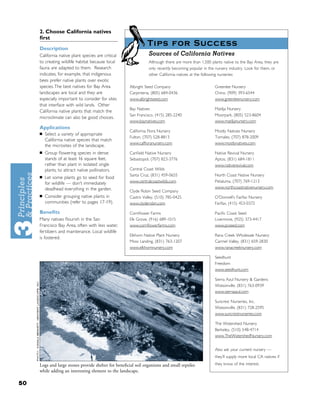
BAY-FRIENDLY
LANDSCAPE GUIDELINES


Sustainable Practices
    for the Landscape Professional
BAY-FRIENDLY
LANDSCAPE GUIDELINES
Sustainable Practices
for the Landscape Professional


                       “A thing is right
                when it tends to preserve the integrity,
                            stability and beauty of the
                                     biotic community.”
                                  SOURCE: ALDO LEOPOLD, A SAND COUNTY ALMANAC
hese Bay-Friendly Landscape Guidelines are written for the professional

  T               landscape industry to offer an integrated approach to environmentally friendly
                  landscaping.
                                                                                                                       Disclaimer:
                                                                                                                       The information in these Guidelines
                                                                                                                       is provided for consideration by
                                                                                                                       landscape professionals in the
                                                                                                                       course of designing, constructing
The Guidelines are organized around seven principles for protecting the environment. By                                and maintaining new or existing
                                                                                                                       landscapes. It is presented as a
viewing the landscape through the lens of these seven principles, we can see it in a                                   public service by the Alameda
                                                                                                                       County Waste Management and
different light, such as how plant selection can create or decrease waste or how soil                                  Recycling Board in an attempt to
                                                                                                                       support environmental benefits and
preparation can prevent or increase runoff. There are fifty-five practices listed under these                            reduce costs. The practices in these
seven principles. The practices themselves each include many examples of applications.                                 Guidelines are strictly for use on a
                                                                                                                       voluntary basis. They are not a
The applications are meant to be a starting point but are not meant to be                                              substitute for the exercise of sound
                                                                                                                       judgment in particular circum-
comprehensive. It is likely that there are many additional applications for each.                                      stances and are not intended as
                                                                                                                       recommendations for particular
                                                                                                                       products or services.
On the other hand, some of the practices are repeated under different principles because
one practice can be integral to more than one principle. In other words, there are a number of critical practices that
can protect the environment in more than one way. Using mulch, for example, reduces waste, nurtures the soil,
conserves water, and creates wildlife habitat

The Bay-Friendly principles, practices, and applications included in these Guidelines were selected with guidance from
landscape architects and designers, contractors, and experts in the many fields represented in these Guidelines, as well
as representatives from local public agencies and the staff of StopWaste.Org.

Bay-Friendly Landscaping is a program of StopWaste.Org.


Acknowledgements
Development Team
Teresa Eade, Senior Program Manager            Cynthia Havstad, Program Manager                    David Gilmore, Graphic Designer
StopWaste.Org, teade@StopWaste.Org             StopWaste.Org, chavstad@StopWaste.Org               david@outrightradio.org


Special thanks go to the following landscape professionals and agency representatives for their input, review and commitment to the
completion of these guidelines:

Michael Baefsky                                Christine Finch, Susan Handjian & David Langridge   Jim Scanlin
Baefsky & Associates                           East Bay Municipal Utility District                 Alameda Countywide Clean Water Program

Katrine Benninger                              Geoff Hall                                          Glen Schneider
Katrine Benninger Landscape Design             Sentient Landscape, Inc.                            Glen Schneider Landscape

Michael Boland                                 Doug Johnson                                        Chris Shein
Presidio Trust                                 California Invasive Plant Council                   Wildheart Gardens

Jake Cacciato                                  Manual Gonzales                                     Nate Silin
Jensen Corporation Landscape Contractors       Cagwin & Dorward                                    New Growth Landscape

Rebecca Coffman                                Greg Harrington                                     Mr. Burt Tanoue
Design Works                                   UC Berkeley                                         Office of Cheryl Barton

Shauna Cozad & Karen Wikler                    Jerry Koch                                          Michael Thilgen
UC Cooperative Extension, Alameda County       City of Berkeley                                    Four Dimensions Landscape Co.

Tanya Drlik                                    George Pacheco                                      COVER PHOTOS: TOP LEFT AND CENTER RIGHT:
                                                                                                   MICHAEL THILGEN, FOUR DIMENSIONS LANDSCAPE
Bio-Integral Resource Center                   Pacheco Brothers Gardening                          CO. TOP RIGHT: SUSAN REYNOLDS PHOTOGRAPHY.
                                                                                                   BOTTOM RIGHT: JANE HUBER.

Sharon Farrell & Tamara Shulman                Bob Perry, Professor Emeritus                       PRINTED ON 100% RECYCLED-CONTENT PAPER,
                                                                                                   50% POST-CONSUMER, BY NEW LEAF,
Aquatic Outreach Institute                     Cal Poly, Pomona                                    REINCARNATION MATTE.
(now called The Watershed Project)
                                                                                                   JANUARY 2008 (3RD EDITION)
Table of Contents

   Chapter 1
           Introduction to Bay-Friendly Landscaping                                                                                                                                2
   Chapter 2
           Bay-Friendly Landscaping Menu of Best Practices                                                                                                                         9
   Chapter 3
           Bay-Friendly Landscaping Principles and Practices                                                                                                                      12
                         1   Landscape Locally . . . . . . . . . . . . . . . . . . . . . . . . . . . . . . . . . . . . . . . . . . . . . . . . . . . . . . . . . . . . .    13
                         2   Landscape for Less to the Landfill . . . . . . . . . . . . . . . . . . . . . . . . . . . . . . . . . . . . . . . . . . . . . . .                20
                         3   Nurture the Soil . . . . . . . . . . . . . . . . . . . . . . . . . . . . . . . . . . . . . . . . . . . . . . . . . . . . . . . . . . . . . .   27
                         4   Conserve Water . . . . . . . . . . . . . . . . . . . . . . . . . . . . . . . . . . . . . . . . . . . . . . . . . . . . . . . . . . . . . .     34
                         5   Conserve Energy . . . . . . . . . . . . . . . . . . . . . . . . . . . . . . . . . . . . . . . . . . . . . . . . . . . . . . . . . . . . . .    38
                         6   Protect Water & Air Quality . . . . . . . . . . . . . . . . . . . . . . . . . . . . . . . . . . . . . . . . . . . . . . . . . . . .            41
                         7   Create & Protect Wildlife Habitat . . . . . . . . . . . . . . . . . . . . . . . . . . . . . . . . . . . . . . . . . . . . . . .                49


   Chapter 4
           Bay-Friendly Landscape Scorecard                                                                                                                                       52
   Chapter 5
           How to Start Landscaping in a Bay-Friendly Way                                                                                                                         60


                Table of Ti p s
    •   Soil Texture by Feel . . . . . . . . . . . . . . . . . . . . . . . . . . . . . . . . . . . . 14
                                                                                                                                                      Survey Says...
    •   Fire-Resistant Plants . . . . . . . . . . . . . . . . . . . . . . . . . . . . . . . . . . . 15                                      The results of a phone survey of
    •   Using Salvaged Materials in the Landscape . . . . . . . . . . . . . . . . 26
                                                                                                                                         Alameda County residents are quoted
    •   Indicators of Quality Compost . . . . . . . . . . . . . . . . . . . . . . . . . . 30
    •   Sheet Mulching . . . . . . . . . . . . . . . . . . . . . . . . . . . . . . . . . . . . . . . 31                                  throughout the Bay-Friendly Landscape
    •   Compost Tea . . . . . . . . . . . . . . . . . . . . . . . . . . . . . . . . . . . . . . . . . 32                                 Guidelines.
    •   OMRI . . . . . . . . . . . . . . . . . . . . . . . . . . . . . . . . . . . . . . . . . . . . . . . 33
    •   Rebates for Irrigation Upgrades . . . . . . . . . . . . . . . . . . . . . . . . . 37                                                 Evans McDonough Company, Inc.
    •   Shade Effectiveness in Parking Lots . . . . . . . . . . . . . . . . . . . . . . 39                                               randomly selected more than 500
    •   Attracting Beneficial Insects . . . . . . . . . . . . . . . . . . . . . . . . . . . . 44
                                                                                                                                         single-family residents with questions
    •   Pervious Concrete . . . . . . . . . . . . . . . . . . . . . . . . . . . . . . . . . . . . 47
    •   Using Dry Wells to Capture Water                                                                                                 about their use of, and interest in,
        from Downspouts . . . . . . . . . . . . . . . . . . . . . . . . . . . . . . . . . . . . 48                                       Bay-Friendly landscaping practices.
    •   Sources of California Natives . . . . . . . . . . . . . . . . . . . . . . . . . . . 50
    •   Flowering Periods of Plants that Attract Beneficial Insects . . . 51                                                              Conclusions about their opinions and
    •   Guide Your Clients through a Transition Period . . . . . . . . . . . . 62                                                        practices are presented wherever you
    •   Bringing Bay-Friendly Landscaping to
                                                                                                                                         see the heading: Survey Says…
        Public Sector Projects . . . . . . . . . . . . . . . . . . . . . . . . . . . . . . . . . 65
INTRODUCTION


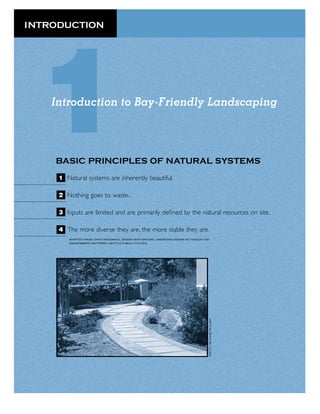
    Introduction to Bay-Friendly Landscaping


    BASIC PRINCIPLES OF NATURAL SYSTEMS                                                     *


     1 Natural systems are inherently beautiful.

     2 Nothing goes to waste.

     3 Inputs are limited and are primarily defined by the natural resources on site.

     4 The more diverse they are, the more stable they are.
         ADAPTED FROM: DAVID MCDONALD, DESIGN WITH NATURE: LANDSCAPE DESIGN AS THOUGH THE
         ENVIRONMENT MATTERED, SEATTLE PUBLIC UTILITIES.
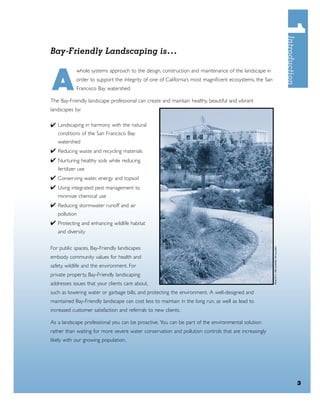
Bay-Friendly Landscaping is. . .


A
            whole systems approach to the design, construction and maintenance of the landscape in
            order to support the integrity of one of California’s most magnificent ecosystems, the San
            Francisco Bay watershed.

The Bay-Friendly landscape professional can create and maintain healthy, beautiful and vibrant
landscapes by:

✔ Landscaping in harmony with the natural
   conditions of the San Francisco Bay
   watershed
✔ Reducing waste and recycling materials
✔ Nurturing healthy soils while reducing
   fertilizer use
✔ Conserving water, energy and topsoil
✔ Using integrated pest management to
   minimize chemical use
✔ Reducing stormwater runoff and air
   pollution
✔ Protecting and enhancing wildlife habitat
   and diversity


For public spaces, Bay-Friendly landscapes
embody community values for health and
safety, wildlife and the environment. For
private property, Bay-Friendly landscaping
addresses issues that your clients care about,
such as lowering water or garbage bills, and protecting the environment. A well-designed and
maintained Bay-Friendly landscape can cost less to maintain in the long run, as well as lead to
increased customer satisfaction and referrals to new clients.

As a landscape professional you can be proactive. You can be part of the environmental solution
rather than waiting for more severe water conservation and pollution controls that are increasingly
likely with our growing population.


                                                                                                        3
Conventional Landscaping
                                                                    Keeping plant debris on-site can:
    Commercial, public and residential landscapes can
    benefit the owner and the community through their                ■ Foster living soils
    beauty, the recreation they offer, and their positive           ■ Increase the organic matter in the soil
    environmental effects. Trees, for example, can provide          ■ Improve soil structure and reduce compaction


    shade and reduce energy consumption, absorb                     ■ Retain and restore topsoil

    greenhouse gases, reduce stormwater runoff and add to           ■ Create healthier plants

    property values.                                                ■ Reduce the need for irrigation, fertilizers and


    On the other hand, landscaping can cause damage to                 pesticides
    the environment, consuming fossil fuels, contributing to        ■ Conserve landfill space

    pollution of the soil, air and water, and burdening landfill     ■ Reduce air pollution and the emission of

    space.                                                             greenhouse gases from transporting plant
    Conventional landscaping often relies on large lawns,              debris long distances to be processed or
    non-native plants, abundant irrigation, and heavy use of           landfilled
                                                                    ■ Reduce greenhouse gas emissions caused by
    fertilizers and pesticides. It frequently requires significant
    mowing, blowing, trimming and removal of plant debris.             plant debris decomposing without oxygen in
                                                                       landfills
    Removing all plant debris from the site is one example          ■ Restore the soil’s ability to absorb and filter
    of an especially damaging practice. It removes food and            water, improving water quality and reducing
    habitat for birds, insects and beneficial soil organisms. It        stormwater runoff into local creeks and the
    mines our local soils of nutrients and degrades soil               San Francisco Bay
    health. Often, the result is an increased dependency on         While it may not be possible to keep all plant
    fertilizers and irrigation, as well as greater stormwater       debris on site, there are more opportunities to
    runoff, erosion, pollution of the Bay and global warming.       reuse plant debris in our landscapes than are
                                                                    commonly practiced.


                       “To continue working with standard landscape practices is to
                       continue to poison the earth. Reducing resource consumption and waste output
                       are things we must learn to do.We have no choice but to adopt ecologically
                       friendly techniques if we wish to thrive in the long term.”
    — Michael Thilgen, Landscape Architect and Contractor,
      Four Dimensions Landscape Company, Oakland


                                                                                    SurveySays...
                  “Our urban landscapes are                                     Almost 90% of single-family
                  really a major cause of environmental                         households agree or strongly
                  degradation and depletion.”                                   agree with the statement:
                  — Bob Perry, Landscape Architect,                             “Lawn and garden products
                    Professor Emeritus Cal Poly, Pomona                         can have an impact on the
                                                                                water in the bay”.


4
Why is Bay-Friendly
Landscaping Important?
Over the last two decades, there has been a significant
reduction in plant debris landfilled in the San Francisco Bay           “Landscape waste
Area, due in large part to residential recycling programs and          is an unused resource, a
because tens of thousands of households practice backyard              misapplied nutrient.”
composting. This positive trend reflects the interest of                — Geoff Hall, Co-Founder,
residents in recycling plant debris and reducing waste.                Sentient Landscape, Inc., Sebastapol
But more needs to be done, as tons of plant debris are still
thrown away each year. Twenty-three states have banned or
limited the disposal of plant debris in their landfills; however
California has not and statewide, 2.7 million tons of plant
                                                                             Plant Debris Disposal
debris are landfilled each year. Leaves and clippings alone are
sixth out of the ten most prevalent material types in
California’s overall disposal waste system. In Alameda County                                          Single-Family 15%
alone 110,000 tons of plant debris are still landfilled each year,
much of which passes through the hands of a professional
landscaper.                                                                                                     Multi-Family 9%
Other types of waste, including plastics and hazardous wastes,
are also generated by conventional landscaping practices.The
horticultural industry in the US throws away almost a half-
billion pounds of greenhouse film, plastic pots and plastic                                                    Commercial 13%
groundcover each year. Annual disposal of leftover pesticides
used by residents costs tens of thousands of dollars for each
Bay Area County — and only a fraction of the pesticides are            Self-Haul 53%             Roll-Off 10%
disposed of properly.
Bay-Friendly landscaping minimizes the use of plastics and
                                                                           Source: Alameda County, Year 2000
pesticides, and diverts plant debris from the landfill by
                                                                                      109,393 tons
preventing waste in the first place through careful plant
selection, watering and fertilizing or reusing plant material
through grasscycling, mulch and compost.
Because generating plant debris is linked to a wide range of
landscaping practices — such as watering and fertilizing — this
integrated solution is essential.


“For the landscaping industry                            to perpetuate
itself, we have to answer some nagging questions. The number one
question is, what are we going to do with all this waste we generate?”
— Manual L. Gonzales, Director of Training, Cagwin & Dorward, Novato


                                                                                                                                  5
The Link Between Wastesheds and Watersheds...
    Returning organic matter to the soil, in the form of plant debris,
    is the link between protecting our watershed and conserving
    landfill space.
    In healthy landscapes, water from rain or irrigation percolates
    through soil that is rich in organic matter and alive with
    organisms. Living soils absorb and retain much of the water
    while also filtering out pollutants before the water reaches the
    aquifer or watershed.
    For the most part, conventional landscapes no longer provide
    this cleansing function because...

    1. Rooftops, asphalt, cement, and
       other impervious surfaces, on
                                            4. And once in the stormdrain,
                                               the water is not treated!           The EPA has              listed
       the one hand, prevent much of        5. From stormdrains, the polluted      all creeks in the San Francisco
       the water from ever reaching            runoff flows directly into creeks    Bay Area as impaired due to
       the soil.                               and rivers, which are themselves    the pesticide diazinon.
    2. On the other hand, urban soils          important resources for             SOURCE: PROBLEM PESTICIDES, BAY AREA WATER POL-
                                                                                   LUTION PREVENTION AGENCIES, 2001.
       that have been mined of                 supporting the diverse and
       organic matter, compacted,              complex array of Bay Area
       eroded, and treated with                natural ecosystems.
       chemicals are often lifeless and     6. And, all creeks and rivers in our
       no longer able to function              watershed flow to the wetlands
       naturally — they have lost their        and the San Francisco Bay,
       ability to absorb much water or         where the contaminated water
       to filter pollutants out of the          again harms fish and other
       water.                                  wildlife and can cause illness in
    3. Water from irrigation and               humans.
       rainfall then washes pesticides,
       fertilizers, plant debris, pet
       waste, heavy metals, spilled
       motor oil and other
       contaminants from lawns,
       gardens, roads and parking lots
       into gutters and stormdrains.


      What is a Wasteshed?                                        What is a Watershed?
      A wasteshed is all the land in a region from which          A watershed is all the land in a region from which
      waste is collected and hauled into a common                 water collects and drains into a common creek,
      landfill.                                                    river, lake or bay.


6
The Link between Bay-Friendly Landscaping and Global Warming
We are experiencing global warming and there is now          You may be required to deal with the problems
“unprecedented certainty” that this is due to                associated with:
greenhouse gases that are emitted into the
                                       1                     ■   Planting and hardiness zones that are changing
atmosphere when we burn fossil fuels. Average
temperatures are increasing, rain patterns are changing
                                                             ■   Plants that are leafing out and blooming earlier
and extreme weather events, including heavy                  ■   Birds and butterflies that are breeding and migrating
downpours and floods, heat waves and drought, are                 earlier
becoming more frequent.                                      ■   Wildlife species that are shifting their ranges
If you professionally design, install and manage             Studies indicate, for example, that increasing
landscapes, the climate changes due to global warming        temperatures could make aphids capable of producing
will create new challenges to the way you do business,       more than 1 million offspring in 2 months — up from
and the expertise your clients will need from you.           the 300,000 that they can currently produce. Drought-
Conventional landscaping practices that contribute to        stressed plants are more attractive to aphids and
global warming, by relying on coal, oil and natural gas      susceptible to disease. Tough, invasive pest plants are
for powering equipment, transporting landscape               expected to be able to exploit new conditions and
materials and waste over long distances, manufacturing       expand their spread. Plant species native to the San
pesticides and fertilizers, pumping and using water in       Francisco Bay Area may find the conditions to which
the landscape may become increasingly subject to local,      they have adapted changing dramatically. It may
state and federal regulations, and less attractive to your   become more difficult to help your clients provide
clients.                                                     habitat and food for wildlife, as butterfly caterpillars
Additionally, the consequences of global warming will        emerge before the leaves of their host plants, or bees
clearly impact the landscaping expertise needed to           arrive too early or late to feed on the flowers that
differentiate your business in the marketplace.              provide them with food.

Put on your garden gloves and fight global warming
You can distinguish yourself in the marketplace by preparing to deal with
landscape problems associated with global warming and by becoming part              How Bay-Friendly
of the solution. The practices detailed in these Bay-Friendly Landscape             Landscaping Reduces
Guidelines are effective steps toward a solution to the problem of global           Greenhouse Gases
warming. Direct and immediate ways to reduce the impact of the
landscapes you design, install or maintain, include:                                Less organic matter transported
■ Keeping yard waste out of landfills where it decomposes anaerobically,                         = less CO2
   releasing methane                                                                Less organic debris in the landfill
■ Decreasing the burning of fossil fuels by:                                                = less CH4
   • Keeping plant debris on site by grasscycling, mulching and composting          Reduced mowing & trimming
   • Using hand-powered tools or equipment powered by biofuels                                  = less CO2
   • Carpooling and careful planning of routes
                                                                                    Fewer fertilizers & pesticides
   • Irrigating efficiently
                                                                                                = less N20 & CO2
   • Reducing lawn size
   • Selecting low maintenance and drought- tolerant California native              Reduced water consumption
      plants                                                                                    = less CO2
■ Nurturing the soil to maintain its ability to store carbon, by:
                                                                                    Increased soil organic matter
   • Efficiently using natural fertilizers as a source of nitrogen
                                                                                                = less CO2
   • Building the organic matter content of the soil
   • Minimizing site and soil disturbance
   • Protecting the soil from compaction
■ Planting and protecting trees                                                     1
                                                                                        INTERGOVERNMENTAL PANEL ON CLIMATE CHANGE.


                                                                                                                                     7
Returning organic matter to the soil…
    …is again key to protecting our environment. Just as managing plant debris as if it is a resource and not a waste
    product can be the link between protecting our watersheds and conserving our resources, so too is this
    approach critical to reducing the emission of greenhouse gases that contribute to global warming. Consider the
    practices listed on the previous page that are related to the management of landscape trimmings and grass
    clippings. You can provide your clients with the most advanced, comprehensive approach to fighting global
    warming by using sound, effective soil-building strategies.


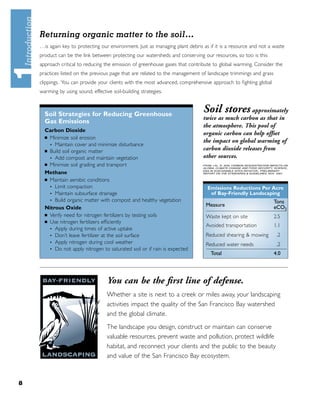
      Soil Strategies for Reducing Greenhouse
                                                                               Soil stores approximately
                                                                               twice as much carbon as that in
      Gas Emissions
                                                                               the atmosphere. This pool of
      Carbon Dioxide
                                                                               organic carbon can help offset
      ■ Minimize soil erosion
                                                                               the impact on global warming of
        • Maintain cover and minimize disturbance
      ■ Build soil organic matter
                                                                               carbon dioxide releases from
        • Add compost and maintain vegetation                                  other sources.
      ■ Minimize soil grading and transport                                    FROM: LAL, R, SOIL CARBON SEQUESTRATION IMPACTS ON
                                                                               GLOBAL CLIMATE CHANGE AND FOOD SECURITY, SCIENCE,
                                                                               2004 IN SUSTAINABLE SITES INITIATIVE, PRELIMINARY
      Methane                                                                  REPORT ON THE STANDARDS & GUIDELINES, NOV. 2007.

      ■ Maintain aerobic conditions

        • Limit compaction                                                       Emissions Reductions Per Acre
        • Maintain subsurface drainage                                            of Bay-Friendly Landscaping
        • Build organic matter with compost and healthy vegetation                                                      Tons
                                                                                Measure                                 eCO2
      Nitrous Oxide
      ■ Verify need for nitrogen fertilizers by testing soils
                                                                                Waste kept on site                      2.5
      ■ Use nitrogen fertilizers efficiently
                                                                                Avoided transportation                  1.1
        • Apply during times of active uptake
        • Don’t leave fertilizer at the soil surface                            Reduced shearing & mowing                 .2
        • Apply nitrogen during cool weather                                    Reduced water needs                       .2
        • Do not apply nitrogen to saturated soil or if rain is expected
                                                                                   Total                                4.0


                                    You can be the first line of defense.
                                    Whether a site is next to a creek or miles away, your landscaping
                                    activities impact the quality of the San Francisco Bay watershed
                                    and the global climate.
                                    The landscape you design, construct or maintain can conserve
                                    valuable resources, prevent waste and pollution, protect wildlife
                                    habitat, and reconnect your clients and the public to the beauty
                                    and value of the San Francisco Bay ecosystem.


8
Chapter TWO


  Bay-Friendly Landscaping
                 Menu of Best Practices


                                          9
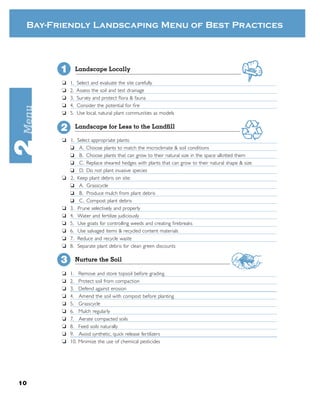
Bay-Friendly Landscaping Menu of Best Practices


       1        Landscape Locally

       ❏   1.    Select and evaluate the site carefully
       ❏   2.    Assess the soil and test drainage
       ❏   3.    Survey and protect flora & fauna
       ❏   4.    Consider the potential for fire
       ❏   5.    Use local, natural plant communities as models


       2        Landscape for Less to the Landfill

       ❏ 1.      Select appropriate plants:
         ❏        A. Choose plants to match the microclimate & soil conditions
         ❏        B. Choose plants that can grow to their natural size in the space allotted them
         ❏        C. Replace sheared hedges with plants that can grow to their natural shape & size
         ❏        D. Do not plant invasive species
       ❏ 2.      Keep plant debris on site:
         ❏        A. Grasscycle
         ❏        B. Produce mulch from plant debris
         ❏        C. Compost plant debris
       ❏ 3.      Prune selectively and properly
       ❏ 4.      Water and fertilize judiciously
       ❏ 5.      Use goats for controlling weeds and creating firebreaks
       ❏ 6.      Use salvaged items & recycled content materials
       ❏ 7.      Reduce and recycle waste
       ❏ 8.      Separate plant debris for clean green discounts

       3        Nurture the Soil

       ❏   1.    Remove and store topsoil before grading
       ❏   2.    Protect soil from compaction
       ❏   3.    Defend against erosion
       ❏   4.    Amend the soil with compost before planting
       ❏   5.    Grasscycle
       ❏   6.    Mulch regularly
       ❏   7.    Aerate compacted soils
       ❏   8.    Feed soils naturally
       ❏   9.    Avoid synthetic, quick release fertilizers
       ❏   10.   Minimize the use of chemical pesticides


10
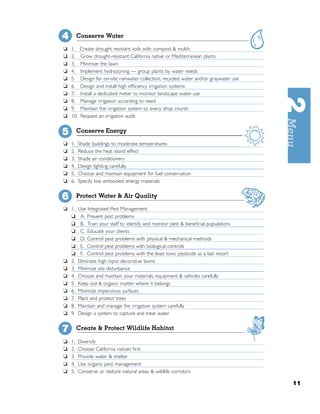
4        Conserve Water

❏   1.    Create drought resistant soils with compost & mulch
❏   2.    Grow drought-resistant California native or Mediterranean plants
❏   3.    Minimize the lawn
❏   4.    Implement hydrozoning — group plants by water needs
❏   5.    Design for on-site rainwater collection, recycled water and/or graywater use
❏   6.    Design and install high efficiency irrigation systems
❏   7.    Install a dedicated meter to monitor landscape water use
❏   8.    Manage irrigation according to need
❏   9.    Maintain the irrigation system so every drop counts
❏   10.   Request an irrigation audit


5        Conserve Energy

❏   1.    Shade buildings to moderate temperatures
❏   2.    Reduce the heat island effect
❏   3.    Shade air conditioners
❏   4.    Design lighting carefully
❏   5.    Choose and maintain equipment for fuel conservation
❏   6.    Specify low embodied energy materials


6        Protect Water & Air Quality

❏ 1.      Use Integrated Pest Management:
  ❏        A. Prevent pest problems
  ❏        B. Train your staff to identify and monitor pest & beneficial populations
  ❏        C. Educate your clients
  ❏        D. Control pest problems with physical & mechanical methods
  ❏        E. Control pest problems with biological controls
  ❏        F. Control pest problems with the least toxic pesticide as a last resort
❏ 2.      Eliminate high input decorative lawns
❏ 3.      Minimize site disturbance
❏ 4.      Choose and maintain your materials, equipment & vehicles carefully
❏ 5.      Keep soil & organic matter where it belongs
❏ 6.      Minimize impervious surfaces
❏ 7.      Plant and protect trees
❏ 8.      Maintain and manage the irrigation system carefully
❏ 9.      Design a system to capture and treat water


7        Create & Protect Wildlife Habitat

❏   1.    Diversify
❏   2.    Choose California natives first
❏   3.    Provide water & shelter
❏   4.    Use organic pest management
❏   5.    Conserve or restore natural areas & wildlife corridors

                                                                                         11
Chapter THREE


     Bay-Friendly Landscaping
                   Principles and Practices


                                        15
                                                      16


                                       14

                                                                17
                     12                  13


                          11                                                                               2

                                                           9
                                                                                                                              1
                                                                                                               3
                                                                        8
                                                                                                 4


                                                 10


                                                                              7

                                                                                                     5


                                                                              6


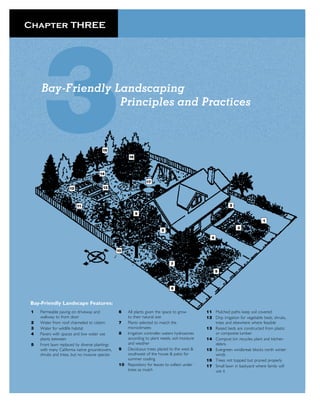
Bay-Friendly Landscape Features:
 1   Permeable paving on driveway and            6  All plants given the space to grow        11 Mulched paths keep soil covered
     walkway to front door                          to their natural size                     12 Drip irrigation for vegetable beds, shrubs,
 2   Water from roof channeled to cistern        7  Plants selected to match the                 trees and elsewhere where feasible
 3   Water for wildlife habitat                     microclimates                             13 Raised beds are constructed from plastic
 4   Pavers with spaces and low water use        8  Irrigation controller waters hydrozones      or composite lumber
     plants between                                 according to plant needs, soil moisture   14 Compost bin recycles plant and kitchen
 5   Front lawn replaced by diverse plantings       and weather                                  debris
     with many California native groundcovers,   9  Deciduous trees placed to the west &      15 Evergreen windbreak blocks north winter
     shrubs and trees, but no invasive species      southwest of the house & patio for           winds
                                                    summer cooling                            16 Trees not topped but pruned properly
                                                 10 Repository for leaves to collect under    17 Small lawn in backyard where family will
                                                    trees as mulch                               use it
1. Landscape Locally


B
         ay-Friendly landscaping recognizes that our landscapes, whether they are commercial, institutional,
         residential or open space, are part of the larger ecosystem of the San Francisco Bay Area. It does not
         mean that the landscape must be wild and uncontrolled, but rather on the whole, it respects the natural
attributes of our region and contributes to the health, diversity and sustainability of the San Francisco Bay
ecosystem.
In return, many of the natural processes of a well functioning ecosystem, like nutrient cycling, can then benefit the
landscape you design, construct or maintain. In addition, your clients are re-connected to nature through their
landscapes, in one of the world’s most renowned environments.

1. Select and evaluate the site
carefully
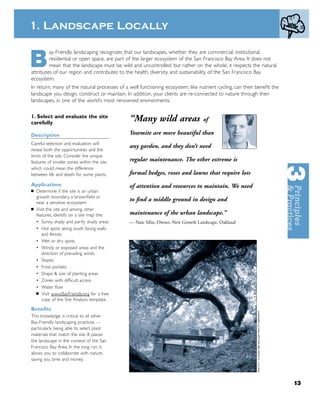
                                              “Many wild areas                  of

Description                                   Yosemite are more beautiful than
Careful selection and evaluation will
                                              any garden, and they don’t need
reveal both the opportunities and the
limits of the site. Consider the unique
features of smaller zones within the site,    regular maintenance. The other extreme is
which could mean the difference
between life and death for some plants.       formal hedges, roses and lawns that require lots
Applications                                  of attention and resources to maintain. We need
■   Determine if the site is an urban
    growth boundary, a brownfield or
    near a sensitive ecosystem
                                              to find a middle ground in design and
■   Visit the site and among other
    features, identify on a site map the:     maintenance of the urban landscape.”
    • Sunny, shady and partly shady areas     — Nate Silin, Owner, New Growth Landscape, Oakland
    • Hot spots along south facing walls
       and fences
    • Wet or dry spots
    • Windy or exposed areas and the
       direction of prevailing winds
    • Slopes
    • Frost pockets
    • Shape & size of planting areas
    • Zones with difficult access
    • Water flow
    ■ Visit www.BayFriendly.org for a free
       copy of the Site Analysis template.

Benefits
This knowledge is critical to all other
Bay-Friendly landscaping practices —
particularly being able to select plant
materials that match the site. It places
the landscape in the context of the San
Francisco Bay Area. In the long run, it
allows you to collaborate with nature,
saving you time and money.


                                                                                                                       13
2. Assess the soil and test drainage
     Description                                         ■    Check for compaction zones with
     Know the soil: its organic matter, fertility,            probes, augers or shovels. Test
     texture, and structure. Identify problems                drainage in several spots.
                                                         ■    Sample the soil from different zones
     such as compaction layers, poor
     drainage, or contamination with heavy                    in the landscape - and remember that
                                                              different plants have different nutrient
     metals, salts or toxic compounds. This
                                                              requirements. Send soil samples for
     knowledge will help you determine the
                                                              an analysis of the soil pH, organic
     soil quality, the types of plants it can best            matter, nutrients and potential
     support and any need for supplements.                    contaminants.
                                                         ■   Identify soil characteristics on a site
     Applications                                                                                        Benefits
     ■
                                                              map.
         Locate the landscape site on a soil                                                             Understanding the soil is also critical to
                                                         ■   Do an initial soil analysis, and then
         survey map (available from the local                                                            landscaping in an environmentally friendly
         library or the USDA Natural                          annually during the transition to a
                                                                                                         manner. Plants are more likely to be
         Resource Conservation Service at                     Bay-Friendly landscape, and also:
                                                                                                         placed appropriately and fertilizers used
         www.baysavers.org).                                 • When planning a renovation                only as needed.
     ■   Review site grading specifications.                  • When experiencing ongoing
     ■   Visit the site and take handfuls of the                 problems
         soil to determine the texture by feel.          ■   Watch the weeds. Clover, in turf, for
                                                                                                         3. Survey and protect
                                                              example suggests a need for nitrogen.
                                                                                                         flora & fauna
                                                                                                         Description
                                                                                                         Existing flora and fauna provide insight
                                                                                                         into the ecosystem health and the
                                                                                                         landscape possibilities. Native vegetation,
                                                                                                         wildlife habitat & sensitive areas such as
                                                                                                         wetlands may need protection. Invasive
                  Tips for Success                                                                       species will need active control.
                   Soil Texture by Feel                                                                  Applications
         Take a 1or 2-tablespoon sample of soil into your hand. Slowly add water and                     ■   Identify plant species and communities,
         knead the sample until moist. Try to form the sample into a ball. Squeeze it to                      especially California natives, invasive or
         see if you can make a cast (an impression of your fingers). Gently stretch the                        endangered species and wetlands.
         soil out between your thumb and forefinger and try and make a ribbon. Note                       ■   Learn what wildlife inhabit or move
         the feel of the soil as you are working it and use the table below to determine                      through the site or have historically
         its texture:                                                                                         inhabited the site. Consider what they
                                                                                                              used for food and shelter. Plan for
         Characteristics of Soil Sample                                      Soil Texture
                                                                                                              restoration.
         Soil will not stay in a ball. Loose and single-grained with           Sand                      ■   Ask your clients to identify plants that
         a gritty feeling when moistened.                                                                     are of value to them.
                                                                                                         ■   Become familiar with local tree
         A cast will form but it can’t be handled without breaking             Loamy sand                     ordinances and wetland or
         and will not form into a ribbon. Soil feels slightly gritty.                                         endangered species regulations.
                                                                                                         ■   Develop a plan for preserving existing
         A short ribbon can be formed but breaks when about                    Loam
                                                                                                              trees and shrubs or engage the
         1/2 inch long                                                                                        services of a certified arborist to help
                                                                                                              you create the plan.
         A ribbon can be formed. The ribbon is moderately                      Clay loam
         strong until it breaks at about 3/4 inch length. Soil feels                                     Benefits
         slightly sticky.                                                                                Conserving or restoring local flora, fauna
                                                                                                         and habitat provides your clients with a
         The soil can easily be formed into a ribbon 1 inch or                 Clay
                                                                                                         sense of place. Native plants can make
         longer. Soil feels very sticky.                                                                 the job easier for the landscape
         ADAPTED FROM: S.J. THEIN, A FLOW DIAGRAM FOR TEACHING TEXTURE BY FEEL ANALYSIS, JOURNAL OF      professional.
         AGRON. EDU.


14
4. Consider the potential for fire
Description                                           •  Emphasize plants with low fuel
After the Oakland Hills fire of 1991,                     volume and/or high moisture
there is no doubt that the potential for                 content in planting plans.
fire in our region can be great and that               • Avoid plants with high oil content
landscaping is a critical factor.                        or that tend to accumulate
Understanding the topography, fuel and                   excessive dead wood or debris
local weather are critical to designing                  (pyrophites).
and maintaining a landscape that reduces              • Assure that trees are well-spaced
the potential for loss to fire. Plant                     and pruned to 6 feet minimum
selection is also very important to                      above ground, and that dense shrub
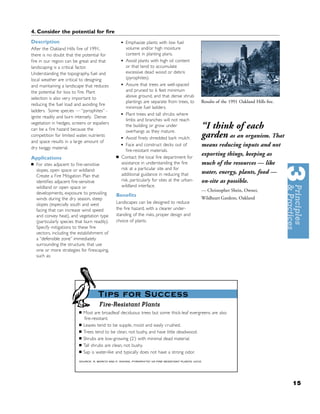
                                                         plantings are separate from trees, to        Results of the 1991 Oakland Hills fire.
reducing the fuel load and avoiding fire
                                                         minimize fuel ladders.
ladders. Some species — “pyrophites” -
ignite readily and burn intensely. Dense              • Plant trees and tall shrubs where
                                                         limbs and branches will not reach
vegetation in hedges, screens or espaliers
can be a fire hazard because the
                                                         the building or grow under
                                                         overhangs as they mature.
                                                                                                      “I think of each
competition for limited water, nutrients
                                                      • Avoid finely shredded bark mulch.              garden as an organism. That
and space results in a large amount of
dry twiggy material.
                                                      • Face and construct decks out of               means reducing inputs and not
                                                         fire-resistant materials.
                                                  ■   Contact the local fire department for
                                                                                                      exporting things, keeping as
Applications
■   For sites adjacent to fire-sensitive               assistance in understanding the fire             much of the resources — like
    slopes, open space or wildland:                   risk at a particular site and for
                                                      additional guidance in reducing that            water, energy, plants, food —
    Create a Fire Mitigation Plan that
    identifies adjacent fire-sensitive                  risk, particularly for sites at the urban-      on-site as possible.
    wildland or open space or                         wildland interface.
                                                                                                      — Christopher Shein, Owner,
    developments, exposure to prevailing          Benefits
    winds during the dry season, steep                                                                Wildheart Gardens, Oakland
    slopes (especially south and west             Landscapes can be designed to reduce
    facing that can increase wind speed           the fire hazard, with a clearer under-
    and convey heat), and vegetation type         standing of the risks, proper design and
    (particularly species that burn readily).     choice of plants.
    Specify mitigations to these fire
    vectors, including the establishment of
    a “defensible zone” immediately
    surrounding the structure, that use
    one or more strategies for firescaping,
    such as:


                                       Tips for Success
                                        Fire-Resistant Plants
                            ■   Most are broadleaf deciduous trees but some thick-leaf evergreens are also
                                fire-resistant.
                            ■   Leaves tend to be supple, moist and easily crushed.
                            ■   Trees tend to be clean, not bushy, and have little deadwood.
                            ■   Shrubs are low-growing (2’) with minimal dead material.
                            ■   Tall shrubs are clean, not bushy.
                            ■   Sap is water-like and typically does not have a strong odor.
                            SOURCE: R. MORITZ AND P. SVIHRA, PYROPHYTIC VS FIRE RESISTANT PLANTS, UCCE.


                                                                                                                                               15
5. Use local, natural plant                  San Francisco Bay Area Natural Plant Communities
     communities as models
                                                  Many local native species are excellent      Ecologists classify these groups of plants
     Description                                  landscape plants. You can imitate natural    with terms like “biotic province,”
     A plant community is a relatively distinct   processes by using the plant community       “vegetation type,” “plant community,”
     pattern of vegetation that is found in       concept to organize plantings. Blending      “plant association,” and “series.” The
     different regions of the Bay Area. Six of    the science of ecology with the practice     natural distribution of plants is very
     these local plant communities are briefly
                                                  of horticulture, you can create landscape    complex, with much overlapping of
     described in next section of these
                                                  projects that assume some of the             species, and experts disagree about the
     guidelines. It is important to also
                                                  beautiful natural qualities of our area.     fine points of grouping and
     consider that species of plants within
     these communities overlap and that they      If you choose plants in                                            nomenclature.
     change over time.                            response to the site                                              Here we use the
                                                  conditions, the new                                               term “plant
     Applications
                                                  planting will probably                                            community” to
     ■   Learn about local plant communities.
                                                  become established                                                describe a group of
     ■   Train yourself and your staff to
                                                  easily. There will be no                                          plants that recurs
         recognize local plant communities and
         to evaluate the conditions under         need for the special                                              with relative
         which the plants are succeeding.         fertilizing, pest control,                                        consistency, often
     ■   Use these communities to guide your      and heavy irrigation                                              dominated by a single
         choice in plant selection.               that have been so common in the past.        species. The Bay Area consists of many
     ■   Plant seeds of annuals to fill in with    The plants grow easily because they're       different places, from the cool, moist
         color and greenery while slower          adapted to this place - they've lived here   saltwater marshes close to the water to
         growing perennials get established.      for thousands of years! If you visit our     the hot and dry eastern ridges and
     Benefits                                      Bay Area wildlands, you will notice that a   slopes. These places support a series of
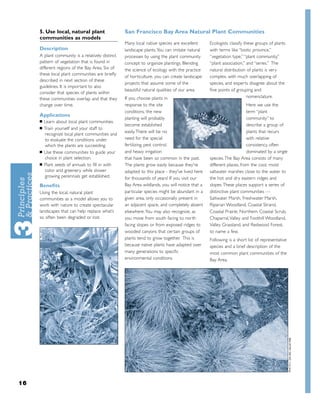
     Using the local, natural plant               particular species might be abundant in a    distinctive plant communities —
     communities as a model allows you to         given area, only occasionally present in     Saltwater Marsh, Freshwater Marsh,
     work with nature to create spectacular       an adjacent space, and completely absent     Riparian Woodland, Coastal Strand,
     landscapes that can help replace what’s      elsewhere.You may also recognize, as         Coastal Prairie, Northern Coastal Scrub,
     so often been degraded or lost.              you move from south facing to north          Chaparral,Valley and Foothill Woodland,
                                                  facing slopes or from exposed ridges to      Valley Grassland, and Redwood Forest,
                                                  wooded canyons that certain groups of        to name a few.
                                                  plants tend to grow together. This is        Following is a short list of representative
                                                  because native plants have adapted over      species and a brief description of the
                                                  many generations to specific                  most common plant communities of the
                                                  environmental conditions                     Bay Area.


16
Co mmo n P la nt Co mmuni t ie s of t he SF Ba y A re a
Coastal Prairie
  Herbaceous Perennials
    Achillea millefolium (White Yarrow)                       Valley and Foothill Woodland
    Calamagrostis nutkaensis (Reed Grass)
    Calochortus luteus (Golden Mariposa)                       Trees
    Carex tumulicola (Dwarf Sedge)                               Aesculus californica (California Buckeye)
    Danthonia californica (Wild Oat Grass)                       Arbutus menziesii (Madrone)
    Deschampsia caespitosa holciformis (Hair Grass)              Quercus agrifolia (Coast Live Oak)
    Festuca idahoensis (Fescue Bunchgrass)                       Quercus chrysolepis (Canyon Live Oak)
    Iris douglasiana (Douglas Iris)                              Quercus kellogii (Black Oak )
    Pteridium aquilinum pubescens (Bracken Fern)                 Quercus lobata (Valley Oak )
    Sisyrinchium bellum (Blue-eyed Grass)                        Quercus wislizenii (Interior Live Oak)
                                                                 Umbellularia californica (California Bay)
Northern Coastal Scrub                                         Shrubs
  Shrubs                                                         Garrya elliptica (Coast Silktassle)
    Arctostaphylos uva-ursi 'Pt. Reyes' (Manzanita)              Holodiscus discolor (Ocean Spray)
    Artemisia californica (Coast Sagebrush)                      Myrica californica (Pacific Wax Myrtle)
    Baccharis pilularis ssp. pilularis (Dwarf Coyote Brush)      Physocarpus capitatus (Ninebark)
    Baccharis pilularis var. consanguinea (Coyote Brush)         Rhamnus californica (Coffeeberry)
    Ceanothus cuneatus (Buckbrush)                               Ribes sanguineum glutinosum (Pink Current)
    Ceanothus gloriosus (Ceanothus)                              Rosa californica (California Rose)
    Cercocarpus betuloides (Mountain Mahogany)                   Sambucus mexicana (Blue Elderberry
    Diplacus aurantiacus (Monkey Flower)                         Symphoricarpos albus (Snowberry)
    Heteromeles arbutifolia (Toyon)
    Lupinus albifrons (Bush Lupine)                            Herbaceous Perennials
    Mimulus aurantiacus (Sticky Monkeyflower)                     Artemisia douglasiana (Mugwort)
    Rhamnus californica (Coffee Berry)                           Dryopteris arguta (Woodfern)
    Salvia melifera (Black Sage)                                 Festuca californica (California Fescue)
                                                                 Fragaria californica (California Strawberry)
  Herbaceous Perennials                                          Heracleum lanatum (Cow Parsnip)
    Chlorogolum pomeridianum (Soap Plant)                        Juncus patens (Common Rush)
    Epilobium canum (California Fuchsia)                         Polypodium vulgare (Polypody Fern)
    Heracleum lanatum (Cow Parsnip)                              Rubus parviflorus (Thimbleberry)
    Scrophularia californica (Bee Plant)                         Rubus vitifolius (Calif. Blackberry)
    Wyethia angustifolia (Mule's Ears)                           Satureja douglasii (Yerba Buena)
                                                                 Stachys ajugoides (Hedge Nettle)
                                                                 Tellima grandiflora (Fringe Cups)
Valley Grassland
                                                               Vines
  Herbaceous Perennials                                          Lonicera hispidula (California Honeysuckle)
    Calochortus luteus (Golden Mariposa)
    Dichelostemma capitatum (Bluedicks)
    Eschscholzia californica (California Poppy)               Riparian Woodland
    Nasella lepida (Needlegrass)
    Nasella pulchra (Purple Needlegrass)                       Trees
    Sidalcea malviflora (Checkerbloom)                            Acer macrophyllum (Bigleaf Maple)
    Sisyrinchium bellum (Blue-eyed Grass)                        Alnus rhombifolia (White Alder)
    Solidago californica (California Goldenrod)                  Platanus racemosa (Western Sycamore)
    Triteleia laxa (Ithuriel's Spear)
    Wyethia angustifolia (Mule’s Ears)                         Shrubs
                                                                 Cornus species (Creek Dogwood)
Redwood Forest                                                   Rosa californica (California Rose)
                                                                 Salix species (Red Willow)
  Trees
    Sequoia sempervirens (Redwood)
                                                               Herbaceous Perennials
                                                                 Athyrium filix-femina (Lady Fern)
                                                                 Carex species (Dwarf Sedge)
  Shrubs                                                         Equisetum species (Horsetail)
    Ceanothus thyrsiflorus (Blue Blossom)
                                                                 Juncus effusis bruneus (Green Rush)
    Corylus cornuta var. californica (Western Hazelnut)
                                                                 Mimulus cardenalis (Scarlet Monkeyflower)
    Vaccinium ovatum (Huckleberry)
                                                                 Mimulus guttatus (Monkeyflower)
                                                                 Oenanthe sarmentosa (Creek Parsley)
  Herbaceous Perennials                                          Sisyrinchium californicum (Yellow-eyed Grass)
    Adiantum jordanii (Five-finger Fern)
    Asarum caudatum (Wild Ginger)
    Athyrium filix-femina (Lady Fern)
                                                               Vines
                                                                 Aristolochia californica (Dutchman's pipe)
    Oxalis oregana (Redwood Sorrel)
                                                                 Clematis ligusticifolia (Clematis)
    Polystichum munitum (Western Sword Fern)
                                                                 Vitis californica (California Grape)
    Rubus ursinus (California Blackberry)
    Smilacina racemosa (False Solomon Seal)
    Tiarella cordifolia (Foam Flower)
    Woodwardia fimbriata (Giant Chain Fern)
                                                                                                                 17
Common Plant Communities of the SF Bay Area


                                                           Coastal Prairie
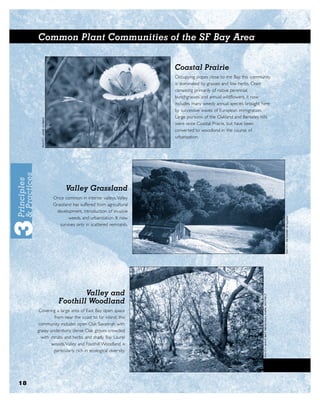
                                                           Occupying slopes close to the Bay, this community
                                                           is dominated by grasses and low herbs. Once
                                                           consisting primarily of native perennial
                                                           bunchgrasses and annual wildflowers, it now
                                                           includes many weedy annual species brought here
                                                           by successive waves of European immigration.
                                                           Large portions of the Oakland and Berkeley hills
                                                           were once Coastal Prairie, but have been
                                                           converted to woodland in the course of
                                                           urbanization.


                     Valley Grassland
              Once common in interior valleys, Valley
              Grassland has suffered from agricultural
               development, introduction of invasive
                      weeds, and urbanization. It now
                 survives only in scattered remnants.


                         Valley and
                 Foothill Woodland
      Covering a large area of East Bay open space
              from near the coast to far inland, this
     community includes open Oak Savannah with
     grassy understory, dense Oak groves crowded
       with shrubs and herbs, and shady Bay Laurel
             woods.Valley and Foothill Woodland is
              particularly rich in ecological diversity.


18
Riparian Woodland
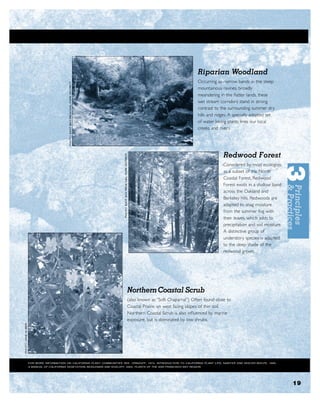
                                                                                                    Occurring as narrow bands in the steep
                                                                                                    mountainous ravines, broadly
                                                                                                    meandering in the flatter lands, these
                                                                                                    wet stream corridors stand in strong
                                                                                                    contrast to the surrounding summer dry
                                                                                                    hills and ridges. A specially adapted set
                                                                                                    of water loving plants lines our local
                                                                                                    creeks and rivers.


                                                                                                                 Redwood Forest
                                                                                                                 Considered by most ecologists
                                                                                                                 as a subset of the North
                                                                                                                 Coastal Forest, Redwood
                                                                                                                 Forest exists in a shallow band
                                                                                                                 across the Oakland and
                                                                                                                 Berkeley hills. Redwoods are
                                                                                                                 adapted to snag moisture
                                                                                                                 from the summer fog with
                                                                                                                 their leaves, which adds to
                                                                                                                 precipitation and soil moisture.
                                                                                                                 A distinctive group of
                                                                                                                 understory species is adapted
                                                                                                                 to the deep shade of the
                                                                                                                 redwood groves.


                                                          Northern Coastal Scrub
                                                          (also known as “Soft Chaparral”) Often found close to
                                                          Coastal Prairie on west facing slopes of thin soil.
                                                          Northern Coastal Scrub is also influenced by marine
                                                          exposure, but is dominated by low shrubs.


FOR MORE INFORMATION ON CALIFORNIA PLANT COMMUNITIES SEE: ORNDUFF, 1974, INTRODUCTION TO CALIFORNIA PLANT LIFE; SAWY ER AND KEELER -WOLFE, 1995,
A MANUAL OF CALIFORNIA VEGETATION; BEIDLEMAN AND KOZLOFF, 2003, PLANTS OF THE SAN FRANCISCO BAY REGION.


                                                                                                                                                    19
2. Landscape for Less to the Landfill

                educing waste starts with not generating it in the first place. Selecting the right plants for the right place, as

     R          well as watering and fertilizing judiciously are important ways to reduce the tons of plant debris that end
                up in the landfills in the Bay Area.
     Reusing plant trimmings as mulch, grasscycling, and using compost improves soils, creates healthier landscapes and in
     addition, keeps materials out of local landfills.
     Material use is an important factor in the landscape. Using recycled content, salvaged, durable or local materials
     conserves resources and can reduce the amount of embodied energy that is consumed by the landscape.
     Landscaping for less to the landfill will help you create a beautiful, relatively trouble free landscape that yields years of
     benefits for you, your client and the San Francisco Bay.


     1. Select appropriate plants

     A. Choose plants to match
     the microclimate & soil
     conditions

     Description
     Selecting the right plants is linked to
     understanding the site-specific conditions
     of the landscape. Plant selection is the
     foundation of environmentally sound
     landscaping and thus an important
     practice for meeting many of the other
     principles of Bay-Friendly landscaping.

     Applications
     ■   Select flora that is compatible with     Benefits
         the exposure, temperature, moisture,
         and soil in microsites within each      Plants are more likely to thrive, which
         particular landscape site.              reduces their susceptibility to disease
     ■   Consider appropriate plant              and other pests and their need for
         communities and how one                 fertilizers and pesticides. Water can be
         community may succeed another with      conserved. Callbacks and plant replace-
         time.                                   ment are often reduced. Debris is not
                                                 generated in the first place.


                                                 “We are trying to recycle more of our green waste
                Survey Says...                   on our sites. One major benefit is that we don't have to haul it
           75% of single-family households
           always or almost always recycle       off site to a dump. Second, it helps to cut down on worker's
           their plant waste. Recycling plant
           debris is important to your current
                                                 compensation claims from back injuries due to heavy tarps of
           customers — and potential new         material being picked up for disposal.”
           clients.
                                                 — Manuel L. Gonzales, Director of Training, Cagwin & Dorward, Novato

20
1. Select appropriate plants
B. Choose plants that can                     C. Replace sheared hedges                    D. Do not plant invasive
grow to their natural size in                 with plants that can grow to                 species
the space allotted them                       their natural shape & size

Description                                   Description                                  Description
Selecting a plant or plants to grow in        Shearing is a horticulturally unsound        Invasive plants used in landscaping often
too small a space starts a lifelong battle    practice that is labor intensive and that    escape into our natural areas, where
with the plant’s genetics, thereby inviting   encourages excessive new growth that         they can spread rapidly and out-
disease and insects, generating               can lead to unhealthy plants and             compete natives, degrade wildlife habitat
unnecessary waste or increasing the fuel      increased waste. What’s more, sheared        and increase the fuel load.
load.                                         hedges and screens have lots of
                                              deadwood under the dense green               Applications
Applications                                  crown because of the lack of light           Familiarize yourself with locally important
■   Consider the mature size and shape        reaching into the hedge. This dieback in     invasive species, some of which are listed
    of the plants you choose and place        the center of the plant increases its        on the following page, and eliminate
    them in areas that will allow them to     flammability.                                 them from the site. Sheet mulch can be
    assume their natural form.                                                             very effective for weed control. Do not
■   Avoid over-planting for instant effect.   Applications                                 plant invasive species. For more
■   Select trees with a mature height of      ■   If hedges are desired, select dense      information contact www.cal-ipc.org.
    less than 20 feet for planting near           species that will be able to grow to
    power lines.                                  their natural shapes and sizes.          Benefits
                                              ■   Reduce the number of plants in the       The cost of later pulling these species
Benefits                                           existing hedges and allow the            out of the landscape, neighboring sites
Labor, fuel and waste are likely to be            remaining plants to grow into their      and wild lands is avoided. Waste is
reduced, cutting your costs. Plant health         natural form, if their size is           reduced and ecosystem diversity is
and resistance to disease is fostered.            appropriate to the space.
                                                                                           protected.
                                              ■   Or recommend to your customers
                                                  that sheared hedges be removed and
                                                  replaced with plants that can grow to
                                                  their natural form.

                                              Benefits
                                              Your cost for the labor to regularly shear
                                              the hedges is lowered and at the same
                      “People                 time, fuel load can be decreased, waste
                                              will likely be reduced and your disposal
                      are                     bills lowered.
                      focused
on how the landscape looks                                     “Using the right plant                         in the right spot
right after planting. This                                     will minimize the level of maintenance required to
means that shrubs are planted                                  have a good looking landscape. This means taking
so tightly that they can’t reach                               into consideration the growth habits, maximum height
maturity or flower and this                                     and breadth, pests, ideal soil conditions, and water
leads to higher maintenance                                    requirements associated with the plant.
                                                               — Gary Imazumi, Interim Associate Director, Grounds, Recycling and
costs.”                                                        Refuse, and Pest Management Services, Physical Plant — Campus
— George Pacheco, Owner/President,                             Services, University of California, Berkeley
Pacheco Brothers Gardening, Hayward


                                                                                                                                         21
Avoid Invasive Garden Plants of the Greater San Francisco Bay Area
         Invasive Plants                                                 Non-Invasive Plants
          Latin Name                   Common Name                                                      Instead Try
       Carpobrotus edulis              Iceplant or Hottentot Fig         Delosperma cooperi (Hardy Iceplant) or Osteospermum fruticsum and
                                                                         hybrids (Freeway Daisy) or Drosanthemum floribundum (Showy
                                                                         Dewflower)

       Cortaderia selloana             Pampasgrass                       Chondropetalum tectorum (Cape Thatching Reed) or Muhlenbergia
                                                                         lindheimeri (Lindheimer’s Muhly Grass) or Carex spissa (San Diego
                                                                         Sedge) or Nolina bigelovii (Bigelow’s Bear Grass)

       Cotoneaster lacteus,            Cotoneaster                       Heteromeles arbutifolia and cultivars (Toyon) or Feijoa sellowiana
       C. pannosus                                                       (Pineapple Guava) or Arbutus unedo (Strawberry Tree) or Viburnum
                                                                         suspensum (Sandankwa Viburnum) or Cistrus mitis or x Citrofortunella
                                                                         microcarpa (Calamondin Orange)

       Cytisus scoparius,              Scotch, Portuguese,               Jasminum nudiflorum (Winter Jasmine) or Cornus mas (Cornelian-cherry
       C. striatus,                    Spanish or French                 Dogwood) or Kerria japonica (Japanese Kerria) or Ribes aureum
                                       Broom                             (Golden Currant) or Phlomis fructicosa (Jerusalem Sage) or
       Spartium junceum,
                                                                         Hypericum rowallane (Shrub Hypericum)
       Genista monspessulana

       Hedera helix,                   English Ivy, Algerian Ivy,        Campanula poscharskyana (Serbian Bellflower) or Trachelospermum
       H. canariensis,                 Periwinkle                        asiasticum (Ivory Star Jasmine) or
                                                                         or Rubus pentalobus (Taiwan Raspberry) or Heuchera maxima and
       Vinca major
                                                                         hybrids (Giant Alumroot) or Asarum caudatum (Wild Ginger) or
                                                                         Helleborus foetidus (Bear’s Foot Hellebore) or Bergenia cordifolia and
                                                                         hybrids (Winter Saxifrage)

       Helichrysum petiolare           Licorice Plant                    Salvia leucophylia (Coast Purple Sage) or Te u c rium fructicans and
                                                                         cultivars (Bush Germander) or Phlomis fructicosa (Jerusalem Sage) or
                                                                         Artemisia ‘Powis Castle’ or Eriogonum giganteum (St. Catherine’s
                                                                         Lace)

       Sesbania punicea                Scarlet Wisteria                  Calliandra tweedii (Brazilian Flame Bush) or Lagerstroemia species
                                                                         (Crape Myrtle) or Cassia leptophylla (Gold Medallion Tree) or Galvezi
                                                                         speciosa (Showy Island Snapdragon)
     ADAPTED FROM: DON’T PLANT A PEST! GIVE THEM AN INCH AND THEY’LL TAKE AN ACRE...., CALIFORNIA INVASIVE PEST COUNCIL

     SU GGESTED ALTERNA TI VES I N BOLD ARE CALIFORNIA NATIVE SPECIES.


                                                                                              Cal-IPC also recommends that we don’t plant the
     Invasive                                   Instead Try                                   following trees in the San Francisco Bay Area.
                                                                                              ■   Crataegus monogyna (Single seed hawthorn)
                                                                                              ■   Elaeagnus angustifolia (Russian olive)
                                                                                              ■   Eucalyptus glubulus (Blue gum eucalyptus)
                                                                                              ■   Myoporum laetum (Myoporum)
                                                                                              ■   Robinia pseudoacacia (Black locust)
                                                                                              ■   Sapium sebiferum (Chinese tallow tree)
                                                                                              ■   Schinus terebinthifolius (Brazilian peppertree)
                                                                                              ■   Sesbania punicea (Scarlet wisteria)
     Cortaderia selloana                         Muhlenbergia lindheimeri
                                                                                              ■   Tamarix species (Saltcedar)
     (Pampasgrass)                               (Lindheimer’s Muhly Grass)
     PHOTO: BRIANNA RICHARDSON, 2003
                                                 PHOTO: BLUESTEM NURSERY,
                                                 WWW.BLUESTEM.COM
                                                                                              For suggested alternatives, visit www.cal-ipc.org.

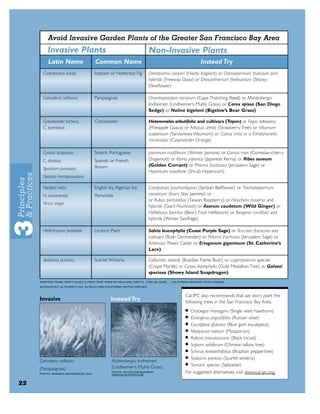
22
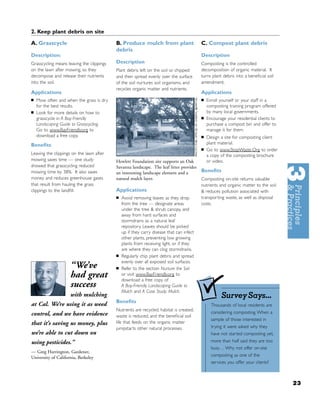
2. Keep plant debris on site

A. Grasscycle                              B. Produce mulch from plant                    C. Compost plant debris
                                           debris
Description:                                                                              Description
Grasscycling means leaving the clippings   Description                                    Composting is the controlled
on the lawn after mowing, so they          Plant debris left on the soil or chipped       decomposition of organic material. It
decompose and release their nutrients      and then spread evenly over the surface        turns plant debris into a beneficial soil
into the soil.                             of the soil nurtures soil organisms, and       amendment.
                                           recycles organic matter and nutrients.
Applications                                                                              Applications
■   Mow often and when the grass is dry                                                   ■   Enroll yourself or your staff in a
    for the best results.                                                                     composting training program offered
■   Look for more details on how to                                                           by many local governments.
    grasscycle in A Bay-Friendly                                                          ■   Encourage your residential clients to
    Landscaping Guide to Grasscycling.                                                        purchase a compost bin and offer to
    Go to www.BayFriendly.org to                                                              manage it for them.
    download a free copy.                                                                 ■   Design a site for composting client
Benefits                                                                                       plant material.
                                                                                          ■   Go to www.StopWaste.Org to order
Leaving the clippings on the lawn after                                                       a copy of the composting brochure
mowing saves time — one study              Hewlett Foundation site supports an Oak            or video.
showed that grasscycling reduced           Savanna landscape. The leaf litter provides
mowing time by 38%. It also saves          an interesting landscape element and a         Benefits
money and reduces greenhouse gases         natural mulch layer.                           Composting on-site returns valuable
that result from hauling the grass                                                        nutrients and organic matter to the soil
clippings to the landfill.                  Applications                                   & reduces pollution associated with
                                           ■   Avoid removing leaves as they drop         transporting waste, as well as disposal
                                               from the tree — designate areas            costs.
                                               under the tree & shrub canopy, and
                                               away from hard surfaces and
                                               stormdrains as a natural leaf
                                               repository. Leaves should be picked
                                               up if they carry disease that can infect
                                               other plants, preventing low growing
                                               plants from receiving light, or if they
                                               are where they can clog stormdrains.
                                           ■   Regularly chip plant debris and spread
                                               evenly over all exposed soil surfaces.
                     “We’ve                ■   Refer to the section Nurture the Soil
                     had great                 or visit www.BayFriendly.org to
                                               download a free copy of
                     success                   A Bay-Friendly Landscaping Guide to
                                               Mulch and A Case Study: Mulch.
                     with mulching                                                                   Survey Says...
                                           Benefits
at Cal. We’re using it as weed                                                                  Thousands of local residents are
                                           Nutrients are recycled, habitat is created,
control, and we have evidence                                                                   considering composting. When a
                                           waste is reduced, and the beneficial soil
                                                                                                sample of those interested in
that it’s saving us money, plus            life that feeds on the organic matter
                                           jumpstarts other natural processes.                  trying it were asked why they
we’re able to cut down on                                                                       have not started composting yet,
using pesticides.”                                                                              more than half said they are too
                                                                                                busy… Why not offer on-site
— Greg Harrington, Gardener,
University of California, Berkeley                                                              composting as one of the
                                                                                                services you offer your clients?


                                                                                                                                      23
3. Prune selectively and                                                                      4. Water and fertilize
     properly
                                                         “Water use is                             judiciously
     Description
                                                          an issue here                            Description
     Pruning should complement the natural               in California.                            Watering and fer tilizing wisely prevents
     form and strengthen the structural              Plus, when you use a lot of                   rampant plant growth that weakens the
     integrity of the plant. It should not be                                                      plants and generates plant debris.
     used to dominate plants. The labor for            water and fertilizer, that
     this type of pruning is not a cost well                                                       Applications
     spent; it never ends, weakens the plant
                                                    translates into green growth,                  There are many applications. Refer to
     and generates unnecessary plant debris.          more clippings, and more                     Nurture the Soil and Conserve Water for
                                                                                                   more info.
     Applications                                         waste. If you can tell
     ■   Use the standards from the American                                                       Benefits
         National Standards Institute for
                                                          customers, ‘Let’s just
                                                                                                   Plants are not pushed into growth over-
         proper tree pruning, including pruning         fertilize once a year,’ it                 drive. Water damage to fences and
         at the appropriate time of year. Do                                                       hardscapes is minimized. Waste is
         not top trees but rather remove                      reduces waste.”                      prevented and disposal bills are
         branches at their point of origin or
                                                      — Glen Schneider, Proprietor, Glen           decreased. Less maintenance translates
         shorten branches back to a lateral.
                                                       Schneider Gardening, Berkeley               into lower labor and fuel costs.
     ■   Prune when the plant is not under
         stress or dormant.
     ■   Ask your client to consider replacing a
         tree or shrub that requires frequent
         pruning because it has grown too
         large for its space with a species that
         will require little or no pruning.

     Benefits
     Trees and shrubs are stronger and more
     likely to resist pests. Waste is minimized.


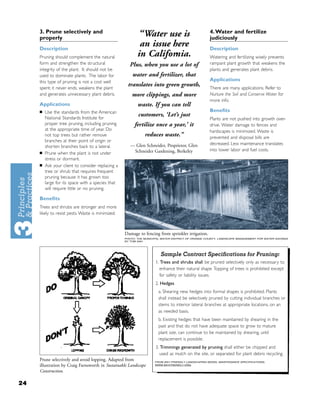
                                                   Damage to fencing from sprinkler irrigation.
                                                   PHOTO: THE MUNICIPAL WATER DISTRICT OF ORANGE COUNTY, LANDSCAPE MANAGEMENT FOR WATER SAVINGS
                                                   BY TOM ASH


                                                                       Sample Contract Specifications for Pruning:
                                                                    1. Trees and shrubs shall be pruned selectively only as necessary to
                                                                      enhance their natural shape. Topping of trees is prohibited except
                                                                      for safety or liability issues.
                                                                    2. Hedges
                                                                      a. Shearing new hedges into formal shapes is prohibited. Plants
                                                                      shall instead be selectively pruned by cutting individual branches or
                                                                      stems to interior lateral branches at appropriate locations, on an
                                                                      as needed basis.
                                                                      b. Existing hedges that have been maintained by shearing in the
                                                                      past and that do not have adequate space to grow to mature
                                                                      plant size, can continue to be maintained by shearing, until
                                                                      replacement is possible.
                                                                    3. Trimmings generated by pruning shall either be chipped and
                                                                      used as mulch on the site, or separated for plant debris recycling.
     Prune selectively and avoid lopping. Adapted from              FROM BAY-FRIENDLY LANDSCAPING MODEL MAINTENANCE SPECIFICATIONS,
     illustration by Craig Farnsworth in Sustainable Landscape      WWW.BAYFRIENDLY.ORG.

     Construction.

24
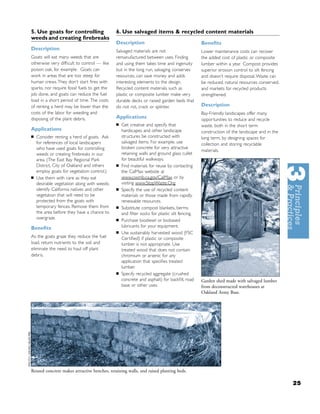
5. Use goats for controlling                  6. Use salvaged items & recycled content materials
weeds and creating firebreaks
                                              Description                                     Benefits
Description                                   Salvaged materials are not                      Lower maintenance costs can recover
Goats will eat many weeds that are            remanufactured between uses. Finding            the added cost of plastic or composite
otherwise very difficult to control — like     and using them takes time and ingenuity         lumber within a year. Compost provides
poison oak, for example. Goats can            but in the long run, salvaging conserves        superior erosion control to silt fencing
work in areas that are too steep for          resources, can save money and adds              and doesn’t require disposal. Waste can
human crews. They don’t start fires with       interesting elements to the design.             be reduced, natural resources conserved,
sparks, nor require fossil fuels to get the   Recycled content materials such as              and markets for recycled products
job done, and goats can reduce the fuel       plastic or composite lumber make very           strengthened.
load in a short period of time. The costs     durable decks or raised garden beds that
of renting a herd may be lower than the       do not rot, crack or splinter.                  Description
costs of the labor for weeding and                                                            Bay-Friendly landscapes offer many
disposing of the plant debris.                Applications                                    opportunities to reduce and recycle
                                              ■   Get creative and specify that               waste, both in the short term
Applications                                      hardscapes and other landscape              construction of the landscape and in the
■   Consider renting a herd of goats. Ask         structures be constructed with              long term, by designing spaces for
    for references of local landscapers           salvaged items. For example, use            collection and storing recyclable
    who have used goats for controlling           broken concrete for very attractive
                                                                                              materials.
    weeds or creating firebreaks in our            retaining walls and ground glass cullet
    area. (The East Bay Regional Park             for beautiful walkways.
    District, City of Oakland and others      ■   Find materials for reuse by contacting
    employ goats for vegetation control.)         the CalMax website at
■   Use them with care as they eat                www.ciwmb.ca.gov/CalMax or by
    desirable vegetation along with weeds:        visiting www.StopWaste.Org.
    identify California natives and other     ■   Specify the use of recycled content
    vegetation that will need to be               materials or those made from rapidly
    protected from the goats with                 renewable resources.
    temporary fences. Remove them from        ■   Substitute compost blankets, berms
    the area before they have a chance to         and filter socks for plastic silt fencing.
    overgraze.                                ■   Purchase biodiesel or biobased
Benefits                                           lubricants for your equipment.
                                              ■   Use sustainably harvested wood (FSC
As the goats graze they reduce the fuel           Certified) if plastic or composite
load, return nutrients to the soil and            lumber is not appropriate. Use
eliminate the need to haul off plant              treated wood that does not contain
debris.                                           chromium or arsenic for any
                                                  application that specifies treated
                                                  lumber.
                                              ■   Specify recycled aggregate (crushed
                                                  concrete and asphalt) for backfill, road     Garden shed made with salvaged lumber
                                                  base or other uses.                         from deconstructed warehouses at
                                                                                              Oakland Army Base.


Reused concrete makes attractive benches, retaining walls, and raised planting beds.

                                                                                                                                         25
7. Reduce and recycle waste                                                                      8. Separate plant debris for
                                                                                                      clean green discounts
     Applications                                      ■   Ask the nursery(s) where plant
     ■   Dedicate an easily accessible area to             materials are purchased if they accept     Description
         the collection & storage of materials             used containers or send them to the
                                                                                                      Most local landfills and transfer stations
         for recycling.                                    recycler for processing.
                                                                                                      offer a discount for disposing of plant
                                                       ■   Offer materials for reuse by
     ■   List the types and estimated quantities                                                      debris if it is kept separate from other
         of materials that will be generated at            contacting the CalMax website at
                                                                                                      types of waste.
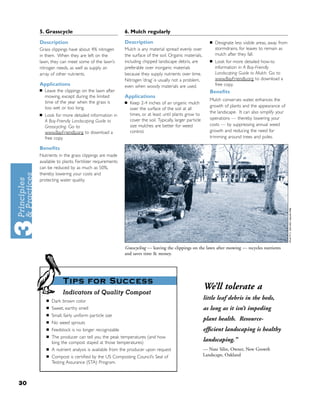
         the job site.                                     www.ciwmb.ca.gov/CalMax or visit
                                                           www.StopWaste.Org for additional           Applications
     ■   Develop and implement a plan to
                                                           information on materials reuse
         reduce construction waste including                                                          If reusing and recycling on site is not
                                                           facilities and construction site cleanup
         plastic plant containers, land clearing                                                      feasible, take the time to separate yard
                                                           contractors.
         waste and other landscape
                                                       ■   Offer incentives to contractors or         trimmings from other waste. At larger
         construction materials.
                                                           employees who reduce waste.                sites, dedicate a bin to plant trimmings
     ■   Specify the recycling or donating of
                                                       ■   Return wooden pallets to suppliers or      only and ask the hauler for a reduction
         unused materials to reach a goal of
                                                           take apart non-returnable wood             in the collection fee.
         reducing waste by at least 50%.
     ■
                                                           pallets to chip for mulch.
         Contact local recycling facilities and                                                       Benefits
         haulers to identify terms and                 ■   Donate healthy plants to local
                                                           nonprofits or school gardens.               Your disposal costs are trimmed, and in
         conditions required for recycling
         materials.                                                                                   most cases, the material is processed
     ■
                                                       Benefits                                        into mulch or compost.
         Select suppliers that allow returns of
         unused items.                                 Recycling and donating unused items
     ■   Allocate space for recycling bins and         reduces pressure on landfills, saves
         containers.                                   money by reducing tipping fees and
                                                       provides raw materials for future
                                                       projects. Donations may be tax
                                                       deductible.


                   Tips for Success
                    Using Salvaged Materials in the Landscape
         1. Let the materials inspire the design.
         2. Locate materials early in the design process to avoid major design revisions
            when materials are found.                                                                   Each year, the
         3. Maintain flexibility in the design until materials are found.                                horticultural
         4. Use materials with interesting “stories” or cultural significance to the                     industry disposes
            project.                                                                                    of:
         5. At the start of a project, evaluate project sites and old buildings for                     ■   130 million pounds of
            materials to reuse.                                                                             greenhouse film
         6. Hire demo contractors with experience in deconstruction and salvage.                        ■   140 million pounds of
         7. Require contractors to provide a plan for construction and demolition                           plastic pots
            salvage and recycling.                                                                      ■   170 million pounds of
         8. Use materials for the highest use — avoid “down-cycling.”                                       plastic ground cover
                                                                                                        FROM: TEXAS A&M
         9. Include appearance and environmental performance standards in the
            specifications.
         10. Get the contractor on board with using salvage early in the process.
         SOURCE: MEG CALKINS, CLOSING THE LOOP: PART II, LANDSCAPE ARCHITECTURE, DECEMBER 2002.


26
3. Nurture the Soil

                                    oil is a complex, dynamic combination of minerals, air, water and organic matter.

                          S         And although organic matter is a small fraction of the soil, it is a vital component.
                                    It includes plant and animal debris in various stages of decay as well as many
                          living organisms — one teaspoon of a healthy soil can contain billions of beneficial bacteria
                          and fungi.
                          A cornerstone of Bay-Friendly landscaping is creating and protecting conditions for a
                          diversity of beneficial soil organisms. It is based on the principle of feeding the soil, not the
                          plant, to encourage a thriving community — a foodweb — of microorganisms, worms and
                          other beneficial creatures. Healthy soil is alive!


                          Why Does Soil Life Matter?
                          Living soil is teeming with bacteria, fungi, protozoa, beneficial
                          nematodes, worms and other beneficial organisms — amazing
                          workhorses that will carry out the following valuable processes:

                                ✔ Creating soil structure
                                ✔ Storing and cycling nutrients
                                                                                                            Survey Says...
                                ✔ Protecting plants from pests
                                                                                                       80% of single-family households
                                ✔ Improving water infiltration and storage                              agree with the statement that
                                                                                                       using compost in the yard is
                                ✔ Filtering out urban pollutants                                       good for the environment.


Functions of a Healthy Living Soil


        Store water
       and nutrients                                                        Neutralization                      Resists pests
   Much like a giant sponge,                                                 of pollutants
                                        Water flow and                                                      Living soil has an incredible
   healthy soil acts as a
                                         regulation                     Healthy soil is the site of        array of organisms, most of
   storehouse for water and
                                                                        intensive physical, chemical       which are beneficial. The
   nutrients. The slow release       Like the on/off function of a      and biological activity, thus it   beneficial organisms protect
   helps plants absorb the           faucet, healthy soil regulates     can prevent water and air          plants from disease through
   correct amount. As a              and partitions water flow,          pollution. Soil rich in organic    predation, parasitization,
   storage reservoir for both        naturally maintaining the          matter contains                    competition and antibiosis.
   water and nutrients, healthy      water cycle by slowly              microorganisms that can            Bacteria, for example, cover
   soil has a greater holding        discharging to streams, lakes      immobilize or degrade              leaf surfaces and block
   capacity than soils that lack     and recharging aquifers.           pollutants.                        infection. Beneficial
   sufficient organisms, organic
                                                                                                           nematodes prey on harmful
   matter and pore spaces.
                                                                                                           nematodes.
ADAPTED FROM: THE RELATIONSHIP BETWEEN SOIL AND WATER, KING COUNTY DEPARTMENT OF NATURAL RESOURCES.


                                                                                                                                           27
1. Remove and store topsoil                   2. Protect soil from
     before grading                                compaction
                                                                                                  Why Use Compost for
     Description                                   Description                                    Erosion Control?
     Topsoil is a valuable resource, yet it is     Heavy equipment can compact soil as            ■   Compost blankets and compost
     typically removed or mixed with subsoil       deep as two feet below the surface of
                                                                                                      filter berms are less expensive
     during construction, beginning a cycle of     the soil. Compacted soils do not have
                                                                                                      when construction, maintenance,
     high water and chemical dependency.           adequate space for air or water.
                                                                                                      removal and disposal costs are
     Applications                                  Application                                        considered.
     When grading the soil is unavoidable:         ■   Before construction begins, specify a      ■   Compost blankets and filter berms
     ■   Identify areas that are to be paved as        limited construction area. Install
                                                       temporary fences to restrict heavy             provide chemical, biological and
         a place to store topsoil during                                                              physical filtration.
         construction.                                 equipment, including cars. Areas that
                                                       will be paved or built over are good       ■   They work better than standard
     ■   Remove the topsoil (at least the top
                                                       sites for parking equipment.
         6 inches if the topsoil is deep) before                                                      BMP’s like silt fences or straw bales.
                                                   ■   Don’t assume you need the biggest,
         other grading and store for future                                                       ■   Berms offer more actual filtration
         use.                                          heaviest equipment.
                                                   ■   If using heavy equipment, select those         than coir rolls, silt fences or straw
     ■   Do not store in piles larger than 6
                                                       with flotation tires or wide tracks to          bales.
         feet high.
                                                       distribute the load.                       ■   Compost is annually renewable.
     ■   Protect from erosion.
                                                   ■   On a longer-term basis, limit foot
     ■   Send samples for analysis.                                                               ■   Compost is 100% recycled.
                                                       traffic, especially during the wet
     ■   Amend with 20-35% compost,                    season.                                    ■   Compost is all organic and natural.
         depending on soil type and analysis,      ■   Do not work soil when it is too wet        ■   It strengthens the market for
         compost quality and plant selection.
                                                       or too dry. Till as little as possible,
     ■   Re-spread after grading and                                                                  compost.
                                                       and only with a clearly identified goal,
         construction.                                 such as incorporating organic matter.      ■   Aquatic wildlife can negotiate
                                                       Loosen the soil with a fork instead of         berms but not silt fences.
     Benefits                                           turning it over whenever possible.
     Conserving topsoil can reduce the                                                            ■   It avoids the use of petroleum
     likelihood of many problems over the          Benefits                                            based products like silt fences.
     long run, including stormwater runoff.        Soil structure and the soil’s ability to       ■   Construction equipment can run
     It can minimize fertilizer and irrigation     support the microbes that cycle                    over it and it still works — and it is
     requirements and topsoil replacement          nutrients and filter pollutants are
                                                                                                      easy to fix.
     costs.                                        protected. The soil is easier to work.
                                                                                                  ■   The materials can be re-used in
                                                                                                      landscaping or seeding after their
                                                                                                      use for erosion control.
                                                                                                  ■   Look for specifications from the
                                                                                                      California Integrated Waste
                                                                                                      Management Board in: Compost
                                                                                                      Use for Landscape and
                                                                                                      Environmental Enhancement Manual.

                                                                                                  SOURCE: ROD TYLER, WAKE UP AND SMELL THE
                                                                                                  COMPOST! PRESENTED AT INNOVATIONS IN
                                                                                                  EROSION CONTROL, WA.


                                                                                        Topsoil has been removed and stockpiled
                                                                                        before building construction for later
                                                                                        re-use in the landscape.

28
3. Defend against erosion                       4. Amend the soil with compost before planting
Description                                     Description                                    ■   Mixing compost into the backfill of a
A sediment and erosion control plan             Compost is thriving with microorganisms            planting hole for trees and shrubs
that conforms to local sedimentation            — one teaspoon can have more than                  may not yield significant benefits.
and erosion standards or the best               one billion beneficial microbes. Adding             Some research indicates that young
management practices in the EPA’s               good quality compost before planting               plants benefit more than mature
                                                                                                   plants. Some specialists also believe
Stormwater Management for                       turf, annuals, perennials, trees and shrubs
                                                                                                   that amending backfill can create such
Construction Activities (whichever is           brings life to the soil and feeds existing
                                                                                                   a difference between the soil in the
more stringent) should have the                 soil organisms. Compost is effective in            hole and the surrounding soil that the
following objectives:                           improving problem soils — in particular            roots don’t grow outwards — it is as
    a. Prevent loss of soil during              those that are compacted, heavy clay or            if they are growing in a pot. To
       construction by stormwater runoff        sandy, poor in nutrients, or lead                  prevent this problem, amend the
       and/or wind erosion, including           contaminated. It is one of the most                entire bed or create planting holes
       protecting topsoil by stockpiling for    important practices for a healthy, thriving,       that are no deeper than the root ball
       reuse.                                   Bay-Friendly landscape.                            and a minimum of 3 times size of the
    b. Also prevent longer term                                                                    transplant’s root ball. Rough up the
       sedimentation of streams,                Applications                                       sides of the hole. Mix soil from the
       stormwater drains and/or air             It is important to first assess the soil for        hole with compost at a rate of 1 part
       pollution with dust and particulate      physical and chemical problems. Refer to           compost to 3-5 parts soil (by volume)
       matter.                                  the section Landscape Locally in these             and backfill. Make the hole shallower
                                                guidelines.                                        and create a mound in heavy clay
Applications                                                                                       soils.
                                                ■   If topsoil has been removed and
■    Do not remove valuable trees and                                                          ■   And, consider the conditions under
     shrubs, especially near waterways.             stored during building construction,
                                                                                                   which the plant grows naturally. Some
     Protect them with fencing.                     mix one cubic yard of compost into
                                                                                                   California natives require less fertile
                                                    3-5 cubic yards of soil before re-
■    Schedule grading for the dry season.                                                          soils and compost may not be
                                                    spreading.
■    Use compost berms, blankets, or                                                               necessary.
                                                ■   If the topsoil has not been removed
     socks. The EPA specifies that,                                                             ■   Finally, quality compost is important.
                                                    then sheet mulching is an efficient
     depending on the length and height                                                            Use compost made from local green
                                                    means of adding compost & other
     of a particular slope, a 1/2-inch to 4-                                                       and food waste to maximum feasible.
                                                    organic matter while controlling
     inch layer of mature, screened                                                                Specify compost from a producer that
                                                    weeds. Refer to the tip on sheet-
     compost, placed directly on top of the                                                        is enrolled in the US Composting
                                                    mulching on page 25 for more
     soil, controls erosion by enhancing                                                           Council’s Standard Testing Assurance
                                                    information.
     planted or volunteer vegetation                                                               (STA) program.
                                                ■   For turf or groundcover installations:
     growth.
                                                    Incorporate 1-2 inches (3 1/3 – 6 2/3      Benefits
■    Construct earth dikes or install silt
                                                    cubic yards) of compost into 1000          Compost fosters a diverse, fertile, and
     fencing, sediment traps, and sediment
                                                    square feet. Mix it with the top 5-7
     basins.                                                                                   disease suppressive soil. You and your
                                                    inches of soil.
■    Terrace steep slopes.                                                                     clients may see both long and short-
                                                ■   For preparing planting beds: Spread
■    Hydroseed or otherwise plant to                                                           term benefits, including faster plant
                                                    2- 4 inches of compost over the
     reduce bare soil, but do not over-                                                        establishment, decreased fertilizer &
                                                    surface of the soil and incorporate it
     plant for instant color. Annuals and                                                      pesticide use and lower water usage.
                                                    into the top 12-24 inches of the
     short-lived perennials can be used to          planting bed.
     fill in areas while larger trees & shrubs
     become established. Cover crops
     provide excellent short-term cover
     that also adds nitrogen and/or organic
     matter when it is later tilled into the
     soil.
■    Mulch regularly.
                                                                                                                                Mulch is placed on
■    Minimize the use of blowers.                                                                                               miles of freeway
                                                                                                                                hillsides by
Benefits                                                                                                                         Caltrans.
The likelihood of erosion is lessened,                                                                                          PHOTO: THE MUNICIPAL
thereby conserving topsoil and                                                                                                  WATER DISTRICT OF
                                                                                                                                ORANGE COUNTY,
                                                                                                                                LANDSCAPE
protecting aquatic habitat.                                                                                                     MANAGEMENT FOR
                                                                                                                                WATER SAVINGS
                                                                                                                                BY TOM ASH.


                                                                                                                                                  29
5. Grasscycle                                  6. Mulch regularly
     Description                                    Description                                         ■   Designate less visible areas, away from
     Grass clippings have about 4% nitrogen         Mulch is any material spread evenly over                stormdrains, for leaves to remain as
     in them. When they are left on the             the surface of the soil. Organic materials,             mulch after they fall.
     lawn, they can meet some of the lawn’s         including chipped landscape debris, are             ■   Look for more detailed how-to
     nitrogen needs, as well as supply an           preferable over inorganic materials                     information in A Bay-Friendly
     array of other nutrients.                      because they supply nutrients over time.                Landscaping Guide to Mulch. Go to
                                                    Nitrogen ‘drag’ is usually not a problem,               www.BayFriendly.org to download a
     Applications                                   even when woody materials are used.                     free copy.
     ■   Leave the clippings on the lawn after                                                          Benefits
         mowing, except during the limited          Applications
                                                                                                        Mulch conserves water, enhances the
         time of the year when the grass is         ■   Keep 2-4 inches of an organic mulch
         too wet or too long.                                                                           growth of plants and the appearance of
                                                        over the surface of the soil at all
                                                        times, or at least until plants grow to         the landscape. It can also simplify your
     ■   Look for more detailed information in
                                                        cover the soil. Typically, larger particle      operations — thereby lowering your
         A Bay-Friendly Landscaping Guide to
         Grasscycling. Go to                            size mulches are better for weed                costs — by suppressing annual weed
         www.BayFriendly.org to download a              control.                                        growth and reducing the need for
         free copy.                                                                                     trimming around trees and poles.

     Benefits
     Nutrients in the grass clippings are made
     available to plants. Fertilizer requirements
     can be reduced by as much as 50%,
     thereby lowering your costs and
     protecting water quality.


                                                    Grasscycling — leaving the clippings on the lawn after mowing — recycles nutrients
                                                    and saves time & money.


                   Tips for Success
                                                                                                     We’ll tolerate a
                   Indicators of Quality Compost
         ■   Dark brown color
                                                                                                     little leaf debris in the beds,
         ■   Sweet, earthy smell                                                                     as long as it isn’t impeding
         ■   Small, fairly uniform particle size
         ■
                                                                                                     plant health. Resource-
             No weed sprouts
         ■   Feedstock is no longer recognizable                                                     efficient landscaping is healthy
         ■   The producer can tell you the peak temperatures (and how
             long the compost stayed at those temperatures)
                                                                                                     landscaping.”
         ■   A nutrient analysis is available from the producer upon request                         — Nate Silin, Owner, New Growth
         ■   Compost is certified by the US Composting Council’s Seal of                              Landscape, Oakland
             Testing Assurance (STA) Program.


30
Tips for Success
         Sheet Mulching is...
...a layered mulch system. It is a simple and underutilized technique for optimizing the benefits of mulch. Sheet mulching can
be used either in establishing a landscape, or to enrich existing plantings. In both cases, mulch is applied to bare soil or on
top of cut or flattened weeds. Trees, shrubs, herbaceous perennials and annuals are planted through the mulch, or a small
area is left open to accommodate established plants.
Sheet mulch can:
■   Suppress weed growth
■   Reduce labor and maintenance costs: weeds are composted in place
■   Improve nutrient and water retention in the soil
■   Encourage favorable soil microbial activity and worms
■   Enhance soil structure
■   Improve plant vigor and health, often leading to improved resistance to pests
    and diseases
Step 1: Prepare the site. Knock down or mow existing vegetation so that it lies
flat. Remove only woody or bulky plant material. The organic matter left will
decay and add nutrients to the soil. Add fertizilers and amendments to this layer
if a soil analysis indicates the need. Optional: "jump start" the decay of weeds
                                                                                            Re c ycled cardboard is a good weed barrier.
and grass by adding compost or manure at the rate of about 50 lbs/100 square
feet. Soak with water to start the natural process of decomposition. It is much
easier to soak the ground now, before the remaining layers of mulch are
applied.
Step 2: Plant 5 gallon and larger plants.
Step 3: Add a weed barrier. The next layer is an organic weed barrier that
breaks down with time. It is essential that the barrier is permeable to water and
air. Do not use plastic. Recycled cardboard, a thick layer of newspaper, burlap
bags or old carpets of natural fiber work well. Many paper companies offer
                                                                                   Sheet mulched site is ready for planting.
recycled cardboard or paper in rolls of varying widths. Two or three layers may
be required to achieve an adequate thickness. But, if the weed barrier is applied
too thickly, the soil can become anaerobic. Overlap pieces 6-8 inches to completely cover the ground without any breaks,
except where there are established plants you want to save. Leave a generous opening for air circulation around the root
crown. Wet down the cardboard or paper barrier to keep it in place.
Step 4: Layer compost and mulch. The top layer mimics the newly fallen organic matter of the forest. Good materials for
this layer include chipped plant debris, tree prunings, leaves or straw. They must be free of weed seeds. Well decomposed,
weed-free compost is also a good material but it should be spread directly over the weed barrier and covered with bulkier
materials such as chipped tree prunings, to optimize weed control. In total, the compost/mulch layer should be 2-5 inches
deep. Many materials suitable for the top layer often have an attractive appearance, making sheet mulch a versatile practice.
Step 5: Plant. Punch a hole in the cardboard and place plants in the soil under the sheet mulch. Smaller plants can often be
planted right into the mulch/compost layer. Add a small amount of compost around the rootball if compost has not been
included in the top layer.
In most cases, the benefits of sheet mulching outweigh the costs. However, take care to prevent these potential problems:
■   As with any mulch, do not pile materials up against the trunks or stems of plants to prevent disease.
■   Especially during the dry season, small seedlings will need protection from snails and slugs that will seek cover under the
    mulch.
■   Protect young trees from rodents with physical guards.
ADAPTED FROM: C.R. ELEVITCH AND K.M. WILKINSON, SHEET MULCHING: GREATER PLANT AND SOIL HEALTH FOR LESS WORK, PERMANENT AGRICULTURE
RESOURCES AND GEOFF HALL, SHEET MULCH, SENTIENT LANDSCAPE, INC.


                                                                                                                                           31
7. Aerate compacted soils                                                                   8. Feed soils naturally
     Description                                    ■   Deep tap-rooted plants can be            Description
     It is not always possible to remove                seeded to break up compacted soils       There are important benefits to
     topsoil or otherwise protect it during             in non-turf areas. Mow before plants     regularly adding a thin layer of good
     construction. Additionally, soils under            have gone to seed, leaving organic
                                                                                                 compost to the surface of the soil under
     turf subject to heavy use become                   matter on the soil surface as mulch.
                                                                                                 turf, perennials, shrubs or trees, or
     compacted, which can increase the              ■   Mechanically aerate soil under turf at   drenching the soil with compost tea.
     lawn’s susceptibility to weeds, drought,           least once a year : the number of
     disease and insect damage.                         times will depend on use and type.       Applications
                                                        Aerating in the spring is best. Avoid    ■   Feed turf, especially after aeration, by
     Applications                                       doing so in the summer. Topdress             topdressing with finely screened
     ■   Specify that soil be mechanically              with compost following aeration.             compost: one-fourth of an inch
         aerated before amending and planting.      ■   Use power augers or water jets to            applied 2-4 times per year will show
     ■   Reduce subsoil compaction by ripping           create holes in compacted soil around        good results.
         or trenching.                                  trees and shrubs. Fill with compost.     ■   Apply compost once or twice each
                                                                                                     year to the base of the plant or under
                                                    Benefits
                                                                                                     the dripline. Be sure the compost is
                                                    Root growth is stimulated and plants are         free of weed seeds and the plant is
                                                    more easily established. Water and               also mulched at an optimum
                                                    fertilizer requirements may be lessened,         thickness. You can scatter the
                                                    while disease is resisted.                       compost over the mulch and it will
                                                                                                     settle to the surface of the soil.
                                                                                                 ■   As an alternative, feed the soil around
                                                                                                     trees and shrubs with compost tea.
                    Tips for Success                                                                 Refer to the tip on Compost Tea.

                    Compost Tea is...                                                            Benefits
                                                                                                 A strong soil foodweb, which makes
         ... a water extract of mature compost. Nutrients, including a wide variety of
                                                                                                 nu t rients available to the plants and
         macro and micronutrients, and beneficial microorganisms diffuse into the extract
                                                                                                 protects water quality, is nu rtured.
         from the compost during the ‘brewing’ process.
                                                                                                 Topdressing turf with compost can
         Using compost tea can help re-establish a healthy soil foodweb that:                    decrease fertilizer use by as much as 50%.
         ■   Suppresses disease
         ■
         ■
             Cycles and retains nutrients
             Improves soil structure
                                                                                                 “Part of our organic
         ■   Decreases the need for pesticide & fertilizer use                                   maintenance
                                                                                                 package
         Starting with a quality, fully mature, microbially diverse compost is important.
         Brewing includes aeration to keep the medium flushed with oxygen and the                 includes using
         aerobic organisms alive and reproducing. Often times molasses, kelp, rock dust          compost tea, a
         or other ingredients are added to enhance microbial growth. Different recipes           liquid extract
         can be effective in encouraging bacterial growth for use of the tea on vegetable
                                                                                                 of high-grade compost. Foliar
         crops, or fungal growth for use on fruit trees. But a diversity of organisms in the
         tea optimizes overall disease suppression, nutrient retention and cycling.              application replaces fungicide.
         Compost tea is best used soon — within hours and no later than 1 day - after            The high beneficial microbe
         it is produced. It can be sprayed onto lawns, the foliage of trees and                  content excludes disease. We
         ornamentals or to the soil under them.Thorough coverage of leaf surfaces is             also apply it to soil for plant
         important and the best time of day for applying to foliage is in the evening.
                                                                                                 fertility. We are currently
         For more information:
                                                                                                 using compost tea on our
         www.composttea.org; www.attra.org; www.soilfoodweb.com
                                                                                                 residential construction and
         Equipment for Brewing Compost Tea:
         EPM, Inc., www.composttea.com; Growing Solutions, www.growingsolutions.com;             maintenance contracts.”
         SoilSoup, www.soilsoup.com; Lyngso Garden Materials, www.lyngsogarden.com               — Jake Cacciato, Superintendent,
                                                                                                 Jensen Corporation Landscape
                                                                                                 Contractors, Cupertino

32
9. Avoid synthetic, quick                     10. Minimize the use of chemical pesticides
release fertilizers
                                              Description                                    least toxic alternative. Refer to the
Description                                   Many pesticides are toxic to microbes          description of Integrated Pest
Synthetic, quick release fertilizers          and other soil dwelling creatures such as      Management in the section Protecting
frequently wash through the soil before       earthworms. These toxins can reduce            Water and Air Quality and visit the
they are even taken up by the plants.         the diversity of soil life, select for         websites: www.ipm.ucdavis.edu or
They can also damage soil microbial           resistant organisms or even increase soil      www.birc.org or
populations or cause a flush of tender         pathogen density.                              www.ourwaterourworld.org.
new plant growth that is very attractive
                                              Applications                                   Benefits
to sucking insects. Furthermore, many
well-chosen California native plants          Learn and offer integrated pest                Minimizing pesticides reduces water
thrive without fertilizers. Most other        management to your clients. If pesticides      pollution and helps support soil life,
plants do not need the quick release          are absolutely necessary — choose the          which cycles nutrients and promotes
fertilizers that are often applied on a                                                      resistance to plant disease. Your costs
scheduled basis. Plant nutrient                                                              may then be reduced in the long run.
requirements can be met with compost,
naturally derived fertilizers or slow-
release synthetic fertilizers as a last
resort.                                                   Tips for Success
Applications                                             The Organic Materials Review Institute (OMRI) is. . . a great
■   Kick the chemical habit: base feedings       resource for finding environmentally-friendly materials and products. OMRI is
    on a soil analysis or other clear            a national, nonprofit organization that identifies generic materials that are
    indications of need, not on a calendar.
                                                 allowed or prohibited for use in organic crop production, including soil
■   Use compost to establish beneficial           amendments (such as compost), fertilizers and other materials, such as acetic
    soil organisms and release nutrients
    over the long term.                          acid, for cleaning drip irrigation. Many of these generic materials are relevant to
■   Sow nitrogen fixing or deep rooted            landscapes. OMRI also maintains a second list of products, which is a 3rd party
    cover crops, then till them in before        rating of specific brand name products that meet the National Organic
    they go to seed.                             Standards or those that can be used with restrictions. You can purchase the
■   Use blood and bone meal, fishmeal or          general materials or products listings, or download the product catalog, or
    kelp, examples of naturally derived          subscribe to OMRI, at www.omri.org.
    fertilizers that release nutrients in a
    1- 4 month time frame.
■   Use synthetic fertilizers as a last
    resort and select fertilizers that             Sample Contract Specifications for Nurturing Soil Health:
    contain 30% or more of the nitrogen
    in slow release form.                       1. Initial soil analysis shall be performed to determine drainage and nutrient
                                                   status and shall be repeated annually during the transition to Bay-Friendly
■   Do not use weed and feed
                                                   landscape, when planning a renovation, or when experiencing ongoing
    formulations.
                                                   problems.
■   Do not fertilize within 25 feet of the
    water’s edge.                               2. A soil probe shall be used at every visit to assess water content.
                                                3. Leaf drop shall become part of the mulch layer in the tree, shrub or
Benefits                                            groundcover areas, in an attractive manner and away from high traffic areas.
Slow release fer tilizers make nutrients           Leaf drop shall not be allowed to enter the stormdrain.
available to the plants when they are           4. Mulch shall be maintained under all trees and shrubs and on bare soil with a
needed, and are therefore often a better           minimum 3-inch layer of organic material. To the greatest extent practicable,
value. Flushes of growth that result in            [company name] shall not procure mulch products that originate from forest
pest infestations or plant waste are less          products. When possible, [company name] shall give preference to mulch
likely. Avoiding synthetic fertilizers can         products that are produced on-site or from regionally generated plant debris.
also reduce the likelihood of soil              5. Fertilizing shall be done on an as needed basis, as indicated by a soil analysis
compaction, acidification and thatch                or other clear indications of need, not on a calendar basis. Naturally derived
build-up in lawns.                                 and/or slow release fertilizers are preferred.
                                                   ADAPTED FROM: LANDSCAPE MAINTENANCE PRACTICE FOR WATER AND GREEN WASTE EFFICIENCY,
                                                   MUNICIPAL WATER DISTRICT OF ORANGE COUNTY.


                                                                                                                                        33
4. Conserve Water
                  alifornia’s climate includes long dry summers and the periodic failure of winter rains — water is a

     C            precious and often scarce resource. With projected population growth, it is estimated that by 2020 the
                  state will face annual water shortages, even during years of regular rainfall.
     Yet one-third of all urban water is applied to landscapes. What’s more, much of this water is used in excess or at
     the wrong time of year: residential properties are regularly over-watered by 30-40%.
     Water-wise landscaping is, however, more than efficient irrigation and xeriscapes. It also means augmenting the
     water holding capacity of the soil to create drought resistant soils. Water-wise landscaping makes use of
     alternatives to potable water such as recycled water, graywater, or captured rain. And, it relies on the latest in
     irrigation controller technology for the most efficient application of water possible. The landscape professional
     can offer the following critical expertise in conserving water:

     1. Create drought resistant                    2. Grow drought tolerant CA native or Mediterranean plants
     soils with compost & mulch
                                                    Description                                  ■   Or select plants from Mediterranean
     Description                                    California native plants have evolved with       climates that also thrive with little
     A robust, living soil, with sufficient          local ecosystems and adapted to our              irrigation.
     organic content, is the foundation of a        soils, wildlife and climate — including no   ■   Plant in fall so the plants can establish
     water conserving landscape: 1 cubic foot       rain for 6 months of the year. Many              their root system during the rainy
     of soil holds roughly 1.5 quarts of water      natives, as well as many Mediterranean           season and require less water their
     for each 1% of organic matter. The             species, tolerate dry summers without            first dry season.
     amount of irrigation water required for a      watering once they are established.          ■   Water drought tolerant species for
     landscape thus varies significantly with                                                         their first one or two summers, until
     soil quality.
                                                    Applications                                     they are established.
                                                    ■   Keep in mind that California’s climate   ■   Minimize high water use ornamentals.
     Applications                                       and soil can vary significantly, as can
     ■   Know the soil texture.                         native plant species. Not every native   Benefits
                                                        is drought tolerant: some, like Salix    Appropriately sited native or
     ■   Incorporate 2-4 inches of compost
                                                        spp. (Willows) and Populus fremontii
         into the top 6-12 inches of soil to                                                     Mediterranean type plants often require
                                                        (Cottonwood), need moist soil.
         reach a target soil organic matter of                                                   less soil preparation, watering, mowing,
                                                        Select the native species that match
         3.5% under turf and 5% in planting                                                      fertilizing and spraying, which can reduce
                                                        the site soil and microclimate and if
         beds.                                                                                   your operating costs. CA native species
                                                        possible, choose local ecotypes.
     ■   Topdress with compost around shrubs                                                     are relatively easy and inexpensive to
         and trees, and on turf.                                                                 implement on a trial basis. Using local
     ■   Regularly apply mulch to all exposed                                                    natives reduces the risk of spreading
         surfaces to encourage living soils and                                                  non-local plant species.
         reduce evaporation.
     ■   For additional practices see Nurture
         the Soil in these guidelines.
     ■   Finally, consider applying high quality
         mycorrhizal innoculants, available as
         root dips, mixes, tablets and solutions.

     Benefits
     Compost can increase permeability and
     water-holding capacity, thereby reducing
     the need for irrigation and lowering
     water bills.


                                                    Landscaping with natives and Mediterranean plants require little or no irrigation once
                                                    established and provide a sense of the seasons.

34
3. Minimize the lawn                          4. Implement hydrozoning —                        5. Design for on-site rainwater
                                              group plants by water needs                       collection, recycled water
Description                                                                                     and/or graywater use
Lawns are useful for recreation or places     Description
where family members and employees            Different plants have different water             Description
can relax. But turf requires frequent         requirements. Dividing the landscape into         Rainwater can be channeled through
watering to stay green during our long        low, medium and high water use zones              gutters and downspouts to a storage
dry season.                                   prevents over-watering.                           unit. During a 1-inch rain, 625 gallons of
                                                                                                water can be collected from 1,000
Applications                                  Applications                                      square feet of roof. Stored water can
■   Recommend to your clients that they       ■   Group plants by water and light               then be used for irrigation.
    replace decorative lawns with water           needs (dry shade, dry sun, wet sun,
    conserving California native                  wet shade).                                   Recycled water refers to wastewater that
    groundcovers or perennial grasses,        ■
                                                                                                has been treated at a regional facility, of a
                                                  Place thirstier plants in relatively small,
    shrubs and trees.                                                                           quality suitable for landscape irrigation but
                                                  highly visible areas and if possible, in
■   If lawns are desired, limit turf to no        spots that naturally collect water.           not human consumption. It is becoming
    more than 25% of total irrigated                                                            increasingly common in California. Gray-
                                              ■   Plant a large perimeter area with
    areas. For residential clients, suggest                                                     water is wastewater from sinks, showers,
                                                  drought adapted species.
    the lawn be limited to a small part of                                                      bathtubs and washing machines that is
                                              ■   Plan to discontinue irrigating those
    the backyard where it is more likely                                                        not contaminated by human waste. Not
    to be used for play and relaxation.           California natives that do not tolerate
                                                                                                suitable for drinking, it is an intelligient re-
                                                  water in the summer after they are
■   Do not plant turf in areas or medians                                                       source when used for subsurface
                                                  established — and be sure to
    less than 8 feet wide — it is too hard        separate them from plants that will           irrigation of the roots of trees and shrubs.
    to irrigate efficiently.                       need ongoing irrigation.
■
                                                                                                Applications
    Avoid planting turf on slopes greater     ■   Create and identify irrigation zones          ■   Encourage the building architect, if
    than 10%, in irregular shapes, or in          on plans, based on the plants’ water              possible, to pre-plumb for graywater
    bioswales, and instead specify a turf         requirements, exposure, and soil                  conversion.
    alternative such as Carex pansa.              water holding capacity. Include a
                                                                                                ■   Conserve water by channeling rain
                                                  summary table of the square footage
Benefits                                                                                             from the roof to planters, swales and
                                                  of each hydrozone in construction
Water and energy can be conserved.                                                                  other landscaped areas.
                                                  documents.
For example, reducing the size of a           ■
                                                                                                ■   Raise stormwater inlets in planting
                                                  Separate valves and circuits for
1,000 square foot lawn that gets 1 inch                                                             areas to allow rain to soak in.
                                                  individual hydrozones. In particular, put
of water per week to 500 square feet              turf on its own valve.                        ■   Design, install and operate recycled water
can save approximately 10,000 gallons of                                                            irrigation systems (dual distribution systems)
water per dry season.Your clients’ water      Benefits                                               to allow for the current and future use of
bills and your labor for mowing may also      Water use can be more easily matched                  recycled water, especially for decorative
be reduced. Chemical use may be               to the plant requirements. This fosters               water features.
decreased and water quality protected.        resistance to pests as well as conserves          ■   Learn to use recycled water
                                              water. Plant mortality is reduced, saving             appropriately: poor drainage and
                                              time and money.                                       incorrect watering can cause
                                                                                                    problems, just as is true for non-
                                                                                                    recycled water.
                                                                                                ■   Check with local building code for
                                                                                                    graywater policies and requirements.
                                                                                                ■   Use graywater for subsurface
                                                                                                    irrigation only. Educate your clients to
                                                                                                    use biodegradable soaps.

                                                                                                Benefits
                                                                                                The use of treated, drinkable water to
                                                                                                irrigate lawns and gardens can be
                                                                                                reduced. Groundwater is recharged.

Landscape before and after an upgrade that reduced lawn size, increased diversity,
improved property values, cut water bills by 50% and reduced maintenance costs
by 20%.


                                                                                                                                                     35
6. Design and install high                      Benefits                                       8. Manage irrigation according
     efficiency irrigation systems                    High efficiency systems not only limit         to need
                                                     evaporation and runoff, but also prevent
     Description                                                                                   Description
                                                     disease and minimize weed growth.
     Drip and bubbler irrigation technologies                                                      Watering requirements will vary with
                                                     Water bills can be lower and water
     apply water accurately, to the plant root                                                     soil, plant, climate, exposure and season.
                                                     quality protected.
     zones, at the rate that it can infiltrate.                                                     If the irrigation system is not timed by a
     Low flow sprinkler heads apply water                                                           weather based controller, management
     uniformly and slowly and improve                                                              of the irrigation requires particular
     the efficiency of turf and groundcover                                                         attention and expertise.
     irrigation. Both minimize overspray and
     evaporation and reduce runoff. Drip is                                                        Applications
                                                                                                   ■   Become familiar with CA Irrigation
     often more appropriate than overhead
     in areas that are narrow, odd shaped,                                                             Management Information System
                                                                                                       (CIMIS).
     densely planted, or in parking lots and
     medians.                                                                                      ■   Base irrigation on:
                                                                                                       •   The watering needs of the plant
     Applications                                                                                          material, in inches per week.
     ■   Be pro-active, not reactive with
         customers. Provide them with
                                                                                                       •   How fast the water is being
                                                     7. Install a dedicated meter to                       applied. Sprinklers apply water in
         recommendations to improve their            monitor landscape water use                           inches per hour, drip in gallons per
         irrigation efficiency to achieve 70% or                                                            hour
         greater distribution uniformity in turf     Description
         areas and 80% in all other landscaped       Separate irrigation meters, although they
                                                                                                       •   The soil types and slope. Apply
         areas.                                                                                            water slowly or intermittently on
                                                     can be expensive, allow for the                       slopes or clay soils, so that it can
     ■   Install a weather based, self-adjusting     monitoring and evaluation of water use                soak into the soil.
         irrigation controller that has certified     in the landscape. EBMUD is requiring          ■   If the system does not include a soil
         by the Irrigation Association               them on all new water service for
         (www.ia.org), and has, at a minimum, a                                                        moisture sensing device, use a soil
                                                     landscapes greater than 5000 square               probe to check soil moisture before
         soil moisture or rain sensor shutoff.
                                                     feet, with single-family residences being         irrigating and watch the plants for
     ■   For large commercial or municipal           the only exception.                               signs that they need water.
         sites, select controllers that can detect
                                                                                                   ■   Avoid watering during the warmest
         and respond to problems like a              Applications
         broken sprinkler head.                      ■
                                                                                                       and windiest times of the day.
                                                         Specify the addition of a separate
                                                         water meter for landscapes larger         ■   Water deeply enough to soak the
     ■   Rediscover drip. Several types of drip
         systems exist: select the right system          than 5000 sq. ft.                             root zone.
         for the specific job. Using ‘in-line         ■   Combine with a ‘smart’ or automatic,      ■   If you have installed an irrigation
         emitters’ or ‘subsurface’ drip improves         self adjusting irrigation controller(s)       system but will not be managing it,
         efficiency.                                      for a sophisticated understanding of          provide the property owner with
     ■   Irrigate turf areas with subsurface             water use.                                    precipitation rate for each valve zone,
         irrigation or equipment that has a          ■
                                                                                                       maximum runtimes for July 3, location
                                                         Read the irrigation meter to check for
         precipitation rate of 1 inch or less per                                                      of irrigation supply shut off,
                                                         leaks and maintain a water budget.
         hour as specified by the manufacturer                                                          maintenance checklist, distribution
                                                     ■   Provide detailed feedback to your
         and use stream rotator heads instead                                                          uniformity and internet address for
                                                         customers about their water use or            watering index information.
         of standard spray heads.
                                                         conservation achievements.
     ■   Use matched precipitation rate              ■   If a dedicated water meter is not         Benefits
         nozzles within each control valve and                                                     Appropriate watering moderates plant
                                                         possible, install a submeter to track
         circuit.
                                                         the irrigation portion of a mixed use     growth, promotes plant health and
     ■   Design a system based on a water                water meter.                              reduces replacement costs, as well as the
         use budget of no more than 70% of                                                         need for pesticides and pruning. Your
         reference ET and have this budget           Benefits
                                                                                                   costs and your clients’ water bills can be
         and your irrigation plans reviewed by       Monitoring the landscape water use            reduced.
         a representative of your water              more precisely can demonstrate and
         supplier or a trained irrigation            support water conservation. A separate
         specialist.
                                                     meter can also reduce your client’s
     ■   Check with your local water supplier        sewage bill since it is based on water
         for rebates.                                use in buildings.

36
9. Maintain the irrigation
system so every drop counts
                                             10. Request an irrigation audit
                                                                                             “We ask to see our
Description
                                             Description
                                             FREE water use surveys for landscapes,
                                                                                             clients’ water bills,
Every drop of water that is supplied to      offered by many local water districts           and show them what we can
the landscape by irrigation should be        provide your commercial or home-
protected from loss due to evaporation,      owners association customers with
                                                                                             do to save them money.”
overspraying or runoff. Irrigation systems   practical information for improving             — George Pacheco, Owner/President,
that do not leak, overspray or gush          landscape quality and reducing water            Pacheco Brothers Gardening, Hayward
water are critical to conserving water.      costs. Utility company staff will
                                             demonstrate how to use irrigation
Applications                                 equipment efficiently.
■   Mulch to reduce evaporation.
■   Keep the rain shut off device in         Applications
    working condition.                       Your local water district is often a good
■   For overhead spray systems, check        source for information on water
    and adjust the system regularly for:     conservation. Many offer free irrigation
                                             audits of existing landscapes. An audit
    •   Matched precipitation rate (MPR)
                                             includes landscape area measurements
        nozzles
                                             and an analysis of distribution uniformity,
    •   Low, buried sprinklers
                                             irrigation scheduling, and overall system       Irrigation water running into the street
    •   Incorrect nozzles                    performance.                                    contributes to excessive water bills and
    •   Overspray                                                                            damage to pavement.
                                             Benefits
    •   Head to head coverage
                                             Additional practices for conserving water
    •   Improper pressure
                                             may be identified. You can then demon-
    •   Leaks near unusually tall, green     strate to the clients how your skills can
        vegetation, muddy or eroding spots   save them money on their water bills.
■   Repair leaks and broken sprinklers       Customer satisfaction will be increased.
    immediately. Use originally specified
    materials or materials of superior
    quality and efficiency.                   “I believe we can reduce urban landscape water
■   Keep in mind that it may take more       use by 50%. Irvine has seen water use decline from 4.4
    diligence with drip systems to notice    acre-feet per acre in 1990 to 1.9 acre-feet per acre in 2003.”
    leaks and troubleshoot other
                                             SOURCE: TOM ASH, LANDSCAPE WATER USE: WHAT TO KNOW & WHAT TO DO NOW,
    problems.                                ECO-LANDSCAPING: PROFITING FROM A GREEN FUTURE, 2004.


■   Become IA certified. Contact the
    Irrigation Association at
    www.irrigation.org.

Benefits
Properly maintained irrigation systems                    Tips for Success
not only save water but can also avoid
unnecessary plant, fencing and asphalt                    Rebates for Irrigation Upgrades
replacement costs and increase property          Many water districts offer free commercial landscape irrigation audits and
values. They can also decrease the use           irrigation upgrade programs.
of energy for pumping and moving
                                                 Customers of East Bay Municipal Utility District (EBMUD), for example, may
water, which in turn reduces greenhouse
                                                 qualify for rebates of 50% of the material costs of installing water-efficient
gas emissions.
                                                 irrigation equipment for existing irrigation systems, up to $10,000 per site,
                                                 $5,000 per account (meter). Sites must have had a site survey to participate in

        It is estimated                          the program.
                                                 Contact your local water supplier, or EBMUD at (510) 287-0591 or visit their
that overwatering causes 85%
                                                 website at www.ebmud.com, for information on how to apply for rebates.
  of all landscape problems.
     SOURCE: A CONSUMER’S GUIDE TO WATER
                                                 See Conserve Water in the Resource Section of this book for a listing of water
     CONSERVATION, AMERICAN WATER WORKS
                 ASSOCIATION                     districts in the Bay Area.


                                                                                                                                        37
5. Conserve Energy

                       he need to conserve energy is as important to Bay-Friendly landscaping as the need to conserve


     T                 water. Both are increasing concerns in California as energy shortfalls and droughts continue to
                       occur throughout the West. Energy and water are related — it takes a lot of energy to supply
                       water to our landscapes.
     Conventional landscapes also directly consume large amounts of fossil fuels. Nationally, forty million lawnmowers
     consume 200 million gallons of gasoline per year, representing a huge investment of energy for this one landscape
     maintenance task. What’s more, the US EPA estimates that the few ounces spilled during each refueling of lawn
     and other garden equipment — during the summer only — totals 17 million gallons of gasoline nationwide. And
     energy use means releasing greenhouse gases that are contributing to global warming.
     Landscape designers, installers and professional maintenance staff can play an important role in conserving energy.
     Include these Bay-Friendly, energy conserving practices in your design or service program:

     1. Shade buildings to moderate temperatures
     Description                                    Benefits
     Trees conserve energy by shading,              When properly placed, mature trees can
     cooling the air through evapo-                 reduce the interior temperature of a
     transpiration and reducing the velocity of     building by as much as 20 degrees,
     wind. Selecting and placing trees to           reducing summer cooling costs by 25-
     shade adjacent buildings in the summer         40%, and reducing greenhouse gas
     or protect them from the prevailing            emissions.
     winter winds can moderate building
     temperatures.

     Applications
     ■   Plant trees to the west of a building
         for maximum shading benefits. Avoid
         planting trees that block solar
         collectors or in front of south facing
         windows that allow the low winter
         sun to warm a building, especially in
         cooler regions of the Bay Area.
     ■   Large deciduous trees will be of
         greater value for summer cooling and
         winter solar gain.
     ■   Select evergreen trees for windbreaks.
     ■   Select trees that are appropriate for
         the soil type, water use and exposure.
         If possible, select trees that have low
         water requirements.
                                                                                                 This model demonstrates
     ■   Plant larger trees at least 20 feet from                                                the shading effects of
         the foundation. Plant smaller trees a                                                   design, landscape, and
         minimum of 10 feet from the                                                             orientation during three
         foundation.                                                                             seasons of the year. To
     ■   For more info go to the following                                                       schedule use of the
         websites: http://cufr.ucdavis.edu and                                                   heliodon contact
         www.pge.com.                                                                            www.pge.com/pec/heliodon.


38
2. Reduce the heat island                     3. Shade air conditioners
effect                                                                                              What Large Trees Mean:
                                              Description
                                                                                                       More shade = More energy
Description                                   Limiting the sun that shines directly on                                savings.
Parking lots and streets are significant       an air conditioner will keep it cooler and                Cleaner air = Better health and
sources of heat and pollutants (parked        running more efficiently.                                                fewere hospital
cars emit hydrocarbons that contribute                                                                                visits.
                                              Applications                                        More stormwater = Lower costs for
to the formation of ground level ozone),
                                              ■   Choose a shrub or tree that will                    management stormwater
as well as often being unattractive. Trees                                                                            controls.
                                                  match the soil and microclimate.
reduce the amount of heat stored in, or                                                              More shaded = Longer time
                                              ■   Or build a freestanding arbor with                        streets between
reflected from, paved surfaces which can
contribute to increased building and car          deciduous vines to provide shade.                                   resurfacing.
temperatures.                                 ■   Do not obstruct airflow around the                 SOURCE: CENTER FOR URBAN FOREST
                                                  unit.                                             RESEARCH, DAVIS, CA, 2003


                                              Benefits
                                              The air conditioner runs more efficiently,
                                              which will reduce your client’s utility bill.


                                                      “Compared to a small-stature tree,
Light colored, stabilized, compacted soil,            a strategically located large stature tree has a bigger
in lieu of asphalt was used to surface this
parking lot, reducing heat island
                                                      impact on conserving energy, mitigating an urban
gradients by 30%.                                     heat island and cooling a parking lot.”
                                                      — James Geiger, Center for Urban Forest Research, Davis
Applications
■   Check with your local municipality for
    minimum tree requirements in parking
    lots: then specify more.
■   Select and plant trees that are
    appropriate for the site in terms of
    soil type, water use and exposure.
■   Choose as large a tree as possible but
    be sure it will be allowed to grow to
    its natural shape and size in the                        Tips for Success
    allotted space.
                                                              Shade Effectiveness in Parking Lots
■   Use open grid paving.
■
                                                  Parking lots are thermal hot spots. Many cities in California have ordinances
    Also, select light colored, reflective
    paving materials.                             that require shading of paved area by trees. Implement the suggestions below to
                                                  ensure that you maximize shading:
■   And consider shading paved areas
    with photovoltaic arrays.                     ■   Become familiar with local ordinances and their recommended tree lists.
                                                  ■   Include only trees that are on the local ordinance’s recommended tree list.
Benefits                                           ■   Be sure crown diameters on parking lot plans are not overstated.
Patios & cars can be much more                    ■   Do not allow smaller-size substitutions after the plans have been approved.
comfortable in the summer. Air quality            ■   Follow-up to ensure trees are actually planted, as well as not removed after
can be improved. Costs of cooling
                                                      planting, especially at sites near store fronts where trees could obstruct signs.
adjacent buildings may be lowered.
                                                  ADAPTED FROM: FACT SHEET #3: MAKING PARKING LOTS MORE TREE FRIENDLY, CENTER FOR URBAN
                                                  FOREST RESARCH, PACIFIC SOUTHWEST RESEARCH STATION, USDA FOREST SERVICE, DAVIS, CA, 2002.


                                                                                                                                              39
4. Design lighting carefully                    5. Choose and maintain                       6. Specify low embodied
                                                     equipment for fuel                           energy materials
     Description                                     conservation
     Outdoor lighting consumes a large                                                            Description
     fraction of the electricity used in the         Description                                  Embodied energy is the energy
     United States. Site lighting can be             Equipment is most often selected for its     consumed by all the processes
     designed to use less energy and                 speed, cost and ease of use. However,        associated with the production of an
     minimize light pollution and trespass.          reducing fossil fuel consumption is one      item, from the acquistion of natural
                                                     of the most important practices the          resources to the delivery of the final
     Applications                                    landscape professional can do to protect     product. The single most important
     ■   Identify lighting goals and determine       the environment, while lowering the cost     factor in reducing the impact of
         lowest acceptable levels.
                                                     of operating the equipment.                  embodied energy is to design long lived
     ■   Use only fluorescent, high-intensity                                                      and adaptable landscapes. Transporting
         discharge (HID), or low pressure            Applications                                 items the least distance reduces fuel
         sodium lamps.                               ■   Use hand powered equipment when          consumption and air pollution and
     ■   Specify Energy Star, photovoltaic or            possible and take pride in the quality
                                                                                                  supports local economies.
         12-volt for 100% of outdoor building            of the work.
         and site fixtures.                           ■   Minimize the use of gas-powered          Applications
     ■   For security, use lights with a                 blowers.                                 ■   Consider the source and embodied
         photocell or motion sensor lights           ■   When using machinery, choose the             energy of all materials in the
         instead of all night illumination.              smallest, most fuel efficient, lowest         landscape, including stone, gravel,
                                                         emission machinery required to get           plants, lumber, furniture, etc. Use local
     ■   Specify that all exterior luminaries
                                                         the job done.                                stone, for example, rather than
         emit no light above horizontal OR are
                                                                                                      limestone shipped from the Midwest.
         Dark Sky certified. Visit                    ■   As you upgrade your equipment &
                                                                                                  ■   Select smaller container stock to
         www.darksky.org for a list of fixtures           vehicles, select for fuel economy and
         approved by the International Dark              low emissions. Select vehicles that          increase the number of plants per
         Sky Association.                                operate on biodiesel — or convert            delivery. Smaller plants also transplant
                                                         existing vehicles.                           better.
     ■   Prevent light trespass by selecting and
                                                                                                  ■   Use recycled and less highly
         placing fixtures that will not spill light   ■   Keep every piece of equipment and
         onto neighboring properties.                    vehicle tuned.                               processed materials, and avoid
                                                                                                      petroleum-based products, including
                                                     ■   Recycle plant debris on site to
     Benefits                                                                                          synthetic fertilizers.
                                                         minimize fuel consumption for hauling.
     Power and energy use can be decreased.
                                                     ■   Require employee carpooling to sites     Benefits
     Lower operating costs can often recover
                                                         and plan maintenance routes carefully.   Buying locally produced and low
     higher initial purchase costs of newer
     more efficient lamps.
                                                     ■   Track the gallons of gas your business   embodied energy products often
                                                         consumes and set goals to reduce         reduces the cost of an item, as well as
                                                         that consumption.                        the hidden environmental costs of
                                                                                                  transporting materials, such as pollution.
                                                     Benefits
                                                     Manual labor may make the most
                                                     economic sense for many landscape
                                                     operations. You can cut the cost of fuel
                                                     while protecting the health of your staff,
                                                     and local air and water quality.


                                        “We use so much fossil fuel               that the
                                        energy that is used consumes more oxygen from the
                                        atmosphere than the landscapes actually provide.”
                                     — Bob Perry, Landscape Architect, Professor Emeritus, Cal Poly, Pomona


40
6. Protect Water and Air Quality

Bay-Friendly landscaping can help
protect our water from pollution by:
  ✔ Increasing on-site infiltration and reducing runoff
  ✔ Reducing contaminants in runoff
  ✔ Increasing the soil’s ability to remove pollutants
       from runoff
In an undisturbed landscape, only 15% of the rainwater
leaves the system through surface water runoff. More
than one-third moves into the soil where living,
biologically diverse organisms break down and naturally
filter out pollutants, before it reaches groundwater or         Heathy, Undisturbed Soils. A healthy vibrant soil
our waterways.                                                 structure teeming with micro and macro organisms. The
                                                               presence of abundant organic material allows the soil to
As land is developed into residential or commercial            hold and retain water, and bind and degrade pollutants.
landscapes, roads and parking lots, major changes
occur.
  ■   More water runs off the surfaces — as much as
      70% of all rain and irrigation water runs into
      waterways without moving through soil.
  ■   The soil supports less microbial life and is less able
      to filter harmful chemicals out of the little water
      that infiltrates and moves through soil.
What happens next? Flash floods scour creek banks.
Erosion of channels is greatly accelerated. As little as
10% impervious surface causes significant degradation
of streams.                                                    Unhealthy, Disturbed and Paved Soils. A soil structure
Pollutant load also increases. An acre of parking lot          impacted by human activity with limited organic life.
                                                               Erosion and surface water run-off are high.
collects as much as 4 gallons of oil, gasoline and diesel
                                                               SOURCE: THE RELATIONSHIP BETWEEN SOIL AND WATER, KING COUNTY
fuel each year. When it rains and water runs off the           DEPARTMENT OF NATURAL RESOURCES.

parking lot, these toxic compounds are discharged into
local creeks where they may eventually enter the Bay.
Other pollutants include trace metals, pesticides,             Bay-Friendly landscaping can help
nutrients from fertilizers and pet waste, trash and
suspended soil particles from poorly vegetated ground.
                                                               protect our air from pollution by:
Stormwater runoff, from both residential and                      ✔ Reducing fossil fuel consumption
commercial sites, thus becomes a large source of                  ✔ Recycling plant debris on site
pollution.                                                        ✔ Planting trees to remove CO2 and absorb
At the same time air pollution from power equipment                   air pollutants
used in conventional landscaping takes an enormous
toll on our environment. Gas powered garden tools              Make the connection between
emit 5 percent of the nation's air pollution. Plant            Bay-Friendly and reducing the emissions
debris is hauled to the landfill in vehicles that pollute
the air, and once there, the materials decompose               that cause global warming — and
without oxygen and in the process emit greenhouse              distinguish yourself in the marketplace.
gases.


                                                                                                                              41
Integrated Pest Management (IPM) is a holistic approach to controlling insects, plant
     diseases, weeds, and other pests. IPM programs integrate the use of many environmentally-sound strategies for
     managing, but not necessarily eliminating, pests. First and foremost, IPM seeks to prevent pests by fostering a
     healthy environment in which plants have the strength to resist disease and insect infestations and to out-
     compete weeds. An IPM approach requires an understanding of the life cycles of pests and beneficial organisms
     and regular monitoring of their populations. If a pest problem is identified, IPM then considers all viable solutions
     and uses a variety of techniques to control pests, rather than turning only to pesticides. The least toxic pesticides
     are used as a last resort only. IPM offers a great opportunity to market your skills to your clients by providing the
     following services:
     1. Use Integrated Pest Management

     A. Prevent pest problems                      ■   Cleaning equipment after use.                   Benefits
                                                   ■   Inspecting and removing invasive plant          A healthy, diverse landscape that
     Description                                       parts or seeds from your clothing,              prevents pests in the first place is critical
     Applying the best landscape design,               tools and vehicle before leaving an             to eliminating the need for pesticides,
     construction and management practices             infested site.                                  thereby reducing pollution and
     to prevent pests is always preferable to      ■   Cleaning up wood, fruit and other               protecting the health of the San
     trying to control them after they                 plant material that is infected with            Francisco Bay.
     become established.                               disease — compost the debris only if
                                                       you have the experience to get the
     Applications                                      compost pile to temperatures over
     Design to prevent pests by:                       135o F for an extended period.
     ■   Choosing a diversity of species that
         are well suited to the site.
     ■   Selecting resistant varieties and local       IPM for Weed Control
         native species, including species that        Prevent weeds first:
         attract beneficial insects.                    ■   Purchase only weed free plants and compost
     ■   Placing plants at proper distances            ■   Use drip irrigation to apply water only to desired plants
         from buildings, giving them space for
                                                       ■   Use mulch to suppress weeds. Sheet mulching is an effective strategy that
         adequate air circulation and room to
         reach their natural size and shape.               layers cardboard, compost and then coarse mulch (see page 31).
     ■   Avoiding over-planting for instant            Monitor weeds:
         color.                                        ■   Create a map that locates the species and density of weeds
     ■   Including compost in the soil
                                                       Try cultural, mechanical & physical controls before reaching
         specifications
                                                       for the herbicides:
     Prevent pests during landscape                    ■   Flame weeders use a targeted flame to kill weeds and are very effective for
     construction and maintenance by:
                                                           controlling weeds in sidewalks and other hardscapes.
     ■   Selecting plant material that is free         ■   Boiling water, hot foam and high pressure steam both work to kill weeds and
         from disease and insects.
                                                           are a better option in areas where an open flame may be hazardous.
     ■   Planting at the right depth.
     ■   Watering thoroughly but not over-             Select herbicides as a last resort & use the least toxic:
         watering.                                     ■   Corn gluten meal is a pre-emergent herbicide that also acts as a fertilizer. The
     ■   Sheetmulch, see page 31.                          timing of the application is important, if it is used after weeds have started
     ■   Keeping mulch on the surface of the               growing, they will actually benefit from its fertilizing properties.
         soil at all times.                            ■   Horticultural vinegar, or acetic acid, is also effective at killing certain weeds.
     ■   Using slow release fertilizers if soil            Use with caution since acetic acid greater than 5% can cause skin irritation or
         tests indicate their need, and not                eye damage.
         over-fertilizing.                             ■   Herbicidal soaps are highly refined soaps that can penetrate the waxy coating
     ■   Pruning judiciously — severe pruning              on plant leaves, causing them to dry out. Some of these products also contain
         stimulates new growth, stresses plants
                                                           essential oils that enhance their herbicidal properties.
         and encourages pests and disease.
                                                       ADAPTED FROM QUARLES, WILLIAM, SAY GOOD-BYE TO WEED WORRIES, FINE GARDENING, 80, PP. 48-51
     ■   Eliminating noxious weeds before they         AND BEYOND PESTICIDES FACT SHEET: LEAST TOXIC CONTROL OF WEEDS.

         go to seed or spread uncontrollably.

42
1. Use Integrated Pest Management

B.Train your staff to identify                 C. Educate your clients                       D. Control pest problems
and monitor pest &                                                                           with physical & mechanical
beneficial populations                          Description                                   controls
                                               Many clients have unrealistic standards of
Description                                    absolute pest control and will require        Description
A critical part of an integrated pest          education. Landscapes can tolerate            When pests are identified as the source
management program is “watchful                certain levels of pests without causing       of unacceptable levels of damage,
waiting”-- observing the site at regular       significant or even noticeable damage.         physical barriers or mechanical
intervals in order to understand whether       Small populations of pest organisms are       techniques for excluding or removing
populations are increasing or decreasing       necessary to establish healthy                pests should be implemented as a first
and what harm pests are doing. It is           populations of predators.                     line of control.
likely that most organisms in the
                                               Applications                                  Applications
landscape are actually beneficial. Living
                                               ■   Educate your clients about the role of    ■   Learn about and specify sheet
soils, for example, can support billions of
                                                   beneficial organisms and ask them to           mulching to prepare the soil and
beneficial organisms, which suppress the
                                                   consider some damage as a sign of a           control weeds.
fewer disease causing organisms. Many              balanced, thriving ecosystem.
insects naturally feed on other pest
                                                                                             ■   Weeds can also be controlled by
                                                   Encourage them to raise their                 using drip irrigation and a minimum 2-
insects — some even feed on weeds.                 threshold of acceptable damage.               inch layer of coarse mulch.
Insects provide food for birds, reptiles       ■   Ask yourself and your clients if          ■   Flame seedlings.
and amphibians. Raptors and snakes eat             treatment is even necessary before
rodents. Immediately pulling out the big
                                                                                             ■   Hoe or pull established weeds.
                                                   developing a strategy for managing a
guns in the form of pesticides will kill the       pest problem.                             ■   Spray aphids with a strong jet of
beneficial organisms along with the pests,      ■
                                                                                                 water.
                                                   Fact sheets on alternative pest control
which can lead to more problems as the             strategies are available at               ■   Use sticky traps around tree trunks to
balance between the two is disrupted.              www.ourwaterourworld.org or from              keep ants and other insects away.
                                                   the UC Statewide IPM Program at           ■   Hand-pick large adult insect pests and
Applications                                       www.ipm.ucdavis.edu or the Seattle            larvae as they appear.
■   Provide your staff with the time and           Green Gardening program at                ■   Remove dead or diseased plants or
    resources to learn to identify both            www.ci.seattle.wa.us/util/proipm/             plant parts — hot composting the
    pest and beneficial organisms.                  default.htm.                                  debris will kill disease-causing
■   Check plants often for vigor and signs     ■   In the case of ongoing pests, advise          organisms.
    of pests.                                      your clients that removing a particular
■                                                  problem plant may be the best             Benefits
    Train your residential clients to
    monitor and record pest populations.           solution.                                 Pests can be kept at acceptable levels
■   Clarify which problems are the result                                                    thereby reducing the need for pesticides.
                                               Benefits                                       Pollutants are kept out of stormwater in
    of pests and not other factors, such as
    overwatering.                              Insects and other pests can be accepted       the first place.
■
                                               as an integral component of any
    Evaluate the results of any treatments.
                                               ecosystem, in which case they are not
■   Check regularly with the University of
                                               controlled until they cause an
    California (www.ipm.ucdavis.edu) or
    subscribe to the IPM Monitor from the      unacceptable level of damage. The need
    Bio-Integral Resources Center              for pesticides may be reduced or
    (www.birc.org) for up to date              eliminated.
    resources and information.

Benefits
Your staff enjoys greater job satisfaction
as they learn additional, valuable skills.
                                               In a study conducted for the Bay Area Stormwater
Beneficial organisms are given the              Management Agencies Association in California, 75% of people
opportunity to control pests. If a
problem does develop, you can catch it         surveyed indicated a willingness to try less toxic alternatives to
just as it is reaching a level that needs      manage household pests if they were available. They ARE!
control.


                                                                                                                                          43
1.E. Control pest problems
     with biological controls
     Description                                                          “I grew up in the nursery business.
     Biological control is the use of living                      The older generation had a lot of health issues,
     organisms to control pests. Knowing the                      a lot of cancer. For ourselves and our own
     life cycles of the pest and its enemies is
                                                                  health and safety, we should try to eliminate
     important to maximizing the efficiency of
     any biological control.                                      toxics.Why should a beautiful landscape be
                                                    purchased with the health of the people who work on it?"
     Applications
     ■   Encourage beneficial insects by             — Glen Schneider, Proprietor, Glen Schneider Gardening, Berkeley
         planting a wide variety of plants that
         flower throughout the year.
     ■   Introduce natural predators, parasites
         and beneficial microbes. Parasitic
         nematodes are effective for control of
         pests. Bacillus thuringiensis (Bt) is a                     Tips for Success
         bacterium that kills caterpillars,
         including those of non-pest moths                        Attracting Beneficial Insects
         and butterflies. (Do not use Bt in a
         butterfly garden.) Compost tea
         introduces large and diverse
                                                      Attract these
         populations of microbes that can             beneficial insects                   By planting these species
         suppress some leaf and root diseases.
     ■
                                                      Bigeyed bug                         Native grasses
         Buy all biological controls from a
         reputable source.                                                                Polygonum sp. (Silver Lace Vine)
     ■   Do not use pesticides, especially            Hoverflies                           Achillea sp. (Yarrow)
         broad spectrum pesticides, when                                                  Asclepias fascicularis (Narrowleaf Milkweed)
         using beneficial organisms.                                                       Baccharis sp. (Coyote brush, Mulefat)
     ■   Goats, used with care, can be an                                                 Ceanothus sp. (California Lilac)
         excellent means of controlling poison                                            Eriogonom sp. (Buckwheat)
         oak, blackberries and other vegetation                                           Prunis ilicifolia (Hollyleaf Cherry)
         and in the process, returning nutrients
                                                      Lacewings                           Ceanothus sp. (California Lilac)
         to the soil.
                                                                                          Prunus Ilicifolia (Hollyleaf Cherry)
     Benefits                                          Lady beetles                        Achillea sp. (Yarrow)
     Beneficial organisms feed on or                                                       Asclepias fascicularis (Narrowleaf Milkweed)
     parasitize pests, potentially reducing the                                           Atriplex sp. (Quailbush, Saltbush)
     cost of purchasing and applying                                                      Ceanothus sp. (California Lilac)
     pesticides.Your staff will not be applying                                           Native grasses
     dangerous pesticides, which may reduce                                               Rhamnus californica (Coffeeberry)
     your liability.                                                                      Salix sp. (Willow)
                                                      Minute pirate bug                   Achillea sp. (Yarrow)
         Pesticides to Avoid:                                                             Baccharis sp. (Coyote brush, Mulefat)
         ■   Metaldehyde     ■   Pyrethroids                                              Eriogonum sp. (Buckwheat)
         ■   Disulfoton          • Bifenthrin         Parasitic & Predatory Wasps         Achillea sp. (Yarrow)
         ■   Carbaryl            • Cypermethrin                                           Aesclepias fascicularis (Narrowleaf Milkweed)
         ■   Malathion           • Cyfluthrin                                              Eriogonum sp. (Buckwheat)
                                 • Permethrin                                             Myoporum sp. (Boobialla)
         Use with Caution:                            Tachnid flies                        Achillea sp. (Yarrow)
         ■   Pyrethrins                                                                   Eriogonum sp. (Buckwheat)
         ■   Imidacloprid                                                                 Heteromeles arbutifolia (Toyon)
         ■   Fipronil                                                                     Myoporum sp. (Boobialla)
         SOURCE: KELLY MORAN & MARY LOUISE FLINT,                                         Rhamnus californica (Coffeeberry)
                                                    ADAPTED FROM CORNFLOWER FARMS WILDLAND/AGRICULTURE CATALOG, 2006


44
1.F. Control pest problems
with the least toxic pesticide
                                               2. Eliminate high input
                                               decorative lawns
                                                                                                                 “Grasses are
as a last resort
                                               Description
                                                                                                                 really a huge,
Description                                    Installing large turf areas solely for their
                                                                                                              flexible family.
The least toxic and least persistent           looks is resource inefficient. One study                        Native and non-
pesticide is used only when monitoring         estimated that over a 20 year period, the
indicates that preventative and non-           cumulative cost of maintaining a prairie
                                                                                              native grasses can be planted to
chemical methods are not keeping pests         or a wetland totals $3,000 per acre            match site conditions in ways that
below acceptable levels. The goal is to        versus $20,000 per acre for non-native
                                                                                              mimic natural grasslands and
reduce the population of the pest              turf grasses.
organisms with the least toxic pesticide                                                      don’t use a lot of resources.
that will control the pest but not harm        Applications
                                               ■   Plant groundcovers, shrubs, or trees,      You don’t have to mow them.
the organisms or the environment.
                                                   instead of turf.                           They can become meadows.
Applications                                   ■   Replace lawns, especially those on
■
                                                                                              — Michael Baefsky, Landscape Ecology
    Do not use pesticides on a                     steep slopes, in shady areas or near
                                                                                              Consultant, Baefsky & Associates, Orinda
    prescheduled basis.                            creeks and wetlands with native plant
■   Learn the life cycle of the pest to            meadows or grassy swales that treat
    maximize pesticide efficiency.                  stormwater and resemble native
                                                   grasslands.
■   Consider naturally occurring pesticides
    before synthetic. For example, soaps       Benefits
    and oils can be used for control of        The need for irrigation, synthetic
    aphids and other insect species. Sulfur    fertilizers and pesticides can be reduced
    controls fungal diseases. Corn gluten      or eliminated, thus protecting water
    is available as a pre-emergent weed        quality.
    control. Acetic acid based sprays are
    becoming available for use on weed
    seedlings.
■   If synthetic pesticides are identified as
    the last resort: choose the least toxic
    and the least persistent.
■   Do not assume a high percentage of
    inert ingredients means the product is
    not hazardous.
■   Do not use broad-spectrum, synthetic
    chemical pesticides.
■   Spot spray weeds or use an ultra low
    volume sprayer to apply the absolute
    minimum amount.
■   Keep pesticides out of gutters,
    stormdrains, and off sidewalks,
    driveways and other hard surfaces,
    and dispose of leftover product
    properly.

Benefits
Using the least amount of the least toxic
pesticide helps to protect water quality
and demonstrates your commitment to
the health of your clients and staff, the
community and the Bay.


                                                                                                                                         45
3. Minimize site disturbance                        4. Choose and maintain your                    5. Keep soil & organic matter
                                                         materials, equipment &                         where it belongs
     Description                                         vehicles carefully
     In general, soil should have 100% plant                                                            Description
     or mulch cover, since exposed soil                  Description                                    Organic matter, added to the landscape
     surfaces are highly susceptible to runoff           Lawn mowers, chain saws and leaf               in the form of mulch or compost,
     and erosion, especially along slopes and            blowers emit significant amounts of             supports soil microbial life, which filter
     waterways. Often, natural hydrological              pollutants. According to the US EPA, a         out pollutants. But it can become a
     features are destroyed by grading and               gas-powered lawn mower emits 11 times          pollutant when it enters the stormdrain.
     with the exception of a few large trees,            the air pollution of a new car, per hour
     native vegetation is typically removed              of use. In addition, operators are typically   Applications
     from a site before building or                      positioned where exposure to toxic             Amend soil with compost as described
     landscaping. Doing so exposes the soil to           emissions is greatest.                         in the section Nurture the Soil. But be
     erosion, and the resulting loss of topsoil                                                         sure to keep organic matter from being
     depletes the soil of its organic, living            Applications                                   washed or blown into the gutter or
                                                         ■   Upgrade to low emission equipment.         stormdrain where it could become a
     component and clogs waterways. It
     turns nature on its head by turning a               ■   Inspect and maintain all equipment to      pollutant by:
     valuable resource into a pollutant.                     keep it performing optimally. Repair oil   ■   Using compost filter socks around
                                                             leaks immediately.                             stockpiled organic matter.
     Applications                                        ■   Don’t repair equipment on site.            ■   Storing it away from creeks and
     ■   Design and implement a plan to                  ■   Dispose of spent oil properly                  stormdrains.
         defend against erosion, as described in
                                                         ■   Refuel carefully. Do not refuel near a     ■   Sweeping every day during
         Nurture the Soil.
                                                             creek or drainage area.                        construction.
     ■   Retain natural topographic features
                                                         ■   Consider your routes and always            ■   Minimizing the use of blowers and
         that slow and store storm flows
         and/or do not increase steep                        carpool to sites.                              using them carefully so you are not
         continuous slopes.                              ■
                                                                                                            removing topsoil.
                                                             Specify low or zero VOC paints,
                                                             sealants, solvents and adhesives.          ■   Switching to gravel or cobblestone
     ■   Limit overall cut and fill through
         efficient road design and lot layout.            ■
                                                                                                            mulch in areas of high surface water
                                                             Use sustainably harvested wood (FSC
                                                                                                            flow.
     ■   Limit clearing to road, utility building            Certified) if plastic or composite
                                                             lumber is not appropriate. Use             ■   Keeping fallen leaves, grassclippings,
         pad, landscape areas and the
         minimum area needed to maneuver.                    treated wood that does not contain             and other plant materials away from
                                                             chromium or arsenic for any                    storm drains, creek banks, and the
     ■   Use mulch regularly. Place it in a way
                                                             application that specifies treated              shoreline.
         that keeps it out of stormwater.
                                                             lumber.
                                                                                                        Benefits
     Benefits                                             Benefits                                        Organic matter does not become a
     Vegetation, topography and hydrology is             Fuel consumption is minimized. Air, water      pollutant but rather, increases the soil’s
     undisturbed and erosion is prevented.               and noise pollution can often be               ability to remove pollutants, thereby
     Sediment does not clog waterways.                   reduced. Worker and community health           protecting our watershed. It also
                                                         will be protected.                             increases the soil’s pool of sequestered
                                                                                                        carbon dioxide.


         Why calendar-based spraying doesn’t work:
         ■   Over 2/3 of plant problems are not caused by any living pathogen. More often than not, the problem is from improper soil
             conditions, watering or fertilizing practices and other cultural problems.
         ■   If a pathogen or other pest is present, it must be treated at the correct point in its life cycle. Pest organisms do not grow
             on a regular calendar basis. It is likely the timing of spraying based on the calendar would be too early or too late to be
             effective.
         ■   Timed sprays endanger the beneficial organisms. Healthy landscapes with a diversity of birds, insects, microbes and other
             organisms can often keep pest populations under threshold levels, making chemical treatment unnecessary.
             ADAPTED FROM: PROIPM FACT SHEET, GREEN GARDENING PROGRAM, SEATTLE, WA.


46
6. Minimize impervious                        7. Plant and protect trees
surfaces
                                              Description                                    Benefits
Description                                   Trees can intercept significant amounts         Appropriately planting more trees
Watershed quality decreases rapidly           of rainfall each year and thus help            decreases runoff and protects water
when the total impervious area exceeds        control stormwater runoff. The Center          quality. Trees also absorb air pollutants,
10%. Yet typical single-family housing        for Urban Forest Research estimates that       thus protecting air quality. Dollar for
projects have 25-50% impervious               the the continuous tree canopy in              dollar, larger trees deliver 8 times the
surfaces. Asphalt and concrete for            Oakland intercepts 4 inches of rain over       benefits of smaller trees.
parking lots and driveways can be             one acre in a typical year — about
formulated to be porous. Crushed rock         108,000 gallons. Their root growth also
and mulch add a striking element to the       increases the ability of soil to take in
design while allowing water infiltration.      rainfall.
Pervious pavers which can include low
                                              Applications
growing groundcovers or gravel also
                                              ■   Select trees that match the
                                                                                             “In the City of
facilitate water infiltration into the soil.                                                  Berkeley’s Parks, Recreation
                                                  microclimate and soil characteristics.
Applications                                  ■   Select California natives or other low     and Waterfront Department
■   Keep impervious surfaces to a                 water use species.                         we do not use any pesticides.
    minimum: Use porous surfaces,
    including permeable paving, and
                                              ■   Specify large stature trees in as many     As an Arborist, I mainly deal
                                                  appropriate places as possible.            with tree issues, and with
    maximize landscaped area to
                                              ■   Plant in groves and hydrozones.
    encourage infiltration.                                                                   most insect problems I face,
                                              ■   Provide adequate soil volume,
■   Avoid contiguous impervious surfaces.                                                    the insect is gone in a week or
    Do not directly connect impervious            amended as per a soil analysis.
    areas to the stormdrain.
                                                                                             so. It’s like having a cold.
                                              ■   Inspect tree health regularly.
■   Decrease parking lot sizes by
                                                                                             It passes.”
                                              ■   Maintain and prune appropriately.
    narrowing the aisles between rows                                                        — Jerry Koch, Arborist, Parks Recreation
    and increasing the ratio of compact to
                                              ■   Design the landscape to protect 80%
                                                                                             & Waterfront Department, City of
    full size spaces. For more information        or more of existing, mature, healthy
                                                                                             Berkeley
    contact the Center for Watershed              trees and include penalties for
    Protection at www.cwp.org.                    destruction of protected trees in the
■
                                                  construction contract.
    Remove all unnecessary impervious
    paving. Go to www.StopWaste.Org or
    check with your local hauler for more
    information on where to recycle
    asphalt & concrete.

Benefits
Increasing porous surfaces decreases                                     Tips for Success
runoff, protects the biology of the San                                   Pervious Concrete
Francisco watershed and contributes to
the restoration of our local streams,                         Pervious concrete is a high cement content mix manufactured with
                                                              a low water-cement ratio and without fine aggregate that:
creeks and wetlands.
                                                              ■   Meets NPDES regulations
                                                              ■   Provides for groundwater recharge
                                                              ■   Has the same structural integrity as conventional concrete
                                                              When compared to a conventional asphalt parking lot requiring
                                                              stormwater system tie-in and first flush pollution measures, pervious
                                                              concrete parking lots are by far the lower initial cost solution.
                                                              SOURCE: PERVIOUS CONCRETE, CONCRETE PROMOTION COUNCIL OF NORTHERN
                                                              CALIFORNIA, WWW.CPCNC.ORG.


                                                                                                                                          47
8. Manage and maintain the                   9. Design a system to capture and treat water
     irrigation system carefully
                                                  Description                                   ■   Design bioswales with flat bottoms of
     Description                                  Catching, slowing and retaining water will        at least 18 inches across, and/or rock
     A poorly maintained irrigation system        promote infiltration and removal of                cobble at points of concentrated flow.
     wastes water, adds to surface runoff, and    pollutants, as well as minimize               ■   Specify turf alternatives for bioswales.
     damages property.                            stormwater runoff. It can also add            ■   Plant a 24 inch buffer zone between
                                                  beauty and value to the landscape.                areas receiving spray irrigation and
     Applications                                 Studies indicate that home values and             impervious surfaces to keep over-
     ■   Match watering schedule to plant         leases of commercial buildings are higher         spray and runoff out of stormdrains.
         needs, soil type, slope and season.      if the building overlooks, or the home is
     ■   Eliminate leaks and spraying onto        within 300 feet of a water element.           Benefits
         sidewalks immediately.                                                                 Stormwater runoff is reduced while
     ■   Install rain shut-off devices.           Applications                                  water recycled on site fosters the
                                                  ■   Limit grading to protect existing         removal of pollutants and encourages
     ■   Upgrade to new technology irrigation
                                                      patterns of drainage and retain natural   biodiversity. Downstream engineering
         controllers that adjust watering
                                                      topographic features that slow and        costs are decreased. Property values can
         schedules to reflect weather
                                                      store storm flows.                         be increased.
         conditions or soil moisture and
                                                  ■   Incorporate design measures and
         include a rain shut-off device.
     ■
                                                      treatment controls, such as landscape
         Refer to applications in the section
                                                      beds, detention basins, ponds,
         Conserve Water.
                                                      stormwater wetlands and/or
     Benefits                                          vegetated swales, that are sized to
                                                      treat at least 85% of average annual
     Water will be conserved, runoff reduced
                                                      runoff.
     and your customer may save money on
                                                  ■   Divert rain water from all down
     water bills, while protecting the San
                                                      spouts to planters, swales or
     Francisco Bay watershed.
                                                      landscaped areas. Capture and filter
                                                      runoff from parking lots into islands
                                                      or planter strips or other treatment
                                                      controls.


                                                 Rain is directed into landscape
                                                 beds. Rock cobble around
                                                 stormdrains prevents mulch from                Site water flows to a bioswale, enhancing
                                                 entering the drain.                            on-site infiltration and reducing
                                                                                                contaminants.


                   Tips for Success
                   Using Dry Wells to Capture Water from Downspouts
         Directing roof runoff to dry wells is a good way to reduce the amount of potable water used for landscape irrigation. Use
         of dry wells can improve stormwater quality, increase groundwater recharge, decrease runoff volume and peak flows, and
         decrease flooding potential. The captured water can be reused for watering gardens, lawns and trees. To construct a dry
         well, dig a hole in the ground — sized according to the amount of rooftop runoff received (typically 4 to 5 feet square and
         2 to 3 feet deep, with a minimum of 1 foot soil on top) — and fill with an open graded aggregate. The roof downspout is
         directed to the dry well which allows the water to infiltrate after a storm. Dry wells must be located at least 10 feet from
         any building to protect the foundation. Dry wells are less effective in soils with poor drainage. For more information, see
         “Roof Runoff Controls, SD-11,” from the 2003 California Stormwater BMP Handbook: New Development and
         Redevelopment, www.cabmphandbooks.com.


48
7. Create & Protect Wildlife Habitat
         lant and animal diversity is one of the many factors that make the San Francisco Bay Watershed unique

P        and beautiful. More than 1,500 local plant species bloom throughout the year, supporting hundreds of
         native pollinators, beneficial insects and other organisms that can reduce the need for pesticides. Birds &
butterflies are attracted, bringing with them beauty, song and interest to a landscape.
Biodiversity is crucial to the health and resiliency of the local landscape, the Bay area ecosystem and its
inhabitants. Yet the loss of habitat is threatening local biodiversity. The population of the Bay Area is growing and
expected to continue to do so. With increased populations comes development, which is too often done
without regard for wildlife habitat.
And although we tend to rely on parks and open space for preserving wildlife habitat, both residential and
commercial landscapes can also play an important role. Developed landscapes can provide food, water, shelter
and nesting sites for birds, butterflies, beneficial insects and other creatures, thus helping to conserve valuable
wildlife resources and restore damaged ecosystems. Small spaces or corridors, patched together over the entire
Bay Area, add up to a great opportunity for encouraging and protecting wildlife.
Offer your skill and expertise to your customers through the following practices for creating wildlife habitat:

1. Diversify
Description
A diverse landscape includes annuals,
biennials and perennials of many
different sizes, shapes, colors and
textures. It includes evergreens and
deciduous plants, species that bloom at
different times of the year and those
that bear fruit or berries. And it includes
plants that occupy different canopy levels
and root zones.

Applications
■   Educate your customers and
    encourage them to embrace diversity.
■   Start with a trial zone, then plan for
    increasing diversity throughout the
    landscape over time.
■   Recommend to your clients that they
    convert a lawn that no one uses, or
                                                 ■   Remove weeds: extra effort to clear
    that they replace part of it with a
    diverse border.                                  invasive species now will save labor
                                                     later.
■   Select a rich array of plant species
    that includes many, if not all, California   Benefits
    natives.                                     Biodiversity is fostered. A diverse
■   Specify layers of groundcovers, shrubs       landscape may resist disease and insect
    and trees that provide a variety of          pests better than those with little variety,
    nesting sites or flower and bear fruit        while providing a higher habitat value. A
                                                                                                     Survey Says...
    at different times of the year. Refer to                                                    More than 1/2 of single-family
                                                 single insect or disease infestation is less
    the Tips for Success: Flowering Periods of
                                                 likely to be devastating.                      households with yards or
    Beneficial Insects Plants in this section.
■
                                                                                                gardens are interested in
    Do not plant invasive species as they
    often damage or destroy habitat.                                                            creating habitat for birds and
                                                                                                pollinators in their yard.


                                                                                                                                 49
2. Choose California natives
     first
                                                               Tips for Success
     Description
     California native plant species are critical               Sources of California Natives
     to creating wildlife habitat because local                 Although there are more than 1,500 plants native to the Bay Area, they are
     fauna are adapted to them. Research                        only recently becoming popular in the nursery industry. Look for them, or
     indicates, for example, that indigenous                    other California natives at the following nurseries:
     bees prefer native plants over exotic
     species. The best natives for Bay Area           Albright Seed Company                          Greenlee Nursery
     landscapes are local and they are                Carpinteria, (805) 684-0436                    Chino, (909) 393-6544
     especially important to consider for sites       www.albrightseed.com                           www.greenleenursery.com
     that interface with wild lands. Other
                                                      Bay Natives                                    Matilja Nursery
     California native plants that match the
                                                      San Francisco, (415) 285-2240                  Moorpark, (805) 523-8604
     microclimate can also be good choices.
                                                      www.baynatives.com                             www.matiljanursery.com
     Applications
                                                      California Flora Nursery                       Mostly Natives Nursery
     ■   Select a variety of appropriate
                                                      Fulton, (707) 528-8813                         Tomales, (707) 878-2009
         California native species that match
                                                      www.calfloranursery.com                         www.mostlynatives.com
         the microsites of the landscape.
     ■   Group flowering species in dense              Canfield Native Nursery                         Native Revival Nursery
         stands of at least 16 square feet,           Sebastopol, (707) 823-3776                     Aptos, (831) 684-1811
         rather than plant in isolated single                                                        www.nativerevival.com
         plants, to attract native pollinators.       Central Coast Wilds
     ■
                                                      Santa Cruz, (831) 459-0655                     North Coast Native Nursery
         Let some plants go to seed for food
         for wildlife — don’t immediately             www.centralcoastwilds.com                      Petaluma, (707) 769-1213
         deadhead everything in the garden.                                                          www.northcoastnativenursery.com
                                                      Clyde Robin Seed Company
     ■   Consider grouping native plants in           Castro Valley, (510) 785-0425                  O’Donnell’s Fairfax Nursery
         communities (refer to pages 17-19).          www.clyderobin.com                             Fairfax, (415) 453-0372

     Benefits                                          Cornflower Farms                                Pacific Coast Seed
     Many natives flourish in the San                  Elk Grove, (916) 689-1015                      Livermore, (925) 373-4417
     Francisco Bay Area, often with less water,       www.cornflowerfarms.com                         www.pcseed.com
     fertilizers and maintenance. Local wildlife
                                                      Elkhorn Native Plant Nursery                   Rana Creek Wholesale Nursery
     is fostered.
                                                      Moss Landing, (831) 763-1207                   Carmel Valley, (831) 659-2830
                                                      www.elkhornnursery.com                         www.ranacreeknursery.com

                                                                                                     Seedhunt
                                                                                                     Freedom
                                                                                                     www.seedhunt.com

                                                                                                     Sierra Azul Nursery & Gardens
                                                                                                     Watsonville, (831) 763-0939
                                                                                                     www.sierraazul.com

                                                                                                     Suncrest Nurseries, Inc.
                                                                                                     Watsonville, (831) 728-2595
                                                                                                     www.suncrestnurseries.com

                                                                                                     The Watershed Nursery
                                                                                                     Berkeley, (510) 548-4714
                                                                                                     www.TheWatershedNursery.com


                                                                                                     Also ask your current nursery —
                                                                                                     they’ll supply more local CA natives if

     Logs and large stones provide shelter for beneficial soil organisms and small reptiles           they know of the interest.
     while adding an interesting element to the landscape.

50
3. Provide water & shelter                     4. Use organic pest                            5. Conserve or restore natural
                                               management                                     areas & wildlife corridors
Description
Providing nesting sites, shelter and clean,    Description                                    Description
fresh water is also essential for              Pesticides do not kill only the target pest    Careful site planning, especially for new
encouraging wildlife. But care must be         species. Birds, bees, butterflies and other     development along the urban-wild
taken not to create breeding sites for         creatures are also vulnerable — in many        interface is important for protecting
mosquitoes.                                    cases they are more sensitive to the           biodiversity. Natural areas and corridors
Applications                                   toxins than the pests. Eliminating or at       increase habitat and range, supporting a
                                               least using them only as a last resort is      diversity of organisms and allowing them
■   Place a birdbath in the garden.
                                               one of the most important practices for        to travel safely between sites.
    Remind your customers to change
    the water every few days to keep           nurturing wildlife.
                                                                                              Applications
    mosquitoes from breeding.
                                               Applications                                   ■   Become familiar with local open space
■   Learn an organic approach to               ■   Refer to the integrated pest                   requirements.
    landscape maintenance from the                 management practices in the section:       ■   Limit earthwork and clearing of
    Standards for Organic Land Care:               Protect Water & Air Quality.
    Practices for Design and Maintenance                                                          vegetation.
                                               ■   Use only products allowed by OMRI
    of Ecological Landscapes, from the                                                        ■   Place impervious surfaces outside of
                                                   (see page 33).                                 tree drip lines.
    Northeast Organic Farming
    Association, www.nofamass.org.             ■   Read the label on every pesticide          ■   Specify, in the construction contract,
■
                                                   (including naturally derived pesticides)       penalties for destruction of protected
    Select groundcovers, shrubs, and trees
                                                   that you use for toxicity to non-target        soil, trees and other vegetation.
    that provide a variety of nesting sites.
                                                   organisms.
■   Specify rockwalls and boulders as                                                         ■   On previously developed sites, restore
    design elements that also provide          Benefits                                            open space by planting native
    habitat.                                   Beneficial organisms, which can keep                vegetation.
■   Install bird and bat houses in locations   pests under control, are not harmed.           ■   Build in wildlife corridors adjacent to
    that are secure and away from a lot        The soil’s ability to filter out pollutants         open spaces, wild lands, and creeks.
    of activity.                               and suppress disease is fostered.              ■   Consider corridors when designing
■   Snags are dead trees left in place.                                                           roads and fencing.
    Consider leaving wood materials or                                                        ■   Protect or create a diverse buffer of
    downed trees if they don’t threaten                                                           dense low maintenance vegetation
                                                   Contact the Wildlife Habitat Council
    structures or parking areas or create                                                         along monocultures, creeks and the
                                                   for information on how both private
    a fire hazard.                                                                                 bay.
                                                   and corporate landscapes can be
Benefits                                            managed for wildlife habitat at            Benefits
Water and shelter supports wildlife and            www.wildlifehc.org.
                                                                                              The San Francisco Bay Area’s open
adds interesting elements to the                                                              space, plant and animal diversity is
landscape.                                                                                    protected. Runoff is slowed, streams are
                                                                                              cooled and bank erosion is prevented.


                                                    Tips for Success
                                                 Flowering Periods of Plants that Attract Beneficial Insects


                                        ADAPTED FROM CORNFLOWER FARMS WILDLAND/AGRICULTURE CATALOG


                                                                                                                                            51
Chapter FOUR


   Bay-Friendly Landscape Scorecard


                       “Conscientious landscape
        professionals are seeking ways to balance environmentally sound
       practices with business demands. Many successful companies have
    adopted win-win sustainable landscaping strategies for the benefit of
                    their business, their employees and the environment.
                                    SOURCE: SAN FRANCISCO BAY CHAPTER OF THE CALIFORNIA LANDSCAPE CONTRACOR’S ASSOCIATION,
                          FROM: INTRODUCTION TO, “PRESERVING THE ENVIRONMENT AND GROWING YOUR BUSINESS” SEMINAR, 2002.
Bay-Friendly Scorecard for Commercial & Civic Landscapes
    2008 Version
    This scorecard tracks Bay-Friendly features incorporated into the design and
    constructon of new landscapes.The minimum requirements for a Bay-Friendly
    Landscape are: earn a total of 60 points or more; and complete the 9 required
    practices indicated by the “R” in the columns labeled “Possible Points.”

A. Site Planning                                                                                    P O S S I B L E   P O I N T S
1. Select and evaluate the site carefully
   a. Submit the completed Bay-Friendly Site Analysis before 100% design development
                                                                                                    5
      documents
   b. The site is located within an urban growth boundary and avoids environmentally sensitive
                                                                                                    3
      sites
   c. The site development results in the clean up of a contaminated site (i.e. brownfield) or is
                                                                                                                           3
      in a designated redevelopment area
2. Consider the potential for fire
   a. For sites adjacent to fire sensitive open space or wildlands only: Submit a Fire Mitigation
                                                                                                    5
      Plan
3. Keep plant debris on site
   a. Produce mulch from plant debris
     i. Design documents specify areas under tree & shrub canopies and at least 10 feet away
                                                                                                        1
        from hard surfaces and storm drains, to be used as a leaf repository for mulch
     ii. Construction documents specify that of the trees identified for removal, some are chipped
                                                                                                        1
        for use as mulch onsite
   b. Produce compost from plant debris
     i. A site for composting is included in landscape plans. Systems for composting up to and
                                                                                                        1
        including 3 cubic yards at one time
     ii. Systems for composting more than 3 and up to 10 yards at one time (total 2 points)             1
     iii. Systems 10 cubic yards or larger (total 3 points)                                             1
4. Reduce and recycle waste
   a. An easily accessible area is dedicated to the collection and storage of materials for
                                                                                                        2
      recycling
5. Minimize site disturbance
   a. On greenfield sites, limit site disturbance to protect topography, vegetation and hydrology
                                                                                                    1                      1   1
      (total 3 points)
   b. On previously developed sites, restore vegetation and hydrology (total 3 points)              1                      1   1
6. Provide water and/or shelter for wildlife such as birdhouse, bathouses, boulders, logs, wood
                                                                                                                               1
   piles, large native shrubs or trees
7. Conserve or restore natural areas & wildlife corridors
   a. The landscape is designed to preserve 80% of existing mature healthy trees and penalties
                                                                                                                               2
      for destruction of protected trees are included in construction contract
   b. The landscape is designed to increase open space compared to its previous use and/or to
                                                                                                                               2
      connect it to other open space or wildlife corridors
   c. Create or protect a diverse plant buffer of low maintenance vegetation along creeks,
                                                                                                                               2
      shorelines or monocultured landscaped areas

                                         Site Planning Subtotal, out of possible 33 points:


                                                                                                                                    53
B. Stormwater and Site Drainage                                                                          P O S S I B L E   P O I N T S
     1. Minimize impervious surfaces
       a. Permeable paving, gravel or other porous surfaces are installed for
           i. 25% OR                                                                                                                 1
          ii. 33% (total 3 ponts) OR                                                                                                 2
          iii. 50% of the paved area (total 5 points)                                                                                2
       b. No impervious surfaces directly connect to the storm drain                                                                 2
     2. Design a system to capture and filter storm water
        a. Capture and filter runoff from parking lots into landscape beds, vegetated swales or other
                                                                                                                                     2
           landscape stormwater bmps
        b. Incorporate landscape measures,including vegetated swales, infiltration planters, detention
           basins and/or stormwater wetlands, that are designed to capture and filter 85% of average                                  2
           annual stormwater runoff OR
        c. Designed to capture and filter 100% of average annual runoff (total 4 points)                                              2
        d. Bioswales specify flat bottoms of at least 18 inches across and/or rock cobble at points of
                                                                                                                                     1
           concentrated flow
        e. Turf is not specified in bioswales                                                                                         1
        f. Direct rain water from all down spouts to planters, swales or landscaped areas                                            1

                                  Stormwater and Site Drainage Subtotal, out of possible 16 points:

     C. Earthwork and Soil Health
     1. Assess the soil and test drainage
        a. Submit laboratory soil analysis results and recommendations for compost and natural
                                                                                                              2        1
           fertilizers (total 3 points)
     2. Remove and store topsoil before grading
        a. The removal, temporary storage, and re-spreading of topsoil is specified in the landscape
           design documents AND specifications include a maximum topsoil pile height of 6 feet, as                      2
           well as measures to protect the stored topsoil from erosion
     3. Protect soil from compaction
        a. Grading specifications and construction plans call for the installation and maintenance of
                                                                                                                       2
           fencing to prohibit parking or materials staging in areas identified for protection
        b. Design documents specify that soil is not worked when wet                                                   1
     4. Aerate compacted soils
        a. Design documents include specification to alleviate compacted soils to a depth of at least
           8 inches, before planting, for all landscaped areas that can not be protected during                        1
           construction
        b. Design documents include specification to alleviate compacted soils to a depth of at least
           12 inches, before planting, for all landscaped areas that can not be protected during                       1
           construction (total 2 points)
     5. Feed soils naturally & avoid synthetic fertilizers
        a. Fertilizers or soil amendment materials prohibited by Organic Materials Research Institute
                                                                                                                       1
           in its generic materials list are prohibited in construction of the project
     6. Mulch
        a. Required: Planting specifications and plans indicate that after construction, all soil on site is
                                                                                                                       R
           protected with a minimum of 3 inches of recycled mulch


54
P O S S I B L E   P O I N T S
7. Amend the soil with compost before planting
   a. Quality compost is specified as the soil amendment, at the rates indicated by a soil
      analysis, to bring the soil organic matter content to a minimum of:
    i. Required: 3.5% by dry weight OR 1 inch of quality compost OR                                            R
    ii. 5% by dry weight OR (total 2 points)                                                                   1    1
    iii. Specify the use of compost from processors that participate in the US Composting
                                                                                                               1
        Council's Standard Testing Assurance program
8. Use IPM design and construction practices to prevent pest problems
   a. Sheet mulch is specified for weed control (total 3 points)                                            1             2
   b. Synthetic chemical pre-emergents are prohibited                                                                    2
9. Keep soil & organic matter where it belongs
   a. Compost berms or blankets or socks are specified for controlling erosion (total 2 points)             1             1

                       Earthwork and Soil Health Subtotal, out of possible 21 points:
D. Materials
1. Use salvaged items & recycled content materials
   a. Non-plant landscape materials are salvaged or made from recycled content materials or
      FSC certified wood:
    i. Decking (100% of non structural materials)                                                     1
    ii. Fencing (100% of non structural materials)                                                    2
    iii. Outdoor furniture such as bike racks, benches, tables and chairs (50% minimum)               2
    iv. Planters or retaining walls (100% of either or both)                                          1
    v. Parking stops or lighting/sign posts (100% of either or both)                                  1
    vi. Play structures or surfaces (100% of either or both)                                          2
    vii. Edging or decorative glass mulch (100% of either or both)                                    1
   b. A minimum 25% of recycled aggregate (crushed concrete) is specified for walkway,
                                                                                                      2
     driveway, roadway base and other uses
   c. Replace Portland cement in concrete with flyash or slag
    i. 20%                                                                                            1
    ii. 25% (total 2 points)                                                                          1
   d. Purchased compost and/or mulch is recycled from local, organic materials such as plant or
      wood waste
    i. 100% of compost OR 100% of mulch                                                               1
    ii. 100% of both (total 2 points)                                                                 1
2. Reduce and recycle landscape construction waste
   a. Required: Divert 50% of landscape construction and demolition waste.                            R
   b. Divert 100% of asphalt and concrete and 65% of remaining materials OR                           2
   c. Divert 100% of asphalt and concrete and 80% of remaining materials (total 4 points)             2
   d. Donate unused materials                                                                         1
3. Reduce the heat island effect with cool site techniques
   a. at least 50% of the paved site area includes cool site techniques                                             2


                                                                                                                                  55
P O S S I B L E   P O I N T S
     4. Design lighting carefully
        a. Low energy fixtures are specified for all site lighting                                                          2
        b. Photovoltaic is specified for site lighting
          i. all path lighting is solar powered                                                                           1
          ii. 50% of all other site lighting is solar powered                                                             2
          iii. 100% of all other site lighting is solar powered (total 4 points)                                          2
        c. Reduce light pollution and trespass: exterior luminaries emit no light above horizontal or
                                                                                                                          1
           are Dark Sky certified
        d. The site and exterior building lighting does not cast direct beam illumination onto
                                                                                                                          1
           adjacent properties or right of ways
     5. Choose and maintain equipment for fuel conservation
        a. Specify solar powered pump(s) for water features                                                               1
     6. Specify low embodied energy products
        a. 100% of any stone and non-concrete hardscapes materials are produced within 500
                                                                                                                          2
           miles of the project site
     7. Use integrated pest management
        a. Design documents include construction specifications that require integrated pest
                                                                                                                               2
           management
     8. Use organic pest management
        a. Design documents include construction specifications that prohibit the use of pesticides
           that are not allowed by Organic Materials Research Institute in its generic materials                                   2
           (total 4 points)

                                                   Materials Subtotal, out of possible 39 points:

     E. Planting
     1. Select appropriate plants: choose & locate plants to grow to natural size and avoid shearing
        a. Required: No species will require shearing                                                       R
        b. Plants specified can grow to mature size within space allotted them                               1
     2. Select appropriate plants: do not plant invasive species
        a. Required: None of the species listed by Cal-IPC as invasive in the San Francisco Bay Area
                                                                                                            R
           are included in the planting plan
     3. Grow drought tolerant CA native, Mediterranean or climate adapted plants
        a. Required: Specify California native, Mediterranean or other climate adapted plants that
                                                                                                                     R
           require occasional, little or no summer water for 75% of all non-turf plants
        b. Specify California native or Mediterranean or other climate adapted plants that require
                                                                                                                     2
           occasional, little or no summer water for 100% of all non-turf plants
        c. 100% of the non-turf plant palette need no irrigation once established (total 5 points)                   3
     4. Minimize the lawn
        a. Turf is not specified in areas less than 8 feet wide or in medians, unless irrigated with
                                                                                                                     2
           subsurface or low volume irrigation
        b. Turf shall not be installed on slopes exceeding 10%                                                       2
        c. Required: A maximum of 25% of total irrigated area is specified as turf, with sports or
                                                                                                                     R
           multiple use fields exempted
        d. A maximum of 15% of total landscaped area is specified as turf, with sports or multiple
                                                                                                                     2
           use fields exempted
        e. No turf is specified (total 5 points)                                                                      3


56
P O S S I B L E   P O I N T S
5. Implement hydrozoning
   a. Group plants by water requirements and sun exposure and select plant species that are
      appropriate for the water use within each zone and identify hydrozones on the irrigation                   2
      plan (with separate irrigation valves for differing water needs, if irrigation is required)
6. Provide shade to moderate building temperatures
   a. Protect existing trees and/or specify new trees such that 50% or more of west facing
      glazing and walls will be shaded (at 4 pm in September) by the trees at their mature size                       2
      AND trees must be deciduous
7. Plant trees
   a. At least 50% of the paved site area is shaded by trees or other vegetation                                      2
   b. At least one tree species is a large stature species (total 2 points)                                           1        1
8. Diversify
   a. Landscapes less than 20,000 square feet shall have a minimum of:
     ii. 20 distinct species OR                                                                                                1
     iii. 30 distinct plant species (total 3 points)                                                                           2
   c. Landscapes with 20,000 to 43,560 square feet (1 acre) shall include a minimum of:
     i. 30 distinct plant species OR                                                                                           1
     ii. 40 distinct species OR (total 2 points)                                                                               1
     iii. 50 distinct plant species (total 4 points)                                                                           2
   d. Landscapes of greater than 1 acre shall include a minimum of 40 distinct plant species
      AND
     i. one additional species per acre over 1 acre OR                                                                         2
     ii. two additional species per acre over 1 acre (total 4 points)                                                          2
9. Choose California natives first
   a. CA natives are specified for 50% of non-turf plants                                                                       2

                                                 Planting Subtotal, out of possible 36 points:

F. Irrigation
1. Design for on-site rainwater collection, recycled water and/or graywater use
   a. Irrigation systems and/or all ornamental uses of water (ponds, fountains, etc) are plumbed
                                                                                                                 3
      for recycled water where it is available from a municipal source
   b. Design a system that can store and use rainwater and/or graywater to satisfy a percentage
      of the landscape irrigation requirements:
     i. 10% OR                                                                                                   3
     ii. 50% OR (total 4 points)                                                                                 1
     iii. 100% of dry season landscape water requirements satisfied with harvested rainwater
                                                                                                                 1
          (total 5 points)


                                                                                                                                    57
P O S S I B L E   P O I N T S
     2. Design and install high efficiency irrigation systems
        a. Required: Specify weather based (automatic, self adjusting) irrigation controller(s) that
                                                                                                                           R
           includes a moisture and/or rain sensor shutoff
        b. Required: Sprinkler and spray heads are not specified for areas less than 8 feet wide                            R
        c. For 75% or greater of non-turf irrigated areas: Specify and install irrigation equipment with
                                                                                                                           2
           an operational distribution uniformity of 80% or greater, such as drip or bubblers
         d. For 100% of non-turf irrigated areas: Specify and install irrigation equipment with an
                                                                                                                           3
           operational distribution uniformity of 80% or greater, such as drip or bubblers (total 5 points)
        e. For all turf areas: Specifiy and install equipment with a precipitation rate of 1 inch or less
                                                                                                                           2
           per hour and an operational distribution uniformity of 70% or greater
        f. Design and install irrigation system that will be operated at 70% of reference ET                               3
     3 Install a dedicated meter for landscape water use or install a submeter
        a. A dedicated irrigation meter or submeter is specified to track irrigation water                                  2
                                                   Irrigation Subtotal, out of possible 20 points:
     G. Maintenance
     1. Keep plant debris on site
        a. Grasscycle
          i. Maintenance specifications and/or task list includes grasscycling (grass clippings left on the
             lawn after mowing) for all lawns from April through October, or longer. Sports                       2
             turf may be excluded “in season” when clippings will interfere with play
        b. Produce mulch from plant debris
          i. Maintenance specifications and/or task list requires that leaves and/or seed free vegetative
             debris less than 4 inches (including cut or chipped woody prunings) be re-incorporated into          2
             the mulch layer of landscaped areas away from storm drain
        c. Produce compost from plant debris
          i. Composting plant debris on site is included in maintenance specifications or task list                3
     2. Separate plant debris for clean green discounts
        a. Maintenance specifications and/or task list require all exported plant debris be separated
                                                                                                                  3
           from other refuse and taken to a facility where it will be used to produce compost or mulch
     3. Protect soil from compaction
        a. maintenance task list specifies that soil is not worked when wet, generally between
                                                                                                                       1
           October and April
     4. Feed soils naturally & avoid synthetic fertilizers
        a. Maintenance manual include specifications to topdress turf with finely screened quality
                                                                                                                       1
           compost after aeration and/or 1-4 times per year
        b. Plant and soil amendments for maintenance are specified as compost, compost tea or
                                                                                                                       1
           other naturally occuring, non-synthetic fertilizers for all landscape areas
        c. Fertilizers prohibited by Organic Materials Research Institute are prohibited in the project                1
     5. Mulch Regularly
        a. Regular reapplication of organic mulch, to a minimum depth of 3 inches is included in the
                                                                                                                       1   1
           maintenance specifications or task list (total 2 points)


58
P O S S I B L E     P O I N T S
6. Manage and maintain irrigation system so every drop counts
   a. Maintenance task list includes a schedule for reading the dedicated meter or submeter and
                                                                                                                       1
      reporting water use
   b. At completion of the installation, the contractor shall provide the property owner with
      1. precipitation rate for each valve zone, 2. area calculations for each irrigation zone and
                                                                                                                       2
      the irrigation plans which include the location of irrigation supply shut off, 3. internet
      address for watering index information
   c. Maintenance task list includes regular checking of irrigation equipment, and/or checking soil
      moisture content before watering AND/OR immediate replacement of broken equipment                                1
      with equal or superior materials
7. Use IPM as part of maintenance practices
   a. Maintenance task list includes integrated pest management specifications                                                    2
   b. At least one landscaping staff member or contractor is trained in the use of IPM or is a
                                                                                                                                 2
      Bay-Friendly Qualified Professional
8. Choose and maintain your materials, equipment & vehicles carefully
   a. Maintenance task list specifies that all oil leaks are repaired immediately and that repairs are
                                                                                                                                 1
      not done at the landscape site
   b. Equipment that uses biobased lubricants and/or alternative fuels is specified in the
                                                                                                                                 2
      maintenance task list
9. Use organic pest management
   a. Maintenance task list prohibits the use of pesticides that are not allowed by Organic
                                                                                                                                      2
      Materials Research Institute in its generic materials list
                                          Maintenance Subtotal, out of possible 29 points:
H. Innovation
1. Bay-Friendly Landscape Guidelines and Principles are defined and referenced in the
                                                                                                        3
   construction bid documents
2. Design & install educational signage
   a. Provide instructional signs and other educational materials to describe the landscapes Bay-
                                                                                                        4
      Friendly design, construction and maintenance practices
3. Create a Bay-Friendly Maintenance task list
   a. Provide a detailed Bay-Friendly maintenance task list and/or use the BF Maintenance
      Specification Guidelines as an official reference docoument in the the landscape                    1    1    1    1    1    1    1
      maintenance contract and/or with on site landscape staff (total 7 points)

4. Employ a holistic approach
   a. Site analysis is submitted AND 65% of landscape construction waste is diverted AND
      planting plan includes a diverse pallette AND 50% of non-turf plants are California native
      species AND none of the landscape area is in turf AND compost is specified for amending            1    1    1    1    1    1    1
      the soil during installation AND natural fertilizers are specified as the exclusive source of
      nutrients AND integrated OR organic pest management is specified (total 7 points)
5. Innovation: Design your own Bay-Friendly innovation
   a. Enter the description of the innovation here, and enter up to 4 points to the right.
      Points will be evaluated by the Bay-Friendly rater                                                0    0    0    0    0    0    0

                                             Innovation Subtotal, out of possible 25 points:
Summary
                                                                               Total Possible Points:   25   41   18   45   22   36   28
                                                                             Total Points Achieved:     0    0    0    0    0    0    0


                                                                                                                                           59
Chapter FIVE


        How to Start Landscaping. . .
                       in a Bay-Friendly Way


                                               A conventional landscape
                                               is transitioned to a Bay-Friendly
                                               landscape.


Conventional landscape


                         Lawn sheet mulched in place


                                                            One year later
an Francisco Bay Area residents, business owners and policy makers are already thinking about


               S STEP 1:
                                 the connection between their landscapes and the environment and they want to make a
                                 difference. Yet Bay-Friendly landscaping practices require skill and expertise. Communicate your
                                 expertise to earn new clients and strengthen your existing customer loyalty, then expand to
                                 include more practices, marketing yourself as a Bay-Friendly landscaper.


                                    Start with the Bay-Friendly practices that you already do…
                                    and explain the benefits to your clients.

                 STEP 2:            Plan to offer more Bay-Friendly landscaping practices

                 STEP 3:            Market “Bay-Friendly Landscaping Packages”

                 STEP 4:            Integrate Bay-Friendly into Green Building

                 STEP 5:            Start your Bay-Friendly Reference Library


                                                                                                               “Once
STEP 1:                                                                                                        clients see
Start with the Bay-Friendly practices that you already                                                   you’re doing a
do…and explain the benefits to your clients.
                                                                                                         good job, you
The best strategy for offering Bay-           Include the practices and their benefits
Friendly landscaping to your clients is to    in your contracts. You may even want
                                                                                          can educate them about
start by identifying those practices that     to request that your clients sign an        landscaping to have a low
you already do.                               agreement on the goals of their Bay-        impact on the environment.”
Then: train yourself and your staff on the    Friendly Landscape program.
                                                                                          — Katrine Benninger, Katrine Benninger
benefits. Learn how these practices can                                                    Landscape Design, Oakland
protect your client’s health or that of the
environment, save landfill space, provide
wildlife habitat or increase the value of
their property.
Communicate your skills and the
benefits of Bay-Friendly landscaping to
your customers or potential new
customers. Feel free to share the
information in these guidelines with
them. Let them know you can help them
landscape in an environmentally friendly
manner with these Bay-Friendly services.
Emphasize that many of these services
can save them money. Detail your skill in
providing these benefits in periodic
quality control reports mailed to your
clients. Be sure to include the benefits to
                                              Landscape professionals learn how to sheet-mulch.
your customer such as lower water bills
and increased property value.


                                                                                                                                    61
STEP 2:
     Plan to offer more Bay-Friendly landscaping
     practices
                                                                         “An ecologically-based planting
                                                                         design is inherently complex. The mainten-
     The ideal Bay-Friendly landscape is designed, constructed and
     maintained with most, if not all, the practices listed in this
                                                                         ance needs to change over time. A trained
     guide. It is a holistic, integrated approach that yields the most   maintenance presence is needed.”
     benefits to your clients, your business, the environment and our     — Michael Thilgen, Landscape Architect and Contractor,
     community. It is more likely, though, that you will need to         Four Dimensions Landscape Company, Oakland
     evolve towards that goal rather than instantly switch over.
     Sit down with your staff and ask yourselves:
     ■   Do we currently offer more practices from one principle
         than others? Why?
     ■   What other Bay-Friendly practices from the Menu of Best
         Practices (pages 10-11) might our clients also value?
     ■   What additional practices would be relatively easy to learn
         about and implement in the near future?
     Consider how to adopt more of the practices over time:
     ■   Under the principle(s) at which your company is already
         strong, (such as Conserve Water) what would it take to offer
         all or most of the practices?
     ■   What additional practices can you offer in the next fiscal
         year, or the next 2 years?
     ■   What training do you need to offer more Bay-Friendly
         services?
     ■   Design professionals: ask that the landscapes you design be
         maintained in accordance with the Bay-Friendly Landscape
         Guidelines by firms with Bay-Friendly Qualified Landscape
         Maintenance Professionals on staff. You can find these
         qualified professionals at www.BayFriendly.org/qualified

                                                                                  Tips for Success
                                                                               Guide your Clients through a
                                                                             Transition Period
                                                                             Transitioning a landscape that has been managed with
                            Survey Says...                                   few chemical inputs and some additions of organic
                                                                             amendments to a Bay-Friendly landscaping
                      Almost 50% of single-family                            maintenance program can be a relatively simple and
                      households that employ a                               short process. Landscapes that have been intensively
                      professional landscaper                                treated with pesticides, over-watered and over-
                      would pay more for a                                   fer tilized will require greater skill and time to
                      service that uses                                      transition.
                                                                             ■   Let your customers know that it may take 2 years
                      environmentally-friendly
                                                                                 or more to make the change, that it will require
                      practices.
                                                                                 skill, frequent monitoring and increased
                                                                                 communication, and that their expenses could be
                                                                                 greater during that period.
                                                                             ■   Agree upon an acceptable period and include this
                                                                                 in your contract.
                                                                             ■   Start by assessing the soil and testing drainage.


62
STEP 3:
Market Bay-Friendly Landscaping Packages

Another important question to ask yourself as you expand             Bay-Friendly Soil Health Care Program
your Bay-Friendly services is how to market them to your             Soil is the foundation of a healthy, beautiful landscape. Offer the
clients. Here are some suggestions for Bay-Friendly                  following practices:
Landscaping Packages that could be developed to both                 ■   Assessing the soil and testing drainage
respond to and encourage customer demand:                            ■   Removing and storing topsoil during construction
                                                                     ■   Protecting soil from compaction and erosion
                                                                     ■   Amending the soil with compost
Bay-Friendly Lawn Care Program
                                                                     ■   Mulching regularly
Lawns continue to be a part of our culture. But maybe it is
                                                                     ■   Feeding soils naturally with compost or compost tea
time to rethink what we mean by a lawn. Bay-Friendly
                                                                     ■   Avoiding synthetic fer tilizers
landscaping emphasizes that high input lawns are not included
                                                                     ■   Minimizing chemicals with a goal of eliminating them
solely for their looks. Small functional lawns — those that are
                                                                         altogether
used for play and relaxation - can be managed to minimize
environmental impacts and provide your clients with a safer
lawn by including:
■   Grasscycling                                                                          “Ecological design has
■   Aerating, then topdressing with compost                                           a lot to do with how we present
■   Phasing out the scheduled application of synthetic fertilizers                    it to the client. It’s in our hands.
    and pesticides                                                                    We need to describe our work in
■   Feeding with compost or other natural or slow release
    fertilizers after analysis or demonstrated need
                                                                                      language that appeals to people,
■   Integrated pest management that includes:                        that they can relate to and sign on to.”
    • Hand pulling weeds                                             — Rebecca Coffman, Landscape Architect, Berkeley
    •   Use of natural herbicides
    •   Use of beneficial nematodes
    •   Use of compost tea for disease management and nutrient
        cycling
■   State of the art irrigation management to prevent over
    watering
                                                                                            Survey Says...
Bay-Friendly Wildlife Gardening                                                       More than 50% of single-family
Specializing in designing, constructing or maintaining wildlife
                                                                                      households with yards or gardens
gardens is another opportunity for your business to grow and
flourish. Develop expertise in the following practices and offer                       are interested in creating habitat
them to new and existing clients:
                                                                                      for birds and pollinators.
■   Survey flora and fauna
■   Learn about local, natural plant communities and use them
    as models
■   Conserve or restore natural areas
■   Diversify and include many California native plant species
■   Provide water and shelter
■   Eliminate the use of pesticides


                                                                                                                                           63
STEP 4:
     Amending the soil with compost
                                                                               Integrate Bay-Friendly into Green Building
     may be one of your easiest selling
     points:                                                                   GreenPoint Rated is a residential rating program for single and
                                                                               multifamily new construction projects in California. It is
     Compost pays for itself over the long term as you and                     administered by Build It Green and designed to provide a
     your clients benefit from:                                                 credible yet accessible entry point into green building and to
                                                                               guide home builders to achieve increasingly higher levels of
     ■   Bringing life to the soil
                                                                               performance. GreenPoint Rated is based on the Build It Green
         ➢   Reduces the need for fertilizers                                  Building Guidelines, originally developed in Alameda County and
         ➢   Improves plant resistance to disease                              later adopted by local governments throughout California.
         ➢   Reduces need for pesticides                                       GreenPoint Rated for remodeling and existing homes is
         ➢
                                                                               expected to be completed by the end of 2007 and like the
             Degrades pollutants
                                                                               program for single and multifamily homes, will be integrated
     ■   Healthier plants with an improved appearance                          with Bay-Friendly Landscaping for use in the San Francisco Bay
                                                                               Area. For more information, visit www.builditgreen.org.
         ➢   Increased customer satisfaction
                                                                               Nationally, the US Green Building Council has developed a
     ■   Faster planting in amended soils                                      rating system that specifies ‘green’ standards for commercial,
                                                                               multifamily and civic buildings. The Leadership in Energy and
     ■   Reducing plant loss                                                   Environmental Design (LEEDTM) is a voluntary program for
         ➢   Fewer callbacks                                                   rating the environmental impacts and sustainability of both new
         ➢
                                                                               and existing building projects. Certification is awarded at
             Improved profits
                                                                               different levels, based on the number of points earned. Go to
     ■   Increasing water holding capacity                                     www.usgbc.org for more information.
         ➢   Irrigation costs are cut by as much as 50%                        Also under development, through a partnership between the
                                                                               American Society of Landscape Architects, US Green Building
         ➢   Reduced water bills for customer
                                                                               Council and the Ladybird Johnson Wildflower Center is the
         ➢   Decreased stormwater runoff                                       Sustainable Sites Initiative to develop national, voluntary
                                                                               standards for sustainable land development and management.
     ■   Paying back the cost of amending soil in 5-7 years
                                                                               Visit www.sustainablesites.org for updates on their progress.
     ■   Protecting the environment and the health of their
         families.
     ADAPTED FROM: FIELD GUIDE TO COMPOST USE, US COMPOSTING COUNCIL
     AND SOILS FOR SALMON: A LANDSCAPERS GUIDE TO BUILDING HEALTHY SOILS AND
     STREAMS, 2000.


          “Landscapes need to
          become ‘sustainable’ or the
          industry will suffer economically.
          We need to move the industry, the
          public and public policy to improve
          our environments.”
          SOURCE: TOM ASH, LANDSCAPE WATER USE: WHAT TO KNOW &
          WHAT TO DO NOW, ECO-LANDSCAPING: PROFITING FROM A GREEN
          FUTURE, 2004.


64
STEP 5:
     Tips for Success                                         Start your Bay-Friendly Reference Library
                                                              with these titles:
Bringing Bay-Friendly Landscaping
 to Public Sector Projects                                    Beidleman, Linda and Eugene N. Kozloff, Plants of the San
                                                              Francisco Bay Region, University of California Press, 2003.
There are some important differences in the way public
landscapes are designed, constructed, and maintained.         Bornstein, Carol, David Fross and Bart O’Brien, California Native
A good first step for successfully implementing Bay-           Plants for the Garden, Cachuma Press, 2005.
Friendly landscaping in public projects is starting with
the coordinated involvement of city planners, landscape       Bossard, Carla, John Randall and Marc Hoshovsky, Invasive Plants
architects, landscape contractors, and landscape              of California Wildlands, University of California Press, 2000.
maintenance professionals. If there is a building also
                                                              East Bay Municipal Utility District, Plants and Landscapes for
being planned, bring a team together to discuss Bay-
                                                              Summer Dry Climates of the San Francisco Bay Region,
Friendly goals at the conceptual design phase for the
                                                              www.ebmud.com, May 2004.
building — including the professionals responsible for
both designing and maintaining the landscape.                 Flint, Mary Louise, Pests of Landscape Trees & Shrubs, University
Here are some additional tips for making the transition       of California Press, 1994 (Revised edition due in January 2004).
to Bay-Friendly in public landscaping projects more
                                                              Flint, Mary Louise and Steve Dreistadt, Natural Enemies
successful:
                                                              Handbook: The Illustrated Guide to Biological Pest Control,
■   Identify the key people, again involved in the project,   University of California Press, 1998.
    initially and for the long term — and organize a Bay-
    Friendly landscape team that includes the city            Francis, Mark and Andreas Reimann, The California Landscape
    planner, arborist, landscape architect or designer,       Garden: Ecology, Culture and Design, University of California
    landscape contractor, and the landscape maintenance       Press, 1999.
    staff.
                                                              Gilmer, Maureen, California Wildfire Landscaping, Taylor
■   Have the key people, again including maintenance
                                                              Publishing Company, 1994.
    staff, complete an initial Bay-Friendly Scorecard for
    Commercial and Civic Landscapes no later than the         Lowry, Judith Larner, Gardening With a Wild Heart: Restoring
    design and development phase, to define the Bay-           California’s Native Landscapes at Home, University of California
    Friendly landscape goals for the project.                 Press, 1999.
■   Include language in the RFP & RFQ that clearly states
    that the landscape will be designed to Bay-Friendly       Schmidt, Marjorie G., Growing California Native Plants, University
    landscape standards as per the Bay-Friendly Scorecard.    of California Press, 1980.
■   Include language in the construction bid documents        Thompson, J. William and Kim Sorvig, Sustainable Landscape
    that clearly states that the landscape will be built as   Construction: A Guide to Green Building Outdoors, Island Press,
    per the final Bay-Friendly Scorecard.
                                                              2000.
■   Create a Bay-Friendly landscape maintenance task
    list, or use the Bay-Friendly Landscaping Model           University of California Cooperative Extension, A Guide to
    Maintenance Specifications as a reference document         Estimating Irrigation Water Needs of Landscape Plantings in
    to the maintenance contract.                              California, www.owue.water.ca.gov/docs/wucols00.pdf, 2000.
■   Provide educational signage describing the Bay-
                                                              Wasowski, Andy and Sally Wasowski, The Landscaping
    Friendly features of the landscape and their benefit
                                                              Revolution: Garden with Mother Nature, Not Against Her,
    to the public.
                                                              Contemporary Books, 2000.


                                                                                                                                   65
Resources
     Introduction                                                             • Ohmega Salvage: www.ohmegasalvage.com
     ■   The EPA GreenScapes Alliance, unites government and                  • Terra Mai Reclaimed Wood Products: www.terramai.com
         industry into a powerful force for the reduction, reuse, and         • Urban Ore: http://urbanore.citysearch.com
         recycling of waste materials in large landscapes. Learn more     ■   Recycle municipal trees: www.greenwasterecycleyard.com
         about GreenScapes, or become a participant in the
         GreenScapes Alliance at: www.epa.gov/epaoswer/non-
         hw/green                                                         Nurture the Soil
     ■   Low Impact Development (LID) is a more environmentally-          ■   Guidelines on creating and implementing a Soil Management
         sensitive approach to developing land and managing                   Plan can be downloaded from Western Washington at
         stormwater runoff. Many jurisdictions are incorporating LID          www.puyallup.wsu.edu
         techniques to help protect their waters and natural
                                                                          ■   For listings of compost and mulch producers visit the
         resources. Learn more at www.lowimpactdevelopment.org
                                                                              CIWMB website: www.ciwmb.ca.gov/organics
                                                                          ■   The CIWMB also provides specifications for using compost.
                                                                              Go to www.ciwmb.ca.gov to download Compost Use for
     Landscape Locally
                                                                              Landscape and Environmental Enhancement
     ■   Soil surveys can be found at your local library or by            ■   The US Composting Council describes its Standard Testing
         contacting the USDA Natural Resource Conservation                    Assurance program for ensuring quality compost at
         Service. Look for contact information at www.baysavers.org           www.compostingcouncil.org
     ■   Contact soil and compost testing laboratories:                   ■   Rolls of recycled cardboard can be purchased for sheet
         • ABC Organics at www.abcorganics.com                                mulching from www.northbaypaper.com or Monahan Paper,
         • A&L Western Agricultural Labs at                                   (510) 835-4670
           www.al-labs-west.com                                           ■   Info on compost tea is available from: www.attra.org or
                                                                              www.composttea.org or www.soilfoodweb.com
         • Harmony Farm Supply & Nursery at
                                                                          ■   For information and equipment to brew compost tea
           www.harmonyfarm.com
                                                                              contact: EPM, Inc., www.composttea.com, Growing Solutions,
         • Peaceful Valley Farm Supply: www.groworganic.com                   www.growingsolutions.com, or SoilSoup, www.soilsoup.com
         • Soil Control Lab at www.controllabs.com                            or www.soilfoodweb.com
         • Soil Foodweb at www.soilfoodweb.com
         • Soil & Plant Lab at www.soilandplantlaboratory.com
                                                                          Conserve Water
     ■   Fire Prevention: Options for Managing Fire Fuel Load can be
         found at the California Forest Stewardship website:              ■   The California Department of Water Resources has
         http://ceres.ca.gov/foreststeward/html/fuelsoption.html              information on water supply and demand, at
     ■   The City of Oakland offers Recommendations for Ecologically          www.waterplan.water.ca.gov
         Sensitive Fire Abatement at                                      ■   California Urban Water Agencies offer information on water
         www.oaklandpw.com/creeks/docs/fire.doc                                conservation, including costs at www.cuwa.org
                                                                          ■   The California Urban Water Conservation Council offers a
     Landscape for Less to the Landfill                                        variety of services and information, including product news
     ■   Invasive plant species websites: www.cal-ipc.org and                 and technical resources at www.cuwcc.org
                                                                          ■   Graywater Guide: Using Graywater in Your Home Landscape is
         http://tncweeds.ucdavis.edu and www.invasivespecies.org
     ■   ANSI A300-(Part 1)-2001: Tree Care Operations, can be                at www.owue.water.ca.gov/docs/graywater_guide_book.pdf
                                                                          ■   The Irrigation Training & Research Center at California
         purchased from www.ansi.org
     ■   For more information on using goats for controlling weeds            Polytechnic State University, San Luis Obispo offers Irrigation
         and creating firebreaks, contact: www.goatsrus.com                    Auditor and Landscape Water Budget classes. Information at
         or www.thegoatworks.net or www.goatgrazers.com                       www.itrc.org
                                                                          ■   Information on the California Irrigation Management
     ■   To find or offer salvaged materials visit California Integrated
         Waste Management Board’s (CIWMB) CalMax website at                   Information System (CIMIS) is at www.cimis.water.ca.gov
                                                                          ■   Local water districts often offer information on water
         www.ciwmb.ca.gov/CalMAX/ or MarinMax Materials
         Exchange at www.marinmax.org                                         conservation or landscape audits or audit/water budget
     ■   To purchase salvaged materials contact or visit:                     training. Contact your water supplier or check the following
                                                                              websites for some SF Bay Area water districts:
         • Black’s Farmwood: www.blacksfarmwood.com/
                                                                              • Alameda County Water District: www.acwd.org
         • Building Resources: www.buildingresources.org
                                                                              • Bay Area Water Supply and Conservation Agency:
         • East Bay Habitat for Humanity’s ReStore                              www.baswca.org
           www.eastbayhabitat.org/restore
                                                                              • Cal Water Service: www.calwater.com

66
• Coastside County Water District: www.coastsidewater.org
    • Contra Costa County Water District: www.ccwater.com           Create & Protect Wildlife Habitat
    • Dublin-San Ramon Water district: www.dsrd.com                 ■   California native plants are described at
    • EBMUD: www.ebmud.com                                              www.calflora.org
    • Marin Municipal Water District: www.marinwater.org            ■   East Bay Native Plant Society (www.ebcnps.org) is a good
    • North Coast County Water District: www.nccwd.com                  resource for information on local native plant species
                                                                    ■   An updated list of native plant nurseries is at
    • San Mateo County: www.midpeninsulawaste.org or
                                                                        www.cnps.org/links/native_plant_nurseries.htm
      www.coastsidewater.org
                                                                    ■   Information on California Oaks is available from the
    • Santa Clara Valley Water District: www.valleywater.org            California Oak Foundation at www.californiaoaks.org
    • Zone 7 Water Agency: www.zone7water.com                       ■   California Native Grasslands Association (www.cnga.org) is
                                                                        an excellent resource for landscaping with native grasses
                                                                    ■   Wildlife Habitat Council (www.wildlifehc.org) provides
Conserve Energy                                                         information on how landscapes can provide habitat
■                                                                   ■   To foster wildlife habitat for pest control visit
    PG&E website, which includes information on planting trees
    to reduce energy consumption: www.pge.com                           www.hungryowl.com and www.californiabats.com
■                                                                   ■   Learn about an organic approach to pest control in
    The Center for Urban Forest Research of the USDA Forest
    Service offers free fact sheets on maximizing the benefits of        landscapes from the Standards for Organic Land Care:
    the urban forest, as well as many reports on their costs and        Practices for Design and Maintenance of Ecological Landscapes,
    benefits. Visit http://cufr.ucdavis.edu                              from the Northeast Organic Farming Association,
■
                                                                        www.nofamass.org
    The International Dark Sky Association has a list of
    approved light fixtures at www.darksky.org


Protect Water & Air Quality                                             Bay-Friendly Landscape
                                                                        Professional Training Opportunities
■   Alameda Countywide Clean Water
    Program provides landscaping tips and resources for                 Residents and local municipalities are becoming aware of
    preventing runoffstormwater runoff and pollution. Visit their
                                                                        the benefits of Bay-Friendly landscaping and the need for
    website: www.cleanwaterprogram.com
■   You can learn more about the EPA Pesticide Environmental            trained and experienced Bay-Friendly landscape
    Stewardship Program by visiting: www.pesp.org                       professionals.
■   Bio-Integral Resource Center (BIRC) offers the IPM
                                                                        Gain a competitive edge by becoming an expert in Bay-
    Practitioner and Common Sense Pest Control Quarterly.
    Visit www.birc.org                                                  Friendly landscaping.
■   Environmentally-friendly pest management solutions for              ■   For landscape maintenance professionals
    hundreds of pests of garden and landscape plants, including
    an interactive guide for healthy lawns, is available from the           Enroll in the 6-week Bay-Friendly Landscape
    UC Statewide IPM Program, www.ipm.ucdavis.edu                           Maintenance Training and Qualification Program. Upon
■   Seattle Green Gardening program offers free Pro IPM Fact                the successful completion of the class and final exam,
    Sheets at www.ci.seattle.wa.us/util/proipm/default.htm
                                                                            participants will be able to market their expertise and
■   A Porous Pavement fact sheet is at
    www.epa.gov/owmitnet/mtb/porouspa.pdf; information is also              services as Qualified Landscape Professionals.
    available from the Concrete Promotion Council of Northern
    California at www.cpcnc.org                                         ■   For landscape design and construction professionals
■   For information on pesticides, water quality, and less toxic            In both the public and private sectors, StopWaste.Org
    alternatives, visit www.ourwaterourworld.org
                                                                            offers half-day trainings at least once a year. These
■   Lawn Fact Sheet for least toxic approaches to lawn care visit
    www.ourwaterourworld.org/factsheets.cfm                                 trainings feature case studies and guest experts
■   To look up impacts of active ingredients in pesticides visit            presenting cutting-edge practices in their field.
    www.pesticideinfo.org
■   Information on the hazards of lawn chemicals are at                 Go to www.Bay-Friendly.org for more information.
    www.beyondpesticides.org/pesticidefreelawns


                                                                                                                                         67
About StopWaste.Org                                                 Bay-Friendly Gardening Program

     The Bay-Friendly Landscaping program has produced this guide        Look for the StopWaste.Org’s Bay-Friendly Gardening Guide for
     to aid landscapers in the reuse and reduction of plant debris.      the homeowner, now available to download from our website.
     Bay-Friendly Landscaping is a project of StopWaste.Org.
                                                                         Take Advantage of Our Free Resources
     StopWaste.Org is the Alameda County Waste Management
     Authority and the Alameda County Source Reduction and               Visit www.BayFriendly.org to download free copies of these
     Recycling Board acting as one public agency. It is an integrated    guidelines as well as:
     public agency comprised of the County of Alameda, each of           ■  A Bay-Friendly Landscaping Guide to Mulch: Save Money,
     the fourteen cities within the county and two sanitary districts       Control Weeds and Create Healthy Landscapes
     that also provide refuse collection services. Its mission is to     ■ A Bay-Friendly Landscaping Guide to Grasscycling: Save Time,
     provide the most environmentally sound waste management                Save Money and Create Beautiful Lawns
     program for the residents, businesses and institutions of           ■ A Case Study: Grasscyling
     Alameda County. Funding is derived solely from waste disposal
                                                                         ■ Una guía de Bay-Friendly Landscaping sobre el reciclaje del
     and waste import mitigation fees collected at the Altamont, Tri-
                                                                            pasto (A Landscaper’s Guide to Grasscycling in Spanish)
     Cities and Vasco road landfill sites. The agency receives no
                                                                         ■ Choosing a Professional Landscaper for your Bay-Friendly
     general tax funds.
                                                                            Garden (A Brochure to give potential clients). Visit
     StopWaste.Org offers a wide range of programs in the areas             www.StopWaste.Org/fsbuild.html to download copies of:
     of source reduction, public education, sustainable landscaping,     ■ Builder’s Guide to Reuse and Recycling, A Directory for
     home composting, green building, recycled product                      Construction, Demolition & Landscaping Materials
     procurement, technical assistance, low interest loans and grants.   ■ A Guide to Green Maintenance Operations

                                                                         Visit www.StopWaste.Org/buyrecycled.html to download the
     Bay-Fr i e n d ly Landscaping for Member                               following fact sheets:
     Agencies Design Resources & Grant Program                           ■ How to Buy Recycled-content Park & Recreation Products in

     StopWaste.Org’s Bay-Friendly Landscaping for Member                    Alameda County
                                                                         ■ Pointers on Using Recycled-content Plastic Lumber
     Agencies (BFMA) Program provides Bay-Friendly training,
     design resources, and grant funding to its Member Agencies          ■ How to Buy Recycled-content Transportation Products

     (cities, county and sanitary districts in Alameda County). The
     BFMA Program educates and provides support to member
     agency staff, including officials, planners, landscape architects,
     and maintenance staff, to help them implement Bay-Friendly
     policies, design and maintenance practices. For more
     information about the BFMA Program, contact Teresa Eade,
     Program Manager, (510) 891-6500.


         Visit our website:
        www.BayFriendly.org


                                                                             Comprehensive guides for using mulch and recycling
                                                                             grass clippings are available at www.BayFriendly.Org


68
2

CA: Bay Friendly Landscaping Resource Guide

  • 1.
  • 2.
    BAY-FRIENDLY LANDSCAPE GUIDELINES Sustainable Practices forthe Landscape Professional “A thing is right when it tends to preserve the integrity, stability and beauty of the biotic community.” SOURCE: ALDO LEOPOLD, A SAND COUNTY ALMANAC
  • 3.
    hese Bay-Friendly LandscapeGuidelines are written for the professional T landscape industry to offer an integrated approach to environmentally friendly landscaping. Disclaimer: The information in these Guidelines is provided for consideration by landscape professionals in the course of designing, constructing The Guidelines are organized around seven principles for protecting the environment. By and maintaining new or existing landscapes. It is presented as a viewing the landscape through the lens of these seven principles, we can see it in a public service by the Alameda County Waste Management and different light, such as how plant selection can create or decrease waste or how soil Recycling Board in an attempt to support environmental benefits and preparation can prevent or increase runoff. There are fifty-five practices listed under these reduce costs. The practices in these seven principles. The practices themselves each include many examples of applications. Guidelines are strictly for use on a voluntary basis. They are not a The applications are meant to be a starting point but are not meant to be substitute for the exercise of sound judgment in particular circum- comprehensive. It is likely that there are many additional applications for each. stances and are not intended as recommendations for particular products or services. On the other hand, some of the practices are repeated under different principles because one practice can be integral to more than one principle. In other words, there are a number of critical practices that can protect the environment in more than one way. Using mulch, for example, reduces waste, nurtures the soil, conserves water, and creates wildlife habitat The Bay-Friendly principles, practices, and applications included in these Guidelines were selected with guidance from landscape architects and designers, contractors, and experts in the many fields represented in these Guidelines, as well as representatives from local public agencies and the staff of StopWaste.Org. Bay-Friendly Landscaping is a program of StopWaste.Org. Acknowledgements Development Team Teresa Eade, Senior Program Manager Cynthia Havstad, Program Manager David Gilmore, Graphic Designer StopWaste.Org, teade@StopWaste.Org StopWaste.Org, chavstad@StopWaste.Org david@outrightradio.org Special thanks go to the following landscape professionals and agency representatives for their input, review and commitment to the completion of these guidelines: Michael Baefsky Christine Finch, Susan Handjian & David Langridge Jim Scanlin Baefsky & Associates East Bay Municipal Utility District Alameda Countywide Clean Water Program Katrine Benninger Geoff Hall Glen Schneider Katrine Benninger Landscape Design Sentient Landscape, Inc. Glen Schneider Landscape Michael Boland Doug Johnson Chris Shein Presidio Trust California Invasive Plant Council Wildheart Gardens Jake Cacciato Manual Gonzales Nate Silin Jensen Corporation Landscape Contractors Cagwin & Dorward New Growth Landscape Rebecca Coffman Greg Harrington Mr. Burt Tanoue Design Works UC Berkeley Office of Cheryl Barton Shauna Cozad & Karen Wikler Jerry Koch Michael Thilgen UC Cooperative Extension, Alameda County City of Berkeley Four Dimensions Landscape Co. Tanya Drlik George Pacheco COVER PHOTOS: TOP LEFT AND CENTER RIGHT: MICHAEL THILGEN, FOUR DIMENSIONS LANDSCAPE Bio-Integral Resource Center Pacheco Brothers Gardening CO. TOP RIGHT: SUSAN REYNOLDS PHOTOGRAPHY. BOTTOM RIGHT: JANE HUBER. Sharon Farrell & Tamara Shulman Bob Perry, Professor Emeritus PRINTED ON 100% RECYCLED-CONTENT PAPER, 50% POST-CONSUMER, BY NEW LEAF, Aquatic Outreach Institute Cal Poly, Pomona REINCARNATION MATTE. (now called The Watershed Project) JANUARY 2008 (3RD EDITION)
  • 4.
    Table of Contents Chapter 1 Introduction to Bay-Friendly Landscaping 2 Chapter 2 Bay-Friendly Landscaping Menu of Best Practices 9 Chapter 3 Bay-Friendly Landscaping Principles and Practices 12 1 Landscape Locally . . . . . . . . . . . . . . . . . . . . . . . . . . . . . . . . . . . . . . . . . . . . . . . . . . . . . . . . . . . . . 13 2 Landscape for Less to the Landfill . . . . . . . . . . . . . . . . . . . . . . . . . . . . . . . . . . . . . . . . . . . . . . . 20 3 Nurture the Soil . . . . . . . . . . . . . . . . . . . . . . . . . . . . . . . . . . . . . . . . . . . . . . . . . . . . . . . . . . . . . . 27 4 Conserve Water . . . . . . . . . . . . . . . . . . . . . . . . . . . . . . . . . . . . . . . . . . . . . . . . . . . . . . . . . . . . . . 34 5 Conserve Energy . . . . . . . . . . . . . . . . . . . . . . . . . . . . . . . . . . . . . . . . . . . . . . . . . . . . . . . . . . . . . . 38 6 Protect Water & Air Quality . . . . . . . . . . . . . . . . . . . . . . . . . . . . . . . . . . . . . . . . . . . . . . . . . . . . 41 7 Create & Protect Wildlife Habitat . . . . . . . . . . . . . . . . . . . . . . . . . . . . . . . . . . . . . . . . . . . . . . . 49 Chapter 4 Bay-Friendly Landscape Scorecard 52 Chapter 5 How to Start Landscaping in a Bay-Friendly Way 60 Table of Ti p s • Soil Texture by Feel . . . . . . . . . . . . . . . . . . . . . . . . . . . . . . . . . . . . 14 Survey Says... • Fire-Resistant Plants . . . . . . . . . . . . . . . . . . . . . . . . . . . . . . . . . . . 15 The results of a phone survey of • Using Salvaged Materials in the Landscape . . . . . . . . . . . . . . . . 26 Alameda County residents are quoted • Indicators of Quality Compost . . . . . . . . . . . . . . . . . . . . . . . . . . 30 • Sheet Mulching . . . . . . . . . . . . . . . . . . . . . . . . . . . . . . . . . . . . . . . 31 throughout the Bay-Friendly Landscape • Compost Tea . . . . . . . . . . . . . . . . . . . . . . . . . . . . . . . . . . . . . . . . . 32 Guidelines. • OMRI . . . . . . . . . . . . . . . . . . . . . . . . . . . . . . . . . . . . . . . . . . . . . . . 33 • Rebates for Irrigation Upgrades . . . . . . . . . . . . . . . . . . . . . . . . . 37 Evans McDonough Company, Inc. • Shade Effectiveness in Parking Lots . . . . . . . . . . . . . . . . . . . . . . 39 randomly selected more than 500 • Attracting Beneficial Insects . . . . . . . . . . . . . . . . . . . . . . . . . . . . 44 single-family residents with questions • Pervious Concrete . . . . . . . . . . . . . . . . . . . . . . . . . . . . . . . . . . . . 47 • Using Dry Wells to Capture Water about their use of, and interest in, from Downspouts . . . . . . . . . . . . . . . . . . . . . . . . . . . . . . . . . . . . 48 Bay-Friendly landscaping practices. • Sources of California Natives . . . . . . . . . . . . . . . . . . . . . . . . . . . 50 • Flowering Periods of Plants that Attract Beneficial Insects . . . 51 Conclusions about their opinions and • Guide Your Clients through a Transition Period . . . . . . . . . . . . 62 practices are presented wherever you • Bringing Bay-Friendly Landscaping to see the heading: Survey Says… Public Sector Projects . . . . . . . . . . . . . . . . . . . . . . . . . . . . . . . . . 65
  • 5.
    INTRODUCTION Introduction to Bay-Friendly Landscaping BASIC PRINCIPLES OF NATURAL SYSTEMS * 1 Natural systems are inherently beautiful. 2 Nothing goes to waste. 3 Inputs are limited and are primarily defined by the natural resources on site. 4 The more diverse they are, the more stable they are. ADAPTED FROM: DAVID MCDONALD, DESIGN WITH NATURE: LANDSCAPE DESIGN AS THOUGH THE ENVIRONMENT MATTERED, SEATTLE PUBLIC UTILITIES.
  • 6.
    Bay-Friendly Landscaping is.. . A whole systems approach to the design, construction and maintenance of the landscape in order to support the integrity of one of California’s most magnificent ecosystems, the San Francisco Bay watershed. The Bay-Friendly landscape professional can create and maintain healthy, beautiful and vibrant landscapes by: ✔ Landscaping in harmony with the natural conditions of the San Francisco Bay watershed ✔ Reducing waste and recycling materials ✔ Nurturing healthy soils while reducing fertilizer use ✔ Conserving water, energy and topsoil ✔ Using integrated pest management to minimize chemical use ✔ Reducing stormwater runoff and air pollution ✔ Protecting and enhancing wildlife habitat and diversity For public spaces, Bay-Friendly landscapes embody community values for health and safety, wildlife and the environment. For private property, Bay-Friendly landscaping addresses issues that your clients care about, such as lowering water or garbage bills, and protecting the environment. A well-designed and maintained Bay-Friendly landscape can cost less to maintain in the long run, as well as lead to increased customer satisfaction and referrals to new clients. As a landscape professional you can be proactive. You can be part of the environmental solution rather than waiting for more severe water conservation and pollution controls that are increasingly likely with our growing population. 3
  • 7.
    Conventional Landscaping Keeping plant debris on-site can: Commercial, public and residential landscapes can benefit the owner and the community through their ■ Foster living soils beauty, the recreation they offer, and their positive ■ Increase the organic matter in the soil environmental effects. Trees, for example, can provide ■ Improve soil structure and reduce compaction shade and reduce energy consumption, absorb ■ Retain and restore topsoil greenhouse gases, reduce stormwater runoff and add to ■ Create healthier plants property values. ■ Reduce the need for irrigation, fertilizers and On the other hand, landscaping can cause damage to pesticides the environment, consuming fossil fuels, contributing to ■ Conserve landfill space pollution of the soil, air and water, and burdening landfill ■ Reduce air pollution and the emission of space. greenhouse gases from transporting plant Conventional landscaping often relies on large lawns, debris long distances to be processed or non-native plants, abundant irrigation, and heavy use of landfilled ■ Reduce greenhouse gas emissions caused by fertilizers and pesticides. It frequently requires significant mowing, blowing, trimming and removal of plant debris. plant debris decomposing without oxygen in landfills Removing all plant debris from the site is one example ■ Restore the soil’s ability to absorb and filter of an especially damaging practice. It removes food and water, improving water quality and reducing habitat for birds, insects and beneficial soil organisms. It stormwater runoff into local creeks and the mines our local soils of nutrients and degrades soil San Francisco Bay health. Often, the result is an increased dependency on While it may not be possible to keep all plant fertilizers and irrigation, as well as greater stormwater debris on site, there are more opportunities to runoff, erosion, pollution of the Bay and global warming. reuse plant debris in our landscapes than are commonly practiced. “To continue working with standard landscape practices is to continue to poison the earth. Reducing resource consumption and waste output are things we must learn to do.We have no choice but to adopt ecologically friendly techniques if we wish to thrive in the long term.” — Michael Thilgen, Landscape Architect and Contractor, Four Dimensions Landscape Company, Oakland SurveySays... “Our urban landscapes are Almost 90% of single-family really a major cause of environmental households agree or strongly degradation and depletion.” agree with the statement: — Bob Perry, Landscape Architect, “Lawn and garden products Professor Emeritus Cal Poly, Pomona can have an impact on the water in the bay”. 4
  • 8.
    Why is Bay-Friendly LandscapingImportant? Over the last two decades, there has been a significant reduction in plant debris landfilled in the San Francisco Bay “Landscape waste Area, due in large part to residential recycling programs and is an unused resource, a because tens of thousands of households practice backyard misapplied nutrient.” composting. This positive trend reflects the interest of — Geoff Hall, Co-Founder, residents in recycling plant debris and reducing waste. Sentient Landscape, Inc., Sebastapol But more needs to be done, as tons of plant debris are still thrown away each year. Twenty-three states have banned or limited the disposal of plant debris in their landfills; however California has not and statewide, 2.7 million tons of plant Plant Debris Disposal debris are landfilled each year. Leaves and clippings alone are sixth out of the ten most prevalent material types in California’s overall disposal waste system. In Alameda County Single-Family 15% alone 110,000 tons of plant debris are still landfilled each year, much of which passes through the hands of a professional landscaper. Multi-Family 9% Other types of waste, including plastics and hazardous wastes, are also generated by conventional landscaping practices.The horticultural industry in the US throws away almost a half- billion pounds of greenhouse film, plastic pots and plastic Commercial 13% groundcover each year. Annual disposal of leftover pesticides used by residents costs tens of thousands of dollars for each Bay Area County — and only a fraction of the pesticides are Self-Haul 53% Roll-Off 10% disposed of properly. Bay-Friendly landscaping minimizes the use of plastics and Source: Alameda County, Year 2000 pesticides, and diverts plant debris from the landfill by 109,393 tons preventing waste in the first place through careful plant selection, watering and fertilizing or reusing plant material through grasscycling, mulch and compost. Because generating plant debris is linked to a wide range of landscaping practices — such as watering and fertilizing — this integrated solution is essential. “For the landscaping industry to perpetuate itself, we have to answer some nagging questions. The number one question is, what are we going to do with all this waste we generate?” — Manual L. Gonzales, Director of Training, Cagwin & Dorward, Novato 5
  • 9.
    The Link BetweenWastesheds and Watersheds... Returning organic matter to the soil, in the form of plant debris, is the link between protecting our watershed and conserving landfill space. In healthy landscapes, water from rain or irrigation percolates through soil that is rich in organic matter and alive with organisms. Living soils absorb and retain much of the water while also filtering out pollutants before the water reaches the aquifer or watershed. For the most part, conventional landscapes no longer provide this cleansing function because... 1. Rooftops, asphalt, cement, and other impervious surfaces, on 4. And once in the stormdrain, the water is not treated! The EPA has listed the one hand, prevent much of 5. From stormdrains, the polluted all creeks in the San Francisco the water from ever reaching runoff flows directly into creeks Bay Area as impaired due to the soil. and rivers, which are themselves the pesticide diazinon. 2. On the other hand, urban soils important resources for SOURCE: PROBLEM PESTICIDES, BAY AREA WATER POL- LUTION PREVENTION AGENCIES, 2001. that have been mined of supporting the diverse and organic matter, compacted, complex array of Bay Area eroded, and treated with natural ecosystems. chemicals are often lifeless and 6. And, all creeks and rivers in our no longer able to function watershed flow to the wetlands naturally — they have lost their and the San Francisco Bay, ability to absorb much water or where the contaminated water to filter pollutants out of the again harms fish and other water. wildlife and can cause illness in 3. Water from irrigation and humans. rainfall then washes pesticides, fertilizers, plant debris, pet waste, heavy metals, spilled motor oil and other contaminants from lawns, gardens, roads and parking lots into gutters and stormdrains. What is a Wasteshed? What is a Watershed? A wasteshed is all the land in a region from which A watershed is all the land in a region from which waste is collected and hauled into a common water collects and drains into a common creek, landfill. river, lake or bay. 6
  • 10.
    The Link betweenBay-Friendly Landscaping and Global Warming We are experiencing global warming and there is now You may be required to deal with the problems “unprecedented certainty” that this is due to associated with: greenhouse gases that are emitted into the 1 ■ Planting and hardiness zones that are changing atmosphere when we burn fossil fuels. Average temperatures are increasing, rain patterns are changing ■ Plants that are leafing out and blooming earlier and extreme weather events, including heavy ■ Birds and butterflies that are breeding and migrating downpours and floods, heat waves and drought, are earlier becoming more frequent. ■ Wildlife species that are shifting their ranges If you professionally design, install and manage Studies indicate, for example, that increasing landscapes, the climate changes due to global warming temperatures could make aphids capable of producing will create new challenges to the way you do business, more than 1 million offspring in 2 months — up from and the expertise your clients will need from you. the 300,000 that they can currently produce. Drought- Conventional landscaping practices that contribute to stressed plants are more attractive to aphids and global warming, by relying on coal, oil and natural gas susceptible to disease. Tough, invasive pest plants are for powering equipment, transporting landscape expected to be able to exploit new conditions and materials and waste over long distances, manufacturing expand their spread. Plant species native to the San pesticides and fertilizers, pumping and using water in Francisco Bay Area may find the conditions to which the landscape may become increasingly subject to local, they have adapted changing dramatically. It may state and federal regulations, and less attractive to your become more difficult to help your clients provide clients. habitat and food for wildlife, as butterfly caterpillars Additionally, the consequences of global warming will emerge before the leaves of their host plants, or bees clearly impact the landscaping expertise needed to arrive too early or late to feed on the flowers that differentiate your business in the marketplace. provide them with food. Put on your garden gloves and fight global warming You can distinguish yourself in the marketplace by preparing to deal with landscape problems associated with global warming and by becoming part How Bay-Friendly of the solution. The practices detailed in these Bay-Friendly Landscape Landscaping Reduces Guidelines are effective steps toward a solution to the problem of global Greenhouse Gases warming. Direct and immediate ways to reduce the impact of the landscapes you design, install or maintain, include: Less organic matter transported ■ Keeping yard waste out of landfills where it decomposes anaerobically, = less CO2 releasing methane Less organic debris in the landfill ■ Decreasing the burning of fossil fuels by: = less CH4 • Keeping plant debris on site by grasscycling, mulching and composting Reduced mowing & trimming • Using hand-powered tools or equipment powered by biofuels = less CO2 • Carpooling and careful planning of routes Fewer fertilizers & pesticides • Irrigating efficiently = less N20 & CO2 • Reducing lawn size • Selecting low maintenance and drought- tolerant California native Reduced water consumption plants = less CO2 ■ Nurturing the soil to maintain its ability to store carbon, by: Increased soil organic matter • Efficiently using natural fertilizers as a source of nitrogen = less CO2 • Building the organic matter content of the soil • Minimizing site and soil disturbance • Protecting the soil from compaction ■ Planting and protecting trees 1 INTERGOVERNMENTAL PANEL ON CLIMATE CHANGE. 7
  • 11.
    Returning organic matterto the soil… …is again key to protecting our environment. Just as managing plant debris as if it is a resource and not a waste product can be the link between protecting our watersheds and conserving our resources, so too is this approach critical to reducing the emission of greenhouse gases that contribute to global warming. Consider the practices listed on the previous page that are related to the management of landscape trimmings and grass clippings. You can provide your clients with the most advanced, comprehensive approach to fighting global warming by using sound, effective soil-building strategies. Soil Strategies for Reducing Greenhouse Soil stores approximately twice as much carbon as that in Gas Emissions the atmosphere. This pool of Carbon Dioxide organic carbon can help offset ■ Minimize soil erosion the impact on global warming of • Maintain cover and minimize disturbance ■ Build soil organic matter carbon dioxide releases from • Add compost and maintain vegetation other sources. ■ Minimize soil grading and transport FROM: LAL, R, SOIL CARBON SEQUESTRATION IMPACTS ON GLOBAL CLIMATE CHANGE AND FOOD SECURITY, SCIENCE, 2004 IN SUSTAINABLE SITES INITIATIVE, PRELIMINARY Methane REPORT ON THE STANDARDS & GUIDELINES, NOV. 2007. ■ Maintain aerobic conditions • Limit compaction Emissions Reductions Per Acre • Maintain subsurface drainage of Bay-Friendly Landscaping • Build organic matter with compost and healthy vegetation Tons Measure eCO2 Nitrous Oxide ■ Verify need for nitrogen fertilizers by testing soils Waste kept on site 2.5 ■ Use nitrogen fertilizers efficiently Avoided transportation 1.1 • Apply during times of active uptake • Don’t leave fertilizer at the soil surface Reduced shearing & mowing .2 • Apply nitrogen during cool weather Reduced water needs .2 • Do not apply nitrogen to saturated soil or if rain is expected Total 4.0 You can be the first line of defense. Whether a site is next to a creek or miles away, your landscaping activities impact the quality of the San Francisco Bay watershed and the global climate. The landscape you design, construct or maintain can conserve valuable resources, prevent waste and pollution, protect wildlife habitat, and reconnect your clients and the public to the beauty and value of the San Francisco Bay ecosystem. 8
  • 12.
    Chapter TWO Bay-Friendly Landscaping Menu of Best Practices 9
  • 13.
    Bay-Friendly Landscaping Menuof Best Practices 1 Landscape Locally ❏ 1. Select and evaluate the site carefully ❏ 2. Assess the soil and test drainage ❏ 3. Survey and protect flora & fauna ❏ 4. Consider the potential for fire ❏ 5. Use local, natural plant communities as models 2 Landscape for Less to the Landfill ❏ 1. Select appropriate plants: ❏ A. Choose plants to match the microclimate & soil conditions ❏ B. Choose plants that can grow to their natural size in the space allotted them ❏ C. Replace sheared hedges with plants that can grow to their natural shape & size ❏ D. Do not plant invasive species ❏ 2. Keep plant debris on site: ❏ A. Grasscycle ❏ B. Produce mulch from plant debris ❏ C. Compost plant debris ❏ 3. Prune selectively and properly ❏ 4. Water and fertilize judiciously ❏ 5. Use goats for controlling weeds and creating firebreaks ❏ 6. Use salvaged items & recycled content materials ❏ 7. Reduce and recycle waste ❏ 8. Separate plant debris for clean green discounts 3 Nurture the Soil ❏ 1. Remove and store topsoil before grading ❏ 2. Protect soil from compaction ❏ 3. Defend against erosion ❏ 4. Amend the soil with compost before planting ❏ 5. Grasscycle ❏ 6. Mulch regularly ❏ 7. Aerate compacted soils ❏ 8. Feed soils naturally ❏ 9. Avoid synthetic, quick release fertilizers ❏ 10. Minimize the use of chemical pesticides 10
  • 14.
    4 Conserve Water ❏ 1. Create drought resistant soils with compost & mulch ❏ 2. Grow drought-resistant California native or Mediterranean plants ❏ 3. Minimize the lawn ❏ 4. Implement hydrozoning — group plants by water needs ❏ 5. Design for on-site rainwater collection, recycled water and/or graywater use ❏ 6. Design and install high efficiency irrigation systems ❏ 7. Install a dedicated meter to monitor landscape water use ❏ 8. Manage irrigation according to need ❏ 9. Maintain the irrigation system so every drop counts ❏ 10. Request an irrigation audit 5 Conserve Energy ❏ 1. Shade buildings to moderate temperatures ❏ 2. Reduce the heat island effect ❏ 3. Shade air conditioners ❏ 4. Design lighting carefully ❏ 5. Choose and maintain equipment for fuel conservation ❏ 6. Specify low embodied energy materials 6 Protect Water & Air Quality ❏ 1. Use Integrated Pest Management: ❏ A. Prevent pest problems ❏ B. Train your staff to identify and monitor pest & beneficial populations ❏ C. Educate your clients ❏ D. Control pest problems with physical & mechanical methods ❏ E. Control pest problems with biological controls ❏ F. Control pest problems with the least toxic pesticide as a last resort ❏ 2. Eliminate high input decorative lawns ❏ 3. Minimize site disturbance ❏ 4. Choose and maintain your materials, equipment & vehicles carefully ❏ 5. Keep soil & organic matter where it belongs ❏ 6. Minimize impervious surfaces ❏ 7. Plant and protect trees ❏ 8. Maintain and manage the irrigation system carefully ❏ 9. Design a system to capture and treat water 7 Create & Protect Wildlife Habitat ❏ 1. Diversify ❏ 2. Choose California natives first ❏ 3. Provide water & shelter ❏ 4. Use organic pest management ❏ 5. Conserve or restore natural areas & wildlife corridors 11
  • 15.
    Chapter THREE Bay-Friendly Landscaping Principles and Practices 15 16 14 17 12 13 11 2 9 1 3 8 4 10 7 5 6 Bay-Friendly Landscape Features: 1 Permeable paving on driveway and 6 All plants given the space to grow 11 Mulched paths keep soil covered walkway to front door to their natural size 12 Drip irrigation for vegetable beds, shrubs, 2 Water from roof channeled to cistern 7 Plants selected to match the trees and elsewhere where feasible 3 Water for wildlife habitat microclimates 13 Raised beds are constructed from plastic 4 Pavers with spaces and low water use 8 Irrigation controller waters hydrozones or composite lumber plants between according to plant needs, soil moisture 14 Compost bin recycles plant and kitchen 5 Front lawn replaced by diverse plantings and weather debris with many California native groundcovers, 9 Deciduous trees placed to the west & 15 Evergreen windbreak blocks north winter shrubs and trees, but no invasive species southwest of the house & patio for winds summer cooling 16 Trees not topped but pruned properly 10 Repository for leaves to collect under 17 Small lawn in backyard where family will trees as mulch use it
  • 16.
    1. Landscape Locally B ay-Friendly landscaping recognizes that our landscapes, whether they are commercial, institutional, residential or open space, are part of the larger ecosystem of the San Francisco Bay Area. It does not mean that the landscape must be wild and uncontrolled, but rather on the whole, it respects the natural attributes of our region and contributes to the health, diversity and sustainability of the San Francisco Bay ecosystem. In return, many of the natural processes of a well functioning ecosystem, like nutrient cycling, can then benefit the landscape you design, construct or maintain. In addition, your clients are re-connected to nature through their landscapes, in one of the world’s most renowned environments. 1. Select and evaluate the site carefully “Many wild areas of Description Yosemite are more beautiful than Careful selection and evaluation will any garden, and they don’t need reveal both the opportunities and the limits of the site. Consider the unique features of smaller zones within the site, regular maintenance. The other extreme is which could mean the difference between life and death for some plants. formal hedges, roses and lawns that require lots Applications of attention and resources to maintain. We need ■ Determine if the site is an urban growth boundary, a brownfield or near a sensitive ecosystem to find a middle ground in design and ■ Visit the site and among other features, identify on a site map the: maintenance of the urban landscape.” • Sunny, shady and partly shady areas — Nate Silin, Owner, New Growth Landscape, Oakland • Hot spots along south facing walls and fences • Wet or dry spots • Windy or exposed areas and the direction of prevailing winds • Slopes • Frost pockets • Shape & size of planting areas • Zones with difficult access • Water flow ■ Visit www.BayFriendly.org for a free copy of the Site Analysis template. Benefits This knowledge is critical to all other Bay-Friendly landscaping practices — particularly being able to select plant materials that match the site. It places the landscape in the context of the San Francisco Bay Area. In the long run, it allows you to collaborate with nature, saving you time and money. 13
  • 17.
    2. Assess thesoil and test drainage Description ■ Check for compaction zones with Know the soil: its organic matter, fertility, probes, augers or shovels. Test texture, and structure. Identify problems drainage in several spots. ■ Sample the soil from different zones such as compaction layers, poor drainage, or contamination with heavy in the landscape - and remember that different plants have different nutrient metals, salts or toxic compounds. This requirements. Send soil samples for knowledge will help you determine the an analysis of the soil pH, organic soil quality, the types of plants it can best matter, nutrients and potential support and any need for supplements. contaminants. ■ Identify soil characteristics on a site Applications Benefits ■ map. Locate the landscape site on a soil Understanding the soil is also critical to ■ Do an initial soil analysis, and then survey map (available from the local landscaping in an environmentally friendly library or the USDA Natural annually during the transition to a manner. Plants are more likely to be Resource Conservation Service at Bay-Friendly landscape, and also: placed appropriately and fertilizers used www.baysavers.org). • When planning a renovation only as needed. ■ Review site grading specifications. • When experiencing ongoing ■ Visit the site and take handfuls of the problems soil to determine the texture by feel. ■ Watch the weeds. Clover, in turf, for 3. Survey and protect example suggests a need for nitrogen. flora & fauna Description Existing flora and fauna provide insight into the ecosystem health and the landscape possibilities. Native vegetation, wildlife habitat & sensitive areas such as wetlands may need protection. Invasive Tips for Success species will need active control. Soil Texture by Feel Applications Take a 1or 2-tablespoon sample of soil into your hand. Slowly add water and ■ Identify plant species and communities, knead the sample until moist. Try to form the sample into a ball. Squeeze it to especially California natives, invasive or see if you can make a cast (an impression of your fingers). Gently stretch the endangered species and wetlands. soil out between your thumb and forefinger and try and make a ribbon. Note ■ Learn what wildlife inhabit or move the feel of the soil as you are working it and use the table below to determine through the site or have historically its texture: inhabited the site. Consider what they used for food and shelter. Plan for Characteristics of Soil Sample Soil Texture restoration. Soil will not stay in a ball. Loose and single-grained with Sand ■ Ask your clients to identify plants that a gritty feeling when moistened. are of value to them. ■ Become familiar with local tree A cast will form but it can’t be handled without breaking Loamy sand ordinances and wetland or and will not form into a ribbon. Soil feels slightly gritty. endangered species regulations. ■ Develop a plan for preserving existing A short ribbon can be formed but breaks when about Loam trees and shrubs or engage the 1/2 inch long services of a certified arborist to help you create the plan. A ribbon can be formed. The ribbon is moderately Clay loam strong until it breaks at about 3/4 inch length. Soil feels Benefits slightly sticky. Conserving or restoring local flora, fauna and habitat provides your clients with a The soil can easily be formed into a ribbon 1 inch or Clay sense of place. Native plants can make longer. Soil feels very sticky. the job easier for the landscape ADAPTED FROM: S.J. THEIN, A FLOW DIAGRAM FOR TEACHING TEXTURE BY FEEL ANALYSIS, JOURNAL OF professional. AGRON. EDU. 14
  • 18.
    4. Consider thepotential for fire Description • Emphasize plants with low fuel After the Oakland Hills fire of 1991, volume and/or high moisture there is no doubt that the potential for content in planting plans. fire in our region can be great and that • Avoid plants with high oil content landscaping is a critical factor. or that tend to accumulate Understanding the topography, fuel and excessive dead wood or debris local weather are critical to designing (pyrophites). and maintaining a landscape that reduces • Assure that trees are well-spaced the potential for loss to fire. Plant and pruned to 6 feet minimum selection is also very important to above ground, and that dense shrub plantings are separate from trees, to Results of the 1991 Oakland Hills fire. reducing the fuel load and avoiding fire minimize fuel ladders. ladders. Some species — “pyrophites” - ignite readily and burn intensely. Dense • Plant trees and tall shrubs where limbs and branches will not reach vegetation in hedges, screens or espaliers can be a fire hazard because the the building or grow under overhangs as they mature. “I think of each competition for limited water, nutrients • Avoid finely shredded bark mulch. garden as an organism. That and space results in a large amount of dry twiggy material. • Face and construct decks out of means reducing inputs and not fire-resistant materials. ■ Contact the local fire department for exporting things, keeping as Applications ■ For sites adjacent to fire-sensitive assistance in understanding the fire much of the resources — like slopes, open space or wildland: risk at a particular site and for additional guidance in reducing that water, energy, plants, food — Create a Fire Mitigation Plan that identifies adjacent fire-sensitive risk, particularly for sites at the urban- on-site as possible. wildland or open space or wildland interface. — Christopher Shein, Owner, developments, exposure to prevailing Benefits winds during the dry season, steep Wildheart Gardens, Oakland slopes (especially south and west Landscapes can be designed to reduce facing that can increase wind speed the fire hazard, with a clearer under- and convey heat), and vegetation type standing of the risks, proper design and (particularly species that burn readily). choice of plants. Specify mitigations to these fire vectors, including the establishment of a “defensible zone” immediately surrounding the structure, that use one or more strategies for firescaping, such as: Tips for Success Fire-Resistant Plants ■ Most are broadleaf deciduous trees but some thick-leaf evergreens are also fire-resistant. ■ Leaves tend to be supple, moist and easily crushed. ■ Trees tend to be clean, not bushy, and have little deadwood. ■ Shrubs are low-growing (2’) with minimal dead material. ■ Tall shrubs are clean, not bushy. ■ Sap is water-like and typically does not have a strong odor. SOURCE: R. MORITZ AND P. SVIHRA, PYROPHYTIC VS FIRE RESISTANT PLANTS, UCCE. 15
  • 19.
    5. Use local,natural plant San Francisco Bay Area Natural Plant Communities communities as models Many local native species are excellent Ecologists classify these groups of plants Description landscape plants. You can imitate natural with terms like “biotic province,” A plant community is a relatively distinct processes by using the plant community “vegetation type,” “plant community,” pattern of vegetation that is found in concept to organize plantings. Blending “plant association,” and “series.” The different regions of the Bay Area. Six of the science of ecology with the practice natural distribution of plants is very these local plant communities are briefly of horticulture, you can create landscape complex, with much overlapping of described in next section of these projects that assume some of the species, and experts disagree about the guidelines. It is important to also beautiful natural qualities of our area. fine points of grouping and consider that species of plants within these communities overlap and that they If you choose plants in nomenclature. change over time. response to the site Here we use the conditions, the new term “plant Applications planting will probably community” to ■ Learn about local plant communities. become established describe a group of ■ Train yourself and your staff to easily. There will be no plants that recurs recognize local plant communities and to evaluate the conditions under need for the special with relative which the plants are succeeding. fertilizing, pest control, consistency, often ■ Use these communities to guide your and heavy irrigation dominated by a single choice in plant selection. that have been so common in the past. species. The Bay Area consists of many ■ Plant seeds of annuals to fill in with The plants grow easily because they're different places, from the cool, moist color and greenery while slower adapted to this place - they've lived here saltwater marshes close to the water to growing perennials get established. for thousands of years! If you visit our the hot and dry eastern ridges and Benefits Bay Area wildlands, you will notice that a slopes. These places support a series of Using the local, natural plant particular species might be abundant in a distinctive plant communities — communities as a model allows you to given area, only occasionally present in Saltwater Marsh, Freshwater Marsh, work with nature to create spectacular an adjacent space, and completely absent Riparian Woodland, Coastal Strand, landscapes that can help replace what’s elsewhere.You may also recognize, as Coastal Prairie, Northern Coastal Scrub, so often been degraded or lost. you move from south facing to north Chaparral,Valley and Foothill Woodland, facing slopes or from exposed ridges to Valley Grassland, and Redwood Forest, wooded canyons that certain groups of to name a few. plants tend to grow together. This is Following is a short list of representative because native plants have adapted over species and a brief description of the many generations to specific most common plant communities of the environmental conditions Bay Area. 16
  • 20.
    Co mmo nP la nt Co mmuni t ie s of t he SF Ba y A re a Coastal Prairie Herbaceous Perennials Achillea millefolium (White Yarrow) Valley and Foothill Woodland Calamagrostis nutkaensis (Reed Grass) Calochortus luteus (Golden Mariposa) Trees Carex tumulicola (Dwarf Sedge) Aesculus californica (California Buckeye) Danthonia californica (Wild Oat Grass) Arbutus menziesii (Madrone) Deschampsia caespitosa holciformis (Hair Grass) Quercus agrifolia (Coast Live Oak) Festuca idahoensis (Fescue Bunchgrass) Quercus chrysolepis (Canyon Live Oak) Iris douglasiana (Douglas Iris) Quercus kellogii (Black Oak ) Pteridium aquilinum pubescens (Bracken Fern) Quercus lobata (Valley Oak ) Sisyrinchium bellum (Blue-eyed Grass) Quercus wislizenii (Interior Live Oak) Umbellularia californica (California Bay) Northern Coastal Scrub Shrubs Shrubs Garrya elliptica (Coast Silktassle) Arctostaphylos uva-ursi 'Pt. Reyes' (Manzanita) Holodiscus discolor (Ocean Spray) Artemisia californica (Coast Sagebrush) Myrica californica (Pacific Wax Myrtle) Baccharis pilularis ssp. pilularis (Dwarf Coyote Brush) Physocarpus capitatus (Ninebark) Baccharis pilularis var. consanguinea (Coyote Brush) Rhamnus californica (Coffeeberry) Ceanothus cuneatus (Buckbrush) Ribes sanguineum glutinosum (Pink Current) Ceanothus gloriosus (Ceanothus) Rosa californica (California Rose) Cercocarpus betuloides (Mountain Mahogany) Sambucus mexicana (Blue Elderberry Diplacus aurantiacus (Monkey Flower) Symphoricarpos albus (Snowberry) Heteromeles arbutifolia (Toyon) Lupinus albifrons (Bush Lupine) Herbaceous Perennials Mimulus aurantiacus (Sticky Monkeyflower) Artemisia douglasiana (Mugwort) Rhamnus californica (Coffee Berry) Dryopteris arguta (Woodfern) Salvia melifera (Black Sage) Festuca californica (California Fescue) Fragaria californica (California Strawberry) Herbaceous Perennials Heracleum lanatum (Cow Parsnip) Chlorogolum pomeridianum (Soap Plant) Juncus patens (Common Rush) Epilobium canum (California Fuchsia) Polypodium vulgare (Polypody Fern) Heracleum lanatum (Cow Parsnip) Rubus parviflorus (Thimbleberry) Scrophularia californica (Bee Plant) Rubus vitifolius (Calif. Blackberry) Wyethia angustifolia (Mule's Ears) Satureja douglasii (Yerba Buena) Stachys ajugoides (Hedge Nettle) Tellima grandiflora (Fringe Cups) Valley Grassland Vines Herbaceous Perennials Lonicera hispidula (California Honeysuckle) Calochortus luteus (Golden Mariposa) Dichelostemma capitatum (Bluedicks) Eschscholzia californica (California Poppy) Riparian Woodland Nasella lepida (Needlegrass) Nasella pulchra (Purple Needlegrass) Trees Sidalcea malviflora (Checkerbloom) Acer macrophyllum (Bigleaf Maple) Sisyrinchium bellum (Blue-eyed Grass) Alnus rhombifolia (White Alder) Solidago californica (California Goldenrod) Platanus racemosa (Western Sycamore) Triteleia laxa (Ithuriel's Spear) Wyethia angustifolia (Mule’s Ears) Shrubs Cornus species (Creek Dogwood) Redwood Forest Rosa californica (California Rose) Salix species (Red Willow) Trees Sequoia sempervirens (Redwood) Herbaceous Perennials Athyrium filix-femina (Lady Fern) Carex species (Dwarf Sedge) Shrubs Equisetum species (Horsetail) Ceanothus thyrsiflorus (Blue Blossom) Juncus effusis bruneus (Green Rush) Corylus cornuta var. californica (Western Hazelnut) Mimulus cardenalis (Scarlet Monkeyflower) Vaccinium ovatum (Huckleberry) Mimulus guttatus (Monkeyflower) Oenanthe sarmentosa (Creek Parsley) Herbaceous Perennials Sisyrinchium californicum (Yellow-eyed Grass) Adiantum jordanii (Five-finger Fern) Asarum caudatum (Wild Ginger) Athyrium filix-femina (Lady Fern) Vines Aristolochia californica (Dutchman's pipe) Oxalis oregana (Redwood Sorrel) Clematis ligusticifolia (Clematis) Polystichum munitum (Western Sword Fern) Vitis californica (California Grape) Rubus ursinus (California Blackberry) Smilacina racemosa (False Solomon Seal) Tiarella cordifolia (Foam Flower) Woodwardia fimbriata (Giant Chain Fern) 17
  • 21.
    Common Plant Communitiesof the SF Bay Area Coastal Prairie Occupying slopes close to the Bay, this community is dominated by grasses and low herbs. Once consisting primarily of native perennial bunchgrasses and annual wildflowers, it now includes many weedy annual species brought here by successive waves of European immigration. Large portions of the Oakland and Berkeley hills were once Coastal Prairie, but have been converted to woodland in the course of urbanization. Valley Grassland Once common in interior valleys, Valley Grassland has suffered from agricultural development, introduction of invasive weeds, and urbanization. It now survives only in scattered remnants. Valley and Foothill Woodland Covering a large area of East Bay open space from near the coast to far inland, this community includes open Oak Savannah with grassy understory, dense Oak groves crowded with shrubs and herbs, and shady Bay Laurel woods.Valley and Foothill Woodland is particularly rich in ecological diversity. 18
  • 22.
    Riparian Woodland Occurring as narrow bands in the steep mountainous ravines, broadly meandering in the flatter lands, these wet stream corridors stand in strong contrast to the surrounding summer dry hills and ridges. A specially adapted set of water loving plants lines our local creeks and rivers. Redwood Forest Considered by most ecologists as a subset of the North Coastal Forest, Redwood Forest exists in a shallow band across the Oakland and Berkeley hills. Redwoods are adapted to snag moisture from the summer fog with their leaves, which adds to precipitation and soil moisture. A distinctive group of understory species is adapted to the deep shade of the redwood groves. Northern Coastal Scrub (also known as “Soft Chaparral”) Often found close to Coastal Prairie on west facing slopes of thin soil. Northern Coastal Scrub is also influenced by marine exposure, but is dominated by low shrubs. FOR MORE INFORMATION ON CALIFORNIA PLANT COMMUNITIES SEE: ORNDUFF, 1974, INTRODUCTION TO CALIFORNIA PLANT LIFE; SAWY ER AND KEELER -WOLFE, 1995, A MANUAL OF CALIFORNIA VEGETATION; BEIDLEMAN AND KOZLOFF, 2003, PLANTS OF THE SAN FRANCISCO BAY REGION. 19
  • 23.
    2. Landscape forLess to the Landfill educing waste starts with not generating it in the first place. Selecting the right plants for the right place, as R well as watering and fertilizing judiciously are important ways to reduce the tons of plant debris that end up in the landfills in the Bay Area. Reusing plant trimmings as mulch, grasscycling, and using compost improves soils, creates healthier landscapes and in addition, keeps materials out of local landfills. Material use is an important factor in the landscape. Using recycled content, salvaged, durable or local materials conserves resources and can reduce the amount of embodied energy that is consumed by the landscape. Landscaping for less to the landfill will help you create a beautiful, relatively trouble free landscape that yields years of benefits for you, your client and the San Francisco Bay. 1. Select appropriate plants A. Choose plants to match the microclimate & soil conditions Description Selecting the right plants is linked to understanding the site-specific conditions of the landscape. Plant selection is the foundation of environmentally sound landscaping and thus an important practice for meeting many of the other principles of Bay-Friendly landscaping. Applications ■ Select flora that is compatible with Benefits the exposure, temperature, moisture, and soil in microsites within each Plants are more likely to thrive, which particular landscape site. reduces their susceptibility to disease ■ Consider appropriate plant and other pests and their need for communities and how one fertilizers and pesticides. Water can be community may succeed another with conserved. Callbacks and plant replace- time. ment are often reduced. Debris is not generated in the first place. “We are trying to recycle more of our green waste Survey Says... on our sites. One major benefit is that we don't have to haul it 75% of single-family households always or almost always recycle off site to a dump. Second, it helps to cut down on worker's their plant waste. Recycling plant debris is important to your current compensation claims from back injuries due to heavy tarps of customers — and potential new material being picked up for disposal.” clients. — Manuel L. Gonzales, Director of Training, Cagwin & Dorward, Novato 20
  • 24.
    1. Select appropriateplants B. Choose plants that can C. Replace sheared hedges D. Do not plant invasive grow to their natural size in with plants that can grow to species the space allotted them their natural shape & size Description Description Description Selecting a plant or plants to grow in Shearing is a horticulturally unsound Invasive plants used in landscaping often too small a space starts a lifelong battle practice that is labor intensive and that escape into our natural areas, where with the plant’s genetics, thereby inviting encourages excessive new growth that they can spread rapidly and out- disease and insects, generating can lead to unhealthy plants and compete natives, degrade wildlife habitat unnecessary waste or increasing the fuel increased waste. What’s more, sheared and increase the fuel load. load. hedges and screens have lots of deadwood under the dense green Applications Applications crown because of the lack of light Familiarize yourself with locally important ■ Consider the mature size and shape reaching into the hedge. This dieback in invasive species, some of which are listed of the plants you choose and place the center of the plant increases its on the following page, and eliminate them in areas that will allow them to flammability. them from the site. Sheet mulch can be assume their natural form. very effective for weed control. Do not ■ Avoid over-planting for instant effect. Applications plant invasive species. For more ■ Select trees with a mature height of ■ If hedges are desired, select dense information contact www.cal-ipc.org. less than 20 feet for planting near species that will be able to grow to power lines. their natural shapes and sizes. Benefits ■ Reduce the number of plants in the The cost of later pulling these species Benefits existing hedges and allow the out of the landscape, neighboring sites Labor, fuel and waste are likely to be remaining plants to grow into their and wild lands is avoided. Waste is reduced, cutting your costs. Plant health natural form, if their size is reduced and ecosystem diversity is and resistance to disease is fostered. appropriate to the space. protected. ■ Or recommend to your customers that sheared hedges be removed and replaced with plants that can grow to their natural form. Benefits Your cost for the labor to regularly shear the hedges is lowered and at the same “People time, fuel load can be decreased, waste will likely be reduced and your disposal are bills lowered. focused on how the landscape looks “Using the right plant in the right spot right after planting. This will minimize the level of maintenance required to means that shrubs are planted have a good looking landscape. This means taking so tightly that they can’t reach into consideration the growth habits, maximum height maturity or flower and this and breadth, pests, ideal soil conditions, and water leads to higher maintenance requirements associated with the plant. — Gary Imazumi, Interim Associate Director, Grounds, Recycling and costs.” Refuse, and Pest Management Services, Physical Plant — Campus — George Pacheco, Owner/President, Services, University of California, Berkeley Pacheco Brothers Gardening, Hayward 21
  • 25.
    Avoid Invasive GardenPlants of the Greater San Francisco Bay Area Invasive Plants Non-Invasive Plants Latin Name Common Name Instead Try Carpobrotus edulis Iceplant or Hottentot Fig Delosperma cooperi (Hardy Iceplant) or Osteospermum fruticsum and hybrids (Freeway Daisy) or Drosanthemum floribundum (Showy Dewflower) Cortaderia selloana Pampasgrass Chondropetalum tectorum (Cape Thatching Reed) or Muhlenbergia lindheimeri (Lindheimer’s Muhly Grass) or Carex spissa (San Diego Sedge) or Nolina bigelovii (Bigelow’s Bear Grass) Cotoneaster lacteus, Cotoneaster Heteromeles arbutifolia and cultivars (Toyon) or Feijoa sellowiana C. pannosus (Pineapple Guava) or Arbutus unedo (Strawberry Tree) or Viburnum suspensum (Sandankwa Viburnum) or Cistrus mitis or x Citrofortunella microcarpa (Calamondin Orange) Cytisus scoparius, Scotch, Portuguese, Jasminum nudiflorum (Winter Jasmine) or Cornus mas (Cornelian-cherry C. striatus, Spanish or French Dogwood) or Kerria japonica (Japanese Kerria) or Ribes aureum Broom (Golden Currant) or Phlomis fructicosa (Jerusalem Sage) or Spartium junceum, Hypericum rowallane (Shrub Hypericum) Genista monspessulana Hedera helix, English Ivy, Algerian Ivy, Campanula poscharskyana (Serbian Bellflower) or Trachelospermum H. canariensis, Periwinkle asiasticum (Ivory Star Jasmine) or or Rubus pentalobus (Taiwan Raspberry) or Heuchera maxima and Vinca major hybrids (Giant Alumroot) or Asarum caudatum (Wild Ginger) or Helleborus foetidus (Bear’s Foot Hellebore) or Bergenia cordifolia and hybrids (Winter Saxifrage) Helichrysum petiolare Licorice Plant Salvia leucophylia (Coast Purple Sage) or Te u c rium fructicans and cultivars (Bush Germander) or Phlomis fructicosa (Jerusalem Sage) or Artemisia ‘Powis Castle’ or Eriogonum giganteum (St. Catherine’s Lace) Sesbania punicea Scarlet Wisteria Calliandra tweedii (Brazilian Flame Bush) or Lagerstroemia species (Crape Myrtle) or Cassia leptophylla (Gold Medallion Tree) or Galvezi speciosa (Showy Island Snapdragon) ADAPTED FROM: DON’T PLANT A PEST! GIVE THEM AN INCH AND THEY’LL TAKE AN ACRE...., CALIFORNIA INVASIVE PEST COUNCIL SU GGESTED ALTERNA TI VES I N BOLD ARE CALIFORNIA NATIVE SPECIES. Cal-IPC also recommends that we don’t plant the Invasive Instead Try following trees in the San Francisco Bay Area. ■ Crataegus monogyna (Single seed hawthorn) ■ Elaeagnus angustifolia (Russian olive) ■ Eucalyptus glubulus (Blue gum eucalyptus) ■ Myoporum laetum (Myoporum) ■ Robinia pseudoacacia (Black locust) ■ Sapium sebiferum (Chinese tallow tree) ■ Schinus terebinthifolius (Brazilian peppertree) ■ Sesbania punicea (Scarlet wisteria) Cortaderia selloana Muhlenbergia lindheimeri ■ Tamarix species (Saltcedar) (Pampasgrass) (Lindheimer’s Muhly Grass) PHOTO: BRIANNA RICHARDSON, 2003 PHOTO: BLUESTEM NURSERY, WWW.BLUESTEM.COM For suggested alternatives, visit www.cal-ipc.org. 22
  • 26.
    2. Keep plantdebris on site A. Grasscycle B. Produce mulch from plant C. Compost plant debris debris Description: Description Grasscycling means leaving the clippings Description Composting is the controlled on the lawn after mowing, so they Plant debris left on the soil or chipped decomposition of organic material. It decompose and release their nutrients and then spread evenly over the surface turns plant debris into a beneficial soil into the soil. of the soil nurtures soil organisms, and amendment. recycles organic matter and nutrients. Applications Applications ■ Mow often and when the grass is dry ■ Enroll yourself or your staff in a for the best results. composting training program offered ■ Look for more details on how to by many local governments. grasscycle in A Bay-Friendly ■ Encourage your residential clients to Landscaping Guide to Grasscycling. purchase a compost bin and offer to Go to www.BayFriendly.org to manage it for them. download a free copy. ■ Design a site for composting client Benefits plant material. ■ Go to www.StopWaste.Org to order Leaving the clippings on the lawn after a copy of the composting brochure mowing saves time — one study Hewlett Foundation site supports an Oak or video. showed that grasscycling reduced Savanna landscape. The leaf litter provides mowing time by 38%. It also saves an interesting landscape element and a Benefits money and reduces greenhouse gases natural mulch layer. Composting on-site returns valuable that result from hauling the grass nutrients and organic matter to the soil clippings to the landfill. Applications & reduces pollution associated with ■ Avoid removing leaves as they drop transporting waste, as well as disposal from the tree — designate areas costs. under the tree & shrub canopy, and away from hard surfaces and stormdrains as a natural leaf repository. Leaves should be picked up if they carry disease that can infect other plants, preventing low growing plants from receiving light, or if they are where they can clog stormdrains. ■ Regularly chip plant debris and spread evenly over all exposed soil surfaces. “We’ve ■ Refer to the section Nurture the Soil had great or visit www.BayFriendly.org to download a free copy of success A Bay-Friendly Landscaping Guide to Mulch and A Case Study: Mulch. with mulching Survey Says... Benefits at Cal. We’re using it as weed Thousands of local residents are Nutrients are recycled, habitat is created, control, and we have evidence considering composting. When a waste is reduced, and the beneficial soil sample of those interested in that it’s saving us money, plus life that feeds on the organic matter jumpstarts other natural processes. trying it were asked why they we’re able to cut down on have not started composting yet, using pesticides.” more than half said they are too busy… Why not offer on-site — Greg Harrington, Gardener, University of California, Berkeley composting as one of the services you offer your clients? 23
  • 27.
    3. Prune selectivelyand 4. Water and fertilize properly “Water use is judiciously Description an issue here Description Pruning should complement the natural in California. Watering and fer tilizing wisely prevents form and strengthen the structural Plus, when you use a lot of rampant plant growth that weakens the integrity of the plant. It should not be plants and generates plant debris. used to dominate plants. The labor for water and fertilizer, that this type of pruning is not a cost well Applications spent; it never ends, weakens the plant translates into green growth, There are many applications. Refer to and generates unnecessary plant debris. more clippings, and more Nurture the Soil and Conserve Water for more info. Applications waste. If you can tell ■ Use the standards from the American Benefits National Standards Institute for customers, ‘Let’s just Plants are not pushed into growth over- proper tree pruning, including pruning fertilize once a year,’ it drive. Water damage to fences and at the appropriate time of year. Do hardscapes is minimized. Waste is not top trees but rather remove reduces waste.” prevented and disposal bills are branches at their point of origin or — Glen Schneider, Proprietor, Glen decreased. Less maintenance translates shorten branches back to a lateral. Schneider Gardening, Berkeley into lower labor and fuel costs. ■ Prune when the plant is not under stress or dormant. ■ Ask your client to consider replacing a tree or shrub that requires frequent pruning because it has grown too large for its space with a species that will require little or no pruning. Benefits Trees and shrubs are stronger and more likely to resist pests. Waste is minimized. Damage to fencing from sprinkler irrigation. PHOTO: THE MUNICIPAL WATER DISTRICT OF ORANGE COUNTY, LANDSCAPE MANAGEMENT FOR WATER SAVINGS BY TOM ASH Sample Contract Specifications for Pruning: 1. Trees and shrubs shall be pruned selectively only as necessary to enhance their natural shape. Topping of trees is prohibited except for safety or liability issues. 2. Hedges a. Shearing new hedges into formal shapes is prohibited. Plants shall instead be selectively pruned by cutting individual branches or stems to interior lateral branches at appropriate locations, on an as needed basis. b. Existing hedges that have been maintained by shearing in the past and that do not have adequate space to grow to mature plant size, can continue to be maintained by shearing, until replacement is possible. 3. Trimmings generated by pruning shall either be chipped and used as mulch on the site, or separated for plant debris recycling. Prune selectively and avoid lopping. Adapted from FROM BAY-FRIENDLY LANDSCAPING MODEL MAINTENANCE SPECIFICATIONS, illustration by Craig Farnsworth in Sustainable Landscape WWW.BAYFRIENDLY.ORG. Construction. 24
  • 28.
    5. Use goatsfor controlling 6. Use salvaged items & recycled content materials weeds and creating firebreaks Description Benefits Description Salvaged materials are not Lower maintenance costs can recover Goats will eat many weeds that are remanufactured between uses. Finding the added cost of plastic or composite otherwise very difficult to control — like and using them takes time and ingenuity lumber within a year. Compost provides poison oak, for example. Goats can but in the long run, salvaging conserves superior erosion control to silt fencing work in areas that are too steep for resources, can save money and adds and doesn’t require disposal. Waste can human crews. They don’t start fires with interesting elements to the design. be reduced, natural resources conserved, sparks, nor require fossil fuels to get the Recycled content materials such as and markets for recycled products job done, and goats can reduce the fuel plastic or composite lumber make very strengthened. load in a short period of time. The costs durable decks or raised garden beds that of renting a herd may be lower than the do not rot, crack or splinter. Description costs of the labor for weeding and Bay-Friendly landscapes offer many disposing of the plant debris. Applications opportunities to reduce and recycle ■ Get creative and specify that waste, both in the short term Applications hardscapes and other landscape construction of the landscape and in the ■ Consider renting a herd of goats. Ask structures be constructed with long term, by designing spaces for for references of local landscapers salvaged items. For example, use collection and storing recyclable who have used goats for controlling broken concrete for very attractive materials. weeds or creating firebreaks in our retaining walls and ground glass cullet area. (The East Bay Regional Park for beautiful walkways. District, City of Oakland and others ■ Find materials for reuse by contacting employ goats for vegetation control.) the CalMax website at ■ Use them with care as they eat www.ciwmb.ca.gov/CalMax or by desirable vegetation along with weeds: visiting www.StopWaste.Org. identify California natives and other ■ Specify the use of recycled content vegetation that will need to be materials or those made from rapidly protected from the goats with renewable resources. temporary fences. Remove them from ■ Substitute compost blankets, berms the area before they have a chance to and filter socks for plastic silt fencing. overgraze. ■ Purchase biodiesel or biobased Benefits lubricants for your equipment. ■ Use sustainably harvested wood (FSC As the goats graze they reduce the fuel Certified) if plastic or composite load, return nutrients to the soil and lumber is not appropriate. Use eliminate the need to haul off plant treated wood that does not contain debris. chromium or arsenic for any application that specifies treated lumber. ■ Specify recycled aggregate (crushed concrete and asphalt) for backfill, road Garden shed made with salvaged lumber base or other uses. from deconstructed warehouses at Oakland Army Base. Reused concrete makes attractive benches, retaining walls, and raised planting beds. 25
  • 29.
    7. Reduce andrecycle waste 8. Separate plant debris for clean green discounts Applications ■ Ask the nursery(s) where plant ■ Dedicate an easily accessible area to materials are purchased if they accept Description the collection & storage of materials used containers or send them to the Most local landfills and transfer stations for recycling. recycler for processing. offer a discount for disposing of plant ■ Offer materials for reuse by ■ List the types and estimated quantities debris if it is kept separate from other of materials that will be generated at contacting the CalMax website at types of waste. the job site. www.ciwmb.ca.gov/CalMax or visit www.StopWaste.Org for additional Applications ■ Develop and implement a plan to information on materials reuse reduce construction waste including If reusing and recycling on site is not facilities and construction site cleanup plastic plant containers, land clearing feasible, take the time to separate yard contractors. waste and other landscape ■ Offer incentives to contractors or trimmings from other waste. At larger construction materials. employees who reduce waste. sites, dedicate a bin to plant trimmings ■ Specify the recycling or donating of ■ Return wooden pallets to suppliers or only and ask the hauler for a reduction unused materials to reach a goal of take apart non-returnable wood in the collection fee. reducing waste by at least 50%. ■ pallets to chip for mulch. Contact local recycling facilities and Benefits haulers to identify terms and ■ Donate healthy plants to local nonprofits or school gardens. Your disposal costs are trimmed, and in conditions required for recycling materials. most cases, the material is processed ■ Benefits into mulch or compost. Select suppliers that allow returns of unused items. Recycling and donating unused items ■ Allocate space for recycling bins and reduces pressure on landfills, saves containers. money by reducing tipping fees and provides raw materials for future projects. Donations may be tax deductible. Tips for Success Using Salvaged Materials in the Landscape 1. Let the materials inspire the design. 2. Locate materials early in the design process to avoid major design revisions when materials are found. Each year, the 3. Maintain flexibility in the design until materials are found. horticultural 4. Use materials with interesting “stories” or cultural significance to the industry disposes project. of: 5. At the start of a project, evaluate project sites and old buildings for ■ 130 million pounds of materials to reuse. greenhouse film 6. Hire demo contractors with experience in deconstruction and salvage. ■ 140 million pounds of 7. Require contractors to provide a plan for construction and demolition plastic pots salvage and recycling. ■ 170 million pounds of 8. Use materials for the highest use — avoid “down-cycling.” plastic ground cover FROM: TEXAS A&M 9. Include appearance and environmental performance standards in the specifications. 10. Get the contractor on board with using salvage early in the process. SOURCE: MEG CALKINS, CLOSING THE LOOP: PART II, LANDSCAPE ARCHITECTURE, DECEMBER 2002. 26
  • 30.
    3. Nurture theSoil oil is a complex, dynamic combination of minerals, air, water and organic matter. S And although organic matter is a small fraction of the soil, it is a vital component. It includes plant and animal debris in various stages of decay as well as many living organisms — one teaspoon of a healthy soil can contain billions of beneficial bacteria and fungi. A cornerstone of Bay-Friendly landscaping is creating and protecting conditions for a diversity of beneficial soil organisms. It is based on the principle of feeding the soil, not the plant, to encourage a thriving community — a foodweb — of microorganisms, worms and other beneficial creatures. Healthy soil is alive! Why Does Soil Life Matter? Living soil is teeming with bacteria, fungi, protozoa, beneficial nematodes, worms and other beneficial organisms — amazing workhorses that will carry out the following valuable processes: ✔ Creating soil structure ✔ Storing and cycling nutrients Survey Says... ✔ Protecting plants from pests 80% of single-family households ✔ Improving water infiltration and storage agree with the statement that using compost in the yard is ✔ Filtering out urban pollutants good for the environment. Functions of a Healthy Living Soil Store water and nutrients Neutralization Resists pests Much like a giant sponge, of pollutants Water flow and Living soil has an incredible healthy soil acts as a regulation Healthy soil is the site of array of organisms, most of storehouse for water and intensive physical, chemical which are beneficial. The nutrients. The slow release Like the on/off function of a and biological activity, thus it beneficial organisms protect helps plants absorb the faucet, healthy soil regulates can prevent water and air plants from disease through correct amount. As a and partitions water flow, pollution. Soil rich in organic predation, parasitization, storage reservoir for both naturally maintaining the matter contains competition and antibiosis. water and nutrients, healthy water cycle by slowly microorganisms that can Bacteria, for example, cover soil has a greater holding discharging to streams, lakes immobilize or degrade leaf surfaces and block capacity than soils that lack and recharging aquifers. pollutants. infection. Beneficial sufficient organisms, organic nematodes prey on harmful matter and pore spaces. nematodes. ADAPTED FROM: THE RELATIONSHIP BETWEEN SOIL AND WATER, KING COUNTY DEPARTMENT OF NATURAL RESOURCES. 27
  • 31.
    1. Remove andstore topsoil 2. Protect soil from before grading compaction Why Use Compost for Description Description Erosion Control? Topsoil is a valuable resource, yet it is Heavy equipment can compact soil as ■ Compost blankets and compost typically removed or mixed with subsoil deep as two feet below the surface of filter berms are less expensive during construction, beginning a cycle of the soil. Compacted soils do not have when construction, maintenance, high water and chemical dependency. adequate space for air or water. removal and disposal costs are Applications Application considered. When grading the soil is unavoidable: ■ Before construction begins, specify a ■ Compost blankets and filter berms ■ Identify areas that are to be paved as limited construction area. Install temporary fences to restrict heavy provide chemical, biological and a place to store topsoil during physical filtration. construction. equipment, including cars. Areas that will be paved or built over are good ■ They work better than standard ■ Remove the topsoil (at least the top sites for parking equipment. 6 inches if the topsoil is deep) before BMP’s like silt fences or straw bales. ■ Don’t assume you need the biggest, other grading and store for future ■ Berms offer more actual filtration use. heaviest equipment. ■ If using heavy equipment, select those than coir rolls, silt fences or straw ■ Do not store in piles larger than 6 with flotation tires or wide tracks to bales. feet high. distribute the load. ■ Compost is annually renewable. ■ Protect from erosion. ■ On a longer-term basis, limit foot ■ Send samples for analysis. ■ Compost is 100% recycled. traffic, especially during the wet ■ Amend with 20-35% compost, season. ■ Compost is all organic and natural. depending on soil type and analysis, ■ Do not work soil when it is too wet ■ It strengthens the market for compost quality and plant selection. or too dry. Till as little as possible, ■ Re-spread after grading and compost. and only with a clearly identified goal, construction. such as incorporating organic matter. ■ Aquatic wildlife can negotiate Loosen the soil with a fork instead of berms but not silt fences. Benefits turning it over whenever possible. Conserving topsoil can reduce the ■ It avoids the use of petroleum likelihood of many problems over the Benefits based products like silt fences. long run, including stormwater runoff. Soil structure and the soil’s ability to ■ Construction equipment can run It can minimize fertilizer and irrigation support the microbes that cycle over it and it still works — and it is requirements and topsoil replacement nutrients and filter pollutants are easy to fix. costs. protected. The soil is easier to work. ■ The materials can be re-used in landscaping or seeding after their use for erosion control. ■ Look for specifications from the California Integrated Waste Management Board in: Compost Use for Landscape and Environmental Enhancement Manual. SOURCE: ROD TYLER, WAKE UP AND SMELL THE COMPOST! PRESENTED AT INNOVATIONS IN EROSION CONTROL, WA. Topsoil has been removed and stockpiled before building construction for later re-use in the landscape. 28
  • 32.
    3. Defend againsterosion 4. Amend the soil with compost before planting Description Description ■ Mixing compost into the backfill of a A sediment and erosion control plan Compost is thriving with microorganisms planting hole for trees and shrubs that conforms to local sedimentation — one teaspoon can have more than may not yield significant benefits. and erosion standards or the best one billion beneficial microbes. Adding Some research indicates that young management practices in the EPA’s good quality compost before planting plants benefit more than mature plants. Some specialists also believe Stormwater Management for turf, annuals, perennials, trees and shrubs that amending backfill can create such Construction Activities (whichever is brings life to the soil and feeds existing a difference between the soil in the more stringent) should have the soil organisms. Compost is effective in hole and the surrounding soil that the following objectives: improving problem soils — in particular roots don’t grow outwards — it is as a. Prevent loss of soil during those that are compacted, heavy clay or if they are growing in a pot. To construction by stormwater runoff sandy, poor in nutrients, or lead prevent this problem, amend the and/or wind erosion, including contaminated. It is one of the most entire bed or create planting holes protecting topsoil by stockpiling for important practices for a healthy, thriving, that are no deeper than the root ball reuse. Bay-Friendly landscape. and a minimum of 3 times size of the b. Also prevent longer term transplant’s root ball. Rough up the sedimentation of streams, Applications sides of the hole. Mix soil from the stormwater drains and/or air It is important to first assess the soil for hole with compost at a rate of 1 part pollution with dust and particulate physical and chemical problems. Refer to compost to 3-5 parts soil (by volume) matter. the section Landscape Locally in these and backfill. Make the hole shallower guidelines. and create a mound in heavy clay Applications soils. ■ If topsoil has been removed and ■ Do not remove valuable trees and ■ And, consider the conditions under shrubs, especially near waterways. stored during building construction, which the plant grows naturally. Some Protect them with fencing. mix one cubic yard of compost into California natives require less fertile 3-5 cubic yards of soil before re- ■ Schedule grading for the dry season. soils and compost may not be spreading. ■ Use compost berms, blankets, or necessary. ■ If the topsoil has not been removed socks. The EPA specifies that, ■ Finally, quality compost is important. then sheet mulching is an efficient depending on the length and height Use compost made from local green means of adding compost & other of a particular slope, a 1/2-inch to 4- and food waste to maximum feasible. organic matter while controlling inch layer of mature, screened Specify compost from a producer that weeds. Refer to the tip on sheet- compost, placed directly on top of the is enrolled in the US Composting mulching on page 25 for more soil, controls erosion by enhancing Council’s Standard Testing Assurance information. planted or volunteer vegetation (STA) program. ■ For turf or groundcover installations: growth. Incorporate 1-2 inches (3 1/3 – 6 2/3 Benefits ■ Construct earth dikes or install silt cubic yards) of compost into 1000 Compost fosters a diverse, fertile, and fencing, sediment traps, and sediment square feet. Mix it with the top 5-7 basins. disease suppressive soil. You and your inches of soil. ■ Terrace steep slopes. clients may see both long and short- ■ For preparing planting beds: Spread ■ Hydroseed or otherwise plant to term benefits, including faster plant 2- 4 inches of compost over the reduce bare soil, but do not over- establishment, decreased fertilizer & surface of the soil and incorporate it plant for instant color. Annuals and pesticide use and lower water usage. into the top 12-24 inches of the short-lived perennials can be used to planting bed. fill in areas while larger trees & shrubs become established. Cover crops provide excellent short-term cover that also adds nitrogen and/or organic matter when it is later tilled into the soil. ■ Mulch regularly. Mulch is placed on ■ Minimize the use of blowers. miles of freeway hillsides by Benefits Caltrans. The likelihood of erosion is lessened, PHOTO: THE MUNICIPAL thereby conserving topsoil and WATER DISTRICT OF ORANGE COUNTY, LANDSCAPE protecting aquatic habitat. MANAGEMENT FOR WATER SAVINGS BY TOM ASH. 29
  • 33.
    5. Grasscycle 6. Mulch regularly Description Description ■ Designate less visible areas, away from Grass clippings have about 4% nitrogen Mulch is any material spread evenly over stormdrains, for leaves to remain as in them. When they are left on the the surface of the soil. Organic materials, mulch after they fall. lawn, they can meet some of the lawn’s including chipped landscape debris, are ■ Look for more detailed how-to nitrogen needs, as well as supply an preferable over inorganic materials information in A Bay-Friendly array of other nutrients. because they supply nutrients over time. Landscaping Guide to Mulch. Go to Nitrogen ‘drag’ is usually not a problem, www.BayFriendly.org to download a Applications even when woody materials are used. free copy. ■ Leave the clippings on the lawn after Benefits mowing, except during the limited Applications Mulch conserves water, enhances the time of the year when the grass is ■ Keep 2-4 inches of an organic mulch too wet or too long. growth of plants and the appearance of over the surface of the soil at all times, or at least until plants grow to the landscape. It can also simplify your ■ Look for more detailed information in cover the soil. Typically, larger particle operations — thereby lowering your A Bay-Friendly Landscaping Guide to Grasscycling. Go to size mulches are better for weed costs — by suppressing annual weed www.BayFriendly.org to download a control. growth and reducing the need for free copy. trimming around trees and poles. Benefits Nutrients in the grass clippings are made available to plants. Fertilizer requirements can be reduced by as much as 50%, thereby lowering your costs and protecting water quality. Grasscycling — leaving the clippings on the lawn after mowing — recycles nutrients and saves time & money. Tips for Success We’ll tolerate a Indicators of Quality Compost ■ Dark brown color little leaf debris in the beds, ■ Sweet, earthy smell as long as it isn’t impeding ■ Small, fairly uniform particle size ■ plant health. Resource- No weed sprouts ■ Feedstock is no longer recognizable efficient landscaping is healthy ■ The producer can tell you the peak temperatures (and how long the compost stayed at those temperatures) landscaping.” ■ A nutrient analysis is available from the producer upon request — Nate Silin, Owner, New Growth ■ Compost is certified by the US Composting Council’s Seal of Landscape, Oakland Testing Assurance (STA) Program. 30
  • 34.
    Tips for Success Sheet Mulching is... ...a layered mulch system. It is a simple and underutilized technique for optimizing the benefits of mulch. Sheet mulching can be used either in establishing a landscape, or to enrich existing plantings. In both cases, mulch is applied to bare soil or on top of cut or flattened weeds. Trees, shrubs, herbaceous perennials and annuals are planted through the mulch, or a small area is left open to accommodate established plants. Sheet mulch can: ■ Suppress weed growth ■ Reduce labor and maintenance costs: weeds are composted in place ■ Improve nutrient and water retention in the soil ■ Encourage favorable soil microbial activity and worms ■ Enhance soil structure ■ Improve plant vigor and health, often leading to improved resistance to pests and diseases Step 1: Prepare the site. Knock down or mow existing vegetation so that it lies flat. Remove only woody or bulky plant material. The organic matter left will decay and add nutrients to the soil. Add fertizilers and amendments to this layer if a soil analysis indicates the need. Optional: "jump start" the decay of weeds Re c ycled cardboard is a good weed barrier. and grass by adding compost or manure at the rate of about 50 lbs/100 square feet. Soak with water to start the natural process of decomposition. It is much easier to soak the ground now, before the remaining layers of mulch are applied. Step 2: Plant 5 gallon and larger plants. Step 3: Add a weed barrier. The next layer is an organic weed barrier that breaks down with time. It is essential that the barrier is permeable to water and air. Do not use plastic. Recycled cardboard, a thick layer of newspaper, burlap bags or old carpets of natural fiber work well. Many paper companies offer Sheet mulched site is ready for planting. recycled cardboard or paper in rolls of varying widths. Two or three layers may be required to achieve an adequate thickness. But, if the weed barrier is applied too thickly, the soil can become anaerobic. Overlap pieces 6-8 inches to completely cover the ground without any breaks, except where there are established plants you want to save. Leave a generous opening for air circulation around the root crown. Wet down the cardboard or paper barrier to keep it in place. Step 4: Layer compost and mulch. The top layer mimics the newly fallen organic matter of the forest. Good materials for this layer include chipped plant debris, tree prunings, leaves or straw. They must be free of weed seeds. Well decomposed, weed-free compost is also a good material but it should be spread directly over the weed barrier and covered with bulkier materials such as chipped tree prunings, to optimize weed control. In total, the compost/mulch layer should be 2-5 inches deep. Many materials suitable for the top layer often have an attractive appearance, making sheet mulch a versatile practice. Step 5: Plant. Punch a hole in the cardboard and place plants in the soil under the sheet mulch. Smaller plants can often be planted right into the mulch/compost layer. Add a small amount of compost around the rootball if compost has not been included in the top layer. In most cases, the benefits of sheet mulching outweigh the costs. However, take care to prevent these potential problems: ■ As with any mulch, do not pile materials up against the trunks or stems of plants to prevent disease. ■ Especially during the dry season, small seedlings will need protection from snails and slugs that will seek cover under the mulch. ■ Protect young trees from rodents with physical guards. ADAPTED FROM: C.R. ELEVITCH AND K.M. WILKINSON, SHEET MULCHING: GREATER PLANT AND SOIL HEALTH FOR LESS WORK, PERMANENT AGRICULTURE RESOURCES AND GEOFF HALL, SHEET MULCH, SENTIENT LANDSCAPE, INC. 31
  • 35.
    7. Aerate compactedsoils 8. Feed soils naturally Description ■ Deep tap-rooted plants can be Description It is not always possible to remove seeded to break up compacted soils There are important benefits to topsoil or otherwise protect it during in non-turf areas. Mow before plants regularly adding a thin layer of good construction. Additionally, soils under have gone to seed, leaving organic compost to the surface of the soil under turf subject to heavy use become matter on the soil surface as mulch. turf, perennials, shrubs or trees, or compacted, which can increase the ■ Mechanically aerate soil under turf at drenching the soil with compost tea. lawn’s susceptibility to weeds, drought, least once a year : the number of disease and insect damage. times will depend on use and type. Applications Aerating in the spring is best. Avoid ■ Feed turf, especially after aeration, by Applications doing so in the summer. Topdress topdressing with finely screened ■ Specify that soil be mechanically with compost following aeration. compost: one-fourth of an inch aerated before amending and planting. ■ Use power augers or water jets to applied 2-4 times per year will show ■ Reduce subsoil compaction by ripping create holes in compacted soil around good results. or trenching. trees and shrubs. Fill with compost. ■ Apply compost once or twice each year to the base of the plant or under Benefits the dripline. Be sure the compost is Root growth is stimulated and plants are free of weed seeds and the plant is more easily established. Water and also mulched at an optimum fertilizer requirements may be lessened, thickness. You can scatter the while disease is resisted. compost over the mulch and it will settle to the surface of the soil. ■ As an alternative, feed the soil around trees and shrubs with compost tea. Tips for Success Refer to the tip on Compost Tea. Compost Tea is... Benefits A strong soil foodweb, which makes ... a water extract of mature compost. Nutrients, including a wide variety of nu t rients available to the plants and macro and micronutrients, and beneficial microorganisms diffuse into the extract protects water quality, is nu rtured. from the compost during the ‘brewing’ process. Topdressing turf with compost can Using compost tea can help re-establish a healthy soil foodweb that: decrease fertilizer use by as much as 50%. ■ Suppresses disease ■ ■ Cycles and retains nutrients Improves soil structure “Part of our organic ■ Decreases the need for pesticide & fertilizer use maintenance package Starting with a quality, fully mature, microbially diverse compost is important. Brewing includes aeration to keep the medium flushed with oxygen and the includes using aerobic organisms alive and reproducing. Often times molasses, kelp, rock dust compost tea, a or other ingredients are added to enhance microbial growth. Different recipes liquid extract can be effective in encouraging bacterial growth for use of the tea on vegetable of high-grade compost. Foliar crops, or fungal growth for use on fruit trees. But a diversity of organisms in the tea optimizes overall disease suppression, nutrient retention and cycling. application replaces fungicide. Compost tea is best used soon — within hours and no later than 1 day - after The high beneficial microbe it is produced. It can be sprayed onto lawns, the foliage of trees and content excludes disease. We ornamentals or to the soil under them.Thorough coverage of leaf surfaces is also apply it to soil for plant important and the best time of day for applying to foliage is in the evening. fertility. We are currently For more information: using compost tea on our www.composttea.org; www.attra.org; www.soilfoodweb.com residential construction and Equipment for Brewing Compost Tea: EPM, Inc., www.composttea.com; Growing Solutions, www.growingsolutions.com; maintenance contracts.” SoilSoup, www.soilsoup.com; Lyngso Garden Materials, www.lyngsogarden.com — Jake Cacciato, Superintendent, Jensen Corporation Landscape Contractors, Cupertino 32
  • 36.
    9. Avoid synthetic,quick 10. Minimize the use of chemical pesticides release fertilizers Description least toxic alternative. Refer to the Description Many pesticides are toxic to microbes description of Integrated Pest Synthetic, quick release fertilizers and other soil dwelling creatures such as Management in the section Protecting frequently wash through the soil before earthworms. These toxins can reduce Water and Air Quality and visit the they are even taken up by the plants. the diversity of soil life, select for websites: www.ipm.ucdavis.edu or They can also damage soil microbial resistant organisms or even increase soil www.birc.org or populations or cause a flush of tender pathogen density. www.ourwaterourworld.org. new plant growth that is very attractive Applications Benefits to sucking insects. Furthermore, many well-chosen California native plants Learn and offer integrated pest Minimizing pesticides reduces water thrive without fertilizers. Most other management to your clients. If pesticides pollution and helps support soil life, plants do not need the quick release are absolutely necessary — choose the which cycles nutrients and promotes fertilizers that are often applied on a resistance to plant disease. Your costs scheduled basis. Plant nutrient may then be reduced in the long run. requirements can be met with compost, naturally derived fertilizers or slow- release synthetic fertilizers as a last resort. Tips for Success Applications The Organic Materials Review Institute (OMRI) is. . . a great ■ Kick the chemical habit: base feedings resource for finding environmentally-friendly materials and products. OMRI is on a soil analysis or other clear a national, nonprofit organization that identifies generic materials that are indications of need, not on a calendar. allowed or prohibited for use in organic crop production, including soil ■ Use compost to establish beneficial amendments (such as compost), fertilizers and other materials, such as acetic soil organisms and release nutrients over the long term. acid, for cleaning drip irrigation. Many of these generic materials are relevant to ■ Sow nitrogen fixing or deep rooted landscapes. OMRI also maintains a second list of products, which is a 3rd party cover crops, then till them in before rating of specific brand name products that meet the National Organic they go to seed. Standards or those that can be used with restrictions. You can purchase the ■ Use blood and bone meal, fishmeal or general materials or products listings, or download the product catalog, or kelp, examples of naturally derived subscribe to OMRI, at www.omri.org. fertilizers that release nutrients in a 1- 4 month time frame. ■ Use synthetic fertilizers as a last resort and select fertilizers that Sample Contract Specifications for Nurturing Soil Health: contain 30% or more of the nitrogen in slow release form. 1. Initial soil analysis shall be performed to determine drainage and nutrient status and shall be repeated annually during the transition to Bay-Friendly ■ Do not use weed and feed landscape, when planning a renovation, or when experiencing ongoing formulations. problems. ■ Do not fertilize within 25 feet of the water’s edge. 2. A soil probe shall be used at every visit to assess water content. 3. Leaf drop shall become part of the mulch layer in the tree, shrub or Benefits groundcover areas, in an attractive manner and away from high traffic areas. Slow release fer tilizers make nutrients Leaf drop shall not be allowed to enter the stormdrain. available to the plants when they are 4. Mulch shall be maintained under all trees and shrubs and on bare soil with a needed, and are therefore often a better minimum 3-inch layer of organic material. To the greatest extent practicable, value. Flushes of growth that result in [company name] shall not procure mulch products that originate from forest pest infestations or plant waste are less products. When possible, [company name] shall give preference to mulch likely. Avoiding synthetic fertilizers can products that are produced on-site or from regionally generated plant debris. also reduce the likelihood of soil 5. Fertilizing shall be done on an as needed basis, as indicated by a soil analysis compaction, acidification and thatch or other clear indications of need, not on a calendar basis. Naturally derived build-up in lawns. and/or slow release fertilizers are preferred. ADAPTED FROM: LANDSCAPE MAINTENANCE PRACTICE FOR WATER AND GREEN WASTE EFFICIENCY, MUNICIPAL WATER DISTRICT OF ORANGE COUNTY. 33
  • 37.
    4. Conserve Water alifornia’s climate includes long dry summers and the periodic failure of winter rains — water is a C precious and often scarce resource. With projected population growth, it is estimated that by 2020 the state will face annual water shortages, even during years of regular rainfall. Yet one-third of all urban water is applied to landscapes. What’s more, much of this water is used in excess or at the wrong time of year: residential properties are regularly over-watered by 30-40%. Water-wise landscaping is, however, more than efficient irrigation and xeriscapes. It also means augmenting the water holding capacity of the soil to create drought resistant soils. Water-wise landscaping makes use of alternatives to potable water such as recycled water, graywater, or captured rain. And, it relies on the latest in irrigation controller technology for the most efficient application of water possible. The landscape professional can offer the following critical expertise in conserving water: 1. Create drought resistant 2. Grow drought tolerant CA native or Mediterranean plants soils with compost & mulch Description ■ Or select plants from Mediterranean Description California native plants have evolved with climates that also thrive with little A robust, living soil, with sufficient local ecosystems and adapted to our irrigation. organic content, is the foundation of a soils, wildlife and climate — including no ■ Plant in fall so the plants can establish water conserving landscape: 1 cubic foot rain for 6 months of the year. Many their root system during the rainy of soil holds roughly 1.5 quarts of water natives, as well as many Mediterranean season and require less water their for each 1% of organic matter. The species, tolerate dry summers without first dry season. amount of irrigation water required for a watering once they are established. ■ Water drought tolerant species for landscape thus varies significantly with their first one or two summers, until soil quality. Applications they are established. ■ Keep in mind that California’s climate ■ Minimize high water use ornamentals. Applications and soil can vary significantly, as can ■ Know the soil texture. native plant species. Not every native Benefits is drought tolerant: some, like Salix Appropriately sited native or ■ Incorporate 2-4 inches of compost spp. (Willows) and Populus fremontii into the top 6-12 inches of soil to Mediterranean type plants often require (Cottonwood), need moist soil. reach a target soil organic matter of less soil preparation, watering, mowing, Select the native species that match 3.5% under turf and 5% in planting fertilizing and spraying, which can reduce the site soil and microclimate and if beds. your operating costs. CA native species possible, choose local ecotypes. ■ Topdress with compost around shrubs are relatively easy and inexpensive to and trees, and on turf. implement on a trial basis. Using local ■ Regularly apply mulch to all exposed natives reduces the risk of spreading surfaces to encourage living soils and non-local plant species. reduce evaporation. ■ For additional practices see Nurture the Soil in these guidelines. ■ Finally, consider applying high quality mycorrhizal innoculants, available as root dips, mixes, tablets and solutions. Benefits Compost can increase permeability and water-holding capacity, thereby reducing the need for irrigation and lowering water bills. Landscaping with natives and Mediterranean plants require little or no irrigation once established and provide a sense of the seasons. 34
  • 38.
    3. Minimize thelawn 4. Implement hydrozoning — 5. Design for on-site rainwater group plants by water needs collection, recycled water Description and/or graywater use Lawns are useful for recreation or places Description where family members and employees Different plants have different water Description can relax. But turf requires frequent requirements. Dividing the landscape into Rainwater can be channeled through watering to stay green during our long low, medium and high water use zones gutters and downspouts to a storage dry season. prevents over-watering. unit. During a 1-inch rain, 625 gallons of water can be collected from 1,000 Applications Applications square feet of roof. Stored water can ■ Recommend to your clients that they ■ Group plants by water and light then be used for irrigation. replace decorative lawns with water needs (dry shade, dry sun, wet sun, conserving California native wet shade). Recycled water refers to wastewater that groundcovers or perennial grasses, ■ has been treated at a regional facility, of a Place thirstier plants in relatively small, shrubs and trees. quality suitable for landscape irrigation but highly visible areas and if possible, in ■ If lawns are desired, limit turf to no spots that naturally collect water. not human consumption. It is becoming more than 25% of total irrigated increasingly common in California. Gray- ■ Plant a large perimeter area with areas. For residential clients, suggest water is wastewater from sinks, showers, drought adapted species. the lawn be limited to a small part of bathtubs and washing machines that is ■ Plan to discontinue irrigating those the backyard where it is more likely not contaminated by human waste. Not to be used for play and relaxation. California natives that do not tolerate suitable for drinking, it is an intelligient re- water in the summer after they are ■ Do not plant turf in areas or medians source when used for subsurface established — and be sure to less than 8 feet wide — it is too hard separate them from plants that will irrigation of the roots of trees and shrubs. to irrigate efficiently. need ongoing irrigation. ■ Applications Avoid planting turf on slopes greater ■ Create and identify irrigation zones ■ Encourage the building architect, if than 10%, in irregular shapes, or in on plans, based on the plants’ water possible, to pre-plumb for graywater bioswales, and instead specify a turf requirements, exposure, and soil conversion. alternative such as Carex pansa. water holding capacity. Include a ■ Conserve water by channeling rain summary table of the square footage Benefits from the roof to planters, swales and of each hydrozone in construction Water and energy can be conserved. other landscaped areas. documents. For example, reducing the size of a ■ ■ Raise stormwater inlets in planting Separate valves and circuits for 1,000 square foot lawn that gets 1 inch areas to allow rain to soak in. individual hydrozones. In particular, put of water per week to 500 square feet turf on its own valve. ■ Design, install and operate recycled water can save approximately 10,000 gallons of irrigation systems (dual distribution systems) water per dry season.Your clients’ water Benefits to allow for the current and future use of bills and your labor for mowing may also Water use can be more easily matched recycled water, especially for decorative be reduced. Chemical use may be to the plant requirements. This fosters water features. decreased and water quality protected. resistance to pests as well as conserves ■ Learn to use recycled water water. Plant mortality is reduced, saving appropriately: poor drainage and time and money. incorrect watering can cause problems, just as is true for non- recycled water. ■ Check with local building code for graywater policies and requirements. ■ Use graywater for subsurface irrigation only. Educate your clients to use biodegradable soaps. Benefits The use of treated, drinkable water to irrigate lawns and gardens can be reduced. Groundwater is recharged. Landscape before and after an upgrade that reduced lawn size, increased diversity, improved property values, cut water bills by 50% and reduced maintenance costs by 20%. 35
  • 39.
    6. Design andinstall high Benefits 8. Manage irrigation according efficiency irrigation systems High efficiency systems not only limit to need evaporation and runoff, but also prevent Description Description disease and minimize weed growth. Drip and bubbler irrigation technologies Watering requirements will vary with Water bills can be lower and water apply water accurately, to the plant root soil, plant, climate, exposure and season. quality protected. zones, at the rate that it can infiltrate. If the irrigation system is not timed by a Low flow sprinkler heads apply water weather based controller, management uniformly and slowly and improve of the irrigation requires particular the efficiency of turf and groundcover attention and expertise. irrigation. Both minimize overspray and evaporation and reduce runoff. Drip is Applications ■ Become familiar with CA Irrigation often more appropriate than overhead in areas that are narrow, odd shaped, Management Information System (CIMIS). densely planted, or in parking lots and medians. ■ Base irrigation on: • The watering needs of the plant Applications material, in inches per week. ■ Be pro-active, not reactive with customers. Provide them with • How fast the water is being 7. Install a dedicated meter to applied. Sprinklers apply water in recommendations to improve their monitor landscape water use inches per hour, drip in gallons per irrigation efficiency to achieve 70% or hour greater distribution uniformity in turf Description areas and 80% in all other landscaped Separate irrigation meters, although they • The soil types and slope. Apply areas. water slowly or intermittently on can be expensive, allow for the slopes or clay soils, so that it can ■ Install a weather based, self-adjusting monitoring and evaluation of water use soak into the soil. irrigation controller that has certified in the landscape. EBMUD is requiring ■ If the system does not include a soil by the Irrigation Association them on all new water service for (www.ia.org), and has, at a minimum, a moisture sensing device, use a soil landscapes greater than 5000 square probe to check soil moisture before soil moisture or rain sensor shutoff. feet, with single-family residences being irrigating and watch the plants for ■ For large commercial or municipal the only exception. signs that they need water. sites, select controllers that can detect ■ Avoid watering during the warmest and respond to problems like a Applications broken sprinkler head. ■ and windiest times of the day. Specify the addition of a separate water meter for landscapes larger ■ Water deeply enough to soak the ■ Rediscover drip. Several types of drip systems exist: select the right system than 5000 sq. ft. root zone. for the specific job. Using ‘in-line ■ Combine with a ‘smart’ or automatic, ■ If you have installed an irrigation emitters’ or ‘subsurface’ drip improves self adjusting irrigation controller(s) system but will not be managing it, efficiency. for a sophisticated understanding of provide the property owner with ■ Irrigate turf areas with subsurface water use. precipitation rate for each valve zone, irrigation or equipment that has a ■ maximum runtimes for July 3, location Read the irrigation meter to check for precipitation rate of 1 inch or less per of irrigation supply shut off, leaks and maintain a water budget. hour as specified by the manufacturer maintenance checklist, distribution ■ Provide detailed feedback to your and use stream rotator heads instead uniformity and internet address for customers about their water use or watering index information. of standard spray heads. conservation achievements. ■ Use matched precipitation rate ■ If a dedicated water meter is not Benefits nozzles within each control valve and Appropriate watering moderates plant possible, install a submeter to track circuit. the irrigation portion of a mixed use growth, promotes plant health and ■ Design a system based on a water water meter. reduces replacement costs, as well as the use budget of no more than 70% of need for pesticides and pruning. Your reference ET and have this budget Benefits costs and your clients’ water bills can be and your irrigation plans reviewed by Monitoring the landscape water use reduced. a representative of your water more precisely can demonstrate and supplier or a trained irrigation support water conservation. A separate specialist. meter can also reduce your client’s ■ Check with your local water supplier sewage bill since it is based on water for rebates. use in buildings. 36
  • 40.
    9. Maintain theirrigation system so every drop counts 10. Request an irrigation audit “We ask to see our Description Description FREE water use surveys for landscapes, clients’ water bills, Every drop of water that is supplied to offered by many local water districts and show them what we can the landscape by irrigation should be provide your commercial or home- protected from loss due to evaporation, owners association customers with do to save them money.” overspraying or runoff. Irrigation systems practical information for improving — George Pacheco, Owner/President, that do not leak, overspray or gush landscape quality and reducing water Pacheco Brothers Gardening, Hayward water are critical to conserving water. costs. Utility company staff will demonstrate how to use irrigation Applications equipment efficiently. ■ Mulch to reduce evaporation. ■ Keep the rain shut off device in Applications working condition. Your local water district is often a good ■ For overhead spray systems, check source for information on water and adjust the system regularly for: conservation. Many offer free irrigation audits of existing landscapes. An audit • Matched precipitation rate (MPR) includes landscape area measurements nozzles and an analysis of distribution uniformity, • Low, buried sprinklers irrigation scheduling, and overall system Irrigation water running into the street • Incorrect nozzles performance. contributes to excessive water bills and • Overspray damage to pavement. Benefits • Head to head coverage Additional practices for conserving water • Improper pressure may be identified. You can then demon- • Leaks near unusually tall, green strate to the clients how your skills can vegetation, muddy or eroding spots save them money on their water bills. ■ Repair leaks and broken sprinklers Customer satisfaction will be increased. immediately. Use originally specified materials or materials of superior quality and efficiency. “I believe we can reduce urban landscape water ■ Keep in mind that it may take more use by 50%. Irvine has seen water use decline from 4.4 diligence with drip systems to notice acre-feet per acre in 1990 to 1.9 acre-feet per acre in 2003.” leaks and troubleshoot other SOURCE: TOM ASH, LANDSCAPE WATER USE: WHAT TO KNOW & WHAT TO DO NOW, problems. ECO-LANDSCAPING: PROFITING FROM A GREEN FUTURE, 2004. ■ Become IA certified. Contact the Irrigation Association at www.irrigation.org. Benefits Properly maintained irrigation systems Tips for Success not only save water but can also avoid unnecessary plant, fencing and asphalt Rebates for Irrigation Upgrades replacement costs and increase property Many water districts offer free commercial landscape irrigation audits and values. They can also decrease the use irrigation upgrade programs. of energy for pumping and moving Customers of East Bay Municipal Utility District (EBMUD), for example, may water, which in turn reduces greenhouse qualify for rebates of 50% of the material costs of installing water-efficient gas emissions. irrigation equipment for existing irrigation systems, up to $10,000 per site, $5,000 per account (meter). Sites must have had a site survey to participate in It is estimated the program. Contact your local water supplier, or EBMUD at (510) 287-0591 or visit their that overwatering causes 85% website at www.ebmud.com, for information on how to apply for rebates. of all landscape problems. SOURCE: A CONSUMER’S GUIDE TO WATER See Conserve Water in the Resource Section of this book for a listing of water CONSERVATION, AMERICAN WATER WORKS ASSOCIATION districts in the Bay Area. 37
  • 41.
    5. Conserve Energy he need to conserve energy is as important to Bay-Friendly landscaping as the need to conserve T water. Both are increasing concerns in California as energy shortfalls and droughts continue to occur throughout the West. Energy and water are related — it takes a lot of energy to supply water to our landscapes. Conventional landscapes also directly consume large amounts of fossil fuels. Nationally, forty million lawnmowers consume 200 million gallons of gasoline per year, representing a huge investment of energy for this one landscape maintenance task. What’s more, the US EPA estimates that the few ounces spilled during each refueling of lawn and other garden equipment — during the summer only — totals 17 million gallons of gasoline nationwide. And energy use means releasing greenhouse gases that are contributing to global warming. Landscape designers, installers and professional maintenance staff can play an important role in conserving energy. Include these Bay-Friendly, energy conserving practices in your design or service program: 1. Shade buildings to moderate temperatures Description Benefits Trees conserve energy by shading, When properly placed, mature trees can cooling the air through evapo- reduce the interior temperature of a transpiration and reducing the velocity of building by as much as 20 degrees, wind. Selecting and placing trees to reducing summer cooling costs by 25- shade adjacent buildings in the summer 40%, and reducing greenhouse gas or protect them from the prevailing emissions. winter winds can moderate building temperatures. Applications ■ Plant trees to the west of a building for maximum shading benefits. Avoid planting trees that block solar collectors or in front of south facing windows that allow the low winter sun to warm a building, especially in cooler regions of the Bay Area. ■ Large deciduous trees will be of greater value for summer cooling and winter solar gain. ■ Select evergreen trees for windbreaks. ■ Select trees that are appropriate for the soil type, water use and exposure. If possible, select trees that have low water requirements. This model demonstrates ■ Plant larger trees at least 20 feet from the shading effects of the foundation. Plant smaller trees a design, landscape, and minimum of 10 feet from the orientation during three foundation. seasons of the year. To ■ For more info go to the following schedule use of the websites: http://cufr.ucdavis.edu and heliodon contact www.pge.com. www.pge.com/pec/heliodon. 38
  • 42.
    2. Reduce theheat island 3. Shade air conditioners effect What Large Trees Mean: Description More shade = More energy Description Limiting the sun that shines directly on savings. Parking lots and streets are significant an air conditioner will keep it cooler and Cleaner air = Better health and sources of heat and pollutants (parked running more efficiently. fewere hospital cars emit hydrocarbons that contribute visits. Applications More stormwater = Lower costs for to the formation of ground level ozone), ■ Choose a shrub or tree that will management stormwater as well as often being unattractive. Trees controls. match the soil and microclimate. reduce the amount of heat stored in, or More shaded = Longer time ■ Or build a freestanding arbor with streets between reflected from, paved surfaces which can contribute to increased building and car deciduous vines to provide shade. resurfacing. temperatures. ■ Do not obstruct airflow around the SOURCE: CENTER FOR URBAN FOREST unit. RESEARCH, DAVIS, CA, 2003 Benefits The air conditioner runs more efficiently, which will reduce your client’s utility bill. “Compared to a small-stature tree, Light colored, stabilized, compacted soil, a strategically located large stature tree has a bigger in lieu of asphalt was used to surface this parking lot, reducing heat island impact on conserving energy, mitigating an urban gradients by 30%. heat island and cooling a parking lot.” — James Geiger, Center for Urban Forest Research, Davis Applications ■ Check with your local municipality for minimum tree requirements in parking lots: then specify more. ■ Select and plant trees that are appropriate for the site in terms of soil type, water use and exposure. ■ Choose as large a tree as possible but be sure it will be allowed to grow to its natural shape and size in the Tips for Success allotted space. Shade Effectiveness in Parking Lots ■ Use open grid paving. ■ Parking lots are thermal hot spots. Many cities in California have ordinances Also, select light colored, reflective paving materials. that require shading of paved area by trees. Implement the suggestions below to ensure that you maximize shading: ■ And consider shading paved areas with photovoltaic arrays. ■ Become familiar with local ordinances and their recommended tree lists. ■ Include only trees that are on the local ordinance’s recommended tree list. Benefits ■ Be sure crown diameters on parking lot plans are not overstated. Patios & cars can be much more ■ Do not allow smaller-size substitutions after the plans have been approved. comfortable in the summer. Air quality ■ Follow-up to ensure trees are actually planted, as well as not removed after can be improved. Costs of cooling planting, especially at sites near store fronts where trees could obstruct signs. adjacent buildings may be lowered. ADAPTED FROM: FACT SHEET #3: MAKING PARKING LOTS MORE TREE FRIENDLY, CENTER FOR URBAN FOREST RESARCH, PACIFIC SOUTHWEST RESEARCH STATION, USDA FOREST SERVICE, DAVIS, CA, 2002. 39
  • 43.
    4. Design lightingcarefully 5. Choose and maintain 6. Specify low embodied equipment for fuel energy materials Description conservation Outdoor lighting consumes a large Description fraction of the electricity used in the Description Embodied energy is the energy United States. Site lighting can be Equipment is most often selected for its consumed by all the processes designed to use less energy and speed, cost and ease of use. However, associated with the production of an minimize light pollution and trespass. reducing fossil fuel consumption is one item, from the acquistion of natural of the most important practices the resources to the delivery of the final Applications landscape professional can do to protect product. The single most important ■ Identify lighting goals and determine the environment, while lowering the cost factor in reducing the impact of lowest acceptable levels. of operating the equipment. embodied energy is to design long lived ■ Use only fluorescent, high-intensity and adaptable landscapes. Transporting discharge (HID), or low pressure Applications items the least distance reduces fuel sodium lamps. ■ Use hand powered equipment when consumption and air pollution and ■ Specify Energy Star, photovoltaic or possible and take pride in the quality supports local economies. 12-volt for 100% of outdoor building of the work. and site fixtures. ■ Minimize the use of gas-powered Applications ■ For security, use lights with a blowers. ■ Consider the source and embodied photocell or motion sensor lights ■ When using machinery, choose the energy of all materials in the instead of all night illumination. smallest, most fuel efficient, lowest landscape, including stone, gravel, emission machinery required to get plants, lumber, furniture, etc. Use local ■ Specify that all exterior luminaries the job done. stone, for example, rather than emit no light above horizontal OR are limestone shipped from the Midwest. Dark Sky certified. Visit ■ As you upgrade your equipment & ■ Select smaller container stock to www.darksky.org for a list of fixtures vehicles, select for fuel economy and approved by the International Dark low emissions. Select vehicles that increase the number of plants per Sky Association. operate on biodiesel — or convert delivery. Smaller plants also transplant existing vehicles. better. ■ Prevent light trespass by selecting and ■ Use recycled and less highly placing fixtures that will not spill light ■ Keep every piece of equipment and onto neighboring properties. vehicle tuned. processed materials, and avoid petroleum-based products, including ■ Recycle plant debris on site to Benefits synthetic fertilizers. minimize fuel consumption for hauling. Power and energy use can be decreased. ■ Require employee carpooling to sites Benefits Lower operating costs can often recover and plan maintenance routes carefully. Buying locally produced and low higher initial purchase costs of newer more efficient lamps. ■ Track the gallons of gas your business embodied energy products often consumes and set goals to reduce reduces the cost of an item, as well as that consumption. the hidden environmental costs of transporting materials, such as pollution. Benefits Manual labor may make the most economic sense for many landscape operations. You can cut the cost of fuel while protecting the health of your staff, and local air and water quality. “We use so much fossil fuel that the energy that is used consumes more oxygen from the atmosphere than the landscapes actually provide.” — Bob Perry, Landscape Architect, Professor Emeritus, Cal Poly, Pomona 40
  • 44.
    6. Protect Waterand Air Quality Bay-Friendly landscaping can help protect our water from pollution by: ✔ Increasing on-site infiltration and reducing runoff ✔ Reducing contaminants in runoff ✔ Increasing the soil’s ability to remove pollutants from runoff In an undisturbed landscape, only 15% of the rainwater leaves the system through surface water runoff. More than one-third moves into the soil where living, biologically diverse organisms break down and naturally filter out pollutants, before it reaches groundwater or Heathy, Undisturbed Soils. A healthy vibrant soil our waterways. structure teeming with micro and macro organisms. The presence of abundant organic material allows the soil to As land is developed into residential or commercial hold and retain water, and bind and degrade pollutants. landscapes, roads and parking lots, major changes occur. ■ More water runs off the surfaces — as much as 70% of all rain and irrigation water runs into waterways without moving through soil. ■ The soil supports less microbial life and is less able to filter harmful chemicals out of the little water that infiltrates and moves through soil. What happens next? Flash floods scour creek banks. Erosion of channels is greatly accelerated. As little as 10% impervious surface causes significant degradation of streams. Unhealthy, Disturbed and Paved Soils. A soil structure Pollutant load also increases. An acre of parking lot impacted by human activity with limited organic life. Erosion and surface water run-off are high. collects as much as 4 gallons of oil, gasoline and diesel SOURCE: THE RELATIONSHIP BETWEEN SOIL AND WATER, KING COUNTY fuel each year. When it rains and water runs off the DEPARTMENT OF NATURAL RESOURCES. parking lot, these toxic compounds are discharged into local creeks where they may eventually enter the Bay. Other pollutants include trace metals, pesticides, Bay-Friendly landscaping can help nutrients from fertilizers and pet waste, trash and suspended soil particles from poorly vegetated ground. protect our air from pollution by: Stormwater runoff, from both residential and ✔ Reducing fossil fuel consumption commercial sites, thus becomes a large source of ✔ Recycling plant debris on site pollution. ✔ Planting trees to remove CO2 and absorb At the same time air pollution from power equipment air pollutants used in conventional landscaping takes an enormous toll on our environment. Gas powered garden tools Make the connection between emit 5 percent of the nation's air pollution. Plant Bay-Friendly and reducing the emissions debris is hauled to the landfill in vehicles that pollute the air, and once there, the materials decompose that cause global warming — and without oxygen and in the process emit greenhouse distinguish yourself in the marketplace. gases. 41
  • 45.
    Integrated Pest Management(IPM) is a holistic approach to controlling insects, plant diseases, weeds, and other pests. IPM programs integrate the use of many environmentally-sound strategies for managing, but not necessarily eliminating, pests. First and foremost, IPM seeks to prevent pests by fostering a healthy environment in which plants have the strength to resist disease and insect infestations and to out- compete weeds. An IPM approach requires an understanding of the life cycles of pests and beneficial organisms and regular monitoring of their populations. If a pest problem is identified, IPM then considers all viable solutions and uses a variety of techniques to control pests, rather than turning only to pesticides. The least toxic pesticides are used as a last resort only. IPM offers a great opportunity to market your skills to your clients by providing the following services: 1. Use Integrated Pest Management A. Prevent pest problems ■ Cleaning equipment after use. Benefits ■ Inspecting and removing invasive plant A healthy, diverse landscape that Description parts or seeds from your clothing, prevents pests in the first place is critical Applying the best landscape design, tools and vehicle before leaving an to eliminating the need for pesticides, construction and management practices infested site. thereby reducing pollution and to prevent pests is always preferable to ■ Cleaning up wood, fruit and other protecting the health of the San trying to control them after they plant material that is infected with Francisco Bay. become established. disease — compost the debris only if you have the experience to get the Applications compost pile to temperatures over Design to prevent pests by: 135o F for an extended period. ■ Choosing a diversity of species that are well suited to the site. ■ Selecting resistant varieties and local IPM for Weed Control native species, including species that Prevent weeds first: attract beneficial insects. ■ Purchase only weed free plants and compost ■ Placing plants at proper distances ■ Use drip irrigation to apply water only to desired plants from buildings, giving them space for ■ Use mulch to suppress weeds. Sheet mulching is an effective strategy that adequate air circulation and room to reach their natural size and shape. layers cardboard, compost and then coarse mulch (see page 31). ■ Avoiding over-planting for instant Monitor weeds: color. ■ Create a map that locates the species and density of weeds ■ Including compost in the soil Try cultural, mechanical & physical controls before reaching specifications for the herbicides: Prevent pests during landscape ■ Flame weeders use a targeted flame to kill weeds and are very effective for construction and maintenance by: controlling weeds in sidewalks and other hardscapes. ■ Selecting plant material that is free ■ Boiling water, hot foam and high pressure steam both work to kill weeds and from disease and insects. are a better option in areas where an open flame may be hazardous. ■ Planting at the right depth. ■ Watering thoroughly but not over- Select herbicides as a last resort & use the least toxic: watering. ■ Corn gluten meal is a pre-emergent herbicide that also acts as a fertilizer. The ■ Sheetmulch, see page 31. timing of the application is important, if it is used after weeds have started ■ Keeping mulch on the surface of the growing, they will actually benefit from its fertilizing properties. soil at all times. ■ Horticultural vinegar, or acetic acid, is also effective at killing certain weeds. ■ Using slow release fertilizers if soil Use with caution since acetic acid greater than 5% can cause skin irritation or tests indicate their need, and not eye damage. over-fertilizing. ■ Herbicidal soaps are highly refined soaps that can penetrate the waxy coating ■ Pruning judiciously — severe pruning on plant leaves, causing them to dry out. Some of these products also contain stimulates new growth, stresses plants essential oils that enhance their herbicidal properties. and encourages pests and disease. ADAPTED FROM QUARLES, WILLIAM, SAY GOOD-BYE TO WEED WORRIES, FINE GARDENING, 80, PP. 48-51 ■ Eliminating noxious weeds before they AND BEYOND PESTICIDES FACT SHEET: LEAST TOXIC CONTROL OF WEEDS. go to seed or spread uncontrollably. 42
  • 46.
    1. Use IntegratedPest Management B.Train your staff to identify C. Educate your clients D. Control pest problems and monitor pest & with physical & mechanical beneficial populations Description controls Many clients have unrealistic standards of Description absolute pest control and will require Description A critical part of an integrated pest education. Landscapes can tolerate When pests are identified as the source management program is “watchful certain levels of pests without causing of unacceptable levels of damage, waiting”-- observing the site at regular significant or even noticeable damage. physical barriers or mechanical intervals in order to understand whether Small populations of pest organisms are techniques for excluding or removing populations are increasing or decreasing necessary to establish healthy pests should be implemented as a first and what harm pests are doing. It is populations of predators. line of control. likely that most organisms in the Applications Applications landscape are actually beneficial. Living ■ Educate your clients about the role of ■ Learn about and specify sheet soils, for example, can support billions of beneficial organisms and ask them to mulching to prepare the soil and beneficial organisms, which suppress the consider some damage as a sign of a control weeds. fewer disease causing organisms. Many balanced, thriving ecosystem. insects naturally feed on other pest ■ Weeds can also be controlled by Encourage them to raise their using drip irrigation and a minimum 2- insects — some even feed on weeds. threshold of acceptable damage. inch layer of coarse mulch. Insects provide food for birds, reptiles ■ Ask yourself and your clients if ■ Flame seedlings. and amphibians. Raptors and snakes eat treatment is even necessary before rodents. Immediately pulling out the big ■ Hoe or pull established weeds. developing a strategy for managing a guns in the form of pesticides will kill the pest problem. ■ Spray aphids with a strong jet of beneficial organisms along with the pests, ■ water. Fact sheets on alternative pest control which can lead to more problems as the strategies are available at ■ Use sticky traps around tree trunks to balance between the two is disrupted. www.ourwaterourworld.org or from keep ants and other insects away. the UC Statewide IPM Program at ■ Hand-pick large adult insect pests and Applications www.ipm.ucdavis.edu or the Seattle larvae as they appear. ■ Provide your staff with the time and Green Gardening program at ■ Remove dead or diseased plants or resources to learn to identify both www.ci.seattle.wa.us/util/proipm/ plant parts — hot composting the pest and beneficial organisms. default.htm. debris will kill disease-causing ■ Check plants often for vigor and signs ■ In the case of ongoing pests, advise organisms. of pests. your clients that removing a particular ■ problem plant may be the best Benefits Train your residential clients to monitor and record pest populations. solution. Pests can be kept at acceptable levels ■ Clarify which problems are the result thereby reducing the need for pesticides. Benefits Pollutants are kept out of stormwater in of pests and not other factors, such as overwatering. Insects and other pests can be accepted the first place. ■ as an integral component of any Evaluate the results of any treatments. ecosystem, in which case they are not ■ Check regularly with the University of controlled until they cause an California (www.ipm.ucdavis.edu) or subscribe to the IPM Monitor from the unacceptable level of damage. The need Bio-Integral Resources Center for pesticides may be reduced or (www.birc.org) for up to date eliminated. resources and information. Benefits Your staff enjoys greater job satisfaction as they learn additional, valuable skills. In a study conducted for the Bay Area Stormwater Beneficial organisms are given the Management Agencies Association in California, 75% of people opportunity to control pests. If a problem does develop, you can catch it surveyed indicated a willingness to try less toxic alternatives to just as it is reaching a level that needs manage household pests if they were available. They ARE! control. 43
  • 47.
    1.E. Control pestproblems with biological controls Description “I grew up in the nursery business. Biological control is the use of living The older generation had a lot of health issues, organisms to control pests. Knowing the a lot of cancer. For ourselves and our own life cycles of the pest and its enemies is health and safety, we should try to eliminate important to maximizing the efficiency of any biological control. toxics.Why should a beautiful landscape be purchased with the health of the people who work on it?" Applications ■ Encourage beneficial insects by — Glen Schneider, Proprietor, Glen Schneider Gardening, Berkeley planting a wide variety of plants that flower throughout the year. ■ Introduce natural predators, parasites and beneficial microbes. Parasitic nematodes are effective for control of pests. Bacillus thuringiensis (Bt) is a Tips for Success bacterium that kills caterpillars, including those of non-pest moths Attracting Beneficial Insects and butterflies. (Do not use Bt in a butterfly garden.) Compost tea introduces large and diverse Attract these populations of microbes that can beneficial insects By planting these species suppress some leaf and root diseases. ■ Bigeyed bug Native grasses Buy all biological controls from a reputable source. Polygonum sp. (Silver Lace Vine) ■ Do not use pesticides, especially Hoverflies Achillea sp. (Yarrow) broad spectrum pesticides, when Asclepias fascicularis (Narrowleaf Milkweed) using beneficial organisms. Baccharis sp. (Coyote brush, Mulefat) ■ Goats, used with care, can be an Ceanothus sp. (California Lilac) excellent means of controlling poison Eriogonom sp. (Buckwheat) oak, blackberries and other vegetation Prunis ilicifolia (Hollyleaf Cherry) and in the process, returning nutrients Lacewings Ceanothus sp. (California Lilac) to the soil. Prunus Ilicifolia (Hollyleaf Cherry) Benefits Lady beetles Achillea sp. (Yarrow) Beneficial organisms feed on or Asclepias fascicularis (Narrowleaf Milkweed) parasitize pests, potentially reducing the Atriplex sp. (Quailbush, Saltbush) cost of purchasing and applying Ceanothus sp. (California Lilac) pesticides.Your staff will not be applying Native grasses dangerous pesticides, which may reduce Rhamnus californica (Coffeeberry) your liability. Salix sp. (Willow) Minute pirate bug Achillea sp. (Yarrow) Pesticides to Avoid: Baccharis sp. (Coyote brush, Mulefat) ■ Metaldehyde ■ Pyrethroids Eriogonum sp. (Buckwheat) ■ Disulfoton • Bifenthrin Parasitic & Predatory Wasps Achillea sp. (Yarrow) ■ Carbaryl • Cypermethrin Aesclepias fascicularis (Narrowleaf Milkweed) ■ Malathion • Cyfluthrin Eriogonum sp. (Buckwheat) • Permethrin Myoporum sp. (Boobialla) Use with Caution: Tachnid flies Achillea sp. (Yarrow) ■ Pyrethrins Eriogonum sp. (Buckwheat) ■ Imidacloprid Heteromeles arbutifolia (Toyon) ■ Fipronil Myoporum sp. (Boobialla) SOURCE: KELLY MORAN & MARY LOUISE FLINT, Rhamnus californica (Coffeeberry) ADAPTED FROM CORNFLOWER FARMS WILDLAND/AGRICULTURE CATALOG, 2006 44
  • 48.
    1.F. Control pestproblems with the least toxic pesticide 2. Eliminate high input decorative lawns “Grasses are as a last resort Description really a huge, Description Installing large turf areas solely for their flexible family. The least toxic and least persistent looks is resource inefficient. One study Native and non- pesticide is used only when monitoring estimated that over a 20 year period, the indicates that preventative and non- cumulative cost of maintaining a prairie native grasses can be planted to chemical methods are not keeping pests or a wetland totals $3,000 per acre match site conditions in ways that below acceptable levels. The goal is to versus $20,000 per acre for non-native mimic natural grasslands and reduce the population of the pest turf grasses. organisms with the least toxic pesticide don’t use a lot of resources. that will control the pest but not harm Applications ■ Plant groundcovers, shrubs, or trees, You don’t have to mow them. the organisms or the environment. instead of turf. They can become meadows. Applications ■ Replace lawns, especially those on ■ — Michael Baefsky, Landscape Ecology Do not use pesticides on a steep slopes, in shady areas or near Consultant, Baefsky & Associates, Orinda prescheduled basis. creeks and wetlands with native plant ■ Learn the life cycle of the pest to meadows or grassy swales that treat maximize pesticide efficiency. stormwater and resemble native grasslands. ■ Consider naturally occurring pesticides before synthetic. For example, soaps Benefits and oils can be used for control of The need for irrigation, synthetic aphids and other insect species. Sulfur fertilizers and pesticides can be reduced controls fungal diseases. Corn gluten or eliminated, thus protecting water is available as a pre-emergent weed quality. control. Acetic acid based sprays are becoming available for use on weed seedlings. ■ If synthetic pesticides are identified as the last resort: choose the least toxic and the least persistent. ■ Do not assume a high percentage of inert ingredients means the product is not hazardous. ■ Do not use broad-spectrum, synthetic chemical pesticides. ■ Spot spray weeds or use an ultra low volume sprayer to apply the absolute minimum amount. ■ Keep pesticides out of gutters, stormdrains, and off sidewalks, driveways and other hard surfaces, and dispose of leftover product properly. Benefits Using the least amount of the least toxic pesticide helps to protect water quality and demonstrates your commitment to the health of your clients and staff, the community and the Bay. 45
  • 49.
    3. Minimize sitedisturbance 4. Choose and maintain your 5. Keep soil & organic matter materials, equipment & where it belongs Description vehicles carefully In general, soil should have 100% plant Description or mulch cover, since exposed soil Description Organic matter, added to the landscape surfaces are highly susceptible to runoff Lawn mowers, chain saws and leaf in the form of mulch or compost, and erosion, especially along slopes and blowers emit significant amounts of supports soil microbial life, which filter waterways. Often, natural hydrological pollutants. According to the US EPA, a out pollutants. But it can become a features are destroyed by grading and gas-powered lawn mower emits 11 times pollutant when it enters the stormdrain. with the exception of a few large trees, the air pollution of a new car, per hour native vegetation is typically removed of use. In addition, operators are typically Applications from a site before building or positioned where exposure to toxic Amend soil with compost as described landscaping. Doing so exposes the soil to emissions is greatest. in the section Nurture the Soil. But be erosion, and the resulting loss of topsoil sure to keep organic matter from being depletes the soil of its organic, living Applications washed or blown into the gutter or ■ Upgrade to low emission equipment. stormdrain where it could become a component and clogs waterways. It turns nature on its head by turning a ■ Inspect and maintain all equipment to pollutant by: valuable resource into a pollutant. keep it performing optimally. Repair oil ■ Using compost filter socks around leaks immediately. stockpiled organic matter. Applications ■ Don’t repair equipment on site. ■ Storing it away from creeks and ■ Design and implement a plan to ■ Dispose of spent oil properly stormdrains. defend against erosion, as described in ■ Refuel carefully. Do not refuel near a ■ Sweeping every day during Nurture the Soil. creek or drainage area. construction. ■ Retain natural topographic features ■ Consider your routes and always ■ Minimizing the use of blowers and that slow and store storm flows and/or do not increase steep carpool to sites. using them carefully so you are not continuous slopes. ■ removing topsoil. Specify low or zero VOC paints, sealants, solvents and adhesives. ■ Switching to gravel or cobblestone ■ Limit overall cut and fill through efficient road design and lot layout. ■ mulch in areas of high surface water Use sustainably harvested wood (FSC flow. ■ Limit clearing to road, utility building Certified) if plastic or composite lumber is not appropriate. Use ■ Keeping fallen leaves, grassclippings, pad, landscape areas and the minimum area needed to maneuver. treated wood that does not contain and other plant materials away from chromium or arsenic for any storm drains, creek banks, and the ■ Use mulch regularly. Place it in a way application that specifies treated shoreline. that keeps it out of stormwater. lumber. Benefits Benefits Benefits Organic matter does not become a Vegetation, topography and hydrology is Fuel consumption is minimized. Air, water pollutant but rather, increases the soil’s undisturbed and erosion is prevented. and noise pollution can often be ability to remove pollutants, thereby Sediment does not clog waterways. reduced. Worker and community health protecting our watershed. It also will be protected. increases the soil’s pool of sequestered carbon dioxide. Why calendar-based spraying doesn’t work: ■ Over 2/3 of plant problems are not caused by any living pathogen. More often than not, the problem is from improper soil conditions, watering or fertilizing practices and other cultural problems. ■ If a pathogen or other pest is present, it must be treated at the correct point in its life cycle. Pest organisms do not grow on a regular calendar basis. It is likely the timing of spraying based on the calendar would be too early or too late to be effective. ■ Timed sprays endanger the beneficial organisms. Healthy landscapes with a diversity of birds, insects, microbes and other organisms can often keep pest populations under threshold levels, making chemical treatment unnecessary. ADAPTED FROM: PROIPM FACT SHEET, GREEN GARDENING PROGRAM, SEATTLE, WA. 46
  • 50.
    6. Minimize impervious 7. Plant and protect trees surfaces Description Benefits Description Trees can intercept significant amounts Appropriately planting more trees Watershed quality decreases rapidly of rainfall each year and thus help decreases runoff and protects water when the total impervious area exceeds control stormwater runoff. The Center quality. Trees also absorb air pollutants, 10%. Yet typical single-family housing for Urban Forest Research estimates that thus protecting air quality. Dollar for projects have 25-50% impervious the the continuous tree canopy in dollar, larger trees deliver 8 times the surfaces. Asphalt and concrete for Oakland intercepts 4 inches of rain over benefits of smaller trees. parking lots and driveways can be one acre in a typical year — about formulated to be porous. Crushed rock 108,000 gallons. Their root growth also and mulch add a striking element to the increases the ability of soil to take in design while allowing water infiltration. rainfall. Pervious pavers which can include low Applications growing groundcovers or gravel also ■ Select trees that match the “In the City of facilitate water infiltration into the soil. Berkeley’s Parks, Recreation microclimate and soil characteristics. Applications ■ Select California natives or other low and Waterfront Department ■ Keep impervious surfaces to a water use species. we do not use any pesticides. minimum: Use porous surfaces, including permeable paving, and ■ Specify large stature trees in as many As an Arborist, I mainly deal appropriate places as possible. with tree issues, and with maximize landscaped area to ■ Plant in groves and hydrozones. encourage infiltration. most insect problems I face, ■ Provide adequate soil volume, ■ Avoid contiguous impervious surfaces. the insect is gone in a week or Do not directly connect impervious amended as per a soil analysis. areas to the stormdrain. so. It’s like having a cold. ■ Inspect tree health regularly. ■ Decrease parking lot sizes by It passes.” ■ Maintain and prune appropriately. narrowing the aisles between rows — Jerry Koch, Arborist, Parks Recreation and increasing the ratio of compact to ■ Design the landscape to protect 80% & Waterfront Department, City of full size spaces. For more information or more of existing, mature, healthy Berkeley contact the Center for Watershed trees and include penalties for Protection at www.cwp.org. destruction of protected trees in the ■ construction contract. Remove all unnecessary impervious paving. Go to www.StopWaste.Org or check with your local hauler for more information on where to recycle asphalt & concrete. Benefits Increasing porous surfaces decreases Tips for Success runoff, protects the biology of the San Pervious Concrete Francisco watershed and contributes to the restoration of our local streams, Pervious concrete is a high cement content mix manufactured with a low water-cement ratio and without fine aggregate that: creeks and wetlands. ■ Meets NPDES regulations ■ Provides for groundwater recharge ■ Has the same structural integrity as conventional concrete When compared to a conventional asphalt parking lot requiring stormwater system tie-in and first flush pollution measures, pervious concrete parking lots are by far the lower initial cost solution. SOURCE: PERVIOUS CONCRETE, CONCRETE PROMOTION COUNCIL OF NORTHERN CALIFORNIA, WWW.CPCNC.ORG. 47
  • 51.
    8. Manage andmaintain the 9. Design a system to capture and treat water irrigation system carefully Description ■ Design bioswales with flat bottoms of Description Catching, slowing and retaining water will at least 18 inches across, and/or rock A poorly maintained irrigation system promote infiltration and removal of cobble at points of concentrated flow. wastes water, adds to surface runoff, and pollutants, as well as minimize ■ Specify turf alternatives for bioswales. damages property. stormwater runoff. It can also add ■ Plant a 24 inch buffer zone between beauty and value to the landscape. areas receiving spray irrigation and Applications Studies indicate that home values and impervious surfaces to keep over- ■ Match watering schedule to plant leases of commercial buildings are higher spray and runoff out of stormdrains. needs, soil type, slope and season. if the building overlooks, or the home is ■ Eliminate leaks and spraying onto within 300 feet of a water element. Benefits sidewalks immediately. Stormwater runoff is reduced while ■ Install rain shut-off devices. Applications water recycled on site fosters the ■ Limit grading to protect existing removal of pollutants and encourages ■ Upgrade to new technology irrigation patterns of drainage and retain natural biodiversity. Downstream engineering controllers that adjust watering topographic features that slow and costs are decreased. Property values can schedules to reflect weather store storm flows. be increased. conditions or soil moisture and ■ Incorporate design measures and include a rain shut-off device. ■ treatment controls, such as landscape Refer to applications in the section beds, detention basins, ponds, Conserve Water. stormwater wetlands and/or Benefits vegetated swales, that are sized to treat at least 85% of average annual Water will be conserved, runoff reduced runoff. and your customer may save money on ■ Divert rain water from all down water bills, while protecting the San spouts to planters, swales or Francisco Bay watershed. landscaped areas. Capture and filter runoff from parking lots into islands or planter strips or other treatment controls. Rain is directed into landscape beds. Rock cobble around stormdrains prevents mulch from Site water flows to a bioswale, enhancing entering the drain. on-site infiltration and reducing contaminants. Tips for Success Using Dry Wells to Capture Water from Downspouts Directing roof runoff to dry wells is a good way to reduce the amount of potable water used for landscape irrigation. Use of dry wells can improve stormwater quality, increase groundwater recharge, decrease runoff volume and peak flows, and decrease flooding potential. The captured water can be reused for watering gardens, lawns and trees. To construct a dry well, dig a hole in the ground — sized according to the amount of rooftop runoff received (typically 4 to 5 feet square and 2 to 3 feet deep, with a minimum of 1 foot soil on top) — and fill with an open graded aggregate. The roof downspout is directed to the dry well which allows the water to infiltrate after a storm. Dry wells must be located at least 10 feet from any building to protect the foundation. Dry wells are less effective in soils with poor drainage. For more information, see “Roof Runoff Controls, SD-11,” from the 2003 California Stormwater BMP Handbook: New Development and Redevelopment, www.cabmphandbooks.com. 48
  • 52.
    7. Create &Protect Wildlife Habitat lant and animal diversity is one of the many factors that make the San Francisco Bay Watershed unique P and beautiful. More than 1,500 local plant species bloom throughout the year, supporting hundreds of native pollinators, beneficial insects and other organisms that can reduce the need for pesticides. Birds & butterflies are attracted, bringing with them beauty, song and interest to a landscape. Biodiversity is crucial to the health and resiliency of the local landscape, the Bay area ecosystem and its inhabitants. Yet the loss of habitat is threatening local biodiversity. The population of the Bay Area is growing and expected to continue to do so. With increased populations comes development, which is too often done without regard for wildlife habitat. And although we tend to rely on parks and open space for preserving wildlife habitat, both residential and commercial landscapes can also play an important role. Developed landscapes can provide food, water, shelter and nesting sites for birds, butterflies, beneficial insects and other creatures, thus helping to conserve valuable wildlife resources and restore damaged ecosystems. Small spaces or corridors, patched together over the entire Bay Area, add up to a great opportunity for encouraging and protecting wildlife. Offer your skill and expertise to your customers through the following practices for creating wildlife habitat: 1. Diversify Description A diverse landscape includes annuals, biennials and perennials of many different sizes, shapes, colors and textures. It includes evergreens and deciduous plants, species that bloom at different times of the year and those that bear fruit or berries. And it includes plants that occupy different canopy levels and root zones. Applications ■ Educate your customers and encourage them to embrace diversity. ■ Start with a trial zone, then plan for increasing diversity throughout the landscape over time. ■ Recommend to your clients that they convert a lawn that no one uses, or ■ Remove weeds: extra effort to clear that they replace part of it with a diverse border. invasive species now will save labor later. ■ Select a rich array of plant species that includes many, if not all, California Benefits natives. Biodiversity is fostered. A diverse ■ Specify layers of groundcovers, shrubs landscape may resist disease and insect and trees that provide a variety of pests better than those with little variety, nesting sites or flower and bear fruit while providing a higher habitat value. A Survey Says... at different times of the year. Refer to More than 1/2 of single-family single insect or disease infestation is less the Tips for Success: Flowering Periods of likely to be devastating. households with yards or Beneficial Insects Plants in this section. ■ gardens are interested in Do not plant invasive species as they often damage or destroy habitat. creating habitat for birds and pollinators in their yard. 49
  • 53.
    2. Choose Californianatives first Tips for Success Description California native plant species are critical Sources of California Natives to creating wildlife habitat because local Although there are more than 1,500 plants native to the Bay Area, they are fauna are adapted to them. Research only recently becoming popular in the nursery industry. Look for them, or indicates, for example, that indigenous other California natives at the following nurseries: bees prefer native plants over exotic species. The best natives for Bay Area Albright Seed Company Greenlee Nursery landscapes are local and they are Carpinteria, (805) 684-0436 Chino, (909) 393-6544 especially important to consider for sites www.albrightseed.com www.greenleenursery.com that interface with wild lands. Other Bay Natives Matilja Nursery California native plants that match the San Francisco, (415) 285-2240 Moorpark, (805) 523-8604 microclimate can also be good choices. www.baynatives.com www.matiljanursery.com Applications California Flora Nursery Mostly Natives Nursery ■ Select a variety of appropriate Fulton, (707) 528-8813 Tomales, (707) 878-2009 California native species that match www.calfloranursery.com www.mostlynatives.com the microsites of the landscape. ■ Group flowering species in dense Canfield Native Nursery Native Revival Nursery stands of at least 16 square feet, Sebastopol, (707) 823-3776 Aptos, (831) 684-1811 rather than plant in isolated single www.nativerevival.com plants, to attract native pollinators. Central Coast Wilds ■ Santa Cruz, (831) 459-0655 North Coast Native Nursery Let some plants go to seed for food for wildlife — don’t immediately www.centralcoastwilds.com Petaluma, (707) 769-1213 deadhead everything in the garden. www.northcoastnativenursery.com Clyde Robin Seed Company ■ Consider grouping native plants in Castro Valley, (510) 785-0425 O’Donnell’s Fairfax Nursery communities (refer to pages 17-19). www.clyderobin.com Fairfax, (415) 453-0372 Benefits Cornflower Farms Pacific Coast Seed Many natives flourish in the San Elk Grove, (916) 689-1015 Livermore, (925) 373-4417 Francisco Bay Area, often with less water, www.cornflowerfarms.com www.pcseed.com fertilizers and maintenance. Local wildlife Elkhorn Native Plant Nursery Rana Creek Wholesale Nursery is fostered. Moss Landing, (831) 763-1207 Carmel Valley, (831) 659-2830 www.elkhornnursery.com www.ranacreeknursery.com Seedhunt Freedom www.seedhunt.com Sierra Azul Nursery & Gardens Watsonville, (831) 763-0939 www.sierraazul.com Suncrest Nurseries, Inc. Watsonville, (831) 728-2595 www.suncrestnurseries.com The Watershed Nursery Berkeley, (510) 548-4714 www.TheWatershedNursery.com Also ask your current nursery — they’ll supply more local CA natives if Logs and large stones provide shelter for beneficial soil organisms and small reptiles they know of the interest. while adding an interesting element to the landscape. 50
  • 54.
    3. Provide water& shelter 4. Use organic pest 5. Conserve or restore natural management areas & wildlife corridors Description Providing nesting sites, shelter and clean, Description Description fresh water is also essential for Pesticides do not kill only the target pest Careful site planning, especially for new encouraging wildlife. But care must be species. Birds, bees, butterflies and other development along the urban-wild taken not to create breeding sites for creatures are also vulnerable — in many interface is important for protecting mosquitoes. cases they are more sensitive to the biodiversity. Natural areas and corridors Applications toxins than the pests. Eliminating or at increase habitat and range, supporting a least using them only as a last resort is diversity of organisms and allowing them ■ Place a birdbath in the garden. one of the most important practices for to travel safely between sites. Remind your customers to change the water every few days to keep nurturing wildlife. Applications mosquitoes from breeding. Applications ■ Become familiar with local open space ■ Learn an organic approach to ■ Refer to the integrated pest requirements. landscape maintenance from the management practices in the section: ■ Limit earthwork and clearing of Standards for Organic Land Care: Protect Water & Air Quality. Practices for Design and Maintenance vegetation. ■ Use only products allowed by OMRI of Ecological Landscapes, from the ■ Place impervious surfaces outside of (see page 33). tree drip lines. Northeast Organic Farming Association, www.nofamass.org. ■ Read the label on every pesticide ■ Specify, in the construction contract, ■ (including naturally derived pesticides) penalties for destruction of protected Select groundcovers, shrubs, and trees that you use for toxicity to non-target soil, trees and other vegetation. that provide a variety of nesting sites. organisms. ■ Specify rockwalls and boulders as ■ On previously developed sites, restore design elements that also provide Benefits open space by planting native habitat. Beneficial organisms, which can keep vegetation. ■ Install bird and bat houses in locations pests under control, are not harmed. ■ Build in wildlife corridors adjacent to that are secure and away from a lot The soil’s ability to filter out pollutants open spaces, wild lands, and creeks. of activity. and suppress disease is fostered. ■ Consider corridors when designing ■ Snags are dead trees left in place. roads and fencing. Consider leaving wood materials or ■ Protect or create a diverse buffer of downed trees if they don’t threaten dense low maintenance vegetation Contact the Wildlife Habitat Council structures or parking areas or create along monocultures, creeks and the for information on how both private a fire hazard. bay. and corporate landscapes can be Benefits managed for wildlife habitat at Benefits Water and shelter supports wildlife and www.wildlifehc.org. The San Francisco Bay Area’s open adds interesting elements to the space, plant and animal diversity is landscape. protected. Runoff is slowed, streams are cooled and bank erosion is prevented. Tips for Success Flowering Periods of Plants that Attract Beneficial Insects ADAPTED FROM CORNFLOWER FARMS WILDLAND/AGRICULTURE CATALOG 51
  • 55.
    Chapter FOUR Bay-Friendly Landscape Scorecard “Conscientious landscape professionals are seeking ways to balance environmentally sound practices with business demands. Many successful companies have adopted win-win sustainable landscaping strategies for the benefit of their business, their employees and the environment. SOURCE: SAN FRANCISCO BAY CHAPTER OF THE CALIFORNIA LANDSCAPE CONTRACOR’S ASSOCIATION, FROM: INTRODUCTION TO, “PRESERVING THE ENVIRONMENT AND GROWING YOUR BUSINESS” SEMINAR, 2002.
  • 56.
    Bay-Friendly Scorecard forCommercial & Civic Landscapes 2008 Version This scorecard tracks Bay-Friendly features incorporated into the design and constructon of new landscapes.The minimum requirements for a Bay-Friendly Landscape are: earn a total of 60 points or more; and complete the 9 required practices indicated by the “R” in the columns labeled “Possible Points.” A. Site Planning P O S S I B L E P O I N T S 1. Select and evaluate the site carefully a. Submit the completed Bay-Friendly Site Analysis before 100% design development 5 documents b. The site is located within an urban growth boundary and avoids environmentally sensitive 3 sites c. The site development results in the clean up of a contaminated site (i.e. brownfield) or is 3 in a designated redevelopment area 2. Consider the potential for fire a. For sites adjacent to fire sensitive open space or wildlands only: Submit a Fire Mitigation 5 Plan 3. Keep plant debris on site a. Produce mulch from plant debris i. Design documents specify areas under tree & shrub canopies and at least 10 feet away 1 from hard surfaces and storm drains, to be used as a leaf repository for mulch ii. Construction documents specify that of the trees identified for removal, some are chipped 1 for use as mulch onsite b. Produce compost from plant debris i. A site for composting is included in landscape plans. Systems for composting up to and 1 including 3 cubic yards at one time ii. Systems for composting more than 3 and up to 10 yards at one time (total 2 points) 1 iii. Systems 10 cubic yards or larger (total 3 points) 1 4. Reduce and recycle waste a. An easily accessible area is dedicated to the collection and storage of materials for 2 recycling 5. Minimize site disturbance a. On greenfield sites, limit site disturbance to protect topography, vegetation and hydrology 1 1 1 (total 3 points) b. On previously developed sites, restore vegetation and hydrology (total 3 points) 1 1 1 6. Provide water and/or shelter for wildlife such as birdhouse, bathouses, boulders, logs, wood 1 piles, large native shrubs or trees 7. Conserve or restore natural areas & wildlife corridors a. The landscape is designed to preserve 80% of existing mature healthy trees and penalties 2 for destruction of protected trees are included in construction contract b. The landscape is designed to increase open space compared to its previous use and/or to 2 connect it to other open space or wildlife corridors c. Create or protect a diverse plant buffer of low maintenance vegetation along creeks, 2 shorelines or monocultured landscaped areas Site Planning Subtotal, out of possible 33 points: 53
  • 57.
    B. Stormwater andSite Drainage P O S S I B L E P O I N T S 1. Minimize impervious surfaces a. Permeable paving, gravel or other porous surfaces are installed for i. 25% OR 1 ii. 33% (total 3 ponts) OR 2 iii. 50% of the paved area (total 5 points) 2 b. No impervious surfaces directly connect to the storm drain 2 2. Design a system to capture and filter storm water a. Capture and filter runoff from parking lots into landscape beds, vegetated swales or other 2 landscape stormwater bmps b. Incorporate landscape measures,including vegetated swales, infiltration planters, detention basins and/or stormwater wetlands, that are designed to capture and filter 85% of average 2 annual stormwater runoff OR c. Designed to capture and filter 100% of average annual runoff (total 4 points) 2 d. Bioswales specify flat bottoms of at least 18 inches across and/or rock cobble at points of 1 concentrated flow e. Turf is not specified in bioswales 1 f. Direct rain water from all down spouts to planters, swales or landscaped areas 1 Stormwater and Site Drainage Subtotal, out of possible 16 points: C. Earthwork and Soil Health 1. Assess the soil and test drainage a. Submit laboratory soil analysis results and recommendations for compost and natural 2 1 fertilizers (total 3 points) 2. Remove and store topsoil before grading a. The removal, temporary storage, and re-spreading of topsoil is specified in the landscape design documents AND specifications include a maximum topsoil pile height of 6 feet, as 2 well as measures to protect the stored topsoil from erosion 3. Protect soil from compaction a. Grading specifications and construction plans call for the installation and maintenance of 2 fencing to prohibit parking or materials staging in areas identified for protection b. Design documents specify that soil is not worked when wet 1 4. Aerate compacted soils a. Design documents include specification to alleviate compacted soils to a depth of at least 8 inches, before planting, for all landscaped areas that can not be protected during 1 construction b. Design documents include specification to alleviate compacted soils to a depth of at least 12 inches, before planting, for all landscaped areas that can not be protected during 1 construction (total 2 points) 5. Feed soils naturally & avoid synthetic fertilizers a. Fertilizers or soil amendment materials prohibited by Organic Materials Research Institute 1 in its generic materials list are prohibited in construction of the project 6. Mulch a. Required: Planting specifications and plans indicate that after construction, all soil on site is R protected with a minimum of 3 inches of recycled mulch 54
  • 58.
    P O SS I B L E P O I N T S 7. Amend the soil with compost before planting a. Quality compost is specified as the soil amendment, at the rates indicated by a soil analysis, to bring the soil organic matter content to a minimum of: i. Required: 3.5% by dry weight OR 1 inch of quality compost OR R ii. 5% by dry weight OR (total 2 points) 1 1 iii. Specify the use of compost from processors that participate in the US Composting 1 Council's Standard Testing Assurance program 8. Use IPM design and construction practices to prevent pest problems a. Sheet mulch is specified for weed control (total 3 points) 1 2 b. Synthetic chemical pre-emergents are prohibited 2 9. Keep soil & organic matter where it belongs a. Compost berms or blankets or socks are specified for controlling erosion (total 2 points) 1 1 Earthwork and Soil Health Subtotal, out of possible 21 points: D. Materials 1. Use salvaged items & recycled content materials a. Non-plant landscape materials are salvaged or made from recycled content materials or FSC certified wood: i. Decking (100% of non structural materials) 1 ii. Fencing (100% of non structural materials) 2 iii. Outdoor furniture such as bike racks, benches, tables and chairs (50% minimum) 2 iv. Planters or retaining walls (100% of either or both) 1 v. Parking stops or lighting/sign posts (100% of either or both) 1 vi. Play structures or surfaces (100% of either or both) 2 vii. Edging or decorative glass mulch (100% of either or both) 1 b. A minimum 25% of recycled aggregate (crushed concrete) is specified for walkway, 2 driveway, roadway base and other uses c. Replace Portland cement in concrete with flyash or slag i. 20% 1 ii. 25% (total 2 points) 1 d. Purchased compost and/or mulch is recycled from local, organic materials such as plant or wood waste i. 100% of compost OR 100% of mulch 1 ii. 100% of both (total 2 points) 1 2. Reduce and recycle landscape construction waste a. Required: Divert 50% of landscape construction and demolition waste. R b. Divert 100% of asphalt and concrete and 65% of remaining materials OR 2 c. Divert 100% of asphalt and concrete and 80% of remaining materials (total 4 points) 2 d. Donate unused materials 1 3. Reduce the heat island effect with cool site techniques a. at least 50% of the paved site area includes cool site techniques 2 55
  • 59.
    P O SS I B L E P O I N T S 4. Design lighting carefully a. Low energy fixtures are specified for all site lighting 2 b. Photovoltaic is specified for site lighting i. all path lighting is solar powered 1 ii. 50% of all other site lighting is solar powered 2 iii. 100% of all other site lighting is solar powered (total 4 points) 2 c. Reduce light pollution and trespass: exterior luminaries emit no light above horizontal or 1 are Dark Sky certified d. The site and exterior building lighting does not cast direct beam illumination onto 1 adjacent properties or right of ways 5. Choose and maintain equipment for fuel conservation a. Specify solar powered pump(s) for water features 1 6. Specify low embodied energy products a. 100% of any stone and non-concrete hardscapes materials are produced within 500 2 miles of the project site 7. Use integrated pest management a. Design documents include construction specifications that require integrated pest 2 management 8. Use organic pest management a. Design documents include construction specifications that prohibit the use of pesticides that are not allowed by Organic Materials Research Institute in its generic materials 2 (total 4 points) Materials Subtotal, out of possible 39 points: E. Planting 1. Select appropriate plants: choose & locate plants to grow to natural size and avoid shearing a. Required: No species will require shearing R b. Plants specified can grow to mature size within space allotted them 1 2. Select appropriate plants: do not plant invasive species a. Required: None of the species listed by Cal-IPC as invasive in the San Francisco Bay Area R are included in the planting plan 3. Grow drought tolerant CA native, Mediterranean or climate adapted plants a. Required: Specify California native, Mediterranean or other climate adapted plants that R require occasional, little or no summer water for 75% of all non-turf plants b. Specify California native or Mediterranean or other climate adapted plants that require 2 occasional, little or no summer water for 100% of all non-turf plants c. 100% of the non-turf plant palette need no irrigation once established (total 5 points) 3 4. Minimize the lawn a. Turf is not specified in areas less than 8 feet wide or in medians, unless irrigated with 2 subsurface or low volume irrigation b. Turf shall not be installed on slopes exceeding 10% 2 c. Required: A maximum of 25% of total irrigated area is specified as turf, with sports or R multiple use fields exempted d. A maximum of 15% of total landscaped area is specified as turf, with sports or multiple 2 use fields exempted e. No turf is specified (total 5 points) 3 56
  • 60.
    P O SS I B L E P O I N T S 5. Implement hydrozoning a. Group plants by water requirements and sun exposure and select plant species that are appropriate for the water use within each zone and identify hydrozones on the irrigation 2 plan (with separate irrigation valves for differing water needs, if irrigation is required) 6. Provide shade to moderate building temperatures a. Protect existing trees and/or specify new trees such that 50% or more of west facing glazing and walls will be shaded (at 4 pm in September) by the trees at their mature size 2 AND trees must be deciduous 7. Plant trees a. At least 50% of the paved site area is shaded by trees or other vegetation 2 b. At least one tree species is a large stature species (total 2 points) 1 1 8. Diversify a. Landscapes less than 20,000 square feet shall have a minimum of: ii. 20 distinct species OR 1 iii. 30 distinct plant species (total 3 points) 2 c. Landscapes with 20,000 to 43,560 square feet (1 acre) shall include a minimum of: i. 30 distinct plant species OR 1 ii. 40 distinct species OR (total 2 points) 1 iii. 50 distinct plant species (total 4 points) 2 d. Landscapes of greater than 1 acre shall include a minimum of 40 distinct plant species AND i. one additional species per acre over 1 acre OR 2 ii. two additional species per acre over 1 acre (total 4 points) 2 9. Choose California natives first a. CA natives are specified for 50% of non-turf plants 2 Planting Subtotal, out of possible 36 points: F. Irrigation 1. Design for on-site rainwater collection, recycled water and/or graywater use a. Irrigation systems and/or all ornamental uses of water (ponds, fountains, etc) are plumbed 3 for recycled water where it is available from a municipal source b. Design a system that can store and use rainwater and/or graywater to satisfy a percentage of the landscape irrigation requirements: i. 10% OR 3 ii. 50% OR (total 4 points) 1 iii. 100% of dry season landscape water requirements satisfied with harvested rainwater 1 (total 5 points) 57
  • 61.
    P O SS I B L E P O I N T S 2. Design and install high efficiency irrigation systems a. Required: Specify weather based (automatic, self adjusting) irrigation controller(s) that R includes a moisture and/or rain sensor shutoff b. Required: Sprinkler and spray heads are not specified for areas less than 8 feet wide R c. For 75% or greater of non-turf irrigated areas: Specify and install irrigation equipment with 2 an operational distribution uniformity of 80% or greater, such as drip or bubblers d. For 100% of non-turf irrigated areas: Specify and install irrigation equipment with an 3 operational distribution uniformity of 80% or greater, such as drip or bubblers (total 5 points) e. For all turf areas: Specifiy and install equipment with a precipitation rate of 1 inch or less 2 per hour and an operational distribution uniformity of 70% or greater f. Design and install irrigation system that will be operated at 70% of reference ET 3 3 Install a dedicated meter for landscape water use or install a submeter a. A dedicated irrigation meter or submeter is specified to track irrigation water 2 Irrigation Subtotal, out of possible 20 points: G. Maintenance 1. Keep plant debris on site a. Grasscycle i. Maintenance specifications and/or task list includes grasscycling (grass clippings left on the lawn after mowing) for all lawns from April through October, or longer. Sports 2 turf may be excluded “in season” when clippings will interfere with play b. Produce mulch from plant debris i. Maintenance specifications and/or task list requires that leaves and/or seed free vegetative debris less than 4 inches (including cut or chipped woody prunings) be re-incorporated into 2 the mulch layer of landscaped areas away from storm drain c. Produce compost from plant debris i. Composting plant debris on site is included in maintenance specifications or task list 3 2. Separate plant debris for clean green discounts a. Maintenance specifications and/or task list require all exported plant debris be separated 3 from other refuse and taken to a facility where it will be used to produce compost or mulch 3. Protect soil from compaction a. maintenance task list specifies that soil is not worked when wet, generally between 1 October and April 4. Feed soils naturally & avoid synthetic fertilizers a. Maintenance manual include specifications to topdress turf with finely screened quality 1 compost after aeration and/or 1-4 times per year b. Plant and soil amendments for maintenance are specified as compost, compost tea or 1 other naturally occuring, non-synthetic fertilizers for all landscape areas c. Fertilizers prohibited by Organic Materials Research Institute are prohibited in the project 1 5. Mulch Regularly a. Regular reapplication of organic mulch, to a minimum depth of 3 inches is included in the 1 1 maintenance specifications or task list (total 2 points) 58
  • 62.
    P O SS I B L E P O I N T S 6. Manage and maintain irrigation system so every drop counts a. Maintenance task list includes a schedule for reading the dedicated meter or submeter and 1 reporting water use b. At completion of the installation, the contractor shall provide the property owner with 1. precipitation rate for each valve zone, 2. area calculations for each irrigation zone and 2 the irrigation plans which include the location of irrigation supply shut off, 3. internet address for watering index information c. Maintenance task list includes regular checking of irrigation equipment, and/or checking soil moisture content before watering AND/OR immediate replacement of broken equipment 1 with equal or superior materials 7. Use IPM as part of maintenance practices a. Maintenance task list includes integrated pest management specifications 2 b. At least one landscaping staff member or contractor is trained in the use of IPM or is a 2 Bay-Friendly Qualified Professional 8. Choose and maintain your materials, equipment & vehicles carefully a. Maintenance task list specifies that all oil leaks are repaired immediately and that repairs are 1 not done at the landscape site b. Equipment that uses biobased lubricants and/or alternative fuels is specified in the 2 maintenance task list 9. Use organic pest management a. Maintenance task list prohibits the use of pesticides that are not allowed by Organic 2 Materials Research Institute in its generic materials list Maintenance Subtotal, out of possible 29 points: H. Innovation 1. Bay-Friendly Landscape Guidelines and Principles are defined and referenced in the 3 construction bid documents 2. Design & install educational signage a. Provide instructional signs and other educational materials to describe the landscapes Bay- 4 Friendly design, construction and maintenance practices 3. Create a Bay-Friendly Maintenance task list a. Provide a detailed Bay-Friendly maintenance task list and/or use the BF Maintenance Specification Guidelines as an official reference docoument in the the landscape 1 1 1 1 1 1 1 maintenance contract and/or with on site landscape staff (total 7 points) 4. Employ a holistic approach a. Site analysis is submitted AND 65% of landscape construction waste is diverted AND planting plan includes a diverse pallette AND 50% of non-turf plants are California native species AND none of the landscape area is in turf AND compost is specified for amending 1 1 1 1 1 1 1 the soil during installation AND natural fertilizers are specified as the exclusive source of nutrients AND integrated OR organic pest management is specified (total 7 points) 5. Innovation: Design your own Bay-Friendly innovation a. Enter the description of the innovation here, and enter up to 4 points to the right. Points will be evaluated by the Bay-Friendly rater 0 0 0 0 0 0 0 Innovation Subtotal, out of possible 25 points: Summary Total Possible Points: 25 41 18 45 22 36 28 Total Points Achieved: 0 0 0 0 0 0 0 59
  • 63.
    Chapter FIVE How to Start Landscaping. . . in a Bay-Friendly Way A conventional landscape is transitioned to a Bay-Friendly landscape. Conventional landscape Lawn sheet mulched in place One year later
  • 64.
    an Francisco BayArea residents, business owners and policy makers are already thinking about S STEP 1: the connection between their landscapes and the environment and they want to make a difference. Yet Bay-Friendly landscaping practices require skill and expertise. Communicate your expertise to earn new clients and strengthen your existing customer loyalty, then expand to include more practices, marketing yourself as a Bay-Friendly landscaper. Start with the Bay-Friendly practices that you already do… and explain the benefits to your clients. STEP 2: Plan to offer more Bay-Friendly landscaping practices STEP 3: Market “Bay-Friendly Landscaping Packages” STEP 4: Integrate Bay-Friendly into Green Building STEP 5: Start your Bay-Friendly Reference Library “Once STEP 1: clients see Start with the Bay-Friendly practices that you already you’re doing a do…and explain the benefits to your clients. good job, you The best strategy for offering Bay- Include the practices and their benefits Friendly landscaping to your clients is to in your contracts. You may even want can educate them about start by identifying those practices that to request that your clients sign an landscaping to have a low you already do. agreement on the goals of their Bay- impact on the environment.” Then: train yourself and your staff on the Friendly Landscape program. — Katrine Benninger, Katrine Benninger benefits. Learn how these practices can Landscape Design, Oakland protect your client’s health or that of the environment, save landfill space, provide wildlife habitat or increase the value of their property. Communicate your skills and the benefits of Bay-Friendly landscaping to your customers or potential new customers. Feel free to share the information in these guidelines with them. Let them know you can help them landscape in an environmentally friendly manner with these Bay-Friendly services. Emphasize that many of these services can save them money. Detail your skill in providing these benefits in periodic quality control reports mailed to your clients. Be sure to include the benefits to Landscape professionals learn how to sheet-mulch. your customer such as lower water bills and increased property value. 61
  • 65.
    STEP 2: Plan to offer more Bay-Friendly landscaping practices “An ecologically-based planting design is inherently complex. The mainten- The ideal Bay-Friendly landscape is designed, constructed and maintained with most, if not all, the practices listed in this ance needs to change over time. A trained guide. It is a holistic, integrated approach that yields the most maintenance presence is needed.” benefits to your clients, your business, the environment and our — Michael Thilgen, Landscape Architect and Contractor, community. It is more likely, though, that you will need to Four Dimensions Landscape Company, Oakland evolve towards that goal rather than instantly switch over. Sit down with your staff and ask yourselves: ■ Do we currently offer more practices from one principle than others? Why? ■ What other Bay-Friendly practices from the Menu of Best Practices (pages 10-11) might our clients also value? ■ What additional practices would be relatively easy to learn about and implement in the near future? Consider how to adopt more of the practices over time: ■ Under the principle(s) at which your company is already strong, (such as Conserve Water) what would it take to offer all or most of the practices? ■ What additional practices can you offer in the next fiscal year, or the next 2 years? ■ What training do you need to offer more Bay-Friendly services? ■ Design professionals: ask that the landscapes you design be maintained in accordance with the Bay-Friendly Landscape Guidelines by firms with Bay-Friendly Qualified Landscape Maintenance Professionals on staff. You can find these qualified professionals at www.BayFriendly.org/qualified Tips for Success Guide your Clients through a Transition Period Transitioning a landscape that has been managed with Survey Says... few chemical inputs and some additions of organic amendments to a Bay-Friendly landscaping Almost 50% of single-family maintenance program can be a relatively simple and households that employ a short process. Landscapes that have been intensively professional landscaper treated with pesticides, over-watered and over- would pay more for a fer tilized will require greater skill and time to service that uses transition. ■ Let your customers know that it may take 2 years environmentally-friendly or more to make the change, that it will require practices. skill, frequent monitoring and increased communication, and that their expenses could be greater during that period. ■ Agree upon an acceptable period and include this in your contract. ■ Start by assessing the soil and testing drainage. 62
  • 66.
    STEP 3: Market Bay-FriendlyLandscaping Packages Another important question to ask yourself as you expand Bay-Friendly Soil Health Care Program your Bay-Friendly services is how to market them to your Soil is the foundation of a healthy, beautiful landscape. Offer the clients. Here are some suggestions for Bay-Friendly following practices: Landscaping Packages that could be developed to both ■ Assessing the soil and testing drainage respond to and encourage customer demand: ■ Removing and storing topsoil during construction ■ Protecting soil from compaction and erosion ■ Amending the soil with compost Bay-Friendly Lawn Care Program ■ Mulching regularly Lawns continue to be a part of our culture. But maybe it is ■ Feeding soils naturally with compost or compost tea time to rethink what we mean by a lawn. Bay-Friendly ■ Avoiding synthetic fer tilizers landscaping emphasizes that high input lawns are not included ■ Minimizing chemicals with a goal of eliminating them solely for their looks. Small functional lawns — those that are altogether used for play and relaxation - can be managed to minimize environmental impacts and provide your clients with a safer lawn by including: ■ Grasscycling “Ecological design has ■ Aerating, then topdressing with compost a lot to do with how we present ■ Phasing out the scheduled application of synthetic fertilizers it to the client. It’s in our hands. and pesticides We need to describe our work in ■ Feeding with compost or other natural or slow release fertilizers after analysis or demonstrated need language that appeals to people, ■ Integrated pest management that includes: that they can relate to and sign on to.” • Hand pulling weeds — Rebecca Coffman, Landscape Architect, Berkeley • Use of natural herbicides • Use of beneficial nematodes • Use of compost tea for disease management and nutrient cycling ■ State of the art irrigation management to prevent over watering Survey Says... Bay-Friendly Wildlife Gardening More than 50% of single-family Specializing in designing, constructing or maintaining wildlife households with yards or gardens gardens is another opportunity for your business to grow and flourish. Develop expertise in the following practices and offer are interested in creating habitat them to new and existing clients: for birds and pollinators. ■ Survey flora and fauna ■ Learn about local, natural plant communities and use them as models ■ Conserve or restore natural areas ■ Diversify and include many California native plant species ■ Provide water and shelter ■ Eliminate the use of pesticides 63
  • 67.
    STEP 4: Amending the soil with compost Integrate Bay-Friendly into Green Building may be one of your easiest selling points: GreenPoint Rated is a residential rating program for single and multifamily new construction projects in California. It is Compost pays for itself over the long term as you and administered by Build It Green and designed to provide a your clients benefit from: credible yet accessible entry point into green building and to guide home builders to achieve increasingly higher levels of ■ Bringing life to the soil performance. GreenPoint Rated is based on the Build It Green ➢ Reduces the need for fertilizers Building Guidelines, originally developed in Alameda County and ➢ Improves plant resistance to disease later adopted by local governments throughout California. ➢ Reduces need for pesticides GreenPoint Rated for remodeling and existing homes is ➢ expected to be completed by the end of 2007 and like the Degrades pollutants program for single and multifamily homes, will be integrated ■ Healthier plants with an improved appearance with Bay-Friendly Landscaping for use in the San Francisco Bay Area. For more information, visit www.builditgreen.org. ➢ Increased customer satisfaction Nationally, the US Green Building Council has developed a ■ Faster planting in amended soils rating system that specifies ‘green’ standards for commercial, multifamily and civic buildings. The Leadership in Energy and ■ Reducing plant loss Environmental Design (LEEDTM) is a voluntary program for ➢ Fewer callbacks rating the environmental impacts and sustainability of both new ➢ and existing building projects. Certification is awarded at Improved profits different levels, based on the number of points earned. Go to ■ Increasing water holding capacity www.usgbc.org for more information. ➢ Irrigation costs are cut by as much as 50% Also under development, through a partnership between the American Society of Landscape Architects, US Green Building ➢ Reduced water bills for customer Council and the Ladybird Johnson Wildflower Center is the ➢ Decreased stormwater runoff Sustainable Sites Initiative to develop national, voluntary standards for sustainable land development and management. ■ Paying back the cost of amending soil in 5-7 years Visit www.sustainablesites.org for updates on their progress. ■ Protecting the environment and the health of their families. ADAPTED FROM: FIELD GUIDE TO COMPOST USE, US COMPOSTING COUNCIL AND SOILS FOR SALMON: A LANDSCAPERS GUIDE TO BUILDING HEALTHY SOILS AND STREAMS, 2000. “Landscapes need to become ‘sustainable’ or the industry will suffer economically. We need to move the industry, the public and public policy to improve our environments.” SOURCE: TOM ASH, LANDSCAPE WATER USE: WHAT TO KNOW & WHAT TO DO NOW, ECO-LANDSCAPING: PROFITING FROM A GREEN FUTURE, 2004. 64
  • 68.
    STEP 5: Tips for Success Start your Bay-Friendly Reference Library with these titles: Bringing Bay-Friendly Landscaping to Public Sector Projects Beidleman, Linda and Eugene N. Kozloff, Plants of the San Francisco Bay Region, University of California Press, 2003. There are some important differences in the way public landscapes are designed, constructed, and maintained. Bornstein, Carol, David Fross and Bart O’Brien, California Native A good first step for successfully implementing Bay- Plants for the Garden, Cachuma Press, 2005. Friendly landscaping in public projects is starting with the coordinated involvement of city planners, landscape Bossard, Carla, John Randall and Marc Hoshovsky, Invasive Plants architects, landscape contractors, and landscape of California Wildlands, University of California Press, 2000. maintenance professionals. If there is a building also East Bay Municipal Utility District, Plants and Landscapes for being planned, bring a team together to discuss Bay- Summer Dry Climates of the San Francisco Bay Region, Friendly goals at the conceptual design phase for the www.ebmud.com, May 2004. building — including the professionals responsible for both designing and maintaining the landscape. Flint, Mary Louise, Pests of Landscape Trees & Shrubs, University Here are some additional tips for making the transition of California Press, 1994 (Revised edition due in January 2004). to Bay-Friendly in public landscaping projects more Flint, Mary Louise and Steve Dreistadt, Natural Enemies successful: Handbook: The Illustrated Guide to Biological Pest Control, ■ Identify the key people, again involved in the project, University of California Press, 1998. initially and for the long term — and organize a Bay- Friendly landscape team that includes the city Francis, Mark and Andreas Reimann, The California Landscape planner, arborist, landscape architect or designer, Garden: Ecology, Culture and Design, University of California landscape contractor, and the landscape maintenance Press, 1999. staff. Gilmer, Maureen, California Wildfire Landscaping, Taylor ■ Have the key people, again including maintenance Publishing Company, 1994. staff, complete an initial Bay-Friendly Scorecard for Commercial and Civic Landscapes no later than the Lowry, Judith Larner, Gardening With a Wild Heart: Restoring design and development phase, to define the Bay- California’s Native Landscapes at Home, University of California Friendly landscape goals for the project. Press, 1999. ■ Include language in the RFP & RFQ that clearly states that the landscape will be designed to Bay-Friendly Schmidt, Marjorie G., Growing California Native Plants, University landscape standards as per the Bay-Friendly Scorecard. of California Press, 1980. ■ Include language in the construction bid documents Thompson, J. William and Kim Sorvig, Sustainable Landscape that clearly states that the landscape will be built as Construction: A Guide to Green Building Outdoors, Island Press, per the final Bay-Friendly Scorecard. 2000. ■ Create a Bay-Friendly landscape maintenance task list, or use the Bay-Friendly Landscaping Model University of California Cooperative Extension, A Guide to Maintenance Specifications as a reference document Estimating Irrigation Water Needs of Landscape Plantings in to the maintenance contract. California, www.owue.water.ca.gov/docs/wucols00.pdf, 2000. ■ Provide educational signage describing the Bay- Wasowski, Andy and Sally Wasowski, The Landscaping Friendly features of the landscape and their benefit Revolution: Garden with Mother Nature, Not Against Her, to the public. Contemporary Books, 2000. 65
  • 69.
    Resources Introduction • Ohmega Salvage: www.ohmegasalvage.com ■ The EPA GreenScapes Alliance, unites government and • Terra Mai Reclaimed Wood Products: www.terramai.com industry into a powerful force for the reduction, reuse, and • Urban Ore: http://urbanore.citysearch.com recycling of waste materials in large landscapes. Learn more ■ Recycle municipal trees: www.greenwasterecycleyard.com about GreenScapes, or become a participant in the GreenScapes Alliance at: www.epa.gov/epaoswer/non- hw/green Nurture the Soil ■ Low Impact Development (LID) is a more environmentally- ■ Guidelines on creating and implementing a Soil Management sensitive approach to developing land and managing Plan can be downloaded from Western Washington at stormwater runoff. Many jurisdictions are incorporating LID www.puyallup.wsu.edu techniques to help protect their waters and natural ■ For listings of compost and mulch producers visit the resources. Learn more at www.lowimpactdevelopment.org CIWMB website: www.ciwmb.ca.gov/organics ■ The CIWMB also provides specifications for using compost. Go to www.ciwmb.ca.gov to download Compost Use for Landscape Locally Landscape and Environmental Enhancement ■ Soil surveys can be found at your local library or by ■ The US Composting Council describes its Standard Testing contacting the USDA Natural Resource Conservation Assurance program for ensuring quality compost at Service. Look for contact information at www.baysavers.org www.compostingcouncil.org ■ Contact soil and compost testing laboratories: ■ Rolls of recycled cardboard can be purchased for sheet • ABC Organics at www.abcorganics.com mulching from www.northbaypaper.com or Monahan Paper, • A&L Western Agricultural Labs at (510) 835-4670 www.al-labs-west.com ■ Info on compost tea is available from: www.attra.org or www.composttea.org or www.soilfoodweb.com • Harmony Farm Supply & Nursery at ■ For information and equipment to brew compost tea www.harmonyfarm.com contact: EPM, Inc., www.composttea.com, Growing Solutions, • Peaceful Valley Farm Supply: www.groworganic.com www.growingsolutions.com, or SoilSoup, www.soilsoup.com • Soil Control Lab at www.controllabs.com or www.soilfoodweb.com • Soil Foodweb at www.soilfoodweb.com • Soil & Plant Lab at www.soilandplantlaboratory.com Conserve Water ■ Fire Prevention: Options for Managing Fire Fuel Load can be found at the California Forest Stewardship website: ■ The California Department of Water Resources has http://ceres.ca.gov/foreststeward/html/fuelsoption.html information on water supply and demand, at ■ The City of Oakland offers Recommendations for Ecologically www.waterplan.water.ca.gov Sensitive Fire Abatement at ■ California Urban Water Agencies offer information on water www.oaklandpw.com/creeks/docs/fire.doc conservation, including costs at www.cuwa.org ■ The California Urban Water Conservation Council offers a Landscape for Less to the Landfill variety of services and information, including product news ■ Invasive plant species websites: www.cal-ipc.org and and technical resources at www.cuwcc.org ■ Graywater Guide: Using Graywater in Your Home Landscape is http://tncweeds.ucdavis.edu and www.invasivespecies.org ■ ANSI A300-(Part 1)-2001: Tree Care Operations, can be at www.owue.water.ca.gov/docs/graywater_guide_book.pdf ■ The Irrigation Training & Research Center at California purchased from www.ansi.org ■ For more information on using goats for controlling weeds Polytechnic State University, San Luis Obispo offers Irrigation and creating firebreaks, contact: www.goatsrus.com Auditor and Landscape Water Budget classes. Information at or www.thegoatworks.net or www.goatgrazers.com www.itrc.org ■ Information on the California Irrigation Management ■ To find or offer salvaged materials visit California Integrated Waste Management Board’s (CIWMB) CalMax website at Information System (CIMIS) is at www.cimis.water.ca.gov ■ Local water districts often offer information on water www.ciwmb.ca.gov/CalMAX/ or MarinMax Materials Exchange at www.marinmax.org conservation or landscape audits or audit/water budget ■ To purchase salvaged materials contact or visit: training. Contact your water supplier or check the following websites for some SF Bay Area water districts: • Black’s Farmwood: www.blacksfarmwood.com/ • Alameda County Water District: www.acwd.org • Building Resources: www.buildingresources.org • Bay Area Water Supply and Conservation Agency: • East Bay Habitat for Humanity’s ReStore www.baswca.org www.eastbayhabitat.org/restore • Cal Water Service: www.calwater.com 66
  • 70.
    • Coastside CountyWater District: www.coastsidewater.org • Contra Costa County Water District: www.ccwater.com Create & Protect Wildlife Habitat • Dublin-San Ramon Water district: www.dsrd.com ■ California native plants are described at • EBMUD: www.ebmud.com www.calflora.org • Marin Municipal Water District: www.marinwater.org ■ East Bay Native Plant Society (www.ebcnps.org) is a good • North Coast County Water District: www.nccwd.com resource for information on local native plant species ■ An updated list of native plant nurseries is at • San Mateo County: www.midpeninsulawaste.org or www.cnps.org/links/native_plant_nurseries.htm www.coastsidewater.org ■ Information on California Oaks is available from the • Santa Clara Valley Water District: www.valleywater.org California Oak Foundation at www.californiaoaks.org • Zone 7 Water Agency: www.zone7water.com ■ California Native Grasslands Association (www.cnga.org) is an excellent resource for landscaping with native grasses ■ Wildlife Habitat Council (www.wildlifehc.org) provides Conserve Energy information on how landscapes can provide habitat ■ ■ To foster wildlife habitat for pest control visit PG&E website, which includes information on planting trees to reduce energy consumption: www.pge.com www.hungryowl.com and www.californiabats.com ■ ■ Learn about an organic approach to pest control in The Center for Urban Forest Research of the USDA Forest Service offers free fact sheets on maximizing the benefits of landscapes from the Standards for Organic Land Care: the urban forest, as well as many reports on their costs and Practices for Design and Maintenance of Ecological Landscapes, benefits. Visit http://cufr.ucdavis.edu from the Northeast Organic Farming Association, ■ www.nofamass.org The International Dark Sky Association has a list of approved light fixtures at www.darksky.org Protect Water & Air Quality Bay-Friendly Landscape Professional Training Opportunities ■ Alameda Countywide Clean Water Program provides landscaping tips and resources for Residents and local municipalities are becoming aware of preventing runoffstormwater runoff and pollution. Visit their the benefits of Bay-Friendly landscaping and the need for website: www.cleanwaterprogram.com ■ You can learn more about the EPA Pesticide Environmental trained and experienced Bay-Friendly landscape Stewardship Program by visiting: www.pesp.org professionals. ■ Bio-Integral Resource Center (BIRC) offers the IPM Gain a competitive edge by becoming an expert in Bay- Practitioner and Common Sense Pest Control Quarterly. Visit www.birc.org Friendly landscaping. ■ Environmentally-friendly pest management solutions for ■ For landscape maintenance professionals hundreds of pests of garden and landscape plants, including an interactive guide for healthy lawns, is available from the Enroll in the 6-week Bay-Friendly Landscape UC Statewide IPM Program, www.ipm.ucdavis.edu Maintenance Training and Qualification Program. Upon ■ Seattle Green Gardening program offers free Pro IPM Fact the successful completion of the class and final exam, Sheets at www.ci.seattle.wa.us/util/proipm/default.htm participants will be able to market their expertise and ■ A Porous Pavement fact sheet is at www.epa.gov/owmitnet/mtb/porouspa.pdf; information is also services as Qualified Landscape Professionals. available from the Concrete Promotion Council of Northern California at www.cpcnc.org ■ For landscape design and construction professionals ■ For information on pesticides, water quality, and less toxic In both the public and private sectors, StopWaste.Org alternatives, visit www.ourwaterourworld.org offers half-day trainings at least once a year. These ■ Lawn Fact Sheet for least toxic approaches to lawn care visit www.ourwaterourworld.org/factsheets.cfm trainings feature case studies and guest experts ■ To look up impacts of active ingredients in pesticides visit presenting cutting-edge practices in their field. www.pesticideinfo.org ■ Information on the hazards of lawn chemicals are at Go to www.Bay-Friendly.org for more information. www.beyondpesticides.org/pesticidefreelawns 67
  • 71.
    About StopWaste.Org Bay-Friendly Gardening Program The Bay-Friendly Landscaping program has produced this guide Look for the StopWaste.Org’s Bay-Friendly Gardening Guide for to aid landscapers in the reuse and reduction of plant debris. the homeowner, now available to download from our website. Bay-Friendly Landscaping is a project of StopWaste.Org. Take Advantage of Our Free Resources StopWaste.Org is the Alameda County Waste Management Authority and the Alameda County Source Reduction and Visit www.BayFriendly.org to download free copies of these Recycling Board acting as one public agency. It is an integrated guidelines as well as: public agency comprised of the County of Alameda, each of ■ A Bay-Friendly Landscaping Guide to Mulch: Save Money, the fourteen cities within the county and two sanitary districts Control Weeds and Create Healthy Landscapes that also provide refuse collection services. Its mission is to ■ A Bay-Friendly Landscaping Guide to Grasscycling: Save Time, provide the most environmentally sound waste management Save Money and Create Beautiful Lawns program for the residents, businesses and institutions of ■ A Case Study: Grasscyling Alameda County. Funding is derived solely from waste disposal ■ Una guía de Bay-Friendly Landscaping sobre el reciclaje del and waste import mitigation fees collected at the Altamont, Tri- pasto (A Landscaper’s Guide to Grasscycling in Spanish) Cities and Vasco road landfill sites. The agency receives no ■ Choosing a Professional Landscaper for your Bay-Friendly general tax funds. Garden (A Brochure to give potential clients). Visit StopWaste.Org offers a wide range of programs in the areas www.StopWaste.Org/fsbuild.html to download copies of: of source reduction, public education, sustainable landscaping, ■ Builder’s Guide to Reuse and Recycling, A Directory for home composting, green building, recycled product Construction, Demolition & Landscaping Materials procurement, technical assistance, low interest loans and grants. ■ A Guide to Green Maintenance Operations Visit www.StopWaste.Org/buyrecycled.html to download the Bay-Fr i e n d ly Landscaping for Member following fact sheets: Agencies Design Resources & Grant Program ■ How to Buy Recycled-content Park & Recreation Products in StopWaste.Org’s Bay-Friendly Landscaping for Member Alameda County ■ Pointers on Using Recycled-content Plastic Lumber Agencies (BFMA) Program provides Bay-Friendly training, design resources, and grant funding to its Member Agencies ■ How to Buy Recycled-content Transportation Products (cities, county and sanitary districts in Alameda County). The BFMA Program educates and provides support to member agency staff, including officials, planners, landscape architects, and maintenance staff, to help them implement Bay-Friendly policies, design and maintenance practices. For more information about the BFMA Program, contact Teresa Eade, Program Manager, (510) 891-6500. Visit our website: www.BayFriendly.org Comprehensive guides for using mulch and recycling grass clippings are available at www.BayFriendly.Org 68
  • 72.