Rizgar Amin Agha Int. Journal of Engineering Research and Applications www.ijera.com
ISSN : 2248-9622, Vol. 4, Issue 10( Part - 5), October 2014, pp.11-18
www.ijera.com 11 | P a g e
A Proposed Equation for Elastic Modulus of High-Strength
Concrete Using Local Aggregates in Iraq
Rizgar Amin Agha (BSc,MSc, PhD) and Samal Muhammad Rashid(BSc,MSc, PhD)
Faculty of Engineering-University of Sulaimani
Kurdistan Region of Iraq
Abstract:
There several of equations to determine the modulus of elasticity by codes of practice and researchers. They
differ in the form of the equations and their parameter functions. Many codes and researches advise engineers of
the dependence of the modulus of elasticity on the aggregate type, size and shape; and, hence, it is wise to
determine the concrete properties for the specified mix from the trial batches. This paper considers the Iraqi
aggregates used in producing the HSC to develop and equation for prediction the modulus of elasticity for HSC.
Modulus of elasticity of high strength concrete using Iraqi aggregate with a wide range of 41 to 83.3 MPa has
been studied and by analyzing 69 tests from the available literature. An empirical equation has been proposed
for prediction of modulus elasticity presents the local aggregate in Iraq. The predicted values are compared with
the predictions by codes of practice like ACI 318-02, EC2-02 and a practical equation by Noguchi et al. It has
been found that there are differences in the predictions between them and the proposed equation. The ACI
overestimates the modulus of elasticity for these tests and 80% of the tests are below it, while EC2 values are
over conservative as they are below 78% of test values. The proposed equation is lie between the two codes. The
prediction by Noguchi et al. showed better results as they are very close to the proposed equation.
Keywords: High-Strength Concrete, Modulus of Elasticity, Coarse Aggregates, Correction Factors
Introduction:
It is understood that for design of plain, reinforced and prestressed concrete one of the most important elastic
properties of concrete needs to be defined is a modulus of elasticity. This is for the performance of the structure,
serviceability of reinforced concrete members in calculating the deflection and stresses under short-term and
long-term loading.
The modulus of elasticity is calculated as a function of compressive strength of concrete, therefore all the
parameters which have influence on the quality of concrete and value of compressive strength should
necessarily have its effects on the value of the modulus of elasticity. These include water to cement ratio,
properties and proportions of fine and coarse aggregates, age of concrete, rate of loading.
The codes of practice include different expressions for prediction of the modulus of elasticity. Because member
stiffness and deflections are functions of the average values of the stiffness of materials, EC2-02 bases the
expression for the modulus of elasticity on the mean compressive strength. ACI 318-02 use a secant modulus in
different definition where it is based on the specified compressive strength, which is somewhat less than the
average strength.
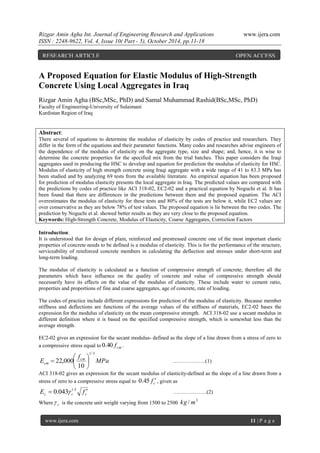
EC2-02 gives an expression for the secant modulus- defined as the slope of a line drawn from a stress of zero to
a compressive stress equal to cmf40.0 .
MPa
f
E cm
cm
3/1
10
000,22 





 ..……………..(1)
ACI 318-02 gives an expression for the secant modulus of elasticity-defined as the slope of a line drawn from a
stress of zero to a compressive stress equal to cf 45.0 , given as
ccc fE  5.1
043.0  ……………….(2)
Where c is the concrete unit weight varying from 1500 to 2500
3
/ mkg
RESEARCH ARTICLE OPEN ACCESS
Rizgar Amin Agha Int. Journal of Engineering Research and Applications www.ijera.com
ISSN : 2248-9622, Vol. 4, Issue 10( Part - 5), October 2014, pp.11-18
www.ijera.com 12 | P a g e
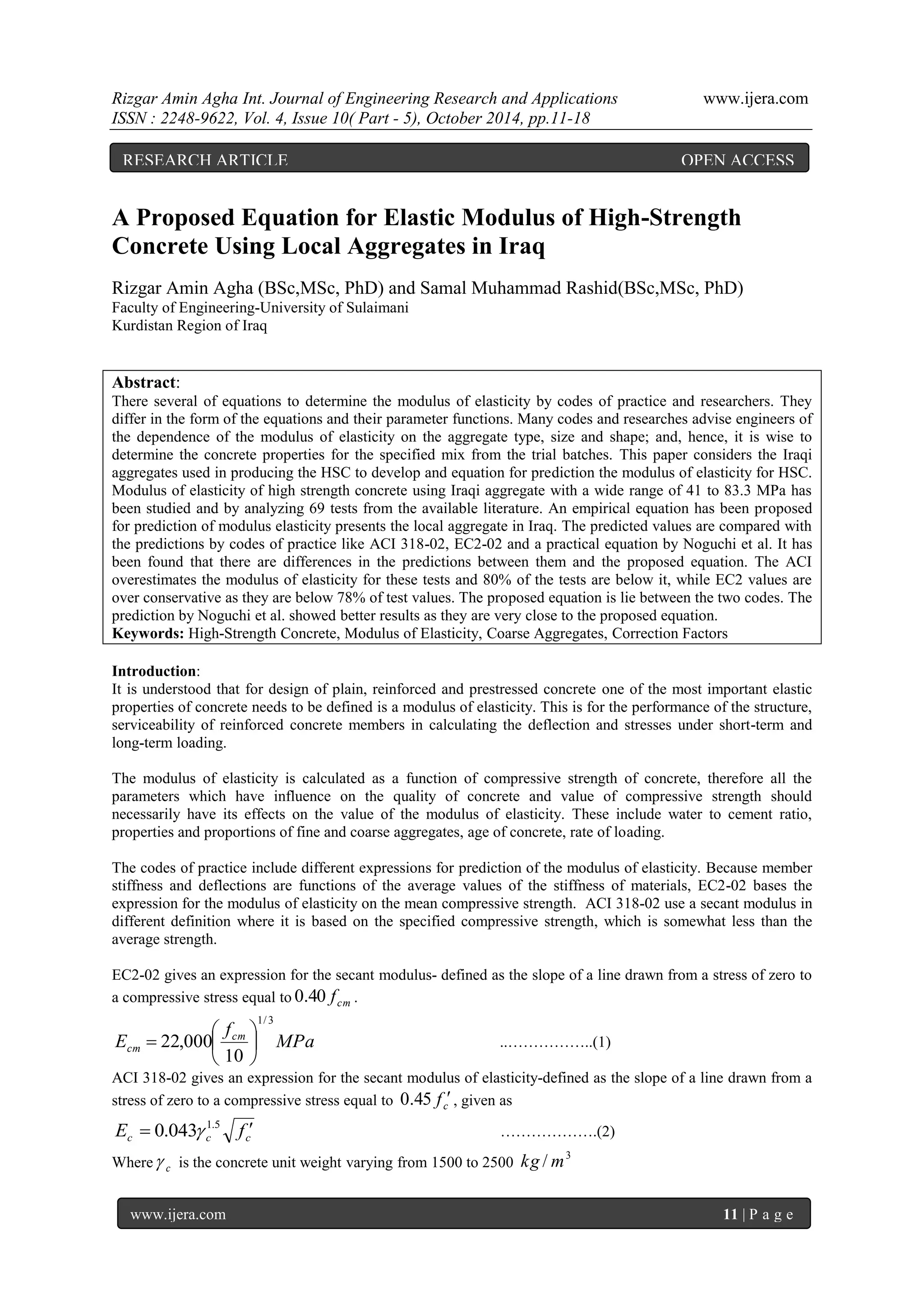
For normal density concrete, the expression simplifies to cc fE  4700 MPa
Carrasquillo, Nilson and Slate modified versions of ACI 318-02 expression and reported by ACI Committee
363, as follows
  MPafE ckc
5.1
2300
.69003320 







………………(3)
There are many expressions for predicting modulus of elasticity for HSC. Codes of practice like ACI 318-02
and EC2-02 use expressions in term of compressive strength only without factors for types of aggregate and
admixtures. ACI does not limit a specified concrete strength while EC2 considers up to MPafc 90 . MC90
clause 2.1.4.2 gives value of ciE , the tangent modulus for concretes made of quartzite aggregates, for concrete
cylinder strengths up to 80 MPa. It recommends factors (  ) to account for the influences from different types
of aggregates as in table 2.1.5 in MC90 (which is reproduced in table (1)). Report 2.2 of PR 5480 recommends
that only be used in situations where the effect of aggregate has not been determined by testing.
Concrete Society Report 49 recommended a direct measurement of ciE to take full account of the differences in
aggregate stiffness and for higher strengths the cmE should be determined by testing.
Table (1)  factor to take account of different types
of aggregate(by MC90)
Aggregate type

Basalt, dense limestone aggregates 1.2
Quartzitic aggregates 1.0
Limestone aggregates 0.9
Sandstone aggregates 0.7
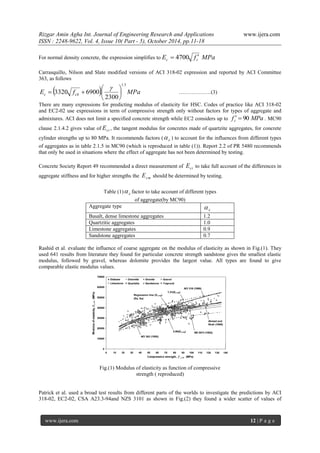
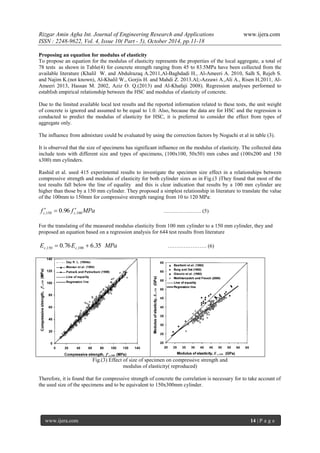
Rashid et al. evaluate the influence of coarse aggregate on the modulus of elasticity as shown in Fig.(1). They
used 641 results from literature they found for particular concrete strength sandstone gives the smallest elastic
modulus, followed by gravel, whereas dolomite provides the largest value. All types are found to give
comparable elastic modulus values.
Fig.(1) Modulus of elasticity as function of compressive
strength ( reproduced)
Patrick et al. used a broad test results from different parts of the worlds to investigate the predictions by ACI
318-02, EC2-02, CSA A23.3-94and NZS 3101 as shown in Fig.(2) they found a wider scatter of values of
Rizgar Amin Agha Int. Journal of Engineering Research and Applications www.ijera.com
ISSN : 2248-9622, Vol. 4, Issue 10( Part - 5), October 2014, pp.11-18
www.ijera.com 13 | P a g e
modulus of elasticity. They conclude that the North American data in the consideration provide a more accurate
prediction of cE than others in the comparison.
Fig.(2) Secant modulus of elasticity predicted using the simplified ACI 318-02 expression, the EC2 expression,
and the expression used by CSA A23.3.94 and NZS 3101-95, as a function of cf 
Noguchi et al. conducted a regression analysis for more than 3000 data tests for to introduce a practical equation
as in equation (4) applicable to a wide range of aggregate types and mineral admixture.
    MPafxkkE cc
3/124
21 60/2400/1035.3.  …………………(4)
They believed that the modulus of elasticity needs to be expressed as a function of coarse aggregate type and the
type and amount of admixtures. They introduce the values of 1k and 2k for the types of aggregates and mineral
admixtures as in table (2) and (3) respectively.
Table (2) practical values of correction factor 1k
Lithological type of coarse aggregate 1.2
Crushed limestone, calcined bauxite 0.95
Crushed quartzitic aggregate, crushed andesite, crushed basalt, crushed
clayslate, crushed cobblestone
1.00
Table (3) practical values of correction factor 2k
Type of addiction
2k
Silica fume, ground-granulated blast-furnace slag, fly ash fume 0.95
Fly ash 1.10
Addition other than above 1.00
Iraqi researchers conducted a considerable experimental works to study the mechanical properties of HSC
including the modulus of elasticity on limited specimens. However, there is no effort towards introducing
expressions for predicting the modulus of elasticity using Iraqi aggregates and industrial admixtures. These tests
are not reported sufficiently to be used for further investigations. The authors of this paper spent much time and
effort for collecting the data for this study.
Rizgar Amin Agha Int. Journal of Engineering Research and Applications www.ijera.com
ISSN : 2248-9622, Vol. 4, Issue 10( Part - 5), October 2014, pp.11-18
www.ijera.com 14 | P a g e
Proposing an equation for modulus of elasticity
To propose an equation for the modulus of elasticity represents the properties of the local aggregate, a total of
78 tests as shown in Table(4) for concrete strength ranging from 45 to 83.5MPa have been collected from the
available literature (Khalil W. and Abdulrazaq A.2011,Al-Baghdadi H., Al-Ameeri A. 2010, Salh S, Rejeb S.
and Najim K.(not known), Al-Khalil W., Gorjis H. and Mahdi Z. 2013.Al;-Azzawi A.,Ali A., Risen H.2011, Al-
Ameeri 2013, Hassan M. 2002, Aziz O. Q.(2013) and Al-Khafaji 2008). Regression analyses performed to
establish empirical relationship between the HSC and modulus of elasticity of concrete.
Due to the limited available local test results and the reported information related to these tests, the unit weight
of concrete is ignored and assumed to be equal to 1.0. Also, because the data are for HSC and the regression is
conducted to predict the modulus of elasticity for HSC, it is preferred to consider the effect from types of
aggregate only.
The influence from admixture could be evaluated by using the correction factors by Noguchi et al in table (3).
It is observed that the size of specimens has significant influence on the modulus of elasticity. The collected data
include tests with different size and types of specimens, (100x100, 50x50) mm cubes and (100x200 and 150
x300) mm cylinders.
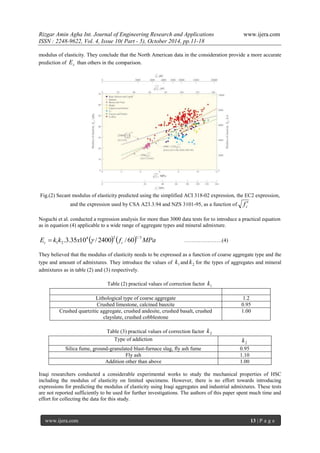
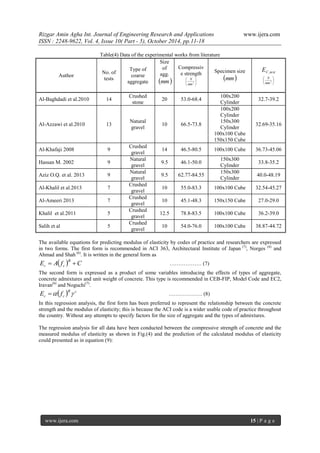
Rashid et al. used 415 experimental results to investigate the specimen size effect in a relationships between
compressive strength and modulus of elasticity for both cylinder sizes as in Fig.(3 )They found that most of the
test results fall below the line of equality and this is clear indication that results by a 100 mm cylinder are
higher than those by a 150 mm cylinder. They proposed a simplest relationship in literature to translate the value
of the 100mm to 150mm for compressive strength ranging from 10 to 120 MPa:
MPaff cc 100,150, 96.0  ………………… (5)
For the translating of the measured modulus elasticity from 100 mm cylinder to a 150 mm cylinder, they and
proposed an equation based on a regression analysis for 644 test results from literature
MPaEE cc 35.676.0 100,150,  …………………. (6)
Fig.(3) Effect of size of specimen on compressive strength and
modulus of elasticity( reproduced)
Therefore, it is found that for compressive strength of concrete the correlation is necessary for to take account of
the used size of the specimens and to be equivalent to 150x300mm cylinder.
Rizgar Amin Agha Int. Journal of Engineering Research and Applications www.ijera.com
ISSN : 2248-9622, Vol. 4, Issue 10( Part - 5), October 2014, pp.11-18
www.ijera.com 15 | P a g e
Table(4) Data of the experimental works from literature
Author
No. of
tests
Type of
coarse
aggregate
Size
of
agg.
 mm
Compressiv
e strength






2
mm
N
Specimen size
 mm
testCE ,






2
mm
N
Al-Baghdadi et al.2010 14
Crushed
stone
20 53.0-68.4
100x200
Cylinder
32.7-39.2
Al-Azzawi et al.2010 13
Natural
gravel
10 66.5-73.8
100x200
Cylinder
150x300
Cylinder
100x100 Cube
150x150 Cube
32.69-35.16
Al-Khafaji 2008 9
Crushed
gravel
14 46.5-80.5 100x100 Cube 36.73-45.06
Hassan M. 2002 9
Natural
gravel
9.5 46.1-50.0
150x300
Cylinder
33.8-35.2
Aziz O.Q. et al. 2013 9
Natural
gravel
9.5 62.77-84.55
150x300
Cylinder
40.0-48.19
Al-Khalil et al.2013 7
Crushed
gravel
10 55.0-83.3 100x100 Cube 32.54-45.27
Al-Ameeri 2013 7
Crushed
gravel
10 45.1-48.3 150x150 Cube 27.0-29.0
Khalil et al.2011 5
Crushed
gravel
12.5 78.8-83.5 100x100 Cube 36.2-39.0
Salih et al 5
Crushed
gravel
10 54.0-76.0 100x100 Cube 38.87-44.72
The available equations for predicting modulus of elasticity by codes of practice and researchers are expressed
in two forms. The first form is recommended in ACI 363, Architectural Institute of Japan (7)
, Norges (6)
and
Ahmad and Shah (6)
. It is written in the general form as
  CfAE
B
cc  ……………… (7)
The second form is expressed as a product of some variables introducing the effects of types of aggregate,
concrete admixtures and unit weight of concrete. This type is recommended in CEB-FIP, Model Code and EC2,
Iravan(6)
and Noguchi(7)
.
  cB
cc fE  ………………. (8)
In this regression analysis, the first form has been preferred to represent the relationship between the concrete
strength and the modulus of elasticity; this is because the ACI code is a wider usable code of practice throughout
the country. Without any attempts to specify factors for the size of aggregate and the types of admixtures.
The regression analysis for all data have been conducted between the compressive strength of concrete and the
measured modulus of elasticity as shown in Fig.(4) and the prediction of the calculated modulus of elasticity
could presented as in equation (9):
Rizgar Amin Agha Int. Journal of Engineering Research and Applications www.ijera.com
ISSN : 2248-9622, Vol. 4, Issue 10( Part - 5), October 2014, pp.11-18
www.ijera.com 16 | P a g e
20000.0
25000.0
30000.0
35000.0
40000.0
45000.0
50000.0
5 6 7 8 9 10
2
/mmNEc
 2
/mmNfc
 MPafE ckoposedc .39074173Pr, 
Fig(4) Relationships between the measured modulus of elasticity
and Compressive strength of concrete
 MPafE ckoposedc .39074173Pr,  ………………(9)
To account for the aggregate types in the proposed equation, further considerations have been made as shown in
Fig.(5) to introduce a factor of k to the first part of the equation as shown in equation (10).and it was found that
he values of k for both crushed gravel aggregate 0.95and crushed stone are similar and equal to 0.974, while
for natural aggregate is different and equal to 1.00.
20000.0
25000.0
30000.0
35000.0
40000.0
45000.0
50000.0
5 6 7 8 9 10
NG
CG
CS
Linear (CS)
Linear (CS)
Linear (NG)
Linear (CG)
974.0CGk
2
/mmNEc
 2
/mmNfc
00.1NGk
95.0CSk
Fig(5) Estimation of aggregate types in the proposed equation
for modulus of elasticity
Note: NG: Natural River aggregate, CG: Crushed River aggregate and CS: Crushed stone
 MPafkE ckoposedc 39074173.Pr,  .…………….(10)
Comparisons haven been carried out between the predictions by the codes of practice of ACI 318-02,Ec2-02,
equation by and the proposed equation as shown in Fig.(4) For calculating of cmE in EC2-02 , it is assumed
of 88  cckcm fff as shown in Fig.(6)
Rizgar Amin Agha Int. Journal of Engineering Research and Applications www.ijera.com
ISSN : 2248-9622, Vol. 4, Issue 10( Part - 5), October 2014, pp.11-18
www.ijera.com 17 | P a g e
The figure shows that there are differences in the predictions between them and the proposed equation. The ACI
overestimates the modulus of elasticity for these tests and as they are below 80% of the entire data fall below
this line., while EC2 values are over conservative as they are below 78%of the entire data fall above this line.
The predictions by the proposed equation and by Noguchi et al. showed better results as their lines lie between
the two codes and are very close to each other. Also, the estimated values of a correction factor k seem to agree
with those proposed by Noguchi as in table (2).
20000.0
25000.0
30000.0
35000.0
40000.0
45000.0
50000.0
55000.0
4 5 6 7 8 9 10 11 12
TEST
EC2
ACI
Nogochi
Linear
(TEST)
Power (EC2)
Linear (ACI)
Linear
(Nogochi)
Linear
(Nogochi)
 2
/mmNfc
2
/mmNEc
 MPafE ckoposedc .39074173Pr, 
 69003320,  ckACIc fE
  3/14
21, 60/1035.3. cNc fxkkE 
3/1
2,
10
000,22 





 cm
ECcm
f
E
Fig(6) Predictions of modulus of elasticity by the proposed equation,
EC2, ACI and Noguchi et al.
Conclusion
Codes of practice like ACI, EC2, MC90 and others recommend various equations for predicting the modulus of
elasticity for HSC. Also, overall studies conducted by various researchers have shown that the types of
aggregate have a great influence on the modulus of elasticity and local equation is necessary to take account this
influence accurately.
A correction factor has been introduced to consider the types of aggregate, while the influence from various
types of admixtures is not included.
It is observed that the proposed equation for the local types of coarse aggregates produce results better than
those by codes of practice .The ACI overestimates the modulus of elasticity for these tests and 80% of the tests
are below its regression line, while EC2 values are over conservative as78% of test values are above its line but
they are very close to the prediction by Noguchi et al.'s equation.
From the limited experimental study, it is concluded that further experimental works are required to consider a
wide range of types and size of aggregates from different sources overall of Iraq.
Reference:
[1.] ACI Committee 363, State –of-the Art Report on High –Strength Concrete, ACI Journal, Proceedings
VOL.81, No.4, July-Aug.1984,pp. 364-411.
[2.] Commite Euro-International du Beton, High Performance Concrete, Recommended Extensions to the
Model Code 90-Research Needs, CEB Bulletin d'Information, No.228, 1995, 46pp.
[3.] ENV 1992-1-1, Eurocode 2. Design of Concrete Structures-Part 1: General Rules and Rules for
Buildings, 2004, 225pp.
[4.] Concrete Society, Design Guide for High Strength Concrete, Tech. Report 49, Slough, The Concrete
Society, 1998(amended 2004)
[5.] Carrasquillo R.L,,Nilson A.H. and Slate F.O.,Properties of High-Strength Concrete Subjected to Short-
Term Loads. ACI Journal Proceedings, Vol.78, No.3, May-June 1981, pp.171-178.
Rizgar Amin Agha Int. Journal of Engineering Research and Applications www.ijera.com
ISSN : 2248-9622, Vol. 4, Issue 10( Part - 5), October 2014, pp.11-18
www.ijera.com 18 | P a g e
[6.] Rashid M. A.; Mansur M. A and Paramasivam P., Correlations between Mechanical Properties of
High-Strength Concrete. Journal of Materials in Civil Engineering / May-June 2002,pp.230-238
[7.] Noguchi T.,Tomosawa F., Nemati K.M.,Chiaia B.M., Fantilli A.P, A Practical Equation of Elastic
Modulus of Concrete, ACI Structural Journal,Vol.106,No.5, Sept-Oct.2009, pp.690-696.
[8.] Al-Ameeri A., The Effect of Steel Fiber on Some Mechanical Properties of Self Compacting Concrete.
American Journal of Civil Engineering.Vo.1, No.3, 2013, pp102-110.
[9.] Khalil W.I and Abdulrazaq A., Mechanical Properties of High Performance Carbon Fiber Concrete,
Engineering and Technology Journal, Vol.29,No.5, 2011
[10.] Al-Azzawi A.A., Ali S.A., Risan H.K., Behavior of Ultra High Performance Concrete Structures.
ARPN Journal of Engineering and Applied Science, Vol.6, No.5, May 2011, pp95-109.
[11.] Al-Baghdadi H.M., Al-Ameeri A.S., Using Different Types of Fine Aggregate to Produce High
Strength Concrete. Babil University Journal for Pure and Applied Science.Vol.2, No.18, 2010,pp713-
723
[12.] Khalil W.I,Gorgis I.N.,Mahdi Z.R., Mechanical Properties of High Performance of Fiber Reinforced
Concrete. Engineering and Technology Journal, Vol.31, Part A, No.7, 2013,pp1365-1387.
[13.] Salih S.A.,Rejeb S.K., Najim K.B., Improving the Modulus of Elasticity of High Performance Concrete
by Using Steel Fibers. Anbar Journal for Engineering Science, pp.205-216.
[14.] Sarsam K. and Al-Azzawi Z.K.,Mechanical Properties of High-Strength Fiber Reinforced Concrete.
Engineering and Technology Journal, Vol.28, No.12, 2010.
[15.] Hassan M., Stiffness and Strength of Concrete In-Filled Steel Frame with and without Opening
Subjected to Vertical Loading, MSc Dissertation, College of Engineering, University of Sulaimani,
2002.
[16.] Aziz O.Q. and Taha B.O., Mechanical Properties of High-Strength Concrete (HSC) with and without
Chopped Carbon Fiber (CCF). International Journal of Civil Engineering (IJCE).Vol.2, Issue 1,
2013,pp 1-12.
[17.] Al-Khafaji S.F., Predicting Mechanical Properties of High Performance Concrete by Using Non-
destructive Tests, MSc Dissertation, College of Building and Construction, University of Technology,
2008.

A Proposed Equation for Elastic Modulus of High-Strength Concrete Using Local Aggregates in Iraq

  • 1.
    Rizgar Amin AghaInt. Journal of Engineering Research and Applications www.ijera.com ISSN : 2248-9622, Vol. 4, Issue 10( Part - 5), October 2014, pp.11-18 www.ijera.com 11 | P a g e A Proposed Equation for Elastic Modulus of High-Strength Concrete Using Local Aggregates in Iraq Rizgar Amin Agha (BSc,MSc, PhD) and Samal Muhammad Rashid(BSc,MSc, PhD) Faculty of Engineering-University of Sulaimani Kurdistan Region of Iraq Abstract: There several of equations to determine the modulus of elasticity by codes of practice and researchers. They differ in the form of the equations and their parameter functions. Many codes and researches advise engineers of the dependence of the modulus of elasticity on the aggregate type, size and shape; and, hence, it is wise to determine the concrete properties for the specified mix from the trial batches. This paper considers the Iraqi aggregates used in producing the HSC to develop and equation for prediction the modulus of elasticity for HSC. Modulus of elasticity of high strength concrete using Iraqi aggregate with a wide range of 41 to 83.3 MPa has been studied and by analyzing 69 tests from the available literature. An empirical equation has been proposed for prediction of modulus elasticity presents the local aggregate in Iraq. The predicted values are compared with the predictions by codes of practice like ACI 318-02, EC2-02 and a practical equation by Noguchi et al. It has been found that there are differences in the predictions between them and the proposed equation. The ACI overestimates the modulus of elasticity for these tests and 80% of the tests are below it, while EC2 values are over conservative as they are below 78% of test values. The proposed equation is lie between the two codes. The prediction by Noguchi et al. showed better results as they are very close to the proposed equation. Keywords: High-Strength Concrete, Modulus of Elasticity, Coarse Aggregates, Correction Factors Introduction: It is understood that for design of plain, reinforced and prestressed concrete one of the most important elastic properties of concrete needs to be defined is a modulus of elasticity. This is for the performance of the structure, serviceability of reinforced concrete members in calculating the deflection and stresses under short-term and long-term loading. The modulus of elasticity is calculated as a function of compressive strength of concrete, therefore all the parameters which have influence on the quality of concrete and value of compressive strength should necessarily have its effects on the value of the modulus of elasticity. These include water to cement ratio, properties and proportions of fine and coarse aggregates, age of concrete, rate of loading. The codes of practice include different expressions for prediction of the modulus of elasticity. Because member stiffness and deflections are functions of the average values of the stiffness of materials, EC2-02 bases the expression for the modulus of elasticity on the mean compressive strength. ACI 318-02 use a secant modulus in different definition where it is based on the specified compressive strength, which is somewhat less than the average strength. EC2-02 gives an expression for the secant modulus- defined as the slope of a line drawn from a stress of zero to a compressive stress equal to cmf40.0 . MPa f E cm cm 3/1 10 000,22        ..……………..(1) ACI 318-02 gives an expression for the secant modulus of elasticity-defined as the slope of a line drawn from a stress of zero to a compressive stress equal to cf 45.0 , given as ccc fE  5.1 043.0  ……………….(2) Where c is the concrete unit weight varying from 1500 to 2500 3 / mkg RESEARCH ARTICLE OPEN ACCESS
  • 2.
    Rizgar Amin AghaInt. Journal of Engineering Research and Applications www.ijera.com ISSN : 2248-9622, Vol. 4, Issue 10( Part - 5), October 2014, pp.11-18 www.ijera.com 12 | P a g e For normal density concrete, the expression simplifies to cc fE  4700 MPa Carrasquillo, Nilson and Slate modified versions of ACI 318-02 expression and reported by ACI Committee 363, as follows   MPafE ckc 5.1 2300 .69003320         ………………(3) There are many expressions for predicting modulus of elasticity for HSC. Codes of practice like ACI 318-02 and EC2-02 use expressions in term of compressive strength only without factors for types of aggregate and admixtures. ACI does not limit a specified concrete strength while EC2 considers up to MPafc 90 . MC90 clause 2.1.4.2 gives value of ciE , the tangent modulus for concretes made of quartzite aggregates, for concrete cylinder strengths up to 80 MPa. It recommends factors (  ) to account for the influences from different types of aggregates as in table 2.1.5 in MC90 (which is reproduced in table (1)). Report 2.2 of PR 5480 recommends that only be used in situations where the effect of aggregate has not been determined by testing. Concrete Society Report 49 recommended a direct measurement of ciE to take full account of the differences in aggregate stiffness and for higher strengths the cmE should be determined by testing. Table (1)  factor to take account of different types of aggregate(by MC90) Aggregate type  Basalt, dense limestone aggregates 1.2 Quartzitic aggregates 1.0 Limestone aggregates 0.9 Sandstone aggregates 0.7 Rashid et al. evaluate the influence of coarse aggregate on the modulus of elasticity as shown in Fig.(1). They used 641 results from literature they found for particular concrete strength sandstone gives the smallest elastic modulus, followed by gravel, whereas dolomite provides the largest value. All types are found to give comparable elastic modulus values. Fig.(1) Modulus of elasticity as function of compressive strength ( reproduced) Patrick et al. used a broad test results from different parts of the worlds to investigate the predictions by ACI 318-02, EC2-02, CSA A23.3-94and NZS 3101 as shown in Fig.(2) they found a wider scatter of values of
  • 3.
    Rizgar Amin AghaInt. Journal of Engineering Research and Applications www.ijera.com ISSN : 2248-9622, Vol. 4, Issue 10( Part - 5), October 2014, pp.11-18 www.ijera.com 13 | P a g e modulus of elasticity. They conclude that the North American data in the consideration provide a more accurate prediction of cE than others in the comparison. Fig.(2) Secant modulus of elasticity predicted using the simplified ACI 318-02 expression, the EC2 expression, and the expression used by CSA A23.3.94 and NZS 3101-95, as a function of cf  Noguchi et al. conducted a regression analysis for more than 3000 data tests for to introduce a practical equation as in equation (4) applicable to a wide range of aggregate types and mineral admixture.     MPafxkkE cc 3/124 21 60/2400/1035.3.  …………………(4) They believed that the modulus of elasticity needs to be expressed as a function of coarse aggregate type and the type and amount of admixtures. They introduce the values of 1k and 2k for the types of aggregates and mineral admixtures as in table (2) and (3) respectively. Table (2) practical values of correction factor 1k Lithological type of coarse aggregate 1.2 Crushed limestone, calcined bauxite 0.95 Crushed quartzitic aggregate, crushed andesite, crushed basalt, crushed clayslate, crushed cobblestone 1.00 Table (3) practical values of correction factor 2k Type of addiction 2k Silica fume, ground-granulated blast-furnace slag, fly ash fume 0.95 Fly ash 1.10 Addition other than above 1.00 Iraqi researchers conducted a considerable experimental works to study the mechanical properties of HSC including the modulus of elasticity on limited specimens. However, there is no effort towards introducing expressions for predicting the modulus of elasticity using Iraqi aggregates and industrial admixtures. These tests are not reported sufficiently to be used for further investigations. The authors of this paper spent much time and effort for collecting the data for this study.
  • 4.
    Rizgar Amin AghaInt. Journal of Engineering Research and Applications www.ijera.com ISSN : 2248-9622, Vol. 4, Issue 10( Part - 5), October 2014, pp.11-18 www.ijera.com 14 | P a g e Proposing an equation for modulus of elasticity To propose an equation for the modulus of elasticity represents the properties of the local aggregate, a total of 78 tests as shown in Table(4) for concrete strength ranging from 45 to 83.5MPa have been collected from the available literature (Khalil W. and Abdulrazaq A.2011,Al-Baghdadi H., Al-Ameeri A. 2010, Salh S, Rejeb S. and Najim K.(not known), Al-Khalil W., Gorjis H. and Mahdi Z. 2013.Al;-Azzawi A.,Ali A., Risen H.2011, Al- Ameeri 2013, Hassan M. 2002, Aziz O. Q.(2013) and Al-Khafaji 2008). Regression analyses performed to establish empirical relationship between the HSC and modulus of elasticity of concrete. Due to the limited available local test results and the reported information related to these tests, the unit weight of concrete is ignored and assumed to be equal to 1.0. Also, because the data are for HSC and the regression is conducted to predict the modulus of elasticity for HSC, it is preferred to consider the effect from types of aggregate only. The influence from admixture could be evaluated by using the correction factors by Noguchi et al in table (3). It is observed that the size of specimens has significant influence on the modulus of elasticity. The collected data include tests with different size and types of specimens, (100x100, 50x50) mm cubes and (100x200 and 150 x300) mm cylinders. Rashid et al. used 415 experimental results to investigate the specimen size effect in a relationships between compressive strength and modulus of elasticity for both cylinder sizes as in Fig.(3 )They found that most of the test results fall below the line of equality and this is clear indication that results by a 100 mm cylinder are higher than those by a 150 mm cylinder. They proposed a simplest relationship in literature to translate the value of the 100mm to 150mm for compressive strength ranging from 10 to 120 MPa: MPaff cc 100,150, 96.0  ………………… (5) For the translating of the measured modulus elasticity from 100 mm cylinder to a 150 mm cylinder, they and proposed an equation based on a regression analysis for 644 test results from literature MPaEE cc 35.676.0 100,150,  …………………. (6) Fig.(3) Effect of size of specimen on compressive strength and modulus of elasticity( reproduced) Therefore, it is found that for compressive strength of concrete the correlation is necessary for to take account of the used size of the specimens and to be equivalent to 150x300mm cylinder.
  • 5.
    Rizgar Amin AghaInt. Journal of Engineering Research and Applications www.ijera.com ISSN : 2248-9622, Vol. 4, Issue 10( Part - 5), October 2014, pp.11-18 www.ijera.com 15 | P a g e Table(4) Data of the experimental works from literature Author No. of tests Type of coarse aggregate Size of agg.  mm Compressiv e strength       2 mm N Specimen size  mm testCE ,       2 mm N Al-Baghdadi et al.2010 14 Crushed stone 20 53.0-68.4 100x200 Cylinder 32.7-39.2 Al-Azzawi et al.2010 13 Natural gravel 10 66.5-73.8 100x200 Cylinder 150x300 Cylinder 100x100 Cube 150x150 Cube 32.69-35.16 Al-Khafaji 2008 9 Crushed gravel 14 46.5-80.5 100x100 Cube 36.73-45.06 Hassan M. 2002 9 Natural gravel 9.5 46.1-50.0 150x300 Cylinder 33.8-35.2 Aziz O.Q. et al. 2013 9 Natural gravel 9.5 62.77-84.55 150x300 Cylinder 40.0-48.19 Al-Khalil et al.2013 7 Crushed gravel 10 55.0-83.3 100x100 Cube 32.54-45.27 Al-Ameeri 2013 7 Crushed gravel 10 45.1-48.3 150x150 Cube 27.0-29.0 Khalil et al.2011 5 Crushed gravel 12.5 78.8-83.5 100x100 Cube 36.2-39.0 Salih et al 5 Crushed gravel 10 54.0-76.0 100x100 Cube 38.87-44.72 The available equations for predicting modulus of elasticity by codes of practice and researchers are expressed in two forms. The first form is recommended in ACI 363, Architectural Institute of Japan (7) , Norges (6) and Ahmad and Shah (6) . It is written in the general form as   CfAE B cc  ……………… (7) The second form is expressed as a product of some variables introducing the effects of types of aggregate, concrete admixtures and unit weight of concrete. This type is recommended in CEB-FIP, Model Code and EC2, Iravan(6) and Noguchi(7) .   cB cc fE  ………………. (8) In this regression analysis, the first form has been preferred to represent the relationship between the concrete strength and the modulus of elasticity; this is because the ACI code is a wider usable code of practice throughout the country. Without any attempts to specify factors for the size of aggregate and the types of admixtures. The regression analysis for all data have been conducted between the compressive strength of concrete and the measured modulus of elasticity as shown in Fig.(4) and the prediction of the calculated modulus of elasticity could presented as in equation (9):
  • 6.
    Rizgar Amin AghaInt. Journal of Engineering Research and Applications www.ijera.com ISSN : 2248-9622, Vol. 4, Issue 10( Part - 5), October 2014, pp.11-18 www.ijera.com 16 | P a g e 20000.0 25000.0 30000.0 35000.0 40000.0 45000.0 50000.0 5 6 7 8 9 10 2 /mmNEc  2 /mmNfc  MPafE ckoposedc .39074173Pr,  Fig(4) Relationships between the measured modulus of elasticity and Compressive strength of concrete  MPafE ckoposedc .39074173Pr,  ………………(9) To account for the aggregate types in the proposed equation, further considerations have been made as shown in Fig.(5) to introduce a factor of k to the first part of the equation as shown in equation (10).and it was found that he values of k for both crushed gravel aggregate 0.95and crushed stone are similar and equal to 0.974, while for natural aggregate is different and equal to 1.00. 20000.0 25000.0 30000.0 35000.0 40000.0 45000.0 50000.0 5 6 7 8 9 10 NG CG CS Linear (CS) Linear (CS) Linear (NG) Linear (CG) 974.0CGk 2 /mmNEc  2 /mmNfc 00.1NGk 95.0CSk Fig(5) Estimation of aggregate types in the proposed equation for modulus of elasticity Note: NG: Natural River aggregate, CG: Crushed River aggregate and CS: Crushed stone  MPafkE ckoposedc 39074173.Pr,  .…………….(10) Comparisons haven been carried out between the predictions by the codes of practice of ACI 318-02,Ec2-02, equation by and the proposed equation as shown in Fig.(4) For calculating of cmE in EC2-02 , it is assumed of 88  cckcm fff as shown in Fig.(6)
  • 7.
    Rizgar Amin AghaInt. Journal of Engineering Research and Applications www.ijera.com ISSN : 2248-9622, Vol. 4, Issue 10( Part - 5), October 2014, pp.11-18 www.ijera.com 17 | P a g e The figure shows that there are differences in the predictions between them and the proposed equation. The ACI overestimates the modulus of elasticity for these tests and as they are below 80% of the entire data fall below this line., while EC2 values are over conservative as they are below 78%of the entire data fall above this line. The predictions by the proposed equation and by Noguchi et al. showed better results as their lines lie between the two codes and are very close to each other. Also, the estimated values of a correction factor k seem to agree with those proposed by Noguchi as in table (2). 20000.0 25000.0 30000.0 35000.0 40000.0 45000.0 50000.0 55000.0 4 5 6 7 8 9 10 11 12 TEST EC2 ACI Nogochi Linear (TEST) Power (EC2) Linear (ACI) Linear (Nogochi) Linear (Nogochi)  2 /mmNfc 2 /mmNEc  MPafE ckoposedc .39074173Pr,   69003320,  ckACIc fE   3/14 21, 60/1035.3. cNc fxkkE  3/1 2, 10 000,22        cm ECcm f E Fig(6) Predictions of modulus of elasticity by the proposed equation, EC2, ACI and Noguchi et al. Conclusion Codes of practice like ACI, EC2, MC90 and others recommend various equations for predicting the modulus of elasticity for HSC. Also, overall studies conducted by various researchers have shown that the types of aggregate have a great influence on the modulus of elasticity and local equation is necessary to take account this influence accurately. A correction factor has been introduced to consider the types of aggregate, while the influence from various types of admixtures is not included. It is observed that the proposed equation for the local types of coarse aggregates produce results better than those by codes of practice .The ACI overestimates the modulus of elasticity for these tests and 80% of the tests are below its regression line, while EC2 values are over conservative as78% of test values are above its line but they are very close to the prediction by Noguchi et al.'s equation. From the limited experimental study, it is concluded that further experimental works are required to consider a wide range of types and size of aggregates from different sources overall of Iraq. Reference: [1.] ACI Committee 363, State –of-the Art Report on High –Strength Concrete, ACI Journal, Proceedings VOL.81, No.4, July-Aug.1984,pp. 364-411. [2.] Commite Euro-International du Beton, High Performance Concrete, Recommended Extensions to the Model Code 90-Research Needs, CEB Bulletin d'Information, No.228, 1995, 46pp. [3.] ENV 1992-1-1, Eurocode 2. Design of Concrete Structures-Part 1: General Rules and Rules for Buildings, 2004, 225pp. [4.] Concrete Society, Design Guide for High Strength Concrete, Tech. Report 49, Slough, The Concrete Society, 1998(amended 2004) [5.] Carrasquillo R.L,,Nilson A.H. and Slate F.O.,Properties of High-Strength Concrete Subjected to Short- Term Loads. ACI Journal Proceedings, Vol.78, No.3, May-June 1981, pp.171-178.
  • 8.
    Rizgar Amin AghaInt. Journal of Engineering Research and Applications www.ijera.com ISSN : 2248-9622, Vol. 4, Issue 10( Part - 5), October 2014, pp.11-18 www.ijera.com 18 | P a g e [6.] Rashid M. A.; Mansur M. A and Paramasivam P., Correlations between Mechanical Properties of High-Strength Concrete. Journal of Materials in Civil Engineering / May-June 2002,pp.230-238 [7.] Noguchi T.,Tomosawa F., Nemati K.M.,Chiaia B.M., Fantilli A.P, A Practical Equation of Elastic Modulus of Concrete, ACI Structural Journal,Vol.106,No.5, Sept-Oct.2009, pp.690-696. [8.] Al-Ameeri A., The Effect of Steel Fiber on Some Mechanical Properties of Self Compacting Concrete. American Journal of Civil Engineering.Vo.1, No.3, 2013, pp102-110. [9.] Khalil W.I and Abdulrazaq A., Mechanical Properties of High Performance Carbon Fiber Concrete, Engineering and Technology Journal, Vol.29,No.5, 2011 [10.] Al-Azzawi A.A., Ali S.A., Risan H.K., Behavior of Ultra High Performance Concrete Structures. ARPN Journal of Engineering and Applied Science, Vol.6, No.5, May 2011, pp95-109. [11.] Al-Baghdadi H.M., Al-Ameeri A.S., Using Different Types of Fine Aggregate to Produce High Strength Concrete. Babil University Journal for Pure and Applied Science.Vol.2, No.18, 2010,pp713- 723 [12.] Khalil W.I,Gorgis I.N.,Mahdi Z.R., Mechanical Properties of High Performance of Fiber Reinforced Concrete. Engineering and Technology Journal, Vol.31, Part A, No.7, 2013,pp1365-1387. [13.] Salih S.A.,Rejeb S.K., Najim K.B., Improving the Modulus of Elasticity of High Performance Concrete by Using Steel Fibers. Anbar Journal for Engineering Science, pp.205-216. [14.] Sarsam K. and Al-Azzawi Z.K.,Mechanical Properties of High-Strength Fiber Reinforced Concrete. Engineering and Technology Journal, Vol.28, No.12, 2010. [15.] Hassan M., Stiffness and Strength of Concrete In-Filled Steel Frame with and without Opening Subjected to Vertical Loading, MSc Dissertation, College of Engineering, University of Sulaimani, 2002. [16.] Aziz O.Q. and Taha B.O., Mechanical Properties of High-Strength Concrete (HSC) with and without Chopped Carbon Fiber (CCF). International Journal of Civil Engineering (IJCE).Vol.2, Issue 1, 2013,pp 1-12. [17.] Al-Khafaji S.F., Predicting Mechanical Properties of High Performance Concrete by Using Non- destructive Tests, MSc Dissertation, College of Building and Construction, University of Technology, 2008.