Mangalayatan University
Faculty Name :- Prof. LALIT MOHAN GUPTA
Course Name :- Programming with ‘C’
Course Code :- CSM – 6151
Semester :- 1
Class No. :- 5
Block No. :- 2
UNIT No. :- 5,6
10/7/2024 CSM – 6151 Programming with "C" 1
Mangalayatan University
What are operators
and expressions?
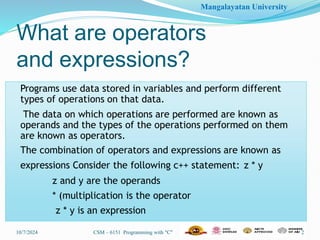
Programs use data stored in variables and perform different
types of operations on that data.
The data on which operations are performed are known as
operands and the types of the operations performed on them
are known as operators.
The combination of operators and expressions are known as
expressions Consider the following c++ statement: z * y
z and y are the operands
* (multiplication is the operator
z * y is an expression
10/7/2024 CSM – 6151 Programming with "C" 2
Mangalayatan University
Operators and Type
An operator is a symbol that specifies the mathematical, logical
or relational operation to be performed.
C language supports different types of operators which can be
used with variables and constants to form expressions.
10/7/2024 CSM – 6151 Programming with "C" 3
Mangalayatan University
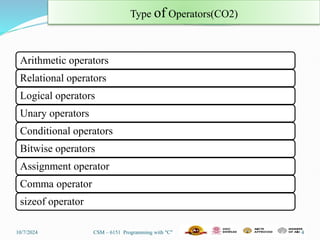
Type of Operators(CO2)
Arithmetic operators
Relational operators
Logical operators
Unary operators
Conditional operators
Bitwise operators
Assignment operator
Comma operator
sizeof operator
10/7/2024 CSM – 6151 Programming with "C" 4
Mangalayatan University
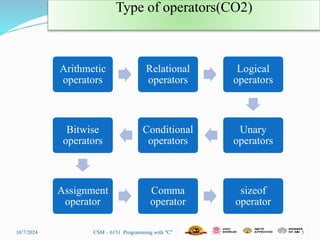
Type of operators(CO2)
Arithmetic
operators
Relational
operators
Logical
operators
Unary
operators
Conditional
operators
Bitwise
operators
Assignment
operator
Comma
operator
sizeof
operator
10/7/2024 CSM – 6151 Programming with "C" 5
Mangalayatan University
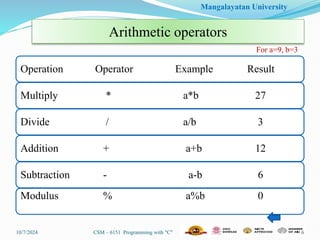
Arithmetic operators
For a=9, b=3
Operation Operator Example Result
Multiply * a*b 27
Divide / a/b 3
Addition + a+b 12
Subtraction - a-b 6
Modulus % a%b 0
10/7/2024 CSM – 6151 Programming with "C" 6
Mangalayatan University
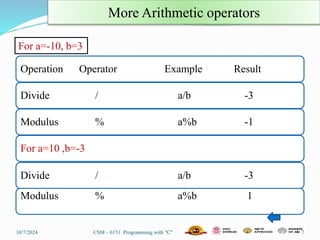
More Arithmetic operators
For a=-10, b=3
Operation Operator Example Result
Divide / a/b -3
Modulus % a%b -1
For a=10 ,b=-3
Divide / a/b -3
Modulus % a%b 1
10/7/2024 CSM – 6151 Programming with "C" 7
Mangalayatan University
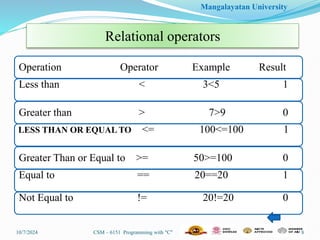
Relational operators
Operation Operator Example Result
Less than < 3<5 1
Greater than > 7>9 0
LESS THAN OR EQUAL TO <= 100<=100 1
Greater Than or Equal to >= 50>=100 0
Equal to == 20==20 1
Not Equal to != 20!=20 0
10/7/2024 CSM – 6151 Programming with "C" 8
Mangalayatan University
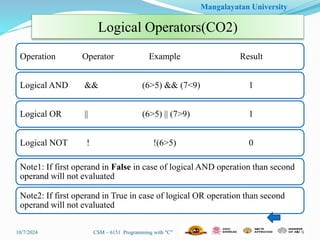
Logical Operators(CO2)
Operation Operator Example Result
Logical AND && (6>5) && (7<9) 1
Logical OR || (6>5) || (7>9) 1
Logical NOT ! !(6>5) 0
Note1: If first operand in False in case of logical AND operation than second
operand will not evaluated
Note2: If first operand in True in case of logical OR operation than second
operand will not evaluated
10/7/2024 CSM – 6151 Programming with "C" 9
Mangalayatan University
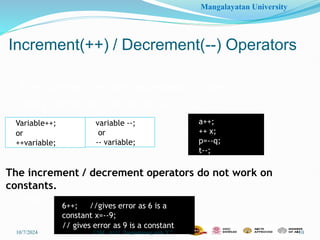
Increment(++) / Decrement(--) Operators
The increment(++) and decrement(--) are
unary operators . The syntax is :
Example
s:
The increment / decrement operators do not work on
constants.
Thus
:
Variable++;
or
++variable;
variable --;
or
-- variable;
a++;
++ x;
p=--q;
t--;
6++; //gives error as 6 is a
constant x=--9;
// gives error as 9 is a constant
10/7/2024 CSM – 6151 Programming with "C" 10
Mangalayatan University
Increment(++) / Decrement(--) Operators
The increment operator increases the value of
a variable by 1 The decrement operator
decreases the value of a variable by 1. Thus
and
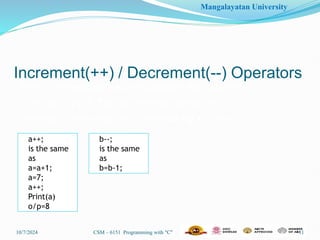
a++;
is the same
as
a=a+1;
a=7;
a++;
Print(a)
o/p=8
b--;
is the same
as
b=b-1;
10/7/2024 CSM – 6151 Programming with "C" 11
Mangalayatan University
Both the increment and decrement operators can be
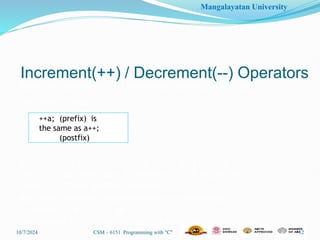
prefixed or postfixed. i.e.
In the above statements both prefix and postfix
forms do not make any difference in the output as
these are stand alone statements.
But when the pre/post increment or decrement
operators are part of an
expression the prefix and postfix notation does matter
++a; (prefix) is
the same as a++;
(postfix)
Increment(++) / Decrement(--) Operators
10/7/2024 CSM – 6151 Programming with "C" 12
Mangalayatan University
Increment(++) / Decrement(-
-) Operators Pre Increment
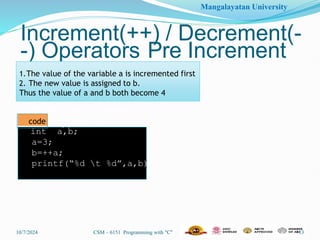
int a,b;
a=3;
b=++a;
printf(“%d t %d”,a,b);
Consider the following
code snippet:
a=
4
b=
4
1.The value of the variable a is incremented first
2. The new value is assigned to b.
Thus the value of a and b both become 4
1
2
code
10/7/2024 CSM – 6151 Programming with "C" 13
Mangalayatan University
Increment(++) / Decrement(--) Operators Post Increment
In the prefix form the increment or decrement
operation is carried
out before the rest of the expression.
Consider the following
code snippet: a
b
b=a
a=a
+1
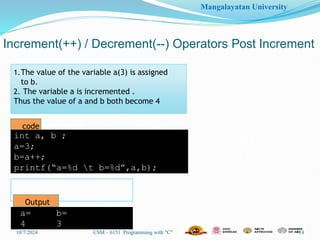
a=
4
b=
3
1.The value of the variable a(3) is assigned
to b.
2. The variable a is incremented .
Thus the value of a and b both become 4
2
1
code
int a, b ;
a=3;
b=a++;
printf(“a=%d t b=%d”,a,b);
Output
10/7/2024 CSM – 6151 Programming with "C" 14
Mangalayatan University
Increment/Decrement operators(CO2)
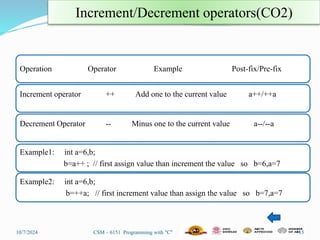
Operation Operator Example Post-fix/Pre-fix
Increment operator ++ Add one to the current value a++/++a
Decrement Operator -- Minus one to the current value a--/--a
Example1: int a=6,b;
b=a++ ; // first assign value than increment the value so b=6,a=7
Example2: int a=6,b;
b=++a; // first increment value than assign the value so b=7,a=7
10/7/2024 CSM – 6151 Programming with "C" 15
Mangalayatan University
Assignment operators(CO2)
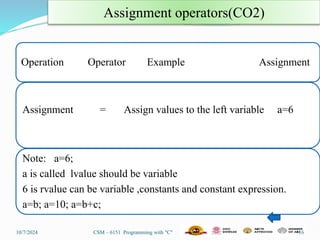
Operation Operator Example Assignment
Assignment = Assign values to the left variable a=6
Note: a=6;
a is called lvalue should be variable
6 is rvalue can be variable ,constants and constant expression.
a=b; a=10; a=b+c;
10/7/2024 CSM – 6151 Programming with "C" 16
Mangalayatan University
Points to note about arithmetic operators
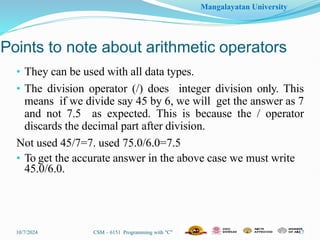
• They can be used with all data types.
• The division operator (/) does integer division only. This
means if we divide say 45 by 6, we will get the answer as 7
and not 7.5 as expected. This is because the / operator
discards the decimal part after division.
Not used 45/7=7. used 75.0/6.0=7.5
• To get the accurate answer in the above case we must write
45.0/6.0.
10/7/2024 CSM – 6151 Programming with "C" 17
Mangalayatan University
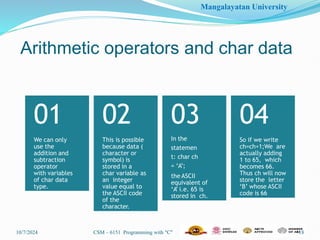
01
We can only
use the
addition and
subtraction
operator
with variables
of char data
type.
02
This is possible
because data (
character or
symbol) is
stored in a
char variable as
an integer
value equal to
the ASCII code
of the
character.
03
In the
statemen
t: char ch
= ‘A’;
the ASCII
equivalent of
‘A
’ i.e. 65 is
stored in ch.
04
So if we write
ch=ch+1;We are
actually adding
1 to 65, which
becomes 66.
Thus ch will now
store the letter
‘B’ whose ASCII
code is 66
Arithmetic operators and char data
10/7/2024 CSM – 6151 Programming with "C" 18
Mangalayatan University
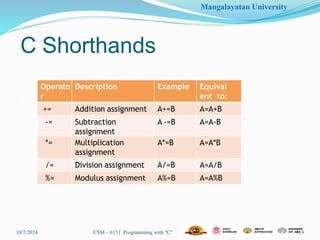
C Shorthands
These are operators used to perform an arithmetic
function on an operand and assign the new value
to the operand at the same time.
Operato
r
Description Example Equival
ent to:
+= Addition assignment A+=B A=A+B
-= Subtraction
assignment
A -=B A=A-B
*= Multiplication
assignment
A*=B A=A*B
/= Division assignment A/=B A=A/B
%= Modulus assignment A%=B A=A%B
10/7/2024 CSM – 6151 Programming with "C" 19

C Programming Language (Operators and Expression)

  • 1.
    Mangalayatan University Faculty Name:- Prof. LALIT MOHAN GUPTA Course Name :- Programming with ‘C’ Course Code :- CSM – 6151 Semester :- 1 Class No. :- 5 Block No. :- 2 UNIT No. :- 5,6 10/7/2024 CSM – 6151 Programming with "C" 1
  • 2.
    Mangalayatan University What areoperators and expressions? Programs use data stored in variables and perform different types of operations on that data. The data on which operations are performed are known as operands and the types of the operations performed on them are known as operators. The combination of operators and expressions are known as expressions Consider the following c++ statement: z * y z and y are the operands * (multiplication is the operator z * y is an expression 10/7/2024 CSM – 6151 Programming with "C" 2
  • 3.
    Mangalayatan University Operators andType An operator is a symbol that specifies the mathematical, logical or relational operation to be performed. C language supports different types of operators which can be used with variables and constants to form expressions. 10/7/2024 CSM – 6151 Programming with "C" 3
  • 4.
    Mangalayatan University Type ofOperators(CO2) Arithmetic operators Relational operators Logical operators Unary operators Conditional operators Bitwise operators Assignment operator Comma operator sizeof operator 10/7/2024 CSM – 6151 Programming with "C" 4
  • 5.
    Mangalayatan University Type ofoperators(CO2) Arithmetic operators Relational operators Logical operators Unary operators Conditional operators Bitwise operators Assignment operator Comma operator sizeof operator 10/7/2024 CSM – 6151 Programming with "C" 5
  • 6.
    Mangalayatan University Arithmetic operators Fora=9, b=3 Operation Operator Example Result Multiply * a*b 27 Divide / a/b 3 Addition + a+b 12 Subtraction - a-b 6 Modulus % a%b 0 10/7/2024 CSM – 6151 Programming with "C" 6
  • 7.
    Mangalayatan University More Arithmeticoperators For a=-10, b=3 Operation Operator Example Result Divide / a/b -3 Modulus % a%b -1 For a=10 ,b=-3 Divide / a/b -3 Modulus % a%b 1 10/7/2024 CSM – 6151 Programming with "C" 7
  • 8.
    Mangalayatan University Relational operators OperationOperator Example Result Less than < 3<5 1 Greater than > 7>9 0 LESS THAN OR EQUAL TO <= 100<=100 1 Greater Than or Equal to >= 50>=100 0 Equal to == 20==20 1 Not Equal to != 20!=20 0 10/7/2024 CSM – 6151 Programming with "C" 8
  • 9.
    Mangalayatan University Logical Operators(CO2) OperationOperator Example Result Logical AND && (6>5) && (7<9) 1 Logical OR || (6>5) || (7>9) 1 Logical NOT ! !(6>5) 0 Note1: If first operand in False in case of logical AND operation than second operand will not evaluated Note2: If first operand in True in case of logical OR operation than second operand will not evaluated 10/7/2024 CSM – 6151 Programming with "C" 9
  • 10.
    Mangalayatan University Increment(++) /Decrement(--) Operators The increment(++) and decrement(--) are unary operators . The syntax is : Example s: The increment / decrement operators do not work on constants. Thus : Variable++; or ++variable; variable --; or -- variable; a++; ++ x; p=--q; t--; 6++; //gives error as 6 is a constant x=--9; // gives error as 9 is a constant 10/7/2024 CSM – 6151 Programming with "C" 10
  • 11.
    Mangalayatan University Increment(++) /Decrement(--) Operators The increment operator increases the value of a variable by 1 The decrement operator decreases the value of a variable by 1. Thus and a++; is the same as a=a+1; a=7; a++; Print(a) o/p=8 b--; is the same as b=b-1; 10/7/2024 CSM – 6151 Programming with "C" 11
  • 12.
    Mangalayatan University Both theincrement and decrement operators can be prefixed or postfixed. i.e. In the above statements both prefix and postfix forms do not make any difference in the output as these are stand alone statements. But when the pre/post increment or decrement operators are part of an expression the prefix and postfix notation does matter ++a; (prefix) is the same as a++; (postfix) Increment(++) / Decrement(--) Operators 10/7/2024 CSM – 6151 Programming with "C" 12
  • 13.
    Mangalayatan University Increment(++) /Decrement(- -) Operators Pre Increment int a,b; a=3; b=++a; printf(“%d t %d”,a,b); Consider the following code snippet: a= 4 b= 4 1.The value of the variable a is incremented first 2. The new value is assigned to b. Thus the value of a and b both become 4 1 2 code 10/7/2024 CSM – 6151 Programming with "C" 13
  • 14.
    Mangalayatan University Increment(++) /Decrement(--) Operators Post Increment In the prefix form the increment or decrement operation is carried out before the rest of the expression. Consider the following code snippet: a b b=a a=a +1 a= 4 b= 3 1.The value of the variable a(3) is assigned to b. 2. The variable a is incremented . Thus the value of a and b both become 4 2 1 code int a, b ; a=3; b=a++; printf(“a=%d t b=%d”,a,b); Output 10/7/2024 CSM – 6151 Programming with "C" 14
  • 15.
    Mangalayatan University Increment/Decrement operators(CO2) OperationOperator Example Post-fix/Pre-fix Increment operator ++ Add one to the current value a++/++a Decrement Operator -- Minus one to the current value a--/--a Example1: int a=6,b; b=a++ ; // first assign value than increment the value so b=6,a=7 Example2: int a=6,b; b=++a; // first increment value than assign the value so b=7,a=7 10/7/2024 CSM – 6151 Programming with "C" 15
  • 16.
    Mangalayatan University Assignment operators(CO2) OperationOperator Example Assignment Assignment = Assign values to the left variable a=6 Note: a=6; a is called lvalue should be variable 6 is rvalue can be variable ,constants and constant expression. a=b; a=10; a=b+c; 10/7/2024 CSM – 6151 Programming with "C" 16
  • 17.
    Mangalayatan University Points tonote about arithmetic operators • They can be used with all data types. • The division operator (/) does integer division only. This means if we divide say 45 by 6, we will get the answer as 7 and not 7.5 as expected. This is because the / operator discards the decimal part after division. Not used 45/7=7. used 75.0/6.0=7.5 • To get the accurate answer in the above case we must write 45.0/6.0. 10/7/2024 CSM – 6151 Programming with "C" 17
  • 18.
    Mangalayatan University 01 We canonly use the addition and subtraction operator with variables of char data type. 02 This is possible because data ( character or symbol) is stored in a char variable as an integer value equal to the ASCII code of the character. 03 In the statemen t: char ch = ‘A’; the ASCII equivalent of ‘A ’ i.e. 65 is stored in ch. 04 So if we write ch=ch+1;We are actually adding 1 to 65, which becomes 66. Thus ch will now store the letter ‘B’ whose ASCII code is 66 Arithmetic operators and char data 10/7/2024 CSM – 6151 Programming with "C" 18
  • 19.
    Mangalayatan University C Shorthands Theseare operators used to perform an arithmetic function on an operand and assign the new value to the operand at the same time. Operato r Description Example Equival ent to: += Addition assignment A+=B A=A+B -= Subtraction assignment A -=B A=A-B *= Multiplication assignment A*=B A=A*B /= Division assignment A/=B A=A/B %= Modulus assignment A%=B A=A%B 10/7/2024 CSM – 6151 Programming with "C" 19