Mangalayatan University
Faculty Name:- Prof. LALIT MOHAN GUPTA
Course Name :- Programming with ‘C’
Course Code :- CSM – 6151
Semester :- 1
Class No. :- 3
Block No. :- 2
UNIT No. :- 5,6
9/21/2024 CSM – 6151 Programming with "C" 1
2.
Mangalayatan University
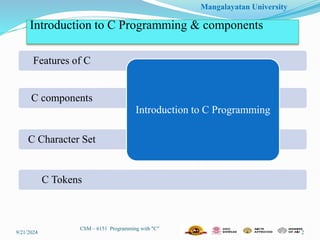
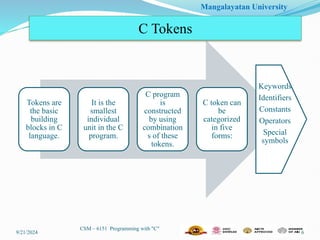
C Tokens
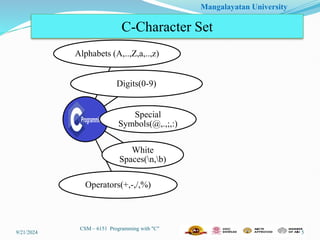
CCharacter Set
Features of C
C components
Introduction to C Programming
9/21/2024
CSM – 6151 Programming with "C"
2
Introduction to C Programming & components
3.
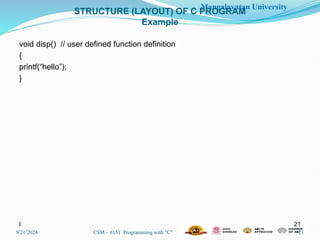
Mangalayatan University
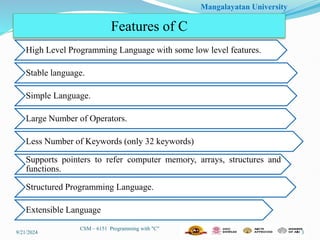
High LevelProgramming Language with some low level features.
Stable language.
Simple Language.
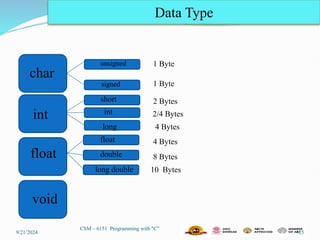
Large Number of Operators.
Less Number of Keywords (only 32 keywords)
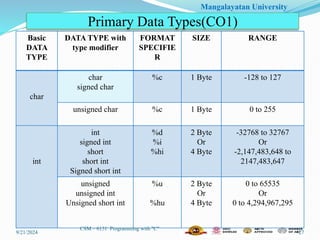
Supports pointers to refer computer memory, arrays, structures and
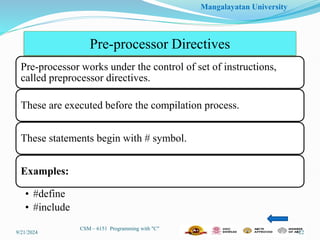
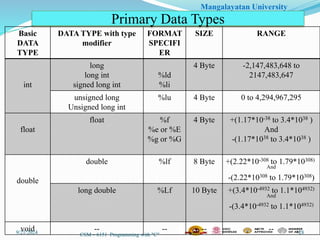
functions.
Structured Programming Language.
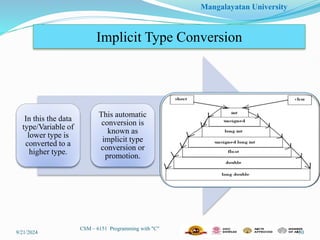
Extensible Language
9/21/2024
CSM – 6151 Programming with "C"
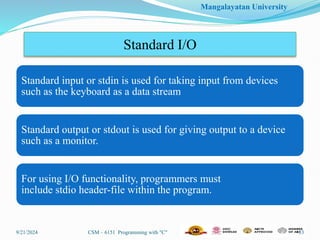
3
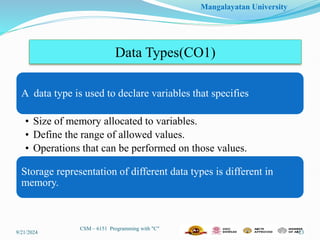
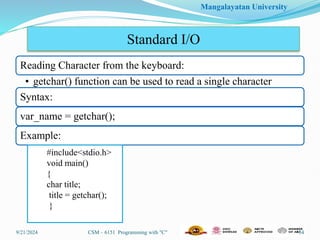
Features of C
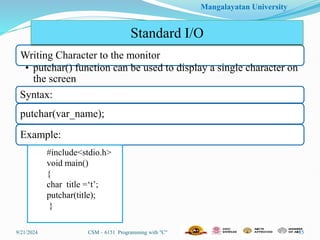
4.
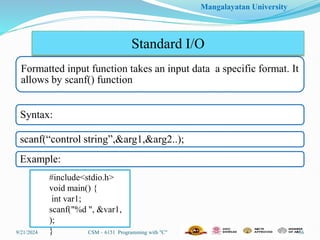
Mangalayatan University
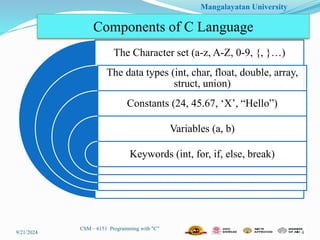
The Characterset (a-z, A-Z, 0-9, {, }…)
The data types (int, char, float, double, array,
struct, union)
Constants (24, 45.67, ‘X’, “Hello”)
Variables (a, b)
Keywords (int, for, if, else, break)
9/21/2024
CSM – 6151 Programming with "C"
4
Components of C Language
Mangalayatan University
Tokens are
thebasic
building
blocks in C
language.
It is the
smallest
individual
unit in the C
program.
C program
is
constructed
by using
combination
s of these
tokens.
C token can
be
categorized
in five
forms:
Keywords
Identifiers
Constants
Operators
Special
symbols
9/21/2024
CSM – 6151 Programming with "C"
6
C Tokens
Mangalayatan University
9/21/2024
CSM –6151 Programming with "C"
8
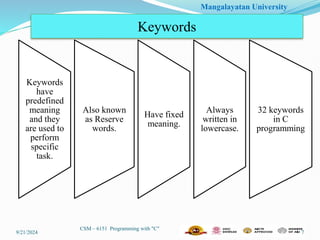
Keywords
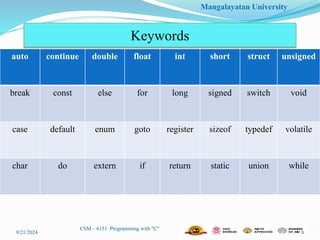
auto continue double float int short struct unsigned
break const else for long signed switch void
case default enum goto register sizeof typedef volatile
char do extern if return static union while
9.
Mangalayatan University
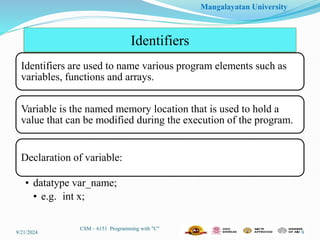
Identifiers areused to name various program elements such as
variables, functions and arrays.
Variable is the named memory location that is used to hold a
value that can be modified during the execution of the program.
Declaration of variable:
• datatype var_name;
• e.g. int x;
9/21/2024
CSM – 6151 Programming with "C"
9
Identifiers
10.
Mangalayatan University
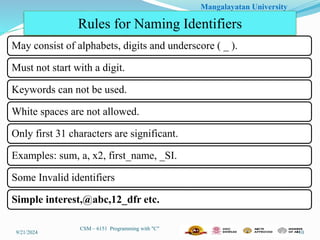
May consistof alphabets, digits and underscore ( _ ).
Must not start with a digit.
Keywords can not be used.
White spaces are not allowed.
Only first 31 characters are significant.
Examples: sum, a, x2, first_name, _SI.
Some Invalid identifiers
Simple interest,@abc,12_dfr etc.
9/21/2024
CSM – 6151 Programming with "C"
10
Rules for Naming Identifiers
11.
Mangalayatan University
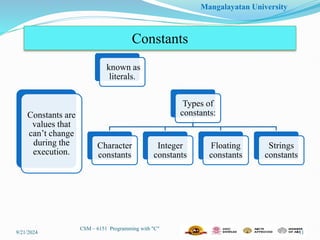
Constants are
valuesthat
can’t change
during the
execution.
known as
literals.
Types of
constants:
Character
constants
Integer
constants
Floating
constants
Strings
constants
9/21/2024
CSM – 6151 Programming with "C"
11
Constants
12.
Mangalayatan University
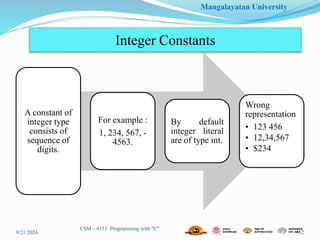
A constantof
integer type
consists of
sequence of
digits.
For example :
1, 234, 567, -
4563.
By default
integer literal
are of type int.
Wrong
representation
• 123 456
• 12,34,567
• $234
9/21/2024
CSM – 6151 Programming with "C"
12
Integer Constants
13.
Mangalayatan University
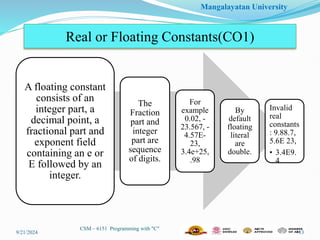
A floatingconstant
consists of an
integer part, a
decimal point, a
fractional part and
exponent field
containing an e or
E followed by an
integer.
The
Fraction
part and
integer
part are
sequence
of digits.
For
example
0.02, -
23.567, -
4.57E-
23,
3.4e+25,
.98
By
default
floating
literal
are
double.
Invalid
real
constants
: 9.88.7,
5.6E 23,
• 3.4E9.
4
9/21/2024
CSM – 6151 Programming with "C"
13
Real or Floating Constants(CO1)
14.
Mangalayatan University
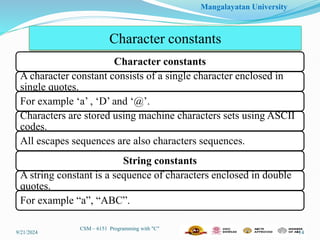
Character constants
Acharacter constant consists of a single character enclosed in
single quotes.
For example ‘a’ , ‘D’ and ‘@’.
Characters are stored using machine characters sets using ASCII
codes.
All escapes sequences are also characters sequences.
String constants
A string constant is a sequence of characters enclosed in double
quotes.
For example “a”, “ABC”.
9/21/2024
CSM – 6151 Programming with "C"
14
Character constants
15.
Mangalayatan University
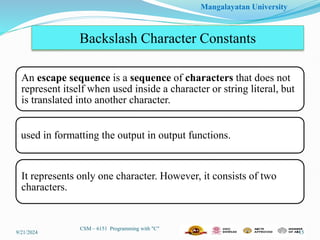
An escapesequence is a sequence of characters that does not
represent itself when used inside a character or string literal, but
is translated into another character.
used in formatting the output in output functions.
It represents only one character. However, it consists of two
characters.
9/21/2024
CSM – 6151 Programming with "C"
15
Backslash Character Constants
16.
Mangalayatan University
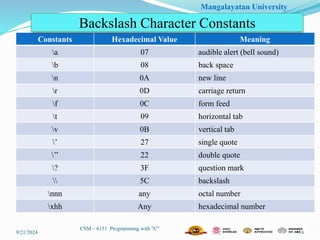
Constants HexadecimalValue Meaning
a 07 audible alert (bell sound)
b 08 back space
n 0A new line
r 0D carriage return
f 0C form feed
t 09 horizontal tab
v 0B vertical tab
’ 27 single quote
’’ 22 double quote
? 3F question mark
5C backslash
nnn any octal number
xhh Any hexadecimal number
9/21/2024
CSM – 6151 Programming with "C"
16
Backslash Character Constants
17.
Mangalayatan University
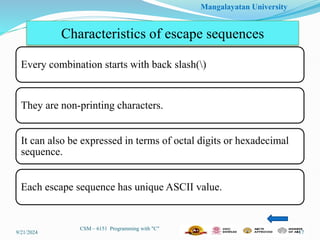
Every combinationstarts with back slash()
They are non-printing characters.
It can also be expressed in terms of octal digits or hexadecimal
sequence.
Each escape sequence has unique ASCII value.
9/21/2024
CSM – 6151 Programming with "C"
17
Characteristics of escape sequences
18.
Mangalayatan University
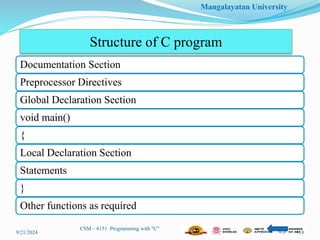
Documentation Section
PreprocessorDirectives
Global Declaration Section
void main()
{
Local Declaration Section
Statements
}
Other functions as required
9/21/2024
CSM – 6151 Programming with "C"
18
Structure of C program
19.
Mangalayatan University
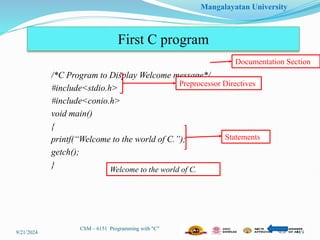
/*C Programto Display Welcome message*/
#include<stdio.h>
#include<conio.h>
void main()
{
printf(“Welcome to the world of C.”);
getch();
}
9/21/2024
CSM – 6151 Programming with "C"
19
First C program
Documentation Section
Preprocessor Directives
Statements
Welcome to the world of C.
20.
Mangalayatan University
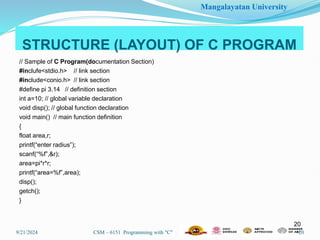
STRUCTURE (LAYOUT)OF C PROGRAM
// Sample of C Program(documentation Section)
#inclufe<stdio.h> // link section
#include<conio.h> // link section
#define pi 3.14 // definition section
int a=10; // global variable declaration
void disp(); // global function declaration
void main() // main function definition
{
float area,r;
printf(“enter radius”);
scanf(“%f”,&r);
area=pi*r*r;
printf(“area=%f”,area);
disp();
getch();
}
20
9/21/2024 CSM – 6151 Programming with "C" 20
21.
Mangalayatan University
STRUCTURE (LAYOUT)OF C PROGRAM
Example
void disp() // user defined function definition
{
printf(“hello”);
}
l 21
9/21/2024 CSM – 6151 Programming with "C" 21
22.
Mangalayatan University
Pre-processor worksunder the control of set of instructions,
called preprocessor directives.
These are executed before the compilation process.
These statements begin with # symbol.
Examples:
• #define
• #include
9/21/2024
CSM – 6151 Programming with "C"
22
Pre-processor Directives
23.
Mangalayatan University
A datatype is used to declare variables that specifies
• Size of memory allocated to variables.
• Define the range of allowed values.
• Operations that can be performed on those values.
Storage representation of different data types is different in
memory.
9/21/2024
CSM – 6151 Programming with "C"
23
Data Types(CO1)
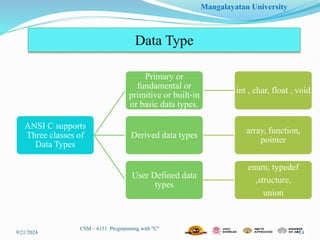
24.
Mangalayatan University
ANSI Csupports
Three classes of
Data Types
Primary or
fundamental or
primitive or built-in
or basic data types.
int , char, float , void
Derived data types
array, function,
pointer
User Defined data
types
enum, typedef
,structure,
union
9/21/2024
CSM – 6151 Programming with "C"
24
Data Type
25.
Mangalayatan University
9/21/2024
CSM –6151 Programming with "C"
25
Data Type
char
int
float
void
unsigned
signed
short
int
long
float
double
long double
1 Byte
1 Byte
2 Bytes
2/4 Bytes
4 Bytes
4 Bytes
8 Bytes
10 Bytes
26.
Mangalayatan University
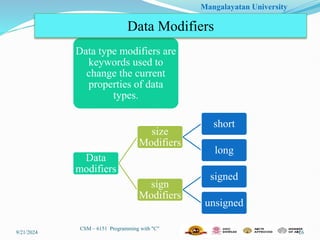
Data typemodifiers are
keywords used to
change the current
properties of data
types.
Type for
Data
modifiers
:
size
Modifiers
short
long
sign
Modifiers
signed
unsigned
9/21/2024
CSM – 6151 Programming with "C"
26
Data Modifiers
27.
Mangalayatan University
Basic
DATA
TYPE
DATA TYPEwith
type modifier
FORMAT
SPECIFIE
R
SIZE RANGE
char
char
signed char
%c 1 Byte -128 to 127
unsigned char %c 1 Byte 0 to 255
int
int
signed int
short
short int
Signed short int
%d
%i
%hi
2 Byte
Or
4 Byte
-32768 to 32767
Or
-2,147,483,648 to
2147,483,647
unsigned
unsigned int
Unsigned short int
%u
%hu
2 Byte
Or
4 Byte
0 to 65535
Or
0 to 4,294,967,295
9/21/2024
CSM – 6151 Programming with "C"
27
Primary Data Types(CO1)
28.
Mangalayatan University
Basic
DATA
TYPE
DATA TYPEwith type
modifier
FORMAT
SPECIFI
ER
SIZE RANGE
int
long
long int
signed long int
%ld
%li
4 Byte -2,147,483,648 to
2147,483,647
unsigned long
Unsigned long int
%lu 4 Byte 0 to 4,294,967,295
float
float %f
%e or %E
%g or %G
4 Byte +(1.17*10-38 to 3.4*1038 )
And
-(1.17*1038 to 3.4*1038 )
double
double %lf 8 Byte +(2.22*10-308 to 1.79*10308)
And
-(2.22*10308 to 1.79*10308)
long double %Lf 10 Byte +(3.4*10-4932 to 1.1*104932)
And
-(3.4*10-4932 to 1.1*104932)
void -- -- -- --
9/21/2024 CSM – 6151 Programming with "C" 28
Primary Data Types
29.
Mangalayatan University
Type castingis a way to convert a variable from one data type to
another data type. For example, if you want to store a long value
into a simple integer then you can type cast long to int.
There are two types of Type Casting
• Implicit type conversion
• Explicit type conversion
9/21/2024
CSM – 6151 Programming with "C"
29
Type Casting or Type Conversion(CO1)
30.
Mangalayatan University
In thisthe data
type/Variable of
lower type is
converted to a
higher type.
This automatic
conversion is
known as
implicit type
conversion or
promotion.
9/21/2024
CSM – 6151 Programming with "C"
30
Implicit Type Conversion
31.
Mangalayatan University
When wewant to convert a type forcibly in a way that is
different from automatic type conversion, we need to go for
explicit type conversion.
Lower to higher and higher to lower both type conversion can be
done in type casting.
Syntax
• (type name) expression;
• For e.g.
• x = (float)y;
• Where x is of type float and y is of type int.
9/21/2024
CSM – 6151 Programming with "C"
31
Explicit Type Conversion
32.
Mangalayatan University
• 8.5is converted to integer 8 by
truncation
x=(int) 8.5
• Evaluated as 23/7 and the result
would be 3
a = (int) 23.6/(int)7.2
• Division is done in floating point
mode
b= (double)sum/n
• Result of a+b is converted to
intger.
c= (int)(a+b)
• a is converted to integer and then
added to b.
p= (int)a+b
9/21/2024
CSM – 6151 Programming with "C"
32
Explicit Type Conversion or Type Casting
33.
Mangalayatan University
Standard inputor stdin is used for taking input from devices
such as the keyboard as a data stream
Standard output or stdout is used for giving output to a device
such as a monitor.
For using I/O functionality, programmers must
include stdio header-file within the program.
9/21/2024 CSM – 6151 Programming with "C" 33
Standard I/O
34.
Mangalayatan University
Reading Characterfrom the keyboard:
• getchar() function can be used to read a single character
Syntax:
var_name = getchar();
Example:
9/21/2024 CSM – 6151 Programming with "C" 34
Standard I/O
#include<stdio.h>
void main()
{
char title;
title = getchar();
}
35.
Mangalayatan University
Writing Characterto the monitor
• putchar() function can be used to display a single character on
the screen
Syntax:
putchar(var_name);
Example:
9/21/2024 CSM – 6151 Programming with "C" 35
Standard I/O
#include<stdio.h>
void main()
{
char title =‘t’;
putchar(title);
}
36.
Mangalayatan University
Formatted inputfunction takes an input data a specific format. It
allows by scanf() function
Syntax:
scanf(“control string”,&arg1,&arg2..);
Example:
9/21/2024 CSM – 6151 Programming with "C" 36
Standard I/O
#include<stdio.h>
void main() {
int var1;
scanf("%d ", &var1,
);
}
37.
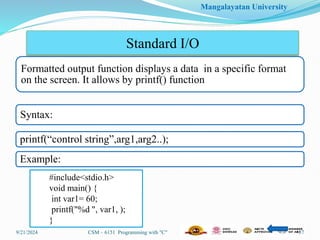
Mangalayatan University
Formatted outputfunction displays a data in a specific format
on the screen. It allows by printf() function
Syntax:
printf(“control string”,arg1,arg2..);
Example:
9/21/2024 CSM – 6151 Programming with "C" 37
Standard I/O
#include<stdio.h>
void main() {
int var1= 60;
printf("%d ", var1, );
}
38.
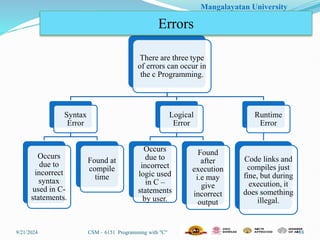
Mangalayatan University
There arethree type
of errors can occur in
the c Programming.
Syntax
Error
Occurs
due to
incorrect
syntax
used in C-
statements.
Found at
compile
time
Logical
Error
Occurs
due to
incorrect
logic used
in C –
statements
by user.
Found
after
execution
i.e may
give
incorrect
output
Runtime
Error
Code links and
compiles just
fine, but during
execution, it
does something
illegal.
9/21/2024 CSM – 6151 Programming with "C" 38
Errors
39.
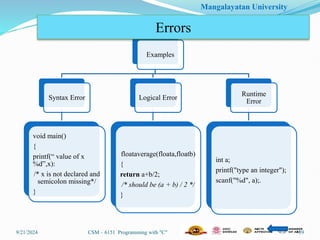
Mangalayatan University
Examples
Syntax Error
voidmain()
{
printf(“ value of x
%d”,x):
/* x is not declared and
semicolon missing*/
}
Logical Error
floataverage(floata,floatb)
{
return a+b/2;
/* should be (a + b) / 2 */
}
Runtime
Error
int a;
printf("type an integer");
scanf("%d", a);.
9/21/2024 CSM – 6151 Programming with "C" 39
Errors
40.
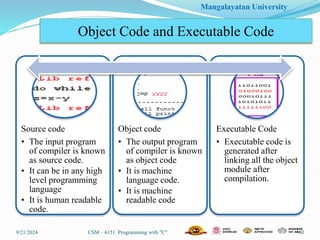
Mangalayatan University
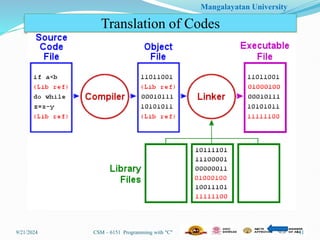
Source code
•The input program
of compiler is known
as source code.
• It can be in any high
level programming
language
• It is human readable
code.
Object code
• The output program
of compiler is known
as object code
• It is machine
language code.
• It is machine
readable code
Executable Code
• Executable code is
generated after
linking all the object
module after
compilation.
9/21/2024 CSM – 6151 Programming with "C" 40
Object Code and Executable Code
Mangalayatan University
A variableis a name which is assigned to a data value at storage
location in computer’s memory.
Variables are used to store various kinds of data during program
executions.
Variables name assigned before it use and it can be letter , digit
and an underscore(_).
9/21/2024 42
Variables and Memory allocation
CSM – 6151 Programming with "C"
43.
Mangalayatan University
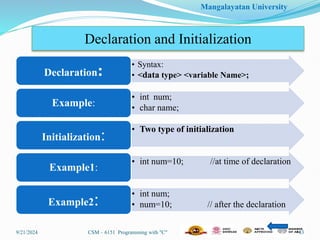
• Syntax:
•<data type> <variable Name>;
Declaration:
• int num;
• char name;
Example:
• Two type of initialization
Initialization:
• int num=10; //at time of declaration
Example1:
• int num;
• num=10; // after the declaration
Example2:
9/21/2024 CSM – 6151 Programming with "C" 43
Declaration and Initialization
44.
Mangalayatan University
Write aprogram of find area of circle
Write a program of find area of triangle.
Write a program of find swap two numbers using third variable
Write a program of swap two numbers without using third variable
Write a program of swap two numbers without using third variable
Write a program of find area of circle.
Write a program of find area of triangle.
Write a program of find swap two numbers using third variable.
Write a program of swap two numbers without using third
variable
9/21/2024 CSM – 6151 Programming with "C" 44
Programs
45.
Mangalayatan University
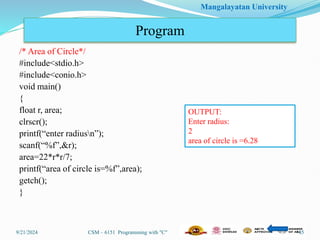
/* Areaof Circle*/
#include<stdio.h>
#include<conio.h>
void main()
{
float r, area;
clrscr();
printf(“enter radiusn”);
scanf(“%f”,&r);
area=22*r*r/7;
printf(“area of circle is=%f”,area);
getch();
}
9/21/2024 CSM – 6151 Programming with "C" 45
Program
OUTPUT:
Enter radius:
2
area of circle is =6.28
46.
Mangalayatan University
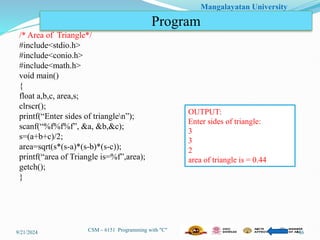
/* Areaof Triangle*/
#include<stdio.h>
#include<conio.h>
#include<math.h>
void main()
{
float a,b,c, area,s;
clrscr();
printf(“Enter sides of trianglen”);
scanf(“%f%f%f”, &a, &b,&c);
s=(a+b+c)/2;
area=sqrt(s*(s-a)*(s-b)*(s-c));
printf(“area of Triangle is=%f”,area);
getch();
}
9/21/2024 CSM – 6151 Programming with "C" 46
Program
OUTPUT:
Enter sides of triangle:
3
3
2
area of triangle is = 0.44
47.
Mangalayatan University
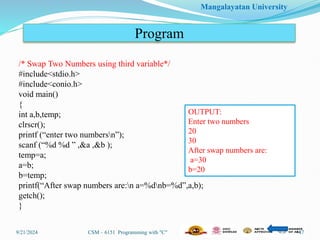
/* SwapTwo Numbers using third variable*/
#include<stdio.h>
#include<conio.h>
void main()
{
int a,b,temp;
clrscr();
printf (“enter two numbersn”);
scanf (“%d %d ” ,&a ,&b );
temp=a;
a=b;
b=temp;
printf(“After swap numbers are:n a=%dnb=%d”,a,b);
getch();
}
9/21/2024 CSM – 6151 Programming with "C" 47
Program
OUTPUT:
Enter two numbers
20
30
After swap numbers are:
a=30
b=20
48.
Mangalayatan University
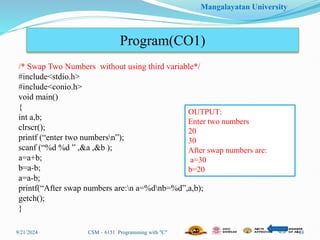
/* SwapTwo Numbers without using third variable*/
#include<stdio.h>
#include<conio.h>
void main()
{
int a,b;
clrscr();
printf (“enter two numbersn”);
scanf (“%d %d ” ,&a ,&b );
a=a+b;
b=a-b;
a=a-b;
printf(“After swap numbers are:n a=%dnb=%d”,a,b);
getch();
}
9/21/2024 CSM – 6151 Programming with "C" 48
Program(CO1)
OUTPUT:
Enter two numbers
20
30
After swap numbers are:
a=30
b=20
49.
Mangalayatan University
InC-programming what will be the value of r if r=p%q where p=-17 and q=5?
[MTU 2011-12 (Even) Marks 2]
What is the value of 2^3? [GBTU 2011-12 (Odd) Marks 2]
Write a program in C to find the greatest number among three numbers using
conditional operator. [GBTU 2013-14 (Odd) Marks 5]
What will be the output of the following code? [GBTU 2011-12 (Odd) Marks 2]
void main( )
{
int a=5, b=6;
printf(“%dt”,a=b);
printf(“%dt”,a==b);
printf(“%dt%d”,a,b);
}
9/21/2024
CSM – 6151 Programming with "C"
49
Weekly Assignment
50.
Mangalayatan University
Datatypes
Structure of C Program
Basic of C program
9/21/2024 CSM – 6151 Programming with "C" 50
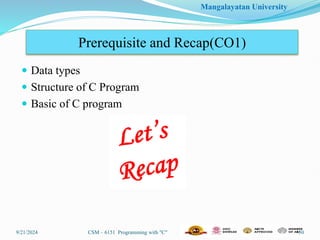
Prerequisite and Recap(CO1)
51.
Mangalayatan University
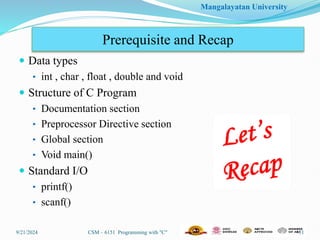
Datatypes
• int , char , float , double and void
Structure of C Program
• Documentation section
• Preprocessor Directive section
• Global section
• Void main()
Standard I/O
• printf()
• scanf()
9/21/2024 CSM – 6151 Programming with "C" 51
Prerequisite and Recap
![Mangalayatan University
In C-programming what will be the value of r if r=p%q where p=-17 and q=5?
[MTU 2011-12 (Even) Marks 2]
What is the value of 2^3? [GBTU 2011-12 (Odd) Marks 2]
Write a program in C to find the greatest number among three numbers using
conditional operator. [GBTU 2013-14 (Odd) Marks 5]
What will be the output of the following code? [GBTU 2011-12 (Odd) Marks 2]
void main( )
{
int a=5, b=6;
printf(“%dt”,a=b);
printf(“%dt”,a==b);
printf(“%dt%d”,a,b);
}
9/21/2024
CSM – 6151 Programming with "C"
49
Weekly Assignment](https://image.slidesharecdn.com/lecture3-250531161014-de60ed41/85/C-Programming-Language-Features-and-Components-49-320.jpg)