• It had been developed at AT&T’s (American Telephone and
Telegraph)BellLaboratories in 1972 by DennisRitchie.
• It is based on highlevel language.
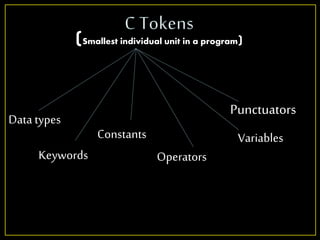
(Smallest individual unit in a program)
Data types
Keywords
Constants
Operators
Punctuators
Variables
• C identifier is a name used to identify a variable, function,
or any other user-defined item .
• An identifier starts with a letter A to Z, a to z, or an
underscore followed by zero or more letters, underscores,
and digits ( 0 to 9).
• C does not allow punctuation characters such as @, $, and
% within identifiers.
• For example : move name
• Zara a_122 _tem
• The name should consist of only alphabets (both upper
and lower case), digits and underscore sign (_)
• First character should be an alphabet or underscore.
• The name should not be a keyword.
• The uppercase and lowercase letters are considered
different as C is case-sensitive. For example : code ,
Code and CODE are three different identifiers.
• The words that are reserved for doing specific tasks and
have standard , predefined meaning in C are known as
keywords.
• They are always written in lowercase.
• There are only 32 keywords in C –
• Auto break case char const
• Continue default do double
goto
• Register enum switch long for
• Return int if else
struct
• While short void extern static
• A data type in a programming language is a set of data
with values having predefined characteristics such as
integers and characters.
Data Types
Primary/ Built-in Derived/ User-defined
double
Array
Floating-
point
character
Integer
String
pointer
Structure
Function
• A variable is nothing but a name given to a storage area
that our programs can manipulate.
• Each variable in C has a specific type, which determines
the size and layout of the variable’s memory.
• The range of values that can be stored within that
memory and the set of operations that can applied to the
variable.
• Rules for variable naming –
• Variable name can be composed of letters, digits, and underscore
character.
• It must begin with either a letter or an underscore.
• A variable declaration specifies a data type and contains a list of
one or more variables of that type as follows :
• type variable_list;
• Here, “type” must be valid C data type including char, int, float,
double, or any user-defined object; and “ variable_list ” may
consist of one or more identifier names separated by commas.
• Example of valid declaration are :
int i , k;
char ch;
float salary , f;
double d;
• Variables can be initialized ( assigned an initial value) in their declaration.
type variable_name= value ;
Example :int d=3,f==6;
• A variable declaration has its meaning at the time of compilation only, the
compiler needs actual variable declaration at the time of linking the program.

C Language presentation

  • 2.
    • It hadbeen developed at AT&T’s (American Telephone and Telegraph)BellLaboratories in 1972 by DennisRitchie. • It is based on highlevel language.
  • 3.
    (Smallest individual unitin a program) Data types Keywords Constants Operators Punctuators Variables
  • 4.
    • C identifieris a name used to identify a variable, function, or any other user-defined item . • An identifier starts with a letter A to Z, a to z, or an underscore followed by zero or more letters, underscores, and digits ( 0 to 9). • C does not allow punctuation characters such as @, $, and % within identifiers. • For example : move name • Zara a_122 _tem
  • 5.
    • The nameshould consist of only alphabets (both upper and lower case), digits and underscore sign (_) • First character should be an alphabet or underscore. • The name should not be a keyword. • The uppercase and lowercase letters are considered different as C is case-sensitive. For example : code , Code and CODE are three different identifiers.
  • 6.
    • The wordsthat are reserved for doing specific tasks and have standard , predefined meaning in C are known as keywords. • They are always written in lowercase. • There are only 32 keywords in C – • Auto break case char const • Continue default do double goto • Register enum switch long for • Return int if else struct • While short void extern static
  • 7.
    • A datatype in a programming language is a set of data with values having predefined characteristics such as integers and characters.
  • 8.
    Data Types Primary/ Built-inDerived/ User-defined double Array Floating- point character Integer String pointer Structure Function
  • 9.
    • A variableis nothing but a name given to a storage area that our programs can manipulate. • Each variable in C has a specific type, which determines the size and layout of the variable’s memory. • The range of values that can be stored within that memory and the set of operations that can applied to the variable. • Rules for variable naming – • Variable name can be composed of letters, digits, and underscore character. • It must begin with either a letter or an underscore.
  • 10.
    • A variabledeclaration specifies a data type and contains a list of one or more variables of that type as follows : • type variable_list; • Here, “type” must be valid C data type including char, int, float, double, or any user-defined object; and “ variable_list ” may consist of one or more identifier names separated by commas. • Example of valid declaration are : int i , k; char ch; float salary , f; double d; • Variables can be initialized ( assigned an initial value) in their declaration. type variable_name= value ; Example :int d=3,f==6; • A variable declaration has its meaning at the time of compilation only, the compiler needs actual variable declaration at the time of linking the program.