BUYER BEHAVIOR IN
MARKETING STRATEGY
   (John A. Howard, 2nd ed.)
Consumer behavior
 ”Consumer behavior is the study of
 how consumers differentiate
 among products, why people buy
 and consume products, and the
 way they think and act when
 buying and consuming.”
Key concepts
 • product categories
 • product life cycle (PLC)
 • customer decision model (CDM)
Key concepts (cont’d)
 • product categories
   ”group of brands that serve the same
   generic needs and are perceived
   similar.” (simplifying)
 • product life cycle (PLC)
 • customer decision model (CDM)
Key concepts
 • product categories
   ”group of brands that serve the same
   generic needs and are perceived
   similar.” (simplifying)
 • product life cycle (PLC)
   1. introduction
   2. growth
   3. maturity
 • customer decision model (CDM)
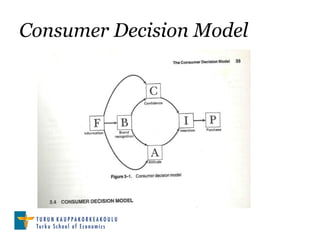
Consumer Decision Model
Problem solving
 • Extensive (EPS)
 • Limited (LPS)
 • Routine (RPS)

   connected to Stage of PLC, Amount
   of Information, Speed of Decision
Complex factors
 • evoked set (or consideration set)
 • brand loyalty (repeat purchases,
   nonrecursivity)
 • habitual purchasing (routine
   problem solving) vs. variety
   seeking (heterogeneity)
Critique
 • explicit focus on corporate USA
    – big corporations
    – consumer power
 • lack of service focus
 • hasty generalizations
    – ”all judgments about the quality of each [instant
      coffee] brand had largely been made: consumers
      already had formed an image of each brand.”
      (impossible?)
    – compare: ”Consequently, the product sat on
      shelves unsold. The company had not provided
      the amount of information – through advertising –
      that the consumer required.”
 • outdated examples (GM)
More critique
 ”Not all new products conform to
 this theoretical life cycle [PLC], but
 most do, so (...) it is a highly useful
 description.”
   – NO! Most new products DIE.
   – Hence, it is useful if you have tons
     of products and tons of money; if
     not, it gives you ZERO help.
However… (the positive)
 • very good methodological
   implications; practical
   walkthrough of measurements
 • involvement of psychology
 • not only praising quantitative
   approach, but actually
   recommending a synthesis
Thanks!


    joni.salminen@tse.fi

Buyer Behavior in Marketing Strategy

  • 1.
    BUYER BEHAVIOR IN MARKETINGSTRATEGY (John A. Howard, 2nd ed.)
  • 2.
    Consumer behavior ”Consumerbehavior is the study of how consumers differentiate among products, why people buy and consume products, and the way they think and act when buying and consuming.”
  • 3.
    Key concepts •product categories • product life cycle (PLC) • customer decision model (CDM)
  • 4.
    Key concepts (cont’d) • product categories ”group of brands that serve the same generic needs and are perceived similar.” (simplifying) • product life cycle (PLC) • customer decision model (CDM)
  • 5.
    Key concepts •product categories ”group of brands that serve the same generic needs and are perceived similar.” (simplifying) • product life cycle (PLC) 1. introduction 2. growth 3. maturity • customer decision model (CDM)
  • 6.
  • 7.
    Problem solving •Extensive (EPS) • Limited (LPS) • Routine (RPS) connected to Stage of PLC, Amount of Information, Speed of Decision
  • 8.
    Complex factors •evoked set (or consideration set) • brand loyalty (repeat purchases, nonrecursivity) • habitual purchasing (routine problem solving) vs. variety seeking (heterogeneity)
  • 9.
    Critique • explicitfocus on corporate USA – big corporations – consumer power • lack of service focus • hasty generalizations – ”all judgments about the quality of each [instant coffee] brand had largely been made: consumers already had formed an image of each brand.” (impossible?) – compare: ”Consequently, the product sat on shelves unsold. The company had not provided the amount of information – through advertising – that the consumer required.” • outdated examples (GM)
  • 10.
    More critique ”Notall new products conform to this theoretical life cycle [PLC], but most do, so (...) it is a highly useful description.” – NO! Most new products DIE. – Hence, it is useful if you have tons of products and tons of money; if not, it gives you ZERO help.
  • 11.
    However… (the positive) • very good methodological implications; practical walkthrough of measurements • involvement of psychology • not only praising quantitative approach, but actually recommending a synthesis
  • 12.
    Thanks! joni.salminen@tse.fi