Open Source Projects:
Management/
Governance
Jim Jagielski
Agenda
Introduction
What exactly is “Open Source”
How the ASF Does It
Introduction
Jim Jagielski
Longest still-active developer/contributor
Co-founder of the ASF
Member, Director and Chairman
CTO/Chief Architect for the Covalent Division of
SpringSource
The draw of Open Source
Having a real impact in the development and direction of IT
Personal satisfaction: I wrote that!
Sense of membership in a community
Sense of accomplishment - very quick turnaround times
Developers and engineers love to tinker - huge opportunity
to do so
What is Open Source?
Open Source Licensing
OSI Approved
Open Source Development
ala, the Apache Software Foundation
Free Software
As in Free Speech, not Free Beer
What is Open Source?
Basically, it’s a “new” way to develop, license and distribute
code
Actually, there was “open source” even before it was called
that
The key technologies behind the Internet and the Web are all
Open Source based
True Open Source
For software to be Open Source, it must be under an OSI
approved Open Source License
At last count, over 70 exist
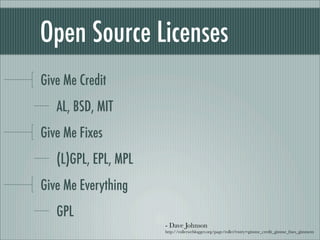
Open Source Licenses
Give Me Credit
AL, BSD, MIT
Give Me Fixes
(L)GPL, EPL, MPL
Give Me Everything
GPL
- Dave Johnson
http://rollerweblogger.org/page/roller?entry=gimme_credit_gimme_fixes_gimmem
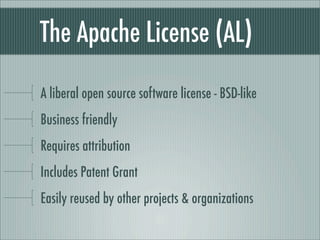
The Apache License (AL)
A liberal open source software license - BSD-like
Business friendly
Requires attribution
Includes Patent Grant
Easily reused by other projects & organizations
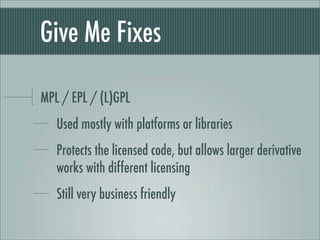
Give Me Fixes
MPL / EPL / (L)GPL
Used mostly with platforms or libraries
Protects the licensed code, but allows larger derivative
works with different licensing
Still very business friendly
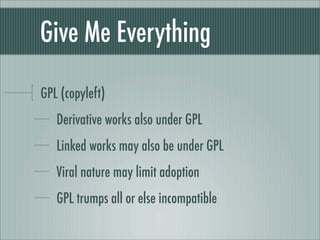
Give Me Everything
GPL (copyleft)
Derivative works also under GPL
Linked works may also be under GPL
Viral nature may limit adoption
GPL trumps all or else incompatible
License Differences
Mainly involve the licensing of derivative works
Only really applies during (re)distribution of work
Where the “freedom” should be mostly focused: the user or
the code itself
One True License
There is no such thing
Licensing is selected to address what you are trying to do
In general, Open Standards do better with AL-like license
The ASF
ASF == The Apache Software Foundation
Before the ASF there was “The Apache Group”
The ASF was incorporated in 1999
How We Work
The Apache Software Foundation provides support for the
Apache community of open-source software projects. The
Apache projects are characterized by a collaborative,
consensus based development process, an open and
pragmatic software license, and a desire to create high
quality software that leads the way in its field. We consider
ourselves not simply a group of projects sharing a server, but
rather a community of developers and users.
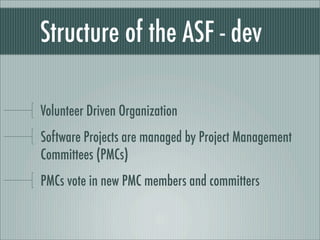
Structure of the ASF - dev
Volunteer Driven Organization
Software Projects are managed by Project Management
Committees (PMCs)
PMCs vote in new PMC members and committers
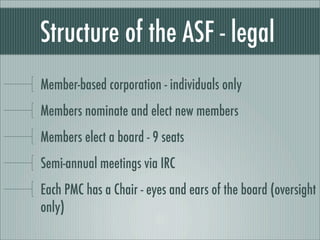
Structure of the ASF - legal
Member-based corporation - individuals only
Members nominate and elect new members
Members elect a board - 9 seats
Semi-annual meetings via IRC
Each PMC has a Chair - eyes and ears of the board (oversight
only)
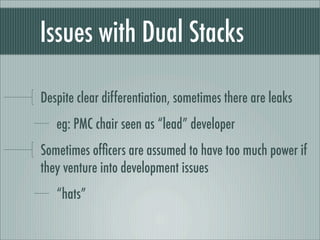
Issues with Dual Stacks
Despite clear differentiation, sometimes there are leaks
eg: PMC chair seen as “lead” developer
Sometimes officers are assumed to have too much power if
they venture into development issues
“hats”
The Apache Way
Although the term is deprecated, “The Apache Way” relates
to how the ASF (and its projects) work and operate
Basically, the least common denominators on how PMCs
operate
Basic Memes
Meritocracy
Peer-based
Consensus decision making
Collaborative development
Responsible oversight
Meritocracy
“Govern by Merit”
Merit is based on what you do
Merit never expires
Those with merit, get more responsibility
Peer-based
Developers represent themselves - individuals
Mutual trust and respect
All votes hold the same weight
Community over code
Healthy communities create healthy code
Poisonous communities don’t
Why Community > Code
Since we are all volunteers, people’s time and interests
change
A healthy community is “warm and inviting” and encourages
a continued influx of developers
Poisonous people/communities turn people off, and the
project will die
End result - better code, long-term code
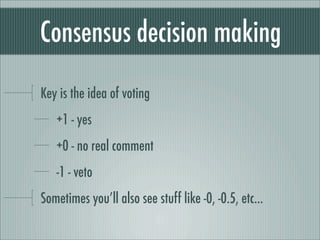
Consensus decision making
Key is the idea of voting
+1 - yes
+0 - no real comment
-1 - veto
Sometimes you’ll also see stuff like -0, -0.5, etc...
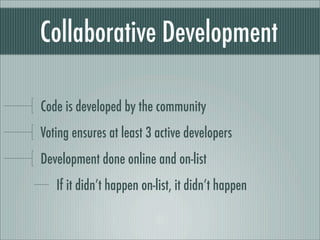
Collaborative Development
Code is developed by the community
Voting ensures at least 3 active developers
Development done online and on-list
If it didn’t happen on-list, it didn’t happen
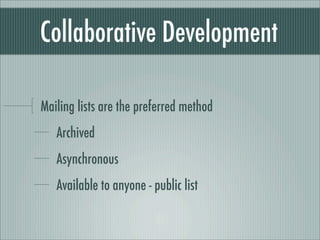
Collaborative Development
Mailing lists are the preferred method
Archived
Asynchronous
Available to anyone - public list
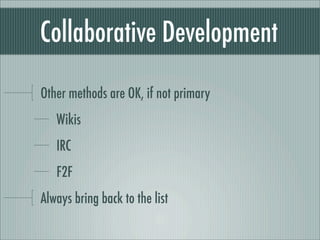
Collaborative Development
Other methods are OK, if not primary
Wikis
IRC
F2F
Always bring back to the list
Responsible Oversight
Ensure license compliance
Track IP
Quality code
Quality community
Look Familiar?
These concepts are not new or unique
Best practices regarding how the Scientific and Health
community works
Publish or Perish
In Open Source, frequent releases indicate healthy activity
What is collaborative s/w development other than peer
review?
Think how restrictive research would be w/o open
communication
Internal Advantages
Might tighter community
better communication (esp. with “users”)
tighter feedback loop
Ready made audience
Don’t need to “sell” the aspects of Open Source which scare/
confuse IT people
Governance Gotchas
Trust and Merit are earned, which implies time
The available pool might be relatively small
How to encourage external involvement
“scratching your own itch”
Mentoring: lurking on lists vs. direct involvment
Typical CXX Level Questions
How do I know what Open Source s/w to use?
What if something breaks?
What if the project goes away?
Am I the first?
Helpful links
The Apache Software Foundation
www.apache.org
SpringSource
www.springsource.com
Want to help a great organization?
www.marylandstateboychoir.org
That’s It
Thank you!
Any questions?

Open Source Management

  • 1.
  • 2.
    Agenda Introduction What exactly is“Open Source” How the ASF Does It
  • 3.
    Introduction Jim Jagielski Longest still-activedeveloper/contributor Co-founder of the ASF Member, Director and Chairman CTO/Chief Architect for the Covalent Division of SpringSource
  • 4.
    The draw ofOpen Source Having a real impact in the development and direction of IT Personal satisfaction: I wrote that! Sense of membership in a community Sense of accomplishment - very quick turnaround times Developers and engineers love to tinker - huge opportunity to do so
  • 5.
    What is OpenSource? Open Source Licensing OSI Approved Open Source Development ala, the Apache Software Foundation Free Software As in Free Speech, not Free Beer
  • 6.
    What is OpenSource? Basically, it’s a “new” way to develop, license and distribute code Actually, there was “open source” even before it was called that The key technologies behind the Internet and the Web are all Open Source based
  • 7.
    True Open Source Forsoftware to be Open Source, it must be under an OSI approved Open Source License At last count, over 70 exist
  • 8.
    Open Source Licenses GiveMe Credit AL, BSD, MIT Give Me Fixes (L)GPL, EPL, MPL Give Me Everything GPL - Dave Johnson http://rollerweblogger.org/page/roller?entry=gimme_credit_gimme_fixes_gimmem
  • 9.
    The Apache License(AL) A liberal open source software license - BSD-like Business friendly Requires attribution Includes Patent Grant Easily reused by other projects & organizations
  • 10.
    Give Me Fixes MPL/ EPL / (L)GPL Used mostly with platforms or libraries Protects the licensed code, but allows larger derivative works with different licensing Still very business friendly
  • 11.
    Give Me Everything GPL(copyleft) Derivative works also under GPL Linked works may also be under GPL Viral nature may limit adoption GPL trumps all or else incompatible
  • 12.
    License Differences Mainly involvethe licensing of derivative works Only really applies during (re)distribution of work Where the “freedom” should be mostly focused: the user or the code itself
  • 13.
    One True License Thereis no such thing Licensing is selected to address what you are trying to do In general, Open Standards do better with AL-like license
  • 14.
    The ASF ASF ==The Apache Software Foundation Before the ASF there was “The Apache Group” The ASF was incorporated in 1999
  • 15.
    How We Work TheApache Software Foundation provides support for the Apache community of open-source software projects. The Apache projects are characterized by a collaborative, consensus based development process, an open and pragmatic software license, and a desire to create high quality software that leads the way in its field. We consider ourselves not simply a group of projects sharing a server, but rather a community of developers and users.
  • 16.
    Structure of theASF - dev Volunteer Driven Organization Software Projects are managed by Project Management Committees (PMCs) PMCs vote in new PMC members and committers
  • 17.
    Structure of theASF - legal Member-based corporation - individuals only Members nominate and elect new members Members elect a board - 9 seats Semi-annual meetings via IRC Each PMC has a Chair - eyes and ears of the board (oversight only)
  • 18.
    Issues with DualStacks Despite clear differentiation, sometimes there are leaks eg: PMC chair seen as “lead” developer Sometimes officers are assumed to have too much power if they venture into development issues “hats”
  • 19.
    The Apache Way Althoughthe term is deprecated, “The Apache Way” relates to how the ASF (and its projects) work and operate Basically, the least common denominators on how PMCs operate
  • 20.
    Basic Memes Meritocracy Peer-based Consensus decisionmaking Collaborative development Responsible oversight
  • 21.
    Meritocracy “Govern by Merit” Meritis based on what you do Merit never expires Those with merit, get more responsibility
  • 22.
    Peer-based Developers represent themselves- individuals Mutual trust and respect All votes hold the same weight Community over code Healthy communities create healthy code Poisonous communities don’t
  • 23.
    Why Community >Code Since we are all volunteers, people’s time and interests change A healthy community is “warm and inviting” and encourages a continued influx of developers Poisonous people/communities turn people off, and the project will die End result - better code, long-term code
  • 24.
    Consensus decision making Keyis the idea of voting +1 - yes +0 - no real comment -1 - veto Sometimes you’ll also see stuff like -0, -0.5, etc...
  • 25.
    Collaborative Development Code isdeveloped by the community Voting ensures at least 3 active developers Development done online and on-list If it didn’t happen on-list, it didn’t happen
  • 26.
    Collaborative Development Mailing listsare the preferred method Archived Asynchronous Available to anyone - public list
  • 27.
    Collaborative Development Other methodsare OK, if not primary Wikis IRC F2F Always bring back to the list
  • 28.
    Responsible Oversight Ensure licensecompliance Track IP Quality code Quality community
  • 29.
    Look Familiar? These conceptsare not new or unique Best practices regarding how the Scientific and Health community works
  • 30.
    Publish or Perish InOpen Source, frequent releases indicate healthy activity What is collaborative s/w development other than peer review? Think how restrictive research would be w/o open communication
  • 31.
    Internal Advantages Might tightercommunity better communication (esp. with “users”) tighter feedback loop Ready made audience Don’t need to “sell” the aspects of Open Source which scare/ confuse IT people
  • 32.
    Governance Gotchas Trust andMerit are earned, which implies time The available pool might be relatively small How to encourage external involvement “scratching your own itch” Mentoring: lurking on lists vs. direct involvment
  • 33.
    Typical CXX LevelQuestions How do I know what Open Source s/w to use? What if something breaks? What if the project goes away? Am I the first?
  • 34.
    Helpful links The ApacheSoftware Foundation www.apache.org SpringSource www.springsource.com Want to help a great organization? www.marylandstateboychoir.org
  • 35.