Business Reports
• Importance, Characteristics, Types, Structure,
Preparation, Technical Description
Importance of Reports
• - Provide factual information for decision-making.
• - Record business activities and performance.
• - Ensure accountability and transparency.
• - Help identify problems and suggest solutions.
• - Facilitate communication within and outside the
organization.
Characteristics of Reports
• - Objectivity: unbiased and based on facts.
• - Accuracy: correct data and details.
• - Clarity: easily understandable language.
• - Conciseness: brief but comprehensive.
• - Systematic: logical flow and organized format.
Qualities of a Good Report
• - Clear purpose and objectives.
• - Relevant and accurate information.
• - Logical and coherent structure.
• - Proper analysis and interpretation.
• - Well-presented with visuals if necessary.
• - Correct grammar and formatting.
Types of Reports
• - Formal Reports: Structured, detailed, follow
specific formats; e.g., annual reports, research
reports.
• - Informal Reports: Brief, less structured; e.g.,
memos, internal updates.
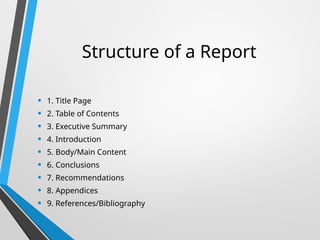
Structure of a Report
• 1. Title Page
• 2. Table of Contents
• 3. Executive Summary
• 4. Introduction
• 5. Body/Main Content
• 6. Conclusions
• 7. Recommendations
• 8. Appendices
• 9. References/Bibliography
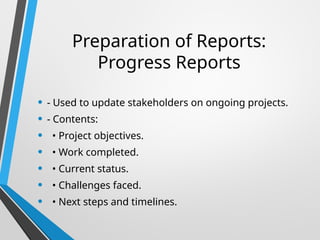
Preparation of Reports:
Progress Reports
• - Used to update stakeholders on ongoing projects.
• - Contents:
• • Project objectives.
• • Work completed.
• • Current status.
• • Challenges faced.
• • Next steps and timelines.
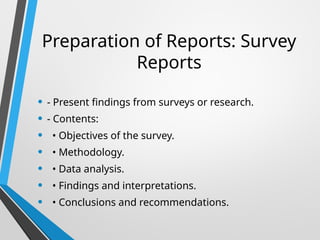
Preparation of Reports: Survey
Reports
• - Present findings from surveys or research.
• - Contents:
• • Objectives of the survey.
• • Methodology.
• • Data analysis.
• • Findings and interpretations.
• • Conclusions and recommendations.
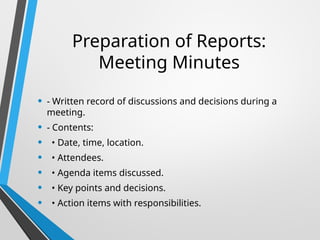
Preparation of Reports:
Meeting Minutes
• - Written record of discussions and decisions during a
meeting.
• - Contents:
• • Date, time, location.
• • Attendees.
• • Agenda items discussed.
• • Key points and decisions.
• • Action items with responsibilities.
Technical Description in
Business Reports
• - Explain complex processes, products, or systems.
• - Use diagrams, charts, and visuals for clarity.
• - Include specifications, features, and technical
data.
• - Ensure precision and simplicity to suit the
audience’s understanding.
Conclusion
• - Good reports provide reliable information for
effective decision-making.
• - Following proper structure and qualities ensures
clarity and professionalism.
• - Technical descriptions enhance understanding of
complex subjects in business reports.

Business_Reports_Presentation NOTES.pptx

  • 1.
    Business Reports • Importance,Characteristics, Types, Structure, Preparation, Technical Description
  • 2.
    Importance of Reports •- Provide factual information for decision-making. • - Record business activities and performance. • - Ensure accountability and transparency. • - Help identify problems and suggest solutions. • - Facilitate communication within and outside the organization.
  • 3.
    Characteristics of Reports •- Objectivity: unbiased and based on facts. • - Accuracy: correct data and details. • - Clarity: easily understandable language. • - Conciseness: brief but comprehensive. • - Systematic: logical flow and organized format.
  • 4.
    Qualities of aGood Report • - Clear purpose and objectives. • - Relevant and accurate information. • - Logical and coherent structure. • - Proper analysis and interpretation. • - Well-presented with visuals if necessary. • - Correct grammar and formatting.
  • 5.
    Types of Reports •- Formal Reports: Structured, detailed, follow specific formats; e.g., annual reports, research reports. • - Informal Reports: Brief, less structured; e.g., memos, internal updates.
  • 6.
    Structure of aReport • 1. Title Page • 2. Table of Contents • 3. Executive Summary • 4. Introduction • 5. Body/Main Content • 6. Conclusions • 7. Recommendations • 8. Appendices • 9. References/Bibliography
  • 7.
    Preparation of Reports: ProgressReports • - Used to update stakeholders on ongoing projects. • - Contents: • • Project objectives. • • Work completed. • • Current status. • • Challenges faced. • • Next steps and timelines.
  • 8.
    Preparation of Reports:Survey Reports • - Present findings from surveys or research. • - Contents: • • Objectives of the survey. • • Methodology. • • Data analysis. • • Findings and interpretations. • • Conclusions and recommendations.
  • 9.
    Preparation of Reports: MeetingMinutes • - Written record of discussions and decisions during a meeting. • - Contents: • • Date, time, location. • • Attendees. • • Agenda items discussed. • • Key points and decisions. • • Action items with responsibilities.
  • 10.
    Technical Description in BusinessReports • - Explain complex processes, products, or systems. • - Use diagrams, charts, and visuals for clarity. • - Include specifications, features, and technical data. • - Ensure precision and simplicity to suit the audience’s understanding.
  • 11.
    Conclusion • - Goodreports provide reliable information for effective decision-making. • - Following proper structure and qualities ensures clarity and professionalism. • - Technical descriptions enhance understanding of complex subjects in business reports.