Business Project Management (600542)
2019-20Session 1
Gavin Betts[email protected]
Introduction
Gavin Betts
Management Systems Group at HUBS
Support you to learn about & understand how to apply two
different methods for undertaking projects aimed at achieving
some form of organisational change and improvement.
Focussing mainly on the systemic approach.
Jeremy Wilcock
Marketing and Business Strategy Group at HUBS
Also here to support your learning during the module. Focussing
mostly on the ‘traditional’ approach to project management.
Together, we have many decades of practical experience to draw
upon from private and public sector organisations
2
i) Module Contents and Overview
Module Content
Introduction to module & assignment question
Overview of both project management approaches
Detailed coverage of systems approach
Detailed coverage of traditional approach
Summary & final assignment guidance
Over the weeks of our lecture sessions, we will be covering all
of these points.
Decisions, decisions…
Your Module Handbook talks about 2 different approaches to
project management. We’ll consider each in detail. You need to
make a judgement about which to use for your assignment. In
the real world, business projects of various types are undertaken
regularly. Different methodologies may be better suited to some
tasks than others. Making an astute judgement about how to
execute the task can make a significant difference. It may be the
difference between success and failure for a project.
Purpose
This module introduces a number of concepts, techniques, and
methods designed to aid undertaking projects successfully. It
also addresses differences in management thinking in relation to
project management and the different principles and
assumptions that underpin various techniques and methods.
In particular, this module will introduce you to two contrasting
approaches to thinking about, planning and executing a project
as well as encouraging reflection on the appropriateness of each
to different contexts and challenges. Making astute judgements
about what a project should be and how to undertake is not
always easy and can have significant implications.
6
Thinking
Approaches to organising projects
Performance
(Derived from Seddon, 2005)
7
Assessment challenge
Make an informed choice about which approach to use; the one
you feel is most suited to one of the two scenarios which will be
made available.
Use the chosen approach to work through and complete the
assignment for this module (1 x 4500 word report worth 100%)
8
(During the early part of the module, you will be introduced to
each approach - this will help inform your thinking about which
project management approach to apply in which scenario)
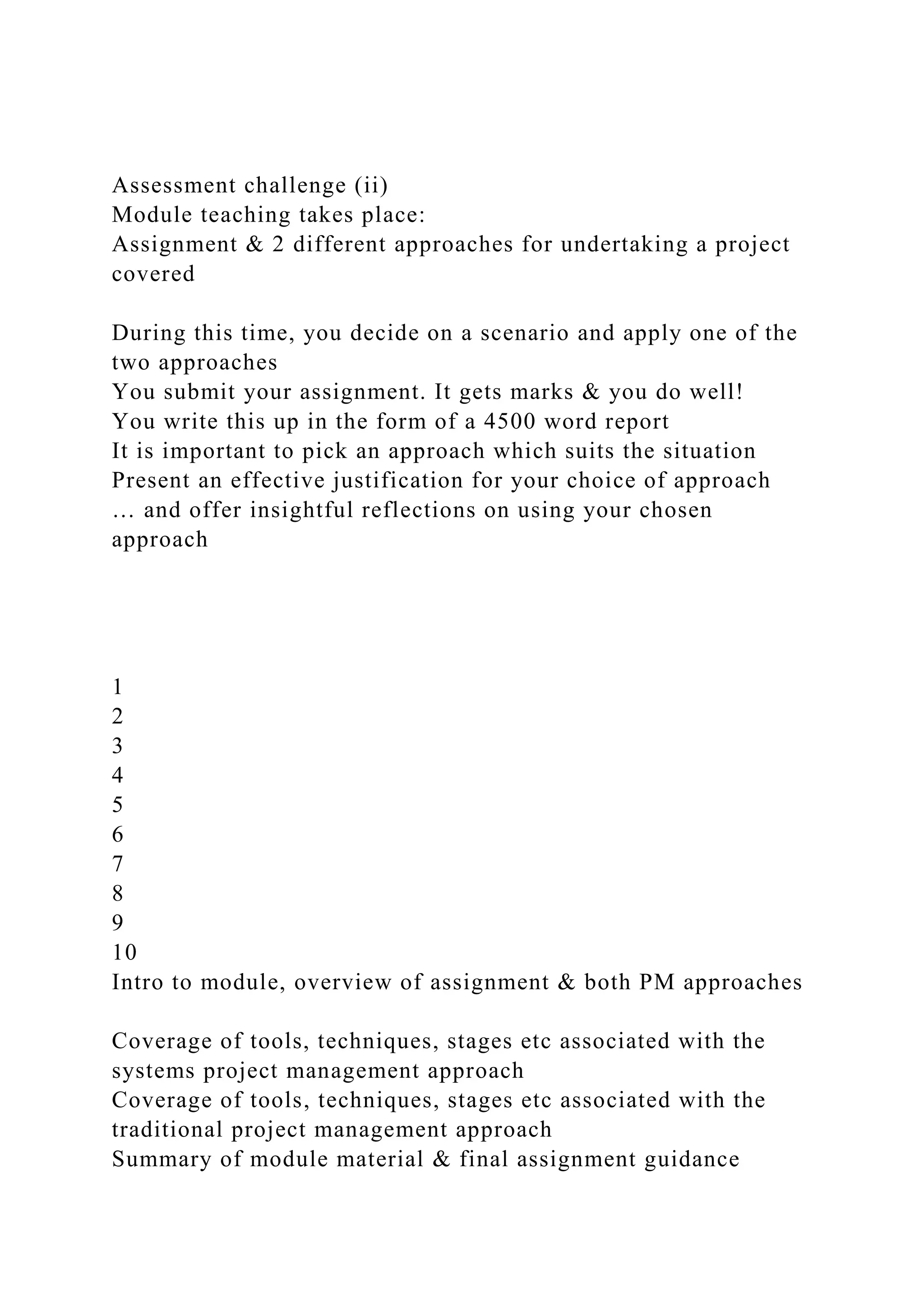
Assessment challenge (ii)
Module teaching takes place:
Assignment & 2 different approaches for undertaking a project
covered
During this time, you decide on a scenario and apply one of the
two approaches
You submit your assignment. It gets marks & you do well!
You write this up in the form of a 4500 word report
It is important to pick an approach which suits the situation
Present an effective justification for your choice of approach
… and offer insightful reflections on using your chosen
approach
1
2
3
4
5
6
7
8
9
10
Intro to module, overview of assignment & both PM approaches
Coverage of tools, techniques, stages etc associated with the
systems project management approach
Coverage of tools, techniques, stages etc associated with the
traditional project management approach
Summary of module material & final assignment guidance
Module Structure
There will also be some exercises published on Canvas for you
to work through. These help to support and extend your learning
about the approaches covered.
ii) Overview of Project Management Approaches
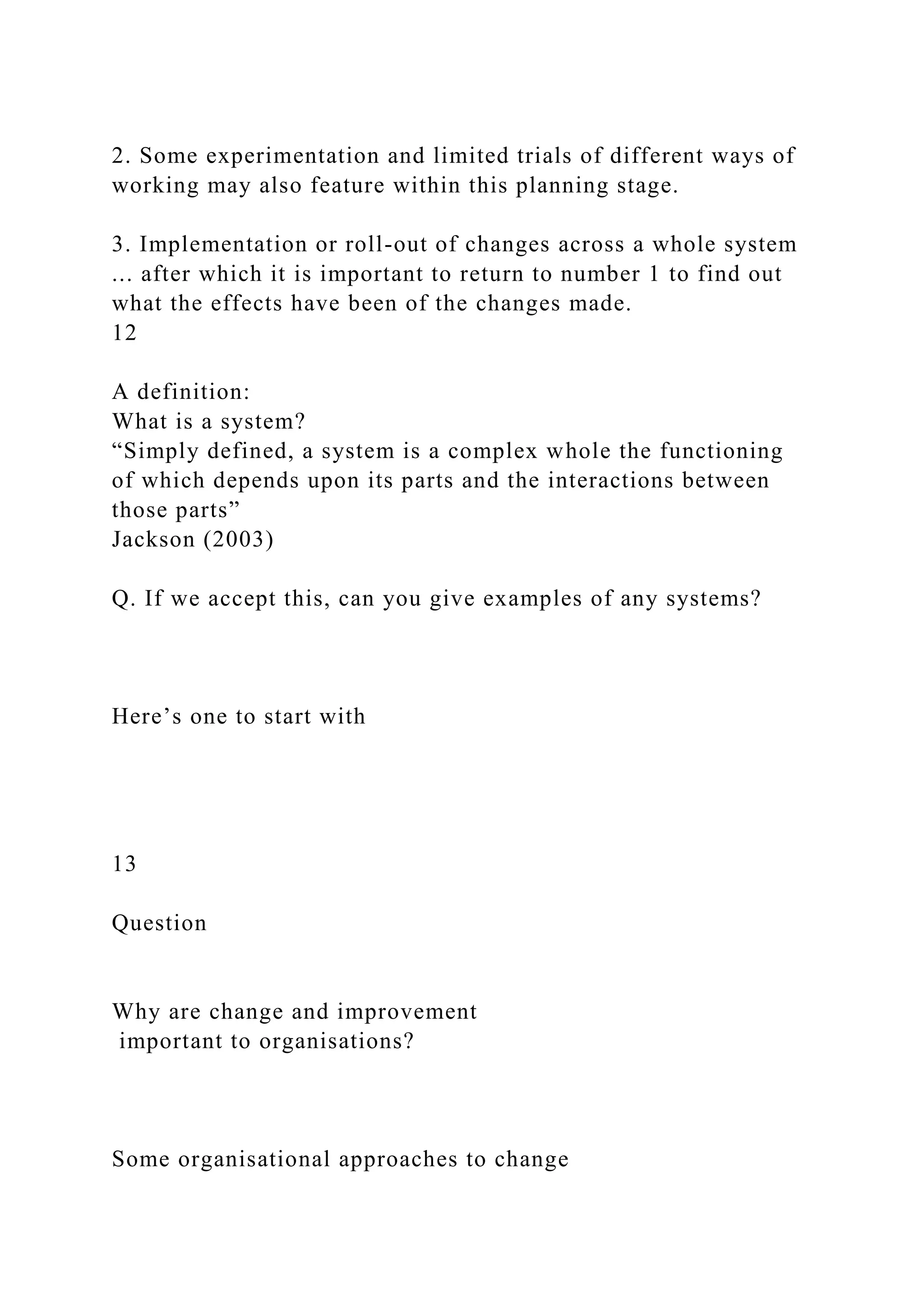
The Systems Approach:
Outline of the 3-stage systems methodology
You go & study how it* works now
You plan & experiment with changes to improve how it works
You roll out the changes
*The ‘it’ referred to needs to be an operational work system…
next slide considers the definition of a system
Check
Plan
Do
1
2
3
John Seddon (2005). Referred to as ‘Vanguard Method’ and the
‘Lean Systems Methodology’
1. It is important that analysis is undertaken to find out how it
(the system in question) works now from a customer’s
perspective .
2. Some experimentation and limited trials of different ways of
working may also feature within this planning stage.
3. Implementation or roll-out of changes across a whole system
... after which it is important to return to number 1 to find out
what the effects have been of the changes made.
12
A definition:
What is a system?
“Simply defined, a system is a complex whole the functioning
of which depends upon its parts and the interactions between
those parts”
Jackson (2003)
Q. If we accept this, can you give examples of any systems?
Here’s one to start with
13
Question
Why are change and improvement
important to organisations?
Some organisational approaches to change
A proverb attributed to the Dakota Indians says that
‘when you discover you are riding a dead horse,
the thing to do is dismount’.
However, this is not necessarily always the approach taken in
organisational settings ...
Organisational approaches to change & improvement?
16
Sadly, some of the examples opposite might be accurate in
describing the way organisations ‘deal’ with the recognition
that they might be “riding a dead horse”.
16
Assumptions
Any instances when something listed on the previous slide
seemed to come about in organisational life are examples of the
different ways that changes have been attempted or tackled.
Underlying each one are thoughts and assumptions about work
and how it should be organised.
Put another way, any instances of something listed on the
previous slide coming to pass is not just unfortunate – it also
offers insight into the managerial assumptions which resulted in
one (or more) of the ‘dead horse’ examples emerging.
17
Assumptions
Action strategies & ways of organising
Outcomes
18
Thinking
System
Performance
(Seddon, 2005)
These early slides have all been designed to start you thinking
about the relationship between thinking and assumptions,
(particularly at managerial level), the design of the work system
– whether the ongoing, operational kind, or shorter, project-
based ones - and the performance that is achieved by that
system.
Chris Argyris talks about what he calls single and double loop
learning. He states that organisations “fail to get people to
reflect on their work and behaviour.” “... they do not surface the
kinds of deep and potentially threatening or embarrassing
information that can motivate learning and produce real
change.” (Argyris, 1994: 77 – 78).
These initial exercises have all been designed to start you
thinking about the relationship between thinking and
assumptions, (particularly at managerial level), the design of
the work system and the performance that is achieved by that
system.
Chris Argyris talks about what he calls single and double loop
learning. He states that organisations “fail to get people to
reflect on their work and behaviour.” “... they do not surface the
kinds of deep and potentially threatening or embarrassing
information that can motivate learning and produce real
change.” (Argyris, 1994: 77 – 78).
19
Organisations as
‘open social systems’
“Organizations are open social systems... The change and
complexity in environmental domains have major implications
for organization design and action. ...Organizational
environments differ in terms of uncertainty and can be
conceptualized in terms stable – unstable and simple – complex
dimensions.”
Daft et al (2010, 167)
Organisational Change
“A complex [social] system is not like a machine that, once a
new set of directions has been implemented, then runs like
clockwork and is amenable to top-down control. Any innovation
[such as a new way of organising work] interacts with numerous
systemic factors so that you do not find a uniform effect across
the organisation or between similar organisations. Moreover,
over time, the interactions will produce new effects.”
Munro, E., and Hubbard, A. (2011) A Systems Approach to
Evaluating Organisational Change in Children's Social Care.
British Journal of Social Work, 41, 726-743.
21
More on seeking to intervene & bring about change
“When we take conscious action in the world, [e.g. intervening
to improve an organisation, or part of one], we do so on the
basis of how we see and understand the world. Different
viewpoints, therefore, give rise to very different actions ”
Jackson (2003)
“For whatever reason, very few managers find it easy to think in
different ways about the operations and organisations they are
responsible for and, as a result, they manage in predictable and
restricted ways.”
Jackson (2003)
Dominance of the mechanistic view perhaps? (See Morgan,
1997 – ‘Images of Organization’)
What is (traditional) project management ?
Project management involves using a range of management
skills and techniques to successfully carry out a project -
Thinking ahead
Carry out research
Planning what happens where and when
Managing the people and resources
Monitoring the project
Changing the plan
Communicating with people
Evaluating the project
(Allan, 2004: 9)
Does the shape made by this chart remind you of anything?
What is (traditional) project management 2?
The most efficient way of introducing change.
... achieved by:
Defining what has to be accomplished, generally in terms of
time, cost and various technical and quality performance
parameters;
Developing a plan to achieve these and then working this plan,
ensuring that progress is maintained in line with these
objectives;
Using appropriate project management techniques and tools to
plan, monitor and maintain progress;
Employing persons skilled in project management – including
normally a project manager – who are given [single]
responsibility for introducing the change and are accountable
for its successful accomplishment.
(Burke 2007 ,18)
[Before next slide]
Q. When did aspects of what we can recognise today as project
management first start to develop?
25
From the systems perspective covered in this module, change
starts with ‘getting knowledge’
“Command-and-control thinkers expect change to be preceded
by cost/benefit analyses, projects, deliverables, timescales and
milestones. Change always starts with a plan. And there is an
awful lot of planning: projects are broken down into constituent
parts, interdependencies identified, time-lines agreed and so on.
Systems thinking [the systems thinking methodology introduced
in this module at any rate] dispenses with all of this. Starting ...
[by] getting knowledge of the ‘what and why’ of current
performance as a system; nothing is assumed other than we
almost certainly don’t know what that performance is.
Command-and-control thinkers have a problem with that…
Change starts with ‘getting knowledge’ 2
… They think that the idea of embarking on change without
predetermining outcomes is bizarre. Yet question them and they
will tell you how their plans are rarely, if ever, returned to; they
will tell you how disasters are buried, how milestones are
extended and extenuating circumstances created. While
managers will confess that their plans, by implication, are based
on opinion rather than knowledge, even so, they would prefer to
have a plan. I tell them the only plan is to get knowledge.”
Seddon (2008, 78-79)
Complex social systems and predictability
“... self-organizing, nonlinear, feedback systems are inherently
unpredictable. They are not controllable. They are
understandable only in the most general way. The goal of
foreseeing the future exactly and preparing for it perfectly is
unrealizable. The idea of making a complex system do just what
you want it to do can be achieved only temporarily, at best. We
can never fully understand our world, not in the way our
reductionist science has led us to expect.”
Meadows, D. H. (2001) Dancing with Systems, Whole Earth,
Issue 106.
Simple model of a system
Throughput
Input
Output
Very
The lean systems methodology is designed to be applied to work
systems rather like this.
An example of an operational ‘system’
Principle
Understand demand and design your system to deal with it
effectively
Systems need to be capable of responding to the variety of
demands that are placed upon them
What is offered by the system needs to be well-matched against
demand in the environment
Open boundary between system & environment
(things pass through)
Environment
System
Legal & regulatory requirements
Demand for product type A
Demand for product type B
Other demands / possibilities in the environment which an
organisation decides not to respond to… perhaps for strategic or
tactical reasons
The system responding to demands / other possibilities in the
environment
So, what did the fella in the middle have to say about work by
these other two & how important it might be for managers?
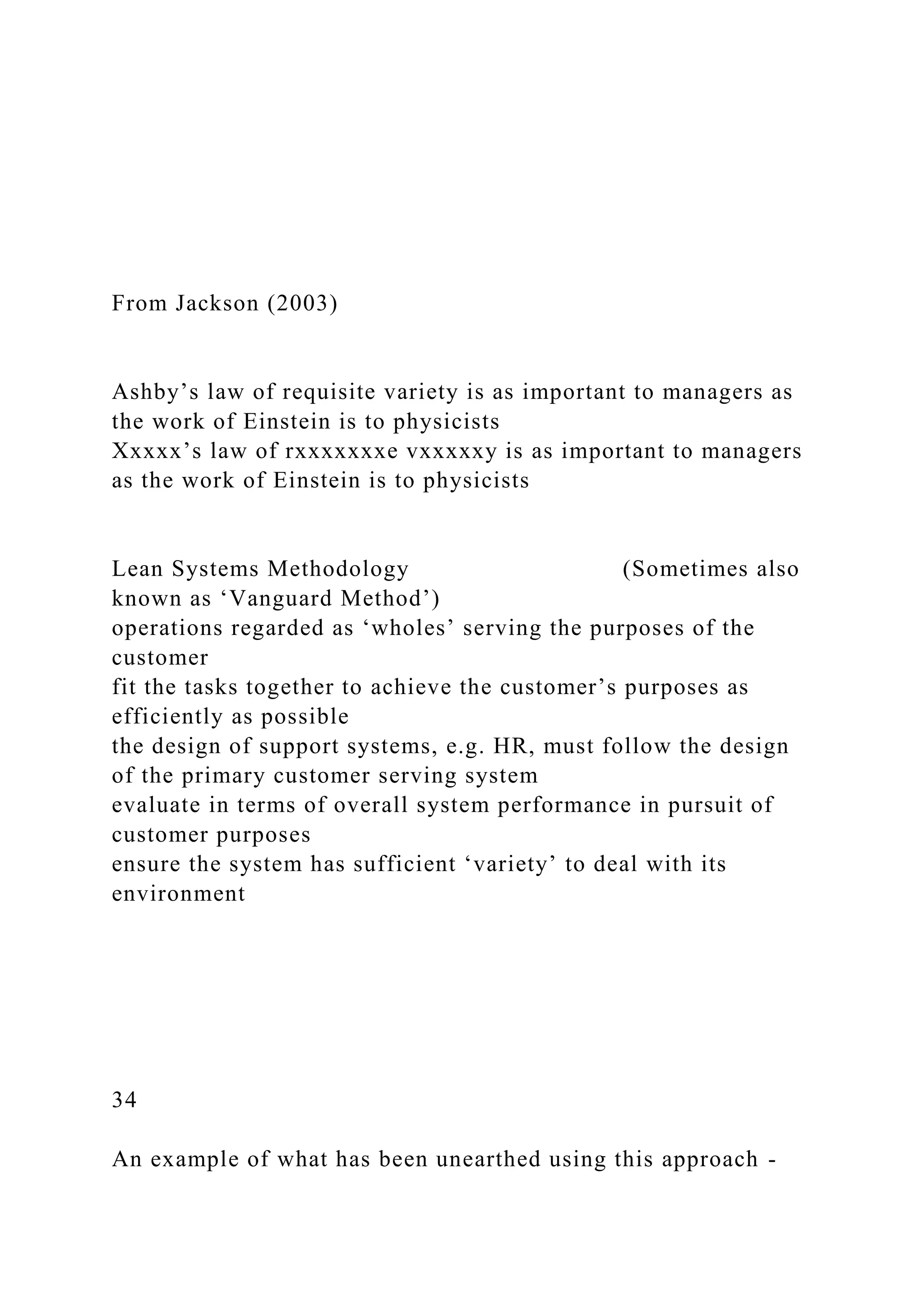
W R Ashby: Active in the field of cybernetics – published
various works including “An Introduction to Cybernetics”
The Law of Requisite Variety (1956)
According to Ashby’s Law of Requisite Variety, systems can
only be controlled if the would-be controller can command the
same degree of variety as the system.
Stafford Beer built on the work of Ross Ashby.
According to Jackson (2000) "Beer was the first to apply
cybernetics to management”
Beer (1974) believed that Ashby’s law of requisite variety was
as important to managers as Einstein’s law of relativity was to
physicists.
32
From Jackson (2003)
Ashby’s law of requisite variety is as important to managers as
the work of Einstein is to physicists
Xxxxx’s law of rxxxxxxxe vxxxxxy is as important to managers
as the work of Einstein is to physicists
Lean Systems Methodology (Sometimes also
known as ‘Vanguard Method’)
operations regarded as ‘wholes’ serving the purposes of the
customer
fit the tasks together to achieve the customer’s purposes as
efficiently as possible
the design of support systems, e.g. HR, must follow the design
of the primary customer serving system
evaluate in terms of overall system performance in pursuit of
customer purposes
ensure the system has sufficient ‘variety’ to deal with its
environment
34
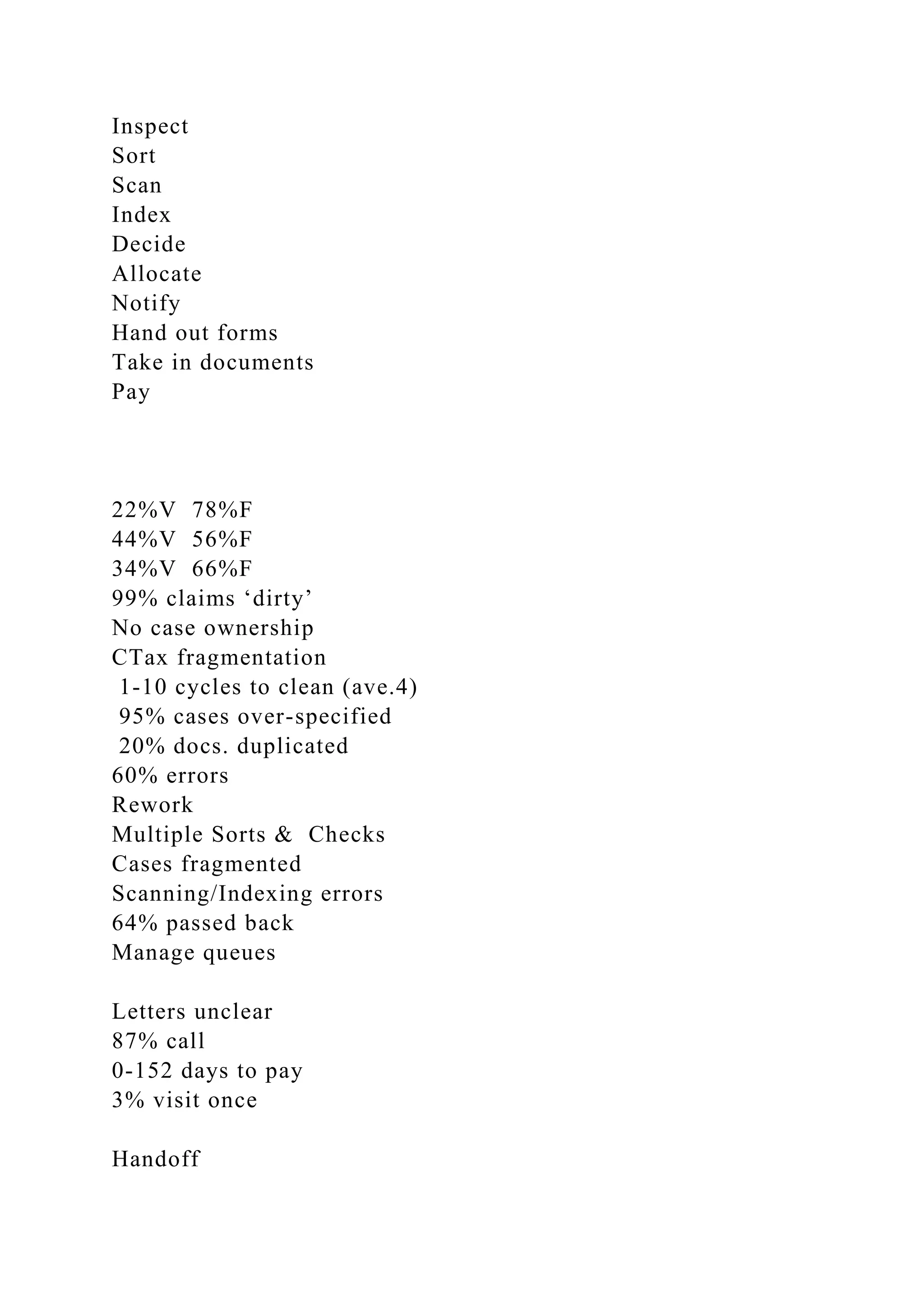
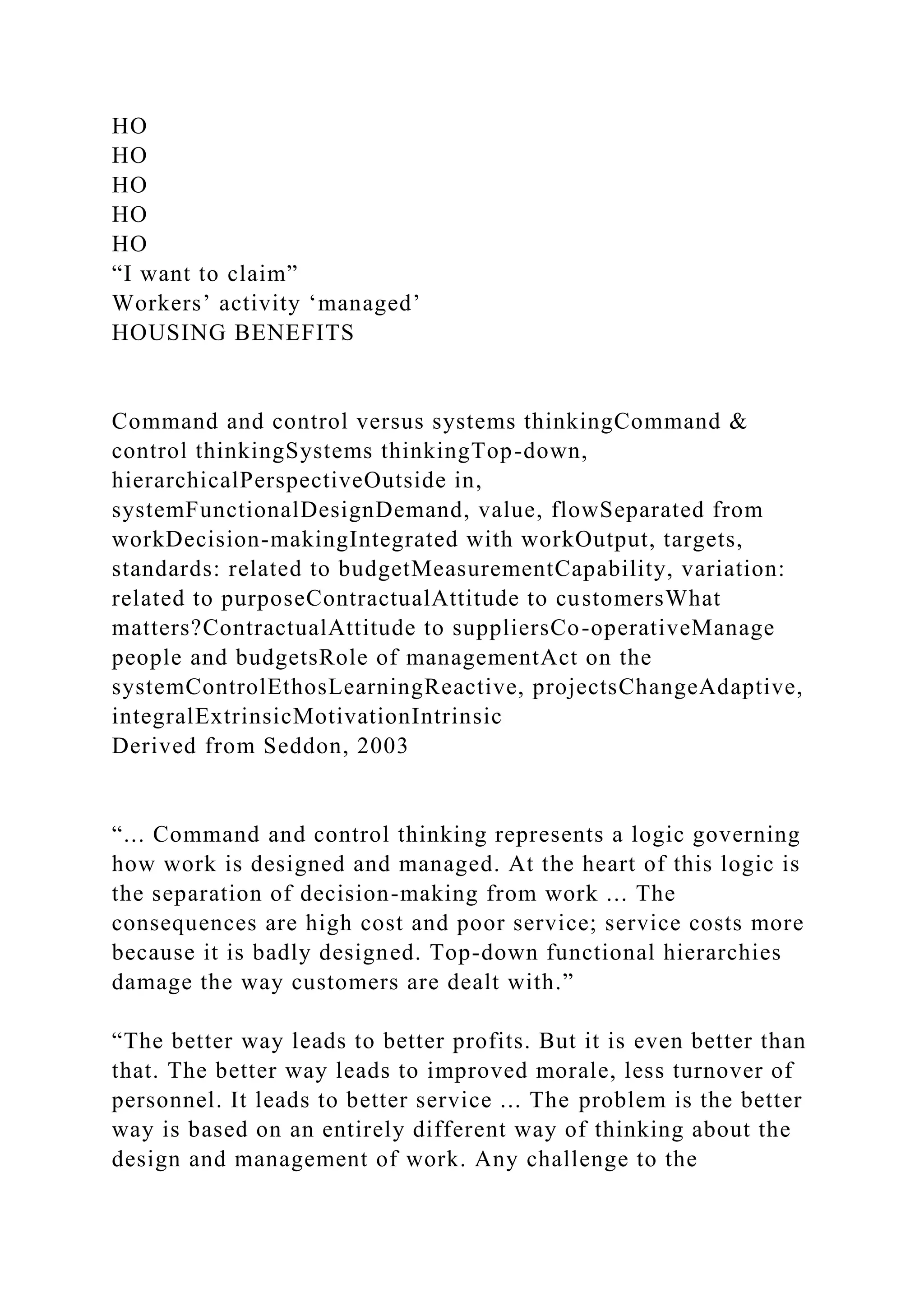
An example of what has been unearthed using this approach -
Inspect
Sort
Scan
Index
Decide
Allocate
Notify
Hand out forms
Take in documents
Pay
22%V 78%F
44%V 56%F
34%V 66%F
99% claims ‘dirty’
No case ownership
CTax fragmentation
1-10 cycles to clean (ave.4)
95% cases over-specified
20% docs. duplicated
60% errors
Rework
Multiple Sorts & Checks
Cases fragmented
Scanning/Indexing errors
64% passed back
Manage queues
Letters unclear
87% call
0-152 days to pay
3% visit once
Handoff
HO
HO
HO
HO
HO
“I want to claim”
Workers’ activity ‘managed’
HOUSING BENEFITS
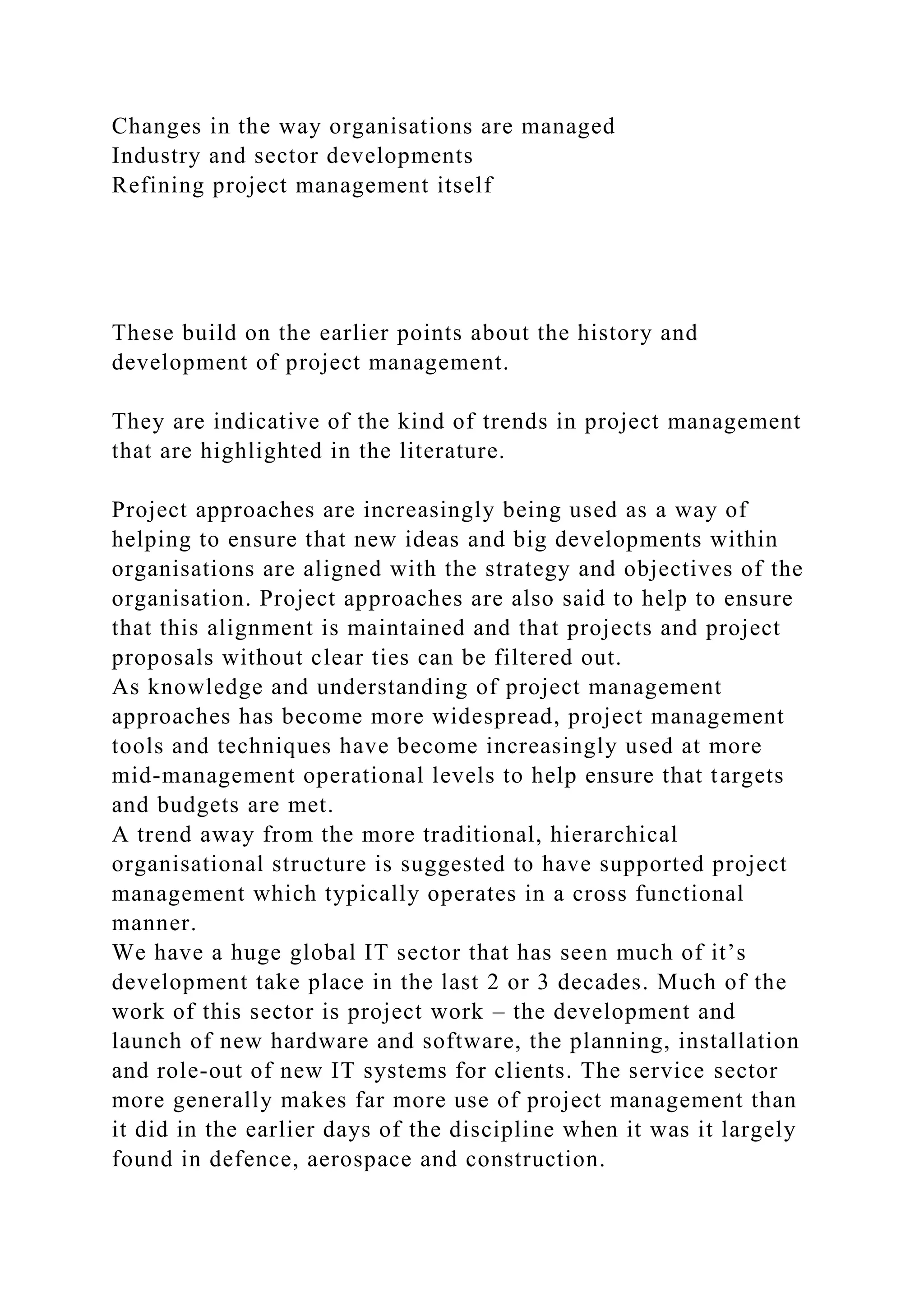
Command and control versus systems thinkingCommand &
control thinkingSystems thinkingTop-down,
hierarchicalPerspectiveOutside in,
systemFunctionalDesignDemand, value, flowSeparated from
workDecision-makingIntegrated with workOutput, targets,
standards: related to budgetMeasurementCapability, variation:
related to purposeContractualAttitude to customersWhat
matters?ContractualAttitude to suppliersCo-operativeManage
people and budgetsRole of managementAct on the
systemControlEthosLearningReactive, projectsChangeAdaptive,
integralExtrinsicMotivationIntrinsic
Derived from Seddon, 2003
“... Command and control thinking represents a logic governing
how work is designed and managed. At the heart of this logic is
the separation of decision-making from work ... The
consequences are high cost and poor service; service costs more
because it is badly designed. Top-down functional hierarchies
damage the way customers are dealt with.”
“The better way leads to better profits. But it is even better than
that. The better way leads to improved morale, less turnover of
personnel. It leads to better service ... The problem is the better
way is based on an entirely different way of thinking about the
design and management of work. Any challenge to the
prevailing norms is bound to be treated with scepticism at bets,
and cynicism at worst.”
36
Lean systems methodology
Check
Plan
Do
1
2
3
John Seddon
Check, plan, do cycle devised by Seddon.
Underpinned by a variety of other concepts that it seeks to draw
together.
37
Check asks -
What, in reality, is the purpose of this system? (as opposed to
what the purpose should be from the customer’s point of view)
What is the nature of customer demand? (where do people first
present, what different types of demand are present?)
What is the system achieving? (response times for frequently
occurring demands, capability or process behaviour charts)
How does the work flow? (follow the flow of tasks, produce
flow charts)
What system conditions influence the organisation and the
performance of the system?
What thinking is shaping the system (& conditions)?
For your assignment, you will be writing about these kinds of
things if you chose the systems approach.
38
Check… a diagrammatic representation
Derived from Seddon, 2005: 112
1 Purpose? (In customer terms)
2
3
4
5
6
39
So far, the overview has considered the lean systems
methodology (and some wider concepts from the field of
systems thinking)… one way of undertaking a business project
Next we consider an overview of the other method covered
during this module, the more ‘traditional’ approach to
undertaking and managing business projects
‘Traditional’ Project Management
Used to help humans create and achieve remarkable things…
This Photo by Unknown Author is licensed under CC BY-NC-
ND
This Photo by Unknown Author is licensed under CC BY-NC
The last picture on the previous slide shows a bridge… but that
doesn’t really do justice to what this project, the most recent of
the 3, achieved
The picture showed a part of the Hong Kong–Zhuhai–Macau
Bridge… which is actually a bridge and tunnel system. It
opened in 2018.
Have a look at it here:
https://www.youtube.com/watch?v=guJY5z7BWAM
It is 55km long
(that is, over 34 miles)
Key questions to consider…
What is ‘a project’ ?
What is ‘project management’ ?
What is a project: definitions
“a specific activity that involves innovation and change ... and
has a clear aim, set of outcomes and start and end date” (Allan,
2004: 5)
“A temporary endeavour undertaken to create a Unique product
or service (outcome or result). Temporary means that every
project has a definite end. Unique means that the product or
service is different in some distinguishing way from all similar
products or services” (Burke, 2007: 17)
“A management environment that is created for the purpose of
delivering one or more business products according to a
specified business case.”
And
“A temporary organisation that is needed to produce a unique
and predefined outcome or result at a given time using
predetermined resources.” (PRINCE 2 2009 in Maylor, 2010: 5)
What is a project (2)
Finally, the Project Management Association of Japan suggests:
“A project refers to a value creation undertaking based on a
specific mission, which is completed in a given or agreed
timeframe and under constraints, including resources and
external circumstances” (See Maylor, 2010, 5)
Maylor identifies 3 common themes as evident across a range of
definitions –
Uniqueness: the exact project has not been performed before
Temporary: the project has a beginning & end
Focussed: the task of the project is to deliver a specific product,
service or result
What is project management
Project management involves using a range of management
skills and techniques to successfully carry out a project -
Thinking ahead
Carry out research
Planning what happens where and when
Managing the people and resources
Monitoring the project
Changing the plan
Communicating with people
Evaluating the project
(Allan, 2004: 9)
What is project management 2
The most efficient way of introducing change.
... achieved by:
Defining what has to be accomplished, generally in terms of
time, cost and various technical and quality performance
parameters;
Developing a plan to achieve these and then working this plan,
ensuring that progress is maintained in line with these
objectives;
Using appropriate project management techniques and tools to
plan, monitor and maintain progress;
Employing persons skilled in project management – including
normally a project manager – who are given responsibility for
introducing the change and are accountable for its successful
accomplishment.
(Burke 2007 ,18)
[Before next slide]
Q. When did aspects of what we can recognise today as project
management first start to develop?
47
What is Implied by the Preceding Definitions?
Morgan (1997, 26-27) states that ideas such as “specify every
detail so that everyone will be sure of the jobs that they have to
perform” and “plan, organise and control, control, control” are
often ingrained in our way of thinking about organisations and
in the way we evaluate organisational practice.
Early theorists believed they had discovered the principles of
organisation which, if followed, would more or less solve
managerial problems for ever... they were completely wrong on
this score. Indeed, if we look closely, we find that their
management principles often lie at the basis of many modern
organisational problems.
(This links back to themes from earlier slides)
Book: Images of Organization
Some history
Pre 1950’s there was no generally accepted or defined method
of (what we are calling ‘traditional’) project management
Tools and techniques were developed during the 1950s and
1960s as a way of formalising the approaches being taken to
manage large, complex projects
This development was particularly found within the US defence
& aerospace sectors. The construction sector also contributed
Used in NASA space programme & development of Polaris
missile system
49
Some more history
The Project Management Institute is one of the major project
management organizations
It was founded in 1969
It grew from 7,500 members in 1990 to over 260,000* in 2007
* Which is about the population of Hull
We can see here some data that points to the way in which the
profession of project management has flourished over the years,
especially through the 1990’s and on into the new millennium.
Both the PMI, mentioned on the slide, and the Association of
Project Management (APM) are concerned with the development
of the project management profession.
In particular, they both have a body of knowledge about project
management which they promote and develop.
www.pmi.org
www.apm.org.uk
[Q. Can anyone tell me what the main dimensions of a project
are?]
50
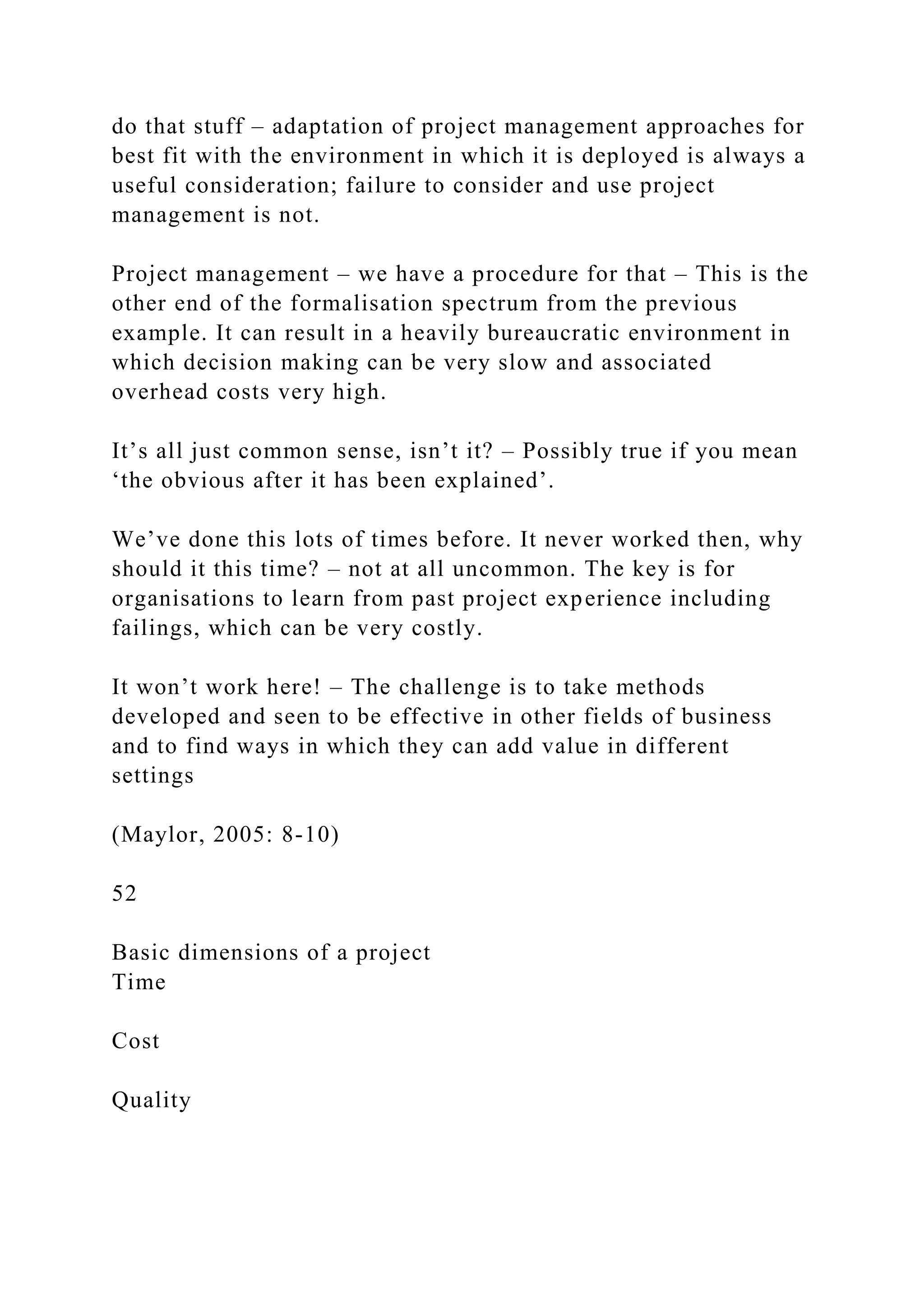
Trends in project management
Changes and developments in the field have been significantly
shaped by the changes in the context that projects operate
within.
Alignment with strategic goals
Reaching operational goals
Changes in the way organisations are managed
Industry and sector developments
Refining project management itself
These build on the earlier points about the history and
development of project management.
They are indicative of the kind of trends in project management
that are highlighted in the literature.
Project approaches are increasingly being used as a way of
helping to ensure that new ideas and big developments within
organisations are aligned with the strategy and objectives of the
organisation. Project approaches are also said to help to ensure
that this alignment is maintained and that projects and project
proposals without clear ties can be filtered out.
As knowledge and understanding of project management
approaches has become more widespread, project management
tools and techniques have become increasingly used at more
mid-management operational levels to help ensure that targets
and budgets are met.
A trend away from the more traditional, hierarchical
organisational structure is suggested to have supported project
management which typically operates in a cross functional
manner.
We have a huge global IT sector that has seen much of it’s
development take place in the last 2 or 3 decades. Much of the
work of this sector is project work – the development and
launch of new hardware and software, the planning, installation
and role-out of new IT systems for clients. The service sector
more generally makes far more use of project management than
it did in the earlier days of the discipline when it was it largely
found in defence, aerospace and construction.
Techniques and approaches develop over time. The creation of a
formal Project Management Office (PMO) is one good example
of this. Also, increases in computing power, the development of
the internet and the widespread availability of project
management software have enabled so-called ‘virtual’ project
management to develop. (People working remotely from one
another on project work with co-ordinated supported by the use
of proj mgmnt software).
51
Current issues in project management
Ready, fire, aim
It’s all in my head
We work in a nanosecond environment, we don’t have time to
do that stuff
Project management – we have a procedure for that
It’s all just common sense, isn’t it?
We’ve done this lots of times before. It never worked then, why
should it this time?
It won’t work here!
See Maylor, (2010, 14 - 16) for explanations of other points
above
Project begins with no clear objectives. The motto is ‘shoot
first… whatever you hit, call it the target’ (Maylor, 2010, 14)
Ready, fire, aim – the project is started with no clear objectives
in place ... this is the fate of too many projects
It’s all in my head – may work well for the very small project
but for anything larger, or if the scale of the project escalates,
the application of appropriate structures and systems will
greatly help.
We work in a nanosecond environment, we don’t have time to
do that stuff – adaptation of project management approaches for
best fit with the environment in which it is deployed is always a
useful consideration; failure to consider and use project
management is not.
Project management – we have a procedure for that – This is the
other end of the formalisation spectrum from the previous
example. It can result in a heavily bureaucratic environment in
which decision making can be very slow and associated
overhead costs very high.
It’s all just common sense, isn’t it? – Possibly true if you mean
‘the obvious after it has been explained’.
We’ve done this lots of times before. It never worked then, why
should it this time? – not at all uncommon. The key is for
organisations to learn from past project experience including
failings, which can be very costly.
It won’t work here! – The challenge is to take methods
developed and seen to be effective in other fields of business
and to find ways in which they can add value in different
settings
(Maylor, 2005: 8-10)
52
Basic dimensions of a project
Time
Cost
Quality
(Meredith & Mantel, 2010:4)
These can be thought of as constraints
These are the three generic dimensions or factors that are
central to all projects. These are sometimes also referred to as
constraints as a project manager is likely to find that there are
limits on each of them.
This diagram seeks to represent the interrelated nature of each
of these factors ... a change in one will have an impact on the
others.
53
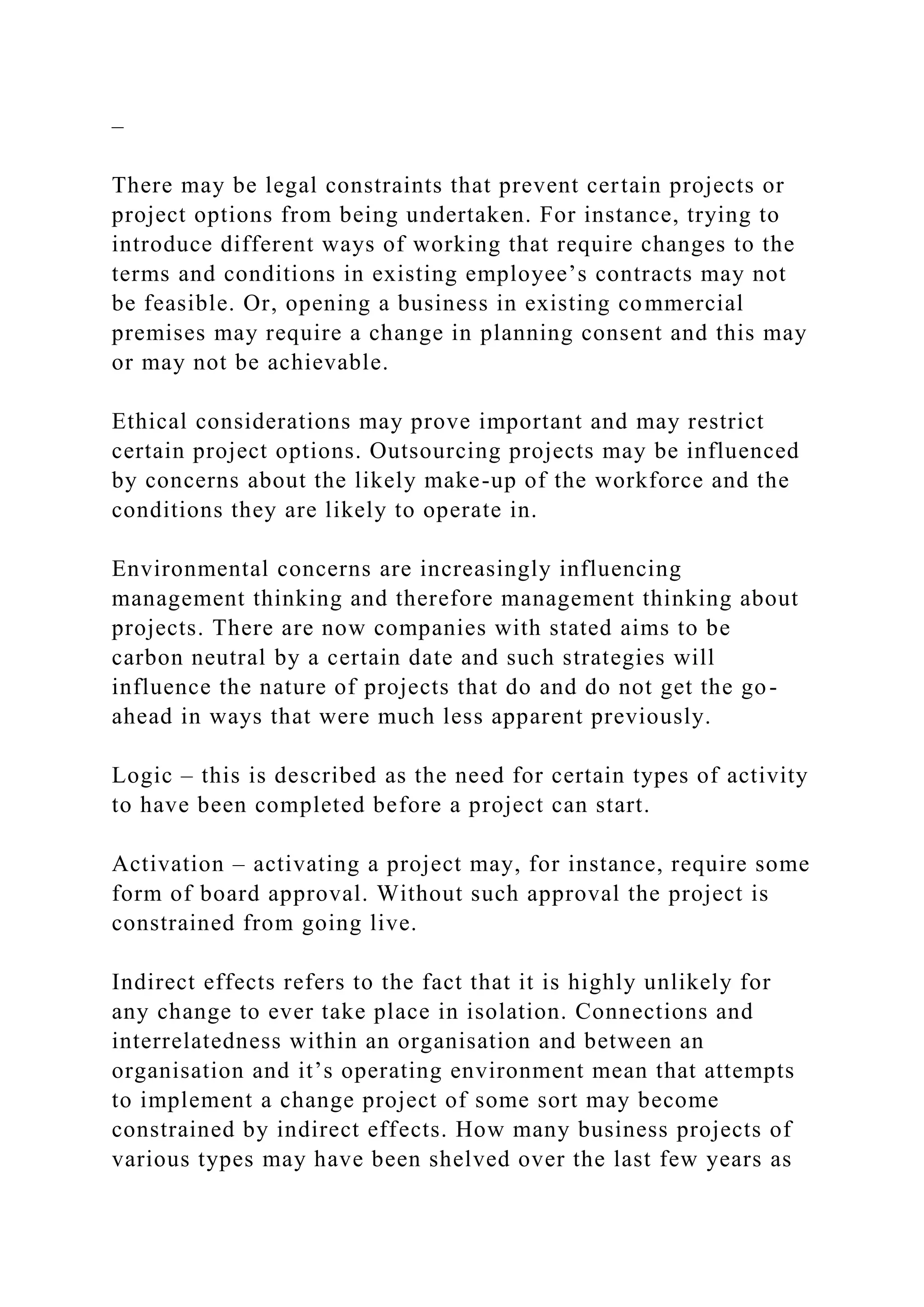
Some other constraints
Legal
Ethical
Environmental
Logic
Activation
Indirect effects
Maylor (2005) identifies further constraints beyond the main
three of time, cost & quality that can also impact upon a project
–
There may be legal constraints that prevent certain projects or
project options from being undertaken. For instance, trying to
introduce different ways of working that require changes to the
terms and conditions in existing employee’s contracts may not
be feasible. Or, opening a business in existing commercial
premises may require a change in planning consent and this may
or may not be achievable.
Ethical considerations may prove important and may restrict
certain project options. Outsourcing projects may be influenced
by concerns about the likely make-up of the workforce and the
conditions they are likely to operate in.
Environmental concerns are increasingly influencing
management thinking and therefore management thinking about
projects. There are now companies with stated aims to be
carbon neutral by a certain date and such strategies will
influence the nature of projects that do and do not get the go-
ahead in ways that were much less apparent previously.
Logic – this is described as the need for certain types of activity
to have been completed before a project can start.
Activation – activating a project may, for instance, require some
form of board approval. Without such approval the project is
constrained from going live.
Indirect effects refers to the fact that it is highly unlikely for
any change to ever take place in isolation. Connections and
interrelatedness within an organisation and between an
organisation and it’s operating environment mean that attempts
to implement a change project of some sort may become
constrained by indirect effects. How many business projects of
various types may have been shelved over the last few years as
a result of banks restricting their lending to small and medium
enterprises.
54
Project management and general management
General Management
Project Management
Maylor (2010, 11) contrasts these two.
He suggests PM is typically responsible for overseeing change
whereas GM is more typically concerned with maintaining the
status quo.
PM is mainly concerned with innovation, unlike GM
General management is also said to deal with a limited set of
variables.
Project management on the other hand is said to contain
intrinsic uncertainties.
[next, exercise thinking up reasons why projects go wrong]
55
Why do projects go wrong?
Spend a few minutes individually listing all the reasons why
you think projects go wrong (these can be as general or specific
as you like)
Project
model
(Derived from Maylor, 2010, 30)
Project
Output:
satisfied need
Constraints:
Financial
Legal
Ethical
Environmental
Logic
Time
Quality
Indirect effects
Mechanisms:
People
Knowledge & expertise
Capital
Tools & techniques
technology
Input:
want / need
Maylor suggests (2005: 24) that it is useful to have a model of
project management in mind to help understand the processes
and accompanying management activities that are or should be
occuring.
This is referred to as the IOCM model (from Inputs, Outputs,
Constraints, Mechanisms).
Mechanisms are the way by which outputs are achieved.
He highlights an important aspect of the role of project manager
– that of integrator.
They integrate the elements of the project – the need or want
with the available mechanisms or resources under the conditions
imposed by the constraints to achieve the outputs required.
57
What you need to do: Decide on what you are going to do,
(scenario A or B), and your choice of approach; one you can
justify (fit between method & task) -
Throughput
Inputs
(Customer Demands)
Outputs
or
“a specific activity that involves innovation and change ... and
has a clear aim, set of outcomes and start and end date”
(Allan, 2004: 5)
Traditional… or systems?
Remember
Methods, tools and techniques were created for a reason; to help
solve some particular problem or deal with a particular situation
Know this lineage
Know the problem / situation currently facing you (your choice
of scenario)
Make an informed choice about what approach is suited
Which one?
SYSTEMS
TRADITIONAL
Thank you
See you next time
www.it-ebooks.info
http://www.it-ebooks.info/
www.it-ebooks.info
http://www.it-ebooks.info/
Additional Praise for
Implementing Enterprise Risk Management
“Educators the world over seeking to make the management of
risk an integral part
of management degrees have had great difficulties in providing
their students with
a definitive ERM text for their course. The Standards and
associated Handbooks
helped, but until the arrival of Implementing Enterprise Risk
Management: Case Stud-
ies and Best Practices, there has been no text to enlighten
students on the application
of an effective program to manage risk across an enterprise so
that objectives are
maximized and threats minimized. Fraser, Simkins, and Narvaez
have combined
with a group of contributors that represent the cream of risk
practitioners, to pro-
vide the reader with a clear and concise journey through the
management of risk
within a wide range of organizations and industries. The
knowledge, skills, and
experience in the management of risk contained within the
covers of this book are
second to none. It will provide a much needed resource to
students and practition-
ers for many years to come and should become a well-used
reference on the desk
of every manager of risk.”
—Kevin W. Knight AM, chairman, ISO/TC 262—Risk
Management
“The authors—Fraser, Simkins, and Narvaez—have done an
invaluable service to
advance the science of enterprise risk management by collecting
an extensive num-
ber of wonderful case studies that describe innovative risk
management practices
in a diverse set of companies around the world. This book
should be an extremely
valuable source of knowledge for anyone interested in the
emerging and evolving
field of risk management.”
—Robert S. Kaplan, senior fellow, Marvin Bower Professor of
Leadership
Development, emeritus, Harvard University
“Lessons learned from case studies and best practices represent
an efficient way
to gain practical insights on the implementation of ERM.
Implementing Enterprise
Risk Management provides such insights from a robust
collection of ERM pro-
grams across public companies and private organizations. I
commend the editors
and contributors for making a significant contribution to ERM
by sharing their
experiences.”
—James Lam, president, James Lam & Associates; director and
Risk Oversight
Committee chairman, E∗ TRADE Financial Corporation;
author, Enterprise Risk Management—From Incentives to
Controls
“For those who still think that enterprise risk management is
just a fad, the varied
examples of practical value-generating uses contained in this
book should dispel
any doubt that the discipline is here to stay! The broad
collection of practices is
insightful for students, academics, and executives, as well as
seasoned risk man-
agement professionals.”
—Carol Fox, ARM, director of Strategic and Enterprise Risk
Practice, RIMS
“Managing risk across the enterprise is the new frontier of
business management.
Doing so effectively, in my view, will be the single most
important differentiating
factor for many enterprises in the twenty-first century.
Implementing Enterprise Risk
Management: Case Studies and Best Practices is an innovative
and important addition
to the literature and contains a wealth of insight in this critical
area. This book’s
integration of theory with hands-on, real-world lessons in
managing enterprise
risk provides an opportunity for its readers to gain insight and
understanding that
could otherwise be acquired only through many years of hard-
earned experience.
www.it-ebooks.info
http://www.it-ebooks.info/
I highly recommend this book for use by executives, line
managers, risk managers,
and business students alike.”
—Douglas F. Prawitt, professor of Accounting at Brigham
Young University,
and Committee of Sponsoring Organizations (COSO)
Executive Board member
“The real beauty of and value in this book is its case study
focus and the wide
variety of firms profiled and writers’ perspectives shared. This
will provide readers
with a wealth of details and views that will help them chart an
ERM journey of their
own that is more likely to fit the specific and typically
customized ERM needs of
the firms for whom they toil.”
—Chris Mandel, senior vice president, Strategic
Solution
s for Sedgwick;
former president of the Risk Management Society
and the 2004 Risk Manager of the Year
“Implementing Enterprise Risk Management looks at many
industries through excel-
lent case studies, providing a real-world base for its
recommendations and an
important reminder that ERM is valuable in many industries. I
highly recommend
this text.”
—Russell Walker, Clinical associate professor, Kellogg School
of Management;
author of Winning with Risk Management
“The body of knowledge in Implementing Enterprise Risk
Management continues to
develop as business educators and leaders confront a complex
and rapidly chang-
ing environment. This book provides a valuable resource for
academics and prac-
titioners in this dynamic area.”
—Mark L. Frigo, director, Strategic Risk Management Lab,
Kellstadt Graduate School of Business, DePaul University
“The management of enterprise risk is one of the most vexatious
problems con-
fronting boards and executives worldwide. This is why this
latest book by Fraser,
Simkins, and Narvaez is a much needed and highly refreshing
approach to the sub-
ject. The editors have managed to assemble an impressive list of
contributors who,
through a series of fascinating real-life case studies, adroitly
help educate readers
to better understand and deal with the myriad of risks that can
assault, seriously
maim, and/or kill an organization. This is a ‘how to’ book
written with the ‘risk
management problem solver’ in mind. It provides the link that
has been missing
for effectively teaching ERM at the university and executive
education levels and
it is an exceptional achievement by true risk management
advocates.”
—Dr. Chris Bart, FCPA, founder and lead faculty,
The Directors College of Canada
“The Institute of Risk Management welcomes the publication of
this highly practi-
cal text which should be of great interest to our students and
members around the
world. Implementing Enterprise Risk Management brings
together a fine collection of
detailed case studies from organizations of varying sizes and
working in differ-
ent sectors, all seeking to enhance their business performance
by managing their
risks more effectively, from the boardroom to the shop floor.
This book makes a
valuable contribution to the body of knowledge of what works
that will benefit the
development of the risk profession.”
—Carolyn Williams, technical director, Institute of Risk
Management
www.it-ebooks.info
http://www.it-ebooks.info/
IMPLEMENTING
ENTERPRISE RISK
MANAGEMENT
www.it-ebooks.info
http://www.it-ebooks.info/
The Robert W. Kolb Series in Finance provides a
comprehensive view of the field
of finance in all of its variety and complexity. The series is
projected to include
approximately 65 volumes covering all major topics and
specializations in finance,
ranging from investments, to corporate finance, to financial
institutions. Each vol-
ume in the Kolb Series in Finance consists of new articles
especially written for
the volume.
Each volume is edited by a specialist in a particular area of
finance, who develops
the volume outline and commissions articles by the world’s
experts in that partic-
ular field of finance. Each volume includes an editor’s
introduction and approx-
imately thirty articles to fully describe the current state of
financial research and
practice in a particular area of finance.
The essays in each volume are intended for practicing finance
professionals, grad-
uate students, and advanced undergraduate students. The goal of
each volume is
to encapsulate the current state of knowledge in a particular
area of finance so that
the reader can quickly achieve a mastery of that special area of
finance.
www.it-ebooks.info
http://www.it-ebooks.info/
IMPLEMENTING
ENTERPRISE RISK
MANAGEMENT
Case Studies and Best Practices
Editors
John R.S. Fraser
Betty J. Simkins
Kristina Narvaez
The Robert W. Kolb Series in Finance
www.it-ebooks.info
http://www.it-ebooks.info/
Cover Design: Wiley
Cover Image: © iStock.com/clauiad
Copyright © 2015 by John R.S. Fraser, Betty J. Simkins,
Kristina Narvaev. All rights
reserved.
Published by John Wiley & Sons, Inc., Hoboken, New Jersey.
Published simultaneously in Canada.
No part of this publication may be reproduced, stored in a
retrieval system, or transmitted
in any form or by any means, electronic, mechanical,
photocopying, recording, scanning,
or otherwise, except as permitted under Section 107 or 108 of
the 1976 United States
Copyright Act, without either the prior written permission of
the Publisher, or
authorization through payment of the appropriate per-copy fee
to the Copyright
Clearance Center, Inc., 222 Rosewood Drive, Danvers, MA
01923, (978) 750-8400, fax (978)
646-8600, or on the Web at www.copyright.com. Requests to
the Publisher for permission
should be addressed to the Permissions Department, John Wiley
& Sons, Inc., 111 River
Street, Hoboken, NJ 07030, (201) 748-6011, fax (201) 748-
6008, or online at
http://www.wiley.com/go/permissions.
Limit of Liability/Disclaimer of Warranty: While the publisher
and author have used their
best efforts in preparing this book, they make no representations
or warranties with
respect to the accuracy or completeness of the contents of this
book and specifically
disclaim any implied warranties of merchantability or fitness
for a particular purpose. No
warranty may be created or extended by sales representatives or
written sales materials.
The advice and strategies contained herein may not be suitable
for your situation. You
should consult with a professional where appropriate. Neither
the publisher nor author
shall be liable for any loss of profit or any other commercial
damages, including but not
limited to special, incidental, consequential, or other damages.
For general information on our other products and services or
for technical support, please
contact our Customer Care Department within the United States
at (800) 762-2974, outside
the United States at (317) 572-3993 or fax (317) 572-4002.
Wiley publishes in a variety of print and electronic formats and
by print-on-demand.
Some material included with standard print versions of this
book may not be included in
e-books or in print-on-demand. If this book refers to media such
as a CD or DVD that is
not included in the version you purchased, you may download
this material at
http://booksupport.wiley.com. For more information about
Wiley products, visit
www.wiley.com.
Library of Congress Cataloging-in-Publication Data:
ISBN 978-1-118-69196-0 (Hardcover)
ISBN 978-1-118-74576-2 (ePDF)
ISBN 978-1-118-74618-9 (ePub)
Printed in the United States of America.
10 9 8 7 6 5 4 3 2 1
www.it-ebooks.info
http://www.copyright.com
http://www.wiley.com/go/permissions
http://booksupport.wiley.com
http://www.wiley.com
http://www.it-ebooks.info/
To Wendy, my wonderful wife and my inspiration, and to my
parents who instilled in me a lifelong thirst for learning.
—John Fraser
To my husband (Russell) and our family: sons and daughters-
in-law (Luke & Stephanie and Walt & Lauren), daughter and
son-in-law (Susan & Jason), and our youngest daughter (April).
Thank you for your love, support, and encouragement!
—Betty Simkins
I would like to thank my husband and four children for support-
ing me on my journey of writing two chapters and co-editing
this
book. I would also like to thank the Risk and Insurance Manage-
ment Society for supporting me during my educational years
and providing great workshops and conferences on enterprise
risk management.
—Kristina Narvaez
www.it-ebooks.info
http://www.it-ebooks.info/
www.it-ebooks.info
http://www.it-ebooks.info/
Contents
Foreword xiii
1 Enterprise Risk Management Case Studies:
An Introduction and Overview 1
John R.S. Fraser, Betty J. Simkins, and Kristina Narvaez
PART I Overview and Insights for Teaching ERM 17
2 An Innovative Method to Teaching Enterprise Risk
Management: A Learner-Centered Teaching Approach 19
David R. Lange and Betty J. Simkins
PART II ERM Implementation at Leading Organizations 37
3 ERM at Mars, Incorporated: ERM for Strategy
and Operations 39
Larry Warner
4 Value and Risk: Enterprise Risk Management at Statoil 59
Alf Alviniussen and Håkan Jankensgård
5 ERM in Practice at the University of California
Health System 75
Grace Crickette
6 Strategic Risk Management at the LEGO Group:
Integrating Strategy and Risk Management 93
Mark L. Frigo and Hans Læssøe
7 Turning the Organizational Pyramid Upside Down:
Ten Years of Evolution in Enterprise Risk Management
at United Grain Growers 107
John Bugalla
ix
www.it-ebooks.info
http://www.it-ebooks.info/
x Contents
8 Housing Association Case Study of ERM in a
Changing Marketplace 119
John Hargreaves
9 Lessons from the Academy: ERM Implementation in
the University Setting 143
Anne E. Lundquist
10 Developing Accountability in Risk Management: The
British Columbia Lottery Corporation Case Study 179
Jacquetta C. M. Goy
11 Starting from Scratch: The Evolution of ERM at the
Workers’ Compensation Fund 207
Dan M. Hair
12 Measuring Performance at Intuit: A Value-Added
Component in ERM Programs 227
Janet Nasburg
13 TD Bank’s Approach to an Enterprise Risk
Management Program 241
Paul Cunha and Kristina Narvaez
PART III Linking ERM to Strategy and Strategic
Risk Management 251
14 A Strategic Approach to Enterprise Risk Management
at Zurich Insurance Group 253
Linda Conrad and Kristina Narvaez
15 Embedding ERM into Strategic Planning at the City
of Edmonton 281
Ken Baker
16 Leveraging ERM to Practice Strategic Risk Management 305
John Bugalla and James Kallman
PART IV Specialized Aspects of Risk Management 319
17 Developing a Strategic Risk Plan for the Hope City
Police Service 321
Andrew Graham
18 Blue Wood Chocolates 335
Stephen McPhie and Rick Nason
www.it-ebooks.info
http://www.it-ebooks.info/
CONTENTS xi
19 Kilgore Custom Milling 363
Rick Nason and Stephen McPhie
20 Implementing Risk Management within Middle
Eastern Oil and Gas Companies 377
Alexander Larsen
21 The Role of Root Cause Analysis in Public Safety
ERM Programs 397
Andrew Bent
22 JAA Inc.—A Case Study in Creating Value from
Uncertainty: Best Practices in Managing Risk 427
Julian du Plessis, Arnold Schanfield, and Alpaslan Menevse
23 Control Complacency: Rogue Trading
at Société Générale 461
Steve Lindo
24 The Role of VaR in Enterprise Risk Management:
Calculating Value at Risk for Portfolios Held by the
Vane Mallory Investment Bank 489
Allissa A. Lee and Betty J. Simkins
25 Uses of Efficient Frontier Analysis in Strategic Risk
Management: A Technical Examination 501
Ward Ching and Loren Nickel
PART V Mini-Cases on ERM and Risk 523
26 Bim Consultants Inc. 525
John R.S. Fraser
27 Nerds Galore 529
Rob Quail
28 The Reluctant General Counsel 535
Norman D. Marks
29 Transforming Risk Management at Akawini Copper 539
Grant Purdy
30 Alleged Corruption at Chessfield: Corporate
Governance and the Risk Oversight Role of the Board
of Directors 547
Richard Leblanc
www.it-ebooks.info
http://www.it-ebooks.info/
xii Contents
31 Operational Risk Management Case Study:
Bon Boulangerie 555
Diana Del Bel Belluz
PART VI Other Case Studies 559
32 Constructive Dialogue and ERM: Lessons from the
Financial Crisis 561
Thomas H. Stanton
33 Challenges and Obstacles of ERM Implementation
in Poland 577
Zbigniew Krysiak and Sl̄ awomir Pijanowski
34 Turning Crisis into Opportunity: Building an ERM
Program at General Motors 607
Marc S. Robinson, Lisa M. Smith, and Brian D. Thelen
35 ERM at Malaysia’s Media Company Astro: Quickly
Implementing ERM and Using It to Assess the
Risk-Adjusted Performance of a Portfolio of Acquired
Foreign Companies 623
Patrick Adam K. Abdullah and Ghislain Giroux Dufort
About the Editors 649
Index 651
www.it-ebooks.info
http://www.it-ebooks.info/
Foreword
Enterprise Risk Management is an evolving discipline focused
on a com-plex and still imperfectly-understood subject. In such
a situation, science isadvanced best by collecting data from
multiple, independent sites. A rich
set of observations educates the field’s scholars and
practitioners and provides the
foundation for them to develop descriptive and normative
theories as well as cod-
ified best practices about the subject.
The authors—Fraser, Simkins, and Narvaez—have done an
invaluable service
to advance the science of enterprise risk management by
collecting an extensive
number of wonderful case studies that describe innovative risk
management prac-
tices in a diverse set of companies around the world. This book
should be an
extremely valuable source of knowledge for anyone interested
in the emerging
and evolving field of risk management. We should be grateful to
the editors and
to each chapter author for expanding the body of knowledge for
risk management
professionals and academics.
Robert S. Kaplan
Senior Fellow, Marvin Bower Professor
of Leadership Development, Emeritus
Harvard University
xiii
www.it-ebooks.info
http://www.it-ebooks.info/
www.it-ebooks.info
http://www.it-ebooks.info/
CHAPTER 1
Enterprise Risk Management
Case Studies
An Introduction and Overview
JOHN R.S. FRASER
Senior Vice President, Internal Audit, and former Chief Risk
Officer, Hydro One
Networks Inc.
BETTY J. SIMKINS
Williams Companies Chair of Business and Professor of
Finance, Oklahoma State
University
KRISTINA NARVAEZ
President and Owner of ERM Strategies, LLC
Businesses, business schools, regulators, and the public are now
scrambling to
catch up with the emerging field of enterprise risk management.
—Robert Kaplan (quote from Foreword in Fraser and Simkins,
2010)
Most executives with MBA degrees were not taught ERM. In
fact, there are only
a few universities that teach ERM. So some business school
graduates are strong
in finance, marketing, and management theory, but they are
limited in terms of
critical thinking, business acumen, and risk analysis skills.
—Paul Walker1
THE EVOLUTION OF ENTERPRISE
RISK MANAGEMENT
Over the past two decades enterprise risk management (ERM)
has evolved
from concepts and visions of how risks should be addressed to a
method-
ology that is becoming entrenched in modern management and
is now
increasingly expected by those in oversight roles (e.g.,
governing bodies and
regulators). As Felix Kloman describes in his chapter “A Brief
History of Risk Man-
agement,” published in Fraser and Simkins (2010), many of the
concepts go back
a very long time and many of the so-called newly discovered
techniques can be
1
www.it-ebooks.info
http://www.it-ebooks.info/
2 Implementing Enterprise Risk Management
referenced to the earlier writings and practices described by
Kloman. However,
it is only from around the mid-1990s that the concept of giving
a name to manag-
ing risks in a holistic way across the many operating silos of an
enterprise started
to take hold. In the 1990s, terms such as integrated risk
management and enterprise-
wide risk management were also used. Many thought leaders,
for example, those
who created ISO 31000,2 believe that the term risk management
is all that is needed
to describe good risk management; however, many others
believe that the latter
term is often used to describe risk management at the lower
levels of the organiza-
tion and does not necessarily capture the concepts of enterprise-
level approaches
to risk. As a result, the term ERM is used throughout this book.
As ERM continues to evolve there is still much discussion and
confusion over
exactly what it is and how it should be achieved. It is important
to realize that
it is still evolving and may take many more years before it is
fully codified and
practiced in a consistent way. In fact, there is a grave danger
now of believing
that there is only one way of doing ERM. This is probably a
mistake by regula-
tors who have too eagerly seized some of these concepts and are
trying to impose
them when the methods are not fully understood, and in some
cases the require-
ments are unlikely to produce the desired results. As Fraser and
Simkins (2010)
noted in their first book on ERM: “While regulatory interest can
force ERM into
companies, if not done well, it can become another box-ticking
exercise that adds
little value.”3
The leading and most commonly agreed4 guideline to holistic
risk manage-
ment is ISO 31000. However, it should be mentioned that in the
United States
the COSO 2004 Enterprise Risk Management–Integrated
Framework has been the
dominant framework used to date. Many organizations are
currently adopting
one or the other of these frameworks and then customizing them
to their own
context.
WHY THE NEED FOR A BOOK WITH ERM
CASE STUDIES?
Following the success of the earlier Enterprise Risk
Management: Today’s Leading
Research and Best Practices for Tomorrow’s Executives by
Fraser and Simkins (2010),
we found through our own teaching experiences, and by talking
to others, that
there was an urgent need for a university-level textbook of ERM
case studies to
help educate executives, risk practitioners, academics, and
students alike about
the evolving methodology. As a result, Fraser and Simkins,
together with Kristina
Narvaez, approached many of the leading ERM specialists to
write case studies for
this book.
Surveys have also shown that there is a dire need for more case
studies on ERM
(see Fraser, Schoening-Thiessen, and Simkins 2008).
Additionally, surveys of risk
executives report that business risk is increasing due to new
technologies, faster
rate of change, increases in regulatory risk, and more (PWC
2014). As Paul Walker
of St. John’s University points out in the opening quote of the
2014 American Pro-
ductivity & Quality Center (APQC) report on ERM, “Most
executives with MBA
degrees were not taught ERM. In fact, there are only a few
universities that teach
ERM. So some business school graduates are strong in finance,
marketing, and
www.it-ebooks.info
http://www.it-ebooks.info/
ENTERPRISE RISK MANAGEMENT CASE STUDIES 3
management theory, but they are limited in terms of critical
thinking, business acu-
men, and risk analysis skills.” Learning Centered Teaching
(LCT), as discussed in
Chapter 2, is an ideal way to achieve this. Using LCT and the
case study approach,
students actively participate in the learning process through
constructive reflective
reasoning, critical thinking and analysis, and discussion of key
issues. This is the
first book to provide such a broad coverage of case studies on
ERM.
The case studies that follow are from some of the leading
academics and prac-
titioners of enterprise risk management. While many of the
cases are about real-life
situations, there are also those that, while based on real-life
experiences, have had
names changed to maintain confidentiality or are composites of
several situations.
We are deeply indebted to the authors and to the organizations
that agreed so
kindly to share their stories to help benefit future generations of
ERM practition-
ers. In addition, we have added several chapters where we feel
the fundamentals
of these specialized techniques (e.g., VaR) deserve to be
understood by ERM stu-
dents and practitioners. Each case study provides opportunities
for executives, risk
practitioners, and students to explore what went well, what
could have been done
differently, and what lessons are to be learned.
Teachers of ERM will find a wealth of material to use in
demonstrating ERM
principles to students. These can be used for term papers or
class discussions, and
the approaches can be contrasted to emphasize different
contexts that may require
customized approaches. This book introduces the reader to a
wide range of con-
cepts and techniques for managing risks in a holistic way, by
correctly identifying
risks and prioritizing the appropriate responses. It offers a
broad overview of the
various types of ERM techniques, the role of the board of
directors, risk tolerances,
profiles, workshops, and allocation of resources, while focusing
on the principles
that determine business success.
Practitioners interested in implementing ERM, enhancing their
knowledge on
the subject, or wishing to mature their ERM program, will find
this book an abso-
lute must resource to have. Case studies are one of the best
ways to learn more on
this topic.
This book is a companion to Enterprise Risk Management:
Today’s Leading
Research and Best Practices for Tomorrow’s Executives (Fraser
and Simkins 2010).
Together, these two books can create a curriculum of study for
business students
and risk practitioners who desire to have a better understanding
of the world of
enterprise risk management and where it is heading in the
future. Boards and
senior leadership teams in progressive organizations are now
engaging in building
ERM into their scenario-planning and decision-making
processes. These forward-
looking organizations are also integrating ERM into the
business-planning pro-
cess with resource allocation and investment decisions. At the
business unit
level, ERM is being used to measure the performance of risk-
taking activities of
employees.
As these case studies demonstrate, ERM is a continuous
improvement process
and takes time to evolve. As can be gleaned from these case
studies, most firms that
have taken the ERM journey started with a basic ERM language,
risk identification,
and risk-assessment process and then moved down the road to
broaden their pro-
grams to include risk treatments, monitoring, and reporting
processes. The ulti-
mate goal of ERM is to have it embedded into the risk culture of
the organization
and drive the decision-making process to make more sound
business decisions.
www.it-ebooks.info
http://www.it-ebooks.info/
4 Implementing Enterprise Risk Management
SUMMARY OF THE BOOK CHAPTERS
As mentioned earlier, the purpose of this book is to provide
case studies on ERM
in order to educate executives, risk practitioners, academics,
and students alike
about this evolving methodology. To achieve this goal, the book
is organized into
the following sections:
Part I: Overview and Insights for Teaching ERM
Part II: ERM Implementation at Leading Organizations
Part III: Linking ERM to Strategy and Strategic Risk
Management
Part IV: Specialized Aspects of Risk Management
Part V: Mini-Cases on ERM and Risk
Part VI: Other Case Studies
Brief descriptions of the contributors and the chapters are
provided next.
PART I: OVERVIEW AND INSIGHTS FOR
TEACHING ERM
The first two chapters provide an overview of ERM and
guidance on ERM educa-
tion. As we have pointed out, education on ERM is crucial and
more universities
need to offer courses in this area. Our conversations with many
ERM educators
and consultants highlight how extremely challenging it is to
achieve excellence in
ERM education.
Chapter 2, “An Innovative Method to Teaching Enterprise Risk
Manage-
ment: A Learner-Centered Teaching Approach,” offers insights
and suggestions
on teaching ERM. This chapter covers the concept of flipping
the classroom with
learner-centered teaching (LCT), distinguishes it from
traditional lectures, and
describes how it can be used in teaching ERM. The LCT
approach emphasizes
active student participation and collaboration on in-class
activities such as case
studies versus the traditional lecture approach. This chapter
provides several
examples as to how LCT can be applied in teaching ERM,
utilizing Fraser and
Simkins’ (2010) book. David R. Lange and Betty J. Simkins,
both experienced ERM
educators, team together to write this chapter. David Lange,
DBA, is an Auburn
University Montgomery (AUM) Distinguished Research and
Teaching Professor of
Finance. He has received many prestigious awards for both
research and teaching
from the University and from several academic associations. He
has taught many
courses in the area of risk management and has consulted in a
significant num-
ber of individual and class insurance–related cases in both state
and federal court.
Betty Simkins, PhD, the Williams Companies Chair of Business
and Professor of
Finance at Oklahoma State University, is coeditor of this book.
PART II: ERM IMPLEMENTATION AT
LEADING ORGANIZATIONS
Part II is a collection of ERM case studies that give examples of
how ERM was
developed and applied in major organizations around the world.
Note that there
is no perfect ERM case study and the objective is for readers to
assess what they
believe was successful or not so successful about these ERM
programs.
www.it-ebooks.info
http://www.it-ebooks.info/
ENTERPRISE RISK MANAGEMENT CASE STUDIES 5
The first case study in this book describes ERM at Mars, Inc.
Larry Warner, who
is the former corporate risk manager at Mars, Inc. and now is
president of Warner
Risk Group, describes the ERM program at the company in
Chapter 3. Mars is
a global food company and one of the largest privately held
corporations in the
United States. It has more than 72,000 associates and annual net
sales in excess
of $33 billion across six business segments—Petcare,
Chocolate, Wrigley, Food,
Drinks, and Symbioscience. Its brands include Pedigree, Royal
Canin, M&M’s,
Snickers, Extra, Skittles, Uncle Ben’s, and Flavia. With such
complex business oper-
ations, Mars recognized the importance of providing its
managers with a tool to
knowledgably and comfortably take risk in order to achieve its
long-term goals.
Mars business units use its award-winning process to test their
annual operating
plan and thereby increase the probability of achieving these
objectives.
The case study in Chapter 4 entitled “Value and Risk: ERM in
Statoil” was writ-
ten by Alf Alviniussen, who is the former Group Treasurer and
Senior Vice Pres-
ident of Norsk Hydro ASA, Oslo, Norway, and Håkan
Jankensgård who holds
a PhD in risk management from Lund University, Sweden.
Håkan is also a for-
mer risk manager of Norsk Hydro. In this case study, the
authors discuss ERM at
Statoil, one of the top oil and gas companies in the world,
located in Norway. In
Statoil, understanding and managing risk is today considered a
core value of the
company, which is written into the corporate directives and
widely communicated
to employees. ERM is thoroughly embedded in the
organization’s work processes,
and its risk committee has managed the transition from a “silo”-
mentality to pro-
moting Statoil’s best interests in areas where risk needs to be
considered.
Chapter 5, called “ERM in Practice at University of California
Health Systems,”
is written by their former Chief Risk Officer (CRO), Grace
Crickette, who is now
the Senior Vice President and Chief Risk and Compliance
Officer of AAA Northern
California, Nevada, and Utah. The University of California’s
(UC) Health System
is comprised of numerous clinical operations, including five
medical centers that
support the clinical teaching programs for the university’s
medical and health sci-
ence school and handle more than three million patient visits
each year. ERM plays
an important role at the UC Health System and assists the
organization in assess-
ing and responding to all risks (operational, clinical, business,
accreditation, and
regulatory) that affect the achievement of the strategic and
financial objectives of
the UC Health System.
The descriptive case study in Chapter 6, written by Dr. Mark
Frigo from
DePaul University and Hans Læssøe, the Strategic Risk
Manager of the LEGO
Group, provides a great example of integrating risk management
in strategy devel-
opment and strategy execution at the LEGO Group, which is
based on an initiative
started in late 2006 and led by co-author Hans Læssøe. The
LEGO methodology is
also part of the continuing work of the Strategic Risk
Management Lab at DePaul
University, which is identifying and developing leading
practices in integrating
risk management with strategy development and execution.
United Grain Growers (UGG), a conservative 100-year-old
Winnipeg, Canada-
based grain handler and distributor of farm supplies, was an
ERM pioneer. Chap-
ter 7 called “Turning the Organizational Pyramid Upside Down:
Ten Years of Evo-
lution in Enterprise Risk Management at United Grain Growers”
analyzes the ERM
program at United Grain Growers 15 years later. When UGG
announced that it
had implemented a new integrated risk-financing program in
1999, it received
a great deal of attention in the financial press. CFO magazine
hailed the UGG
www.it-ebooks.info
http://www.it-ebooks.info/
6 Implementing Enterprise Risk Management
program as “the deal of the decade.” The Economist
characterized it as a “revo-
lutionary advance in corporate finance,” and Harvard University
created a UGG
case study. While most outside attention focused on the direct
financial benefits
of implementing the program (protection of cash flow, the
reduced risk-capital
required, and a 20 percent increase in stock price), scant
attention was given to the
less tangible and therefore less measurable issues of
governance, leadership, and
corporate culture—the conditions that enabled such innovation.
It was a combi-
nation of a collaborative leadership open to new ideas, a culture
of controlled risk
taking, and active risk oversight by the board that produced a
strategic approach
to UGG’s risk management process. This chapter is written by
John Bugalla, who
is the principal of ermINSIGHTS.
John Hargreaves has written Chapter 8 titled “Housing
Association Case
Study of ERM in a Changing Marketplace.” He has a
mathematics degree from
Cambridge University and six years strategy consultancy
experience at KPMG.
This case study features four real-life charitable housing
associations in England
and Wales, each with a different strategy and risk environment.
Simple yet prac-
tical tools to assist in risk identification and prioritization are
also presented. This
case study has two main aims. The first is to help develop an
understanding of
the importance of ERM in a charitable context, showing that
modern charities are
often very active organizations that face significant risks.
Second, the case aims to
illustrate the need for a close relationship between risk
assessment and strategy
development, particularly in sectors where objectives are
defined in social as well
as economic terms. Each of the four cases has a different
perspective and challenges
the student or practitioner to identify and assess the risk and
develop possible risk
treatments for each.
Chapter 9, “Lessons from the Academy: ERM Implementation in
the Univer-
sity Setting,” was written by Anne E. Lundquist. She is
pursuing a PhD in the
Educational Leadership program at Western Michigan
University with a concen-
tration in Higher Education Administration. This chapter
explores the unique
aspects of the University of Washington’s (UW) risk
environment, including how
leadership, goal-setting, planning, and decision-making differ
from the for-profit
sector. The lack of risk management regulatory requirements,
combined with cul-
tural and environmental differences, helps explain why there are
a limited number
of fully evolved ERM programs at colleges and universities.
The second half of the
chapter explores the decision to adopt and implement ERM at
UW, including a
description of early decisions, a timeline of how the program
evolved, a discus-
sion of the ERM framework, and examples of some of the tools
used in the risk
management process. It traces the evolution of the UW program
as well as demon-
strates decisions that administrators made to tailor ERM to fit
the decentralized
culture of a university.
The case study in Chapter 10, “Developing Accountability in
Risk Manage-
ment: The British Columbia Lottery Corporation Case Study,”
demonstrates how
ERM was successfully implemented in a Canadian public sector
organization over
a 10-year period. Jacquetta Goy, author of this chapter, was the
Senior Manager,
Risk Advisory Services at British Columbia Lottery Corporation
and was respon-
sible for establishing and developing the ERM program.
Currently, Jacquetta is
the Director of Risk Management at Thompson Rivers
University, Canada. This
case study focuses on initiation, early development, and
sustainment of the ERM
www.it-ebooks.info
http://www.it-ebooks.info/
ENTERPRISE RISK MANAGEMENT CASE STUDIES 7
program, highlighting some of the barriers and enablers that
affected implemen-
tation. This case study includes a focus on developing risk
profiles; the role of
risk managers, champions, and committees; and the
development of effective risk
evaluation tools. The approach to ERM has evolved from
informal conversations
supported by an external assessment, through a period of high-
level corporate
focus supported by a dedicated group of champions using voting
technology to
an embedded approach, where risk assessment is incorporated
into both opera-
tional practice and planning.
Chapter 11, “Starting from Scratch: The Evolution of ERM at
the Workers Com-
pensation Fund,” describes the evolution of a formal ERM
program at a midsize
property casualty insurance carrier. This chapter is authored by
Dan Hair, the CRO
of the Workers Compensation Fund. In this chapter, the
motivations of executive
management and the board of directors in taking existing
strategic risk manage-
ment discussions to a higher level are reviewed. The step-by-
step actions taken by
the company to develop the ERM program are explained in
chronological order.
External resources used are also commented upon. The chapter
concludes with a
discussion of striking an ongoing balance between program
rigor, documentation,
and business needs.
Chapter 12, “Measuring Performance at Intuit: A Value-Added
Component
in ERM Programs,” shows how Intuit, maker of Quicken,
QuickBooks, and Turbo-
Tax, is committed to creating new and easier ways for
consumers and businesses to
tackle life’s financial chores, giving them more time to live
their lives and
run their businesses. This case study shows how Intuit, a global
company, is
exposed to a wide range of customer-related and operational
risks. Understand-
ing the risk landscape enables Intuit to formulate and execute
strategies to address
potential pitfalls and opportunities. The author, Janet Nasburg,
is Chief Risk Offi-
cer at Intuit. Janet is responsible for driving Intuit’s ERM
capability, ensuring that
the company appropriately balances opportunities and risks to
achieve optimal
business results. Before Intuit, Janet spent 16 years in various
finance roles at Visa,
and has more than 30 years of risk management and finance
experience.
Chapter 13 describes TD Bank’s ERM program and how it has
been developed
to reinforce the risk culture and ensure that all stakeholders
have a common under-
standing of how risks are addressed within the organization.
This is achieved by
identifying the risks to TD Bank’s business strategy and
operations, determining
the types of risk it is prepared to take, establishing policies and
practices to gov-
ern risks, and following an ERM framework to manage those
risks. This chapter is
co-authored by Paul Cunha and Kristina Narvaez. Paul Cunha is
Vice President,
Enterprise Risk Management at TD Bank. During his career at
TD Bank, he has
spent time in risk management, internal audit, retail banking,
commercial bank-
ing, and corporate and investment banking. Kristina Narvaez is
the president and
owner of ERM Strategies, LLC, and is co-editor of this book.
PART III: LINKING ERM TO STRATEGY AND
STRATEGIC RISK MANAGEMENT
Part III of this book demonstrates the link between ERM and
strategy in what is
now being called strategic risk management (SRM). SRM
represents an important
evolution in enterprise risk management, shifting from a
reactive approach to a
www.it-ebooks.info
http://www.it-ebooks.info/
8 Implementing Enterprise Risk Management
proactive approach in dealing with the large spectrum of risks
across the organi-
zation. These case studies view their risk-taking activities in a
strategic way, not
only to protect the organization’s value and assets, but also to
be able to capture
new value that is in alignment with the strategic goals of the
organization.
Zurich Insurance Group, the case study in Chapter 14,
demonstrates the link
between ERM and strategy. Zurich is a global insurance carrier
and is exposed to
a wide range of risks. Zurich recognizes that taking the right
risks is a necessary
part of growing and protecting shareholder value. It is careful
not to miss valu-
able market opportunities that could attract the best talent and
investor capital, but
must also balance the growth opportunities with the reality that
it is operating in
a complex world economy. This chapter is co-authored by Linda
Conrad, Director
of Strategic Business Risk Management at Zurich and Kristina
Narvaez, president
and owner of ERM Strategies, LLC and co-editor of this book.
Linda leads a global
team responsible for delivering tactical solutions to Zurich and
to its customers on
strategic issues such as business resilience, supply chain risk,
ERM, risk culture,
and total risk profiling.
Chapter 15, “Embedding ERM into Strategic Planning at the
City of Edmon-
ton,” is written by Ken Baker, who is their ERM Program
Manager. This study
examines the process used by the City of Edmonton in Alberta,
Canada, to estab-
lish its strategic ERM model. After examining several existing
frameworks, the
City decided on a framework based on the ISO 31000 risk
management standard,
but customized to suit the City’s needs. During the process,
administration had
to weigh factors common to any large organization, as well as
those specific to
governments in general and municipalities in particular. The
chronicling of this
process may assist those in similar organizations to more
successfully implement
their own ERM and SRM programs.
Chapter 16 describes a brief history of the evolution of
enterprise risk
management and describes a new and innovative approach
(value mapping) to
measuring the potential value by taking risks. This chapter also
provides a model
for incorporating the ERM process into strategic planning. John
Bugalla, Principal
of ermINSIGHTS and author of Chapter 7, and James Kallman,
a finance professor
at St. Edward’s University, co-author this chapter. John’s
experience includes
30 years in the risk management profession serving as
Managing Director of
Marsh & McLennan, Inc., Willis Group, Plc., and Aon Corp.,
before founding
ermINSIGHTS. James teaches courses in finance, statistics, and
risk management.
PART IV: SPECIALIZED ASPECTS OF
RISK MANAGEMENT
Part IV of the book captures unique aspects of ERM so that the
reader can learn
about the many broad applications, including insights into
managing specific
types of risk. This part starts with a case study in Chapter 17 of
the challenges
of risk management within a typical police department. This
case is followed by
eight additional chapters addressing other intriguing aspects of
risk management.
Andrew Graham reveals the complex and challenging aspects of
risk manage-
ment in Chapter 17, “Developing a Strategic Risk Plan for the
Hope City Police Ser-
vice.” This fictional case study was developed based on many
years of teaching risk
management to police forces. The setting is a medium-sized but
growing city that
www.it-ebooks.info
http://www.it-ebooks.info/
ENTERPRISE RISK MANAGEMENT CASE STUDIES 9
is facing many issues, including changes in demographics,
traffic issues, budgetary
challenges, and so on. The student is required to act as a
consultant who has been
hired by the chief of police to assist him in briefing the Police
Services Board and the
mayor in understanding the most critical risks to their objective
of having a best-
in-class police service for their citizens. Andrew Graham
researches, teaches, and
writes on public-sector management, financial management,
integrated risk man-
agement, and governance at Queen’s University School of
Policy Studies, Canada,
as well as a variety of international and Canadian venues.
Andrew had an exten-
sive career in Canada’s criminal justice system and has taught
and worked with
police services and police boards and commissioners in a
variety of ways for the
past 10 years.
Chapter 18, “Blue Wood Chocolates,” is designed to facilitate
discussion of the
implementation of an ERM framework, corporate governance
issues, and com-
modity risk management. The situation that this fictional
company faces is typi-
cal of many midsize companies that have performed
satisfactorily in the past but
are exposed, often unknowingly, to major potential risks and do
not have the
internal governance and risk management structures to identify,
quantify, and
manage such risks adequately. In particular, this case illustrates
commodity and
foreign currency exposures, and challenges the student to
investigate the specifics
of hedging such positions. Rick Nason, PhD, CFA, and Stephen
McPhie, CA, coau-
thored this chapter. Rick is an associate professor of finance at
Dalhousie Univer-
sity, Canada, and is also a founding partner of RSD

Business Project Management (600542)2019-20Session 1.docx

  • 1.
    Business Project Management(600542) 2019-20Session 1 Gavin Betts[email protected] Introduction Gavin Betts Management Systems Group at HUBS Support you to learn about & understand how to apply two different methods for undertaking projects aimed at achieving some form of organisational change and improvement. Focussing mainly on the systemic approach. Jeremy Wilcock Marketing and Business Strategy Group at HUBS Also here to support your learning during the module. Focussing mostly on the ‘traditional’ approach to project management. Together, we have many decades of practical experience to draw upon from private and public sector organisations 2 i) Module Contents and Overview Module Content
  • 2.
    Introduction to module& assignment question Overview of both project management approaches Detailed coverage of systems approach Detailed coverage of traditional approach Summary & final assignment guidance Over the weeks of our lecture sessions, we will be covering all of these points. Decisions, decisions… Your Module Handbook talks about 2 different approaches to project management. We’ll consider each in detail. You need to make a judgement about which to use for your assignment. In the real world, business projects of various types are undertaken regularly. Different methodologies may be better suited to some tasks than others. Making an astute judgement about how to execute the task can make a significant difference. It may be the difference between success and failure for a project. Purpose This module introduces a number of concepts, techniques, and methods designed to aid undertaking projects successfully. It also addresses differences in management thinking in relation to project management and the different principles and assumptions that underpin various techniques and methods. In particular, this module will introduce you to two contrasting approaches to thinking about, planning and executing a project as well as encouraging reflection on the appropriateness of each to different contexts and challenges. Making astute judgements about what a project should be and how to undertake is not always easy and can have significant implications.
  • 3.
    6 Thinking Approaches to organisingprojects Performance (Derived from Seddon, 2005) 7 Assessment challenge Make an informed choice about which approach to use; the one you feel is most suited to one of the two scenarios which will be made available. Use the chosen approach to work through and complete the assignment for this module (1 x 4500 word report worth 100%) 8 (During the early part of the module, you will be introduced to each approach - this will help inform your thinking about which project management approach to apply in which scenario)
  • 4.
    Assessment challenge (ii) Moduleteaching takes place: Assignment & 2 different approaches for undertaking a project covered During this time, you decide on a scenario and apply one of the two approaches You submit your assignment. It gets marks & you do well! You write this up in the form of a 4500 word report It is important to pick an approach which suits the situation Present an effective justification for your choice of approach … and offer insightful reflections on using your chosen approach 1 2 3 4 5 6 7 8 9 10 Intro to module, overview of assignment & both PM approaches Coverage of tools, techniques, stages etc associated with the systems project management approach Coverage of tools, techniques, stages etc associated with the traditional project management approach Summary of module material & final assignment guidance
  • 5.
    Module Structure There willalso be some exercises published on Canvas for you to work through. These help to support and extend your learning about the approaches covered. ii) Overview of Project Management Approaches The Systems Approach: Outline of the 3-stage systems methodology You go & study how it* works now You plan & experiment with changes to improve how it works You roll out the changes *The ‘it’ referred to needs to be an operational work system… next slide considers the definition of a system Check Plan Do 1 2 3 John Seddon (2005). Referred to as ‘Vanguard Method’ and the ‘Lean Systems Methodology’ 1. It is important that analysis is undertaken to find out how it (the system in question) works now from a customer’s perspective .
  • 6.
    2. Some experimentationand limited trials of different ways of working may also feature within this planning stage. 3. Implementation or roll-out of changes across a whole system ... after which it is important to return to number 1 to find out what the effects have been of the changes made. 12 A definition: What is a system? “Simply defined, a system is a complex whole the functioning of which depends upon its parts and the interactions between those parts” Jackson (2003) Q. If we accept this, can you give examples of any systems? Here’s one to start with 13 Question Why are change and improvement important to organisations? Some organisational approaches to change
  • 7.
    A proverb attributedto the Dakota Indians says that ‘when you discover you are riding a dead horse, the thing to do is dismount’. However, this is not necessarily always the approach taken in organisational settings ... Organisational approaches to change & improvement? 16 Sadly, some of the examples opposite might be accurate in describing the way organisations ‘deal’ with the recognition that they might be “riding a dead horse”. 16 Assumptions Any instances when something listed on the previous slide seemed to come about in organisational life are examples of the different ways that changes have been attempted or tackled. Underlying each one are thoughts and assumptions about work and how it should be organised. Put another way, any instances of something listed on the previous slide coming to pass is not just unfortunate – it also offers insight into the managerial assumptions which resulted in one (or more) of the ‘dead horse’ examples emerging. 17
  • 8.
    Assumptions Action strategies &ways of organising Outcomes 18 Thinking System Performance (Seddon, 2005) These early slides have all been designed to start you thinking about the relationship between thinking and assumptions, (particularly at managerial level), the design of the work system – whether the ongoing, operational kind, or shorter, project- based ones - and the performance that is achieved by that system.
  • 9.
    Chris Argyris talksabout what he calls single and double loop learning. He states that organisations “fail to get people to reflect on their work and behaviour.” “... they do not surface the kinds of deep and potentially threatening or embarrassing information that can motivate learning and produce real change.” (Argyris, 1994: 77 – 78). These initial exercises have all been designed to start you thinking about the relationship between thinking and assumptions, (particularly at managerial level), the design of the work system and the performance that is achieved by that system. Chris Argyris talks about what he calls single and double loop learning. He states that organisations “fail to get people to reflect on their work and behaviour.” “... they do not surface the kinds of deep and potentially threatening or embarrassing information that can motivate learning and produce real change.” (Argyris, 1994: 77 – 78). 19 Organisations as ‘open social systems’ “Organizations are open social systems... The change and complexity in environmental domains have major implications for organization design and action. ...Organizational environments differ in terms of uncertainty and can be conceptualized in terms stable – unstable and simple – complex dimensions.” Daft et al (2010, 167)
  • 10.
    Organisational Change “A complex[social] system is not like a machine that, once a new set of directions has been implemented, then runs like clockwork and is amenable to top-down control. Any innovation [such as a new way of organising work] interacts with numerous systemic factors so that you do not find a uniform effect across the organisation or between similar organisations. Moreover, over time, the interactions will produce new effects.” Munro, E., and Hubbard, A. (2011) A Systems Approach to Evaluating Organisational Change in Children's Social Care. British Journal of Social Work, 41, 726-743. 21 More on seeking to intervene & bring about change “When we take conscious action in the world, [e.g. intervening to improve an organisation, or part of one], we do so on the basis of how we see and understand the world. Different viewpoints, therefore, give rise to very different actions ” Jackson (2003) “For whatever reason, very few managers find it easy to think in different ways about the operations and organisations they are responsible for and, as a result, they manage in predictable and restricted ways.”
  • 11.
    Jackson (2003) Dominance ofthe mechanistic view perhaps? (See Morgan, 1997 – ‘Images of Organization’) What is (traditional) project management ? Project management involves using a range of management skills and techniques to successfully carry out a project - Thinking ahead Carry out research Planning what happens where and when Managing the people and resources Monitoring the project Changing the plan Communicating with people Evaluating the project (Allan, 2004: 9) Does the shape made by this chart remind you of anything? What is (traditional) project management 2? The most efficient way of introducing change. ... achieved by: Defining what has to be accomplished, generally in terms of time, cost and various technical and quality performance parameters; Developing a plan to achieve these and then working this plan, ensuring that progress is maintained in line with these objectives; Using appropriate project management techniques and tools to plan, monitor and maintain progress; Employing persons skilled in project management – including
  • 12.
    normally a projectmanager – who are given [single] responsibility for introducing the change and are accountable for its successful accomplishment. (Burke 2007 ,18) [Before next slide] Q. When did aspects of what we can recognise today as project management first start to develop? 25 From the systems perspective covered in this module, change starts with ‘getting knowledge’ “Command-and-control thinkers expect change to be preceded by cost/benefit analyses, projects, deliverables, timescales and milestones. Change always starts with a plan. And there is an awful lot of planning: projects are broken down into constituent parts, interdependencies identified, time-lines agreed and so on. Systems thinking [the systems thinking methodology introduced in this module at any rate] dispenses with all of this. Starting ... [by] getting knowledge of the ‘what and why’ of current performance as a system; nothing is assumed other than we almost certainly don’t know what that performance is. Command-and-control thinkers have a problem with that… Change starts with ‘getting knowledge’ 2 … They think that the idea of embarking on change without predetermining outcomes is bizarre. Yet question them and they will tell you how their plans are rarely, if ever, returned to; they
  • 13.
    will tell youhow disasters are buried, how milestones are extended and extenuating circumstances created. While managers will confess that their plans, by implication, are based on opinion rather than knowledge, even so, they would prefer to have a plan. I tell them the only plan is to get knowledge.” Seddon (2008, 78-79) Complex social systems and predictability “... self-organizing, nonlinear, feedback systems are inherently unpredictable. They are not controllable. They are understandable only in the most general way. The goal of foreseeing the future exactly and preparing for it perfectly is unrealizable. The idea of making a complex system do just what you want it to do can be achieved only temporarily, at best. We can never fully understand our world, not in the way our reductionist science has led us to expect.” Meadows, D. H. (2001) Dancing with Systems, Whole Earth, Issue 106. Simple model of a system Throughput Input Output Very
  • 14.
    The lean systemsmethodology is designed to be applied to work systems rather like this. An example of an operational ‘system’ Principle Understand demand and design your system to deal with it effectively Systems need to be capable of responding to the variety of demands that are placed upon them What is offered by the system needs to be well-matched against demand in the environment Open boundary between system & environment (things pass through) Environment System Legal & regulatory requirements Demand for product type A Demand for product type B
  • 15.
    Other demands /possibilities in the environment which an organisation decides not to respond to… perhaps for strategic or tactical reasons The system responding to demands / other possibilities in the environment So, what did the fella in the middle have to say about work by these other two & how important it might be for managers? W R Ashby: Active in the field of cybernetics – published various works including “An Introduction to Cybernetics” The Law of Requisite Variety (1956) According to Ashby’s Law of Requisite Variety, systems can only be controlled if the would-be controller can command the same degree of variety as the system. Stafford Beer built on the work of Ross Ashby. According to Jackson (2000) "Beer was the first to apply cybernetics to management” Beer (1974) believed that Ashby’s law of requisite variety was as important to managers as Einstein’s law of relativity was to physicists. 32
  • 16.
    From Jackson (2003) Ashby’slaw of requisite variety is as important to managers as the work of Einstein is to physicists Xxxxx’s law of rxxxxxxxe vxxxxxy is as important to managers as the work of Einstein is to physicists Lean Systems Methodology (Sometimes also known as ‘Vanguard Method’) operations regarded as ‘wholes’ serving the purposes of the customer fit the tasks together to achieve the customer’s purposes as efficiently as possible the design of support systems, e.g. HR, must follow the design of the primary customer serving system evaluate in terms of overall system performance in pursuit of customer purposes ensure the system has sufficient ‘variety’ to deal with its environment 34 An example of what has been unearthed using this approach -
  • 17.
    Inspect Sort Scan Index Decide Allocate Notify Hand out forms Takein documents Pay 22%V 78%F 44%V 56%F 34%V 66%F 99% claims ‘dirty’ No case ownership CTax fragmentation 1-10 cycles to clean (ave.4) 95% cases over-specified 20% docs. duplicated 60% errors Rework Multiple Sorts & Checks Cases fragmented Scanning/Indexing errors 64% passed back Manage queues Letters unclear 87% call 0-152 days to pay 3% visit once Handoff
  • 18.
    HO HO HO HO HO “I want toclaim” Workers’ activity ‘managed’ HOUSING BENEFITS Command and control versus systems thinkingCommand & control thinkingSystems thinkingTop-down, hierarchicalPerspectiveOutside in, systemFunctionalDesignDemand, value, flowSeparated from workDecision-makingIntegrated with workOutput, targets, standards: related to budgetMeasurementCapability, variation: related to purposeContractualAttitude to customersWhat matters?ContractualAttitude to suppliersCo-operativeManage people and budgetsRole of managementAct on the systemControlEthosLearningReactive, projectsChangeAdaptive, integralExtrinsicMotivationIntrinsic Derived from Seddon, 2003 “... Command and control thinking represents a logic governing how work is designed and managed. At the heart of this logic is the separation of decision-making from work ... The consequences are high cost and poor service; service costs more because it is badly designed. Top-down functional hierarchies damage the way customers are dealt with.” “The better way leads to better profits. But it is even better than that. The better way leads to improved morale, less turnover of personnel. It leads to better service ... The problem is the better way is based on an entirely different way of thinking about the design and management of work. Any challenge to the
  • 19.
    prevailing norms isbound to be treated with scepticism at bets, and cynicism at worst.” 36 Lean systems methodology Check Plan Do 1 2 3 John Seddon Check, plan, do cycle devised by Seddon. Underpinned by a variety of other concepts that it seeks to draw together. 37 Check asks - What, in reality, is the purpose of this system? (as opposed to what the purpose should be from the customer’s point of view) What is the nature of customer demand? (where do people first present, what different types of demand are present?) What is the system achieving? (response times for frequently occurring demands, capability or process behaviour charts) How does the work flow? (follow the flow of tasks, produce flow charts) What system conditions influence the organisation and the performance of the system? What thinking is shaping the system (& conditions)?
  • 20.
    For your assignment,you will be writing about these kinds of things if you chose the systems approach. 38 Check… a diagrammatic representation Derived from Seddon, 2005: 112 1 Purpose? (In customer terms) 2 3 4 5 6 39 So far, the overview has considered the lean systems methodology (and some wider concepts from the field of systems thinking)… one way of undertaking a business project Next we consider an overview of the other method covered during this module, the more ‘traditional’ approach to undertaking and managing business projects ‘Traditional’ Project Management Used to help humans create and achieve remarkable things… This Photo by Unknown Author is licensed under CC BY-NC- ND
  • 21.
    This Photo byUnknown Author is licensed under CC BY-NC The last picture on the previous slide shows a bridge… but that doesn’t really do justice to what this project, the most recent of the 3, achieved The picture showed a part of the Hong Kong–Zhuhai–Macau Bridge… which is actually a bridge and tunnel system. It opened in 2018. Have a look at it here: https://www.youtube.com/watch?v=guJY5z7BWAM It is 55km long (that is, over 34 miles) Key questions to consider… What is ‘a project’ ? What is ‘project management’ ? What is a project: definitions “a specific activity that involves innovation and change ... and has a clear aim, set of outcomes and start and end date” (Allan, 2004: 5) “A temporary endeavour undertaken to create a Unique product or service (outcome or result). Temporary means that every
  • 22.
    project has adefinite end. Unique means that the product or service is different in some distinguishing way from all similar products or services” (Burke, 2007: 17) “A management environment that is created for the purpose of delivering one or more business products according to a specified business case.” And “A temporary organisation that is needed to produce a unique and predefined outcome or result at a given time using predetermined resources.” (PRINCE 2 2009 in Maylor, 2010: 5) What is a project (2) Finally, the Project Management Association of Japan suggests: “A project refers to a value creation undertaking based on a specific mission, which is completed in a given or agreed timeframe and under constraints, including resources and external circumstances” (See Maylor, 2010, 5) Maylor identifies 3 common themes as evident across a range of definitions – Uniqueness: the exact project has not been performed before Temporary: the project has a beginning & end Focussed: the task of the project is to deliver a specific product, service or result What is project management Project management involves using a range of management skills and techniques to successfully carry out a project - Thinking ahead Carry out research Planning what happens where and when Managing the people and resources Monitoring the project Changing the plan Communicating with people
  • 23.
    Evaluating the project (Allan,2004: 9) What is project management 2 The most efficient way of introducing change. ... achieved by: Defining what has to be accomplished, generally in terms of time, cost and various technical and quality performance parameters; Developing a plan to achieve these and then working this plan, ensuring that progress is maintained in line with these objectives; Using appropriate project management techniques and tools to plan, monitor and maintain progress; Employing persons skilled in project management – including normally a project manager – who are given responsibility for introducing the change and are accountable for its successful accomplishment. (Burke 2007 ,18) [Before next slide] Q. When did aspects of what we can recognise today as project management first start to develop? 47 What is Implied by the Preceding Definitions? Morgan (1997, 26-27) states that ideas such as “specify every detail so that everyone will be sure of the jobs that they have to
  • 24.
    perform” and “plan,organise and control, control, control” are often ingrained in our way of thinking about organisations and in the way we evaluate organisational practice. Early theorists believed they had discovered the principles of organisation which, if followed, would more or less solve managerial problems for ever... they were completely wrong on this score. Indeed, if we look closely, we find that their management principles often lie at the basis of many modern organisational problems. (This links back to themes from earlier slides) Book: Images of Organization Some history Pre 1950’s there was no generally accepted or defined method of (what we are calling ‘traditional’) project management Tools and techniques were developed during the 1950s and 1960s as a way of formalising the approaches being taken to manage large, complex projects This development was particularly found within the US defence & aerospace sectors. The construction sector also contributed Used in NASA space programme & development of Polaris missile system 49 Some more history The Project Management Institute is one of the major project management organizations
  • 25.
    It was foundedin 1969 It grew from 7,500 members in 1990 to over 260,000* in 2007 * Which is about the population of Hull We can see here some data that points to the way in which the profession of project management has flourished over the years, especially through the 1990’s and on into the new millennium. Both the PMI, mentioned on the slide, and the Association of Project Management (APM) are concerned with the development of the project management profession. In particular, they both have a body of knowledge about project management which they promote and develop. www.pmi.org www.apm.org.uk [Q. Can anyone tell me what the main dimensions of a project are?] 50 Trends in project management Changes and developments in the field have been significantly shaped by the changes in the context that projects operate within. Alignment with strategic goals Reaching operational goals
  • 26.
    Changes in theway organisations are managed Industry and sector developments Refining project management itself These build on the earlier points about the history and development of project management. They are indicative of the kind of trends in project management that are highlighted in the literature. Project approaches are increasingly being used as a way of helping to ensure that new ideas and big developments within organisations are aligned with the strategy and objectives of the organisation. Project approaches are also said to help to ensure that this alignment is maintained and that projects and project proposals without clear ties can be filtered out. As knowledge and understanding of project management approaches has become more widespread, project management tools and techniques have become increasingly used at more mid-management operational levels to help ensure that targets and budgets are met. A trend away from the more traditional, hierarchical organisational structure is suggested to have supported project management which typically operates in a cross functional manner. We have a huge global IT sector that has seen much of it’s development take place in the last 2 or 3 decades. Much of the work of this sector is project work – the development and launch of new hardware and software, the planning, installation and role-out of new IT systems for clients. The service sector more generally makes far more use of project management than it did in the earlier days of the discipline when it was it largely found in defence, aerospace and construction.
  • 27.
    Techniques and approachesdevelop over time. The creation of a formal Project Management Office (PMO) is one good example of this. Also, increases in computing power, the development of the internet and the widespread availability of project management software have enabled so-called ‘virtual’ project management to develop. (People working remotely from one another on project work with co-ordinated supported by the use of proj mgmnt software). 51 Current issues in project management Ready, fire, aim It’s all in my head We work in a nanosecond environment, we don’t have time to do that stuff Project management – we have a procedure for that It’s all just common sense, isn’t it? We’ve done this lots of times before. It never worked then, why should it this time? It won’t work here! See Maylor, (2010, 14 - 16) for explanations of other points above Project begins with no clear objectives. The motto is ‘shoot first… whatever you hit, call it the target’ (Maylor, 2010, 14) Ready, fire, aim – the project is started with no clear objectives in place ... this is the fate of too many projects It’s all in my head – may work well for the very small project but for anything larger, or if the scale of the project escalates, the application of appropriate structures and systems will greatly help. We work in a nanosecond environment, we don’t have time to
  • 28.
    do that stuff– adaptation of project management approaches for best fit with the environment in which it is deployed is always a useful consideration; failure to consider and use project management is not. Project management – we have a procedure for that – This is the other end of the formalisation spectrum from the previous example. It can result in a heavily bureaucratic environment in which decision making can be very slow and associated overhead costs very high. It’s all just common sense, isn’t it? – Possibly true if you mean ‘the obvious after it has been explained’. We’ve done this lots of times before. It never worked then, why should it this time? – not at all uncommon. The key is for organisations to learn from past project experience including failings, which can be very costly. It won’t work here! – The challenge is to take methods developed and seen to be effective in other fields of business and to find ways in which they can add value in different settings (Maylor, 2005: 8-10) 52 Basic dimensions of a project Time Cost Quality
  • 29.
    (Meredith & Mantel,2010:4) These can be thought of as constraints These are the three generic dimensions or factors that are central to all projects. These are sometimes also referred to as constraints as a project manager is likely to find that there are limits on each of them. This diagram seeks to represent the interrelated nature of each of these factors ... a change in one will have an impact on the others. 53 Some other constraints Legal Ethical Environmental Logic Activation Indirect effects Maylor (2005) identifies further constraints beyond the main three of time, cost & quality that can also impact upon a project
  • 30.
    – There may belegal constraints that prevent certain projects or project options from being undertaken. For instance, trying to introduce different ways of working that require changes to the terms and conditions in existing employee’s contracts may not be feasible. Or, opening a business in existing commercial premises may require a change in planning consent and this may or may not be achievable. Ethical considerations may prove important and may restrict certain project options. Outsourcing projects may be influenced by concerns about the likely make-up of the workforce and the conditions they are likely to operate in. Environmental concerns are increasingly influencing management thinking and therefore management thinking about projects. There are now companies with stated aims to be carbon neutral by a certain date and such strategies will influence the nature of projects that do and do not get the go- ahead in ways that were much less apparent previously. Logic – this is described as the need for certain types of activity to have been completed before a project can start. Activation – activating a project may, for instance, require some form of board approval. Without such approval the project is constrained from going live. Indirect effects refers to the fact that it is highly unlikely for any change to ever take place in isolation. Connections and interrelatedness within an organisation and between an organisation and it’s operating environment mean that attempts to implement a change project of some sort may become constrained by indirect effects. How many business projects of various types may have been shelved over the last few years as
  • 31.
    a result ofbanks restricting their lending to small and medium enterprises. 54 Project management and general management General Management Project Management Maylor (2010, 11) contrasts these two. He suggests PM is typically responsible for overseeing change whereas GM is more typically concerned with maintaining the status quo. PM is mainly concerned with innovation, unlike GM General management is also said to deal with a limited set of variables. Project management on the other hand is said to contain intrinsic uncertainties. [next, exercise thinking up reasons why projects go wrong] 55 Why do projects go wrong? Spend a few minutes individually listing all the reasons why you think projects go wrong (these can be as general or specific as you like)
  • 32.
    Project model (Derived from Maylor,2010, 30) Project Output: satisfied need Constraints: Financial Legal Ethical Environmental Logic Time Quality Indirect effects Mechanisms: People Knowledge & expertise Capital Tools & techniques technology Input: want / need Maylor suggests (2005: 24) that it is useful to have a model of project management in mind to help understand the processes and accompanying management activities that are or should be occuring. This is referred to as the IOCM model (from Inputs, Outputs, Constraints, Mechanisms).
  • 33.
    Mechanisms are theway by which outputs are achieved. He highlights an important aspect of the role of project manager – that of integrator. They integrate the elements of the project – the need or want with the available mechanisms or resources under the conditions imposed by the constraints to achieve the outputs required. 57 What you need to do: Decide on what you are going to do, (scenario A or B), and your choice of approach; one you can justify (fit between method & task) - Throughput Inputs (Customer Demands) Outputs or “a specific activity that involves innovation and change ... and has a clear aim, set of outcomes and start and end date” (Allan, 2004: 5) Traditional… or systems?
  • 34.
    Remember Methods, tools andtechniques were created for a reason; to help solve some particular problem or deal with a particular situation Know this lineage Know the problem / situation currently facing you (your choice of scenario) Make an informed choice about what approach is suited Which one? SYSTEMS TRADITIONAL Thank you See you next time www.it-ebooks.info http://www.it-ebooks.info/ www.it-ebooks.info http://www.it-ebooks.info/
  • 35.
    Additional Praise for ImplementingEnterprise Risk Management “Educators the world over seeking to make the management of risk an integral part of management degrees have had great difficulties in providing their students with a definitive ERM text for their course. The Standards and associated Handbooks helped, but until the arrival of Implementing Enterprise Risk Management: Case Stud- ies and Best Practices, there has been no text to enlighten students on the application of an effective program to manage risk across an enterprise so that objectives are maximized and threats minimized. Fraser, Simkins, and Narvaez have combined with a group of contributors that represent the cream of risk practitioners, to pro- vide the reader with a clear and concise journey through the management of risk within a wide range of organizations and industries. The knowledge, skills, and experience in the management of risk contained within the covers of this book are second to none. It will provide a much needed resource to students and practition- ers for many years to come and should become a well-used reference on the desk of every manager of risk.” —Kevin W. Knight AM, chairman, ISO/TC 262—Risk Management
  • 36.
    “The authors—Fraser, Simkins,and Narvaez—have done an invaluable service to advance the science of enterprise risk management by collecting an extensive num- ber of wonderful case studies that describe innovative risk management practices in a diverse set of companies around the world. This book should be an extremely valuable source of knowledge for anyone interested in the emerging and evolving field of risk management.” —Robert S. Kaplan, senior fellow, Marvin Bower Professor of Leadership Development, emeritus, Harvard University “Lessons learned from case studies and best practices represent an efficient way to gain practical insights on the implementation of ERM. Implementing Enterprise Risk Management provides such insights from a robust collection of ERM pro- grams across public companies and private organizations. I commend the editors and contributors for making a significant contribution to ERM by sharing their experiences.” —James Lam, president, James Lam & Associates; director and Risk Oversight Committee chairman, E∗ TRADE Financial Corporation; author, Enterprise Risk Management—From Incentives to Controls “For those who still think that enterprise risk management is
  • 37.
    just a fad,the varied examples of practical value-generating uses contained in this book should dispel any doubt that the discipline is here to stay! The broad collection of practices is insightful for students, academics, and executives, as well as seasoned risk man- agement professionals.” —Carol Fox, ARM, director of Strategic and Enterprise Risk Practice, RIMS “Managing risk across the enterprise is the new frontier of business management. Doing so effectively, in my view, will be the single most important differentiating factor for many enterprises in the twenty-first century. Implementing Enterprise Risk Management: Case Studies and Best Practices is an innovative and important addition to the literature and contains a wealth of insight in this critical area. This book’s integration of theory with hands-on, real-world lessons in managing enterprise risk provides an opportunity for its readers to gain insight and understanding that could otherwise be acquired only through many years of hard- earned experience. www.it-ebooks.info http://www.it-ebooks.info/ I highly recommend this book for use by executives, line managers, risk managers,
  • 38.
    and business studentsalike.” —Douglas F. Prawitt, professor of Accounting at Brigham Young University, and Committee of Sponsoring Organizations (COSO) Executive Board member “The real beauty of and value in this book is its case study focus and the wide variety of firms profiled and writers’ perspectives shared. This will provide readers with a wealth of details and views that will help them chart an ERM journey of their own that is more likely to fit the specific and typically customized ERM needs of the firms for whom they toil.” —Chris Mandel, senior vice president, Strategic Solution s for Sedgwick; former president of the Risk Management Society and the 2004 Risk Manager of the Year “Implementing Enterprise Risk Management looks at many industries through excel- lent case studies, providing a real-world base for its
  • 39.
    recommendations and an importantreminder that ERM is valuable in many industries. I highly recommend this text.” —Russell Walker, Clinical associate professor, Kellogg School of Management; author of Winning with Risk Management “The body of knowledge in Implementing Enterprise Risk Management continues to develop as business educators and leaders confront a complex and rapidly chang- ing environment. This book provides a valuable resource for academics and prac- titioners in this dynamic area.” —Mark L. Frigo, director, Strategic Risk Management Lab, Kellstadt Graduate School of Business, DePaul University “The management of enterprise risk is one of the most vexatious problems con- fronting boards and executives worldwide. This is why this latest book by Fraser, Simkins, and Narvaez is a much needed and highly refreshing
  • 40.
    approach to thesub- ject. The editors have managed to assemble an impressive list of contributors who, through a series of fascinating real-life case studies, adroitly help educate readers to better understand and deal with the myriad of risks that can assault, seriously maim, and/or kill an organization. This is a ‘how to’ book written with the ‘risk management problem solver’ in mind. It provides the link that has been missing for effectively teaching ERM at the university and executive education levels and it is an exceptional achievement by true risk management advocates.” —Dr. Chris Bart, FCPA, founder and lead faculty, The Directors College of Canada “The Institute of Risk Management welcomes the publication of this highly practi- cal text which should be of great interest to our students and members around the world. Implementing Enterprise Risk Management brings together a fine collection of
  • 41.
    detailed case studiesfrom organizations of varying sizes and working in differ- ent sectors, all seeking to enhance their business performance by managing their risks more effectively, from the boardroom to the shop floor. This book makes a valuable contribution to the body of knowledge of what works that will benefit the development of the risk profession.” —Carolyn Williams, technical director, Institute of Risk Management www.it-ebooks.info http://www.it-ebooks.info/ IMPLEMENTING ENTERPRISE RISK MANAGEMENT www.it-ebooks.info http://www.it-ebooks.info/
  • 42.
    The Robert W.Kolb Series in Finance provides a comprehensive view of the field of finance in all of its variety and complexity. The series is projected to include approximately 65 volumes covering all major topics and specializations in finance, ranging from investments, to corporate finance, to financial institutions. Each vol- ume in the Kolb Series in Finance consists of new articles especially written for the volume. Each volume is edited by a specialist in a particular area of finance, who develops the volume outline and commissions articles by the world’s experts in that partic- ular field of finance. Each volume includes an editor’s introduction and approx- imately thirty articles to fully describe the current state of financial research and practice in a particular area of finance. The essays in each volume are intended for practicing finance
  • 43.
    professionals, grad- uate students,and advanced undergraduate students. The goal of each volume is to encapsulate the current state of knowledge in a particular area of finance so that the reader can quickly achieve a mastery of that special area of finance. www.it-ebooks.info http://www.it-ebooks.info/ IMPLEMENTING ENTERPRISE RISK MANAGEMENT Case Studies and Best Practices Editors John R.S. Fraser Betty J. Simkins Kristina Narvaez
  • 44.
    The Robert W.Kolb Series in Finance www.it-ebooks.info http://www.it-ebooks.info/ Cover Design: Wiley Cover Image: © iStock.com/clauiad Copyright © 2015 by John R.S. Fraser, Betty J. Simkins, Kristina Narvaev. All rights reserved. Published by John Wiley & Sons, Inc., Hoboken, New Jersey. Published simultaneously in Canada. No part of this publication may be reproduced, stored in a retrieval system, or transmitted in any form or by any means, electronic, mechanical, photocopying, recording, scanning, or otherwise, except as permitted under Section 107 or 108 of the 1976 United States Copyright Act, without either the prior written permission of the Publisher, or
  • 45.
    authorization through paymentof the appropriate per-copy fee to the Copyright Clearance Center, Inc., 222 Rosewood Drive, Danvers, MA 01923, (978) 750-8400, fax (978) 646-8600, or on the Web at www.copyright.com. Requests to the Publisher for permission should be addressed to the Permissions Department, John Wiley & Sons, Inc., 111 River Street, Hoboken, NJ 07030, (201) 748-6011, fax (201) 748- 6008, or online at http://www.wiley.com/go/permissions. Limit of Liability/Disclaimer of Warranty: While the publisher and author have used their best efforts in preparing this book, they make no representations or warranties with respect to the accuracy or completeness of the contents of this book and specifically disclaim any implied warranties of merchantability or fitness for a particular purpose. No warranty may be created or extended by sales representatives or written sales materials. The advice and strategies contained herein may not be suitable for your situation. You should consult with a professional where appropriate. Neither
  • 46.
    the publisher norauthor shall be liable for any loss of profit or any other commercial damages, including but not limited to special, incidental, consequential, or other damages. For general information on our other products and services or for technical support, please contact our Customer Care Department within the United States at (800) 762-2974, outside the United States at (317) 572-3993 or fax (317) 572-4002. Wiley publishes in a variety of print and electronic formats and by print-on-demand. Some material included with standard print versions of this book may not be included in e-books or in print-on-demand. If this book refers to media such as a CD or DVD that is not included in the version you purchased, you may download this material at http://booksupport.wiley.com. For more information about Wiley products, visit www.wiley.com. Library of Congress Cataloging-in-Publication Data:
  • 47.
    ISBN 978-1-118-69196-0 (Hardcover) ISBN978-1-118-74576-2 (ePDF) ISBN 978-1-118-74618-9 (ePub) Printed in the United States of America. 10 9 8 7 6 5 4 3 2 1 www.it-ebooks.info http://www.copyright.com http://www.wiley.com/go/permissions http://booksupport.wiley.com http://www.wiley.com http://www.it-ebooks.info/ To Wendy, my wonderful wife and my inspiration, and to my parents who instilled in me a lifelong thirst for learning. —John Fraser To my husband (Russell) and our family: sons and daughters- in-law (Luke & Stephanie and Walt & Lauren), daughter and son-in-law (Susan & Jason), and our youngest daughter (April). Thank you for your love, support, and encouragement!
  • 48.
    —Betty Simkins I wouldlike to thank my husband and four children for support- ing me on my journey of writing two chapters and co-editing this book. I would also like to thank the Risk and Insurance Manage- ment Society for supporting me during my educational years and providing great workshops and conferences on enterprise risk management. —Kristina Narvaez www.it-ebooks.info http://www.it-ebooks.info/ www.it-ebooks.info http://www.it-ebooks.info/ Contents
  • 49.
    Foreword xiii 1 EnterpriseRisk Management Case Studies: An Introduction and Overview 1 John R.S. Fraser, Betty J. Simkins, and Kristina Narvaez PART I Overview and Insights for Teaching ERM 17 2 An Innovative Method to Teaching Enterprise Risk Management: A Learner-Centered Teaching Approach 19 David R. Lange and Betty J. Simkins PART II ERM Implementation at Leading Organizations 37 3 ERM at Mars, Incorporated: ERM for Strategy and Operations 39 Larry Warner 4 Value and Risk: Enterprise Risk Management at Statoil 59 Alf Alviniussen and Håkan Jankensgård 5 ERM in Practice at the University of California Health System 75 Grace Crickette
  • 50.
    6 Strategic RiskManagement at the LEGO Group: Integrating Strategy and Risk Management 93 Mark L. Frigo and Hans Læssøe 7 Turning the Organizational Pyramid Upside Down: Ten Years of Evolution in Enterprise Risk Management at United Grain Growers 107 John Bugalla ix www.it-ebooks.info http://www.it-ebooks.info/ x Contents 8 Housing Association Case Study of ERM in a Changing Marketplace 119 John Hargreaves 9 Lessons from the Academy: ERM Implementation in the University Setting 143 Anne E. Lundquist
  • 51.
    10 Developing Accountabilityin Risk Management: The British Columbia Lottery Corporation Case Study 179 Jacquetta C. M. Goy 11 Starting from Scratch: The Evolution of ERM at the Workers’ Compensation Fund 207 Dan M. Hair 12 Measuring Performance at Intuit: A Value-Added Component in ERM Programs 227 Janet Nasburg 13 TD Bank’s Approach to an Enterprise Risk Management Program 241 Paul Cunha and Kristina Narvaez PART III Linking ERM to Strategy and Strategic Risk Management 251 14 A Strategic Approach to Enterprise Risk Management at Zurich Insurance Group 253 Linda Conrad and Kristina Narvaez 15 Embedding ERM into Strategic Planning at the City
  • 52.
    of Edmonton 281 KenBaker 16 Leveraging ERM to Practice Strategic Risk Management 305 John Bugalla and James Kallman PART IV Specialized Aspects of Risk Management 319 17 Developing a Strategic Risk Plan for the Hope City Police Service 321 Andrew Graham 18 Blue Wood Chocolates 335 Stephen McPhie and Rick Nason www.it-ebooks.info http://www.it-ebooks.info/ CONTENTS xi 19 Kilgore Custom Milling 363 Rick Nason and Stephen McPhie
  • 53.
    20 Implementing RiskManagement within Middle Eastern Oil and Gas Companies 377 Alexander Larsen 21 The Role of Root Cause Analysis in Public Safety ERM Programs 397 Andrew Bent 22 JAA Inc.—A Case Study in Creating Value from Uncertainty: Best Practices in Managing Risk 427 Julian du Plessis, Arnold Schanfield, and Alpaslan Menevse 23 Control Complacency: Rogue Trading at Société Générale 461 Steve Lindo 24 The Role of VaR in Enterprise Risk Management: Calculating Value at Risk for Portfolios Held by the Vane Mallory Investment Bank 489 Allissa A. Lee and Betty J. Simkins 25 Uses of Efficient Frontier Analysis in Strategic Risk Management: A Technical Examination 501 Ward Ching and Loren Nickel
  • 54.
    PART V Mini-Caseson ERM and Risk 523 26 Bim Consultants Inc. 525 John R.S. Fraser 27 Nerds Galore 529 Rob Quail 28 The Reluctant General Counsel 535 Norman D. Marks 29 Transforming Risk Management at Akawini Copper 539 Grant Purdy 30 Alleged Corruption at Chessfield: Corporate Governance and the Risk Oversight Role of the Board of Directors 547 Richard Leblanc www.it-ebooks.info http://www.it-ebooks.info/ xii Contents
  • 55.
    31 Operational RiskManagement Case Study: Bon Boulangerie 555 Diana Del Bel Belluz PART VI Other Case Studies 559 32 Constructive Dialogue and ERM: Lessons from the Financial Crisis 561 Thomas H. Stanton 33 Challenges and Obstacles of ERM Implementation in Poland 577 Zbigniew Krysiak and Sl̄ awomir Pijanowski 34 Turning Crisis into Opportunity: Building an ERM Program at General Motors 607 Marc S. Robinson, Lisa M. Smith, and Brian D. Thelen 35 ERM at Malaysia’s Media Company Astro: Quickly Implementing ERM and Using It to Assess the Risk-Adjusted Performance of a Portfolio of Acquired Foreign Companies 623 Patrick Adam K. Abdullah and Ghislain Giroux Dufort
  • 56.
    About the Editors649 Index 651 www.it-ebooks.info http://www.it-ebooks.info/ Foreword Enterprise Risk Management is an evolving discipline focused on a com-plex and still imperfectly-understood subject. In such a situation, science isadvanced best by collecting data from multiple, independent sites. A rich set of observations educates the field’s scholars and practitioners and provides the foundation for them to develop descriptive and normative theories as well as cod- ified best practices about the subject. The authors—Fraser, Simkins, and Narvaez—have done an invaluable service to advance the science of enterprise risk management by collecting an extensive
  • 57.
    number of wonderfulcase studies that describe innovative risk management prac- tices in a diverse set of companies around the world. This book should be an extremely valuable source of knowledge for anyone interested in the emerging and evolving field of risk management. We should be grateful to the editors and to each chapter author for expanding the body of knowledge for risk management professionals and academics. Robert S. Kaplan Senior Fellow, Marvin Bower Professor of Leadership Development, Emeritus Harvard University xiii www.it-ebooks.info http://www.it-ebooks.info/
  • 58.
    www.it-ebooks.info http://www.it-ebooks.info/ CHAPTER 1 Enterprise RiskManagement Case Studies An Introduction and Overview JOHN R.S. FRASER Senior Vice President, Internal Audit, and former Chief Risk Officer, Hydro One Networks Inc. BETTY J. SIMKINS Williams Companies Chair of Business and Professor of Finance, Oklahoma State University KRISTINA NARVAEZ President and Owner of ERM Strategies, LLC Businesses, business schools, regulators, and the public are now
  • 59.
    scrambling to catch upwith the emerging field of enterprise risk management. —Robert Kaplan (quote from Foreword in Fraser and Simkins, 2010) Most executives with MBA degrees were not taught ERM. In fact, there are only a few universities that teach ERM. So some business school graduates are strong in finance, marketing, and management theory, but they are limited in terms of critical thinking, business acumen, and risk analysis skills. —Paul Walker1 THE EVOLUTION OF ENTERPRISE RISK MANAGEMENT Over the past two decades enterprise risk management (ERM) has evolved from concepts and visions of how risks should be addressed to a method- ology that is becoming entrenched in modern management and is now increasingly expected by those in oversight roles (e.g.,
  • 60.
    governing bodies and regulators).As Felix Kloman describes in his chapter “A Brief History of Risk Man- agement,” published in Fraser and Simkins (2010), many of the concepts go back a very long time and many of the so-called newly discovered techniques can be 1 www.it-ebooks.info http://www.it-ebooks.info/ 2 Implementing Enterprise Risk Management referenced to the earlier writings and practices described by Kloman. However, it is only from around the mid-1990s that the concept of giving a name to manag- ing risks in a holistic way across the many operating silos of an enterprise started to take hold. In the 1990s, terms such as integrated risk management and enterprise-
  • 61.
    wide risk managementwere also used. Many thought leaders, for example, those who created ISO 31000,2 believe that the term risk management is all that is needed to describe good risk management; however, many others believe that the latter term is often used to describe risk management at the lower levels of the organiza- tion and does not necessarily capture the concepts of enterprise- level approaches to risk. As a result, the term ERM is used throughout this book. As ERM continues to evolve there is still much discussion and confusion over exactly what it is and how it should be achieved. It is important to realize that it is still evolving and may take many more years before it is fully codified and practiced in a consistent way. In fact, there is a grave danger now of believing that there is only one way of doing ERM. This is probably a mistake by regula- tors who have too eagerly seized some of these concepts and are trying to impose them when the methods are not fully understood, and in some
  • 62.
    cases the require- mentsare unlikely to produce the desired results. As Fraser and Simkins (2010) noted in their first book on ERM: “While regulatory interest can force ERM into companies, if not done well, it can become another box-ticking exercise that adds little value.”3 The leading and most commonly agreed4 guideline to holistic risk manage- ment is ISO 31000. However, it should be mentioned that in the United States the COSO 2004 Enterprise Risk Management–Integrated Framework has been the dominant framework used to date. Many organizations are currently adopting one or the other of these frameworks and then customizing them to their own context. WHY THE NEED FOR A BOOK WITH ERM CASE STUDIES? Following the success of the earlier Enterprise Risk Management: Today’s Leading
  • 63.
    Research and BestPractices for Tomorrow’s Executives by Fraser and Simkins (2010), we found through our own teaching experiences, and by talking to others, that there was an urgent need for a university-level textbook of ERM case studies to help educate executives, risk practitioners, academics, and students alike about the evolving methodology. As a result, Fraser and Simkins, together with Kristina Narvaez, approached many of the leading ERM specialists to write case studies for this book. Surveys have also shown that there is a dire need for more case studies on ERM (see Fraser, Schoening-Thiessen, and Simkins 2008). Additionally, surveys of risk executives report that business risk is increasing due to new technologies, faster rate of change, increases in regulatory risk, and more (PWC 2014). As Paul Walker of St. John’s University points out in the opening quote of the 2014 American Pro- ductivity & Quality Center (APQC) report on ERM, “Most
  • 64.
    executives with MBA degreeswere not taught ERM. In fact, there are only a few universities that teach ERM. So some business school graduates are strong in finance, marketing, and www.it-ebooks.info http://www.it-ebooks.info/ ENTERPRISE RISK MANAGEMENT CASE STUDIES 3 management theory, but they are limited in terms of critical thinking, business acu- men, and risk analysis skills.” Learning Centered Teaching (LCT), as discussed in Chapter 2, is an ideal way to achieve this. Using LCT and the case study approach, students actively participate in the learning process through constructive reflective reasoning, critical thinking and analysis, and discussion of key issues. This is the first book to provide such a broad coverage of case studies on ERM.
  • 65.
    The case studiesthat follow are from some of the leading academics and prac- titioners of enterprise risk management. While many of the cases are about real-life situations, there are also those that, while based on real-life experiences, have had names changed to maintain confidentiality or are composites of several situations. We are deeply indebted to the authors and to the organizations that agreed so kindly to share their stories to help benefit future generations of ERM practition- ers. In addition, we have added several chapters where we feel the fundamentals of these specialized techniques (e.g., VaR) deserve to be understood by ERM stu- dents and practitioners. Each case study provides opportunities for executives, risk practitioners, and students to explore what went well, what could have been done differently, and what lessons are to be learned. Teachers of ERM will find a wealth of material to use in demonstrating ERM
  • 66.
    principles to students.These can be used for term papers or class discussions, and the approaches can be contrasted to emphasize different contexts that may require customized approaches. This book introduces the reader to a wide range of con- cepts and techniques for managing risks in a holistic way, by correctly identifying risks and prioritizing the appropriate responses. It offers a broad overview of the various types of ERM techniques, the role of the board of directors, risk tolerances, profiles, workshops, and allocation of resources, while focusing on the principles that determine business success. Practitioners interested in implementing ERM, enhancing their knowledge on the subject, or wishing to mature their ERM program, will find this book an abso- lute must resource to have. Case studies are one of the best ways to learn more on this topic. This book is a companion to Enterprise Risk Management:
  • 67.
    Today’s Leading Research andBest Practices for Tomorrow’s Executives (Fraser and Simkins 2010). Together, these two books can create a curriculum of study for business students and risk practitioners who desire to have a better understanding of the world of enterprise risk management and where it is heading in the future. Boards and senior leadership teams in progressive organizations are now engaging in building ERM into their scenario-planning and decision-making processes. These forward- looking organizations are also integrating ERM into the business-planning pro- cess with resource allocation and investment decisions. At the business unit level, ERM is being used to measure the performance of risk- taking activities of employees. As these case studies demonstrate, ERM is a continuous improvement process and takes time to evolve. As can be gleaned from these case studies, most firms that
  • 68.
    have taken theERM journey started with a basic ERM language, risk identification, and risk-assessment process and then moved down the road to broaden their pro- grams to include risk treatments, monitoring, and reporting processes. The ulti- mate goal of ERM is to have it embedded into the risk culture of the organization and drive the decision-making process to make more sound business decisions. www.it-ebooks.info http://www.it-ebooks.info/ 4 Implementing Enterprise Risk Management SUMMARY OF THE BOOK CHAPTERS As mentioned earlier, the purpose of this book is to provide case studies on ERM in order to educate executives, risk practitioners, academics, and students alike about this evolving methodology. To achieve this goal, the book is organized into
  • 69.
    the following sections: PartI: Overview and Insights for Teaching ERM Part II: ERM Implementation at Leading Organizations Part III: Linking ERM to Strategy and Strategic Risk Management Part IV: Specialized Aspects of Risk Management Part V: Mini-Cases on ERM and Risk Part VI: Other Case Studies Brief descriptions of the contributors and the chapters are provided next. PART I: OVERVIEW AND INSIGHTS FOR TEACHING ERM The first two chapters provide an overview of ERM and guidance on ERM educa- tion. As we have pointed out, education on ERM is crucial and more universities need to offer courses in this area. Our conversations with many ERM educators and consultants highlight how extremely challenging it is to achieve excellence in ERM education.
  • 70.
    Chapter 2, “AnInnovative Method to Teaching Enterprise Risk Manage- ment: A Learner-Centered Teaching Approach,” offers insights and suggestions on teaching ERM. This chapter covers the concept of flipping the classroom with learner-centered teaching (LCT), distinguishes it from traditional lectures, and describes how it can be used in teaching ERM. The LCT approach emphasizes active student participation and collaboration on in-class activities such as case studies versus the traditional lecture approach. This chapter provides several examples as to how LCT can be applied in teaching ERM, utilizing Fraser and Simkins’ (2010) book. David R. Lange and Betty J. Simkins, both experienced ERM educators, team together to write this chapter. David Lange, DBA, is an Auburn University Montgomery (AUM) Distinguished Research and Teaching Professor of Finance. He has received many prestigious awards for both research and teaching from the University and from several academic associations. He
  • 71.
    has taught many coursesin the area of risk management and has consulted in a significant num- ber of individual and class insurance–related cases in both state and federal court. Betty Simkins, PhD, the Williams Companies Chair of Business and Professor of Finance at Oklahoma State University, is coeditor of this book. PART II: ERM IMPLEMENTATION AT LEADING ORGANIZATIONS Part II is a collection of ERM case studies that give examples of how ERM was developed and applied in major organizations around the world. Note that there is no perfect ERM case study and the objective is for readers to assess what they believe was successful or not so successful about these ERM programs. www.it-ebooks.info http://www.it-ebooks.info/
  • 72.
    ENTERPRISE RISK MANAGEMENTCASE STUDIES 5 The first case study in this book describes ERM at Mars, Inc. Larry Warner, who is the former corporate risk manager at Mars, Inc. and now is president of Warner Risk Group, describes the ERM program at the company in Chapter 3. Mars is a global food company and one of the largest privately held corporations in the United States. It has more than 72,000 associates and annual net sales in excess of $33 billion across six business segments—Petcare, Chocolate, Wrigley, Food, Drinks, and Symbioscience. Its brands include Pedigree, Royal Canin, M&M’s, Snickers, Extra, Skittles, Uncle Ben’s, and Flavia. With such complex business oper- ations, Mars recognized the importance of providing its managers with a tool to knowledgably and comfortably take risk in order to achieve its long-term goals. Mars business units use its award-winning process to test their annual operating plan and thereby increase the probability of achieving these
  • 73.
    objectives. The case studyin Chapter 4 entitled “Value and Risk: ERM in Statoil” was writ- ten by Alf Alviniussen, who is the former Group Treasurer and Senior Vice Pres- ident of Norsk Hydro ASA, Oslo, Norway, and Håkan Jankensgård who holds a PhD in risk management from Lund University, Sweden. Håkan is also a for- mer risk manager of Norsk Hydro. In this case study, the authors discuss ERM at Statoil, one of the top oil and gas companies in the world, located in Norway. In Statoil, understanding and managing risk is today considered a core value of the company, which is written into the corporate directives and widely communicated to employees. ERM is thoroughly embedded in the organization’s work processes, and its risk committee has managed the transition from a “silo”- mentality to pro- moting Statoil’s best interests in areas where risk needs to be considered.
  • 74.
    Chapter 5, called“ERM in Practice at University of California Health Systems,” is written by their former Chief Risk Officer (CRO), Grace Crickette, who is now the Senior Vice President and Chief Risk and Compliance Officer of AAA Northern California, Nevada, and Utah. The University of California’s (UC) Health System is comprised of numerous clinical operations, including five medical centers that support the clinical teaching programs for the university’s medical and health sci- ence school and handle more than three million patient visits each year. ERM plays an important role at the UC Health System and assists the organization in assess- ing and responding to all risks (operational, clinical, business, accreditation, and regulatory) that affect the achievement of the strategic and financial objectives of the UC Health System. The descriptive case study in Chapter 6, written by Dr. Mark Frigo from DePaul University and Hans Læssøe, the Strategic Risk
  • 75.
    Manager of theLEGO Group, provides a great example of integrating risk management in strategy devel- opment and strategy execution at the LEGO Group, which is based on an initiative started in late 2006 and led by co-author Hans Læssøe. The LEGO methodology is also part of the continuing work of the Strategic Risk Management Lab at DePaul University, which is identifying and developing leading practices in integrating risk management with strategy development and execution. United Grain Growers (UGG), a conservative 100-year-old Winnipeg, Canada- based grain handler and distributor of farm supplies, was an ERM pioneer. Chap- ter 7 called “Turning the Organizational Pyramid Upside Down: Ten Years of Evo- lution in Enterprise Risk Management at United Grain Growers” analyzes the ERM program at United Grain Growers 15 years later. When UGG announced that it had implemented a new integrated risk-financing program in 1999, it received
  • 76.
    a great dealof attention in the financial press. CFO magazine hailed the UGG www.it-ebooks.info http://www.it-ebooks.info/ 6 Implementing Enterprise Risk Management program as “the deal of the decade.” The Economist characterized it as a “revo- lutionary advance in corporate finance,” and Harvard University created a UGG case study. While most outside attention focused on the direct financial benefits of implementing the program (protection of cash flow, the reduced risk-capital required, and a 20 percent increase in stock price), scant attention was given to the less tangible and therefore less measurable issues of governance, leadership, and corporate culture—the conditions that enabled such innovation. It was a combi- nation of a collaborative leadership open to new ideas, a culture
  • 77.
    of controlled risk taking,and active risk oversight by the board that produced a strategic approach to UGG’s risk management process. This chapter is written by John Bugalla, who is the principal of ermINSIGHTS. John Hargreaves has written Chapter 8 titled “Housing Association Case Study of ERM in a Changing Marketplace.” He has a mathematics degree from Cambridge University and six years strategy consultancy experience at KPMG. This case study features four real-life charitable housing associations in England and Wales, each with a different strategy and risk environment. Simple yet prac- tical tools to assist in risk identification and prioritization are also presented. This case study has two main aims. The first is to help develop an understanding of the importance of ERM in a charitable context, showing that modern charities are often very active organizations that face significant risks. Second, the case aims to
  • 78.
    illustrate the needfor a close relationship between risk assessment and strategy development, particularly in sectors where objectives are defined in social as well as economic terms. Each of the four cases has a different perspective and challenges the student or practitioner to identify and assess the risk and develop possible risk treatments for each. Chapter 9, “Lessons from the Academy: ERM Implementation in the Univer- sity Setting,” was written by Anne E. Lundquist. She is pursuing a PhD in the Educational Leadership program at Western Michigan University with a concen- tration in Higher Education Administration. This chapter explores the unique aspects of the University of Washington’s (UW) risk environment, including how leadership, goal-setting, planning, and decision-making differ from the for-profit sector. The lack of risk management regulatory requirements, combined with cul- tural and environmental differences, helps explain why there are
  • 79.
    a limited number offully evolved ERM programs at colleges and universities. The second half of the chapter explores the decision to adopt and implement ERM at UW, including a description of early decisions, a timeline of how the program evolved, a discus- sion of the ERM framework, and examples of some of the tools used in the risk management process. It traces the evolution of the UW program as well as demon- strates decisions that administrators made to tailor ERM to fit the decentralized culture of a university. The case study in Chapter 10, “Developing Accountability in Risk Manage- ment: The British Columbia Lottery Corporation Case Study,” demonstrates how ERM was successfully implemented in a Canadian public sector organization over a 10-year period. Jacquetta Goy, author of this chapter, was the Senior Manager, Risk Advisory Services at British Columbia Lottery Corporation and was respon-
  • 80.
    sible for establishingand developing the ERM program. Currently, Jacquetta is the Director of Risk Management at Thompson Rivers University, Canada. This case study focuses on initiation, early development, and sustainment of the ERM www.it-ebooks.info http://www.it-ebooks.info/ ENTERPRISE RISK MANAGEMENT CASE STUDIES 7 program, highlighting some of the barriers and enablers that affected implemen- tation. This case study includes a focus on developing risk profiles; the role of risk managers, champions, and committees; and the development of effective risk evaluation tools. The approach to ERM has evolved from informal conversations supported by an external assessment, through a period of high- level corporate focus supported by a dedicated group of champions using voting
  • 81.
    technology to an embeddedapproach, where risk assessment is incorporated into both opera- tional practice and planning. Chapter 11, “Starting from Scratch: The Evolution of ERM at the Workers Com- pensation Fund,” describes the evolution of a formal ERM program at a midsize property casualty insurance carrier. This chapter is authored by Dan Hair, the CRO of the Workers Compensation Fund. In this chapter, the motivations of executive management and the board of directors in taking existing strategic risk manage- ment discussions to a higher level are reviewed. The step-by- step actions taken by the company to develop the ERM program are explained in chronological order. External resources used are also commented upon. The chapter concludes with a discussion of striking an ongoing balance between program rigor, documentation, and business needs.
  • 82.
    Chapter 12, “MeasuringPerformance at Intuit: A Value-Added Component in ERM Programs,” shows how Intuit, maker of Quicken, QuickBooks, and Turbo- Tax, is committed to creating new and easier ways for consumers and businesses to tackle life’s financial chores, giving them more time to live their lives and run their businesses. This case study shows how Intuit, a global company, is exposed to a wide range of customer-related and operational risks. Understand- ing the risk landscape enables Intuit to formulate and execute strategies to address potential pitfalls and opportunities. The author, Janet Nasburg, is Chief Risk Offi- cer at Intuit. Janet is responsible for driving Intuit’s ERM capability, ensuring that the company appropriately balances opportunities and risks to achieve optimal business results. Before Intuit, Janet spent 16 years in various finance roles at Visa, and has more than 30 years of risk management and finance experience.
  • 83.
    Chapter 13 describesTD Bank’s ERM program and how it has been developed to reinforce the risk culture and ensure that all stakeholders have a common under- standing of how risks are addressed within the organization. This is achieved by identifying the risks to TD Bank’s business strategy and operations, determining the types of risk it is prepared to take, establishing policies and practices to gov- ern risks, and following an ERM framework to manage those risks. This chapter is co-authored by Paul Cunha and Kristina Narvaez. Paul Cunha is Vice President, Enterprise Risk Management at TD Bank. During his career at TD Bank, he has spent time in risk management, internal audit, retail banking, commercial bank- ing, and corporate and investment banking. Kristina Narvaez is the president and owner of ERM Strategies, LLC, and is co-editor of this book. PART III: LINKING ERM TO STRATEGY AND STRATEGIC RISK MANAGEMENT Part III of this book demonstrates the link between ERM and
  • 84.
    strategy in whatis now being called strategic risk management (SRM). SRM represents an important evolution in enterprise risk management, shifting from a reactive approach to a www.it-ebooks.info http://www.it-ebooks.info/ 8 Implementing Enterprise Risk Management proactive approach in dealing with the large spectrum of risks across the organi- zation. These case studies view their risk-taking activities in a strategic way, not only to protect the organization’s value and assets, but also to be able to capture new value that is in alignment with the strategic goals of the organization. Zurich Insurance Group, the case study in Chapter 14, demonstrates the link between ERM and strategy. Zurich is a global insurance carrier
  • 85.
    and is exposedto a wide range of risks. Zurich recognizes that taking the right risks is a necessary part of growing and protecting shareholder value. It is careful not to miss valu- able market opportunities that could attract the best talent and investor capital, but must also balance the growth opportunities with the reality that it is operating in a complex world economy. This chapter is co-authored by Linda Conrad, Director of Strategic Business Risk Management at Zurich and Kristina Narvaez, president and owner of ERM Strategies, LLC and co-editor of this book. Linda leads a global team responsible for delivering tactical solutions to Zurich and to its customers on strategic issues such as business resilience, supply chain risk, ERM, risk culture, and total risk profiling. Chapter 15, “Embedding ERM into Strategic Planning at the City of Edmon- ton,” is written by Ken Baker, who is their ERM Program Manager. This study
  • 86.
    examines the processused by the City of Edmonton in Alberta, Canada, to estab- lish its strategic ERM model. After examining several existing frameworks, the City decided on a framework based on the ISO 31000 risk management standard, but customized to suit the City’s needs. During the process, administration had to weigh factors common to any large organization, as well as those specific to governments in general and municipalities in particular. The chronicling of this process may assist those in similar organizations to more successfully implement their own ERM and SRM programs. Chapter 16 describes a brief history of the evolution of enterprise risk management and describes a new and innovative approach (value mapping) to measuring the potential value by taking risks. This chapter also provides a model for incorporating the ERM process into strategic planning. John Bugalla, Principal of ermINSIGHTS and author of Chapter 7, and James Kallman,
  • 87.
    a finance professor atSt. Edward’s University, co-author this chapter. John’s experience includes 30 years in the risk management profession serving as Managing Director of Marsh & McLennan, Inc., Willis Group, Plc., and Aon Corp., before founding ermINSIGHTS. James teaches courses in finance, statistics, and risk management. PART IV: SPECIALIZED ASPECTS OF RISK MANAGEMENT Part IV of the book captures unique aspects of ERM so that the reader can learn about the many broad applications, including insights into managing specific types of risk. This part starts with a case study in Chapter 17 of the challenges of risk management within a typical police department. This case is followed by eight additional chapters addressing other intriguing aspects of risk management. Andrew Graham reveals the complex and challenging aspects of risk manage-
  • 88.
    ment in Chapter17, “Developing a Strategic Risk Plan for the Hope City Police Ser- vice.” This fictional case study was developed based on many years of teaching risk management to police forces. The setting is a medium-sized but growing city that www.it-ebooks.info http://www.it-ebooks.info/ ENTERPRISE RISK MANAGEMENT CASE STUDIES 9 is facing many issues, including changes in demographics, traffic issues, budgetary challenges, and so on. The student is required to act as a consultant who has been hired by the chief of police to assist him in briefing the Police Services Board and the mayor in understanding the most critical risks to their objective of having a best- in-class police service for their citizens. Andrew Graham researches, teaches, and writes on public-sector management, financial management,
  • 89.
    integrated risk man- agement,and governance at Queen’s University School of Policy Studies, Canada, as well as a variety of international and Canadian venues. Andrew had an exten- sive career in Canada’s criminal justice system and has taught and worked with police services and police boards and commissioners in a variety of ways for the past 10 years. Chapter 18, “Blue Wood Chocolates,” is designed to facilitate discussion of the implementation of an ERM framework, corporate governance issues, and com- modity risk management. The situation that this fictional company faces is typi- cal of many midsize companies that have performed satisfactorily in the past but are exposed, often unknowingly, to major potential risks and do not have the internal governance and risk management structures to identify, quantify, and manage such risks adequately. In particular, this case illustrates commodity and
  • 90.
    foreign currency exposures,and challenges the student to investigate the specifics of hedging such positions. Rick Nason, PhD, CFA, and Stephen McPhie, CA, coau- thored this chapter. Rick is an associate professor of finance at Dalhousie Univer- sity, Canada, and is also a founding partner of RSD