MS 201 Business Policy and Strategic Management Uttarakhand Open University
Unit 1 Introduction to Business Policy Page 1 of 479
UNIT 1 INTRODUCTION TO BUSINESS POLICY
1.1 Introduction
1.2 Objectives
1.3 Definition of Business Policy
1.4 Features of Business policy
1.5 Business Policy and Strategy
1.6 Policies & Procedures
1.7 Types of Business Policies
1.8 Formulating Business Policies
1.9 Implementing Business Policies in Firms
1.10 Policy Evaluation & Control
1.11 Summary
1.12 Glossary
1.13 Answer to Check Your Progress
1.14 References/ Bibliography
1.15 Suggested Readings
1.16 Terminal & Model Questions
1.17 Activity
1.1 INTRODUCTION
Businesses are increasingly finding themselves in a fast-changing environment due factors
such as globalisation, newer emerging technologies, socio-demographic changes in the
employee and customer profiles, volatile political scenario etc. Traditional outlook towards
planned policy making design no longer holds validity. Thus, courses earlier focussed on
teaching business policy in isolation have been incorporated as a integrated part of strategic
management programs.
In this unit, the concept of business policy will be introduced. Business policy and strategy
though distinct concepts are also inter-linked in some areas. They are the twin pillars which
enable organisations to survive and grow in a competitive and demanding environment. Thus,
the understanding of business policy in the context of strategic management is important.
MS 201 Business Policy and Strategic Management Uttarakhand Open University
Unit 1 Introduction to Business Policy Page 2 of 479
Business policy essentially is a set of guidelines which is internal to an organisation and
defines the decision making process and procedures of the organisation. It is a blueprint
defined by the top management which is executed by the levels below for a smooth day-to-
day functioning of the business.
1.2 OBJECTIVES
After reading this unit you will be able to:
• Understand the concepts of Business Policy and Strategy.
• Describe the features of Business Policy.
• Understand the difference between procedures and business policy, strategy.
• Know the different types of policies and their impact on organisations.
• Understand how to frame business policies.
• How to implement policies in organisation.
1.3 DEFINITION OF BUSINESS POLICY
Every organisation big or small has its own way of doing things. Some businesses are
characterised by the leader or owner making all decisions for the business. This is largely
prevalent in small business enterprises. However, when organisations grow in size, often
decision making needs to be delegated to other levels. Top management needs to focus on
strategic management rather than day-to-day operations. This is where a good set of policies
are critical for daily functioning of the organisation.
Policies in general are statements which guide actions, decision-making and thinking in the
organisation. While there are multiple definitions of business policy formulated by strategy
experts, some popular ones are given below:
“The study of the function and responsibilities of senior management, the crucial
problems that affect success in the total enterprise, and the decisions that determine the
direction of the organisation and shape its future.” Christensen, Steiner and others
“Policy refers to goal-directed decisions and actions in which capabilities and resources
are matched with the opportunities and threats in the environment. Policy and Strategy
are consistent stream of decisions and actions to deal with the environment.” Henry
Mintzberb.
MS 201 Business Policy and Strategic Management Uttarakhand Open University
Unit 1 Introduction to Business Policy Page 3 of 479
“Business Policy basically deals with decisions regarding the future of an ongoing
enterprise. Such policy decisions are taken at the top level after carefully evaluating the
organisational strengths and weaknesses in relation to its environment.” R. E. Thomas
Thus, Business Policy is a set of guidelines used by the middle and lower management to
allocate resources, resolve issues and problems within a pre-determined sphere of decision
making without consulting top management. It defines the scope, limits and the conditions
under which the subordinates can independently take decisions of day-to-day routine
activities. Managerial action is governed by policies laid down by the top management.
1.4 FEATURES OF BUSINES POLICY
The features of business policy given below will further clarify the concept and
understanding of corporate policy.
Generalised statements – Policies are guiding principles which incorporate management
thinking and organisational objectives. Thus, they contain generalised qualitative
statements of intent and action. This ensures a wide scope of applicability and flexibility
for adapting to multiple scenarios.
Long-term outlook – Policies unlike strategies don’t have timelines or time limits of
validity. They are ongoing documents which stay relevant unless modified. This in
important in providing stability to business.
Aligned to goals and objectives – Business policies originate at the strategic level as a
means to fulfil organisational goals and objectives. They need to flow in that top-down
manner through the organisation.
Multi-level existence – Evident from the above, policies flow and exist across multiple
levels in the organisation. Each policy is typically tagged to its parent policy to ensure
traceability and alignment across top management, middle management and lower
management levels.
Decision making for routine and repetitive functions – Unlike strategy which handles
new unanswered challenges for the organisation, the underlying purpose of a policy is
delegating decision making and smooth functioning of the routine operations of the
organisation.
Positive orientation – Business policy is a guide for managerial action. It thus has a
positive orientation of what needs to be done. In most cases it sets a affirmative tone with
the employees and other users. In some sense the policy wording echoes the corporate
culture and values which are meant to inspire managers.
Non-repeatability - Policies due to the fact that they exist at multiple levels of the
business are meant to delegate power and authority. Thus, they need to avoid repeated
MS 201 Business Policy and Strategic Management Uttarakhand Open University
Unit 1 Introduction to Business Policy Page 4 of 479
handling of scenarios and prescribed action. This only creates confusion among the
employees.
1.5 BUSINESS POLICY AND STRATEGY
Business policy and strategy are used inter-changeably many times, but they are 2 distinct
concepts and need to be understood accordingly. There is a group of management experts
who treat policy and strategy as synonymous. For example, William Glueck defines business
policy as “management policy is long range planning. For all practical purposes, management
policy, long range planning and strategic management mean the same thing”. This view can
be justified in the earlier days when strategy was largely an inward looking process in itself.
Businesses were localised in terms of their markets, resourcing, legal and political
environment and impacted communities. Management institutes would have courses on
business policy where strategic management would be covered.
This view and the discipline of strategic management has undergone a massive change in the
recent times. Increased globalisation, coupled with technological, social and political factors
operating at multiple levels have moved strategy to the external realm. Business Policy is an
outcome of the study of the top management functioning and decision-making to enable the
lower management successfully manage and operate routine/repetitive functions. While
strategy as you may have learned in the earlier units is a forward looking roadmap for the
organisation which incorporates both external and internal factors in helping the organisation
realise its vision, goals and objectives. While effective and quick decision-making is a key
tool in strategic management, strategy encompasses other outward looking and growth
oriented aspects like handling opportunities and threats, identifying and monetising trends,
organisation performance management etc.
Another view of policy positions it as a process of implementing strategy guided by Robert
Mudric definition of policy as “A policy establishes guidelines and limits for discretionary
action by individuals responsible for implementing the overall plan.”. This view of business
policy restricts its scope to the operational level bordering on treating it equivalent to
processes and procedures. As discussed, earlier policies exist at all levels including strategic
levels.
MS 201 Business Policy and Strategic Management Uttarakhand Open University
Unit 1 Introduction to Business Policy Page 5 of 479
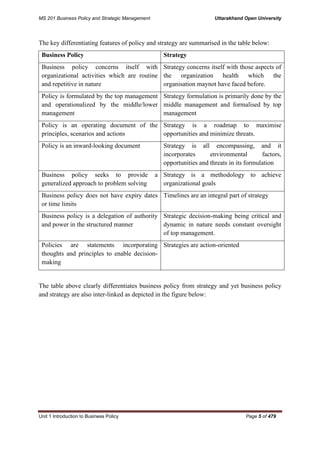
The key differentiating features of policy and strategy are summarised in the table below:
Business Policy Strategy
Business policy concerns itself with
organizational activities which are routine
and repetitive in nature
Strategy concerns itself with those aspects of
the organization health which the
organisation maynot have faced before.
Policy is formulated by the top management
and operationalized by the middle/lower
management
Strategy formulation is primarily done by the
middle management and formalised by top
management
Policy is an operating document of the
principles, scenarios and actions
Strategy is a roadmap to maximise
opportunities and minimize threats.
Policy is an inward-looking document Strategy is all encompassing, and it
incorporates environmental factors,
opportunities and threats in its formulation
Business policy seeks to provide a
generalized approach to problem solving
Strategy is a methodology to achieve
organizational goals
Business policy does not have expiry dates
or time limits
Timelines are an integral part of strategy
Business policy is a delegation of authority
and power in the structured manner
Strategic decision-making being critical and
dynamic in nature needs constant oversight
of top management.
Policies are statements incorporating
thoughts and principles to enable decision-
making
Strategies are action-oriented
The table above clearly differentiates business policy from strategy and yet business policy
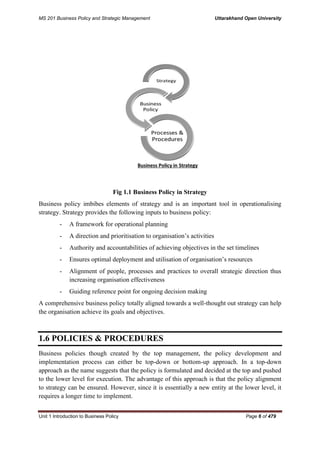
and strategy are also inter-linked as depicted in the figure below:
MS 201 Business Policy and Strategic Management Uttarakhand Open University
Unit 1 Introduction to Business Policy Page 6 of 479
Fig 1.1 Business Policy in Strategy
Business policy imbibes elements of strategy and is an important tool in operationalising
strategy. Strategy provides the following inputs to business policy:
- A framework for operational planning
- A direction and prioritisation to organisation’s activities
- Authority and accountabilities of achieving objectives in the set timelines
- Ensures optimal deployment and utilisation of organisation’s resources
- Alignment of people, processes and practices to overall strategic direction thus
increasing organisation effectiveness
- Guiding reference point for ongoing decision making
A comprehensive business policy totally aligned towards a well-thought out strategy can help
the organisation achieve its goals and objectives.
1.6 POLICIES & PROCEDURES
Business policies though created by the top management, the policy development and
implementation process can either be top-down or bottom-up approach. In a top-down
approach as the name suggests that the policy is formulated and decided at the top and pushed
to the lower level for execution. The advantage of this approach is that the policy alignment
to strategy can be ensured. However, since it is essentially a new entity at the lower level, it
requires a longer time to implement.
MS 201 Business Policy and Strategic Management Uttarakhand Open University
Unit 1 Introduction to Business Policy Page 7 of 479
The second approach, the bottom-up approach, as the name suggests originates from the
operational level of the organisation. It is more inclusive and grounded in operational reality
but lacks support and strategic alignment of the top management.
Policies are high-level documents which transmit the management strategy to the operational
level. Polices further guide the documentation of low-level detailed processes and
procedures. Thus, procedures can be understood as step-wise instructions which inherit the
spirit of the guiding policy. Since procedures are detailed instructions for undertaking a
certain activity, they are specific to the context, technology, environment, user etc. Any
change in even one of these factors will require an update of the procedures. Thus,
procedures can be deemed as more dynamic as compared to policies. For example, the
Recruitment policy of an organisation may prescribe lateral recruitment of experience
professionals in case of specific project requirements. A procedure would entail how exactly
will the recruitment team go about sourcing these lateral hires.
Check Your Progress-A
Q1. Define Business Policy?
-------------------------------------------------------------------------------------------------------------
-------------------------------------------------------------------------------------------------------------
--------------------------------------------------------------------------------------------------------------
-------------------------------------------------------------------------------------------------------------
-------------------------------------------------------------------------------------------------------------
--------------------------------------------------------------------------------------------------------------
Q2. Explain the difference between strategy and policy?
--------------------------------------------------------------------------------------------------------------
------------------------------------------------------------------------------------------------------------
--------------------------------------------------------------------------------------------------------------
-------------------------------------------------------------------------------------------------------------
MS 201 Business Policy and Strategic Management Uttarakhand Open University
Unit 1 Introduction to Business Policy Page 8 of 479
Q3. Explain the key features of business policy?
-------------------------------------------------------------------------------------------------------------
-------------------------------------------------------------------------------------------------------------
-------------------------------------------------------------------------------------------------------------
-------------------------------------------------------------------------------------------------------------
-------------------------------------------------------------------------------------------------------------
1.7 TYPES OF BUSINESS POLICIES
In the earlier sections we have seen what constitutes a good business policy. Policies while
incorporating the business goals and top management thinking also need to be compliant to
the laws and regulations. In fact, some policies are created exclusively due to the regulatory
requirements. Examples of these would be Privacy policy, Whistle-blower policy, Policy on
Prevention of Sexual harassment etc. Another type of business policy could stem from
customer or market requirements in the form of quality & audit policies, sustainability
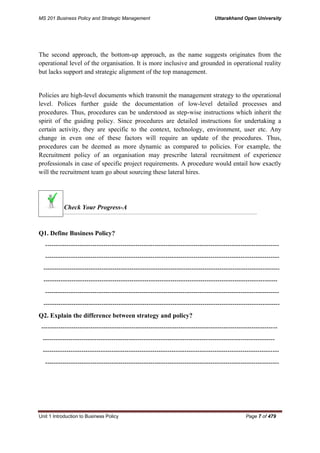
policies etc. A popular approach to classifying policies is based on functional areas as stated
above. Some of the common types of policies in organisations based on functional areas are
shown in the figure below:
Fig 1.2 Sample Types of Business Policies
Policies can be termed as operations manuals, handbooks, standard operating procedures,
guidelines etc. Another way to categories policies is by their intent:
• Regulatory – Bulk of the policies as discussed above fall in this bucket. These policies
ensure that organization functioning is in accordance with the regulatory requirements
MS 201 Business Policy and Strategic Management Uttarakhand Open University
Unit 1 Introduction to Business Policy Page 9 of 479
and local laws. Some organizations go beyond the basic legal requirements in framing
their policies. For example, Policy for Prevention of Sexual Harassment
• Advisory – These are policies which prescribe certain way of functioning or certain
behavior from employees. These policies advise acceptable standards and also advise
consequences thereof. For example, social media policy
• Informative – These are designed primarily for information dissemination. These
policies typically cover processes such as customer complaints redressal policy etc.
Based on the level at which the policy operates a policy can be categorized as Major or
Minor. Major policies are those policies which are formulated by the top management to
cover overall corporate objectives, structure, resourcing and other strategic areas. Senior
management operations and procedures are also covered in major policies. Minor policies as
the name suggests are at a lower operational level. Often, they are formulated at the
department or unit level and are normally part of some major policy. Day to day operations of
the organization are governed by the minor policies and effective implementation of these
rollup to the effectiveness of the major policies as well.
In a similar way policy from a hierarchical perspective, policies can be tagged as parent or
child policies. Following a top-down approach, child policies refer to the parent policy in
intent and guidance but operate at a lower level of hierarchy. This hierarchy of policies helps
aligning all corporate policies and trace them back to organizational objectives, structure and
strategy.
There are many other ways to classify policy, only some key types have been discussed in
this unit. Students are advised to go through the suggested readings to gain an understanding
of other types of classifications.
1.7.1 IMPACT OF POLICY TYPES ON THE ORGANISATION
We have seen that different business policies can be created at different levels for different
purposes. Hence these policies impact the organization and its stakeholders in many different
ways. For examples policies such as safety, privacy, health etc. can foster positive work
environments in companies. HR policies like compensation, performance management,
rewards and recognition can create a talented and motivated workforce. Similarly, policies
like customer engagement, quality management impact the overall customer experience for
the product or service. Some policies like ethics, whistle-blower policy, social responsibility
create a positive brand image of the organization.
Clearly laid out policies also set clear expectations from a variety of players. Employees for
instance will know the dos and don’ts in a variety of situations. Similarly, customers will also
know what to expect from the business in terms of quality, price, delivery etc. This in turn
shapes the organizational culture. A word of caution here though, a policy is only as good as
MS 201 Business Policy and Strategic Management Uttarakhand Open University
Unit 1 Introduction to Business Policy Page 10 of 479
its implementation. Thus, we see many organizations with fancy policies but poor
implementation of those policies. These organizations flounder in the long-run and some may
even collapse due to even one significant adverse event.
Thus, we can see the importance of business policies in impacting a range of organization
parameters from legal to employees to brand to customers. Backward linkage of the policy to
the organizational goals can also be seen from the above. Transparency and consistent
approach while formulating the policy also creates an element of fairness among key
stakeholders like employees, customers, vendors. In the next section we will understand the
process of formulating good business policies.
1.8 FORMULATING BUSINESS POLICIES
Business policies are an integration of knowledge in management areas with a complex
overlay of inter-linkages within the organisation to provide a generalised approach to
decision-making and problem solving. While the business policy output incorporates the
features as discussed above itself may look like a simple manual or document, its formulation
is an arduous task in itself. Policy formulation is a democratic exercise which incorporates
the views and opinions of people with the knowledge and experience of the organisation.
Before we address the steps involved in formulating business policies let us recap on the
basic aspects which the policy should cover:
1. It should incorporate a future approach which the organisation should adopt towards
realising its goals and objectives
2. The policy should be able to mould the character and identity of the organisation via
its content.
3. It should be able to comprehensively address the roles and responsibilities of the top
management both for current and future challenges which the organisation may face.
4. Policies should also incorporate the element of resource mobilisation towards
achievement of organisational goals.
Thus, business policies are framed as rules, procedures and guidelines to address the above
aspects in providing an aid to decision-making while not in itself providing decisions. It
should simply provide the limits, boundaries and direction for managerial action.
Policy formulation process goes through the following steps:
MS 201 Business Policy and Strategic Management Uttarakhand Open University
Unit 1 Introduction to Business Policy Page 11 of 479
Fig1.3 Policy Formulation Process
1. Understanding organisational objectives – As discussed at the outset, many startups
and small businesses may not have any defined business policies as the owner/leader
is practically doing all the thinking and taking all decisions. However, as the company
grows the need for policies crops up to streamline and grow operations or from a
regulatory or customer requirement. Thus, organization objectives form an important
start point for policy formulation. It also ensures alignment of the policies
subsequently to the business goals.
2. Conducting internal analysis – Since policy is primarily an inward document which
integrates an organisation’s knowledge, experience, values and culture the process of
internal analysis is the most critical step in policy formulation. Internal environment
of an organisation typically comprises its structure, employees, resources, values etc.
These are what make the organisation distinct and makes the organisational policies
unique to the organisational context.
3. Surveying relevant external factors – While it has been said multiple times that
policies are primarily inward looking, external factors do influence policies directly or
indirectly via strategy. Regulatory factors, legal requirements, market practices,
societal forces are all parameters which have a bearing on an organisation’s business
policy. While the organisation has little control over external factors, it is important to
incorporate their effect in the formulation of the policy itself.
MS 201 Business Policy and Strategic Management Uttarakhand Open University
Unit 1 Introduction to Business Policy Page 12 of 479
4. Evaluating policy alternatives – After doing the analysis the context under which the
policy is to be formulated is set in terms of the strengths, weaknesses, culture, values
and any external drivers. Policy options emerge based on the above augmented by
past experiences or best practices. These policy options are evaluated, based on their
contribution to the organisation objectives like profitability, growth, productivity etc.
Feasibility and ease of implementation are additional criteria on which policy
alternatives are evaluated.
5. Identifying policies to be formulated - From the various policy alternatives choosing
the most appropriate policies is the next step in the process. This creates a list of
policies to be formulated for example:
a) Business policies – sales and marketing, operations, materials, servicing etc.
b) People policies – labour, HR, recruitment, health and safety etc.
c) Regulatory – audit & compliance, security, privacy, anti-discrimination etc.
d) Strategic – innovation, customer experience, ethics & sustainability etc.
6. Documentation, testing and release of policies - Some of the policies listed could be
standard policies which are adopted across all companies in the industry. Such policy
templates are normally available and can simply be validated and customized to the
specific company context. However, there will be a number of policies which be so
unique that they will need to be created ground up simply because these policies
incorporate the specific company context, culture and strategic vision. Majority of the
policies however will be a combination of both the above categories i.e. unique to the
company while adhering to normal business practices or regulatory requirements.
1.8.1 COMPONENTS OF BUSINESS POLICY DOCUMENT
By now you will know that business policy defines rules and boundaries for managerial
action, while not actually giving the decision. Hence it normally starts with a mission-
statement like rule which sets out the objective of the policy. The other components of the
policy would typically be:
a. Title – The title of the policy is a meaningful phrase which will clearly indicate what
the policy is about.
b. Policy – This contains the actual text of the policy
c. Purpose – Purpose of the policy lays out the need for the policy
d. Scope – Applicability of the policy defines its scope
e. Responsibilities – Who does what in the different scenarios is covered under the
responsibilities section
f. Definitions – Some terms of the policy may need to be defined in unambiguous terms
so that everyone has the same understanding of them
MS 201 Business Policy and Strategic Management Uttarakhand Open University
Unit 1 Introduction to Business Policy Page 13 of 479
g. Special cases/deviations – Any exception or special cases which can be anticipated or
maynot be anticipated get handled in this section
h. References – Is this policy linked to any other policy or refers other organizational
documents
i. Owner of the policy – Who is the functional owner of the policy document?
Each policy is different in its content and may incorporate some extra elements depending on
the policy being formulated. For example, policies relating to quality standards could contain
metrics, KPIs, standards etc.
However, in general if the above areas/questions have been answered then the policy is more
or less ready. It is a normal practice to look at available templates before starting the process
of policy formulation and leverage any resources available which can shorten the process
overall. The policy itself is a configurable document and goes under configuration
management process for document storage and release. Policy formulation is a iterative
process, each step feeds into the next step. A failure at any step loops the process back to the
previous step for revaluation.
1.8.2 CHECKLIST FOR GOOD BUSINESS POLICY
Having understood the importance and purpose of business policy, it is evident that a well-
written, clear and crisp business policy is an important tool for the smooth-running of routine
business operations as well as a cohesive operating environment which is aligned to the top
management thinking. Every organisation typically has multiple types of policies however; a
good policy is governed by the following key features:
1. Specific – A good policy should be precise and specific in content. Generalised
policies will be inconsistently implemented.
2. Clear – It should be defined unambiguously and should not be left open to
interpretation. Too much use of jargons, abbreviations should be typically avoided.
3. Uniform – The policy should be reliable and uniform in its handling of aspects across
all levels of the organisation. This also lends credibility to the policy and its
acceptance by the organisation employees.
4. Appropriate and suitable – Needless to say the policy should be appropriate to the
organisation’s goal, else it is superfluous.
5. Simple – It should be written in simple, easy-to-understand language which is
comprehended by the larger organisation
6. Inclusive – The policy should be inclusive of all possible scenarios and outcomes. It
should have a wide-scope for it to be used by all within the organisation
MS 201 Business Policy and Strategic Management Uttarakhand Open University
Unit 1 Introduction to Business Policy Page 14 of 479
7. Stable and flexible – The policy should be stable and not subject to frequent
alterations; however, it should be flexible in operation so that managers can use it in
multiple scenarios without referring to top management.
A well-crafted business policy guided by the above features will enable business to
be governed effectively and grow strategically in a dynamic environment.
1.9 IMPLEMENTING BUSINESS POLICIES IN FIRMS
A law is as good as its implementation. This old adage holds true not only of law but business
policy as well. Very often we come across organisations with a large number of good
policies, but barely able to keep afloat. This is often due to the inadequate implementation of
the policies formulated. As is true with most implementation activities, it has to be a
systematic, consistent and persistent effort.
Policy implementation starts with awareness building. Every policy has a stakeholder
ecosystem for whom the policy is relevant. This set of stakeholders need to be made aware of
the policy, its contents and of any changes or modifications subsequently. Most common
stakeholder of a policy is an employee. So, employees undertaking the role of marketing
should be aware of the relevant marketing policies, vendor manager needs to be aware of
procurement policies etc. Business leaders need to train employees of relevant policies and its
amendments from time to time. They also need make these policies available subsequently
for reference and feedback.
Policies relating to compliance or safety are more broad-based and maybe applicable to all
employees in the organization. Many organizations include these sessions as part of induction
for new joinees. Some organizations also need their employees to revalidate their awareness
and understanding of the latest policies on a regular basis. This is a good practice as it forces
employees to stay current and updated of the business policy.
The next important step in implementation of the policy is the governance of its compliance.
A good policy is seamlessly integrated into the processes and procedures of the function such
that compliance is not an extra effort. This can easily be done digitally these days with most
processes already digitized in companies. Violations of the policy in most such cases would
be minimal or none. However, every policy has its exception cases which cannot be
anticipated and/or handled at the time of formulation of the policy. Such cases are typically
routed separately and hence could be ripe for violations.
MS 201 Business Policy and Strategic Management Uttarakhand Open University
Unit 1 Introduction to Business Policy Page 15 of 479
Whatever be the cause or type, violations to business policy need to be dealt appropriately
and uniformly by the top management. This is important to convey a consistency, seriousness
and fairness about the policy, its implementations and repercussions if any. Employee
expectations are set accordingly, and they will feel more confused incase of inconsistent
handling of policy violations.
Many policies are exclusively documented to handle cases of violations. Management has
‘zero tolerance’ policy in many cases like prevention of sexual harassment, ethical conduct,
privacy etc. This means that even a small violation of such policies will invite punitive or
disciplinary action against the violator. Other smaller violations could be handled in milder
ways with warnings or retraining.
Business policy formulation, implementation and compliance are serious activities to be
undertaken by any organization. It not only impacts the softer aspects of the organization
working, but also safeguards the organization from legal challenges and brings the
organization closer to achieving the strategic objectives and goals.
1.10 POLICY EVALUATION & CONTROL
As discussed, earlier policies don’t come with an expiry date or a timeline. Theoretically they
exist in perpetuity unless amended or revoked. Strategic management process calls for a
periodic evaluation of the strategic plan, monitoring of its performance and course
corrections wherever required. Similarly, policies review, monitoring and control needs to be
a planned activity done at periodic intervals.
Different policies need to be reviewed at different intervals based on their criticality, speed of
change and complexity. For example, a policy on quality standards need not be as frequently
reviewed as policy on product innovation. HR and people policies are dynamic by nature and
need constant reviews. Some review can be triggered by an external event, such as a change
in regulation.
MS 201 Business Policy and Strategic Management Uttarakhand Open University
Unit 1 Introduction to Business Policy Page 16 of 479
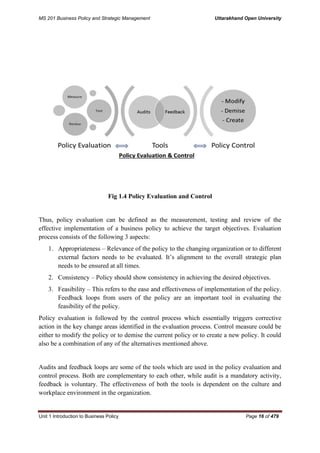
Fig 1.4 Policy Evaluation and Control
Thus, policy evaluation can be defined as the measurement, testing and review of the
effective implementation of a business policy to achieve the target objectives. Evaluation
process consists of the following 3 aspects:
1. Appropriateness – Relevance of the policy to the changing organization or to different
external factors needs to be evaluated. It’s alignment to the overall strategic plan
needs to be ensured at all times.
2. Consistency – Policy should show consistency in achieving the desired objectives.
3. Feasibility – This refers to the ease and effectiveness of implementation of the policy.
Feedback loops from users of the policy are an important tool in evaluating the
feasibility of the policy.
Policy evaluation is followed by the control process which essentially triggers corrective
action in the key change areas identified in the evaluation process. Control measure could be
either to modify the policy or to demise the current policy or to create a new policy. It could
also be a combination of any of the alternatives mentioned above.
Audits and feedback loops are some of the tools which are used in the policy evaluation and
control process. Both are complementary to each other, while audit is a mandatory activity,
feedback is voluntary. The effectiveness of both the tools is dependent on the culture and
workplace environment in the organization.
MS 201 Business Policy and Strategic Management Uttarakhand Open University
Unit 1 Introduction to Business Policy Page 17 of 479
Audits of policies and procedures include a review of the documents and a validation of
reality complying with the intention. A gap between what is laid down in the policy with the
reality indicates that the specific scenario could be missing in the policy, or its could be
difficult to follow or a failure at the hands of the employee either intentionally or due to
ignorance.
Business today exists in a every changing environment with varying degrees of volatility;
thus change is part of the new normal in every business process. Policy evaluation is a subset
of strategic evaluation process. Even though business policy operates at an operational level it
is still a strategic document and it is important to remember the inter-linkage between
business policy and strategy earlier in the unit.
Check Your Progress-B
Q1. Give examples of impact of types of policy on organization.
-------------------------------------------------------------------------------------------------------------
-------------------------------------------------------------------------------------------------------------
-------------------------------------------------------------------------------------------------------------
Q2. Name the steps involved in formulating business policy?
-------------------------------------------------------------------------------------------------------------
-------------------------------------------------------------------------------------------------------------
-------------------------------------------------------------------------------------------------------------
Q3. Fill in the Blanks with appropriate word or words.
a) ………………… is a detailed set of instructions for undertaking an activity
b) Policy is as good as its …………………..
c) Two components of a policy document are ………………… and ……………….
d) Policies where even a minor violation invites disciplinary action are often called
…………………….

Business policy concept,examples,synergy

  • 1.
    MS 201 BusinessPolicy and Strategic Management Uttarakhand Open University Unit 1 Introduction to Business Policy Page 1 of 479 UNIT 1 INTRODUCTION TO BUSINESS POLICY 1.1 Introduction 1.2 Objectives 1.3 Definition of Business Policy 1.4 Features of Business policy 1.5 Business Policy and Strategy 1.6 Policies & Procedures 1.7 Types of Business Policies 1.8 Formulating Business Policies 1.9 Implementing Business Policies in Firms 1.10 Policy Evaluation & Control 1.11 Summary 1.12 Glossary 1.13 Answer to Check Your Progress 1.14 References/ Bibliography 1.15 Suggested Readings 1.16 Terminal & Model Questions 1.17 Activity 1.1 INTRODUCTION Businesses are increasingly finding themselves in a fast-changing environment due factors such as globalisation, newer emerging technologies, socio-demographic changes in the employee and customer profiles, volatile political scenario etc. Traditional outlook towards planned policy making design no longer holds validity. Thus, courses earlier focussed on teaching business policy in isolation have been incorporated as a integrated part of strategic management programs. In this unit, the concept of business policy will be introduced. Business policy and strategy though distinct concepts are also inter-linked in some areas. They are the twin pillars which enable organisations to survive and grow in a competitive and demanding environment. Thus, the understanding of business policy in the context of strategic management is important.
  • 2.
    MS 201 BusinessPolicy and Strategic Management Uttarakhand Open University Unit 1 Introduction to Business Policy Page 2 of 479 Business policy essentially is a set of guidelines which is internal to an organisation and defines the decision making process and procedures of the organisation. It is a blueprint defined by the top management which is executed by the levels below for a smooth day-to- day functioning of the business. 1.2 OBJECTIVES After reading this unit you will be able to: • Understand the concepts of Business Policy and Strategy. • Describe the features of Business Policy. • Understand the difference between procedures and business policy, strategy. • Know the different types of policies and their impact on organisations. • Understand how to frame business policies. • How to implement policies in organisation. 1.3 DEFINITION OF BUSINESS POLICY Every organisation big or small has its own way of doing things. Some businesses are characterised by the leader or owner making all decisions for the business. This is largely prevalent in small business enterprises. However, when organisations grow in size, often decision making needs to be delegated to other levels. Top management needs to focus on strategic management rather than day-to-day operations. This is where a good set of policies are critical for daily functioning of the organisation. Policies in general are statements which guide actions, decision-making and thinking in the organisation. While there are multiple definitions of business policy formulated by strategy experts, some popular ones are given below: “The study of the function and responsibilities of senior management, the crucial problems that affect success in the total enterprise, and the decisions that determine the direction of the organisation and shape its future.” Christensen, Steiner and others “Policy refers to goal-directed decisions and actions in which capabilities and resources are matched with the opportunities and threats in the environment. Policy and Strategy are consistent stream of decisions and actions to deal with the environment.” Henry Mintzberb.
  • 3.
    MS 201 BusinessPolicy and Strategic Management Uttarakhand Open University Unit 1 Introduction to Business Policy Page 3 of 479 “Business Policy basically deals with decisions regarding the future of an ongoing enterprise. Such policy decisions are taken at the top level after carefully evaluating the organisational strengths and weaknesses in relation to its environment.” R. E. Thomas Thus, Business Policy is a set of guidelines used by the middle and lower management to allocate resources, resolve issues and problems within a pre-determined sphere of decision making without consulting top management. It defines the scope, limits and the conditions under which the subordinates can independently take decisions of day-to-day routine activities. Managerial action is governed by policies laid down by the top management. 1.4 FEATURES OF BUSINES POLICY The features of business policy given below will further clarify the concept and understanding of corporate policy. Generalised statements – Policies are guiding principles which incorporate management thinking and organisational objectives. Thus, they contain generalised qualitative statements of intent and action. This ensures a wide scope of applicability and flexibility for adapting to multiple scenarios. Long-term outlook – Policies unlike strategies don’t have timelines or time limits of validity. They are ongoing documents which stay relevant unless modified. This in important in providing stability to business. Aligned to goals and objectives – Business policies originate at the strategic level as a means to fulfil organisational goals and objectives. They need to flow in that top-down manner through the organisation. Multi-level existence – Evident from the above, policies flow and exist across multiple levels in the organisation. Each policy is typically tagged to its parent policy to ensure traceability and alignment across top management, middle management and lower management levels. Decision making for routine and repetitive functions – Unlike strategy which handles new unanswered challenges for the organisation, the underlying purpose of a policy is delegating decision making and smooth functioning of the routine operations of the organisation. Positive orientation – Business policy is a guide for managerial action. It thus has a positive orientation of what needs to be done. In most cases it sets a affirmative tone with the employees and other users. In some sense the policy wording echoes the corporate culture and values which are meant to inspire managers. Non-repeatability - Policies due to the fact that they exist at multiple levels of the business are meant to delegate power and authority. Thus, they need to avoid repeated
  • 4.
    MS 201 BusinessPolicy and Strategic Management Uttarakhand Open University Unit 1 Introduction to Business Policy Page 4 of 479 handling of scenarios and prescribed action. This only creates confusion among the employees. 1.5 BUSINESS POLICY AND STRATEGY Business policy and strategy are used inter-changeably many times, but they are 2 distinct concepts and need to be understood accordingly. There is a group of management experts who treat policy and strategy as synonymous. For example, William Glueck defines business policy as “management policy is long range planning. For all practical purposes, management policy, long range planning and strategic management mean the same thing”. This view can be justified in the earlier days when strategy was largely an inward looking process in itself. Businesses were localised in terms of their markets, resourcing, legal and political environment and impacted communities. Management institutes would have courses on business policy where strategic management would be covered. This view and the discipline of strategic management has undergone a massive change in the recent times. Increased globalisation, coupled with technological, social and political factors operating at multiple levels have moved strategy to the external realm. Business Policy is an outcome of the study of the top management functioning and decision-making to enable the lower management successfully manage and operate routine/repetitive functions. While strategy as you may have learned in the earlier units is a forward looking roadmap for the organisation which incorporates both external and internal factors in helping the organisation realise its vision, goals and objectives. While effective and quick decision-making is a key tool in strategic management, strategy encompasses other outward looking and growth oriented aspects like handling opportunities and threats, identifying and monetising trends, organisation performance management etc. Another view of policy positions it as a process of implementing strategy guided by Robert Mudric definition of policy as “A policy establishes guidelines and limits for discretionary action by individuals responsible for implementing the overall plan.”. This view of business policy restricts its scope to the operational level bordering on treating it equivalent to processes and procedures. As discussed, earlier policies exist at all levels including strategic levels.
  • 5.
    MS 201 BusinessPolicy and Strategic Management Uttarakhand Open University Unit 1 Introduction to Business Policy Page 5 of 479 The key differentiating features of policy and strategy are summarised in the table below: Business Policy Strategy Business policy concerns itself with organizational activities which are routine and repetitive in nature Strategy concerns itself with those aspects of the organization health which the organisation maynot have faced before. Policy is formulated by the top management and operationalized by the middle/lower management Strategy formulation is primarily done by the middle management and formalised by top management Policy is an operating document of the principles, scenarios and actions Strategy is a roadmap to maximise opportunities and minimize threats. Policy is an inward-looking document Strategy is all encompassing, and it incorporates environmental factors, opportunities and threats in its formulation Business policy seeks to provide a generalized approach to problem solving Strategy is a methodology to achieve organizational goals Business policy does not have expiry dates or time limits Timelines are an integral part of strategy Business policy is a delegation of authority and power in the structured manner Strategic decision-making being critical and dynamic in nature needs constant oversight of top management. Policies are statements incorporating thoughts and principles to enable decision- making Strategies are action-oriented The table above clearly differentiates business policy from strategy and yet business policy and strategy are also inter-linked as depicted in the figure below:
  • 6.
    MS 201 BusinessPolicy and Strategic Management Uttarakhand Open University Unit 1 Introduction to Business Policy Page 6 of 479 Fig 1.1 Business Policy in Strategy Business policy imbibes elements of strategy and is an important tool in operationalising strategy. Strategy provides the following inputs to business policy: - A framework for operational planning - A direction and prioritisation to organisation’s activities - Authority and accountabilities of achieving objectives in the set timelines - Ensures optimal deployment and utilisation of organisation’s resources - Alignment of people, processes and practices to overall strategic direction thus increasing organisation effectiveness - Guiding reference point for ongoing decision making A comprehensive business policy totally aligned towards a well-thought out strategy can help the organisation achieve its goals and objectives. 1.6 POLICIES & PROCEDURES Business policies though created by the top management, the policy development and implementation process can either be top-down or bottom-up approach. In a top-down approach as the name suggests that the policy is formulated and decided at the top and pushed to the lower level for execution. The advantage of this approach is that the policy alignment to strategy can be ensured. However, since it is essentially a new entity at the lower level, it requires a longer time to implement.
  • 7.
    MS 201 BusinessPolicy and Strategic Management Uttarakhand Open University Unit 1 Introduction to Business Policy Page 7 of 479 The second approach, the bottom-up approach, as the name suggests originates from the operational level of the organisation. It is more inclusive and grounded in operational reality but lacks support and strategic alignment of the top management. Policies are high-level documents which transmit the management strategy to the operational level. Polices further guide the documentation of low-level detailed processes and procedures. Thus, procedures can be understood as step-wise instructions which inherit the spirit of the guiding policy. Since procedures are detailed instructions for undertaking a certain activity, they are specific to the context, technology, environment, user etc. Any change in even one of these factors will require an update of the procedures. Thus, procedures can be deemed as more dynamic as compared to policies. For example, the Recruitment policy of an organisation may prescribe lateral recruitment of experience professionals in case of specific project requirements. A procedure would entail how exactly will the recruitment team go about sourcing these lateral hires. Check Your Progress-A Q1. Define Business Policy? ------------------------------------------------------------------------------------------------------------- ------------------------------------------------------------------------------------------------------------- -------------------------------------------------------------------------------------------------------------- ------------------------------------------------------------------------------------------------------------- ------------------------------------------------------------------------------------------------------------- -------------------------------------------------------------------------------------------------------------- Q2. Explain the difference between strategy and policy? -------------------------------------------------------------------------------------------------------------- ------------------------------------------------------------------------------------------------------------ -------------------------------------------------------------------------------------------------------------- -------------------------------------------------------------------------------------------------------------
  • 8.
    MS 201 BusinessPolicy and Strategic Management Uttarakhand Open University Unit 1 Introduction to Business Policy Page 8 of 479 Q3. Explain the key features of business policy? ------------------------------------------------------------------------------------------------------------- ------------------------------------------------------------------------------------------------------------- ------------------------------------------------------------------------------------------------------------- ------------------------------------------------------------------------------------------------------------- ------------------------------------------------------------------------------------------------------------- 1.7 TYPES OF BUSINESS POLICIES In the earlier sections we have seen what constitutes a good business policy. Policies while incorporating the business goals and top management thinking also need to be compliant to the laws and regulations. In fact, some policies are created exclusively due to the regulatory requirements. Examples of these would be Privacy policy, Whistle-blower policy, Policy on Prevention of Sexual harassment etc. Another type of business policy could stem from customer or market requirements in the form of quality & audit policies, sustainability policies etc. A popular approach to classifying policies is based on functional areas as stated above. Some of the common types of policies in organisations based on functional areas are shown in the figure below: Fig 1.2 Sample Types of Business Policies Policies can be termed as operations manuals, handbooks, standard operating procedures, guidelines etc. Another way to categories policies is by their intent: • Regulatory – Bulk of the policies as discussed above fall in this bucket. These policies ensure that organization functioning is in accordance with the regulatory requirements
  • 9.
    MS 201 BusinessPolicy and Strategic Management Uttarakhand Open University Unit 1 Introduction to Business Policy Page 9 of 479 and local laws. Some organizations go beyond the basic legal requirements in framing their policies. For example, Policy for Prevention of Sexual Harassment • Advisory – These are policies which prescribe certain way of functioning or certain behavior from employees. These policies advise acceptable standards and also advise consequences thereof. For example, social media policy • Informative – These are designed primarily for information dissemination. These policies typically cover processes such as customer complaints redressal policy etc. Based on the level at which the policy operates a policy can be categorized as Major or Minor. Major policies are those policies which are formulated by the top management to cover overall corporate objectives, structure, resourcing and other strategic areas. Senior management operations and procedures are also covered in major policies. Minor policies as the name suggests are at a lower operational level. Often, they are formulated at the department or unit level and are normally part of some major policy. Day to day operations of the organization are governed by the minor policies and effective implementation of these rollup to the effectiveness of the major policies as well. In a similar way policy from a hierarchical perspective, policies can be tagged as parent or child policies. Following a top-down approach, child policies refer to the parent policy in intent and guidance but operate at a lower level of hierarchy. This hierarchy of policies helps aligning all corporate policies and trace them back to organizational objectives, structure and strategy. There are many other ways to classify policy, only some key types have been discussed in this unit. Students are advised to go through the suggested readings to gain an understanding of other types of classifications. 1.7.1 IMPACT OF POLICY TYPES ON THE ORGANISATION We have seen that different business policies can be created at different levels for different purposes. Hence these policies impact the organization and its stakeholders in many different ways. For examples policies such as safety, privacy, health etc. can foster positive work environments in companies. HR policies like compensation, performance management, rewards and recognition can create a talented and motivated workforce. Similarly, policies like customer engagement, quality management impact the overall customer experience for the product or service. Some policies like ethics, whistle-blower policy, social responsibility create a positive brand image of the organization. Clearly laid out policies also set clear expectations from a variety of players. Employees for instance will know the dos and don’ts in a variety of situations. Similarly, customers will also know what to expect from the business in terms of quality, price, delivery etc. This in turn shapes the organizational culture. A word of caution here though, a policy is only as good as
  • 10.
    MS 201 BusinessPolicy and Strategic Management Uttarakhand Open University Unit 1 Introduction to Business Policy Page 10 of 479 its implementation. Thus, we see many organizations with fancy policies but poor implementation of those policies. These organizations flounder in the long-run and some may even collapse due to even one significant adverse event. Thus, we can see the importance of business policies in impacting a range of organization parameters from legal to employees to brand to customers. Backward linkage of the policy to the organizational goals can also be seen from the above. Transparency and consistent approach while formulating the policy also creates an element of fairness among key stakeholders like employees, customers, vendors. In the next section we will understand the process of formulating good business policies. 1.8 FORMULATING BUSINESS POLICIES Business policies are an integration of knowledge in management areas with a complex overlay of inter-linkages within the organisation to provide a generalised approach to decision-making and problem solving. While the business policy output incorporates the features as discussed above itself may look like a simple manual or document, its formulation is an arduous task in itself. Policy formulation is a democratic exercise which incorporates the views and opinions of people with the knowledge and experience of the organisation. Before we address the steps involved in formulating business policies let us recap on the basic aspects which the policy should cover: 1. It should incorporate a future approach which the organisation should adopt towards realising its goals and objectives 2. The policy should be able to mould the character and identity of the organisation via its content. 3. It should be able to comprehensively address the roles and responsibilities of the top management both for current and future challenges which the organisation may face. 4. Policies should also incorporate the element of resource mobilisation towards achievement of organisational goals. Thus, business policies are framed as rules, procedures and guidelines to address the above aspects in providing an aid to decision-making while not in itself providing decisions. It should simply provide the limits, boundaries and direction for managerial action. Policy formulation process goes through the following steps:
  • 11.
    MS 201 BusinessPolicy and Strategic Management Uttarakhand Open University Unit 1 Introduction to Business Policy Page 11 of 479 Fig1.3 Policy Formulation Process 1. Understanding organisational objectives – As discussed at the outset, many startups and small businesses may not have any defined business policies as the owner/leader is practically doing all the thinking and taking all decisions. However, as the company grows the need for policies crops up to streamline and grow operations or from a regulatory or customer requirement. Thus, organization objectives form an important start point for policy formulation. It also ensures alignment of the policies subsequently to the business goals. 2. Conducting internal analysis – Since policy is primarily an inward document which integrates an organisation’s knowledge, experience, values and culture the process of internal analysis is the most critical step in policy formulation. Internal environment of an organisation typically comprises its structure, employees, resources, values etc. These are what make the organisation distinct and makes the organisational policies unique to the organisational context. 3. Surveying relevant external factors – While it has been said multiple times that policies are primarily inward looking, external factors do influence policies directly or indirectly via strategy. Regulatory factors, legal requirements, market practices, societal forces are all parameters which have a bearing on an organisation’s business policy. While the organisation has little control over external factors, it is important to incorporate their effect in the formulation of the policy itself.
  • 12.
    MS 201 BusinessPolicy and Strategic Management Uttarakhand Open University Unit 1 Introduction to Business Policy Page 12 of 479 4. Evaluating policy alternatives – After doing the analysis the context under which the policy is to be formulated is set in terms of the strengths, weaknesses, culture, values and any external drivers. Policy options emerge based on the above augmented by past experiences or best practices. These policy options are evaluated, based on their contribution to the organisation objectives like profitability, growth, productivity etc. Feasibility and ease of implementation are additional criteria on which policy alternatives are evaluated. 5. Identifying policies to be formulated - From the various policy alternatives choosing the most appropriate policies is the next step in the process. This creates a list of policies to be formulated for example: a) Business policies – sales and marketing, operations, materials, servicing etc. b) People policies – labour, HR, recruitment, health and safety etc. c) Regulatory – audit & compliance, security, privacy, anti-discrimination etc. d) Strategic – innovation, customer experience, ethics & sustainability etc. 6. Documentation, testing and release of policies - Some of the policies listed could be standard policies which are adopted across all companies in the industry. Such policy templates are normally available and can simply be validated and customized to the specific company context. However, there will be a number of policies which be so unique that they will need to be created ground up simply because these policies incorporate the specific company context, culture and strategic vision. Majority of the policies however will be a combination of both the above categories i.e. unique to the company while adhering to normal business practices or regulatory requirements. 1.8.1 COMPONENTS OF BUSINESS POLICY DOCUMENT By now you will know that business policy defines rules and boundaries for managerial action, while not actually giving the decision. Hence it normally starts with a mission- statement like rule which sets out the objective of the policy. The other components of the policy would typically be: a. Title – The title of the policy is a meaningful phrase which will clearly indicate what the policy is about. b. Policy – This contains the actual text of the policy c. Purpose – Purpose of the policy lays out the need for the policy d. Scope – Applicability of the policy defines its scope e. Responsibilities – Who does what in the different scenarios is covered under the responsibilities section f. Definitions – Some terms of the policy may need to be defined in unambiguous terms so that everyone has the same understanding of them
  • 13.
    MS 201 BusinessPolicy and Strategic Management Uttarakhand Open University Unit 1 Introduction to Business Policy Page 13 of 479 g. Special cases/deviations – Any exception or special cases which can be anticipated or maynot be anticipated get handled in this section h. References – Is this policy linked to any other policy or refers other organizational documents i. Owner of the policy – Who is the functional owner of the policy document? Each policy is different in its content and may incorporate some extra elements depending on the policy being formulated. For example, policies relating to quality standards could contain metrics, KPIs, standards etc. However, in general if the above areas/questions have been answered then the policy is more or less ready. It is a normal practice to look at available templates before starting the process of policy formulation and leverage any resources available which can shorten the process overall. The policy itself is a configurable document and goes under configuration management process for document storage and release. Policy formulation is a iterative process, each step feeds into the next step. A failure at any step loops the process back to the previous step for revaluation. 1.8.2 CHECKLIST FOR GOOD BUSINESS POLICY Having understood the importance and purpose of business policy, it is evident that a well- written, clear and crisp business policy is an important tool for the smooth-running of routine business operations as well as a cohesive operating environment which is aligned to the top management thinking. Every organisation typically has multiple types of policies however; a good policy is governed by the following key features: 1. Specific – A good policy should be precise and specific in content. Generalised policies will be inconsistently implemented. 2. Clear – It should be defined unambiguously and should not be left open to interpretation. Too much use of jargons, abbreviations should be typically avoided. 3. Uniform – The policy should be reliable and uniform in its handling of aspects across all levels of the organisation. This also lends credibility to the policy and its acceptance by the organisation employees. 4. Appropriate and suitable – Needless to say the policy should be appropriate to the organisation’s goal, else it is superfluous. 5. Simple – It should be written in simple, easy-to-understand language which is comprehended by the larger organisation 6. Inclusive – The policy should be inclusive of all possible scenarios and outcomes. It should have a wide-scope for it to be used by all within the organisation
  • 14.
    MS 201 BusinessPolicy and Strategic Management Uttarakhand Open University Unit 1 Introduction to Business Policy Page 14 of 479 7. Stable and flexible – The policy should be stable and not subject to frequent alterations; however, it should be flexible in operation so that managers can use it in multiple scenarios without referring to top management. A well-crafted business policy guided by the above features will enable business to be governed effectively and grow strategically in a dynamic environment. 1.9 IMPLEMENTING BUSINESS POLICIES IN FIRMS A law is as good as its implementation. This old adage holds true not only of law but business policy as well. Very often we come across organisations with a large number of good policies, but barely able to keep afloat. This is often due to the inadequate implementation of the policies formulated. As is true with most implementation activities, it has to be a systematic, consistent and persistent effort. Policy implementation starts with awareness building. Every policy has a stakeholder ecosystem for whom the policy is relevant. This set of stakeholders need to be made aware of the policy, its contents and of any changes or modifications subsequently. Most common stakeholder of a policy is an employee. So, employees undertaking the role of marketing should be aware of the relevant marketing policies, vendor manager needs to be aware of procurement policies etc. Business leaders need to train employees of relevant policies and its amendments from time to time. They also need make these policies available subsequently for reference and feedback. Policies relating to compliance or safety are more broad-based and maybe applicable to all employees in the organization. Many organizations include these sessions as part of induction for new joinees. Some organizations also need their employees to revalidate their awareness and understanding of the latest policies on a regular basis. This is a good practice as it forces employees to stay current and updated of the business policy. The next important step in implementation of the policy is the governance of its compliance. A good policy is seamlessly integrated into the processes and procedures of the function such that compliance is not an extra effort. This can easily be done digitally these days with most processes already digitized in companies. Violations of the policy in most such cases would be minimal or none. However, every policy has its exception cases which cannot be anticipated and/or handled at the time of formulation of the policy. Such cases are typically routed separately and hence could be ripe for violations.
  • 15.
    MS 201 BusinessPolicy and Strategic Management Uttarakhand Open University Unit 1 Introduction to Business Policy Page 15 of 479 Whatever be the cause or type, violations to business policy need to be dealt appropriately and uniformly by the top management. This is important to convey a consistency, seriousness and fairness about the policy, its implementations and repercussions if any. Employee expectations are set accordingly, and they will feel more confused incase of inconsistent handling of policy violations. Many policies are exclusively documented to handle cases of violations. Management has ‘zero tolerance’ policy in many cases like prevention of sexual harassment, ethical conduct, privacy etc. This means that even a small violation of such policies will invite punitive or disciplinary action against the violator. Other smaller violations could be handled in milder ways with warnings or retraining. Business policy formulation, implementation and compliance are serious activities to be undertaken by any organization. It not only impacts the softer aspects of the organization working, but also safeguards the organization from legal challenges and brings the organization closer to achieving the strategic objectives and goals. 1.10 POLICY EVALUATION & CONTROL As discussed, earlier policies don’t come with an expiry date or a timeline. Theoretically they exist in perpetuity unless amended or revoked. Strategic management process calls for a periodic evaluation of the strategic plan, monitoring of its performance and course corrections wherever required. Similarly, policies review, monitoring and control needs to be a planned activity done at periodic intervals. Different policies need to be reviewed at different intervals based on their criticality, speed of change and complexity. For example, a policy on quality standards need not be as frequently reviewed as policy on product innovation. HR and people policies are dynamic by nature and need constant reviews. Some review can be triggered by an external event, such as a change in regulation.
  • 16.
    MS 201 BusinessPolicy and Strategic Management Uttarakhand Open University Unit 1 Introduction to Business Policy Page 16 of 479 Fig 1.4 Policy Evaluation and Control Thus, policy evaluation can be defined as the measurement, testing and review of the effective implementation of a business policy to achieve the target objectives. Evaluation process consists of the following 3 aspects: 1. Appropriateness – Relevance of the policy to the changing organization or to different external factors needs to be evaluated. It’s alignment to the overall strategic plan needs to be ensured at all times. 2. Consistency – Policy should show consistency in achieving the desired objectives. 3. Feasibility – This refers to the ease and effectiveness of implementation of the policy. Feedback loops from users of the policy are an important tool in evaluating the feasibility of the policy. Policy evaluation is followed by the control process which essentially triggers corrective action in the key change areas identified in the evaluation process. Control measure could be either to modify the policy or to demise the current policy or to create a new policy. It could also be a combination of any of the alternatives mentioned above. Audits and feedback loops are some of the tools which are used in the policy evaluation and control process. Both are complementary to each other, while audit is a mandatory activity, feedback is voluntary. The effectiveness of both the tools is dependent on the culture and workplace environment in the organization.
  • 17.
    MS 201 BusinessPolicy and Strategic Management Uttarakhand Open University Unit 1 Introduction to Business Policy Page 17 of 479 Audits of policies and procedures include a review of the documents and a validation of reality complying with the intention. A gap between what is laid down in the policy with the reality indicates that the specific scenario could be missing in the policy, or its could be difficult to follow or a failure at the hands of the employee either intentionally or due to ignorance. Business today exists in a every changing environment with varying degrees of volatility; thus change is part of the new normal in every business process. Policy evaluation is a subset of strategic evaluation process. Even though business policy operates at an operational level it is still a strategic document and it is important to remember the inter-linkage between business policy and strategy earlier in the unit. Check Your Progress-B Q1. Give examples of impact of types of policy on organization. ------------------------------------------------------------------------------------------------------------- ------------------------------------------------------------------------------------------------------------- ------------------------------------------------------------------------------------------------------------- Q2. Name the steps involved in formulating business policy? ------------------------------------------------------------------------------------------------------------- ------------------------------------------------------------------------------------------------------------- ------------------------------------------------------------------------------------------------------------- Q3. Fill in the Blanks with appropriate word or words. a) ………………… is a detailed set of instructions for undertaking an activity b) Policy is as good as its ………………….. c) Two components of a policy document are ………………… and ………………. d) Policies where even a minor violation invites disciplinary action are often called …………………….