CONSULTING
Business
Planning
in the
Digital Age
How a highly integrated and real-time approach will
elevate a select few firms to future market dominance.
External document © 2017 Infosys Consulting 2
As we advance into a new age of disruptive digital technologies, the rules and ways-of-
working that we have been so accustomed to are being quickly re-written, thus drastically
changing the business models of some of today’s most established companies.
The seamless connectivity between data and objects through the Internet of Things has
reached the mainstream consumer (i.e., the smart home). Automation and artificial
intelligence are helping to streamline organizational planning processes and analyze data
on unimagined levels. Industry 4.0 is redefining discrete manufacturing as a new, intelligent
and sustainable way of production. And, new models of interaction and collaboration
between resources and assets are being created (i.e., “Uberization”).
One of the key challenges executives face head-on is how to harness these now main stream
industry disruptions and convert them into business opportunities – and ultimately drive
competitive advantage for their firms. One element will remain constant, however – the need
to predict, plan and generate profit for the organization. The good news is that these technology
breakthroughs will offer new and more powerful ways to enable the planning and realization
of bottom-line results.
This thought-piece will explore these concepts in more detail and offer a view into the
different maturity levels an organization can achieve in their integrated planning processes.
Evolution
of Planning
Capabilities in
the Enterprise
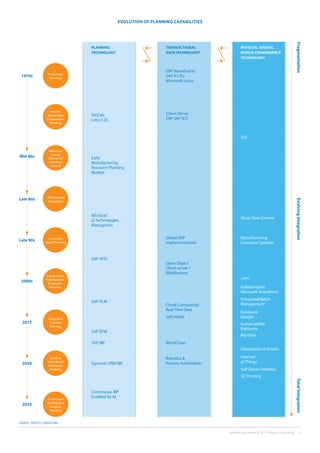
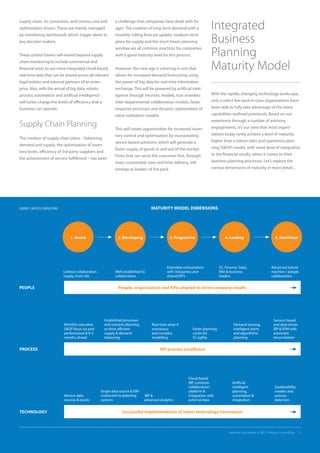
Corporate planning systems have evolved over
time from basic, manual planning models and
early spreadsheet-based systems, to increased
levels of optimization such as manufacturing
resource planning (MRP2).
The common characteristic of this evolution up to
now has been the elimination of barriers between
planning data and transitional data, powered
in large part by the shift to seamless technical
integration in memory planning and cloud
computing. In the near future we will see another
transformational barrier being achieved: the
convergence between physical world, real-time
information and transactional/planning systems.
This evolution will allow for even more rapid
response to business changes, more complex and
relevant planning models and further integration
between sales, operations and finance to analyze
and show the real value drivers for the business.
This has profound meaning for the C-suite:
	 For the CFO: This translates to increased
predictability of the month-end results,
achieving a complete reconciliation
between the real financial actuals and the
promises made via the business planning
and performance management process.
	 For the COO: This allows for the complete
focus of company resources that maximize
key value drivers by dynamically adjusting
company plans to constant feedback and
response capabilities.
	 For the CEO: It will produce a quantum
leap in the company results and deliver
greater value to its stakeholders.
The current planning offering in today’s enter-
prise is often referred to as“integrated business
planning.” Many vendors and solutions exists to
support this complex function, but most offer
only scattered solutions based on the premise of
long planning cycles to address the limited visibil-
ity and slow information flow across commercial,
supply chain and finance planning systems.
We believe the future of business planning
will go well beyond the current paradigm and
will be expanded to more dynamic models as
new technologies become real, implementable
propositions for organizations. In our view, a best
practice model for integrated business planning
in the digital age should include end-to-end
business processes across the entire supply chain,
including finance and performance management.
External document © 2017 Infosys Consulting 3
EVOLUTION OF PLANNING CAPABILITIES
Volume
Based Sales
 Operations
Planning
Production
Planning
1970s
Balancing
Supply,
Demand 
Inventory
Control
Mid 80s
ERP enabled
Integration
Late 80s
Constrains
Based Planning
Late 90s
Supply Chain
Collaboration
 Scenario
Planning
2000s
Integrated
Business
Planning
2015
Dynamic
Value Based
Enterprise
Planning
2020
Continuous
AI Integrated
Business
Planning
2025
FragmentationEvolvingIntegrationTotalIntegration
PLANNING
TECHNOLOGY
TRANSACTIONAL
DATATECHNOLOGY
PHYSICAL /DIGITAL
WORLD CONVERGENCE
TECHNOLOGY
ERP (Mainframe)
SAP R1/R2
Microsoft Lotus
Client Server
ERP SAP R/3
Global ERP
Implementations
Open Object
Client server /
Middlewave
Manufacturing
Execution Systems
Shop Floor Control
Facebook
Google
Big Data
Internet
of Things
Uberisation of Assets
Self-Driven Vehicles
3D Printing
Collaboration
Microsoft SharePoint
Integrated Batch
Management
Sustainability
Platforms
.com
VisiCalc
Lotus123
Early
Manufacturing
Resource Planning
Models
EDI
MS Excel
I2 Technologies
Manugistics
SAP APO
SAP PLM
SAP IBP
SAP EPM
SAP HANA
Cloud Computing/
Real Time Data
BlockChain
Robotics 
Process AutomationDynamic VRM IBP
Continuous IBP
Enabled by AI
SOURCE: INFOSYS CONSULTING
End-to-End
Integrated
Business
Planning
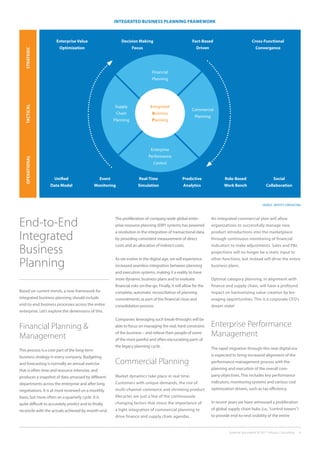
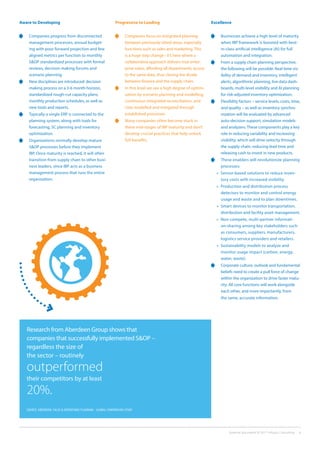
Based on current trends, a new framework for
integrated business planning should include
end-to-end business processes across the entire
enterprise. Let’s explore the dimensions of this.
Financial Planning 
Management
This process is a core part of the long-term
business strategy in every company. Budgeting
and forecasting is normally an annual exercise
that is often time and resource intensive, and
produces a snapshot of data amassed by different
departments across the enterprise and after long
negotiations. It is at most reviewed on a monthly
basis, but more often on a quarterly cycle. It is
quite difficult to accurately predict and to finally
reconcile with the actuals achieved by month-end.
The proliferation of company-wide global enter-
prise resource planning (ERP) systems has powered
a revolution in the integration of transactional data
by providing consistent measurement of direct
costs and an allocation of indirect costs.
As we evolve in the digital age, we will experience
increased seamless integration between planning
and execution systems, making it a reality to have
more dynamic business plans and to evaluate
financial risks on-the-go. Finally, it will allow for the
complete, automatic reconciliation of planning
commitments as part of the financial close and
consolidation process.
Companies leveraging such break-throughs will be
able to focus on managing the real, hard constrains
of the business – and relieve their people of some
of the most painful and often excruciating parts of
the legacy planning cycle.
Commercial Planning
Market dynamics take place in real time.
Customers with unique demands, the rise of
multi-channel commerce and shrinking product
lifecycles are just a few of the continuously
changing factors that stress the importance of
a tight integration of commercial planning to
drive finance and supply chain agendas.
An integrated commercial plan will allow
organizations to successfully manage new
product introductions into the marketplace
through continuous monitoring of financial
indicators to make adjustments. Sales and PL
projections will no longer be a static input to
other functions, but instead will drive the entire
business plans.
Optimal category planning, in alignment with
finance and supply chain, will have a profound
impact on harmonizing value creation by lev-
eraging opportunities. This is a corporate CFO’s
dream state!
Enterprise Performance
Management
The rapid migration through this new digital era
is expected to bring increased alignment of the
performance management process with the
planning and execution of the overall com-
pany objectives. This includes key performance
indicators, monitoring systems and various cost
optimization drivers, such as tax efficiency.
In recent years we have witnessed a proliferation
of global supply chain hubs (i.e.,“control towers”)
to provide end-to-end visibility of the entire
INTEGRATED BUSINESS PLANNING FRAMEWORK
Enterprise Value
Optimization
Decision Making
Focus
Fact-Based
Driven
Cross-Functional
Convergence
Unified
Data Model
Event
Monitoring
Real-Time
Simulation
Predictive
Analytics
Role-Based
Work Bench
Social
Collaboration
OPERATIONALTACTICALSTRATEGIC
Financial
Planning
Supply
Chain
Planning
Commercial
Planning
Enterprise
Performance
Control
Integrated
Business
Planning
SOURCE: INFOSYS CONSULTING
External document © 2017 Infosys Consulting 4
supply chain, its constraints, and various cost and
optimization drivers. These are mainly managed
by monitoring dashboards which trigger alerts to
key decision makers.
These control towers will extend beyond supply
chain monitoring to include commercial and
financial areas to use more integrated cloud-based,
real-time data that can be shared across all relevant
legal entities and external partners of an enter-
prise. Also, with the arrival of big data, robotic
process automation and artificial intelligence
will turbo-charge the levels of efficiency that a
business can operate.
Supply Chain Planning
The creation of supply chain plans – balancing
demand and supply, the optimization of inven-
tory levels, efficiency of 3rd party suppliers and
the achievement of service fulfillment – has been
External document © 2017 Infosys Consulting 5
a challenge that companies have dealt with for
ages. The creation of long-term demand with a
monthly rolling forecast update, medium-term
plans for supply and the short freeze planning
window are all common practices for companies
with a good maturity level for this process.
However, this new age is ushering in one that
allows for increased demand forecasting using
the power of big data for real-time information
exchange. This will be powered by artificial intel-
ligence through heuristic models, true seamless
inter-departmental collaboration models, faster
response processes and dynamic optimization of
value realization models.
This will create opportunities for increased inven-
tory control and optimization by incorporating
sensor-based solutions, which will generate a
faster supply of goods in and out of the market.
Firms that can serve the consumer first, through
mass customized, near-real-time delivery, will
emerge as leaders of the pack.
Integrated
Business
Planning
Maturity Model
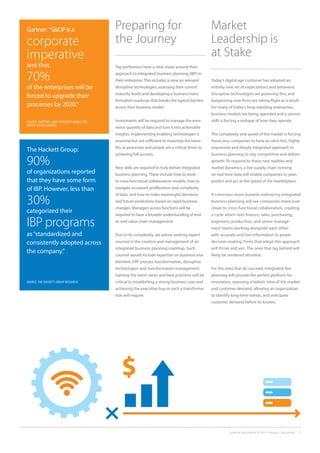
With the rapidly changing technology landscape,
only a select few best-in-class organizations have
been able to fully take advantage of the latest
capabilities outlined previously. Based on our
experience through a number of advisory
engagements, it’s our view that most organi-
zations today rarely achieve a level of maturity
higher than a robust sales and operations plan-
ning (SOP) model, with some level of integration
to the financial results, when it comes to their
business planning processes. Let’s explore the
various dimensions of maturity in more detail…
PEOPLE
PROCESS
TECHNOLOGY
1. Aware 2. Developing 3. Progressive 4. Leading 5. Excellence
Limited collaboration
supply chain silo
Monthly executive
SOP focus on past
performance  0-3
months ahead
Various data
sources  excels
Established processes
and scenario planning
to drive efficient
supply  demand
balancing
Single data source  ERP
connected to planning
systems
Real-time what-if
scenarious
and complex
modelling
IBP 
advanced analytics
Faster planning
cycles for
SC agility
Cloud based
IBP, customer
collaboration
platform 
integration with
external data
Demand sensing,
intelligent alerts
and algorithmic
planning
Artificial
intelligent
planning,
automation 
integration
Sensors based
and data driven
IBP  EPM with
automatic
reconciliation
Sustainability
models and
process
detectors
Well established SC
collaboration
People, organization and KPIs aligned to drive company results
IBP process excellence
Successful implementation of latest technology/innovation
Extended orchestration
with 3rd parties and
shared KPI’s
SC, Finance, Sales,
Mkt  business
leaders
Advanced hybrid
machine / people
collaboration
MATURITY MODEL DIMENSIONSSOURCE: INFOSYS CONSULTING
Aware to Developing
	Companies progress from disconnected
management processes, annual budget-
ing with poor forward projection and few
aligned metrics per function to monthly
SOP standardized processes with formal
reviews, decision making forums and
scenario planning.
	 New disciplines are introduced: decision
making process on a 3-6 month horizon,
standardized rough-cut capacity plans,
monthly production schedules, as well as
new tools and reports.
	Typically a single ERP is connected to the
planning system, along with tools for
forecasting, SC planning and inventory
optimization.
	 Organizations normally develop mature
SOP processes before they implement
IBP. Once maturity is reached, it will often
transition from supply chain to other busi-
ness leaders, since IBP acts as a business
management process that runs the entire
organization.
Progressive to Leading
	Companies focus on integrated planning
between previously siloed areas, especially
functions such as sales and marketing. This
is a huge step change - it’s here where a
collaborative approach delivers true enter-
prise value, affording all departments’access
to the same data, thus closing the divide
between finance and the supply chain.
	In this level we see a high degree of optimi-
zation by scenario planning and modelling,
continuous integrated reconciliation, and
risks modelled and mitigated through
established processes.
	 Many companies often become stuck in
these mid-stages of IBP maturity and don’t
develop crucial practices that help unlock
full benefits.
Excellence
	Businesses achieve a high level of maturity
when IBP framework is boosted with best-
in-class artificial intelligence (AI) for full
automation and integration.
	From a supply chain planning perspective,
the following will be possible: Real-time vis-
ibility of demand and inventory, intelligent
alerts, algorithmic planning, live data dash-
boards, multi-level visibility and AI planning
for risk-adjusted inventory optimization.
	Flexibility factors – service levels, costs, time,
and quality – as well as inventory synchro-
nization will be evaluated by advanced
auto-decision support, simulation models
and analyzers. These components play a key
role in reducing variability and increasing
visibility, which will drive velocity through
the supply chain, reducing lead time and
releasing cash to invest in new products.
	These enablers will revolutionize planning
processes:
»	 Sensor-based solutions to reduce inven-
tory costs with increased visibility.
»	 Production and distribution process
detectors to monitor and control energy
usage and waste and to plan downtimes.
»	 Smart devices to monitor transportation,
distribution and facility asset management.
»	 Non-compete, multi-partner informati-
on-sharing among key stakeholders such
as consumers, suppliers, manufacturers,
logistics service providers and retailers.
»	 Sustainability models to analyze and
monitor usage impact (carbon, energy,
water, waste).
	Corporate culture, outlook and fundamental
beliefs need to create a pull force of change
within the organization to drive faster matu-
rity. All core functions will work alongside
each other, and more importantly, from
the same, accurate information.
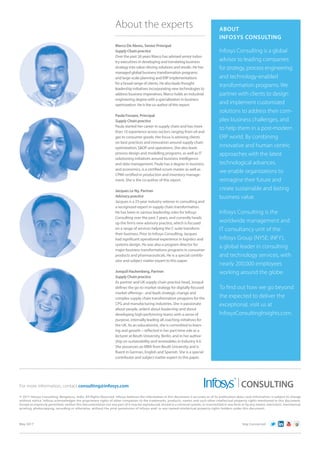
Research from Aberdeen Group shows that
companies that successfully implemented SOP –
regardless the size of
the sector – routinely
outperformed
their competitors by at least
20%.
SOURCE: ABERDEEN: SALES  OPERATIONS PLANNING - GLOBAL COMPARISON STUDY
External document © 2017 Infosys Consulting 6
External document © 2017 Infosys Consulting 7
Gartner: “SOP is a
corporate
imperative
and that
70%
of the enterprises will be
forced to upgrade their
processes by 2020.”
The Hackett Group:
90%
of organizations reported
that they have some form
of IBP. However, less than
30%
categorized their
IBP programs
as“standardized and
consistently adopted across
the company.”
Preparing for
the Journey
Top performers have a clear vision around their
approach to integrated business planning (IBP) in
their enterprise. This includes a view on relevant
disruptive technologies, assessing their current
maturity levels and developing a business trans-
formation roadmap that breaks the typical barriers
across their business model.
Investments will be required to manage the enor-
mous quantity of data and turn it into actionable
insights. Implementing enabling technologies is
essential but not sufficient to maximize the bene-
fits, as processes and people are a critical driver to
achieving full success.
New skills are required to truly deliver integrated
business planning. These include how to work
in cross-functional collaboration models, how to
navigate increased proliferation and complexity
of data, and how to make meaningful decisions
and future predictions based on rapid business
changes. Managers across functions will be
required to have a broader understanding of end-
to-end value chain management.
Due to its complexity, we advise seeking expert
counsel in the creation and management of an
integrated business planning roadmap. Such
counsel would include expertise on business ena-
blement, ERP process transformation, disruptive
technologies and transformation management.
Gaining the latest views and best practices will be
critical to establishing a strong business case and
achieving the executive buy-in such a transforma-
tion will require.
Market
Leadership is
at Stake
Today’s digital age customer has adopted an
entirely new set of expectations and behaviors.
Disruptive technologies are powering this, and
burgeoning new firms are taking flight as a result.
For many of today’s long-standing enterprises,
business models are being upended and a seismic
shift is forcing a reshape of how they operate.
The complexity and speed of the market is forcing
these very companies to have an ultra-fast, highly
responsive and deeply integrated approach to
business planning to stay competitive and deliver
growth. To respond to these new realities and
market dynamics, a live supply chain running
on real-time data will enable companies to plan,
predict and act at the speed of the marketplace.
A conscious move towards embracing integrated
business planning will see companies move ever
closer to cross-functional collaboration, creating
a cycle which sees finance, sales, purchasing,
engineers, production, and senior manage-
ment teams working alongside each other
with accurate and live information to power
decision-making. Firms that adopt this approach
will thrive and win. The ones that lag behind will
likely be rendered obsolete.
For the ones that do succeed, integrated, live
planning will provide the perfect platform for
innovation, exposing a holistic view of the market
and customer demand, allowing an organization
to identify long-term trends, and anticipate
customer demand before its known.
SOURCE: GARTNER: SOP MATURITY MODEL FOR
SUPPLY CHAIN LEADERS
SOURCE: THE HACKETT GROUP RESEARCH
ABOUT
INFOSYS CONSULTING
Infosys Consulting is a global
advisor to leading companies
for strategy, process engineering
and technology-enabled
transformation programs. We
partner with clients to design
and implement customized
solutions to address their com-
plex business challenges, and
to help them in a post-modern
ERP world. By combining
innovative and human centric
approaches with the latest
technological advances,
we enable organizations to
reimagine their future and
create sustainable and lasting
business value.
Infosys Consulting is the
worldwide management and
IT consultancy unit of the
Infosys Group (NYSE: INFY),
a global leader in consulting
and technology services, with
nearly 200,000 employees
working around the globe.
To find out how we go beyond
the expected to deliver the
exceptional, visit us at
InfosysConsultingInsights.com.
About the experts
Marco De Abreu, Senior Principal
Supply Chain practice
Over the past 26 years Marco has advised senior indus-
try executives in developing and translating business
strategy into value-driving solutions and results. He has
managed global business transformation programs
and large-scale planning and ERP implementations
for a broad range of clients. He also leads thought
leadership initiatives incorporating new technologies to
address business imperatives. Marco holds an industrial
engineering degree with a specialization in business
optimization. He is the co-author of this report.
Paula Forzani, Principal
Supply Chain practice
Paula started her career in supply chain and has more
than 10 experience across sectors ranging from oil and
gas to consumer goods. Her focus is advising clients
on best practices and innovation around supply chain
optimization, SOP and operations. She also leads
process design and modelling programs, as well as IT
solutioning initiatives around business intelligence
and data management. Paula has a degree in business
and economics, is a certified scrum master as well as
CPIM certified in production and inventory manage-
ment. She is the co-author of this report.
Jacques Le Ny, Partner
Advisory practice
Jacques is a 25-year industry veteran in consulting and
a recognized expert in supply chain transformation.
He has been in various leadership roles for Infosys
Consulting over the past 7 years, and currently heads
up the firm’s new advisory practice, which is focused
on a range of services helping the C-suite transform
their business. Prior to Infosys Consulting, Jacques
had significant operational experience in logistics and
systems design. He was also a program director for
major business transformations programs in consumer
products and pharmaceuticals. He is a special contrib-
utor and subject matter expert to this paper.
Jonquil Hackenberg, Partner
Supply Chain practice
As partner and UK supply chain practice head, Jonquil
defines the go-to-market strategy for digitally-focused
market offerings - and leads strategic change and
complex supply chain transformation programs for the
CPG and manufacturing industries. She is passionate
about people, ardent about leadership and about
developing high-performing teams with a sense of
purpose, internally leading all coaching initiatives for
the UK. As an educationist, she is committed to learn-
ing and growth – reflected in her part-time role as a
lecturer at Beuth University, Berlin, and in her author-
ship on sustainability and renewables in Industry 4.0.
She possesses an MBA from Beuth University and is
fluent in German, English and Spanish. She is a special
contributor and subject matter expert to this paper.
May 2017 Stay Connected
© 2017 Infosys Consulting, Bengaluru, India. All Rights Reserved. Infosys believes the information in this document is accurate as of its publication date; such information is subject to change
without notice. Infosys acknowledges the proprietary rights of other companies to the trademarks, products, names and such other intellectual property rights mentioned in this document.
Except as expressly permitted, neither this documentation nor any part of it may be reproduced, stored in a retrieval system, or transmitted in any form or by any means, electronic, mechanical,
printing, photocopying, recording or otherwise, without the prior permission of Infosys and/ or any named intellectual property rights holders under this document.
For more information, contact consulting@infosys.com CONSULTING

Business planning in digital age

  • 1.
    CONSULTING Business Planning in the Digital Age Howa highly integrated and real-time approach will elevate a select few firms to future market dominance.
  • 2.
    External document ©2017 Infosys Consulting 2 As we advance into a new age of disruptive digital technologies, the rules and ways-of- working that we have been so accustomed to are being quickly re-written, thus drastically changing the business models of some of today’s most established companies. The seamless connectivity between data and objects through the Internet of Things has reached the mainstream consumer (i.e., the smart home). Automation and artificial intelligence are helping to streamline organizational planning processes and analyze data on unimagined levels. Industry 4.0 is redefining discrete manufacturing as a new, intelligent and sustainable way of production. And, new models of interaction and collaboration between resources and assets are being created (i.e., “Uberization”). One of the key challenges executives face head-on is how to harness these now main stream industry disruptions and convert them into business opportunities – and ultimately drive competitive advantage for their firms. One element will remain constant, however – the need to predict, plan and generate profit for the organization. The good news is that these technology breakthroughs will offer new and more powerful ways to enable the planning and realization of bottom-line results. This thought-piece will explore these concepts in more detail and offer a view into the different maturity levels an organization can achieve in their integrated planning processes. Evolution of Planning Capabilities in the Enterprise Corporate planning systems have evolved over time from basic, manual planning models and early spreadsheet-based systems, to increased levels of optimization such as manufacturing resource planning (MRP2). The common characteristic of this evolution up to now has been the elimination of barriers between planning data and transitional data, powered in large part by the shift to seamless technical integration in memory planning and cloud computing. In the near future we will see another transformational barrier being achieved: the convergence between physical world, real-time information and transactional/planning systems. This evolution will allow for even more rapid response to business changes, more complex and relevant planning models and further integration between sales, operations and finance to analyze and show the real value drivers for the business. This has profound meaning for the C-suite: For the CFO: This translates to increased predictability of the month-end results, achieving a complete reconciliation between the real financial actuals and the promises made via the business planning and performance management process. For the COO: This allows for the complete focus of company resources that maximize key value drivers by dynamically adjusting company plans to constant feedback and response capabilities. For the CEO: It will produce a quantum leap in the company results and deliver greater value to its stakeholders. The current planning offering in today’s enter- prise is often referred to as“integrated business planning.” Many vendors and solutions exists to support this complex function, but most offer only scattered solutions based on the premise of long planning cycles to address the limited visibil- ity and slow information flow across commercial, supply chain and finance planning systems. We believe the future of business planning will go well beyond the current paradigm and will be expanded to more dynamic models as new technologies become real, implementable propositions for organizations. In our view, a best practice model for integrated business planning in the digital age should include end-to-end business processes across the entire supply chain, including finance and performance management.
  • 3.
    External document ©2017 Infosys Consulting 3 EVOLUTION OF PLANNING CAPABILITIES Volume Based Sales Operations Planning Production Planning 1970s Balancing Supply, Demand Inventory Control Mid 80s ERP enabled Integration Late 80s Constrains Based Planning Late 90s Supply Chain Collaboration Scenario Planning 2000s Integrated Business Planning 2015 Dynamic Value Based Enterprise Planning 2020 Continuous AI Integrated Business Planning 2025 FragmentationEvolvingIntegrationTotalIntegration PLANNING TECHNOLOGY TRANSACTIONAL DATATECHNOLOGY PHYSICAL /DIGITAL WORLD CONVERGENCE TECHNOLOGY ERP (Mainframe) SAP R1/R2 Microsoft Lotus Client Server ERP SAP R/3 Global ERP Implementations Open Object Client server / Middlewave Manufacturing Execution Systems Shop Floor Control Facebook Google Big Data Internet of Things Uberisation of Assets Self-Driven Vehicles 3D Printing Collaboration Microsoft SharePoint Integrated Batch Management Sustainability Platforms .com VisiCalc Lotus123 Early Manufacturing Resource Planning Models EDI MS Excel I2 Technologies Manugistics SAP APO SAP PLM SAP IBP SAP EPM SAP HANA Cloud Computing/ Real Time Data BlockChain Robotics Process AutomationDynamic VRM IBP Continuous IBP Enabled by AI SOURCE: INFOSYS CONSULTING
  • 4.
    End-to-End Integrated Business Planning Based on currenttrends, a new framework for integrated business planning should include end-to-end business processes across the entire enterprise. Let’s explore the dimensions of this. Financial Planning Management This process is a core part of the long-term business strategy in every company. Budgeting and forecasting is normally an annual exercise that is often time and resource intensive, and produces a snapshot of data amassed by different departments across the enterprise and after long negotiations. It is at most reviewed on a monthly basis, but more often on a quarterly cycle. It is quite difficult to accurately predict and to finally reconcile with the actuals achieved by month-end. The proliferation of company-wide global enter- prise resource planning (ERP) systems has powered a revolution in the integration of transactional data by providing consistent measurement of direct costs and an allocation of indirect costs. As we evolve in the digital age, we will experience increased seamless integration between planning and execution systems, making it a reality to have more dynamic business plans and to evaluate financial risks on-the-go. Finally, it will allow for the complete, automatic reconciliation of planning commitments as part of the financial close and consolidation process. Companies leveraging such break-throughs will be able to focus on managing the real, hard constrains of the business – and relieve their people of some of the most painful and often excruciating parts of the legacy planning cycle. Commercial Planning Market dynamics take place in real time. Customers with unique demands, the rise of multi-channel commerce and shrinking product lifecycles are just a few of the continuously changing factors that stress the importance of a tight integration of commercial planning to drive finance and supply chain agendas. An integrated commercial plan will allow organizations to successfully manage new product introductions into the marketplace through continuous monitoring of financial indicators to make adjustments. Sales and PL projections will no longer be a static input to other functions, but instead will drive the entire business plans. Optimal category planning, in alignment with finance and supply chain, will have a profound impact on harmonizing value creation by lev- eraging opportunities. This is a corporate CFO’s dream state! Enterprise Performance Management The rapid migration through this new digital era is expected to bring increased alignment of the performance management process with the planning and execution of the overall com- pany objectives. This includes key performance indicators, monitoring systems and various cost optimization drivers, such as tax efficiency. In recent years we have witnessed a proliferation of global supply chain hubs (i.e.,“control towers”) to provide end-to-end visibility of the entire INTEGRATED BUSINESS PLANNING FRAMEWORK Enterprise Value Optimization Decision Making Focus Fact-Based Driven Cross-Functional Convergence Unified Data Model Event Monitoring Real-Time Simulation Predictive Analytics Role-Based Work Bench Social Collaboration OPERATIONALTACTICALSTRATEGIC Financial Planning Supply Chain Planning Commercial Planning Enterprise Performance Control Integrated Business Planning SOURCE: INFOSYS CONSULTING External document © 2017 Infosys Consulting 4
  • 5.
    supply chain, itsconstraints, and various cost and optimization drivers. These are mainly managed by monitoring dashboards which trigger alerts to key decision makers. These control towers will extend beyond supply chain monitoring to include commercial and financial areas to use more integrated cloud-based, real-time data that can be shared across all relevant legal entities and external partners of an enter- prise. Also, with the arrival of big data, robotic process automation and artificial intelligence will turbo-charge the levels of efficiency that a business can operate. Supply Chain Planning The creation of supply chain plans – balancing demand and supply, the optimization of inven- tory levels, efficiency of 3rd party suppliers and the achievement of service fulfillment – has been External document © 2017 Infosys Consulting 5 a challenge that companies have dealt with for ages. The creation of long-term demand with a monthly rolling forecast update, medium-term plans for supply and the short freeze planning window are all common practices for companies with a good maturity level for this process. However, this new age is ushering in one that allows for increased demand forecasting using the power of big data for real-time information exchange. This will be powered by artificial intel- ligence through heuristic models, true seamless inter-departmental collaboration models, faster response processes and dynamic optimization of value realization models. This will create opportunities for increased inven- tory control and optimization by incorporating sensor-based solutions, which will generate a faster supply of goods in and out of the market. Firms that can serve the consumer first, through mass customized, near-real-time delivery, will emerge as leaders of the pack. Integrated Business Planning Maturity Model With the rapidly changing technology landscape, only a select few best-in-class organizations have been able to fully take advantage of the latest capabilities outlined previously. Based on our experience through a number of advisory engagements, it’s our view that most organi- zations today rarely achieve a level of maturity higher than a robust sales and operations plan- ning (SOP) model, with some level of integration to the financial results, when it comes to their business planning processes. Let’s explore the various dimensions of maturity in more detail… PEOPLE PROCESS TECHNOLOGY 1. Aware 2. Developing 3. Progressive 4. Leading 5. Excellence Limited collaboration supply chain silo Monthly executive SOP focus on past performance 0-3 months ahead Various data sources excels Established processes and scenario planning to drive efficient supply demand balancing Single data source ERP connected to planning systems Real-time what-if scenarious and complex modelling IBP advanced analytics Faster planning cycles for SC agility Cloud based IBP, customer collaboration platform integration with external data Demand sensing, intelligent alerts and algorithmic planning Artificial intelligent planning, automation integration Sensors based and data driven IBP EPM with automatic reconciliation Sustainability models and process detectors Well established SC collaboration People, organization and KPIs aligned to drive company results IBP process excellence Successful implementation of latest technology/innovation Extended orchestration with 3rd parties and shared KPI’s SC, Finance, Sales, Mkt business leaders Advanced hybrid machine / people collaboration MATURITY MODEL DIMENSIONSSOURCE: INFOSYS CONSULTING
  • 6.
    Aware to Developing Companiesprogress from disconnected management processes, annual budget- ing with poor forward projection and few aligned metrics per function to monthly SOP standardized processes with formal reviews, decision making forums and scenario planning. New disciplines are introduced: decision making process on a 3-6 month horizon, standardized rough-cut capacity plans, monthly production schedules, as well as new tools and reports. Typically a single ERP is connected to the planning system, along with tools for forecasting, SC planning and inventory optimization. Organizations normally develop mature SOP processes before they implement IBP. Once maturity is reached, it will often transition from supply chain to other busi- ness leaders, since IBP acts as a business management process that runs the entire organization. Progressive to Leading Companies focus on integrated planning between previously siloed areas, especially functions such as sales and marketing. This is a huge step change - it’s here where a collaborative approach delivers true enter- prise value, affording all departments’access to the same data, thus closing the divide between finance and the supply chain. In this level we see a high degree of optimi- zation by scenario planning and modelling, continuous integrated reconciliation, and risks modelled and mitigated through established processes. Many companies often become stuck in these mid-stages of IBP maturity and don’t develop crucial practices that help unlock full benefits. Excellence Businesses achieve a high level of maturity when IBP framework is boosted with best- in-class artificial intelligence (AI) for full automation and integration. From a supply chain planning perspective, the following will be possible: Real-time vis- ibility of demand and inventory, intelligent alerts, algorithmic planning, live data dash- boards, multi-level visibility and AI planning for risk-adjusted inventory optimization. Flexibility factors – service levels, costs, time, and quality – as well as inventory synchro- nization will be evaluated by advanced auto-decision support, simulation models and analyzers. These components play a key role in reducing variability and increasing visibility, which will drive velocity through the supply chain, reducing lead time and releasing cash to invest in new products. These enablers will revolutionize planning processes: » Sensor-based solutions to reduce inven- tory costs with increased visibility. » Production and distribution process detectors to monitor and control energy usage and waste and to plan downtimes. » Smart devices to monitor transportation, distribution and facility asset management. » Non-compete, multi-partner informati- on-sharing among key stakeholders such as consumers, suppliers, manufacturers, logistics service providers and retailers. » Sustainability models to analyze and monitor usage impact (carbon, energy, water, waste). Corporate culture, outlook and fundamental beliefs need to create a pull force of change within the organization to drive faster matu- rity. All core functions will work alongside each other, and more importantly, from the same, accurate information. Research from Aberdeen Group shows that companies that successfully implemented SOP – regardless the size of the sector – routinely outperformed their competitors by at least 20%. SOURCE: ABERDEEN: SALES OPERATIONS PLANNING - GLOBAL COMPARISON STUDY External document © 2017 Infosys Consulting 6
  • 7.
    External document ©2017 Infosys Consulting 7 Gartner: “SOP is a corporate imperative and that 70% of the enterprises will be forced to upgrade their processes by 2020.” The Hackett Group: 90% of organizations reported that they have some form of IBP. However, less than 30% categorized their IBP programs as“standardized and consistently adopted across the company.” Preparing for the Journey Top performers have a clear vision around their approach to integrated business planning (IBP) in their enterprise. This includes a view on relevant disruptive technologies, assessing their current maturity levels and developing a business trans- formation roadmap that breaks the typical barriers across their business model. Investments will be required to manage the enor- mous quantity of data and turn it into actionable insights. Implementing enabling technologies is essential but not sufficient to maximize the bene- fits, as processes and people are a critical driver to achieving full success. New skills are required to truly deliver integrated business planning. These include how to work in cross-functional collaboration models, how to navigate increased proliferation and complexity of data, and how to make meaningful decisions and future predictions based on rapid business changes. Managers across functions will be required to have a broader understanding of end- to-end value chain management. Due to its complexity, we advise seeking expert counsel in the creation and management of an integrated business planning roadmap. Such counsel would include expertise on business ena- blement, ERP process transformation, disruptive technologies and transformation management. Gaining the latest views and best practices will be critical to establishing a strong business case and achieving the executive buy-in such a transforma- tion will require. Market Leadership is at Stake Today’s digital age customer has adopted an entirely new set of expectations and behaviors. Disruptive technologies are powering this, and burgeoning new firms are taking flight as a result. For many of today’s long-standing enterprises, business models are being upended and a seismic shift is forcing a reshape of how they operate. The complexity and speed of the market is forcing these very companies to have an ultra-fast, highly responsive and deeply integrated approach to business planning to stay competitive and deliver growth. To respond to these new realities and market dynamics, a live supply chain running on real-time data will enable companies to plan, predict and act at the speed of the marketplace. A conscious move towards embracing integrated business planning will see companies move ever closer to cross-functional collaboration, creating a cycle which sees finance, sales, purchasing, engineers, production, and senior manage- ment teams working alongside each other with accurate and live information to power decision-making. Firms that adopt this approach will thrive and win. The ones that lag behind will likely be rendered obsolete. For the ones that do succeed, integrated, live planning will provide the perfect platform for innovation, exposing a holistic view of the market and customer demand, allowing an organization to identify long-term trends, and anticipate customer demand before its known. SOURCE: GARTNER: SOP MATURITY MODEL FOR SUPPLY CHAIN LEADERS SOURCE: THE HACKETT GROUP RESEARCH
  • 8.
    ABOUT INFOSYS CONSULTING Infosys Consultingis a global advisor to leading companies for strategy, process engineering and technology-enabled transformation programs. We partner with clients to design and implement customized solutions to address their com- plex business challenges, and to help them in a post-modern ERP world. By combining innovative and human centric approaches with the latest technological advances, we enable organizations to reimagine their future and create sustainable and lasting business value. Infosys Consulting is the worldwide management and IT consultancy unit of the Infosys Group (NYSE: INFY), a global leader in consulting and technology services, with nearly 200,000 employees working around the globe. To find out how we go beyond the expected to deliver the exceptional, visit us at InfosysConsultingInsights.com. About the experts Marco De Abreu, Senior Principal Supply Chain practice Over the past 26 years Marco has advised senior indus- try executives in developing and translating business strategy into value-driving solutions and results. He has managed global business transformation programs and large-scale planning and ERP implementations for a broad range of clients. He also leads thought leadership initiatives incorporating new technologies to address business imperatives. Marco holds an industrial engineering degree with a specialization in business optimization. He is the co-author of this report. Paula Forzani, Principal Supply Chain practice Paula started her career in supply chain and has more than 10 experience across sectors ranging from oil and gas to consumer goods. Her focus is advising clients on best practices and innovation around supply chain optimization, SOP and operations. She also leads process design and modelling programs, as well as IT solutioning initiatives around business intelligence and data management. Paula has a degree in business and economics, is a certified scrum master as well as CPIM certified in production and inventory manage- ment. She is the co-author of this report. Jacques Le Ny, Partner Advisory practice Jacques is a 25-year industry veteran in consulting and a recognized expert in supply chain transformation. He has been in various leadership roles for Infosys Consulting over the past 7 years, and currently heads up the firm’s new advisory practice, which is focused on a range of services helping the C-suite transform their business. Prior to Infosys Consulting, Jacques had significant operational experience in logistics and systems design. He was also a program director for major business transformations programs in consumer products and pharmaceuticals. He is a special contrib- utor and subject matter expert to this paper. Jonquil Hackenberg, Partner Supply Chain practice As partner and UK supply chain practice head, Jonquil defines the go-to-market strategy for digitally-focused market offerings - and leads strategic change and complex supply chain transformation programs for the CPG and manufacturing industries. She is passionate about people, ardent about leadership and about developing high-performing teams with a sense of purpose, internally leading all coaching initiatives for the UK. As an educationist, she is committed to learn- ing and growth – reflected in her part-time role as a lecturer at Beuth University, Berlin, and in her author- ship on sustainability and renewables in Industry 4.0. She possesses an MBA from Beuth University and is fluent in German, English and Spanish. She is a special contributor and subject matter expert to this paper. May 2017 Stay Connected © 2017 Infosys Consulting, Bengaluru, India. All Rights Reserved. Infosys believes the information in this document is accurate as of its publication date; such information is subject to change without notice. Infosys acknowledges the proprietary rights of other companies to the trademarks, products, names and such other intellectual property rights mentioned in this document. Except as expressly permitted, neither this documentation nor any part of it may be reproduced, stored in a retrieval system, or transmitted in any form or by any means, electronic, mechanical, printing, photocopying, recording or otherwise, without the prior permission of Infosys and/ or any named intellectual property rights holders under this document. For more information, contact consulting@infosys.com CONSULTING