Stefan Haefliger

haefliger@city.ac.uk
City Unrulyversity, June 1, 2016
www.cass.city.ac.uk
Business Models, Open Collaboration,
and Open Source Software Development
www.cass.city.ac.uk
Agenda
• Business models and FLOSS
• The big question of motivation
• Open collaboration
• We are the innovation
• Q&A
www.cass.city.ac.uk
www.cass.city.ac.uk
Hi, I’m Stefan
• Currently prof in strategic management and innovation at Cass
• Since 2001 research in Free and Open Source software
development: Free Java, FOSDEM, interviewed dozens of hackers
across Europe
• Studied code reuse in FLOSS, community dynamics and
motivation, and now open collaboration
• With strategy colleagues at CASS: F1 research and business model
typology: the businessmodelzoo.com
• Swiss originally, worked in the US, Japan, Italy, Belgium
• Passionate about meditation, art, and creativity
www.cass.city.ac.uk
Models of Business
• What is a business and its purpose?
• What does strategy tell us about open source?
• What is a business model?
• The model of the customer interface in the mind
of the designer of the business
• Implementations may work out, - or fail!
www.cass.city.ac.uk
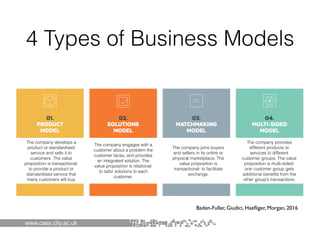
4 Types of Business Models
Baden-Fuller, Giudici, Haefliger, Morgan, 2016
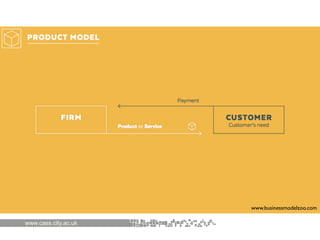
The company develops a
product or standardised
service and sells it to
customers. The value
proposition is transactional:
to provide a product or
standardised service that
many customers will buy.
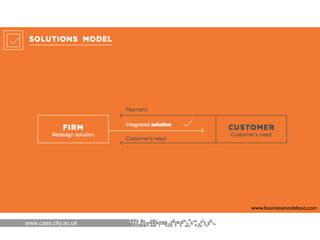
The company engages with a
customer about a problem the
customer faces, and provides
an integrated solution. The
value proposition is relational:
to tailor solutions to each
customer.
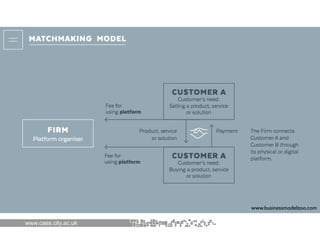
The company joins buyers
and sellers in its online or
physical marketplace. The
value proposition is
transactional: to facilitate
exchange.
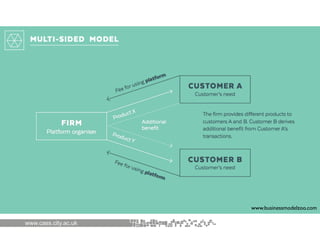
The company provides
different products or
services to different
customer groups. The value
proposition is multi-sided:
one customer group gets
additional benefits from the
other group’s transactions.
www.cass.city.ac.uk
www.businessmodelzoo.com
www.cass.city.ac.uk
www.businessmodelzoo.com
www.cass.city.ac.uk
www.businessmodelzoo.com
www.cass.city.ac.uk
www.businessmodelzoo.com
www.cass.city.ac.uk
OSS and Business Models
• Selling work for hire: your talent to TechCity firms
• Sell solutions: RedHat, Acquia, etc.
• Build a market: match talent and tech firms (pilot.co
and others)
• Build a multisided platform business model:
connect but keep separate (Ad-supported or data
sales on social networks, often one side free!)
www.cass.city.ac.uk
Technology ≠ Business
• “Platforms” are known in technology, economics,
and business.
• A platform technology is not the same as a platform
business model! Consider e-commerce over the
Internet and advertisement-enabled online search
(Google)
• Technology is all three: a product and an enabler
and an input to business!
www.cass.city.ac.uk
What is special with OSS?
• Innovation by user developers gives the world
great software and enables new business
• User entrepreneurs set up shop with what they’ve
developed
• Developers help each other and contribute to
business problems
• “We are the product” also means: 

“We are the innovation!”
www.cass.city.ac.uk
Two Questions for the 

OSS-enabled Business Model
• Why?
• Lerner and Tirole in 2001: “Why do highly skilled programmers
give a way software for free?”
• Stallman, the GNU and so forth only half the story
• Why is FLOSS sustainable and (often) resulting in high quality
and for the benefit of business?
• How?
• Who solves whose problems in OSSD today?
• What are the patterns of open collaboration?
www.cass.city.ac.uk
Open source
software development
• Two central questions remained unanswered after
reading most or all that’s been written about
developers’ motivations:
• why do they keep developing over long periods
of time (often after solving their own problems)?
• why do they produce high quality if they do?
• Why?
von Krogh, Haefliger,Wallin, Spaeth 2012
www.cass.city.ac.uk
Motivation by reward
• Self-determination theory, since the 80ies, explains
the different reasons that bring about human action
• note that what is to be explained is action rather
than inaction!
• Extrinsic motivation if action is performed to obtain
a separable outcome
• Intrinsic motivation if joy or interest inherent in the
action
www.cass.city.ac.uk
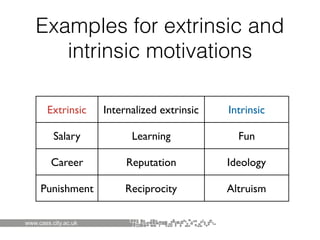
Examples for extrinsic and
intrinsic motivations
Extrinsic Internalized extrinsic Intrinsic
Salary Learning Fun
Career Reputation Ideology
Punishment Reciprocity Altruism
www.cass.city.ac.uk
Motivation
• What is missing?
www.cass.city.ac.uk
A broader look at motivation
• Long-term goals that may be in vain
• Making sense of one’s life (narrative, character, learning)
• Doing the right thing
• Understanding quality
• standards of excellence as shared in a community
• community as defined by a social practice
www.cass.city.ac.uk
What is a social practice?
• Shared type of work: think care givers, architects,
managers, software engineers, bankers etc.
• Social practice defined as “a coherent and
complex form of socially established cooperative
human activity ... trying to achieve and extend the
standards of excellence appropriate to and
definitive of the activity” (after MacIntyre, 1981)
www.cass.city.ac.uk
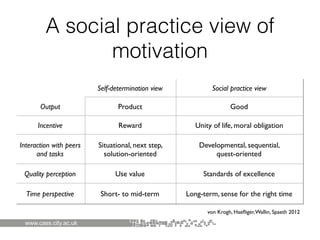
A social practice view of
motivation
Self-determination view Social practice view
Output Product Good
Incentive Reward Unity of life, moral obligation
Interaction with peers
and tasks
Situational, next step, 

solution-oriented
Developmental, sequential, 

quest-oriented
Quality perception Use value Standards of excellence
Time perspective Short- to mid-term Long-term, sense for the right time
von Krogh, Haefliger,Wallin, Spaeth 2012
www.cass.city.ac.uk
Open Collaboration
• Private-collective innovation involves individual
users, firm users, and firm producers
• Problems revealed are incremental or path-creating
• What is the inner working mechanism of open
collaboration? Who solves whose problems?
• How?
www.cass.city.ac.uk
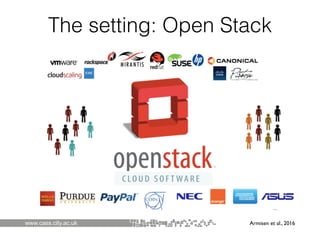
The setting: Open Stack
Armisen et al., 2016
www.cass.city.ac.uk
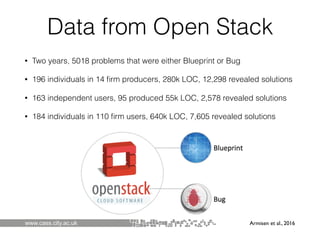
Data from Open Stack
• Two years, 5018 problems that were either Blueprint or Bug
• 196 individuals in 14 firm producers, 280k LOC, 12,298 revealed solutions
• 163 independent users, 95 produced 55k LOC, 2,578 revealed solutions
• 184 individuals in 110 firm users, 640k LOC, 7,605 revealed solutions
Armisen et al., 2016
www.cass.city.ac.uk
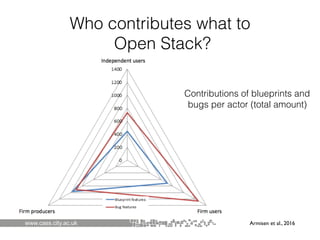
Who contributes what to

Open Stack?
Contributions of blueprints and
bugs per actor (total amount)
Armisen et al., 2016
www.cass.city.ac.uk
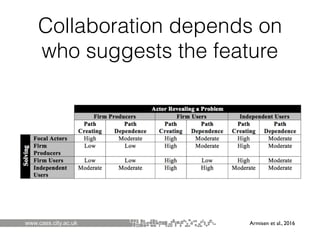
Collaboration depends on
who suggests the feature
Armisen et al., 2016
www.cass.city.ac.uk
Business Models and

Open Collaboration
• If “we are the innovation” then triadic business
models that engage in open collaboration need to
understand the social practice behind innovation
• Because interaction is developmental, long-term
• Because consumers are also suppliers
• Because learning is an explicit part of the customer
engagement and runs both ways
www.cass.city.ac.uk
Comments

Questions

Critique
Answers
Puzzles
Data
?
PDF with today’s slides:

Business Models, Open Collaboration, and Open Source Software Development

  • 1.
    Stefan Haefliger
 haefliger@city.ac.uk City Unrulyversity,June 1, 2016 www.cass.city.ac.uk Business Models, Open Collaboration, and Open Source Software Development
  • 2.
    www.cass.city.ac.uk Agenda • Business modelsand FLOSS • The big question of motivation • Open collaboration • We are the innovation • Q&A www.cass.city.ac.uk
  • 3.
    www.cass.city.ac.uk Hi, I’m Stefan •Currently prof in strategic management and innovation at Cass • Since 2001 research in Free and Open Source software development: Free Java, FOSDEM, interviewed dozens of hackers across Europe • Studied code reuse in FLOSS, community dynamics and motivation, and now open collaboration • With strategy colleagues at CASS: F1 research and business model typology: the businessmodelzoo.com • Swiss originally, worked in the US, Japan, Italy, Belgium • Passionate about meditation, art, and creativity
  • 4.
    www.cass.city.ac.uk Models of Business •What is a business and its purpose? • What does strategy tell us about open source? • What is a business model? • The model of the customer interface in the mind of the designer of the business • Implementations may work out, - or fail!
  • 5.
    www.cass.city.ac.uk 4 Types ofBusiness Models Baden-Fuller, Giudici, Haefliger, Morgan, 2016 The company develops a product or standardised service and sells it to customers. The value proposition is transactional: to provide a product or standardised service that many customers will buy. The company engages with a customer about a problem the customer faces, and provides an integrated solution. The value proposition is relational: to tailor solutions to each customer. The company joins buyers and sellers in its online or physical marketplace. The value proposition is transactional: to facilitate exchange. The company provides different products or services to different customer groups. The value proposition is multi-sided: one customer group gets additional benefits from the other group’s transactions.
  • 6.
  • 7.
  • 8.
  • 9.
  • 10.
    www.cass.city.ac.uk OSS and BusinessModels • Selling work for hire: your talent to TechCity firms • Sell solutions: RedHat, Acquia, etc. • Build a market: match talent and tech firms (pilot.co and others) • Build a multisided platform business model: connect but keep separate (Ad-supported or data sales on social networks, often one side free!)
  • 11.
    www.cass.city.ac.uk Technology ≠ Business •“Platforms” are known in technology, economics, and business. • A platform technology is not the same as a platform business model! Consider e-commerce over the Internet and advertisement-enabled online search (Google) • Technology is all three: a product and an enabler and an input to business!
  • 12.
    www.cass.city.ac.uk What is specialwith OSS? • Innovation by user developers gives the world great software and enables new business • User entrepreneurs set up shop with what they’ve developed • Developers help each other and contribute to business problems • “We are the product” also means: 
 “We are the innovation!”
  • 13.
    www.cass.city.ac.uk Two Questions forthe 
 OSS-enabled Business Model • Why? • Lerner and Tirole in 2001: “Why do highly skilled programmers give a way software for free?” • Stallman, the GNU and so forth only half the story • Why is FLOSS sustainable and (often) resulting in high quality and for the benefit of business? • How? • Who solves whose problems in OSSD today? • What are the patterns of open collaboration?
  • 14.
    www.cass.city.ac.uk Open source software development •Two central questions remained unanswered after reading most or all that’s been written about developers’ motivations: • why do they keep developing over long periods of time (often after solving their own problems)? • why do they produce high quality if they do? • Why? von Krogh, Haefliger,Wallin, Spaeth 2012
  • 15.
    www.cass.city.ac.uk Motivation by reward •Self-determination theory, since the 80ies, explains the different reasons that bring about human action • note that what is to be explained is action rather than inaction! • Extrinsic motivation if action is performed to obtain a separable outcome • Intrinsic motivation if joy or interest inherent in the action
  • 16.
    www.cass.city.ac.uk Examples for extrinsicand intrinsic motivations Extrinsic Internalized extrinsic Intrinsic Salary Learning Fun Career Reputation Ideology Punishment Reciprocity Altruism
  • 17.
  • 18.
    www.cass.city.ac.uk A broader lookat motivation • Long-term goals that may be in vain • Making sense of one’s life (narrative, character, learning) • Doing the right thing • Understanding quality • standards of excellence as shared in a community • community as defined by a social practice
  • 19.
    www.cass.city.ac.uk What is asocial practice? • Shared type of work: think care givers, architects, managers, software engineers, bankers etc. • Social practice defined as “a coherent and complex form of socially established cooperative human activity ... trying to achieve and extend the standards of excellence appropriate to and definitive of the activity” (after MacIntyre, 1981)
  • 20.
    www.cass.city.ac.uk A social practiceview of motivation Self-determination view Social practice view Output Product Good Incentive Reward Unity of life, moral obligation Interaction with peers and tasks Situational, next step, 
 solution-oriented Developmental, sequential, 
 quest-oriented Quality perception Use value Standards of excellence Time perspective Short- to mid-term Long-term, sense for the right time von Krogh, Haefliger,Wallin, Spaeth 2012
  • 21.
    www.cass.city.ac.uk Open Collaboration • Private-collectiveinnovation involves individual users, firm users, and firm producers • Problems revealed are incremental or path-creating • What is the inner working mechanism of open collaboration? Who solves whose problems? • How?
  • 22.
    www.cass.city.ac.uk The setting: OpenStack Armisen et al., 2016
  • 23.
    www.cass.city.ac.uk Data from OpenStack • Two years, 5018 problems that were either Blueprint or Bug • 196 individuals in 14 firm producers, 280k LOC, 12,298 revealed solutions • 163 independent users, 95 produced 55k LOC, 2,578 revealed solutions • 184 individuals in 110 firm users, 640k LOC, 7,605 revealed solutions Armisen et al., 2016
  • 24.
    www.cass.city.ac.uk Who contributes whatto
 Open Stack? Contributions of blueprints and bugs per actor (total amount) Armisen et al., 2016
  • 25.
    www.cass.city.ac.uk Collaboration depends on whosuggests the feature Armisen et al., 2016
  • 26.
    www.cass.city.ac.uk Business Models and
 OpenCollaboration • If “we are the innovation” then triadic business models that engage in open collaboration need to understand the social practice behind innovation • Because interaction is developmental, long-term • Because consumers are also suppliers • Because learning is an explicit part of the customer engagement and runs both ways
  • 27.