Business Function
Human Resources
By- Ms.Shivani Naik Devrukhkar, ASSISTANT
PROFESSOR, (MBA, MCOM, PGDHE, NET,
B.ED)
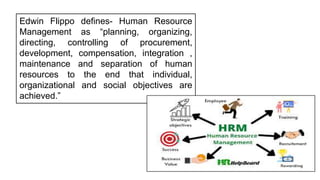
Edwin Flippo defines- Human Resource
Management as “planning, organizing,
directing, controlling of procurement,
development, compensation, integration ,
maintenance and separation of human
resources to the end that individual,
organizational and social objectives are
achieved.”
helps
management in
the preparation
adoption and
continuing
evolution of
personnel
programs and
policies
supplies
skilled
workers
through
scientific
selection
process
ensures
maximum
benefit out of
the
expenditure on
training
and
development
Works
towards
appreciation
of human
asset
prepares
workers
according to
the changing
needs of
industry and
environment
01 02 03 04 05
Importance of HRM for an organization
According to Peter F. Drucker, ―The proper or improper use of the different factors of production depend on
the wishes of the human resources. Hence, besides other resources human resources need more
development. Human resources can increase cooperation but it needs proper and efficient management to
guide it.
motivates
workers and
upgrades them
so as to enable
them
to accomplish
the organization
goals
helps in
reducing
costs and
helps in
increasing
Productivity
through
Innovation
contributes in
restoring the
industrial
harmony
Promotes
healthy
employer-
employee
relations
establishes
mechanism for
the
administration
of personnel
Services as
delegated
01 02 03 04 05
Recommended video for Basics of HRM in a nutshell
https://www.youtube.com/watch?v=9MWFkH4xb3U
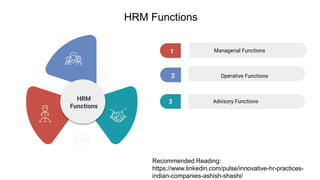
Managerial Functions
Operative Functions
Advisory Functions
HRM
Functions
1
2
3
4
HRM Functions
Recommended Reading:
https://www.linkedin.com/pulse/innovative-hr-practices-
indian-companies-ashish-shashi/
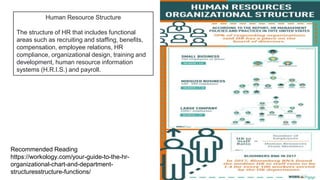
Human Resource Structure
The structure of HR that includes functional
areas such as recruiting and staffing, benefits,
compensation, employee relations, HR
compliance, organizational design, training and
development, human resource information
systems (H.R.I.S.) and payroll.
Recommended Reading
https://workology.com/your-guide-to-the-hr-
organizational-chart-and-department-
structuresstructure-functions/
Why do you need to set up the HR Department?
1. Create
Resilience to
the Changing
Work
Environment
2. Attract
Better Talent
3. Retention of
Talent
4. Compliant to
Industry laws
5. Organization
design and
development
1. Refer HR Policy document
Types of Organizational Structures
1. Functional Organizational Structure
Functional organizational structure is the most common organizational structure With that in mind, here are
three examples of HR department team structures within an organization. The structure of HR that includes
functional areas such as recruiting and staffing, benefits, compensation, employee relations, HR compliance,
organizational design, training and development, human resource information systems (H.R.I.S.) and
payroll.
2. Flat Organizational Structure
Opposite of the functional organizational structure, flat organizational structures often have few, or no, people in middle
management. It is literally flat meaning there are less managerial layers, so employees and managers all work on a level
playing field. One VP of HR might have seven direct reports each with an area of expertise like recruiting, benefits,
compensation payroll, HR business partner(s) and training and development. All of these individuals directly report to the VP of
HR, are the same level and have no direct reports themselves.
This model eliminates workplace politics and red tape to distributing responsibilities and power equally across the HR
department giving everyone a hand in the decision-making process. This is common in small companies and startups.
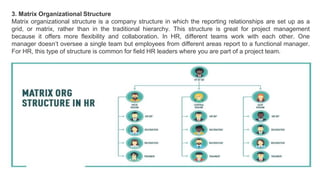
3. Matrix Organizational Structure
Matrix organizational structure is a company structure in which the reporting relationships are set up as a
grid, or matrix, rather than in the traditional hierarchy. This structure is great for project management
because it offers more flexibility and collaboration. In HR, different teams work with each other. One
manager doesn’t oversee a single team but employees from different areas report to a functional manager.
For HR, this type of structure is common for field HR leaders where you are part of a project team.
Other Less Common Organizational Structure Types
While the above organization structures are most common there are others you can use to build out your
HR team or company organizational structure. Here are a handful of other less-common options:
– Divisional Organizational Structure. This is for large enterprises and is comm with a divisional
organizational structure.
– Network Organizational Structure. A network organizational structure involves two or more
independent organizations partnering together in some capacity for business purposes.
– Team Organizational Structure. A team, or team-based, organizational structure refers to the business
model that functions when groups of employees collaborate on teams towards a shared goal under the
direction of one supervisor.
Good HR practices examples
https://www.humanresourcesmba.net/worlds-30-innovative-corporate-human-resources-departments/
Unilever Case study
Video
https://www.youtube.com/watch?v=O5ID6OPbVLk

Business Function Human Resources.pptx

  • 1.
    Business Function Human Resources By-Ms.Shivani Naik Devrukhkar, ASSISTANT PROFESSOR, (MBA, MCOM, PGDHE, NET, B.ED)
  • 2.
    Edwin Flippo defines-Human Resource Management as “planning, organizing, directing, controlling of procurement, development, compensation, integration , maintenance and separation of human resources to the end that individual, organizational and social objectives are achieved.”
  • 3.
    helps management in the preparation adoptionand continuing evolution of personnel programs and policies supplies skilled workers through scientific selection process ensures maximum benefit out of the expenditure on training and development Works towards appreciation of human asset prepares workers according to the changing needs of industry and environment 01 02 03 04 05 Importance of HRM for an organization According to Peter F. Drucker, ―The proper or improper use of the different factors of production depend on the wishes of the human resources. Hence, besides other resources human resources need more development. Human resources can increase cooperation but it needs proper and efficient management to guide it.
  • 4.
    motivates workers and upgrades them soas to enable them to accomplish the organization goals helps in reducing costs and helps in increasing Productivity through Innovation contributes in restoring the industrial harmony Promotes healthy employer- employee relations establishes mechanism for the administration of personnel Services as delegated 01 02 03 04 05
  • 5.
    Recommended video forBasics of HRM in a nutshell https://www.youtube.com/watch?v=9MWFkH4xb3U
  • 6.
    Managerial Functions Operative Functions AdvisoryFunctions HRM Functions 1 2 3 4 HRM Functions Recommended Reading: https://www.linkedin.com/pulse/innovative-hr-practices- indian-companies-ashish-shashi/
  • 8.
    Human Resource Structure Thestructure of HR that includes functional areas such as recruiting and staffing, benefits, compensation, employee relations, HR compliance, organizational design, training and development, human resource information systems (H.R.I.S.) and payroll. Recommended Reading https://workology.com/your-guide-to-the-hr- organizational-chart-and-department- structuresstructure-functions/
  • 9.
    Why do youneed to set up the HR Department? 1. Create Resilience to the Changing Work Environment 2. Attract Better Talent 3. Retention of Talent 4. Compliant to Industry laws 5. Organization design and development 1. Refer HR Policy document
  • 10.
    Types of OrganizationalStructures 1. Functional Organizational Structure Functional organizational structure is the most common organizational structure With that in mind, here are three examples of HR department team structures within an organization. The structure of HR that includes functional areas such as recruiting and staffing, benefits, compensation, employee relations, HR compliance, organizational design, training and development, human resource information systems (H.R.I.S.) and payroll.
  • 11.
    2. Flat OrganizationalStructure Opposite of the functional organizational structure, flat organizational structures often have few, or no, people in middle management. It is literally flat meaning there are less managerial layers, so employees and managers all work on a level playing field. One VP of HR might have seven direct reports each with an area of expertise like recruiting, benefits, compensation payroll, HR business partner(s) and training and development. All of these individuals directly report to the VP of HR, are the same level and have no direct reports themselves. This model eliminates workplace politics and red tape to distributing responsibilities and power equally across the HR department giving everyone a hand in the decision-making process. This is common in small companies and startups.
  • 12.
    3. Matrix OrganizationalStructure Matrix organizational structure is a company structure in which the reporting relationships are set up as a grid, or matrix, rather than in the traditional hierarchy. This structure is great for project management because it offers more flexibility and collaboration. In HR, different teams work with each other. One manager doesn’t oversee a single team but employees from different areas report to a functional manager. For HR, this type of structure is common for field HR leaders where you are part of a project team.
  • 13.
    Other Less CommonOrganizational Structure Types While the above organization structures are most common there are others you can use to build out your HR team or company organizational structure. Here are a handful of other less-common options: – Divisional Organizational Structure. This is for large enterprises and is comm with a divisional organizational structure. – Network Organizational Structure. A network organizational structure involves two or more independent organizations partnering together in some capacity for business purposes. – Team Organizational Structure. A team, or team-based, organizational structure refers to the business model that functions when groups of employees collaborate on teams towards a shared goal under the direction of one supervisor.
  • 15.
    Good HR practicesexamples https://www.humanresourcesmba.net/worlds-30-innovative-corporate-human-resources-departments/ Unilever Case study Video https://www.youtube.com/watch?v=O5ID6OPbVLk