BUSINESS SURVIVAL
DURING A CRISIS
BUSINESS CONTINUITY
PLANNING
PREPARE AND PREVENT NOT REPAIR AND REPENT
• Owning a business means you’ll always need to be alert to
external events that threaten the smooth operation of your
business.
• If you’re willing to embrace change you might even be able to
identify opportunities
• First you need to survive any crisis that occurs and thats where
your business continuity plan comes in
3
BUSINESS THREATS
• Can be global, industry-wide or business specific
• Has a negative impact on performance
• Need to be managed carefully to minimise effect
• Can affect any area of the business, but usually will involve
financial consequences
• Having a business continuity plan helps identify external events or
conditions that could impact your operations
4
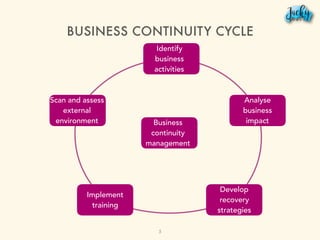
BUSINESS CONTINUITY CYCLE
Identify
business
activities
Analyse
business
impact
Develop
recovery
strategies
Implement
training
Scan and assess
external
environment Business
continuity
management
5
1.IDENTIFY BUSINESS ACTIVITIES
• Enables you to manage your key activities more closely and react
quicker
• Knowing the impact allows you to respond to and minimise its
effect.
• In general the main areas of focus are company guidance and
management, employees, your supply chain and the cashflow of
the business.
6
COMPANY GUIDANCE AND MANAGEMENT
• Knowing how to respond to a crisis means you can react quicker
• Appropriate processes and procedures can guide the business
through troubled times
• Procedures could include infection control and prevention, remote
working, emergency preparedness, personnel risk assessments and
additional training
• Emergency contact information might also be useful if you need to
contact staff out of hours
• Knowing the location of any backup data could help your business get
back to normal quicker
8
EMPLOYEES
• Open communication with your staff is imperative.
• Keeping important information from them will mean morale goes
down and productivity will be affected.
• Keeping them up to date (as much as possible) promotes a strong
corporate culture
• Communicating regularly with your employees fosters greater
loyalty from them
9
SUPPLY CHAIN
• Where is your weakest link. If they are a strategic supplier you
may need to help them stay afloat in troubled times.
• Classifying your suppliers enables you to identify the most
vulnerable areas of your supply chain and implement
contingencies quicker
• Business continuity may involve identifying secondary sources of
components or services, changing payment terms to help
cashflow, or insourcing previously outsourced activities
11
COMPANY LIQUIDITY
• Cashflow is an important part of running a business.
• If you have a good financial plan, then you are more likely to
attract investors who can help fund the business if there’s a sharp
downturn in revenue
• The speed at which we can quantify risk is key.
• The sooner you recognise an issue, the quicker you will be able to
react to any financial implications.
12
2. ANALYSE BUSINESS IMPACT
• Understanding the impact helps identify and prioritise those activities which have the most
impact
• Understanding the effects guides your strategies to minimise any interruptions
• Doing the analysis will let you plan for different scenarios and understand where your
business is most vulnerable so you can implement improvements to make your business
more resilient to any crisis.
• Areas to evaluate include:
• the possibility of negative cash flow due to lost sales and income
• Increased expenses due to overtime, outsourcing, special deliveries etc
• Any contractual penalties or loss of bonuses
• Impact on customer satisfaction which could result in them going elsewhere
• Any delays in executing business plan initiatives
• Resources required to support time-critical operations
13
3. DEVELOP RECOVERY STRATEGIES
• Working with a team of people from across the organisation, brainstorm
mitigation strategies
• Identify the minimum requirements to keep the business functioning.
What must be achieved and what resources are required
• What competencies would be needed
• Organise recovery teams and make sure they know their role
• Conduct a gap analysis and work with your teams to ensure that all gaps
are resolved
• Create processes and document them to help train anyone new coming
on board
14
4. IMPLEMENT TRAINING
• No point in implementing a BCM programme if your staff aren’t
aware of their role within it
• Business continuity training directly correlates to your ability to
recover effectively and in a timely manner
• The training can be through written documentation, through live
workshops or online courses.
• Where there are significant differences in how they would normally
operate that they practice for the event, in the same way that you
would carry out a fire evacuation practice
• Embed risk management awareness into your company culture
15
5. SCAN AND ASSESS THE EXTERNAL ENVIRONMENT
• Reviewing your external environment allows you to both consider risks
that might have an impact on your business, as well as any
opportunities available
• Companies that are quick to recognise opportunities are able to reap
the benefits and as long as they don’t try to take advantage of their
clients in hard times their business will grow
• Political, Economic, Social, Technological, Legal and Environmental
(PESTLE) factors are good way to review and understand the external
environment
• Use this information to update your business continuity plan and make
sure your business is in the best possible position to ride out the storm.
16
If you’d like me to help you
implement business continuity
planning system, then please contact
me at
briskassessment@gmail.com
17

Business Continuity Management

  • 1.
    BUSINESS SURVIVAL DURING ACRISIS BUSINESS CONTINUITY PLANNING
  • 3.
    PREPARE AND PREVENTNOT REPAIR AND REPENT • Owning a business means you’ll always need to be alert to external events that threaten the smooth operation of your business. • If you’re willing to embrace change you might even be able to identify opportunities • First you need to survive any crisis that occurs and thats where your business continuity plan comes in 3
  • 4.
    BUSINESS THREATS • Canbe global, industry-wide or business specific • Has a negative impact on performance • Need to be managed carefully to minimise effect • Can affect any area of the business, but usually will involve financial consequences • Having a business continuity plan helps identify external events or conditions that could impact your operations 4
  • 5.
  • 6.
    1.IDENTIFY BUSINESS ACTIVITIES •Enables you to manage your key activities more closely and react quicker • Knowing the impact allows you to respond to and minimise its effect. • In general the main areas of focus are company guidance and management, employees, your supply chain and the cashflow of the business. 6
  • 8.
    COMPANY GUIDANCE ANDMANAGEMENT • Knowing how to respond to a crisis means you can react quicker • Appropriate processes and procedures can guide the business through troubled times • Procedures could include infection control and prevention, remote working, emergency preparedness, personnel risk assessments and additional training • Emergency contact information might also be useful if you need to contact staff out of hours • Knowing the location of any backup data could help your business get back to normal quicker 8
  • 9.
    EMPLOYEES • Open communicationwith your staff is imperative. • Keeping important information from them will mean morale goes down and productivity will be affected. • Keeping them up to date (as much as possible) promotes a strong corporate culture • Communicating regularly with your employees fosters greater loyalty from them 9
  • 11.
    SUPPLY CHAIN • Whereis your weakest link. If they are a strategic supplier you may need to help them stay afloat in troubled times. • Classifying your suppliers enables you to identify the most vulnerable areas of your supply chain and implement contingencies quicker • Business continuity may involve identifying secondary sources of components or services, changing payment terms to help cashflow, or insourcing previously outsourced activities 11
  • 12.
    COMPANY LIQUIDITY • Cashflowis an important part of running a business. • If you have a good financial plan, then you are more likely to attract investors who can help fund the business if there’s a sharp downturn in revenue • The speed at which we can quantify risk is key. • The sooner you recognise an issue, the quicker you will be able to react to any financial implications. 12
  • 13.
    2. ANALYSE BUSINESSIMPACT • Understanding the impact helps identify and prioritise those activities which have the most impact • Understanding the effects guides your strategies to minimise any interruptions • Doing the analysis will let you plan for different scenarios and understand where your business is most vulnerable so you can implement improvements to make your business more resilient to any crisis. • Areas to evaluate include: • the possibility of negative cash flow due to lost sales and income • Increased expenses due to overtime, outsourcing, special deliveries etc • Any contractual penalties or loss of bonuses • Impact on customer satisfaction which could result in them going elsewhere • Any delays in executing business plan initiatives • Resources required to support time-critical operations 13
  • 14.
    3. DEVELOP RECOVERYSTRATEGIES • Working with a team of people from across the organisation, brainstorm mitigation strategies • Identify the minimum requirements to keep the business functioning. What must be achieved and what resources are required • What competencies would be needed • Organise recovery teams and make sure they know their role • Conduct a gap analysis and work with your teams to ensure that all gaps are resolved • Create processes and document them to help train anyone new coming on board 14
  • 15.
    4. IMPLEMENT TRAINING •No point in implementing a BCM programme if your staff aren’t aware of their role within it • Business continuity training directly correlates to your ability to recover effectively and in a timely manner • The training can be through written documentation, through live workshops or online courses. • Where there are significant differences in how they would normally operate that they practice for the event, in the same way that you would carry out a fire evacuation practice • Embed risk management awareness into your company culture 15
  • 16.
    5. SCAN ANDASSESS THE EXTERNAL ENVIRONMENT • Reviewing your external environment allows you to both consider risks that might have an impact on your business, as well as any opportunities available • Companies that are quick to recognise opportunities are able to reap the benefits and as long as they don’t try to take advantage of their clients in hard times their business will grow • Political, Economic, Social, Technological, Legal and Environmental (PESTLE) factors are good way to review and understand the external environment • Use this information to update your business continuity plan and make sure your business is in the best possible position to ride out the storm. 16
  • 17.
    If you’d likeme to help you implement business continuity planning system, then please contact me at briskassessment@gmail.com 17