Business Communication
Writing Effectively
Varda Pendse
Writing is a learnt Skill
• Writing is a ‘Technical’ Skill
• Writing skills is ability to communicate effectively to other’s person
• Its about converting thoughts, complex situations in an easy-to-
understand manner to another person.
• It goes beyond just writing – it requires other skills too – usage of words,
editing, proofreading, using diagrams and visuals.
Practice, Feedback from others and Self Reflection builds our writing skills
At work when do use your Writing Skill
• Use of writing skills
• Report Writing
• Customer Visit
• Data Analysis Report
• Proposal Writing
• Pitching or Seeking ‘work’
• Preparing Minutes of meeting
• Responding to Emails
• 40 – 60 % of our times we focus on responding to Emails.
• This module will focus on how do we respond to emails effectively
Different Types of Emails
• Request-and-Reply Emails: Questions which are to be answered,
specific tasks that need to completed, some observations on policies/
meetings / projects etc.
• Confirmation Emails: Written Records of a conversation that has taken
place.
• Welcome Emails: First point of contact that the recipient experience.
• Announcement Emails: Share news or updates about the company,
team or project.
• Invitation Emails: Invite for a meeting, events or social gathering
• Feedback and Survey Emails: Either to invite Feedback or gather some
information's from the target audience
Aspects to take care of whilst writing
Think before you write:
• Prep up for writing – focus on what you want to convey
• Make notes about different aspects you want to share
• Arrange them in logical group
• Identify key points you would like to include
• Think of your audience – who is going to get the message ? What is
there needs and expectations ?
Aspects to take care of whilst writing
Writing the Email :
• Start with Proper Salutation
• Ensure there is a Subject Line that reflects the matter
• Get to the message quickly – don’t bury the main point in unnecessary details
• Be specific in your call to action – what do you really want
• Always seek feedback from colleagues and mentors – it is a good idea to show
critical / important emails to others and take their feedback before sending it across.
Aspects to take care of whilst writing
Your Writing Style :
Should be easy to read and understand. Keep the Sentences short
Be concise and focused
Use of Active Voice – makes the writing direct and clear
Avoid using Jargons / complex sentences
Be positive in your tone
Aspects to take care of whilst writing
Before hitting the send button
Ensure information provided is correct and up to date
Proof read – for spelling, grammar and punctuation mark
Check the recipients – who have marked cc – have you missed
somebody / should you not be sending to someone
Subject line – is that reflective of the subject / email matter
What reduces the impact of Email Response
Use of Slang or abbreviations - example Bullshit, Lol etc: Keep your
language professional.
Typing in CAPITAL LETTERS – in writing this is equivalent to shouting in
writing.
Use colored fonts or different sizes or different types of Fonts – keep it
clean and professional
Use Excessive Exclamation Points: Overuse of exclamation points can make
your email seem unprofessional or overly emotional.
Long Paragraphs: Keep your paragraphs short and to the point to make your
email easier to read.
Not using a Signature: A professional email signature with your contact
information makes it easy for people to get in touch with you.
Not Using a Non-Professional Email Address whilst communicating to
Client: Always use KAPL email id.
Don’ts in Email Writing
Don’t Forget the Attachment: If you mention an attachment in your email, make sure to
include it. Forgetting to attach files can lead to delays and miscommunication.
Don’t Ignore Emails: Even if you can’t provide a detailed response immediately, it’s good
practice to acknowledge receipt of an email and let the sender know when they can expect
a full response.
Don’t Send Emails with Empty Subject Lines: Subject lines help the recipient
understand the content of the email at a glance. Always include a clear, concise subject
line.
Don’t Send Emails When You’re Emotional: If you’re upset, take a moment to calm down
before responding to an email. Writing emails when you’re emotional can lead to
messages that you might regret later.
Don’t Forget to Use a Signature: A professional email signature with your contact
information makes it easy for people to get in touch with you.
Don’t Forget to Reply All When Necessary: If an email was sent to multiple people, make
sure to reply all if your response is relevant to everyone.
Examples of Emails – Internal Team Members
To : s@kapl.com
Subject Line: Meeting to discuss the new client
proposal
Dear S
Pls come to meet me at my office at 3 pm for 30
minutes to discuss the new client proposal.
V
To : s@kapl.com
Subject Line: Meeting for discussion
Dear S
Lets meet at 3 pm at my office for the
discussion
V
Email 1 is terse and does not give any information on what is the purpose of the discussion or for how long will
the discussion be for.
The second email shares the details in a more specific – time, for how long, venue.
Examples of Emails – to an External Vendor
• Subject: Meeting on the Proposal
hey,
we need to talk about the project. when
can u meet me next week?
thx,
R
Subject: Request for Meeting to discuss the Proposal
Dear Mr. Shah,
I hope this email finds you well. I am writing to request
a meeting with you to discuss our upcoming project. I
believe your insights and guidance would be invaluable.
Could we schedule a meeting for next week? I am available
on Tuesday and Thursday between 10:00 AM and 3:00 PM.
Please let me know a time that works best for you.
Thank you for considering my request. I look forward to
our meeting.
Best regards,
R
Email 1 is terse and does not give any information on what is the purpose of the discussion or for how long will
the discussion be for.
The second email shares the details in a more specific – time, for how long, venue.
Also note the difference in communication between a internal team member and external client. With an external client
one needs to be more formal and seek confirmation.
Examples of Emails – Manager to colleague for
additional information
• Subject: Information Required
Hi Deepak,
Can you share the following
information asap as I need it
urgently for the Auditors.
thx,
R
Subject: Information required for the
Audit Purpose 2023
Hi Deepak,
Thanks for all the information provided so
far. The Auditors have requested for
additional information as detailed below
Request you to share the same by tomorrow
10 am. Pls do reach out to me for any
clarifications / support.
Best regards
R
Email 1 is direct and does not give any information detail the timelines by when the information is required. The email
Also does not acknowledge the recipient in terms of contribution.
The second email shares the details in a more specific – what data is required and by when. Second the email shows
appreciation of the support given so far and also willingness to provide support.
Examples of Emails – To another department
about not having shared the data on time
• Subject: Information Not
Received on time
Hi Deepak,
Inspite of several follow ups, you
have not shared the data. Can you
share the following information
asap as I need it urgently for the
Auditors.
thx,
R
Subject: Information Pending for the Audit
Purpose 2023
Hi Deepak,
Just a gentle reminder to share the
requested information required by 4 pm today.
Today is the last day of Audit and if the
information is not shared, they may assume
that we are not working on these aspects.
Let me know if you need support from me to
complete the task.
Best regards
R
Email 1 is direct and in a way accusatory – puts the onus on the recipient
The second email shares the details in a more specific – impact of not sharing the data on time, that he has got
extension till 4 pm, willingness of the sender to support for compilation of data. The appropriate use of word “we”
makes it more collaborative. Finally use of word Pending instead of Not Received makes it positive for the recipient
Examples of Emails – To HR department about
missed attendance
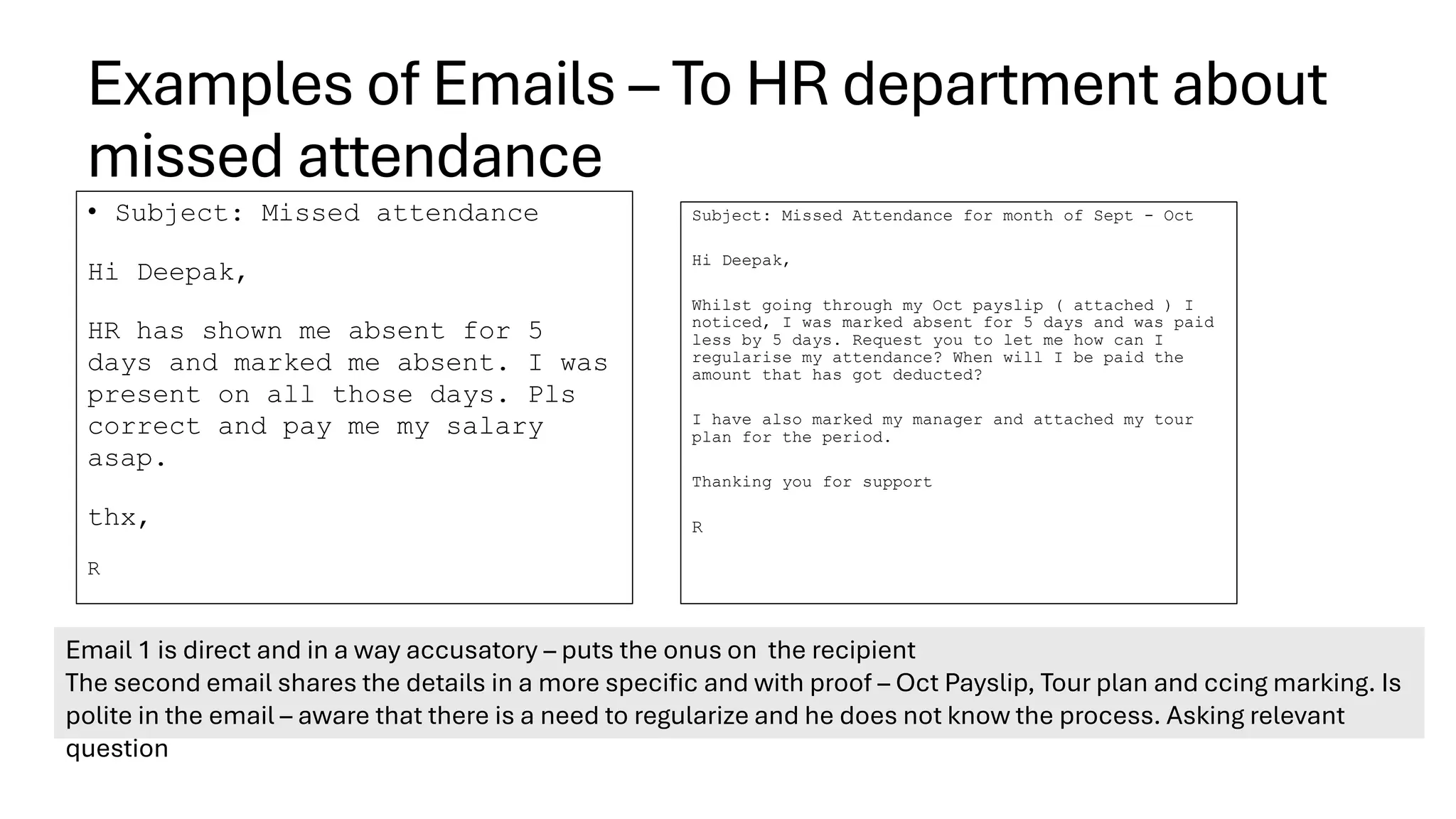
• Subject: Missed attendance
Hi Deepak,
HR has shown me absent for 5
days and marked me absent. I was
present on all those days. Pls
correct and pay me my salary
asap.
thx,
R
Subject: Missed Attendance for month of Sept - Oct
Hi Deepak,
Whilst going through my Oct payslip ( attached ) I
noticed, I was marked absent for 5 days and was paid
less by 5 days. Request you to let me how can I
regularise my attendance? When will I be paid the
amount that has got deducted?
I have also marked my manager and attached my tour
plan for the period.
Thanking you for support
R
Email 1 is direct and in a way accusatory – puts the onus on the recipient
The second email shares the details in a more specific and with proof – Oct Payslip, Tour plan and ccing marking. Is
polite in the email – aware that there is a need to regularize and he does not know the process. Asking relevant
question
When writing Complex & Difficult Emails
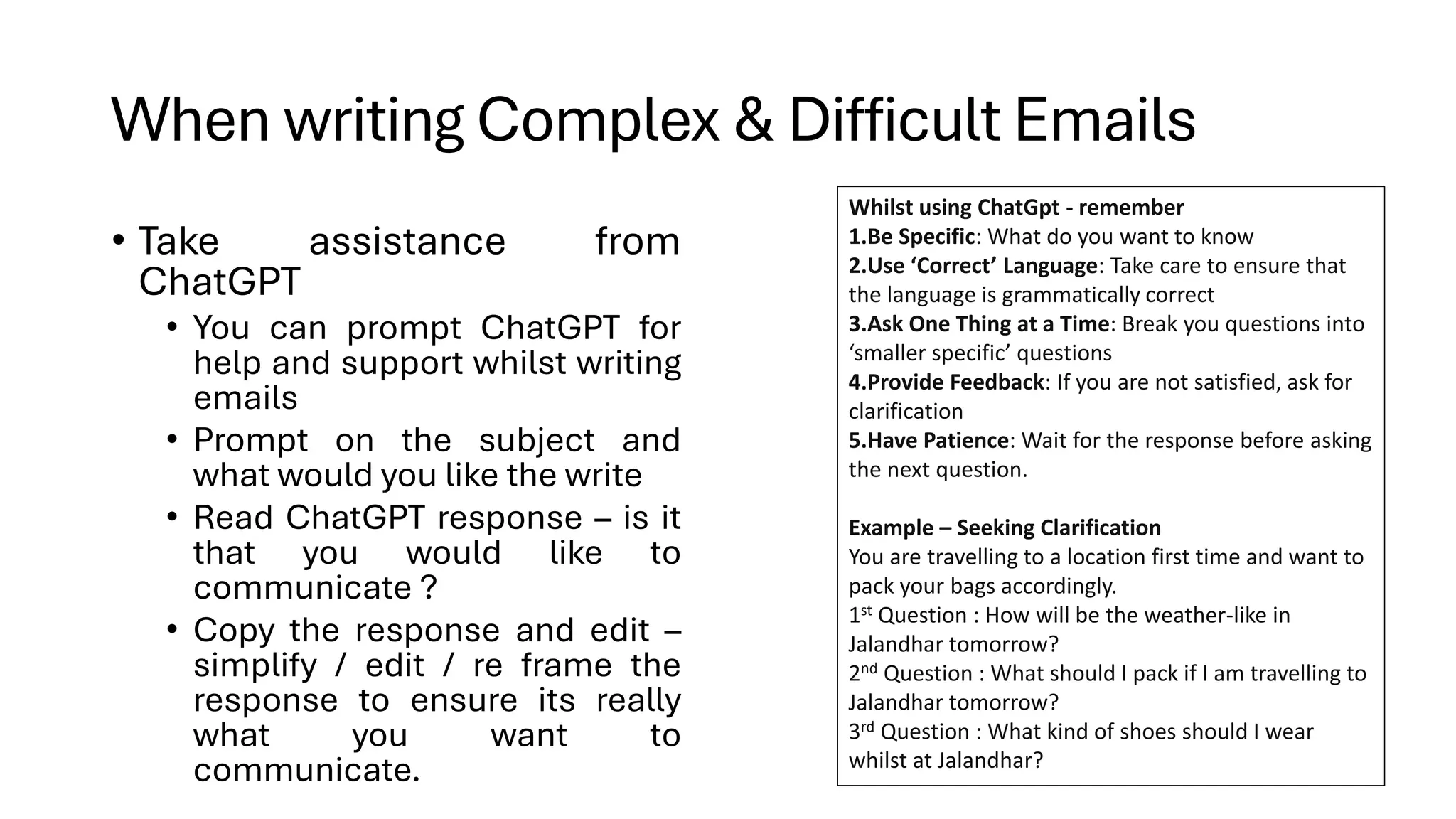
• Take assistance from
ChatGPT
• You can prompt ChatGPT for
help and support whilst writing
emails
• Prompt on the subject and
what would you like the write
• Read ChatGPT response – is it
that you would like to
communicate ?
• Copy the response and edit –
simplify / edit / re frame the
response to ensure its really
what you want to
communicate.
Whilst using ChatGpt - remember
1.Be Specific: What do you want to know
2.Use ‘Correct’ Language: Take care to ensure that
the language is grammatically correct
3.Ask One Thing at a Time: Break you questions into
‘smaller specific’ questions
4.Provide Feedback: If you are not satisfied, ask for
clarification
5.Have Patience: Wait for the response before asking
the next question.
Example – Seeking Clarification
You are travelling to a location first time and want to
pack your bags accordingly.
1st Question : How will be the weather-like in
Jalandhar tomorrow?
2nd Question : What should I pack if I am travelling to
Jalandhar tomorrow?
3rd Question : What kind of shoes should I wear
whilst at Jalandhar?
When writing Complex & Difficult Emails
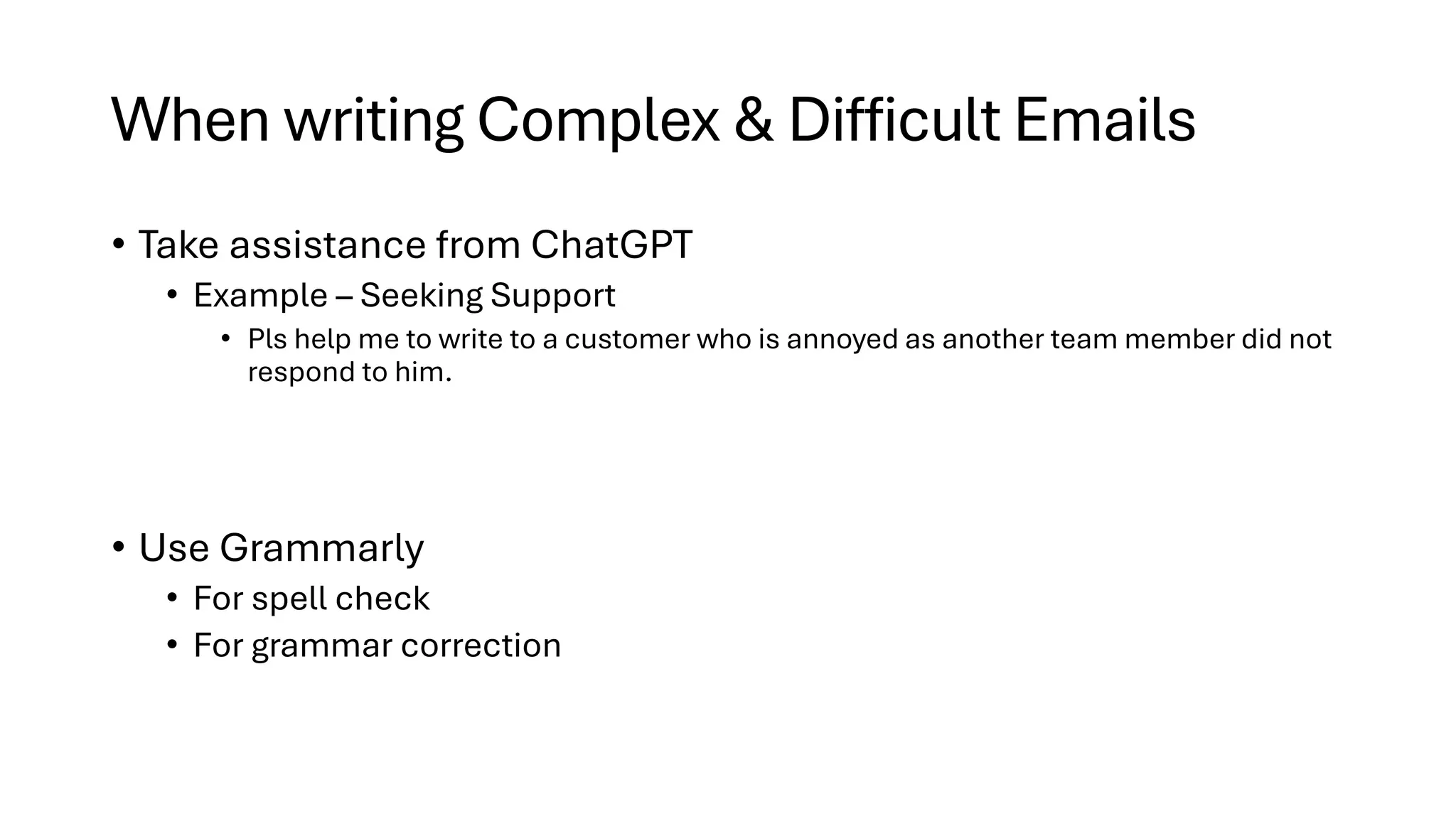
• Take assistance from ChatGPT
• Example – Seeking Support
• Pls help me to write to a customer who is annoyed as another team member did not
respond to him.
• Use Grammarly
• For spell check
• For grammar correction

Business Communication Email Writing Module 4.pdf

  • 1.
  • 2.
    Writing is alearnt Skill • Writing is a ‘Technical’ Skill • Writing skills is ability to communicate effectively to other’s person • Its about converting thoughts, complex situations in an easy-to- understand manner to another person. • It goes beyond just writing – it requires other skills too – usage of words, editing, proofreading, using diagrams and visuals. Practice, Feedback from others and Self Reflection builds our writing skills
  • 3.
    At work whendo use your Writing Skill • Use of writing skills • Report Writing • Customer Visit • Data Analysis Report • Proposal Writing • Pitching or Seeking ‘work’ • Preparing Minutes of meeting • Responding to Emails • 40 – 60 % of our times we focus on responding to Emails. • This module will focus on how do we respond to emails effectively
  • 4.
    Different Types ofEmails • Request-and-Reply Emails: Questions which are to be answered, specific tasks that need to completed, some observations on policies/ meetings / projects etc. • Confirmation Emails: Written Records of a conversation that has taken place. • Welcome Emails: First point of contact that the recipient experience. • Announcement Emails: Share news or updates about the company, team or project. • Invitation Emails: Invite for a meeting, events or social gathering • Feedback and Survey Emails: Either to invite Feedback or gather some information's from the target audience
  • 5.
    Aspects to takecare of whilst writing Think before you write: • Prep up for writing – focus on what you want to convey • Make notes about different aspects you want to share • Arrange them in logical group • Identify key points you would like to include • Think of your audience – who is going to get the message ? What is there needs and expectations ?
  • 6.
    Aspects to takecare of whilst writing Writing the Email : • Start with Proper Salutation • Ensure there is a Subject Line that reflects the matter • Get to the message quickly – don’t bury the main point in unnecessary details • Be specific in your call to action – what do you really want • Always seek feedback from colleagues and mentors – it is a good idea to show critical / important emails to others and take their feedback before sending it across.
  • 7.
    Aspects to takecare of whilst writing Your Writing Style : Should be easy to read and understand. Keep the Sentences short Be concise and focused Use of Active Voice – makes the writing direct and clear Avoid using Jargons / complex sentences Be positive in your tone
  • 8.
    Aspects to takecare of whilst writing Before hitting the send button Ensure information provided is correct and up to date Proof read – for spelling, grammar and punctuation mark Check the recipients – who have marked cc – have you missed somebody / should you not be sending to someone Subject line – is that reflective of the subject / email matter
  • 9.
    What reduces theimpact of Email Response Use of Slang or abbreviations - example Bullshit, Lol etc: Keep your language professional. Typing in CAPITAL LETTERS – in writing this is equivalent to shouting in writing. Use colored fonts or different sizes or different types of Fonts – keep it clean and professional Use Excessive Exclamation Points: Overuse of exclamation points can make your email seem unprofessional or overly emotional. Long Paragraphs: Keep your paragraphs short and to the point to make your email easier to read. Not using a Signature: A professional email signature with your contact information makes it easy for people to get in touch with you. Not Using a Non-Professional Email Address whilst communicating to Client: Always use KAPL email id.
  • 10.
    Don’ts in EmailWriting Don’t Forget the Attachment: If you mention an attachment in your email, make sure to include it. Forgetting to attach files can lead to delays and miscommunication. Don’t Ignore Emails: Even if you can’t provide a detailed response immediately, it’s good practice to acknowledge receipt of an email and let the sender know when they can expect a full response. Don’t Send Emails with Empty Subject Lines: Subject lines help the recipient understand the content of the email at a glance. Always include a clear, concise subject line. Don’t Send Emails When You’re Emotional: If you’re upset, take a moment to calm down before responding to an email. Writing emails when you’re emotional can lead to messages that you might regret later. Don’t Forget to Use a Signature: A professional email signature with your contact information makes it easy for people to get in touch with you. Don’t Forget to Reply All When Necessary: If an email was sent to multiple people, make sure to reply all if your response is relevant to everyone.
  • 11.
    Examples of Emails– Internal Team Members To : s@kapl.com Subject Line: Meeting to discuss the new client proposal Dear S Pls come to meet me at my office at 3 pm for 30 minutes to discuss the new client proposal. V To : s@kapl.com Subject Line: Meeting for discussion Dear S Lets meet at 3 pm at my office for the discussion V Email 1 is terse and does not give any information on what is the purpose of the discussion or for how long will the discussion be for. The second email shares the details in a more specific – time, for how long, venue.
  • 12.
    Examples of Emails– to an External Vendor • Subject: Meeting on the Proposal hey, we need to talk about the project. when can u meet me next week? thx, R Subject: Request for Meeting to discuss the Proposal Dear Mr. Shah, I hope this email finds you well. I am writing to request a meeting with you to discuss our upcoming project. I believe your insights and guidance would be invaluable. Could we schedule a meeting for next week? I am available on Tuesday and Thursday between 10:00 AM and 3:00 PM. Please let me know a time that works best for you. Thank you for considering my request. I look forward to our meeting. Best regards, R Email 1 is terse and does not give any information on what is the purpose of the discussion or for how long will the discussion be for. The second email shares the details in a more specific – time, for how long, venue. Also note the difference in communication between a internal team member and external client. With an external client one needs to be more formal and seek confirmation.
  • 13.
    Examples of Emails– Manager to colleague for additional information • Subject: Information Required Hi Deepak, Can you share the following information asap as I need it urgently for the Auditors. thx, R Subject: Information required for the Audit Purpose 2023 Hi Deepak, Thanks for all the information provided so far. The Auditors have requested for additional information as detailed below Request you to share the same by tomorrow 10 am. Pls do reach out to me for any clarifications / support. Best regards R Email 1 is direct and does not give any information detail the timelines by when the information is required. The email Also does not acknowledge the recipient in terms of contribution. The second email shares the details in a more specific – what data is required and by when. Second the email shows appreciation of the support given so far and also willingness to provide support.
  • 14.
    Examples of Emails– To another department about not having shared the data on time • Subject: Information Not Received on time Hi Deepak, Inspite of several follow ups, you have not shared the data. Can you share the following information asap as I need it urgently for the Auditors. thx, R Subject: Information Pending for the Audit Purpose 2023 Hi Deepak, Just a gentle reminder to share the requested information required by 4 pm today. Today is the last day of Audit and if the information is not shared, they may assume that we are not working on these aspects. Let me know if you need support from me to complete the task. Best regards R Email 1 is direct and in a way accusatory – puts the onus on the recipient The second email shares the details in a more specific – impact of not sharing the data on time, that he has got extension till 4 pm, willingness of the sender to support for compilation of data. The appropriate use of word “we” makes it more collaborative. Finally use of word Pending instead of Not Received makes it positive for the recipient
  • 15.
    Examples of Emails– To HR department about missed attendance • Subject: Missed attendance Hi Deepak, HR has shown me absent for 5 days and marked me absent. I was present on all those days. Pls correct and pay me my salary asap. thx, R Subject: Missed Attendance for month of Sept - Oct Hi Deepak, Whilst going through my Oct payslip ( attached ) I noticed, I was marked absent for 5 days and was paid less by 5 days. Request you to let me how can I regularise my attendance? When will I be paid the amount that has got deducted? I have also marked my manager and attached my tour plan for the period. Thanking you for support R Email 1 is direct and in a way accusatory – puts the onus on the recipient The second email shares the details in a more specific and with proof – Oct Payslip, Tour plan and ccing marking. Is polite in the email – aware that there is a need to regularize and he does not know the process. Asking relevant question
  • 16.
    When writing Complex& Difficult Emails • Take assistance from ChatGPT • You can prompt ChatGPT for help and support whilst writing emails • Prompt on the subject and what would you like the write • Read ChatGPT response – is it that you would like to communicate ? • Copy the response and edit – simplify / edit / re frame the response to ensure its really what you want to communicate. Whilst using ChatGpt - remember 1.Be Specific: What do you want to know 2.Use ‘Correct’ Language: Take care to ensure that the language is grammatically correct 3.Ask One Thing at a Time: Break you questions into ‘smaller specific’ questions 4.Provide Feedback: If you are not satisfied, ask for clarification 5.Have Patience: Wait for the response before asking the next question. Example – Seeking Clarification You are travelling to a location first time and want to pack your bags accordingly. 1st Question : How will be the weather-like in Jalandhar tomorrow? 2nd Question : What should I pack if I am travelling to Jalandhar tomorrow? 3rd Question : What kind of shoes should I wear whilst at Jalandhar?
  • 17.
    When writing Complex& Difficult Emails • Take assistance from ChatGPT • Example – Seeking Support • Pls help me to write to a customer who is annoyed as another team member did not respond to him. • Use Grammarly • For spell check • For grammar correction