BUSINESS ANALYTICS
INTRODUCTION
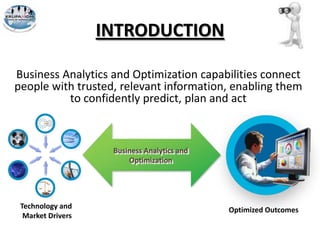
Business Analytics and Optimization capabilities connect
people with trusted, relevant information, enabling them
to confidently predict, plan and act
Business Analytics and
Optimization
Technology and
Market Drivers
Optimized Outcomes
PURPOSE FOR BUSINESS ANALYTICS
– Identify where the business stands
in relation to rivals, etc.
– Collect and use data to inform business decision
making
– Identify strengths and weaknesses
in the business
– Use information to inform strategic planning
IDENTIFY /
FORMULATE
PROBLEM
DATA
PREPARATION
DATA
EXPLORATIO
N
TRANSFORM
& SELECT
BUILD
MODEL
VALIDATE
MODEL
DEPLOY
MODEL
EVALUATE /
MONITOR
RESULTSDomain Expert
Makes Decisions
Evaluates Processes and ROI
BUSINESS
MANAGER
Model Validation
Model Deployment
Model Monitoring
Data Preparation
IT / SYSTEMS
MANAGEMENT
Data Exploration
Data Visualization
Report Creation
BUSINESS
ANALYST
Exploratory Analysis
Descriptive Segmentation
Predictive Modeling
DATA MINER /
STATISTICIAN
THE ANALYTICS LIFECYCLE
Complex Business Problems Drive Analytics Innovation
• Ongoing research to ensure that analysts have access to modern
techniques which are robust and scalable
• Innovative computational implementations of existing analytical
methods
• Creative applications of existing methods to solve new and
different problems
• Integration of methods from multiple disciplines to provide
targeted solutions
CURRENT TRENDS IN ANALYTICS
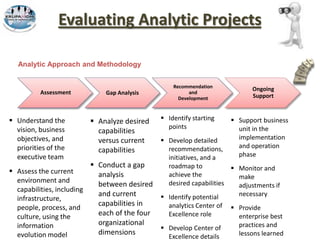
Evaluating Analytic Projects
Analytic Approach and Methodology
Assessment Gap Analysis
Recommendation
and
Development
Ongoing
Support
 Understand the
vision, business
objectives, and
priorities of the
executive team
 Assess the current
environment and
capabilities, including
infrastructure,
people, process, and
culture, using the
information
evolution model
 Analyze desired
capabilities
versus current
capabilities
 Conduct a gap
analysis
between desired
and current
capabilities in
each of the four
organizational
dimensions
 Identify starting
points
 Develop detailed
recommendations,
initiatives, and a
roadmap to
achieve the
desired capabilities
 Identify potential
analytics Center of
Excellence role
 Develop Center of
Excellence details
 Support business
unit in the
implementation
and operation
phase
 Monitor and
make
adjustments if
necessary
 Provide
enterprise best
practices and
lessons learned
Business analytic process in PR solution

Business analytic process in PR solution

  • 1.
  • 2.
    INTRODUCTION Business Analytics andOptimization capabilities connect people with trusted, relevant information, enabling them to confidently predict, plan and act Business Analytics and Optimization Technology and Market Drivers Optimized Outcomes
  • 3.
    PURPOSE FOR BUSINESSANALYTICS – Identify where the business stands in relation to rivals, etc. – Collect and use data to inform business decision making – Identify strengths and weaknesses in the business – Use information to inform strategic planning
  • 4.
    IDENTIFY / FORMULATE PROBLEM DATA PREPARATION DATA EXPLORATIO N TRANSFORM & SELECT BUILD MODEL VALIDATE MODEL DEPLOY MODEL EVALUATE/ MONITOR RESULTSDomain Expert Makes Decisions Evaluates Processes and ROI BUSINESS MANAGER Model Validation Model Deployment Model Monitoring Data Preparation IT / SYSTEMS MANAGEMENT Data Exploration Data Visualization Report Creation BUSINESS ANALYST Exploratory Analysis Descriptive Segmentation Predictive Modeling DATA MINER / STATISTICIAN THE ANALYTICS LIFECYCLE
  • 5.
    Complex Business ProblemsDrive Analytics Innovation • Ongoing research to ensure that analysts have access to modern techniques which are robust and scalable • Innovative computational implementations of existing analytical methods • Creative applications of existing methods to solve new and different problems • Integration of methods from multiple disciplines to provide targeted solutions CURRENT TRENDS IN ANALYTICS
  • 6.
    Evaluating Analytic Projects AnalyticApproach and Methodology Assessment Gap Analysis Recommendation and Development Ongoing Support  Understand the vision, business objectives, and priorities of the executive team  Assess the current environment and capabilities, including infrastructure, people, process, and culture, using the information evolution model  Analyze desired capabilities versus current capabilities  Conduct a gap analysis between desired and current capabilities in each of the four organizational dimensions  Identify starting points  Develop detailed recommendations, initiatives, and a roadmap to achieve the desired capabilities  Identify potential analytics Center of Excellence role  Develop Center of Excellence details  Support business unit in the implementation and operation phase  Monitor and make adjustments if necessary  Provide enterprise best practices and lessons learned