Chemical Services Routine Request JUN13099-100
Silver Plated Copper Bus
Sketch 7 & 8 - CDA-834952 June 21, 2013
Page 1 of 4
BACKGROUND:
R. Jain submitted samples of Silver Plated Copper Bus from Sketch Numbers 7 & 8 and S&C
Part # CDA-834952. The Material Specification Procedure (MSP No. 0020) calls the preferred
alloy ETP Copper CA11000.
The request was made to check the copper alloy, the material hardness, and the silver plating
thickness.
Photos #1 and #2 represent the two Silver Plated Copper Bus samples submitted to the
Analytical lab. Photo #1 is from Sketch #7 and Photo #2 is from Sketch #8.
Photos have been removed for size consolidation
TEST PROCEDURES AND EQUIPTMENT:
 Chemical Composition
The chemical composition was obtained with the Bruker SRS 3000 X-ray Florescence (XRF)
instrument. M. Dwyer completed the analytical work under Chemical Services Routine Request
Number JUN13099-100. The results are reported in the body of this report.
Chemical Services Routine Request JUN13099-100
Silver Plated Copper Bus
Sketch 7 & 8 - CDA-834952 June 21, 2013
Page 2 of 4
 Plating Thickness
Corner samples from the bus were mounted in Buehler Epomet ® epoxy compound. The cross
sections of the bus copper were polished with silicon carbide media ranging from 120 to 600-grit
and a Buehler ®-polishing wheel until planar. The final finish polish was obtained using
Buehler Metadi ® Diamond compounds ranging from 9 to 1 micron in particle size. Samples
were prepared in accordance with good metallographic practice and ASTM E3, or the “Standard
Practice for Preparation of Metallographic Samples”. The sample was then placed in the Nikon
Stereo Zoom Microscope in order to obtain images to measure the plating thickness.
 Material Hardness
The material hardness was tested per ASTM E18 or the standard specification for “Rockwell
Hardness or Rockwell Superficial Hardness Tests of Metallic Materials”. The readings were
taken using the Rockwell “F” hardness (HRF) scale.
RESULTS AND DISCUSSION:
1. Chemical Composition
Table I and II report the chemical composition of the Copper Bus samples. The samples were
compared to C11000 per ASTM B-187 or the “Standard Specification for Copper, Bus Bar, Rod,
and Shapes and General Propose Rod, Bar, and Shape”. The specification is referenced by MSP
# 0020.
Table I
Element & Chemical
Symbol
UNS C11000 per ASTM B-
187
CDA-834952
Sketch #7
Lab Reference No. JUN13099
Copper, Cu 99.90 99.99
Table I reports the chemical composition for the sample representing Sketch #7.
Table II
Element & Chemical
Symbol
UNS C11000 per ASTM B-
187
CDA-834952
Sketch #8
Lab Reference No. JUN13100
Copper, Cu 99.90 99.99
Table II reports the Chemical composition for the sample representing Sketch #8. Both samples
were compared to UNS C11000 as per ASTM B-187.
Both samples from Sketch #7 and Sketch #8 of CDA 834952 satisfy the requirements for UNS
C11000.
2. Plating Thickness
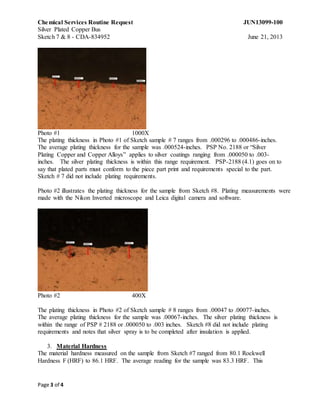
Photo #1 illustrates the plating thickness for the sample from Sketch #7.
Chemical Services Routine Request JUN13099-100
Silver Plated Copper Bus
Sketch 7 & 8 - CDA-834952 June 21, 2013
Page 3 of 4
Photo #1 1000X
The plating thickness in Photo #1 of Sketch sample # 7 ranges from .000296 to .000486-inches.
The average plating thickness for the sample was .000524-inches. PSP No. 2188 or “Silver
Plating Copper and Copper Alloys” applies to silver coatings ranging from .000050 to .003-
inches. The silver plating thickness is within this range requirement. PSP-2188 (4.1) goes on to
say that plated parts must conform to the piece part print and requirements special to the part.
Sketch # 7 did not include plating requirements.
Photo #2 illustrates the plating thickness for the sample from Sketch #8. Plating measurements were
made with the Nikon Inverted microscope and Leica digital camera and software.
Photo #2 400X
The plating thickness in Photo #2 of Sketch sample # 8 ranges from .00047 to .00077-inches.
The average plating thickness for the sample was .00067-inches. The silver plating thickness is
within the range of PSP # 2188 or .000050 to .003 inches. Sketch #8 did not include plating
requirements and notes that silver spray is to be completed after insulation is applied.
3. Material Hardness
The material hardness measured on the sample from Sketch #7 ranged from 80.1 Rockwell
Hardness F (HRF) to 86.1 HRF. The average reading for the sample was 83.3 HRF. This
Chemical Services Routine Request JUN13099-100
Silver Plated Copper Bus
Sketch 7 & 8 - CDA-834952 June 21, 2013
Page 4 of 4
satisfies MSP No. 0020 for hard drawn bus copper with a minimum material hardness of 80
Rockwell “F”.
The sample of measured on the sample from Sketch #8 ranged from 87.8 HRF to 88.9 HRF. The
average hardness reading was 88.2 HRF. This satisfies MSP No. 0020 for hard drawn bus
copper with a minimum material hardness of 80 Rockwell “F”.
CONCLUSIONS:
Considering the information the following conclusions are offered:
1. R. Jain submitted two (2) samples of CDA-834952 to the Analytical Lab for Analysis. One
sample was labeled as Sketch #7 and the other was labeled as Sketch #8. The composition
and material hardness were compared with S&C Specification MSP # 0020. The plating
thickness was compared with S&C Process Specification PSP # 2188.
2. Both samples submitted met the requirements for CA 110 Bus Copper from MSP # 0020.
3. Both samples satisfied the general range requirements for silver plating per PSP # 2188.
PSP # 2188 (4.1) goes on to say that plated parts must conform to the piece part print and
requirements special to the part. Sketch # 7 & 8 did not include plating requirements.
4. Both samples were found to satisfy the material hardness requirements from MSP # 0020
for hard drawn bus copper.
Metallurgical notations and observations were conducted under the guidance of Assistant
Laboratory Manager B. Kirk.
KEY WORDS:
CDA-834952, Chemical Compositions, MSP # 0020, PSP # 2188, CA 110, Bus, Sketch #7,
Sketch #8, Plating Thickness, Material Hardness, copper

BUS Copper Analysis

  • 1.
    Chemical Services RoutineRequest JUN13099-100 Silver Plated Copper Bus Sketch 7 & 8 - CDA-834952 June 21, 2013 Page 1 of 4 BACKGROUND: R. Jain submitted samples of Silver Plated Copper Bus from Sketch Numbers 7 & 8 and S&C Part # CDA-834952. The Material Specification Procedure (MSP No. 0020) calls the preferred alloy ETP Copper CA11000. The request was made to check the copper alloy, the material hardness, and the silver plating thickness. Photos #1 and #2 represent the two Silver Plated Copper Bus samples submitted to the Analytical lab. Photo #1 is from Sketch #7 and Photo #2 is from Sketch #8. Photos have been removed for size consolidation TEST PROCEDURES AND EQUIPTMENT:  Chemical Composition The chemical composition was obtained with the Bruker SRS 3000 X-ray Florescence (XRF) instrument. M. Dwyer completed the analytical work under Chemical Services Routine Request Number JUN13099-100. The results are reported in the body of this report.
  • 2.
    Chemical Services RoutineRequest JUN13099-100 Silver Plated Copper Bus Sketch 7 & 8 - CDA-834952 June 21, 2013 Page 2 of 4  Plating Thickness Corner samples from the bus were mounted in Buehler Epomet ® epoxy compound. The cross sections of the bus copper were polished with silicon carbide media ranging from 120 to 600-grit and a Buehler ®-polishing wheel until planar. The final finish polish was obtained using Buehler Metadi ® Diamond compounds ranging from 9 to 1 micron in particle size. Samples were prepared in accordance with good metallographic practice and ASTM E3, or the “Standard Practice for Preparation of Metallographic Samples”. The sample was then placed in the Nikon Stereo Zoom Microscope in order to obtain images to measure the plating thickness.  Material Hardness The material hardness was tested per ASTM E18 or the standard specification for “Rockwell Hardness or Rockwell Superficial Hardness Tests of Metallic Materials”. The readings were taken using the Rockwell “F” hardness (HRF) scale. RESULTS AND DISCUSSION: 1. Chemical Composition Table I and II report the chemical composition of the Copper Bus samples. The samples were compared to C11000 per ASTM B-187 or the “Standard Specification for Copper, Bus Bar, Rod, and Shapes and General Propose Rod, Bar, and Shape”. The specification is referenced by MSP # 0020. Table I Element & Chemical Symbol UNS C11000 per ASTM B- 187 CDA-834952 Sketch #7 Lab Reference No. JUN13099 Copper, Cu 99.90 99.99 Table I reports the chemical composition for the sample representing Sketch #7. Table II Element & Chemical Symbol UNS C11000 per ASTM B- 187 CDA-834952 Sketch #8 Lab Reference No. JUN13100 Copper, Cu 99.90 99.99 Table II reports the Chemical composition for the sample representing Sketch #8. Both samples were compared to UNS C11000 as per ASTM B-187. Both samples from Sketch #7 and Sketch #8 of CDA 834952 satisfy the requirements for UNS C11000. 2. Plating Thickness Photo #1 illustrates the plating thickness for the sample from Sketch #7.
  • 3.
    Chemical Services RoutineRequest JUN13099-100 Silver Plated Copper Bus Sketch 7 & 8 - CDA-834952 June 21, 2013 Page 3 of 4 Photo #1 1000X The plating thickness in Photo #1 of Sketch sample # 7 ranges from .000296 to .000486-inches. The average plating thickness for the sample was .000524-inches. PSP No. 2188 or “Silver Plating Copper and Copper Alloys” applies to silver coatings ranging from .000050 to .003- inches. The silver plating thickness is within this range requirement. PSP-2188 (4.1) goes on to say that plated parts must conform to the piece part print and requirements special to the part. Sketch # 7 did not include plating requirements. Photo #2 illustrates the plating thickness for the sample from Sketch #8. Plating measurements were made with the Nikon Inverted microscope and Leica digital camera and software. Photo #2 400X The plating thickness in Photo #2 of Sketch sample # 8 ranges from .00047 to .00077-inches. The average plating thickness for the sample was .00067-inches. The silver plating thickness is within the range of PSP # 2188 or .000050 to .003 inches. Sketch #8 did not include plating requirements and notes that silver spray is to be completed after insulation is applied. 3. Material Hardness The material hardness measured on the sample from Sketch #7 ranged from 80.1 Rockwell Hardness F (HRF) to 86.1 HRF. The average reading for the sample was 83.3 HRF. This
  • 4.
    Chemical Services RoutineRequest JUN13099-100 Silver Plated Copper Bus Sketch 7 & 8 - CDA-834952 June 21, 2013 Page 4 of 4 satisfies MSP No. 0020 for hard drawn bus copper with a minimum material hardness of 80 Rockwell “F”. The sample of measured on the sample from Sketch #8 ranged from 87.8 HRF to 88.9 HRF. The average hardness reading was 88.2 HRF. This satisfies MSP No. 0020 for hard drawn bus copper with a minimum material hardness of 80 Rockwell “F”. CONCLUSIONS: Considering the information the following conclusions are offered: 1. R. Jain submitted two (2) samples of CDA-834952 to the Analytical Lab for Analysis. One sample was labeled as Sketch #7 and the other was labeled as Sketch #8. The composition and material hardness were compared with S&C Specification MSP # 0020. The plating thickness was compared with S&C Process Specification PSP # 2188. 2. Both samples submitted met the requirements for CA 110 Bus Copper from MSP # 0020. 3. Both samples satisfied the general range requirements for silver plating per PSP # 2188. PSP # 2188 (4.1) goes on to say that plated parts must conform to the piece part print and requirements special to the part. Sketch # 7 & 8 did not include plating requirements. 4. Both samples were found to satisfy the material hardness requirements from MSP # 0020 for hard drawn bus copper. Metallurgical notations and observations were conducted under the guidance of Assistant Laboratory Manager B. Kirk. KEY WORDS: CDA-834952, Chemical Compositions, MSP # 0020, PSP # 2188, CA 110, Bus, Sketch #7, Sketch #8, Plating Thickness, Material Hardness, copper