Building up Tax Systems:
Lessons from the Nordic Countries
Jukka Pirttilä (University of Tampere and UNU-WIDER)
Embassy of Finland and UNU-WIDER Seminar, Maputo, 7 July 2017
1 / 27
Outline
Introduction
Some data about taxation
Key features of Nordic tax systems
Conclusions
2 / 27
Motivation
Developing countries like Mozambique need to raise a sucient
amount of revenues to nance poverty reduction and to ght
inequality
How could their tax capacity be improved?
Nordic countries, in turn, have very high tax/GDP ratios  some
would say too high
Conventional economics: heavy tax burden creates distortions to the
economy (savings, employment reduced)
How can these countries still maintain high income levels?
3 / 27
The purpose of this talk
Review briey some key features of the tax structure and tax
systems in Nordic countries
To understand how taxes can be so high in the Nordic countries
To provide food for thought for reforming tax systems in developing
and emerging economies
Especially if and when these countries aim to increase their tax
revenues
Much of the material draws on recent survey by Kleven (2014)
Discussion:
can these tax solutions be exported?
should they be exported?
4 / 27
Outline
Introduction
Some data about taxation
Key features of Nordic tax systems
Conclusions
5 / 27
Outline
Introduction
Some data about taxation
Key features of Nordic tax systems
Conclusions
6 / 27
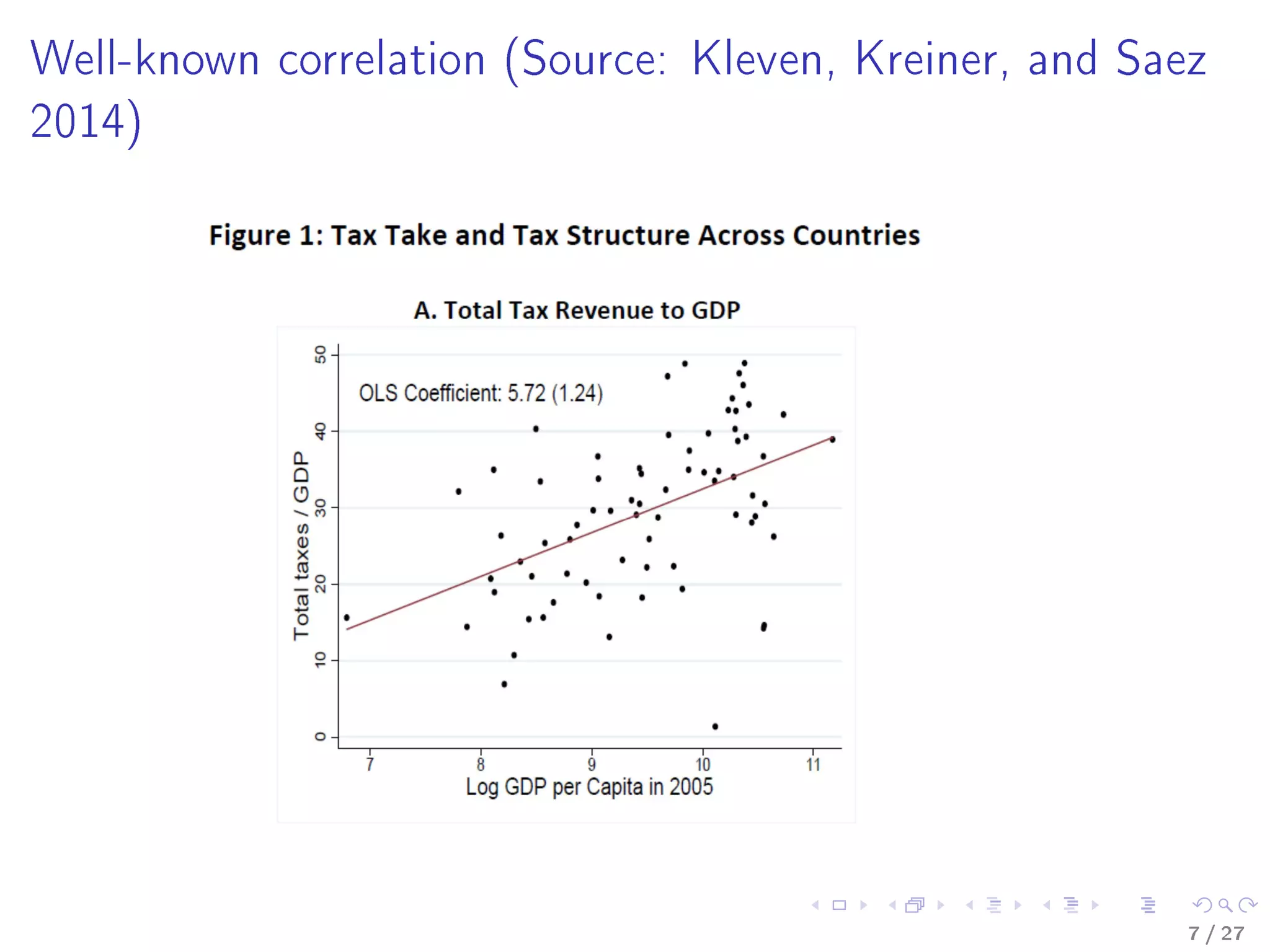
Well-known correlation (Source: Kleven, Kreiner, and Saez
2014)
7 / 27
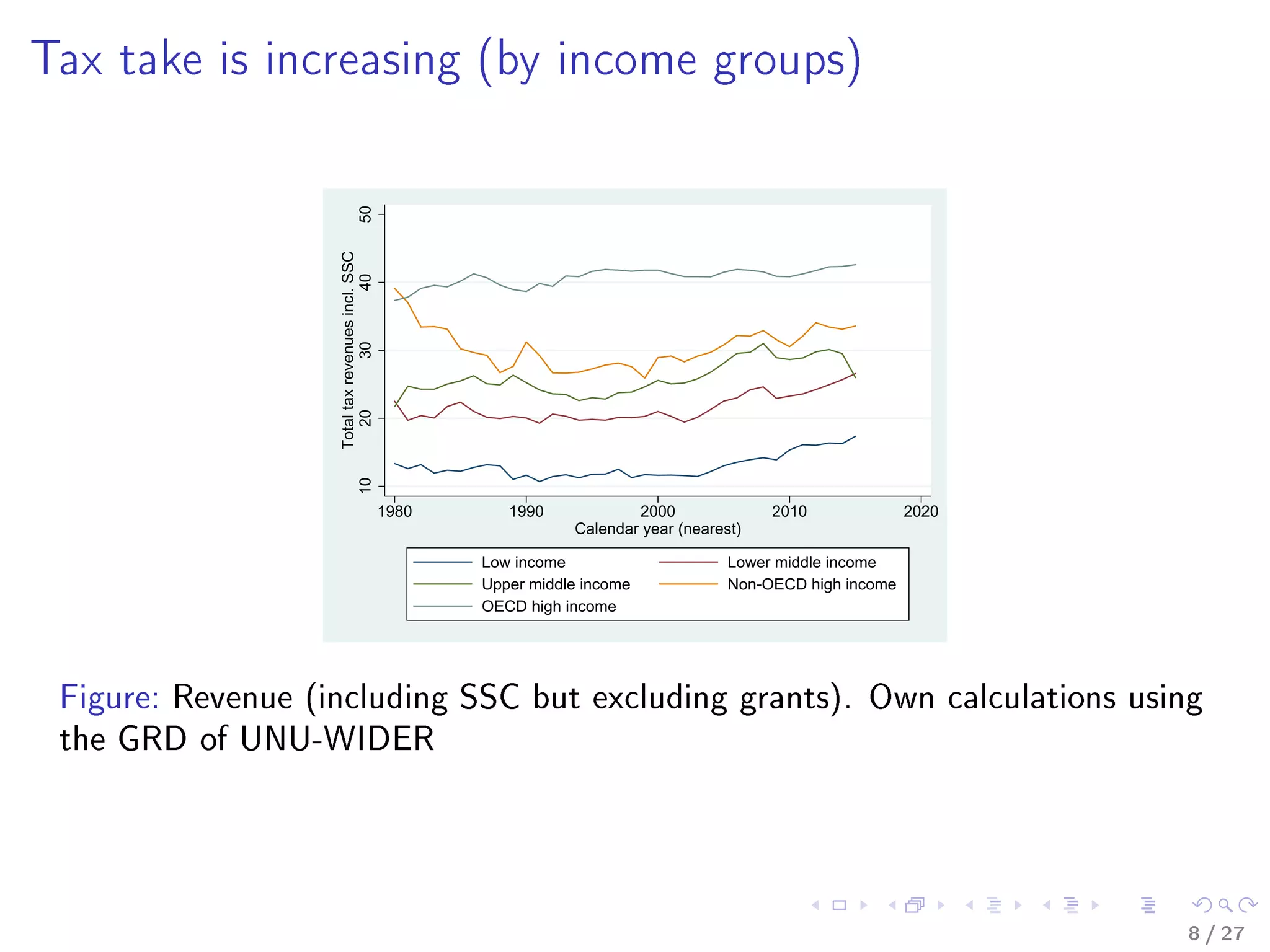
Tax take is increasing (by income groups)
1020304050
Totaltaxrevenuesincl.SSC
1980 1990 2000 2010 2020
Calendar year (nearest)
Low income Lower middle income
Upper middle income Non-OECD high income
OECD high income
Figure: Revenue (including SSC but excluding grants). Own calculations using
the GRD of UNU-WIDER
8 / 27
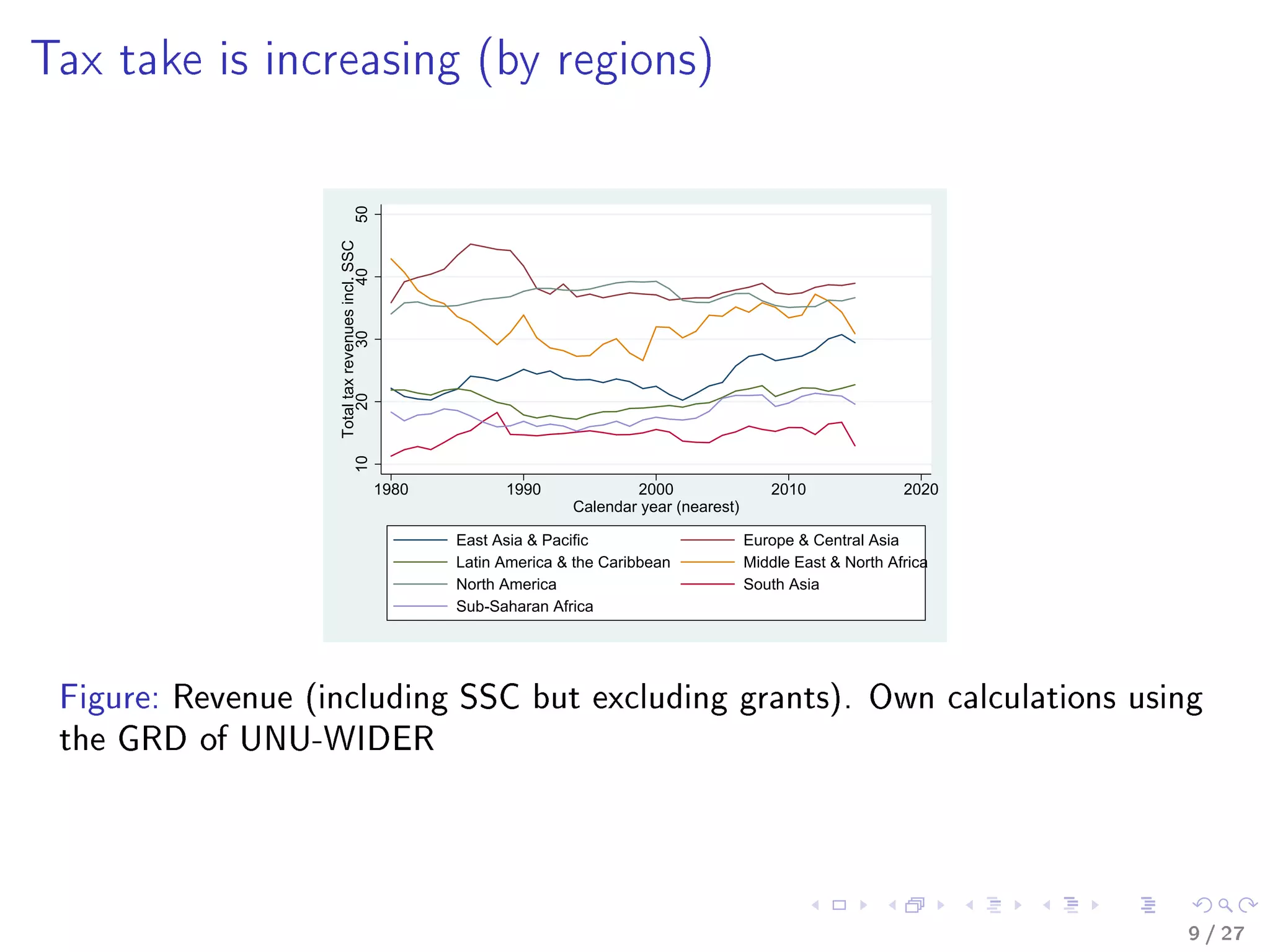
Tax take is increasing (by regions)
1020304050
Totaltaxrevenuesincl.SSC
1980 1990 2000 2010 2020
Calendar year (nearest)
East Asia  Pacific Europe  Central Asia
Latin America  the Caribbean Middle East  North Africa
North America South Asia
Sub-Saharan Africa
Figure: Revenue (including SSC but excluding grants). Own calculations using
the GRD of UNU-WIDER
9 / 27
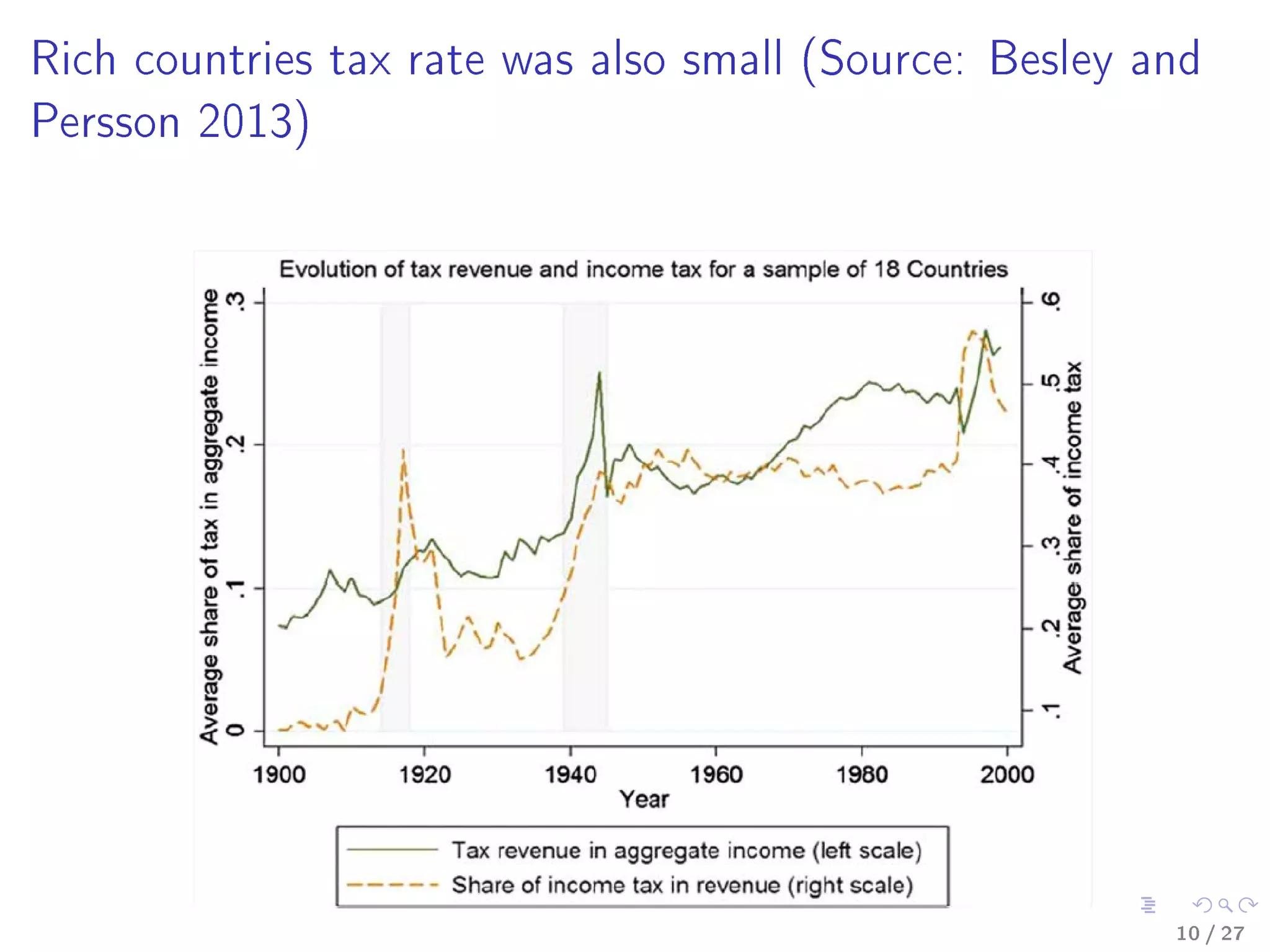
Rich countries tax rate was also small (Source: Besley and
Persson 2013)
10 / 27
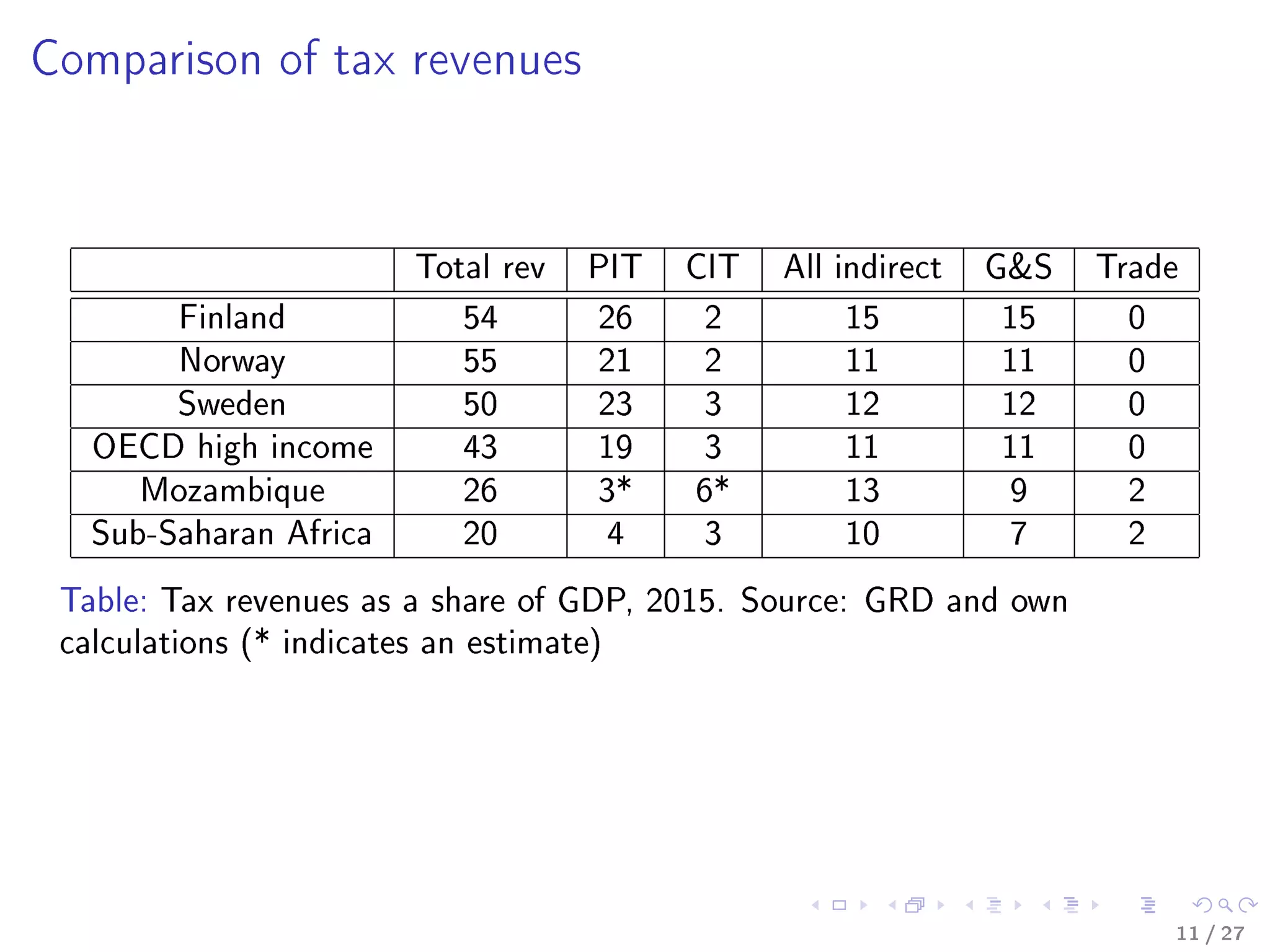
Comparison of tax revenues
Total rev PIT CIT All indirect GS Trade
Finland 54 26 2 15 15 0
Norway 55 21 2 11 11 0
Sweden 50 23 3 12 12 0
OECD high income 43 19 3 11 11 0
Mozambique 26 3* 6* 13 9 2
Sub-Saharan Africa 20 4 3 10 7 2
Table: Tax revenues as a share of GDP, 2015. Source: GRD and own
calculations (* indicates an estimate)
11 / 27
Outline
Introduction
Some data about taxation
Key features of Nordic tax systems
Conclusions
12 / 27
1. Broad tax base
The reaction of taxable income to changes in the tax rate is a good
way of measuring the overall distortions of taxes on the economy
Economists typically measure this as a elasticity (ETI):
It is dened as the proportional change in taxable income when the
take-home part (1-marginal tax rate) of income is increased by 1 per
cent
US estimates between 0.2-0.5. The response of broad income less
than that of taxable income
Some evidence that ETI is lower in Nordic countries (Kleven and
Schultz, 2014; Matikka, 2017)
In addition, the dierence in the elasticity of broad income and
taxable income is smaller, reecting wider tax base
13 / 27
2. Third-party reporting
In the Nordic countries, extensive third party reporting regarding
not only labour income, but also on many deductions and items of
capital income
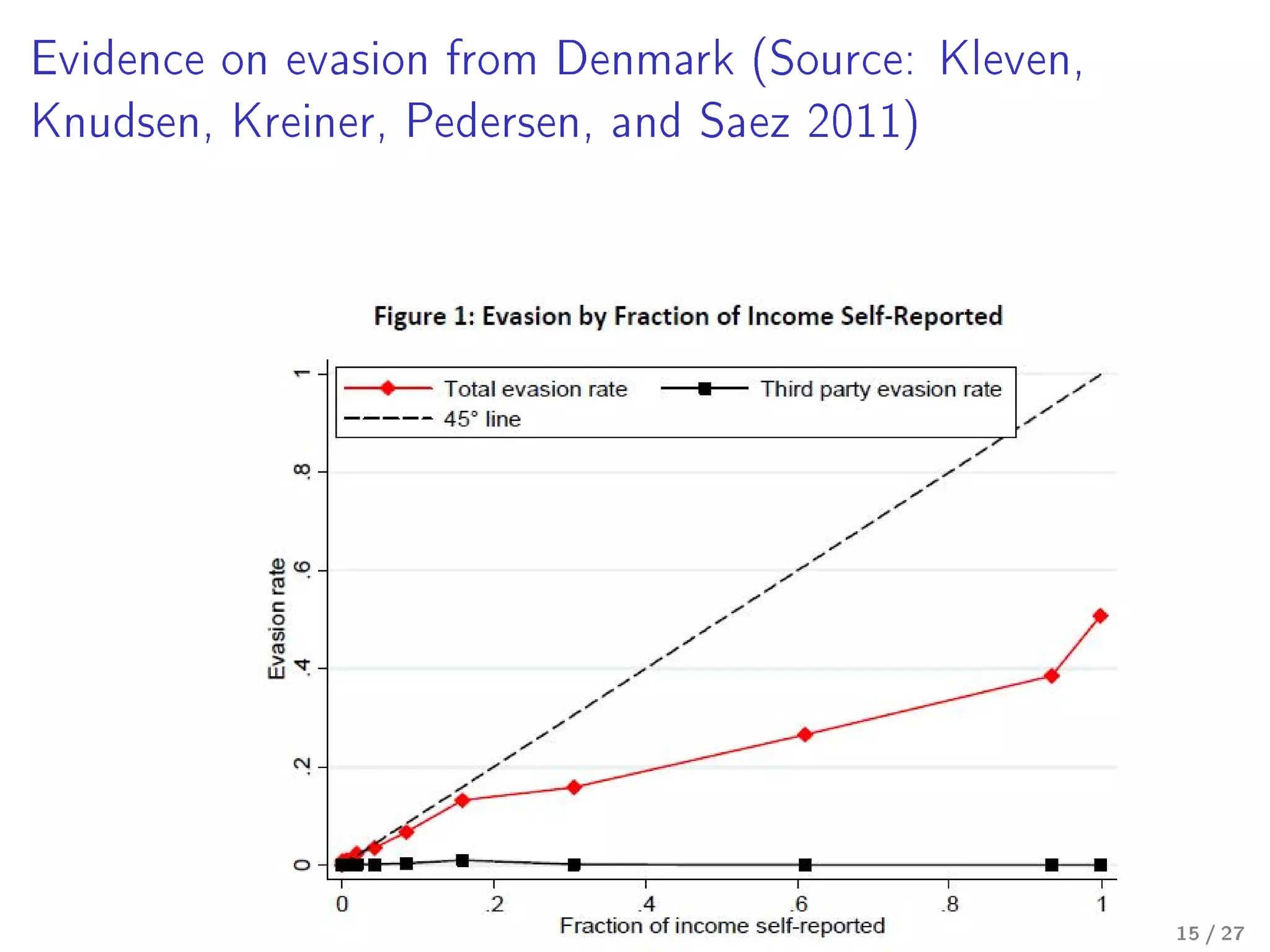
Kleven, Knudsen, Kreiner, Pedersen, and Saez (2011) show that
there is virtually no tax evasion for items that are third party
reported
Whereas there is signicant tax evasion on self-reported parts of the
tax bill
Third-party reporting crucial for minimizing tax evasion. The key
question is how to achieve it in developing countries
14 / 27
Evidence on evasion from Denmark (Source: Kleven,
Knudsen, Kreiner, Pedersen, and Saez 2011)
15 / 27
International tax evasion and the Nordic countries
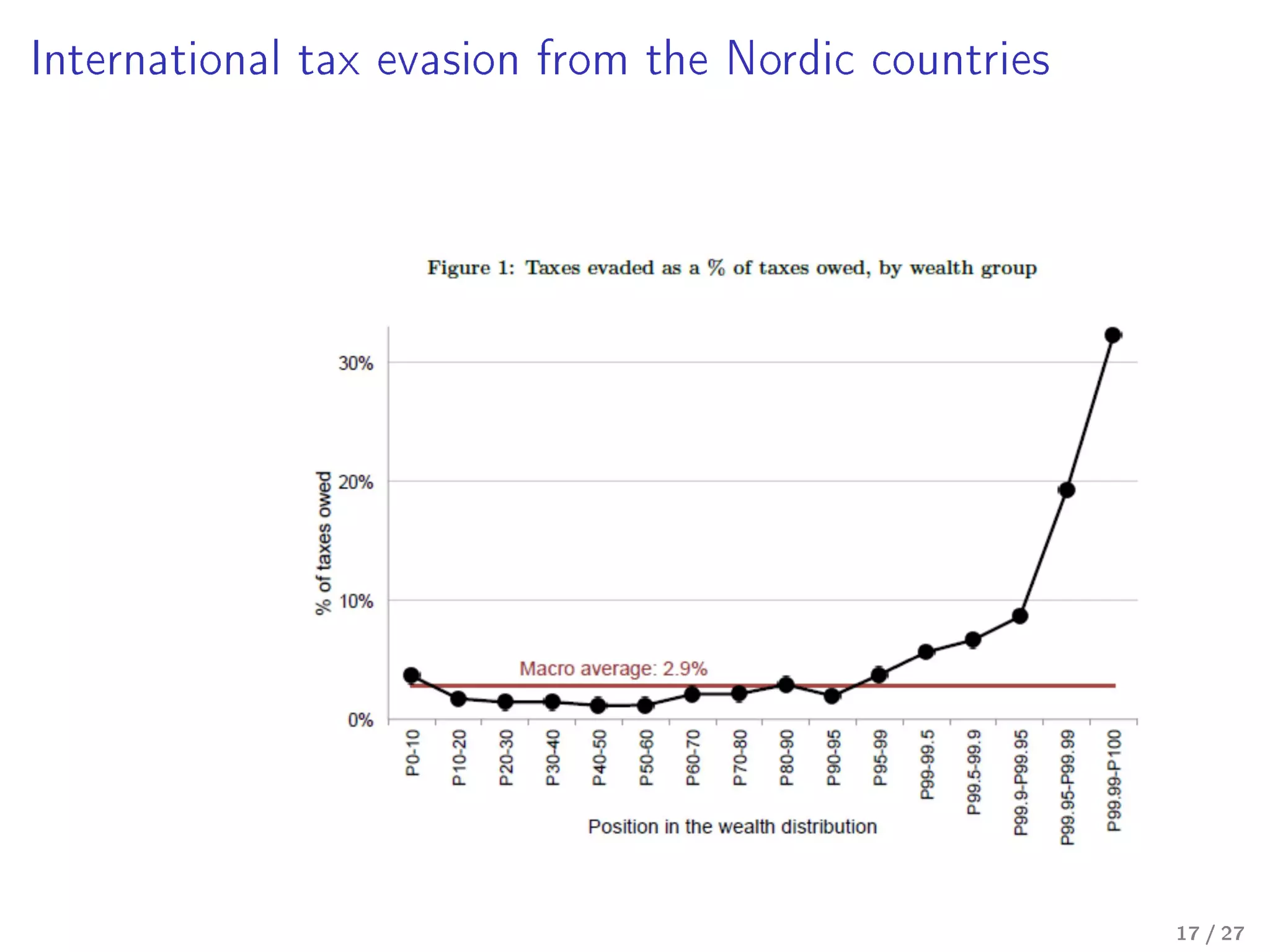
Alstadsaeter, Johannesen, and Zucman (2017) study how
individuals from three Nordic countries (Denmark, Norway, Sweden)
evade taxes using tax havens
They are able to do so by combining leaks information (like the
Panama papers) with data from revenue authorities
They show that there is a strong gradient in wealth
This information has not been (before) reported by third parties
16 / 27
International tax evasion from the Nordic countries
17 / 27
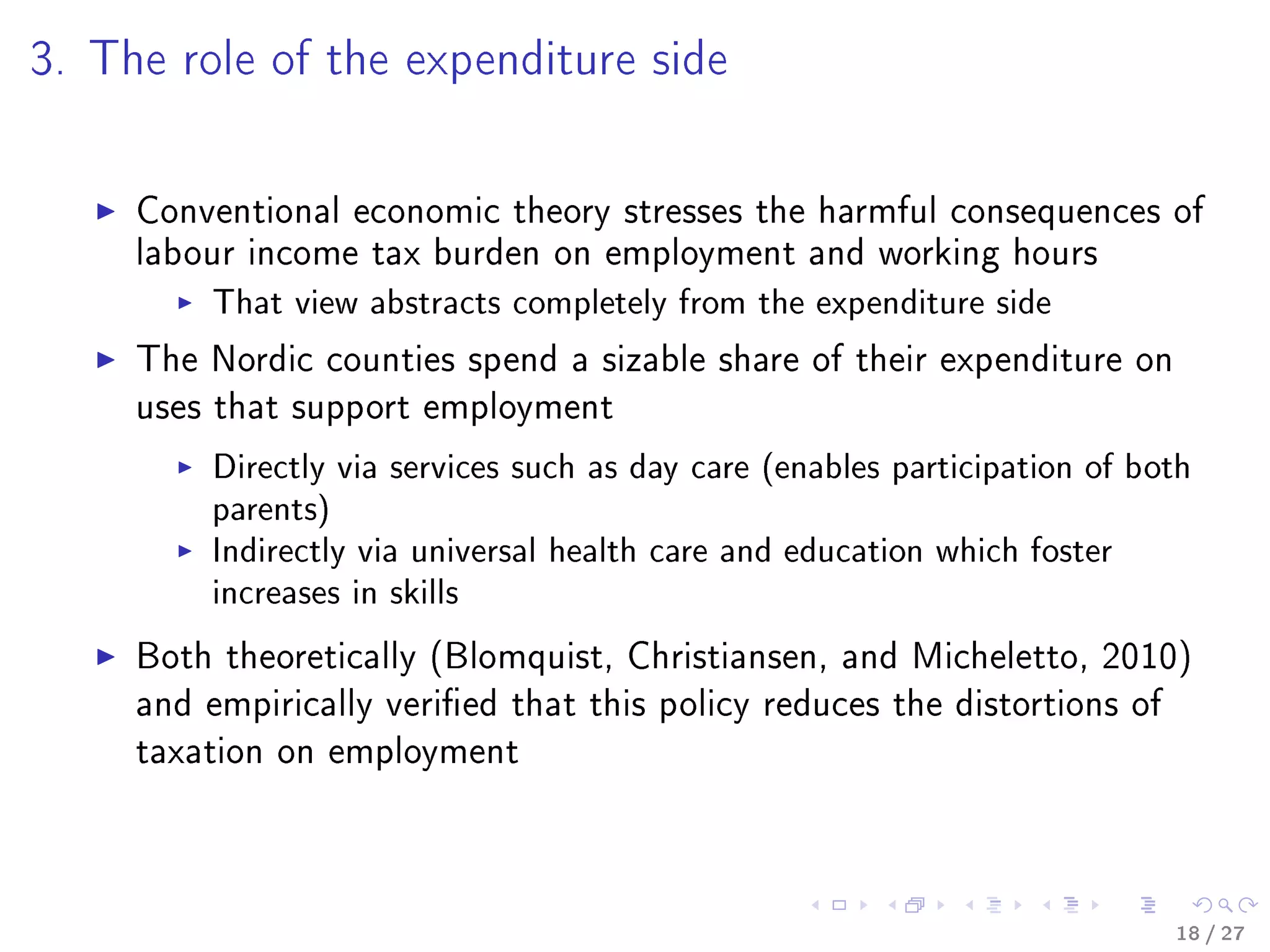
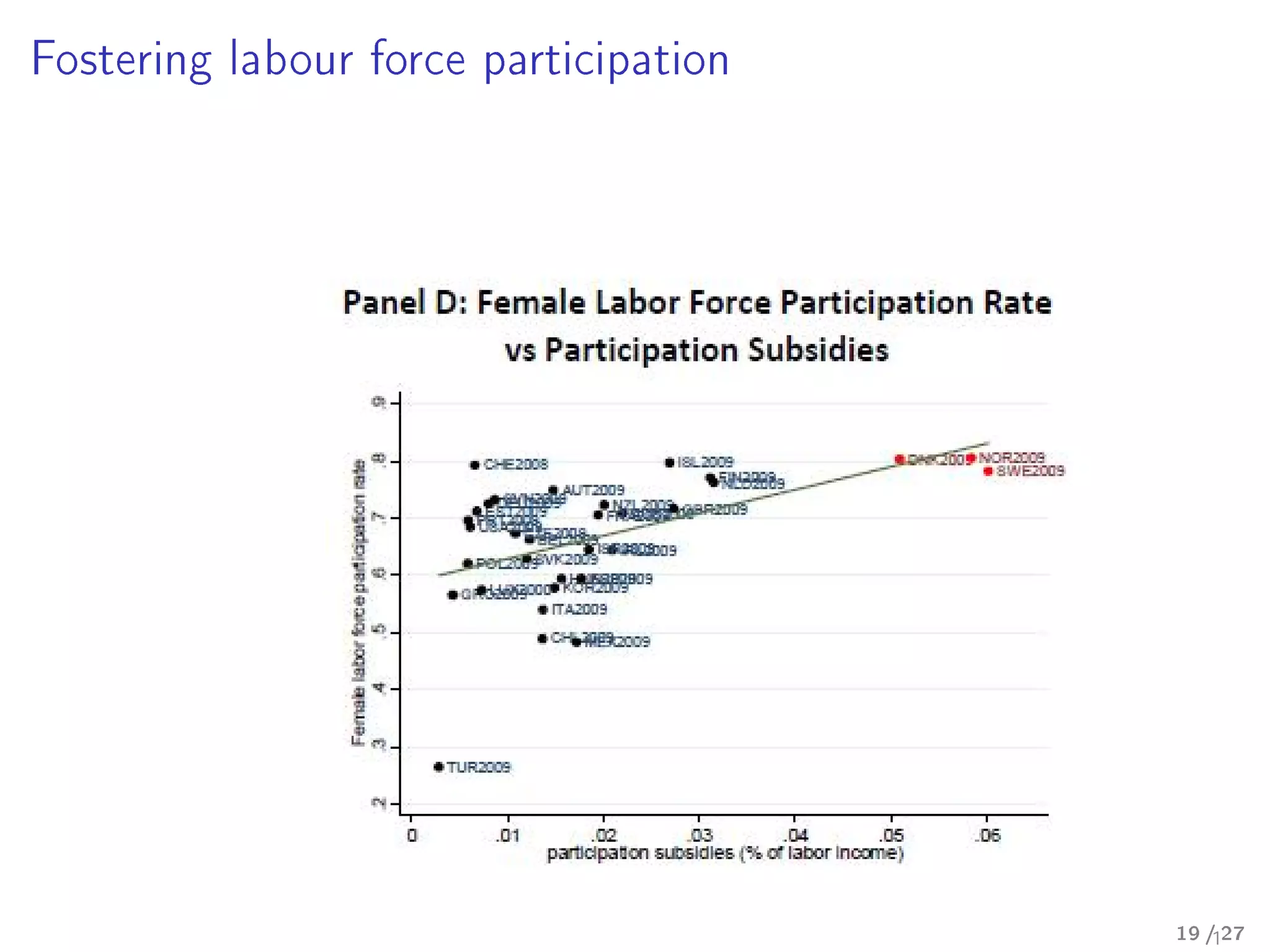
3. The role of the expenditure side
Conventional economic theory stresses the harmful consequences of
labour income tax burden on employment and working hours
That view abstracts completely from the expenditure side
The Nordic counties spend a sizable share of their expenditure on
uses that support employment
Directly via services such as day care (enables participation of both
parents)
Indirectly via universal health care and education which foster
increases in skills
Both theoretically (Blomquist, Christiansen, and Micheletto, 2010)
and empirically veried that this policy reduces the distortions of
taxation on employment
18 / 27
Fostering labour force participation
119 / 27
4. The role social norms
Scandinavians have a stronger-than-average-trust on others, and
enjoy high levels of social capital (measured by civic participation
and voter turnout)
correlated with willingness to pay for public goods and can matter
for tax compliance
They also believe that poverty is not predominantly due to laziness
of the poor but rather a results of a bad luck
this creates support for redistribution as the poor are seen as
deserving
These are strong correlations, but probably jointly determined
e.g. easier to trust others in a well-functioning state
20 / 27
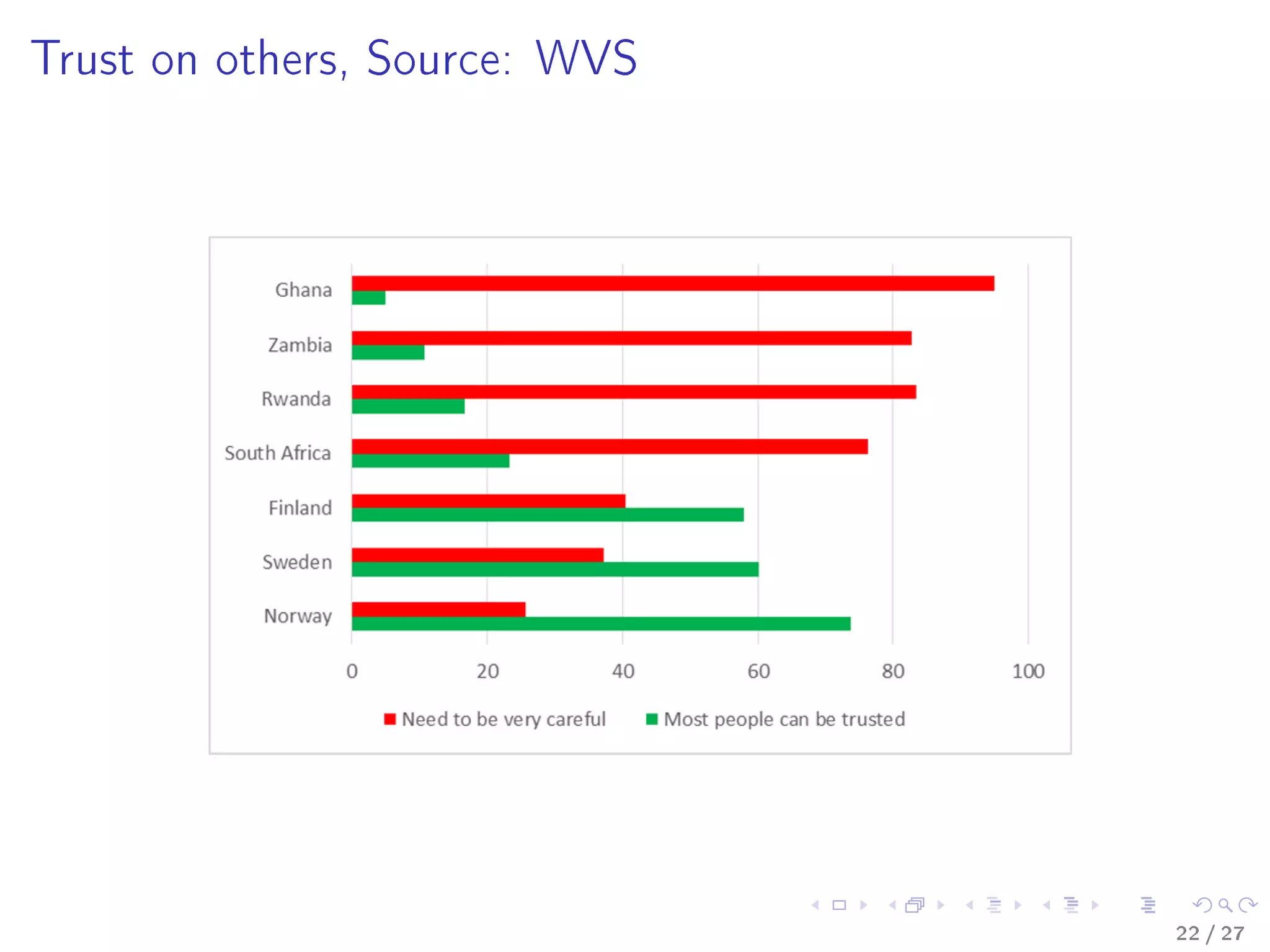
Trust on others
Data from World Values Survey, latest two waves
Question:
Generally speaking, would you say that most people can be trusted
or that you need to be very careful in dealing with people?
Choices:
Most people can be trusted
Need to be very careful
No answer
Do not know
21 / 27
Trust on others, Source: WVS
22 / 27
Outline
Introduction
Some data about taxation
Key features of Nordic tax systems
Conclusions
23 / 27
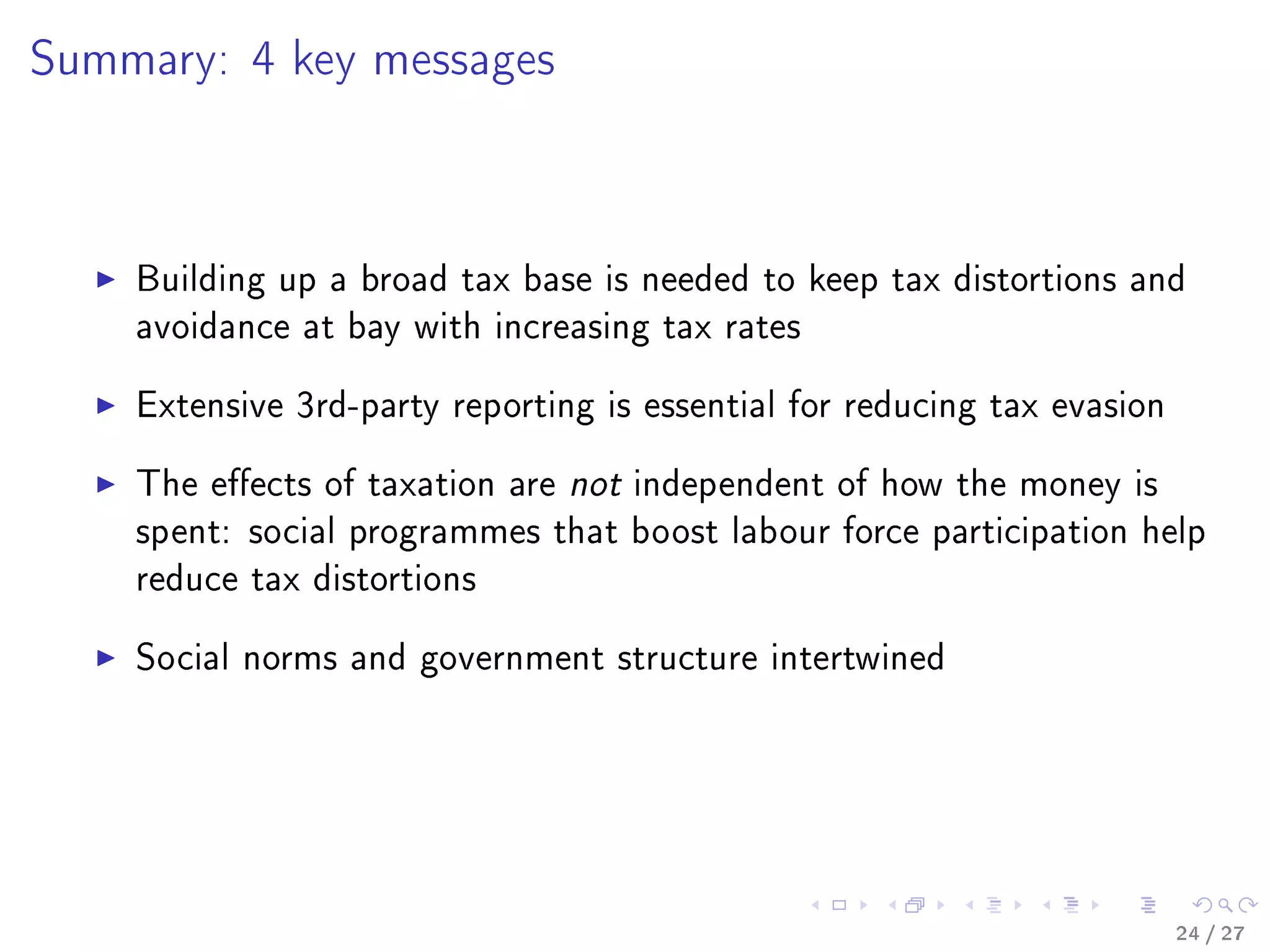
Summary: 4 key messages
Building up a broad tax base is needed to keep tax distortions and
avoidance at bay with increasing tax rates
Extensive 3rd-party reporting is essential for reducing tax evasion
The eects of taxation are not independent of how the money is
spent: social programmes that boost labour force participation help
reduce tax distortions
Social norms and government structure intertwined
24 / 27
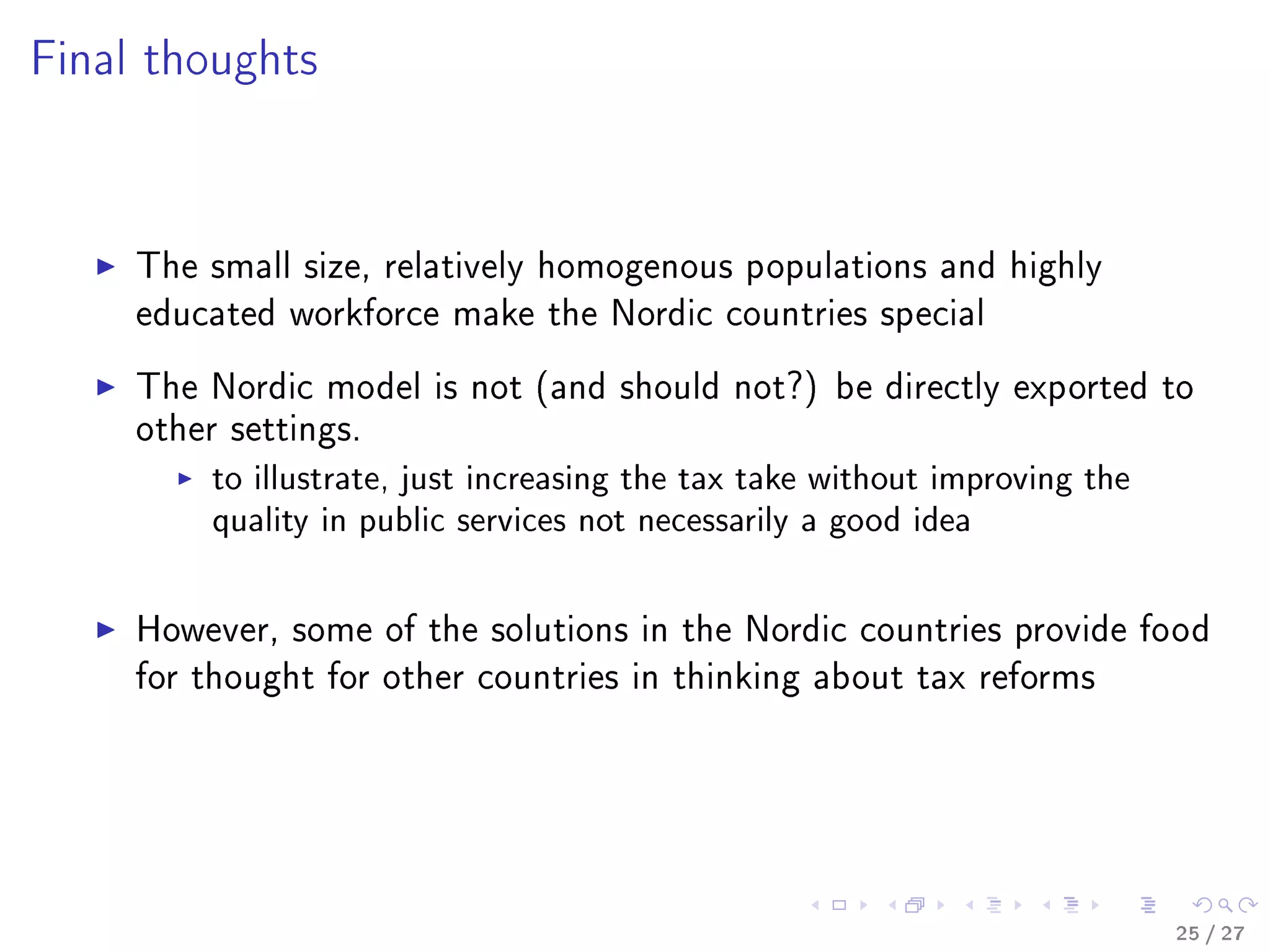
Final thoughts
The small size, relatively homogenous populations and highly
educated workforce make the Nordic countries special
The Nordic model is not (and should not?) be directly exported to
other settings.
to illustrate, just increasing the tax take without improving the
quality in public services not necessarily a good idea
However, some of the solutions in the Nordic countries provide food
for thought for other countries in thinking about tax reforms
25 / 27
References I
Alstadsaeter, A., N. Johannesen, and G. Zucman (2017): Tax evasion
and inequality, Mimeo, University of Copenhagen.
Besley, T., and T. Persson (2013): Chapter 2 - Taxation and
Development, in handbook of public economics, vol. 5, ed. by M. F.
Alan J. Auerbach, Raj Chetty, and E. Saez, vol. 5 of Handbook of
Public Economics, pp. 51  110. Elsevier.
Blomquist, S., V. Christiansen, and L. Micheletto (2010): Public
provision of private goods and nondistortionary marginal tax rates,
American Economic Journal: Economic Policy, 2, 127.
Kleven, H. (2014): How can Scandinavians tax so much?, Journal of
Economic Perspectives, 28(4), 7798.
Kleven, H. J., M. B. Knudsen, C. T. Kreiner, S. Pedersen, and E. Saez
(2011): Unwilling or Unable to Cheat? Evidence from a Tax Audit
Experiment in Denmark, Econometrica, 79, 651692.
26 / 27
References II
Kleven, H. J., C. T. Kreiner, and E. Saez (2014): Why Can Modern
Governments Tax So Much? An Agency Model of Firms as Fiscal
Intermediaries, Mimeo, University of Copenhagen.
Kleven, H. J., and E. A. Schultz (2014): Estimating Taxable Income
Responses Using Danish Tax Reforms, American Economic Journal:
Economic Policy, 6(4), 271301.
Matikka, T. (2017): The Elasticity of Taxable Income: Evidence from
Changes in Municipal Income Tax Rates in Finland, The
Scandinavian Journal of Economics, pp. n/an/a.
27 / 27

Building up tax systems: lessons from the Nordic countries

  • 1.
    Building up TaxSystems: Lessons from the Nordic Countries Jukka Pirttilä (University of Tampere and UNU-WIDER) Embassy of Finland and UNU-WIDER Seminar, Maputo, 7 July 2017 1 / 27
  • 2.
    Outline Introduction Some data abouttaxation Key features of Nordic tax systems Conclusions 2 / 27
  • 3.
    Motivation Developing countries likeMozambique need to raise a sucient amount of revenues to nance poverty reduction and to ght inequality How could their tax capacity be improved? Nordic countries, in turn, have very high tax/GDP ratios some would say too high Conventional economics: heavy tax burden creates distortions to the economy (savings, employment reduced) How can these countries still maintain high income levels? 3 / 27
  • 4.
    The purpose ofthis talk Review briey some key features of the tax structure and tax systems in Nordic countries To understand how taxes can be so high in the Nordic countries To provide food for thought for reforming tax systems in developing and emerging economies Especially if and when these countries aim to increase their tax revenues Much of the material draws on recent survey by Kleven (2014) Discussion: can these tax solutions be exported? should they be exported? 4 / 27
  • 5.
    Outline Introduction Some data abouttaxation Key features of Nordic tax systems Conclusions 5 / 27
  • 6.
    Outline Introduction Some data abouttaxation Key features of Nordic tax systems Conclusions 6 / 27
  • 7.
    Well-known correlation (Source:Kleven, Kreiner, and Saez 2014) 7 / 27
  • 8.
    Tax take isincreasing (by income groups) 1020304050 Totaltaxrevenuesincl.SSC 1980 1990 2000 2010 2020 Calendar year (nearest) Low income Lower middle income Upper middle income Non-OECD high income OECD high income Figure: Revenue (including SSC but excluding grants). Own calculations using the GRD of UNU-WIDER 8 / 27
  • 9.
    Tax take isincreasing (by regions) 1020304050 Totaltaxrevenuesincl.SSC 1980 1990 2000 2010 2020 Calendar year (nearest) East Asia Pacific Europe Central Asia Latin America the Caribbean Middle East North Africa North America South Asia Sub-Saharan Africa Figure: Revenue (including SSC but excluding grants). Own calculations using the GRD of UNU-WIDER 9 / 27
  • 10.
    Rich countries taxrate was also small (Source: Besley and Persson 2013) 10 / 27
  • 11.
    Comparison of taxrevenues Total rev PIT CIT All indirect GS Trade Finland 54 26 2 15 15 0 Norway 55 21 2 11 11 0 Sweden 50 23 3 12 12 0 OECD high income 43 19 3 11 11 0 Mozambique 26 3* 6* 13 9 2 Sub-Saharan Africa 20 4 3 10 7 2 Table: Tax revenues as a share of GDP, 2015. Source: GRD and own calculations (* indicates an estimate) 11 / 27
  • 12.
    Outline Introduction Some data abouttaxation Key features of Nordic tax systems Conclusions 12 / 27
  • 13.
    1. Broad taxbase The reaction of taxable income to changes in the tax rate is a good way of measuring the overall distortions of taxes on the economy Economists typically measure this as a elasticity (ETI): It is dened as the proportional change in taxable income when the take-home part (1-marginal tax rate) of income is increased by 1 per cent US estimates between 0.2-0.5. The response of broad income less than that of taxable income Some evidence that ETI is lower in Nordic countries (Kleven and Schultz, 2014; Matikka, 2017) In addition, the dierence in the elasticity of broad income and taxable income is smaller, reecting wider tax base 13 / 27
  • 14.
    2. Third-party reporting Inthe Nordic countries, extensive third party reporting regarding not only labour income, but also on many deductions and items of capital income Kleven, Knudsen, Kreiner, Pedersen, and Saez (2011) show that there is virtually no tax evasion for items that are third party reported Whereas there is signicant tax evasion on self-reported parts of the tax bill Third-party reporting crucial for minimizing tax evasion. The key question is how to achieve it in developing countries 14 / 27
  • 15.
    Evidence on evasionfrom Denmark (Source: Kleven, Knudsen, Kreiner, Pedersen, and Saez 2011) 15 / 27
  • 16.
    International tax evasionand the Nordic countries Alstadsaeter, Johannesen, and Zucman (2017) study how individuals from three Nordic countries (Denmark, Norway, Sweden) evade taxes using tax havens They are able to do so by combining leaks information (like the Panama papers) with data from revenue authorities They show that there is a strong gradient in wealth This information has not been (before) reported by third parties 16 / 27
  • 17.
    International tax evasionfrom the Nordic countries 17 / 27
  • 18.
    3. The roleof the expenditure side Conventional economic theory stresses the harmful consequences of labour income tax burden on employment and working hours That view abstracts completely from the expenditure side The Nordic counties spend a sizable share of their expenditure on uses that support employment Directly via services such as day care (enables participation of both parents) Indirectly via universal health care and education which foster increases in skills Both theoretically (Blomquist, Christiansen, and Micheletto, 2010) and empirically veried that this policy reduces the distortions of taxation on employment 18 / 27
  • 19.
    Fostering labour forceparticipation 119 / 27
  • 20.
    4. The rolesocial norms Scandinavians have a stronger-than-average-trust on others, and enjoy high levels of social capital (measured by civic participation and voter turnout) correlated with willingness to pay for public goods and can matter for tax compliance They also believe that poverty is not predominantly due to laziness of the poor but rather a results of a bad luck this creates support for redistribution as the poor are seen as deserving These are strong correlations, but probably jointly determined e.g. easier to trust others in a well-functioning state 20 / 27
  • 21.
    Trust on others Datafrom World Values Survey, latest two waves Question: Generally speaking, would you say that most people can be trusted or that you need to be very careful in dealing with people? Choices: Most people can be trusted Need to be very careful No answer Do not know 21 / 27
  • 22.
    Trust on others,Source: WVS 22 / 27
  • 23.
    Outline Introduction Some data abouttaxation Key features of Nordic tax systems Conclusions 23 / 27
  • 24.
    Summary: 4 keymessages Building up a broad tax base is needed to keep tax distortions and avoidance at bay with increasing tax rates Extensive 3rd-party reporting is essential for reducing tax evasion The eects of taxation are not independent of how the money is spent: social programmes that boost labour force participation help reduce tax distortions Social norms and government structure intertwined 24 / 27
  • 25.
    Final thoughts The smallsize, relatively homogenous populations and highly educated workforce make the Nordic countries special The Nordic model is not (and should not?) be directly exported to other settings. to illustrate, just increasing the tax take without improving the quality in public services not necessarily a good idea However, some of the solutions in the Nordic countries provide food for thought for other countries in thinking about tax reforms 25 / 27
  • 26.
    References I Alstadsaeter, A.,N. Johannesen, and G. Zucman (2017): Tax evasion and inequality, Mimeo, University of Copenhagen. Besley, T., and T. Persson (2013): Chapter 2 - Taxation and Development, in handbook of public economics, vol. 5, ed. by M. F. Alan J. Auerbach, Raj Chetty, and E. Saez, vol. 5 of Handbook of Public Economics, pp. 51 110. Elsevier. Blomquist, S., V. Christiansen, and L. Micheletto (2010): Public provision of private goods and nondistortionary marginal tax rates, American Economic Journal: Economic Policy, 2, 127. Kleven, H. (2014): How can Scandinavians tax so much?, Journal of Economic Perspectives, 28(4), 7798. Kleven, H. J., M. B. Knudsen, C. T. Kreiner, S. Pedersen, and E. Saez (2011): Unwilling or Unable to Cheat? Evidence from a Tax Audit Experiment in Denmark, Econometrica, 79, 651692. 26 / 27
  • 27.
    References II Kleven, H.J., C. T. Kreiner, and E. Saez (2014): Why Can Modern Governments Tax So Much? An Agency Model of Firms as Fiscal Intermediaries, Mimeo, University of Copenhagen. Kleven, H. J., and E. A. Schultz (2014): Estimating Taxable Income Responses Using Danish Tax Reforms, American Economic Journal: Economic Policy, 6(4), 271301. Matikka, T. (2017): The Elasticity of Taxable Income: Evidence from Changes in Municipal Income Tax Rates in Finland, The Scandinavian Journal of Economics, pp. n/an/a. 27 / 27