Building the Data Warehouse 3rd Edition W. H. Inmon
Building the Data Warehouse 3rd Edition W. H. Inmon
Building the Data Warehouse 3rd Edition W. H. Inmon
Building the Data Warehouse 3rd Edition W. H. Inmon
Building the Data Warehouse 3rd Edition W. H. Inmon
1.
Building the DataWarehouse 3rd Edition W. H.
Inmon download
https://ebookultra.com/download/building-the-data-warehouse-3rd-
edition-w-h-inmon/
Explore and download more ebooks or textbooks
at ebookultra.com
2.
Here are somerecommended products for you. Click the link to
download, or explore more at ebookultra.com
The Microsoft Data Warehouse Toolkit With SQL Server 2008
R2 and the Microsoft Business Intelligence Toolset 2nd
edition Edition Kimball
https://ebookultra.com/download/the-microsoft-data-warehouse-toolkit-
with-sql-server-2008-r2-and-the-microsoft-business-intelligence-
toolset-2nd-edition-edition-kimball/
SAP Business Information Warehouse Reporting Building
Better BI with SAP BI 7 0 1st Edition Peter Jones
https://ebookultra.com/download/sap-business-information-warehouse-
reporting-building-better-bi-with-sap-bi-7-0-1st-edition-peter-jones/
Fortifications of the Incas First Edition H. W. Kaufmann
https://ebookultra.com/download/fortifications-of-the-incas-first-
edition-h-w-kaufmann/
The Infinite 3rd Edition A. W. Moore
https://ebookultra.com/download/the-infinite-3rd-edition-a-w-moore/
3.
Plant Biochemistry 4edEdition Heldt H.-W.
https://ebookultra.com/download/plant-biochemistry-4ed-edition-heldt-
h-w/
Andrew Jackson 1st Edition H. W. Brands
https://ebookultra.com/download/andrew-jackson-1st-edition-h-w-brands/
Network Security Through Data Analysis Building
Situational Awareness 1st Edition Michael Collins
https://ebookultra.com/download/network-security-through-data-
analysis-building-situational-awareness-1st-edition-michael-collins/
The Data Game Controversies in Social Science Statistics
4th Edition Mark H. Maier
https://ebookultra.com/download/the-data-game-controversies-in-social-
science-statistics-4th-edition-mark-h-maier/
Building Contract Dictionary 3rd ed Edition David Chappell
https://ebookultra.com/download/building-contract-dictionary-3rd-ed-
edition-david-chappell/
5.
Building the DataWarehouse 3rd Edition W. H. Inmon
Digital Instant Download
Author(s): W. H. Inmon
ISBN(s): 9780471270485, 0471270482
Edition: 3
File Details: PDF, 1.46 MB
Year: 2002
Language: english
7.
John Wiley &Sons, Inc.
NEW YORK • CHICHESTER • WEINHEIM • BRISBANE • SINGAPORE • TORONTO
Wiley Computer Publishing
W. H. Inmon
Building the
Data Warehouse
Third Edition
John Wiley &Sons, Inc.
NEW YORK • CHICHESTER • WEINHEIM • BRISBANE • SINGAPORE • TORONTO
Wiley Computer Publishing
W. H. Inmon
Building the
Data Warehouse
Third Edition
CO NTE NTS
Prefacefor the Second Edition xiii
Preface for the Third Edition xiv
Acknowledgments xix
About the Author xx
Chapter 1 Evolution of Decision Support Systems 1
The Evolution 2
The Advent of DASD 4
PC/4GL Technology 4
Enter the Extract Program 5
The Spider Web 6
Problems with the Naturally Evolving Architecture 6
Lack of Data Credibility 6
Problems with Productivity 9
From Data to Information 12
A Change in Approach 15
The Architected Environment 16
Data Integration in the Architected Environment 19
Who Is the User? 19
The Development Life Cycle 21
Patterns of Hardware Utilization 22
Setting the Stage for Reengineering 23
Monitoring the Data Warehouse Environment 25
Summary 28
Chapter 2 The Data Warehouse Environment 31
The Structure of the Data Warehouse 35
Subject Orientation 36
Day 1-Day n Phenomenon 41
Granularity 43
The Benefits of Granularity 45
An Example of Granularity 46
Dual Levels of Granularity 49
vii
16.
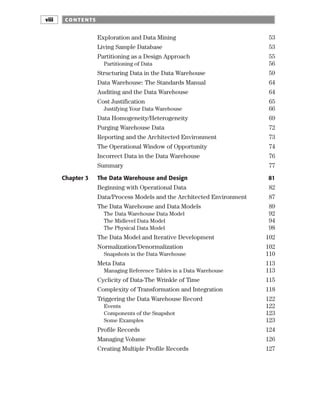
Exploration and DataMining 53
Living Sample Database 53
Partitioning as a Design Approach 55
Partitioning of Data 56
Structuring Data in the Data Warehouse 59
Data Warehouse: The Standards Manual 64
Auditing and the Data Warehouse 64
Cost Justification 65
Justifying Your Data Warehouse 66
Data Homogeneity/Heterogeneity 69
Purging Warehouse Data 72
Reporting and the Architected Environment 73
The Operational Window of Opportunity 74
Incorrect Data in the Data Warehouse 76
Summary 77
Chapter 3 The Data Warehouse and Design 81
Beginning with Operational Data 82
Data/Process Models and the Architected Environment 87
The Data Warehouse and Data Models 89
The Data Warehouse Data Model 92
The Midlevel Data Model 94
The Physical Data Model 98
The Data Model and Iterative Development 102
Normalization/Denormalization 102
Snapshots in the Data Warehouse 110
Meta Data 113
Managing Reference Tables in a Data Warehouse 113
Cyclicity of Data-The Wrinkle of Time 115
Complexity of Transformation and Integration 118
Triggering the Data Warehouse Record 122
Events 122
Components of the Snapshot 123
Some Examples 123
Profile Records 124
Managing Volume 126
Creating Multiple Profile Records 127
CO NTE NTS
viii
17.
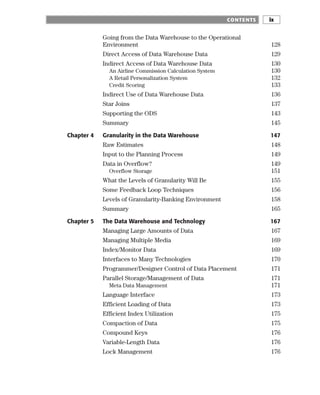
Going from theData Warehouse to the Operational
Environment 128
Direct Access of Data Warehouse Data 129
Indirect Access of Data Warehouse Data 130
An Airline Commission Calculation System 130
A Retail Personalization System 132
Credit Scoring 133
Indirect Use of Data Warehouse Data 136
Star Joins 137
Supporting the ODS 143
Summary 145
Chapter 4 Granularity in the Data Warehouse 147
Raw Estimates 148
Input to the Planning Process 149
Data in Overflow? 149
Overflow Storage 151
What the Levels of Granularity Will Be 155
Some Feedback Loop Techniques 156
Levels of Granularity-Banking Environment 158
Summary 165
Chapter 5 The Data Warehouse and Technology 167
Managing Large Amounts of Data 167
Managing Multiple Media 169
Index/Monitor Data 169
Interfaces to Many Technologies 170
Programmer/Designer Control of Data Placement 171
Parallel Storage/Management of Data 171
Meta Data Management 171
Language Interface 173
Efficient Loading of Data 173
Efficient Index Utilization 175
Compaction of Data 175
Compound Keys 176
Variable-Length Data 176
Lock Management 176
CONTENTS ix
18.
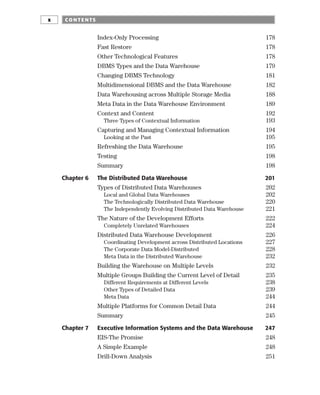
Index-Only Processing 178
FastRestore 178
Other Technological Features 178
DBMS Types and the Data Warehouse 179
Changing DBMS Technology 181
Multidimensional DBMS and the Data Warehouse 182
Data Warehousing across Multiple Storage Media 188
Meta Data in the Data Warehouse Environment 189
Context and Content 192
Three Types of Contextual Information 193
Capturing and Managing Contextual Information 194
Looking at the Past 195
Refreshing the Data Warehouse 195
Testing 198
Summary 198
Chapter 6 The Distributed Data Warehouse 201
Types of Distributed Data Warehouses 202
Local and Global Data Warehouses 202
The Technologically Distributed Data Warehouse 220
The Independently Evolving Distributed Data Warehouse 221
The Nature of the Development Efforts 222
Completely Unrelated Warehouses 224
Distributed Data Warehouse Development 226
Coordinating Development across Distributed Locations 227
The Corporate Data Model-Distributed 228
Meta Data in the Distributed Warehouse 232
Building the Warehouse on Multiple Levels 232
Multiple Groups Building the Current Level of Detail 235
Different Requirements at Different Levels 238
Other Types of Detailed Data 239
Meta Data 244
Multiple Platforms for Common Detail Data 244
Summary 245
Chapter 7 Executive Information Systems and the Data Warehouse 247
EIS-The Promise 248
A Simple Example 248
Drill-Down Analysis 251
CO NTE NTS
x
19.
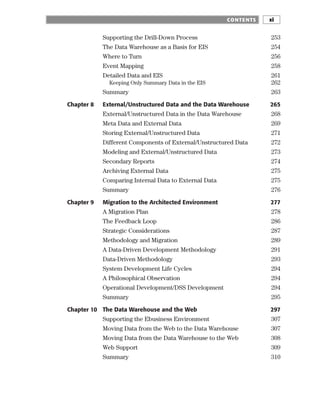
Supporting the Drill-DownProcess 253
The Data Warehouse as a Basis for EIS 254
Where to Turn 256
Event Mapping 258
Detailed Data and EIS 261
Keeping Only Summary Data in the EIS 262
Summary 263
Chapter 8 External/Unstructured Data and the Data Warehouse 265
External/Unstructured Data in the Data Warehouse 268
Meta Data and External Data 269
Storing External/Unstructured Data 271
Different Components of External/Unstructured Data 272
Modeling and External/Unstructured Data 273
Secondary Reports 274
Archiving External Data 275
Comparing Internal Data to External Data 275
Summary 276
Chapter 9 Migration to the Architected Environment 277
A Migration Plan 278
The Feedback Loop 286
Strategic Considerations 287
Methodology and Migration 289
A Data-Driven Development Methodology 291
Data-Driven Methodology 293
System Development Life Cycles 294
A Philosophical Observation 294
Operational Development/DSS Development 294
Summary 295
Chapter 10 The Data Warehouse and the Web 297
Supporting the Ebusiness Environment 307
Moving Data from the Web to the Data Warehouse 307
Moving Data from the Data Warehouse to the Web 308
Web Support 309
Summary 310
CONTENTS xi
20.
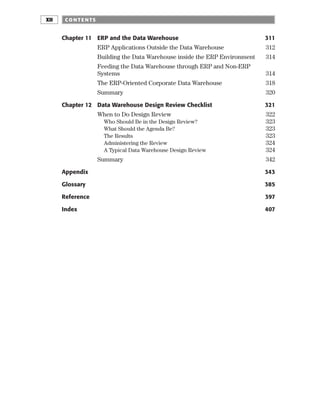
Chapter 11 ERPand the Data Warehouse 311
ERP Applications Outside the Data Warehouse 312
Building the Data Warehouse inside the ERP Environment 314
Feeding the Data Warehouse through ERP and Non-ERP
Systems 314
The ERP-Oriented Corporate Data Warehouse 318
Summary 320
Chapter 12 Data Warehouse Design Review Checklist 321
When to Do Design Review 322
Who Should Be in the Design Review? 323
What Should the Agenda Be? 323
The Results 323
Administering the Review 324
A Typical Data Warehouse Design Review 324
Summary 342
Appendix 343
Glossary 385
Reference 397
Index 407
CO NTE NTS
XII
smashed. I tookthe piece to a dealer in such articles, and he not
only confirmed me in my suspicion, but showed me a complete
casket of the same style of workmanship. It was a small thing, about
six inches long by four broad, and might be used, the dealer said,
for holding either jewels or money. They were very expensive, and
but few were sold. This last bit of information I found to be correct,
for after going over all the dealers in such articles in Edinburgh I
could not find one who had sold a casket answering the description
of the fragment I had found. I wished to find the owner for a
particular reason. In examining the ivory one day it struck me that it
had a smoked appearance—a kind of dingy hue which could never
have been imparted by simply lying among soot. How could it have
got that tinge? Not by being thrown into the fire, for there was not a
burn on the whole fragment. Could Sandy have hung it up his own
chimney like a red herring or a ham to give it that colour, or had it
been so tinged when it came into his possession? The chimney in
Sandy’s house had been the place which we searched most
rigorously, so I was tolerably certain that he had no other interesting
herrings there in pickle. I thought the owner of the bit of ivory and
brass might help me to an answer, and at length decided to
advertise for him. “An Ivory Casket, Carved,” was notified in the
newspapers as having been found, and the owner was requested to
call without delay upon me. The day that this advertisement
appeared, Sandy called at Mrs Nolten’s house in George Square, and
asked permission to go up on the roof to get a rope which he
believed he had left there on his last visit. The request was put
before the lady of the house, and promptly refused. Sandy then
went to the next house and made the same request, and received as
23.
prompt a refusal.After the second appearance of the advertisement,
a gentleman named Dundas called, and requested to see the “Ivory
Casket.” There was a strange reserve about him, which I only
understood when in confidence he imparted to me the suspicion that
his own son had been the robber, at the same time emphatically
stating that he was firmly resolved not to give in any charge against
the runaway. On being shown the fragment, he identified it as part
of the lid of an ivory casket stolen from his house, and containing at
that time nearly £10 in gold and silver. The casket had not been
missed till after the flight of his son, who had left a good situation
and gone to London with the craze strong upon him to be an actor. I
found, however, that Mr Dundas had a distinct recollection of
employing Sandy to sweep his chimneys about that time, and as six
months had since elapsed, Sandy had been there on the same
errand but a month or two ago. On calling the gentleman’s attention
to the smoky appearance of the ivory, he declared that it had not
been so tinged when in his possession, and spontaneously
remarked—
“It must have been hanging in some chimney.”
In a chimney certainly, but what chimney? whose chimney? I
revolved the matter in my mind, and at length concluded that Sandy
would never have been foolhardy enough to conceal anything in his
own chimney. And yet there was pretty palpable evidence that the
stolen article had been in a chimney.
After half a day’s cogitation, an idea struck me which gave such a
feasible explanation of the thing that my only wonder is that it did
not occur to me earlier. Sandy, if he wanted a chimney as a hide,
was not limited in his choice to one or twenty. He visited some at
24.
regular intervals, andwas in these cases the only man employed.
What was to hinder him from using them boldly as establishments of
his own? depots for goods which he could not conveniently store at
home? I began to wonder how I could get hold of a list of these
houses that I might inspect the chimneys. In sweeping a chimney it
was often necessary for Sandy to lift out the grate, when it was
what is known as a “Register,” and it seemed to me that in doing so
he could easily make use of the space behind as a hide when the
grate was put back; but in making this guess it will be found that I
gave Sandy credit for less ingenuity than he possessed. While Mr
Dundas was diligently hunting for the address of his runaway son,
that he might fairly ask him if he had been the thief of the casket
and its contents, I was ferreting out the most prominent of Sandy’s
customers. In making the round of these it is singular, but true, that
I never thought of calling at Mrs Nolten’s, and when I did find myself
there, it was more by accident than from choice. Being on the spot
one day, I thought I would go in and have the register grate lifted
out; but when this had been done in presence of the lady and
myself, and nothing found, Mrs Nolten recalled the recent visit of
Sandy, and detailed to me the circumstances. I immediately
conceived a strong desire to go up on the roof and have a look for
that “rope which he thought he had left.” I did not look about the
slates or rhone pipes, but went straight to the chimneys, though I
confess I was at a loss to understand how anything could be safely
concealed in them. After going over all the chimney-cans, I came to
one inside which, just at the bottom where the can was embedded
in mortar to secure it to the stones, I saw sticking a common three-
inch nail.
25.
It was allbut hidden with soot, but enough was left bare to show
that it had attached to it a bit of twine, which hung down inside the
chimney proper. I grasped at the nail, easily pulled it out, and drew
up with it the bit of twine. Something dangled at the end of the
twine, which proved to be a paper parcel not very neatly tied up. I
felt the contents of the parcel through the paper, and smiled out
broadly.
“What a dunce I was not to think of this sooner!” was my
comment upon myself.
I distinctly felt the shape of a bracelet through the paper, and did
not trouble to open the parcel till I should get down into the house. I
went down, and Mrs Nolten, seeing me smile and the parcel in my
hand attached to the sooty string, instantly grasped at the truth.
“You’ve found them in my own chimney?”
A woman’s instincts seldom mislead her. The lady was right. I
opened the paper parcel, and there, snugly reposing within, and not
a whit the worse of the smoking, were the bracelet, the necklet, and
the odd gold ear-ring. I left the house at once, taking the interesting
parcel with me, and in a minute or two stood before Sandy in his
own home.
“It’s a fine day, sir,” he graciously began.
“It is—a very fine day,” I returned, with emphasis. “Do you
remember that bit of ivory, Sandy, with the brass handle attached,
which we found here?”
Sandy found his memory conveniently defective.
“I had quite forgot aboot it, sir,” he said awkwardly, when I had
refreshed his powers a little.
26.
“Well, I’ve discoveredthe gentleman who owns it, and strangely
enough he declares that you were in his house sweeping some
chimneys the day before it went amissing.”
Sandy’s sooty face was a curious study, but he wisely made no
audible reply.
“Don’t say anything unless you like, but did you ever see this
parcel before?” I gently pursued, as I brought out the parcel and
showed him its contents. “Nothing to say?—very good. Just put on
your coat and cap and we’ll go, then. I’m only sorry,” I added, as I
put a handcuff on his wrist, and retained the other end in my hand,
“that I haven’t a pair of these with a longer chain between the
bracelets, for I never come close to you, Sandy, without sneezing for
half a day after.”
Sandy grinned a feeble and ghastly assent, and then went with
me without a word. We could easily have proved both robberies
against him, but he decided to make the best of his position by
pleading guilty, and so got off with three months imprisonment.
27.
THE FAMILY BIBLE.
Tomen of business or wealth, accustomed to handle large sums of
money, bank-notes for large sums—such as £50 or £100—suggest
nothing but convenience of handling and counting. With those who
never owned £50 in their lives it is very different. The sum
represented seems fabulously great—a fortune in itself. And then the
thing is so small—a little oblong square of paper—so compressible—
so thin—that the second stage—that of temptation—easily follows.
Fifty or a hundred pounds in gold would be a good weight to carry,
and a sum difficult to conceal; but a slip of paper! how many
cunning and impenetrable places of hiding could be devised in a few
minutes for that?
I have to give here the adventures of three £50 bank-notes.
These notes had been paid to Mr George Lockyer, a builder, who
dabbled a little in money lending, by a friend in quittance of a bond
on some property. The payer of the money was but a working man,
else the transaction would probably have been settled with a
cheque; and the fact that this man was in working clothes had an
important bearing upon the whole case, apart from the absence of a
cheque altogether. The money had been drawn from the bank, but
neither the teller who paid over the notes nor the receiver of them
thought of noting the numbers.
Mr Lockyer, however, though anything but a careful or methodical
man in regard to money, chanced to notice the number of the top
28.
note, from thefact that it was formed of two twenties, thus—“2020.”
The notes were scarcely opened out—they were quickly counted
—the necessary papers handed over to the payee, and the whole
transaction, and some friendly conversation as well, was all over in
about fifteen minutes.
When the payee was gone, Mr Lockyer lifted the lid of his desk,
and carelessly placed the notes, folded in three, on the top of some
papers, intending to take them out in a short time, and bank them
on his way home to dinner. He did not take them out or bank them—
he forgot all about them. About half an hour later he left the little
office, locking the door after him, and taking the key with him.
This little office was part of a small erection attached to the
building yard. That part which Mr Lockyer used as an office was not
above ten feet square. It was fitted up with two desks, as at times
the builder employed a clerk, but at that time was entered by no one
but himself, or any callers he might have to receive while there.
The remainder of the erection was used as a kind of tool-house,
and was fitted all round with shelves. This apartment entered from
the building yard, and at one time the door between the two places
had been open, but now it was not only closed and locked, but
crossed on the tool-house side by the shelves aforesaid. This door
had not been open for years, and the builder had not even a key for
the lock. The other door, and that now in use, entered from the
street, close to the gate of the yard.
Mr Lockyer remained away from his office during the whole
afternoon, the reason being that he found some friends waiting him,
and had no particular press of business to call him away. Late in the
evening, however, he remembered suddenly of the three £50 notes
29.
left so carelesslyin his desk at the office, and started up and
whispered to his wife that he would have to go out on business for
half an hour.
“I have left some money in the place which should have been in
the bank or here,” was his explanation, “and I must go and get it, for
the place is a mere shed;” and as the word “money” rouses the
strongest instincts of some wives, he was suffered to depart in
peace.
He reached his office in ten minutes, and found it to all
appearance exactly as he left it. It was then quite dark, but he was
so sure of the spot on which he had placed the three notes that he
did not trouble to strike a light, but merely raised the lid of the desk
and groped for the notes. His fingers did not touch the soft, greasy
papers, but the harder and smoother pile of accounts which had
been beneath them. He groped and groped; he struck a light—first
only a match, then the gas—but in vain. The three bank-notes were
gone.
“Did I leave them here? Did I not put them in my pocket?” was
his first wild thought, followed by a hurried groping and searching
for his pocket-book.
The notes were not there. Then he distinctly remembered placing
them in the desk, and the fact that he had never removed them. He
searched the whole desk, turned out every scrap of paper and article
that it contained, carefully examined the room from floor to ceiling,
turned over everything in the other desk, and finally sat down with
his hands in his pockets, thoroughly baffled and puzzled. He had
locked the notes in that small apartment; the key had never been
30.
out of hispocket, yet, on returning a few hours later, he found that
they had vanished.
The builder glared about him in a state of great excitement,
imprecating under his breath, and heartily abusing himself for his
carelessness, though he had done the same often before with
impunity. While he sat thus vainly seeking a solution his eye fell
upon the disused door. There was no key to it that he knew of, and
the outer door of the tool-house, entering from the yard, he felt sure
was locked. Still there was a possibility of entrance in that direction,
and that fact set the builder a-thinking. But one man had the entry
of that tool-house—a disabled mason, named John Morley, whom
out of charity he kept employed about the yard. Morley had injured
himself permanently by lifting a heavy weight, and could do little but
look after the things in the yard, and give them out as they were
wanted by the men. Mr Lockyer had known him nearly all his life,
and had never found him to do a dishonest action. Yet still the fact
remained that there was a man, very poorly paid—his wage was
12s. a week—having a wife and two bairns to keep, and with a
possible means of access to the missing money. Might the money
not have been taken in a moment of strong temptation even by a
man like John Morley, reputed sterling and honest?
“If he has taken it, I can hardly blame him,” was the generous
reflection of the builder. “They have a sair struggle to make ends
meet, I’ve no doubt; and I was a fool to leave the money lying
about. But I never knew him to have a key for that door, and how
could he possibly knew that the money was there, even if he had a
key? I had better act cautiously, as much for my own sake as for his
31.
and his family’s.I must say nothing to the police or any one till I see
John himself.”
Mr Lockyer had been kind to his yard-keeper; he had all but
supported the man and his family during Morley’s illness; then he
had devised how he could employ him at some nominal task by way
of making the man feel less dependent; and lastly, he had promised
to assist him and his family to join a brother abroad who was in a
more flourishing condition and had promised him work suited to his
bodily strength. The builder, therefore, could scarcely believe that
the man he had so helped and shielded could return the kindness by
robbing him of £150; and he locked up his office and turned in the
direction of the yard-keeper’s home, resolved to be as guarded in his
words as possible, so as not to hurt the man’s feelings. Mr Lockyer
was a man who had risen—a bluff, hearty, generous-hearted fellow—
and had always a lenient hand for a working man in difficulties.
Morley’s home was a cellar in Buccleuch Street—a dingy, damp
hovel, lighted by a grating under a shop window. The place was not
far from the yard, and therefore was speedily reached by the builder.
Morley was at home, smoking by the fire, and the bairns were
playing in a corner. The wife was out washing, as she often was, in
order to eke out their income.
Morley looked a good deal surprised at the visit, and scarcely
asked his employer to enter. Mr Lockyer, however, walked in and
seated himself, and, after a few preliminary words, said abruptly—
“John, was there anybody about the yard this afternoon?”
How Morley looked it is impossible to say, for the light was only
that of the fire, and his back was towards it.
“No, sir,” he answered very readily.
32.
“Nor in thetool-house?” continued his employer.
“No; it’s been lockit a’ day,” said Morley, decidedly.
“You’re sure?”
“Quite sure, sir.”
There was an awkward pause, and then Morley, with a slight
tremor in his tones, said—
“Is there onything wrang?”
“Yes; I left three notes—bank-notes for £50—in my desk when I
went away to dinner, and they were gone when I got back half an
hour ago.”
“Impossible!” The man looked shocked and astonished, but there
was nevertheless a something constrained or unusual in his manner
which the builder did not like. “Naebody could get into the office by
the tool-house,” Morley hastened to add; “that door hasna been
open for years, and the key’s lost. Besides, there’s the shelves in the
road.”
“How could they get in, then?” cried Mr Lockyer. “The front door
was locked, and the key in my pocket; and it’s not likely that they
would pick the lock in broad daylight in the front street.”
“Oh, thieves are clever now-a-days,” observed Morley; “they’re fit
for onything.”
“They may be, but that’s a little beyond the ordinary,” drily
returned his master. “How were they to know I had left the money in
my desk, or how long I would be away?”
“Ah, that’s it!” said Morley.
“Do you know anything about it?” said Mr Lockyer at last, with an
effort.
33.
“Me! Do youthink I’m a thief?” said Morley, flushing up. “If you
do, you’re welcome to search the house now.”
“Oh, I daresay!” sneeringly returned his master, liking his yard-
keeper’s manner less than ever. “It would be easy finding three
notes, wouldn’t it, if you liked to hide them well? I might as well look
for a needle in a haystack. No, no, Morley; I don’t say you took
them, or that you didn’t, but they’re to be found, and I’ll leave that
to the men that are bred to the trade—the police or the detectives.”
“Yes, they’re the best hands at that,” said Morley feebly.
No strong and indignant protestations of innocence; no hot
words, or tears, or reproaches; nothing but that meaningless
answer, and that look of guilt and fear.
“The man’s a thief if looks are to be trusted,” thought the builder.
“If it turns out so, I’ll never be kind to mortal being again.”
Mr Lockyer had done a foolish thing; he had let the man know he
was suspected; but in the action he had been prompted by the best
of intentions. He had failed in these, and he now did the next best
thing to redeem the mistake—he came to us with news of the
robbery. He described the circumstances of the robbery and the
position of the place much as I have put them down, and concluded
by stating it to be his firm belief that Morley was either himself the
thief, or knew how the clever robbery had been accomplished. I
agreed with him, but blamed him strongly for going near the
suspected man.
“It is the money you are most anxious to recover, and yet you go
and put the man on his guard. You may make up your mind now
that you will never see the notes again. They will either go into the
fire, or be put away in some hiding-place far beyond our reach.”
34.
“That’s nice comfortto a fellow,” observed the builder ruefully. “Is
there anything you can do?”
“Oh, yes; we can do our best to make up for your blunder, by
hunting for both the thief and the notes; but I have told you what is
most likely to be the result.”
I had no expectation of making anything by a search in Morley’s
house, but I thought it advisable that the form should be gone
through, if only that I might study the man’s face the while. I could
have gone and done it there and then, but deemed it best to wait till
morning.
There was a possibility, as Mr Lockyer suggested, of Morley
repenting of his act and returning the plunder in the night time, and,
besides, by delaying till morning, we might take him unexpectedly.
Of course I afterwards regretted the delay; we always do when we
find ourselves disappointed in results.
Morley appeared as usual at the yard before six o’clock, and
made no allusion to the interview of the night before beyond asking
his master, when he appeared about eight o’clock, “if he had got any
word of the missing money.”
He got a very curt and ungracious answer, and spoke no more. At
the breakfast hour, when Morley locked up the yard and went home,
I was waiting near the spot with two assistants skilled in searching.
We just allowed John to enter his house and get comfortably seated
at his porridge, when we knocked and were admitted. He did not
seem greatly disturbed when I gave my name and showed the
search warrant.
“You didna need a warrant to search my house,” he said boldly. “I
tellt the maister that he was welcome to search it whenever he
35.
liked.”
He sat downand finished his porridge with evident zest and
appetite, while we turned over every article in the little den of a
house. The place had not been disturbed so much for many a day.
Morley’s wife seemed much more distressed at the charge than he,
and assisted us with the greatest eagerness and anxious concern.
We found no trace of the notes, and Morley’s manner convinced me
that they were not in the house. He was too cool and careless. Had
they been hidden there—however securely or effectively—he could
not have concealed some perturbation when we came near the spot
or grew “hot” in our little game of “hide and seek.” Just once did I
notice anything like a change in his expression of face. When we had
turned over everything in the house, I chanced to say to Mrs
Morley—
“These are all the things you have, I suppose?”
“Oh, yes, sir,” she earnestly answered. “Since John rackit himsel’
we’ve had to make shift with less and less.”
While she thus spoke, I saw her eye run round the room as if in
search of something; then she began poking about with the aid of
one of our lanterns, and finally she turned to her husband and said
in a kind of whisper—
“Where’s the famil——”
She did not get the sentence finished, nor even enough of it to
be intelligible to me. Morley was standing close to her, and whether
he kicked her on the leg, or trod on her toe, or merely gave her a
look, I cannot tell, but he checked her speech most suddenly and
effectually. I just saw enough and heard enough to make me
suspicious, for the den was dark, and I was not expecting the words
36.
so unguardedly utteredby the wife. The last word sounded to me
like “fummel,” and I racked my brains for many an hour after to
discover what on earth a “fummel” was. I had no doubt at all now of
Morley’s guilt, and, of course, I could have arrested him; but what
good would that have done? There was no evidence whatever to
support the charge, and likely to be none with Morley locked up in
prison. Besides, I now felt tolerably certain that the notes were not
destroyed, but concealed in the “fummel”—whatever that meant. I
wanted badly to find that “fummel,” and reasoned that I was more
likely to do so with Morley moving about in freedom than with him
cooped up in prison. The secret of the hiding-place was known to
Morley alone; that was quite evident to me from the eagerness of
the wife to assist me, and help to prove her husband’s innocence,
and also by the simplicity with which she had let out the remark
about the “fummel.” I determined to draw off my men, with so many
apologies that Morley should think himself quite safe from further
trouble or suspicion. To confirm this impression, I directed his
master to take no further notice of the matter, and to keep him in his
employment as usual, which was done.
I now had Morley carefully watched during the hours he was free
from his work. I changed the men occasionally, and never watched
him myself, that he might not take alarm, but nothing came of the
watching. Morley never once attempted to change a fifty pound
note, never appeared a penny richer than before the robbery, and
never went near any place likely to be used for the concealment of
the notes. The only thing that concerned me was the fact that he
was preparing to leave the country, nor could I make that a ground
for suspicion, as he had begun those arrangements long before the
37.
date of therobbery. At length I grew impatient, and took to relieving
the men watching him after dark, as then there was little chance of
him recognising me. Morley generally took a solitary stroll after
partaking of his frugal supper, and on one of these occasions he
stopped before a broker’s in the Potterrow, a place suspected to be a
kind of “wee pawn”—that is, an unlicensed pawnbroker’s. Morley
looked in at the window first, then all round him, and then walked
into the shop, and was soon engaged in a violent altercation with
the boy in charge. He stormed, and he threatened, and he swore,
and I could see his arms moving about more energetically than
those of a preacher “dingin’ the poopit cushion a’ to bits,” but I was
afraid to venture near enough to hear the words and understand
their meaning. At length he left the shop in a furious and excited
state, volubly threatening to “send the police” to them. I was
strongly tempted to offer my services, but, being curious to learn the
cause of the dispute, I allowed the blustering man to depart, and
then entered the shop. The boy was a smart young shaver named
Tim Cordiner, and knew me perfectly.
“What did Morley kick up such a row about?” I asked.
Tim put on an air of simplicity and said—
“Who’s Morley?”
“That man who was here just now.”
“His name isn’t Morley—it’s Peter Mackintosh,” said Tim, with an
air of superior knowledge.
“Oh, is it? I beg your pardon,” I returned, with a fine-drawn
sneer, which Tim perfectly appreciated. “Well, what was he in such a
state about?”
38.
Tim fenced cunningly,but finding me in dead earnest, was forced
at last to say—“He’s in a state about something which he sold to my
father, and wants now to buy back again. He says the agreement
was that it was to be kept for a month, to give him a chance to buy
it back. Did you ever hear the like? We’re not allowed to do that,”
the monkey solemnly added, “it would be as bad as keeping a ‘wee
pawn.’”
“Oh, come now, Tim, don’t try that with me; play ‘the daft laddie’
with somebody else,” I laughingly returned. “What was the article he
sold or left with you?”
“A Bible—a Family Bible——”
“Good gracious!”
“Ay, you may say that. Bibles is a drug in the market; and to
expect us to keep one when we had a chance to sell it! Family Bibles
is out of fashion now—can’t get the price of the binding for them—
and the last we had lay for a year in the windy.”
“And so you sold this one?” I said quietly, having got time to
think during Tim’s speech. “Who was the buyer?”
“Blest if I can tell—seemed a sort of ‘revival,’” by which Tim
meant a “revivalist,” a name given to a sect of religious enthusiasts
then newly started in Edinburgh. “Was it you who sold the Bible to
him?”
“Yes, that’s why that man kicked up the row. He says my father
knew it wasn’t to be sold. I wasn’t to know that, and I was glad to
get rid of it. The ‘revival’ was near not taking it because the Family
Register was cut out—tried to beat me down two shillings for that.
Religious folks are always the biggest screws.”
39.
“You must beterribly religious then,” I calmly remarked to Tim,
for I knew that that youthful precocity could drive a bargain which
would have drawn a blush to the cheeks of the biggest rogue of a
broker who ever bartered and sold.
Tim grinned delightedly at the tribute to his genius.
“Would you know the ‘revival’ again?” I asked, beginning to think
I was fairly done at last.
“Oh, fine. I’ve seen him before, giving away tracts on the streets.
He left me one, after buying the Bible and trying to beat me down
two shillings.”
“Have you got it now?”
“No; I used it to light the gas—it saved a match, you know.”
I thought if any one was likely to save money and die rich that
one was Tim, but I was to change my opinion soon by discovering
that the smart young broker was as great a spendthrift as he was a
screw. After some further conversation I warned him to say nothing
to Morley of my visit, should that worthy return, as I had no doubt
he would, to see Tim’s father. I am doubtful if Tim kept his promise.
Certainly if any one offered him a shilling to break it, the promise
would instantly kick the beam.
After the visit to Tim the suspected yard-keeper seemed a good
deal depressed. He went back once, and had a hot quarrel with
Tim’s father, threatening the police again, but failing to fulfil that
threat. He said the Bible must be got, and the broker promised to do
his best—which meant nothing.
In the meantime I had been much occupied in thought about Tim
himself. His answers to me had appeared frank and truthful enough,
but a dire suspicion that it was possible for the monkey to cheat and
40.
deceive even mecrept into my mind. I discovered that Tim was
squandering money right and left, quite unknown to his father. He
sometimes went to Portobello, or Leith, or Musselburgh with his
companions, and spent a day there, Tim always paying the entire
expense, like a lord of the land.
Could it be possible that Tim was himself the purchaser of that
Family Bible, and the “revival” merely a creation of his vivid
imagination?
So strong a hold did this idea take of my mind that I gave up
watching Morley, and turned my undivided attention to Tim. I could
not find that he had changed a £50 bank-note, but I did discover
that he had been seen with two twenties. I, therefore, only waited
till he should be out with his friends for a day’s squandering, and
then I pounced on him in the midst of his jolity. Tim appeared
mightily crestfallen, but grandly demanded to know what was the
charge against him. I replied by asking where he got all the money
he had been spending. His reply staggered me a little.
“What! is it my father who has set you on to this?”
Now, why should Tim blurt out that? To me it implied that Tim
had taken the money from his father. I threw out a hint about a
Family Bible being a good bank to draw from. Tim looked puzzled,
and really did not seem to grasp the idea. I did not enlighten him
with an explanation, but I myself was enlightened next day by his
father, who had discovered that his smart son had broken in on a
hoard of his own, and lessened it by nearly £60. He nevertheless did
not wish to charge Tim with the robbery, but merely requested that
that clever monkey might be handed over to him for punishment.
41.
I could notoblige him, though he promised that the chastisement
should bring Tim as near the grave as he would ever be without
entering it. I had now to put the matter before Tim in a plain,
straightforward question—“Had he or had he not lied about the sale
of that Family Bible?”
He loudly protested his truthfulness, and offered to help me to
find the buyer.
“How can you do that when you say he left neither name nor
address?” I impatiently returned.
“Oh, we could easily find him at some of the revival meetings,”
was Tim’s quickwitted reply. “He’ll be at the door giving out tracts
when the meeting breaks up. I know his face fine.”
I stared at Tim, and then spoke out the thought that flashed
across my mind. “Tim, if you don’t turn out a thief, you’ll maybe be a
detective some day.”
“A detective!” he echoed, with a merry twinkle in his eyes. “Oh,
no, Mr Mc
Govan, I haven’t enough wickedness in me for that.”
Tim and I went to a revival meeting that night together. By going
together I mean to imply that we were closely attached to each
other—by a pair of handcuffs. Tim could not have gone forward to
the penitent form though he had been ever so strongly inclined. We
did not need to wait till the close, nor look out for a tract distributor,
for one of those who rose to address the meeting was instantly
identified by Tim as the buyer of the Family Bible. The lad was quite
young, and had on his face as he spoke a look of etherial happiness
and rapt delight which could never have been assumed. I think I see
that fair face before me now. It looked noble, exalted, thrilling—just
42.
such a faceas we could imagine smiling at the stake, and breathing
forth forgiveness and peace amidst the roaring of the flames.
When the address was over, the young man had occasion to
move through the hall and past the place where we sat. I touched
him on the arm, and drew him out to the door. He promptly
admitted that he had bought a Family Bible, second-hand, from the
boy before him. He had it at home, but though he had used it twice
every day in his home, he declared most earnestly that he had found
nothing in it. At my suggestion we walked with him to his home. He
was evidently unmarried, for the home was presided over by his
mother, a quiet, respectable-looking widow.
The Family Bible I sought occupied a place of honour in the little
home, and the owner had only to point to it and tell me to take it
down with my own hands. I opened the book, and he quietly
informed me that the only alteration I should find would be at the
beginning, where he had inserted a new leaf as a Family Register.
I turned to the leaf and read there his own name, and quite a
recent date, in the column of “Births,” with the words below—“Saved
from wrath by the mercy of Jesus Christ.” Without a remark I sat
down and turned over every single leaf in that book, but found
nothing. When I had finished, and was in despair, I happened to
notice that the paper pasted against the inside of the back board did
not correspond in colour and texture with that on the front board. A
little examination revealed the cause. The lining of the back board
was simply one of the fly-leaves pasted down at the edges. I passed
my fingers over the pasted leaf. There was a feeling of something
below. I took out my pen-knife and ran the point into the sheet and
round the pasted edge—the whole family, and Tim in particular,
43.
looking on withgoggling eyes. When I turned back the leaf, I found
it glazed and yellow on the under side, like that inside the front
board, but I found also other three slips of paper neatly ranged
above one another, flat against the board of the Bible—three £50
bank-notes. The owner of the Bible looked simply and truly
surprised. Tim looked terribly disappointed and chagrined.
“If I had known they were there, I’d never have sold it so cheap,”
he blurted out.
“Maybe not at all?” I suggested; and Tim did not deny the soft
impeachment.
The notes were readily identified by the builder by the number
“2020” which one of them bore; but when we came to look for
Morley, he had vanished. From another country he afterwards sent a
detailed confession of the circumstances which led to the crime. The
payer of the money was dressed as a working man, and asked at the
gate for Mr Lockyer. Morley at once conceived a suspicion that the
man had come after the post of yard-keeper, and applied his eyes
and ears to the inner door in the tool-house to ascertain the truth.
He saw the notes placed in the desk, and the temptation followed,
for he had found a key shortly before in the tool-house which fitted
the lock perfectly. After taking the notes he dropped the key into a
street “siver,” or we might have stumbled on it during our search.
Tim was set free, but he has not yet developed into a detective.
44.
Welcome to ourwebsite – the ideal destination for book lovers and
knowledge seekers. With a mission to inspire endlessly, we offer a
vast collection of books, ranging from classic literary works to
specialized publications, self-development books, and children's
literature. Each book is a new journey of discovery, expanding
knowledge and enriching the soul of the reade
Our website is not just a platform for buying books, but a bridge
connecting readers to the timeless values of culture and wisdom. With
an elegant, user-friendly interface and an intelligent search system,
we are committed to providing a quick and convenient shopping
experience. Additionally, our special promotions and home delivery
services ensure that you save time and fully enjoy the joy of reading.
Let us accompany you on the journey of exploring knowledge and
personal growth!
ebookultra.com





















![[Ebooks PDF] download Building the Data Warehouse 3rd Edition W. H. Inmon fu...](https://cdn.slidesharecdn.com/ss_thumbnails/24784-241224030338-65617874-thumbnail.jpg?width=640&height=640&fit=bounds)


