
Building Rich
Domain Models
with DDD and TDD
ivan.paulovich@betssongroup.comhttps://paulovich.net
Ivan Paulovich
Betsson Dev'talk #3
Stockholm – September 12th, 2018
@ivanpaulovich
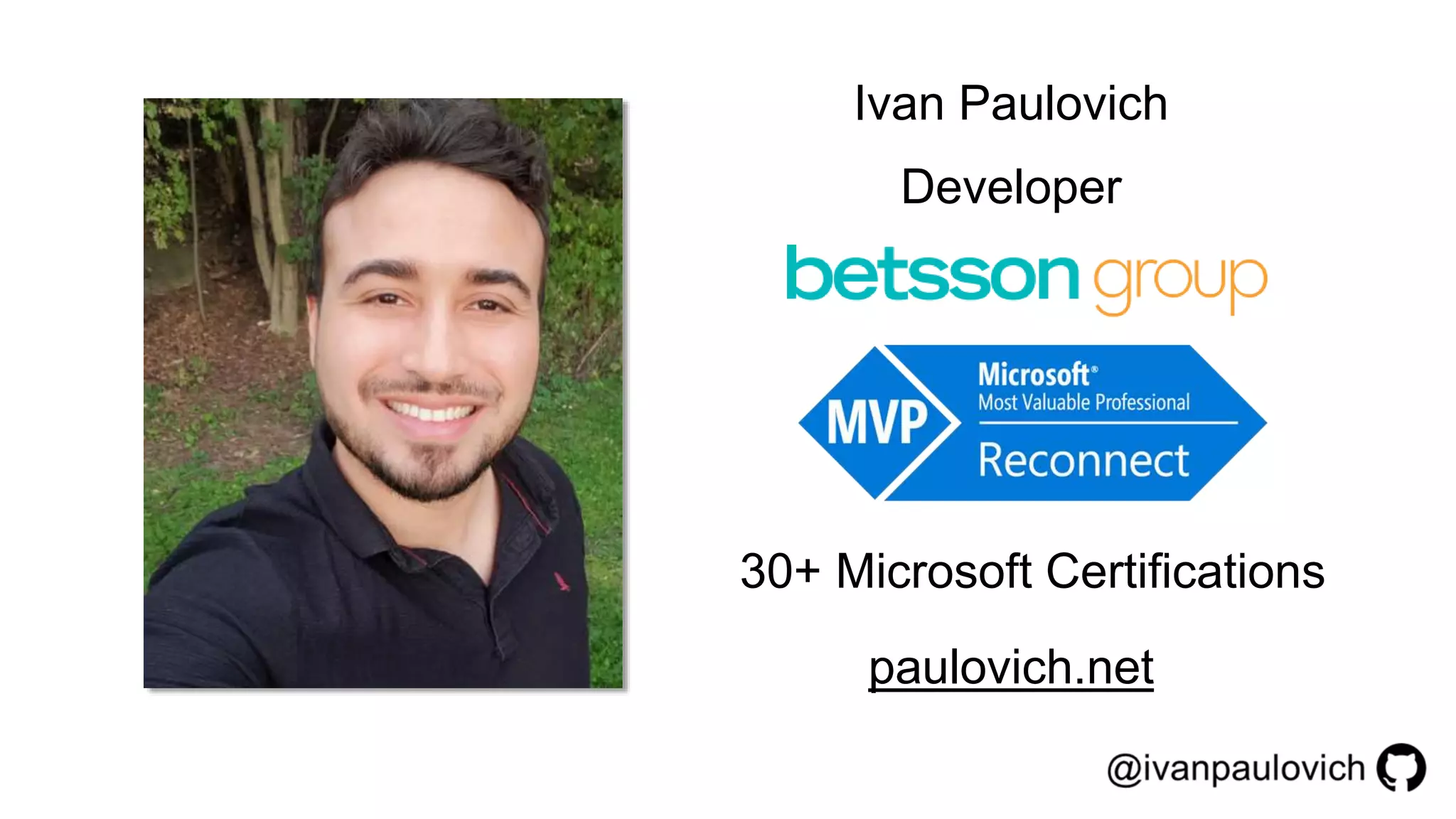
Ivan Paulovich
PhotobyRafaelaBiazionUnsplash
30+ Microsoft Certifications
paulovich.net
Developer
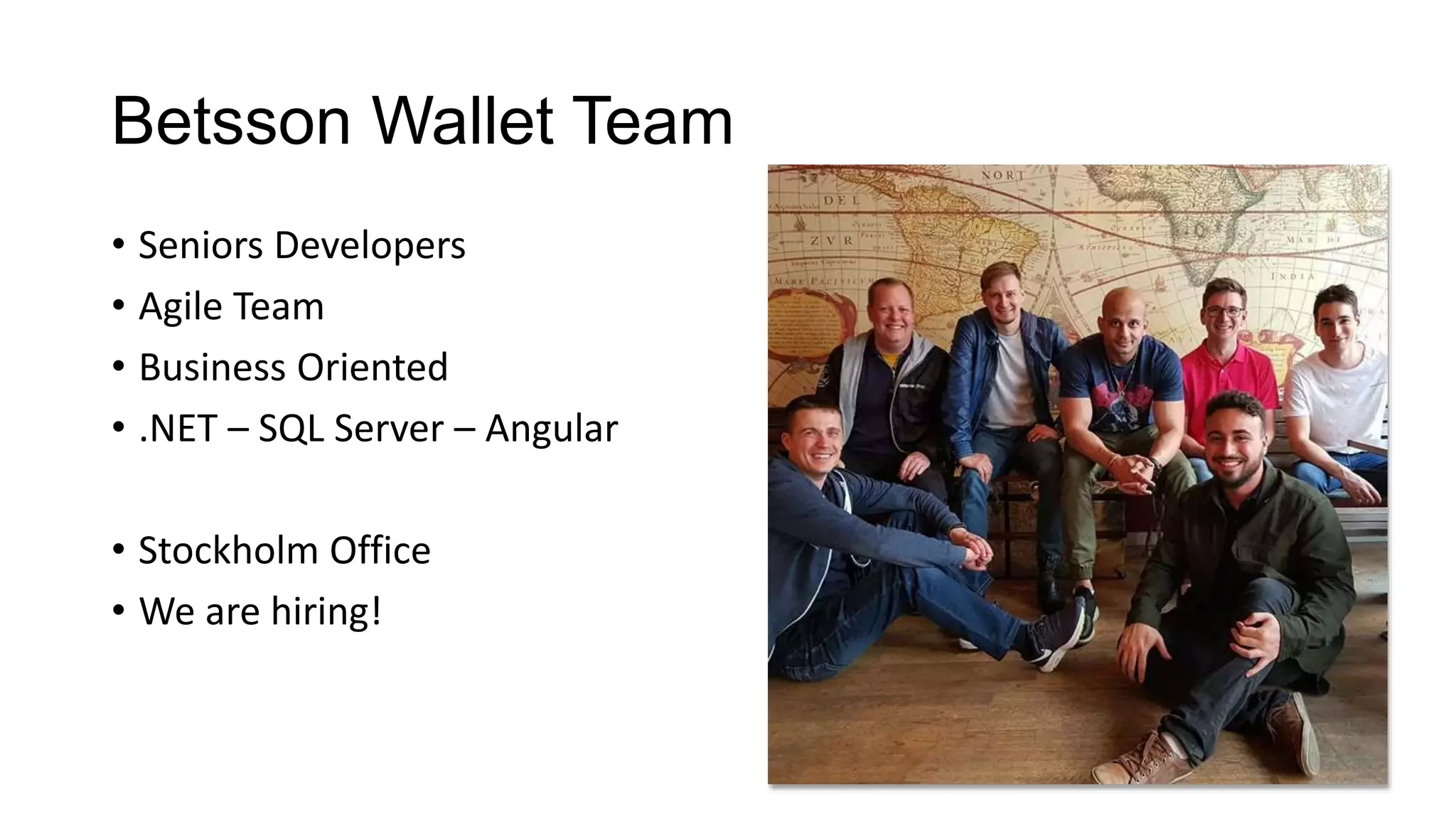
Betsson Wallet Team
• Seniors Developers
• Agile Team
• Business Oriented
• .NET – SQL Server – Angular
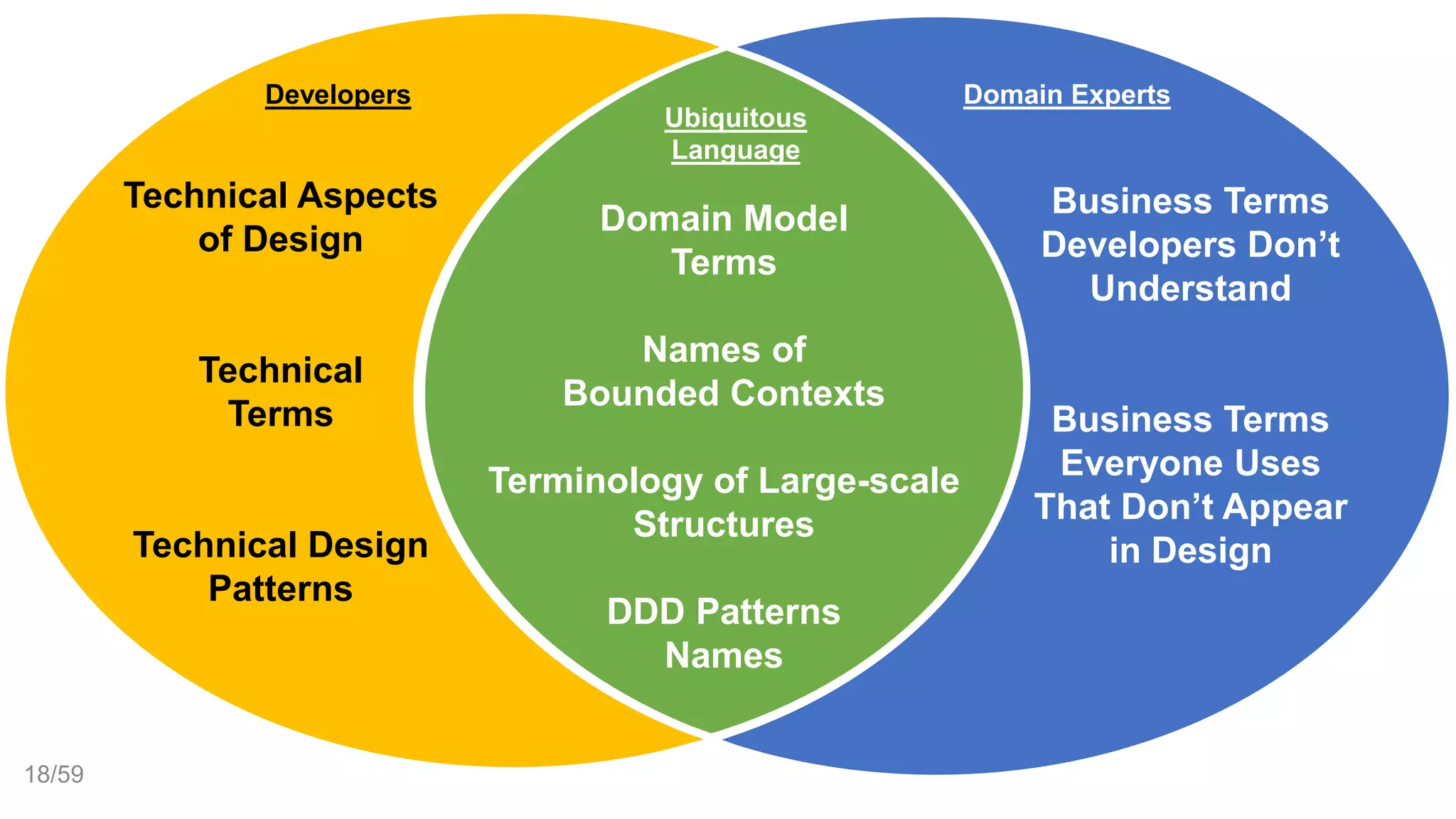
• Stockholm Office
• We are hiring!
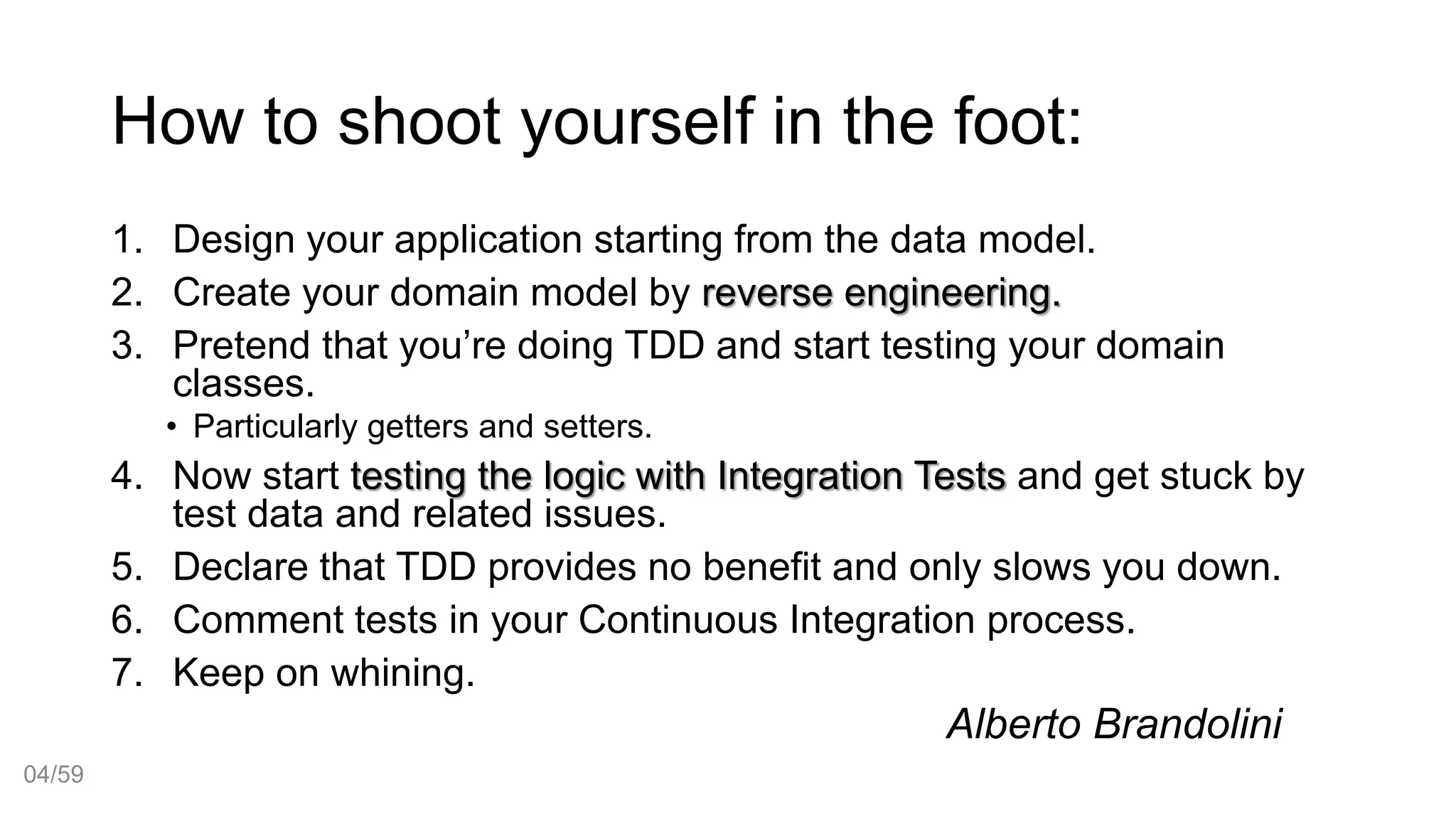
How to shoot yourself in the foot:
1. Design your application starting from the data model.
2. Create your domain model by reverse engineering.
3. Pretend that you’re doing TDD and start testing your domain
classes.
• Particularly getters and setters.
4. Now start testing the logic with Integration Tests and get stuck by
test data and related issues.
5. Declare that TDD provides no benefit and only slows you down.
6. Comment tests in your Continuous Integration process.
7. Keep on whining.
Alberto Brandolini
04/59
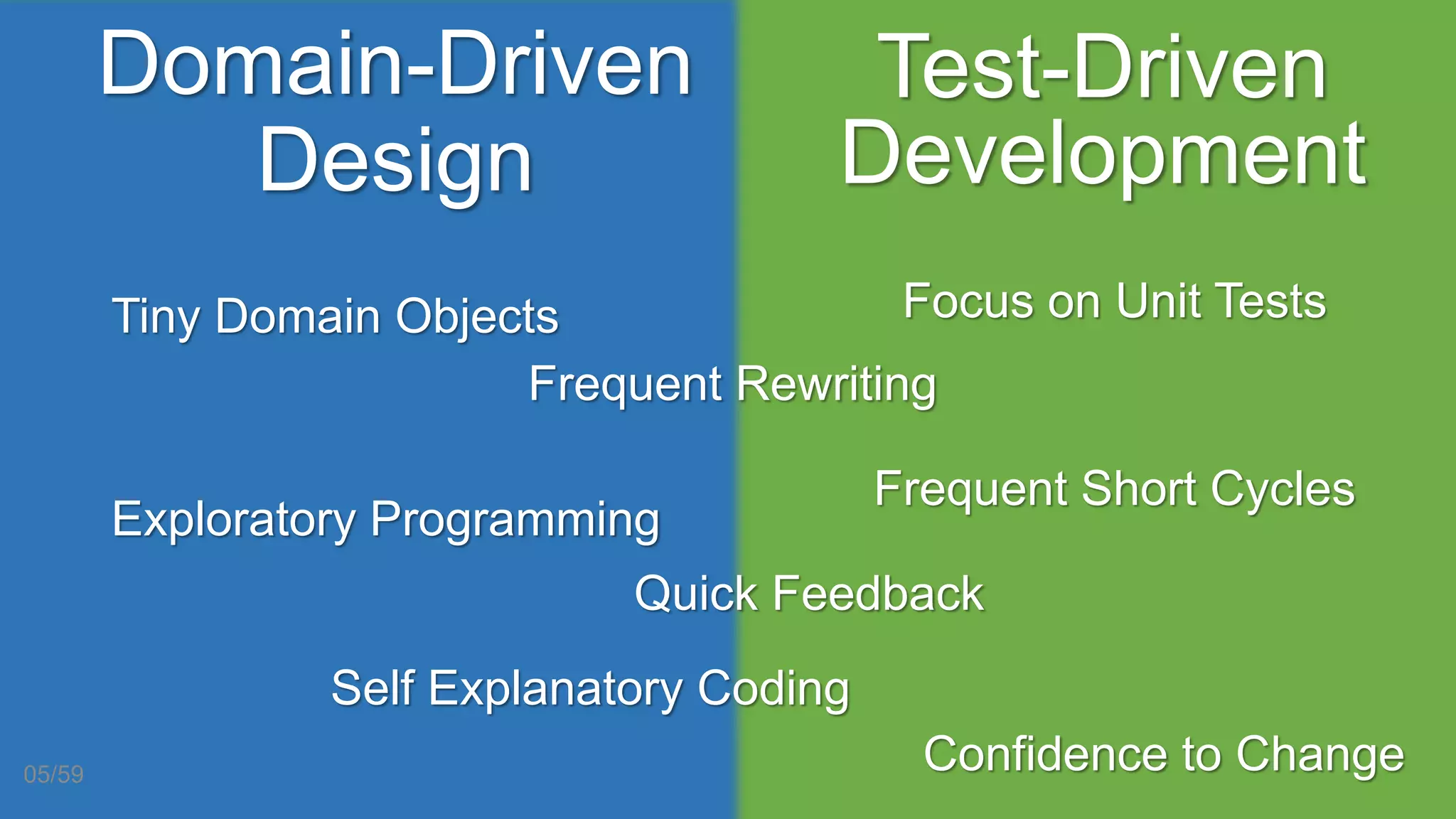
Domain-Driven
Design
Tiny Domain Objects
Exploratory Programming
Focus on Unit Tests
Frequent Short Cycles
Quick Feedback
Self Explanatory Coding
Frequent Rewriting
Confidence to Change
Test-Driven
Development
05/59
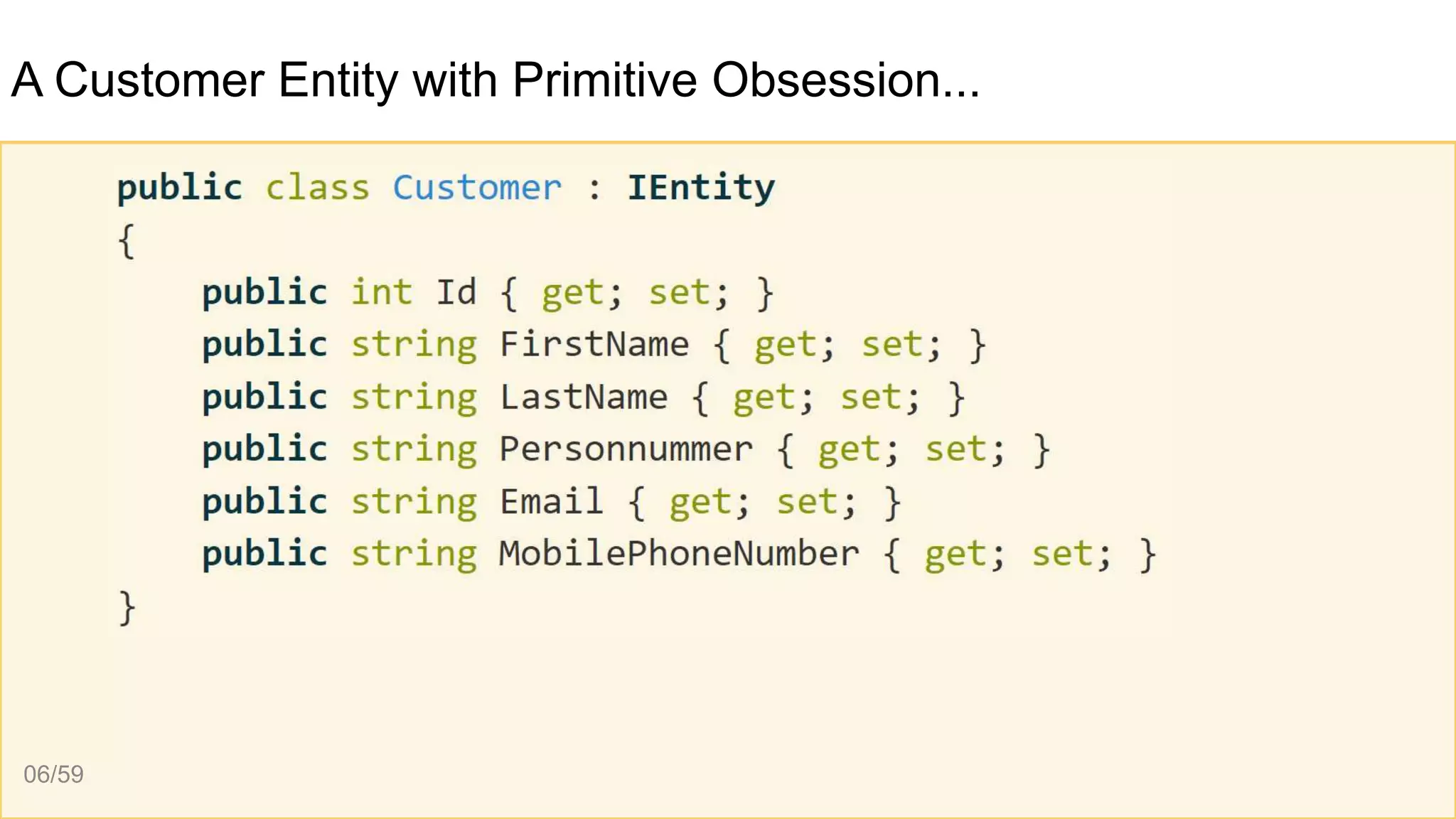
A Customer Entity with Primitive Obsession...
06/59
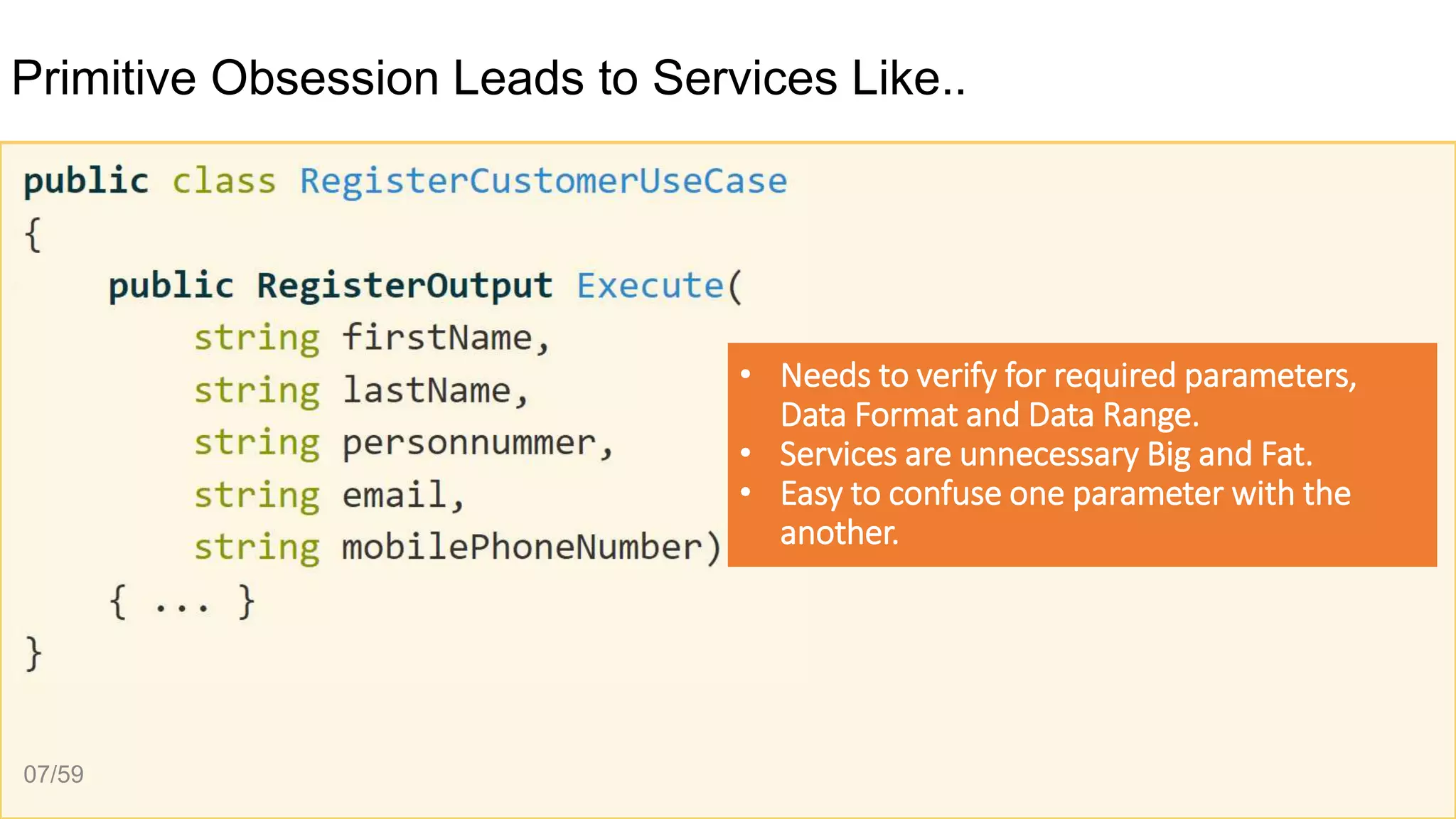
Primitive Obsession Leads to Services Like..
• Needs to verify for required parameters,
Data Format and Data Range.
• Services are unnecessary Big and Fat.
• Easy to confuse one parameter with the
another.
07/59
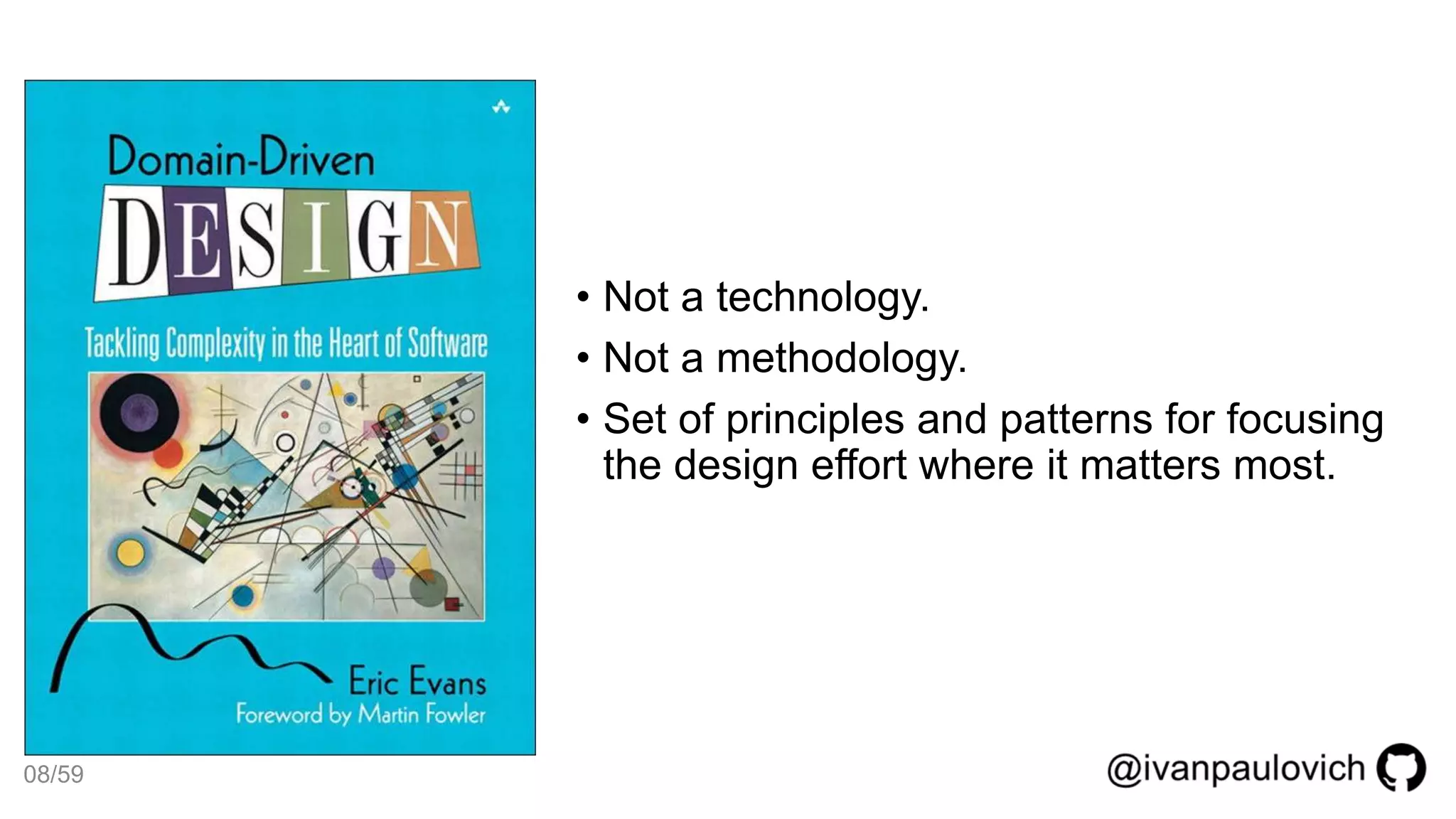
• Not a technology.
• Not a methodology.
• Set of principles and patterns for focusing
the design effort where it matters most.
08/59
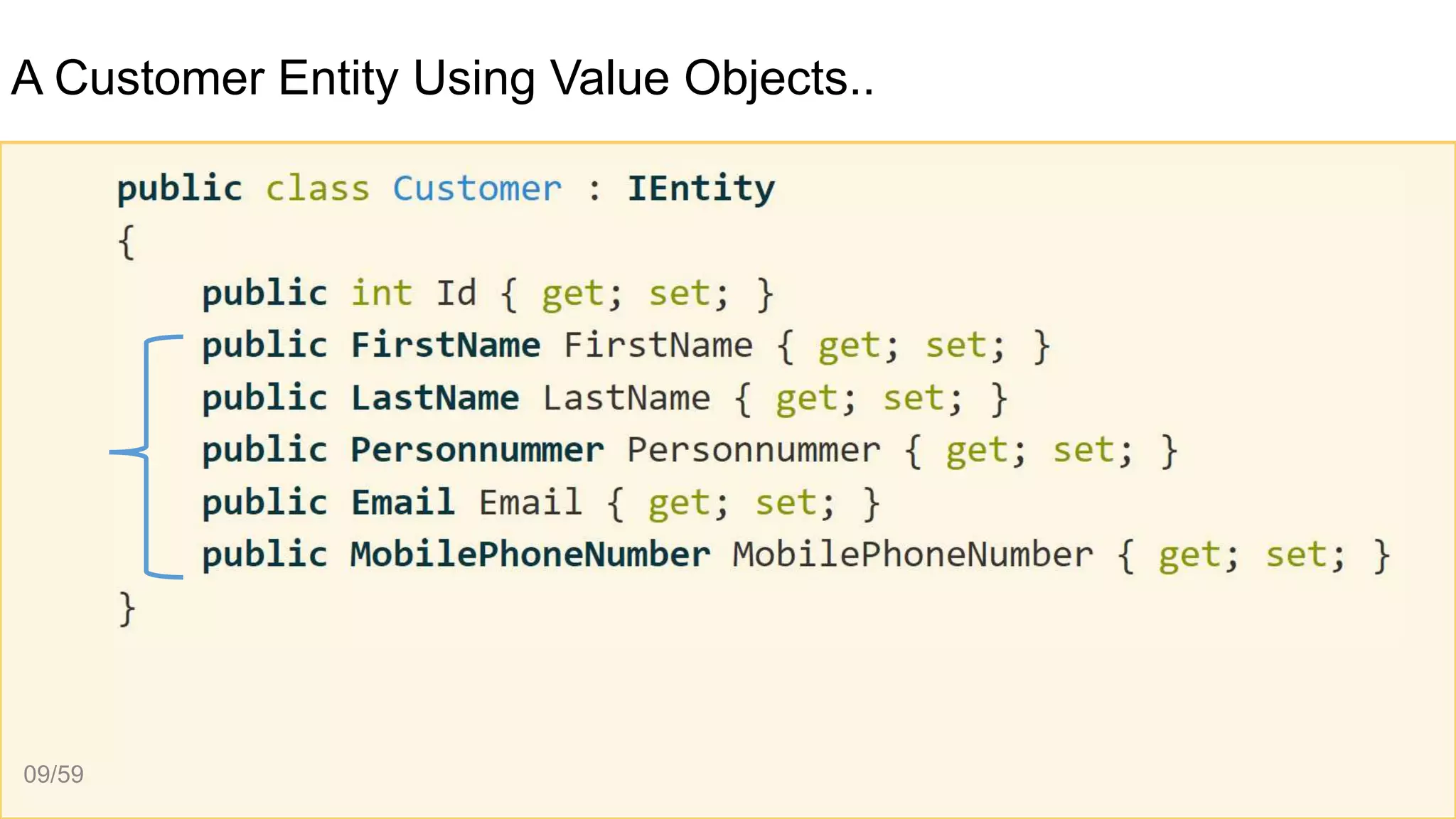
A Customer Entity Using Value Objects..
09/59
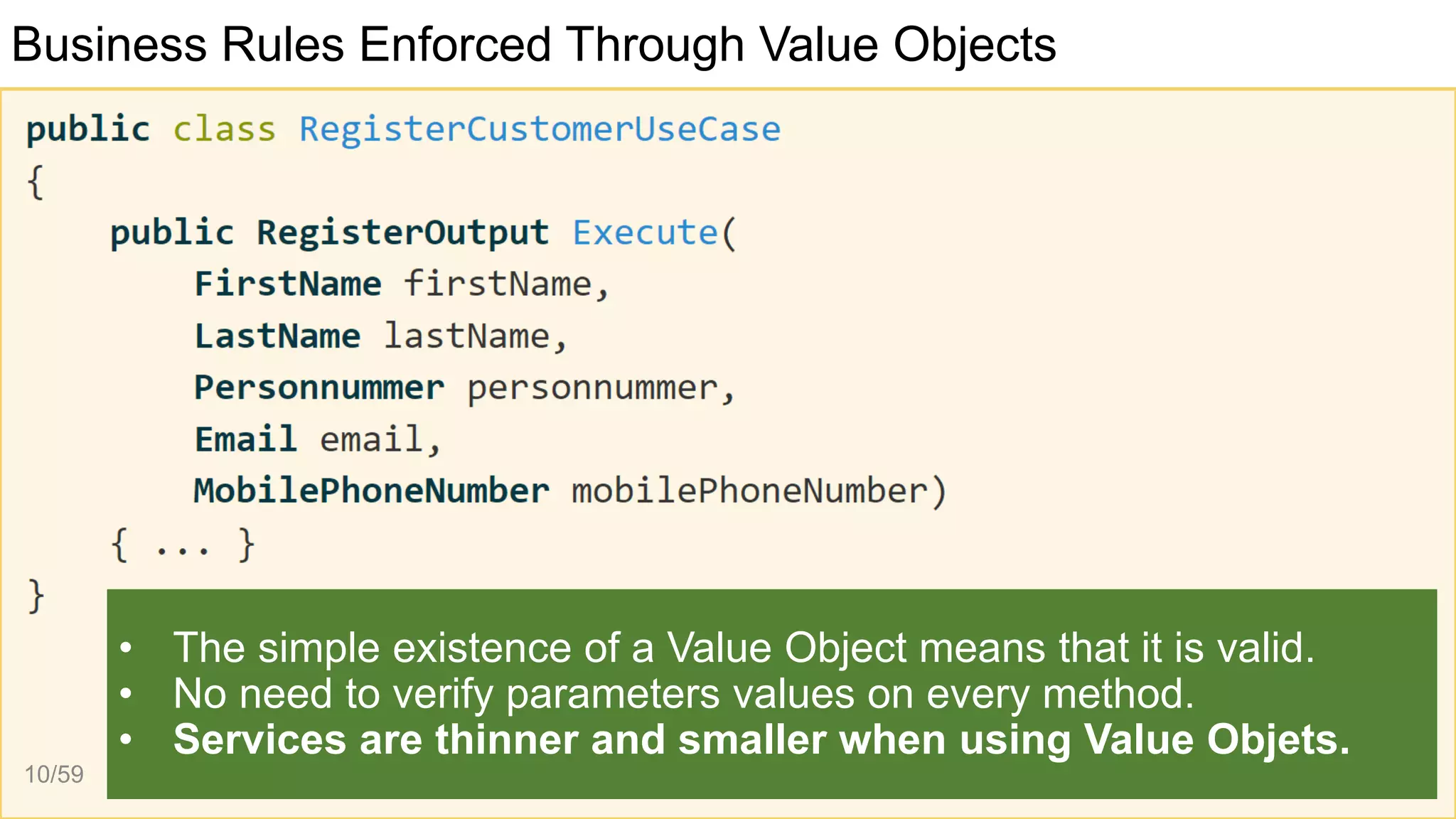
Business Rules Enforced Through Value Objects
• The simple existence of a Value Object means that it is valid.
• No need to verify parameters values on every method.
• Services are thinner and smaller when using Value Objets.
10/59
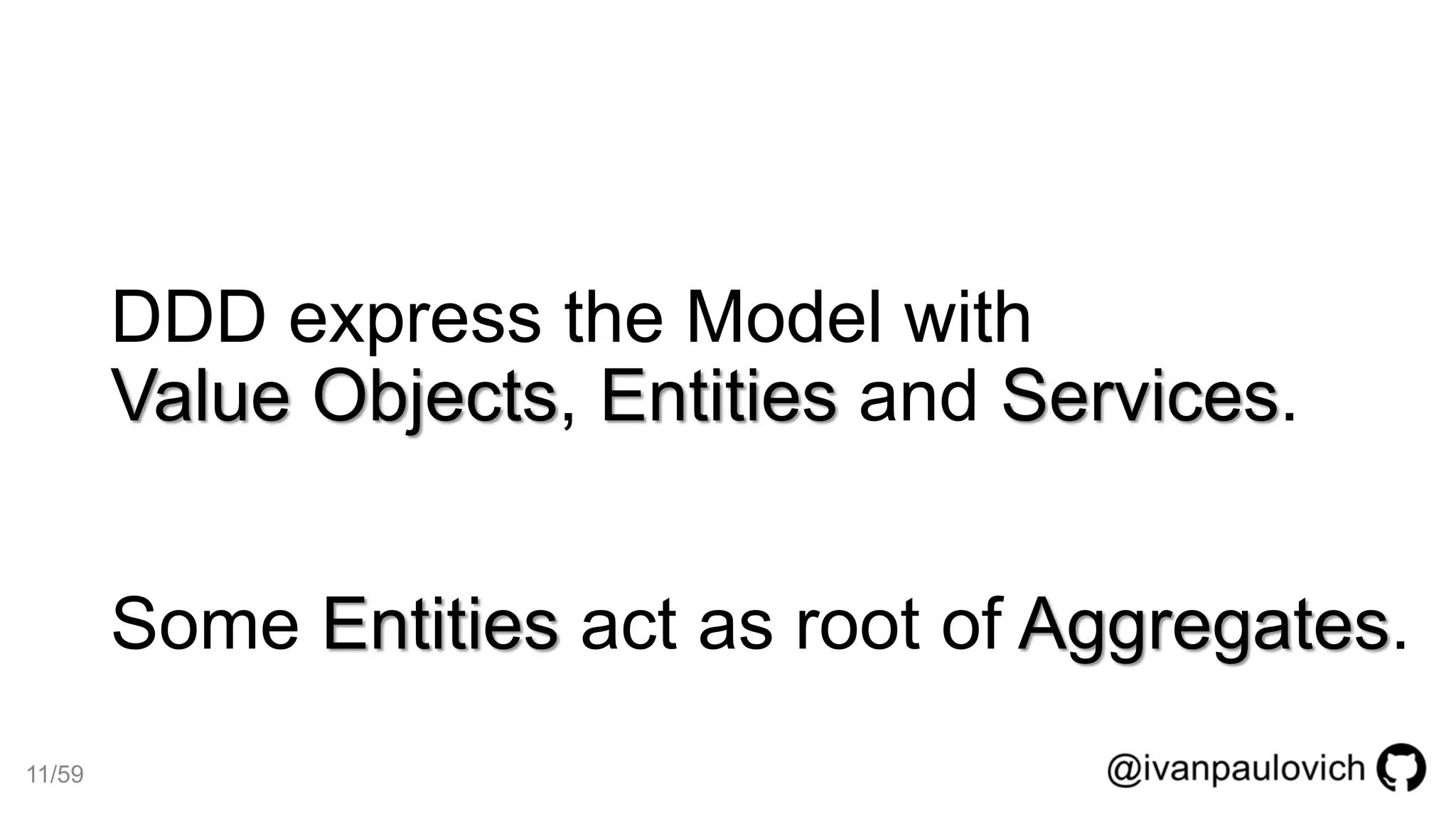
DDD express the Model with
Value Objects, Entities and Services.
Some Entities act as root of Aggregates.
11/59
An Example with Some Use Cases
• A customer can register a new account using its
personal details.
• Allow a customer to deposit funds into an existing
account.
• Allow to withdraw from an existing account.
• Do not allow to withdraw more than the current
balance.
12/59
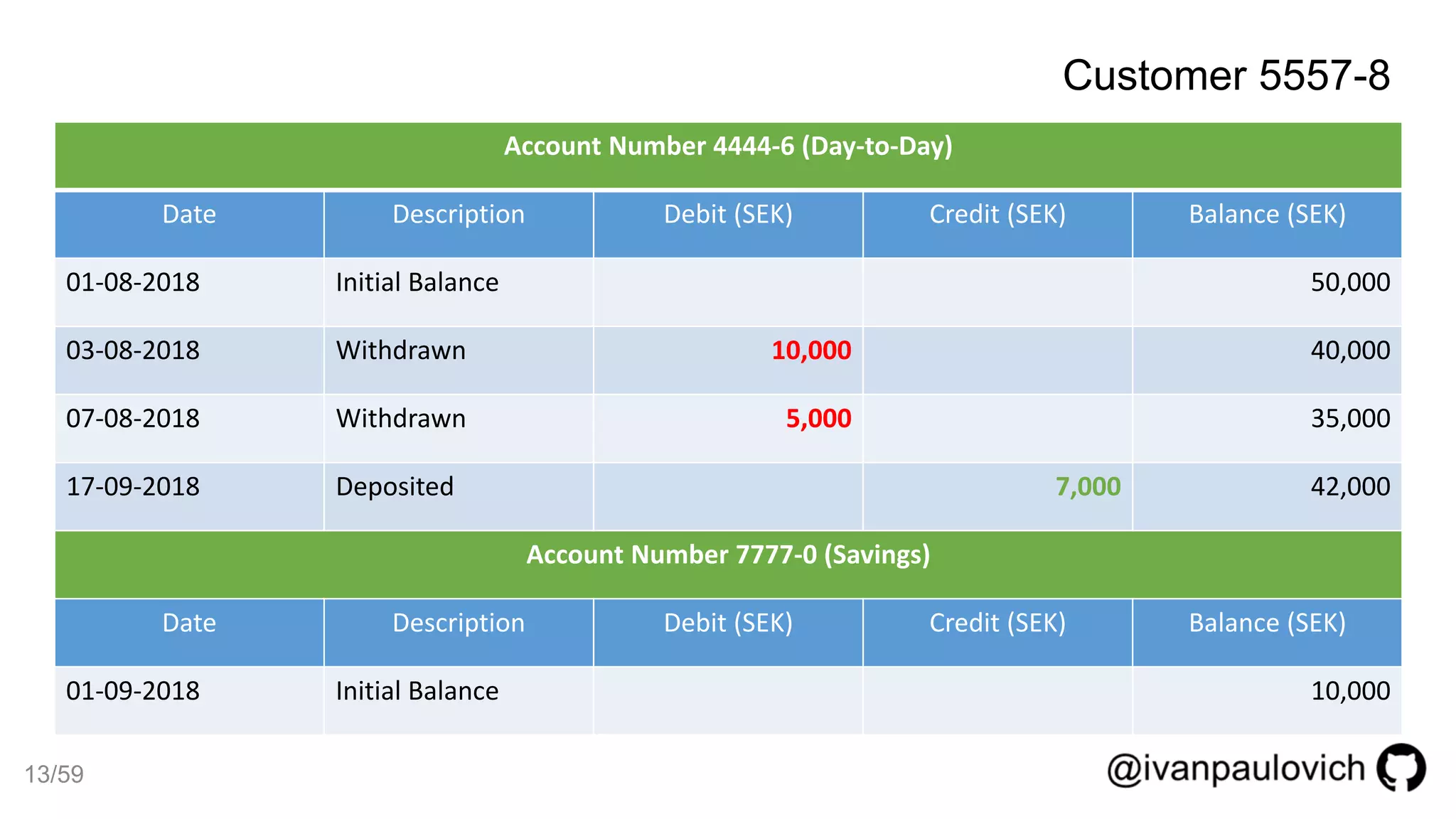
Account Number 4444-6 (Day-to-Day)
Date Description Debit (SEK) Credit (SEK) Balance (SEK)
01-08-2018 Initial Balance 50,000
03-08-2018 Withdrawn 10,000 40,000
07-08-2018 Withdrawn 5,000 35,000
17-09-2018 Deposited 7,000 42,000
Account Number 7777-0 (Savings)
Date Description Debit (SEK) Credit (SEK) Balance (SEK)
01-09-2018 Initial Balance 10,000
Customer 5557-8
13/59
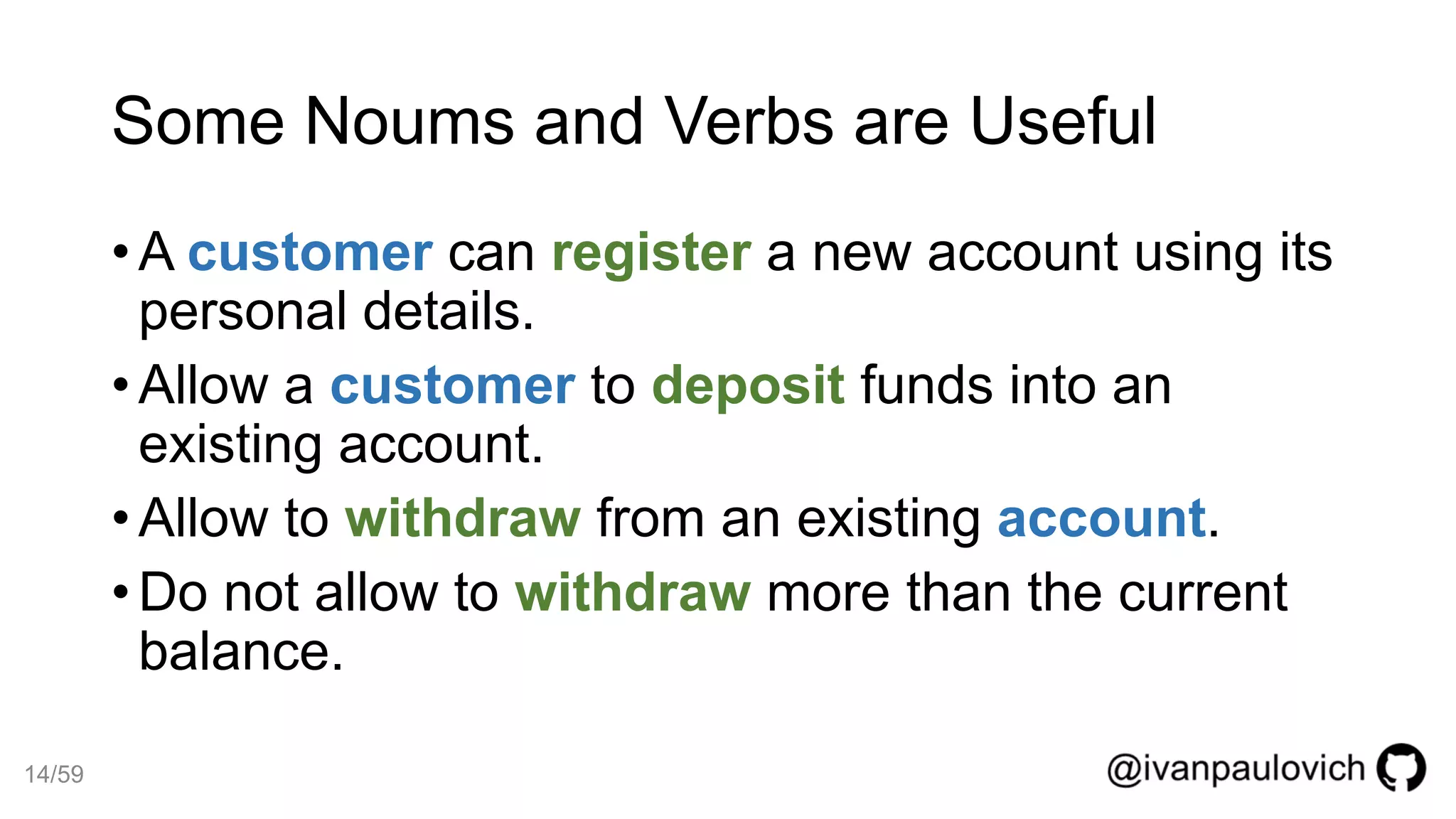
Some Noums and Verbs are Useful
• A customer can register a new account using its
personal details.
• Allow a customer to deposit funds into an
existing account.
• Allow to withdraw from an existing account.
• Do not allow to withdraw more than the current
balance.
14/59
Customer
Account
Credit
First Name
Last Name
Opening Date
Personnummer
Debit
Amount
Transaction
Date
Description
Tactical-Design
Mobile Phone
Number
Amount
Transaction
Date
Description
15/59
Customer
Account
Credit
First Name
Last Name
Opening Date
Personnummer
Debit
Amount
Transaction
Date
Description
Tactical-Design
Mobile Phone
Number
Amount
Transaction
Date
Description
16/59
Customer
Account
Credit
First Name
Last Name
Opening Date
Personnummer
Debit
Amount
Transaction
Date
Description
Tactical-Design
Mobile Phone
Number
Personal Expenses
Bounded Context
Amount
Transaction
Date
Description
17/59
Domain Model
Terms
Names of
Bounded Contexts
Terminology of Large-scale
Structures
DDD Patterns
Names
Business Terms
Developers Don’t
Understand
Business Terms
Everyone Uses
That Don’t Appear
in Design
Technical Aspects
of Design
Technical
Terms
Technical Design
Patterns
Developers Domain Experts
Ubiquitous
Language
18/59
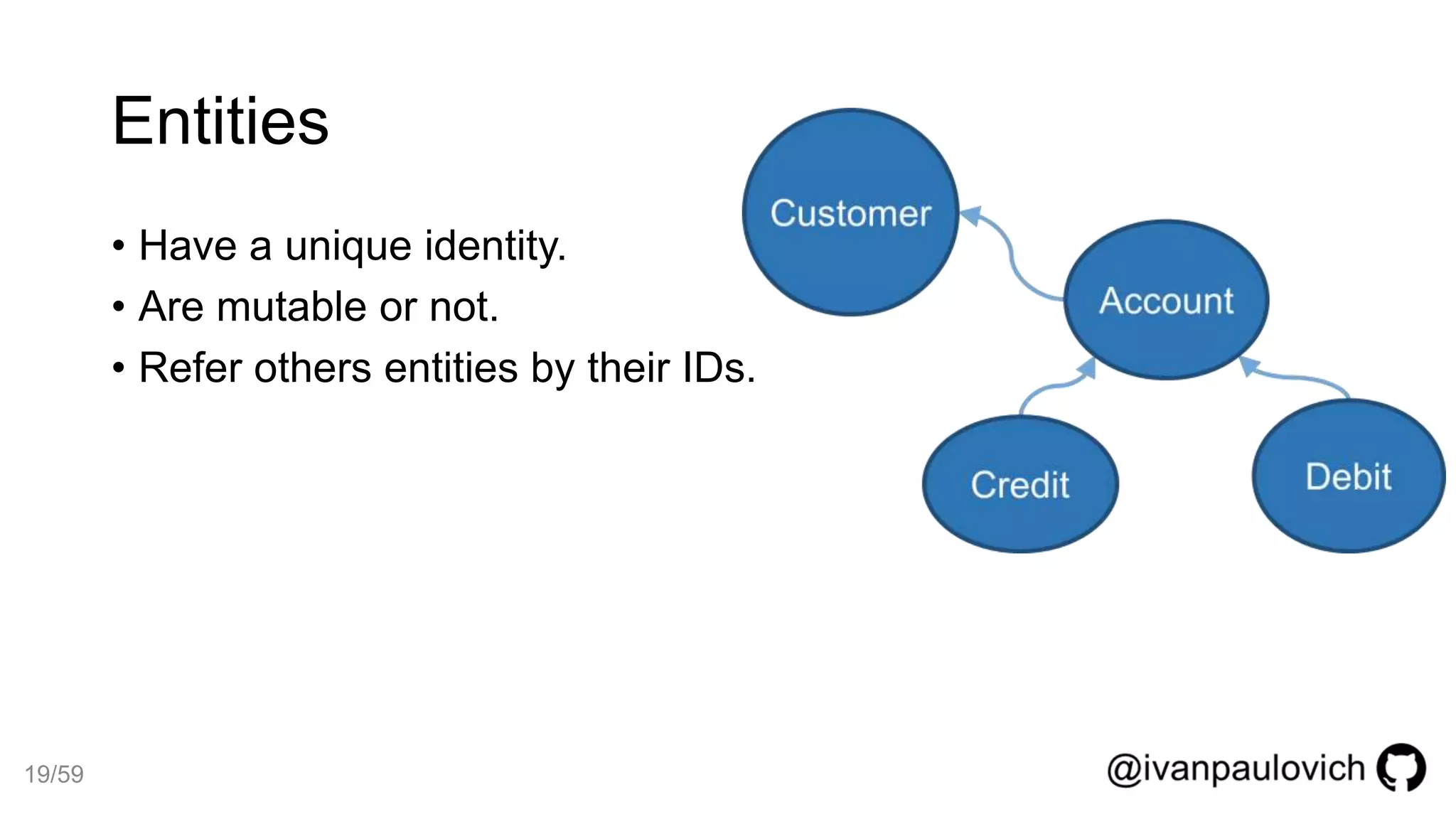
Entities
• Have a unique identity.
• Are mutable or not.
• Refer others entities by their IDs.
19/59
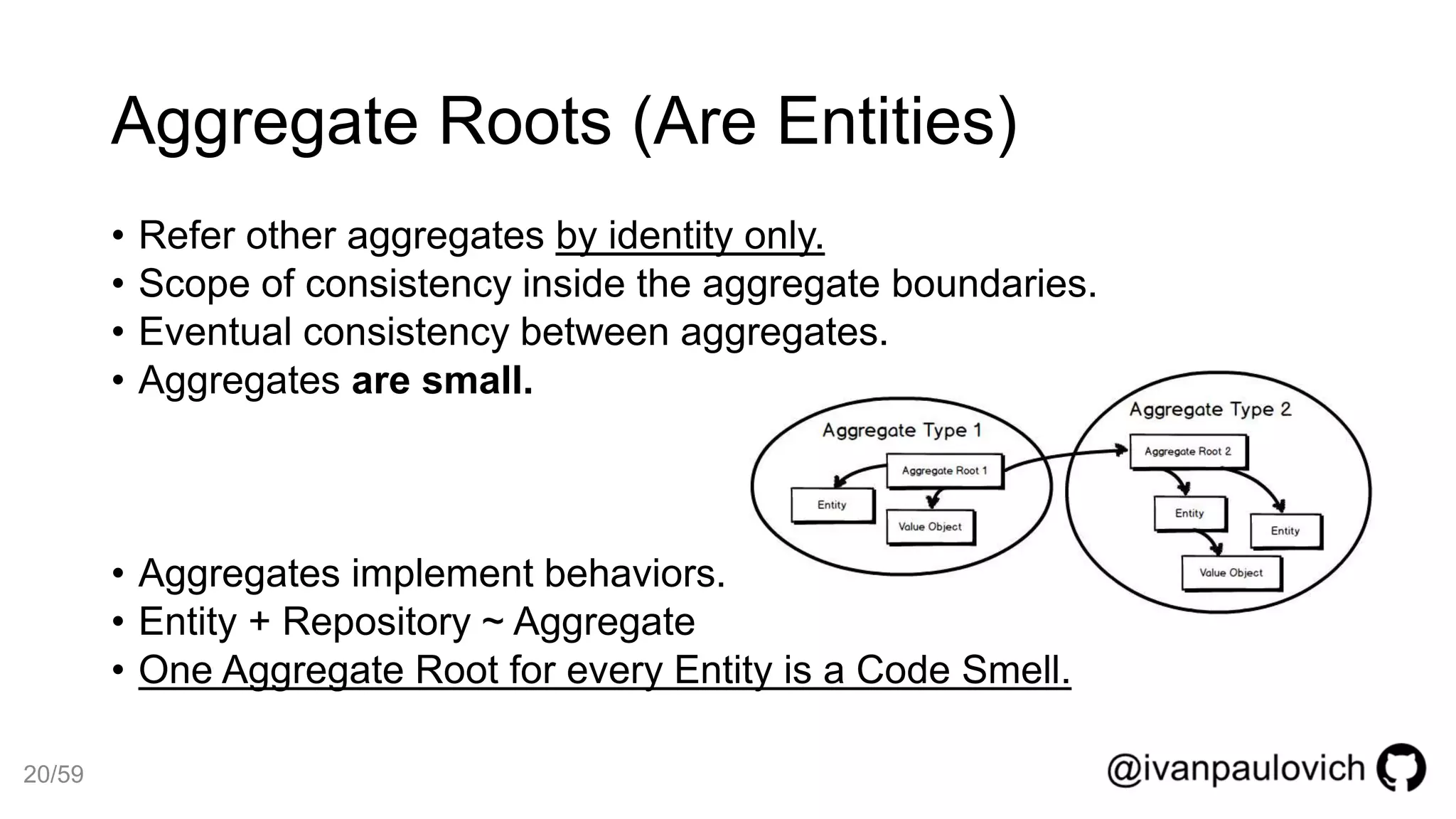
Aggregate Roots (Are Entities)
• Refer other aggregates by identity only.
• Scope of consistency inside the aggregate boundaries.
• Eventual consistency between aggregates.
• Aggregates are small.
• Aggregates implement behaviors.
• Entity + Repository ~ Aggregate
• One Aggregate Root for every Entity is a Code Smell.
20/59
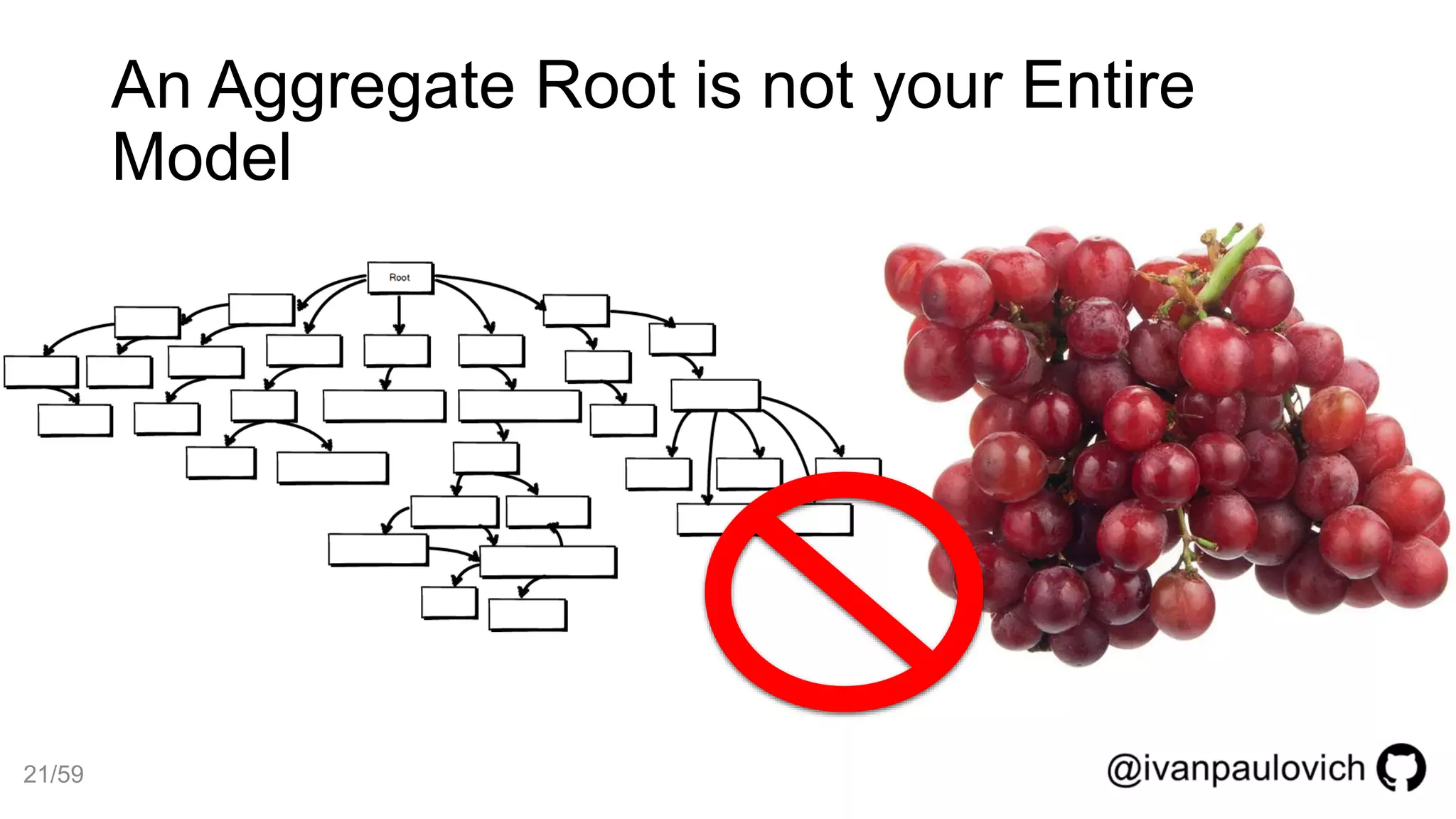
An Aggregate Root is not your Entire
Model
21/59
An Aggregate Root
22/59
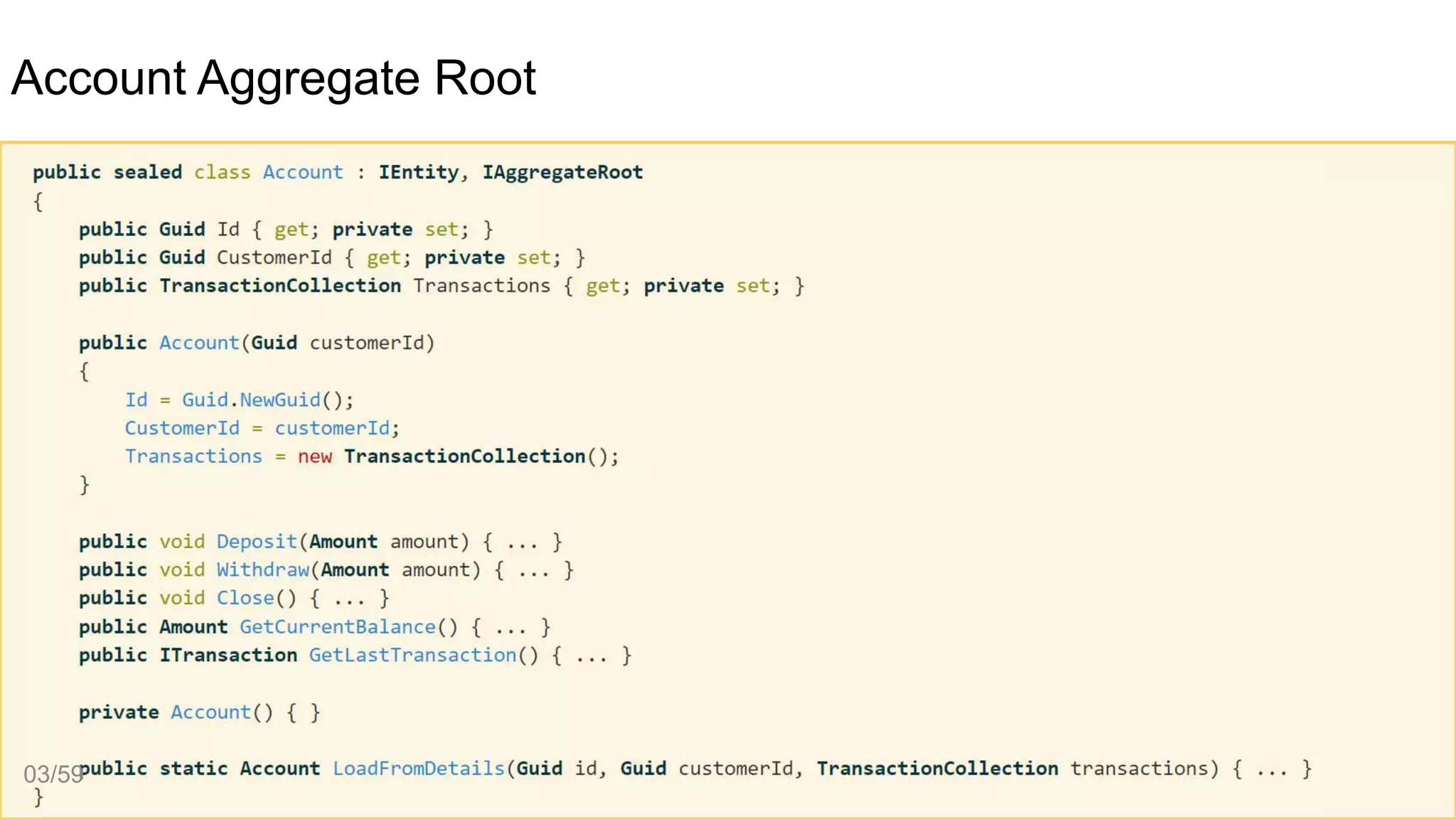
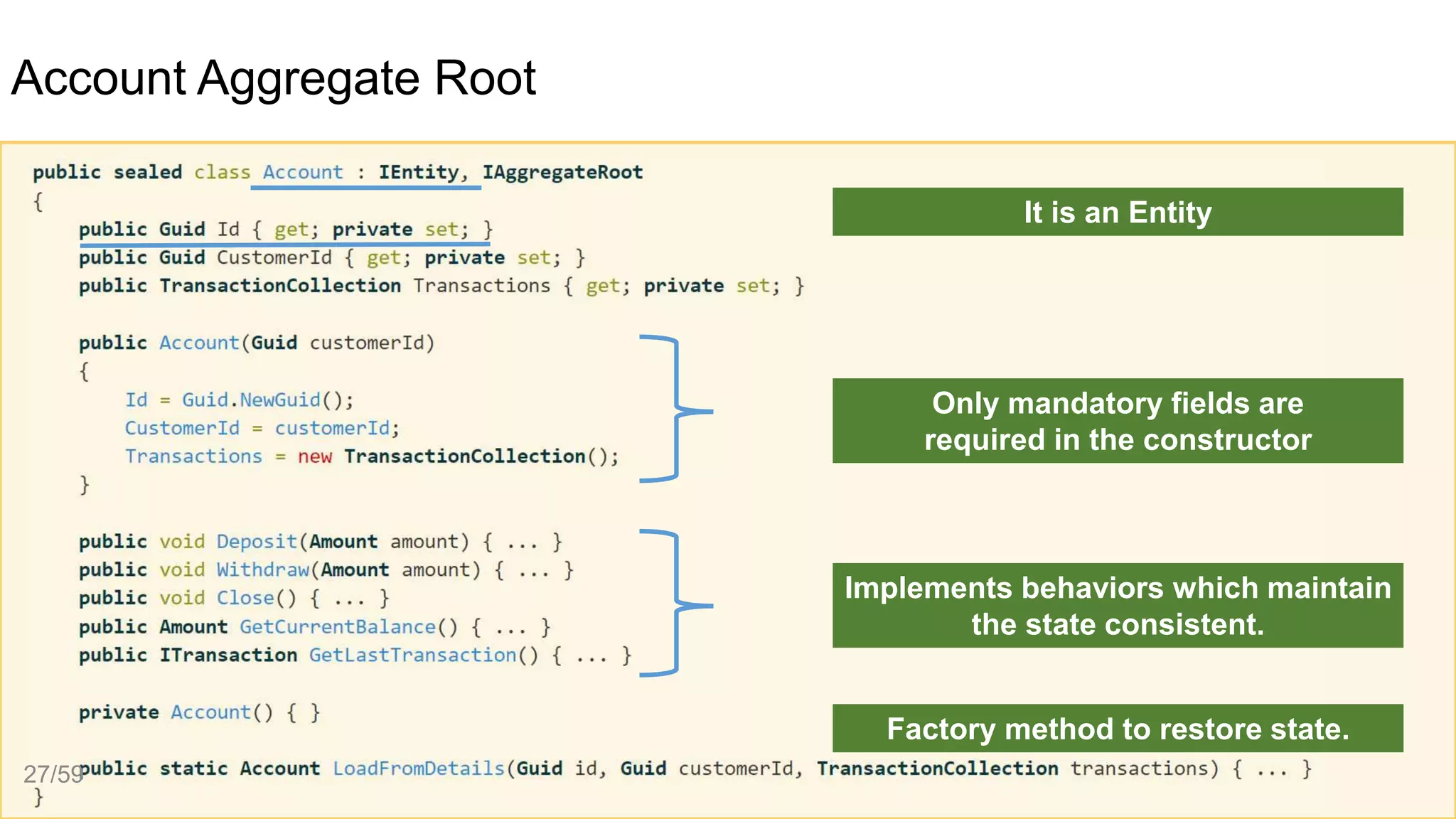
Account Aggregate Root
03/59
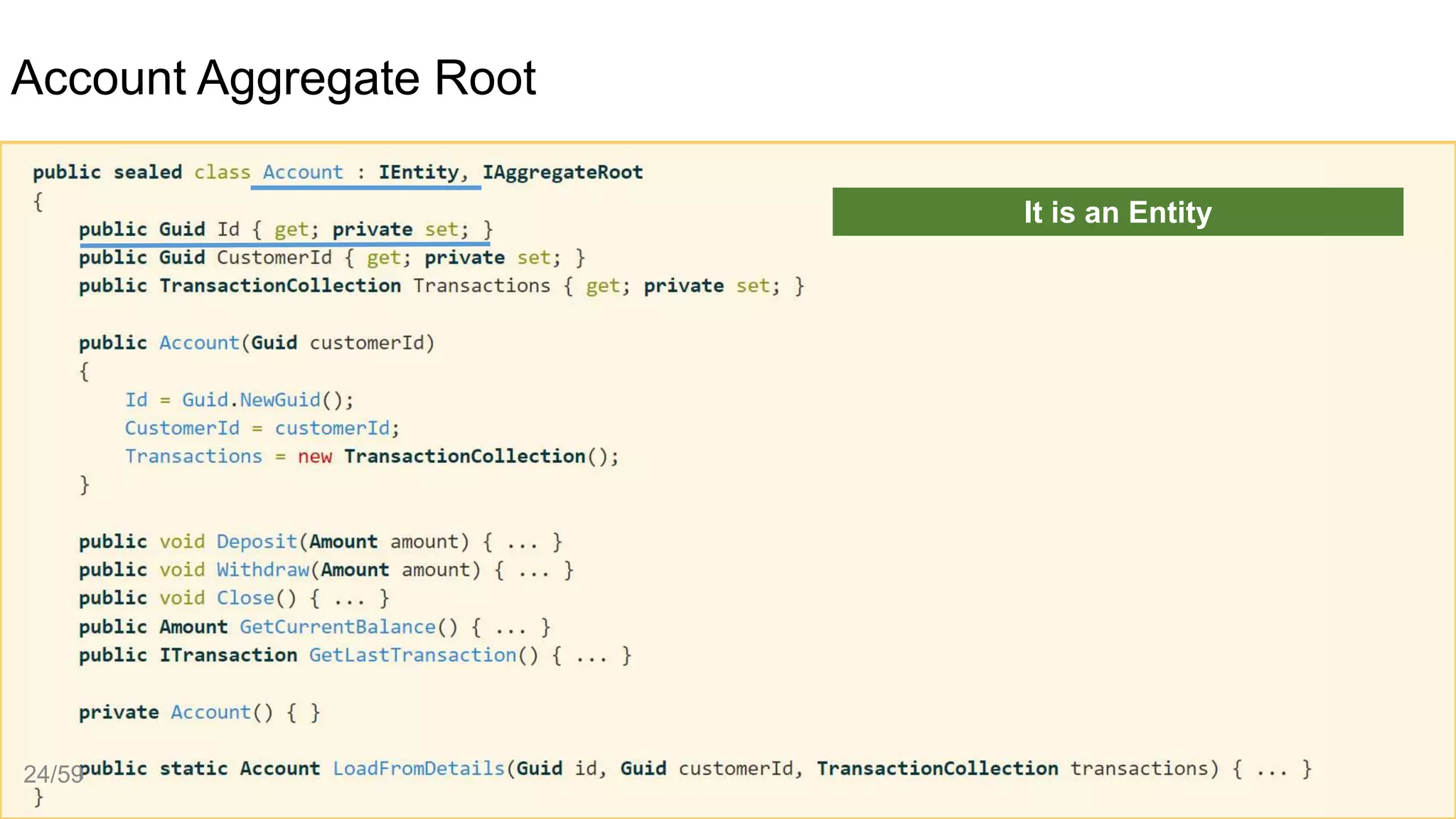
Account Aggregate Root
It is an Entity
24/59
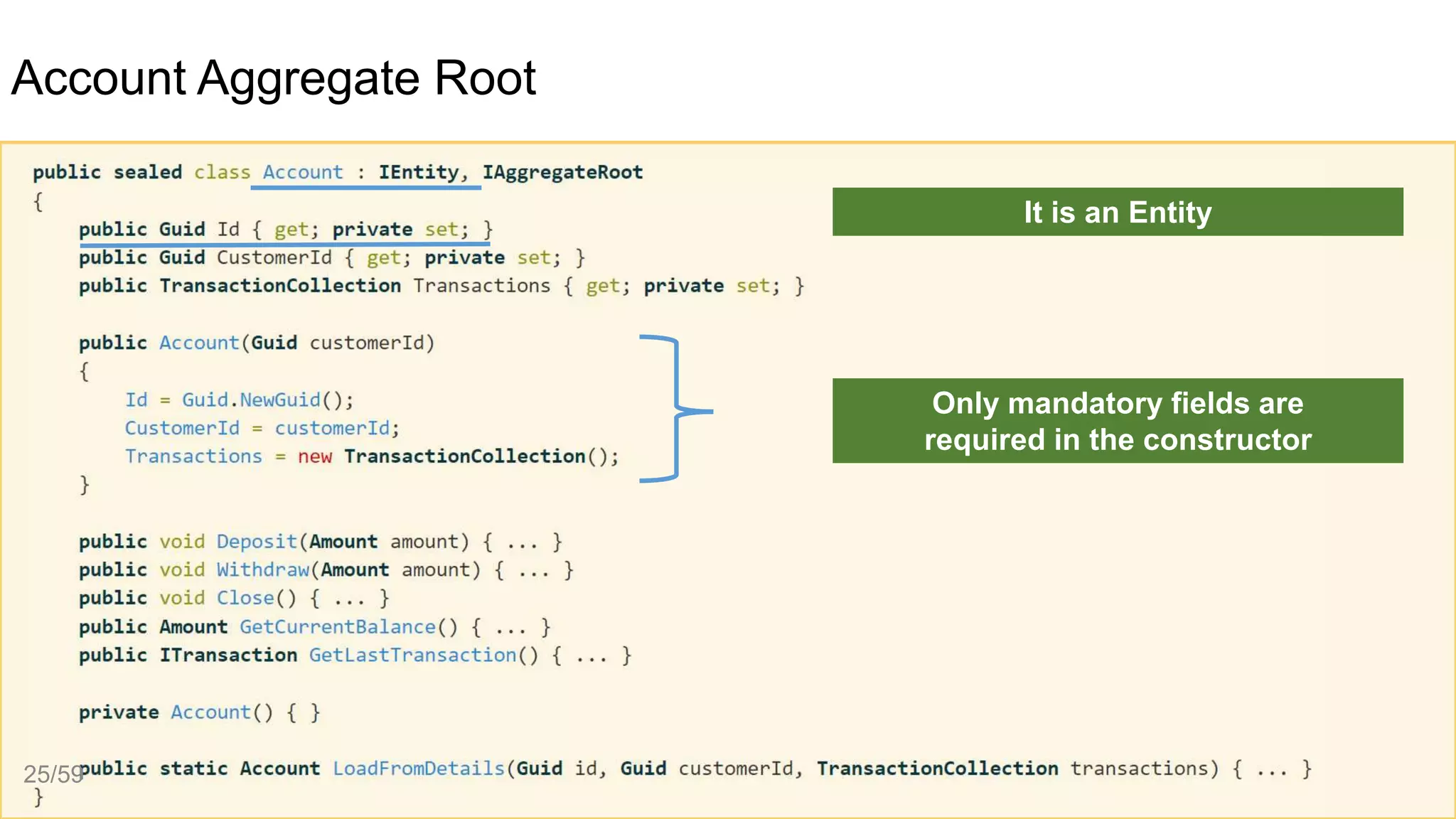
Account Aggregate Root
It is an Entity
Only mandatory fields are
required in the constructor
25/59
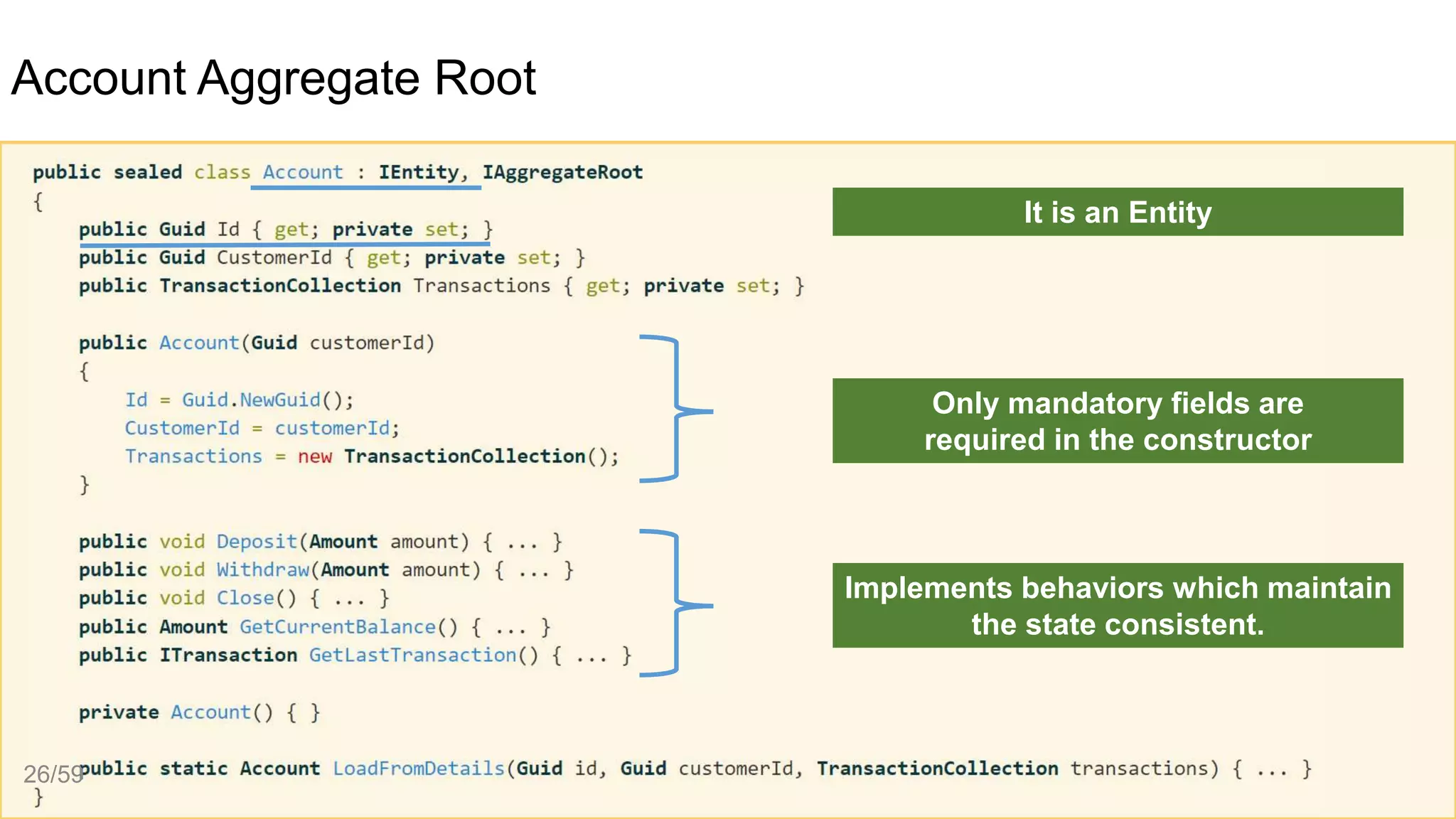
Account Aggregate Root
It is an Entity
Only mandatory fields are
required in the constructor
Implements behaviors which maintain
the state consistent.
26/59
Account Aggregate Root
It is an Entity
Factory method to restore state.
Only mandatory fields are
required in the constructor
Implements behaviors which maintain
the state consistent.
27/59
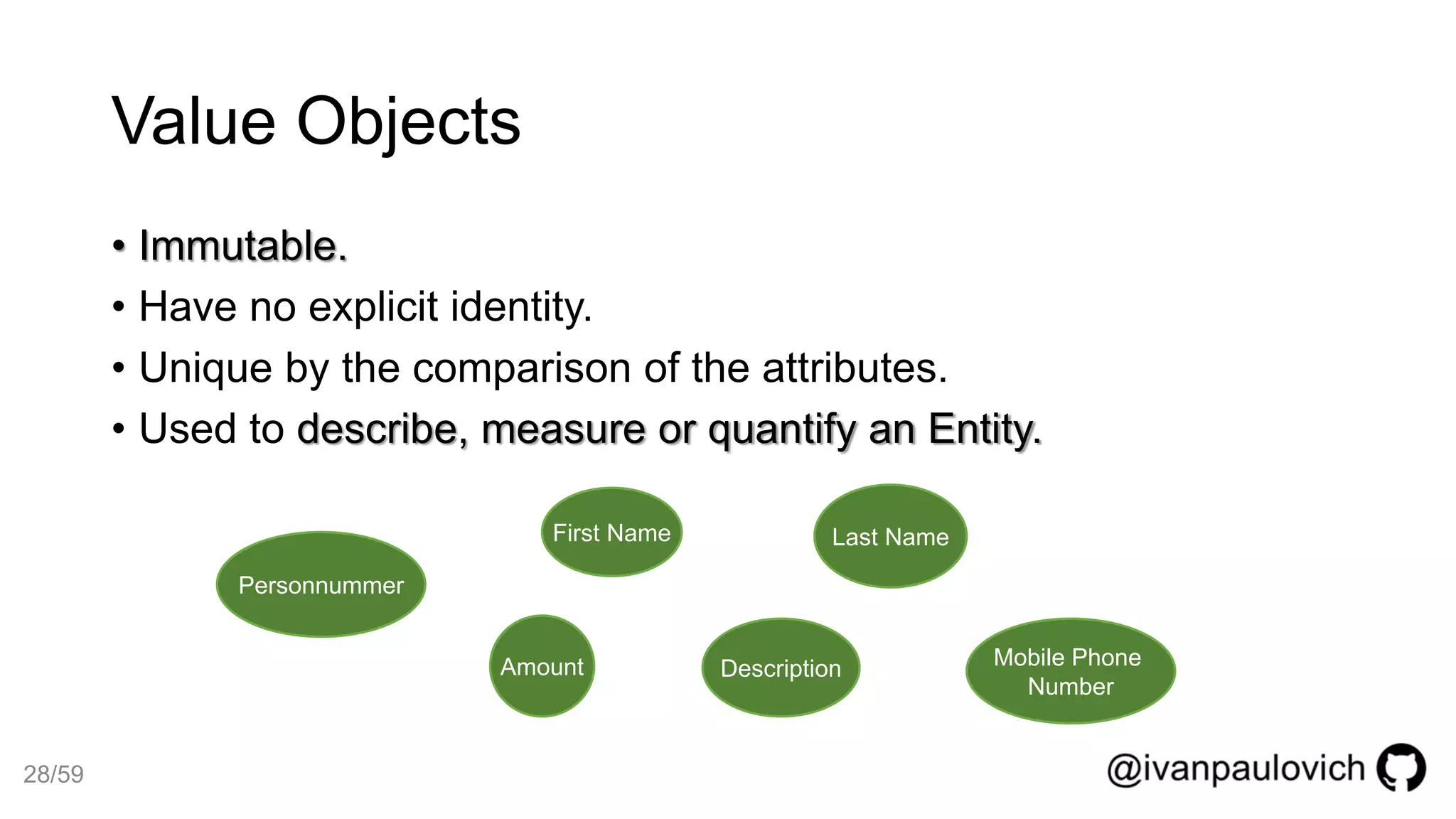
Value Objects
• Immutable.
• Have no explicit identity.
• Unique by the comparison of the attributes.
• Used to describe, measure or quantify an Entity.
First Name Last Name
Personnummer
Mobile Phone
Number
Amount Description
28/59
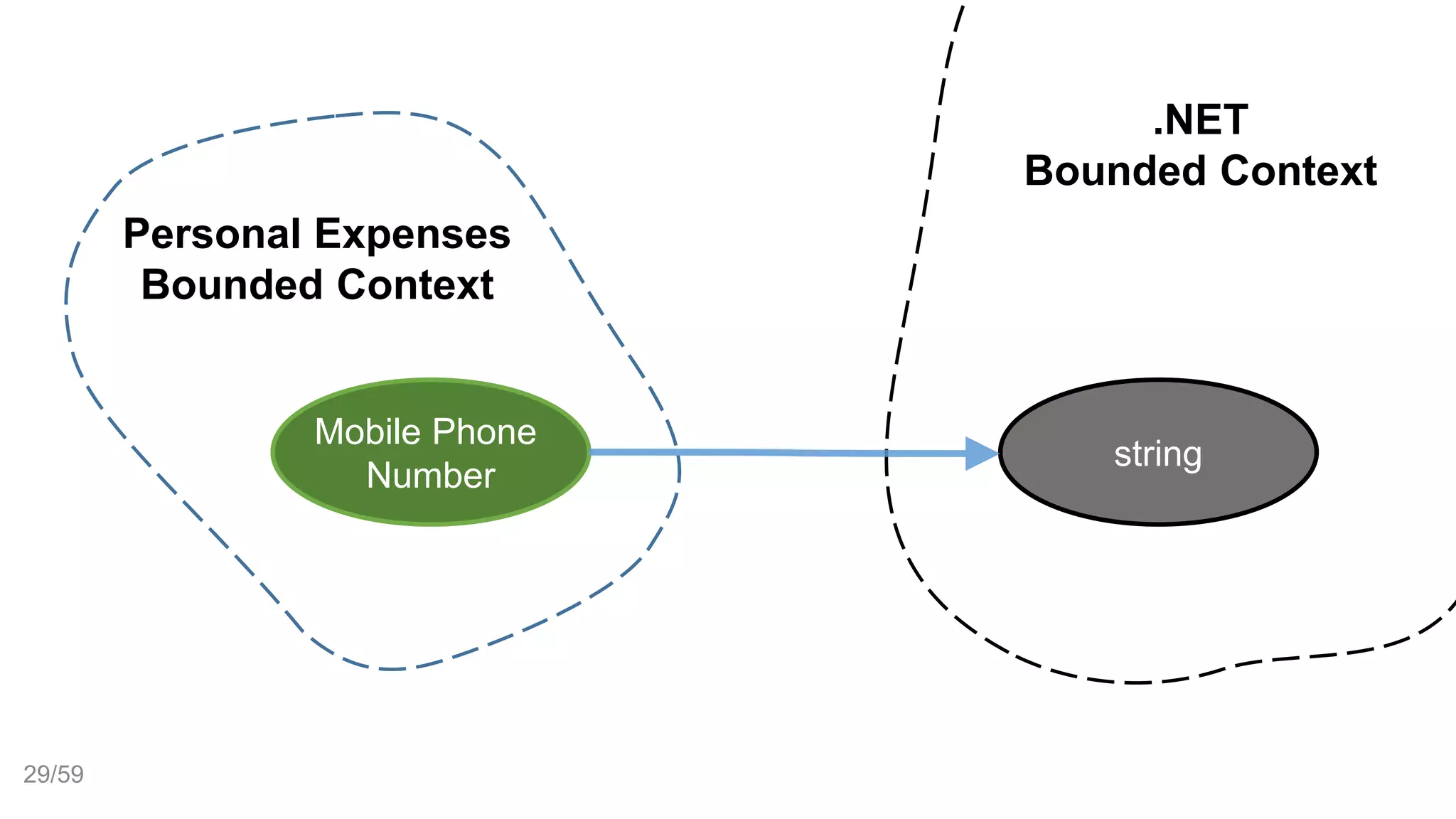
Personal Expenses
Bounded Context
.NET
Bounded Context
Mobile Phone
Number
string
29/59
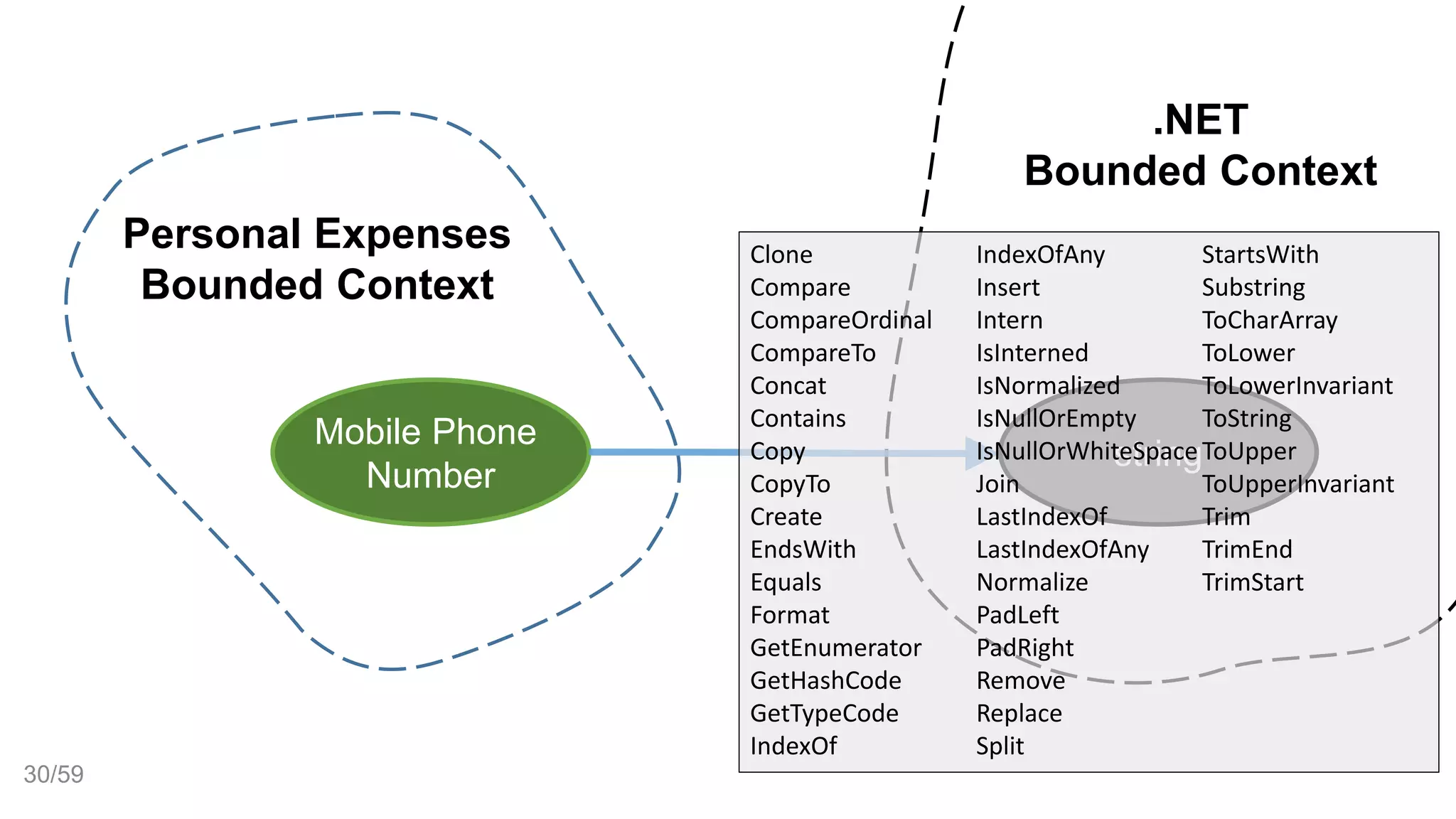
Personal Expenses
Bounded Context
.NET
Bounded Context
Mobile Phone
Number
string
Clone
Compare
CompareOrdinal
CompareTo
Concat
Contains
Copy
CopyTo
Create
EndsWith
Equals
Format
GetEnumerator
GetHashCode
GetTypeCode
IndexOf
IndexOfAny
Insert
Intern
IsInterned
IsNormalized
IsNullOrEmpty
IsNullOrWhiteSpace
Join
LastIndexOf
LastIndexOfAny
Normalize
PadLeft
PadRight
Remove
Replace
Split
StartsWith
Substring
ToCharArray
ToLower
ToLowerInvariant
ToString
ToUpper
ToUpperInvariant
Trim
TrimEnd
TrimStart
30/59
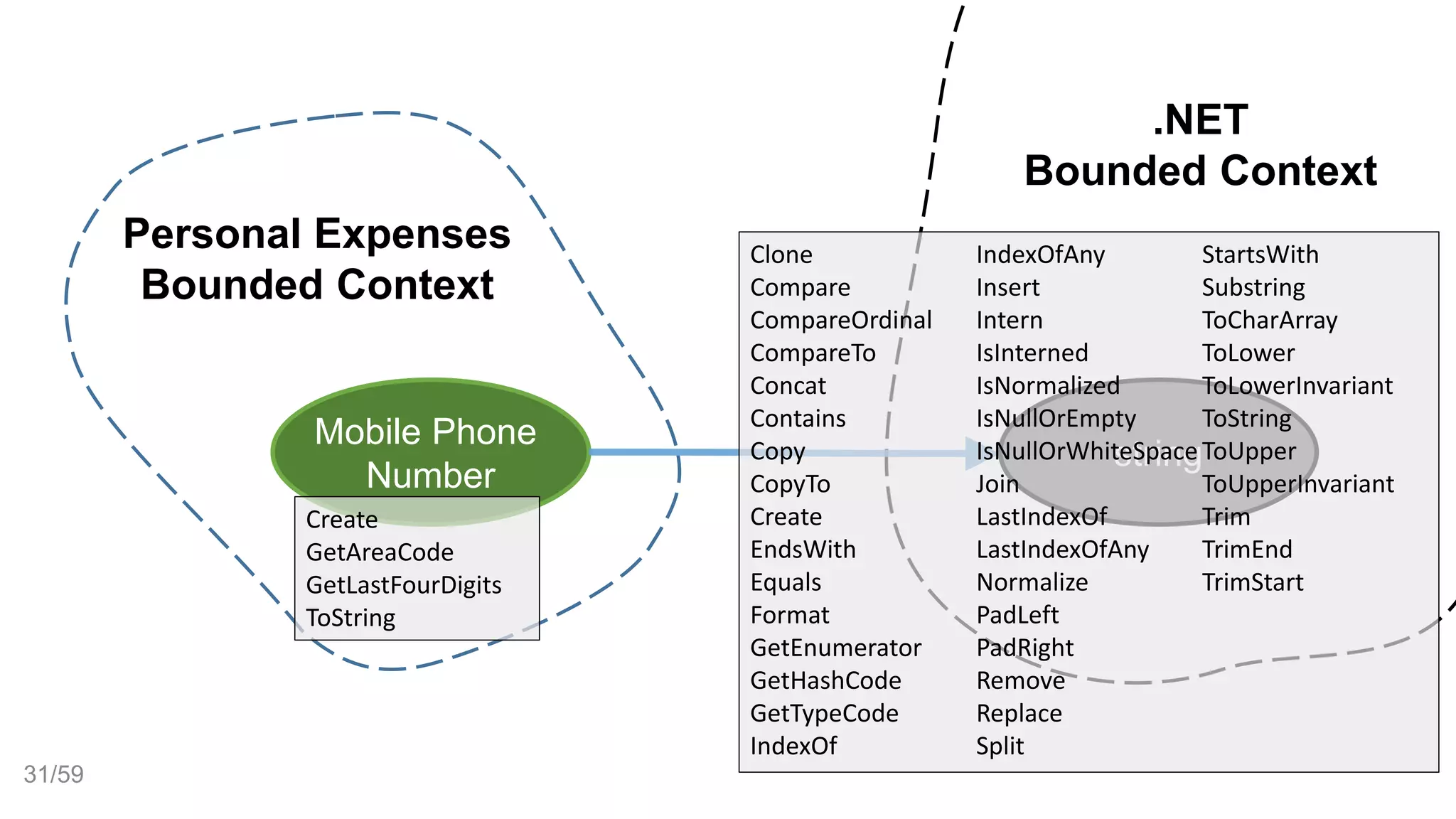
Personal Expenses
Bounded Context
.NET
Bounded Context
Mobile Phone
Number
Create
GetAreaCode
GetLastFourDigits
ToString
string
Clone
Compare
CompareOrdinal
CompareTo
Concat
Contains
Copy
CopyTo
Create
EndsWith
Equals
Format
GetEnumerator
GetHashCode
GetTypeCode
IndexOf
IndexOfAny
Insert
Intern
IsInterned
IsNormalized
IsNullOrEmpty
IsNullOrWhiteSpace
Join
LastIndexOf
LastIndexOfAny
Normalize
PadLeft
PadRight
Remove
Replace
Split
StartsWith
Substring
ToCharArray
ToLower
ToLowerInvariant
ToString
ToUpper
ToUpperInvariant
Trim
TrimEnd
TrimStart
31/59
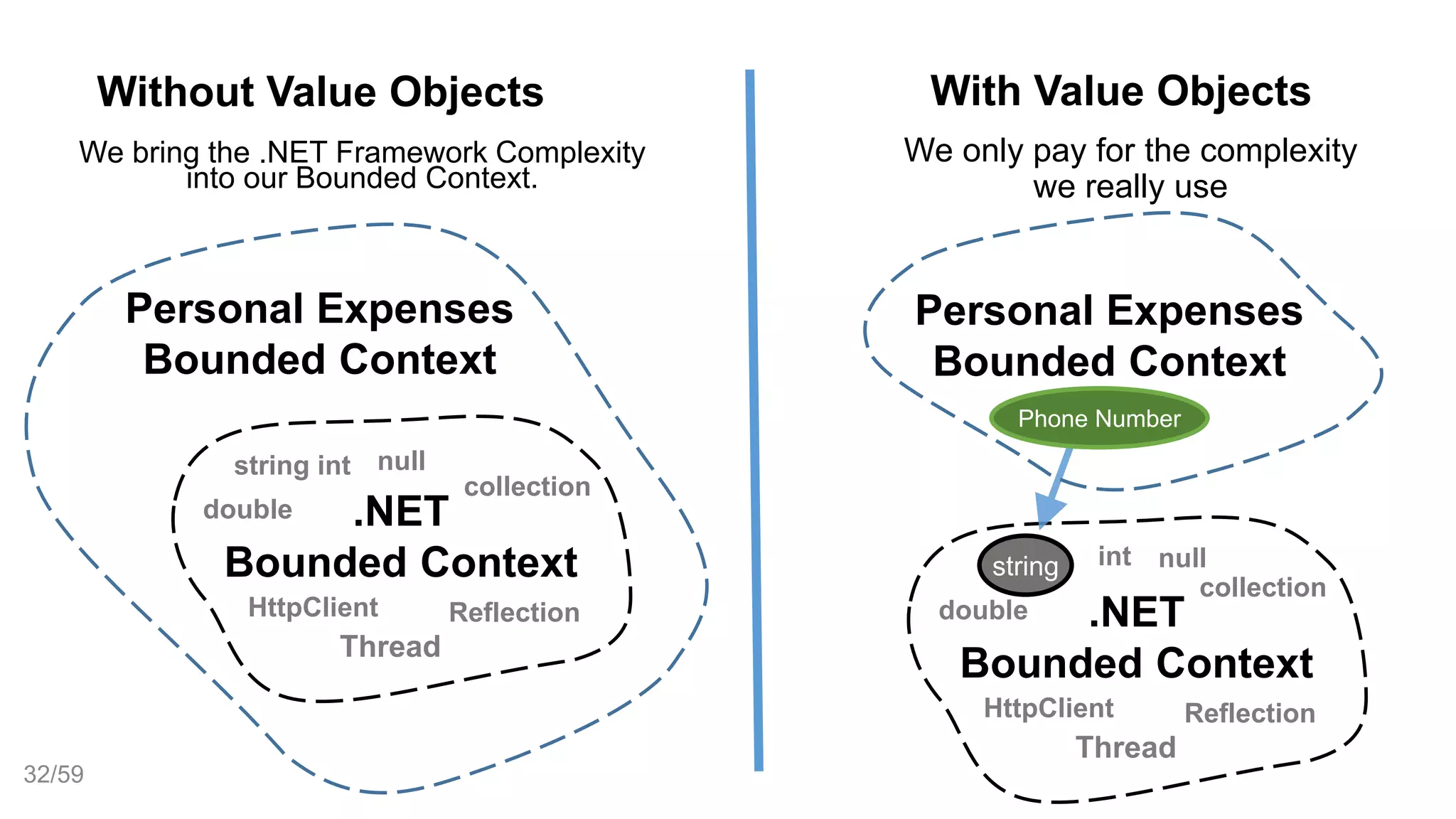
.NET
Bounded Context
Thread
Personal Expenses
Bounded Context
.NET
Bounded Context
Personal Expenses
Bounded Context
We only pay for the complexity
we really use
string
Phone Number
Thread
nullstring int
Reflection
double
collection
HttpClient
Without Value Objects With Value Objects
We bring the .NET Framework Complexity
into our Bounded Context.
nullint
Reflection
double
collection
HttpClient
32/59
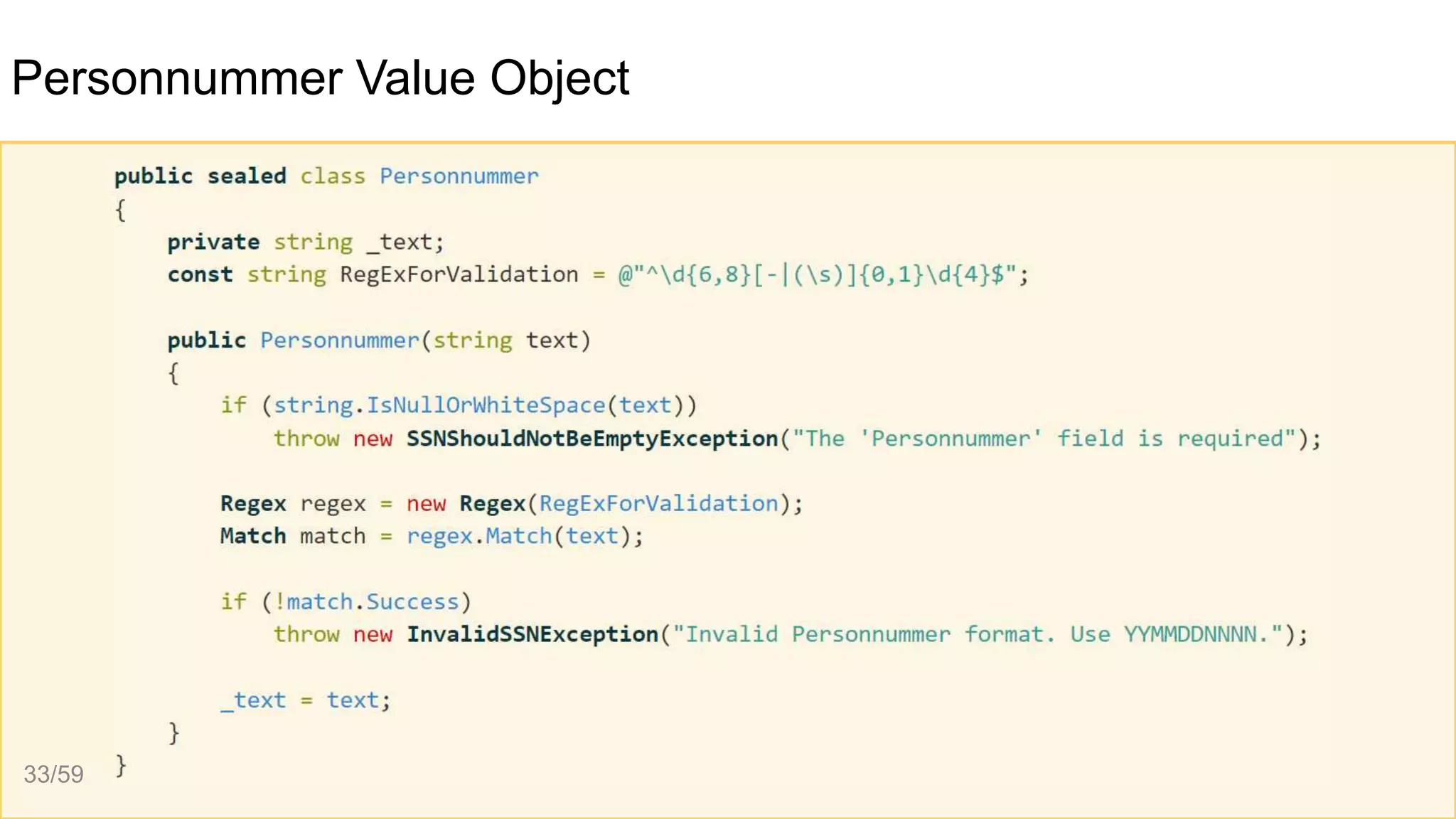
Personnummer Value Object
33/59
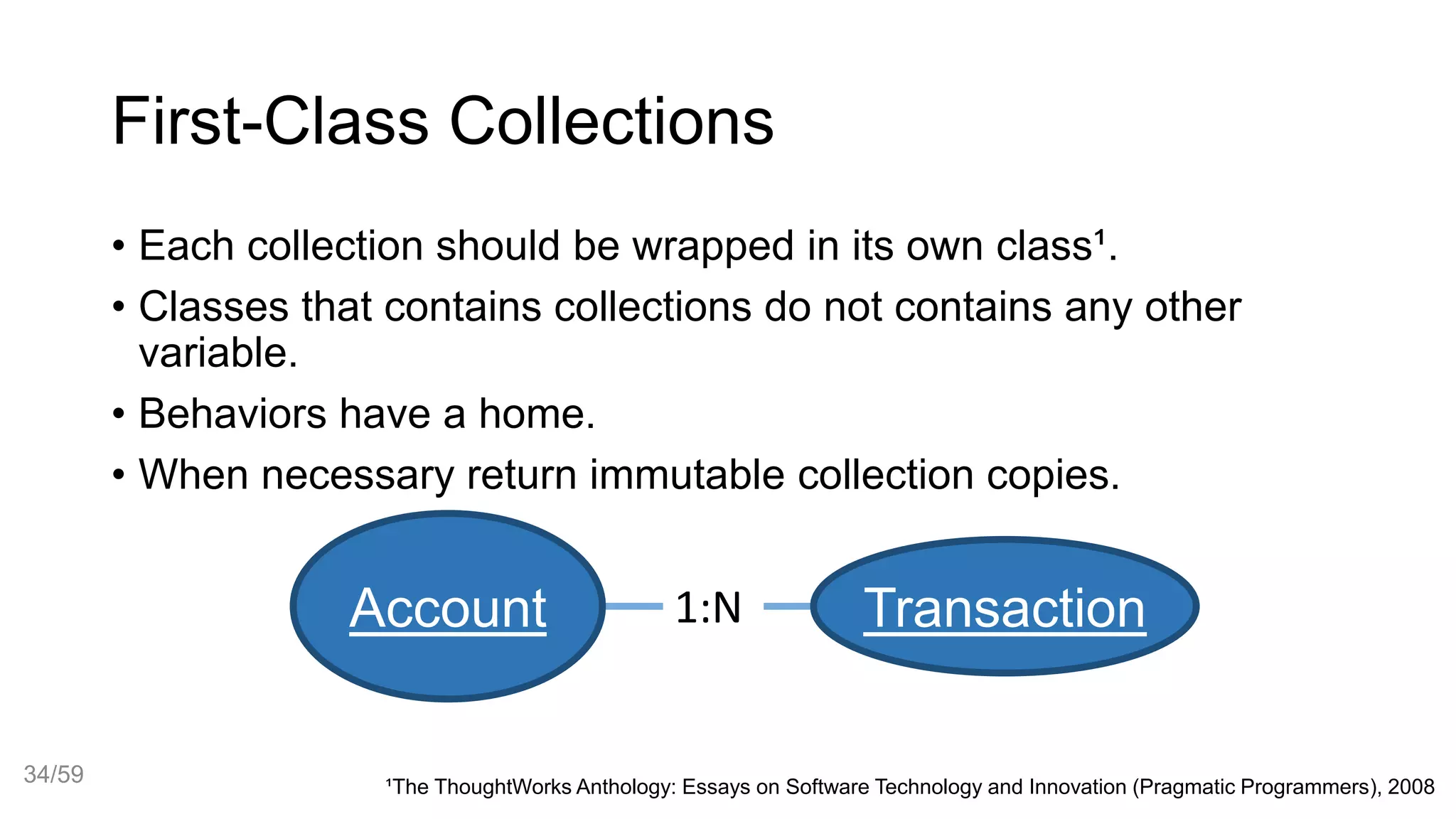
First-Class Collections
• Each collection should be wrapped in its own class¹.
• Classes that contains collections do not contains any other
variable.
• Behaviors have a home.
• When necessary return immutable collection copies.
Account Transaction1:N
¹The ThoughtWorks Anthology: Essays on Software Technology and Innovation (Pragmatic Programmers), 2008
34/59
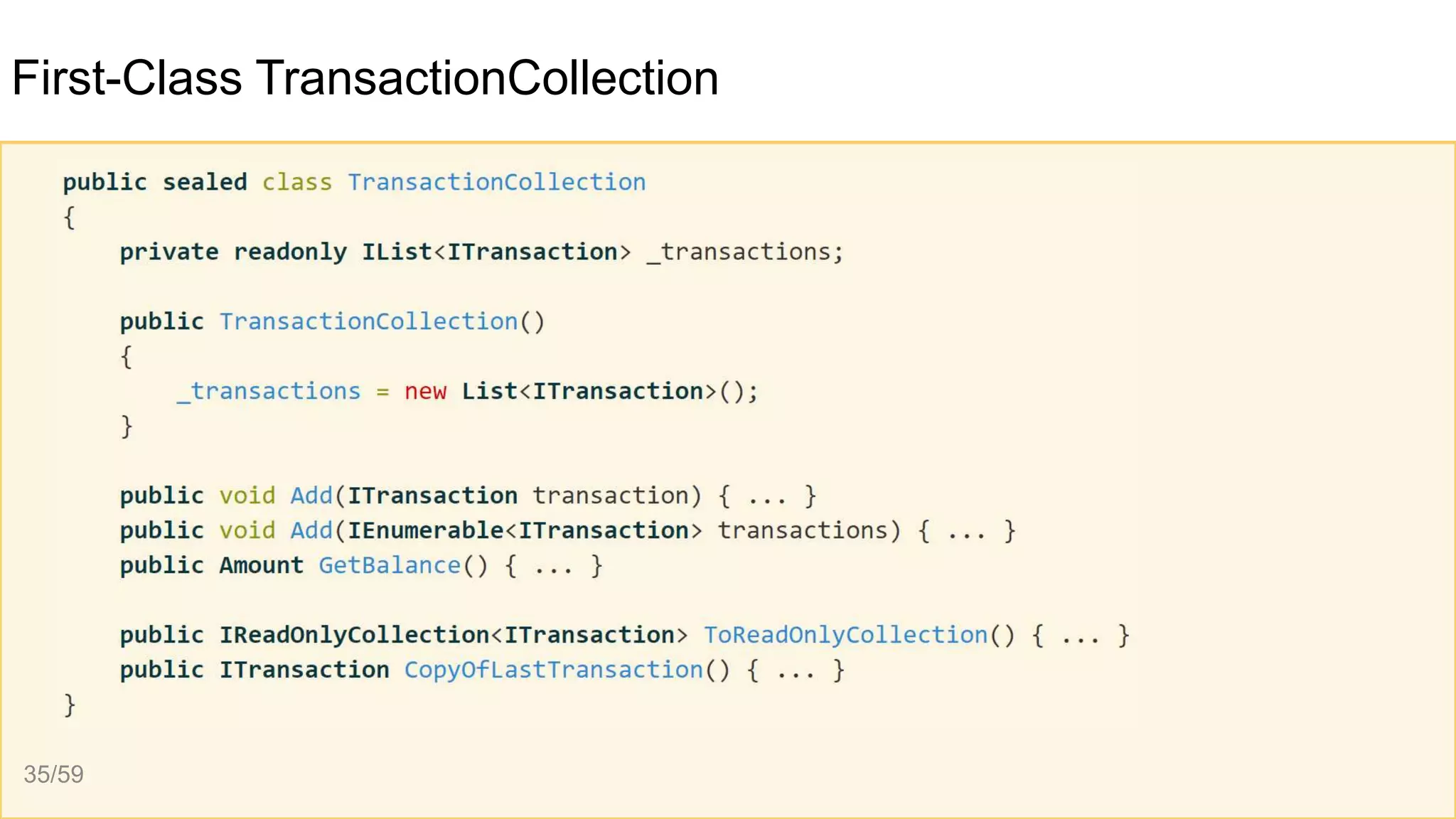
First-Class TransactionCollection
35/59
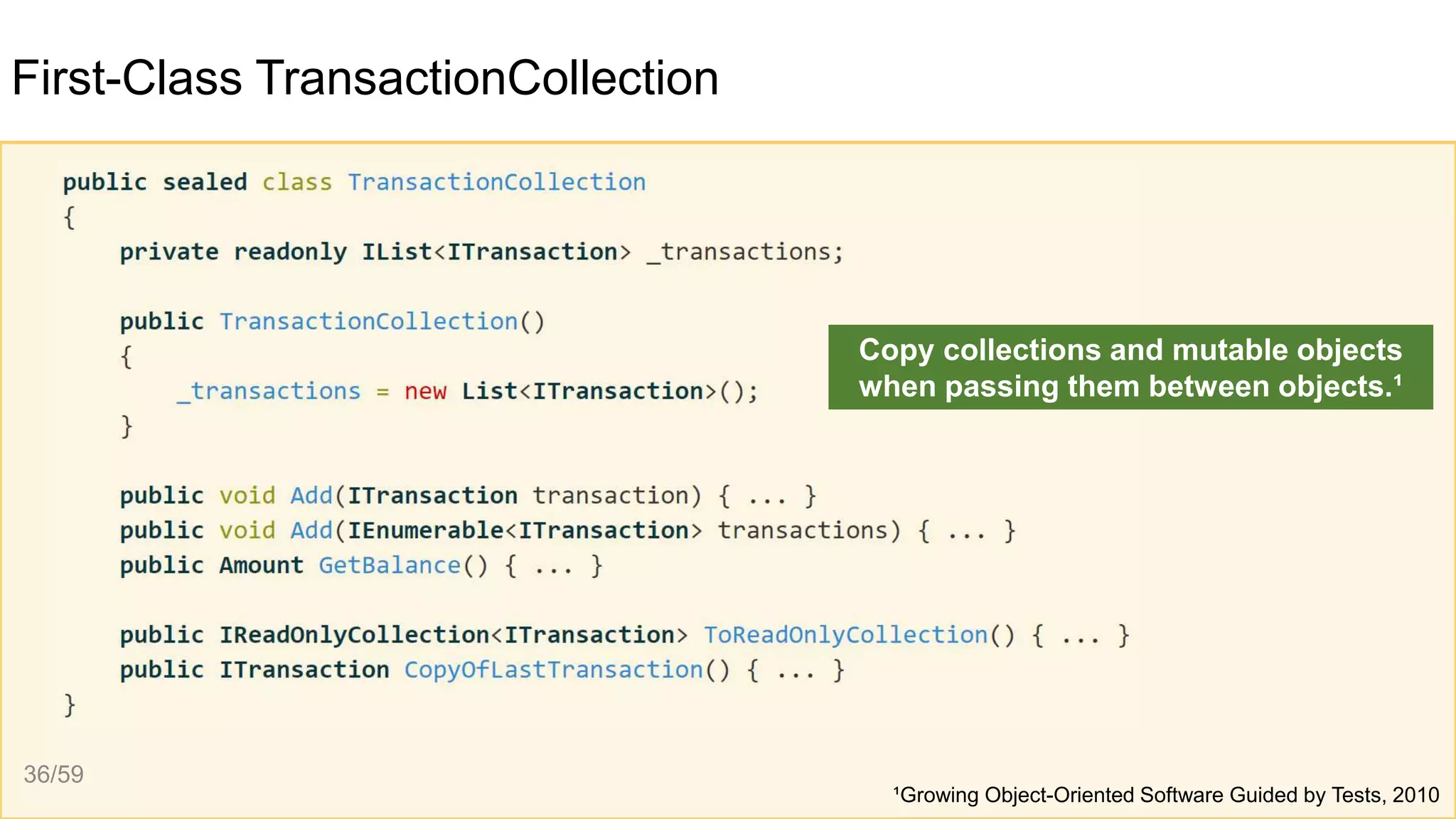
First-Class TransactionCollection
¹Growing Object-Oriented Software Guided by Tests, 2010
36/59
Copy collections and mutable objects
when passing them between objects.¹
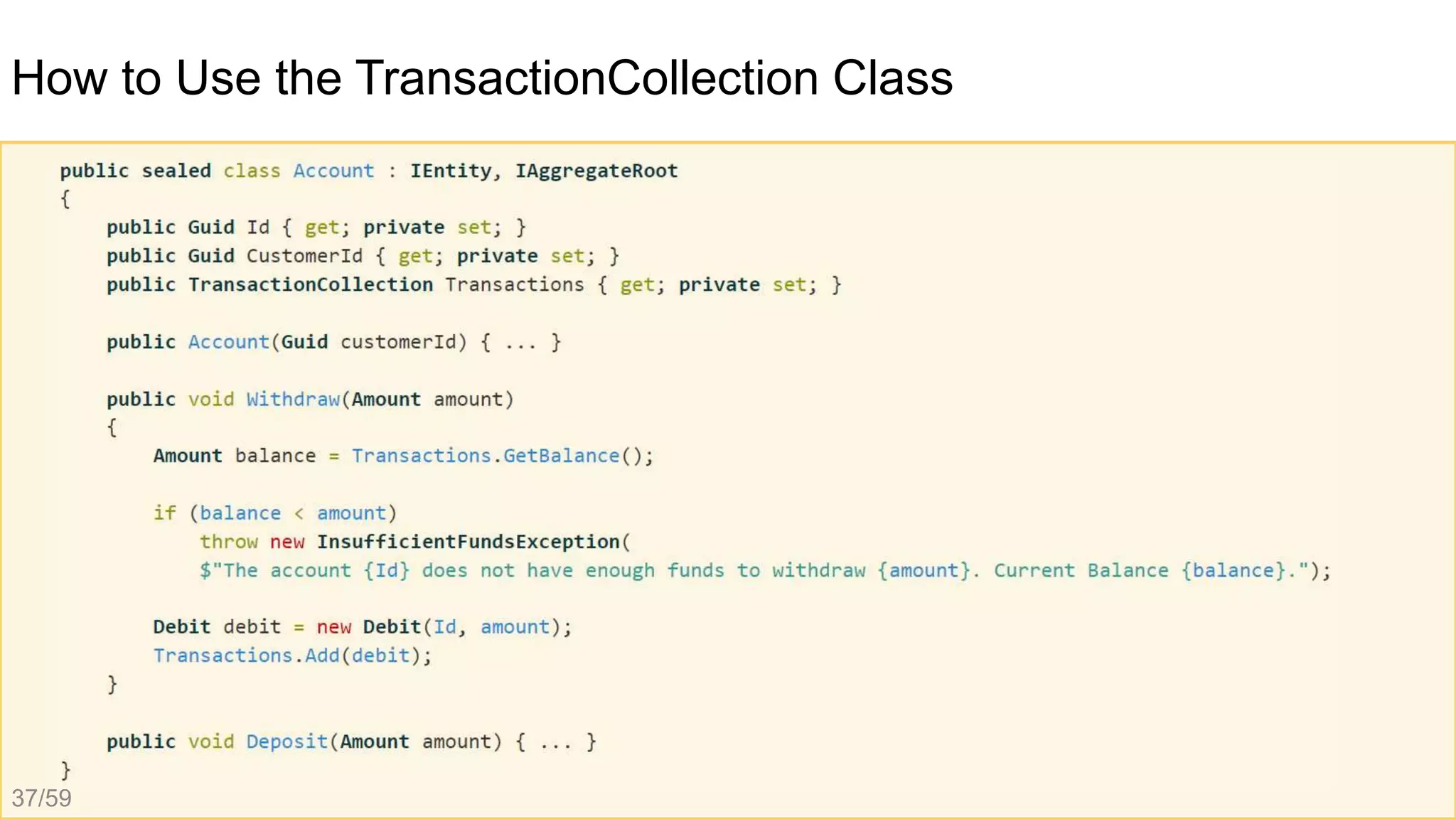
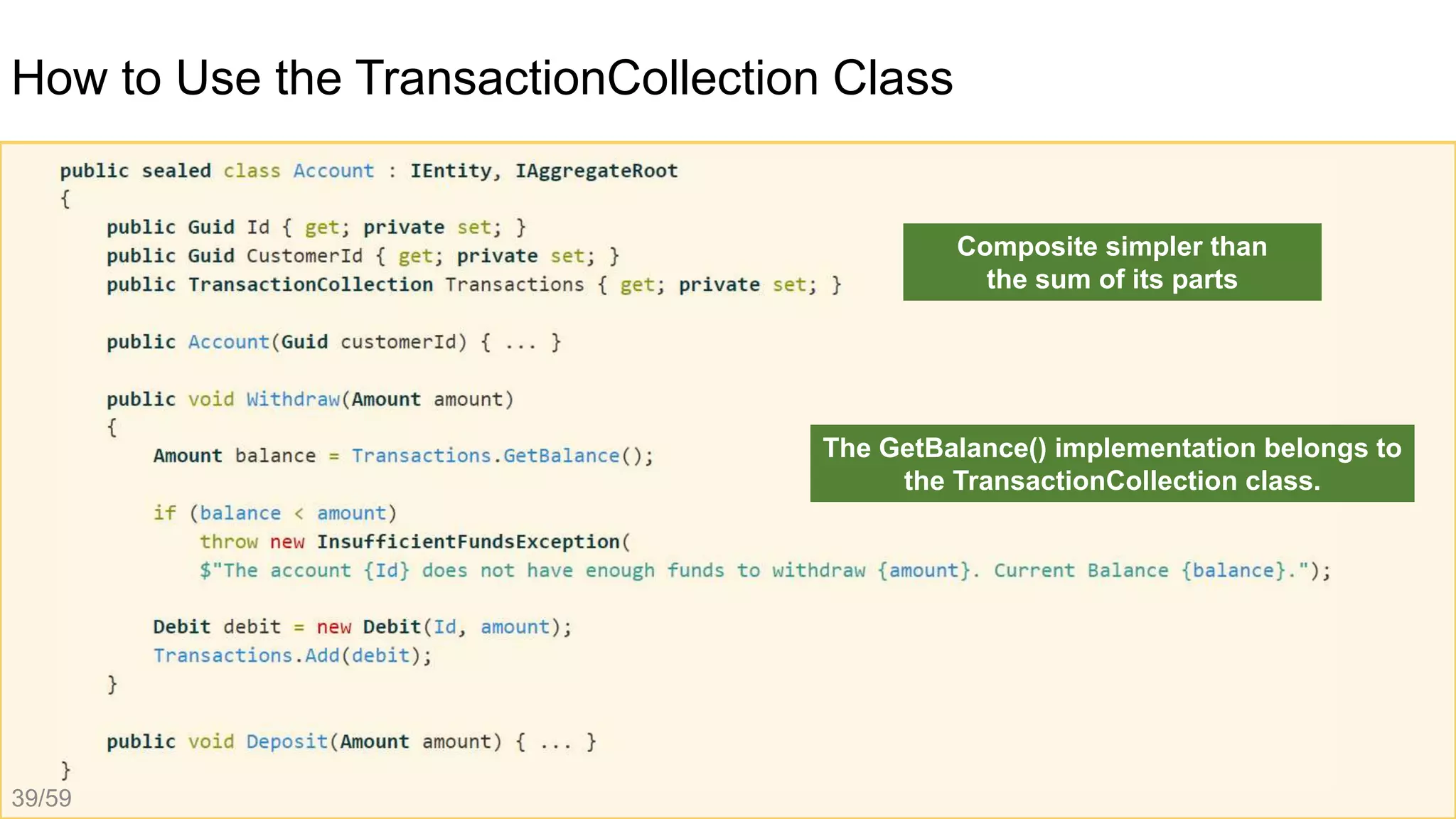
How to Use the TransactionCollection Class
37/59
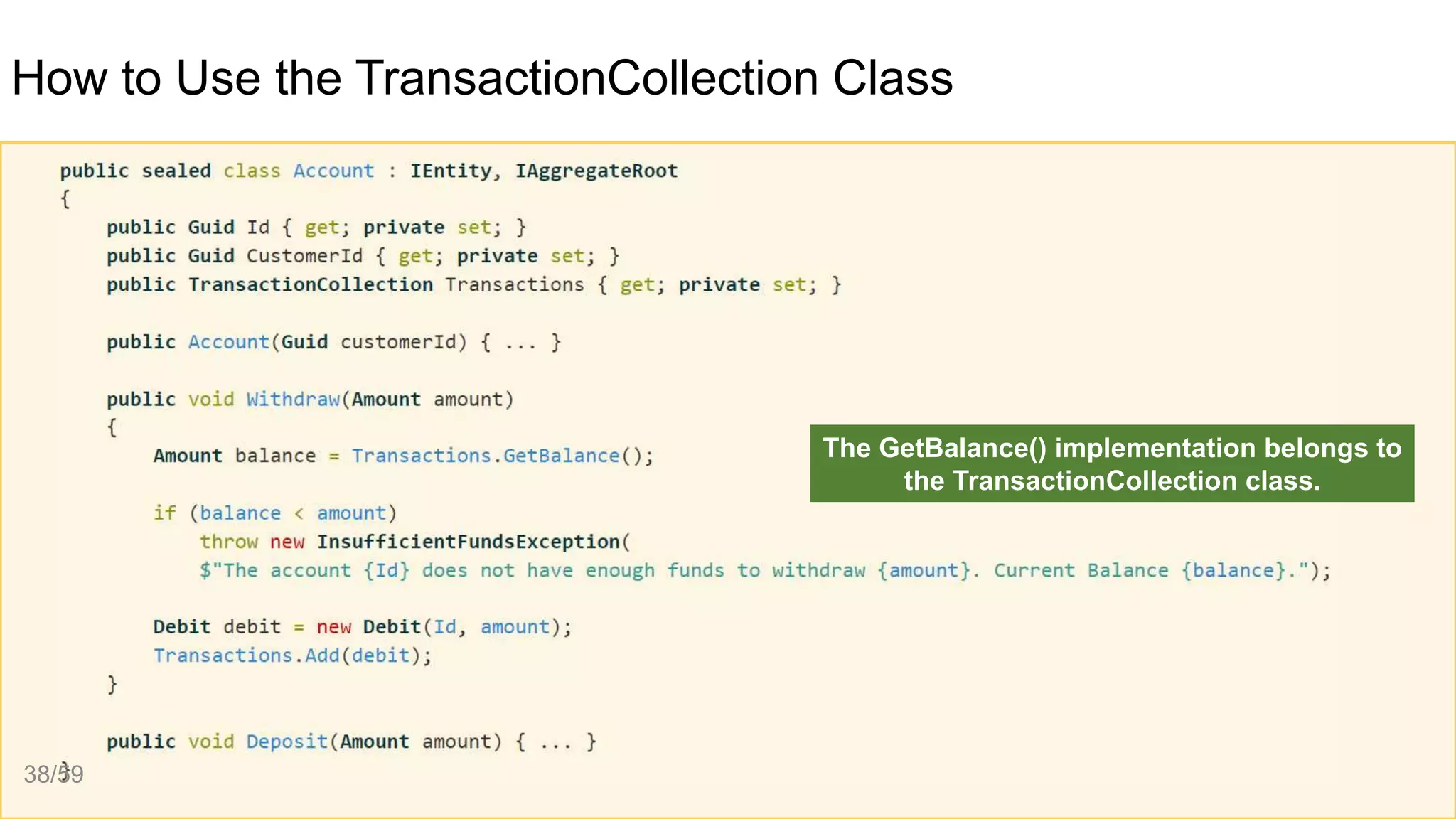
How to Use the TransactionCollection Class
The GetBalance() implementation belongs to
the TransactionCollection class.
38/59
How to Use the TransactionCollection Class
The GetBalance() implementation belongs to
the TransactionCollection class.
Composite simpler than
the sum of its parts
39/59
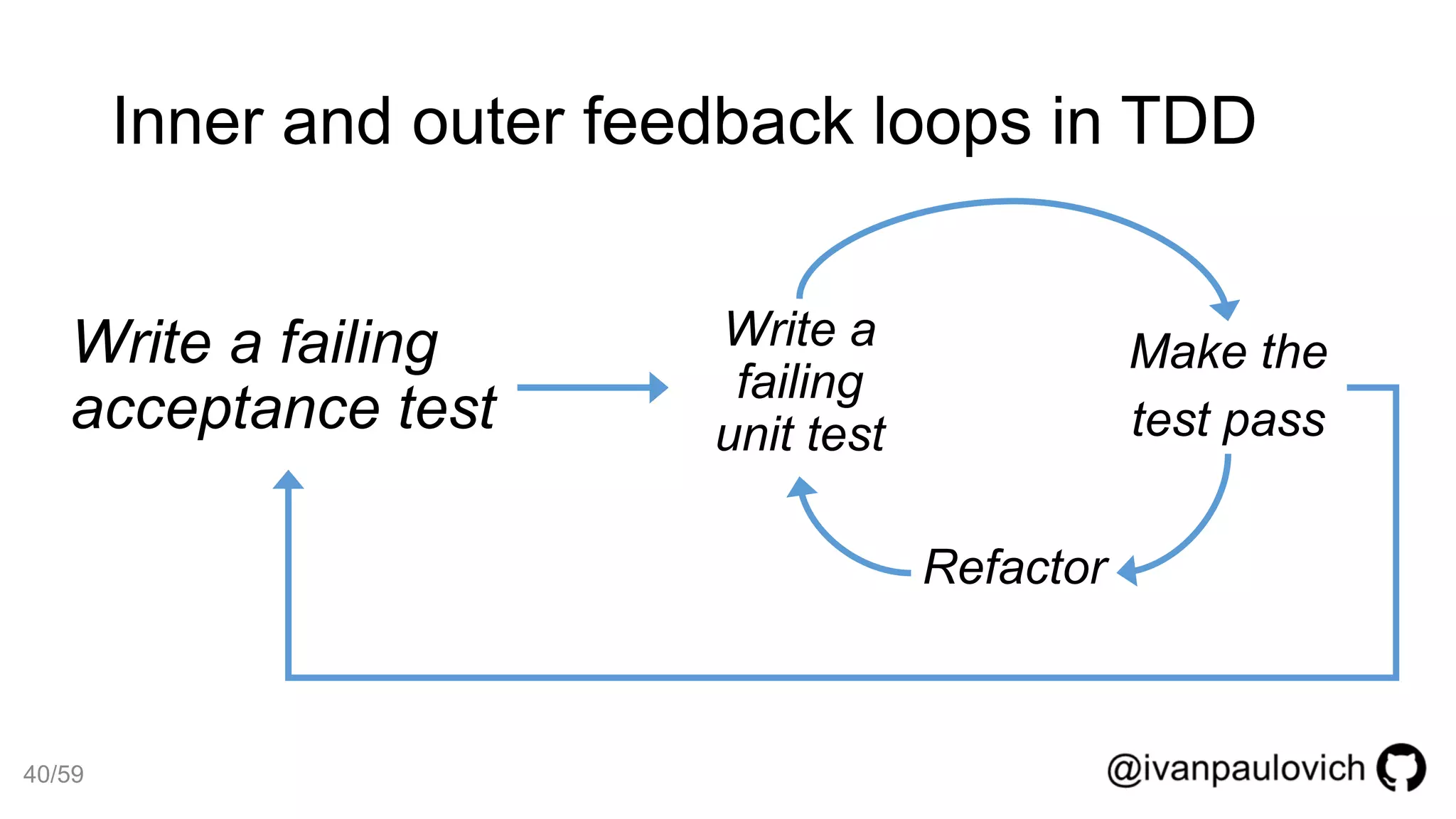
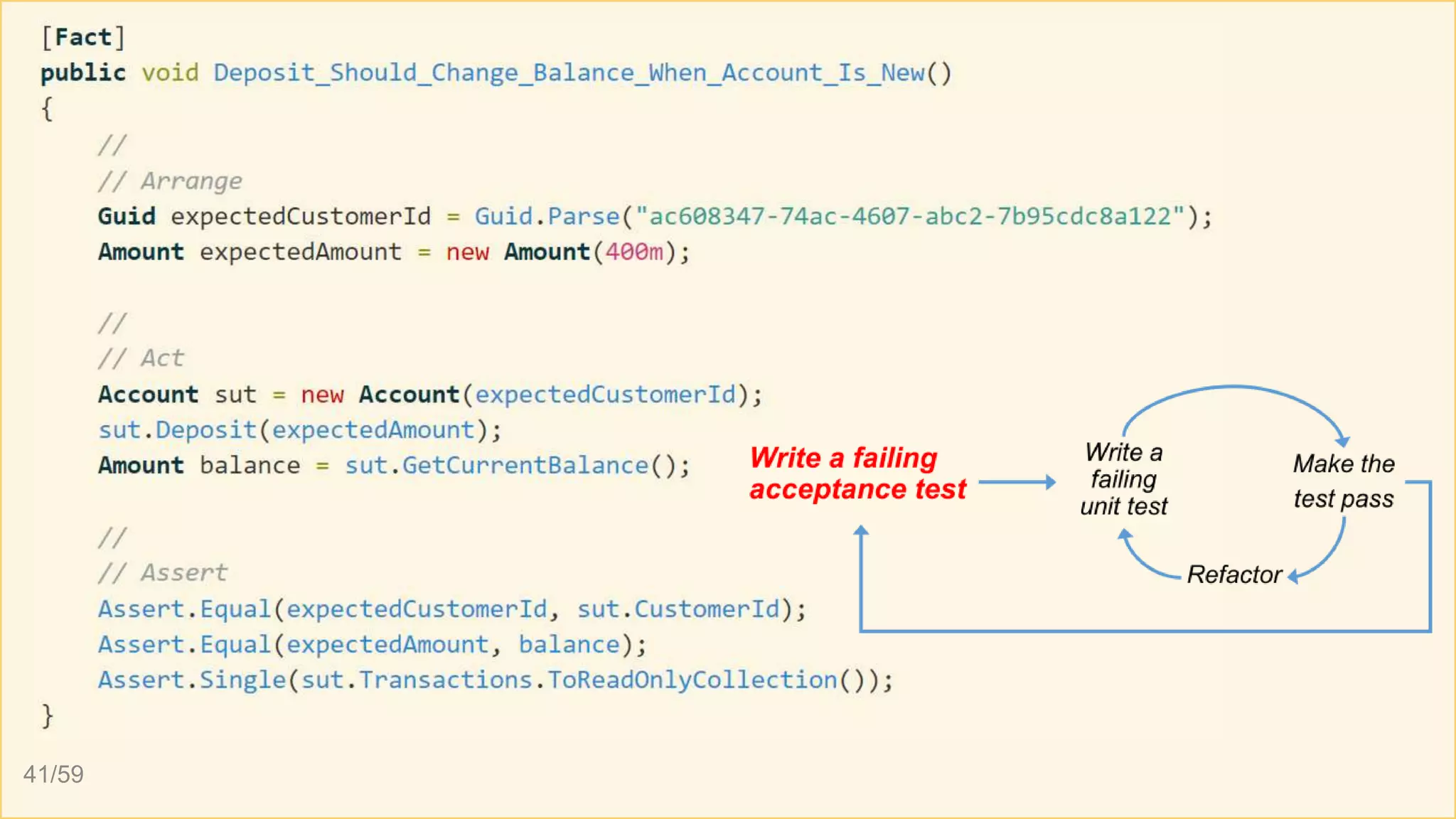
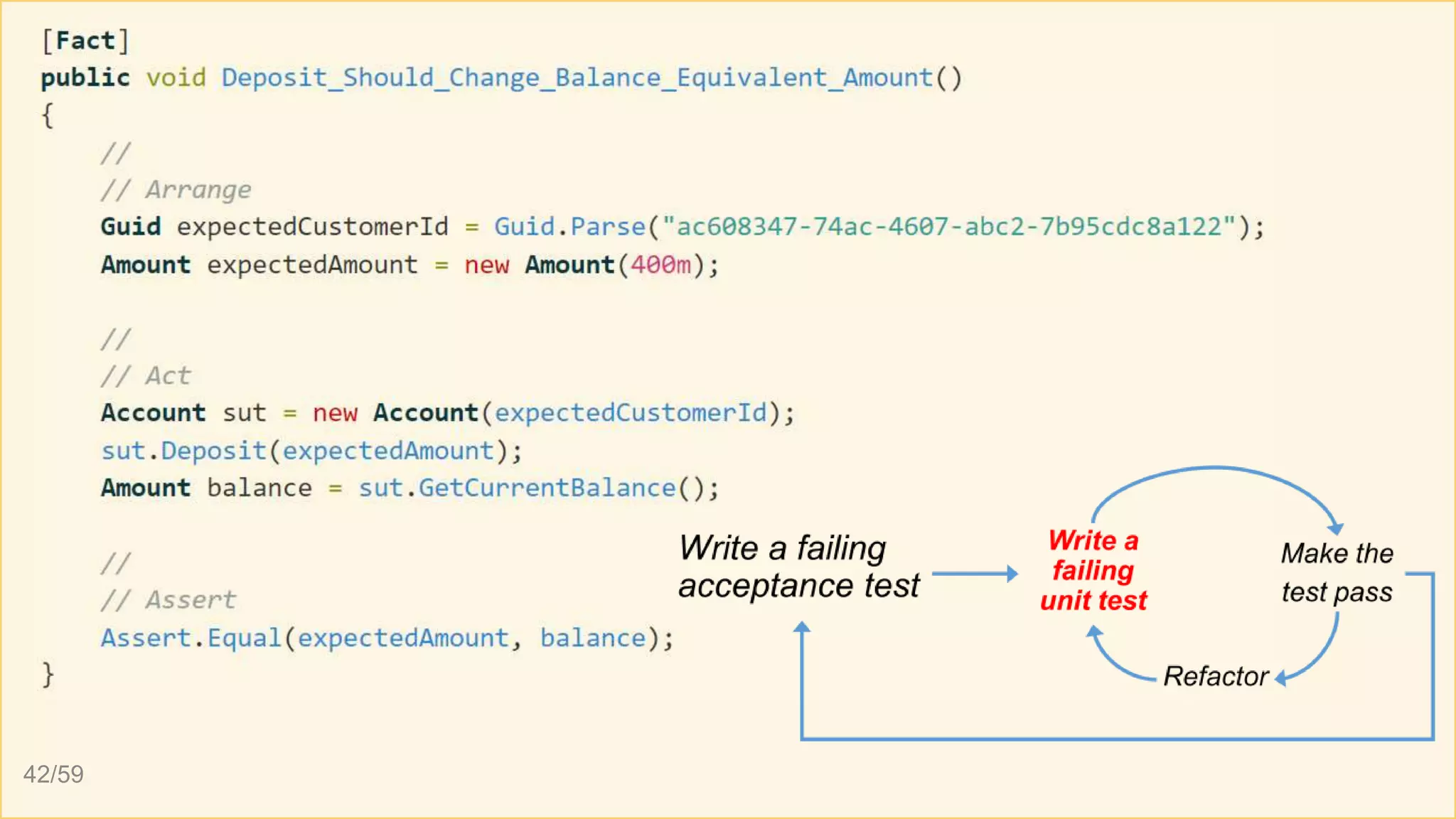
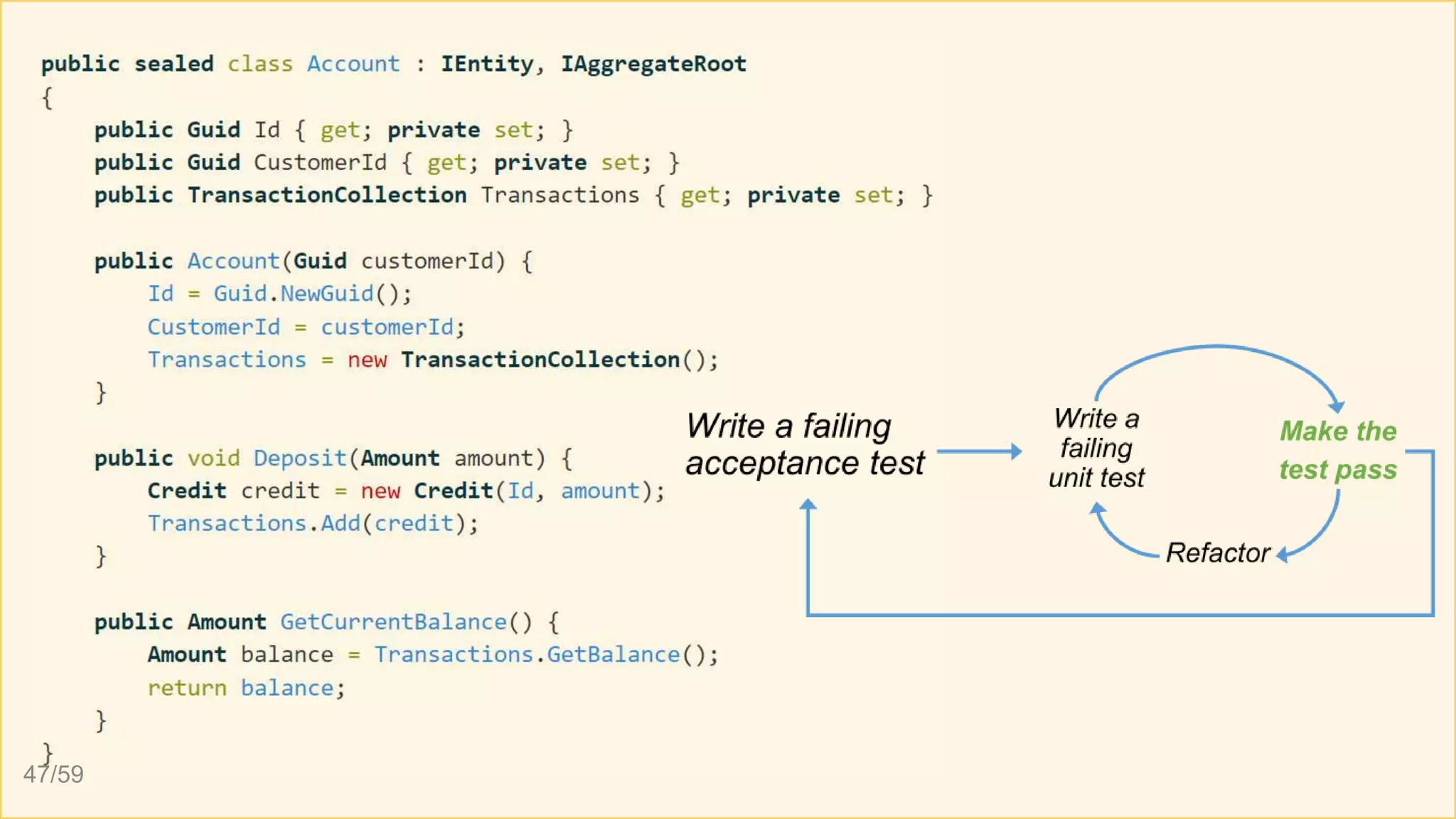
Write a failing
acceptance test
Write a
failing
unit test
Make the
test pass
Refactor
Inner and outer feedback loops in TDD
40/59
41/59
42/59
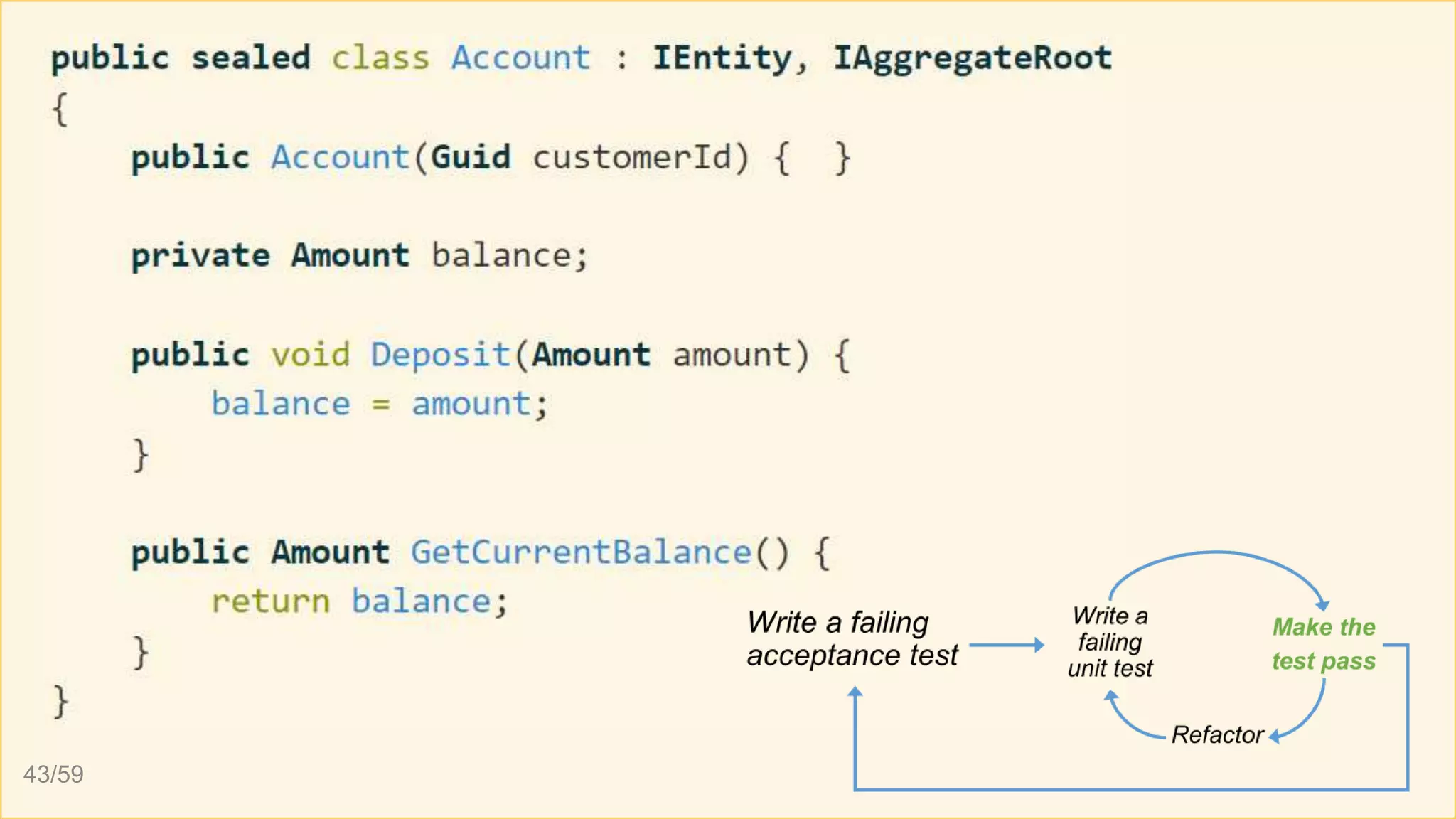
43/59
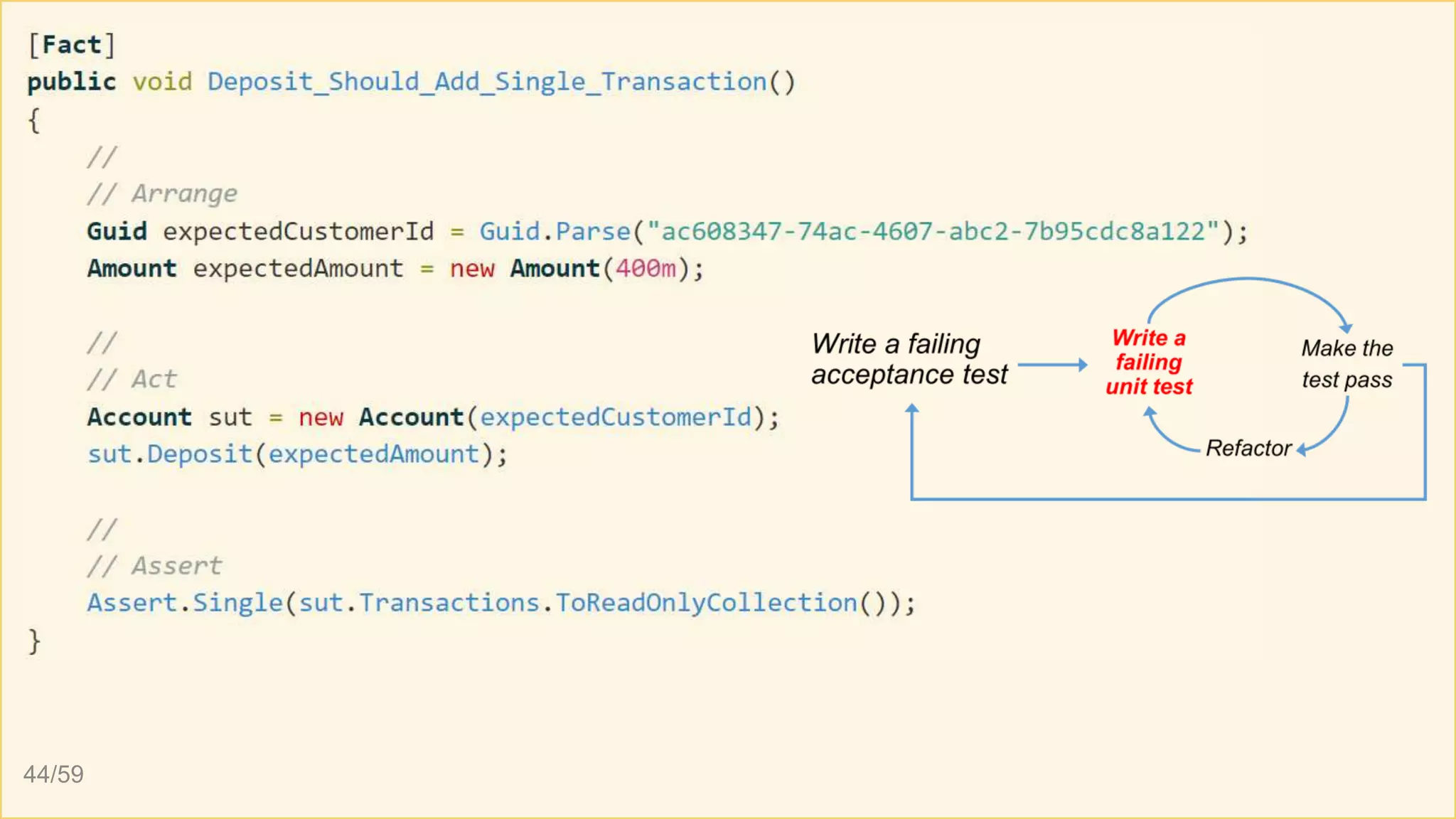
44/59
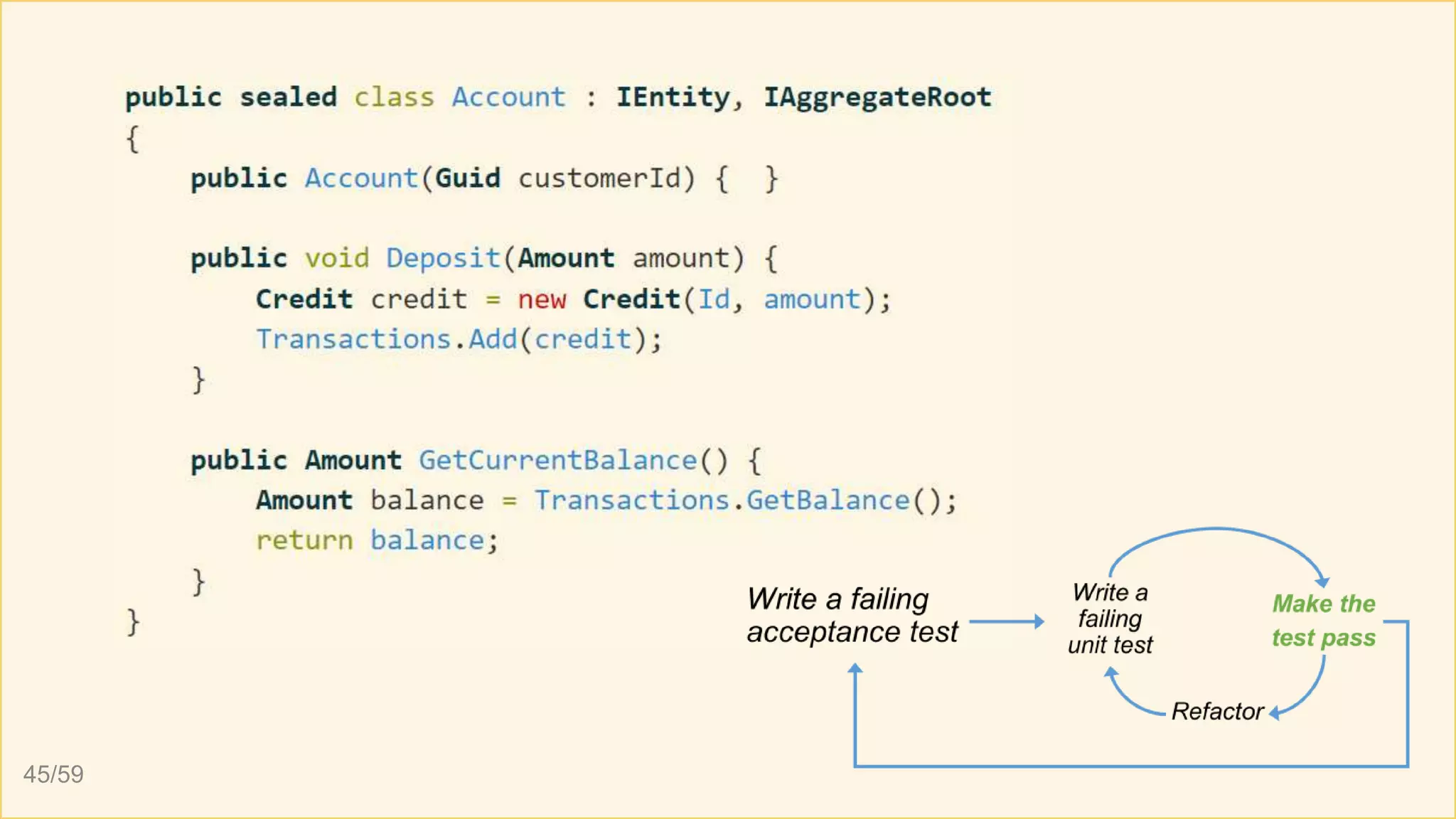
45/59
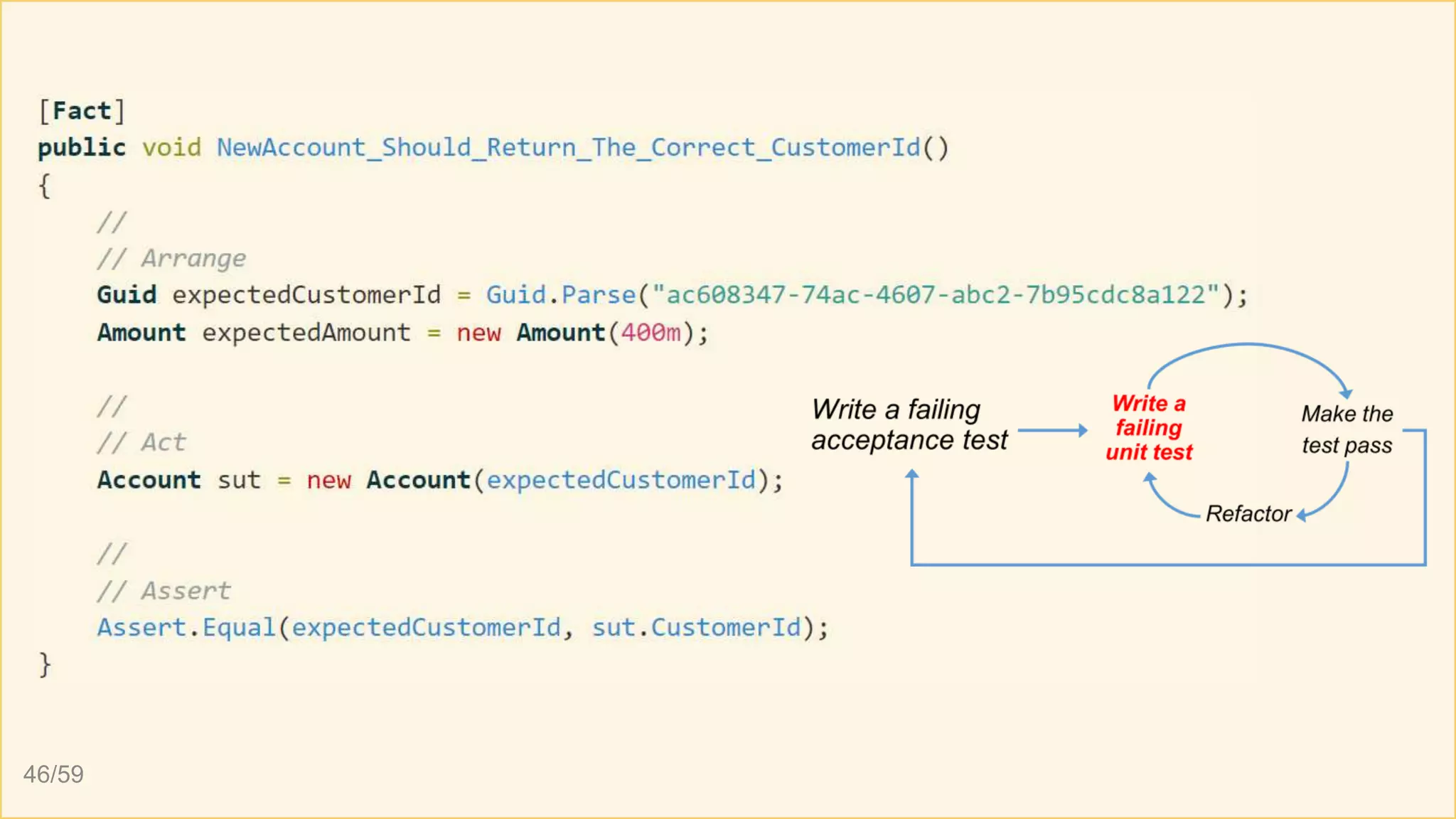
46/59
47/59
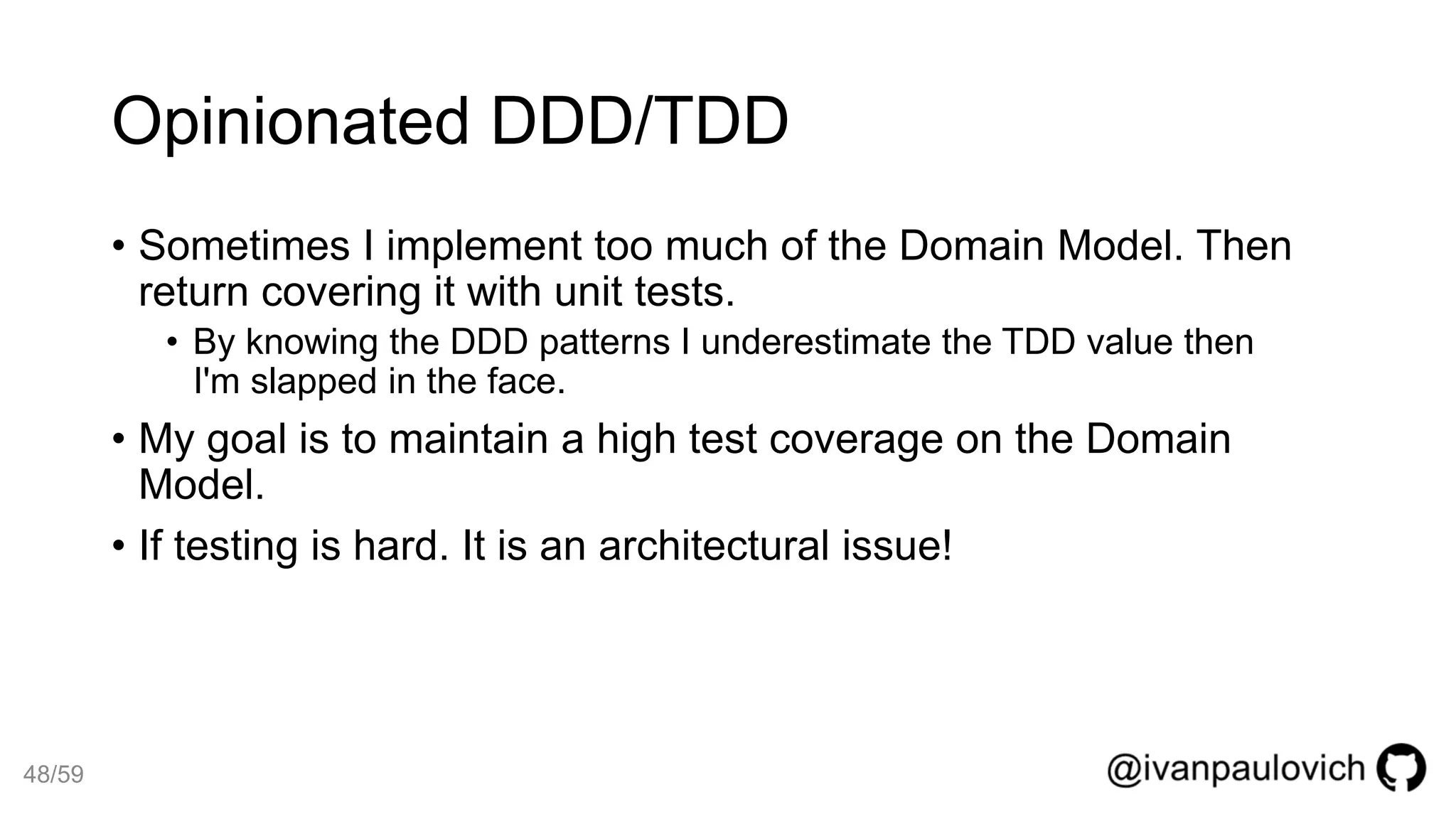
Opinionated DDD/TDD
• Sometimes I implement too much of the Domain Model. Then
return covering it with unit tests.
• By knowing the DDD patterns I underestimate the TDD value then
I'm slapped in the face.
• My goal is to maintain a high test coverage on the Domain
Model.
• If testing is hard. It is an architectural issue!
48/59
I won’t reverse engineer my
data model to create a
domain model.
49/59
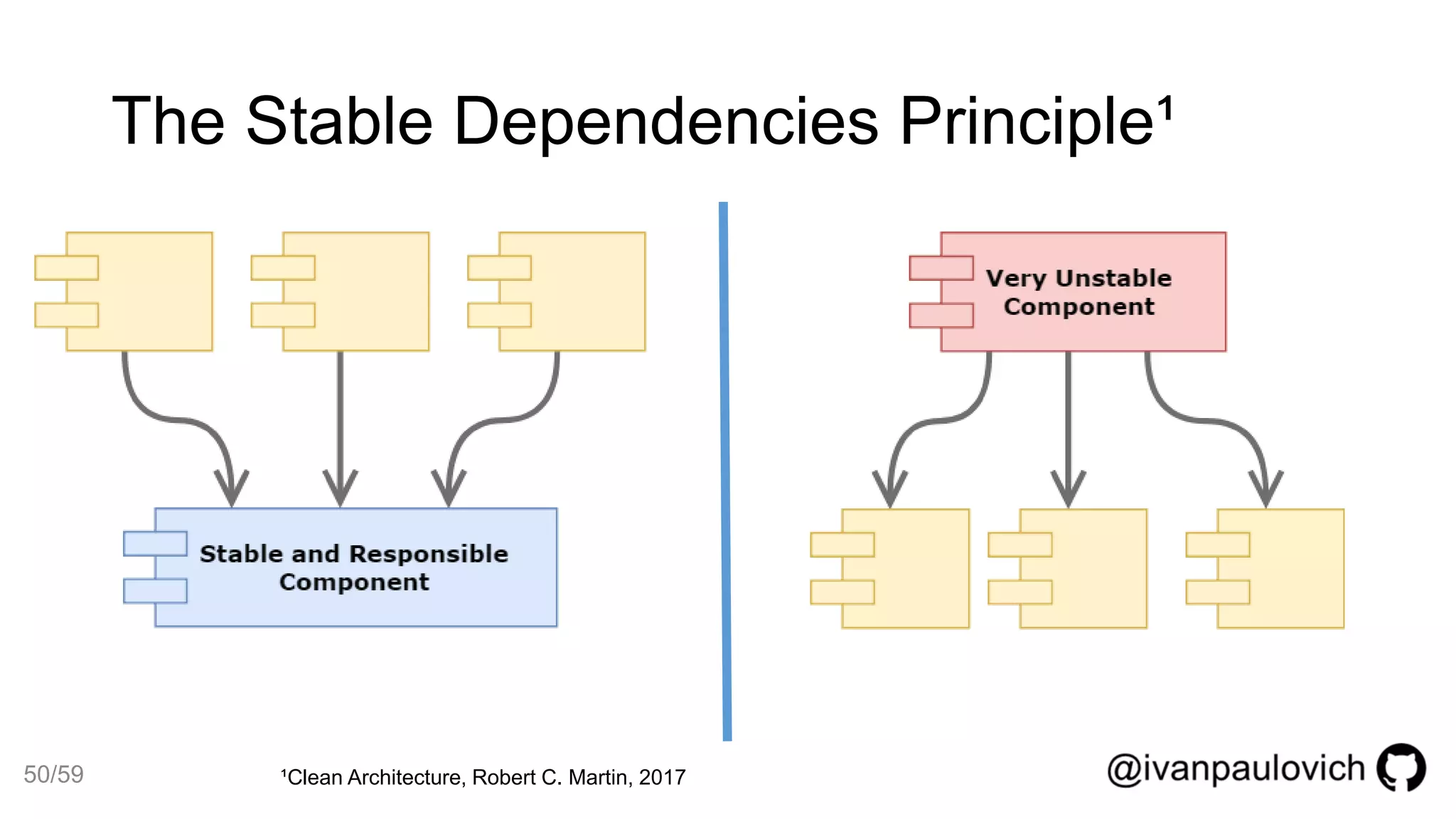
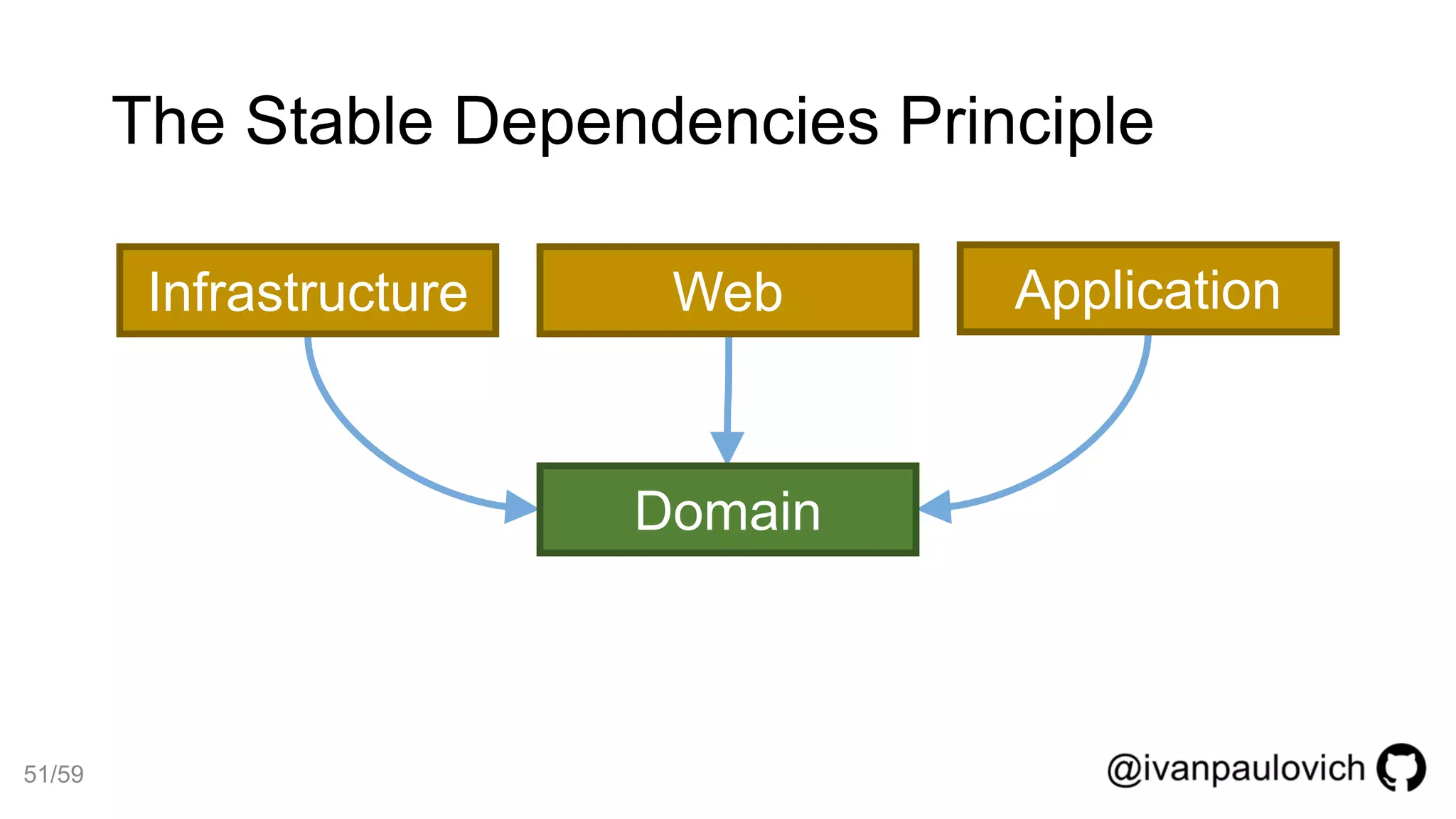
The Stable Dependencies Principle¹
¹Clean Architecture, Robert C. Martin, 201750/59
The Stable Dependencies Principle
Infrastructure Web
Domain
Application
51/59
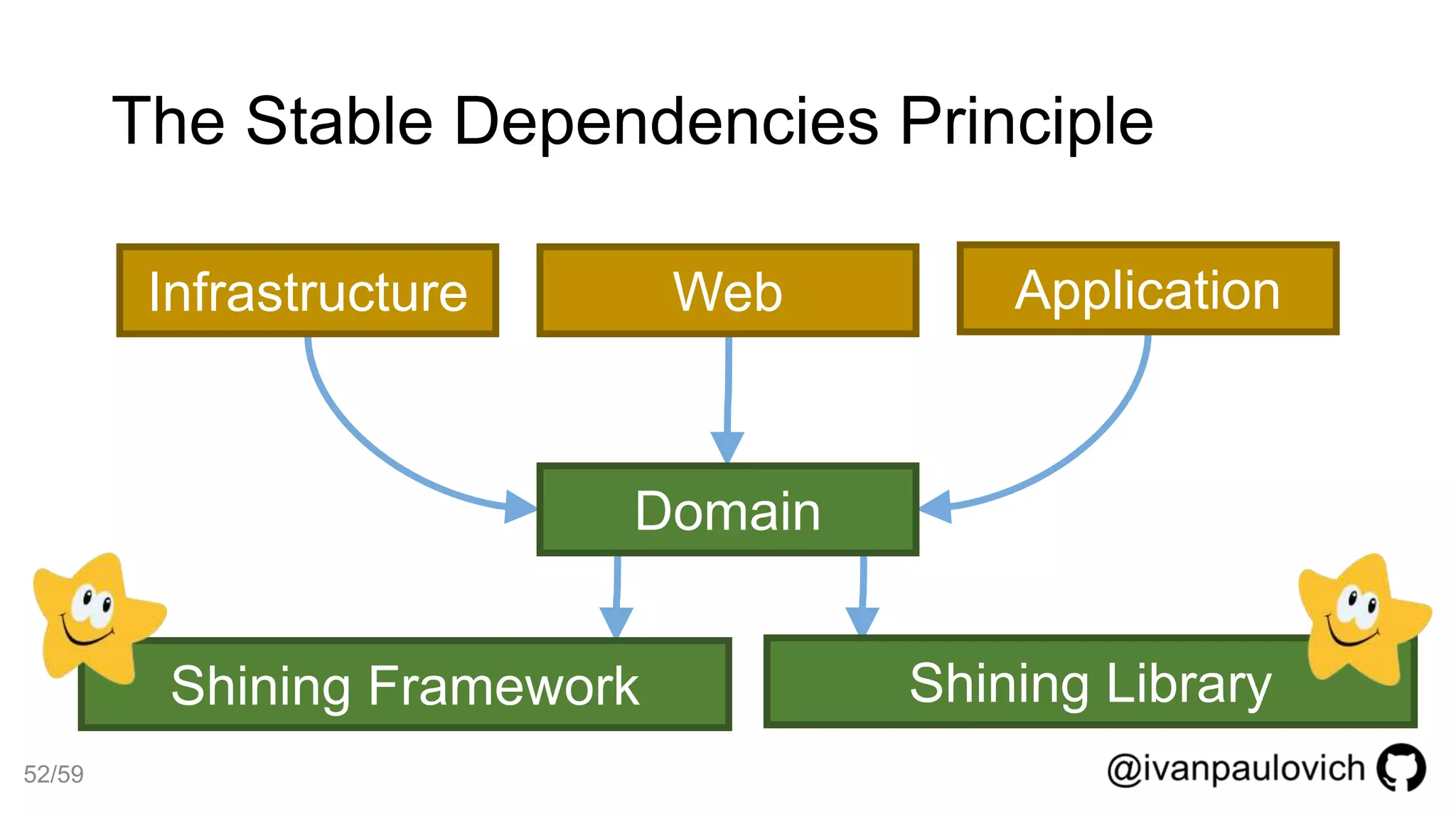
The Stable Dependencies Principle
Infrastructure Web
Domain
Application
Shining Framework Shining Library
52/59
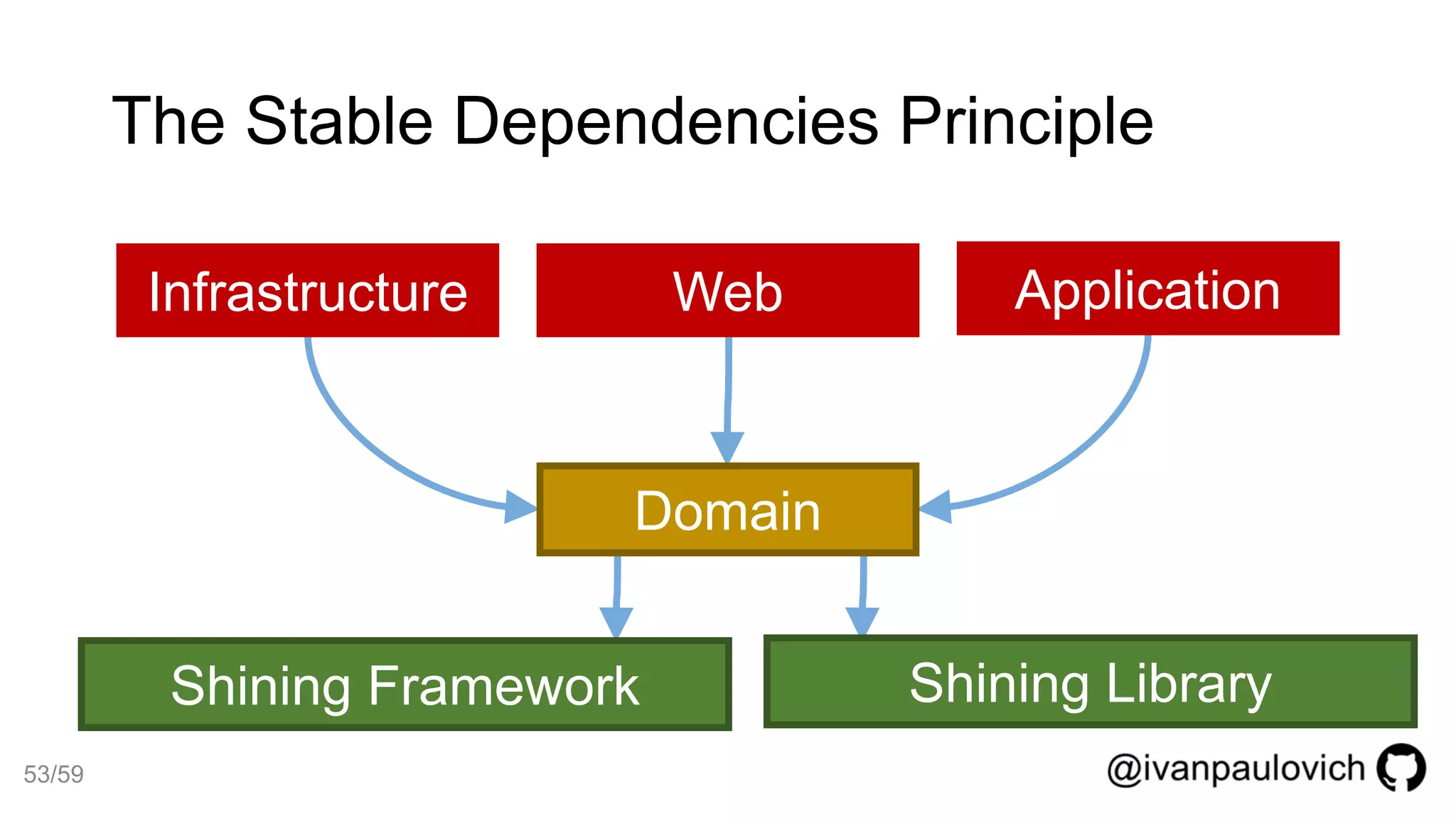
The Stable Dependencies Principle
Infrastructure Web
Domain
Application
Shining Framework Shining Library
53/59
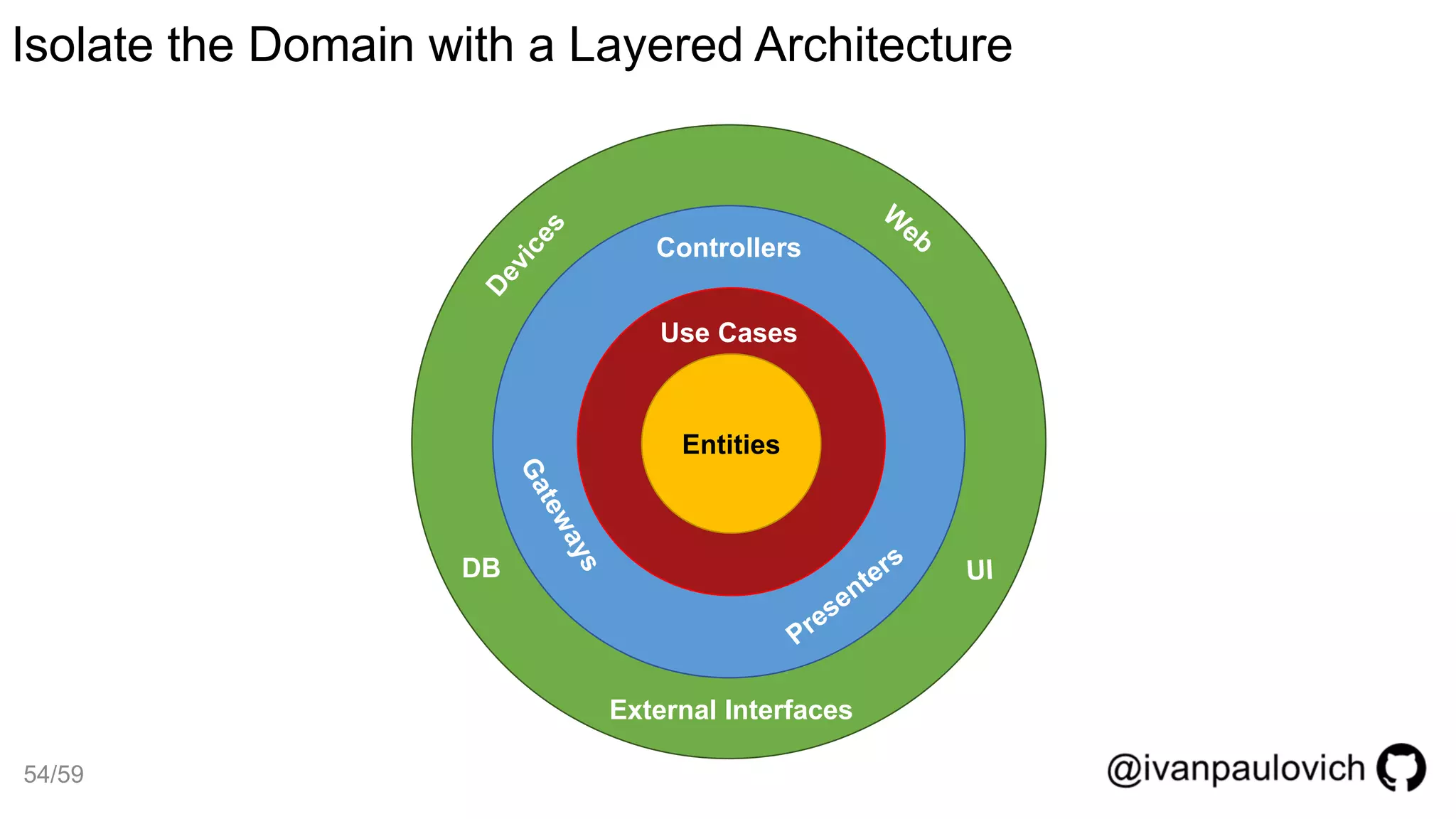
Entities
Use Cases
Controllers
External Interfaces
DB
Isolate the Domain with a Layered Architecture
54/59
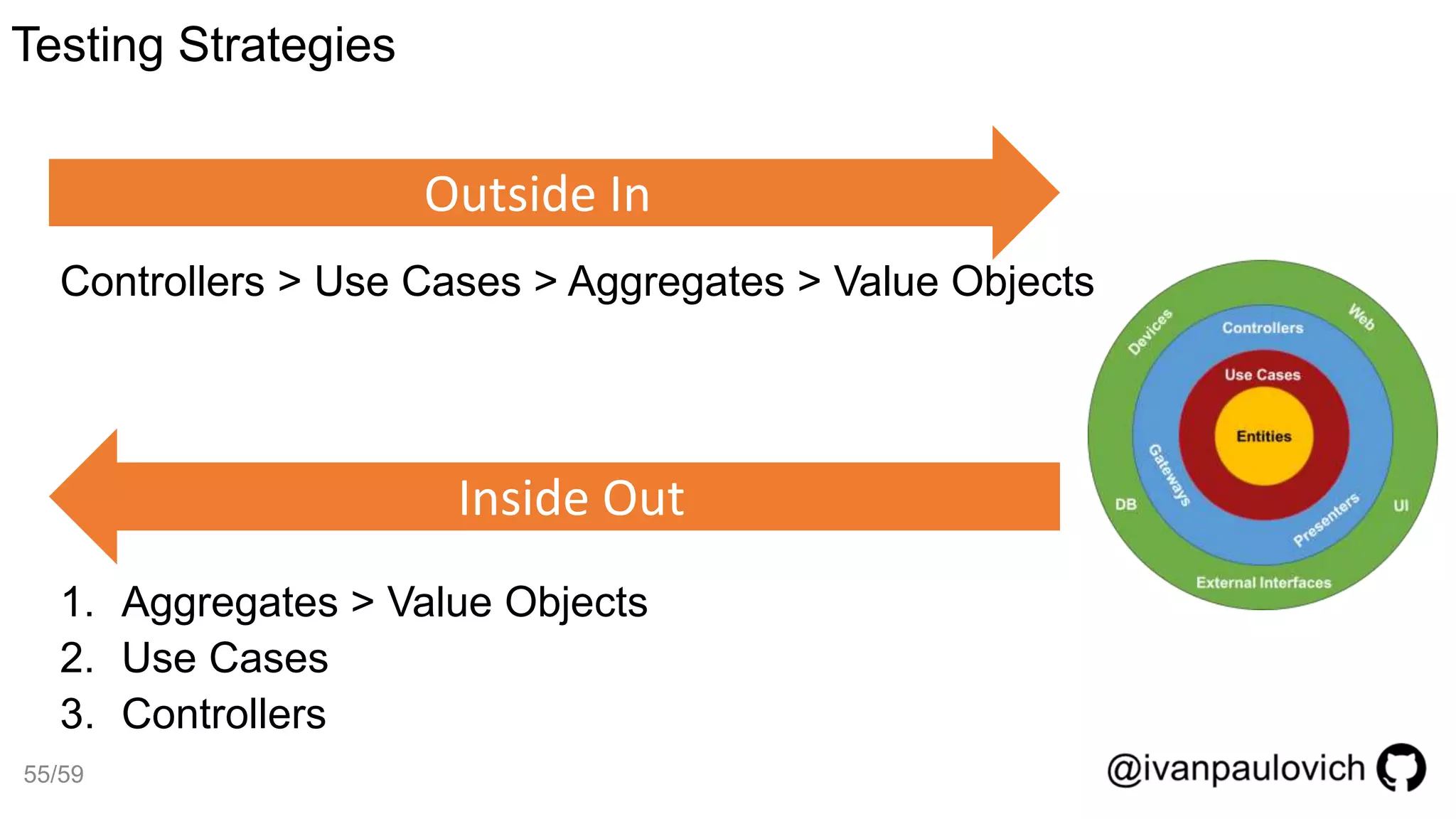
Outside In
Controllers > Use Cases > Aggregates > Value Objects
Inside Out
1. Aggregates > Value Objects
2. Use Cases
3. Controllers
Testing Strategies
55/59
DDD Patterns
Ubiquitous Language
Testing
Application Design
Implementation Samples
Quick Review
56/59
DDD Patterns
Ubiquitous Language
Testing
Application Design
Implementation Samples
Quick Review
57/59
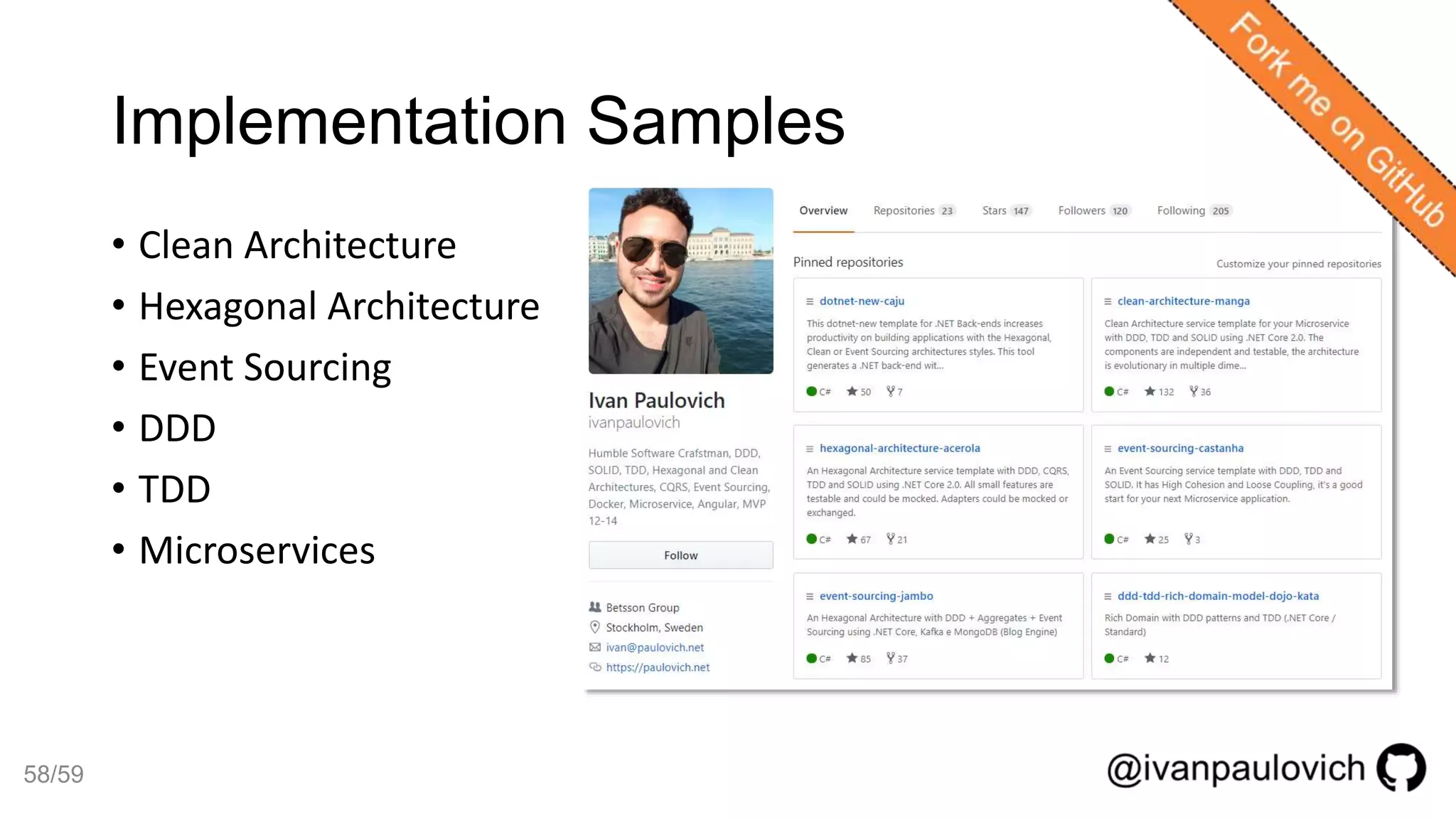
Implementation Samples
• Clean Architecture
• Hexagonal Architecture
• Event Sourcing
• DDD
• TDD
• Microservices
58/59
Resources
• Domain-driven Design, Eric J. Evans, 2003
• The ThoughtWorks Anthology: Essays on Software Technology
and Innovation (Pragmatic Programmers), 2008
• Clean Architecture, Robert C. Martin, 2017
• Growing Object-Oriented Software, Guided by Tests, 1st
Edition, 2009
• Secure by Design, Dan Bergh Johnsson, Daniel Deogun, Daniel
Sawano, 2018
• Domain-Driven Design Quickly, 2007
• Effective Aggregate Design, Vaughn Vernon, 2011
59/59

Building rich domain models with ddd and tdd ivan paulovich - betsson

  • 1.
    Building Rich Domain Models withDDD and TDD ivan.paulovich@betssongroup.comhttps://paulovich.net Ivan Paulovich Betsson Dev'talk #3 Stockholm – September 12th, 2018 @ivanpaulovich
  • 2.
    Ivan Paulovich PhotobyRafaelaBiazionUnsplash 30+ MicrosoftCertifications paulovich.net Developer
  • 3.
    Betsson Wallet Team •Seniors Developers • Agile Team • Business Oriented • .NET – SQL Server – Angular • Stockholm Office • We are hiring!
  • 4.
    How to shootyourself in the foot: 1. Design your application starting from the data model. 2. Create your domain model by reverse engineering. 3. Pretend that you’re doing TDD and start testing your domain classes. • Particularly getters and setters. 4. Now start testing the logic with Integration Tests and get stuck by test data and related issues. 5. Declare that TDD provides no benefit and only slows you down. 6. Comment tests in your Continuous Integration process. 7. Keep on whining. Alberto Brandolini 04/59
  • 5.
    Domain-Driven Design Tiny Domain Objects ExploratoryProgramming Focus on Unit Tests Frequent Short Cycles Quick Feedback Self Explanatory Coding Frequent Rewriting Confidence to Change Test-Driven Development 05/59
  • 6.
    A Customer Entitywith Primitive Obsession... 06/59
  • 7.
    Primitive Obsession Leadsto Services Like.. • Needs to verify for required parameters, Data Format and Data Range. • Services are unnecessary Big and Fat. • Easy to confuse one parameter with the another. 07/59
  • 8.
    • Not atechnology. • Not a methodology. • Set of principles and patterns for focusing the design effort where it matters most. 08/59
  • 9.
    A Customer EntityUsing Value Objects.. 09/59
  • 10.
    Business Rules EnforcedThrough Value Objects • The simple existence of a Value Object means that it is valid. • No need to verify parameters values on every method. • Services are thinner and smaller when using Value Objets. 10/59
  • 11.
    DDD express theModel with Value Objects, Entities and Services. Some Entities act as root of Aggregates. 11/59
  • 12.
    An Example withSome Use Cases • A customer can register a new account using its personal details. • Allow a customer to deposit funds into an existing account. • Allow to withdraw from an existing account. • Do not allow to withdraw more than the current balance. 12/59
  • 13.
    Account Number 4444-6(Day-to-Day) Date Description Debit (SEK) Credit (SEK) Balance (SEK) 01-08-2018 Initial Balance 50,000 03-08-2018 Withdrawn 10,000 40,000 07-08-2018 Withdrawn 5,000 35,000 17-09-2018 Deposited 7,000 42,000 Account Number 7777-0 (Savings) Date Description Debit (SEK) Credit (SEK) Balance (SEK) 01-09-2018 Initial Balance 10,000 Customer 5557-8 13/59
  • 14.
    Some Noums andVerbs are Useful • A customer can register a new account using its personal details. • Allow a customer to deposit funds into an existing account. • Allow to withdraw from an existing account. • Do not allow to withdraw more than the current balance. 14/59
  • 15.
    Customer Account Credit First Name Last Name OpeningDate Personnummer Debit Amount Transaction Date Description Tactical-Design Mobile Phone Number Amount Transaction Date Description 15/59
  • 16.
    Customer Account Credit First Name Last Name OpeningDate Personnummer Debit Amount Transaction Date Description Tactical-Design Mobile Phone Number Amount Transaction Date Description 16/59
  • 17.
    Customer Account Credit First Name Last Name OpeningDate Personnummer Debit Amount Transaction Date Description Tactical-Design Mobile Phone Number Personal Expenses Bounded Context Amount Transaction Date Description 17/59
  • 18.
    Domain Model Terms Names of BoundedContexts Terminology of Large-scale Structures DDD Patterns Names Business Terms Developers Don’t Understand Business Terms Everyone Uses That Don’t Appear in Design Technical Aspects of Design Technical Terms Technical Design Patterns Developers Domain Experts Ubiquitous Language 18/59
  • 19.
    Entities • Have aunique identity. • Are mutable or not. • Refer others entities by their IDs. 19/59
  • 20.
    Aggregate Roots (AreEntities) • Refer other aggregates by identity only. • Scope of consistency inside the aggregate boundaries. • Eventual consistency between aggregates. • Aggregates are small. • Aggregates implement behaviors. • Entity + Repository ~ Aggregate • One Aggregate Root for every Entity is a Code Smell. 20/59
  • 21.
    An Aggregate Rootis not your Entire Model 21/59
  • 22.
  • 23.
  • 24.
    Account Aggregate Root Itis an Entity 24/59
  • 25.
    Account Aggregate Root Itis an Entity Only mandatory fields are required in the constructor 25/59
  • 26.
    Account Aggregate Root Itis an Entity Only mandatory fields are required in the constructor Implements behaviors which maintain the state consistent. 26/59
  • 27.
    Account Aggregate Root Itis an Entity Factory method to restore state. Only mandatory fields are required in the constructor Implements behaviors which maintain the state consistent. 27/59
  • 28.
    Value Objects • Immutable. •Have no explicit identity. • Unique by the comparison of the attributes. • Used to describe, measure or quantify an Entity. First Name Last Name Personnummer Mobile Phone Number Amount Description 28/59
  • 29.
    Personal Expenses Bounded Context .NET BoundedContext Mobile Phone Number string 29/59
  • 30.
    Personal Expenses Bounded Context .NET BoundedContext Mobile Phone Number string Clone Compare CompareOrdinal CompareTo Concat Contains Copy CopyTo Create EndsWith Equals Format GetEnumerator GetHashCode GetTypeCode IndexOf IndexOfAny Insert Intern IsInterned IsNormalized IsNullOrEmpty IsNullOrWhiteSpace Join LastIndexOf LastIndexOfAny Normalize PadLeft PadRight Remove Replace Split StartsWith Substring ToCharArray ToLower ToLowerInvariant ToString ToUpper ToUpperInvariant Trim TrimEnd TrimStart 30/59
  • 31.
    Personal Expenses Bounded Context .NET BoundedContext Mobile Phone Number Create GetAreaCode GetLastFourDigits ToString string Clone Compare CompareOrdinal CompareTo Concat Contains Copy CopyTo Create EndsWith Equals Format GetEnumerator GetHashCode GetTypeCode IndexOf IndexOfAny Insert Intern IsInterned IsNormalized IsNullOrEmpty IsNullOrWhiteSpace Join LastIndexOf LastIndexOfAny Normalize PadLeft PadRight Remove Replace Split StartsWith Substring ToCharArray ToLower ToLowerInvariant ToString ToUpper ToUpperInvariant Trim TrimEnd TrimStart 31/59
  • 32.
    .NET Bounded Context Thread Personal Expenses BoundedContext .NET Bounded Context Personal Expenses Bounded Context We only pay for the complexity we really use string Phone Number Thread nullstring int Reflection double collection HttpClient Without Value Objects With Value Objects We bring the .NET Framework Complexity into our Bounded Context. nullint Reflection double collection HttpClient 32/59
  • 33.
  • 34.
    First-Class Collections • Eachcollection should be wrapped in its own class¹. • Classes that contains collections do not contains any other variable. • Behaviors have a home. • When necessary return immutable collection copies. Account Transaction1:N ¹The ThoughtWorks Anthology: Essays on Software Technology and Innovation (Pragmatic Programmers), 2008 34/59
  • 35.
  • 36.
    First-Class TransactionCollection ¹Growing Object-OrientedSoftware Guided by Tests, 2010 36/59 Copy collections and mutable objects when passing them between objects.¹
  • 37.
    How to Usethe TransactionCollection Class 37/59
  • 38.
    How to Usethe TransactionCollection Class The GetBalance() implementation belongs to the TransactionCollection class. 38/59
  • 39.
    How to Usethe TransactionCollection Class The GetBalance() implementation belongs to the TransactionCollection class. Composite simpler than the sum of its parts 39/59
  • 40.
    Write a failing acceptancetest Write a failing unit test Make the test pass Refactor Inner and outer feedback loops in TDD 40/59
  • 41.
  • 42.
  • 43.
  • 44.
  • 45.
  • 46.
  • 47.
  • 48.
    Opinionated DDD/TDD • SometimesI implement too much of the Domain Model. Then return covering it with unit tests. • By knowing the DDD patterns I underestimate the TDD value then I'm slapped in the face. • My goal is to maintain a high test coverage on the Domain Model. • If testing is hard. It is an architectural issue! 48/59
  • 49.
    I won’t reverseengineer my data model to create a domain model. 49/59
  • 50.
    The Stable DependenciesPrinciple¹ ¹Clean Architecture, Robert C. Martin, 201750/59
  • 51.
    The Stable DependenciesPrinciple Infrastructure Web Domain Application 51/59
  • 52.
    The Stable DependenciesPrinciple Infrastructure Web Domain Application Shining Framework Shining Library 52/59
  • 53.
    The Stable DependenciesPrinciple Infrastructure Web Domain Application Shining Framework Shining Library 53/59
  • 54.
    Entities Use Cases Controllers External Interfaces DB Isolatethe Domain with a Layered Architecture 54/59
  • 55.
    Outside In Controllers >Use Cases > Aggregates > Value Objects Inside Out 1. Aggregates > Value Objects 2. Use Cases 3. Controllers Testing Strategies 55/59
  • 56.
    DDD Patterns Ubiquitous Language Testing ApplicationDesign Implementation Samples Quick Review 56/59
  • 57.
    DDD Patterns Ubiquitous Language Testing ApplicationDesign Implementation Samples Quick Review 57/59
  • 58.
    Implementation Samples • CleanArchitecture • Hexagonal Architecture • Event Sourcing • DDD • TDD • Microservices 58/59
  • 59.
    Resources • Domain-driven Design,Eric J. Evans, 2003 • The ThoughtWorks Anthology: Essays on Software Technology and Innovation (Pragmatic Programmers), 2008 • Clean Architecture, Robert C. Martin, 2017 • Growing Object-Oriented Software, Guided by Tests, 1st Edition, 2009 • Secure by Design, Dan Bergh Johnsson, Daniel Deogun, Daniel Sawano, 2018 • Domain-Driven Design Quickly, 2007 • Effective Aggregate Design, Vaughn Vernon, 2011 59/59

Editor's Notes

  • #2 Thank you for joining the Betsson Meetup. I am going to talk about Domain-Driven Design and Test-Driven Development.
  • #3 First let me introduce myself, I am Ivan Paulovich and I moved to Stockholm earlier this year to be a Developer for Betsson. I used to be an MVP in asp.net for a few years and now I am in the MVP Reconnect Program. My background is Development, Architecture and Cloud and I earned few Microsoft Certifications in these areas. I support the Paulovich.net blog and I am active in GitHub.
  • #4 I work with those guys, we are team of seniors developers following agile practices and we deliver the features the business wants. Our tech stack is .NET, SQL Server and Angular. If you are open to discuss opportunities we are hiring! Try to talk with HR and those developers.
  • #5 Let’s begin with a sad and common story that I copied from Alberto Brandolini. Its about designing the software from the data model using reverse engineering to make the Domain Model fit within the Data Model. And by pretending doing TDD testing getters and setters. Doing integration tests and get stuck by test data and related issues. Disappointing about TDD benefits and removing tests from the CI.
  • #6 Fortunately we move to a more happier story where Domain-Driven Design and Test-Driven Development work together. Alone this topics are huge and I will explain how they can be used together. On one side DDD provides this Tiny Domain Objects, Exploratory Programming.. On the other side TDD with Unit Tests, short cycles and confidence to change. Both target a Self Explanatory Coding, Quick feedback and Rewriting. My strategy is to talk is to introduce DDD and bit by bit talk about TDD.
  • #7 Let’s explicit the problem: This is a Customer Entity, all the properties are strings. It does not have methods and all data are exposed as public.
  • #8 The previous class leads to Services like this, if wanna register a Customer the service receive string parameters that we need to verify for data range, format and what is mandatory or not. Usually it became unecessary big and fat also it is easy to confuse one parameter with another.
  • #9 Then we are enlightened with DDD. Which is not a technology, not a methodology. It is a set os principles and patterns for focus the design effort where it matters.
  • #10 I could replace the string properties with specialized classes that we call Value Objects, this tiny classes enforces the smallest business rules.
  • #11 And it leads to thinner Services, that do not require to validate the arguments of every method. The simple existence of a Value Object means that it is valid. A quick tip about services is that they do not have state.
  • #12 DDD express the Model with Value Objects, Entities and Services.. Some Entities are Aggregate Roots. At this moment it is not clear.
  • #13 So.. I will explain using Use Cases. A Customer can register a new account then deposit and withdraw funds. The customer can not withdraw more that the current balance.
  • #14 This table make the use cases clear. A customer can have multiple accounts, each account has a transaction history and we can get the balance any time.
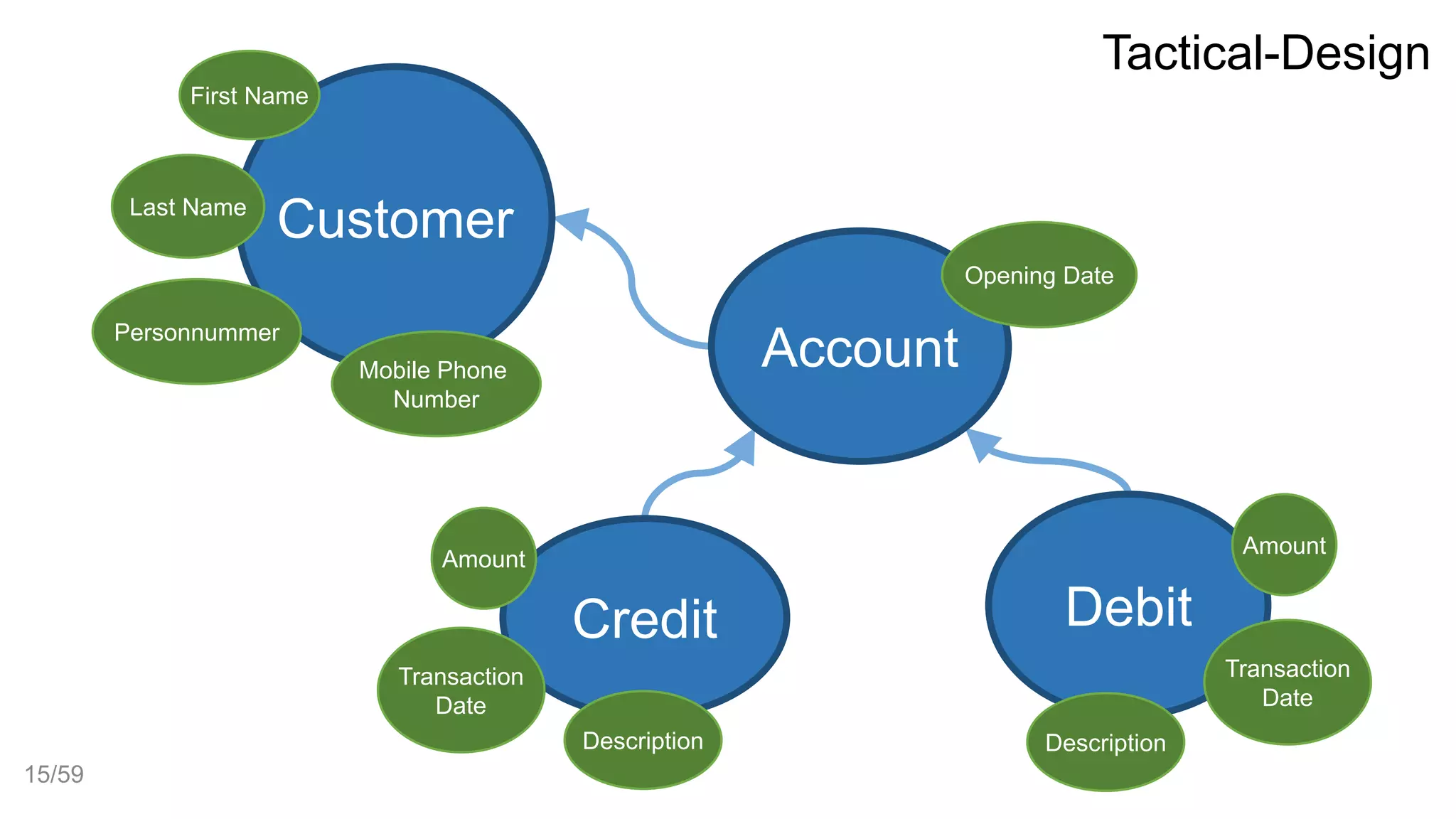
  • #15 The previous use cases are useful to identify some noums and verbs. It helps do draw the initial Design.
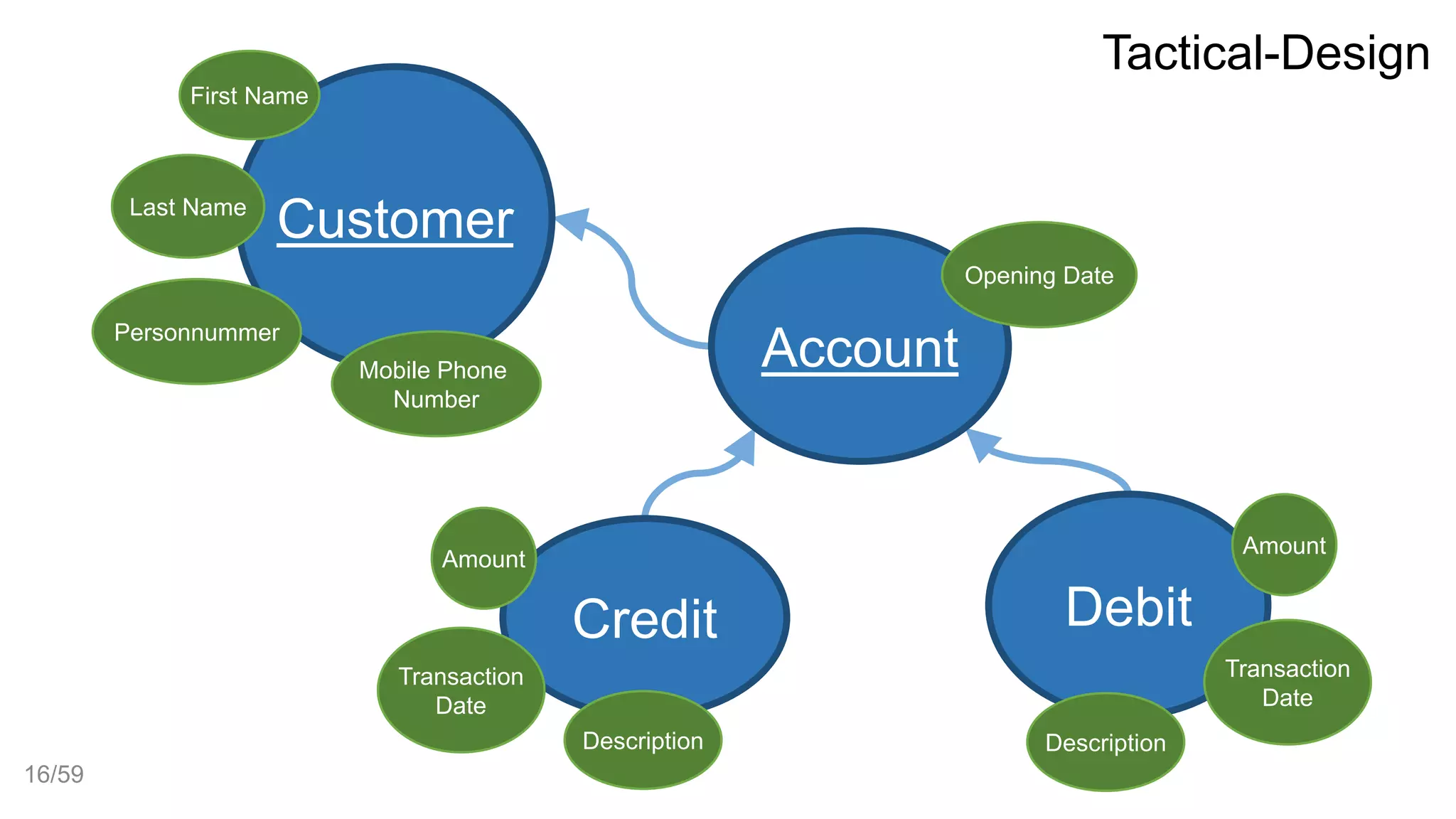
  • #16 This figure is another representation the Domain. In blue the Entities and in green the Value Objects that describe the entities.
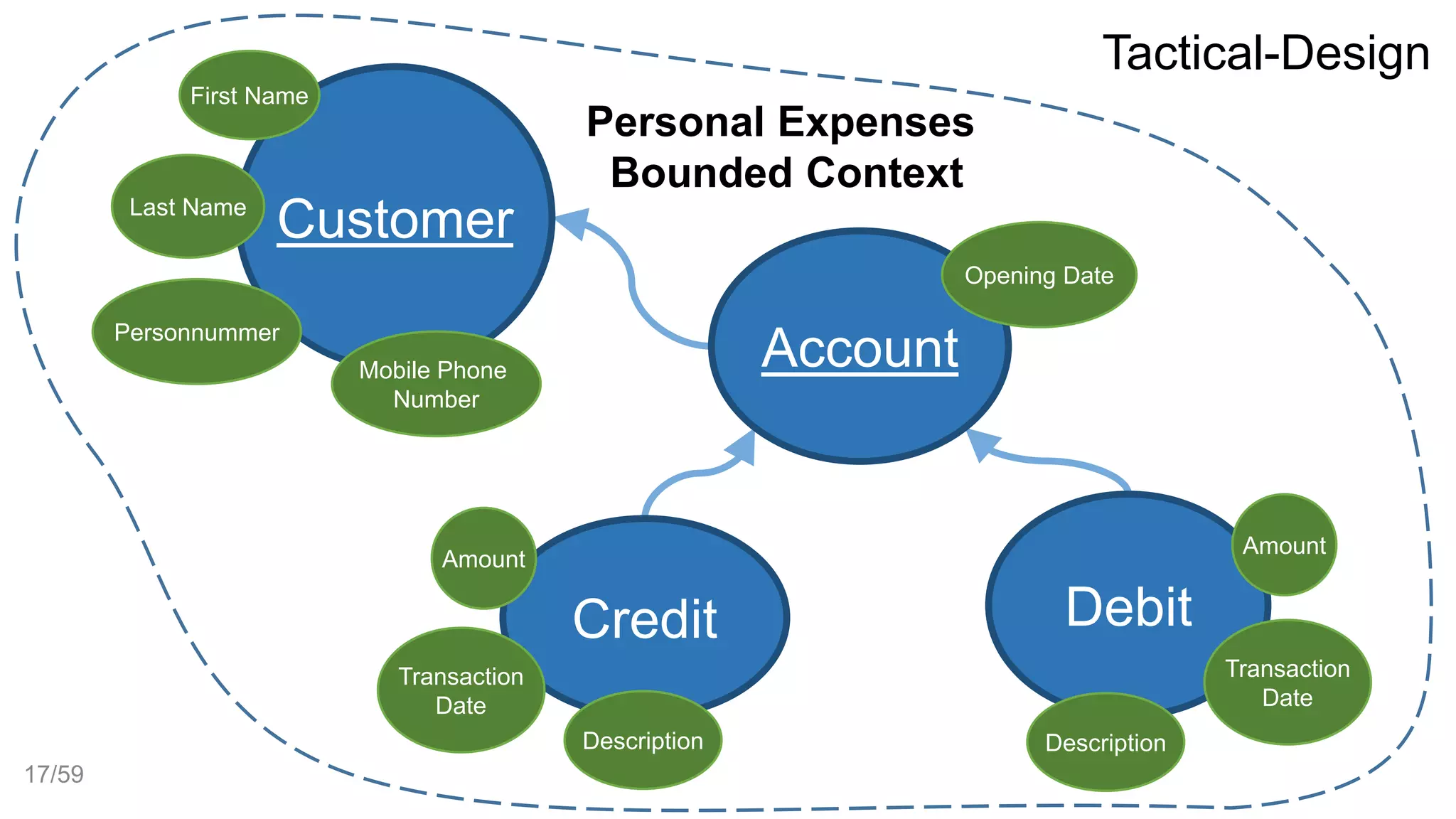
  • #17 The Customer and Account perform the Aggregate Root role, I am going to explain soon.
  • #18 And of course, this structures are only valid inside the Personal Expenses Bounded Context.
  • #19 The fundamentals of DDD is to build an Ubiquitous Language, this is the vocabulary that is shared between Developers and Domain Experts. Developers have jargons, they know technical stuff. And Domain Experts focus in the Business. There are some terms that both should know to create a shared language. The Domain Model Terms, Bounded Contexts, DDD pattterns names and high level structures. Everything else are not ubiquitous.
  • #20 The entity pattern requires that every entity has an unique id. The entity could be mutable or not, and they refer other entities by ID. In our example the Customer, Account, Credit and Debit are Entities.
  • #21 An Aggregate Root is a specialized Entity that control the scope of consistency inside the aggregate boundaries. Usually the aggregate root is a bunch of entities that are seen as one single unit. The aggregates are small, they implement behaviors with methods. And I advance that one entity plus one repository pattern are close to an Aggregate.
  • #22 Another way to explain the Aggregate Pattern, is by what it is not. The aggregate is not your Entire Model, the same way as this bunch of grapes that we can not identify the boundaries.
  • #23 Aggregate Roots are small as this bunch of grapes that we can see the boundaries. This way it is possible to maitain the consistency of the business rules.
  • #34 it simple do not exist if invalid
  • #36 it simple do not exist if invalid
  • #37 it simple do not exist if invalid
  • #38 it simple do not exist if invalid
  • #39 it simple do not exist if invalid
  • #40 it simple do not exist if invalid
  • #42 it simple do not exist if invalid
  • #43 it simple do not exist if invalid
  • #44 it simple do not exist if invalid
  • #45 it simple do not exist if invalid
  • #46 it simple do not exist if invalid
  • #47 it simple do not exist if invalid
  • #48 it simple do not exist if invalid
  • #50 If you're calling two setters in a row, you're missing a concept. Don't get trapped by datastore thinking. DDD and TDD are tools, seniors developers need to know.