Building stateful real
apps on serverless
I’m Tiru
Hasura is :
- GraphQL on Postgres
- Serverless business logic
- Postgres as event source
I do:
- Product development
- Product management
- Developer advocacy
https://hasura.io
@Tirumarai
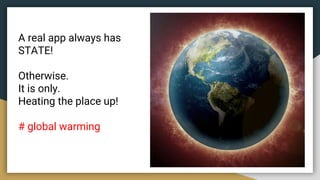
A real app always has
STATE!
Otherwise.
It is only.
Heating the place up!
# global warming
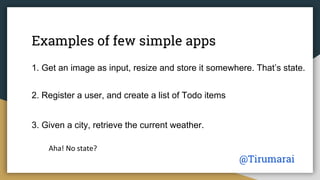
Examples of few simple apps
1. Get an image as input, resize and store it somewhere. That’s state.
2. Register a user, and create a list of Todo items
That’s definitely state.
3. Given a city, retrieve the current weather.
Ah! No state?
@Tirumarai
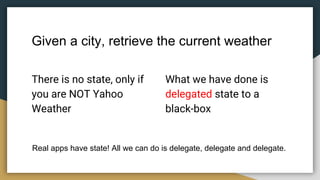
Given a city, retrieve the current weather
There is no state, only if
you are NOT Yahoo
Weather
What we have done is
delegated state to a
black-box
Real apps have state! All we can do is delegate, delegate and delegate.
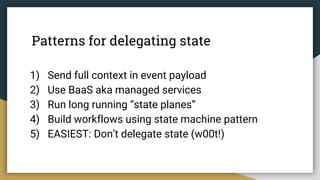
Patterns for delegating state
1) Send full context in event payload
2) Use BaaS aka managed services
3) Run long running “state planes”
4) Build workflows using state machine pattern
5) EASIEST: Don’t delegate state (w00t!)
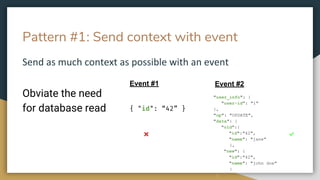
Pattern #1: Send context with event
Event #1
{ "id": “42” }
Event #2
"user_info": {
"user-id": "1"
},
"op": "UPDATE",
"data": {
"old":{
"id":"42",
"name": "jane"
},
"new": {
"id":"42",
"name": "john doe"
}
}
Obviate the need
for database read
❌ ✅
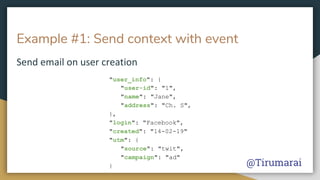
Example #1: Send context with event
"user_info": {
"user-id": "1",
"name": "Jane",
"address": "Ch. S",
},
"login": "Facebook",
"created": "14-02-19"
"utm": {
"source": "twit",
"campaign": "ad"
} @Tirumarai
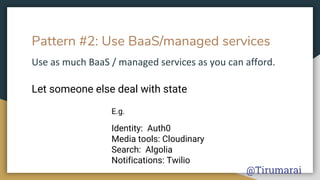
Pattern #2: Use BaaS/managed services
Let someone else deal with state
Identity: Auth0
Media tools: Cloudinary
Search: Algolia
Notifications: Twilio
E.g.
@Tirumarai
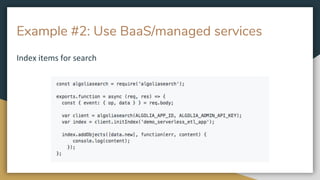
Example #2: Use BaaS/managed services
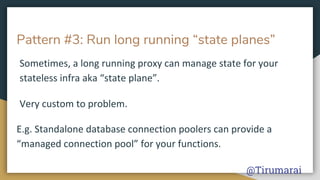
Pattern #3: Run long running “state planes”
@Tirumarai
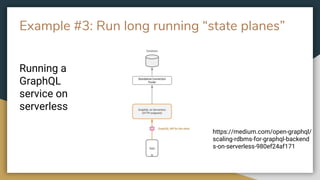
Example #3: Run long running “state planes”
Running a
GraphQL
service on
serverless
https://medium.com/open-graphql/
scaling-rdbms-for-graphql-backend
s-on-serverless-980ef24af171
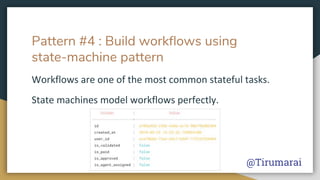
Pattern #4 : Build workflows using
state-machine pattern
@Tirumarai
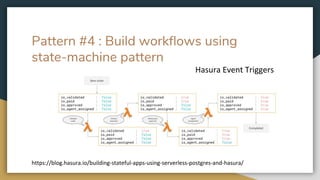
Pattern #4 : Build workflows using
state-machine pattern
Pattern #5 : Use fast databases (EASY)
@Tirumarai
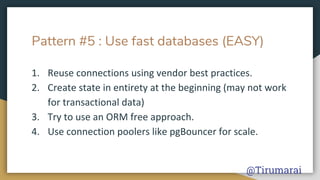
Pattern #5 : Use fast databases (EASY)
@Tirumarai
What is stateless then?
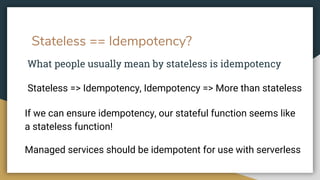
Stateless == Idempotency?
What people usually mean by stateless is idempotency
Stateless => Idempotency, Idempotency => More than stateless
If we can ensure idempotency, our stateful function seems like
a stateless function!
Managed services should be idempotent for use with serverless
Caveats
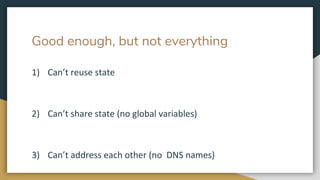
Good enough, but not everything
Demo time :)
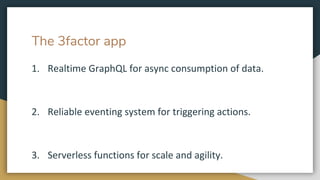
The 3factor app
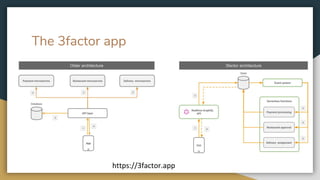
The 3factor app
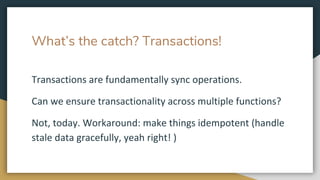
What’s the catch? Transactions!
Let’s talk about Haskell :)
How to get started?
Incremental adoption for brownfield projects
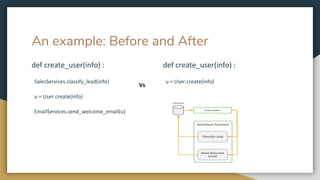
An example: Before and After
Hasura Event Triggers
Thank you!
Tirumarai Selvan
@Tirumarai
hasura.io
github.com/hasura/graphql-engine
Questions?

Building real apps on serverless

  • 1.
  • 2.
    I’m Tiru Hasura is: - GraphQL on Postgres - Serverless business logic - Postgres as event source I do: - Product development - Product management - Developer advocacy https://hasura.io @Tirumarai
  • 3.
    A real appalways has STATE! Otherwise. It is only. Heating the place up! # global warming
  • 4.
    Examples of fewsimple apps 1. Get an image as input, resize and store it somewhere. That’s state. 2. Register a user, and create a list of Todo items That’s definitely state. 3. Given a city, retrieve the current weather. Ah! No state? @Tirumarai
  • 5.
    Given a city,retrieve the current weather There is no state, only if you are NOT Yahoo Weather What we have done is delegated state to a black-box Real apps have state! All we can do is delegate, delegate and delegate.
  • 6.
    Patterns for delegatingstate 1) Send full context in event payload 2) Use BaaS aka managed services 3) Run long running “state planes” 4) Build workflows using state machine pattern 5) EASIEST: Don’t delegate state (w00t!)
  • 7.
    Pattern #1: Sendcontext with event Event #1 { "id": “42” } Event #2 "user_info": { "user-id": "1" }, "op": "UPDATE", "data": { "old":{ "id":"42", "name": "jane" }, "new": { "id":"42", "name": "john doe" } } Obviate the need for database read ❌ ✅
  • 8.
    Example #1: Sendcontext with event "user_info": { "user-id": "1", "name": "Jane", "address": "Ch. S", }, "login": "Facebook", "created": "14-02-19" "utm": { "source": "twit", "campaign": "ad" } @Tirumarai
  • 9.
    Pattern #2: UseBaaS/managed services Let someone else deal with state Identity: Auth0 Media tools: Cloudinary Search: Algolia Notifications: Twilio E.g. @Tirumarai
  • 10.
    Example #2: UseBaaS/managed services
  • 11.
    Pattern #3: Runlong running “state planes” @Tirumarai
  • 12.
    Example #3: Runlong running “state planes” Running a GraphQL service on serverless https://medium.com/open-graphql/ scaling-rdbms-for-graphql-backend s-on-serverless-980ef24af171
  • 13.
    Pattern #4 :Build workflows using state-machine pattern @Tirumarai
  • 14.
    Pattern #4 :Build workflows using state-machine pattern
  • 15.
    Pattern #5 :Use fast databases (EASY) @Tirumarai
  • 16.
    Pattern #5 :Use fast databases (EASY) @Tirumarai
  • 17.
  • 18.
    Stateless == Idempotency? Whatpeople usually mean by stateless is idempotency Stateless => Idempotency, Idempotency => More than stateless If we can ensure idempotency, our stateful function seems like a stateless function! Managed services should be idempotent for use with serverless
  • 19.
  • 20.
    Good enough, butnot everything
  • 21.
  • 22.
  • 23.
  • 24.
    What’s the catch?Transactions!
  • 25.
  • 26.
    How to getstarted?
  • 27.
    Incremental adoption forbrownfield projects
  • 28.
  • 29.
  • 30.
  • 31.