National Rural Knowledge Exchange   CETIS Metadata and Digital Repositories SIG 6th May 2008 Roger Greenhalgh Information Manager (Information Architect ?! )
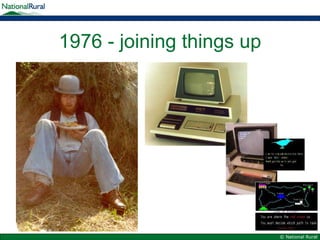
1976 - joining things up
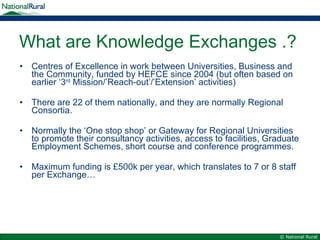
What are Knowledge Exchanges .? Centres of Excellence in work between Universities, Business and the Community, funded by HEFCE since 2004 (but often based on earlier ‘3 rd  Mission/’Reach-out’/’Extension’ activities) There are 22 of them nationally, and they are normally Regional Consortia. Normally the ‘One stop shop’ or Gateway for Regional Universities to promote their consultancy activities, access to facilities, Graduate Employment Schemes, short course and conference programmes. Maximum funding is £500k per year, which translates to 7 or 8 staff per Exchange…
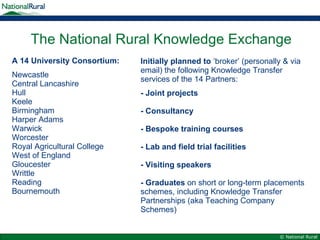
The National Rural Knowledge Exchange   A 14 University Consortium: Newcastle Central Lancashire Hull Keele Birmingham Harper Adams Warwick Worcester Royal Agricultural College West of England Gloucester Writtle Reading Bournemouth Initially planned to  ‘broker’ (personally & via email) the following Knowledge Transfer services of the 14 Partners: - Joint projects - Consultancy - Bespoke training courses - Lab and field trial facilities - Visiting speakers - Graduates  on short or long-term placements schemes, including Knowledge Transfer Partnerships (aka Teaching Company Schemes)
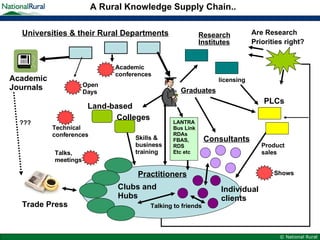
Practitioners Universities & their Rural Departments Research Institutes PLCs Are Research  Priorities right? Consultants Individual clients Clubs and Hubs Land-based  Colleges Academic Journals Trade Press Product sales licensing A Rural Knowledge Supply Chain.. ??? Academic conferences Open Days Shows Talks, meetings Technical conferences Skills & business training Graduates LANTRABus Link RDAs FBAS, RDS Etc etc Talking to friends
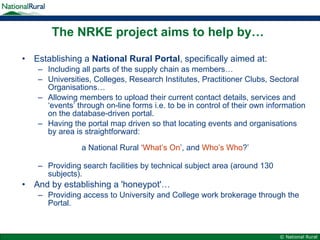
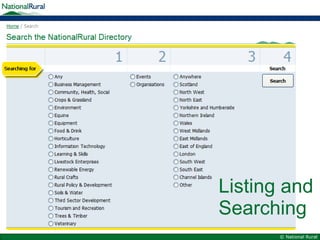
The NRKE project aims to help by… Establishing a  National Rural Portal , specifically aimed at: Including all parts of the supply chain as members… Universities, Colleges, Research Institutes, Practitioner Clubs, Sectoral Organisations… Allowing members to upload their current contact details, services and ‘events’ through on-line forms i.e. to be in control of their own information on the database-driven portal. Having the portal map driven so that locating events and organisations by area is straightforward:    a National Rural ‘ What’s On ’, and  Who’s Who ?’ Providing search facilities by technical subject area (around 130 subjects). And by establishing a 'honeypot'… Providing access to University and College work brokerage through the Portal.
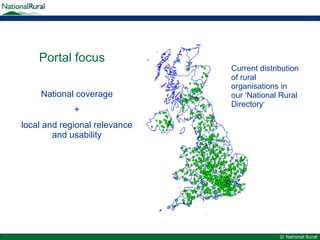
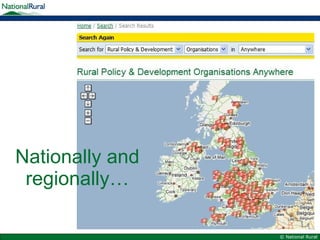
Portal focus Current distribution of rural organisations in our ‘National Rural Directory ’ National coverage + local and regional relevance and usability
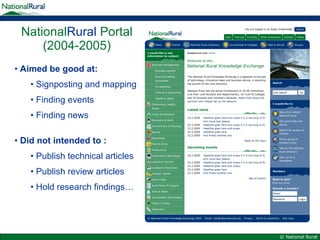
National Rural  Portal (2004-2005) Aimed be good at: Signposting and mapping Finding events Finding news Did not intended to : Publish technical articles Publish review articles Hold research findings…
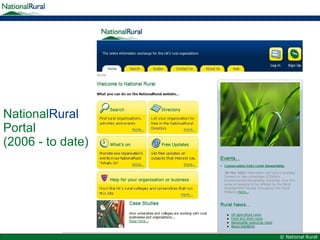
National Rural   Portal (2006 - to date)
Listing and Searching
 
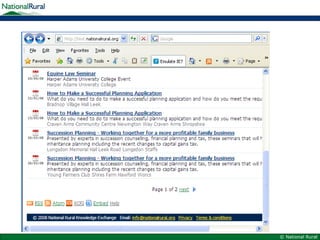
Nationally and regionally…
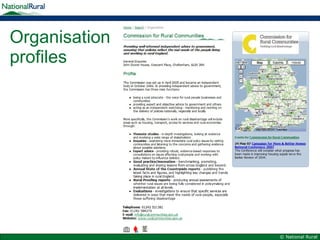
Organisationprofiles
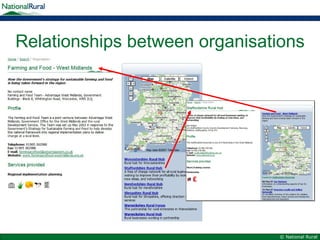
Relationships between organisations
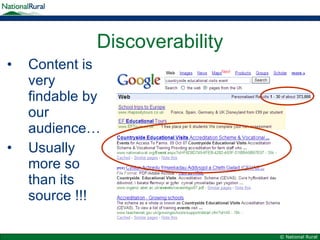
Discoverability Content is very findable by our  audience… Usually more so than its source !!!
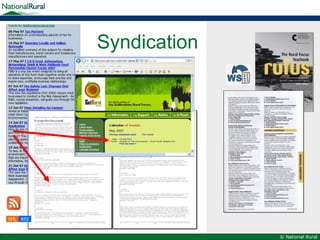
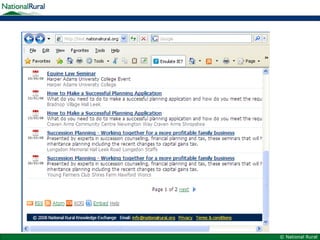
Syndication
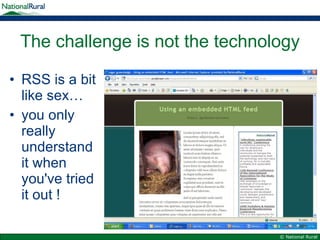
The challenge is not the technology RSS is a bit like sex… you only really understand it when you've tried it out !
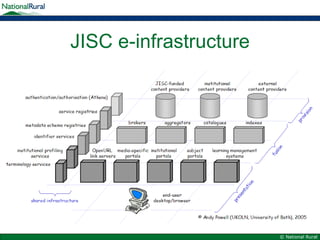
JISC e-infrastructure
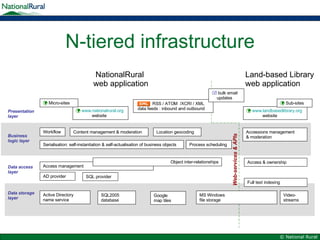
N-tiered infrastructure    www.nationalrural.org   website RSS / ATOM  /XCRI / XML   data feeds : inbound and outbound    bulk email    updates Workflow Business logic layer Presentation layer Data access layer Data storage layer AD provider SQL provider Active Directory name service SQL2005 database Google  map tiles Access management Serialisation: self-instantiation & self-actualisation of business objects Process scheduling Content management & moderation Location geocoding NationalRural  web application Land-based Library web application    www.landbasedlibrary.org   website Accessions management  & moderation Full text indexing MS Windows  file storage Video-streams Web-services & APIs Object inter-relationships    Micro-sites    Sub-sites Access & ownership
 
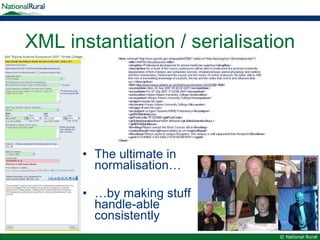
XML instantiation / serialisation The ultimate in normalisation… … by making stuff handle-able consistently
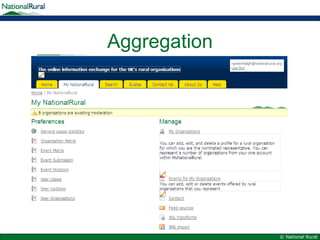
Aggregation
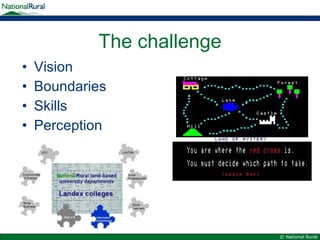
The challenge Vision Boundaries Skills Perception

Building NationalRural for syndication

  • 1.
    National Rural KnowledgeExchange CETIS Metadata and Digital Repositories SIG 6th May 2008 Roger Greenhalgh Information Manager (Information Architect ?! )
  • 2.
    1976 - joiningthings up
  • 3.
    What are KnowledgeExchanges .? Centres of Excellence in work between Universities, Business and the Community, funded by HEFCE since 2004 (but often based on earlier ‘3 rd Mission/’Reach-out’/’Extension’ activities) There are 22 of them nationally, and they are normally Regional Consortia. Normally the ‘One stop shop’ or Gateway for Regional Universities to promote their consultancy activities, access to facilities, Graduate Employment Schemes, short course and conference programmes. Maximum funding is £500k per year, which translates to 7 or 8 staff per Exchange…
  • 4.
    The National RuralKnowledge Exchange A 14 University Consortium: Newcastle Central Lancashire Hull Keele Birmingham Harper Adams Warwick Worcester Royal Agricultural College West of England Gloucester Writtle Reading Bournemouth Initially planned to ‘broker’ (personally & via email) the following Knowledge Transfer services of the 14 Partners: - Joint projects - Consultancy - Bespoke training courses - Lab and field trial facilities - Visiting speakers - Graduates on short or long-term placements schemes, including Knowledge Transfer Partnerships (aka Teaching Company Schemes)
  • 5.
    Practitioners Universities &their Rural Departments Research Institutes PLCs Are Research Priorities right? Consultants Individual clients Clubs and Hubs Land-based Colleges Academic Journals Trade Press Product sales licensing A Rural Knowledge Supply Chain.. ??? Academic conferences Open Days Shows Talks, meetings Technical conferences Skills & business training Graduates LANTRABus Link RDAs FBAS, RDS Etc etc Talking to friends
  • 6.
    The NRKE projectaims to help by… Establishing a National Rural Portal , specifically aimed at: Including all parts of the supply chain as members… Universities, Colleges, Research Institutes, Practitioner Clubs, Sectoral Organisations… Allowing members to upload their current contact details, services and ‘events’ through on-line forms i.e. to be in control of their own information on the database-driven portal. Having the portal map driven so that locating events and organisations by area is straightforward: a National Rural ‘ What’s On ’, and Who’s Who ?’ Providing search facilities by technical subject area (around 130 subjects). And by establishing a 'honeypot'… Providing access to University and College work brokerage through the Portal.
  • 7.
    Portal focus Currentdistribution of rural organisations in our ‘National Rural Directory ’ National coverage + local and regional relevance and usability
  • 8.
    National Rural Portal (2004-2005) Aimed be good at: Signposting and mapping Finding events Finding news Did not intended to : Publish technical articles Publish review articles Hold research findings…
  • 9.
    National Rural Portal (2006 - to date)
  • 10.
  • 11.
  • 12.
  • 13.
  • 14.
  • 15.
    Discoverability Content isvery findable by our audience… Usually more so than its source !!!
  • 16.
  • 17.
    The challenge isnot the technology RSS is a bit like sex… you only really understand it when you've tried it out !
  • 18.
  • 19.
    N-tiered infrastructure  www.nationalrural.org website RSS / ATOM /XCRI / XML data feeds : inbound and outbound  bulk email updates Workflow Business logic layer Presentation layer Data access layer Data storage layer AD provider SQL provider Active Directory name service SQL2005 database Google map tiles Access management Serialisation: self-instantiation & self-actualisation of business objects Process scheduling Content management & moderation Location geocoding NationalRural web application Land-based Library web application  www.landbasedlibrary.org website Accessions management & moderation Full text indexing MS Windows file storage Video-streams Web-services & APIs Object inter-relationships  Micro-sites  Sub-sites Access & ownership
  • 20.
  • 21.
    XML instantiation /serialisation The ultimate in normalisation… … by making stuff handle-able consistently
  • 22.
  • 23.
    The challenge VisionBoundaries Skills Perception