
www.illinoisresource.net
Building Federal
Budgets
Illinois ResourceNet
2010
Jay Readey, JD, MBA
www.illinoisresource.net
Federal Grant Budgeting
• Session Objectives: to understand…
– The threshold levels of financial management
necessary before applying for Federal grants
– Direct vs. Indirect Costs
– Matching/cost sharing
– Allowable Federal rates
– Accounting compliance requirements
– Budget completion and budget narrative principles
www.illinoisresource.net
Preparing your grant budget
• The starting point is…… your organization’s financial
management
• Let’s define sound financial management
– It includes budgeting, creating effective tracking systems
and reporting the organization’s financial activity and plans.
– When carried out effectively, financial management enables
an organization to plan and monitor financial activities, and
show that all financial resources are responsibly applied to
an organization’s charitable mission.
Source: ACH Region V
www.illinoisresource.net
Planning and Monitoring:
Thresholds for applying for Federal grants:
• Budgeting
• Financial recordkeeping
• Financial reports
• Financial accountability
www.illinoisresource.net
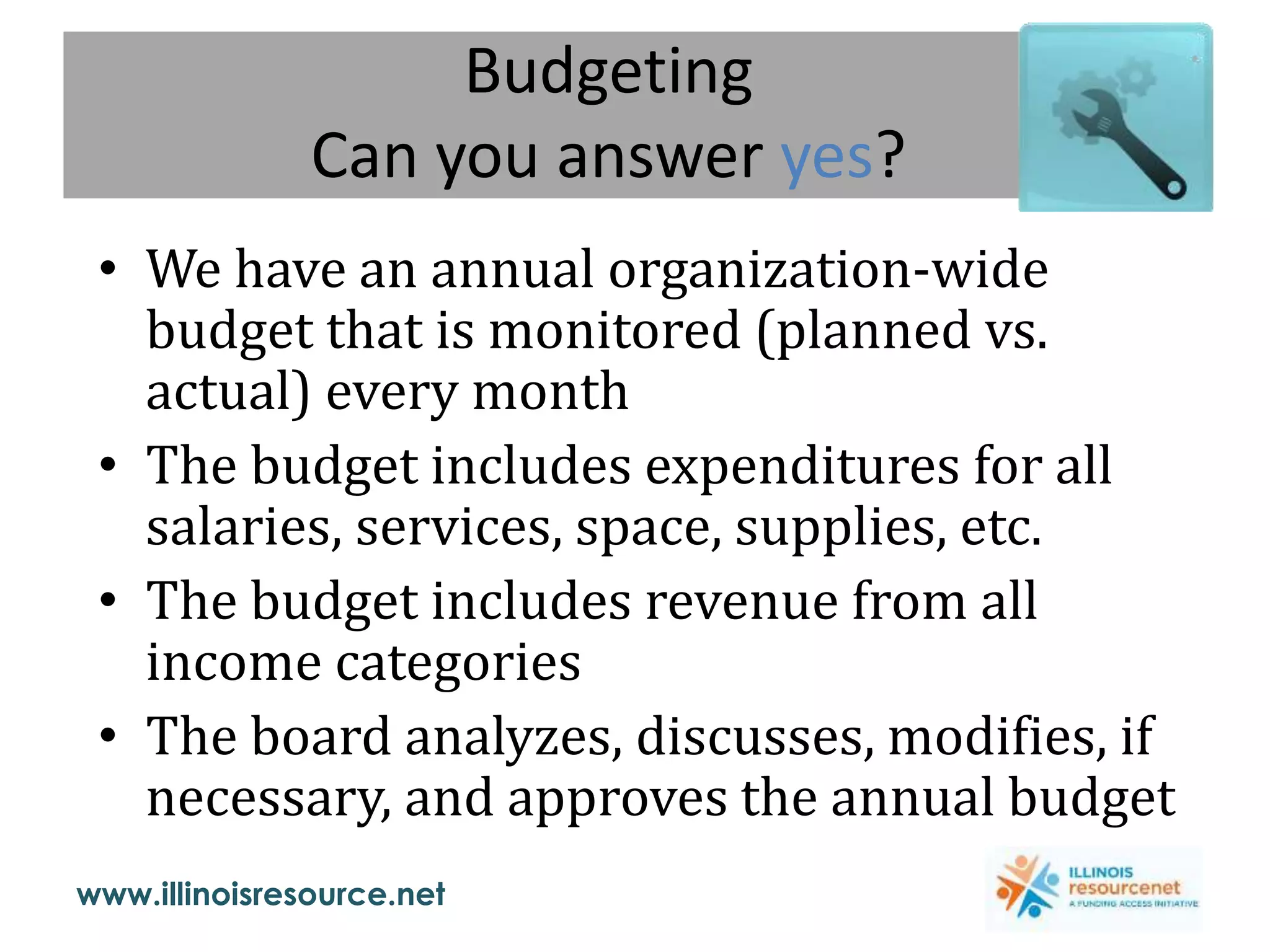
Budgeting
Can you answer yes?
• We have an annual organization-wide
budget that is monitored (planned vs.
actual) every month
• The budget includes expenditures for all
salaries, services, space, supplies, etc.
• The budget includes revenue from all
income categories
• The board analyzes, discusses, modifies, if
necessary, and approves the annual budget
www.illinoisresource.net
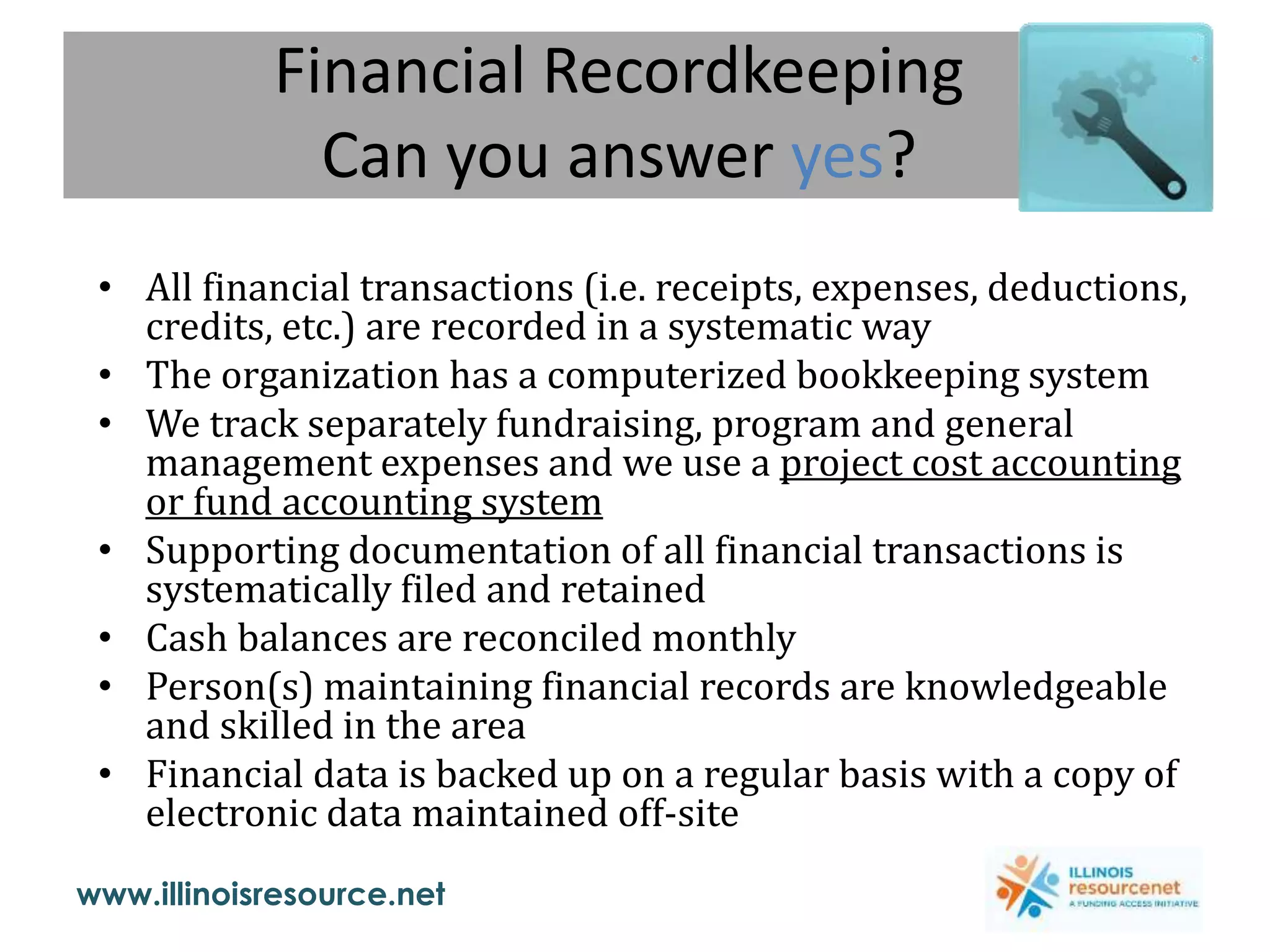
Financial Recordkeeping
Can you answer yes?
• All financial transactions (i.e. receipts, expenses, deductions,
credits, etc.) are recorded in a systematic way
• The organization has a computerized bookkeeping system
• We track separately fundraising, program and general
management expenses and we use a project cost accounting
or fund accounting system
• Supporting documentation of all financial transactions is
systematically filed and retained
• Cash balances are reconciled monthly
• Person(s) maintaining financial records are knowledgeable
and skilled in the area
• Financial data is backed up on a regular basis with a copy of
electronic data maintained off-site
www.illinoisresource.net
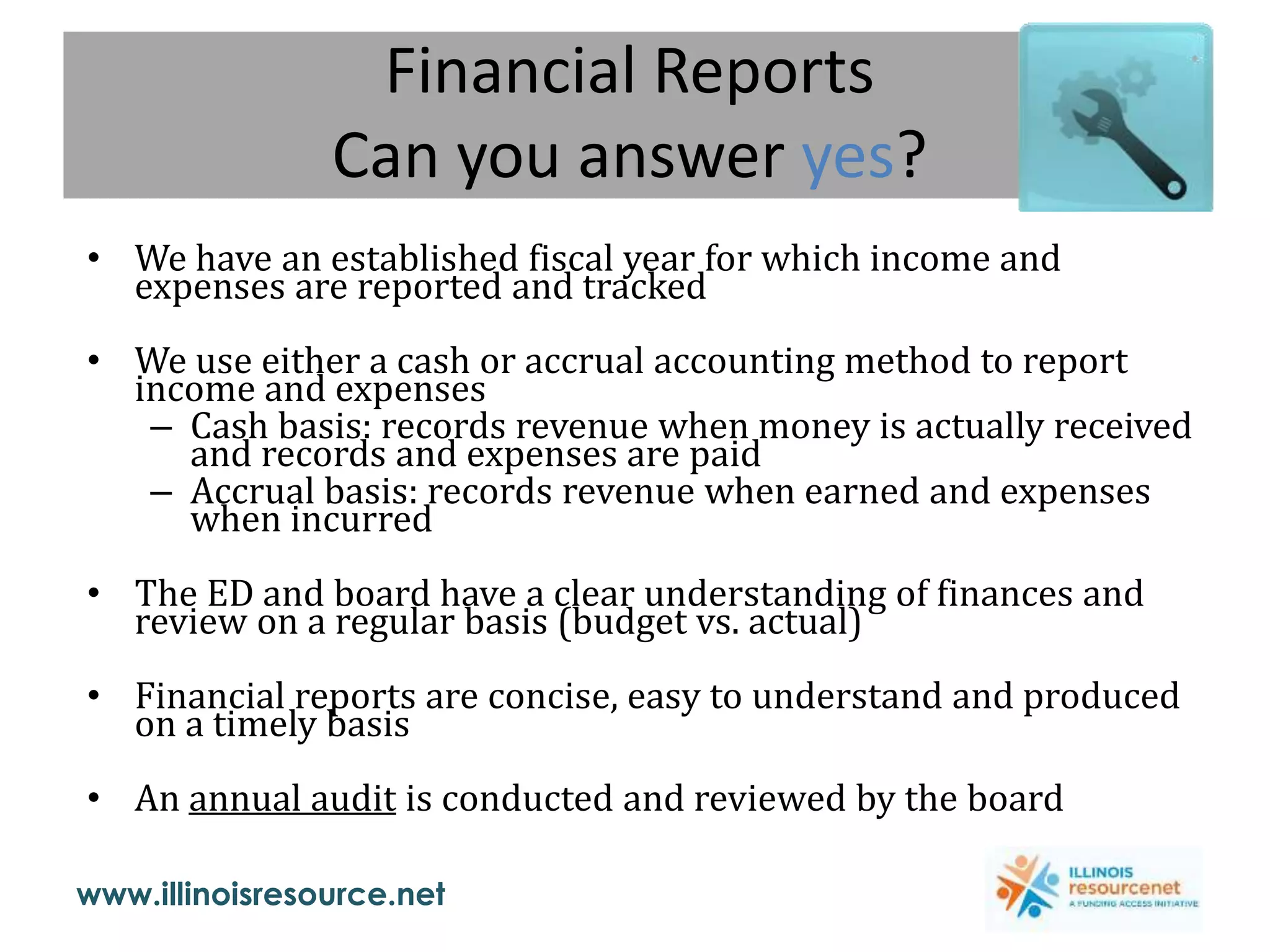
Financial Reports
Can you answer yes?
• We have an established fiscal year for which income and
expenses are reported and tracked
• We use either a cash or accrual accounting method to report
income and expenses
– Cash basis: records revenue when money is actually received
and records and expenses are paid
– Accrual basis: records revenue when earned and expenses
when incurred
• The ED and board have a clear understanding of finances and
review on a regular basis (budget vs. actual)
• Financial reports are concise, easy to understand and produced
on a timely basis
• An annual audit is conducted and reviewed by the board
www.illinoisresource.net
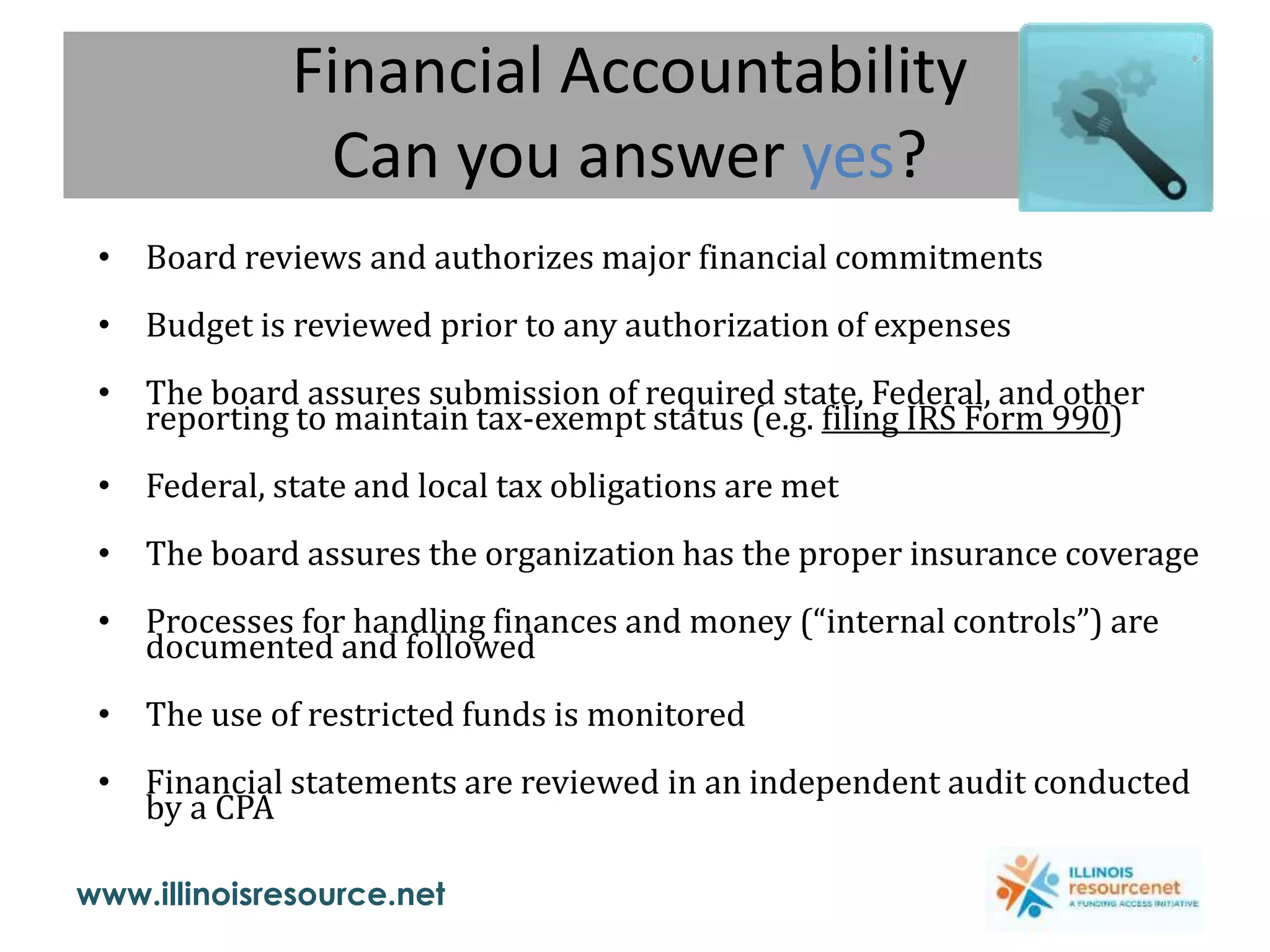
Financial Accountability
Can you answer yes?
• Board reviews and authorizes major financial commitments
• Budget is reviewed prior to any authorization of expenses
• The board assures submission of required state, Federal, and other
reporting to maintain tax-exempt status (e.g. filing IRS Form 990)
• Federal, state and local tax obligations are met
• The board assures the organization has the proper insurance coverage
• Processes for handling finances and money (“internal controls”) are
documented and followed
• The use of restricted funds is monitored
• Financial statements are reviewed in an independent audit conducted
by a CPA
www.illinoisresource.net
The Grant Budget
• Follow the instructions
• What can I include in my budget?
– Budget MUST follow the program
– Allowable Federal costs (this is technical)
• OMB Circular A-122 – Allowable costs for nonprofits
• Is there a cost-sharing (i.e. match) requirement?
• Most grants require a budget narrative
• Check, re-check and triple check the math
www.illinoisresource.net
Dialogue Between Program Staff
and Budgeting Personnel
• What costs relate to the proposed activities?
• Does the program proposal track the requirements
of the grant application?
• Later: does the budget narrative match the program
proposal? (come back and check)
• Do other sources pay some of the Direct Costs for
the program activities? (more on costs in a
moment)
www.illinoisresource.net
Cost Principles
www.illinoisresource.net
Cost Principles
• Total Costs = allowable direct costs + allowable
indirect costs – any applicable credits
– Total costs = allowable Federal reimbursement
• Direct Costs: costs specifically relating to program
activities for purposes of the grant
• Question: What would be some examples of Direct
Costs?
• Question: What might credits be?
www.illinoisresource.net
Allowability of Costs
Costs must be:
• Reasonable (to the performance of the award)
• Conforming (to limits in the award)
• Consistent (with non-Federal activities of the organization)
• Consistent (treated the same over time and across program
categories)
• Determined in accordance with GAAP
• Not included in other Federal awards (no double-dipping)
• Adequately documented
www.illinoisresource.net
Reasonable Costs
Costs are reasonable if they are…
• Ordinary and Necessary (for the organization or
performance of the award)
• Bound by sound and accepted business practices (e.g.
arm’s length negotiation)
• Incurred by persons acting with prudence in the
circumstances
• Not Significant Deviations from established practices
• Question: what would be some unreasonable costs?
www.illinoisresource.net
Allowability of Costs
• Question: other examples of
unallowable costs?
• What would make a cost inconsistent
with other non-federal programs?
www.illinoisresource.net
Unallowable Costs:
Which of the following should be allowed for a federal grant?
• Advertising and Public Relations
• Alcoholic beverages
• Bad debts
• Contingency reserves for uncertain events
• Contributions to others
• Entertainment costs
• Capital expenditures
• Fines and penalties
• Housing as fringe benefits
• Interest expenses
• Lobbying
• Social and country club memberships
• Costs of corporate organizing and reorganizing
www.illinoisresource.net
Allocable Costs
A cost is allocable to a Federal award if it is treated consistently
with other costs incurred for the same purpose in like
circumstances and if it:
• Is incurred specifically for the award;
• Can be distributed in reasonable proportion to the benefits if
it is allocable both to the award and other work; or
• Is necessary to the overall operation of the organization,
even if a direct relationship to a cost objective can’t be
shown.
Don’t shift costs among Federal awards in order to overcome
funding deficiencies, or to avoid restrictions of law or the
award!
www.illinoisresource.net
Direct Costs: More Detail
• Direct costs are “those that can be identified specifically
with a particular final cost objective”
– i.e., a project, service or direct activity of the organization
• Not allowed as Direct Costs:
– Fundraising Costs
– Services to members:
• Maintenance of membership rolls
• Public information, public relations and lobbying
• Meetings and conferences
• Investment of funds not used in operations
• Administration of group benefits
www.illinoisresource.net
Indirect Costs
• Indirect costs are “those that have been
incurred for common or joint objectives
and cannot be readily identified with a
particular final cost objective
• Two broad categories:
– Facilities
– Administration
www.illinoisresource.net
Indirect Costs: Facilities
Facilities costs include:
• Depreciation and use allowances on
buildings, equipment and capital
improvements
• Interest on debt associated with such
capital items, and
• Operations and maintenance expenses
www.illinoisresource.net
Indirect Costs: Administration
Administration costs include:
• General administration and general expenses
such as the director’s office
• Accounting, finance, general counsel, IT
support
• Administrative personnel & clerical staff
• Library expenses, office supplies, postage, local
telephone
www.illinoisresource.net
Indirect Cost Rate: Simple
Calculation
• Determine portion of organizational expenses attributable
to Management & General (M&G)
–  Form 990 M&G expense reporting
• Fractional ratio for indirect costs:
M&G Total Expense
________________________________________________
Total of Program Expenses + Fundraising Expenses
• Numerator is called the “base”, and there are several
variants, chosen by the organization
www.illinoisresource.net
Matching & Cost Sharing
www.illinoisresource.net
Matching and Cost Sharing
• Many grants contain requirements for a non-
Federal share
• Section 23 of OMB Circular A-110 gives details
• Question: What are non-Federal sources?
• Specific requirements may obtain for the cash
match
– Accounting for the non-Federal share
• Third party, in-kind contributions and how to
value them
www.illinoisresource.net
Matching and Cost Sharing
• Contributions are accepted as matching
funds if they are:
– Verifiable from records
– Not counted as contributions for another
Federally-assisted program
– Necessary and reasonable for achievement of
project objectives
– Allowable under applicable cost principles
– Not paid for by Federal Government under
another award
– Identified in the budget
www.illinoisresource.net
Matching and Cost Sharing
• Contributed services and property count:
– As valued on the books at donation, or
– At current fair market value
• Volunteer services count if:
– The work would otherwise incur a cost to the
organization, valued at prevailing market rates
– Ex.: legal, consulting, IT, plumbing
• Loaned executive valued at regular rate of pay
• Donated property, equipment and buildings shall
not be valued at more than FMV at time of
donation
www.illinoisresource.net
Matching and Cost Sharing
• Requirements for supporting records:
– Cash match must be accounted for
separately in fund accounting system
– Volunteer Services shall be documented
and, if feasible, supported by the same
accounting principles that an organization
uses for its employees
– Basis for determining value of donated
goods, services, equipment and property
must be documented
www.illinoisresource.net
Allowable Federal Rates
• For some agencies, or some grants, published rates may
limit the amount that will be reimbursed by the Federal
Government
• Example: Department of Education limits indirect rates
to 8% of a MTDC base
• Example: travel rates can be found at GSA.gov, click on
“Per Diem Rates”
• Example: Consultant Fees per day
• Most other costs are allowable or not based on
principles of reasonableness, prudence, and consistency
(see “Allow ability of Costs”)
www.illinoisresource.net
Budget Narratives
www.illinoisresource.net
Budget Narrative Principles
• Describe in detail how grant funds will be allocated
and spent in each applicable category
• Show:
– Basis for computation
– Total amount of costs for each category
– If applicable, further explanation of how requested
costs were determined
• Also describe all non-Federal funds that will be used to
meet a cost-sharing or matching requirement
– Describe sources, contributions by budget category,
and how value was determined for in-kind matches
www.illinoisresource.net
Sample Budget Narrative
Principles
• Personnel Salaries
– List name and title by position
– Salary rate x % of time devoted to grant project
• Taxes/benefits
– List name and title
– Compute taxes and benefits by a percentage, with
description (again observing time devoted to
project)
• Travel
– Itemize travel expenses by purpose
– Observe Federal per diem rates
www.illinoisresource.net
Sample Budget Narrative
Principles
• Training
– Show the basis for computation, e.g. a table:
– Purpose of training, location, cost per unit, and
computation
• Expense Items: Printing/Copying, Supplies
– List by type; describe sample costs and list
computations to arrive at total costs
• Equipment
– List and describe non-expendable items (e.g.
computers) to be purchased with grant funds
– Items over $1500 and copiers are not allowed
www.illinoisresource.net
Sample Budget Narrative
Principles
• Rent and Utilities
– Include rent (are utilities included? CAM?)
– Telephone and Internet service
– Show and describe computations of totals
• Other
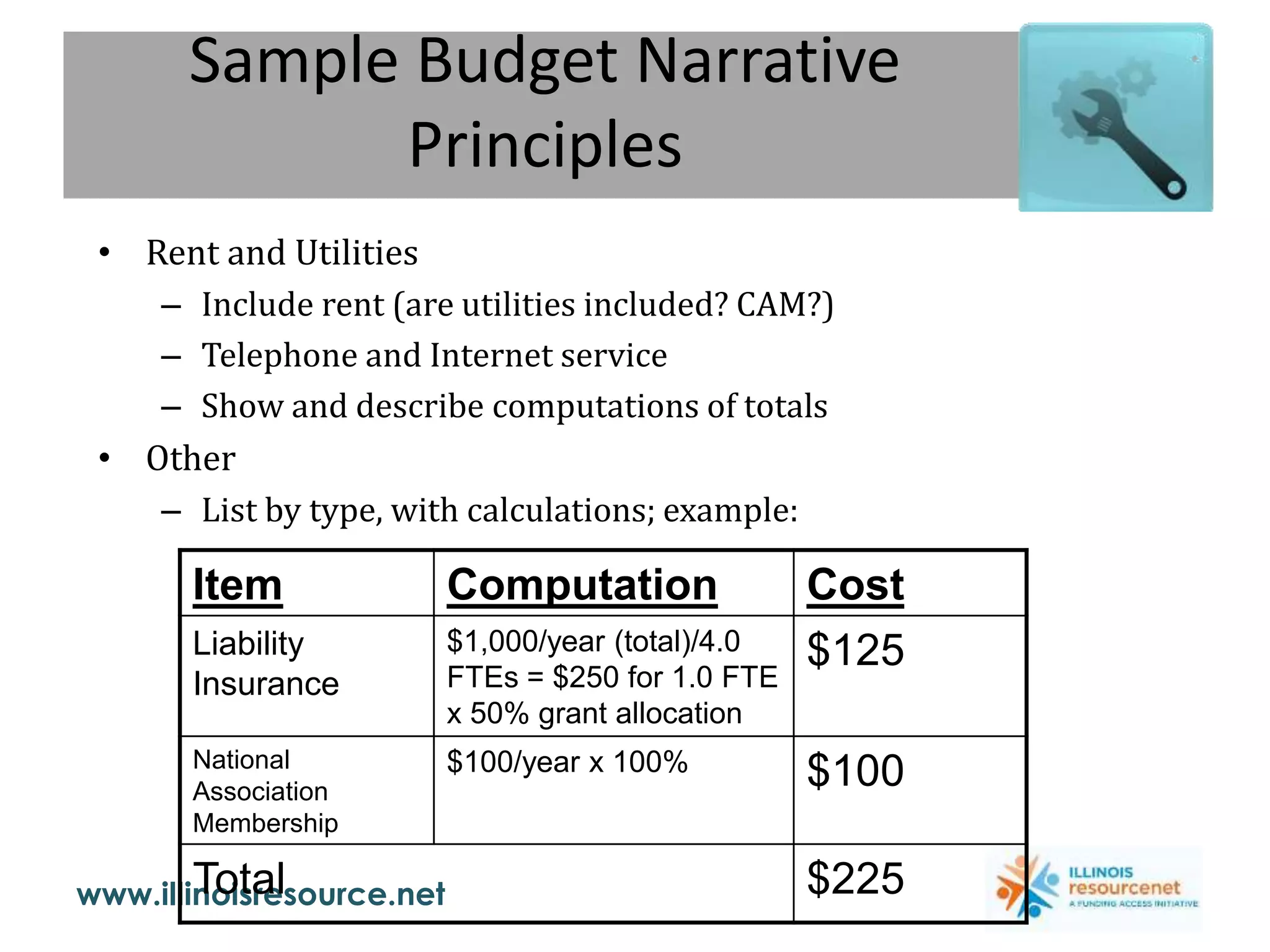
– List by type, with calculations; example:
Item Computation Cost
Liability
Insurance
$1,000/year (total)/4.0
FTEs = $250 for 1.0 FTE
x 50% grant allocation
$125
National
Association
Membership
$100/year x 100% $100
Total $225
www.illinoisresource.net
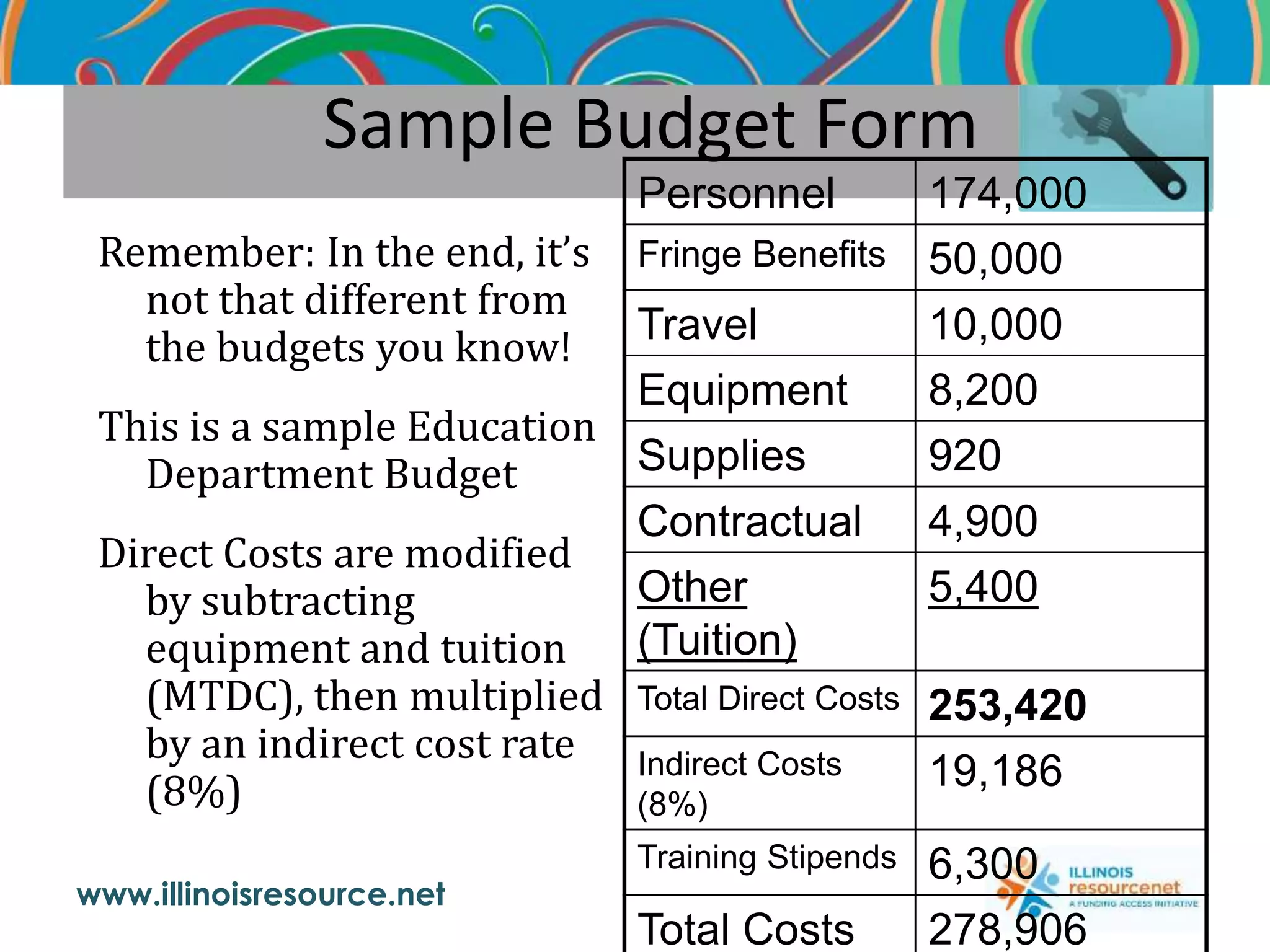
Sample Budget Form
Remember: In the end, it’s
not that different from
the budgets you know!
This is a sample Education
Department Budget
Direct Costs are modified
by subtracting
equipment and tuition
(MTDC), then multiplied
by an indirect cost rate
(8%)
Personnel 174,000
Fringe Benefits 50,000
Travel 10,000
Equipment 8,200
Supplies 920
Contractual 4,900
Other
(Tuition)
5,400
Total Direct Costs 253,420
Indirect Costs
(8%)
19,186
Training Stipends 6,300
Total Costs 278,906
www.illinoisresource.net
Questions?
hank you!
Jay Readey
jay_readey@yahoo.com
www.illinoisresource.net
Thank You!

Building Federal Budgets

  • 1.
  • 2.
    www.illinoisresource.net Federal Grant Budgeting •Session Objectives: to understand… – The threshold levels of financial management necessary before applying for Federal grants – Direct vs. Indirect Costs – Matching/cost sharing – Allowable Federal rates – Accounting compliance requirements – Budget completion and budget narrative principles
  • 3.
    www.illinoisresource.net Preparing your grantbudget • The starting point is…… your organization’s financial management • Let’s define sound financial management – It includes budgeting, creating effective tracking systems and reporting the organization’s financial activity and plans. – When carried out effectively, financial management enables an organization to plan and monitor financial activities, and show that all financial resources are responsibly applied to an organization’s charitable mission. Source: ACH Region V
  • 4.
    www.illinoisresource.net Planning and Monitoring: Thresholdsfor applying for Federal grants: • Budgeting • Financial recordkeeping • Financial reports • Financial accountability
  • 5.
    www.illinoisresource.net Budgeting Can you answeryes? • We have an annual organization-wide budget that is monitored (planned vs. actual) every month • The budget includes expenditures for all salaries, services, space, supplies, etc. • The budget includes revenue from all income categories • The board analyzes, discusses, modifies, if necessary, and approves the annual budget
  • 6.
    www.illinoisresource.net Financial Recordkeeping Can youanswer yes? • All financial transactions (i.e. receipts, expenses, deductions, credits, etc.) are recorded in a systematic way • The organization has a computerized bookkeeping system • We track separately fundraising, program and general management expenses and we use a project cost accounting or fund accounting system • Supporting documentation of all financial transactions is systematically filed and retained • Cash balances are reconciled monthly • Person(s) maintaining financial records are knowledgeable and skilled in the area • Financial data is backed up on a regular basis with a copy of electronic data maintained off-site
  • 7.
    www.illinoisresource.net Financial Reports Can youanswer yes? • We have an established fiscal year for which income and expenses are reported and tracked • We use either a cash or accrual accounting method to report income and expenses – Cash basis: records revenue when money is actually received and records and expenses are paid – Accrual basis: records revenue when earned and expenses when incurred • The ED and board have a clear understanding of finances and review on a regular basis (budget vs. actual) • Financial reports are concise, easy to understand and produced on a timely basis • An annual audit is conducted and reviewed by the board
  • 8.
    www.illinoisresource.net Financial Accountability Can youanswer yes? • Board reviews and authorizes major financial commitments • Budget is reviewed prior to any authorization of expenses • The board assures submission of required state, Federal, and other reporting to maintain tax-exempt status (e.g. filing IRS Form 990) • Federal, state and local tax obligations are met • The board assures the organization has the proper insurance coverage • Processes for handling finances and money (“internal controls”) are documented and followed • The use of restricted funds is monitored • Financial statements are reviewed in an independent audit conducted by a CPA
  • 9.
    www.illinoisresource.net The Grant Budget •Follow the instructions • What can I include in my budget? – Budget MUST follow the program – Allowable Federal costs (this is technical) • OMB Circular A-122 – Allowable costs for nonprofits • Is there a cost-sharing (i.e. match) requirement? • Most grants require a budget narrative • Check, re-check and triple check the math
  • 10.
    www.illinoisresource.net Dialogue Between ProgramStaff and Budgeting Personnel • What costs relate to the proposed activities? • Does the program proposal track the requirements of the grant application? • Later: does the budget narrative match the program proposal? (come back and check) • Do other sources pay some of the Direct Costs for the program activities? (more on costs in a moment)
  • 11.
  • 12.
    www.illinoisresource.net Cost Principles • TotalCosts = allowable direct costs + allowable indirect costs – any applicable credits – Total costs = allowable Federal reimbursement • Direct Costs: costs specifically relating to program activities for purposes of the grant • Question: What would be some examples of Direct Costs? • Question: What might credits be?
  • 13.
    www.illinoisresource.net Allowability of Costs Costsmust be: • Reasonable (to the performance of the award) • Conforming (to limits in the award) • Consistent (with non-Federal activities of the organization) • Consistent (treated the same over time and across program categories) • Determined in accordance with GAAP • Not included in other Federal awards (no double-dipping) • Adequately documented
  • 14.
    www.illinoisresource.net Reasonable Costs Costs arereasonable if they are… • Ordinary and Necessary (for the organization or performance of the award) • Bound by sound and accepted business practices (e.g. arm’s length negotiation) • Incurred by persons acting with prudence in the circumstances • Not Significant Deviations from established practices • Question: what would be some unreasonable costs?
  • 15.
    www.illinoisresource.net Allowability of Costs •Question: other examples of unallowable costs? • What would make a cost inconsistent with other non-federal programs?
  • 16.
    www.illinoisresource.net Unallowable Costs: Which ofthe following should be allowed for a federal grant? • Advertising and Public Relations • Alcoholic beverages • Bad debts • Contingency reserves for uncertain events • Contributions to others • Entertainment costs • Capital expenditures • Fines and penalties • Housing as fringe benefits • Interest expenses • Lobbying • Social and country club memberships • Costs of corporate organizing and reorganizing
  • 17.
    www.illinoisresource.net Allocable Costs A costis allocable to a Federal award if it is treated consistently with other costs incurred for the same purpose in like circumstances and if it: • Is incurred specifically for the award; • Can be distributed in reasonable proportion to the benefits if it is allocable both to the award and other work; or • Is necessary to the overall operation of the organization, even if a direct relationship to a cost objective can’t be shown. Don’t shift costs among Federal awards in order to overcome funding deficiencies, or to avoid restrictions of law or the award!
  • 18.
    www.illinoisresource.net Direct Costs: MoreDetail • Direct costs are “those that can be identified specifically with a particular final cost objective” – i.e., a project, service or direct activity of the organization • Not allowed as Direct Costs: – Fundraising Costs – Services to members: • Maintenance of membership rolls • Public information, public relations and lobbying • Meetings and conferences • Investment of funds not used in operations • Administration of group benefits
  • 19.
    www.illinoisresource.net Indirect Costs • Indirectcosts are “those that have been incurred for common or joint objectives and cannot be readily identified with a particular final cost objective • Two broad categories: – Facilities – Administration
  • 20.
    www.illinoisresource.net Indirect Costs: Facilities Facilitiescosts include: • Depreciation and use allowances on buildings, equipment and capital improvements • Interest on debt associated with such capital items, and • Operations and maintenance expenses
  • 21.
    www.illinoisresource.net Indirect Costs: Administration Administrationcosts include: • General administration and general expenses such as the director’s office • Accounting, finance, general counsel, IT support • Administrative personnel & clerical staff • Library expenses, office supplies, postage, local telephone
  • 22.
    www.illinoisresource.net Indirect Cost Rate:Simple Calculation • Determine portion of organizational expenses attributable to Management & General (M&G) –  Form 990 M&G expense reporting • Fractional ratio for indirect costs: M&G Total Expense ________________________________________________ Total of Program Expenses + Fundraising Expenses • Numerator is called the “base”, and there are several variants, chosen by the organization
  • 23.
  • 24.
    www.illinoisresource.net Matching and CostSharing • Many grants contain requirements for a non- Federal share • Section 23 of OMB Circular A-110 gives details • Question: What are non-Federal sources? • Specific requirements may obtain for the cash match – Accounting for the non-Federal share • Third party, in-kind contributions and how to value them
  • 25.
    www.illinoisresource.net Matching and CostSharing • Contributions are accepted as matching funds if they are: – Verifiable from records – Not counted as contributions for another Federally-assisted program – Necessary and reasonable for achievement of project objectives – Allowable under applicable cost principles – Not paid for by Federal Government under another award – Identified in the budget
  • 26.
    www.illinoisresource.net Matching and CostSharing • Contributed services and property count: – As valued on the books at donation, or – At current fair market value • Volunteer services count if: – The work would otherwise incur a cost to the organization, valued at prevailing market rates – Ex.: legal, consulting, IT, plumbing • Loaned executive valued at regular rate of pay • Donated property, equipment and buildings shall not be valued at more than FMV at time of donation
  • 27.
    www.illinoisresource.net Matching and CostSharing • Requirements for supporting records: – Cash match must be accounted for separately in fund accounting system – Volunteer Services shall be documented and, if feasible, supported by the same accounting principles that an organization uses for its employees – Basis for determining value of donated goods, services, equipment and property must be documented
  • 28.
    www.illinoisresource.net Allowable Federal Rates •For some agencies, or some grants, published rates may limit the amount that will be reimbursed by the Federal Government • Example: Department of Education limits indirect rates to 8% of a MTDC base • Example: travel rates can be found at GSA.gov, click on “Per Diem Rates” • Example: Consultant Fees per day • Most other costs are allowable or not based on principles of reasonableness, prudence, and consistency (see “Allow ability of Costs”)
  • 29.
  • 30.
    www.illinoisresource.net Budget Narrative Principles •Describe in detail how grant funds will be allocated and spent in each applicable category • Show: – Basis for computation – Total amount of costs for each category – If applicable, further explanation of how requested costs were determined • Also describe all non-Federal funds that will be used to meet a cost-sharing or matching requirement – Describe sources, contributions by budget category, and how value was determined for in-kind matches
  • 31.
    www.illinoisresource.net Sample Budget Narrative Principles •Personnel Salaries – List name and title by position – Salary rate x % of time devoted to grant project • Taxes/benefits – List name and title – Compute taxes and benefits by a percentage, with description (again observing time devoted to project) • Travel – Itemize travel expenses by purpose – Observe Federal per diem rates
  • 32.
    www.illinoisresource.net Sample Budget Narrative Principles •Training – Show the basis for computation, e.g. a table: – Purpose of training, location, cost per unit, and computation • Expense Items: Printing/Copying, Supplies – List by type; describe sample costs and list computations to arrive at total costs • Equipment – List and describe non-expendable items (e.g. computers) to be purchased with grant funds – Items over $1500 and copiers are not allowed
  • 33.
    www.illinoisresource.net Sample Budget Narrative Principles •Rent and Utilities – Include rent (are utilities included? CAM?) – Telephone and Internet service – Show and describe computations of totals • Other – List by type, with calculations; example: Item Computation Cost Liability Insurance $1,000/year (total)/4.0 FTEs = $250 for 1.0 FTE x 50% grant allocation $125 National Association Membership $100/year x 100% $100 Total $225
  • 34.
    www.illinoisresource.net Sample Budget Form Remember:In the end, it’s not that different from the budgets you know! This is a sample Education Department Budget Direct Costs are modified by subtracting equipment and tuition (MTDC), then multiplied by an indirect cost rate (8%) Personnel 174,000 Fringe Benefits 50,000 Travel 10,000 Equipment 8,200 Supplies 920 Contractual 4,900 Other (Tuition) 5,400 Total Direct Costs 253,420 Indirect Costs (8%) 19,186 Training Stipends 6,300 Total Costs 278,906
  • 35.
  • 36.

Editor's Notes

  • #4 Don’t be surprised, but this doesn’t start with your grant. Rather the starting point here is with your organization’s financial management.
  • #8 Since we aren’t the accounting team, I’m giving a bit more detail here. Hybrid – more accurate picture of the org.’s finances and required for audit
  • #9 -Major commitments: space rental, building purchase, new services (health insurance, retirement plans, etc.) -Insurances include: general liability, D&O, commercial property, professional liability, liability related to clients (malpractice), workers comp
  • #13 Example: salary payments for a counselor to developmentally disabled clients in a job training and workforce readiness grant Credits: rebates, refunds, insurance proceeds
  • #17 Advertising: Exceptions for recruiting, procurement and surplus disposal necessary for performance of an award Capital Expenditures: not without prior approval, unless < $5000 for special purpose equipment (e.g., X-rays) Interest only in limited instances of post-award financing
  • #23 Note hidden slides that people can look at in the handout, especially different methods and the tension between keeping 990 M&G down and recovering enough indirect costs from federal grants
  • #29 Note hidden slide in handout