Building a Dev/Test cloud with
Apache CloudStack
David Nalley
PMC Member Apache CloudStack
Member, Apache Software Foundation
ke4qqq@apache.org
Twitter: @ke4qqq
#whoami
• Apache Software Foundation Member
• Apache CloudStack PMC Member
• Recovering Sysadmin
• Fedora Project Contributor
• Zenoss contributor
• Employed by Citrix in the Open Source Business Office
Why use cloud?
From a dev point of view the process looks like:
• Start new project
• File ticket for resources....wait....wait....wait
• Get resources, that aren't configured....wait...
• Get network access.....get permission....wait
• Get things done.
Why use cloud?
• What IT Ops provides is not what developers want.
Get rid of the waiting!
●
Remove constraints - developers empowered to get
things done.
●
Agility
●
Enforce automated process instead of manual ones
What does a dev/test cloud look like?
●
Self-service - developers can provision their own
environments
●
Usage measurement - we worry about VM sprawl
●
Isolated networks - must not let dev/test interfere with
the real world.
●
Commodity - as cheap as practical
●
May also house production workloads
Self service
●
Provisioning manually doesn't add value
●
Can be completely automated
●
Do they need full control or just pushing pre-configured
environments?
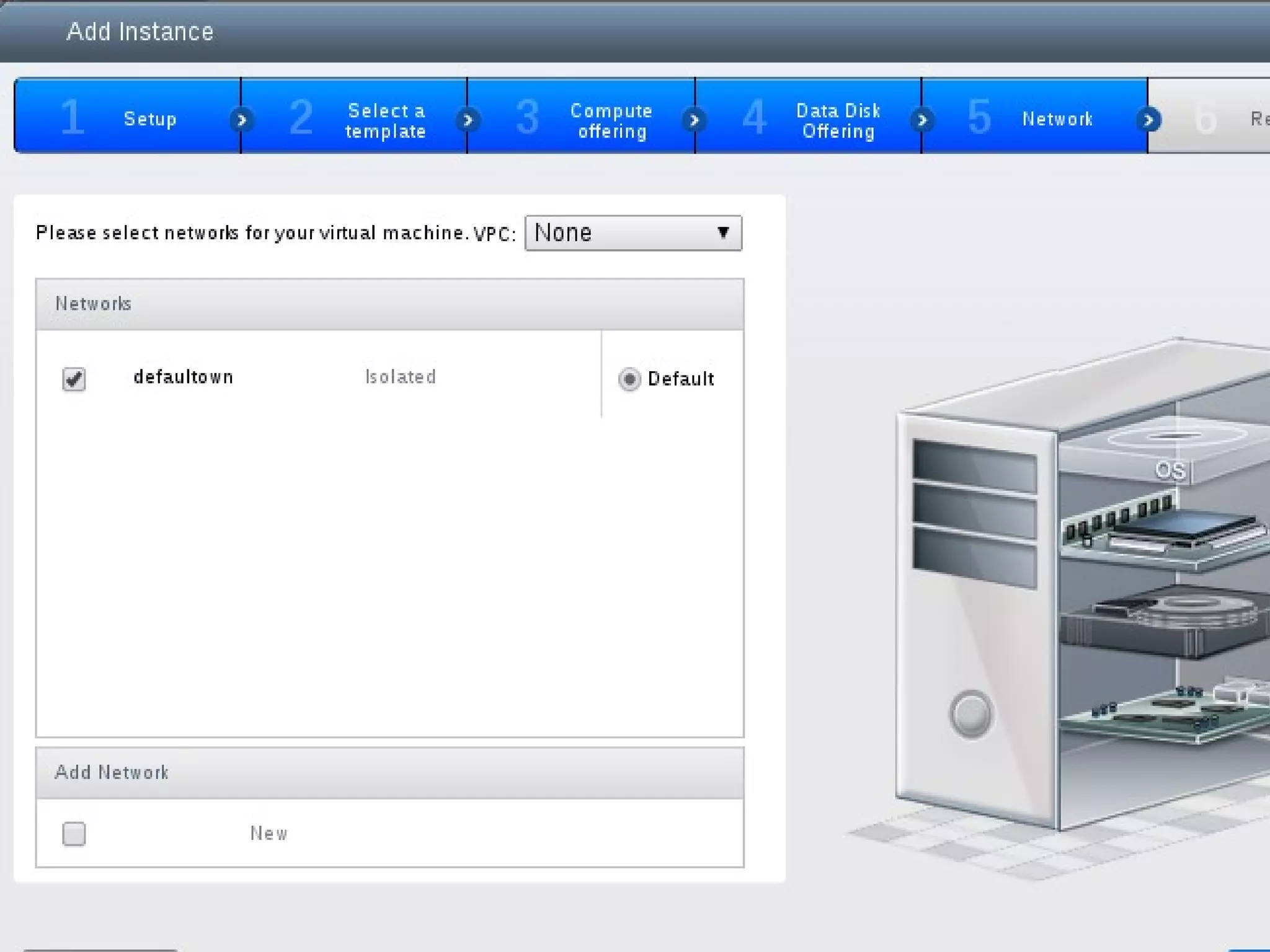
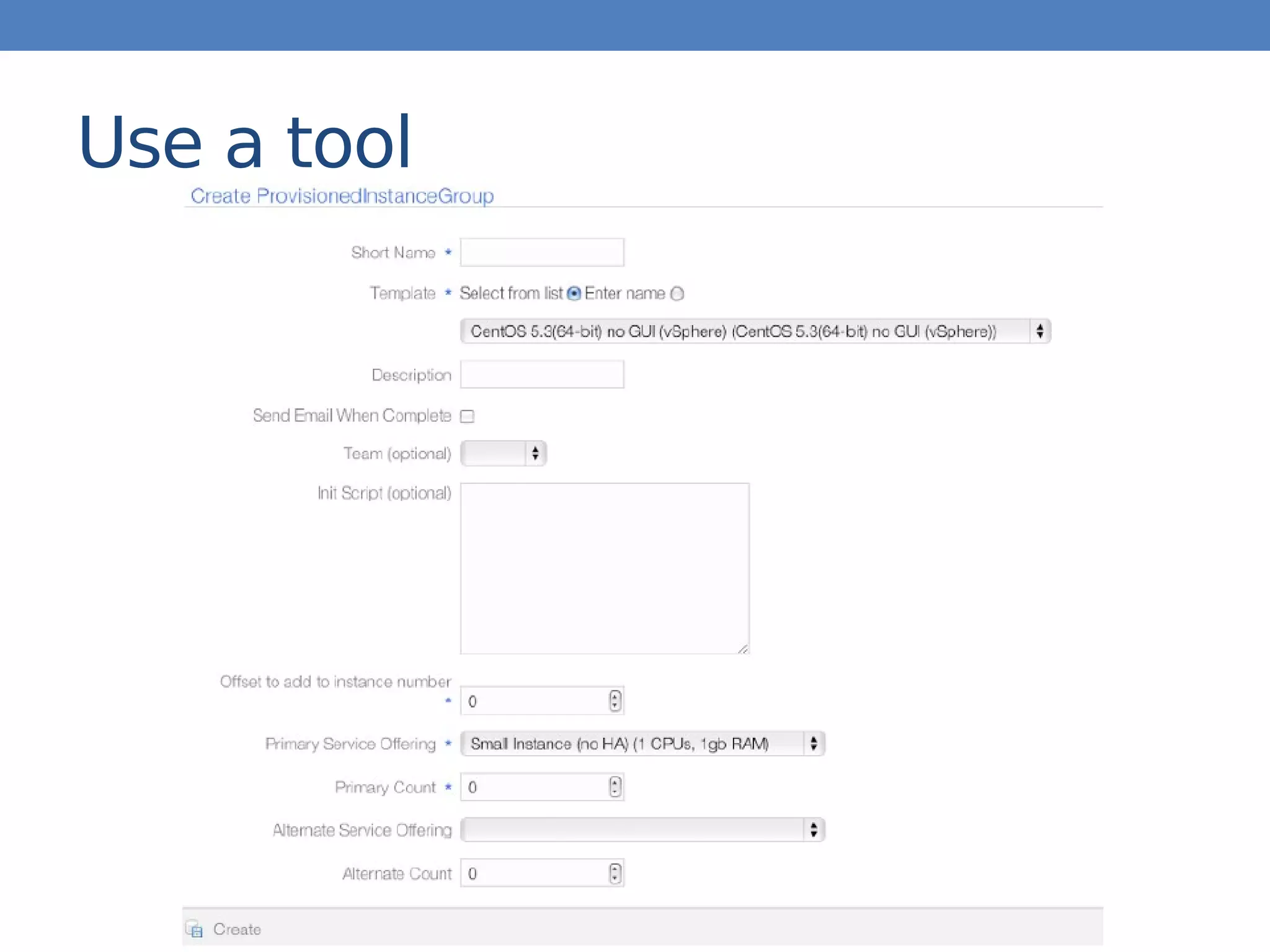
Self service
●
UI
●
API
●
Some external tool
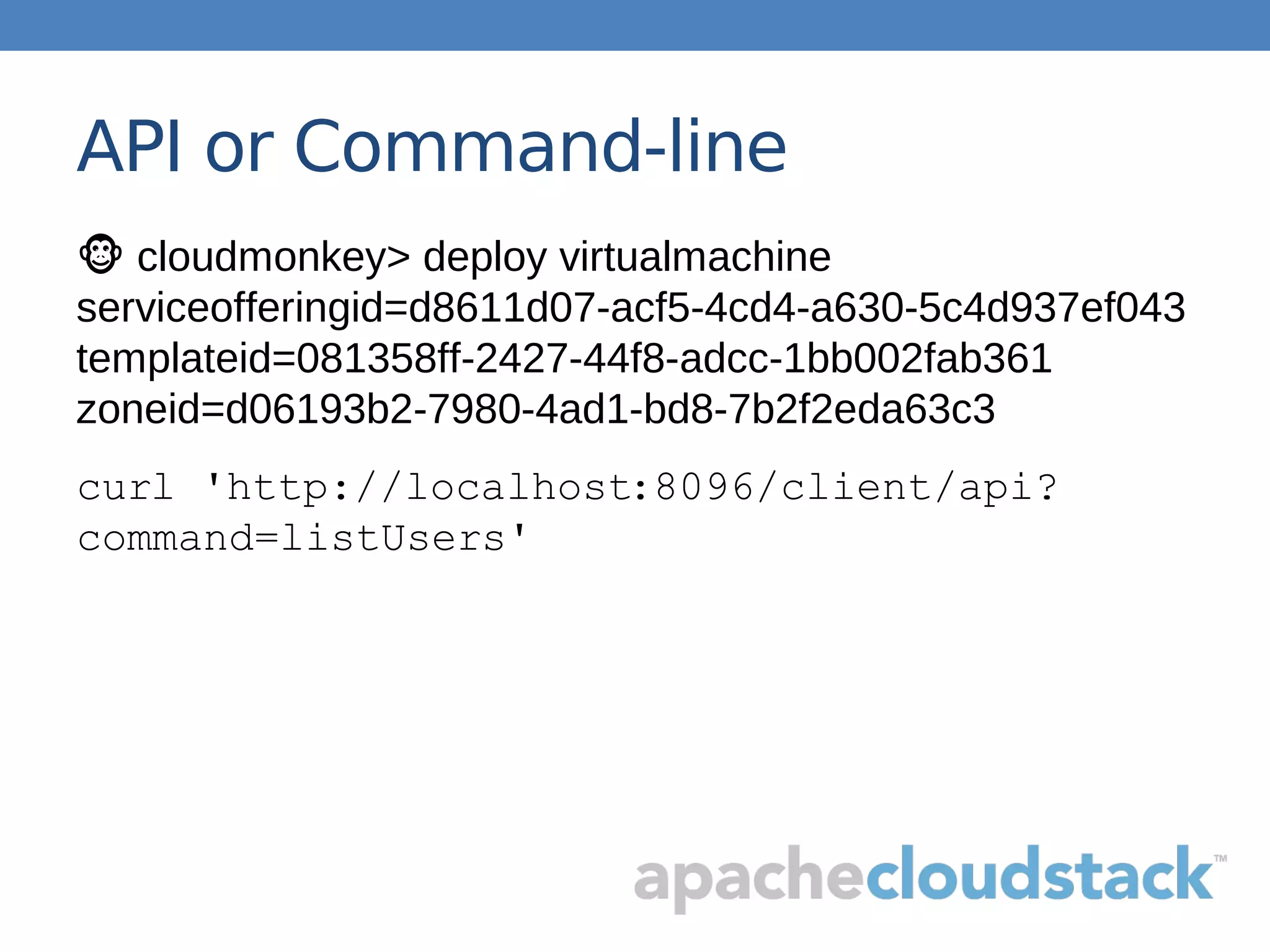
API or Command-line
� cloudmonkey> deploy virtualmachine
serviceofferingid=d8611d07-acf5-4cd4-a630-5c4d937ef043
templateid=081358ff-2427-44f8-adcc-1bb002fab361
zoneid=d06193b2-7980-4ad1-bd8-7b2f2eda63c3
curl 'http://localhost:8096/client/api?
command=listUsers'
Config Management deployment
{
"name": "hadoop_cluster_a",
"description": "A small hadoop cluster with hbase",
"version": "1.0",
"environment": "production",
"servers": [
{
"name": "zookeeper-a, zookeeper-b, zookeeper-c",
"description": "Zookeeper nodes",
"template": "rhel-5.6-base",
"service": "small",
"port_rules": "2181",
"run_list": "role[cluster_a], role[zookeeper_server]",
"actions": [
{ "knife_ssh": ["role:zookeeper_server", "sudo chef-client"] }
]
},
{
"name": "hadoop-master",
"description": "Hadoop master node",
"template": "rhel-5.6-base",
"service": "large",
"networks": "app-net, storage-net",
"port_rules": "50070, 50030, 60010",
"run_list": "role[cluster_a], role[hadoop_master], role[hbase_master]"
},
{
"name": "hadoop-worker-a hadoop-worker-b hadoop-worker-c",
"description": "Hadoop worker nodes",
"template": "rhel-5.6-base",
"service": "medium",
"port_rules": "50075, 50060, 60030",
"run_list": "role[cluster_a], role[hadoop_worker], role[hbase_regionserver]",
"actions": [
{ "knife_ssh": ["role:hadoop_master", "sudo chef-client"] },
{ "http_request": "http://${hadoop-master}:50070/index.jsp" }
]
}
}
Use a tool
Usage
● Jevons Paradox
● Plenty of waste possible as well - will developers always
destroy a machine when they are done with it?
● Important to show what projects and groups are
consuming resources as well as how they are using
those resources
Commodity Storage
● Commodity storage - this is dev/test environment - high
performance, resilient storage isn't needed.
● Local storage tends to be the best mix of cheap and
performant
● No failover, but it's dev/test - do you need it?
Commodity Networking
● Layer 3 isolation - (aka Security Groups)
● VLANs - (not as commodity, but still relatively cheap on
a small scale, but not at a large scale)
● Virtual routers (provide DHCP, DNS, LB, Firewall, PF,
NAT, etc)
Commodity Hypervisor
● KVM is my personal choice in this space.
● Easiest to consume - completely open source
Limiting Resources
● Limit the number of VMs, snapshots, IP addresses, etc.
● Use 'projects' to share resources
● This means most folks will never have problems, but
heaviest users will not be able to interrupt service for
others.
Questions
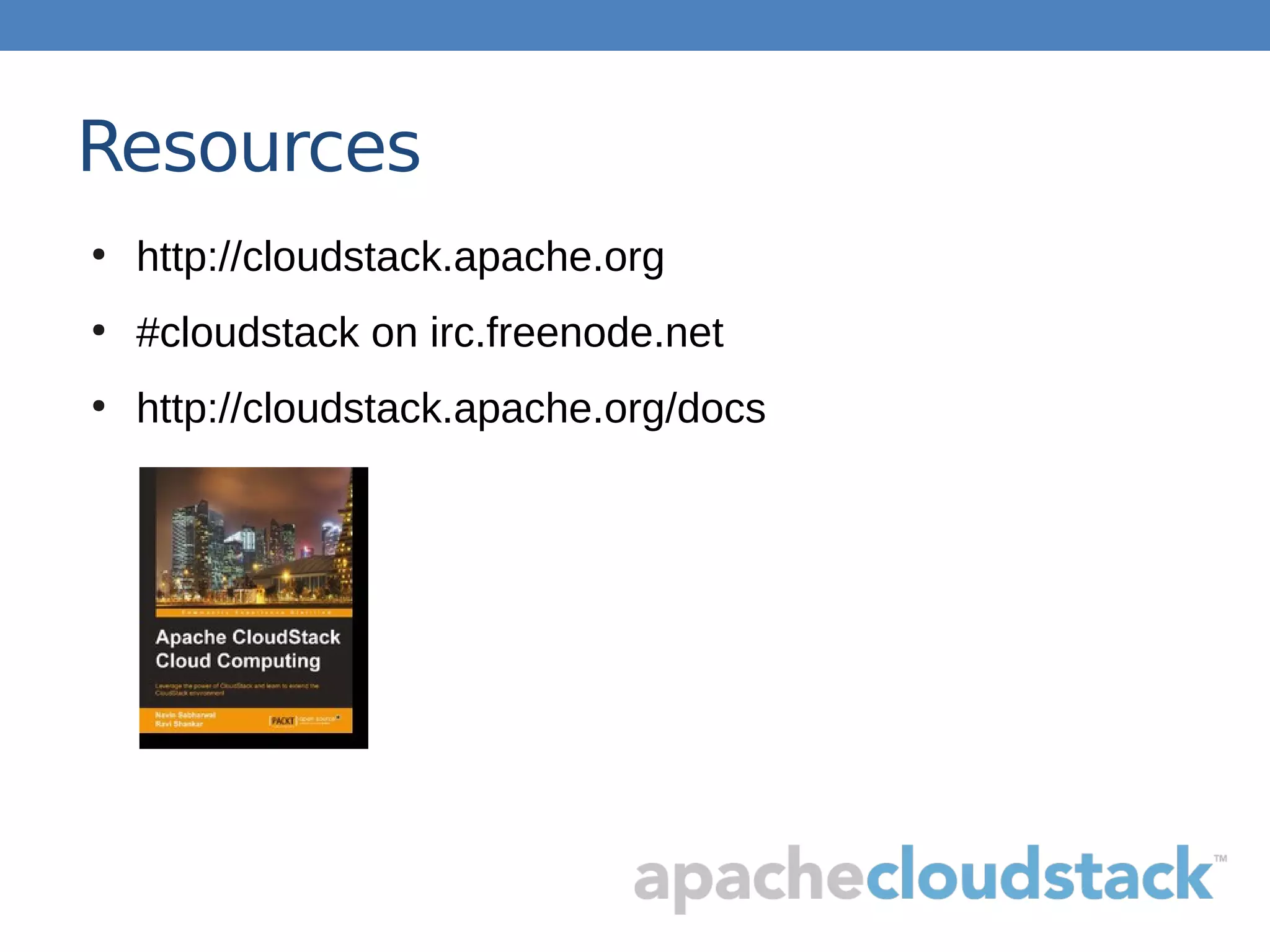
Resources
●
http://cloudstack.apache.org
●
#cloudstack on irc.freenode.net
●
http://cloudstack.apache.org/docs

Building a Dev/Test Cloud with Apache CloudStack

  • 1.
    Building a Dev/Testcloud with Apache CloudStack David Nalley PMC Member Apache CloudStack Member, Apache Software Foundation ke4qqq@apache.org Twitter: @ke4qqq
  • 2.
    #whoami • Apache SoftwareFoundation Member • Apache CloudStack PMC Member • Recovering Sysadmin • Fedora Project Contributor • Zenoss contributor • Employed by Citrix in the Open Source Business Office
  • 3.
    Why use cloud? Froma dev point of view the process looks like: • Start new project • File ticket for resources....wait....wait....wait • Get resources, that aren't configured....wait... • Get network access.....get permission....wait • Get things done.
  • 4.
    Why use cloud? •What IT Ops provides is not what developers want.
  • 5.
    Get rid ofthe waiting! ● Remove constraints - developers empowered to get things done. ● Agility ● Enforce automated process instead of manual ones
  • 6.
    What does adev/test cloud look like? ● Self-service - developers can provision their own environments ● Usage measurement - we worry about VM sprawl ● Isolated networks - must not let dev/test interfere with the real world. ● Commodity - as cheap as practical ● May also house production workloads
  • 7.
    Self service ● Provisioning manuallydoesn't add value ● Can be completely automated ● Do they need full control or just pushing pre-configured environments?
  • 8.
  • 10.
    API or Command-line �cloudmonkey> deploy virtualmachine serviceofferingid=d8611d07-acf5-4cd4-a630-5c4d937ef043 templateid=081358ff-2427-44f8-adcc-1bb002fab361 zoneid=d06193b2-7980-4ad1-bd8-7b2f2eda63c3 curl 'http://localhost:8096/client/api? command=listUsers'
  • 11.
  • 12.
    { "name": "hadoop_cluster_a", "description": "Asmall hadoop cluster with hbase", "version": "1.0", "environment": "production", "servers": [ { "name": "zookeeper-a, zookeeper-b, zookeeper-c", "description": "Zookeeper nodes", "template": "rhel-5.6-base", "service": "small", "port_rules": "2181", "run_list": "role[cluster_a], role[zookeeper_server]", "actions": [ { "knife_ssh": ["role:zookeeper_server", "sudo chef-client"] } ] }, { "name": "hadoop-master", "description": "Hadoop master node", "template": "rhel-5.6-base", "service": "large", "networks": "app-net, storage-net", "port_rules": "50070, 50030, 60010", "run_list": "role[cluster_a], role[hadoop_master], role[hbase_master]" }, { "name": "hadoop-worker-a hadoop-worker-b hadoop-worker-c", "description": "Hadoop worker nodes", "template": "rhel-5.6-base", "service": "medium", "port_rules": "50075, 50060, 60030", "run_list": "role[cluster_a], role[hadoop_worker], role[hbase_regionserver]", "actions": [ { "knife_ssh": ["role:hadoop_master", "sudo chef-client"] }, { "http_request": "http://${hadoop-master}:50070/index.jsp" } ] } }
  • 13.
  • 14.
    Usage ● Jevons Paradox ●Plenty of waste possible as well - will developers always destroy a machine when they are done with it? ● Important to show what projects and groups are consuming resources as well as how they are using those resources
  • 15.
    Commodity Storage ● Commoditystorage - this is dev/test environment - high performance, resilient storage isn't needed. ● Local storage tends to be the best mix of cheap and performant ● No failover, but it's dev/test - do you need it?
  • 16.
    Commodity Networking ● Layer3 isolation - (aka Security Groups) ● VLANs - (not as commodity, but still relatively cheap on a small scale, but not at a large scale) ● Virtual routers (provide DHCP, DNS, LB, Firewall, PF, NAT, etc)
  • 17.
    Commodity Hypervisor ● KVMis my personal choice in this space. ● Easiest to consume - completely open source
  • 18.
    Limiting Resources ● Limitthe number of VMs, snapshots, IP addresses, etc. ● Use 'projects' to share resources ● This means most folks will never have problems, but heaviest users will not be able to interrupt service for others.
  • 19.
  • 20.