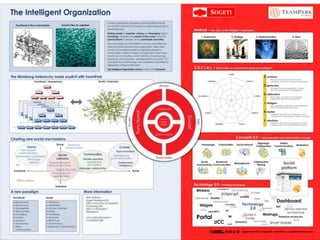
The Intelligent Organizationand how to build it with TeamPark®A short introductionBy I&I, Innovation-experts at Sogeti More information: http://teampark.org
A changing society, customer and employee force organizations to adapt5 REASONS for ‘TeamPark’
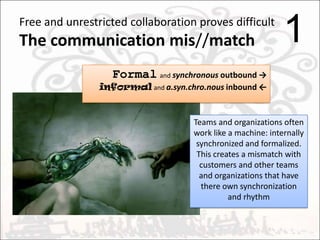
1Free and unrestricted collaboration proves difficultThe communication mis//matchFormalandsynchronousoutbound -> informalanda.syn.chro.nousinbound ←Teams and organizations often work like a machine: internally synchronized and formalized. This creates a mismatch with customers and other teams and organizations that have there own synchronization and rhythm
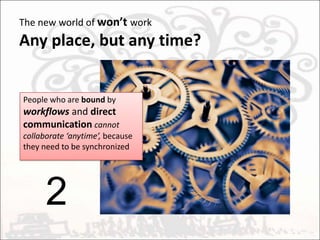
The new world of won’t workAny place, but any time?People who are bound by workflows and direct communication cannot collaborate ‘anytime’, because they need to be synchronized2
Limitations to classic business process improvementWhere to find more effectiveness?3Remaining Underperforming  and misplaced processes cannot be optimized  without consequences> We reached the limits of the current model <
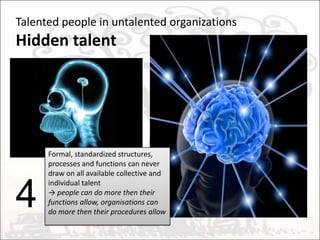
Talented people in untalented organizationsHidden talentFormal, standardized structures, processes and functions can never draw on all available collective and individual talent-> people can do more then their functions allow, organisations can do more then their procedures allow4
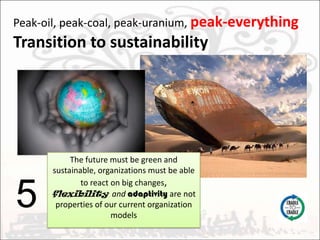
Peak-oil, peak-coal, peak-uranium, peak-everythingTransition to sustainabilityThe future must be green and sustainable, organizations must be able to react on big changes, flexibility  andadaptivity are not properties of our current organization models5
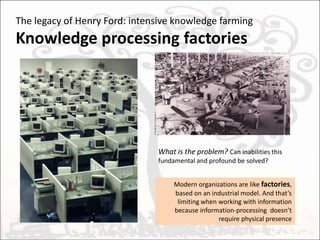
The legacy of Taylor and Ford: intensive knowledge farmingKnowledge processing factoriesWhat is the problem? Can inabilities this fundamental and profound be solved? Modern organizations are like factories,based on an industrial model (Taylorism). And that’s  limiting when working with information because information-processing  doesn’t require physical presence
The problems with the ‘industrial’ modelLimiting communication and proceduresThe industrial model is based on direct, synchronous communication and standardized workflows. The organization adopted a fixed structure and way of working. Based on the views of Taylor (scientific management) .> Centralized control <> Synchronous communication <> Standardized workflows and work dispatch <> Standardized function profiles <> ‘machine-bureaucracy’ <
Social collaboration and communicationFundamentals of TeamPark®
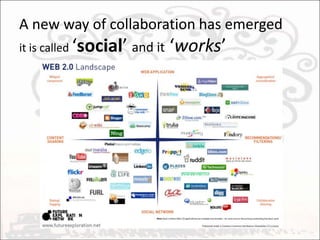
A new way of collaboration has emergedit is called ‘social’ and it ‘works’
Stigmergy drives socialNature’s way of setting up mass-collaborationPart of the new science of ‘complex self-organizing systems’. Structure of stigmergy:A platform
Signals (the state of the platform)
Agents or actors leave of change signals
Predictable reactions on these signalsExamples of stigmergy:Ants and social insects
Road / traffic
All over nature and organisms
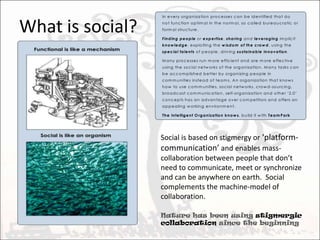
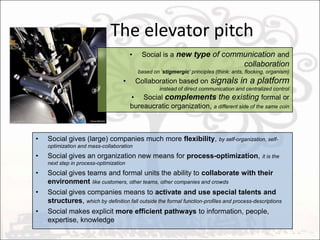
…What is social?Social is based on stigmergy or ‘platform-communication’ and enables mass-collaboration between people that don’t need to communicate, meet or synchronize and can be anywhere on earth. Social complements the machine-model of collaboration.Nature has been using stigmergic collaboration since the beginning
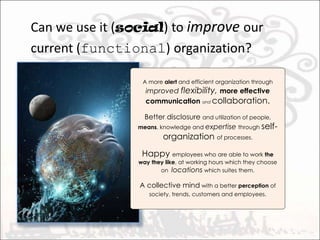
Can we use it (social) to improve our current (functional) organization?
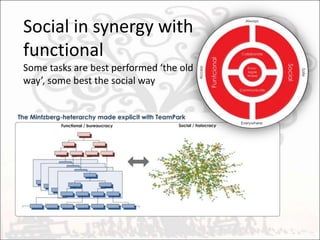
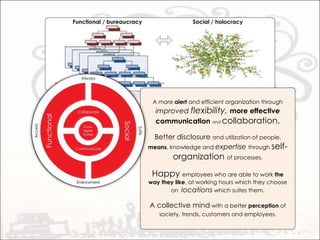
Social in synergy with functionalSome tasks are best performed ‘the old way’, some best the social way
Every social is not born equalDifferent kinds of social exist
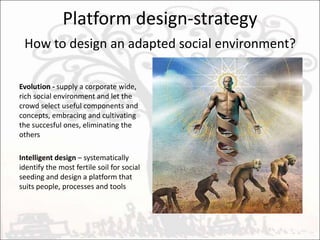
Platform design-strategyHow to design an adapted social environment?Evolution - supply a corporate wide, rich social environment and let the crowd select useful components and concepts, embracing and cultivating the succesful ones, eliminating the othersIntelligent design – systematically identify the most fertile soil for social seeding and design a platform that suits people, processes and tools
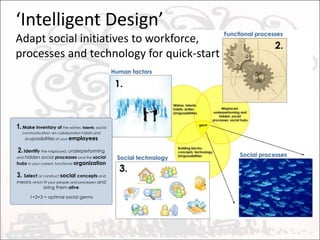
‘Intelligent Design’Adapt social initiatives to workforce, processes and technology for quick-start
The social platformBy definition of TeamPark®
Function of the social platformSocial is not based on direct communication, planning, fixed workflows or central command…… it is based on trails and signals left in the environment, the collaboration platformActivity-streams, persistent conversations and bookmarks, explicit social structures, collaborative documents. Things co-workers can stumble upon, triggering collaboration. Self-organizing mass collaboration. Totally decoupled and ‘unorganized’.The platform facilitates social processes
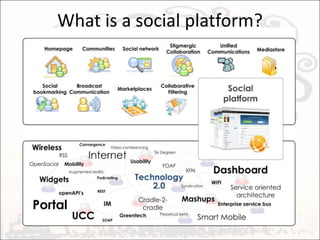
What is a social platform?
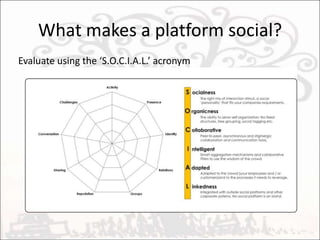
What makes a platform social?Use our ‘S.O.C.I.A.L.’ acronym
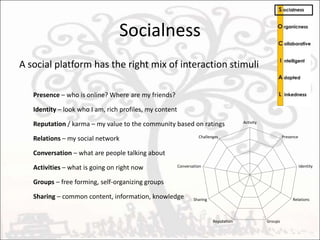
StimulatingA social platform has the right mix of interaction stimuliPresence – who is online? Where are my friends?Identity – look who I am, rich profiles, my contentReputation / karma – my value to the community based on ratingsRelations – my social networkConversation – what are people talking aboutActivities – what is going on right nowGroups – free forming, self-organizing groupsSharing – common content, information, knowledge
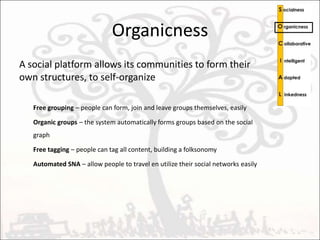
OrganicA social platform allows its communities to form their own structures, to self-organizeFree grouping – people can form, join and leave groups themselves, easilyOrganic groups – the system automatically forms groups based on the social graphFree tagging – people can tag all content, building a folksonomyAutomated SNA – allow people to travel en utilize their social networks easily
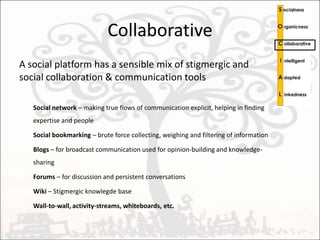
CollaborativeA social platform has a sensible mix of stigmergic and social collaboration & communication toolsSocial network – making true flows of communication explicit, helping in finding expertise and peopleSocial bookmarking – brute force collecting, weighing and filtering of informationBlogs – for broadcast communication used for opinion-building and knowledge-sharingForums – for discussion and persistent conversationsWiki – Stigmergic knowlegde baseWall-to-wall, activity-streams, whiteboards, etc.
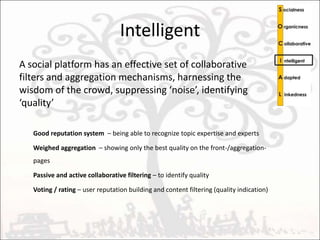
IntelligentA social platform has an effective set of collaborative filters and aggregation mechanisms, harnessing the wisdom of the crowd, suppressing ‘noise’, identifying ‘quality’Good reputation system  – being able to recognize topic expertise and experts Weighed aggregation  – showing only the best quality on the front-/aggregation-pagesPassive and active collaborative filtering – to identify quality Voting/ rating – user reputation building and content filtering (quality indication)
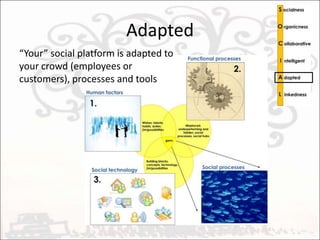
Adapted“Your” social platform is adapted to your crowd (employees or customers), processes and tools
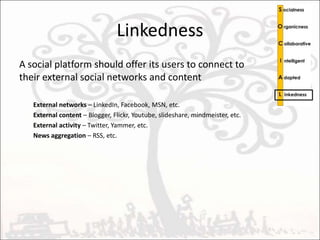
LinkedA social platform should offer its users to connect to their external social networks and contentExternal networks – LinkedIn, Facebook, MSN, etc.External content – Blogger, Flickr, Youtube, slideshare, mindmeister, etc.External activity – Twitter, Yammer, etc.News aggregation – RSS, etc.
Growing a living social sideTeamPark-Method
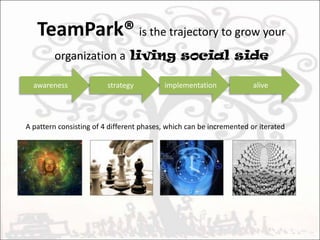
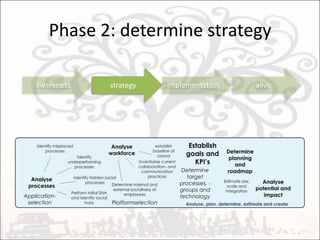
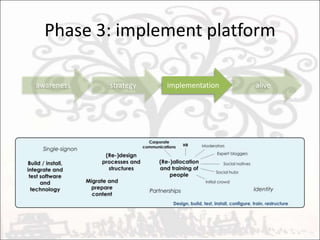
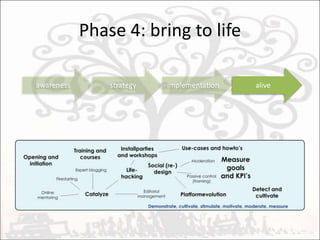
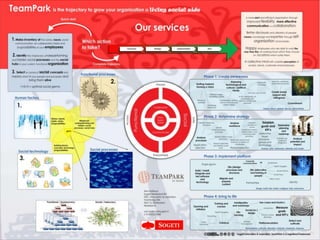
TeamPark®is the trajectory to grow your organizationaliving social sideawarenessstrategyimplementationaliveA pattern consisting of 4 different phases, which can be incremented or iterated
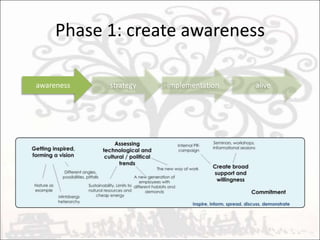
Phase 1: create awarenessawarenessstrategyimplementationalive

Build the socially integrated organization with the TeamPark-method

  • 1.
    The Intelligent Organizationandhow to build it with TeamPark®A short introductionBy I&I, Innovation-experts at Sogeti More information: http://teampark.org
  • 2.
    A changing society,customer and employee force organizations to adapt5 REASONS for ‘TeamPark’
  • 3.
    1Free and unrestrictedcollaboration proves difficultThe communication mis//matchFormalandsynchronousoutbound -> informalanda.syn.chro.nousinbound ←Teams and organizations often work like a machine: internally synchronized and formalized. This creates a mismatch with customers and other teams and organizations that have there own synchronization and rhythm
  • 4.
    The new worldof won’t workAny place, but any time?People who are bound by workflows and direct communication cannot collaborate ‘anytime’, because they need to be synchronized2
  • 5.
    Limitations to classicbusiness process improvementWhere to find more effectiveness?3Remaining Underperforming and misplaced processes cannot be optimized without consequences> We reached the limits of the current model <
  • 6.
    Talented people inuntalented organizationsHidden talentFormal, standardized structures, processes and functions can never draw on all available collective and individual talent-> people can do more then their functions allow, organisations can do more then their procedures allow4
  • 7.
    Peak-oil, peak-coal, peak-uranium,peak-everythingTransition to sustainabilityThe future must be green and sustainable, organizations must be able to react on big changes, flexibility andadaptivity are not properties of our current organization models5
  • 8.
    The legacy ofTaylor and Ford: intensive knowledge farmingKnowledge processing factoriesWhat is the problem? Can inabilities this fundamental and profound be solved? Modern organizations are like factories,based on an industrial model (Taylorism). And that’s limiting when working with information because information-processing doesn’t require physical presence
  • 9.
    The problems withthe ‘industrial’ modelLimiting communication and proceduresThe industrial model is based on direct, synchronous communication and standardized workflows. The organization adopted a fixed structure and way of working. Based on the views of Taylor (scientific management) .> Centralized control <> Synchronous communication <> Standardized workflows and work dispatch <> Standardized function profiles <> ‘machine-bureaucracy’ <
  • 10.
    Social collaboration andcommunicationFundamentals of TeamPark®
  • 11.
    A new wayof collaboration has emergedit is called ‘social’ and it ‘works’
  • 12.
    Stigmergy drives socialNature’sway of setting up mass-collaborationPart of the new science of ‘complex self-organizing systems’. Structure of stigmergy:A platform
  • 13.
    Signals (the stateof the platform)
  • 14.
    Agents or actorsleave of change signals
  • 15.
    Predictable reactions onthese signalsExamples of stigmergy:Ants and social insects
  • 16.
  • 17.
    All over natureand organisms
  • 18.
    …What is social?Socialis based on stigmergy or ‘platform-communication’ and enables mass-collaboration between people that don’t need to communicate, meet or synchronize and can be anywhere on earth. Social complements the machine-model of collaboration.Nature has been using stigmergic collaboration since the beginning
  • 19.
    Can we useit (social) to improve our current (functional) organization?
  • 20.
    Social in synergywith functionalSome tasks are best performed ‘the old way’, some best the social way
  • 21.
    Every social isnot born equalDifferent kinds of social exist
  • 22.
    Platform design-strategyHow todesign an adapted social environment?Evolution - supply a corporate wide, rich social environment and let the crowd select useful components and concepts, embracing and cultivating the succesful ones, eliminating the othersIntelligent design – systematically identify the most fertile soil for social seeding and design a platform that suits people, processes and tools
  • 23.
    ‘Intelligent Design’Adapt socialinitiatives to workforce, processes and technology for quick-start
  • 24.
    The social platformBydefinition of TeamPark®
  • 25.
    Function of thesocial platformSocial is not based on direct communication, planning, fixed workflows or central command…… it is based on trails and signals left in the environment, the collaboration platformActivity-streams, persistent conversations and bookmarks, explicit social structures, collaborative documents. Things co-workers can stumble upon, triggering collaboration. Self-organizing mass collaboration. Totally decoupled and ‘unorganized’.The platform facilitates social processes
  • 26.
    What is asocial platform?
  • 27.
    What makes aplatform social?Use our ‘S.O.C.I.A.L.’ acronym
  • 28.
    StimulatingA social platformhas the right mix of interaction stimuliPresence – who is online? Where are my friends?Identity – look who I am, rich profiles, my contentReputation / karma – my value to the community based on ratingsRelations – my social networkConversation – what are people talking aboutActivities – what is going on right nowGroups – free forming, self-organizing groupsSharing – common content, information, knowledge
  • 29.
    OrganicA social platformallows its communities to form their own structures, to self-organizeFree grouping – people can form, join and leave groups themselves, easilyOrganic groups – the system automatically forms groups based on the social graphFree tagging – people can tag all content, building a folksonomyAutomated SNA – allow people to travel en utilize their social networks easily
  • 30.
    CollaborativeA social platformhas a sensible mix of stigmergic and social collaboration & communication toolsSocial network – making true flows of communication explicit, helping in finding expertise and peopleSocial bookmarking – brute force collecting, weighing and filtering of informationBlogs – for broadcast communication used for opinion-building and knowledge-sharingForums – for discussion and persistent conversationsWiki – Stigmergic knowlegde baseWall-to-wall, activity-streams, whiteboards, etc.
  • 31.
    IntelligentA social platformhas an effective set of collaborative filters and aggregation mechanisms, harnessing the wisdom of the crowd, suppressing ‘noise’, identifying ‘quality’Good reputation system – being able to recognize topic expertise and experts Weighed aggregation – showing only the best quality on the front-/aggregation-pagesPassive and active collaborative filtering – to identify quality Voting/ rating – user reputation building and content filtering (quality indication)
  • 32.
    Adapted“Your” social platformis adapted to your crowd (employees or customers), processes and tools
  • 33.
    LinkedA social platformshould offer its users to connect to their external social networks and contentExternal networks – LinkedIn, Facebook, MSN, etc.External content – Blogger, Flickr, Youtube, slideshare, mindmeister, etc.External activity – Twitter, Yammer, etc.News aggregation – RSS, etc.
  • 35.
    Growing a livingsocial sideTeamPark-Method
  • 36.
    TeamPark®is the trajectoryto grow your organizationaliving social sideawarenessstrategyimplementationaliveA pattern consisting of 4 different phases, which can be incremented or iterated
  • 37.
    Phase 1: createawarenessawarenessstrategyimplementationalive