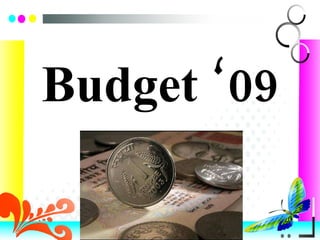
Budget ‘09
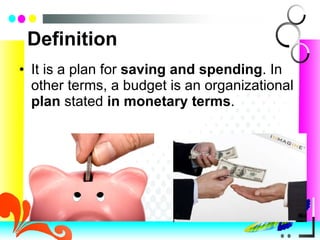
Definition It is a plan for  saving and spending . In other terms, a budget is an organizational  plan  stated  in monetary terms .
The word  budget comes from the French "bougette", a little bag, once used for pills and medication.
Begin A budget begins with  identifying and listing  monthly  income and expenses . It instantly shows people how money flows in and out of their daily lives.
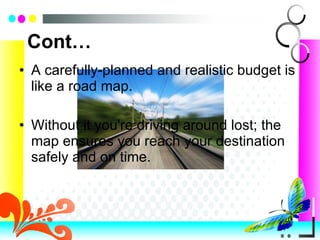
Cont… A carefully-planned and realistic budget is like a road map.  Without it you're driving around lost; the map ensures you reach your destination safely and on time.
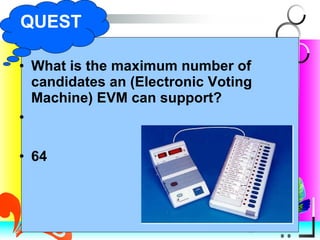
What is the maximum number of candidates an (Electronic Voting Machine) EVM can support? 64 QUEST
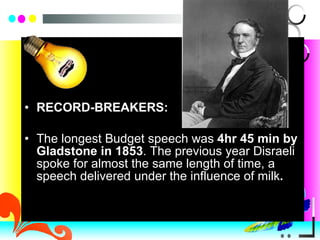
RECORD-BREAKERS:  The longest Budget speech was  4hr 45 min by Gladstone in 1853 . The previous year Disraeli spoke for almost the same length of time, a speech delivered under the influence of milk .
Broad Classification Business start-up   budget-  process of calculating the costs of starting a small business Corporate   budget-  budget of a company is often compiled annually Event   management   budget Government   budget-  budget of a government is a plan of the intended revenues and expenditures of that government. Personal  or  family   budget
What does the letters XP stand for in the product Microsoft XP? Clue : we all have  experienced  it Experience QUEST
Initially, budget papers were printed in Rashtrapati Bhavan. In 1950, budget papers were leaked. This changed the printing venue to Minto Road located security press.
Since 1980, budget papers are printed in North Block. A week before the budget is presented, the employees of the press stay in the ministry and have no means of communicating with the outside world.
Budget types Sales budget : The sales budget is an estimate of future sales, often broken down into both units and dollars. It is used to create company sales goals. Production budget : Product oriented companies create a production budget which estimates the number of units that must be manufactured to meet the sales goals. The production budget also estimates the various costs involved with manufacturing those units, including labor and material.
Cont… Cash Flow/Cash   budget : The cash flow budget is a prediction of future cash receipts and expenditures for a particular time period. It usually covers a period in the short term future. The cash flow budget helps the business determine when income will be sufficient to cover expenses and when the company will need to seek outside financing. Marketing   budget : The marketing budget is an estimate of the funds needed for promotion, advertising, and public relations in order to market the product or service.
Cont… Project budget : The project budget is a prediction of the costs associated with a particular company project. These costs include labor, materials, and other related expenses. The project budget is often broken down into specific tasks, with task budgets assigned to each. Revenue budget : The Revenue Budget consists of revenue receipts of government (revenues from tax and other sources) and the expenditure met from these revenues. Tax revenues are made up of taxes and other duties that the government levies. Expenditure budget : A budget type which include of spending data items.
Summary Budget Provide a forecast of revenues and expenditures. Enable the actual financial operation of the business to be measured against the forecast.
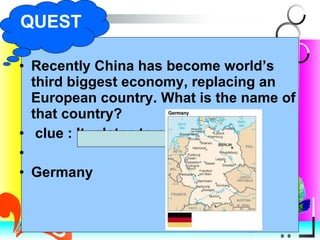
Recently China has become world’s third biggest economy, replacing an European country. What is the name of that country? clue : It relates to our DAD Germany QUEST
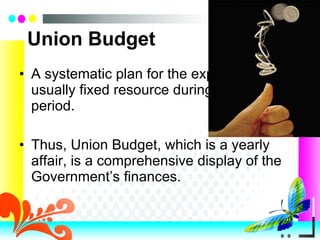
Union Budget A systematic plan for the expenditure of a usually fixed resource during a given period. Thus, Union Budget, which is a yearly affair, is a comprehensive display of the Government’s finances.
R K Shanmukham Shetty presented independent India's first budget on November 26, 1947.
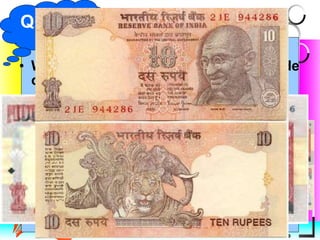
What will be printed on the reverse side of a 100, 500, 1000 rupee notes? Rs .100 ----- Himalayan mountain 157 × 73 mm colour - Blue-green at centre, brown-purple at 2 sides Rs. 500 ----- Dandi March 167 × 73 mm Colour -Olive and yellow Rs. 1000 Economy of India 177 × 73 mm Colour - Pink QUEST
Who is the Chairman of University Grants Commission (UGC)? Mr. S K Thorat QUEST
Cont… It is the most significant economic and financial event in India.  The Finance Minister puts down a report that contains Government of India’s revenue and expenditure for one fiscal year.  The fiscal year runs from April 01 to March 31.
Jawahar Lal Nehru was the first Prime Minister to present the budget when he held the Finance portfolio in 1958-59.
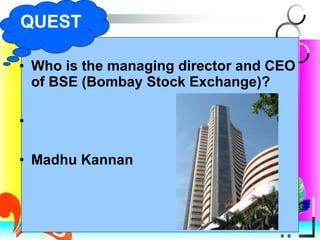
Who is the managing director and CEO of BSE (Bombay Stock Exchange)? Madhu Kannan QUEST
R Venkataraman was the only Finance Minister who later became the President of India.
The Union budget is preceded by an Economic Survey which outlines the broad direction of the budget and the economic performance of the country.  The Budget is the most extensive account of the Government's finances, in which revenues from all sources and expenses of all activities undertaken are aggregated. It comprises the  revenue budget  and the  capital budget . It also contains estimates for the next fiscal year called  budgeted estimates .
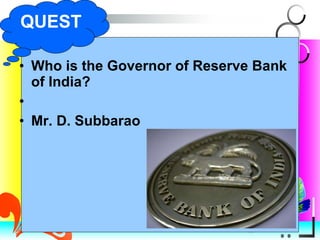
Who is the Governor of Reserve Bank of India? Mr. D. Subbarao QUEST
Barring a few exceptions -- like elections – Finance Minister presents the annual Union Budget in the Parliament on the  last working day of February . The budget has to be passed by the Lok Sabha before it can come into effect on April 01
P Chidambaram rewrote India`s Exim Policy in one non-stop eight-hour sitting in July 1991, when he became the Commerce Minister.
What was the name of State Bank of India before Independence? Imperial Bank of India QUEST
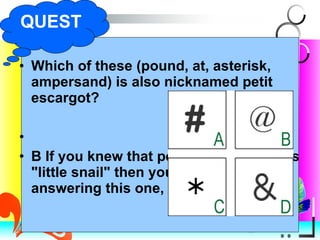
Which of these (pound, at, asterisk, ampersand) is also nicknamed petit escargot? B If you knew that petit escargot means "little snail" then you had no trouble answering this one, right? QUEST
Until the year 2000, the Union Budget was announced at 5 pm on the last working day of the month of February. This practice was inherited from the Colonial Era, when the British Parliament would pass the budget in the noon followed by India in the evening of the day. It was Mr.Yashwant Sinha, the then Finance Minister of India in the government of Atal Bihari Vajpayee, who changed the ritual by announcing the 2001 Union Budget at 11 am.

Incremental   Budgeting Incremental Budgeting uses a budget prepared using a previous period’s budget or actual performance as a base, with incremental amounts added for the new budget period. The allocation of resources is based upon allocations from the previous period.
This approach is not recommended as it fails to take into account changing circumstances.  Moreover, it encourages “spending up to the budget” to ensure a reasonable allocation in the next period. It leads to a “spend it or lose it” mentality
Advantages  of incremental budgeting The budget is stable and change is gradual. Managers can operate their departments on a consistent basis. The system is relatively simple to operate and easy to understand. Conflicts are avoided when departments appear to be treated similarly. Co-ordination between budgets is easier to achieve. The impact of change can be seen quickly
Disadvantages  of incremental budgeting  Assumes activities and methods of working will continue in the same way. No incentive for developing new ideas. No incentive to reduce costs. Encourages spending up to the budget so that the budget is maintained next year.
Cont… 5.  The budget may become out-of-date and no longer relate to the level of activity or type of work being carried out. 6.  The priority for resources may have changed since the budgets were originally set. 7.  There may be budgetary slack built into the budget, which is never reviewed. Managers might have overestimated their requirements in the past in order to obtain a budget which is easier to work within, and which will allow them to achieve favorable results.
Common Budgeting Mistakes Using too much cash : ATM withdrawals are easy to lose track of. Our credit counselors advise relying on debit cards and checks, as they leave a paper trail.  Being too strict : It can be tempting to try to eliminate as many expenses as possible. The enthusiasm to save money is a good impulse, but an overly strict budget is usually doomed to failure, warn our credit counseling advisors. It's okay to budget a modest amount for a hobby, service or activity that boosts your well-being.  Spending the extras : Unexpected windfalls or raises are fun to spend, but they should go into a savings account and help you reach your long-term financial goals that much more quickly.
Conclusion
Note: You can either perform the demonstration described or discuss the short story below to conclude the session. One day an expert in time management was speaking to a group of business students and, to make a point, he used this illustration. As he stood in front of the group he pulled out a large wide-mouthed Mason jar and set it on the table in front of him. Then he produced about a dozen rocks and placed them, one at a time, into the jar. When the jar was filled to the top and no more rocks would fit inside, he asked, "Is this jar full?" Everyone in the class said, "Yes." Then he said, "Really?"  He reached under the table and pulled out a bucket of gravel. He dumped some gravel in and shook the jar causing pieces of gravel to work themselves down into the space between the rocks. Then he asked the group once more, "Is the jar full?" By this time the class began to understand. "Probably not," one of them answered. "Good!" he replied. He reached under the table and brought out a bucket of sand. He started dumping the sand in the jar and it went into all of the spaces left between the rocks and the gravel. Once more he asked the question, "Is this jar full?" No!" the class shouted. Once again he said, "Good." Then he grabbed a pitcher of water and began to pour it in until the jar was filled to the brim. Then he looked at the class and asked, "What is the point of this illustration?“  One student raised his hand and said, “No matter how full your schedule is, if you try really hard you can always fit some more things in it!" "No," the speaker replied, "that's not the point. The truth this illustration teaches us is: If you don't put the big rocks in first, you'll never get them in at all." What are the 'big rocks' in your life? Your children; Your loved ones; Your education; Your dreams; A worthy cause; Teaching or mentoring others; Doing things that you love; Time for yourself; Your health; Your mate (or significant other). Remember to put these BIG ROCKS in first or you'll never get them in at all. If you sweat about the little stuff (the gravel, sand, and water) then you'll fill your life with little things you worry about that don't really matter, and you'll never have the time you need to spend on the big, important stuff (the big rocks). So, tonight, or in the morning, when you are reflecting on this short story, ask yourself this question: What are the 'big rocks' in my life? Then, put those in your jar first.
 

Budget

  • 1.
  • 2.
    Definition It isa plan for saving and spending . In other terms, a budget is an organizational plan stated in monetary terms .
  • 3.
    The word budget comes from the French "bougette", a little bag, once used for pills and medication.
  • 4.
    Begin A budgetbegins with identifying and listing monthly income and expenses . It instantly shows people how money flows in and out of their daily lives.
  • 5.
    Cont… A carefully-plannedand realistic budget is like a road map. Without it you're driving around lost; the map ensures you reach your destination safely and on time.
  • 6.
    What is themaximum number of candidates an (Electronic Voting Machine) EVM can support? 64 QUEST
  • 7.
    RECORD-BREAKERS: Thelongest Budget speech was 4hr 45 min by Gladstone in 1853 . The previous year Disraeli spoke for almost the same length of time, a speech delivered under the influence of milk .
  • 8.
    Broad Classification Businessstart-up budget- process of calculating the costs of starting a small business Corporate budget- budget of a company is often compiled annually Event management budget Government budget- budget of a government is a plan of the intended revenues and expenditures of that government. Personal or family budget
  • 9.
    What does theletters XP stand for in the product Microsoft XP? Clue : we all have experienced it Experience QUEST
  • 10.
    Initially, budget paperswere printed in Rashtrapati Bhavan. In 1950, budget papers were leaked. This changed the printing venue to Minto Road located security press.
  • 11.
    Since 1980, budgetpapers are printed in North Block. A week before the budget is presented, the employees of the press stay in the ministry and have no means of communicating with the outside world.
  • 12.
    Budget types Salesbudget : The sales budget is an estimate of future sales, often broken down into both units and dollars. It is used to create company sales goals. Production budget : Product oriented companies create a production budget which estimates the number of units that must be manufactured to meet the sales goals. The production budget also estimates the various costs involved with manufacturing those units, including labor and material.
  • 13.
    Cont… Cash Flow/Cash budget : The cash flow budget is a prediction of future cash receipts and expenditures for a particular time period. It usually covers a period in the short term future. The cash flow budget helps the business determine when income will be sufficient to cover expenses and when the company will need to seek outside financing. Marketing budget : The marketing budget is an estimate of the funds needed for promotion, advertising, and public relations in order to market the product or service.
  • 14.
    Cont… Project budget: The project budget is a prediction of the costs associated with a particular company project. These costs include labor, materials, and other related expenses. The project budget is often broken down into specific tasks, with task budgets assigned to each. Revenue budget : The Revenue Budget consists of revenue receipts of government (revenues from tax and other sources) and the expenditure met from these revenues. Tax revenues are made up of taxes and other duties that the government levies. Expenditure budget : A budget type which include of spending data items.
  • 15.
    Summary Budget Providea forecast of revenues and expenditures. Enable the actual financial operation of the business to be measured against the forecast.
  • 16.
    Recently China hasbecome world’s third biggest economy, replacing an European country. What is the name of that country? clue : It relates to our DAD Germany QUEST
  • 17.
    Union Budget Asystematic plan for the expenditure of a usually fixed resource during a given period. Thus, Union Budget, which is a yearly affair, is a comprehensive display of the Government’s finances.
  • 18.
    R K ShanmukhamShetty presented independent India's first budget on November 26, 1947.
  • 19.
    What will beprinted on the reverse side of a 100, 500, 1000 rupee notes? Rs .100 ----- Himalayan mountain 157 × 73 mm colour - Blue-green at centre, brown-purple at 2 sides Rs. 500 ----- Dandi March 167 × 73 mm Colour -Olive and yellow Rs. 1000 Economy of India 177 × 73 mm Colour - Pink QUEST
  • 20.
    Who is theChairman of University Grants Commission (UGC)? Mr. S K Thorat QUEST
  • 21.
    Cont… It isthe most significant economic and financial event in India. The Finance Minister puts down a report that contains Government of India’s revenue and expenditure for one fiscal year. The fiscal year runs from April 01 to March 31.
  • 22.
    Jawahar Lal Nehruwas the first Prime Minister to present the budget when he held the Finance portfolio in 1958-59.
  • 23.
    Who is themanaging director and CEO of BSE (Bombay Stock Exchange)? Madhu Kannan QUEST
  • 24.
    R Venkataraman wasthe only Finance Minister who later became the President of India.
  • 25.
    The Union budgetis preceded by an Economic Survey which outlines the broad direction of the budget and the economic performance of the country. The Budget is the most extensive account of the Government's finances, in which revenues from all sources and expenses of all activities undertaken are aggregated. It comprises the revenue budget and the capital budget . It also contains estimates for the next fiscal year called budgeted estimates .
  • 26.
    Who is theGovernor of Reserve Bank of India? Mr. D. Subbarao QUEST
  • 27.
    Barring a fewexceptions -- like elections – Finance Minister presents the annual Union Budget in the Parliament on the last working day of February . The budget has to be passed by the Lok Sabha before it can come into effect on April 01
  • 28.
    P Chidambaram rewroteIndia`s Exim Policy in one non-stop eight-hour sitting in July 1991, when he became the Commerce Minister.
  • 29.
    What was thename of State Bank of India before Independence? Imperial Bank of India QUEST
  • 30.
    Which of these(pound, at, asterisk, ampersand) is also nicknamed petit escargot? B If you knew that petit escargot means "little snail" then you had no trouble answering this one, right? QUEST
  • 31.
    Until the year2000, the Union Budget was announced at 5 pm on the last working day of the month of February. This practice was inherited from the Colonial Era, when the British Parliament would pass the budget in the noon followed by India in the evening of the day. It was Mr.Yashwant Sinha, the then Finance Minister of India in the government of Atal Bihari Vajpayee, who changed the ritual by announcing the 2001 Union Budget at 11 am.
  • 32.
    Incremental Budgeting Incremental Budgeting uses a budget prepared using a previous period’s budget or actual performance as a base, with incremental amounts added for the new budget period. The allocation of resources is based upon allocations from the previous period.
  • 33.
    This approach isnot recommended as it fails to take into account changing circumstances. Moreover, it encourages “spending up to the budget” to ensure a reasonable allocation in the next period. It leads to a “spend it or lose it” mentality
  • 34.
    Advantages ofincremental budgeting The budget is stable and change is gradual. Managers can operate their departments on a consistent basis. The system is relatively simple to operate and easy to understand. Conflicts are avoided when departments appear to be treated similarly. Co-ordination between budgets is easier to achieve. The impact of change can be seen quickly
  • 35.
    Disadvantages ofincremental budgeting Assumes activities and methods of working will continue in the same way. No incentive for developing new ideas. No incentive to reduce costs. Encourages spending up to the budget so that the budget is maintained next year.
  • 36.
    Cont… 5. The budget may become out-of-date and no longer relate to the level of activity or type of work being carried out. 6. The priority for resources may have changed since the budgets were originally set. 7. There may be budgetary slack built into the budget, which is never reviewed. Managers might have overestimated their requirements in the past in order to obtain a budget which is easier to work within, and which will allow them to achieve favorable results.
  • 37.
    Common Budgeting MistakesUsing too much cash : ATM withdrawals are easy to lose track of. Our credit counselors advise relying on debit cards and checks, as they leave a paper trail. Being too strict : It can be tempting to try to eliminate as many expenses as possible. The enthusiasm to save money is a good impulse, but an overly strict budget is usually doomed to failure, warn our credit counseling advisors. It's okay to budget a modest amount for a hobby, service or activity that boosts your well-being. Spending the extras : Unexpected windfalls or raises are fun to spend, but they should go into a savings account and help you reach your long-term financial goals that much more quickly.
  • 38.
  • 39.
    Note: You caneither perform the demonstration described or discuss the short story below to conclude the session. One day an expert in time management was speaking to a group of business students and, to make a point, he used this illustration. As he stood in front of the group he pulled out a large wide-mouthed Mason jar and set it on the table in front of him. Then he produced about a dozen rocks and placed them, one at a time, into the jar. When the jar was filled to the top and no more rocks would fit inside, he asked, "Is this jar full?" Everyone in the class said, "Yes." Then he said, "Really?"  He reached under the table and pulled out a bucket of gravel. He dumped some gravel in and shook the jar causing pieces of gravel to work themselves down into the space between the rocks. Then he asked the group once more, "Is the jar full?" By this time the class began to understand. "Probably not," one of them answered. "Good!" he replied. He reached under the table and brought out a bucket of sand. He started dumping the sand in the jar and it went into all of the spaces left between the rocks and the gravel. Once more he asked the question, "Is this jar full?" No!" the class shouted. Once again he said, "Good." Then he grabbed a pitcher of water and began to pour it in until the jar was filled to the brim. Then he looked at the class and asked, "What is the point of this illustration?“ One student raised his hand and said, “No matter how full your schedule is, if you try really hard you can always fit some more things in it!" "No," the speaker replied, "that's not the point. The truth this illustration teaches us is: If you don't put the big rocks in first, you'll never get them in at all." What are the 'big rocks' in your life? Your children; Your loved ones; Your education; Your dreams; A worthy cause; Teaching or mentoring others; Doing things that you love; Time for yourself; Your health; Your mate (or significant other). Remember to put these BIG ROCKS in first or you'll never get them in at all. If you sweat about the little stuff (the gravel, sand, and water) then you'll fill your life with little things you worry about that don't really matter, and you'll never have the time you need to spend on the big, important stuff (the big rocks). So, tonight, or in the morning, when you are reflecting on this short story, ask yourself this question: What are the 'big rocks' in my life? Then, put those in your jar first.
  • 40.