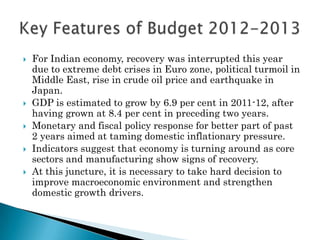

   For Indian economy, recovery was interrupted this year
    due to extreme debt crises in Euro zone, political turmoil in
    Middle East, rise in crude oil price and earthquake in
    Japan.
   GDP is estimated to grow by 6.9 per cent in 2011-12, after
    having grown at 8.4 per cent in preceding two years.
   Monetary and fiscal policy response for better part of past
    2 years aimed at taming domestic inflationary pressure.
   Indicators suggest that economy is turning around as core
    sectors and manufacturing show signs of recovery.
   At this juncture, it is necessary to take hard decision to
    improve macroeconomic environment and strengthen
    domestic growth drivers.
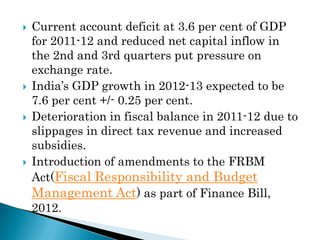
   Current account deficit at 3.6 per cent of GDP
    for 2011-12 and reduced net capital inflow in
    the 2nd and 3rd quarters put pressure on
    exchange rate.
   India’s GDP growth in 2012-13 expected to be
    7.6 per cent +/- 0.25 per cent.
   Deterioration in fiscal balance in 2011-12 due to
    slippages in direct tax revenue and increased
    subsidies.
   Introduction of amendments to the FRBM
    Act(Fiscal Responsibility and Budget
    Management Act) as part of Finance Bill,
    2012.
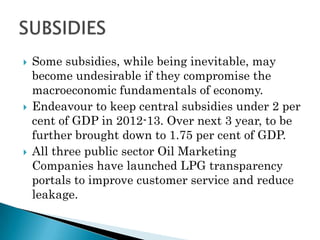
   Some subsidies, while being inevitable, may
    become undesirable if they compromise the
    macroeconomic fundamentals of economy.
   Endeavour to keep central subsidies under 2 per
    cent of GDP in 2012-13. Over next 3 year, to be
    further brought down to 1.75 per cent of GDP.
   All three public sector Oil Marketing
    Companies have launched LPG transparency
    portals to improve customer service and reduce
    leakage.
   Government has further evolved its approach to
    divestment of Central Public Sector Enterprises
    by allowing them a level playing field vis-à-vis
    the private sector in respect of practices like
    buy backs and listing at stock exchanges.
   For 2012-13, `30,000 crore to be raised through
    disinvestment. At least 51 per cent ownership
    and management control to remain with
    Government.
   Foreign Direct Investment: Efforts to arrive at a
    broadbased consensus in consultation with the
    State Governments in respect of decision to allow
    FDI in multi-brand retail upto 51 per cent.
   Advance Pricing Agreement: Provision regarding
    implementation of Advance Pricing Agreement to be
    introduced in Finance Bill, 2012.
   Financial Sector: Rajiv Gandhi Equity Saving
    Scheme to allow for income tax deduction of 50 per
    cent to new retail investors, who invest upto `50,000
    directly in equities and whose annual income is
    below `10 lakh to be introduced. The scheme will
    have a lock-in period of 3 years.
   Capitalisation of Banks and Financial Holding
    Company: To protect the financial health of Public
    Sector Banks and Financial Institutions,`15,888
    crore proposed to be provided for capitalisation.
    Possibility of creating a financial holding company
    to raise resources to meet the capital requirements
    of PSU Banks under examination.
   Financial Inclusion: Out of 73,000 identified
    habitations that were to be covered under
    “Swabhimaan” campaign by March, 2012, about
    70,000 habitations have been covered. Rest likely to
    be covered by March 31, 2012.
   Regional Rural Banks: Out of 82 RRBs in India, 81
    have successfully migrated to Core Banking
    Solutions and have also joined the National
    Electronic Fund Transfer system.
   During Twelfth Plan period, investment in
    infrastructure to go up to `50 lakh crore with
    half of this, expected from private sector.
   First Infrastructure Debt Fund with an initial
    size of `8,000 crore launched earlier this month.
   Tax free bonds of `60,000 crore to be allowed for
    financing infrastructure projects in 2012-13.
   National Manufacturing Policy announced with
    the objective of raising, within a decade, the
    share of manufacturing in GDP to 25 per cent
    and creating of 10 crore jobs.
   Coal India Limited advised to sign fuel supply
    agreements with power plants, having long-
    term PPAs with DISCOMs and getting
    commissioned on or before March 31, 2015.
   Target of covering a length of 8,800 kilometre
    under NHDP(National Highways Development Project) next
    year.
   Allocation of the Road Transport and Highways
    Ministry enhanced by 14 per cent to `25,360
    crore.
   Proposal to allow foreign airlines to participate
    upto 49 per cent in the equity of an air
    transport undertaking under active
    consideration of the government.
   Delhi Mumbai Industrial Corridor: In September 2011
    central assistance of `18,500 crore spread over 5 years
    approved. US $ 4.5 billion as Japanese participation in
    the project.
   Housing Sector: Various proposals to address the
    shortage of housing for low income groups in major cities
    and towns including allowing ECB for low cost housing
    projects and setting up of a credit guarantee trust fund
    etc.
   Fertilisers: Government has taken steps to finalise
    pricing and investment policies for urea to reduce India’s
    import dependence in urea.
   Textiles: Government has announced a financial
    package of `3,884 crore for waiver of loans of handloom
    weavers and their cooperative societies.
   Micro, Small and Medium Enterprises: `5,000 crore
    India Opportunities Venture Fund to be set up with
    SIDBI(Small Industries Development Bank of India).
   Plan Outlay for Department of Agriculture and Co-
    operation increased by 18 percent.
   Initiative of Bringing Green Revolution to Eastern
    India (BGREI) has resulted in increased production
    and productivity of paddy. Allocation for the scheme
    increased to `1,000 crore in 2012-13 from `400 crore
    in 2011-12.
   `2,242 crore project launched with World Bank
    assistance to improve productivity in the dairy
    sector. `500 crore provided to broaden scope of
    production of fish to coastal aquaculture.
   Target for agricultural credit raised by `1,00,000
    crore to `5,75,000 crore in 2012-13.
   Short term RRB credit refinance fund being set
    up to enhance the capacity of RRBs to disburse
    short term crop loans to small and marginal
    farmers.
   A sum of `200 crore set aside for incentivising
    research with rewards.
   National Mission on Food Processing:
   A new centrally sponsored scheme titled “National
    Mission on Food Processing” to be started in 2012-13
    in co-operation with State Governments.
   Steps taken to create additional food grain storage
    capacity in the country.
   For 2012-13, `25,555 crore provided for
    RTE-SSA(Right To Education)(SARVA SHIKSHA
    ABHIYAN) representing an increase of 21.7
    per cent over 2011-12.
   To ensure better flow of credit to students, a
    Credit Guarantee Fund proposed to be set up.
   Allocation for NRHM (National Rural Health
    Mission) proposed to be increased from
    `18,115 crore in 2011-12 to `20,822 crore
    in 2012-13.
   National Urban Health Mission is being
    launched.
   UID-Aadhaar: Enrolment of 20 crore persons
    completed under UID mission. Adequate
    funds to be allocated to complete enrolment
    of another 40 crore persons.
   Black Money: Proposal to lay a White Paper on
    Black Money in current session of Parliament.
   Gross Tax Receipts estimated at `10,77,612 crore.
   Net Tax to Centre estimated at `7,71,071 crore.
   Non-tax Revenue Receipts estimated at `1,64,614
    crore.
   Non-debt Capital Receipts estimated at `41,650
    crore.
   Total expenditure for 2012-13 budgeted at
    `14,90,925 crore.
   Plan expenditure for 2012-13 at `5,21,025 crore is
    18 per cent higher than BE
   2011-12.
   Non-plan expenditure estimated at `9,69,900 crore.
   Fiscal deficit at 5.9 per cent of GDP in RE
    2011-12.
   Fiscal deficit at 5.1 per cent of GDP in BE
    2012-13.
   Net market borrowing required to finance the
    deficit to be `4.79 lakh crore in 2012-13.
   Effective Revenue Deficit to be 1.8 per cent of
    GDP in 2012-13.
   Exemption limit for the general category of
    individual taxpayers proposed to be enhanced
    from `1,80,000 to `2,00,000 giving tax relief of
    `2,000.
   Senior citizens not having income from business
    proposed to be exempted from payment of
    advance tax.
   Proposal to introduce General Anti Avoidance
    Rule to counter aggressive tax avoidance
    scheme.
   A net revenue loss of `4,500 crore estimated as a
    result of Direct Tax proposals.
   Given the imperative for fiscal correction, standard
    rate of excise duty to be raised from 10 per cent to
    12 per cent, merit rate from 5 per cent to 6 per cent
    and the lower merit rate from 1 per cent to 2 per cent
    with few exemptions.
   Excise duty on large cars also proposed to be
    enhanced.
   Basic customs duty reduced for certain agricultural
    equipment and their parts.
   Full exemption from basic duty provided to certain
    fuels for power generation and coal mining projects.
   Relief proposed to be extended to sectors such as
    steel, textiles, branded readymade garments, low-
    cost medical devices.
   Proposals to increase excise duty on ‘demerit’
    goods such as certain cigarettes, hand-rolled
    bidis, pan masala, gutkha, chewing tobacco,
    unmanufactured tobacco and zarda scented
    tobacco.
   Excise duty rationalised for packaged cement,
    whether manufactured by minicement plants
    or others.
   Levy of excise duty of 1 per cent on branded
    precious metal jewellery.
   Branded Silver jewellery exempted from
    excise duty.
   Indirect taxes estimated to result in net
    revenue gain of `45,940 crore.
   Net gain of `41,440 crore in the Budget due
    to various taxation proposals.
Budget2012 2013

Budget2012 2013

  • 2.
    For Indian economy, recovery was interrupted this year due to extreme debt crises in Euro zone, political turmoil in Middle East, rise in crude oil price and earthquake in Japan.  GDP is estimated to grow by 6.9 per cent in 2011-12, after having grown at 8.4 per cent in preceding two years.  Monetary and fiscal policy response for better part of past 2 years aimed at taming domestic inflationary pressure.  Indicators suggest that economy is turning around as core sectors and manufacturing show signs of recovery.  At this juncture, it is necessary to take hard decision to improve macroeconomic environment and strengthen domestic growth drivers.
  • 3.
    Current account deficit at 3.6 per cent of GDP for 2011-12 and reduced net capital inflow in the 2nd and 3rd quarters put pressure on exchange rate.  India’s GDP growth in 2012-13 expected to be 7.6 per cent +/- 0.25 per cent.  Deterioration in fiscal balance in 2011-12 due to slippages in direct tax revenue and increased subsidies.  Introduction of amendments to the FRBM Act(Fiscal Responsibility and Budget Management Act) as part of Finance Bill, 2012.
  • 4.
    Some subsidies, while being inevitable, may become undesirable if they compromise the macroeconomic fundamentals of economy.  Endeavour to keep central subsidies under 2 per cent of GDP in 2012-13. Over next 3 year, to be further brought down to 1.75 per cent of GDP.  All three public sector Oil Marketing Companies have launched LPG transparency portals to improve customer service and reduce leakage.
  • 5.
    Government has further evolved its approach to divestment of Central Public Sector Enterprises by allowing them a level playing field vis-à-vis the private sector in respect of practices like buy backs and listing at stock exchanges.  For 2012-13, `30,000 crore to be raised through disinvestment. At least 51 per cent ownership and management control to remain with Government.
  • 6.
    Foreign Direct Investment: Efforts to arrive at a broadbased consensus in consultation with the State Governments in respect of decision to allow FDI in multi-brand retail upto 51 per cent.  Advance Pricing Agreement: Provision regarding implementation of Advance Pricing Agreement to be introduced in Finance Bill, 2012.  Financial Sector: Rajiv Gandhi Equity Saving Scheme to allow for income tax deduction of 50 per cent to new retail investors, who invest upto `50,000 directly in equities and whose annual income is below `10 lakh to be introduced. The scheme will have a lock-in period of 3 years.
  • 7.
    Capitalisation of Banks and Financial Holding Company: To protect the financial health of Public Sector Banks and Financial Institutions,`15,888 crore proposed to be provided for capitalisation. Possibility of creating a financial holding company to raise resources to meet the capital requirements of PSU Banks under examination.  Financial Inclusion: Out of 73,000 identified habitations that were to be covered under “Swabhimaan” campaign by March, 2012, about 70,000 habitations have been covered. Rest likely to be covered by March 31, 2012.  Regional Rural Banks: Out of 82 RRBs in India, 81 have successfully migrated to Core Banking Solutions and have also joined the National Electronic Fund Transfer system.
  • 8.
    During Twelfth Plan period, investment in infrastructure to go up to `50 lakh crore with half of this, expected from private sector.  First Infrastructure Debt Fund with an initial size of `8,000 crore launched earlier this month.  Tax free bonds of `60,000 crore to be allowed for financing infrastructure projects in 2012-13.
  • 9.
    National Manufacturing Policy announced with the objective of raising, within a decade, the share of manufacturing in GDP to 25 per cent and creating of 10 crore jobs.
  • 10.
    Coal India Limited advised to sign fuel supply agreements with power plants, having long- term PPAs with DISCOMs and getting commissioned on or before March 31, 2015.
  • 11.
    Target of covering a length of 8,800 kilometre under NHDP(National Highways Development Project) next year.  Allocation of the Road Transport and Highways Ministry enhanced by 14 per cent to `25,360 crore.  Proposal to allow foreign airlines to participate upto 49 per cent in the equity of an air transport undertaking under active consideration of the government.
  • 12.
    Delhi Mumbai Industrial Corridor: In September 2011 central assistance of `18,500 crore spread over 5 years approved. US $ 4.5 billion as Japanese participation in the project.  Housing Sector: Various proposals to address the shortage of housing for low income groups in major cities and towns including allowing ECB for low cost housing projects and setting up of a credit guarantee trust fund etc.  Fertilisers: Government has taken steps to finalise pricing and investment policies for urea to reduce India’s import dependence in urea.  Textiles: Government has announced a financial package of `3,884 crore for waiver of loans of handloom weavers and their cooperative societies.  Micro, Small and Medium Enterprises: `5,000 crore India Opportunities Venture Fund to be set up with SIDBI(Small Industries Development Bank of India).
  • 13.
    Plan Outlay for Department of Agriculture and Co- operation increased by 18 percent.  Initiative of Bringing Green Revolution to Eastern India (BGREI) has resulted in increased production and productivity of paddy. Allocation for the scheme increased to `1,000 crore in 2012-13 from `400 crore in 2011-12.  `2,242 crore project launched with World Bank assistance to improve productivity in the dairy sector. `500 crore provided to broaden scope of production of fish to coastal aquaculture.  Target for agricultural credit raised by `1,00,000 crore to `5,75,000 crore in 2012-13.
  • 14.
    Short term RRB credit refinance fund being set up to enhance the capacity of RRBs to disburse short term crop loans to small and marginal farmers.  A sum of `200 crore set aside for incentivising research with rewards.  National Mission on Food Processing:  A new centrally sponsored scheme titled “National Mission on Food Processing” to be started in 2012-13 in co-operation with State Governments.  Steps taken to create additional food grain storage capacity in the country.
  • 15.
    For 2012-13, `25,555 crore provided for RTE-SSA(Right To Education)(SARVA SHIKSHA ABHIYAN) representing an increase of 21.7 per cent over 2011-12.  To ensure better flow of credit to students, a Credit Guarantee Fund proposed to be set up.
  • 16.
    Allocation for NRHM (National Rural Health Mission) proposed to be increased from `18,115 crore in 2011-12 to `20,822 crore in 2012-13.  National Urban Health Mission is being launched.
  • 17.
    UID-Aadhaar: Enrolment of 20 crore persons completed under UID mission. Adequate funds to be allocated to complete enrolment of another 40 crore persons.  Black Money: Proposal to lay a White Paper on Black Money in current session of Parliament.
  • 18.
    Gross Tax Receipts estimated at `10,77,612 crore.  Net Tax to Centre estimated at `7,71,071 crore.  Non-tax Revenue Receipts estimated at `1,64,614 crore.  Non-debt Capital Receipts estimated at `41,650 crore.  Total expenditure for 2012-13 budgeted at `14,90,925 crore.  Plan expenditure for 2012-13 at `5,21,025 crore is 18 per cent higher than BE  2011-12.  Non-plan expenditure estimated at `9,69,900 crore.
  • 19.
    Fiscal deficit at 5.9 per cent of GDP in RE 2011-12.  Fiscal deficit at 5.1 per cent of GDP in BE 2012-13.  Net market borrowing required to finance the deficit to be `4.79 lakh crore in 2012-13.  Effective Revenue Deficit to be 1.8 per cent of GDP in 2012-13.
  • 20.
    Exemption limit for the general category of individual taxpayers proposed to be enhanced from `1,80,000 to `2,00,000 giving tax relief of `2,000.  Senior citizens not having income from business proposed to be exempted from payment of advance tax.  Proposal to introduce General Anti Avoidance Rule to counter aggressive tax avoidance scheme.  A net revenue loss of `4,500 crore estimated as a result of Direct Tax proposals.
  • 21.
    Given the imperative for fiscal correction, standard rate of excise duty to be raised from 10 per cent to 12 per cent, merit rate from 5 per cent to 6 per cent and the lower merit rate from 1 per cent to 2 per cent with few exemptions.  Excise duty on large cars also proposed to be enhanced.  Basic customs duty reduced for certain agricultural equipment and their parts.  Full exemption from basic duty provided to certain fuels for power generation and coal mining projects.  Relief proposed to be extended to sectors such as steel, textiles, branded readymade garments, low- cost medical devices.
  • 22.
    Proposals to increase excise duty on ‘demerit’ goods such as certain cigarettes, hand-rolled bidis, pan masala, gutkha, chewing tobacco, unmanufactured tobacco and zarda scented tobacco.
  • 23.
    Excise duty rationalised for packaged cement, whether manufactured by minicement plants or others.  Levy of excise duty of 1 per cent on branded precious metal jewellery.  Branded Silver jewellery exempted from excise duty.  Indirect taxes estimated to result in net revenue gain of `45,940 crore.  Net gain of `41,440 crore in the Budget due to various taxation proposals.