

issueno.10
apr2014
In collaboration withSponsored by
360° – the Business Transformation Journal  No. 10 | April 2014
2
360° – the Business Transformation Journal  No. 10 | April 2014
DRIVERS
3
At first glance, humans are by nature poorly equipped for survival. We can neither fly
nor swim. We cannot run particularly fast. We are not particularly strong, and we are
not particularly big. We are very sensitive to temperature. We have no claws, no fangs,
and no venomous stings. We are not very resistant to poison. We have a relatively poor
sense of sight, no particularly keen ears, an unreliable sense of taste, no significant
tactile capabilities, and a sense of smell that is nothing more than acceptable. Our re-
productive process is complex and elaborate, our production rate is low, and our natu-
ral failure rate is high.
We come without a warranty. We are susceptible to illnesses and accidents of all kinds,
and are difficult to repair. Our lives are short if we do not take the medical and safety
precautions we have developed over the time.
But we have kept evolving and became resistant and adaptable. We survived amongst
the ruthless competition of our natural environment because we invented technolog-
ical devices to overcome the adversities that surround us. We began to compensate
for the weaknesses of our species through innovations such as technical aids and tools,
and began to outperform the competition.
Outperforming the competition through technology is also the motto of this journal
issue. We report on how the retail banking business will become revolutionized (page 6),
how new forms of organization simultaneously create innovation and flexibility
(page 16), how companies managed to turn themselves around with the help of tech-
nology (page 54), how a hidden champion reinvented its business model through tech-
nology (page 64), and we showcase how technology helps the automotive industry to
reposition itself (page 42).
Yours sincerely,
WELCOME
3
EDITORIAL
Prof. Dr. Axel Uhl
Head of the Business
Transformation Academy
Lars A. Gollenia
Global Head of SAP
Business Transformation Services
360° – the Business Transformation Journal  No. 10 | April 2014
4
		METHODOLOGY | RESEARCH
	 24	A Typology of Business
Transformations
Identify your type of business transforma-
tion – find out three key learnings from 20
global case studies on business transfor-
mations.
Niz Safrudin, Michael Rosemann,
Jan Recker, Michael Genrich
	 42	Gaining Traction
The automotive industry is being trans-
formed by big data. CIOs are under pres-
sure to quickly devise a big data strategy.
What are the current trends, common
challenges, and factors for success?
Michael Voigt, Christopher Bennison,
Maik Hammerschmidt
OVERVIEW
4
		DRIVERS
	 6	New Banking Trends
Things are being digitalized, even
our lifestyle. Do you know what retail
banks need in order to adapt to this
change?
Matthias Kröner, Stephan
Czajkowski, Axel Uhl
	 16	Inspiring Places
No time for networking? Consider
renting a desk in a co-working space,
where networking and innovation
happen naturally.
Axel Gloger
360° – the Business Transformation Journal  No. 10 | April 2014
		 CASE STUDY
	 54	Transformation towards
the Future
A global player faced one of the
greatest challenges in its history. But
with the support of a field expert, the
company was able to step into a new
epoch.
Axel Uhl, Jan vom Brocke
	 64	Shaping the Future of
Gammacorp
When IT falls behind a company’s
growth… Read how a manufacturing
company transformed towards being
an integrated solution provider.
Alexander Schmid, Kerstin Chaves,
Axel Uhl
		 COMMUNITY
	 3	Editorial
	 72	Portraits
of the BTA members
Benno Zoller, Haldun Akpinar,
and Torsten Beckhaus
	 73	Book Review
“Predictive Analytics: The Power to
Predict Who Will Click, Buy, Lie, or Die”
reviewed by Sean Kask
	 74	News
News from BTA Hubs and partners
	 78	Guest Commentary
by Rob Llewellyn
	 80	Events
Review of a past BTA training
	 81	Publication Details
OVERVIEW
5
Abstract
While the Internet has already completely changed many industries or is about to do so, retail bank-
ing is still a long way away from this development. Real innovations can be perceived only where it
is not worthwhile for banks to enforce their traditional "bricks and mortar" strategies. The possibilities
of today clearly show where bank branches do not make sense and where people are more mobile
than a bank. Experts are aware that social commerce is so far nothing more than an empty phrase.
If bank executives did not use the web 2.0 only as a channel but recognized it as the foundation of a
new way of banking, they could give new impetus to the development rather than simply adapt to an
ongoing process with questionable success.
360° – the Business Transformation Journal  No. 10 | April 2014
DRIVERS
7
Most people in industrialized societies
have adopted a “digital lifestyle”, which
means people use technology in such
a way that they become a part of it and
it becomes a part of them; people can
become a part of the product or service
by connecting with other people to reap
or sow the benefits. Technology can be
used not only to improve existing prod-
ucts, but also to provide a platform on
which new products and services can
be continuously developed. Web 2.0, to-
gether with the mobile Internet, has com-
pletely redefined the basis for innovation.
But what is still largely unknown: Hard-
ly any other industry has better op-
portunities to benefit from this tech-
nology than banking. At the same
time, hardly any other industry is so
far away from actually doing anything
about it.
The Paradigm Shift in Banking
Banks first came into being to man-
age financial affairs between individu-
als, retailers, and industries. They had
to ensure a continuous flow of money
between the parties as well as the avail-
ability of that money when needed. Man-
aging credits and debits was the bread
and butter of their existence. Around this
core business developed services such
as account management, bank transfers,
NEW BANKING
TRENDS
A Step towards Connected Banking
Beyond any question, mobile Internet usage and social networks continue to be on
an upwards trajectory. The authors reveal what retail banks have to consider in or-
der to tap the full potential of this development.
by Matthias Kröner, Stephan Czajkowski, and Axel Uhl
credit and debit cards, etc., as well as
well-defined corporate and retail banking
sectors. The only way in which customers
could interact with the bank was through
its branches. This situation remained un-
challenged until call centers found their
way into the world of banking. Call cen-
ters offered a cheap alternative to visiting
a branch. They enabled customers to in-
vest in financial securities over the phone
and without any sort of consultation, at
half the usual price. Expensive branches
lost even more of their importance. How-
ever, a problem faced by many banks
was the difficulty in servicing customers
over the phone due to poor technology.
The software solutions necessary for op-
timal customer service were simply not
available because they had been devel-
oped for banking in branches. One piece
of software managed accounts, another
completed securities transactions, and a
third managed financial transactions. Yet
another system was required to display
the current rates of exchange.
Managing credits and debits
was the bread and butter of
banksʼ existence.
360° – the Business Transformation Journal  No. 10 | April 2014
8
Today, the key factor for success in re-
tail banking is speed, especially when it
comes to trading securities at real-time
exchange rates without having to vis-
it a bank’s branch. One of the main rea-
sons that many customers preferred to
do business over the phone was the dis-
counter approach to trading securities.
As private investors became more and
more experienced, the speed at which
securities orders could be processed be-
came increasingly important. In contrast
to branches, where orders were submit-
ted during the course of the day whenev-
er financial consultants managed to find
the time, transactions could now be pro-
cessed immediately.
IT departments now faced a new com-
petitive challenge to provide faster pro-
cesses for employees in the call center.
Employees often had to manage sever-
al systems on multiple screens, and ini-
tially even had to post cash receipts in
two systems. The degree of complexity
was enormous and caused a number of
problems. It was a common mistake that
employees sold securities instead of buy-
ing them, and vice versa, with sometimes
devastating consequences for the bank’s
internal failure costs account.
From a technological perspective, banks
can learn a lot from other industries. Mer-
cedes would never dream of putting the
new Mercedes SL on the road with the
technology of a 1970s Mercedes. That
would most certainly be a sobering expe-
rience. Even if the leading managers are
slowly coming to realize that they have
to react to the digital lifestyle, and even
if the conferences on "Next Generation
Banking" are well attended, technologi-
cal paralysis is still deeply rooted in the
well-cooled server rooms of the banks.
Focus on the Account – not on the
Customer
At banks, everything revolves around the
products. Organizational and operational
structures are aligned with the products,
and even partner organizations such as
credit card companies, savings and loan
associations, and insurance companies
are organized based on products.
From a customer perspective, product-
oriented structures have significant dis-
advantages. It is not uncommon for a
customer to receive a letter asking to re-
turn the credit card because he or she no
longer meets the criteria for such a card.
The next day, the same customer is of-
fered a consumer loan, and a few days
later receives a call for a meeting with his
or her financial consultant about making
a capital investment.
This is caused by organizational struc-
tures that focus on the product but not
on the customer. Individual organization-
al units often work independently of each
other, do not share customer data, and,
as a result, do not have a coordinated
counseling approach.
The Internet has further distanced banks
from their customers. As with offline
banking, banks have been trapped in
their silo thinking with regard to leverag-
ing the Internet, seeing its potential as
a kind of virtual branch only. Custom-
ers, who have been alienated from the
banks for years as a result of the preva-
lence of ATMs, find themselves at loose
ends because their data is prepared and
displayed in e-banking in a more or less
user-friendly way. In terms of mobile In-
ternet, banks restrict their usage to pre-
New Banking Trends
Mercedes would never dream of
putting the new Mercedes SL on
the road with the technology of a
1970s Mercedes.
In terms of mobile Internet, banks
restrict their usage to presenting
content such as a customer’s
balance via an iOS or Android app.
360° – the Business Transformation Journal  No. 10 | April 2014
DRIVERS
9
senting content such as a customer’s bal-
ance via an iOS or Android app.
Banking apps often simply transfer data
from an existing application to a mobile
device. With a little bit of creativity, new
and user-oriented solutions could be de-
veloped. For example, after having dis-
played the account balance on the mo-
bile device, the customer probably wants
to withdraw cash. Through an integrated
GPS navigation of the mobile device, the
customer could not only find the nearest
branch of the bank, but also the nearest
ATM in the cash group, which may be just
around the corner.
What Banks Need
When developing their strategies, banks
must consider how people want to use
the mobile Internet and not how the banks
would like them to use it. The most impor-
tant things to consider upfront are, what
kind of experience a customer has when
using the service, what the customer
prefers to have, and where the custom-
er sees possible shortcomings in the cur-
rent process. The starting point here is
not the technology but customer centric-
ity that places the focus on the custom-
er experience. What is more, it should be
made clear what the future of the mobile
device technology is: the touch screen.
Even children today are intuitively capa-
ble of using a tablet due to the ease of
use of the touch screen, but they look
puzzled when facing a PC. When de-
signing user interfaces (UI) for a mobile
service, the decisive question is not how
much information can be packed into the
UI but how many benefits the user can
draw from it.
An illustrative example of banks’ ever
more outdated thinking is their offer to
make cashless payments at a cash point
using a mobile device. While banks are
heatedly discussing the use of near field
communication (NFC), Apple has al-
ready delivered an impressively custom-
er-focused solution.
In Apple Retail Stores, iPhones and
iTunes are used not only for payment, but
they also replace the cash point at the
same time. Customers select the goods
that they want, scan them, and pay for
them using their iPhones or iPods. A
point of sale is no longer necessary, and
e-commerce processes are triggered by
an offline action, namely by scanning the
barcode of goods. Benefits for retailers:
No need for points of sale nor point-of-
sale personnel. Benefits for customers:
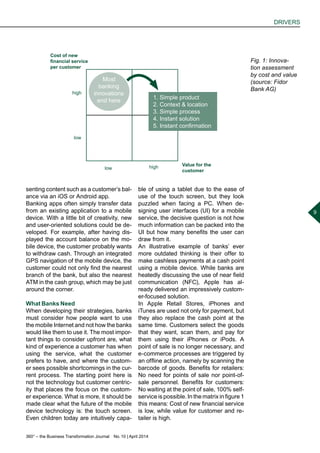
No waiting at the point of sale, 100% self-
service is possible. In the matrix in figure 1
this means: Cost of new financial service
is low, while value for customer and re-
tailer is high.
high
low
low high
1. Simple product
2. Context & location
3. Simple process
4. Instant solution
5. Instant confirmation
Most
banking
innovations
end here
Value for the
customer
Cost of new
financial service
per customer
Fig. 1: Innova-
tion assessment
by cost and value
(source: Fidor
Bank AG)
360° – the Business Transformation Journal  No. 10 | April 2014
10
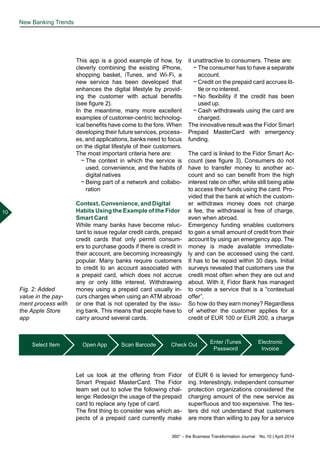
This app is a good example of how, by
cleverly combining the existing iPhone,
shopping basket, iTunes, and Wi-Fi, a
new service has been developed that
enhances the digital lifestyle by provid-
ing the customer with actual benefits
(see figure 2).
In the meantime, many more excellent
examples of customer-centric technolog-
ical benefits have come to the fore. When
developing their future services, process-
es, and applications, banks need to focus
on the digital lifestyle of their customers.
The most important criteria here are:
−− The context in which the service is
used, convenience, and the habits of
digital natives
−− Being part of a network and collabo-
ration
Context, Convenience, and Digital
Habits Using the Example of the Fidor
Smart Card
While many banks have become reluc-
tant to issue regular credit cards, prepaid
credit cards that only permit consum-
ers to purchase goods if there is credit in
their account, are becoming increasingly
popular. Many banks require customers
to credit to an account associated with
a prepaid card, which does not accrue
any or only little interest. Withdrawing
money using a prepaid card usually in-
curs charges when using an ATM abroad
or one that is not operated by the issu-
ing bank. This means that people have to
carry around several cards.
Let us look at the offering from Fidor
Smart Prepaid MasterCard. The Fidor
team set out to solve the following chal-
lenge: Redesign the usage of the prepaid
card to replace any type of card.
The first thing to consider was which as-
pects of a prepaid card currently make
it unattractive to consumers. These are:
−− The consumer has to have a separate
account.
−− Credit on the prepaid card accrues lit-
tle or no interest.
−− No flexibility if the credit has been
used up.
−− Cash withdrawals using the card are
charged.
The innovative result was the Fidor Smart
Prepaid MasterCard with emergency
funding.
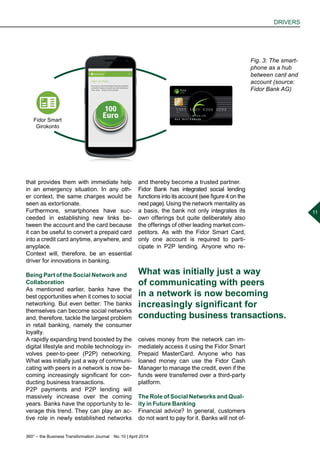
The card is linked to the Fidor Smart Ac-
count (see figure 3). Consumers do not
have to transfer money to another ac-
count and so can benefit from the high
interest rate on offer, while still being able
to access their funds using the card. Pro-
vided that the bank at which the custom-
er withdraws money does not charge
a fee, the withdrawal is free of charge,
even when abroad.
Emergency funding enables customers
to gain a small amount of credit from their
account by using an emergency app. The
money is made available immediate-
ly and can be accessed using the card.
It has to be repaid within 30 days. Initial
surveys revealed that customers use the
credit most often when they are out and
about. With it, Fidor Bank has managed
to create a service that is a “contextual
offer”.
So how do they earn money? Regardless
of whether the customer applies for a
credit of EUR 100 or EUR 200, a charge
of EUR 6 is levied for emergency fund-
ing. Interestingly, independent consumer
protection organizations considered the
charging amount of the new service as
superfluous and too expensive. The tes-
ters did not understand that customers
are more than willing to pay for a service
New Banking Trends
Select Item Open App Scan Barcode Check Out Enter iTunes
Password
Electronic
Invoice
Fig. 2: Added
value in the pay-
ment process with
the Apple Store
app
360° – the Business Transformation Journal  No. 10 | April 2014
DRIVERS
11
that provides them with immediate help
in an emergency situation. In any oth-
er context, the same charges would be
seen as extortionate.
Furthermore, smartphones have suc-
ceeded in establishing new links be-
tween the account and the card because
it can be useful to convert a prepaid card
into a credit card anytime, anywhere, and
anyplace.
Context will, therefore, be an essential
driver for innovations in banking.
Being Part of the Social Network and
Collaboration
As mentioned earlier, banks have the
best opportunities when it comes to social
networking. But even better: The banks
themselves can become social networks
and, therefore, tackle the largest problem
in retail banking, namely the consumer
loyalty.
A rapidly expanding trend boosted by the
digital lifestyle and mobile technology in-
volves peer-to-peer (P2P) networking.
What was initially just a way of communi-
cating with peers in a network is now be-
coming increasingly significant for con-
ducting business transactions.
P2P payments and P2P lending will
massively increase over the coming
years. Banks have the opportunity to le-
verage this trend. They can play an ac-
tive role in newly established networks
and thereby become a trusted partner.
Fidor Bank has integrated social lending
functions into its account (see figure 4 on the
next page). Using the network mentality as
a basis, the bank not only integrates its
own offerings but quite deliberately also
the offerings of other leading market com-
petitors. As with the Fidor Smart Card,
only one account is required to parti-
cipate in P2P lending. Anyone who re-
ceives money from the network can im-
mediately access it using the Fidor Smart
Prepaid MasterCard. Anyone who has
loaned money can use the Fidor Cash
Manager to manage the credit, even if the
funds were transferred over a third-party
platform.
The Role of Social Networks and Qual-
ity in Future Banking
Financial advice? In general, customers
do not want to pay for it. Banks will not of-
Fig. 3: The smart-
phone as a hub
between card and
account (source:
Fidor Bank AG)
What was initially just a way
of communicating with peers
in a network is now becoming
increasingly significant for
conducting business transactions.
Fidor Smart
Girokonto
360° – the Business Transformation Journal  No. 10 | April 2014
12
fer it. The community closes the gap be-
tween asking questions and purchasing
a product more effectively than banks do
(see figure 5).
Advising at a bank means selling prod-
ucts. Today, customers get their informa-
tion from the Internet: customers advise
other customers. Customers know more
about the bank’s products than the bank
itself. And furthermore: Customer experi-
ence is more credible than any opinion of
a bank's financial advisor.
What quality will have to be granted by a
future bank when aiming at fitting a digi-
tal lifestyle?
−− Openness when dealing with cus-
tomers: Customers are fantastic
co-producers and are willing to get
involved. This requires a communica-
tion platform with independent mod-
erators, good listeners, and fast re-
sponses.
−− Design thinking: Marketing and
product development departments
must use feedback channels to have
their ideas evaluated and must have
the courage to go back to the drawing
board. This must be a continuous cy-
cle until the majority of those involved
(including those providing feedback
from external sources) are convinced
that something “new and beneficial”
has been created. The actual launch
date is not important but rather what
will be presented then.
−− Knowledge workers: Employees of
the future are also networked, out-
wardly and inwardly. Any silo struc-
ture here is counterproductive and
leads to failure.
−− Openness when dealing with offer-
ings from other financial service
providers: The bank of the future will
be a platform. Integrating third-party
providers will be the largest challenge.
Networked consumers are informed
consumers and get the best products.
The question is: From whom?
−− Customer development: The task
faced by modern branches may be
to develop customers through online
channels. Branches will be the icing
on the cake and no longer the founda-
tion of modern banking.
What Will a Future Retail Banking IT
Platform Look Like?
In the digital world of retail customers, a
retail bank’s IT platform must meet the
most sophisticated technical require-
ments.
New Banking Trends
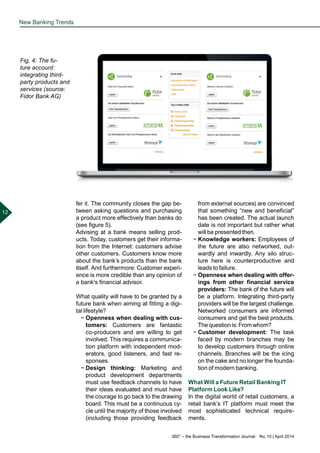
Fig. 4: The fu-
ture account:
integrating third-
party products and
services (source:
Fidor Bank AG)
360° – the Business Transformation Journal  No. 10 | April 2014
DRIVERS
13
The retail banking platform of the fu-
ture will be an open, flexible IT solu-
tion that allows best-practice web ser-
vices and mobile apps to be quickly and
easily integrated into the platform using
open standards and without affecting
the bank’s core processes in any way.
This will enable retail banks to quickly
and flexibly meet new customer require-
ments, as well as continuously include
and benefit from mobile technology de-
velopments. The platform will also allow
eco-partners to offer their products and
services and will enable them to han-
dle the transaction processes required
in their own systems.
Transparency and speed are two key
qualification criteria of future retail banks
– the IT platform will have to be respon-
sive to these requirements. It will enable
vast amounts of data to be analyzed in
next to no time and then presented in a
user-friendly format. This is made pos-
sible by new database technologies, but
also by new analysis tools. These tech-
nologies help analyze both structured
and unstructured data, which would en-
able, for example, a stock broker or as-
set manager to immediately check out
all social media channels whether any-
thing negative is being reported about
the planned investment before settling
a transaction.
Modern IT solutions must be scalable
and perform reliably. Why should retail
banks of the future invest considerable
effort in managing IT systems instead
of concentrating on their customers and
services? The hardware, platforms, and
applications are now available in cloud
solutions, and with their high levels of
standardization, they can be easily in-
tegrated with mobile and Internet-based
services. Banks will also benefit from
cost savings as they will not have to make
any upfront investments in complex IT
infrastructure. In the future, retail banks
will pay only for those services they re-
quest from the cloud computing provid-
ers and will not have to deal with the com-
plexities of bandwidths, storage space,
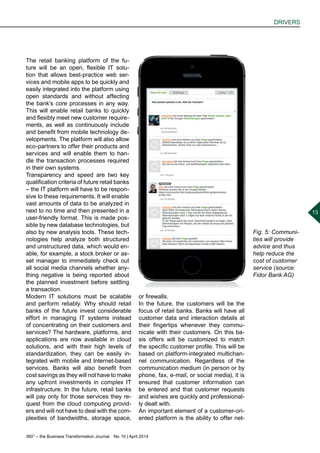
Fig. 5: Communi-
ties will provide
advice and thus
help reduce the
cost of customer
service (source:
Fidor Bank AG)
or firewalls.
In the future, the customers will be the
focus of retail banks. Banks will have all
customer data and interaction details at
their fingertips whenever they commu-
nicate with their customers. On this ba-
sis offers will be customized to match
the specific customer profile. This will be
based on platform-integrated multichan-
nel communication. Regardless of the
communication medium (in person or by
phone, fax, e-mail, or social media), it is
ensured that customer information can
be entered and that customer requests
and wishes are quickly and professional-
ly dealt with.
An important element of a customer-ori-
ented platform is the ability to offer net-
360° – the Business Transformation Journal  No. 10 | April 2014
14
New Banking Trends
working possibilities among individual
customers. The “wisdom of the crowd”
or, in simple terms, the expertise of oth-
er customers, is invaluable to many cus-
tomers. The information is credible and
transparent, with no hidden agenda, and
scrutinized by the entire community to
establish the accuracy of its content. Re-
tail banks of the future will not have to
(and may no longer even wish to) provide
advice for financial products. This will
protect them from the risk of giving inac-
curate advice, and, in any case, they will
hardly be able to compete with the online
community in the real world. The com-
munity is available around the clock and
can answer questions more quickly than
any bank would be able to do.
Part of a customer-based IT banking
platform also involves co-innovating new
services and products together with cus-
tomers. Experience shows that plat-
form providers will soon realize that the
best ideas for new products, apps, or pro-
cesses do not come from consultants or
in-house experts but from the custom-
ers themselves. Customers are an inex-
haustible, and what is more, a complete-
ly free source of innovation – as long as
they are actually listened to and taken se-
riously.
Conclusion
To sum up, we can say that retail banks
currently face the greatest structural
change in their history, and that the ones
to survive this challenge will be those that
adapt better to new requirements, or that
benefit from the new framework thanks
to innovations.
The authors are also sure that the true
competitors of traditional retail banks will
not come from the banking sector at all,
but from completely different sectors –
namely those in the high-tech industry.
Already today, companies such as Ap-
ple, Google, and PayPal offer their own
payment services, thereby enabling hun-
dreds of millions of customers to bene-
fit. Why? Because they have the digital
expertise to address their customers’ re-
quirements in the best possible way: Pro-
cesses and services that offer basic ad-
ditional benefits that relate to the context
in question. So what does this mean for
retail banks? They will either become vic-
tims of these future competitors or they
will need to find a partner that has similar
expertise – perhaps a bank partner like
FIDOR BANK or an independent vendor
with comprehensive consulting and proj-
ect know-how.
The “wisdom of the crowd” or, in
simple terms, the expertise of other
customers, is invaluable to many
customers.
Key Learnings
►► Future banking will benefit from connected knowledge workers and connected
customers.
►► A flexible architecture, where App follows API, and smart integration of third-
party offers in the banks product and service pool are the backbones of the
future retail banking IT platform.
►► The banking industry must take the planning and deployment of a conse-
quent mobile strategy with focus on potential advantages for customers into
consideration.
►► Banks can take advantage of a design of contextual offers fitting modern life
patterns.
360° – the Business Transformation Journal  No. 10 | April 2014
DRIVERS
15
Service
AUTHORS
Matthias Kröner is the CEO and spokesman of FIDOR BANK AG, which he co-founded.
At the age of 32, he became the youngest board member of the German virtual bank, DAB
Bank AG. He helped establish the first online brokerage in continental Europe, and is one of
the most highly profiled and skilled managers in the area of social banking with great exper-
tise in Internet.
kroener[at]fidor.de
Stephan Czajkowski is a coach and freelance consultant for transformation projects in
the banking industry. He helped establish DAB Bank AG and led the retail banking sector
of DAB Bank AG as Managing Director. In his consulting work, he follows the principles of a
solution-focusedmethodologyandiscertifiedasaBTM2 transformationmanager.Heisthe
author of the Next Generation Banking study.
czajkowski[at]dein-werk.net
Prof. Dr. Axel Uhl is head of the Center of Excellence for Business Innovation within
Business Transformation Services at SAP. He is also the president of the Business Trans-
formation Academy (BTA), a global think tank organized as a Swiss non-profit organiza-
tion. Sine 2009 Uhl has been a professor at the University of Applied Sciences and Arts
Northwestern Switzerland (FHNW).
a.uhl[at]sap.com
INTERNET LINKS
►► Some banks are already demonstrating the mobile banking of the future. Scan the QR code or click
the URL below, take a look at the video, and ask yourself how far your current bank offerings are
away from the future trends shown in the video.
http://www.youtube.com/watch?v=mifamWf4Zf0
Abstract
They were invented already in 2006, yet five years ago nobody knew they existed. Now they can be
found in many of the world’s larger cities: co-working spaces, desks that come with the complete
infrastructure of an entire office which are rented out by service providers at an hourly or daily rate,
or longer. The demand is being fueled by knowledge workers, company employees who want to
avoid the commute and be part of an innovation hub, freelancers who are tired of working at the
kitchen table, and project nomads who have sipped enough Starbucks coffee. The article describes
how the concept works, looks at some examples of providers and users, and demonstrates how
co-working can inspire innovation, creativity, and interconnection.
360° – the Business Transformation Journal  No. 10 | April 2014
DRIVERS
17
Marco Peise’s office used to be a fire-
house. A large room under the roof, it is
shared by 15 individuals now. At each
desk sits the owner of a different small
business. They all run their own compa-
nies, but they share the Wi-Fi, the print-
er, the photocopier, and the office kitch-
en. Marco decided to rent a workspace
so he would not have to work from home.
“A home office was never really an option
for me. I just cannot concentrate at home.
There are too many distractions.”
Since 2013 Marco Peise has been work-
ing at a desk provided by Fireworks, a Ber-
lin-based company that offers co-working
spaces. Each workspace in the open-
plan office in Berlin’s Wedding district is
leased individually and is fully equipped
with everything that today’s flexible office
workers need to get on with their job. “The
job” for Marco is Sunride, a web portal he
co-founded, and through which he runs
a virtual renewable energy consultancy.
Having a leased desk saves him the long
commute between Wedding and Pots-
dam, where the company is located, and
where the other Sunride workers spend
their day. “Thanks to co-working, I am
spared a one-hour commute twice a day,”
the entrepreneur enthuses.
A Quarter of a Million Tenants
Marco Peise is part of a growing move-
ment. According to Trendscanner, an
INSPIRING PLACES
How Co-working Spaces Change
the Way We Work
In today’s knowledge economy, co-working spaces are the new
hubs. They are driving innovation, creativity, and collaboration.
by Axel Gloger
information service provider, every day
250,000 people worldwide make their way
to a leased desk in a co-working space,
often in their own neighborhood. “I work
where I live,” is the new mantra of today’s
knowledge economy workers. They take
full advantage of the freedom this form of
work offers them (Plöger 2010, 91).
But co-working spaces do not only offer
greater flexibility and time saving. The
movement is leading to the evolution of a
whole new world of work. In many urban
environments where this service is avail-
able, it is almost as easy to find a fully
equipped and professional working space
as it is to order a pizza via telephone.
A co-working space is a base for flexi-
ble knowledge workers (see box 1 on the
next page), a vibrant environment to which
they can return to network and form rela-
tionships, make use of synergies, and re-
flect on ideas with other creative people.
They are all individuals, all working for dif-
ferent employers on different projects. But
In many urban environments it is
almost as easy to find a fully
equipped and professional working
space as it is to order a pizza via
telephone.
360° – the Business Transformation Journal  No. 10 | April 2014
18
together, Marco Peise and his co-work-
ers form a crowd that is capable of cre-
ating new forms of innovation and intelli-
gence (Tapscott and Williams 2006, 21).
Let us have a look at further examples
to see how the system works in prac-
tice: Markus Matthaei works for Huber-
media, an IT service and geo data com-
pany based in the village called “Lam” in
the Bavarian Forest, Germany. The vil-
lage has 3,000 inhabitants, and it is sit-
uated far away from the next major city.
Hubermedia employee Matthaei lives in
the Bavarian capital Munich, a two-hour
drive away from Lam. Matthaei is happy
to have a co-working desk at Combinat
56 in the Munich Schwabing area. Com-
binat 56, the office landlord, provides ev-
erything an office worker needs for his
working day: power sockets, Wi-Fi, a
photocopier, and as much coffee as you
could wish for. “I work at my co-working
space two or three days a week. The rest
of the time I spend with customers,” is
how Matthaei describes a typical work-
ing week. With its 350 square meters, a
“desk farm” of 30 working spaces, con-
ference rooms, a soundproof telephone
booth, and an office kitchen, Combinat
56 offers smart premises, and is indeed
the perfect business environment.
New Offline Networking for Knowl-
edge Workers
For Matthaei’s employer Hubermedia,
who pays for the Combinat 56 desk, co-
working is more than simply having ac-
cess to an external desk somewhere.
It means that Hubermedia can have an
employee located close to the compa-
ny’s customers in Munich. Matthaei can
also take advantage of all the resources
a state capital like Munich offers, as well
as build potentially useful relationships
with other tenants of the co-working
space. There is a great sense of commu-
nity, of networking, of helping each other
out, and of sharing new ideas. Combinat
56 also promises: “Really getting down
to work.” The company sees the leased
desk as a form of “third place” – what
Starbucks is for Latte aficionados: a ha-
ven located somewhere between work
and home.
But who triggered this innovative idea?
The co-working movement originated in
California, USA, in 2006. It was in San
Francisco where self-employed market-
er and social media strategist Tara Hunt
decided that she had enough of working
at the dining room table. She started to
look for an attractive alternative. “I want-
ed to imitate what it means to work in
Box 1: Profile of Co-working Spaces
►► Function: Co-working spaces are shared premises that are used as the main
place of work by various independently operating individuals or firms. Inter-
connections often develop between the tenants because of shared values
and a variety of skills that complement each other. Co-working space manag-
ers encourage such networking activities among their tenants.
►► Users: The tenants work independently on various projects. Most of them are
freelancers, start-ups, home office fugitives, or company employees working
in flexible surroundings.
►► Infrastructure: Internet (Wi-Fi), desk, coffee machine, conference rooms,
telephone booths for undisturbed mobile phone usage, photocopiers, and
printing facilities form the basic equipment of most co-working spaces.
►► Market and Price: The first co-working space opened in San Francisco in
2006. Today, there are over 2,500 locations, 1,160 thereof in Europe. Mem-
bership is similar to gym membership, and prices vary depending on location
and length of usage. A ticket for one day starts at 10 Euros, a full month costs
between 179 and 400 Euros. Add-ons such as conference rooms or team of-
fices can cost more.
Box 1: Profile
of co-working
spaces (source:
Deskwanted.com
2013 and author's
research)
Inspiring Places
360° – the Business Transformation Journal  No. 10 | April 2014
DRIVERS
19
a cool company,” she says when asked
what had motivated her to invent and es-
tablish the first co-working space togeth-
er with two colleagues. “We wanted to
enter into meaningful relationships with
other knowledge workers, and we want-
ed not to be lonely at work.”
Not only founders of start-ups feel this
way; knowledge workers who are em-
ployed by big companies but who work
from home know what it means to feel
lonely. On some days, the only contact
you have with the outside world is “you
got mail”.
“We wanted real contacts, for ourselves
and for others,” Tara Hunt explains. Her
start-up with the name “Citizen Space –
A Nicer Place to Work” quickly became
popular, and soon there were two more
Citizen Spaces, one in San José and
one in Las Vegas.
Like a Business-Style Family
Every co-working space that has been
created since is designed to provide its us-
ers not only with a desk but also with col-
leagues – an approach that goes straight
to the heart of the concept of being a
knowledge worker (Drucker 1985, 15 –16).
How does the knowledge exchange
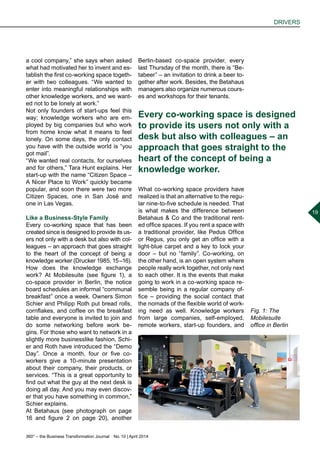
work? At Mobilesuite (see figure 1), a
co-space provider in Berlin, the notice
board schedules an informal “communal
breakfast” once a week. Owners Simon
Schier and Philipp Roth put bread rolls,
cornflakes, and coffee on the breakfast
table and everyone is invited to join and
do some networking before work be-
gins. For those who want to network in a
slightly more businesslike fashion, Schi-
er and Roth have introduced the “Demo
Day”. Once a month, four or five co-
workers give a 10-minute presentation
about their company, their products, or
services. “This is a great opportunity to
find out what the guy at the next desk is
doing all day. And you may even discov-
er that you have something in common,”
Schier explains.
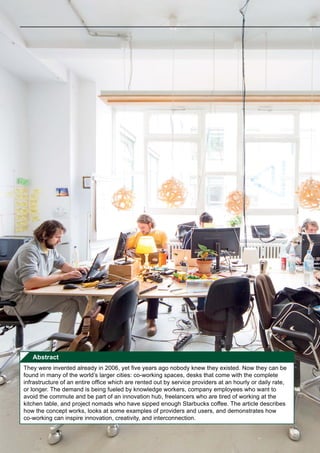
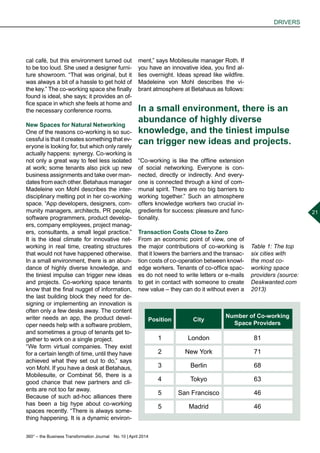
At Betahaus (see photograph on page
16 and figure 2 on page 20), another
Berlin-based co-space provider, every
last Thursday of the month, there is “Be-
tabeer” – an invitation to drink a beer to-
gether after work. Besides, the Betahaus
managers also organize numerous cours-
es and workshops for their tenants.
What co-working space providers have
realized is that an alternative to the regu-
lar nine-to-five schedule is needed. That
is what makes the difference between
Betahaus & Co and the traditional rent-
ed office spaces. If you rent a space with
a traditional provider, like Pedus Office
or Regus, you only get an office with a
light-blue carpet and a key to lock your
door – but no “family”. Co-working, on
the other hand, is an open system where
people really work together, not only next
to each other. It is the events that make
going to work in a co-working space re-
semble being in a regular company of-
fice – providing the social contact that
the nomads of the flexible world of work-
ing need as well. Knowledge workers
from large companies, self-employed,
remote workers, start-up founders, and
Every co-working space is designed
to provide its users not only with a
desk but also with colleagues – an
approach that goes straight to the
heart of the concept of being a
knowledge worker.
Fig. 1: The
Mobilesuite
office in Berlin
360° – the Business Transformation Journal  No. 10 | April 2014
20
small business owners – they all feel at
home here. And they can get a night-ac-
cess key, if they want.
The Number of Co-working Providers
Continues to Grow
One reason why co-working has become
so popular lately is the rise of the itinerant
worker. The office has become portable.
Laptops now replace folders and files,
and snail mail has been pushed to the
sidelines. “The office no longer consists
of bricks and mortar,” says Madeleine
von Mohl, co-founder and CEO of Be-
tahaus. “Today’s knowledge workers can
decide for themselves where they want
to work.” This is a format that really suits
the “Generation Y lifestyle” (Gloger 2012,
77ff.). Co-working spaces have been
mushrooming worldwide in recent years
thanks to a semi-nomadic working style
and an increasing number of freelanc-
ers. They have become a universally ac-
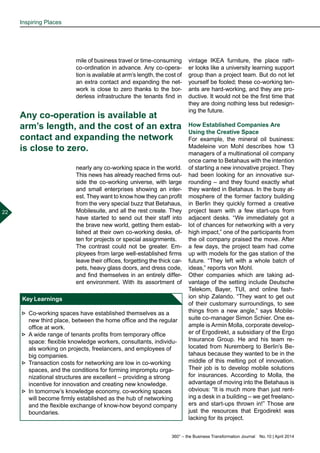
cepted new form of service (see table 1).
The movement may still have a long way
to go until it reaches the same number
of branches as Starbucks or McDonald’s
have, but considering the relatively short
time period it has been around, its growth
is comparable. The market is growing at
an enormous pace. In just one year, the
number of co-working locations has dou-
bled (Deskwanted.com 2013). Special-
ists believe that this rapid development
will continue.
Bettina Sturm is among those who profit-
ed from the boom. The owner of the ca-
reer re-orientation agency called “Dein
Copilot” moved into her co-working space
in September 2012 – after an irregular of-
fice career. First, there was the home of-
fice. What she liked most about it was that
it was so convenient. She lived where she
worked, and she invited the clients into her
living room. “There was no commute, and
I invested the time I saved in my consul-
tancy work.” But she soon realized that a
home office also has its drawbacks. “It is
difficult to draw the line between work and
private life,” she says. “I also did not real-
ly like my candidates being able to see
which book I was reading at the moment.”
She gave up the comfort of her living
room and started meeting her clients in
a variety of surroundings – with a variety
of results. She interviewed them in the lo-
Fig. 2: The
Betahaus Café,
the heart of the
Betahaus co-
working space
in Berlin
Inspiring Places
360° – the Business Transformation Journal  No. 10 | April 2014
DRIVERS
21
cal café, but this environment turned out
to be too loud. She used a designer furni-
ture showroom. “That was original, but it
was always a bit of a hassle to get hold of
the key.” The co-working space she finally
found is ideal, she says; it provides an of-
fice space in which she feels at home and
the necessary conference rooms.
New Spaces for Natural Networking
One of the reasons co-working is so suc-
cessful is that it creates something that ev-
eryone is looking for, but which only rarely
actually happens: synergy. Co-working is
not only a great way to feel less isolated
at work; some tenants also pick up new
business assignments and take over man-
dates from each other. Betahaus manager
Madeleine von Mohl describes the inter-
disciplinary melting pot in her co-working
space. “App developers, designers, com-
munity managers, architects, PR people,
software programmers, product develop-
ers, company employees, project manag-
ers, consultants, a small legal practice.”
It is the ideal climate for innovative net-
working in real time, creating structures
that would not have happened otherwise.
In a small environment, there is an abun-
dance of highly diverse knowledge, and
the tiniest impulse can trigger new ideas
and projects. Co-working space tenants
know that the final nugget of information,
the last building block they need for de-
signing or implementing an innovation is
often only a few desks away. The content
writer needs an app, the product devel-
oper needs help with a software problem,
and sometimes a group of tenants get to-
gether to work on a single project.
“We form virtual companies. They exist
for a certain length of time, until they have
achieved what they set out to do,” says
von Mohl. If you have a desk at Betahaus,
Mobilesuite, or Combinat 56, there is a
good chance that new partners and cli-
ents are not too far away.
Because of such ad-hoc alliances there
has been a big hype about co-working
spaces recently. “There is always some-
thing happening. It is a dynamic environ-
ment,” says Mobilesuite manager Roth. If
you have an innovative idea, you find al-
lies overnight. Ideas spread like wildfire.
Madeleine von Mohl describes the vi-
brant atmosphere at Betahaus as follows:
“Co-working is like the offline extension
of social networking. Everyone is con-
nected, directly or indirectly. And every-
one is connected through a kind of com-
munal spirit. There are no big barriers to
working together.” Such an atmosphere
offers knowledge workers two crucial in-
gredients for success: pleasure and func-
tionality.
Transaction Costs Close to Zero
From an economic point of view, one of
the major contributions of co-working is
that it lowers the barriers and the transac-
tion costs of co-operation between knowl-
edge workers. Tenants of co-office spac-
es do not need to write letters or e-mails
to get in contact with someone to create
new value – they can do it without even a
Table 1: The top
six cities with
the most co-
working space
providers (source:
Deskwanted.com
2013)
Position City
Number of Co-working
Space Providers
1 London 81
2 New York 71
3 Berlin 68
4 Tokyo 63
5 San Francisco 46
5 Madrid 46
In a small environment, there is an
abundance of highly diverse
knowledge, and the tiniest impulse
can trigger new ideas and projects.
360° – the Business Transformation Journal  No. 10 | April 2014
22
mile of business travel or time-consuming
co-ordination in advance. Any co-opera-
tion is available at arm’s length, the cost of
an extra contact and expanding the net-
work is close to zero thanks to the bor-
derless infrastructure the tenants find in
nearly any co-working space in the world.
This news has already reached firms out-
side the co-working universe, with large
and small enterprises showing an inter-
est. They want to know how they can profit
from the very special buzz that Betahaus,
Mobilesuite, and all the rest create. They
have started to send out their staff into
the brave new world, getting them estab-
lished at their own co-working desks, of-
ten for projects or special assignments.
The contrast could not be greater. Em-
ployees from large well-established firms
leave their offices, forgetting the thick car-
pets, heavy glass doors, and dress code,
and find themselves in an entirely differ-
ent environment. With its assortment of
vintage IKEA furniture, the place rath-
er looks like a university learning support
group than a project team. But do not let
yourself be fooled; these co-working ten-
ants are hard-working, and they are pro-
ductive. It would not be the first time that
they are doing nothing less but redesign-
ing the future.
How Established Companies Are
Using the Creative Space
For example, the mineral oil business:
Madeleine von Mohl describes how 13
managers of a multinational oil company
once came to Betahaus with the intention
of starting a new innovative project. They
had been looking for an innovative sur-
rounding – and they found exactly what
they wanted in Betahaus. In the busy at-
mosphere of the former factory building
in Berlin they quickly formed a creative
project team with a few start-ups from
adjacent desks. “We immediately got a
lot of chances for networking with a very
high impact,” one of the participants from
the oil company praised the move. After
a few days, the project team had come
up with models for the gas station of the
future. “They left with a whole batch of
ideas,” reports von Mohl.
Other companies which are taking ad-
vantage of the setting include Deutsche
Telekom, Bayer, TUI, and online fash-
ion ship Zalando. “They want to get out
of their customary surroundings, to see
things from a new angle,” says Mobile-
suite co-manager Simon Schier. One ex-
ample is Armin Molla, corporate develop-
er of Ergodirekt, a subsidiary of the Ergo
Insurance Group. He and his team re-
located from Nuremberg to Berlin’s Be-
tahaus because they wanted to be in the
middle of this melting pot of innovation.
Their job is to develop mobile solutions
for insurances. According to Molla, the
advantage of moving into the Betahaus is
obvious: “It is much more than just rent-
ing a desk in a building – we get freelanc-
ers and start-ups thrown in!” Those are
just the resources that Ergodirekt was
lacking for its project.
Key Learnings
►► Co-working spaces have established themselves as a
new third place, between the home office and the regular
office at work.
►► A wide range of tenants profits from temporary office
space: flexible knowledge workers, consultants, individu-
als working on projects, freelancers, and employees of
big companies.
►► Transaction costs for networking are low in co-working
spaces, and the conditions for forming impromptu orga-
nizational structures are excellent – providing a strong
incentive for innovation and creating new knowledge.
►► In tomorrow’s knowledge economy, co-working spaces
will become firmly established as the hub of networking
and the flexible exchange of know-how beyond company
boundaries.
Any co-operation is available at
arm’s length, and the cost of an extra
contact and expanding the network
is close to zero.
Inspiring Places
360° – the Business Transformation Journal  No. 10 | April 2014
DRIVERS
23
Service
AUTHOR
Axel Gloger is Chairman of the think tank Trendintelligence, a company that deliv-
ers future strategies for businesses. He serves as a board member of various lead-
ing service companies. His major contribution in this role is his expertise in strategy
and his ability to bring up the questions nobody else asks. He is the author of many
hands-on books, and he is the founder of the blog www.ueber-morgen.net. Axel
Gloger studied economics at the universities of Bonn, Freiburg im Breisgau, and Co-
logne. Later on, he upgraded his set of strategic skills at Insead (Fontainebleau) and
ESMT (Berlin). He lives with his family in the Rhine area.
axel[at]gloger.biz
REFERENCES
►► Deskwanted.com (Eds.) (2013). Global Coworking Census 2013. 2498 coworking spaces in 80
countries. Berlin.
►► Drucker, P. F. (1985). Managing in turbulent Times. New York: Harper & Row.
►► Gloger, A. (2012). Über_Morgen. Was Ihr Unternehmen in Zukunft erfolgreich macht. Wien: Linde.
►► Plöger, P. (2010). Arbeitssammler, Jobnomaden und Berufsautisten. Viel gelernt und nichts ge-
wonnen. Das Paradox der neuen Arbeitswelt. München: Carl Hanser Verlag.
►► Tapscott, D., Williams, A. (2006). Wikinomics. How Mass Collaboration changes everything. Lon-
don: Portfolio.
INTERNET LINKS
►► Betahaus 	 (Berlin, Germany) 	 www.betahaus.com/berlin
►► Burooz 	 (Brussels, Belgium)	 www.burooz.be
►► Citizen Space	 (San Francisco, USA)	 www.citizenspace.us
►► Club Workspace 	 (London, UK)	 http://club.workspacegroup.co.uk
►► Combinat 56 	 (Munich, Germany)	 www.combinat56.de
►► Hutfabrik	 (Vienna, Austria)	 www.hutfabrik.com
►► Mobilesuite 	 (Berlin, Germany)	 www.mobilesuite.de
►► Mutinerie 	 (Paris, France)	 www.mutinerie.org
►► The Hub 	 (Zurich, Switzerland)	 www.hubzurich.org
But despite all the excitement, there are
also setbacks in the co-working indus-
try, as the market leader in Berlin discov-
ered in 2013. Betahaus could not rep-
licate its success in other locations. Its
Cologne co-working space closed down
in mid-April 2013, and the Hamburg office
went bankrupt at the beginning of sum-
mer. The reason: not enough tenants. It
seems like not every city has the same
potential for this innovative concept. Also
other co-working-space related projects
had to shut down, like the industry portals
deskwanted.com and Hallenprojekt.de.
Co-working may have the wind in its sails,
but it is the rules of the market economy
that count. Competition is tough, and not
every location is automatically going to
be a success. In particular for mediocre
providers whose ideas, location, pricing,
and service do not add up, there is only
one path – the market will soon weed
them out.
When a snake
sheds its skin,
it changes; when a
caterpillar becomes
a butterfly, it transforms.
360° – the Business Transformation Journal  No. 10 | April 2014
25
METHODOLOGY | RESEARCH
Abstract
Business transformation is, without any doubt, one of
those concepts attracting substantial attention in the
boardrooms of corporations. However, and not uncom-
mon for an emerging approach, there is currently a
plethora of viewpoints on the core characteristics of a
business transformation. Unlike well-established ap-
proaches such as change, lean, or quality management,
business transformation is still under-specified in terms of
methodologies and techniques. This status compromises
the reaching of shared understanding and progress in
an area of ever increasing importance. Motivated by this
lack of consensus, this article proposes a new typology of
business transformations based on the assessment of 20
global case studies.
Trying to explain what a business trans-
formation entails can be challenging.
Many perceive transformation as just an-
other buzzword for managing organiza-
tional change. But in reality change and
transformation are fundamentally dif-
ferent. The following analogy describes
the difference between these two terms:
When a snake sheds its skin, it changes;
when a caterpillar becomes a butterfly, it
transforms.
Transformation Defined
Essentially, a business transforma-
tion can be defined as the orchestrat-
ed re-design of the genetic architec-
ture of the entire enterprise (Morgan
and Page 2008). Due to their enter-
prise-wide scope, transformations are
complex undertakings. Factors that am-
plify their complexity include the compa-
ny size, the mass involvement of inter-
nal and external stakeholders, and the
time required to complete the initiative,
among others (Dehning et al. 2003). As
a consequence, many business transfor-
A TYPOLOGY
OF BUSINESS
TRANSFORMATIONS
Blurry definitions can make communication inefficient and ineffective. The term
“business transformation” is such a case. It is commonly misunderstood – if not
misused – to describe the fundamental changes that occur in an enterprise. As a
result, many inexperienced personnel who are accountable for such risky endeav-
ors underestimate the effort and complexity involved. Our investigation brings clar-
ity by identifying four types of business transformations and thus lays the founda-
tion for successful communication and management of such initiatives.
By Niz Safrudin, Michael Rosemann, Jan Recker, and Michael Genrich
mations are highly susceptible to failure
(up to 70% of cases fail) for reasons of-
ten unrelated to technical aspects, such
as technological feasibility and reliabili-
ty (Markus and Benjamin 1997). Yet, in
spite of the high risk, when executed
successfully, a business transformation
can yield numerous benefits.
360° – the Business Transformation Journal  No. 10 | April 2014
26
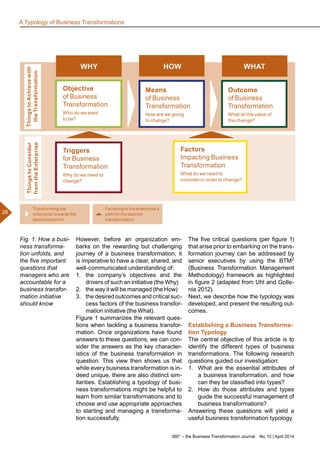
However, before an organization em-
barks on the rewarding but challenging
journey of a business transformation, it
is imperative to have a clear, shared, and
well-communicated understanding of:
1.	 the company’s objectives and the
drivers of such an initiative (the Why)
2.	 the way it will be managed (the How)
3.	 the desired outcomes and critical suc-
cess factors of the business transfor-
mation initiative (the What).
Figure 1 summarizes the relevant ques-
tions when tackling a business transfor-
mation. Once organizations have found
answers to these questions, we can con-
sider the answers as the key character-
istics of the business transformation in
question. This view then shows us that
while every business transformation is in-
deed unique, there are also distinct sim-
ilarities. Establishing a typology of busi-
ness transformations might be helpful to
learn from similar transformations and to
choose and use appropriate approaches
to starting and managing a transforma-
tion successfully.
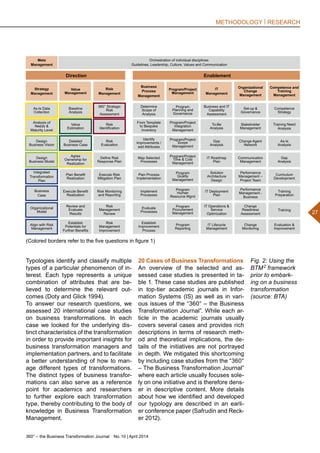
The five critical questions (per figure 1)
that arise prior to embarking on the trans-
formation journey can be addressed by
senior executives by using the BTM2
(Business Transformation Management
Methodology) framework as highlighted
in figure 2 (adapted from Uhl and Golle-
nia 2012).
Next, we describe how the typology was
developed, and present the resulting out-
comes.
Establishing a Business Transforma-
tion Typology
The central objective of this article is to
identify the different types of business
transformations. The following research
questions guided our investigation:
1.	 What are the essential attributes of
a business transformation, and how
can they be classified into types?
2.	 How do those attributes and types
guide the successful management of
business transformations?
Answering these questions will yield a
useful business transformation typology.
Fig. 1: How a busi-
ness transforma-
tion unfolds, and
the five important
questions that
managers who are
accountable for a
business transfor-
mation initiative
should know
Transforming the
enterprise towards the
desired position
WHY
ThingstoAchievewith
theTransformation
HOW WHAT
Objective
of Business
Transformation
Who do we want
to be?
ThingstoConsider
fromtheEnterprise
Means
of Business
Transformation
How are we going
to change?
Outcome
of Business
Transformation
What ist the value of
the change?
Triggers
for Business
Transformation
Why do we need to
change?
Factors
Impacting Business
Transformation
What do we need to
consider in order to change?
Factoring in the enterprise's
path for the desired
transformation
A Typology of Business Transformations
360° – the Business Transformation Journal  No. 10 | April 2014
27
METHODOLOGY | RESEARCH
Typologies identify and classify multiple
types of a particular phenomenon of in-
terest. Each type represents a unique
combination of attributes that are be-
lieved to determine the relevant out-
comes (Doty and Glick 1994).
To answer our research questions, we
assessed 20 international case studies
on business transformations. In each
case we looked for the underlying dis-
tinct characteristics of the transformation
in order to provide important insights for
business transformation managers and
implementation partners, and to facilitate
a better understanding of how to man-
age different types of transformations.
The distinct types of business transfor-
mations can also serve as a reference
point for academics and researchers
to further explore each transformation
type, thereby contributing to the body of
knowledge in Business Transformation
Management.
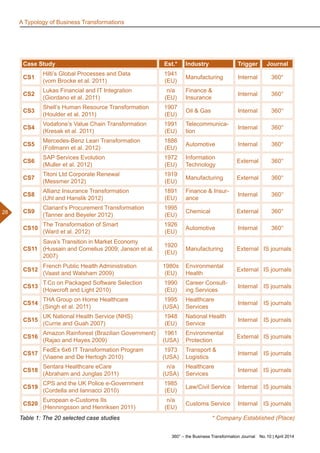
20 Cases of Business Transformations
An overview of the selected and as-
sessed case studies is presented in ta-
ble 1. These case studies are published
in top-tier academic journals in Infor-
mation Systems (IS) as well as in vari-
ous issues of the “360° – the Business
Transformation Journal”. While each ar-
ticle in the academic journals usually
covers several cases and provides rich
descriptions in terms of research meth-
od and theoretical implications, the de-
tails of the initiatives are not portrayed
in depth. We mitigated this shortcoming
by including case studies from the “360°
– The Business Transformation Journal”
where each article usually focuses sole-
ly on one initiative and is therefore dens-
er in descriptive content. More details
about how we identified and developed
our typology are described in an earli-
er conference paper (Safrudin and Reck-
er 2012).
Fig. 2: Using the
BTM2 framework
prior to embark-
ing on a business
transformation
(source: BTA)
Enablement
Orchestration of individual disciplines:
Guidelines, Leadership, Culture, Values and Communication
Direction
Determine
Scope of
Analysis
Program
Planning and
Governance
Business and IT
Capability
Assessment
Set-up 
Governance
Competence
Strategy
From Template
to Bespoke
Inventory
Program/Project
Integration
Management
To-Be
Analysis
Stakeholder
Management
Training Need
Analysis
Identify
Improvements /
add Attributes
Program/Project
Scope
Management
Gap
Analysis
Change Agent
Network
As-Is
Analysis
Map Selected
Processes
Program/Project
Time  Cost
Management
IT Roadmap
Plan
Communication
Management
Gap
Analysis
Plan Process
Implementation
Program
Quality
Management
Solution
Architecture
Design
Performance
Management –
Project Team
Curriculum
Development
Implement
Processes
Program
Human
Resource Mgmt
IT Deployment
Plan
Performance
Management -
Business
Training
Preparation
Evaluate
Processes
Program
Procurement
Management
IT Operations 
Service
Optimization
Change
Readiness
Assessment
Training
Establish
Improvement
Process
Program
Reporting
IT Lifecycle
Management
Change
Monitoring
Evaluation 
Improvement
Strategy
Management
Competence and
Training
Management
Program/Project
Management
Business
Process
Management
Organizational
Change
Management
IT
Management
Value
Management
Risk
Management
Meta
Management
Design
Business Vision
Design
Business Model
360° Strategic
Risk
Assessment
Risk
Identification
Integrated
Transformation
Plan
Business
Case
Value
Estimation
Detailed
Business Case
As-Is Data
Collection
Baseline
Analysis
Analysis of
Needs 
Maturity Level
Agree
Ownership for
Realization
Risk
Evaluation
Define Risk
Response Plan
Plan Benefit
Realization
Execute Risk
Mitigation Plan
Execute Benefit
Realization
Risk Monitoring
and Reporting
Organizational
Model
Review and
Evaluate
Results
Risk
Management
Review
Align with Risk
Management
Establish
Potentials for
Further Benefits
Risk
Management
Improvement
Trigger: Why do we need to change?
Objective: Who do we want to be?
LEGEND: Means: How are we going to change?
Factors: What do we need to consider?
Outcome: What is the value?
(Colored borders refer to the five questions in figure 1)
360° – the Business Transformation Journal  No. 10 | April 2014
28
Case Study Est.* Industry Trigger Journal
CS1
Hilti’s Global Processes and Data
(vom Brocke et al. 2011)
1941
(EU)
Manufacturing Internal 360°
CS2
Lukas Financial and IT Integration
(Giordano et al. 2011)
n/a
(EU)
Finance 
Insurance
Internal 360°
CS3
Shell’s Human Resource Transformation
(Houlder et al. 2011)
1907
(EU)
Oil  Gas Internal 360°
CS4
Vodafone’s Value Chain Transformation
(Kresak et al. 2011)
1991
(EU)
Telecommunica-
tion
Internal 360°
CS5
Mercedes-Benz Lean Transformation
(Follmann et al. 2012)
1886
(EU)
Automotive Internal 360°
CS6
SAP Services Evolution
(Muller et al. 2012)
1972
(EU)
Information
Technology
External 360°
CS7
Titoni Ltd Corporate Renewal
(Messmer 2012)
1919
(EU)
Manufacturing External 360°
CS8
Allianz Insurance Transformation
(Uhl and Hanslik 2012)
1891
(EU)
Finance  Insur-
ance
Internal 360°
CS9
Clariant’s Procurement Transformation
(Tanner and Beyeler 2012)
1995
(EU)
Chemical External 360°
CS10
The Transformation of Smart
(Ward et al. 2012)
1926
(EU)
Automotive Internal 360°
CS11
Sava’s Transition in Market Economy
(Hussain and Cornelius 2009; Janson et al.
2007)
1920
(EU)
Manufacturing External IS journals
CS12
French Public Health Administration
(Vaast and Walsham 2009)
1980s
(EU)
Environmental
Health
External IS journals
CS13
T.Co on Packaged Software Selection
(Howcroft and Light 2010)
1990
(EU)
Career Consult-
ing Services
Internal IS journals
CS14
THA Group on Home Healthcare
(Singh et al. 2011)
1995
(USA)
Healthcare
Services
Internal IS journals
CS15
UK National Health Service (NHS)
(Currie and Guah 2007)
1948
(EU)
National Health
Service
Internal IS journals
CS16
Amazon Rainforest (Brazilian Government)
(Rajao and Hayes 2009)
1961
(USA)
Environmental
Protection
External IS journals
CS17
FedEx 6x6 IT Transformation Program
(Viaene and De Hertogh 2010)
1973
(USA)
Transport 
Logistics
Internal IS journals
CS18
Sentara Healthcare eCare
(Abraham and Junglas 2011)
n/a
(USA)
Healthcare
Services
Internal IS journals
CS19
CPS and the UK Police e-Government
(Cordella and Iannacci 2010)
1985
(EU)
Law/Civil Service Internal IS journals
CS20
European e-Customs IIs
(Henningsson and Henriksen 2011)
n/a
(EU)
Customs Service Internal IS journals
A Typology of Business Transformations
Table 1: The 20 selected case studies * Company Established (Place)
360° – the Business Transformation Journal  No. 10 | April 2014
29
METHODOLOGY | RESEARCH
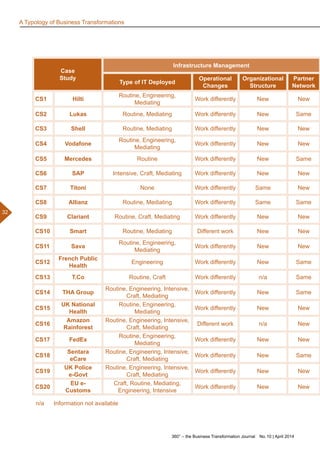
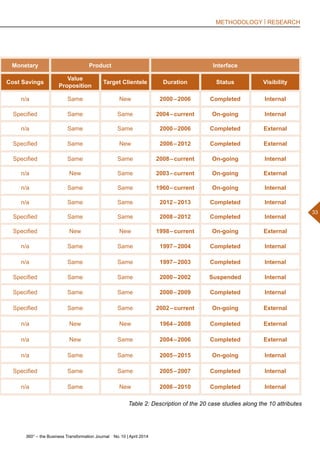
The majority of the 20 transformations
took place over a decade. They cover
various industry sectors, illustrating the
ubiquitous and inevitable need to trans-
form in order to survive and compete in a
dynamic market environment. The trans-
formations were triggered by value de-
ficiencies that were experienced and/or
anticipated by the enterprise. The trig-
gers can be classified as internal or ex-
ternal triggers (see “Trigger” column in
table 1). Internal triggers are factors with-
in the control of the enterprise’s operating
environment, e.g. aging legacy systems
and the need to establish standardized
business processes or to enhance cus-
tomer centricity. External triggers refer to
the factors beyond the enterprise's con-
trol, typically from the external environ-
ment; for example, changes in consumer
demand, technological disruptions, and/
or new competitors and business mod-
els entering the market.
Identifying the transformation triggers
is important in order to deduce whether
the motivation for the business transfor-
mation was driven by internal or external
factors, whether the transformation is ur-
gent or not, and whether the outcome of
the transformation will mean staying in
business or lead to entire new business
ventures and market opportunities.
The next section presents further attri-
butes of transformation initiatives, which
we found to be relevant factors based on
our case study analyses.
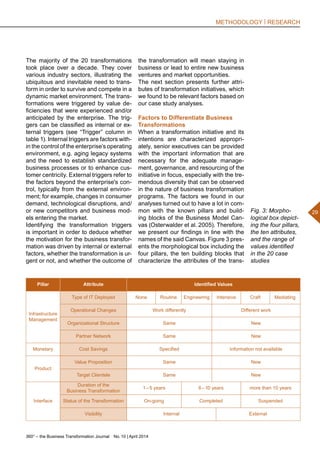
Factors to Differentiate Business
Transformations
When a transformation initiative and its
intentions are characterized appropri-
ately, senior executives can be provided
with the important information that are
necessary for the adequate manage-
ment, governance, and resourcing of the
initiative in focus, especially with the tre-
mendous diversity that can be observed
in the nature of business transformation
programs. The factors we found in our
analyses turned out to have a lot in com-
mon with the known pillars and build-
ing blocks of the Business Model Can-
vas (Osterwalder et al. 2005). Therefore,
we present our findings in line with the
names of the said Canvas. Figure 3 pres-
ents the morphological box including the
four pillars, the ten building blocks that
characterize the attributes of the trans-
Fig. 3: Morpho-
logical box depict-
ing the four pillars,
the ten attributes,
and the range of
values identified
in the 20 case
studies
Pillar Attribute Identified Values
Infrastructure
Management
Type of IT Deployed None Routine Engineering Intensive Craft Mediating
Operational Changes Work differently Different work
Organizational Structure Same New
Partner Network Same New
Monetary Cost Savings Specified Information not available
Product
Value Proposition Same New
Target Clientele Same New
Interface
Duration of the
Business Transformation
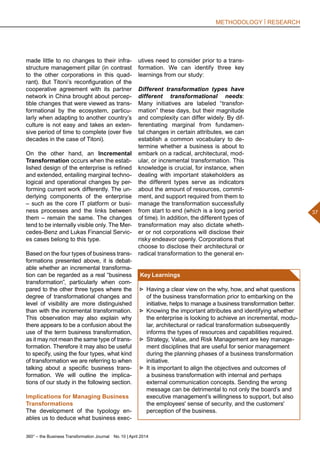
1 – 5 years 6 – 10 years more than 10 years
Status of the Transformation On-going Completed Suspended
Visibility Internal External
360° – the Business Transformation Journal  No. 10 | April 2014
30
formation initiatives, and the range of
values found in the 20 case studies. Ta-
ble 2 on the other hand lists those values
that are prominent in each of the 20 cas-
es. The next paragraphs will explain the
attributes in more detail, with reference
also to the BTM2 that informs the im-
portance of (a) particular management
discipline(s) required to transform the re-
spective attributes in the earlier stages
of the initiative.
(I) Infrastructure Management Pillar
The Type of IT Deployed determines
the technology required to enable the
transformation. The type of IT deployed
is based on analyzing the needs of the
enterprise and on aligning them with the
new business vision with Strategy Man-
agement. This attribute also informs rele-
vant executives about the extent to which
IT resources are required during the dif-
ferent stages of the transformation. The
different types of technologies (Hatch
and Cunliffe 2013) are:
−− Routine technologies: for repetitive
tasks that are low in variation, us-
ing known methods such as that in
an automotive assembly line produc-
tion. Examples of routine technolo-
gies include transactional systems
supporting personnel administra-
tion, finance, sales, and supply chain
management.
−− Engineering technologies: for high
task variability and a high number of
known methods in order to enable
tasks that require analytical skills, e.g.
for lab technicians, data scientists,
controllers, and most engineers who
possess the knowledge to handle ex-
ceptions. Examples of engineering
technologies include business intelli-
gence applications, big data analyt-
ics, and cloud technologies.
−− Intensive technologies: for non-rou-
tine tasks with low analytical require-
ments, such as coordinating spe-
cialized activities of more than two
experts, e.g. in research labs, RD
labs, or in projects in engineering
firms. Examples of intensive technol-
ogies include project management
systems and social enterprise net-
working platforms, etc.
−− Craft technologies: for highly explor-
ative tasks with high variations and lit-
tle known methods to handle excep-
tions. Examples of craft technologies
include those for artistic productions,
construction work, drilling for oil, etc.
−− Mediating technologies: for tasks that
require interactions, communication,
and the socializing of outcomes. Ex-
amples of mediating technologies in-
clude mobile technologies, social
media channels, e-government, and
e-commerce systems.
A Typology of Business Transformations
360° – the Business Transformation Journal  No. 10 | April 2014
31
METHODOLOGY | RESEARCH
The Operational Changes attribute re-
fers to the changes in core competency
and can be two-fold: Either the enterprise
performs current work differently by sim-
plifying complexities, or it performs dif-
ferent work by adopting new approaches
via creative, innovative, or design-led ac-
tivities. In any case, both outcomes con-
tribute to (and require) the reconfigura-
tion of the enterprise’s business model
via Strategy Management.
Organizational Structure pertains to
changes in the social structure of the
enterprise. The transformation initiative
may enhance the company culture and
the working conditions for the existing
organizational structure (“same”), or it
may lead to a new structure (“new”) via
Strategy Management.
Partner Network refers to the coopera-
tive agreements with other – internal or
external – organizations. Such reconfig-
uration can leverage the core offerings
of the business efficiently and commer-
cialize value. As mentioned, business
transformations may reconfigure this as-
pect with new partners that are exter-
nal to the new business, e.g. via merg-
ers and acquisitions, and/or even within
the same business, e.g. new ventures
among business affiliates within a con-
glomerate. Strategy and Value Manage-
ment are essential for transforming this
attribute.
(II) Monetary Pillar
The Cost Savings attribute identifies
whether or not the transformation initiative
is explicitly specified to achieve overall ef-
ficiency gains and financial profitability.
If such a specification exists, the finan-
cial performance of the overall business
needs constant monitoring to ensure that
the transformation is achieving its intend-
ed objective, whereby Value Management
is important for this attribute.
(III) Product Pillar
Value Proposition refers to the initiative
introducing new or enhanced products
and/or services. This requires identify-
ing the necessary strategies to either im-
prove the quality of the existing products
or services (“same”) or developing new
products and services (“new”) – which is
part of reconfiguring the business model
via Strategy Management, and also Val-
ue and Risk Management.
Target Clientele concerns an enter-
prise's target customer groups, who are
the prime reason for the existence of the
business. The question is whether the
transformation focuses on enhancing the
satisfaction of existing clients (“same”) or
whether it is targeting entirely new client
360° – the Business Transformation Journal  No. 10 | April 2014
32
A Typology of Business Transformations
Case
Study
Infrastructure Management
Type of IT Deployed
Operational
Changes
Organizational
Structure
Partner
Network
CS1 Hilti
Routine, Engineering,
Mediating  
Work differently New New  
CS2 Lukas Routine, Mediating Work differently New Same  
CS3 Shell Routine, Mediating Work differently New New  
CS4 Vodafone
Routine, Engineering,
Mediating  
Work differently New New  
CS5 Mercedes Routine Work differently New Same  
CS6 SAP Intensive, Craft, Mediating Work differently New New  
CS7 Titoni None Work differently Same New  
CS8 Allianz Routine, Mediating Work differently Same Same  
CS9 Clariant Routine, Craft, Mediating Work differently New New  
CS10 Smart Routine, Mediating Different work New New  
CS11 Sava
Routine, Engineering,
Mediating  
Work differently New New  
CS12
French Public
Health
Engineering Work differently New Same  
CS13 T.Co Routine, Craft Work differently n/a Same  
CS14 THA Group
Routine, Engineering, Intensive,
Craft, Mediating
Work differently New Same  
CS15
UK National
Health
Routine, Engineering,
Mediating
Work differently New New  
CS16
Amazon
Rainforest
Routine, Engineering, Intensive,
Craft, Mediating
Different work n/a New  
CS17 FedEx
Routine, Engineering,
Mediating  
Work differently New New  
CS18
Sentara
eCare
Routine, Engineering, Intensive,
Craft, Mediating
Work differently New Same  
CS19
UK Police
e-Govt
Routine, Engineering, Intensive,
Craft, Mediating
Work differently New New  
CS20
EU e-
Customs
Craft, Routine, Mediating,
Engineering, Intensive
Work differently New New  
Information not availablen/a
360° – the Business Transformation Journal  No. 10 | April 2014
33
METHODOLOGY | RESEARCH
Monetary Product Interface
Cost Savings
Value
Proposition
Target Clientele Duration Status Visibility 
n/a Same New 2000 – 2006 Completed Internal
Specified Same Same 2004 – current On-going Internal
n/a Same Same 2000 – 2006 Completed External 
Specified Same New 2006 – 2012 Completed External
Specified Same Same 2008 – current On-going Internal
n/a New Same 2003 – current On-going External
n/a Same Same 1960 – current On-going Internal
n/a Same Same 2012 – 2013 Completed Internal
Specified Same Same 2008 – 2012 Completed Internal
Specified New New 1998 – current On-going External 
n/a Same Same 1997 – 2004 Completed Internal
n/a Same Same 1997 – 2003 Completed Internal
Specified Same Same 2000 – 2002 Suspended Internal
Specified Same Same 2000 – 2009 Completed Internal
Specified Same Same 2002 – current On-going External
n/a New New 1964 – 2008 Completed External 
n/a New Same 2004 – 2006 Completed External
n/a Same Same 2005 – 2015 On-going Internal
Specified Same Same 2005 – 2007 Completed Internal
n/a Same New 2006 – 2010 Completed Internal
Table 2: Description of the 20 case studies along the 10 attributes
360° – the Business Transformation Journal  No. 10 | April 2014
34
A Typology of Business Transformations
segments (“new”), where Strategy and
Risk Management are essential for this
attribute.
(IV) Interface Pillar
Duration of Transformation allows
managers to gauge how long an initia-
tive will last and permits the planning of
resource allocation, such as human cap-
ital, finance, and assets, in order to stay
on track and to deal with peak or esca-
lating demands. Such resource alloca-
tion is essential to pro-actively face the
challenge of securing the on-going daily
business while the business transforma-
tion initiative is competing for the same
resources. Risk and Strategy Manage-
ment are particularly useful for this at-
tribute.
Status of Transformation identifies the
progress of the transformation. A trans-
formation initiative can be on-going,
completed, or suspended. The purpose
of acknowledging this attribute is that se-
nior management accountable for such
initiatives can get a full picture of the sit-
uation. For instance, the presence of a
suspended initiative may indicate a previ-
ous, often unsuccessful attempt at trans-
forming the business. Lessons learned
and root causes of such an event may
lead to better awareness of what works
and what does not, therefore requiring
better Risk Management. From previ-
ously completed transformations suc-
cess factors can be derived to better in-
form Strategy Management.
Visibility distinguishes the initiatives
that are only visible to the internal orga-
nization – entailing the operating core
(transactional workers), business divi-
sions (tactical or mid-level managers),
and enterprise network (strategic apex) –
from those that are visible external-
ly to the general public or environment,
where appropriate communication and
marketing strategies are needed. Strate-
gy Management plays an important role
in this regard.
It is important to note that while we state
the use of one or two key management
disciplines of the BTM2 for the attributes
above, it does not necessarily imply that
the other management disciplines are to
be neglected. Indeed, all the manage-
ment disciplines are fundamental for the
transformation initiative as a whole; how-
ever, their importance may vary with the
different points in time of the transforma-
tion journey. Therefore, our intent is to
emphasize the dominance of the afore-
mentioned management disciplines in
forming a concrete direction during the
planning or earlier stages of a business
transformation.
In the next two sections, the 20 cases
will be clustered based on their attribute
values, leading to a classification with
four types of business transformations.
A Two-Dimensional Matrix
The classification is based on two di-
mensions. As mentioned above, it re-
sults in four types of business transfor-
mations. The concept and naming of the
archetypes were inspired by the works of
Henderson and Clark (1990).
Figure 4 illustrates the classification of
the 20 case studies along the two dimen-
sions, whereby the dimensions were de-
rived by consolidating the prominent at-
tributes that: a) reflect the degree of
transformational change; and b) the lev-
el of visibility of the transformation initia-
tive.
The former makes up the horizontal axis
and reflects the marginal to fundamental
changes that occurred in the infrastruc-
ture management pillar. This dimension
specifically entails the organizational or
social structure (same or new), opera-
tional changes (performing current work
differently or performing different work),
and type of technology deployed (none,
one, or several out of the five types) that
subsequently affects the overall enter-
prise infrastructure. The monetary pillar
was omitted as we did not have sufficient
information from all cases – although it
was interesting to note how some en-
360° – the Business Transformation Journal  No. 10 | April 2014
35
METHODOLOGY | RESEARCH
terprises explicitly aimed at cost-cutting
transformation strategies while others
were more subliminal about such intent,
e.g., some cases emphasized custom-
er centricity, which subsequently gener-
ates revenue before saving costs – and
not vice versa (Merton 2013).
The second dimension, the vertical axis,
was derived from the product and inter-
face pillars, namely the value proposition
(same or new products/services), target
clientele (same or new) and extent to
which the transformation is visible to the
enterprise environment (operating core,
business division, enterprise network,
and/or general public). The outcome of
the transformational initiative may range
from being only internally visible (to the
enterprise network) to being external-
ly visible (to the general environment),
and concerns the production of new val-
ue propositions in the form of new prod-
ucts and/or services.
In order to quantify the degree of trans-
formational change and level of visibility,
the dimensions were constructed using
nominal scales for the attributes that re-
flected the changes of the business mod-
el pillars. A value of 1 or 0 is assigned for
the aforementioned attributes, and the
sum is then averaged in percentage to
ascertain the resulting outcome per di-
mension. In our analysis we found that
the median for the horizontal axis sits at
60%, which may suggest that enterpris-
es surpassing this limit are considering
Fig. 4: Classify-
ing the 20 case
studies into four
types of business
transformations
along the degree
of transformational
change versus
level of visibility
Hilti
Lukas
Shell
Vodafone
Mercedes Benz
SAP
Titoni Allianz
Clariant
Smart
Sava
French Public
Health T.Co
THA
Group
UK National
Health Service
Amazon
Rainforest
(Brazillian Govt.)
FedEx
Sentara UK Police
Europe
Customs
0%
5%
10%
15%
20%
25%
30%
35%
40%
45%
50%
55%
60%
65%
70%
75%
80%
85%
90%
95%
100%
0% 5% 10% 15% 20% 25% 30% 35% 40% 45% 50% 55% 60% 65% 70% 75% 80% 85% 90% 95% 100%
Visibility
Degree of Transformational Change
Typology for Business Transformatons
Degree of Transformational Change vs. Level of Visibility
Radical
Transformation
Modular
Transformation
Incremental
Transformation
Architectural
Transformation
(Marginal) (Fundamental)
(External)(Internal)
360° – the Business Transformation Journal  No. 10 | April 2014
36
fundamental changes to their business,
while those below this limit can be cat-
egorized as wanting to make only mar-
ginal changes. As for the vertical axis,
we observed that the median for the ver-
tical axis rests at 57%, suggesting that
those above this limit can be categorized
as externally visible, while those below
this limit are deemed to be internally vis-
ible only.
The Four Different Types of Transfor-
mations
Figure 4 shows the resulting four types of
business transformations: radical, archi-
tectural, modular, and incremental trans-
formations.
A Radical Transformation is typical-
ly externally visible; the entire business
establishes a new set of core concepts
which are embodied and linked together
in a new dominant architectural design.
This implies a major reconfiguration of
the business model. Subsequently, new
value propositions may be offered. Ex-
amples are the Amazon Rainforest case,
Smart case, Vodafone, SAP, FedEx, and
Hilti.
Architectural Transformations can be
visible internally and/or externally. The
enterprise architecture is overhauled, yet
the components and core concepts re-
main unchanged, i.e. they are still per-
forming the same work in spite of the fun-
damental changes. The transformations
at Clariant, Sava, Sentara, and UK Police
appear to be only internally visible, while
those of the UK National Health Service,
the THA Group, and the European Cus-
toms are perceived to be externally visi-
ble.
In a Modular Transformation – while
the overall architecture remains intact –
there are changes to the core design of
the enterprise, which are externally visi-
ble. Shell, T.Co, Allianz, and the French
Public Health Administration are instanc-
es of such transformations which result-
ed in a different work performance by de-
ploying particular types of technologies
and which reconfigured their respective
design of the organizational structure,
work operations, and partner network.
Titoni, however, was an exception in this
group: The Swiss-based company that
was established in 1919 is seen to have
A Typology of Business Transformations
360° – the Business Transformation Journal  No. 10 | April 2014
37
METHODOLOGY | RESEARCH
made little to no changes to their infra-
structure management pillar (in contrast
to the other corporations in this quad-
rant). But Titoni’s reconfiguration of the
cooperative agreement with its partner
network in China brought about percep-
tible changes that were viewed as trans-
formational by the ecosystem, particu-
larly when adapting to another country’s
culture is not easy and takes an exten-
sive period of time to complete (over five
decades in the case of Titoni).
On the other hand, an Incremental
Transformation occurs when the estab-
lished design of the enterprise is refined
and extended, entailing marginal techno-
logical and operational changes by per-
forming current work differently. The un-
derlying components of the enterprise
– such as the core IT platform or busi-
ness processes and the links between
them – remain the same. The changes
tend to be internally visible only. The Mer-
cedes-Benz and Lukas Financial Servic-
es cases belong to this type.
Based on the four types of business trans-
formations presented above, it is debat-
able whether an incremental transforma-
tion can be regarded as a real “business
transformation”, particularly when com-
pared to the other three types where the
degree of transformational changes and
level of visibility are more distinguished
than with the incremental transformation.
This observation may also explain why
there appears to be a confusion about the
use of the term business transformation,
as it may not mean the same type of trans-
formation. Therefore it may also be useful
to specify, using the four types, what kind
of transformation we are referring to when
talking about a specific business trans-
formation. We will outline the implica-
tions of our study in the following section.
Implications for Managing Business
Transformations
The development of the typology en-
ables us to deduce what business exec-
utives need to consider prior to a trans-
formation. We can identify three key
learnings from our study:
Different transformation types have
different transformational needs:
Many initiatives are labeled “transfor-
mation” these days, but their magnitude
and complexity can differ widely. By dif-
ferentiating marginal from fundamen-
tal changes in certain attributes, we can
establish a common vocabulary to de-
termine whether a business is about to
embark on a radical, architectural, mod-
ular, or incremental transformation. This
knowledge is crucial, for instance, when
dealing with important stakeholders as
the different types serve as indicators
about the amount of resources, commit-
ment, and support required from them to
manage the transformation successfully
from start to end (which is a long period
of time). In addition, the different types of
transformation may also dictate wheth-
er or not corporations will disclose their
risky endeavor openly. Corporations that
choose to disclose their architectural or
radical transformation to the general en-
Key Learnings
►► Having a clear view on the why, how, and what questions
of the business transformation prior to embarking on the
initiative, helps to manage a business transformation better.
►► Knowing the important attributes and identifying whether
the enterprise is looking to achieve an incremental, modu-
lar, architectural or radical transformation subsequently
informs the types of resources and capabilities required.
►► Strategy, Value, and Risk Management are key manage-
ment disciplines that are useful for senior management
during the planning phases of a business transformation
initiative.
►► It is important to align the objectives and outcomes of
a business transformation with internal and perhaps
external communication concepts. Sending the wrong
message can be detrimental to not only the board’s and
executive management’s willingness to support, but also
the employees' sense of security, and the customers'
perception of the business.
360° – the Business Transformation Journal  No. 10 | April 2014
38
vironment may wish to attain sharehold-
er confidence in the progression of the
enterprise (Dehning et al. 2003), particu-
larly companies in the private sector. On
the other hand, those who opt to inform
only the enterprise network may do so in
order to achieve competitive advantage
and derive financial benefits via cost-
saving strategies.
With larger transformation come new
perspectives and new perceptions:
The organizational scope of a transfor-
mation heavily influences its visibility.
Three cases can be distinguished:
1.	 For initiatives that do not surpass the
business division boundary, the la-
bel “transformation” can safely be
neglected, as they typically come in
the form of minor business improve-
ments, such as minor process optimi-
zations, or upgrading of the operating
system, or introduction of mediat-
ing technologies – any potential fear
about transformational change may
not even emerge.
2.	 The initiatives that are visible within
the enterprise network may need to
consider alignment of strategies and
communication with the marketing di-
vision as it will be inevitable that the
general environment will learn about
the transformation initiative. The ap-
propriate message or (re-)branding
strategies need to be devised in order
to convey positive sentiments about
the business and ultimately, albeit in-
directly, enhance the performance of
the business as a whole.
3.	 For those initiatives that are visible
to the general environment both pro-
active and reactive management is
needed a) to maintain the momen-
tum of keeping the support from ex-
ecutives alive throughout the duration
of the transformation, and b) to en-
sure that the transformation outcome
matches the publicly announced ob-
jectives – since public perception can
either enhance or damage the repu-
tation of the business.
Handy transformation tools: The ten
transformation attributes identified in our
study shed light on our second research
question, which is about guiding the man-
agement of business transformations. As
the planning of the initiative is one of the
crucial steps in BTM2, we propose the
use of the following tools at the start of
the journey, and even as a point of ref-
erence throughout the initiative to re-use
and/or reconfigure where necessary:
−− The illustrative overview of how a
business transformation unfolds
(see figure 1) can be useful in fram-
ing the communication towards two
important stakeholder groups: on the
one hand to give the managers who
are accountable for such initiatives a
clear perspective on the answers to
the five key questions – as failing to
have those answers may affect the
overall management of such complex
initiatives; on the other hand to com-
municate to other key stakeholders
what the journey entails, i.e. the why,
the how, and the what.
−− Carrying out at least the activities of
the BTM2 management disciplines
highlighted in figure 2, with particular
emphasis on the Strategy, Value, and
Risk Management, can be useful to
concretize the direction of the trans-
formation in the earlier stages of the
initiative.
−− Having a dedicated business mod-
el for the transformation initiative as
specified by the Business Model Can-
vas gives a clear idea of what will
changeintheenterprise(seefigure3),
the type of transformation aimed at,
and what is required to implement
those changes.
Conclusion
In this article, we presented a typology
for business transformations as an en-
deavor to assist managers in better man-
aging and communicating the type of
business transformation the enterprise
is seeking to achieve. The typology is
based on 20 cases of global business
A Typology of Business Transformations
360° – the Business Transformation Journal  No. 10 | April 2014
39
METHODOLOGY | RESEARCH
Service
AUTHORS
Niz Safrudin is a PhD candidate and Research Associate at Queensland University
of Technology (QUT), Brisbane, Australia. Her research on Business Transformation
Management (BTM) is funded by the SAP BTA. She investigates how services from
various management disciplines are composed and orchestrated in BTM, inspired by
jazz music. Niz’s background is in Business Process Management (BPM), where her
Honors study on business process design won a best paper award at a BPM confer-
ence in the USA.
norizan.safrudin[at]qut.edu.au
Prof. Dr. Michael Rosemann is Professor and Head of the Information Systems School,
Queensland University of Technology (QUT). He is the author/editor of seven books and
more than 200 refereed papers. Dr. Rosemann’s main areas of research are Business
Process Management, Innovation Management, and Research Management. He has es-
tablished the Woolworths Chair for Retail Innovation and the Brisbane Airport Corporation
Chair in Airport Innovation at QUT.
m.rosemann[at]qut.edu.au
Prof. Dr. Jan Recker is holder of the Woolworths Chair of Retail Innovation and Profes-
sor for Information Systems at Queensland University of Technology (QUT). He is also
a Fellow of the Alexander-von-Humboldt Foundation. His research focuses on process
innovation, process design in organizational practice, and IT-enabled business transfor-
mations. Jan has written over 130 books, journal articles, and conference papers. His re-
search has attracted funding in excess of AUD $ 2 million from government and industry.
j.recker[at]qut.edu.au
Michael Genrich (Computer Science, MBA) is the Business Transformation Academy
Lead for Australia and New Zealand. He has over 25 years of experience in large-scale
business and technology change and has managed a number of transformation programs
from strategy through to design and execution. Throughout his career Michael has held se-
nior leadership roles in two global management-consulting firms. He is an accredited train-
er for SAP’s Business Transformation Methods and a Design Thinking coach.
michael.genrich[at]sap.com
transformations that were classified us-
ing 7 attributes which were condensed
to two dimensions. The resulting 2x2
matrix depicts four types of business
transformations, namely: radical, archi-
tectural, modular, and incremental trans-
formation. Senior management and key
stakeholders can benefit from this typol-
ogy in order to ascertain what kinds of
resources are required to achieve the
intended type of transformation. Strate-
gy, Value, and Risk Management play a
crucial role during the initial or planning
phases of the business transformation.
Importantly, having an awareness of the
attributes can serve as key contextual
information when deducing which ap-
proaches are useful and relevant based
on similar cases, which in turn can serve
as crucial knowledge and information in
increasing the likelihood of a successful
transformation.
360° – the Business Transformation Journal  No. 10 | April 2014
40
A Typology of Business Transformations
Service
REFERENCES
►► Abraham, C., Junglas, I. (2011). From cacophony to harmony: A case study about the IS imple-
mentation process as an opportunity for organizational transformation at Sentara Healthcare. The
Journal of Strategic Information Systems, 20(2), 177–197.
►► Cordella, A., Iannacci, F. (2010). Information systems in the public sector: The e-Government
enactment framework. The Journal of Strategic Information Systems, 19(1), 52 – 66.
►► Currie, W. L., Guah, M. W. (2007). Conflicting institutional logics: a national program for IT in the
organisational field of healthcare. J Inf technol, 22(3), 235 – 247.
►► Dehning, B., Vernon, J. R., Zmud, R. W. (2003). The Value Relevance of Announcements of Trans-
formational Information Technology Investments. MIS Quarterly, 27(4), 637 – 656.
►► Doty, D. H., Glick, W. H. (1994). Typologies as a Unique Form of Theory Building: Toward Improved
Understanding and Modeling. The Academy of Management Review, 19(2), 230 – 251.
►► Follmann, J., Laack, S., Schütt, H., Uhl, A. (2012). Lean Transformation at Mercedes-Benz. 360°
– the Business Transformation Journal (3), 38 – 45. Available from: http://www.360-bt.com/issue3/
flipviewerxpress.html?pn=38 [Accessed 31.03.2014].
►► Giordano, G., Lamy, A., Janasz, T. (2011). Who's The Leader? Financial IT Integration at a Global
Insurance Company. 360° – the Business Transformation Journal (1), 52 – 59. Available from: http://
www.360-bt.com/issue1/flipviewerxpress.html?pn=52 [Accessed 31.03.2014].
►► Hatch, M. J., Cunliffe, A. L. (2013). Organization theory: Modern, symbolic, and postmodern per-
spectives. 3rd ed. Oxford University Press.
►► Henderson, R. M., Clark, K. B. (1990). Architectural innovation: The reconfiguration of existing prod-
uct technologies and the failure of established firms. Administrative Science Quarterly, 9 – 30.
►► Henningsson, S., Henriksen, H. Z. (2011). Inscription of behaviour and flexible interpretation in
Information Infrastructures: The case of European e-Customs. The Journal of Strategic Information
Systems, 20(4), 355 – 372.
►► Houlder, D., Wokurka, G., Günther, R. (2011). Shell Human Resources Transformation. 360° – the
Business Transformation Journal (2), 46 – 52. Available from: http://www.360-bt.com/issue2/flipview-
erxpress.html?pn=46 [Accessed 31.03.2014].
►► Howcroft, D., Light, B. (2010). The social shaping of packaged software selection. Journal of the As-
sociation for Information Systems, 11(3)
►► Hussain, Z. I., Cornelius, N. (2009). The use of domination and legitimation in information systems
implementation. Information Systems Journal, 19(2), 197 – 224.
►► Janson, M., Cecez-Kecmanovic, D., Zupančič, J. (2007). Prospering in a transition economy
through information technology-supported organizational learning. Information Systems Journal,
17(1), 3 – 36.
►► Kresak, M., Corvington, L., Wiegel, F., Wokurka, G., Teufel, S., Williamson, P. (2011). Vodafone
Answers the Call to Transformation. 360° – the Business Transformation Journal (2), 54 – 66.
Available from: http://www.360-bt.com/issue2/flipviewerxpress.html?pn=54 [Accessed 31.03.2014].
►► Markus, M. L., Benjamin, R. I. (1997). The Magic Bullet Theory in IT-Enabled Transformation.
MIT Sloan Management Review, 38(2), 55 – 55 – 68.
►► Merton, R. C. (2013). Innovation Risk: How to Make Smarter Decisions. Harvard Business Review,
91(4).
►► Messmer, M. (2012). Titoni Ltd. - An Independent Swiss Watch Brand in China. 360° – the Busi-
ness Transformation Journal (4), 68 – 75. Available from: http://360-bt.com/issue4/flipviewerxpress.
html?pn=68 [Accessed 31.03.2014].
►► Morgan, R. E., Page, K. (2008). Managing business transformation to deliver strategic agility.
Strategic Change, 17(5 – 6), 155 – 168.
360° – the Business Transformation Journal  No. 10 | April 2014
41
METHODOLOGY | RESEARCH
►► Müller, O., vom Brocke, J., von Alm, T., Uhl, A. (2012). The Evolution of SAP Services. 360° –
the Business Transformation Journal (3), 48 – 56. Available from: http://www.360-bt.com/issue3/
flipviewerxpress.html?pn=48 [Accessed 31.03.2014].
►► Osterwalder, A., Pigneur, Y., Tucci, C. L. (2005). Clarifying business models: Origins, present, and
future of the concept. Communications of the association for Information Systems, 16(1), 1 – 25.
►► Rajao, R., Hayes, N. (2009). Conceptions of control and IT artefacts: an institutional account of
the Amazon rainforest monitoring system. J Inf technol, 24(4), 320 – 331.
►► Safrudin, N., Recker, J. (2012). A Typology for Business Transformations. Paper presented at the
Australasian Conference in Information Systems (ACIS2012). Melbourne, Australia.
►► Singh, R., Mathiassen, L., Stachura, M. E., Astapova, E. V. (2011). Dynamic capabilities in home
health: IT-enabled transformation of post-acute care. Journal of the Association for Information
Systems, 12(2), 2.
►► Tanner, C., Beyeler, P. (2012). Clariant and the Networked Economy. 360° – the Business
Transformation Journal (6), 54 – 65. Available from: http://360-bt.com/issue6/flipviewerxpress.
html?pn=54 [Accessed 31.03.2014].
►► Uhl, A., Gollenia, L. A. (2012). A Handbook of Business Transformation Management Methodol-
ogy. Farnham, UK: Gower Publishing Limited.
►► Uhl, A., Hanslik, O. (2012). PRO3 at Allianz – A New Dimension of Customer Centricity. 360°
– the Business Transformation Journal (5), 50 – 61. Available from: http://360-bt.com/issue5/
flipviewerxpress.html?pn=50 [Accessed 31.03.2014].
►► Vaast, E., Walsham, G. (2009). Trans-Situated Learning: Supporting a Network of Practice with
an Information Infrastructure. Information Systems Research, 20(4), 547 – 564.
►► Viaene, S., De Hertogh, S. (2010). Enterprise-wide business-IT engagement in an empowered
business environment: the case of FedEx Express EMEA. J Inf technol, 25(3), 323 – 332.
►► vom Brocke, J., Petry, M., Schmiedel, T. (2011). How Hilti Masters Transformation. 360° – the
Business Transformation Journal (1), 38 – 47. Available from: http://www.360-bt.com/issue1/
flipviewerxpress.html?pn=38 [Accessed 31.03.2014].
►► Ward, J., Stratil, P., Uhl, A., Schmid, A. (2012). Smart Mobility – An Up-and-Down Ride on the
Transformation Roller Coaster. 360° – the Business Transformation Journal (7), 44 – 55. Available
from: http://360-bt.com/issue7/flipviewerxpress.html?pn=44 [Accessed 31.03.2014].
ACKNOWLEDGMENT
The authors would like to extend their gratitude to Assoc. Prof. Michael zur Muehlen at Stevens Institute
of Technology in Hoboken, New Jersey, USA, for his invaluable feedback on the research-in-progress
work, and Rita Strasser at the Business Transformation Academy for her helpful input and assistance in
preparing this article.
Abstract
Recent technology innovations, many of which are based on the capture and analysis of big data, are
transforming the automotive industry in a pace deemed inconceivable just a short time ago. At the
heart of this transformation is the new role of the car itself, and the increasingly sophisticated abilities
that “intelligent cars” possess to communicate with individuals, enterprises, and devices around them.
Company leaders in the automotive industry clearly recognize that by embracing the concept of big
data, they can access a mass of opportunities for differentiation, growth, and innovation that revolu-
tionize the very core of existing business models. In order to unlock this potential, the key challenge is
to develop and implement a big data strategy, which is tailored to the capture, analysis, and interpreta-
tion of the ever increasing quantities of structured and unstructured data which will be received from
drivers, vehicles, and other devices. Only those companies which incorporate a big data strategy in
their transformation agendas will be able to reap the rewards offered by the zettabyte revolution.
360° – the Business Transformation Journal  No. 10 | April 2014
43
METHODOLOGY | RESEARCH
During recent decades the automo-
tive industry has seldom been out of the
spotlight. Global topics such as climate
change, globalization, and the increasing
scarcity of resources have served to de-
fine the automotive trends (Gartner 2011)
and have long since set the transforma-
tion agenda for the industry. Automotive
companies around the world have re-
sponded by adjusting their product port-
folios, further developing new energy ef-
ficient technologies, and shifting their
focus to the BRIC countries. However,
recent technology innovations, many of
which are based upon the capture and
analysis of big data, have moved the in-
dustry to the brink of a vastly different
transformation; one that will challenge
the very core of the existing business
models and that will revolutionize the way
in which we view the role of transporta-
tion in the future.
At the heart of this new transformation
is the future role of the car itself. The in-
creasingly sophisticated abilities that “in-
telligent cars” possess to communicate
with the individuals, enterprises and de-
vices around them empower the car in
a way that seemed inconceivable a few
years ago (Mayer-Schönberger and
Cukier 2013). These abilities allow ser-
vice vendors to quickly gather and ana-
lyze masses of structured and unstruc-
GAINING TRACTION
Big Data in the Automotive Industry
Intelligent cars are on the rise and will change our perception of automobiles. The
authors of this article illustrate the importance of a big data strategy in helping
automotive companies to transform and offer consumers a completely new driving
experience.
by Michael Voigt, Christopher Bennison, and Maik Hammerschmidt
tured data received from vehicles and, in
turn, to provide tailor-made offers to the
driver. The customer is the clear benefi-
ciary of this new role of the car, and this
will both fundamentally and rapidly shift
the expectations of consumers in terms
of the functions which they expect a ve-
hicle to perform.
The transformation also goes beyond
the changing role of the car itself. The en-
hanced ability of the car to communicate
key vehicle data to other parties allows
the establishment of new business mod-
els that were previously inconceivable.
More flexible car rental offers, an expan-
sion of the leasing frameworks available
when acquiring vehicles, intelligent car
services, and an increase in the number
of car-sharing options are all feasible. All of
these models provide the Original Equip-
ment Manufacturers (OEM) and drivers
with potential new income sources and
vastly increase the choice available to
customers.
Undoubtedly, key technological inno-
vations will fundamentally influence the
way in which automotive companies run
their businesses in the future. Enterpris-
es will be forced to transform their busi-
ness models and restructure their value
chain, respond to new process require-
ments, and mitigate new risks (Chen et
al. 2012). Those enterprises which fail to
360° – the Business Transformation Journal  No. 10 | April 2014
44 do so will quickly suffer the consequenc-
es as the buying power of the Millennials
increases.
Looking Forward into the New World
In the future, the common driving experi-
ence will change. However, what will be
the extent of these changes? How deep
is the gap between fantasy and reality?
Let us imagine a future automotive sce-
nario from a customer perspective:
It is an ordinary working day. Stephen
Smith is working at home. Before a mid-
morning video conference, he goes to
the kitchen to fetch a coffee. While do-
ing so, he remembers that he has not yet
rented a car for going out with his girl-
friend Anna this evening. The problem
is quickly solved. While standing in front
of the coffee machine he browses all the
available vehicle models using the app
on his smart phone. The vehicles are
displayed in sequence according to the
vehicles which he has driven in the past
and the stored transmission type prefer-
ences. Stephen selects the electric ve-
hicle which he enjoyed driving last week
and specifies the time slot for the res-
ervation. Once the vehicle is booked,
Stephen confirms that his credit card
details are correct before payment is
made. The range of available insurance
options is subsequently displayed by the
app, sorted by price. Stephen selects “in-
sure what you drive”. With this option, the
insurance price is calculated based on
the exact number of kilometers travelled
and also considers the current weath-
er conditions for Stephen’s location, the
vehicle type, the route taken, and Ste-
phen’s driving history. An onboard GPS-
enabled telematics device continuous-
ly transmits trip and vehicle data to the
insurance company during the journey
which is then used to calculate the final
invoice.
Later that day, the reserved vehicle au-
tomatically and autonomously makes
its way to the service point. Before con-
tinuing to its destination, an inspection is
necessary. The diagnostic data collected
by the vehicle show that the brake pads
are worn and need to be replaced. At the
same time, additional maintenance work
is performed. After the service stop, the
vehicle determines the quickest way
to Stephen’s house. The current traffic
situation is determined by gathering
real-time information from other vehicles
currently on the road via the integrated
Gaining Traction
360° – the Business Transformation Journal  No. 10 | April 2014
45
METHODOLOGY | RESEARCH
would allow the vehicle to be rented to a
third party for one hour during the time of
the performance this evening. Stephen
agrees because he knows that the per-
formance will last for two hours and that
he can check the current position of the
vehicle on his mobile device at any time
to ensure that the car is back at the thea-
tre in time. Besides this, the charge for
the short rental will help to pay for the
champagne during the interval! Shortly
afterwards, Anna is picked up from her
place. The vehicle proceeds to the city,
pulls into the street where the theatre is
and identifies the correct building using
the onboard camera. Then it parks in the
place that was reserved a few minutes
ago. Stephen and Anna leave the vehi-
cle and look forward to a wonderful eve-
ning ahead.
Turning Vision into Reality
The described scenario may seem unre-
alistic; a futuristic vision which will have
no impact on the current driving genera-
sensors of the vehicle, and by previ-
ous trip data. From this data, algorithms
are derived to model how the traffic sit-
uation will develop during the next few
hours. The vehicle accesses this infor-
mation in the cloud and plans the route
for the journey accordingly, finally arriv-
ing at Stephen’s place in time.
Stephen Smith gets into the vehicle and
confirms the destination, his girlfriend
Anna’s place, which has been already
transferred via the app. Stephen has had
a long day and does not feel like driv-
ing, so he activates the auto-pilot. The
vehicle uses the road sign recognition
logic to regulate its speed according to
the traffic conditions. During the journey
Stephen talks to Anna. She has made up
her mind, she would like to go to the the-
atre this evening to watch a play which
only started a few days ago. Stephen has
seen very positive reviews about the per-
formance and knows that it will be diffi-
cult to get seats. However, using the in-
telligent car service within the vehicle, a
ticket vendor is found who not only of-
fers tickets for the play, but after a quick
price comparison, also offers a discount
on all tickets bought this evening. Once
Stephen has confirmed the seats, a fur-
ther service is called to determine which
car park would be the closest and cheap-
est. As it will be busy in the city center
this evening, the vehicle knows that it
will be necessary to reserve a parking
space. Unfortunately, it seems that all
the car parks close to the theatre are full.
Therefore, the vehicle calls an additional
service which checks whether alternative
parking spaces at privately owned prop-
erties are available this evening. It turns
out that Stephen is in luck. A privately
owned house is renting out their drive-
way this evening and the price is cheaper
than the car park. Stephen reserves the
space and sits back to enjoy the journey.
A few minutes later, Stephen receives
a request via his mobile device. An on-
line service vendor has identified that
Stephen has booked seats at the theatre
this evening and asks him whether he
360° – the Business Transformation Journal  No. 10 | April 2014
46
tion for years to come. This, however, is
not the case. The use cases illustrated
above, and several related ones, already
provide the backbone for many business
cases currently pursued by forward-look-
ing OEMs. The necessary IT infrastruc-
ture to support these use cases is al-
ready available on the market. However,
there are a huge number of process and
organizational barriers which CIOs must
overcome to successfully transform their
enterprises and deploy the new possi-
bilities. One key challenge is the devel-
opment and implementation of a data
strategy that is tailored to the capture,
analysis, and interpretation of the ever in-
creasing quantities of data which will be
received from vehicles, drivers, and other
devices (McAfee and Brynjolfsson 2012).
Indeed, the ability of OEMs to success-
fully embrace the possibilities offered by
big data analysis and create addition-
al business value in the medium to long
term represents a huge opportunity in the
eyes of many industry observers. How-
ever, this huge opportunity comes along
with a big strategic challenge for the ma-
jor players in the industry (Lopez 2013).
During the course of our research for this
article, we discussed this hypothesis with
the management of leading DAX compa-
nies. During our interviews we assessed
the way in which the companies are re-
sponding to the transformation of the in-
dustry and the extent to which they have
incorporated big data strategies in their
transformation agendas.
The Enabler – A Big Data Strategy
Big data can be defined by the 3 “V”s:
volume, velocity, and variety. This means
that data is available in very high quan-
tities, transmitted at a high rate, and is
varied in structure and quality (Gartner
2011). Recent data growth figures are im-
pressive. According to the Internation-
al Development Corporation (IDC), the
data volume generated worldwide in 2012
amounted to approximately 2.8 zettabyte.
In 2020, the yearly data volume generat-
ed will have grown to 40 zettabyte, with
business transactions on the Internet,
both business-to-business and business-
to-consumer, exceeding 450 billion per
day (Gantz and Reinsel 2012).
In order to be able to support such a dra-
matic change within the IT landscape, it
is essential that enterprises devise a big
data strategy. This strategy must, howev-
er, go much further than just defining how
increased volume, velocity, and variety
of data will be supported within the en-
terprise. Successful big data strategies
have to focus on the “economically pru-
dent acquisition and use of data for deci-
sion making purposes” (BITKOM 2013).
Futhermore, the strategy also describes
approaches and techniques for convert-
ing the mountains of (often unstructured)
data into useful information and subse-
quently combining these findings with
existing business intellectual property
to create knowledge that allows compa-
nies to gain insight and ensure compet-
itiveness. This knowledge cannot only
be used by human beings. It is also in-
creasingly evident that it can provide the
foundation for artificial intelligence and
self-learning systems (Chen et al. 2012).
Consequently, only the link of data char-
acteristics and analytics fully captures
the true definition of the term “big data”
commonly referred to in academia, and
forms the essential dimensions of a big
data strategy. In other words, a big data
strategy has to be understood as data-
driven decision making, i.e., basing busi-
ness activities on measurement, models,
and quantitative analysis instead of sub-
jective opinions only (Brynjolfsson 2011).
A recent study shows that data-driven de-
cision makers have 5% higher productivi-
ty, 6% higher profits, and up to 50% high-
er market value (Brynjolfsson et al. 2011).
A recent study shows that data-driven
decision makers have 5% higher
productivity, 6% higher profits, and up
to 50% higher market value.
Gaining Traction
360° – the Business Transformation Journal  No. 10 | April 2014
47
METHODOLOGY | RESEARCH
stage, it is clear that harnessing big data
enables mass individualization on an un-
precedented level.
Besides data gathered from the vehicle
itself, the largely unstructured data from
social media is equally valuable. Leading
companies apply social media scraping
and sentiment analysis to data generated
in social media blogs, micro-blogs, and
social networks to determine how the
different customer segments and stake-
holders react to their products and ac-
tions (Harris 2013). At Ford, for instance,
the product development team was not
sure as to which type of lift gate the Ford
Escape sport-utility vehicle should be fit-
ted with. There were two options, a stan-
dard lift gate which would open manually
with a possibility to open the rear win-
dow separately, or a power lift gate which
would open automatically by tapping un-
der the rear bumper with one's foot, but
without the possibility to open the win-
dow separately. Although Ford had car-
ried out a series of standard surveys, the
Pushing the Boundaries
An intelligent car concept is a central el-
ement of the big data strategies of many
automotive OEMs and is necessary in or-
der to realize the full potential of the use
cases described above and to implement
them on a large scale. An intelligent car
concept not only allows a huge amount
of real-time data to be gathered direct-
ly from the vehicle, but it also allows the
knowledge created by big data analy-
sis to be published directly to the driver.
Several cross-industry initiatives are cur-
rently underway and have demonstrat-
ed that new services and products can
be successfully positioned by using this
approach, which add value for the ser-
vice provider, the OEM, and the driver of
the vehicle. One example of such an ini-
tiative is BMW's ConnectedDrive, which
currently offers unique apps for real-time
traffic information, concierge services,
intelligent emergency call, online enter-
tainment, and BMW specific TeleSer-
vices. Even at this comparatively early
360° – the Business Transformation Journal  No. 10 | April 2014
48
development of CPSs within vehicles is
one reason why the automotive indus-
try is a frontrunner in the fourth industri-
al revolution, commonly known as Indus-
try 4.0.
Big Data Challenges
Although there are several examples of
successful initiatives to develop a big
data strategy, such as those described
above, it is equally clear that many tra-
ditional companies are being overtaken
by smaller, more agile enterprises that
are not hampered by existing business
models and IT infrastructures. This is not
surprising. The task of building big data
facilities within an organization is com-
plex and should not be underestimated.
Therefore, separating the task in distin-
guishable process steps is essential to
establish big data projects (see box 2
about the Big Data Chain). Furthermore,
as it is frequently repeated by our inter-
view partners, there are five critical fac-
tors which determine the success of a big
data strategy.
Firstly, it can take a considerable effort
to lay the technological foundations for
a successful big data strategy. Here it is
important not only to consider the choice
of technology used for the storage and
analysis of the data, but it is also vital
to ensure that the existing IT landscape
is sufficiently consolidated and harmo-
nized to allow data to be collected from
all geographical and organizational areas
of the enterprise. In many companies
this is not the case and can therefore re-
quire considerable investments upfront.
The selection of appropriate technolo-
gies for the storage and analysis of the
data sample is often far from trivial. This
decision is generally based on the “mix-
ture” of structured and unstructured data
within the data sample. There is current-
ly however a “zoo” of technologies avail-
able, all of which claim to be suited for the
analysis of big data. These technologies
cover various in-memory data bases, dif-
ferent scripting languages, and optimiz-
ers. While many enterprises opt for a
question had not been assessed in suf-
ficient detail, so Ford’s Research  Inno-
vation team was tasked with answering
the question using social media, where
users were already actively discussing
the topic. Using social media intelligence
techniques such as web crawling, Ford
successfully managed to “crowdsource”
their product development, thus render-
ing their decision making processes
“democratic” (Weiger et al. 2012). The
consensus heavily favored the power lift
gate which is now a feature of Ford Es-
cape.
Furthermore, the potential offered by big
data analysis is not limited to the bound-
aries of traditional business processes.
Sensor and data fusion techniques allow
the smart combination of existing data
sources with new data, such as telemat-
ics data from the vehicles, and can there-
fore be used to drive innovation and
create altogether new business opportu-
nities in real time (Manyika et al. 2011).
While in the past it was common to an-
alyze one or two data sources together,
it is now possible to expand this data
range by adding data sent directly from
the vehicle. The Cyber Physical Sys-
tems (CPS), upon which the intelligent
car technologies are based, are capa-
ble of creating a digital representation
of the car. They allow information to be
sent as real-time data and seamless-
ly connect the physical vehicle with the
IT landscape in the so-called “Internet
of things” (Rosemann 2014). The rapid
Box 1: Apache Hadoop and MapReduce
Apache Hadoop is an open-source software framework for
processing data sets on a large scale across clusters of com-
puters. It was developed by the Apache Software Foundation
(The Apache Software Foundation 2014). Hadoop includes,
among others, the module Hadoop MapReduce, which
is derived from Google’s MapReduce. Originally, Google’s
MapReduce was designed for creating web search indexes
(Dumbill 2012).
Gaining Traction
360° – the Business Transformation Journal  No. 10 | April 2014
49
METHODOLOGY | RESEARCH
Box 2: The Big Data Chain (BDC)
During our discussions with our interview partners we also talked about the methodological approach
the companies have taken. Due to the inherent complexity of big data projects, our interview partners de-
scribed the need to simplify initiatives by defining the project as a chain of clearly separable and identifi-
able process steps, the Big Data Chain (BDC). These steps allow better orientation for stakeholders and
ensure that the project stays on track. Furthermore, it makes the activities transparent for the senior man-
agement and retains their buy in. The following process steps were mentioned on several occasions and
can therefore be viewed as best practices for other multinationals.
►► Identify Use Cases
The identification of the best use cases is possibly the most challenging aspect of any big data
project and requires creativity, business insights, and a deep understanding of the technological
possibilities. There are a variety of methodologies which can be used to support this process. The
Hasso Plattner Institute (HPI), for example, successfully applies the Design Thinking methodology to
support this creative process in multi-disciplinary teams. Traditional process innovation approaches
balance the business needs and the technical feasibility of an organization, but they often forget
that business process users are humans, with a complex mixture of logic and emotion. In contrast,
the Design Thinking approach is an approach for balancing these needs, both on the rational side
(business, technology) and also on the emotional side (people) of human intelligence. This ap-
proach brings together what is desirable from a human point of view and what is technologically
feasible and economically viable. The best ideas and use cases are those that cover all three of
these characteristics (Brown 2009).
►► Develop a Portfolio of Initiatives
Once key use cases have been defined, a second step within the BDC is to prioritize these and to
develop a big data roadmap across the company. Initially it is deemed prudent to perform a lean
cost-benefit analysis with the primary aim of identifying the monetary and process benefits of the
different use cases for the company. This analysis should answer the questions, what are the value
levers addressed by each use case and what are the most promising business areas.
►► Implement by Test and Learn Approach
Big data projects require a specific implementation approach because of their nature and complex-
ity. The traditional waterfall approach, suited for traditional software implementation projects where
technology is typically introduced using a “big bang” approach, is not recommended. An agile ap-
proach has proven helpful for companies to quickly realize first quick successes of big data projects
implemented on a limited scope (Manyika et al. 2011). Companies typically experience many small
“failures” by developing hypotheses and examining them against the data. This allows enterprises
to develop a truly coherent strategic approach grounded in data (Bodkin 2013).
►► Scale to Success
Using the process described, it is recommended to launch a series of smaller projects in quick
succession, which build on the successes of initial pilots, represent comparably small investments,
and can generate a short time to value. It is then possible to increase the efforts spent on big data
projects by incrementally broadening the scope of the projects or by adding new technologies
(Sensmeier 2013). By learning to walk before starting to run, it is easier to correct early mistakes,
ramp up knowledge of the new tools and methodologies, reduce acceptance barriers, and ensure
commitment of key stakeholders.
360° – the Business Transformation Journal  No. 10 | April 2014
50
Hadoop-based approach for the analy-
sis of unstructured data (see box 1), the
combination of these MapReduce tech-
nologies with those more suited to the
analysis of structured data can be ex-
tremely complex and time-consuming.
The second key challenge is the reduc-
tion of the barriers preventing big data
adoption within organizations. The shift in
mindset and “trust in data”, which is nec-
essary for a data driven management ap-
proach to be successful in the organiza-
tion, are often difficult to trigger (McAfee
and Brynjolfsson 2012). This is especial-
ly true in enterprises that for many years
have made decisions based on the opin-
ions of certain individuals, referred to as
management by “HiPPOs” (the Highest
Paid Person’s Opinions). In this regard, a
pressing issue is reducing the anxiety of
many executives that software engineers
instead of marketing professionals will
shape the customer experience (Deigh-
ton 2012). Thus, the organizational struc-
ture itself and the degree to which em-
ployees from different departments and
functions work together on big data proj-
ects in interdisciplinary teams is also a
key factor for the success of a big data
strategy. Many of our interview partners
commented that IT technology was no
obstacle, but that they needed to rethink
their organizations in order to work in ful-
ly integrated processes and avoid any
silo structures – to be able to fully lever-
age the potential of big data for the com-
pany as a whole.
The third factor is the availability of skilled
people who are capable of supporting a
big data strategy. Many of our interview
partners commented that they are cur-
rently experiencing difficulties in hiring
qualified data scientists and architects.
It is expected that this trend will contin-
Gaining Traction
Key Learnings
►► Driven by technological innovations like sensors, mobile devices, and data fu-
sion techniques, the automotive industry is a showcase for the “fourth industrial
revolution” which will transform existing business models and will change the
way in which we view the role of transportation in the future. At the heart of this
transformation is the new role of the car itself.
►► To ensure being at the forefront of the industry transformation, automotive
companies must devise big data strategies that go much further than just defin-
ing how the increased volume, velocity, and variety of data will be supported
within the enterprise. Successful big data strategies focus far more on the
subsequent use of this data for decision making purposes.
►► Intelligent car concepts, which gather a huge amount of real-time structured
data from the vehicle and publish the results of the data analysis directly to
the driver, are a central element of the big data strategies of many automotive
OEMs. They enable automotive companies to deploy the full potential of the
available use cases and allow their implementation on a large scale.
►► The largely unstructured data provided by social media is another valuable
source, with leading companies applying social media scraping and sentiment
analysis to these data to determine how the different customer segments and
stakeholders react to their products and actions.
►► The task of building big data capabilities within an organization is complex
and can directly affect the success of a big data strategy. There are a number
of organizational, technological, and data privacy challenges which must be
overcome.
360° – the Business Transformation Journal  No. 10 | April 2014
51
METHODOLOGY | RESEARCH
ue and will have two knock-on effects in
the short to medium term; firstly, that the
role descriptions of typical professions
will change dramatically to incorporate
big data aspects, and secondly, that the
importance of data will soon also be re-
flected in the courses offered at educa-
tional institutions. Already today there is
increasing pressure on higher education
institutions to offer their students hybrid
learning opportunities which combine
“traditional” academic disciplines with
data modeling and analysis topics. Once
enterprises succeed in attracting such
talents, the task will be to retain these
highly-skilled employees within their or-
ganizations, to ensure that they are ef-
fectively integrated within the organiza-
tion and are offered the correct balance
of monetary and, more importantly, in-
trinsic incentives to secure their commit-
ment to the organization over time.
The fourth key challenge for companies
is to ensure that the quality of the data
used for the analysis is as high as pos-
sible. Leaders must be able to trust the
data quality because incorrect, inaccu-
rate, or missing data will lead to subopti-
mal decision making, which will have an
immediate impact on the business. Many
enterprises are therefore forced to initiate
a number of data cleansing projects prior
to crafting a big data strategy. This effort
is well-invested and, based on the feed-
back from our interview partners, often
provides the foundations for the success-
ful implementation of a big data strategy.
Finally, the topic of data privacy is one
of great complexity. The questions “who
owns the data?” and “who is permitted to
use the data, and for which purposes?”
are being posed with increasing frequen-
cy. The legal frameworks in the majority
of countries offer little assistance in an-
swering these questions. In Germany, for
example, the law states that data, which
can be uniquely assigned to an individu-
al, can only be used by a third party under
the condition that this individual has given
his or her permission. As a consequence
of this, however, all data that cannot be
uniquely assigned to an individual can be
used freely by enterprises and individu-
als alike. It is therefore possible to enable
the legal usage of data by anonymizing
or depersonalizing the data sets. Anony-
mization refers to the permanent remov-
al of all information which would allow the
identification of the individuals responsi-
ble for creating the data. Depersonaliza-
tion refers to the replacement of all infor-
mation which would allow the individual
to be identified by alternative data or in-
dicators. The laws in Germany are repre-
sentative of the laws in the majority of Eu-
ropean countries, while those in the US
tend to be even less strict. Given the lack
of support provided by legal frameworks,
individuals are increasingly demanding
the right to be able to better track and de-
lete their own data. One of the techniques
used to enable this is the use of sticky
policies. These machine-readable pol-
icies can be attached to individual data
objects to define their allowed usage and
obligations as they travel between multi-
ple parties. By using sticky data, individ-
uals can significantly increase the control
they have over their personal information
(Pearson and Casassa Mont 2011).
Enterprises are currently obliged to con-
tinually review the data they are gathering
and decide in each and every instance,
whether they are legally permitted to store
and analyze the data collected. In the fu-
ture, however, the onus is clearly on the
international legal systems to clarify this
increasingly nebulous area and to pro-
vide a clear and understandable frame-
work that allows big data to be used by
enterprises without inflicting on the rights
of individuals.
Already today there is increasing
pressure on higher education
institutions to offer their students
hybrid learning opportunities.
360° – the Business Transformation Journal  No. 10 | April 2014
52
Conclusion
Globally, automotive companies are slow-
ly beginning to hear the call to action and
are starting to reassess their business
models and to reevaluate the status quo.
Many companies have recognized the
importance of a successful big data strat-
egy in this transformation and are shifting
their investment focus accordingly. Fol-
lowing our interviews with the DAX mul-
tinationals, it is too early to judge wheth-
er the steps they have taken to embrace
the potential offered by big data will be
sufficient to guarantee success; fur-
thermore it is unclear whether these in-
vestments are being made fast enough.
Despite several obvious success stories
published by the frontrunners, there are
a number of pitfalls and challenges au-
tomotive companies must overcome as
they embark on their big data journeys.
Only those companies which are able to
quickly establish and implement a suc-
cessful big data strategy, learning from
the mistakes of others and from the les-
sons from the “small data” era, will be
able to transform their businesses and
master the “zettabyte revolution”, result-
ing in a strengthened competitive posi-
tion and boosted market shares.
Service
AUTHORS
Michael Voigt is a Business Transformation Chief within the SAP Business Transfor-
mation Services organization in Germany. With an international track record of more
than 16 years in the automotive industry he leads premium partnership programs as a
senior executive advisor and program manager for major automotive customers. Prior
to SAP he worked for Siemens VDO, Accenture, and BMW. He holds a graduate degree
in mechanical engineering from the University of Munich and a graduate degree in gen-
eral engineering from EPF Graduate School of Engineering in Paris.
m.voigt[at]sap.com
Christopher Bennison is a Business Transformation Senior Consultant within the SAP
Business Transformation Services organization in Germany. During his 13 year career
at SAP, he has gained broad exposure to the automotive industry, particularly in the retail
and wholesale sectors, working on a wide range of business transformation and solution
implementation projects across the globe. Prior to joining consulting, he spent 6 years
working in product development at SAP. He holds a graduate degree in economics from
Loughborough University in the United Kingdom.
chris.bennison[at]sap.com
Prof. Dr. Maik Hammerschmidt is Professor of Marketing and holds the Chair of In-
novation Management at the University of Goettingen. His current research focuses on
marketing analytics, technology and innovation management, and social media market-
ing. He has co-authored and co-edited four books on marketing performance and mar-
keting efficiency and has published in renowned journals such as Journal of Marketing,
Journal of the Academy of Marketing Science, and Journal of Service Research. He has
received numerous awards for his academic achievements, including an Overall Best Pa-
per Award of the American Marketing Association.
maik.hammerschmidt[at]wiwi.uni-goettingen.de
Gaining Traction
360° – the Business Transformation Journal  No. 10 | April 2014
53
METHODOLOGY | RESEARCH
REFERENCES
►► BITKOM (2013). Management von Big-Data-Projekten. Report. BITKOM e.V.
►► Bodkin, R. (2013). The big data Wild West: The good, the bad and the ugly. September 2013. Avail-
able from: http://gigaom.com/2013/09/14/the-big-data-wild-west-the-good-the-bad-and-the-ugly/
[Accessed 30.09.2013].
►► Brown, T. (2009). Change by Design: How Design Thinking Can Transform Organizations and Inspire
Innovation. New York: HarperCollins.
►► Brynjolfsson, E. (2012). How Does Data-Driven Decision Making Affect Firm Performance, MSI Big
Data Conference, Conference Summary, December 2012.
►► Brynjolfsson, E., Hitt, L., Kim, H. (2011). Strength in Numbers: How Does Data-Driven Decision
Making Affect Firm Performance?, MIT Working Paper, April 2011.
►► Chen, H., Chiang, R. H., Storey, V. C. (2012). Business Intelligence and Analytics: From Big Data to
Big Impact. MIS Quarterly, 36 (4), 1165 – 1188.
►► Deighton, J. (2012). What Will Big Data Mean for Marketers? June 2012. Available from: http://www.
msi.org/articles/what-will-big-data-mean-for-marketers/ [Accessed 10.02.2013].
►► Dumbill, E. (2012). What is Apache Hadoop? Available from: http://strata.oreilly.com/2012/02/what-
is-apache-hadoop.html [Accessed 10.03.2014].
►► Gantz, J., Reinsel, D. (2012). The Digital Universe in 2020. Report. December 2012. IDC.
►► Gartner (2011). Pattern-Based Strategy: Getting Value from Big Data. Special Report. June 2011.
Available from http://www.gartner.com/newsroom/id/1731916 [Accessed 10.02.2013].
►► Harris, D. (2013). How data is changing the car game for Ford. April 2013. Available from: http://
gigaom.com/2013/04/26/how-data-is-changing-the-car-game-for-ford/ [Accessed 10.05.2013].
►► Lopez, I. (2013). Big Data Will Represent Billions in Automotive. November 2013. Available from:
http://www.datanami.com/datanami/2013-11-21/report:_big_data_will_represent_billions_in_auto-
motive.html [Accessed 02.12.2013].
►► Manyika, J., Chui, M., Brown, B., Bughin, J., Dobbs, R., Roxburgh, C., Hung Byers, A. (2011). Big
data: The next frontier for innovation, competition, and productivity. Report. May 2011. McKinsey
Global Institute.
►► Mayer-Schönberger, V., Cukier, K. (2013). Big Data: A Revolution That Will Transform How We Live,
Work and Think. New York: Houghton Mifflin Harcourt.
►► McAfee, A., Brynjolfsson, E. (2012). Big Data: The Management Revolution. Harvard Business Re-
view, 90 (10), 60 – 68.
►► Pearson, S., Casassa Mont, M. (2011). Sticky Policies: An Approach for Managing Privacy across
Multiple Parties. Computer, 44 (9), 60 – 68.
►► Rosemann, M. (2014). The Internet of Things. 360° – The Business Transformation Journal, No. 9,
pp. 6 –15.
►► Sensmeier, L. (2013). Think Big… Right Start Big Data Projects. September 2013. Available from:
http://hortonworks.com/blog/think-big-right-start-big-data-projects [Accessed 11.11.2013]
►► The Apache Software Foundation (2014). Welcome to Apache™ Hadoop®! Available from: http://
hadoop.apache.org/index.html [Accessed 10.03.2014].
►► Weiger, W., Hammerschmidt, M., Wetzel, H. (2012). Integration vs. Regulation: What Really Drives
User-generated Content in Social Media Channels? AMA Summer Educators Conference Proceed-
ings, Chicago.
360° – the Business Transformation Journal  No. 10 | April 2014
54
Abstract
“Speeding!” is the name of the biggest transformation program in the history of Grancy, a global
player in the consumer goods industry. It was drawn up based on the following insight: If we do not
change now, we might be forced to go out of business in a few years. The main targets of the pro-
gram are to achieve a higher customer orientation, a higher quality of products and services, and
a cost reduction. In order to reach these goals, Grancy aims at transforming its organization and at
harmonizing and standardizing its heterogeneous processes and IT landscapes based on one global
SAP Enterprise Resource Planning solution.
360° – the Business Transformation Journal  No. 10 | April 2014
CASE STUDY
55
TRANSFORMATION
TOWARDS THE FUTURE
This article showcases an exciting journey of a global player in a direction that is
set to fundamentally change its global business. “Speeding!” is the name of the
transformation program that will optimize customer focus and improve operational
performance at the same time. In addition, case studies of other companies that
have successfully accomplished a similar transformation are also illustrated.
by Axel Uhl and Jan vom Brocke
GainingCompetitiveEdgethroughStandardized
IT Landscape
In a recent interview, the CEO of the con-
sumer goods company Grancy (the name
of the company has been changed for
reasons of anonymity) remarked that
Grancy was considered a “burning plat-
form” less than two years ago. At this
time, the company not only had to signifi-
cantly reduce its costs (over USD 250 mil-
lion per year) and abolish business areas,
but also had to cultivate a totally new busi-
ness culture.
In particular, the CEO of Grancy had to
admit that cultural change is highly de-
manding in companies with a long-stand-
ing tradition. It is difficult to dissuade com-
panies from traditional practice. And what
is more, a once strong sense of identifi-
cation with the company can even dis-
solve into nothing under the pressure of
change.
The CEO of Grancy sees cultural change
as the move to standardize processes
across various business units, without
adversely affecting the initiative and busi-
ness responsibility of the business units.
On the one hand, Grancy needs to con-
sistently pursue its global strategy and ap-
proach to standardization, but on the oth-
er hand, it also has to respect the different
business requirements in the various re-
gions such as Southeast Asia, Russia, or
the Middle East – so it is very important to
strike a delicate balance.
Speeding! – the Launch of a New Era
In 2011, Speeding! initiated a transforma-
tion program to establish a new industry
standard. As part of this transformation,
Grancy aimed at designing a state-of-the-
art IT system, standardizing processes,
adapting the organization, and establish-
ing a dedicated customer service organi-
zation. This is not only the largest trans-
formation in the history of the company,
but possibly the largest transformation
ever undergone by a consumer goods
company.
Nevertheless, change means progress –
and consequently is a must for every
company. And Grancy is no exception
to this rule. The immense importance of
this change was readily apparent from the
heterogeneous and obsolete IT architec-
ture at Grancy whose IT systems were
mostly outdated and should ideally have
been replaced ten years ago. Different
360° – the Business Transformation Journal  No. 10 | April 2014
56
infrastructures in the various countries re-
sulted in individual solutions being intro-
duced for different countries and busi-
ness units. The fact that these solutions
were so specific prevented their appli-
cation in other countries or business ar-
eas, and resulted in heterogeneous pro-
cesses, data, and organizational units
– not to mention multiple developments
with high consequential costs. Compa-
ny acquisitions increased this complexity
even further. But the heterogeneity of sys-
tems, data, roles, and processes made
it increasingly difficult to meet the grow-
ing demands of customers and withstand
international cost pressure. The sup-
ply chain organization experienced diffi-
culties in optimally accommodating sup-
ply and demand for complex products
across international production facilities
and supply networks. In some cases, pro-
duction and purchasing organizations
were isolated from other functional areas,
which resulted in low transparency, poor
response times, and high costs.
Those issues are not necessarily specif-
ic to Grancy. Indeed, most global compa-
nies face or have faced similar problems.
A Best-in-Class System for the Entire
Company
The Head of Grancy IT Delivery firmly be-
lieves that the new IT system will prove
to be a great success for Grancy: “What
makes Speeding! so special is that it is a
best-in-class system. It is particularly ro-
bust and modular in design. If we succeed
in managing the system well – and we’re
assuming we will – this will enable us to en-
sure that it can accommodate all business
and market requirements in the future.”
The demands towards the new IT system
are therefore high:
−− The solution needs to be able to man-
age all relevant logistics and finan-
cial processes and information, such
as data for orders, warehouses, prod-
ucts, and bank data.
−− The solution should result in immedi-
ate quantifiable benefits, such as pro-
cess automation or paperless pro-
cesses.
−− The system must be able to process
complex B2B transactions in an inter-
national environment.
−− It must be possible to analyze mass
data and make key performance indi-
cators available in real time.
−− Auditing and compliance processes
must be supported.
−− The total cost of ownership (TCO)
needs to be reduced.
−− The system must allow easier imple-
mentation of technological innova-
tions.
The transformation is not only expected
to standardize the IT landscape and busi-
ness processes, but also to introduce a
higher level of transparency that manag-
ers and employees could previously only
dream of. Greater transparency and flexi-
bility help increase profits through the en-
ablement of new products and business
models. Potential cost reductions are
achieved through more business-relat-
ed benefits such as higher stock turnover,
improved receivables management, low-
er production costs and production times.
And last but not least, customer and part-
ner satisfaction increases through obser-
vance of delivery deadlines, product qual-
ity, and the individualization of products
and services.
“We can see that those benefits were
clearly achieved by companies from oth-
er fields, who have done the transforma-
tion of such scope before,” says the Head
of Grancy IT Delivery. He refers to official
publications by Vodafone and Nestlé who
confirm annual savings of more than EUR
500 million respectively EUR 1 billion per
year as a result of their global ERP har-
monization. Also the qualitative bene-
fits of such projects were confirmed, e.g.
“What makes Speeding! so special
is that it is a best-in-class system.
It is particularly robust and modular
in design.”
Transformation towards the Future
360° – the Business Transformation Journal  No. 10 | April 2014
CASE STUDY
57by Hilti, which improved their process and
product quality as well as their customer
satisfaction. For global processes, a com-
mon data structure based on a global ERP
system is today seen by Hilti as a spring-
board for the entire company to perma-
nently adapt to new market requirements
or new business opportunities.
BASF too was able to improve process
quality and lower process costs. However,
equally important to them is the faster in-
tegration of acquired companies and the
ability to drive innovation based on the lat-
est technology.
There is enough evidence that the expect-
ed benefits can be achieved – however,
rolling out a transformation of this magni-
tude in more than 50 countries, affecting
70,000 employees and the entire ecosys-
tem, demands careful planning. The proj-
ect began in 2011 and is scheduled to be
completed in 2015. Implementing a global
template will allow Grancy to apply a uni-
form business model for all aspects of pro-
cessing, from sales orders to delivery, in-
voicing, and payment. Once the system is
rolled out in a certain country, its existing
systems will be deactivated, the new stan-
dardized processes will be applied, and
employees will assume their new roles.
Manage the Change Holistically – or
Risk Losing Business and Jobs
Speeding! is a major change project for
Grancy and its employees and therefore
demands holistic transformation man-
agement. The Head of IT Delivery em-
phasizes that Grancy must not focus on
the technology alone, rather that the proj-
ect must also be in line with the Gran-
cy corporate strategy, and all parties in-
volved must be aware of both, the added
value for the organization as well as the
risks. All implemented process changes
and the corresponding IT must generate
measurable benefits. Employees need to
understand why changes are being made
and must have the necessary skills to im-
plement them. Consequently, a trans-
formation project of this kind can only
succeed under the leadership of top man-
agement that has embedded the changes
in the corporate values.
With projects of such magnitude, it is no
surprise that there are doubts whether
the goal of standardization, in particular
across various divisions, countries, and
cultures, is possible at all. Actually, some
companies have already walked this cer-
tainly challenging way. Nestlé launched
GLOBE, a global ERP harmonization and
360° – the Business Transformation Journal  No. 10 | April 2014
58
Box 1: SAP Services
Business Transformation Management Methodology (BTM2)
The SAP BTM methodology (BTM2) is a holistic framework to manage extensive,
complex changes on which the organization’s future success strongly depends. It is
a robust, new integrative approach, with an emphasis on the balance between the
rational and emotional aspects of transformation. The methodology has not only
been tried and tested in a wide area of business transformation initiatives, but has
also proved its relevance and value.
SAP Value Partnership
SAP Value Partnership offers the opportunity to realize the full value of your SAP
software investments with the SAP Value Partnership service – one of the SAP key
business transformation offerings. Benefit from a long-term partnership with SAP
that combines dedicated experts and service that will help your business and IT
reach their full potential.
SAP Rapid Deployment Solutions
SAP Rapid Deployment Solutions leverage SAP Best Practice solutions and con-
tent, bringing speed and simplicity to business software implementation. These af-
fordable, scalable packages combine preconfigured software and implementation
services (SAP Best Practices) to ensure quick time-to-value by reducing the im-
plementation time and effort. A defined scope and predictable cost will result in im-
proved project budget control.
SAP MaxAttention Service
By taking advantage of this high level of support, one enters into a long-term en-
gagement with SAP. This premium support complements the SAP Enterprise sup-
port offering.
process standardization project, as ear-
ly as 1998. The project was finally com-
pleted in March 2008. In 2006, Vodafone
started a global SAP ERP standardiza-
tion program that was successfully com-
pleted in 2012. Hilti and BASF each im-
plemented a global ERP solution in four
to five years.
The Head of Grancy IT Delivery is con-
vinced that the project Speeding! is fea-
sible. At the same time, he admits that if
Grancy should fail to make the change,
the company will ultimately lose its busi-
ness and therefore eliminate jobs. While
the employees are aware of this, there
are still lingering elements of uncertain-
ty in relation to jobs, the program’s impact
on their work, their role and performance,
and individual independence.
To support the transformation, business
and change leads have been appointed
both regionally and for specific markets.
They are responsible for helping the mar-
kets, to communicate changes, and man-
age issues that arise during the rollout. In
addition, target-group-oriented informa-
tion has been made available on the in-
tranet, as well as by means of information
events. Necessary training is provided to
prepare employees for the new process-
es and teach them how to operate the
system.
One significant known risk is the coexis-
tence of systems. While the pilot coun-
tries have gone live and are already work-
ing on the new platform, the remaining
locations around the globe are still work-
ing with the old processes and patchwork
IT systems. This means that temporary
solutions will be introduced as well –
Transformation towards the Future
360° – the Business Transformation Journal  No. 10 | April 2014
CASE STUDY
59
which will fortunately be only a short-
term situation.
SAP Value Partnership, Rapid Deploy-
ment Solutions, and MaxAttention
Service
Currently, Grancy, SAP, and other imple-
mentation partners are working hard to
meet the aggressive timeline for the roll-
out. The Business Transformation Man-
agement Methodology (BTM2), the close
partnership with SAP, rapid-deployment
solutions, and MaxAttention Service – all
play key roles (see box 1).
“A close partnership between Grancy and
SAP in which both sides are committed
to the measurable value of the project is
extremely important to us,” explains the
Head of Grancy IT Delivery. “In addition to
technical support, we also need qualified
partners who have previous experience
in a number of transformation projects of
this kind and can therefore manage the
complexity at hand and avoid unneces-
sary mistakes. Such an effective collab-
oration works particularly well and is now
based on a mutual trust of high level.”
Proven best practice processes are anoth-
er key added value offered by SAP. “When
it comes to non-differentiating processes,
why should we reinvent the wheel at Gran-
cy when there are proven processes that
work excellently for other companies in our
industry and we can save time and mon-
ey instead? In many areas, we use pre-
defined SAP templates that provide us
with processes, basic configuration, doc-
umentation, and test specifications,” says
the Head of Grancy IT Delivery.
This approach allows Grancy to eliminate
extensive blueprint documentation and
instead focus on a detailed scope valida-
tion and gap analysis of the preconfigured
SAP modules. Any required changes are
implemented in the system, and the doc-
umentation provided is adjusted accord-
ingly. This approach is new for many mem-
bers of the project team and it demands a
willingness to embark on new paths.
However, the benefits are obvious: the
project is given a jump start, it faces few-
er risks; it profits from the processes tried
and tested by numerous other compara-
ble companies; and it includes the tech-
nological innovations of SAP.
Other innovative offerings provided by
SAP to accelerate the implementation
of global SAP solutions are the Solution
Manager and the SAP MaxAttention Ser-
vice. The Solution Manager helps to en-
sure the integration of the Development
Chain into Change and Request Man-
agement, through a single source of truth
from process design with solution docu-
mentation. In cases of technical issues,
Grancy can get the best possible support
from SAP, called MaxAttention, which is a
close team collaboration between Gran-
cy Delivery Center and the MaxAttention
Backoffice.
Bearing in mind that the rollout must not
have a negative impact on the business, it
is obvious that mistakes should be avoid-
ed by all means. “I firmly believe that our
project has the know-how and expertise
required to make it a success. But we ulti-
mately have no choice – we have to suc-
ceed,” states the Head of Grancy IT De-
livery.
Is Grancy on the Right Track?
Nobody will dispute that the change was
long overdue. Without knowing with ab-
solute certainty the impact of the transfor-
mation on the business, for now optimism
is the driving force. The management of
Grancy is confident that the strong cus-
tomer focus, the greater transparency
achieved through standardization based
on a central IT system, and the ability to
use the vast amount of data gathered for
Grancy in real time are the elements that
will make the difference.
Business Transformation Case Stud-
ies and Lessons Learned
In the last five years, the Business Trans-
formation Academy (BTA) conducted
extensive research including various
business transformation case studies.
Several of these case studies covered
global companies that had grown through
360° – the Business Transformation Journal  No. 10 | April 2014
60
acquisitions and found themselves with
a high and costly level of complexity –
with a wide area of products and diverse
lines of business, different business pro-
cesses, heterogeneous IT systems and
data inconsistencies. The learnings from
these transformation case studies can be
summarized as follows:
−− A clear strategy and a large transfor-
mation program are needed to make
the change happen. It cannot be
achieved through incremental steps
or Continuous Improvement Initia-
tives.
−− The transformation is driven and gov-
erned by the CEO and the entire sen-
ior management leadership team.
−− Essential parts of the transformations
are business model changes, pro-
cess standardization, IT harmoniza-
tion, and organizational alignment.
−− Such transformation programs take
time (four to eight years) and some-
times happen in circles rather than in
straight lines.
−− The transformation is risky and re-
quires high transformational skills.
In the next paragraphs some examples of
companies that went through similar chal-
lenges as Grancy are described.
Case Study Vodafone
In the fiscal year 2013 Vodafone achieved
a turnover of GBP 44.4 billion and had
91,272 employees worldwide. Vodafone
has more than 404 million customers (pro-
rata for shares; as of March 31, 2012) and
is, based on the number of customers, the
second-largest global mobile phone com-
pany in the world, after China Mobile.
Vodafone is a company that has grown
largely through acquisitions. In each
country there were different processes
and IT systems entailing high IT costs, in-
consistent data, a tremendous effort in
the group consolidation and in the integra-
tion of new companies. With the project
EVO (Evolution Vodafone 2006–2012),
Vodafone aimed to create a global com-
pany from the conglomeration of many in-
dependent businesses. To achieve this,
all important back-office processes were
radically changed, from the processes
of “order to cash” through “procurement
to pay” to HR, and global shared service
centers were introduced instead. A total
of 19 new end-to-end processes were de-
signed, and a globally centralized supply
chain community as well as a global pro-
curement organization were established.
The SAP modules SCM, SRM, FI/CO,
and HCM were used.
Not only does the new global business
model achieve an increased “buying pow-
er” and facilitate the integration of new-
ly acquired companies, but it generates
annual savings of EUR 550 million. The
savings are attributable to increased effi-
ciency through shared services and low-
er TCO in IT.
Keys to the success of the business trans-
formation were the use of SAP best prac-
tice processes, the partnership with SAP
and IBM, as well as a holistic transforma-
tion methodology.
Source: Kresak et al. (2011), see case
study in issue 02, page 54.
Case Study Nestlé
With over 339,000 employees, a turnover
of more than CHF 92 billion and big prof-
it, Nestlé is the world's largest food com-
pany and the largest industrial company
in Switzerland.
Over the last years, Nestlé has suc-
cessfully implemented its GLOBE Busi-
ness Solution throughout the world. The
GLOBE Solution combines a set of best
business practices with a standard sys-
tem template running on SAP. GLOBE
enables Nestlé to take advantage of its
worldwide scale whilst retaining the abil-
ity to act locally. To support Nestlé busi-
nesses in implementing GLOBE, Nestlé
created three GLOBE Centers, locat-
ed in Europe, the Americas, and Austra-
lia. With the implementation almost com-
plete, the focus of the GLOBE Centers
now moves to supporting the business
units to continually enhance the business
performance by leveraging the GLOBE
Solution to the full.
Transformation towards the Future
360° – the Business Transformation Journal  No. 10 | April 2014
CASE STUDY
61
The focus of GLOBE was on imple-
menting best practices, standardized
processes, end-to-end process think-
ing, compatible data, integrated sys-
tems, and getting easy access to data.
GLOBE was implemented in 91 Nestlé
markets/business operations covering
96% sales, more than 169,000 users,
800 manufacturing sites, 1,100 distribu-
tion centers, and more than 590 sales of-
fices.
Using the GLOBE platform, Nestlé is
now implementing a Continuous Excel-
lence program (NCE). The focus here
lies on management practices, team-
work, empowerment of people, continu-
ous improvement, and building compe-
tencies/knowledge. The GLOBE effect
were annual savings of CHF 1 billion
per year from 2005 to 2008 and, includ-
ing NCE, more than CHF 1.5 billion from
2008 to 2012.
In 2010, GLOBE managed to upgrade
its ERP solution with zero disruption and
can since then use the latest SAP tech-
nology. Today, Nestlé sees GLOBE not
only as a process and technology plat-
form but rather as a means to delight
consumers, deliver competitive advan-
tage, excel in compliance, and therefore
for the business to win.
Source: Nestlé Investor Seminar 2011
Case Study Hilti
Hilti is a global corporation in the con-
struction industry. It provides tools, sys-
tems, and services to customers world-
wide. The company is a specialist for
fastening technology that has gained a
high reputation with its electro pneumat-
ic rotary hammer. Hilti has more than
21,000 employees and it maintains offic-
es in over 120 countries. In 2012, the net
profit amounted to CHF 194 million (af-
ter CHF 97 million in 2011) and net sales
amounted to CHF 4.2 billion.
In the year 2000, Hilti had started an
ERP project called GPD (global process-
es and data) with the goal to migrate all
eight production sites, 50 sales organiza-
tions, and more than 20,000 employees
onto a single global SAP ERP platform
(vom Brocke et al. 2010). The motivation
for this project originated in the increas-
ing complexity of corporate manage-
ment due to fragmented processes, sys-
tems, and data in the different markets.
This complexity made it increasingly dif-
ficult to implement global initiatives and
was seen as a hurdle for operational ex-
cellence and innovation within the com-
pany. Hilti defined measurable business
objectives, like 95% of customer perfect
order or three days repair cycle times.
Furthermore, new initiatives, such as
360° – the Business Transformation Journal  No. 10 | April 2014
62
fleet management, consistent pricing, or
consistent defined customer data, were
launched as elements of GPD.
GPD was never seen as an IT cost take
out project, therefore, business value
and a reliable infrastructure were needed
to compensate for the project. Hilti decid-
ed to launch the first release as dry run at
a very early stage that served as a basis
for testing and improving the global tem-
plate. Intensive collaboration with SAP
was essential for the project success.
Another key success factor was that Hilti
conducts its business in accordance with
global standards defined through the
GPD project. It is not an objective to do
things differently in different regions –
only if it were business-critical or legally
required.
The key achievements of the project were:
−− Implementation of shared service
centers
−− Global processes, a common data
structure, a global ERP system that
today is seen as a springboard for the
entire company in order to perma-
nently adapt to new market require-
ments or new business opportunities
−− It is seen as a new way to optimize lo-
gistic structures, sales, or customer
service in a multinational way
−− Reliability in business process exe-
cution and increased customer satis-
faction
Source: vom Brocke et al. 2011; see case
study in issue 01, page 38.
Case Study BASF
BASF is the world’s leading chemical
company. Its portfolio ranges from chem-
icals, plastics, performance products, ag-
ricultural products, and fine chemicals to
crude oil and natural gas. As a reliable
partner to virtually all industries, BASF’s
intelligent system solutions and high-val-
ue products help its customers to be more
successful.
In the past, a heterogeneous IT land-
scape with a variety of internal and ex-
ternal interfaces was created at BASF by
further developing individual SAP sys-
tems. Two steps towards a single platform
were taken:
1.	 Project PACE: With PACE, BASF
has launched a project designed to
optimize and harmonize the SAP
landscape of the entire group. The
project named PACE (process and
application consolidation enterprise
systems BASF Group) was launched
in 2004 and was completed in 2008.
PACE comprised around twenty sub-
projects, which in turn contributed to
making the historically evolved SAP
landscape more consistent. In the
project framework, more than 4,000
applications have been adjusted. The
harmonization of processes and the
standardization of the SAP landscape
created a fully integrated process
chain, which, to this day, is globally
unique in its dimension. This leads to
faster and more cost-efficient busi-
ness processes, globally comparable
data, and a homogeneous SAP stan-
dard. With its new platform, BASF
can flexibly respond to organizational
changes in the company. The defi-
ned objectives of growth can only be
achieved through acquisitions. BASF
has acquired eleven companies with
a turnover of EUR 15 billion per year,
Key Learnings
►► When improving a company‘s customer centricity, it is
not sufficient to focus only on the customer-facing pro-
cesses only (e.g. Customer Relationship Management
and call centers). The entire value chain needs to be
optimized and integrated, since the customer experience
and satisfaction are influenced by every single interac-
tion with the company, including back-office processes
(e.g. incorrect invoicing information about product avail-
ability). In this context, having heterogeneous processes
and IT landscapes poses risks that should be avoided.
►► In a global company, the complexity of working with
local solutions and country-specific processes hinders
operational excellence and a flawless customer orienta-
tion. What is needed are globally harmonized standards,
processes, and data.
Transformation towards the Future
360° – the Business Transformation Journal  No. 10 | April 2014
CASE STUDY
63
Service
AUTHORS
Prof. Dr. Axel Uhl is head of the Center of Excellence for Business Innovation within
Business Transformation Services at SAP. He is also the president of the Business Trans-
formation Academy (BTA), a global think tank organized as a Swiss non-profit organiza-
tion. Sine 2009 Uhl has been a professor at the University of Applied Sciences and Arts
Northwestern Switzerland (FHNW).
a.uhl[at]sap.com
Prof. Dr. Jan vom Brocke is Hilti chair of Business Process Management and director of
the Institute of Information Systems at the University of Liechtenstein. He is founder and
academic director of the International Master Program in IT and Business Process Man-
agement (BPM) at the University of Liechtenstein (www.bpm-education.org). Jan has
more than 15 years of experience in IT and BPM projects and has published more than
200 peer-reviewed papers in renowned outlets, including Management Information Sys-
tems Quarterly (MISQ). Jan is author and editor of 19 books including Springer’s Interna-
tional Handbook on Business Process Management. His work is widely recognized, e.g.
by the Financial Times Germany. He is an invited speaker and trusted advisor on Busi-
ness Process Management around the globe.
jan.vom.brocke[at]uni.li
REFERENCES
►► BASF (2008). SAP consolidation milestone achieved. Available from: http://www.information-ser-
vices.basf.com/itr/BISInternet/en/content/press/press_releases/2008/20080312_sap_cobalt_pace
[Accessed 19.10.2013].
►► Kresak, M., Corvington, L., Wiegel, F., Wokurka, G., Teufel, S., Williamson, P. (2011). Vodafone
Answers Call to Transformation. 360° – the Business Transformation Journal, issue no. 2, 54 – 66.
Available from: http://www.360-bt.com/issue2/flipviewerxpress.html [Accessed 19.10.2013].
►► Lopez, J. (2011). Accelerating performance through GLOBE / NCE. Available from: http://www.
nestle.com/asset-library/documents/library/presentations/investors_events/investor_seminar_2011/
nis2011-05-globe-nce-jlopez.pdf [Accessed 19.10.2013].
►► vom Brocke, J., Petry, M., Schmiedel, T. (2011). How Hilti Masters Transformation. 360° – the Busi-
ness Transformation Journal, issue no. 01, June 2011, 38 – 47. Available from: http://www.360-bt.
com/issue1/flipviewerxpress.html [Accessed 19.10.2013].
►► vom Brocke, J., Petry, M., Sinnl, T., Kristensen, B. Ø., Sonnenberg, C. (2010). Global Processes and
Data. The Culture Journey at Hilti Corporation. In: vom Brocke, J., Rosemann, M. (Eds.), Handbook
on Business Process Management: Strategic Alignment, Governance, People and Culture (Interna-
tional Handbooks on Information Systems) (Vol. 2, pp. 537 – 556). Berlin: Springer.
but in the same period, also separa-
ted itself from nine companies with
an annual turnover of EUR 9 billion in
the last few years alone. The integra-
tion of the new companies as well as
the release of sold shares could be
significantly improved.
2.	 Project ONE (2011 – 2014): In 2011,
BASF started another project, with
the aim to migrate the already heavi-
ly standardized SAP landscape onto
one global solution. This project is
not yet completed (BASF 2008).
Abstract
Gammacorp has been growing through organic expansion as well as acquisitions in recent years.
This strong performance, however, had its price. Different business processes and IT systems of ac-
quired companies quickly made the IT landscape of Gammacorp heterogeneous, maintenance cost
exploded, and updates became impossible. The urge for integration eventually led to an IT initiative
which had its origin in the business requirements. As the key stakeholders were already involved in
the early stage of the project, the IT initiative experienced only minor resistance. Today, the new IT
system has been rolled out in several locations. A central master data management and a central
master data distribution were implemented. Productivity and efficiency can be immensely increased.
Gammacorp has taken a considerable step towards “ONE Gammacorp”.
360° – the Business Transformation Journal  No. 10 | April 2014
CASE STUDY
65
Phil Haywood smiled contentedly when
he hung up the phone. During the preced-
ing call he came to realize that an intense
period, lasting over years, had come to its
end and a new era had just started. Un-
til recently, the information of the execu-
tive management that they are planning
a new acquisition would have been al-
most a nightmare for him. However, with
the standardized and harmonized pro-
cesses in place now, the ache formerly
caused by the company’s growth had dis-
appeared. Haywood is CIO at Gamma-
corp (the name of the company has been
changed for reasons of anonymity) and in
this role responsible for the enterprise IT.
He is very well aware of the effort it took
the whole organization to arrive at this
point, and the transformation is not yet ful-
ly finished.
Although the program was initiated by
the IT, it was much more an organiza-
tional transformation than just a system
implementation. It started in 2011 with a
planned duration of five years. Eventual-
ly, all organizational units will have been
involved and affected. The process reen-
gineering affected all key stakeholders
of the company. Therefore, the program
profited from top management’s priority
and attention.
SHAPING THE FUTURE
OF GAMMACORP
How Business Needs Triggered an
IT Transformation
Expanding a company’s footprint through acquisitions is a common practice. How-
ever, do you know the paradox that acquisitions can also hinder companies in ex-
panding their business?
by Alexander Schmid, Kerstin Chaves, and Axel Uhl
Gammacorp is a multinational discrete
manufacturing company, including fabri-
cation and assembly, founded more than
100 years ago. Over 5,500 employees
worldwide are working for Gammacorp,
distributed over ten factories in four differ-
ent countries and over thirty sales  dis-
tribution locations. They generate a total
turnover of more than € 1.2 billion (as of
2012). In recent years, the company has
grown significantly through organic ex-
pansion as well as acquisitions. There-
by, they moved from mere manufacturing
to become an integrated service provider
around their products.
In Need for an Integrated Environment
Back in 1986, Gammacorp went live
with their first enterprise IT system. The
configuration was relatively simple as
there was only one location and the sys-
tem was a mere manufacturing resourc-
es planning platform. Eleven years later,
in 1997, the company carried out the up-
date to the next release of the system, al-
ready expanding its functionality into an
enterprise resource planning system.
Acquired companies were incorporated
through interfaces and the IT landscape
grew to an integrated enterprise system.
In 2010 Gammacorp ended up having
360° – the Business Transformation Journal  No. 10 | April 2014
66
nine locations with more than twenty or-
ganizational entities with all their individ-
ual structures and processes integrated
into the same system.
“The years of growth at Gammacorp
brought serious troubles for our IT or-
ganization as a service provider for the
company,” says Haywood. Preferably,
Gammacorp acquired specialized man-
ufacturers to integrate them into its port-
folio and scale their sales through the ex-
isting, powerful distribution network. The
acquisitions usually had a strong focus
on products, technology, and operations
with manufacturing expertise. “The busi-
ness processes and the IT landscape
quickly became heterogeneous, mainte-
nance was expensive, and updates were
getting impossible. This caused a contin-
uous and significant increase in the time
to incorporate new organizational enti-
ties, as we innovated our business mod-
el.” The infrastructure of Gammacorp’s
earlier acquisitions was tied to the enter-
prise system. When in 2009 the costs for
the integration of the then latest acquisi-
tion exceeded $ 10 million, the economic
risk arising therefrom could no longer be
borne by the company.
In 2011, Haywood was visiting one of the
factories in Austria where he met the In-
dustrial Director Leonard Roy who took
him aside for a talk. “Phil, I have to come
back to the topic of our call last week,” Roy
said. “I know, Leon, I’m aware of the trou-
bles we have with the master data man-
agement (MDM)!” replied Haywood. Roy
insisted, “It’s not just the MDM. It’s the en-
tire processes. We’re losing control of the
information flow between our units. How
can we assure compliance with the regu-
lations if we have media disruptions and
manual information handling all over?!
Those problems are becoming worse as
we’re expanding into new markets… Our
high quality products need uncompromis-
ingly high quality IT processes!”
Listening to Roy, Haywood realized how
pressing the matter was. Their growth,
their shifting business model and the in-
creased regulation compliance require-
ments brought the infrastructure to its lim-
its. Things could not go on like this. On his
way back to the headquarters, Haywood
was finally able to grasp a vague vision on
how to address the issue. This is where
the idea of a transformation program at
Gammacorp was born.
At the beginning of this journey, a clear
vision was formulated jointly by the pro-
gram team and the main stakeholders.
They agreed on four objectives of the pro-
gram, namely (1) a robust platform for ac-
celerated integration of acquisitions, (2) a
significant increase of business process
efficiency, (3) assurance of compliance
needs (product and logistic regulations
as well as chartered accountants), and (4)
reduced IT maintenance costs.
After a template and pilot phase, the go-
live for over fifty locations (eleven ma-
nu-facturing locations and forty sales
and service units) was planned. Only two
thirds of them would be familiar with the
system provider, for the others, the roll-
out would bring a completely new sys-
tem from a provider they were not famil-
iar with. At all of the locations, the focus
was set on synergies and process inte-
gration like the aim to avoid isolated so-
lutions in the locations, reduce manual
work steps, gain full transparency, make
processes lean for business as e.g. re-
duce the month-end closing efforts from
five to two days.
In fact, the IT organization was the initi-
ator of the program, as their service lev-
el for the company was at risk. The urge
to transform, however, originated in the
business needs such as the shifting busi-
ness model and the rapid expansion. Also
the implications of the program would
deeply affect the business.
A Template for the Infrastructure of
“ONE Gammacorp”
After the initiators convinced the Supervi-
sory Board of the program in an informa-
tion meeting at the company headquar-
ters, management was informed about
the objectives and benefits of the pro-
gram. In order to secure their commitment,
Shaping the Future of Gammacorp
360° – the Business Transformation Journal  No. 10 | April 2014
CASE STUDY
67
they were made familiar with and became
engaged in the project. Next was the as-
signment of the business process own-
ers (BPO). Haywood and his team knew
this role to be the critical link between
the IT and the business. Therefore, per-
sons from various locations were strate-
gically chosen and closely involved by the
program team already for the template
phase.
Considering the decentralized structures
and processes of Gammacorp, commu-
nication was treated as a strategic pil-
lar of the program from the beginning.
The steady IT team assigned to the pro-
gram consisted of about fifty internal and
more than thirty external resources on up
to five parallel projects and one central
program, all of it geographically spread
over the world. In order to be a role mod-
el, the team staff was briefed by the Gam-
macorp management on-site about team
performance, communication, as well as
the ruling meeting culture.
The first stage after the setup of the pro-
gram was the template phase. To build
the template, user requirements were col-
lected through the analysis of 2,000 busi-
ness processes at seven Gammacorp lo-
cations, resulting in more than 500 pain
points and corresponding proposals for
improvements. Therefore, a large per-
centage of the future system users were
brought on-site to the headquarters and
their requirements were thoroughly ex-
amined. Together with the BPO, the pro-
gram team then set up a process map
as a guideline for the template. This was
done in three steps differentiating be-
tween management processes (e.g. fi-
nance and controlling), core processes
(e.g. sales, procurement, and manufac-
turing), and support processes like hu-
man resources.
When the template was ready at the end of
2011, it was rolled out into one Sales and
Service Unit and one factory at the end of
2012 respectively at the beginning of 2013.
The two pilots were successful. Minor de-
viations between the effective require-
ments and the functional design were al-
readyaddressedinastandardizedchange
management procedure. From there on,
the program advanced quickly.
The procedure was standardized and is
now rolled out into all of Gammacorp’s lo-
cations. Each implementation starts with
an envisioning phase before the kick-off,
and a learning and optimization phase
of one month after the go-live. During
the envisioning and preparation phase,
communication is intensified and for all
360° – the Business Transformation Journal  No. 10 | April 2014
68
affected staff, comprehensive answers
are provided to the most urgent question
of all: What does the change mean for
me? It proved advantageous for the pro-
gram team that they have involved the
management of the locations and the
works committee since the beginning.
As most of the affected parties had the
opportunity to see the changes coming,
the resistance against the rollouts was
relatively minor. The main opposition was
due to the reduction of stand-alone fea-
tures and local “Kingdoms” through the
implementation of the standardized sys-
tem. Several locations were used to their
own specially customized solution for
the processes. With time, this had led to
a feature obsession, compared to what a
large, centrally connected system might
provide. The challenge for the program
team was to negotiate the level of fea-
tures the program could provide and what
functionality had to be given up.
Enabling Growth through Integration
Until today, the system has been rolled
out into three factories and seven Sales
and Service Units. The program team as
well as the whole Gammacorp organiza-
tion have gained a lot of experience with
the implementations. Accordingly, the
culture of consistent process manage-
ment and the coherence as one Gam-
macorp have profited a great deal. Costs
were reduced and the system landscape
was integrated with many positive effects.
“We have achieved our main goal, to re-
duce the system integration time of new
locations, to the full extent,” says Hay-
wood. “Rollout time – meaning having
the enterprise system with the necessary
Gammacorp processes up and running
in a new location – was reduced by 60%
compared to before. This reduction of the
time-to-market is a significant improve-
ment of Gammacorp’s organizational
competitiveness.” This again results in
less complexity, efforts, and costs.
Through the implementation of a cen-
tral master data management and a cen-
tral master data distribution, Gammacorp
was able to drastically reduce redundan-
cies, i.e. 80% less material numbers. This
increased the data quality of the busi-
ness processes and helped decrease the
maintenance costs. Maintenance costs
were further reduced through the use of
standards instead of individual develop-
ments, harmonization of the implemen-
tations in the different locations, and the
system’s upgradability.
Along with the new system, Gamma-
corp introduced more efficient and uni-
fied business processes, reduced media
Shaping the Future of Gammacorp
360° – the Business Transformation Journal  No. 10 | April 2014
CASE STUDY
69
disruptions and manual handlings of in-
formation, removed many customized
interfaces, standardized the remaining
ones, and got rid of non-transparent leg-
acy systems. The times are over when
clerks had to deal with lists on paper and
type into isolated systems what they had
completed. Acceptance of orders through
Sales and Service Units are processed
automatically and directly delegated to
the factories. After completion of the or-
der, pick-pack information is distributed
by the system itself and the invoicing pro-
cess starts without manual intervention.
The new enterprise system allows the or-
ganization to integrate additional compo-
nents to improve existing processes. By
adding the Global Trade Service com-
ponent to the compliance management,
trade with sanctioned or denied parties
can be avoided through an alignment of
the order system with blacklists, outbound
and inbound customs clearance could be
accelerated, and unnecessary delays re-
duced. This example shows that not only
productivity is boosted by automated pro-
cesses, but also that with a more accurate
risk mitigation, it is now possible to protect
the company brand and image.
The full extent of the program’s poten-
tial has yet to be shown, when Gamma-
corp acquires new companies and when
a continuous improvement process on
the system is put in motion on the way to
“ONE Gammacorp”.
A Glimpse into the Future
Haywood and his team invested a lot
in the program. The experience they
gained, however, is invaluable for the or-
ganization as well as for them personal-
ly. Their planning over such a long period
Key Learnings
►► This case teaches us important lessons on transformations. It is about setting strategic foci appropri-
ate to the organizational setting, enabling a shifting business model through an appropriate infra-
structure, using communication as a tool to foster coherence, learning from inefficacies, and keep-
ing the balance between planning, building, and running systems.
►► In such a demanding context of product and process quality as Gammacorp is in, information
technology can be the critical part in obstructing or enhancing the realization of the business strat-
egy. This not only holds considering the growth and acquisitions towards a service provider, but
also in terms of regulations compliance and product quality assurance. Product deficiencies can-
not be afforded and accordingly have the information handling processes to be set up to mitigated
the existential, strategic risks.
►► This case also shows what a close involvement of the stakeholders can enable. Through it,
Haywood’s IT organization was able to build a completely new system and process environment
as a provision for the business, without arousing their resistance as they felt it would have been
imposed on them. The program team systematically chose persons with the personality to work
as enablers for the program. By getting them involved early in the requirements gathering and
decision finding processes and treating them with the appropriate respect, they cooperated to an
extent which is rarely achieved. Eventually, nearly everyone pulled together to make the program
a success.
►► The program is not terminated yet, but it is on a stable track now. The freed-up resources made
the management realize that over the course of that huge undertaking, they neglected to proac-
tively drive other topics beside such as the IT Service Management. Ultimately, despite all the new
solutions that you have to come up to realize a better future, transformation means also taking
care about the things you want to take along, and to maintain them which are processed with ac-
ceptable performance are often too demanding for transactional databases. More powerful tools
such as in-memory processing might provide a solution.
360° – the Business Transformation Journal  No. 10 | April 2014
70
turned out to be very accurate. All stake-
holders expressed their satisfaction with
the newly built system. The last four paral-
lel releases in February 2014 are the most
recent proof of the success of the pro-
gram. Twelve other locations are on the
plan for 2014. Haywood expects every-
thing to continue as smoothly as it did so
far. So it is the right time for him to reorga-
nize the priorities on his agenda.
Obviously, running the information tech-
nology infrastructure with its mainte-
nance and service management had sec-
ond priority during the main phases of the
program. “It turns out we have been so
focused that other topics were not led pro-
actively enough. Issues such as IT Ser-
vice Management have now to be priori-
tized to keep our high level of service up,”
says Haywood.
What Haywood did not say, and is only a
rumor, is that the knowledge Gammacorp
gained during the program might be the
role model for future enterprise transfor-
mations in the parent company.
Service
AUTHORS
Alexander Schmid is a PhD student and works as a research analyst at the Business
Transformation Academy (BTA). He studied management, informatics, and biology and
holds a Master of Arts in Business Administration from the University of Zurich, Swit-
zerland. Prior to his work at the BTA, Alexander worked as a Business Intelligence and
IT consultant.
alexander.schmid01[at]sap.com
Kerstin Chaves-Castillo is a Business Enterprise Principal Consultant at SAP Busi-
ness Transformation Services. Since 2011, she has been responsible for Value Partner-
ship Engagement, supporting the Program Management of large-scale business trans-
formations. She has a Master Degree in Mathematics and Electrical Engineering from
the University of Siegen, Germany and carries the title of Global Business Transforma-
tion Manager from Business Transformation Academy (BTA).
kerstin.chaves[at]sap.com
Prof. Dr. Axel Uhl is head of the Center of Excellence for Business Innovation within
Business Transformation Services at SAP. He is also the president of the Business Trans-
formation Academy (BTA), a global think tank organized as a Swiss non-profit organiza-
tion. Sine 2009 Uhl has been a professor at the University of Applied Sciences and Arts
Northwestern Switzerland (FHNW).
a.uhl[at]sap.com
ACKNOWLEDGMENTS
The authors would like to acknowledge the valuable contributions of the anonymous CIO, the program
director, and the Industrial Director.
Shaping the Future of Gammacorp
360° – the Business Transformation Journal  No. 10 | April 2014
72
COMMUNITY
72
Portraits of Three BTA Members
Benno Zollner
CIO, Fujitsu
“I think that the most important virtues of a superior are: The
ability to remove blockades, the willingness to change, as well
as the talent for coaching and providing support in challeng-
ing environments.ˮ
Torsten Beckhaus
Chief Business Consultant, SAP Germany
“I think that the three most important fac-
tors for being successful in life are: Integri-
ty, a good sense of humor, and a balanced
private life!ˮ
Prof. Dr. Haldun Akpinar
Head of Department for Business Informatics,
Marmara University, Turkey
“A superior should have a fair and clear manage-
ment style with his team, in order to motivate the em-
ployees and use a holistic approach.ˮ
Click here to download PDF
Interview and Biography
Click here to download PDF
Interview and Biography
Click here to download PDF
Interview and Biography
360° – the Business Transformation Journal  No. 10 | April 2014
BOOK REVIEW
73
“Predictive Analytics: The Power to
Predict Who Will Click, Buy, Lie, or Die”
Eric Siegel
John Wiley  Sons, 2013
Hardcover – 320 pages
Neuroscientist Jeff Hawkins defines hu-
man intelligence as “the ability to see pat-
terns and predict outcomes based on pre-
vious experiences”. Similar to how our
brains process available information to
guess (= predict) the answer to a question
on a TV quiz show or whether we will en-
joy that book on Amazon.com, predictive
analytics enables machines to learn from
data in order to uncover hidden patterns
and provide fact-based “best guesses”
about the likely outcome of an event.
Yet for all the abundant opportunities to
leverage predictive analytics in the age
of big data, many managers see the top-
ic as “just statistics” or an impenetrable
black box being fed formulas in Greek let-
ters. This is where Eric Siegel’s book fills a
prevalent gap.
With “accessible to non-technical read-
ers” stamped across the front (read: no
mathematical formulas or jargon), Siegel
successfully explains predictive analyt-
ics to the masses through lively, real-world
examples: How did HP lower employee
turnover by predicting “flight risk”? Could
US retailer Target really predict which of
its customers could be pregnant in order
to deliver targeted advertising? How was
IBM’s Watson computer able to outwit hu-
man champions in a match of the popular
game show Jeopardy? And, of course, the
book includes a cornucopia of otherwise
hidden insights gleaned from big data,
such as the fact that vegetarians miss few-
er flights and people who retire early can
expect a decrease in life expectancy.
Siegel does away with many common
misconceptions about predictive analyt-
ics while setting realistic expectations of
They Knew You’d (Likely) Do That
its utility. Prediction is not about knowing
the future accurately; rather it is a tool for
predicting the most likely outcome of an
individual event based on analysis of simi-
lar past events. In other words, predictive
techniques learn from data in order to re-
veal useful patterns. This is also why such
techniques could not forecast something
like the recent financial crisis, or as Siegel
puts it, “why microscopes can’t detect as-
teroid collisions”.
Further, the narrative is careful to educate
the reader on the subtle difference be-
tween correlations discovered in data by
means of brute number crunching (ma-
chine learning) and cause-effect relation-
ships. Although the lack of a causal re-
lationship does not necessarily make a
predictive model any less adept at accu-
rate prediction, one must be careful about
inferring any causality unless the model
was designed specifically to do so.
This book does not, however, follow the
traditional “business book” format by pre-
senting an adoption roadmap for organi-
zations. Instead, Siegel does an admira-
ble job of presenting a complex, otherwise
math-laden topic in an entertaining way
that should enable managers to address
such questions as: What exactly do we
want to predict? What is the process of
creating a predictive model? How do we
apply the results? And does this raise any
ethical concerns?
The reader should close the book with
an idea of how pervasive predictive mod-
els are nowadays and how to apply them
in his or her own organization. The only
question is, what do you want to predict?
Dr. Sean Kask, an econometrician and
organizational researcher by training, is
a consultant in SAP Business Transfor-
mation Services, Switzerland.
sean.kask[at]sap.com
73
Book Review by Sean Kask
360° – the Business Transformation Journal  No. 10 | April 2014
74
COMMUNITY
Interview: BTA Hub North America
Since year 2013, the Business Transformation Academy’s Hub North America (BTA
Hub NA) has been closely collaborating with The Paul Merage School of Business
at the University of California, Irvine (UCI), on the topic of digital transformation (for
the healthcare industry). In this interview, Tim Hornung, the Head of the BTA Hub
NA, asks Dr. Vijay Gurbaxani about the Center for Digital Transformation and the
research co-operation with the BTA.
BTA: What is the Center for Digital
Transformation?
Dr. Vijay Gurbaxani: We are a center of
excellence at the Paul Merage School of
Business at the University of California,
Irvine. The Merage School emphasizes
the role of Information Technology in driv-
ing strategic innovation in business.
The Center for Digital Transformation’s vi-
sion is to be an influential voice and cat-
alyst for advancing the competitiveness
and productivity of businesses in the dig-
ital economy. We launched the Center
in response to a need expressed by se-
nior business executives. They told us
they understood the business imperative
to adapt to the emerging digital economy,
but were looking for help in navigating this
confusing and complex terrain.
BTA: What is the Center’s perspective
on the digital economy?
Vijay: We see the digital world as a soft-
ware-driven world. In the past, proprie-
tary information technologies enabled
companies to achieve strategic differenti-
ation. Only large companies could afford
to make the investments needed to com-
pete with technology.
With the emergence and advancement
in infrastructure – the cloud, mobile tech-
nologies, the Internet, and even many
software services – many of the building
blocks of the digital economy are being
commoditized. All businesses now have
easy access to technology. So technolo-
gy by itself cannot lead to competitive ad-
vantage. It is the use of the technology, the
data that a company captures, and more
precisely, the insights generated from the
data that will provide benefit. Perhaps
more importantly, businesses with bet-
ter strategic foresight of where the digi-
tal world is heading and businesses that
are able to leverage this understanding to
adapt to a changing environment, will be
more successful.
A company’s ability to differentiate itself
will result from its unique knowhow, which
is then deployed in its business model,
products, and processes. But knowhow
itself only takes you so far. It is the abil-
ity to codify knowhow in software, make
it repeatable, and deploy it on the shared
Dr. Vijay Gurbaxani
is the Founding
Director of the
Center for Digital
Transformation
and Taco Bell
Professor of Busi-
ness and Computer
Science at The
Paul Merage
School of Business,
UC Irvine.
74
360° – the Business Transformation Journal  No. 10 | April 2014
COMMUNITY
75
technology platforms that will confer com-
petitive advantage. This is not easy to do.
Companies that master the art and sci-
ence of competing in a software-driven
world are the ones that will succeed.
BTA: Why is moving to the digital
world so difficult?
Vijay: Interestingly, many incumbent com-
panies were designed for the physical
world – their strategy and structure re-
flect the economics of the physical world.
But the economics of the digital world are
fundamentally different from those of the
physical world, so companies must under-
go a significant transformation to adapt.
This transformation is very challenging
and fraught with risk. The move to a new
economy will take a long time, as we have
learned from previous industrial revolu-
tions. Most incumbent businesses, in the
short term, will continue to derive revenues
and profits from their traditional business
models, but must simultaneously move to
new business models and technologies
even when these compete with their tradi-
tional businesses. It is very difficult for ex-
ecutives to cannibalize their existing prod-
ucts and services with healthy revenues
and profits with the introduction of new
products with uncertain revenues.
Moreover, the managerial capabilities re-
quired in a digital economy are quite dif-
ferent from those we have required in the
past. The pace of change has accelerat-
ed, decision-making is data driven and
more scientific; this has deep implications
for recruiting strategy and human capital
development.
BTA: What advice would you offer to
companies trying to compete in to-
day’s environment?
Vijay: Many executives ask me if they
should keep investing in traditional tech-
nologies or switch to new digital invest-
ments. The reality is that to survive and
succeed in the future, you have to do both.
Businesses must invest simultaneously in
the new digital opportunities while main-
taining their investments in more tradi-
tional technologies. It is an “and”, not an
“or” decision. This creates a lot of conflict
in businesses.
BTA: What sort of research does the
Center for Digital Transformation con-
duct?
Vijay: Our goal is to conduct research that
is academically rigorous and simultane-
ously relevant to practitioners. The Center
takes both an industry and a cross-cutting
approach in its studies. We study broad-
er technology trends in the economy as
well as their impact on specific industries.
As an example, we have been research-
ing the digital transformation of healthcare
with the support of SAP’s Business Trans-
formation Academy. SAP has provided us
both funding and access to industry ex-
perts who have shared valuable insights
with us. This partnership allows us to meld
rigorous conceptual thinking with deep in-
dustry expertise, resulting in the ability to
derive robust actionable insights.
BTA: What are your future plans for
collaborating with the BTA?
Vijay: As we conducted the first set of re-
search studies, we recognized that there
are common principles that apply consis-
tently throughout the economy, and oth-
ers that are industry specific. Our goal is
to develop a consistent framework, iden-
tify durable management principles, and
highlight best practices that we can then
share with executives who are leading
their companies through this transforma-
tion. We can achieve our goal by studying
multiple industries, focusing on how com-
panies, new and established, are com-
peting in the digital economy. This will
allow us to identify the themes and prin-
ciples that are common across all sectors
and are driven by the move to the digital
world, and which of them depend on spe-
cific features of industries. To this end, we
will partner with BTA to study a number of
industries, such as high-tech manufactur-
ing and financial services.
360° – the Business Transformation Journal  No. 10 | April 2014
76
Hosting the inaugural
Business Transformation
Seminar, a joint collabo-
ration with the QUT and
SAP BTS in Brisbane
Global exploratory
study on mana-
gerial capabilities
required for Busi-
ness Transformati-
on Management
Global collaboration for the
BTM2 handbook – Team
QUT authors the chapter on
Program Management with
a Program Management
expert of SAP BTS
“Shifting the Airline Business
Model to Become Profitable Pas-
senger Experience Companies”
project kick-off (between QUT
BPM Research Group and Chair
for Airport Innovation with SAP
Global Transport and Logistics)
Presentation of the research
publication on “The Emer-
ging Management Services
of Business Transformation
Management” at the
PACIS2011* in Brisbane
Presentation of the re-
search publication on
“Towards an Orchestration
Theory in Business Trans-
formation Management” at
the ACIS2011** in Sydney
Second IT-enabled business
transformation case study on
an internationally recognized
enterprise in the manufactu-
ring and construction
industry in Europe
First IT-enabled business
transformation case study
on one of the largest fi-
nancial institutions in Asia
Pacific Region
Engagement
between the
QUT and the
BTA initiated
APR
2010
MAR
2011
JUL
2011
FEB
2011
JUL
2011
NOV
2011
DEC
2011
APR
2012
FEB
2012
Engaged with SAP Value
Partnership Services (VPS)
research partner at the inau-
gural Global SAP Business
Transformation Summit 2011
in Barcelona, Spain
SEP
2011
Start of the PhD research
program – Composing and
Orchestrating for Business
Transformation Management
AUG
2010
BTA Hub Australia / New Zealand (ANZ)
History and Milestones
Four years after its inception, the BTA Hub ANZ looks back on how far
it has come along, paving the way for a promising outlook on the year
2014 and beyond.
76
*	 PACIS - Pacific Asia Conference on Information Systems
** 	 ACIS - Australasian Conference on Information Systems
COMMUNITY
360° – the Business Transformation Journal  No. 10 | April 2014
COMMUNITY
77
The Business Transformation Academy’s (BTA) Hub Australia/New Zealand (ANZ) is a joint collabora-
tion between the QueenslandUniversityofTechnology(QUT) in Brisbane, SAP Business Transformation
Services (BTS) in ANZ, and the BTA itself that is headquartered in Switzerland. Its primary aim is to
conduct relevant research in the field of Business Transformation and Innovation Management, and
to share the body of knowledge with selected partners within the ecosystem via thought leadership
events and training programs.
Presentation of the research on “Green
Sustainable Transformation” and “Shifting
the Airline Business Model” at Global SAP
Business Transformation Summit 2012 in
Budapest, Hungary
Presentation of the
research publication on
“A Typology for Business
Transformations” at the
ACIS2012** in Melbourne
“Shifting the Airline Business
Model” published in the “360°
– the Business Transformation
Journal”, issue 06
Presentation of the research publication
on “Identifying the Triggers for Manage-
ment Services in Business Transforma-
tion Management” at PACIS2013* on
Jeju Island, South Korea
Presentation of the “Internet
of Things” and research-
in-progress on the “Digital
Capability Framework” at
the Global SAP Business
Transformation Summit 2013
in Washington, D.C., USA
DEC
2012
SEP
2012
Start of a global collaboration for the
Digital Capability Framework hand-
book project – Team QUT authors
the chapter on Innovation Manage-
ment with SAP VPS, and the chapter
on Effective Knowledge Worker
APR
2013
DEC
2012
Third IT-enabled busi-
ness transformation
case study on one of
the largest retail organi-
zations in ANZ region
FEB
2013
SEP
2013
“Internet of Things” pub-
lished in the “360° – the
Business Transformation
Journal”, issue 09
JAN
2014
Conclusion of the PhD
research program on
Business Transformation
Management
APR
2014
JUL
2013
Global survey on the
triggers for manage-
ment services in the
orchestration of busi-
ness transformations
DEC
2013
360° – the Business Transformation Journal  No. 10 | April 2014
78
Implementing a strategy is commonly un-
derstood to be three times more difficult
than developing a strategy. This is be-
cause, in order to implement a new strat-
egy, companies have to leave their opera-
tional mode and move into a dynamic and
less predictable world of change. Tack-
ling such a step requires sound transfor-
mation capabilities.
A meta-analysis of 13 business transfor-
mation case studies of large European
corporations found that only 30% were
successful, 40% partly so, and 30% were
unsuccessful (see article by Ward and
Uhl in issue 03, page 30). In other words:
Despite all good intentions, only a third of
the corporations proved that they had the
capability to achieve a successful trans-
formation.
The Business Transformation Manage-
ment Methodology (BTM2) provides a
proven framework that can be used as a
guide to achieving transformational suc-
cess. Considering BTM2 can help organi-
zations increase the odds of a successful
transformation by avoiding typical sce-
narios fraught with schedule setbacks,
blown budgets, and compromised quality,
scope, and value.
To take full advantage of BTM2, the right
capabilities are vital for any organiza-
tion. Every effort should be made to se-
cure highly capable individuals who can
collectively orchestrate the nine manage-
ment disciplines of BTM2 and facilitate the
capability, culture, and environment re-
quired for a strategy to be successfully
transformed into reality.
Three Formal Management Roles
Figure 1 shows the three levels of a trans-
formation initiative and the three formal
managementrolesacknowledgedbyBTM2
(besides the Executive Steering Commit-
tee,whichwillnotbecoveredhere):
−− Business Transformation Managers
−− Program Managers
−− Project Managers
These three roles and the associated ca-
pabilities will be explained in more detail
now.
Business Transformation Managers
Organizations should appoint Business
Transformation Managers who possess
the ability and authority to manage the
overall transformation program and act
as a key advisor to the Executive Steer-
ing Committee. Besides managing the vi-
sion and the value of the transformation,
the Business Transformation Manag-
er needs to be empowered to make stra-
tegic decisions in consultation with the
Steering Committee during the whole life
of the transformation program. While the
Transformation Manager will heavily de-
pend on the Program Manager, ultimate-
ly, both are responsible for implementing
the strategy into reality.
One of the most critical decisions for the
Business Transformation Manager is se-
lecting the right Program Managers. The
wrong choice can send the Business
Transformation Manager and the stake-
holders on a painful journey.
Program Managers
Capable Program Managers should have
at least five to ten years of experience in
this field and possess the ability to lever-
age program management best practic-
es. These requirements should go hand
in hand with the ability to build a bridge
between strategy and realization. A Pro-
gram Manager has to make sure that
all activities remain focused on achiev-
ing the predefined outcomes that were
aligned with the strategic objectives. Gov-
ernance, management control, resource
and financial planning, risk management,
Essential Transformation Roles and Capabilities
Guest Commentary by Rob Llewellyn
COMMUNITY
360° – the Business Transformation Journal  No. 10 | April 2014
COMMUNITY
79
Strategy
Program
Meta Management
as a Frame
Executive
Steering
Committee
Business
Transformation
Manager
Steering
Committee
Program
Manager
Project
Manager
Formal Management
Roles
Project
and stakeholder engagement are all key
components of the Program Manager’s
responsibility. In order to be successful,
program managers must have exemplary
soft skills as well as commercial and polit-
ical acumen.
A fatal mistake would be putting a Project
Manager in the role of a Program Manag-
er, since the two roles require a very dif-
ferent set of skills. Program Managers
have a greater breadth of responsibili-
ties than Project Managers and are re-
sponsible for the setup and day-to-day
management and delivery of the program
on behalf of the Business Transforma-
tion Manager. Program Managers over-
see multiple projects, are accountable
for achieving program outcomes, and are
likely to work with stakeholders across the
broader organization. Their focus is on
high-level specification (of why and what),
stakeholder management, benefit real-
ization, dependency management, tran-
sition management respectively change
acceptance, and integration with busi-
ness strategies.
If corners are cut and the Program Man-
agement capability is compromised, this
may introduce unnecessary risks for the
transformation. In such a case, programs
often struggle and go out of control after
three to six months. This is then often ad-
dressed by getting an external program
manager to make sure the program gets
back on track and that stakeholder confi-
dence is regained by embedding a more
rigorous degree of governance.
Project Managers
Project Managers are responsible for the
project, the project team, and the prod-
ucts the team is working on, and typically
operate cross-functionally. They are the
single point of contact for the day-to-day
management of a project, and their focus
is often narrower and deeper than that of
a Program Manager as they need to focus
on the detailed specification (of how) and
thecontrolofactivitiestoproduceproducts.
Most organizations understand well the
responsibilities of a Project Manager, of
which there could be many, depending
on the nature and content of the trans-
formation. Typically, a Project Manag-
er will plan, manage, execute, and close
a project to deliver the project outputs as
agreed with the Program Manager.
As a conclusion, the three formal man-
agement roles in transformations are dis-
tinct and have distinct functions and ca-
pabilities. Skimping on transformational
roles and capabilities in a multi-million
Euro transformation initiative is more
trouble than it is worth. Or would you –
with the goal of surviving and winning a
round-the-world yacht race – set out on
the challenging voyage without ensuring
that the right capability is on board to nav-
igate the team through unchartered wa-
ters, reach the shore on schedule, with-
in budget and with minimal damage to the
vessel en route?
Rob Llewellyn is an independent Pro-
gram Manager who has helped compa-
nies transform their strategies into reali-
ty throughout the world since the 1990s.
rob[at]consult-llewellyn.com
Read more about what it requires to be
an excellent Program Manager on the
BTA blog.
Fig. 1: Organiza-
tional structure
and formal man-
agement roles in
transformations
(source: BTA)
Keiichi Matsushi-
ma and Jason G.
Slater (from left),
prototyping their
Design Challen-
ge during the
HPI part of the
GBTM training
In December 2013, I had the pleasure of
being selected by the Business Transfor-
mation Academy (BTA) to participate in
the Global Business Transformation Man-
ager (GBTM) Master Certification train-
ing. My expectations were high as the or-
ganization I work for – the United Nations
Industrial Development Organization
(UNIDO) – had recently undertaken a ma-
jor transformation known as the Program
for Change and Organizational Renewal,
which had started in 2010. This transfor-
mation initiative included the implemen-
tation of an Enterprise Resource Plan-
ning solution based on SAP. Therefore,
this seemed like a great opportunity to ap-
ply lessons learned and benchmark UNI-
DO’s transformation against the Business
Transformation Management Methodolo-
gy (BTM2) and other methodologies.
Having attended the GBTM training now,
I can say that it offers a wonderful chance
to network and share experiences with
high-end experts from SAP as well as oth-
er clients and professors who have been
involved in similar initiatives. More impor-
tantly, the program truly focuses on you
as an individual in terms of leadership and
decision making qualities – with plenty of
practical scenarios to test your bounda-
ries and competences.
The training was held in a peaceful set-
ting in Potsdam, Germany, on a secluded
island surrounded by a picturesque lake.
Expand Your Boundaries
We were a group of 25 professionals con-
sisting of clients and SAP employees,
spanning the entire globe, from Mexico to
Japan. This enabled different cultures to
come together and build ties beyond the
geographical boundaries.
Guided by experts and academics, we
delved into BTM2 and a variety of disci-
plines such as solution coaching and de-
sign thinking, and practiced this knowl-
edge immediately in the form of role plays,
case studies, and group work.
The assessment during the final two days
was designed to test our ability to apply
the skills acquired during the program.
Afterwards, the participants received in-
valuable and well-appreciated individual
feedback from the assessors.
Recently, I assumed a new role at UNIDO,
leading a team responsible for managing
and supporting an integrated and unique
SAP solution, with a mandate to ensure
its contribution to enhancing UNIDO’s
operations and service delivery. In this re-
gard, the GBTM experiences, methodol-
ogies, and acquired skills will assist me
when I meet new and exciting challenges
in this new role. Overall, the GBTM was
a great opportunity as we learned about
tools and gained knowledge which can
be used in a systematic and holistic man-
ner in practice. Even more important, we
learned a lot about ourselves, how we can
act and behave as well as where we can
improve. Such an opportunity should defi-
nitely not be missed!
Mr. Jason G. Slater, ACMA, MBA, is Chief
of Business and Systems Support Ser-
vices at the UNIDO.
j.slater[at]unido.org
Disclaimer: The views expressed herein
are those of the author and do not neces-
sarily reflect the views of the United Na-
tionsIndustrialDevelopmentOrganization.
by Jason G. Slater
360° – the Business Transformation Journal  No. 10 | April 2014
80
COMMUNITY
PUBLICATION DETAILS OF
360° – THE BUSINESS TRANSFORMATION JOURNAL
PUBLISHER
Business Transformation Academy (BTA)
c/o University of Applied Sciences and Arts Northwestern Switzerland (FHNW)
School of Business (HSW), Institute for Information Systems (IWI)
Peter Merian-Strasse 86
CH - 4002 Basel
info[at]bta-online.com
www.bta-online.com
www.360-bt.com
The Business Transformation Academy (BTA) is a joint research project of the University of Applied Scienc-
es and Arts Northwestern Switzerland (FHNW) and SAP AG. The BTA is a Swiss non-profit association. It is
registered with the Commercial Register of the Canton of Basel-Stadt under the name “Business Transfor-
mation Academy” and under the number CH-270.6.000.679-0 (legal nature: association).
Authorized representatives: Prof. Dr. Axel Uhl, Lars Alexander Gollenia, Prof. Dr. Rolf Dornberger, Nicolas
Steib, Prof. Dr. Jan vom Brocke, Paul Stratil.
Disclaimer: Within reason the BTA strives to provide correct and complete information in this journal. How-
ever, the BTA does not accept any responsibility for topicality, correctness, and completeness of the informa-
tion provided in this journal. The BTA does not accept any responsibility or liability for the content on external
links to which this journal refers to directly or indirectly and which is beyond the control of BTA.
The material contained in this journal are the copyright works of the BTA and the authors. Copying or dissem-
inating content from this journal requires the prior written consent of the BTA and of the authors.
Legal venue is Basel, Switzerland.
Note to the reader: The opinions expressed in the articles in this journal do not necessarily reflect the views
of the BTA.
Picture Credits: © iStockphoto.com/lolloj (cover), © iStockphoto.com/martinwimmer (p. 2), www.
qrcode-monkey.de(2),www.goQR.me(15,71),©iStockphoto.com/larisa65(4/5),©iStockphoto.com/Yuri(6),
stefanoborghi.com (16, 20), Mobilesuite (19), Matee Nuserm/shutterstock.com (24), StevenRussellSmith-
Photos/shutterstock.com (30/31), © iStockphoto.com/filo (36), © iStockphoto.com/nadla (42), © iStockphoto.
com/EXTREME-PHOTOGRAPHER (44), © iQoncept/fotolia.com (45), © iStockphoto.com/kolb_art (47),
© iStockphoto.com/shironosov (54, 57), © iStockphoto.com/LeeYiuTung (61), Monkey Business Imag-
es/shutterstock.com (64), SAP AG (67, 68, 76, 77), © iStockphoto.com/benedek (71), courtesy of John
Wiley  Sons Ltd (73), Niz Safrudin/BTA (76 bottom left, 77 top right), BTA/SAP (77 bottom left), Michael von
Kutzschenbach/BTA (80).
Published three to four times a year in electronic format.
EDITORIAL OFFICE
For inquiries about the journal please contact: info[at]360-bt.com.
Subscriptions: If you want to be notified when new issues are published, subscribe on
https://www.bta-online.com/newsletter and tick the box labeled “360° Journal News”.
Business Transformation - 3 T's (Trends, Typology, Tractions) & Future...

Business Transformation - 3 T's (Trends, Typology, Tractions) & Future...

  • 1.
  • 2.
    360° – theBusiness Transformation Journal  No. 10 | April 2014 2
  • 3.
    360° – theBusiness Transformation Journal  No. 10 | April 2014 DRIVERS 3 At first glance, humans are by nature poorly equipped for survival. We can neither fly nor swim. We cannot run particularly fast. We are not particularly strong, and we are not particularly big. We are very sensitive to temperature. We have no claws, no fangs, and no venomous stings. We are not very resistant to poison. We have a relatively poor sense of sight, no particularly keen ears, an unreliable sense of taste, no significant tactile capabilities, and a sense of smell that is nothing more than acceptable. Our re- productive process is complex and elaborate, our production rate is low, and our natu- ral failure rate is high. We come without a warranty. We are susceptible to illnesses and accidents of all kinds, and are difficult to repair. Our lives are short if we do not take the medical and safety precautions we have developed over the time. But we have kept evolving and became resistant and adaptable. We survived amongst the ruthless competition of our natural environment because we invented technolog- ical devices to overcome the adversities that surround us. We began to compensate for the weaknesses of our species through innovations such as technical aids and tools, and began to outperform the competition. Outperforming the competition through technology is also the motto of this journal issue. We report on how the retail banking business will become revolutionized (page 6), how new forms of organization simultaneously create innovation and flexibility (page 16), how companies managed to turn themselves around with the help of tech- nology (page 54), how a hidden champion reinvented its business model through tech- nology (page 64), and we showcase how technology helps the automotive industry to reposition itself (page 42). Yours sincerely, WELCOME 3 EDITORIAL Prof. Dr. Axel Uhl Head of the Business Transformation Academy Lars A. Gollenia Global Head of SAP Business Transformation Services
  • 4.
    360° – theBusiness Transformation Journal  No. 10 | April 2014 4 METHODOLOGY | RESEARCH 24 A Typology of Business Transformations Identify your type of business transforma- tion – find out three key learnings from 20 global case studies on business transfor- mations. Niz Safrudin, Michael Rosemann, Jan Recker, Michael Genrich 42 Gaining Traction The automotive industry is being trans- formed by big data. CIOs are under pres- sure to quickly devise a big data strategy. What are the current trends, common challenges, and factors for success? Michael Voigt, Christopher Bennison, Maik Hammerschmidt OVERVIEW 4 DRIVERS 6 New Banking Trends Things are being digitalized, even our lifestyle. Do you know what retail banks need in order to adapt to this change? Matthias Kröner, Stephan Czajkowski, Axel Uhl 16 Inspiring Places No time for networking? Consider renting a desk in a co-working space, where networking and innovation happen naturally. Axel Gloger
  • 5.
    360° – theBusiness Transformation Journal  No. 10 | April 2014 CASE STUDY 54 Transformation towards the Future A global player faced one of the greatest challenges in its history. But with the support of a field expert, the company was able to step into a new epoch. Axel Uhl, Jan vom Brocke 64 Shaping the Future of Gammacorp When IT falls behind a company’s growth… Read how a manufacturing company transformed towards being an integrated solution provider. Alexander Schmid, Kerstin Chaves, Axel Uhl COMMUNITY 3 Editorial 72 Portraits of the BTA members Benno Zoller, Haldun Akpinar, and Torsten Beckhaus 73 Book Review “Predictive Analytics: The Power to Predict Who Will Click, Buy, Lie, or Die” reviewed by Sean Kask 74 News News from BTA Hubs and partners 78 Guest Commentary by Rob Llewellyn 80 Events Review of a past BTA training 81 Publication Details OVERVIEW 5
  • 6.
    Abstract While the Internethas already completely changed many industries or is about to do so, retail bank- ing is still a long way away from this development. Real innovations can be perceived only where it is not worthwhile for banks to enforce their traditional "bricks and mortar" strategies. The possibilities of today clearly show where bank branches do not make sense and where people are more mobile than a bank. Experts are aware that social commerce is so far nothing more than an empty phrase. If bank executives did not use the web 2.0 only as a channel but recognized it as the foundation of a new way of banking, they could give new impetus to the development rather than simply adapt to an ongoing process with questionable success.
  • 7.
    360° – theBusiness Transformation Journal  No. 10 | April 2014 DRIVERS 7 Most people in industrialized societies have adopted a “digital lifestyle”, which means people use technology in such a way that they become a part of it and it becomes a part of them; people can become a part of the product or service by connecting with other people to reap or sow the benefits. Technology can be used not only to improve existing prod- ucts, but also to provide a platform on which new products and services can be continuously developed. Web 2.0, to- gether with the mobile Internet, has com- pletely redefined the basis for innovation. But what is still largely unknown: Hard- ly any other industry has better op- portunities to benefit from this tech- nology than banking. At the same time, hardly any other industry is so far away from actually doing anything about it. The Paradigm Shift in Banking Banks first came into being to man- age financial affairs between individu- als, retailers, and industries. They had to ensure a continuous flow of money between the parties as well as the avail- ability of that money when needed. Man- aging credits and debits was the bread and butter of their existence. Around this core business developed services such as account management, bank transfers, NEW BANKING TRENDS A Step towards Connected Banking Beyond any question, mobile Internet usage and social networks continue to be on an upwards trajectory. The authors reveal what retail banks have to consider in or- der to tap the full potential of this development. by Matthias Kröner, Stephan Czajkowski, and Axel Uhl credit and debit cards, etc., as well as well-defined corporate and retail banking sectors. The only way in which customers could interact with the bank was through its branches. This situation remained un- challenged until call centers found their way into the world of banking. Call cen- ters offered a cheap alternative to visiting a branch. They enabled customers to in- vest in financial securities over the phone and without any sort of consultation, at half the usual price. Expensive branches lost even more of their importance. How- ever, a problem faced by many banks was the difficulty in servicing customers over the phone due to poor technology. The software solutions necessary for op- timal customer service were simply not available because they had been devel- oped for banking in branches. One piece of software managed accounts, another completed securities transactions, and a third managed financial transactions. Yet another system was required to display the current rates of exchange. Managing credits and debits was the bread and butter of banksʼ existence.
  • 8.
    360° – theBusiness Transformation Journal  No. 10 | April 2014 8 Today, the key factor for success in re- tail banking is speed, especially when it comes to trading securities at real-time exchange rates without having to vis- it a bank’s branch. One of the main rea- sons that many customers preferred to do business over the phone was the dis- counter approach to trading securities. As private investors became more and more experienced, the speed at which securities orders could be processed be- came increasingly important. In contrast to branches, where orders were submit- ted during the course of the day whenev- er financial consultants managed to find the time, transactions could now be pro- cessed immediately. IT departments now faced a new com- petitive challenge to provide faster pro- cesses for employees in the call center. Employees often had to manage sever- al systems on multiple screens, and ini- tially even had to post cash receipts in two systems. The degree of complexity was enormous and caused a number of problems. It was a common mistake that employees sold securities instead of buy- ing them, and vice versa, with sometimes devastating consequences for the bank’s internal failure costs account. From a technological perspective, banks can learn a lot from other industries. Mer- cedes would never dream of putting the new Mercedes SL on the road with the technology of a 1970s Mercedes. That would most certainly be a sobering expe- rience. Even if the leading managers are slowly coming to realize that they have to react to the digital lifestyle, and even if the conferences on "Next Generation Banking" are well attended, technologi- cal paralysis is still deeply rooted in the well-cooled server rooms of the banks. Focus on the Account – not on the Customer At banks, everything revolves around the products. Organizational and operational structures are aligned with the products, and even partner organizations such as credit card companies, savings and loan associations, and insurance companies are organized based on products. From a customer perspective, product- oriented structures have significant dis- advantages. It is not uncommon for a customer to receive a letter asking to re- turn the credit card because he or she no longer meets the criteria for such a card. The next day, the same customer is of- fered a consumer loan, and a few days later receives a call for a meeting with his or her financial consultant about making a capital investment. This is caused by organizational struc- tures that focus on the product but not on the customer. Individual organization- al units often work independently of each other, do not share customer data, and, as a result, do not have a coordinated counseling approach. The Internet has further distanced banks from their customers. As with offline banking, banks have been trapped in their silo thinking with regard to leverag- ing the Internet, seeing its potential as a kind of virtual branch only. Custom- ers, who have been alienated from the banks for years as a result of the preva- lence of ATMs, find themselves at loose ends because their data is prepared and displayed in e-banking in a more or less user-friendly way. In terms of mobile In- ternet, banks restrict their usage to pre- New Banking Trends Mercedes would never dream of putting the new Mercedes SL on the road with the technology of a 1970s Mercedes. In terms of mobile Internet, banks restrict their usage to presenting content such as a customer’s balance via an iOS or Android app.
  • 9.
    360° – theBusiness Transformation Journal  No. 10 | April 2014 DRIVERS 9 senting content such as a customer’s bal- ance via an iOS or Android app. Banking apps often simply transfer data from an existing application to a mobile device. With a little bit of creativity, new and user-oriented solutions could be de- veloped. For example, after having dis- played the account balance on the mo- bile device, the customer probably wants to withdraw cash. Through an integrated GPS navigation of the mobile device, the customer could not only find the nearest branch of the bank, but also the nearest ATM in the cash group, which may be just around the corner. What Banks Need When developing their strategies, banks must consider how people want to use the mobile Internet and not how the banks would like them to use it. The most impor- tant things to consider upfront are, what kind of experience a customer has when using the service, what the customer prefers to have, and where the custom- er sees possible shortcomings in the cur- rent process. The starting point here is not the technology but customer centric- ity that places the focus on the custom- er experience. What is more, it should be made clear what the future of the mobile device technology is: the touch screen. Even children today are intuitively capa- ble of using a tablet due to the ease of use of the touch screen, but they look puzzled when facing a PC. When de- signing user interfaces (UI) for a mobile service, the decisive question is not how much information can be packed into the UI but how many benefits the user can draw from it. An illustrative example of banks’ ever more outdated thinking is their offer to make cashless payments at a cash point using a mobile device. While banks are heatedly discussing the use of near field communication (NFC), Apple has al- ready delivered an impressively custom- er-focused solution. In Apple Retail Stores, iPhones and iTunes are used not only for payment, but they also replace the cash point at the same time. Customers select the goods that they want, scan them, and pay for them using their iPhones or iPods. A point of sale is no longer necessary, and e-commerce processes are triggered by an offline action, namely by scanning the barcode of goods. Benefits for retailers: No need for points of sale nor point-of- sale personnel. Benefits for customers: No waiting at the point of sale, 100% self- service is possible. In the matrix in figure 1 this means: Cost of new financial service is low, while value for customer and re- tailer is high. high low low high 1. Simple product 2. Context & location 3. Simple process 4. Instant solution 5. Instant confirmation Most banking innovations end here Value for the customer Cost of new financial service per customer Fig. 1: Innova- tion assessment by cost and value (source: Fidor Bank AG)
  • 10.
    360° – theBusiness Transformation Journal  No. 10 | April 2014 10 This app is a good example of how, by cleverly combining the existing iPhone, shopping basket, iTunes, and Wi-Fi, a new service has been developed that enhances the digital lifestyle by provid- ing the customer with actual benefits (see figure 2). In the meantime, many more excellent examples of customer-centric technolog- ical benefits have come to the fore. When developing their future services, process- es, and applications, banks need to focus on the digital lifestyle of their customers. The most important criteria here are: −− The context in which the service is used, convenience, and the habits of digital natives −− Being part of a network and collabo- ration Context, Convenience, and Digital Habits Using the Example of the Fidor Smart Card While many banks have become reluc- tant to issue regular credit cards, prepaid credit cards that only permit consum- ers to purchase goods if there is credit in their account, are becoming increasingly popular. Many banks require customers to credit to an account associated with a prepaid card, which does not accrue any or only little interest. Withdrawing money using a prepaid card usually in- curs charges when using an ATM abroad or one that is not operated by the issu- ing bank. This means that people have to carry around several cards. Let us look at the offering from Fidor Smart Prepaid MasterCard. The Fidor team set out to solve the following chal- lenge: Redesign the usage of the prepaid card to replace any type of card. The first thing to consider was which as- pects of a prepaid card currently make it unattractive to consumers. These are: −− The consumer has to have a separate account. −− Credit on the prepaid card accrues lit- tle or no interest. −− No flexibility if the credit has been used up. −− Cash withdrawals using the card are charged. The innovative result was the Fidor Smart Prepaid MasterCard with emergency funding. The card is linked to the Fidor Smart Ac- count (see figure 3). Consumers do not have to transfer money to another ac- count and so can benefit from the high interest rate on offer, while still being able to access their funds using the card. Pro- vided that the bank at which the custom- er withdraws money does not charge a fee, the withdrawal is free of charge, even when abroad. Emergency funding enables customers to gain a small amount of credit from their account by using an emergency app. The money is made available immediate- ly and can be accessed using the card. It has to be repaid within 30 days. Initial surveys revealed that customers use the credit most often when they are out and about. With it, Fidor Bank has managed to create a service that is a “contextual offer”. So how do they earn money? Regardless of whether the customer applies for a credit of EUR 100 or EUR 200, a charge of EUR 6 is levied for emergency fund- ing. Interestingly, independent consumer protection organizations considered the charging amount of the new service as superfluous and too expensive. The tes- ters did not understand that customers are more than willing to pay for a service New Banking Trends Select Item Open App Scan Barcode Check Out Enter iTunes Password Electronic Invoice Fig. 2: Added value in the pay- ment process with the Apple Store app
  • 11.
    360° – theBusiness Transformation Journal  No. 10 | April 2014 DRIVERS 11 that provides them with immediate help in an emergency situation. In any oth- er context, the same charges would be seen as extortionate. Furthermore, smartphones have suc- ceeded in establishing new links be- tween the account and the card because it can be useful to convert a prepaid card into a credit card anytime, anywhere, and anyplace. Context will, therefore, be an essential driver for innovations in banking. Being Part of the Social Network and Collaboration As mentioned earlier, banks have the best opportunities when it comes to social networking. But even better: The banks themselves can become social networks and, therefore, tackle the largest problem in retail banking, namely the consumer loyalty. A rapidly expanding trend boosted by the digital lifestyle and mobile technology in- volves peer-to-peer (P2P) networking. What was initially just a way of communi- cating with peers in a network is now be- coming increasingly significant for con- ducting business transactions. P2P payments and P2P lending will massively increase over the coming years. Banks have the opportunity to le- verage this trend. They can play an ac- tive role in newly established networks and thereby become a trusted partner. Fidor Bank has integrated social lending functions into its account (see figure 4 on the next page). Using the network mentality as a basis, the bank not only integrates its own offerings but quite deliberately also the offerings of other leading market com- petitors. As with the Fidor Smart Card, only one account is required to parti- cipate in P2P lending. Anyone who re- ceives money from the network can im- mediately access it using the Fidor Smart Prepaid MasterCard. Anyone who has loaned money can use the Fidor Cash Manager to manage the credit, even if the funds were transferred over a third-party platform. The Role of Social Networks and Qual- ity in Future Banking Financial advice? In general, customers do not want to pay for it. Banks will not of- Fig. 3: The smart- phone as a hub between card and account (source: Fidor Bank AG) What was initially just a way of communicating with peers in a network is now becoming increasingly significant for conducting business transactions. Fidor Smart Girokonto
  • 12.
    360° – theBusiness Transformation Journal  No. 10 | April 2014 12 fer it. The community closes the gap be- tween asking questions and purchasing a product more effectively than banks do (see figure 5). Advising at a bank means selling prod- ucts. Today, customers get their informa- tion from the Internet: customers advise other customers. Customers know more about the bank’s products than the bank itself. And furthermore: Customer experi- ence is more credible than any opinion of a bank's financial advisor. What quality will have to be granted by a future bank when aiming at fitting a digi- tal lifestyle? −− Openness when dealing with cus- tomers: Customers are fantastic co-producers and are willing to get involved. This requires a communica- tion platform with independent mod- erators, good listeners, and fast re- sponses. −− Design thinking: Marketing and product development departments must use feedback channels to have their ideas evaluated and must have the courage to go back to the drawing board. This must be a continuous cy- cle until the majority of those involved (including those providing feedback from external sources) are convinced that something “new and beneficial” has been created. The actual launch date is not important but rather what will be presented then. −− Knowledge workers: Employees of the future are also networked, out- wardly and inwardly. Any silo struc- ture here is counterproductive and leads to failure. −− Openness when dealing with offer- ings from other financial service providers: The bank of the future will be a platform. Integrating third-party providers will be the largest challenge. Networked consumers are informed consumers and get the best products. The question is: From whom? −− Customer development: The task faced by modern branches may be to develop customers through online channels. Branches will be the icing on the cake and no longer the founda- tion of modern banking. What Will a Future Retail Banking IT Platform Look Like? In the digital world of retail customers, a retail bank’s IT platform must meet the most sophisticated technical require- ments. New Banking Trends Fig. 4: The fu- ture account: integrating third- party products and services (source: Fidor Bank AG)
  • 13.
    360° – theBusiness Transformation Journal  No. 10 | April 2014 DRIVERS 13 The retail banking platform of the fu- ture will be an open, flexible IT solu- tion that allows best-practice web ser- vices and mobile apps to be quickly and easily integrated into the platform using open standards and without affecting the bank’s core processes in any way. This will enable retail banks to quickly and flexibly meet new customer require- ments, as well as continuously include and benefit from mobile technology de- velopments. The platform will also allow eco-partners to offer their products and services and will enable them to han- dle the transaction processes required in their own systems. Transparency and speed are two key qualification criteria of future retail banks – the IT platform will have to be respon- sive to these requirements. It will enable vast amounts of data to be analyzed in next to no time and then presented in a user-friendly format. This is made pos- sible by new database technologies, but also by new analysis tools. These tech- nologies help analyze both structured and unstructured data, which would en- able, for example, a stock broker or as- set manager to immediately check out all social media channels whether any- thing negative is being reported about the planned investment before settling a transaction. Modern IT solutions must be scalable and perform reliably. Why should retail banks of the future invest considerable effort in managing IT systems instead of concentrating on their customers and services? The hardware, platforms, and applications are now available in cloud solutions, and with their high levels of standardization, they can be easily in- tegrated with mobile and Internet-based services. Banks will also benefit from cost savings as they will not have to make any upfront investments in complex IT infrastructure. In the future, retail banks will pay only for those services they re- quest from the cloud computing provid- ers and will not have to deal with the com- plexities of bandwidths, storage space, Fig. 5: Communi- ties will provide advice and thus help reduce the cost of customer service (source: Fidor Bank AG) or firewalls. In the future, the customers will be the focus of retail banks. Banks will have all customer data and interaction details at their fingertips whenever they commu- nicate with their customers. On this ba- sis offers will be customized to match the specific customer profile. This will be based on platform-integrated multichan- nel communication. Regardless of the communication medium (in person or by phone, fax, e-mail, or social media), it is ensured that customer information can be entered and that customer requests and wishes are quickly and professional- ly dealt with. An important element of a customer-ori- ented platform is the ability to offer net-
  • 14.
    360° – theBusiness Transformation Journal  No. 10 | April 2014 14 New Banking Trends working possibilities among individual customers. The “wisdom of the crowd” or, in simple terms, the expertise of oth- er customers, is invaluable to many cus- tomers. The information is credible and transparent, with no hidden agenda, and scrutinized by the entire community to establish the accuracy of its content. Re- tail banks of the future will not have to (and may no longer even wish to) provide advice for financial products. This will protect them from the risk of giving inac- curate advice, and, in any case, they will hardly be able to compete with the online community in the real world. The com- munity is available around the clock and can answer questions more quickly than any bank would be able to do. Part of a customer-based IT banking platform also involves co-innovating new services and products together with cus- tomers. Experience shows that plat- form providers will soon realize that the best ideas for new products, apps, or pro- cesses do not come from consultants or in-house experts but from the custom- ers themselves. Customers are an inex- haustible, and what is more, a complete- ly free source of innovation – as long as they are actually listened to and taken se- riously. Conclusion To sum up, we can say that retail banks currently face the greatest structural change in their history, and that the ones to survive this challenge will be those that adapt better to new requirements, or that benefit from the new framework thanks to innovations. The authors are also sure that the true competitors of traditional retail banks will not come from the banking sector at all, but from completely different sectors – namely those in the high-tech industry. Already today, companies such as Ap- ple, Google, and PayPal offer their own payment services, thereby enabling hun- dreds of millions of customers to bene- fit. Why? Because they have the digital expertise to address their customers’ re- quirements in the best possible way: Pro- cesses and services that offer basic ad- ditional benefits that relate to the context in question. So what does this mean for retail banks? They will either become vic- tims of these future competitors or they will need to find a partner that has similar expertise – perhaps a bank partner like FIDOR BANK or an independent vendor with comprehensive consulting and proj- ect know-how. The “wisdom of the crowd” or, in simple terms, the expertise of other customers, is invaluable to many customers. Key Learnings ►► Future banking will benefit from connected knowledge workers and connected customers. ►► A flexible architecture, where App follows API, and smart integration of third- party offers in the banks product and service pool are the backbones of the future retail banking IT platform. ►► The banking industry must take the planning and deployment of a conse- quent mobile strategy with focus on potential advantages for customers into consideration. ►► Banks can take advantage of a design of contextual offers fitting modern life patterns.
  • 15.
    360° – theBusiness Transformation Journal  No. 10 | April 2014 DRIVERS 15 Service AUTHORS Matthias Kröner is the CEO and spokesman of FIDOR BANK AG, which he co-founded. At the age of 32, he became the youngest board member of the German virtual bank, DAB Bank AG. He helped establish the first online brokerage in continental Europe, and is one of the most highly profiled and skilled managers in the area of social banking with great exper- tise in Internet. kroener[at]fidor.de Stephan Czajkowski is a coach and freelance consultant for transformation projects in the banking industry. He helped establish DAB Bank AG and led the retail banking sector of DAB Bank AG as Managing Director. In his consulting work, he follows the principles of a solution-focusedmethodologyandiscertifiedasaBTM2 transformationmanager.Heisthe author of the Next Generation Banking study. czajkowski[at]dein-werk.net Prof. Dr. Axel Uhl is head of the Center of Excellence for Business Innovation within Business Transformation Services at SAP. He is also the president of the Business Trans- formation Academy (BTA), a global think tank organized as a Swiss non-profit organiza- tion. Sine 2009 Uhl has been a professor at the University of Applied Sciences and Arts Northwestern Switzerland (FHNW). a.uhl[at]sap.com INTERNET LINKS ►► Some banks are already demonstrating the mobile banking of the future. Scan the QR code or click the URL below, take a look at the video, and ask yourself how far your current bank offerings are away from the future trends shown in the video. http://www.youtube.com/watch?v=mifamWf4Zf0
  • 16.
    Abstract They were inventedalready in 2006, yet five years ago nobody knew they existed. Now they can be found in many of the world’s larger cities: co-working spaces, desks that come with the complete infrastructure of an entire office which are rented out by service providers at an hourly or daily rate, or longer. The demand is being fueled by knowledge workers, company employees who want to avoid the commute and be part of an innovation hub, freelancers who are tired of working at the kitchen table, and project nomads who have sipped enough Starbucks coffee. The article describes how the concept works, looks at some examples of providers and users, and demonstrates how co-working can inspire innovation, creativity, and interconnection.
  • 17.
    360° – theBusiness Transformation Journal  No. 10 | April 2014 DRIVERS 17 Marco Peise’s office used to be a fire- house. A large room under the roof, it is shared by 15 individuals now. At each desk sits the owner of a different small business. They all run their own compa- nies, but they share the Wi-Fi, the print- er, the photocopier, and the office kitch- en. Marco decided to rent a workspace so he would not have to work from home. “A home office was never really an option for me. I just cannot concentrate at home. There are too many distractions.” Since 2013 Marco Peise has been work- ing at a desk provided by Fireworks, a Ber- lin-based company that offers co-working spaces. Each workspace in the open- plan office in Berlin’s Wedding district is leased individually and is fully equipped with everything that today’s flexible office workers need to get on with their job. “The job” for Marco is Sunride, a web portal he co-founded, and through which he runs a virtual renewable energy consultancy. Having a leased desk saves him the long commute between Wedding and Pots- dam, where the company is located, and where the other Sunride workers spend their day. “Thanks to co-working, I am spared a one-hour commute twice a day,” the entrepreneur enthuses. A Quarter of a Million Tenants Marco Peise is part of a growing move- ment. According to Trendscanner, an INSPIRING PLACES How Co-working Spaces Change the Way We Work In today’s knowledge economy, co-working spaces are the new hubs. They are driving innovation, creativity, and collaboration. by Axel Gloger information service provider, every day 250,000 people worldwide make their way to a leased desk in a co-working space, often in their own neighborhood. “I work where I live,” is the new mantra of today’s knowledge economy workers. They take full advantage of the freedom this form of work offers them (Plöger 2010, 91). But co-working spaces do not only offer greater flexibility and time saving. The movement is leading to the evolution of a whole new world of work. In many urban environments where this service is avail- able, it is almost as easy to find a fully equipped and professional working space as it is to order a pizza via telephone. A co-working space is a base for flexi- ble knowledge workers (see box 1 on the next page), a vibrant environment to which they can return to network and form rela- tionships, make use of synergies, and re- flect on ideas with other creative people. They are all individuals, all working for dif- ferent employers on different projects. But In many urban environments it is almost as easy to find a fully equipped and professional working space as it is to order a pizza via telephone.
  • 18.
    360° – theBusiness Transformation Journal  No. 10 | April 2014 18 together, Marco Peise and his co-work- ers form a crowd that is capable of cre- ating new forms of innovation and intelli- gence (Tapscott and Williams 2006, 21). Let us have a look at further examples to see how the system works in prac- tice: Markus Matthaei works for Huber- media, an IT service and geo data com- pany based in the village called “Lam” in the Bavarian Forest, Germany. The vil- lage has 3,000 inhabitants, and it is sit- uated far away from the next major city. Hubermedia employee Matthaei lives in the Bavarian capital Munich, a two-hour drive away from Lam. Matthaei is happy to have a co-working desk at Combinat 56 in the Munich Schwabing area. Com- binat 56, the office landlord, provides ev- erything an office worker needs for his working day: power sockets, Wi-Fi, a photocopier, and as much coffee as you could wish for. “I work at my co-working space two or three days a week. The rest of the time I spend with customers,” is how Matthaei describes a typical work- ing week. With its 350 square meters, a “desk farm” of 30 working spaces, con- ference rooms, a soundproof telephone booth, and an office kitchen, Combinat 56 offers smart premises, and is indeed the perfect business environment. New Offline Networking for Knowl- edge Workers For Matthaei’s employer Hubermedia, who pays for the Combinat 56 desk, co- working is more than simply having ac- cess to an external desk somewhere. It means that Hubermedia can have an employee located close to the compa- ny’s customers in Munich. Matthaei can also take advantage of all the resources a state capital like Munich offers, as well as build potentially useful relationships with other tenants of the co-working space. There is a great sense of commu- nity, of networking, of helping each other out, and of sharing new ideas. Combinat 56 also promises: “Really getting down to work.” The company sees the leased desk as a form of “third place” – what Starbucks is for Latte aficionados: a ha- ven located somewhere between work and home. But who triggered this innovative idea? The co-working movement originated in California, USA, in 2006. It was in San Francisco where self-employed market- er and social media strategist Tara Hunt decided that she had enough of working at the dining room table. She started to look for an attractive alternative. “I want- ed to imitate what it means to work in Box 1: Profile of Co-working Spaces ►► Function: Co-working spaces are shared premises that are used as the main place of work by various independently operating individuals or firms. Inter- connections often develop between the tenants because of shared values and a variety of skills that complement each other. Co-working space manag- ers encourage such networking activities among their tenants. ►► Users: The tenants work independently on various projects. Most of them are freelancers, start-ups, home office fugitives, or company employees working in flexible surroundings. ►► Infrastructure: Internet (Wi-Fi), desk, coffee machine, conference rooms, telephone booths for undisturbed mobile phone usage, photocopiers, and printing facilities form the basic equipment of most co-working spaces. ►► Market and Price: The first co-working space opened in San Francisco in 2006. Today, there are over 2,500 locations, 1,160 thereof in Europe. Mem- bership is similar to gym membership, and prices vary depending on location and length of usage. A ticket for one day starts at 10 Euros, a full month costs between 179 and 400 Euros. Add-ons such as conference rooms or team of- fices can cost more. Box 1: Profile of co-working spaces (source: Deskwanted.com 2013 and author's research) Inspiring Places
  • 19.
    360° – theBusiness Transformation Journal  No. 10 | April 2014 DRIVERS 19 a cool company,” she says when asked what had motivated her to invent and es- tablish the first co-working space togeth- er with two colleagues. “We wanted to enter into meaningful relationships with other knowledge workers, and we want- ed not to be lonely at work.” Not only founders of start-ups feel this way; knowledge workers who are em- ployed by big companies but who work from home know what it means to feel lonely. On some days, the only contact you have with the outside world is “you got mail”. “We wanted real contacts, for ourselves and for others,” Tara Hunt explains. Her start-up with the name “Citizen Space – A Nicer Place to Work” quickly became popular, and soon there were two more Citizen Spaces, one in San José and one in Las Vegas. Like a Business-Style Family Every co-working space that has been created since is designed to provide its us- ers not only with a desk but also with col- leagues – an approach that goes straight to the heart of the concept of being a knowledge worker (Drucker 1985, 15 –16). How does the knowledge exchange work? At Mobilesuite (see figure 1), a co-space provider in Berlin, the notice board schedules an informal “communal breakfast” once a week. Owners Simon Schier and Philipp Roth put bread rolls, cornflakes, and coffee on the breakfast table and everyone is invited to join and do some networking before work be- gins. For those who want to network in a slightly more businesslike fashion, Schi- er and Roth have introduced the “Demo Day”. Once a month, four or five co- workers give a 10-minute presentation about their company, their products, or services. “This is a great opportunity to find out what the guy at the next desk is doing all day. And you may even discov- er that you have something in common,” Schier explains. At Betahaus (see photograph on page 16 and figure 2 on page 20), another Berlin-based co-space provider, every last Thursday of the month, there is “Be- tabeer” – an invitation to drink a beer to- gether after work. Besides, the Betahaus managers also organize numerous cours- es and workshops for their tenants. What co-working space providers have realized is that an alternative to the regu- lar nine-to-five schedule is needed. That is what makes the difference between Betahaus & Co and the traditional rent- ed office spaces. If you rent a space with a traditional provider, like Pedus Office or Regus, you only get an office with a light-blue carpet and a key to lock your door – but no “family”. Co-working, on the other hand, is an open system where people really work together, not only next to each other. It is the events that make going to work in a co-working space re- semble being in a regular company of- fice – providing the social contact that the nomads of the flexible world of work- ing need as well. Knowledge workers from large companies, self-employed, remote workers, start-up founders, and Every co-working space is designed to provide its users not only with a desk but also with colleagues – an approach that goes straight to the heart of the concept of being a knowledge worker. Fig. 1: The Mobilesuite office in Berlin
  • 20.
    360° – theBusiness Transformation Journal  No. 10 | April 2014 20 small business owners – they all feel at home here. And they can get a night-ac- cess key, if they want. The Number of Co-working Providers Continues to Grow One reason why co-working has become so popular lately is the rise of the itinerant worker. The office has become portable. Laptops now replace folders and files, and snail mail has been pushed to the sidelines. “The office no longer consists of bricks and mortar,” says Madeleine von Mohl, co-founder and CEO of Be- tahaus. “Today’s knowledge workers can decide for themselves where they want to work.” This is a format that really suits the “Generation Y lifestyle” (Gloger 2012, 77ff.). Co-working spaces have been mushrooming worldwide in recent years thanks to a semi-nomadic working style and an increasing number of freelanc- ers. They have become a universally ac- cepted new form of service (see table 1). The movement may still have a long way to go until it reaches the same number of branches as Starbucks or McDonald’s have, but considering the relatively short time period it has been around, its growth is comparable. The market is growing at an enormous pace. In just one year, the number of co-working locations has dou- bled (Deskwanted.com 2013). Special- ists believe that this rapid development will continue. Bettina Sturm is among those who profit- ed from the boom. The owner of the ca- reer re-orientation agency called “Dein Copilot” moved into her co-working space in September 2012 – after an irregular of- fice career. First, there was the home of- fice. What she liked most about it was that it was so convenient. She lived where she worked, and she invited the clients into her living room. “There was no commute, and I invested the time I saved in my consul- tancy work.” But she soon realized that a home office also has its drawbacks. “It is difficult to draw the line between work and private life,” she says. “I also did not real- ly like my candidates being able to see which book I was reading at the moment.” She gave up the comfort of her living room and started meeting her clients in a variety of surroundings – with a variety of results. She interviewed them in the lo- Fig. 2: The Betahaus Café, the heart of the Betahaus co- working space in Berlin Inspiring Places
  • 21.
    360° – theBusiness Transformation Journal  No. 10 | April 2014 DRIVERS 21 cal café, but this environment turned out to be too loud. She used a designer furni- ture showroom. “That was original, but it was always a bit of a hassle to get hold of the key.” The co-working space she finally found is ideal, she says; it provides an of- fice space in which she feels at home and the necessary conference rooms. New Spaces for Natural Networking One of the reasons co-working is so suc- cessful is that it creates something that ev- eryone is looking for, but which only rarely actually happens: synergy. Co-working is not only a great way to feel less isolated at work; some tenants also pick up new business assignments and take over man- dates from each other. Betahaus manager Madeleine von Mohl describes the inter- disciplinary melting pot in her co-working space. “App developers, designers, com- munity managers, architects, PR people, software programmers, product develop- ers, company employees, project manag- ers, consultants, a small legal practice.” It is the ideal climate for innovative net- working in real time, creating structures that would not have happened otherwise. In a small environment, there is an abun- dance of highly diverse knowledge, and the tiniest impulse can trigger new ideas and projects. Co-working space tenants know that the final nugget of information, the last building block they need for de- signing or implementing an innovation is often only a few desks away. The content writer needs an app, the product devel- oper needs help with a software problem, and sometimes a group of tenants get to- gether to work on a single project. “We form virtual companies. They exist for a certain length of time, until they have achieved what they set out to do,” says von Mohl. If you have a desk at Betahaus, Mobilesuite, or Combinat 56, there is a good chance that new partners and cli- ents are not too far away. Because of such ad-hoc alliances there has been a big hype about co-working spaces recently. “There is always some- thing happening. It is a dynamic environ- ment,” says Mobilesuite manager Roth. If you have an innovative idea, you find al- lies overnight. Ideas spread like wildfire. Madeleine von Mohl describes the vi- brant atmosphere at Betahaus as follows: “Co-working is like the offline extension of social networking. Everyone is con- nected, directly or indirectly. And every- one is connected through a kind of com- munal spirit. There are no big barriers to working together.” Such an atmosphere offers knowledge workers two crucial in- gredients for success: pleasure and func- tionality. Transaction Costs Close to Zero From an economic point of view, one of the major contributions of co-working is that it lowers the barriers and the transac- tion costs of co-operation between knowl- edge workers. Tenants of co-office spac- es do not need to write letters or e-mails to get in contact with someone to create new value – they can do it without even a Table 1: The top six cities with the most co- working space providers (source: Deskwanted.com 2013) Position City Number of Co-working Space Providers 1 London 81 2 New York 71 3 Berlin 68 4 Tokyo 63 5 San Francisco 46 5 Madrid 46 In a small environment, there is an abundance of highly diverse knowledge, and the tiniest impulse can trigger new ideas and projects.
  • 22.
    360° – theBusiness Transformation Journal  No. 10 | April 2014 22 mile of business travel or time-consuming co-ordination in advance. Any co-opera- tion is available at arm’s length, the cost of an extra contact and expanding the net- work is close to zero thanks to the bor- derless infrastructure the tenants find in nearly any co-working space in the world. This news has already reached firms out- side the co-working universe, with large and small enterprises showing an inter- est. They want to know how they can profit from the very special buzz that Betahaus, Mobilesuite, and all the rest create. They have started to send out their staff into the brave new world, getting them estab- lished at their own co-working desks, of- ten for projects or special assignments. The contrast could not be greater. Em- ployees from large well-established firms leave their offices, forgetting the thick car- pets, heavy glass doors, and dress code, and find themselves in an entirely differ- ent environment. With its assortment of vintage IKEA furniture, the place rath- er looks like a university learning support group than a project team. But do not let yourself be fooled; these co-working ten- ants are hard-working, and they are pro- ductive. It would not be the first time that they are doing nothing less but redesign- ing the future. How Established Companies Are Using the Creative Space For example, the mineral oil business: Madeleine von Mohl describes how 13 managers of a multinational oil company once came to Betahaus with the intention of starting a new innovative project. They had been looking for an innovative sur- rounding – and they found exactly what they wanted in Betahaus. In the busy at- mosphere of the former factory building in Berlin they quickly formed a creative project team with a few start-ups from adjacent desks. “We immediately got a lot of chances for networking with a very high impact,” one of the participants from the oil company praised the move. After a few days, the project team had come up with models for the gas station of the future. “They left with a whole batch of ideas,” reports von Mohl. Other companies which are taking ad- vantage of the setting include Deutsche Telekom, Bayer, TUI, and online fash- ion ship Zalando. “They want to get out of their customary surroundings, to see things from a new angle,” says Mobile- suite co-manager Simon Schier. One ex- ample is Armin Molla, corporate develop- er of Ergodirekt, a subsidiary of the Ergo Insurance Group. He and his team re- located from Nuremberg to Berlin’s Be- tahaus because they wanted to be in the middle of this melting pot of innovation. Their job is to develop mobile solutions for insurances. According to Molla, the advantage of moving into the Betahaus is obvious: “It is much more than just rent- ing a desk in a building – we get freelanc- ers and start-ups thrown in!” Those are just the resources that Ergodirekt was lacking for its project. Key Learnings ►► Co-working spaces have established themselves as a new third place, between the home office and the regular office at work. ►► A wide range of tenants profits from temporary office space: flexible knowledge workers, consultants, individu- als working on projects, freelancers, and employees of big companies. ►► Transaction costs for networking are low in co-working spaces, and the conditions for forming impromptu orga- nizational structures are excellent – providing a strong incentive for innovation and creating new knowledge. ►► In tomorrow’s knowledge economy, co-working spaces will become firmly established as the hub of networking and the flexible exchange of know-how beyond company boundaries. Any co-operation is available at arm’s length, and the cost of an extra contact and expanding the network is close to zero. Inspiring Places
  • 23.
    360° – theBusiness Transformation Journal  No. 10 | April 2014 DRIVERS 23 Service AUTHOR Axel Gloger is Chairman of the think tank Trendintelligence, a company that deliv- ers future strategies for businesses. He serves as a board member of various lead- ing service companies. His major contribution in this role is his expertise in strategy and his ability to bring up the questions nobody else asks. He is the author of many hands-on books, and he is the founder of the blog www.ueber-morgen.net. Axel Gloger studied economics at the universities of Bonn, Freiburg im Breisgau, and Co- logne. Later on, he upgraded his set of strategic skills at Insead (Fontainebleau) and ESMT (Berlin). He lives with his family in the Rhine area. axel[at]gloger.biz REFERENCES ►► Deskwanted.com (Eds.) (2013). Global Coworking Census 2013. 2498 coworking spaces in 80 countries. Berlin. ►► Drucker, P. F. (1985). Managing in turbulent Times. New York: Harper & Row. ►► Gloger, A. (2012). Über_Morgen. Was Ihr Unternehmen in Zukunft erfolgreich macht. Wien: Linde. ►► Plöger, P. (2010). Arbeitssammler, Jobnomaden und Berufsautisten. Viel gelernt und nichts ge- wonnen. Das Paradox der neuen Arbeitswelt. München: Carl Hanser Verlag. ►► Tapscott, D., Williams, A. (2006). Wikinomics. How Mass Collaboration changes everything. Lon- don: Portfolio. INTERNET LINKS ►► Betahaus (Berlin, Germany) www.betahaus.com/berlin ►► Burooz (Brussels, Belgium) www.burooz.be ►► Citizen Space (San Francisco, USA) www.citizenspace.us ►► Club Workspace (London, UK) http://club.workspacegroup.co.uk ►► Combinat 56 (Munich, Germany) www.combinat56.de ►► Hutfabrik (Vienna, Austria) www.hutfabrik.com ►► Mobilesuite (Berlin, Germany) www.mobilesuite.de ►► Mutinerie (Paris, France) www.mutinerie.org ►► The Hub (Zurich, Switzerland) www.hubzurich.org But despite all the excitement, there are also setbacks in the co-working indus- try, as the market leader in Berlin discov- ered in 2013. Betahaus could not rep- licate its success in other locations. Its Cologne co-working space closed down in mid-April 2013, and the Hamburg office went bankrupt at the beginning of sum- mer. The reason: not enough tenants. It seems like not every city has the same potential for this innovative concept. Also other co-working-space related projects had to shut down, like the industry portals deskwanted.com and Hallenprojekt.de. Co-working may have the wind in its sails, but it is the rules of the market economy that count. Competition is tough, and not every location is automatically going to be a success. In particular for mediocre providers whose ideas, location, pricing, and service do not add up, there is only one path – the market will soon weed them out.
  • 24.
    When a snake shedsits skin, it changes; when a caterpillar becomes a butterfly, it transforms.
  • 25.
    360° – theBusiness Transformation Journal  No. 10 | April 2014 25 METHODOLOGY | RESEARCH Abstract Business transformation is, without any doubt, one of those concepts attracting substantial attention in the boardrooms of corporations. However, and not uncom- mon for an emerging approach, there is currently a plethora of viewpoints on the core characteristics of a business transformation. Unlike well-established ap- proaches such as change, lean, or quality management, business transformation is still under-specified in terms of methodologies and techniques. This status compromises the reaching of shared understanding and progress in an area of ever increasing importance. Motivated by this lack of consensus, this article proposes a new typology of business transformations based on the assessment of 20 global case studies. Trying to explain what a business trans- formation entails can be challenging. Many perceive transformation as just an- other buzzword for managing organiza- tional change. But in reality change and transformation are fundamentally dif- ferent. The following analogy describes the difference between these two terms: When a snake sheds its skin, it changes; when a caterpillar becomes a butterfly, it transforms. Transformation Defined Essentially, a business transforma- tion can be defined as the orchestrat- ed re-design of the genetic architec- ture of the entire enterprise (Morgan and Page 2008). Due to their enter- prise-wide scope, transformations are complex undertakings. Factors that am- plify their complexity include the compa- ny size, the mass involvement of inter- nal and external stakeholders, and the time required to complete the initiative, among others (Dehning et al. 2003). As a consequence, many business transfor- A TYPOLOGY OF BUSINESS TRANSFORMATIONS Blurry definitions can make communication inefficient and ineffective. The term “business transformation” is such a case. It is commonly misunderstood – if not misused – to describe the fundamental changes that occur in an enterprise. As a result, many inexperienced personnel who are accountable for such risky endeav- ors underestimate the effort and complexity involved. Our investigation brings clar- ity by identifying four types of business transformations and thus lays the founda- tion for successful communication and management of such initiatives. By Niz Safrudin, Michael Rosemann, Jan Recker, and Michael Genrich mations are highly susceptible to failure (up to 70% of cases fail) for reasons of- ten unrelated to technical aspects, such as technological feasibility and reliabili- ty (Markus and Benjamin 1997). Yet, in spite of the high risk, when executed successfully, a business transformation can yield numerous benefits.
  • 26.
    360° – theBusiness Transformation Journal  No. 10 | April 2014 26 However, before an organization em- barks on the rewarding but challenging journey of a business transformation, it is imperative to have a clear, shared, and well-communicated understanding of: 1. the company’s objectives and the drivers of such an initiative (the Why) 2. the way it will be managed (the How) 3. the desired outcomes and critical suc- cess factors of the business transfor- mation initiative (the What). Figure 1 summarizes the relevant ques- tions when tackling a business transfor- mation. Once organizations have found answers to these questions, we can con- sider the answers as the key character- istics of the business transformation in question. This view then shows us that while every business transformation is in- deed unique, there are also distinct sim- ilarities. Establishing a typology of busi- ness transformations might be helpful to learn from similar transformations and to choose and use appropriate approaches to starting and managing a transforma- tion successfully. The five critical questions (per figure 1) that arise prior to embarking on the trans- formation journey can be addressed by senior executives by using the BTM2 (Business Transformation Management Methodology) framework as highlighted in figure 2 (adapted from Uhl and Golle- nia 2012). Next, we describe how the typology was developed, and present the resulting out- comes. Establishing a Business Transforma- tion Typology The central objective of this article is to identify the different types of business transformations. The following research questions guided our investigation: 1. What are the essential attributes of a business transformation, and how can they be classified into types? 2. How do those attributes and types guide the successful management of business transformations? Answering these questions will yield a useful business transformation typology. Fig. 1: How a busi- ness transforma- tion unfolds, and the five important questions that managers who are accountable for a business transfor- mation initiative should know Transforming the enterprise towards the desired position WHY ThingstoAchievewith theTransformation HOW WHAT Objective of Business Transformation Who do we want to be? ThingstoConsider fromtheEnterprise Means of Business Transformation How are we going to change? Outcome of Business Transformation What ist the value of the change? Triggers for Business Transformation Why do we need to change? Factors Impacting Business Transformation What do we need to consider in order to change? Factoring in the enterprise's path for the desired transformation A Typology of Business Transformations
  • 27.
    360° – theBusiness Transformation Journal  No. 10 | April 2014 27 METHODOLOGY | RESEARCH Typologies identify and classify multiple types of a particular phenomenon of in- terest. Each type represents a unique combination of attributes that are be- lieved to determine the relevant out- comes (Doty and Glick 1994). To answer our research questions, we assessed 20 international case studies on business transformations. In each case we looked for the underlying dis- tinct characteristics of the transformation in order to provide important insights for business transformation managers and implementation partners, and to facilitate a better understanding of how to man- age different types of transformations. The distinct types of business transfor- mations can also serve as a reference point for academics and researchers to further explore each transformation type, thereby contributing to the body of knowledge in Business Transformation Management. 20 Cases of Business Transformations An overview of the selected and as- sessed case studies is presented in ta- ble 1. These case studies are published in top-tier academic journals in Infor- mation Systems (IS) as well as in vari- ous issues of the “360° – the Business Transformation Journal”. While each ar- ticle in the academic journals usually covers several cases and provides rich descriptions in terms of research meth- od and theoretical implications, the de- tails of the initiatives are not portrayed in depth. We mitigated this shortcoming by including case studies from the “360° – The Business Transformation Journal” where each article usually focuses sole- ly on one initiative and is therefore dens- er in descriptive content. More details about how we identified and developed our typology are described in an earli- er conference paper (Safrudin and Reck- er 2012). Fig. 2: Using the BTM2 framework prior to embark- ing on a business transformation (source: BTA) Enablement Orchestration of individual disciplines: Guidelines, Leadership, Culture, Values and Communication Direction Determine Scope of Analysis Program Planning and Governance Business and IT Capability Assessment Set-up Governance Competence Strategy From Template to Bespoke Inventory Program/Project Integration Management To-Be Analysis Stakeholder Management Training Need Analysis Identify Improvements / add Attributes Program/Project Scope Management Gap Analysis Change Agent Network As-Is Analysis Map Selected Processes Program/Project Time Cost Management IT Roadmap Plan Communication Management Gap Analysis Plan Process Implementation Program Quality Management Solution Architecture Design Performance Management – Project Team Curriculum Development Implement Processes Program Human Resource Mgmt IT Deployment Plan Performance Management - Business Training Preparation Evaluate Processes Program Procurement Management IT Operations Service Optimization Change Readiness Assessment Training Establish Improvement Process Program Reporting IT Lifecycle Management Change Monitoring Evaluation Improvement Strategy Management Competence and Training Management Program/Project Management Business Process Management Organizational Change Management IT Management Value Management Risk Management Meta Management Design Business Vision Design Business Model 360° Strategic Risk Assessment Risk Identification Integrated Transformation Plan Business Case Value Estimation Detailed Business Case As-Is Data Collection Baseline Analysis Analysis of Needs Maturity Level Agree Ownership for Realization Risk Evaluation Define Risk Response Plan Plan Benefit Realization Execute Risk Mitigation Plan Execute Benefit Realization Risk Monitoring and Reporting Organizational Model Review and Evaluate Results Risk Management Review Align with Risk Management Establish Potentials for Further Benefits Risk Management Improvement Trigger: Why do we need to change? Objective: Who do we want to be? LEGEND: Means: How are we going to change? Factors: What do we need to consider? Outcome: What is the value? (Colored borders refer to the five questions in figure 1)
  • 28.
    360° – theBusiness Transformation Journal  No. 10 | April 2014 28 Case Study Est.* Industry Trigger Journal CS1 Hilti’s Global Processes and Data (vom Brocke et al. 2011) 1941 (EU) Manufacturing Internal 360° CS2 Lukas Financial and IT Integration (Giordano et al. 2011) n/a (EU) Finance Insurance Internal 360° CS3 Shell’s Human Resource Transformation (Houlder et al. 2011) 1907 (EU) Oil Gas Internal 360° CS4 Vodafone’s Value Chain Transformation (Kresak et al. 2011) 1991 (EU) Telecommunica- tion Internal 360° CS5 Mercedes-Benz Lean Transformation (Follmann et al. 2012) 1886 (EU) Automotive Internal 360° CS6 SAP Services Evolution (Muller et al. 2012) 1972 (EU) Information Technology External 360° CS7 Titoni Ltd Corporate Renewal (Messmer 2012) 1919 (EU) Manufacturing External 360° CS8 Allianz Insurance Transformation (Uhl and Hanslik 2012) 1891 (EU) Finance Insur- ance Internal 360° CS9 Clariant’s Procurement Transformation (Tanner and Beyeler 2012) 1995 (EU) Chemical External 360° CS10 The Transformation of Smart (Ward et al. 2012) 1926 (EU) Automotive Internal 360° CS11 Sava’s Transition in Market Economy (Hussain and Cornelius 2009; Janson et al. 2007) 1920 (EU) Manufacturing External IS journals CS12 French Public Health Administration (Vaast and Walsham 2009) 1980s (EU) Environmental Health External IS journals CS13 T.Co on Packaged Software Selection (Howcroft and Light 2010) 1990 (EU) Career Consult- ing Services Internal IS journals CS14 THA Group on Home Healthcare (Singh et al. 2011) 1995 (USA) Healthcare Services Internal IS journals CS15 UK National Health Service (NHS) (Currie and Guah 2007) 1948 (EU) National Health Service Internal IS journals CS16 Amazon Rainforest (Brazilian Government) (Rajao and Hayes 2009) 1961 (USA) Environmental Protection External IS journals CS17 FedEx 6x6 IT Transformation Program (Viaene and De Hertogh 2010) 1973 (USA) Transport Logistics Internal IS journals CS18 Sentara Healthcare eCare (Abraham and Junglas 2011) n/a (USA) Healthcare Services Internal IS journals CS19 CPS and the UK Police e-Government (Cordella and Iannacci 2010) 1985 (EU) Law/Civil Service Internal IS journals CS20 European e-Customs IIs (Henningsson and Henriksen 2011) n/a (EU) Customs Service Internal IS journals A Typology of Business Transformations Table 1: The 20 selected case studies * Company Established (Place)
  • 29.
    360° – theBusiness Transformation Journal  No. 10 | April 2014 29 METHODOLOGY | RESEARCH The majority of the 20 transformations took place over a decade. They cover various industry sectors, illustrating the ubiquitous and inevitable need to trans- form in order to survive and compete in a dynamic market environment. The trans- formations were triggered by value de- ficiencies that were experienced and/or anticipated by the enterprise. The trig- gers can be classified as internal or ex- ternal triggers (see “Trigger” column in table 1). Internal triggers are factors with- in the control of the enterprise’s operating environment, e.g. aging legacy systems and the need to establish standardized business processes or to enhance cus- tomer centricity. External triggers refer to the factors beyond the enterprise's con- trol, typically from the external environ- ment; for example, changes in consumer demand, technological disruptions, and/ or new competitors and business mod- els entering the market. Identifying the transformation triggers is important in order to deduce whether the motivation for the business transfor- mation was driven by internal or external factors, whether the transformation is ur- gent or not, and whether the outcome of the transformation will mean staying in business or lead to entire new business ventures and market opportunities. The next section presents further attri- butes of transformation initiatives, which we found to be relevant factors based on our case study analyses. Factors to Differentiate Business Transformations When a transformation initiative and its intentions are characterized appropri- ately, senior executives can be provided with the important information that are necessary for the adequate manage- ment, governance, and resourcing of the initiative in focus, especially with the tre- mendous diversity that can be observed in the nature of business transformation programs. The factors we found in our analyses turned out to have a lot in com- mon with the known pillars and build- ing blocks of the Business Model Can- vas (Osterwalder et al. 2005). Therefore, we present our findings in line with the names of the said Canvas. Figure 3 pres- ents the morphological box including the four pillars, the ten building blocks that characterize the attributes of the trans- Fig. 3: Morpho- logical box depict- ing the four pillars, the ten attributes, and the range of values identified in the 20 case studies Pillar Attribute Identified Values Infrastructure Management Type of IT Deployed None Routine Engineering Intensive Craft Mediating Operational Changes Work differently Different work Organizational Structure Same New Partner Network Same New Monetary Cost Savings Specified Information not available Product Value Proposition Same New Target Clientele Same New Interface Duration of the Business Transformation 1 – 5 years 6 – 10 years more than 10 years Status of the Transformation On-going Completed Suspended Visibility Internal External
  • 30.
    360° – theBusiness Transformation Journal  No. 10 | April 2014 30 formation initiatives, and the range of values found in the 20 case studies. Ta- ble 2 on the other hand lists those values that are prominent in each of the 20 cas- es. The next paragraphs will explain the attributes in more detail, with reference also to the BTM2 that informs the im- portance of (a) particular management discipline(s) required to transform the re- spective attributes in the earlier stages of the initiative. (I) Infrastructure Management Pillar The Type of IT Deployed determines the technology required to enable the transformation. The type of IT deployed is based on analyzing the needs of the enterprise and on aligning them with the new business vision with Strategy Man- agement. This attribute also informs rele- vant executives about the extent to which IT resources are required during the dif- ferent stages of the transformation. The different types of technologies (Hatch and Cunliffe 2013) are: −− Routine technologies: for repetitive tasks that are low in variation, us- ing known methods such as that in an automotive assembly line produc- tion. Examples of routine technolo- gies include transactional systems supporting personnel administra- tion, finance, sales, and supply chain management. −− Engineering technologies: for high task variability and a high number of known methods in order to enable tasks that require analytical skills, e.g. for lab technicians, data scientists, controllers, and most engineers who possess the knowledge to handle ex- ceptions. Examples of engineering technologies include business intelli- gence applications, big data analyt- ics, and cloud technologies. −− Intensive technologies: for non-rou- tine tasks with low analytical require- ments, such as coordinating spe- cialized activities of more than two experts, e.g. in research labs, RD labs, or in projects in engineering firms. Examples of intensive technol- ogies include project management systems and social enterprise net- working platforms, etc. −− Craft technologies: for highly explor- ative tasks with high variations and lit- tle known methods to handle excep- tions. Examples of craft technologies include those for artistic productions, construction work, drilling for oil, etc. −− Mediating technologies: for tasks that require interactions, communication, and the socializing of outcomes. Ex- amples of mediating technologies in- clude mobile technologies, social media channels, e-government, and e-commerce systems. A Typology of Business Transformations
  • 31.
    360° – theBusiness Transformation Journal  No. 10 | April 2014 31 METHODOLOGY | RESEARCH The Operational Changes attribute re- fers to the changes in core competency and can be two-fold: Either the enterprise performs current work differently by sim- plifying complexities, or it performs dif- ferent work by adopting new approaches via creative, innovative, or design-led ac- tivities. In any case, both outcomes con- tribute to (and require) the reconfigura- tion of the enterprise’s business model via Strategy Management. Organizational Structure pertains to changes in the social structure of the enterprise. The transformation initiative may enhance the company culture and the working conditions for the existing organizational structure (“same”), or it may lead to a new structure (“new”) via Strategy Management. Partner Network refers to the coopera- tive agreements with other – internal or external – organizations. Such reconfig- uration can leverage the core offerings of the business efficiently and commer- cialize value. As mentioned, business transformations may reconfigure this as- pect with new partners that are exter- nal to the new business, e.g. via merg- ers and acquisitions, and/or even within the same business, e.g. new ventures among business affiliates within a con- glomerate. Strategy and Value Manage- ment are essential for transforming this attribute. (II) Monetary Pillar The Cost Savings attribute identifies whether or not the transformation initiative is explicitly specified to achieve overall ef- ficiency gains and financial profitability. If such a specification exists, the finan- cial performance of the overall business needs constant monitoring to ensure that the transformation is achieving its intend- ed objective, whereby Value Management is important for this attribute. (III) Product Pillar Value Proposition refers to the initiative introducing new or enhanced products and/or services. This requires identify- ing the necessary strategies to either im- prove the quality of the existing products or services (“same”) or developing new products and services (“new”) – which is part of reconfiguring the business model via Strategy Management, and also Val- ue and Risk Management. Target Clientele concerns an enter- prise's target customer groups, who are the prime reason for the existence of the business. The question is whether the transformation focuses on enhancing the satisfaction of existing clients (“same”) or whether it is targeting entirely new client
  • 32.
    360° – theBusiness Transformation Journal  No. 10 | April 2014 32 A Typology of Business Transformations Case Study Infrastructure Management Type of IT Deployed Operational Changes Organizational Structure Partner Network CS1 Hilti Routine, Engineering, Mediating   Work differently New New   CS2 Lukas Routine, Mediating Work differently New Same   CS3 Shell Routine, Mediating Work differently New New   CS4 Vodafone Routine, Engineering, Mediating   Work differently New New   CS5 Mercedes Routine Work differently New Same   CS6 SAP Intensive, Craft, Mediating Work differently New New   CS7 Titoni None Work differently Same New   CS8 Allianz Routine, Mediating Work differently Same Same   CS9 Clariant Routine, Craft, Mediating Work differently New New   CS10 Smart Routine, Mediating Different work New New   CS11 Sava Routine, Engineering, Mediating   Work differently New New   CS12 French Public Health Engineering Work differently New Same   CS13 T.Co Routine, Craft Work differently n/a Same   CS14 THA Group Routine, Engineering, Intensive, Craft, Mediating Work differently New Same   CS15 UK National Health Routine, Engineering, Mediating Work differently New New   CS16 Amazon Rainforest Routine, Engineering, Intensive, Craft, Mediating Different work n/a New   CS17 FedEx Routine, Engineering, Mediating   Work differently New New   CS18 Sentara eCare Routine, Engineering, Intensive, Craft, Mediating Work differently New Same   CS19 UK Police e-Govt Routine, Engineering, Intensive, Craft, Mediating Work differently New New   CS20 EU e- Customs Craft, Routine, Mediating, Engineering, Intensive Work differently New New   Information not availablen/a
  • 33.
    360° – theBusiness Transformation Journal  No. 10 | April 2014 33 METHODOLOGY | RESEARCH Monetary Product Interface Cost Savings Value Proposition Target Clientele Duration Status Visibility  n/a Same New 2000 – 2006 Completed Internal Specified Same Same 2004 – current On-going Internal n/a Same Same 2000 – 2006 Completed External  Specified Same New 2006 – 2012 Completed External Specified Same Same 2008 – current On-going Internal n/a New Same 2003 – current On-going External n/a Same Same 1960 – current On-going Internal n/a Same Same 2012 – 2013 Completed Internal Specified Same Same 2008 – 2012 Completed Internal Specified New New 1998 – current On-going External  n/a Same Same 1997 – 2004 Completed Internal n/a Same Same 1997 – 2003 Completed Internal Specified Same Same 2000 – 2002 Suspended Internal Specified Same Same 2000 – 2009 Completed Internal Specified Same Same 2002 – current On-going External n/a New New 1964 – 2008 Completed External  n/a New Same 2004 – 2006 Completed External n/a Same Same 2005 – 2015 On-going Internal Specified Same Same 2005 – 2007 Completed Internal n/a Same New 2006 – 2010 Completed Internal Table 2: Description of the 20 case studies along the 10 attributes
  • 34.
    360° – theBusiness Transformation Journal  No. 10 | April 2014 34 A Typology of Business Transformations segments (“new”), where Strategy and Risk Management are essential for this attribute. (IV) Interface Pillar Duration of Transformation allows managers to gauge how long an initia- tive will last and permits the planning of resource allocation, such as human cap- ital, finance, and assets, in order to stay on track and to deal with peak or esca- lating demands. Such resource alloca- tion is essential to pro-actively face the challenge of securing the on-going daily business while the business transforma- tion initiative is competing for the same resources. Risk and Strategy Manage- ment are particularly useful for this at- tribute. Status of Transformation identifies the progress of the transformation. A trans- formation initiative can be on-going, completed, or suspended. The purpose of acknowledging this attribute is that se- nior management accountable for such initiatives can get a full picture of the sit- uation. For instance, the presence of a suspended initiative may indicate a previ- ous, often unsuccessful attempt at trans- forming the business. Lessons learned and root causes of such an event may lead to better awareness of what works and what does not, therefore requiring better Risk Management. From previ- ously completed transformations suc- cess factors can be derived to better in- form Strategy Management. Visibility distinguishes the initiatives that are only visible to the internal orga- nization – entailing the operating core (transactional workers), business divi- sions (tactical or mid-level managers), and enterprise network (strategic apex) – from those that are visible external- ly to the general public or environment, where appropriate communication and marketing strategies are needed. Strate- gy Management plays an important role in this regard. It is important to note that while we state the use of one or two key management disciplines of the BTM2 for the attributes above, it does not necessarily imply that the other management disciplines are to be neglected. Indeed, all the manage- ment disciplines are fundamental for the transformation initiative as a whole; how- ever, their importance may vary with the different points in time of the transforma- tion journey. Therefore, our intent is to emphasize the dominance of the afore- mentioned management disciplines in forming a concrete direction during the planning or earlier stages of a business transformation. In the next two sections, the 20 cases will be clustered based on their attribute values, leading to a classification with four types of business transformations. A Two-Dimensional Matrix The classification is based on two di- mensions. As mentioned above, it re- sults in four types of business transfor- mations. The concept and naming of the archetypes were inspired by the works of Henderson and Clark (1990). Figure 4 illustrates the classification of the 20 case studies along the two dimen- sions, whereby the dimensions were de- rived by consolidating the prominent at- tributes that: a) reflect the degree of transformational change; and b) the lev- el of visibility of the transformation initia- tive. The former makes up the horizontal axis and reflects the marginal to fundamental changes that occurred in the infrastruc- ture management pillar. This dimension specifically entails the organizational or social structure (same or new), opera- tional changes (performing current work differently or performing different work), and type of technology deployed (none, one, or several out of the five types) that subsequently affects the overall enter- prise infrastructure. The monetary pillar was omitted as we did not have sufficient information from all cases – although it was interesting to note how some en-
  • 35.
    360° – theBusiness Transformation Journal  No. 10 | April 2014 35 METHODOLOGY | RESEARCH terprises explicitly aimed at cost-cutting transformation strategies while others were more subliminal about such intent, e.g., some cases emphasized custom- er centricity, which subsequently gener- ates revenue before saving costs – and not vice versa (Merton 2013). The second dimension, the vertical axis, was derived from the product and inter- face pillars, namely the value proposition (same or new products/services), target clientele (same or new) and extent to which the transformation is visible to the enterprise environment (operating core, business division, enterprise network, and/or general public). The outcome of the transformational initiative may range from being only internally visible (to the enterprise network) to being external- ly visible (to the general environment), and concerns the production of new val- ue propositions in the form of new prod- ucts and/or services. In order to quantify the degree of trans- formational change and level of visibility, the dimensions were constructed using nominal scales for the attributes that re- flected the changes of the business mod- el pillars. A value of 1 or 0 is assigned for the aforementioned attributes, and the sum is then averaged in percentage to ascertain the resulting outcome per di- mension. In our analysis we found that the median for the horizontal axis sits at 60%, which may suggest that enterpris- es surpassing this limit are considering Fig. 4: Classify- ing the 20 case studies into four types of business transformations along the degree of transformational change versus level of visibility Hilti Lukas Shell Vodafone Mercedes Benz SAP Titoni Allianz Clariant Smart Sava French Public Health T.Co THA Group UK National Health Service Amazon Rainforest (Brazillian Govt.) FedEx Sentara UK Police Europe Customs 0% 5% 10% 15% 20% 25% 30% 35% 40% 45% 50% 55% 60% 65% 70% 75% 80% 85% 90% 95% 100% 0% 5% 10% 15% 20% 25% 30% 35% 40% 45% 50% 55% 60% 65% 70% 75% 80% 85% 90% 95% 100% Visibility Degree of Transformational Change Typology for Business Transformatons Degree of Transformational Change vs. Level of Visibility Radical Transformation Modular Transformation Incremental Transformation Architectural Transformation (Marginal) (Fundamental) (External)(Internal)
  • 36.
    360° – theBusiness Transformation Journal  No. 10 | April 2014 36 fundamental changes to their business, while those below this limit can be cat- egorized as wanting to make only mar- ginal changes. As for the vertical axis, we observed that the median for the ver- tical axis rests at 57%, suggesting that those above this limit can be categorized as externally visible, while those below this limit are deemed to be internally vis- ible only. The Four Different Types of Transfor- mations Figure 4 shows the resulting four types of business transformations: radical, archi- tectural, modular, and incremental trans- formations. A Radical Transformation is typical- ly externally visible; the entire business establishes a new set of core concepts which are embodied and linked together in a new dominant architectural design. This implies a major reconfiguration of the business model. Subsequently, new value propositions may be offered. Ex- amples are the Amazon Rainforest case, Smart case, Vodafone, SAP, FedEx, and Hilti. Architectural Transformations can be visible internally and/or externally. The enterprise architecture is overhauled, yet the components and core concepts re- main unchanged, i.e. they are still per- forming the same work in spite of the fun- damental changes. The transformations at Clariant, Sava, Sentara, and UK Police appear to be only internally visible, while those of the UK National Health Service, the THA Group, and the European Cus- toms are perceived to be externally visi- ble. In a Modular Transformation – while the overall architecture remains intact – there are changes to the core design of the enterprise, which are externally visi- ble. Shell, T.Co, Allianz, and the French Public Health Administration are instanc- es of such transformations which result- ed in a different work performance by de- ploying particular types of technologies and which reconfigured their respective design of the organizational structure, work operations, and partner network. Titoni, however, was an exception in this group: The Swiss-based company that was established in 1919 is seen to have A Typology of Business Transformations
  • 37.
    360° – theBusiness Transformation Journal  No. 10 | April 2014 37 METHODOLOGY | RESEARCH made little to no changes to their infra- structure management pillar (in contrast to the other corporations in this quad- rant). But Titoni’s reconfiguration of the cooperative agreement with its partner network in China brought about percep- tible changes that were viewed as trans- formational by the ecosystem, particu- larly when adapting to another country’s culture is not easy and takes an exten- sive period of time to complete (over five decades in the case of Titoni). On the other hand, an Incremental Transformation occurs when the estab- lished design of the enterprise is refined and extended, entailing marginal techno- logical and operational changes by per- forming current work differently. The un- derlying components of the enterprise – such as the core IT platform or busi- ness processes and the links between them – remain the same. The changes tend to be internally visible only. The Mer- cedes-Benz and Lukas Financial Servic- es cases belong to this type. Based on the four types of business trans- formations presented above, it is debat- able whether an incremental transforma- tion can be regarded as a real “business transformation”, particularly when com- pared to the other three types where the degree of transformational changes and level of visibility are more distinguished than with the incremental transformation. This observation may also explain why there appears to be a confusion about the use of the term business transformation, as it may not mean the same type of trans- formation. Therefore it may also be useful to specify, using the four types, what kind of transformation we are referring to when talking about a specific business trans- formation. We will outline the implica- tions of our study in the following section. Implications for Managing Business Transformations The development of the typology en- ables us to deduce what business exec- utives need to consider prior to a trans- formation. We can identify three key learnings from our study: Different transformation types have different transformational needs: Many initiatives are labeled “transfor- mation” these days, but their magnitude and complexity can differ widely. By dif- ferentiating marginal from fundamen- tal changes in certain attributes, we can establish a common vocabulary to de- termine whether a business is about to embark on a radical, architectural, mod- ular, or incremental transformation. This knowledge is crucial, for instance, when dealing with important stakeholders as the different types serve as indicators about the amount of resources, commit- ment, and support required from them to manage the transformation successfully from start to end (which is a long period of time). In addition, the different types of transformation may also dictate wheth- er or not corporations will disclose their risky endeavor openly. Corporations that choose to disclose their architectural or radical transformation to the general en- Key Learnings ►► Having a clear view on the why, how, and what questions of the business transformation prior to embarking on the initiative, helps to manage a business transformation better. ►► Knowing the important attributes and identifying whether the enterprise is looking to achieve an incremental, modu- lar, architectural or radical transformation subsequently informs the types of resources and capabilities required. ►► Strategy, Value, and Risk Management are key manage- ment disciplines that are useful for senior management during the planning phases of a business transformation initiative. ►► It is important to align the objectives and outcomes of a business transformation with internal and perhaps external communication concepts. Sending the wrong message can be detrimental to not only the board’s and executive management’s willingness to support, but also the employees' sense of security, and the customers' perception of the business.
  • 38.
    360° – theBusiness Transformation Journal  No. 10 | April 2014 38 vironment may wish to attain sharehold- er confidence in the progression of the enterprise (Dehning et al. 2003), particu- larly companies in the private sector. On the other hand, those who opt to inform only the enterprise network may do so in order to achieve competitive advantage and derive financial benefits via cost- saving strategies. With larger transformation come new perspectives and new perceptions: The organizational scope of a transfor- mation heavily influences its visibility. Three cases can be distinguished: 1. For initiatives that do not surpass the business division boundary, the la- bel “transformation” can safely be neglected, as they typically come in the form of minor business improve- ments, such as minor process optimi- zations, or upgrading of the operating system, or introduction of mediat- ing technologies – any potential fear about transformational change may not even emerge. 2. The initiatives that are visible within the enterprise network may need to consider alignment of strategies and communication with the marketing di- vision as it will be inevitable that the general environment will learn about the transformation initiative. The ap- propriate message or (re-)branding strategies need to be devised in order to convey positive sentiments about the business and ultimately, albeit in- directly, enhance the performance of the business as a whole. 3. For those initiatives that are visible to the general environment both pro- active and reactive management is needed a) to maintain the momen- tum of keeping the support from ex- ecutives alive throughout the duration of the transformation, and b) to en- sure that the transformation outcome matches the publicly announced ob- jectives – since public perception can either enhance or damage the repu- tation of the business. Handy transformation tools: The ten transformation attributes identified in our study shed light on our second research question, which is about guiding the man- agement of business transformations. As the planning of the initiative is one of the crucial steps in BTM2, we propose the use of the following tools at the start of the journey, and even as a point of ref- erence throughout the initiative to re-use and/or reconfigure where necessary: −− The illustrative overview of how a business transformation unfolds (see figure 1) can be useful in fram- ing the communication towards two important stakeholder groups: on the one hand to give the managers who are accountable for such initiatives a clear perspective on the answers to the five key questions – as failing to have those answers may affect the overall management of such complex initiatives; on the other hand to com- municate to other key stakeholders what the journey entails, i.e. the why, the how, and the what. −− Carrying out at least the activities of the BTM2 management disciplines highlighted in figure 2, with particular emphasis on the Strategy, Value, and Risk Management, can be useful to concretize the direction of the trans- formation in the earlier stages of the initiative. −− Having a dedicated business mod- el for the transformation initiative as specified by the Business Model Can- vas gives a clear idea of what will changeintheenterprise(seefigure3), the type of transformation aimed at, and what is required to implement those changes. Conclusion In this article, we presented a typology for business transformations as an en- deavor to assist managers in better man- aging and communicating the type of business transformation the enterprise is seeking to achieve. The typology is based on 20 cases of global business A Typology of Business Transformations
  • 39.
    360° – theBusiness Transformation Journal  No. 10 | April 2014 39 METHODOLOGY | RESEARCH Service AUTHORS Niz Safrudin is a PhD candidate and Research Associate at Queensland University of Technology (QUT), Brisbane, Australia. Her research on Business Transformation Management (BTM) is funded by the SAP BTA. She investigates how services from various management disciplines are composed and orchestrated in BTM, inspired by jazz music. Niz’s background is in Business Process Management (BPM), where her Honors study on business process design won a best paper award at a BPM confer- ence in the USA. norizan.safrudin[at]qut.edu.au Prof. Dr. Michael Rosemann is Professor and Head of the Information Systems School, Queensland University of Technology (QUT). He is the author/editor of seven books and more than 200 refereed papers. Dr. Rosemann’s main areas of research are Business Process Management, Innovation Management, and Research Management. He has es- tablished the Woolworths Chair for Retail Innovation and the Brisbane Airport Corporation Chair in Airport Innovation at QUT. m.rosemann[at]qut.edu.au Prof. Dr. Jan Recker is holder of the Woolworths Chair of Retail Innovation and Profes- sor for Information Systems at Queensland University of Technology (QUT). He is also a Fellow of the Alexander-von-Humboldt Foundation. His research focuses on process innovation, process design in organizational practice, and IT-enabled business transfor- mations. Jan has written over 130 books, journal articles, and conference papers. His re- search has attracted funding in excess of AUD $ 2 million from government and industry. j.recker[at]qut.edu.au Michael Genrich (Computer Science, MBA) is the Business Transformation Academy Lead for Australia and New Zealand. He has over 25 years of experience in large-scale business and technology change and has managed a number of transformation programs from strategy through to design and execution. Throughout his career Michael has held se- nior leadership roles in two global management-consulting firms. He is an accredited train- er for SAP’s Business Transformation Methods and a Design Thinking coach. michael.genrich[at]sap.com transformations that were classified us- ing 7 attributes which were condensed to two dimensions. The resulting 2x2 matrix depicts four types of business transformations, namely: radical, archi- tectural, modular, and incremental trans- formation. Senior management and key stakeholders can benefit from this typol- ogy in order to ascertain what kinds of resources are required to achieve the intended type of transformation. Strate- gy, Value, and Risk Management play a crucial role during the initial or planning phases of the business transformation. Importantly, having an awareness of the attributes can serve as key contextual information when deducing which ap- proaches are useful and relevant based on similar cases, which in turn can serve as crucial knowledge and information in increasing the likelihood of a successful transformation.
  • 40.
    360° – theBusiness Transformation Journal  No. 10 | April 2014 40 A Typology of Business Transformations Service REFERENCES ►► Abraham, C., Junglas, I. (2011). From cacophony to harmony: A case study about the IS imple- mentation process as an opportunity for organizational transformation at Sentara Healthcare. The Journal of Strategic Information Systems, 20(2), 177–197. ►► Cordella, A., Iannacci, F. (2010). Information systems in the public sector: The e-Government enactment framework. The Journal of Strategic Information Systems, 19(1), 52 – 66. ►► Currie, W. L., Guah, M. W. (2007). Conflicting institutional logics: a national program for IT in the organisational field of healthcare. J Inf technol, 22(3), 235 – 247. ►► Dehning, B., Vernon, J. R., Zmud, R. W. (2003). The Value Relevance of Announcements of Trans- formational Information Technology Investments. MIS Quarterly, 27(4), 637 – 656. ►► Doty, D. H., Glick, W. H. (1994). Typologies as a Unique Form of Theory Building: Toward Improved Understanding and Modeling. The Academy of Management Review, 19(2), 230 – 251. ►► Follmann, J., Laack, S., Schütt, H., Uhl, A. (2012). Lean Transformation at Mercedes-Benz. 360° – the Business Transformation Journal (3), 38 – 45. Available from: http://www.360-bt.com/issue3/ flipviewerxpress.html?pn=38 [Accessed 31.03.2014]. ►► Giordano, G., Lamy, A., Janasz, T. (2011). Who's The Leader? Financial IT Integration at a Global Insurance Company. 360° – the Business Transformation Journal (1), 52 – 59. Available from: http:// www.360-bt.com/issue1/flipviewerxpress.html?pn=52 [Accessed 31.03.2014]. ►► Hatch, M. J., Cunliffe, A. L. (2013). Organization theory: Modern, symbolic, and postmodern per- spectives. 3rd ed. Oxford University Press. ►► Henderson, R. M., Clark, K. B. (1990). Architectural innovation: The reconfiguration of existing prod- uct technologies and the failure of established firms. Administrative Science Quarterly, 9 – 30. ►► Henningsson, S., Henriksen, H. Z. (2011). Inscription of behaviour and flexible interpretation in Information Infrastructures: The case of European e-Customs. The Journal of Strategic Information Systems, 20(4), 355 – 372. ►► Houlder, D., Wokurka, G., Günther, R. (2011). Shell Human Resources Transformation. 360° – the Business Transformation Journal (2), 46 – 52. Available from: http://www.360-bt.com/issue2/flipview- erxpress.html?pn=46 [Accessed 31.03.2014]. ►► Howcroft, D., Light, B. (2010). The social shaping of packaged software selection. Journal of the As- sociation for Information Systems, 11(3) ►► Hussain, Z. I., Cornelius, N. (2009). The use of domination and legitimation in information systems implementation. Information Systems Journal, 19(2), 197 – 224. ►► Janson, M., Cecez-Kecmanovic, D., Zupančič, J. (2007). Prospering in a transition economy through information technology-supported organizational learning. Information Systems Journal, 17(1), 3 – 36. ►► Kresak, M., Corvington, L., Wiegel, F., Wokurka, G., Teufel, S., Williamson, P. (2011). Vodafone Answers the Call to Transformation. 360° – the Business Transformation Journal (2), 54 – 66. Available from: http://www.360-bt.com/issue2/flipviewerxpress.html?pn=54 [Accessed 31.03.2014]. ►► Markus, M. L., Benjamin, R. I. (1997). The Magic Bullet Theory in IT-Enabled Transformation. MIT Sloan Management Review, 38(2), 55 – 55 – 68. ►► Merton, R. C. (2013). Innovation Risk: How to Make Smarter Decisions. Harvard Business Review, 91(4). ►► Messmer, M. (2012). Titoni Ltd. - An Independent Swiss Watch Brand in China. 360° – the Busi- ness Transformation Journal (4), 68 – 75. Available from: http://360-bt.com/issue4/flipviewerxpress. html?pn=68 [Accessed 31.03.2014]. ►► Morgan, R. E., Page, K. (2008). Managing business transformation to deliver strategic agility. Strategic Change, 17(5 – 6), 155 – 168.
  • 41.
    360° – theBusiness Transformation Journal  No. 10 | April 2014 41 METHODOLOGY | RESEARCH ►► Müller, O., vom Brocke, J., von Alm, T., Uhl, A. (2012). The Evolution of SAP Services. 360° – the Business Transformation Journal (3), 48 – 56. Available from: http://www.360-bt.com/issue3/ flipviewerxpress.html?pn=48 [Accessed 31.03.2014]. ►► Osterwalder, A., Pigneur, Y., Tucci, C. L. (2005). Clarifying business models: Origins, present, and future of the concept. Communications of the association for Information Systems, 16(1), 1 – 25. ►► Rajao, R., Hayes, N. (2009). Conceptions of control and IT artefacts: an institutional account of the Amazon rainforest monitoring system. J Inf technol, 24(4), 320 – 331. ►► Safrudin, N., Recker, J. (2012). A Typology for Business Transformations. Paper presented at the Australasian Conference in Information Systems (ACIS2012). Melbourne, Australia. ►► Singh, R., Mathiassen, L., Stachura, M. E., Astapova, E. V. (2011). Dynamic capabilities in home health: IT-enabled transformation of post-acute care. Journal of the Association for Information Systems, 12(2), 2. ►► Tanner, C., Beyeler, P. (2012). Clariant and the Networked Economy. 360° – the Business Transformation Journal (6), 54 – 65. Available from: http://360-bt.com/issue6/flipviewerxpress. html?pn=54 [Accessed 31.03.2014]. ►► Uhl, A., Gollenia, L. A. (2012). A Handbook of Business Transformation Management Methodol- ogy. Farnham, UK: Gower Publishing Limited. ►► Uhl, A., Hanslik, O. (2012). PRO3 at Allianz – A New Dimension of Customer Centricity. 360° – the Business Transformation Journal (5), 50 – 61. Available from: http://360-bt.com/issue5/ flipviewerxpress.html?pn=50 [Accessed 31.03.2014]. ►► Vaast, E., Walsham, G. (2009). Trans-Situated Learning: Supporting a Network of Practice with an Information Infrastructure. Information Systems Research, 20(4), 547 – 564. ►► Viaene, S., De Hertogh, S. (2010). Enterprise-wide business-IT engagement in an empowered business environment: the case of FedEx Express EMEA. J Inf technol, 25(3), 323 – 332. ►► vom Brocke, J., Petry, M., Schmiedel, T. (2011). How Hilti Masters Transformation. 360° – the Business Transformation Journal (1), 38 – 47. Available from: http://www.360-bt.com/issue1/ flipviewerxpress.html?pn=38 [Accessed 31.03.2014]. ►► Ward, J., Stratil, P., Uhl, A., Schmid, A. (2012). Smart Mobility – An Up-and-Down Ride on the Transformation Roller Coaster. 360° – the Business Transformation Journal (7), 44 – 55. Available from: http://360-bt.com/issue7/flipviewerxpress.html?pn=44 [Accessed 31.03.2014]. ACKNOWLEDGMENT The authors would like to extend their gratitude to Assoc. Prof. Michael zur Muehlen at Stevens Institute of Technology in Hoboken, New Jersey, USA, for his invaluable feedback on the research-in-progress work, and Rita Strasser at the Business Transformation Academy for her helpful input and assistance in preparing this article.
  • 42.
    Abstract Recent technology innovations,many of which are based on the capture and analysis of big data, are transforming the automotive industry in a pace deemed inconceivable just a short time ago. At the heart of this transformation is the new role of the car itself, and the increasingly sophisticated abilities that “intelligent cars” possess to communicate with individuals, enterprises, and devices around them. Company leaders in the automotive industry clearly recognize that by embracing the concept of big data, they can access a mass of opportunities for differentiation, growth, and innovation that revolu- tionize the very core of existing business models. In order to unlock this potential, the key challenge is to develop and implement a big data strategy, which is tailored to the capture, analysis, and interpreta- tion of the ever increasing quantities of structured and unstructured data which will be received from drivers, vehicles, and other devices. Only those companies which incorporate a big data strategy in their transformation agendas will be able to reap the rewards offered by the zettabyte revolution.
  • 43.
    360° – theBusiness Transformation Journal  No. 10 | April 2014 43 METHODOLOGY | RESEARCH During recent decades the automo- tive industry has seldom been out of the spotlight. Global topics such as climate change, globalization, and the increasing scarcity of resources have served to de- fine the automotive trends (Gartner 2011) and have long since set the transforma- tion agenda for the industry. Automotive companies around the world have re- sponded by adjusting their product port- folios, further developing new energy ef- ficient technologies, and shifting their focus to the BRIC countries. However, recent technology innovations, many of which are based upon the capture and analysis of big data, have moved the in- dustry to the brink of a vastly different transformation; one that will challenge the very core of the existing business models and that will revolutionize the way in which we view the role of transporta- tion in the future. At the heart of this new transformation is the future role of the car itself. The in- creasingly sophisticated abilities that “in- telligent cars” possess to communicate with the individuals, enterprises and de- vices around them empower the car in a way that seemed inconceivable a few years ago (Mayer-Schönberger and Cukier 2013). These abilities allow ser- vice vendors to quickly gather and ana- lyze masses of structured and unstruc- GAINING TRACTION Big Data in the Automotive Industry Intelligent cars are on the rise and will change our perception of automobiles. The authors of this article illustrate the importance of a big data strategy in helping automotive companies to transform and offer consumers a completely new driving experience. by Michael Voigt, Christopher Bennison, and Maik Hammerschmidt tured data received from vehicles and, in turn, to provide tailor-made offers to the driver. The customer is the clear benefi- ciary of this new role of the car, and this will both fundamentally and rapidly shift the expectations of consumers in terms of the functions which they expect a ve- hicle to perform. The transformation also goes beyond the changing role of the car itself. The en- hanced ability of the car to communicate key vehicle data to other parties allows the establishment of new business mod- els that were previously inconceivable. More flexible car rental offers, an expan- sion of the leasing frameworks available when acquiring vehicles, intelligent car services, and an increase in the number of car-sharing options are all feasible. All of these models provide the Original Equip- ment Manufacturers (OEM) and drivers with potential new income sources and vastly increase the choice available to customers. Undoubtedly, key technological inno- vations will fundamentally influence the way in which automotive companies run their businesses in the future. Enterpris- es will be forced to transform their busi- ness models and restructure their value chain, respond to new process require- ments, and mitigate new risks (Chen et al. 2012). Those enterprises which fail to
  • 44.
    360° – theBusiness Transformation Journal  No. 10 | April 2014 44 do so will quickly suffer the consequenc- es as the buying power of the Millennials increases. Looking Forward into the New World In the future, the common driving experi- ence will change. However, what will be the extent of these changes? How deep is the gap between fantasy and reality? Let us imagine a future automotive sce- nario from a customer perspective: It is an ordinary working day. Stephen Smith is working at home. Before a mid- morning video conference, he goes to the kitchen to fetch a coffee. While do- ing so, he remembers that he has not yet rented a car for going out with his girl- friend Anna this evening. The problem is quickly solved. While standing in front of the coffee machine he browses all the available vehicle models using the app on his smart phone. The vehicles are displayed in sequence according to the vehicles which he has driven in the past and the stored transmission type prefer- ences. Stephen selects the electric ve- hicle which he enjoyed driving last week and specifies the time slot for the res- ervation. Once the vehicle is booked, Stephen confirms that his credit card details are correct before payment is made. The range of available insurance options is subsequently displayed by the app, sorted by price. Stephen selects “in- sure what you drive”. With this option, the insurance price is calculated based on the exact number of kilometers travelled and also considers the current weath- er conditions for Stephen’s location, the vehicle type, the route taken, and Ste- phen’s driving history. An onboard GPS- enabled telematics device continuous- ly transmits trip and vehicle data to the insurance company during the journey which is then used to calculate the final invoice. Later that day, the reserved vehicle au- tomatically and autonomously makes its way to the service point. Before con- tinuing to its destination, an inspection is necessary. The diagnostic data collected by the vehicle show that the brake pads are worn and need to be replaced. At the same time, additional maintenance work is performed. After the service stop, the vehicle determines the quickest way to Stephen’s house. The current traffic situation is determined by gathering real-time information from other vehicles currently on the road via the integrated Gaining Traction
  • 45.
    360° – theBusiness Transformation Journal  No. 10 | April 2014 45 METHODOLOGY | RESEARCH would allow the vehicle to be rented to a third party for one hour during the time of the performance this evening. Stephen agrees because he knows that the per- formance will last for two hours and that he can check the current position of the vehicle on his mobile device at any time to ensure that the car is back at the thea- tre in time. Besides this, the charge for the short rental will help to pay for the champagne during the interval! Shortly afterwards, Anna is picked up from her place. The vehicle proceeds to the city, pulls into the street where the theatre is and identifies the correct building using the onboard camera. Then it parks in the place that was reserved a few minutes ago. Stephen and Anna leave the vehi- cle and look forward to a wonderful eve- ning ahead. Turning Vision into Reality The described scenario may seem unre- alistic; a futuristic vision which will have no impact on the current driving genera- sensors of the vehicle, and by previ- ous trip data. From this data, algorithms are derived to model how the traffic sit- uation will develop during the next few hours. The vehicle accesses this infor- mation in the cloud and plans the route for the journey accordingly, finally arriv- ing at Stephen’s place in time. Stephen Smith gets into the vehicle and confirms the destination, his girlfriend Anna’s place, which has been already transferred via the app. Stephen has had a long day and does not feel like driv- ing, so he activates the auto-pilot. The vehicle uses the road sign recognition logic to regulate its speed according to the traffic conditions. During the journey Stephen talks to Anna. She has made up her mind, she would like to go to the the- atre this evening to watch a play which only started a few days ago. Stephen has seen very positive reviews about the per- formance and knows that it will be diffi- cult to get seats. However, using the in- telligent car service within the vehicle, a ticket vendor is found who not only of- fers tickets for the play, but after a quick price comparison, also offers a discount on all tickets bought this evening. Once Stephen has confirmed the seats, a fur- ther service is called to determine which car park would be the closest and cheap- est. As it will be busy in the city center this evening, the vehicle knows that it will be necessary to reserve a parking space. Unfortunately, it seems that all the car parks close to the theatre are full. Therefore, the vehicle calls an additional service which checks whether alternative parking spaces at privately owned prop- erties are available this evening. It turns out that Stephen is in luck. A privately owned house is renting out their drive- way this evening and the price is cheaper than the car park. Stephen reserves the space and sits back to enjoy the journey. A few minutes later, Stephen receives a request via his mobile device. An on- line service vendor has identified that Stephen has booked seats at the theatre this evening and asks him whether he
  • 46.
    360° – theBusiness Transformation Journal  No. 10 | April 2014 46 tion for years to come. This, however, is not the case. The use cases illustrated above, and several related ones, already provide the backbone for many business cases currently pursued by forward-look- ing OEMs. The necessary IT infrastruc- ture to support these use cases is al- ready available on the market. However, there are a huge number of process and organizational barriers which CIOs must overcome to successfully transform their enterprises and deploy the new possi- bilities. One key challenge is the devel- opment and implementation of a data strategy that is tailored to the capture, analysis, and interpretation of the ever in- creasing quantities of data which will be received from vehicles, drivers, and other devices (McAfee and Brynjolfsson 2012). Indeed, the ability of OEMs to success- fully embrace the possibilities offered by big data analysis and create addition- al business value in the medium to long term represents a huge opportunity in the eyes of many industry observers. How- ever, this huge opportunity comes along with a big strategic challenge for the ma- jor players in the industry (Lopez 2013). During the course of our research for this article, we discussed this hypothesis with the management of leading DAX compa- nies. During our interviews we assessed the way in which the companies are re- sponding to the transformation of the in- dustry and the extent to which they have incorporated big data strategies in their transformation agendas. The Enabler – A Big Data Strategy Big data can be defined by the 3 “V”s: volume, velocity, and variety. This means that data is available in very high quan- tities, transmitted at a high rate, and is varied in structure and quality (Gartner 2011). Recent data growth figures are im- pressive. According to the Internation- al Development Corporation (IDC), the data volume generated worldwide in 2012 amounted to approximately 2.8 zettabyte. In 2020, the yearly data volume generat- ed will have grown to 40 zettabyte, with business transactions on the Internet, both business-to-business and business- to-consumer, exceeding 450 billion per day (Gantz and Reinsel 2012). In order to be able to support such a dra- matic change within the IT landscape, it is essential that enterprises devise a big data strategy. This strategy must, howev- er, go much further than just defining how increased volume, velocity, and variety of data will be supported within the en- terprise. Successful big data strategies have to focus on the “economically pru- dent acquisition and use of data for deci- sion making purposes” (BITKOM 2013). Futhermore, the strategy also describes approaches and techniques for convert- ing the mountains of (often unstructured) data into useful information and subse- quently combining these findings with existing business intellectual property to create knowledge that allows compa- nies to gain insight and ensure compet- itiveness. This knowledge cannot only be used by human beings. It is also in- creasingly evident that it can provide the foundation for artificial intelligence and self-learning systems (Chen et al. 2012). Consequently, only the link of data char- acteristics and analytics fully captures the true definition of the term “big data” commonly referred to in academia, and forms the essential dimensions of a big data strategy. In other words, a big data strategy has to be understood as data- driven decision making, i.e., basing busi- ness activities on measurement, models, and quantitative analysis instead of sub- jective opinions only (Brynjolfsson 2011). A recent study shows that data-driven de- cision makers have 5% higher productivi- ty, 6% higher profits, and up to 50% high- er market value (Brynjolfsson et al. 2011). A recent study shows that data-driven decision makers have 5% higher productivity, 6% higher profits, and up to 50% higher market value. Gaining Traction
  • 47.
    360° – theBusiness Transformation Journal  No. 10 | April 2014 47 METHODOLOGY | RESEARCH stage, it is clear that harnessing big data enables mass individualization on an un- precedented level. Besides data gathered from the vehicle itself, the largely unstructured data from social media is equally valuable. Leading companies apply social media scraping and sentiment analysis to data generated in social media blogs, micro-blogs, and social networks to determine how the different customer segments and stake- holders react to their products and ac- tions (Harris 2013). At Ford, for instance, the product development team was not sure as to which type of lift gate the Ford Escape sport-utility vehicle should be fit- ted with. There were two options, a stan- dard lift gate which would open manually with a possibility to open the rear win- dow separately, or a power lift gate which would open automatically by tapping un- der the rear bumper with one's foot, but without the possibility to open the win- dow separately. Although Ford had car- ried out a series of standard surveys, the Pushing the Boundaries An intelligent car concept is a central el- ement of the big data strategies of many automotive OEMs and is necessary in or- der to realize the full potential of the use cases described above and to implement them on a large scale. An intelligent car concept not only allows a huge amount of real-time data to be gathered direct- ly from the vehicle, but it also allows the knowledge created by big data analy- sis to be published directly to the driver. Several cross-industry initiatives are cur- rently underway and have demonstrat- ed that new services and products can be successfully positioned by using this approach, which add value for the ser- vice provider, the OEM, and the driver of the vehicle. One example of such an ini- tiative is BMW's ConnectedDrive, which currently offers unique apps for real-time traffic information, concierge services, intelligent emergency call, online enter- tainment, and BMW specific TeleSer- vices. Even at this comparatively early
  • 48.
    360° – theBusiness Transformation Journal  No. 10 | April 2014 48 development of CPSs within vehicles is one reason why the automotive indus- try is a frontrunner in the fourth industri- al revolution, commonly known as Indus- try 4.0. Big Data Challenges Although there are several examples of successful initiatives to develop a big data strategy, such as those described above, it is equally clear that many tra- ditional companies are being overtaken by smaller, more agile enterprises that are not hampered by existing business models and IT infrastructures. This is not surprising. The task of building big data facilities within an organization is com- plex and should not be underestimated. Therefore, separating the task in distin- guishable process steps is essential to establish big data projects (see box 2 about the Big Data Chain). Furthermore, as it is frequently repeated by our inter- view partners, there are five critical fac- tors which determine the success of a big data strategy. Firstly, it can take a considerable effort to lay the technological foundations for a successful big data strategy. Here it is important not only to consider the choice of technology used for the storage and analysis of the data, but it is also vital to ensure that the existing IT landscape is sufficiently consolidated and harmo- nized to allow data to be collected from all geographical and organizational areas of the enterprise. In many companies this is not the case and can therefore re- quire considerable investments upfront. The selection of appropriate technolo- gies for the storage and analysis of the data sample is often far from trivial. This decision is generally based on the “mix- ture” of structured and unstructured data within the data sample. There is current- ly however a “zoo” of technologies avail- able, all of which claim to be suited for the analysis of big data. These technologies cover various in-memory data bases, dif- ferent scripting languages, and optimiz- ers. While many enterprises opt for a question had not been assessed in suf- ficient detail, so Ford’s Research Inno- vation team was tasked with answering the question using social media, where users were already actively discussing the topic. Using social media intelligence techniques such as web crawling, Ford successfully managed to “crowdsource” their product development, thus render- ing their decision making processes “democratic” (Weiger et al. 2012). The consensus heavily favored the power lift gate which is now a feature of Ford Es- cape. Furthermore, the potential offered by big data analysis is not limited to the bound- aries of traditional business processes. Sensor and data fusion techniques allow the smart combination of existing data sources with new data, such as telemat- ics data from the vehicles, and can there- fore be used to drive innovation and create altogether new business opportu- nities in real time (Manyika et al. 2011). While in the past it was common to an- alyze one or two data sources together, it is now possible to expand this data range by adding data sent directly from the vehicle. The Cyber Physical Sys- tems (CPS), upon which the intelligent car technologies are based, are capa- ble of creating a digital representation of the car. They allow information to be sent as real-time data and seamless- ly connect the physical vehicle with the IT landscape in the so-called “Internet of things” (Rosemann 2014). The rapid Box 1: Apache Hadoop and MapReduce Apache Hadoop is an open-source software framework for processing data sets on a large scale across clusters of com- puters. It was developed by the Apache Software Foundation (The Apache Software Foundation 2014). Hadoop includes, among others, the module Hadoop MapReduce, which is derived from Google’s MapReduce. Originally, Google’s MapReduce was designed for creating web search indexes (Dumbill 2012). Gaining Traction
  • 49.
    360° – theBusiness Transformation Journal  No. 10 | April 2014 49 METHODOLOGY | RESEARCH Box 2: The Big Data Chain (BDC) During our discussions with our interview partners we also talked about the methodological approach the companies have taken. Due to the inherent complexity of big data projects, our interview partners de- scribed the need to simplify initiatives by defining the project as a chain of clearly separable and identifi- able process steps, the Big Data Chain (BDC). These steps allow better orientation for stakeholders and ensure that the project stays on track. Furthermore, it makes the activities transparent for the senior man- agement and retains their buy in. The following process steps were mentioned on several occasions and can therefore be viewed as best practices for other multinationals. ►► Identify Use Cases The identification of the best use cases is possibly the most challenging aspect of any big data project and requires creativity, business insights, and a deep understanding of the technological possibilities. There are a variety of methodologies which can be used to support this process. The Hasso Plattner Institute (HPI), for example, successfully applies the Design Thinking methodology to support this creative process in multi-disciplinary teams. Traditional process innovation approaches balance the business needs and the technical feasibility of an organization, but they often forget that business process users are humans, with a complex mixture of logic and emotion. In contrast, the Design Thinking approach is an approach for balancing these needs, both on the rational side (business, technology) and also on the emotional side (people) of human intelligence. This ap- proach brings together what is desirable from a human point of view and what is technologically feasible and economically viable. The best ideas and use cases are those that cover all three of these characteristics (Brown 2009). ►► Develop a Portfolio of Initiatives Once key use cases have been defined, a second step within the BDC is to prioritize these and to develop a big data roadmap across the company. Initially it is deemed prudent to perform a lean cost-benefit analysis with the primary aim of identifying the monetary and process benefits of the different use cases for the company. This analysis should answer the questions, what are the value levers addressed by each use case and what are the most promising business areas. ►► Implement by Test and Learn Approach Big data projects require a specific implementation approach because of their nature and complex- ity. The traditional waterfall approach, suited for traditional software implementation projects where technology is typically introduced using a “big bang” approach, is not recommended. An agile ap- proach has proven helpful for companies to quickly realize first quick successes of big data projects implemented on a limited scope (Manyika et al. 2011). Companies typically experience many small “failures” by developing hypotheses and examining them against the data. This allows enterprises to develop a truly coherent strategic approach grounded in data (Bodkin 2013). ►► Scale to Success Using the process described, it is recommended to launch a series of smaller projects in quick succession, which build on the successes of initial pilots, represent comparably small investments, and can generate a short time to value. It is then possible to increase the efforts spent on big data projects by incrementally broadening the scope of the projects or by adding new technologies (Sensmeier 2013). By learning to walk before starting to run, it is easier to correct early mistakes, ramp up knowledge of the new tools and methodologies, reduce acceptance barriers, and ensure commitment of key stakeholders.
  • 50.
    360° – theBusiness Transformation Journal  No. 10 | April 2014 50 Hadoop-based approach for the analy- sis of unstructured data (see box 1), the combination of these MapReduce tech- nologies with those more suited to the analysis of structured data can be ex- tremely complex and time-consuming. The second key challenge is the reduc- tion of the barriers preventing big data adoption within organizations. The shift in mindset and “trust in data”, which is nec- essary for a data driven management ap- proach to be successful in the organiza- tion, are often difficult to trigger (McAfee and Brynjolfsson 2012). This is especial- ly true in enterprises that for many years have made decisions based on the opin- ions of certain individuals, referred to as management by “HiPPOs” (the Highest Paid Person’s Opinions). In this regard, a pressing issue is reducing the anxiety of many executives that software engineers instead of marketing professionals will shape the customer experience (Deigh- ton 2012). Thus, the organizational struc- ture itself and the degree to which em- ployees from different departments and functions work together on big data proj- ects in interdisciplinary teams is also a key factor for the success of a big data strategy. Many of our interview partners commented that IT technology was no obstacle, but that they needed to rethink their organizations in order to work in ful- ly integrated processes and avoid any silo structures – to be able to fully lever- age the potential of big data for the com- pany as a whole. The third factor is the availability of skilled people who are capable of supporting a big data strategy. Many of our interview partners commented that they are cur- rently experiencing difficulties in hiring qualified data scientists and architects. It is expected that this trend will contin- Gaining Traction Key Learnings ►► Driven by technological innovations like sensors, mobile devices, and data fu- sion techniques, the automotive industry is a showcase for the “fourth industrial revolution” which will transform existing business models and will change the way in which we view the role of transportation in the future. At the heart of this transformation is the new role of the car itself. ►► To ensure being at the forefront of the industry transformation, automotive companies must devise big data strategies that go much further than just defin- ing how the increased volume, velocity, and variety of data will be supported within the enterprise. Successful big data strategies focus far more on the subsequent use of this data for decision making purposes. ►► Intelligent car concepts, which gather a huge amount of real-time structured data from the vehicle and publish the results of the data analysis directly to the driver, are a central element of the big data strategies of many automotive OEMs. They enable automotive companies to deploy the full potential of the available use cases and allow their implementation on a large scale. ►► The largely unstructured data provided by social media is another valuable source, with leading companies applying social media scraping and sentiment analysis to these data to determine how the different customer segments and stakeholders react to their products and actions. ►► The task of building big data capabilities within an organization is complex and can directly affect the success of a big data strategy. There are a number of organizational, technological, and data privacy challenges which must be overcome.
  • 51.
    360° – theBusiness Transformation Journal  No. 10 | April 2014 51 METHODOLOGY | RESEARCH ue and will have two knock-on effects in the short to medium term; firstly, that the role descriptions of typical professions will change dramatically to incorporate big data aspects, and secondly, that the importance of data will soon also be re- flected in the courses offered at educa- tional institutions. Already today there is increasing pressure on higher education institutions to offer their students hybrid learning opportunities which combine “traditional” academic disciplines with data modeling and analysis topics. Once enterprises succeed in attracting such talents, the task will be to retain these highly-skilled employees within their or- ganizations, to ensure that they are ef- fectively integrated within the organiza- tion and are offered the correct balance of monetary and, more importantly, in- trinsic incentives to secure their commit- ment to the organization over time. The fourth key challenge for companies is to ensure that the quality of the data used for the analysis is as high as pos- sible. Leaders must be able to trust the data quality because incorrect, inaccu- rate, or missing data will lead to subopti- mal decision making, which will have an immediate impact on the business. Many enterprises are therefore forced to initiate a number of data cleansing projects prior to crafting a big data strategy. This effort is well-invested and, based on the feed- back from our interview partners, often provides the foundations for the success- ful implementation of a big data strategy. Finally, the topic of data privacy is one of great complexity. The questions “who owns the data?” and “who is permitted to use the data, and for which purposes?” are being posed with increasing frequen- cy. The legal frameworks in the majority of countries offer little assistance in an- swering these questions. In Germany, for example, the law states that data, which can be uniquely assigned to an individu- al, can only be used by a third party under the condition that this individual has given his or her permission. As a consequence of this, however, all data that cannot be uniquely assigned to an individual can be used freely by enterprises and individu- als alike. It is therefore possible to enable the legal usage of data by anonymizing or depersonalizing the data sets. Anony- mization refers to the permanent remov- al of all information which would allow the identification of the individuals responsi- ble for creating the data. Depersonaliza- tion refers to the replacement of all infor- mation which would allow the individual to be identified by alternative data or in- dicators. The laws in Germany are repre- sentative of the laws in the majority of Eu- ropean countries, while those in the US tend to be even less strict. Given the lack of support provided by legal frameworks, individuals are increasingly demanding the right to be able to better track and de- lete their own data. One of the techniques used to enable this is the use of sticky policies. These machine-readable pol- icies can be attached to individual data objects to define their allowed usage and obligations as they travel between multi- ple parties. By using sticky data, individ- uals can significantly increase the control they have over their personal information (Pearson and Casassa Mont 2011). Enterprises are currently obliged to con- tinually review the data they are gathering and decide in each and every instance, whether they are legally permitted to store and analyze the data collected. In the fu- ture, however, the onus is clearly on the international legal systems to clarify this increasingly nebulous area and to pro- vide a clear and understandable frame- work that allows big data to be used by enterprises without inflicting on the rights of individuals. Already today there is increasing pressure on higher education institutions to offer their students hybrid learning opportunities.
  • 52.
    360° – theBusiness Transformation Journal  No. 10 | April 2014 52 Conclusion Globally, automotive companies are slow- ly beginning to hear the call to action and are starting to reassess their business models and to reevaluate the status quo. Many companies have recognized the importance of a successful big data strat- egy in this transformation and are shifting their investment focus accordingly. Fol- lowing our interviews with the DAX mul- tinationals, it is too early to judge wheth- er the steps they have taken to embrace the potential offered by big data will be sufficient to guarantee success; fur- thermore it is unclear whether these in- vestments are being made fast enough. Despite several obvious success stories published by the frontrunners, there are a number of pitfalls and challenges au- tomotive companies must overcome as they embark on their big data journeys. Only those companies which are able to quickly establish and implement a suc- cessful big data strategy, learning from the mistakes of others and from the les- sons from the “small data” era, will be able to transform their businesses and master the “zettabyte revolution”, result- ing in a strengthened competitive posi- tion and boosted market shares. Service AUTHORS Michael Voigt is a Business Transformation Chief within the SAP Business Transfor- mation Services organization in Germany. With an international track record of more than 16 years in the automotive industry he leads premium partnership programs as a senior executive advisor and program manager for major automotive customers. Prior to SAP he worked for Siemens VDO, Accenture, and BMW. He holds a graduate degree in mechanical engineering from the University of Munich and a graduate degree in gen- eral engineering from EPF Graduate School of Engineering in Paris. m.voigt[at]sap.com Christopher Bennison is a Business Transformation Senior Consultant within the SAP Business Transformation Services organization in Germany. During his 13 year career at SAP, he has gained broad exposure to the automotive industry, particularly in the retail and wholesale sectors, working on a wide range of business transformation and solution implementation projects across the globe. Prior to joining consulting, he spent 6 years working in product development at SAP. He holds a graduate degree in economics from Loughborough University in the United Kingdom. chris.bennison[at]sap.com Prof. Dr. Maik Hammerschmidt is Professor of Marketing and holds the Chair of In- novation Management at the University of Goettingen. His current research focuses on marketing analytics, technology and innovation management, and social media market- ing. He has co-authored and co-edited four books on marketing performance and mar- keting efficiency and has published in renowned journals such as Journal of Marketing, Journal of the Academy of Marketing Science, and Journal of Service Research. He has received numerous awards for his academic achievements, including an Overall Best Pa- per Award of the American Marketing Association. maik.hammerschmidt[at]wiwi.uni-goettingen.de Gaining Traction
  • 53.
    360° – theBusiness Transformation Journal  No. 10 | April 2014 53 METHODOLOGY | RESEARCH REFERENCES ►► BITKOM (2013). Management von Big-Data-Projekten. Report. BITKOM e.V. ►► Bodkin, R. (2013). The big data Wild West: The good, the bad and the ugly. September 2013. Avail- able from: http://gigaom.com/2013/09/14/the-big-data-wild-west-the-good-the-bad-and-the-ugly/ [Accessed 30.09.2013]. ►► Brown, T. (2009). Change by Design: How Design Thinking Can Transform Organizations and Inspire Innovation. New York: HarperCollins. ►► Brynjolfsson, E. (2012). How Does Data-Driven Decision Making Affect Firm Performance, MSI Big Data Conference, Conference Summary, December 2012. ►► Brynjolfsson, E., Hitt, L., Kim, H. (2011). Strength in Numbers: How Does Data-Driven Decision Making Affect Firm Performance?, MIT Working Paper, April 2011. ►► Chen, H., Chiang, R. H., Storey, V. C. (2012). Business Intelligence and Analytics: From Big Data to Big Impact. MIS Quarterly, 36 (4), 1165 – 1188. ►► Deighton, J. (2012). What Will Big Data Mean for Marketers? June 2012. Available from: http://www. msi.org/articles/what-will-big-data-mean-for-marketers/ [Accessed 10.02.2013]. ►► Dumbill, E. (2012). What is Apache Hadoop? Available from: http://strata.oreilly.com/2012/02/what- is-apache-hadoop.html [Accessed 10.03.2014]. ►► Gantz, J., Reinsel, D. (2012). The Digital Universe in 2020. Report. December 2012. IDC. ►► Gartner (2011). Pattern-Based Strategy: Getting Value from Big Data. Special Report. June 2011. Available from http://www.gartner.com/newsroom/id/1731916 [Accessed 10.02.2013]. ►► Harris, D. (2013). How data is changing the car game for Ford. April 2013. Available from: http:// gigaom.com/2013/04/26/how-data-is-changing-the-car-game-for-ford/ [Accessed 10.05.2013]. ►► Lopez, I. (2013). Big Data Will Represent Billions in Automotive. November 2013. Available from: http://www.datanami.com/datanami/2013-11-21/report:_big_data_will_represent_billions_in_auto- motive.html [Accessed 02.12.2013]. ►► Manyika, J., Chui, M., Brown, B., Bughin, J., Dobbs, R., Roxburgh, C., Hung Byers, A. (2011). Big data: The next frontier for innovation, competition, and productivity. Report. May 2011. McKinsey Global Institute. ►► Mayer-Schönberger, V., Cukier, K. (2013). Big Data: A Revolution That Will Transform How We Live, Work and Think. New York: Houghton Mifflin Harcourt. ►► McAfee, A., Brynjolfsson, E. (2012). Big Data: The Management Revolution. Harvard Business Re- view, 90 (10), 60 – 68. ►► Pearson, S., Casassa Mont, M. (2011). Sticky Policies: An Approach for Managing Privacy across Multiple Parties. Computer, 44 (9), 60 – 68. ►► Rosemann, M. (2014). The Internet of Things. 360° – The Business Transformation Journal, No. 9, pp. 6 –15. ►► Sensmeier, L. (2013). Think Big… Right Start Big Data Projects. September 2013. Available from: http://hortonworks.com/blog/think-big-right-start-big-data-projects [Accessed 11.11.2013] ►► The Apache Software Foundation (2014). Welcome to Apache™ Hadoop®! Available from: http:// hadoop.apache.org/index.html [Accessed 10.03.2014]. ►► Weiger, W., Hammerschmidt, M., Wetzel, H. (2012). Integration vs. Regulation: What Really Drives User-generated Content in Social Media Channels? AMA Summer Educators Conference Proceed- ings, Chicago.
  • 54.
    360° – theBusiness Transformation Journal  No. 10 | April 2014 54 Abstract “Speeding!” is the name of the biggest transformation program in the history of Grancy, a global player in the consumer goods industry. It was drawn up based on the following insight: If we do not change now, we might be forced to go out of business in a few years. The main targets of the pro- gram are to achieve a higher customer orientation, a higher quality of products and services, and a cost reduction. In order to reach these goals, Grancy aims at transforming its organization and at harmonizing and standardizing its heterogeneous processes and IT landscapes based on one global SAP Enterprise Resource Planning solution.
  • 55.
    360° – theBusiness Transformation Journal  No. 10 | April 2014 CASE STUDY 55 TRANSFORMATION TOWARDS THE FUTURE This article showcases an exciting journey of a global player in a direction that is set to fundamentally change its global business. “Speeding!” is the name of the transformation program that will optimize customer focus and improve operational performance at the same time. In addition, case studies of other companies that have successfully accomplished a similar transformation are also illustrated. by Axel Uhl and Jan vom Brocke GainingCompetitiveEdgethroughStandardized IT Landscape In a recent interview, the CEO of the con- sumer goods company Grancy (the name of the company has been changed for reasons of anonymity) remarked that Grancy was considered a “burning plat- form” less than two years ago. At this time, the company not only had to signifi- cantly reduce its costs (over USD 250 mil- lion per year) and abolish business areas, but also had to cultivate a totally new busi- ness culture. In particular, the CEO of Grancy had to admit that cultural change is highly de- manding in companies with a long-stand- ing tradition. It is difficult to dissuade com- panies from traditional practice. And what is more, a once strong sense of identifi- cation with the company can even dis- solve into nothing under the pressure of change. The CEO of Grancy sees cultural change as the move to standardize processes across various business units, without adversely affecting the initiative and busi- ness responsibility of the business units. On the one hand, Grancy needs to con- sistently pursue its global strategy and ap- proach to standardization, but on the oth- er hand, it also has to respect the different business requirements in the various re- gions such as Southeast Asia, Russia, or the Middle East – so it is very important to strike a delicate balance. Speeding! – the Launch of a New Era In 2011, Speeding! initiated a transforma- tion program to establish a new industry standard. As part of this transformation, Grancy aimed at designing a state-of-the- art IT system, standardizing processes, adapting the organization, and establish- ing a dedicated customer service organi- zation. This is not only the largest trans- formation in the history of the company, but possibly the largest transformation ever undergone by a consumer goods company. Nevertheless, change means progress – and consequently is a must for every company. And Grancy is no exception to this rule. The immense importance of this change was readily apparent from the heterogeneous and obsolete IT architec- ture at Grancy whose IT systems were mostly outdated and should ideally have been replaced ten years ago. Different
  • 56.
    360° – theBusiness Transformation Journal  No. 10 | April 2014 56 infrastructures in the various countries re- sulted in individual solutions being intro- duced for different countries and busi- ness units. The fact that these solutions were so specific prevented their appli- cation in other countries or business ar- eas, and resulted in heterogeneous pro- cesses, data, and organizational units – not to mention multiple developments with high consequential costs. Compa- ny acquisitions increased this complexity even further. But the heterogeneity of sys- tems, data, roles, and processes made it increasingly difficult to meet the grow- ing demands of customers and withstand international cost pressure. The sup- ply chain organization experienced diffi- culties in optimally accommodating sup- ply and demand for complex products across international production facilities and supply networks. In some cases, pro- duction and purchasing organizations were isolated from other functional areas, which resulted in low transparency, poor response times, and high costs. Those issues are not necessarily specif- ic to Grancy. Indeed, most global compa- nies face or have faced similar problems. A Best-in-Class System for the Entire Company The Head of Grancy IT Delivery firmly be- lieves that the new IT system will prove to be a great success for Grancy: “What makes Speeding! so special is that it is a best-in-class system. It is particularly ro- bust and modular in design. If we succeed in managing the system well – and we’re assuming we will – this will enable us to en- sure that it can accommodate all business and market requirements in the future.” The demands towards the new IT system are therefore high: −− The solution needs to be able to man- age all relevant logistics and finan- cial processes and information, such as data for orders, warehouses, prod- ucts, and bank data. −− The solution should result in immedi- ate quantifiable benefits, such as pro- cess automation or paperless pro- cesses. −− The system must be able to process complex B2B transactions in an inter- national environment. −− It must be possible to analyze mass data and make key performance indi- cators available in real time. −− Auditing and compliance processes must be supported. −− The total cost of ownership (TCO) needs to be reduced. −− The system must allow easier imple- mentation of technological innova- tions. The transformation is not only expected to standardize the IT landscape and busi- ness processes, but also to introduce a higher level of transparency that manag- ers and employees could previously only dream of. Greater transparency and flexi- bility help increase profits through the en- ablement of new products and business models. Potential cost reductions are achieved through more business-relat- ed benefits such as higher stock turnover, improved receivables management, low- er production costs and production times. And last but not least, customer and part- ner satisfaction increases through obser- vance of delivery deadlines, product qual- ity, and the individualization of products and services. “We can see that those benefits were clearly achieved by companies from oth- er fields, who have done the transforma- tion of such scope before,” says the Head of Grancy IT Delivery. He refers to official publications by Vodafone and Nestlé who confirm annual savings of more than EUR 500 million respectively EUR 1 billion per year as a result of their global ERP har- monization. Also the qualitative bene- fits of such projects were confirmed, e.g. “What makes Speeding! so special is that it is a best-in-class system. It is particularly robust and modular in design.” Transformation towards the Future
  • 57.
    360° – theBusiness Transformation Journal  No. 10 | April 2014 CASE STUDY 57by Hilti, which improved their process and product quality as well as their customer satisfaction. For global processes, a com- mon data structure based on a global ERP system is today seen by Hilti as a spring- board for the entire company to perma- nently adapt to new market requirements or new business opportunities. BASF too was able to improve process quality and lower process costs. However, equally important to them is the faster in- tegration of acquired companies and the ability to drive innovation based on the lat- est technology. There is enough evidence that the expect- ed benefits can be achieved – however, rolling out a transformation of this magni- tude in more than 50 countries, affecting 70,000 employees and the entire ecosys- tem, demands careful planning. The proj- ect began in 2011 and is scheduled to be completed in 2015. Implementing a global template will allow Grancy to apply a uni- form business model for all aspects of pro- cessing, from sales orders to delivery, in- voicing, and payment. Once the system is rolled out in a certain country, its existing systems will be deactivated, the new stan- dardized processes will be applied, and employees will assume their new roles. Manage the Change Holistically – or Risk Losing Business and Jobs Speeding! is a major change project for Grancy and its employees and therefore demands holistic transformation man- agement. The Head of IT Delivery em- phasizes that Grancy must not focus on the technology alone, rather that the proj- ect must also be in line with the Gran- cy corporate strategy, and all parties in- volved must be aware of both, the added value for the organization as well as the risks. All implemented process changes and the corresponding IT must generate measurable benefits. Employees need to understand why changes are being made and must have the necessary skills to im- plement them. Consequently, a trans- formation project of this kind can only succeed under the leadership of top man- agement that has embedded the changes in the corporate values. With projects of such magnitude, it is no surprise that there are doubts whether the goal of standardization, in particular across various divisions, countries, and cultures, is possible at all. Actually, some companies have already walked this cer- tainly challenging way. Nestlé launched GLOBE, a global ERP harmonization and
  • 58.
    360° – theBusiness Transformation Journal  No. 10 | April 2014 58 Box 1: SAP Services Business Transformation Management Methodology (BTM2) The SAP BTM methodology (BTM2) is a holistic framework to manage extensive, complex changes on which the organization’s future success strongly depends. It is a robust, new integrative approach, with an emphasis on the balance between the rational and emotional aspects of transformation. The methodology has not only been tried and tested in a wide area of business transformation initiatives, but has also proved its relevance and value. SAP Value Partnership SAP Value Partnership offers the opportunity to realize the full value of your SAP software investments with the SAP Value Partnership service – one of the SAP key business transformation offerings. Benefit from a long-term partnership with SAP that combines dedicated experts and service that will help your business and IT reach their full potential. SAP Rapid Deployment Solutions SAP Rapid Deployment Solutions leverage SAP Best Practice solutions and con- tent, bringing speed and simplicity to business software implementation. These af- fordable, scalable packages combine preconfigured software and implementation services (SAP Best Practices) to ensure quick time-to-value by reducing the im- plementation time and effort. A defined scope and predictable cost will result in im- proved project budget control. SAP MaxAttention Service By taking advantage of this high level of support, one enters into a long-term en- gagement with SAP. This premium support complements the SAP Enterprise sup- port offering. process standardization project, as ear- ly as 1998. The project was finally com- pleted in March 2008. In 2006, Vodafone started a global SAP ERP standardiza- tion program that was successfully com- pleted in 2012. Hilti and BASF each im- plemented a global ERP solution in four to five years. The Head of Grancy IT Delivery is con- vinced that the project Speeding! is fea- sible. At the same time, he admits that if Grancy should fail to make the change, the company will ultimately lose its busi- ness and therefore eliminate jobs. While the employees are aware of this, there are still lingering elements of uncertain- ty in relation to jobs, the program’s impact on their work, their role and performance, and individual independence. To support the transformation, business and change leads have been appointed both regionally and for specific markets. They are responsible for helping the mar- kets, to communicate changes, and man- age issues that arise during the rollout. In addition, target-group-oriented informa- tion has been made available on the in- tranet, as well as by means of information events. Necessary training is provided to prepare employees for the new process- es and teach them how to operate the system. One significant known risk is the coexis- tence of systems. While the pilot coun- tries have gone live and are already work- ing on the new platform, the remaining locations around the globe are still work- ing with the old processes and patchwork IT systems. This means that temporary solutions will be introduced as well – Transformation towards the Future
  • 59.
    360° – theBusiness Transformation Journal  No. 10 | April 2014 CASE STUDY 59 which will fortunately be only a short- term situation. SAP Value Partnership, Rapid Deploy- ment Solutions, and MaxAttention Service Currently, Grancy, SAP, and other imple- mentation partners are working hard to meet the aggressive timeline for the roll- out. The Business Transformation Man- agement Methodology (BTM2), the close partnership with SAP, rapid-deployment solutions, and MaxAttention Service – all play key roles (see box 1). “A close partnership between Grancy and SAP in which both sides are committed to the measurable value of the project is extremely important to us,” explains the Head of Grancy IT Delivery. “In addition to technical support, we also need qualified partners who have previous experience in a number of transformation projects of this kind and can therefore manage the complexity at hand and avoid unneces- sary mistakes. Such an effective collab- oration works particularly well and is now based on a mutual trust of high level.” Proven best practice processes are anoth- er key added value offered by SAP. “When it comes to non-differentiating processes, why should we reinvent the wheel at Gran- cy when there are proven processes that work excellently for other companies in our industry and we can save time and mon- ey instead? In many areas, we use pre- defined SAP templates that provide us with processes, basic configuration, doc- umentation, and test specifications,” says the Head of Grancy IT Delivery. This approach allows Grancy to eliminate extensive blueprint documentation and instead focus on a detailed scope valida- tion and gap analysis of the preconfigured SAP modules. Any required changes are implemented in the system, and the doc- umentation provided is adjusted accord- ingly. This approach is new for many mem- bers of the project team and it demands a willingness to embark on new paths. However, the benefits are obvious: the project is given a jump start, it faces few- er risks; it profits from the processes tried and tested by numerous other compara- ble companies; and it includes the tech- nological innovations of SAP. Other innovative offerings provided by SAP to accelerate the implementation of global SAP solutions are the Solution Manager and the SAP MaxAttention Ser- vice. The Solution Manager helps to en- sure the integration of the Development Chain into Change and Request Man- agement, through a single source of truth from process design with solution docu- mentation. In cases of technical issues, Grancy can get the best possible support from SAP, called MaxAttention, which is a close team collaboration between Gran- cy Delivery Center and the MaxAttention Backoffice. Bearing in mind that the rollout must not have a negative impact on the business, it is obvious that mistakes should be avoid- ed by all means. “I firmly believe that our project has the know-how and expertise required to make it a success. But we ulti- mately have no choice – we have to suc- ceed,” states the Head of Grancy IT De- livery. Is Grancy on the Right Track? Nobody will dispute that the change was long overdue. Without knowing with ab- solute certainty the impact of the transfor- mation on the business, for now optimism is the driving force. The management of Grancy is confident that the strong cus- tomer focus, the greater transparency achieved through standardization based on a central IT system, and the ability to use the vast amount of data gathered for Grancy in real time are the elements that will make the difference. Business Transformation Case Stud- ies and Lessons Learned In the last five years, the Business Trans- formation Academy (BTA) conducted extensive research including various business transformation case studies. Several of these case studies covered global companies that had grown through
  • 60.
    360° – theBusiness Transformation Journal  No. 10 | April 2014 60 acquisitions and found themselves with a high and costly level of complexity – with a wide area of products and diverse lines of business, different business pro- cesses, heterogeneous IT systems and data inconsistencies. The learnings from these transformation case studies can be summarized as follows: −− A clear strategy and a large transfor- mation program are needed to make the change happen. It cannot be achieved through incremental steps or Continuous Improvement Initia- tives. −− The transformation is driven and gov- erned by the CEO and the entire sen- ior management leadership team. −− Essential parts of the transformations are business model changes, pro- cess standardization, IT harmoniza- tion, and organizational alignment. −− Such transformation programs take time (four to eight years) and some- times happen in circles rather than in straight lines. −− The transformation is risky and re- quires high transformational skills. In the next paragraphs some examples of companies that went through similar chal- lenges as Grancy are described. Case Study Vodafone In the fiscal year 2013 Vodafone achieved a turnover of GBP 44.4 billion and had 91,272 employees worldwide. Vodafone has more than 404 million customers (pro- rata for shares; as of March 31, 2012) and is, based on the number of customers, the second-largest global mobile phone com- pany in the world, after China Mobile. Vodafone is a company that has grown largely through acquisitions. In each country there were different processes and IT systems entailing high IT costs, in- consistent data, a tremendous effort in the group consolidation and in the integra- tion of new companies. With the project EVO (Evolution Vodafone 2006–2012), Vodafone aimed to create a global com- pany from the conglomeration of many in- dependent businesses. To achieve this, all important back-office processes were radically changed, from the processes of “order to cash” through “procurement to pay” to HR, and global shared service centers were introduced instead. A total of 19 new end-to-end processes were de- signed, and a globally centralized supply chain community as well as a global pro- curement organization were established. The SAP modules SCM, SRM, FI/CO, and HCM were used. Not only does the new global business model achieve an increased “buying pow- er” and facilitate the integration of new- ly acquired companies, but it generates annual savings of EUR 550 million. The savings are attributable to increased effi- ciency through shared services and low- er TCO in IT. Keys to the success of the business trans- formation were the use of SAP best prac- tice processes, the partnership with SAP and IBM, as well as a holistic transforma- tion methodology. Source: Kresak et al. (2011), see case study in issue 02, page 54. Case Study Nestlé With over 339,000 employees, a turnover of more than CHF 92 billion and big prof- it, Nestlé is the world's largest food com- pany and the largest industrial company in Switzerland. Over the last years, Nestlé has suc- cessfully implemented its GLOBE Busi- ness Solution throughout the world. The GLOBE Solution combines a set of best business practices with a standard sys- tem template running on SAP. GLOBE enables Nestlé to take advantage of its worldwide scale whilst retaining the abil- ity to act locally. To support Nestlé busi- nesses in implementing GLOBE, Nestlé created three GLOBE Centers, locat- ed in Europe, the Americas, and Austra- lia. With the implementation almost com- plete, the focus of the GLOBE Centers now moves to supporting the business units to continually enhance the business performance by leveraging the GLOBE Solution to the full. Transformation towards the Future
  • 61.
    360° – theBusiness Transformation Journal  No. 10 | April 2014 CASE STUDY 61 The focus of GLOBE was on imple- menting best practices, standardized processes, end-to-end process think- ing, compatible data, integrated sys- tems, and getting easy access to data. GLOBE was implemented in 91 Nestlé markets/business operations covering 96% sales, more than 169,000 users, 800 manufacturing sites, 1,100 distribu- tion centers, and more than 590 sales of- fices. Using the GLOBE platform, Nestlé is now implementing a Continuous Excel- lence program (NCE). The focus here lies on management practices, team- work, empowerment of people, continu- ous improvement, and building compe- tencies/knowledge. The GLOBE effect were annual savings of CHF 1 billion per year from 2005 to 2008 and, includ- ing NCE, more than CHF 1.5 billion from 2008 to 2012. In 2010, GLOBE managed to upgrade its ERP solution with zero disruption and can since then use the latest SAP tech- nology. Today, Nestlé sees GLOBE not only as a process and technology plat- form but rather as a means to delight consumers, deliver competitive advan- tage, excel in compliance, and therefore for the business to win. Source: Nestlé Investor Seminar 2011 Case Study Hilti Hilti is a global corporation in the con- struction industry. It provides tools, sys- tems, and services to customers world- wide. The company is a specialist for fastening technology that has gained a high reputation with its electro pneumat- ic rotary hammer. Hilti has more than 21,000 employees and it maintains offic- es in over 120 countries. In 2012, the net profit amounted to CHF 194 million (af- ter CHF 97 million in 2011) and net sales amounted to CHF 4.2 billion. In the year 2000, Hilti had started an ERP project called GPD (global process- es and data) with the goal to migrate all eight production sites, 50 sales organiza- tions, and more than 20,000 employees onto a single global SAP ERP platform (vom Brocke et al. 2010). The motivation for this project originated in the increas- ing complexity of corporate manage- ment due to fragmented processes, sys- tems, and data in the different markets. This complexity made it increasingly dif- ficult to implement global initiatives and was seen as a hurdle for operational ex- cellence and innovation within the com- pany. Hilti defined measurable business objectives, like 95% of customer perfect order or three days repair cycle times. Furthermore, new initiatives, such as
  • 62.
    360° – theBusiness Transformation Journal  No. 10 | April 2014 62 fleet management, consistent pricing, or consistent defined customer data, were launched as elements of GPD. GPD was never seen as an IT cost take out project, therefore, business value and a reliable infrastructure were needed to compensate for the project. Hilti decid- ed to launch the first release as dry run at a very early stage that served as a basis for testing and improving the global tem- plate. Intensive collaboration with SAP was essential for the project success. Another key success factor was that Hilti conducts its business in accordance with global standards defined through the GPD project. It is not an objective to do things differently in different regions – only if it were business-critical or legally required. The key achievements of the project were: −− Implementation of shared service centers −− Global processes, a common data structure, a global ERP system that today is seen as a springboard for the entire company in order to perma- nently adapt to new market require- ments or new business opportunities −− It is seen as a new way to optimize lo- gistic structures, sales, or customer service in a multinational way −− Reliability in business process exe- cution and increased customer satis- faction Source: vom Brocke et al. 2011; see case study in issue 01, page 38. Case Study BASF BASF is the world’s leading chemical company. Its portfolio ranges from chem- icals, plastics, performance products, ag- ricultural products, and fine chemicals to crude oil and natural gas. As a reliable partner to virtually all industries, BASF’s intelligent system solutions and high-val- ue products help its customers to be more successful. In the past, a heterogeneous IT land- scape with a variety of internal and ex- ternal interfaces was created at BASF by further developing individual SAP sys- tems. Two steps towards a single platform were taken: 1. Project PACE: With PACE, BASF has launched a project designed to optimize and harmonize the SAP landscape of the entire group. The project named PACE (process and application consolidation enterprise systems BASF Group) was launched in 2004 and was completed in 2008. PACE comprised around twenty sub- projects, which in turn contributed to making the historically evolved SAP landscape more consistent. In the project framework, more than 4,000 applications have been adjusted. The harmonization of processes and the standardization of the SAP landscape created a fully integrated process chain, which, to this day, is globally unique in its dimension. This leads to faster and more cost-efficient busi- ness processes, globally comparable data, and a homogeneous SAP stan- dard. With its new platform, BASF can flexibly respond to organizational changes in the company. The defi- ned objectives of growth can only be achieved through acquisitions. BASF has acquired eleven companies with a turnover of EUR 15 billion per year, Key Learnings ►► When improving a company‘s customer centricity, it is not sufficient to focus only on the customer-facing pro- cesses only (e.g. Customer Relationship Management and call centers). The entire value chain needs to be optimized and integrated, since the customer experience and satisfaction are influenced by every single interac- tion with the company, including back-office processes (e.g. incorrect invoicing information about product avail- ability). In this context, having heterogeneous processes and IT landscapes poses risks that should be avoided. ►► In a global company, the complexity of working with local solutions and country-specific processes hinders operational excellence and a flawless customer orienta- tion. What is needed are globally harmonized standards, processes, and data. Transformation towards the Future
  • 63.
    360° – theBusiness Transformation Journal  No. 10 | April 2014 CASE STUDY 63 Service AUTHORS Prof. Dr. Axel Uhl is head of the Center of Excellence for Business Innovation within Business Transformation Services at SAP. He is also the president of the Business Trans- formation Academy (BTA), a global think tank organized as a Swiss non-profit organiza- tion. Sine 2009 Uhl has been a professor at the University of Applied Sciences and Arts Northwestern Switzerland (FHNW). a.uhl[at]sap.com Prof. Dr. Jan vom Brocke is Hilti chair of Business Process Management and director of the Institute of Information Systems at the University of Liechtenstein. He is founder and academic director of the International Master Program in IT and Business Process Man- agement (BPM) at the University of Liechtenstein (www.bpm-education.org). Jan has more than 15 years of experience in IT and BPM projects and has published more than 200 peer-reviewed papers in renowned outlets, including Management Information Sys- tems Quarterly (MISQ). Jan is author and editor of 19 books including Springer’s Interna- tional Handbook on Business Process Management. His work is widely recognized, e.g. by the Financial Times Germany. He is an invited speaker and trusted advisor on Busi- ness Process Management around the globe. jan.vom.brocke[at]uni.li REFERENCES ►► BASF (2008). SAP consolidation milestone achieved. Available from: http://www.information-ser- vices.basf.com/itr/BISInternet/en/content/press/press_releases/2008/20080312_sap_cobalt_pace [Accessed 19.10.2013]. ►► Kresak, M., Corvington, L., Wiegel, F., Wokurka, G., Teufel, S., Williamson, P. (2011). Vodafone Answers Call to Transformation. 360° – the Business Transformation Journal, issue no. 2, 54 – 66. Available from: http://www.360-bt.com/issue2/flipviewerxpress.html [Accessed 19.10.2013]. ►► Lopez, J. (2011). Accelerating performance through GLOBE / NCE. Available from: http://www. nestle.com/asset-library/documents/library/presentations/investors_events/investor_seminar_2011/ nis2011-05-globe-nce-jlopez.pdf [Accessed 19.10.2013]. ►► vom Brocke, J., Petry, M., Schmiedel, T. (2011). How Hilti Masters Transformation. 360° – the Busi- ness Transformation Journal, issue no. 01, June 2011, 38 – 47. Available from: http://www.360-bt. com/issue1/flipviewerxpress.html [Accessed 19.10.2013]. ►► vom Brocke, J., Petry, M., Sinnl, T., Kristensen, B. Ø., Sonnenberg, C. (2010). Global Processes and Data. The Culture Journey at Hilti Corporation. In: vom Brocke, J., Rosemann, M. (Eds.), Handbook on Business Process Management: Strategic Alignment, Governance, People and Culture (Interna- tional Handbooks on Information Systems) (Vol. 2, pp. 537 – 556). Berlin: Springer. but in the same period, also separa- ted itself from nine companies with an annual turnover of EUR 9 billion in the last few years alone. The integra- tion of the new companies as well as the release of sold shares could be significantly improved. 2. Project ONE (2011 – 2014): In 2011, BASF started another project, with the aim to migrate the already heavi- ly standardized SAP landscape onto one global solution. This project is not yet completed (BASF 2008).
  • 64.
    Abstract Gammacorp has beengrowing through organic expansion as well as acquisitions in recent years. This strong performance, however, had its price. Different business processes and IT systems of ac- quired companies quickly made the IT landscape of Gammacorp heterogeneous, maintenance cost exploded, and updates became impossible. The urge for integration eventually led to an IT initiative which had its origin in the business requirements. As the key stakeholders were already involved in the early stage of the project, the IT initiative experienced only minor resistance. Today, the new IT system has been rolled out in several locations. A central master data management and a central master data distribution were implemented. Productivity and efficiency can be immensely increased. Gammacorp has taken a considerable step towards “ONE Gammacorp”.
  • 65.
    360° – theBusiness Transformation Journal  No. 10 | April 2014 CASE STUDY 65 Phil Haywood smiled contentedly when he hung up the phone. During the preced- ing call he came to realize that an intense period, lasting over years, had come to its end and a new era had just started. Un- til recently, the information of the execu- tive management that they are planning a new acquisition would have been al- most a nightmare for him. However, with the standardized and harmonized pro- cesses in place now, the ache formerly caused by the company’s growth had dis- appeared. Haywood is CIO at Gamma- corp (the name of the company has been changed for reasons of anonymity) and in this role responsible for the enterprise IT. He is very well aware of the effort it took the whole organization to arrive at this point, and the transformation is not yet ful- ly finished. Although the program was initiated by the IT, it was much more an organiza- tional transformation than just a system implementation. It started in 2011 with a planned duration of five years. Eventual- ly, all organizational units will have been involved and affected. The process reen- gineering affected all key stakeholders of the company. Therefore, the program profited from top management’s priority and attention. SHAPING THE FUTURE OF GAMMACORP How Business Needs Triggered an IT Transformation Expanding a company’s footprint through acquisitions is a common practice. How- ever, do you know the paradox that acquisitions can also hinder companies in ex- panding their business? by Alexander Schmid, Kerstin Chaves, and Axel Uhl Gammacorp is a multinational discrete manufacturing company, including fabri- cation and assembly, founded more than 100 years ago. Over 5,500 employees worldwide are working for Gammacorp, distributed over ten factories in four differ- ent countries and over thirty sales dis- tribution locations. They generate a total turnover of more than € 1.2 billion (as of 2012). In recent years, the company has grown significantly through organic ex- pansion as well as acquisitions. There- by, they moved from mere manufacturing to become an integrated service provider around their products. In Need for an Integrated Environment Back in 1986, Gammacorp went live with their first enterprise IT system. The configuration was relatively simple as there was only one location and the sys- tem was a mere manufacturing resourc- es planning platform. Eleven years later, in 1997, the company carried out the up- date to the next release of the system, al- ready expanding its functionality into an enterprise resource planning system. Acquired companies were incorporated through interfaces and the IT landscape grew to an integrated enterprise system. In 2010 Gammacorp ended up having
  • 66.
    360° – theBusiness Transformation Journal  No. 10 | April 2014 66 nine locations with more than twenty or- ganizational entities with all their individ- ual structures and processes integrated into the same system. “The years of growth at Gammacorp brought serious troubles for our IT or- ganization as a service provider for the company,” says Haywood. Preferably, Gammacorp acquired specialized man- ufacturers to integrate them into its port- folio and scale their sales through the ex- isting, powerful distribution network. The acquisitions usually had a strong focus on products, technology, and operations with manufacturing expertise. “The busi- ness processes and the IT landscape quickly became heterogeneous, mainte- nance was expensive, and updates were getting impossible. This caused a contin- uous and significant increase in the time to incorporate new organizational enti- ties, as we innovated our business mod- el.” The infrastructure of Gammacorp’s earlier acquisitions was tied to the enter- prise system. When in 2009 the costs for the integration of the then latest acquisi- tion exceeded $ 10 million, the economic risk arising therefrom could no longer be borne by the company. In 2011, Haywood was visiting one of the factories in Austria where he met the In- dustrial Director Leonard Roy who took him aside for a talk. “Phil, I have to come back to the topic of our call last week,” Roy said. “I know, Leon, I’m aware of the trou- bles we have with the master data man- agement (MDM)!” replied Haywood. Roy insisted, “It’s not just the MDM. It’s the en- tire processes. We’re losing control of the information flow between our units. How can we assure compliance with the regu- lations if we have media disruptions and manual information handling all over?! Those problems are becoming worse as we’re expanding into new markets… Our high quality products need uncompromis- ingly high quality IT processes!” Listening to Roy, Haywood realized how pressing the matter was. Their growth, their shifting business model and the in- creased regulation compliance require- ments brought the infrastructure to its lim- its. Things could not go on like this. On his way back to the headquarters, Haywood was finally able to grasp a vague vision on how to address the issue. This is where the idea of a transformation program at Gammacorp was born. At the beginning of this journey, a clear vision was formulated jointly by the pro- gram team and the main stakeholders. They agreed on four objectives of the pro- gram, namely (1) a robust platform for ac- celerated integration of acquisitions, (2) a significant increase of business process efficiency, (3) assurance of compliance needs (product and logistic regulations as well as chartered accountants), and (4) reduced IT maintenance costs. After a template and pilot phase, the go- live for over fifty locations (eleven ma- nu-facturing locations and forty sales and service units) was planned. Only two thirds of them would be familiar with the system provider, for the others, the roll- out would bring a completely new sys- tem from a provider they were not famil- iar with. At all of the locations, the focus was set on synergies and process inte- gration like the aim to avoid isolated so- lutions in the locations, reduce manual work steps, gain full transparency, make processes lean for business as e.g. re- duce the month-end closing efforts from five to two days. In fact, the IT organization was the initi- ator of the program, as their service lev- el for the company was at risk. The urge to transform, however, originated in the business needs such as the shifting busi- ness model and the rapid expansion. Also the implications of the program would deeply affect the business. A Template for the Infrastructure of “ONE Gammacorp” After the initiators convinced the Supervi- sory Board of the program in an informa- tion meeting at the company headquar- ters, management was informed about the objectives and benefits of the pro- gram. In order to secure their commitment, Shaping the Future of Gammacorp
  • 67.
    360° – theBusiness Transformation Journal  No. 10 | April 2014 CASE STUDY 67 they were made familiar with and became engaged in the project. Next was the as- signment of the business process own- ers (BPO). Haywood and his team knew this role to be the critical link between the IT and the business. Therefore, per- sons from various locations were strate- gically chosen and closely involved by the program team already for the template phase. Considering the decentralized structures and processes of Gammacorp, commu- nication was treated as a strategic pil- lar of the program from the beginning. The steady IT team assigned to the pro- gram consisted of about fifty internal and more than thirty external resources on up to five parallel projects and one central program, all of it geographically spread over the world. In order to be a role mod- el, the team staff was briefed by the Gam- macorp management on-site about team performance, communication, as well as the ruling meeting culture. The first stage after the setup of the pro- gram was the template phase. To build the template, user requirements were col- lected through the analysis of 2,000 busi- ness processes at seven Gammacorp lo- cations, resulting in more than 500 pain points and corresponding proposals for improvements. Therefore, a large per- centage of the future system users were brought on-site to the headquarters and their requirements were thoroughly ex- amined. Together with the BPO, the pro- gram team then set up a process map as a guideline for the template. This was done in three steps differentiating be- tween management processes (e.g. fi- nance and controlling), core processes (e.g. sales, procurement, and manufac- turing), and support processes like hu- man resources. When the template was ready at the end of 2011, it was rolled out into one Sales and Service Unit and one factory at the end of 2012 respectively at the beginning of 2013. The two pilots were successful. Minor de- viations between the effective require- ments and the functional design were al- readyaddressedinastandardizedchange management procedure. From there on, the program advanced quickly. The procedure was standardized and is now rolled out into all of Gammacorp’s lo- cations. Each implementation starts with an envisioning phase before the kick-off, and a learning and optimization phase of one month after the go-live. During the envisioning and preparation phase, communication is intensified and for all
  • 68.
    360° – theBusiness Transformation Journal  No. 10 | April 2014 68 affected staff, comprehensive answers are provided to the most urgent question of all: What does the change mean for me? It proved advantageous for the pro- gram team that they have involved the management of the locations and the works committee since the beginning. As most of the affected parties had the opportunity to see the changes coming, the resistance against the rollouts was relatively minor. The main opposition was due to the reduction of stand-alone fea- tures and local “Kingdoms” through the implementation of the standardized sys- tem. Several locations were used to their own specially customized solution for the processes. With time, this had led to a feature obsession, compared to what a large, centrally connected system might provide. The challenge for the program team was to negotiate the level of fea- tures the program could provide and what functionality had to be given up. Enabling Growth through Integration Until today, the system has been rolled out into three factories and seven Sales and Service Units. The program team as well as the whole Gammacorp organiza- tion have gained a lot of experience with the implementations. Accordingly, the culture of consistent process manage- ment and the coherence as one Gam- macorp have profited a great deal. Costs were reduced and the system landscape was integrated with many positive effects. “We have achieved our main goal, to re- duce the system integration time of new locations, to the full extent,” says Hay- wood. “Rollout time – meaning having the enterprise system with the necessary Gammacorp processes up and running in a new location – was reduced by 60% compared to before. This reduction of the time-to-market is a significant improve- ment of Gammacorp’s organizational competitiveness.” This again results in less complexity, efforts, and costs. Through the implementation of a cen- tral master data management and a cen- tral master data distribution, Gammacorp was able to drastically reduce redundan- cies, i.e. 80% less material numbers. This increased the data quality of the busi- ness processes and helped decrease the maintenance costs. Maintenance costs were further reduced through the use of standards instead of individual develop- ments, harmonization of the implemen- tations in the different locations, and the system’s upgradability. Along with the new system, Gamma- corp introduced more efficient and uni- fied business processes, reduced media Shaping the Future of Gammacorp
  • 69.
    360° – theBusiness Transformation Journal  No. 10 | April 2014 CASE STUDY 69 disruptions and manual handlings of in- formation, removed many customized interfaces, standardized the remaining ones, and got rid of non-transparent leg- acy systems. The times are over when clerks had to deal with lists on paper and type into isolated systems what they had completed. Acceptance of orders through Sales and Service Units are processed automatically and directly delegated to the factories. After completion of the or- der, pick-pack information is distributed by the system itself and the invoicing pro- cess starts without manual intervention. The new enterprise system allows the or- ganization to integrate additional compo- nents to improve existing processes. By adding the Global Trade Service com- ponent to the compliance management, trade with sanctioned or denied parties can be avoided through an alignment of the order system with blacklists, outbound and inbound customs clearance could be accelerated, and unnecessary delays re- duced. This example shows that not only productivity is boosted by automated pro- cesses, but also that with a more accurate risk mitigation, it is now possible to protect the company brand and image. The full extent of the program’s poten- tial has yet to be shown, when Gamma- corp acquires new companies and when a continuous improvement process on the system is put in motion on the way to “ONE Gammacorp”. A Glimpse into the Future Haywood and his team invested a lot in the program. The experience they gained, however, is invaluable for the or- ganization as well as for them personal- ly. Their planning over such a long period Key Learnings ►► This case teaches us important lessons on transformations. It is about setting strategic foci appropri- ate to the organizational setting, enabling a shifting business model through an appropriate infra- structure, using communication as a tool to foster coherence, learning from inefficacies, and keep- ing the balance between planning, building, and running systems. ►► In such a demanding context of product and process quality as Gammacorp is in, information technology can be the critical part in obstructing or enhancing the realization of the business strat- egy. This not only holds considering the growth and acquisitions towards a service provider, but also in terms of regulations compliance and product quality assurance. Product deficiencies can- not be afforded and accordingly have the information handling processes to be set up to mitigated the existential, strategic risks. ►► This case also shows what a close involvement of the stakeholders can enable. Through it, Haywood’s IT organization was able to build a completely new system and process environment as a provision for the business, without arousing their resistance as they felt it would have been imposed on them. The program team systematically chose persons with the personality to work as enablers for the program. By getting them involved early in the requirements gathering and decision finding processes and treating them with the appropriate respect, they cooperated to an extent which is rarely achieved. Eventually, nearly everyone pulled together to make the program a success. ►► The program is not terminated yet, but it is on a stable track now. The freed-up resources made the management realize that over the course of that huge undertaking, they neglected to proac- tively drive other topics beside such as the IT Service Management. Ultimately, despite all the new solutions that you have to come up to realize a better future, transformation means also taking care about the things you want to take along, and to maintain them which are processed with ac- ceptable performance are often too demanding for transactional databases. More powerful tools such as in-memory processing might provide a solution.
  • 70.
    360° – theBusiness Transformation Journal  No. 10 | April 2014 70 turned out to be very accurate. All stake- holders expressed their satisfaction with the newly built system. The last four paral- lel releases in February 2014 are the most recent proof of the success of the pro- gram. Twelve other locations are on the plan for 2014. Haywood expects every- thing to continue as smoothly as it did so far. So it is the right time for him to reorga- nize the priorities on his agenda. Obviously, running the information tech- nology infrastructure with its mainte- nance and service management had sec- ond priority during the main phases of the program. “It turns out we have been so focused that other topics were not led pro- actively enough. Issues such as IT Ser- vice Management have now to be priori- tized to keep our high level of service up,” says Haywood. What Haywood did not say, and is only a rumor, is that the knowledge Gammacorp gained during the program might be the role model for future enterprise transfor- mations in the parent company. Service AUTHORS Alexander Schmid is a PhD student and works as a research analyst at the Business Transformation Academy (BTA). He studied management, informatics, and biology and holds a Master of Arts in Business Administration from the University of Zurich, Swit- zerland. Prior to his work at the BTA, Alexander worked as a Business Intelligence and IT consultant. alexander.schmid01[at]sap.com Kerstin Chaves-Castillo is a Business Enterprise Principal Consultant at SAP Busi- ness Transformation Services. Since 2011, she has been responsible for Value Partner- ship Engagement, supporting the Program Management of large-scale business trans- formations. She has a Master Degree in Mathematics and Electrical Engineering from the University of Siegen, Germany and carries the title of Global Business Transforma- tion Manager from Business Transformation Academy (BTA). kerstin.chaves[at]sap.com Prof. Dr. Axel Uhl is head of the Center of Excellence for Business Innovation within Business Transformation Services at SAP. He is also the president of the Business Trans- formation Academy (BTA), a global think tank organized as a Swiss non-profit organiza- tion. Sine 2009 Uhl has been a professor at the University of Applied Sciences and Arts Northwestern Switzerland (FHNW). a.uhl[at]sap.com ACKNOWLEDGMENTS The authors would like to acknowledge the valuable contributions of the anonymous CIO, the program director, and the Industrial Director. Shaping the Future of Gammacorp
  • 72.
    360° – theBusiness Transformation Journal  No. 10 | April 2014 72 COMMUNITY 72 Portraits of Three BTA Members Benno Zollner CIO, Fujitsu “I think that the most important virtues of a superior are: The ability to remove blockades, the willingness to change, as well as the talent for coaching and providing support in challeng- ing environments.ˮ Torsten Beckhaus Chief Business Consultant, SAP Germany “I think that the three most important fac- tors for being successful in life are: Integri- ty, a good sense of humor, and a balanced private life!ˮ Prof. Dr. Haldun Akpinar Head of Department for Business Informatics, Marmara University, Turkey “A superior should have a fair and clear manage- ment style with his team, in order to motivate the em- ployees and use a holistic approach.ˮ Click here to download PDF Interview and Biography Click here to download PDF Interview and Biography Click here to download PDF Interview and Biography
  • 73.
    360° – theBusiness Transformation Journal  No. 10 | April 2014 BOOK REVIEW 73 “Predictive Analytics: The Power to Predict Who Will Click, Buy, Lie, or Die” Eric Siegel John Wiley Sons, 2013 Hardcover – 320 pages Neuroscientist Jeff Hawkins defines hu- man intelligence as “the ability to see pat- terns and predict outcomes based on pre- vious experiences”. Similar to how our brains process available information to guess (= predict) the answer to a question on a TV quiz show or whether we will en- joy that book on Amazon.com, predictive analytics enables machines to learn from data in order to uncover hidden patterns and provide fact-based “best guesses” about the likely outcome of an event. Yet for all the abundant opportunities to leverage predictive analytics in the age of big data, many managers see the top- ic as “just statistics” or an impenetrable black box being fed formulas in Greek let- ters. This is where Eric Siegel’s book fills a prevalent gap. With “accessible to non-technical read- ers” stamped across the front (read: no mathematical formulas or jargon), Siegel successfully explains predictive analyt- ics to the masses through lively, real-world examples: How did HP lower employee turnover by predicting “flight risk”? Could US retailer Target really predict which of its customers could be pregnant in order to deliver targeted advertising? How was IBM’s Watson computer able to outwit hu- man champions in a match of the popular game show Jeopardy? And, of course, the book includes a cornucopia of otherwise hidden insights gleaned from big data, such as the fact that vegetarians miss few- er flights and people who retire early can expect a decrease in life expectancy. Siegel does away with many common misconceptions about predictive analyt- ics while setting realistic expectations of They Knew You’d (Likely) Do That its utility. Prediction is not about knowing the future accurately; rather it is a tool for predicting the most likely outcome of an individual event based on analysis of simi- lar past events. In other words, predictive techniques learn from data in order to re- veal useful patterns. This is also why such techniques could not forecast something like the recent financial crisis, or as Siegel puts it, “why microscopes can’t detect as- teroid collisions”. Further, the narrative is careful to educate the reader on the subtle difference be- tween correlations discovered in data by means of brute number crunching (ma- chine learning) and cause-effect relation- ships. Although the lack of a causal re- lationship does not necessarily make a predictive model any less adept at accu- rate prediction, one must be careful about inferring any causality unless the model was designed specifically to do so. This book does not, however, follow the traditional “business book” format by pre- senting an adoption roadmap for organi- zations. Instead, Siegel does an admira- ble job of presenting a complex, otherwise math-laden topic in an entertaining way that should enable managers to address such questions as: What exactly do we want to predict? What is the process of creating a predictive model? How do we apply the results? And does this raise any ethical concerns? The reader should close the book with an idea of how pervasive predictive mod- els are nowadays and how to apply them in his or her own organization. The only question is, what do you want to predict? Dr. Sean Kask, an econometrician and organizational researcher by training, is a consultant in SAP Business Transfor- mation Services, Switzerland. sean.kask[at]sap.com 73 Book Review by Sean Kask
  • 74.
    360° – theBusiness Transformation Journal  No. 10 | April 2014 74 COMMUNITY Interview: BTA Hub North America Since year 2013, the Business Transformation Academy’s Hub North America (BTA Hub NA) has been closely collaborating with The Paul Merage School of Business at the University of California, Irvine (UCI), on the topic of digital transformation (for the healthcare industry). In this interview, Tim Hornung, the Head of the BTA Hub NA, asks Dr. Vijay Gurbaxani about the Center for Digital Transformation and the research co-operation with the BTA. BTA: What is the Center for Digital Transformation? Dr. Vijay Gurbaxani: We are a center of excellence at the Paul Merage School of Business at the University of California, Irvine. The Merage School emphasizes the role of Information Technology in driv- ing strategic innovation in business. The Center for Digital Transformation’s vi- sion is to be an influential voice and cat- alyst for advancing the competitiveness and productivity of businesses in the dig- ital economy. We launched the Center in response to a need expressed by se- nior business executives. They told us they understood the business imperative to adapt to the emerging digital economy, but were looking for help in navigating this confusing and complex terrain. BTA: What is the Center’s perspective on the digital economy? Vijay: We see the digital world as a soft- ware-driven world. In the past, proprie- tary information technologies enabled companies to achieve strategic differenti- ation. Only large companies could afford to make the investments needed to com- pete with technology. With the emergence and advancement in infrastructure – the cloud, mobile tech- nologies, the Internet, and even many software services – many of the building blocks of the digital economy are being commoditized. All businesses now have easy access to technology. So technolo- gy by itself cannot lead to competitive ad- vantage. It is the use of the technology, the data that a company captures, and more precisely, the insights generated from the data that will provide benefit. Perhaps more importantly, businesses with bet- ter strategic foresight of where the digi- tal world is heading and businesses that are able to leverage this understanding to adapt to a changing environment, will be more successful. A company’s ability to differentiate itself will result from its unique knowhow, which is then deployed in its business model, products, and processes. But knowhow itself only takes you so far. It is the abil- ity to codify knowhow in software, make it repeatable, and deploy it on the shared Dr. Vijay Gurbaxani is the Founding Director of the Center for Digital Transformation and Taco Bell Professor of Busi- ness and Computer Science at The Paul Merage School of Business, UC Irvine. 74
  • 75.
    360° – theBusiness Transformation Journal  No. 10 | April 2014 COMMUNITY 75 technology platforms that will confer com- petitive advantage. This is not easy to do. Companies that master the art and sci- ence of competing in a software-driven world are the ones that will succeed. BTA: Why is moving to the digital world so difficult? Vijay: Interestingly, many incumbent com- panies were designed for the physical world – their strategy and structure re- flect the economics of the physical world. But the economics of the digital world are fundamentally different from those of the physical world, so companies must under- go a significant transformation to adapt. This transformation is very challenging and fraught with risk. The move to a new economy will take a long time, as we have learned from previous industrial revolu- tions. Most incumbent businesses, in the short term, will continue to derive revenues and profits from their traditional business models, but must simultaneously move to new business models and technologies even when these compete with their tradi- tional businesses. It is very difficult for ex- ecutives to cannibalize their existing prod- ucts and services with healthy revenues and profits with the introduction of new products with uncertain revenues. Moreover, the managerial capabilities re- quired in a digital economy are quite dif- ferent from those we have required in the past. The pace of change has accelerat- ed, decision-making is data driven and more scientific; this has deep implications for recruiting strategy and human capital development. BTA: What advice would you offer to companies trying to compete in to- day’s environment? Vijay: Many executives ask me if they should keep investing in traditional tech- nologies or switch to new digital invest- ments. The reality is that to survive and succeed in the future, you have to do both. Businesses must invest simultaneously in the new digital opportunities while main- taining their investments in more tradi- tional technologies. It is an “and”, not an “or” decision. This creates a lot of conflict in businesses. BTA: What sort of research does the Center for Digital Transformation con- duct? Vijay: Our goal is to conduct research that is academically rigorous and simultane- ously relevant to practitioners. The Center takes both an industry and a cross-cutting approach in its studies. We study broad- er technology trends in the economy as well as their impact on specific industries. As an example, we have been research- ing the digital transformation of healthcare with the support of SAP’s Business Trans- formation Academy. SAP has provided us both funding and access to industry ex- perts who have shared valuable insights with us. This partnership allows us to meld rigorous conceptual thinking with deep in- dustry expertise, resulting in the ability to derive robust actionable insights. BTA: What are your future plans for collaborating with the BTA? Vijay: As we conducted the first set of re- search studies, we recognized that there are common principles that apply consis- tently throughout the economy, and oth- ers that are industry specific. Our goal is to develop a consistent framework, iden- tify durable management principles, and highlight best practices that we can then share with executives who are leading their companies through this transforma- tion. We can achieve our goal by studying multiple industries, focusing on how com- panies, new and established, are com- peting in the digital economy. This will allow us to identify the themes and prin- ciples that are common across all sectors and are driven by the move to the digital world, and which of them depend on spe- cific features of industries. To this end, we will partner with BTA to study a number of industries, such as high-tech manufactur- ing and financial services.
  • 76.
    360° – theBusiness Transformation Journal  No. 10 | April 2014 76 Hosting the inaugural Business Transformation Seminar, a joint collabo- ration with the QUT and SAP BTS in Brisbane Global exploratory study on mana- gerial capabilities required for Busi- ness Transformati- on Management Global collaboration for the BTM2 handbook – Team QUT authors the chapter on Program Management with a Program Management expert of SAP BTS “Shifting the Airline Business Model to Become Profitable Pas- senger Experience Companies” project kick-off (between QUT BPM Research Group and Chair for Airport Innovation with SAP Global Transport and Logistics) Presentation of the research publication on “The Emer- ging Management Services of Business Transformation Management” at the PACIS2011* in Brisbane Presentation of the re- search publication on “Towards an Orchestration Theory in Business Trans- formation Management” at the ACIS2011** in Sydney Second IT-enabled business transformation case study on an internationally recognized enterprise in the manufactu- ring and construction industry in Europe First IT-enabled business transformation case study on one of the largest fi- nancial institutions in Asia Pacific Region Engagement between the QUT and the BTA initiated APR 2010 MAR 2011 JUL 2011 FEB 2011 JUL 2011 NOV 2011 DEC 2011 APR 2012 FEB 2012 Engaged with SAP Value Partnership Services (VPS) research partner at the inau- gural Global SAP Business Transformation Summit 2011 in Barcelona, Spain SEP 2011 Start of the PhD research program – Composing and Orchestrating for Business Transformation Management AUG 2010 BTA Hub Australia / New Zealand (ANZ) History and Milestones Four years after its inception, the BTA Hub ANZ looks back on how far it has come along, paving the way for a promising outlook on the year 2014 and beyond. 76 * PACIS - Pacific Asia Conference on Information Systems ** ACIS - Australasian Conference on Information Systems COMMUNITY
  • 77.
    360° – theBusiness Transformation Journal  No. 10 | April 2014 COMMUNITY 77 The Business Transformation Academy’s (BTA) Hub Australia/New Zealand (ANZ) is a joint collabora- tion between the QueenslandUniversityofTechnology(QUT) in Brisbane, SAP Business Transformation Services (BTS) in ANZ, and the BTA itself that is headquartered in Switzerland. Its primary aim is to conduct relevant research in the field of Business Transformation and Innovation Management, and to share the body of knowledge with selected partners within the ecosystem via thought leadership events and training programs. Presentation of the research on “Green Sustainable Transformation” and “Shifting the Airline Business Model” at Global SAP Business Transformation Summit 2012 in Budapest, Hungary Presentation of the research publication on “A Typology for Business Transformations” at the ACIS2012** in Melbourne “Shifting the Airline Business Model” published in the “360° – the Business Transformation Journal”, issue 06 Presentation of the research publication on “Identifying the Triggers for Manage- ment Services in Business Transforma- tion Management” at PACIS2013* on Jeju Island, South Korea Presentation of the “Internet of Things” and research- in-progress on the “Digital Capability Framework” at the Global SAP Business Transformation Summit 2013 in Washington, D.C., USA DEC 2012 SEP 2012 Start of a global collaboration for the Digital Capability Framework hand- book project – Team QUT authors the chapter on Innovation Manage- ment with SAP VPS, and the chapter on Effective Knowledge Worker APR 2013 DEC 2012 Third IT-enabled busi- ness transformation case study on one of the largest retail organi- zations in ANZ region FEB 2013 SEP 2013 “Internet of Things” pub- lished in the “360° – the Business Transformation Journal”, issue 09 JAN 2014 Conclusion of the PhD research program on Business Transformation Management APR 2014 JUL 2013 Global survey on the triggers for manage- ment services in the orchestration of busi- ness transformations DEC 2013
  • 78.
    360° – theBusiness Transformation Journal  No. 10 | April 2014 78 Implementing a strategy is commonly un- derstood to be three times more difficult than developing a strategy. This is be- cause, in order to implement a new strat- egy, companies have to leave their opera- tional mode and move into a dynamic and less predictable world of change. Tack- ling such a step requires sound transfor- mation capabilities. A meta-analysis of 13 business transfor- mation case studies of large European corporations found that only 30% were successful, 40% partly so, and 30% were unsuccessful (see article by Ward and Uhl in issue 03, page 30). In other words: Despite all good intentions, only a third of the corporations proved that they had the capability to achieve a successful trans- formation. The Business Transformation Manage- ment Methodology (BTM2) provides a proven framework that can be used as a guide to achieving transformational suc- cess. Considering BTM2 can help organi- zations increase the odds of a successful transformation by avoiding typical sce- narios fraught with schedule setbacks, blown budgets, and compromised quality, scope, and value. To take full advantage of BTM2, the right capabilities are vital for any organiza- tion. Every effort should be made to se- cure highly capable individuals who can collectively orchestrate the nine manage- ment disciplines of BTM2 and facilitate the capability, culture, and environment re- quired for a strategy to be successfully transformed into reality. Three Formal Management Roles Figure 1 shows the three levels of a trans- formation initiative and the three formal managementrolesacknowledgedbyBTM2 (besides the Executive Steering Commit- tee,whichwillnotbecoveredhere): −− Business Transformation Managers −− Program Managers −− Project Managers These three roles and the associated ca- pabilities will be explained in more detail now. Business Transformation Managers Organizations should appoint Business Transformation Managers who possess the ability and authority to manage the overall transformation program and act as a key advisor to the Executive Steer- ing Committee. Besides managing the vi- sion and the value of the transformation, the Business Transformation Manag- er needs to be empowered to make stra- tegic decisions in consultation with the Steering Committee during the whole life of the transformation program. While the Transformation Manager will heavily de- pend on the Program Manager, ultimate- ly, both are responsible for implementing the strategy into reality. One of the most critical decisions for the Business Transformation Manager is se- lecting the right Program Managers. The wrong choice can send the Business Transformation Manager and the stake- holders on a painful journey. Program Managers Capable Program Managers should have at least five to ten years of experience in this field and possess the ability to lever- age program management best practic- es. These requirements should go hand in hand with the ability to build a bridge between strategy and realization. A Pro- gram Manager has to make sure that all activities remain focused on achiev- ing the predefined outcomes that were aligned with the strategic objectives. Gov- ernance, management control, resource and financial planning, risk management, Essential Transformation Roles and Capabilities Guest Commentary by Rob Llewellyn COMMUNITY
  • 79.
    360° – theBusiness Transformation Journal  No. 10 | April 2014 COMMUNITY 79 Strategy Program Meta Management as a Frame Executive Steering Committee Business Transformation Manager Steering Committee Program Manager Project Manager Formal Management Roles Project and stakeholder engagement are all key components of the Program Manager’s responsibility. In order to be successful, program managers must have exemplary soft skills as well as commercial and polit- ical acumen. A fatal mistake would be putting a Project Manager in the role of a Program Manag- er, since the two roles require a very dif- ferent set of skills. Program Managers have a greater breadth of responsibili- ties than Project Managers and are re- sponsible for the setup and day-to-day management and delivery of the program on behalf of the Business Transforma- tion Manager. Program Managers over- see multiple projects, are accountable for achieving program outcomes, and are likely to work with stakeholders across the broader organization. Their focus is on high-level specification (of why and what), stakeholder management, benefit real- ization, dependency management, tran- sition management respectively change acceptance, and integration with busi- ness strategies. If corners are cut and the Program Man- agement capability is compromised, this may introduce unnecessary risks for the transformation. In such a case, programs often struggle and go out of control after three to six months. This is then often ad- dressed by getting an external program manager to make sure the program gets back on track and that stakeholder confi- dence is regained by embedding a more rigorous degree of governance. Project Managers Project Managers are responsible for the project, the project team, and the prod- ucts the team is working on, and typically operate cross-functionally. They are the single point of contact for the day-to-day management of a project, and their focus is often narrower and deeper than that of a Program Manager as they need to focus on the detailed specification (of how) and thecontrolofactivitiestoproduceproducts. Most organizations understand well the responsibilities of a Project Manager, of which there could be many, depending on the nature and content of the trans- formation. Typically, a Project Manag- er will plan, manage, execute, and close a project to deliver the project outputs as agreed with the Program Manager. As a conclusion, the three formal man- agement roles in transformations are dis- tinct and have distinct functions and ca- pabilities. Skimping on transformational roles and capabilities in a multi-million Euro transformation initiative is more trouble than it is worth. Or would you – with the goal of surviving and winning a round-the-world yacht race – set out on the challenging voyage without ensuring that the right capability is on board to nav- igate the team through unchartered wa- ters, reach the shore on schedule, with- in budget and with minimal damage to the vessel en route? Rob Llewellyn is an independent Pro- gram Manager who has helped compa- nies transform their strategies into reali- ty throughout the world since the 1990s. rob[at]consult-llewellyn.com Read more about what it requires to be an excellent Program Manager on the BTA blog. Fig. 1: Organiza- tional structure and formal man- agement roles in transformations (source: BTA)
  • 80.
    Keiichi Matsushi- ma andJason G. Slater (from left), prototyping their Design Challen- ge during the HPI part of the GBTM training In December 2013, I had the pleasure of being selected by the Business Transfor- mation Academy (BTA) to participate in the Global Business Transformation Man- ager (GBTM) Master Certification train- ing. My expectations were high as the or- ganization I work for – the United Nations Industrial Development Organization (UNIDO) – had recently undertaken a ma- jor transformation known as the Program for Change and Organizational Renewal, which had started in 2010. This transfor- mation initiative included the implemen- tation of an Enterprise Resource Plan- ning solution based on SAP. Therefore, this seemed like a great opportunity to ap- ply lessons learned and benchmark UNI- DO’s transformation against the Business Transformation Management Methodolo- gy (BTM2) and other methodologies. Having attended the GBTM training now, I can say that it offers a wonderful chance to network and share experiences with high-end experts from SAP as well as oth- er clients and professors who have been involved in similar initiatives. More impor- tantly, the program truly focuses on you as an individual in terms of leadership and decision making qualities – with plenty of practical scenarios to test your bounda- ries and competences. The training was held in a peaceful set- ting in Potsdam, Germany, on a secluded island surrounded by a picturesque lake. Expand Your Boundaries We were a group of 25 professionals con- sisting of clients and SAP employees, spanning the entire globe, from Mexico to Japan. This enabled different cultures to come together and build ties beyond the geographical boundaries. Guided by experts and academics, we delved into BTM2 and a variety of disci- plines such as solution coaching and de- sign thinking, and practiced this knowl- edge immediately in the form of role plays, case studies, and group work. The assessment during the final two days was designed to test our ability to apply the skills acquired during the program. Afterwards, the participants received in- valuable and well-appreciated individual feedback from the assessors. Recently, I assumed a new role at UNIDO, leading a team responsible for managing and supporting an integrated and unique SAP solution, with a mandate to ensure its contribution to enhancing UNIDO’s operations and service delivery. In this re- gard, the GBTM experiences, methodol- ogies, and acquired skills will assist me when I meet new and exciting challenges in this new role. Overall, the GBTM was a great opportunity as we learned about tools and gained knowledge which can be used in a systematic and holistic man- ner in practice. Even more important, we learned a lot about ourselves, how we can act and behave as well as where we can improve. Such an opportunity should defi- nitely not be missed! Mr. Jason G. Slater, ACMA, MBA, is Chief of Business and Systems Support Ser- vices at the UNIDO. j.slater[at]unido.org Disclaimer: The views expressed herein are those of the author and do not neces- sarily reflect the views of the United Na- tionsIndustrialDevelopmentOrganization. by Jason G. Slater 360° – the Business Transformation Journal  No. 10 | April 2014 80 COMMUNITY
  • 81.
    PUBLICATION DETAILS OF 360°– THE BUSINESS TRANSFORMATION JOURNAL PUBLISHER Business Transformation Academy (BTA) c/o University of Applied Sciences and Arts Northwestern Switzerland (FHNW) School of Business (HSW), Institute for Information Systems (IWI) Peter Merian-Strasse 86 CH - 4002 Basel info[at]bta-online.com www.bta-online.com www.360-bt.com The Business Transformation Academy (BTA) is a joint research project of the University of Applied Scienc- es and Arts Northwestern Switzerland (FHNW) and SAP AG. The BTA is a Swiss non-profit association. It is registered with the Commercial Register of the Canton of Basel-Stadt under the name “Business Transfor- mation Academy” and under the number CH-270.6.000.679-0 (legal nature: association). Authorized representatives: Prof. Dr. Axel Uhl, Lars Alexander Gollenia, Prof. Dr. Rolf Dornberger, Nicolas Steib, Prof. Dr. Jan vom Brocke, Paul Stratil. Disclaimer: Within reason the BTA strives to provide correct and complete information in this journal. How- ever, the BTA does not accept any responsibility for topicality, correctness, and completeness of the informa- tion provided in this journal. The BTA does not accept any responsibility or liability for the content on external links to which this journal refers to directly or indirectly and which is beyond the control of BTA. The material contained in this journal are the copyright works of the BTA and the authors. Copying or dissem- inating content from this journal requires the prior written consent of the BTA and of the authors. Legal venue is Basel, Switzerland. Note to the reader: The opinions expressed in the articles in this journal do not necessarily reflect the views of the BTA. Picture Credits: © iStockphoto.com/lolloj (cover), © iStockphoto.com/martinwimmer (p. 2), www. qrcode-monkey.de(2),www.goQR.me(15,71),©iStockphoto.com/larisa65(4/5),©iStockphoto.com/Yuri(6), stefanoborghi.com (16, 20), Mobilesuite (19), Matee Nuserm/shutterstock.com (24), StevenRussellSmith- Photos/shutterstock.com (30/31), © iStockphoto.com/filo (36), © iStockphoto.com/nadla (42), © iStockphoto. com/EXTREME-PHOTOGRAPHER (44), © iQoncept/fotolia.com (45), © iStockphoto.com/kolb_art (47), © iStockphoto.com/shironosov (54, 57), © iStockphoto.com/LeeYiuTung (61), Monkey Business Imag- es/shutterstock.com (64), SAP AG (67, 68, 76, 77), © iStockphoto.com/benedek (71), courtesy of John Wiley Sons Ltd (73), Niz Safrudin/BTA (76 bottom left, 77 top right), BTA/SAP (77 bottom left), Michael von Kutzschenbach/BTA (80). Published three to four times a year in electronic format. EDITORIAL OFFICE For inquiries about the journal please contact: info[at]360-bt.com. Subscriptions: If you want to be notified when new issues are published, subscribe on https://www.bta-online.com/newsletter and tick the box labeled “360° Journal News”.