BSBMGT517
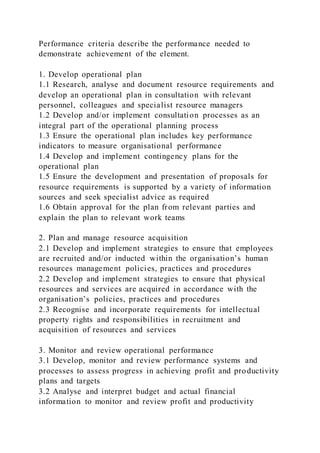
Manage operational
plan
1
Housekeeping
Emergency procedures
Mobiles and security issues
Break times and smoking policy
This course is interactive – ask questions
Practise respect and confidentiality
Ground rules
2
Objectives
Discover how to develop an operational plan
Learn how to plan and manage resource acquisition
Know how to monitor and review operational performance
Gain skills and knowledge required for this unit
Develop operational plan
1.1 Research, analyse and document resource requirements and
develop an operational plan in consultation with relevant
personnel, colleagues and specialist resource managers
4
What is an operational plan?
An operational plan is derived from the strategic plan of the
organisation and is a detailed plan to accomplish the objectives
of the organisation
To be successful, your team should:
raise funds
allocate resources to fill gaps
clearly identify resource needs
have contingency plans
know the length of a project and sustain it.
Strategic plan
A strategic plan is written to answer:
What do we do?
Who are we doing it for?
How will we be successful?
Operational plan
You write an operational plan to answer:
Where are we now?
What do we want to be?
How do we get there?
What method/s can we use to measure our progress?
What is in an operational plan?
Organisational structure
Current and future desired goals
Who are the suppliers?
How many staff is required?
Facilities.
What is in an operational plan?
Production and manufacturing
Inventory
Distribution
Maintenance and service including customer service
Labour
Quality assurance, such
as how performance is
measured.
Effective operational plan
For an operational plan to be effective, it must:
Have clear goals, procedures, objectives, schedules and budgets
Include performance targets
Set timeframes
Have contingency plans
Issue responsibilities
Include strong cohesive teams.
Relevant personnel to consult with
Employees at the same level or more senior managers
Managers
Occupational health and safety committee/s and other people
with specialist responsibilities
Supervisors
Union or employee representatives.
Research, analyse and document resource requirements, that
include:
Goods and services to be purchased and ordered
Human, physical and financial resources - both current and
projected
Stock requirements and requisitions.
To make decisions, consider:
Consult with staff
Activity 1A
15
Develop operational plan
1.2 Develop and/or implement consultation processes as an
integral part of the operational planning process
16
What is consultation?
Consultation is the process where you gather information from
both internal and external personnel to ensure that you can
make an informed decision
Consultation is a key principle in ensuring that your
organisation has a sound planning
and decision-making process.
Effective consultation
For consultation to be effective, you must start consulting early
in the process
Consulting requires that all parties are honest, open and
committed to the project
Consulting when performed
this way will assist in
enhancing relationships
between all parties.
Consultation processes
Consultation processes may refer to:
Email/intranet communications
Newsletters
Other processes and devices surveys, questionnaires and
informal sessions
Meetings
Interviews
Brainstorming sessions.
Feedback
Feedback is the process in what part of the output of a system is
returned to its input in order to regulate more output
Once you have gathered
both the formal and/or
informal information, you
should review it and select
any ideas of value to the
planning process.
Activity 1B
21
Develop operational plan
1.3 Ensure the operational plan includes key performance
indicators to measure organisational performance
22
Key Performance Indicators (KPIs)
KPIs will assist you in the planning process
They will provide you with quantifiable measurements that will
reflect the success factors of the organisation
To be successful, KPIs must
reflect the organisation’s goals,
they must relate to the
organisation’s success, and
they must be quantifiable.
To write a KPI
2. KPIs have four components which are the:
i) Objective that tells what you aim to do. Example: To increase
sales
ii) Measurement is the measurement we use. Example: Sales
growth
3. These KPIs should be passed to their appropriate
subordinates.
1. Once a manager has formulated the department’s objectives
in line with its vision, mission, strategies and objectives.
4. The KPI is then monitored usually directly by the manager to
ensure that the KPIs have been met.
iii) Target is what we want to achieve and when. Example:
increase sales growth by 20% in 2011
iv) Initiatives is a set of all of the above actions, Example:
(i)To increase sale (ii) growth (iii) by 20% in 2011
Activity 1C
25
Develop operational plan
1.4 Develop and implement contingency plans for the
operational plan
26
A contingency plan
Simply a secondary or alternative plan that can be implemented
when the original plan fails
These plans allow businesses and other entities to adjust as the
circumstances change
and you remain in operation
Most organisations have several
contingency plans geared to fast
responses in areas of operation.
Steps for creating a
contingency plan
Complete an impact assessment
Build the plan
Develop recovery strategies
Select suitable measures and control
Identify your needs
Identify your needs
Write the objectives of the contingency plan
State who is responsible for the development, maintenance and
implementation of the plan
Ask what is the scope of the plan
including which departments
participate in the execution of the plan?
Know how you will review the plan
Ask what resources, testing and training is involved in the plan?
Know how the plan will be maintained, backed up and stored.
To create an impact assessment
1. Identify the risks
What is the risk and the possible treatments for the risk?
2. What level of risk does the project pose?
What would happen if the risk happened?
3. What is the chance of each risk happening?
What is the potential of the risk?
4. Formulate a response
Design a plan in the case that the problem eventuates.
Select measures and controls
Once you identify the impact that disruptions can have, you
should consider preventative measures
Prevention is better than a cure. This will end up as a cost
assessment.
Develop recovery strategies
1.Transfer the risk to another party
2. Avoid the risk
3.Reduce the negative impact of the risk
4. Accept some or all of the consequences of the risk
Build the plan
Once you have identified the levels of risk, it is essential that
you determine how to best service the plan by identifying
contingencies
Costs play a part of the plan so it
is important to make sure that
any contingencies stay within
the budget set.
Test, train and maintain
Make sure that all staff are ready for any contingency. This
means that you may need to test the contingency and to train
your staff to ensure that the plan runs smoothly.
Contingency plans
Contingency plans may include:
Contracting out or outsourcing human resources and other
functions or tasks
Diversification of outcomes
Finding cheaper or lower quality raw materials and consumables
Increasing sales or production
Recycling and re-using
Succession planning
Continued..
Rental, hire purchase or alternative means of procurement of
required materials, equipment and stock
Restructuring of organisation to reduce labour costs
Risk identification, assessment and
management processes
Seeking further funding
Strategies for reducing costs,
wastage, stock or consumables.
Activity 1D
37
Develop operational plan
1.5 Ensure the development and presentation of proposals for
resource requirements is supported by a variety of information
sources and seek specialist advice as required
38
Strategic goals
Can only be reached when
organisational activities are
completed to implement the
operational plan
To get a larger slice of the
budget, you need to
develop a business proposal.
Develop a business proposal
1. Identify strategic goals
2. Prioritise strategic goals
3. Conclusion
Present the proposal
The use of graphs to demonstrate costs, savings from previous
years
Strategies you considered and why you did not present them –
these can also be operational plans to support the strategic
plans.
Conclusions with the use of facts from your research.
A power point presentation with all of the key points of the
proposal
Contingency plans and risk management plans and when they
would be used and their impact on the proposal
Activity 1E
42
Develop operational plan
1.6 Ensure the development and presentation of proposals for
resource requirements is supported by a variety of information
sources and seek specialist advice as required
43
Obtain approval
Follow organisational policy and procedure
Stay as close to the timeline as possible within the approved
budget.
Develop SMART goals
Activity 1F
46
Plan and manage resource acquisition
2.1 Develop and implement strategies to ensure that employees
are recruited and/or inducted within the organisation’s human
resources management policies, practices and procedures
47
Human Resources policy and procedures
Obtaining approval for the advertisement for a job requirement
Budgeting and costs
Advertisement, interviewing
and selection of the applicants;
is there a budget allocated?
Attraction and retention
Reference checking
Induction.
Approval to employ staff
Once approval to employ staff is accepted, you need to:
Plan and review the role
Develop a selection criteria
Decide whether to outsource (use a recruitment agency) or the
use internal HR resources
Put together a panel
Plan the time for the
recruitment to take place.
Do not forget...
Outsourcing versus the HR Department
The costs
The applicants
Make sure the selection criteria
matches as close to the resume
as possible.
Activity 2A
51
Plan and manage resource acquisition
2.2 Develop and implement strategies to ensure that physical
resources and services are acquired in accordance with the
organisation’s policies, practices and procedures
52
Supplier relationships
Relationship between the organisation and suppliers
To save on costs increase the supplier relationship by:
using TQM to build
lasting relationships
using JIT to save
in storage costs
which in turns
saves on
production costs.
Internal suppliers
Costs savings through:
Franchises
Networks
Customers
Measuring costs
What the supplier is looking for in the relationship
The way that the supplier is used by your organisation
How it relates to your organisation’s relationships with other
suppliers
Relationship costs and benefits –
Take the time to read this in your
learner guide.
Barriers to maintaining effective customer relationships
Bad communication
Not keeping it simple
Not knowing what is in it for yourself and the supplier
Not having a strong leadership team.
What influences the choice of supplier?
Organisational culture
Organisational guidelines which govern and prescribe
operational functions, such as the acquisition and management
of human and physical resources
Standard operating procedures
Undocumented practices in line with organisational operations.
Activity 2B
58
Plan and manage resource acquisition
2.3 Recognise and incorporate requirements for intellectual
property rights and responsibilities in recruitment and
acquisition of resources and services
59
Intellectual property rights and responsibilities
When recruiting and acquiring resources and services, you need
to be aware of intellectual property rights and responsibilities.
Non-compliance with intellectual property requirements can
result in serious legal consequences, so it is important with the
concept – you must make every effort to comply with them
when acquiring resources and services.
Intellectual property within the organisation
Policies, procedures and information may include:
Intellectual property policy
Licensing agreements
Procedures for ensuring copyright protection
Procedures for registering intellectual property rights
Register of intellectual property assets
Activity 2C
62
Monitor and review operational performance
3.1 Develop, monitor and review performance systems and
processes to assess progress in achieving profit and productivity
plans and targets
63
"Performance management is the process of creating a work
environment or setting in which people are enabled to perform
to the best of their abilities. Performance management is a
whole work system that begins when a job is defined as needed.
It ends when an employee leaves your organisation."
Source: humanresources.about.com
Tools for measuring different types of performance
Measuring quality
quality assessment
quality monitoring
external evaluation of quality
Performance appraisals
Process appraisals
break downs
process report.
Processing performance
When processing performance, remember to ask:
The time in which the measurement took place
Did the measurement stay within acceptable performance
limits?
Have there been any changes
that will impact on the
measurement? If yes, how?
What is the level of quality
expected? Was this level
acceptable? Why? Why not?
Activity 3A
67
Monitor and review operational performance
3.2 Analyse and interpret budget and actual financial
information to monitor and review profit and productivity
performance
68
Financial information
Financial information to monitor, includes:
Budgets
Ratio analysis
Budget forecasts
Cash flow statements
Profit and loss statement
Balance sheets
Investment and liability reports.
Activity 3B
70
Monitor and review operational performance
3.3 Identify areas of under-performance, recommend solutions
and take prompt action to rectify the situation
71
Continuous improvement
“The process of increasing the quality and services through
incremental gains accompanied by occasional innovation.”
(Kuratko and Hodgetts, 1995, p.697)
Innovation and change
Innovation is the development of a new idea or a new
innovation. Innovation is looking at different ways to improve
your job while retaining the same standards in the quality of
your output. Innovation plays a huge role in your workplace
Innovation means the need to change
Change is implemented to make
a job run more smoothly.
Factors affecting output and quality
An increase in output can be caused by:
Technological change
Economic change
Management trends
Political change
Variations to improvement processes
Consider advantages and disadvantages to an improvement
Consider impact to other
departments in the process
Good versus bad.
Action learning
Action learning
Success of action learning comes from teams values, including:
Openness, trust and collaboration
Team spirit, respect for diversity; and
Tolerance of mistakes from which we learn.
Activity 3C
78
Monitor and review operational performance
3.4 Plan and implement systems to ensure that mentoring and
coaching are provided to support individuals and teams to
effectively, economically and safely use resources
79
Gap analysis
The gap between level of performance demonstrated and the
desired level of performance
If a gap in skill level is identified:
coaches should be used to
address job focused and
performance oriented problems
such as reaching goals and outcomes.
mentors should be used to address performance related issues
such as lack of confidence and lack of motivation.
Activity 3D
81
Monitor and review operational performance
3.5 Negotiate recommendations for variations to operational
plans and gain approval from designated persons/groups
82
Negotiation
“a process in which two or more parties who have both common
and conflicting interest bring forth and discuss explicit terms of
possible agreement”
(Collins, 2004, p.207)
Types of negotiation
Hard negotiator: Where negotiation is seen as a test of wills and
who will finish off better. They will win at any cost and as such
will damage relationships.
Types of negotiation
Soft Negotiator: Where negotiators want to avoid conflict. The
negotiator does this by amicable agreement, with the least
amount of fuss and bother, so they make concessions. These
concessions make them feel exploited and that the other parties
are taking unfair advantage of them.
Types of negotiation
Principle Negotiation: A combination of both hard and soft. It is
about getting what you are entitled to and preserving your
relationship with other parties. It can be used in any situation
by many people, irrespective of whether they are experienced or
not.
The Principle negotiator has three elements
Separates people from the problem
It focuses on interest not positions
It develops options.
Consistency of recommendations through policies and
procedures
Benchmarking and continuous improvement followed by an
update of the procedures
Benchmarking means that the organisation will be looking for
the best way in which to
implement improvement
procedures.
Negotiation styles
Competition: A win/lose approach
which leads to confrontation
Compromise: A win/win approach
which is optimal
Co-operation: A win/win approach
which creates joint problem solving
Accommodation: A lose/win approach which leads to
capitulation
Avoidance: A lose/lose approach that leads to withdrawal.
Communication updates to designated personnel
Groups designated in workplace
policies and procedures
Managers or supervisors
whose roles and responsibilities
include decision making on
operations
Other stakeholders such as board members
Other work groups or teams whose work will be affected by
recommendations for variations.
Activity 3E
91
Monitor and review operational performance
3.6 Develop and implement systems to ensure that procedures
and records associated with documenting performance are
managed in accordance with organisational requirements
92
Documentation
Documentation may include:
Operational plans
Strategic goals
SMART goals
Contingency plans
Job advertisement
Selection criteria and duty statement
Quality improvement and performance appraisals.
Activity 3F
94
Skills and Knowledge Activity
95
Major Activity
This activity should take anywhere between an 1-2 hours to
complete and can be found at the end of your workbook.
Your instructor will let you know whether they wish for you to
complete it in session time or your own time.
Summary and Feedback
Did we meet our objectives?
How did you find this session?
Any questions?
97
Congratulations!
You have now finished the unit…
‘Manage operational plan’
98
Page | 20
BSBMGT517
Manage operational plan
Learner Workbook
Table of Contents
Table of Contents1
Candidate Details2
Assessment – BSBMGT517: Manage operational plan2
Competency Record to be completed by Assessor3
Observation/Demonstration4
Activities5
Activity 1A5
Activity 1B6
Activity 1C7
Activity 1D8
Activity 1E9
Activity 1F10
Activity 2A11
Activity 2B12
Activity 2C13
Activity 3A14
Activity 3B15
Activity 3C16
Activity 3D17
Activity 3E18
Activity 3F19
Skills and Knowledge Activity20
Major Activity21
Candidate Details
Assessment – BSBMGT517: Manage operational plan
Please complete the following activities and hand in to your
trainer for marking. This forms part of your assessment for
BSBMGT517: Manage operational plan. Remember to always
keep a copy of your assessment before submitting.
Name:
________________________________________________
_____________
Email:
________________________________________________
_____________
Employer:
________________________________________________
_____________
Declaration
I declare that no part of this assessment has been copied from
another person’s work with the exception of where I have listed
or referenced documents or work and that no part of this
assessment has been written for me by another person.
Signed:
________________________________________________
____________
Date:
________________________________________________
____________
If activities have been completed as part of a small group or in
pairs, details of the learners involved should be provided below:
This activity workbook has been completed by the following
persons and we acknowledge that it was a fair team effort where
everyone contributed equally to the work completed. We
declare that no part of this assessment has been copied fr om
another person’s work with the exception of where we have
listed or referenced documents or work and that no part of this
assessment has been written for us by another person.
Learner 1:
________________________________________________
____________
Signed:
________________________________________________
____________
Learner 2:
________________________________________________
____________
Signed:
________________________________________________
____________
Learner 3:
________________________________________________
____________
Signed:
________________________________________________
____________
Competency Record to be completed by Assessor
Learner Name: __________________________
Date of Submission: __________________________
Date of Assessment: __________________________
The learner has been assessed as competent in the elements and
performance criteria and the evidence has been presented as:
Satisfactory (S)
Non-Satisfactory (NS)
Assessor Initials
Activities 1A – 3F
Skills and Knowledge Questions
Major Project
Learner is deemed: COMPETENT NOT YET COMPETENT
(Please Circle/Highlight)
1. Resubmission Date: ________________________
2. Resubmission Date: ________________________
3. Resubmission Date: ________________________
Comments from Trainer / Assessor:
_____________________________________________________
_____________________________________________________
_____________________________________________________
_____________________________________________________
_____________________________________________________
_____________________________________________________
_____________________________________________________
_____________________________________________________
_____________________________________________________
_____________________________________________________
_____________________________________________________
_____________________________________________________
____________________
Assessor Signature: ___________________________
Date: _______________________
Observation/Demonstration
Throughout this unit, you will be expected to show your
competency of the elements through observations or
demonstrations. Your instructor will have a list of
demonstrations you must complete or tasks to be observed. The
observations and demonstrations will be completed as well as
the activities found in this workbook. An explanation of
demonstrations and observations:
Demonstration is off-the-job
A demonstration will require:
Performing a skill or task that is asked of you
Undertaking a simulation exercise
Observation is on-the-job
The observation will usually require:
Performing a work based skill or task
Interaction with colleagues and/or customers
Your instructor will inform you of which one of the above they
would like you to do. The demonstration/observation will cover
one of the unit’s elements.
The observation/demonstration will take place either in the
workplace or the training environment, depending on the task to
be undertaken and whether it is an observation or
demonstration. Your instructor will ensure you are provided
with the correct equipment and/or materials to complete the
task. They will also inform you of how long you have to
complete the task.
You should be able to demonstrate you can:
1. Develop operational plan
2. Plan and manage resource acquisition
3. Monitor and review operational performance
You should also demonstrate the following skills:
· Reading
· Writing
· Oral Communication
· Numeracy
· Navigate the world of work
· Interact with others
· Get the work done
Activities
Activity 1A
Estimated Time
30 Minutes
Objective
To provide you with an opportunity to research, analyse and
document resource requirements and develop an operational
plan in consultation with relevant personnel, colleagues and
specialist resource managers.
Activity
Complete the following individually or in a group (as applicable
to the specific activity and the assessment environment):
What is the operational plan? Use an example of how to be a
successful team in your answer.
If possible, consult with the relevant personnel in your
organisation regarding an operational plan. Begin to develop the
main aspects of an operational plan using the examples of how
to be a successful team from your previous answer. Otherwise,
work in a group to develop a hypothetical operational plan for a
large corporation. You should consider:
· The project lifespan, sustainability and exit strategy
· Financial resource requirements
· Human resource requirements
· Risk assessment
Activity 1B
Estimated Time
20 Minutes
Objective
To provide you with the chance to develop and/or implement
consultation processes as an integral part of the operational
planning process.
Activity
Complete the following individually or in a group (as applicable
to the specific activity and the assessment environment):
List the ways in which you can communicate consultation
processes. Give an example of a time that you may use each
one.
What is feedback used for in the consultation process?
Develop a newsletter which informs staff about the operational
plan. Ensure there are opportunities for staff to respond.
Activity 1C
Estimated Time
15 Minutes
Objective
To provide you with an opportunity to ensure the operational
plan includes key performance indicators to measure
organisational performance.
Activity
Complete the following individually or in a group (as applicable
to the specific activity and the assessment environment):
What are the two key successful factors for a KPI?
Write a KPI related to your position. Write the operational goal
that you believe it is related to or provide a brief description of
the role that you are writing a KPI for.
Activity 1D
Estimated Time
30 Minutes
Objective
To provide you with an opportunity to develop and implement
contingency plans for the operational plan.
Activity
Complete the following individually or in a group (as applicable
to the specific activity and the assessment environment):
What is a contingency plan?
Briefly explain each step of developing a contingency plan.
The operational plan outlined in Activity 1A has failed.
Develop two contingency plans which could be used to alleviate
the situation.
Activity 1E
Estimated Time
30 Minutes
Objective
To provide you with an opportunity to ensure the development
and presentation of proposals for resource requirements is
supported by a variety of information sources and seek
specialist advice as required.
Activity
Complete the following individually or in a group (as applicable
to the specific activity and the assessment environment):
Describe the steps to writing a winning business proposal in
your own words.
When you write a proposal, why is it important to obtain
specialist advice?
When you present the business proposal, what information
should you include? Give examples of times when you may
present information in different ways.
Activity 1F
Estimated Time
30 Minutes
Objective
To provide you with an opportunity to obtain approval for the
plan from relevant parties and explain the plan to relevant work
teams.
Activity
Complete the following individually or in a group (as applicable
to the specific activity and the assessment environment):
You should now attempt to gain approval for your operational
plan from the relevant stakeholders in your organisation.
Write a smart goal for your job.
Activity 2A
Estimated Time
20 Minutes
Objective
To provide you with an opportunity to develop and implement
strategies to ensure that employees are recruited and/or inducted
within the organisation’s human resources management policies,
practices and procedures.
Activity
Complete the following individually or in a group (as applicable
to the specific activity and the assessment environment):
Briefly explain the importance of the following terms in relation
to recruitment:
· Outsourcing versus the HR Department
· Costs
· The recruitment process
Your organisation is looking recruit an individual for a position
which has become available within production. Develop a job
specification which can be used to advertise the position and is
in line with the organisation’s human resources management
policies, practices and procedures.
Activity 2B
Estimated Time
40 Minutes
Objective
To provide you with an opportunity to develop and implement
strategies to ensure that physical resources and services are
acquired in accordance with the organisation’s policies,
practices and procedures.
Activity
Complete the following individually or in a group (as applicable
to the specific activity and the assessment environment):
What is a supplier relationship?
What impact has just in time and total quality management had
on organisations in supplier relationships?
Who are the internal suppliers?
Why is it important to consider the relationship costs when you
build relationships with suppliers? What are relationship
benefits?
You have been tasked with recommending a supplier for your
organisation. What are some of the factors that will influence
the choice of supplier?
Activity 2C
Estimated Time
20 Minutes
Objective
To provide you with an opportunity to recognise and
incorporate requirements for intellectual property rights and
responsibilities in recruitment and acquisition of resources and
services
Activity
Complete the following individually or in a group (as applicable
to the specific activity and the assessment environment):
For your organisation, what resources and services have
intellectual property rights and responsibilities attached to
them? What measures do you need to take in order to prevent
non-compliance with these?
Activity 3A
Estimated Time
20 Minutes
Objective
To provide you with an opportunity to develop, monitor and
review performance systems and processes to assess progress in
achieving profit and productivity plans and targets.
Activity
Complete the following individually or in a group (as applicable
to the specific activity and the assessment environment):
You are required to monitor the performance of an employee
new to the organisation. Develop a system which will enable
you to monitor them over a four week period. Think about what
measurements you will need to use to establish the employee’s
progression.
Activity 3B
Estimated Time
40 Minutes
Objective
To provide you with an opportunity to analyse and interpret
budget and actual financial information to monitor and review
profit and productivity performance.
Activity
Complete the following individually or in a group (as applicable
to the specific activity and the assessment environment):
Describe two factors that may impact upon how much budget is
available to the organisation.
Locate your organisations financial information. Analyse the
relationship between your profit and loss statement and the rate
of sales over the past twelve months, and make two
observations about the relationship.
Activity 3C
Estimated Time
20 Minutes
Objective
To provide you with an opportunity to identify areas of under -
performance, recommend solutions and take prompt action to
rectify the situation.
Activity
Complete the following individually or in a group (as applicable
to the specific activity and the assessment environment):
You have identified that there are variations in production in
your office/ production line in regards to quality. Draw a flow
chart that your organisation uses to identify and correct a
problem in quality. Do not forget to demonstrate what will
happen if the suggested variation to strategy is rejected.
Activity 3D
Estimated Time
20 Minutes
Objective
To provide you with an opportunity to plan and implement
systems to ensure that mentoring and coaching are provided to
support individuals and teams to effectively, economically and
safely use resources.
Activity
Complete the following individually or in a group (as applicable
to the specific activity and the assessment environment):
A gap has been identified between accepted and desired
performance problems. What steps do you recommend to
support your team?
Activity 3E
Estimated Time
30 Minutes
Objective
To provide you with an opportunity to negotiate
recommendations for variations to operational plans and gain
approval from designated persons/groups.
Activity
Complete the following individually or in a group (as applicable
to the specific activity and the assessment environment):
Why is principle negotiation recommended over hard and soft
negotiation?
You want to implement a new piece of equipment into the
workplace which will increase productivity. In pairs, act out a
negotiation whereby a production manager must convince a
member of senior management that the equipment will be
profitable for the organisation.
Activity 3F
Estimated Time
15 Minutes
Objective
To provide you with an opportunity to develop and implement
systems to ensure that procedures and records associated with
documenting performance are managed in accordance with
organisational requirements.
Activity
Complete the following individually or in a group (as applicable
to the specific activity and the assessment environment):
List the documentation that you will need to collect throughout
the operational plan.
Why is it important that the documentation from the previous
answer is filed away once you have finished with them?
Skills and Knowledge Activity
Estimated Time
45 Minutes
Objective
To provide you with an opportunity to demonstrate your
knowledge of the foundation skills, knowledge evidence and
performance evidence.
Activity
Complete the following individually and attach your completed
work to your workbook.
The answers to the following questions will enable you to
demonstrate your knowledge of:
· Reading
· Writing
· Oral Communication
· Numeracy
· Navigate the world of work
· Interact with others
· Get the work done
· Models and methods for operational plans
· The role of an operational plan in achieving the organisation’s
objectives
· Budgeting processes
· Alternative approaches to developing key performance
indicators to meet business objectives
· Legislative and regulatory context relevant to the operational
plan of the organisation
· Organisation’s policies, practices and procedures that directly
relate to the operational plan
Answer each question in as much detail as possible, considering
your organisational requirements for each one.
All answers will vary depending on the learner and the
organisation they work for but the learner should be able to
answer each question competently.
1. Identify an area/department/member(s) of staff in your
organisation that requires improvement for any reason, for
example to increase productivity, advances in technology have
made it obsolete or colleague under-performance is affecting
output.
Write an organisational plan that details your proposal for the
improvement that you are going to submit to the relevant
management for consideration.
You will need to include:
· The lifespan, sustainability and exit strategy of the plan
· Financial resource requirements
· Human resource and other capacity requirements
· Risk assessment and mitigation strategy
· How you intend to implement it
· How you intend to measure it (KPIs)
Major Activity
Estimated Time
2 Hours
Objective
To provide you with an opportunity to demonstrate your
knowledge of the entire unit.
Activity
This is a major activity – you should let the learners know
whether they will complete it during class or in their own time.
Completed answers should be attached to the workbook.
They must individually, answer the following questions in full
to show their competency of each element:
1. Develop operational plan
2. Plan and manage resource acquisition
3. Monitor and review operational performance
1. Complete the following and present it as a portfolio (attach it
to the workbook):
Project
You have been employed to develop a new department for the
training and development of the administrative and sales team
for your employer at a personnel recruitment company. Due to
demand they have opened two offices, one in Melbourne and
one in Adelaide. This expansion has led to a tight budget within
the organisation for the fiscal year. You need to keep the budget
at a minimal amount.
The strategic goal that you have been asked to concentrate on is
to increase sales by 8% by the end of 2011.
Five staff in the administration department handle enquiries in
regards to sales to the organisations that they provide with
personnel (both permanent and temporary.
There are ten recruitment personnel who have the primary
responsibility to manage their case load and follow up leads for
new opportunities.
As a well established organisation, Excel Personnel is a family
owned company that believes in gaining and retaining customers
through customer service excellence. Though the company has
managed to retain their long standing personnel, several of their
newer clients have changed recruitment companies in the last
six months. Concerned with the loss of clients and no trend in
the customers’ move, the board of directors have decided to
train their team on the latest customer service skills.
For this project:
· All plans, goals and recommendations must flow together to
support the strategic plan
· You may vary your plans, goals, strategies and
recommendations as you progress through each part of this
project. Put a line through the change and briefly outline why
you made an update on the operational plan. This is a normal
part of the development of a plan. As new information is
introduced, you may decide to change your operational plan
· This is a preliminary operational plan that you are drawing up,
so use bullet points (unless advised by your trainer).
You have been asked to develop an operational plan. In the
report you must:
· Clearly state the operational goals and how they are related to
strategic plan
· List resources and funds to meet these goals
· Identify the relevant personnel that you should consult with in
regards to the operational goals and the resultant action plans
required to meet the operational goals
· Include what communication methods you should use to
maintain a record of the consultation process. Why?
· Include what feedback processes you would recommend
should be put in place
· Include what KPIs you would recommend to measure
organisational performance in regards to the training (Write at
least two)
· Create at least two contingency plans if the employees in both
departments do not meet the KPIs.
· Develop a business proposal (discuss this with your trainer
and as a class using what you have learnt to develop and
prioritise your strategies).
· Draw a flow chart of the relevant parties who you should
obtain approval from for this business proposal
· You need to also briefly outline how you would recommend
that staff have the plan communicated to them. Use at least one
smart goal to measure the team members demonstrating an
understanding of the proposal
· The organisation has two external recruitment personnel who
are contracted as a supplier by referring potential customers to
Excel Personnel. They have both recently slowed down in
referring customers to Excel Personnel. Briefly outline in bullet
points how you would strengthen the supplier relationship with
them
· Based on your KPIs, smart goals, communication and feedback
processes and the organisation’s operational plans, recommend
what and how you will measure performance?
· Develop one tool based on your recommendations. (This tool
must reflect the goals)
· How will you monitor financial information? What do you
need to watch for when reviewing this information? Why?
· Based on information that you have already received when you
spoke to staff, there seems to be a mixture of performance and
lack of skills with staff. Some of these problems stem from the
department managers. How would you handle any under-
performance issues in regards to these skills and the level of
performance? In this answer, please refer to the factors that
affect output and quality to justify a lack of skills and
performance
· There is a lack of openness and trust between the departments
and this is having a negative impact on morale. Recommend
ways in which you can overcome this
· Draw a flow chart on the processes that you believe should be
put in place for the approval of any variations to this plan
(Include who you should consult with in this flow chart)
· Using the documents that you have recommended in this
project and developed, draw a flow chart on how the variation
should be implemented after it has been approved.
MSA Training and Professional Development Phone: 03
9905 3180
Room 159, 21 Chancellors Walk Website:
msatraining.edu.au
Monash University Clayton, Vic 3800
BSBMGT517 Manage operational Plan V3.2 28/07/2020
Page | 64
Page | 65
BSBMGT517
Manage operational plan
Learner Guide
Table of Contents
Table of Contents2
Unit of Competency5
Performance Criteria6
Foundation Skills7
Assessment Requirements9
Housekeeping Items10
Objectives10
1. Develop operational plan11
1.1 – Research, analyse and document resource requirements
and develop an operational plan in consultation with relevant
personnel, colleagues and specialist resource managers12
What is an operational plan?12
Research, analyse and document resource requirements14
Activity 1A17
1.2 – Develop and/or implement consultation processes as an
integral part of the operational planning process18
Consultation processes18
Feedback19
Activity 1B20
1.3 – Ensure the operational plan includes key performance
indicators to measure organisational performance22
Key Performance Indicators (KPIs)22
How to write a Key Performance Indicator22
Activity 1C24
1.4 – Develop and implement contingency plans for the
operational plan25
Contingency plans25
Steps for creating a contingency plan25
Activity 1D29
1.5 – Ensure the development and presentation of proposals for
resource requirements is supported by a variety of information
sources and seek specialist advice as required30
Raising funds30
Develop a business proposal30
Activity 1E34
34
1.6 – Obtain approval for the plan from relevant parties and
explain the plan to relevant work teams35
Obtaining approval35
Activity 1F38
2. Plan and manage resource acquisition39
2.1 – Develop and implement strategies to ensure that
employees are recruited and/or inducted within the
organisation’s human resources management policies, practices
and procedures40
Human resources policies and procedures40
Outsourcing versus the HR department42
Activity 2A43
2.2 – Develop and implement strategies to ensure that physical
resources and services are acquired in accordance with the
organisation’s policies, practices and procedures45
Supplier relationship45
Internal suppliers46
The value of a supplier relationship48
Purchase order example50
Activity 2B51
2.3 – Recognise and incorporate requirements for intellectual
property rights and responsibilities in recruitment and
acquisition of resources and services52
Intellectual property rights and responsibilities52
Activity 2C58
3. Monitor and review operational performance59
3.1 – Develop, monitor and review performance systems and
processes to assess progress in achieving profit and pr oductivity
plans and targets60
Performance management systems60
Activity 3A65
3.2 – Analyse and interpret budget and actual financial
information to monitor and review profit and productivity
performance66
Budget and financial information66
Activity 3B67
3.3 – Identify areas of under-performance, recommend solutions
and take prompt action to rectify the situation68
Rectifying under-performance68
Factors affecting output and quality69
Variations to improvement processes70
Activity 3C73
3.4 – Plan and implement systems to ensure that mentoring and
coaching are provided to support individuals and teams to
effectively, economically and safely use resources74
Mentoring and coaching74
Activity 3D 75
3.5 – Negotiate recommendations for variations to operational
plans and gain approval from designated persons/groups76
Negotiation76
The process of negotiation77
Consistency of recommendations78
Activity 3E79
3.6 – Develop and implement systems to ensure that procedures
and records associated with documenting performance are
managed in accordance with organisational requirements80
Documentation80
Activity 3F81
Skills and Knowledge Activity82
Major Activity – An opportunity to revise the unit83
References85
Unit of Competency
Application
This unit describes the skills and knowledge required to develop
and monitor implementation of the operational plan to provide
efficient and effective workplace practices within the
organisation’s productivity and profitability plans.
Management at a strategic level requires systems and
procedures to be developed and implemented to facilitate the
organisation’s operational plan.
This unit applies to individuals who manage the work of others
and operate within the parameters of a broader strategic and/or
business plan.
No licensing, legislative or certification requirements apply to
this unit at the time of publication.
Unit Sector
Management and Leadership – Management
Performance Criteria
Element
Elements describe the essential outcomes.
Performance Criteria
Performance criteria describe the performance needed to
demonstrate achievement of the element.
1. Develop operational plan
1.1 Research, analyse and document resource requirements and
develop an operational plan in consultation with relevant
personnel, colleagues and specialist resource managers
1.2 Develop and/or implement consultation processes as an
integral part of the operational planning process
1.3 Ensure the operational plan includes key performance
indicators to measure organisational performance
1.4 Develop and implement contingency plans for the
operational plan
1.5 Ensure the development and presentation of proposals for
resource requirements is supported by a variety of information
sources and seek specialist advice as required
1.6 Obtain approval for the plan from relevant parties and
explain the plan to relevant work teams
2. Plan and manage resource acquisition
2.1 Develop and implement strategies to ensure that employees
are recruited and/or inducted within the organisation’s human
resources management policies, practices and procedures
2.2 Develop and implement strategies to ensure that physical
resources and services are acquired in accordance with the
organisation’s policies, practices and procedures
2.3 Recognise and incorporate requirements for intellectual
property rights and responsibilities in recruitment and
acquisition of resources and services
3. Monitor and review operational performance
3.1 Develop, monitor and review performance systems and
processes to assess progress in achieving profit and productivity
plans and targets
3.2 Analyse and interpret budget and actual financial
information to monitor and review profit and productivity
performance
3.3 Identify areas of under-performance, recommend solutions
and take prompt action to rectify the situation
3.4 Plan and implement systems to ensure that mentoring and
coaching are provided to support individuals and teams to
effectively, economically and safely use resources
3.5 Negotiate recommendations for variations to operational
plans and gain approval from designated persons/groups
3.6 Develop and implement systems to ensure that procedures
and records associated with documenting performance are
managed in accordance with organisational requirements
Element
Element describes the essential outcomes
Performance Criteria
Performance criteria describes the performance needed to
demonstrate achievement of the element
Foundation Skills
This section describes language, literacy, numeracy and
employment skills incorporated in the performance criteria that
are required for competent performance.
Skill
Performance Criteria
Description
Reading
1.1, 1.5, 2.1, 2.2, 3.1, 3.2, 3.3, 3.4, 3.6
· Identifies and extracts relevant information from a range of
complex texts
· Gathers, interprets and analyses workplace documentation to
determine requirements for the operational plan
Writing
1.1-1.5, 2.1, 2.2, 3.1-3.6
· Develops and documents a range of detailed texts relating to
the management of an operational plan according to
organisational requirements
· Ensures the vocabulary, grammatical structures and
conventions are appropriate for the context and target audience
Oral Communication
1.1, 1.2, 1.5, 1.6, 3.4, 3.5
· Presents information to a range of audiences using appropriate
register, vocabulary and paralinguistic features
· Listens and comprehends information from a variety of spoken
exchanges with clients, co-workers and other stakeholders
· Confirms understanding through questioning and active
listening
Numeracy
1.1, 1.3, 1.4, 3.1-3.4
· Selects and uses mathematical problem-solving strategies to
organise resource requirements, performance benchmarks and
financial viability of the operational plan
Navigate the world of work
2.1, 2.2, 3.4, 3.6
· Monitors adherence to organisational policies, procedures and
considers own role in terms of its contribution to broader goals
of the work environment
· Appreciates the implications of legal responsibilities with
specific reference to health and safety
Interact with others
1.1, 1.2, 1.5, 1.6, 3.5
· Identifies and uses appropriate conventions and protocols
when communicating with colleagues and external stakeholders
· Collaborates with others to achieve joint outcomes, playing an
active role in facilitating effective group interaction,
influencing direction and taking a leadership role on occasion
Get the work done
1.1-1.5, 2.1, 2.2, 3.1, 3.3, 3.4, 3.6
· Takes responsibility for developing and implementing systems
and processes to achieve organisational objectives, seeking
advice, feedback and support as required to assist in the
development and planning phase
· Sequences and schedules complex activities, monitors
implementation, and manages relevant communication
· Uses systematic analytical processes to aid decision making,
identify potential problems and generate contingency plans or
solutions
Assessment Requirements
Performance Evidence
Evidence of the ability to:
· Develop and implement an operational plan using a variety of
information sources and consultation (including using specialist
advice if required) which includes:
· resource requirements
· key performance indicators
· monitoring processes
· contingency plans
· Communicate effectively with relevant stakeholders to explain
the plan and supporting information, seek approvals, negotiate
variations and engage work teams
· Develop and implement strategies to achieve the operational
plan within the organisation’s policies, practices and procedures
including:
· recruiting, inducting and developing personnel
· acquiring physical resources and services
· protecting intellectual property
· making variations to the plan
· monitoring and documenting performance.
Note: If a specific volume or frequency is not stated, then
evidence must be provided at least once.
Knowledge Evidence
To complete the unit requirements safely and effectively, the
individual must:
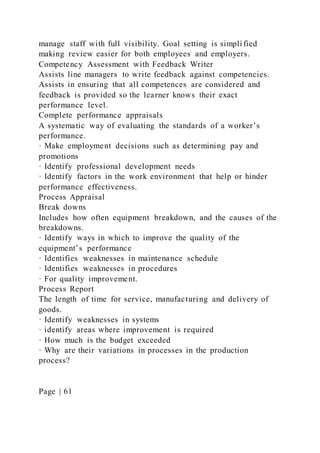
· Describe models and methods for operational plans
· Explain the role of an operational plan in achieving the
organisation’s objectives
· Explain budgeting processes
· List alternative approaches to developing key performance
indicators to meet business objectives
· Outline the legislative and regulatory context relevant to the
operational plan of the organisation
· Outline the organisation’s policies, practices and procedures
that directly relate to the operational plan.
Assessment Conditions
Assessment must be conducted in a safe environment where
evidence gathered demonstrates consistent performance of
typical activities experienced in the management and leadership
field of work and include access to:
· Relevant legislation and regulations
· Workplace documentation and resources
· Case studies and, where possible, real situations
· Interaction with others.
Links
Companion volumes are available from the IBSA website:
http://www.ibsa.org.au/companion_volume s -
http://www.ibsa.org.au/companion_volumesHousekeeping Items
Your trainer will inform you of the following:
Where the toilets and fire exits are located, what the emergency
procedures are and where the breakout and refreshment areas
are.
Any rules, for example asking that all mobile phones are set to
silent and of any security issues they need to be aware of.
What times the breaks will be held and what the smoking policy
is.
That this is an interactive course and you should ask questions.
That to get the most out of this workshop, we must all work
together, listen to each other, explore new ideas, and make
mistakes. After all, that’s how we learn.
Ground rules for participation:
Smile
Support and encourage other participants
When someone is contributing everyone else is quiet
Be patient with others who may not be grasping the ideas
Be on time
Focus discussion on the topic
Speak to the trainer if you have any concernsObjectives
Discover how to develop an operational plan
Learn how to plan and manage resource acquisition
Know how to monitor and review operational performance
Gain skills and knowledge required for this unit
1. Develop operational plan
1.1. Research, analyse and document resource requirements and
develop an operational plan in consultation with relevant
personnel, colleagues and specialist resource managers
1.2. Develop and/or implement consultation processes as an
integral part of the operational planning process
1.3. Ensure the operational plan includes key performance
indicators to measure organisational performance
1.4. Develop and implement contingency plans for the
operational plan
1.5. Ensure the development and presentation of proposals for
resource requirements is supported by a variety of information
sources and seek specialist advice as required
1.6. Obtain approval for the plan from relevant parties and
explain the plan to relevant work teams
1.1 – Research, analyse and document resource requirements
and develop an operational plan in consultation with relevant
personnel, colleagues and specialist resource managers
What is an operational plan?
An operational plan is derived from the strategic plan of the
organisation and is a detailed plan to accomplish the objectives
of the organisation.
An operational plan is essential to implement successfully.
Failure to do so could lead to the failure of the action and
monitoring plans.
To ensure that the operational plan is successful, your team
should:
Raise funds – this requires that you are very clear on what
resources you need and have the ability to convince your
investors for a successful completion of your project
Allocate resources to fill gaps and needs
Clearly identify your resource requirements and your ability to
fill the gap
Have contingency plans to minimise risk
What is the length of the project and how can you sustain it?
An operational plan does not usually exist alone, rather the key
components are integrated together to form the strategic plan.
The key components of an operational plan include:
Estimation of project lifespan, sustainability and exit strategy
How long will this project last, when and how will you
complete the project? How can the project be sustained?
Financial resource requirements
How much money is needed to fund the project, your current
sources of income and potential sources of income, what funds
you need and any gaps in funding that you identified
Human resource and other capacity requirements
Determine the capacity and skills of the human resources
currently available to complete a project. Consider where the
sources of these resources will come from. What other
requirements are needed to implement the project
Risk assessment and mitigation strategy
What risks may be addressed and what are they?
Strategic planning is the process in which an organisation
defines its strategy, whereas an operational plan defines the
short term methods of achieving the strategic plans.
Strategic planning is proactive and often spans years.
Conversely the operational plan is also proactive but can change
to meet the organisation’s current requirements. Operational
plans last 1-three years and are considered short term.
When you write a strategic plan, you need to ask:
What do we do?
Who are we doing it for?
How will we be successful?
On the other hand, when you write an operational plan, you
need to be able to answer:
Where are we now?
What do we want to be?
How do we get there?
What method/s can we use to measure our progress?
Operational plans will contain the following details:
Organisational structure
Current and future desired goals
Who are the suppliers?
How many staff are required?
Facilities
Production and manufacturing
Inventory
Distribution
Maintenance and service including customer service
Labour
Quality Assurance, such as how is performance measured?
For an operational plan to be effective, it must:
Have clear goals, procedures, objectives, schedules and budgets
Include performance targets
Set timeframes
Have contingency plans
Issue responsibilities
Include strong cohesive teams.
“A leader is the organisation’s top strategist, systematically
envisioning the future and specifically mapping out how to get
there.” As a part of the creative thinking process, and to take
advantage of the skills, knowledge and experience of your team,
it is important to let them participate in the decision making
process. If they can see their contributions acknowledged, then
they will take ownership of the project.
Relevant personnel, colleagues and specialist resource
managersmay include:
Employees at the same level or more senior managers
Managers
Occupational health and safety committee/s and other people
with specialist responsibilities
Supervisors
Union or employee representatives.
Ask staff and relevant parties to participate in weekly meetings
presenting their ideas, feedback and any prospects.
Acknowledge their contributions and encouragement. Planning
is an important part of the process. Every staff member must
come to the meeting prepared and with ideas. Make sure your
team understands the importance of meeting the goals.
Research, analyse and document resource requirements
It is essential that all goals and objectives continue on from the
strategic plan and build the requirements to ensure that your
plans are effective. In each step of the process, you must ensure
that you have the required resources to meet the required goals.
Resource requirements may include:
Goods and services to be purchased and ordered
Human, physical and financial resources – both current and
projected
Stock requirements and requisitions.
Based on your budget, teams will be allocated sufficiently to
meet their goals. At times, if control is not maintained on the
allocation of resources, then team members’ ability to meet
their end needs will be affected. To ensure that resources are
correctly allocated, a detailed plan needs to be completed so
that individuals can complete their prescribed tasks in a timely
manner.
When determining actions, you must be able the following
questions:
To answer these questions you should question the team
members and stakeholders who would be in a place where they
would know the answers to each question. In dealing with
operational concerns and the allocation of human resources, you
should research any staff problems.
For example:
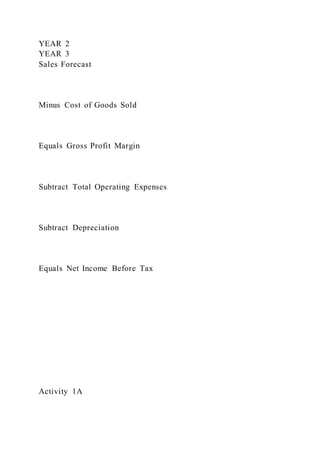
You may be required to demonstrate these answers on a
spreadsheet.
PROJECTED INCOME SUMMARY
YEAR 1
YEAR 2
YEAR 3
Sales Forecast
Minus Cost of Goods Sold
Equals Gross Profit Margin
Subtract Total Operating Expenses
Subtract Depreciation
Equals Net Income Before Tax
Activity 1A
1.2 – Develop and/or implement consultation processes as an
integral part of the operational planning process
Consultation processes
Consultation is the process where you gather information from
both internal and external personnel to ensure that you can
make an informed decision. Consultation is a key principle in
ensuring that your organisation has a sound planning and
decision-making process.
For consultation to be effective, you must start consulting early
in the process. Consulting requires that all parties are honest,
open and committed to the project. Consulting when performed
this way will assist in enhancing relationships between all
parties. If you use manipulation in the consultation process, the
process will fail.
The consultation method you use will vary depending on the
goal and outcome and will range from mere discussion through
to participatory decision-making. The method that you use
should be based on the input from your key informants and
stakeholders, who understand how best to involve the personnel
interested in a potential decision making process.
In large organisations, the consultation process is established by
management and the supervisors are responsible for
implementing the processes and employees are responsible for
actively participating in the consultative process. These
processes may be more formalised than having informal
sessions between parties. This may however be sufficient in
smaller organisations.
Make sure that you familiarise yourself with the processes and
procedures in place in your organisation. You may even be
required to consult with stakeholders in different ways. For
example, a manager that moves around as part of their position
may not be available very often. To ensure that he obtains your
message, you may need to send him/her an email. Conversely,
another manager in the same position may prefer that you call
him/her so that he can consult with you on a personal level.
An organisation may have a survey tool that is used during the
consultation process to maintain a record of feedback that can
be utilised to improve processes. The tool may be in the form of
a questionnaire or a survey that can identify problems with
processes and/or procedures.
Consultation processes may refer to:
Email/intranet communications
Email and intranet may be utilised as a paper trail as a form of
quality assurance. Some organisations may use emails to
identify ways in which to improve processes. It can also be used
to ensure that the same message reaches all staff, and staff have
an opportunity to respond, thereby contributing to the plans
Newsletters
Newsletters provide staff with information about plans and may
provide staff with opportunities to respond
Other processes and devices
Surveys, questionnaires and informal sessions may be used to
encourage staff to respond to the consultation process by
providing specific feedback about the operational plans
Meetings
Meetings may be either formal and/or informal. Informal
meetings can be at any time at any place. Formal meetings can
be in a more controlled environment where feedback is sought
Interviews
An interview is usually between two or more people. Structured
interviews provide management with answers to specific
questions that can provide feedback in relation to specific
aspects on the operational plan
Brainstorming sessions
Brainstorming sessions are used to generate new ideas and
solutions. It should not be used for analysis or decision making.
The ideas and solutions given should be analysed and judged to
ascertain their relevance. To obtain the most out of the feedback
session, you must ensure that you take the time to acknowledge
all participants for their efforts. If you do not acknowledge
them, they may not participate so openly again.
Consultation is an ongoing process that should provide you with
feedback in the shape of new ideas and different ways of
thought.
Feedback
Feedback is the process in which part of the output of a system
is returned to its input in order to regulate more output. Once
you have gathered both the formal and/or informal information,
you should review it and select any ideas of value to the
planning process.
Formal feedback is usually specific so can be more rigorous,
thus may have timelines that you need to be aware of. Keep to
the deadlines because they may have been developed to ensure
some part of the process is enhanced. This means that you
should set goals that you should adhere to.
Once you have made a decision in regards to the feedback, it is
important to make sure that it is communicated to the
appropriate stakeholders. Make sure that all and anybody who
participated in the process also receives a response. It is only
when feedback flows from the source to the stakeholders that
feedback becomes effective. When your stakeholders see the
positive effects of the feedback they have offered, they will
probably be more prone to make contributions to quality and
service in the next meeting. However, if there is no response to
their feedback they will probably be reluctant to contribute in
meetings.
Activity 1B
1.3 – Ensure the operational plan includes key performance
indicators to measure organisational performance
Key Performance Indicators (KPIs)
Key Performance Indicators (KPIs) will assist you in the
planning process. They will provide you with quantifiable
measurements that will reflect the success factors of the
organisation. To be successful, KPIs must reflect the
organisation’s goals, they must be to the organisation’s success,
and they must be quantifiable.
KPIs to reflect organisational goals
If an organisation’s goal is to “obtain a five percent increase in
our market” they will have key performance indicators to not
only increase profit, but also to increase sales and/or service.
These KPIs reflect the organisation’s performance and gives
staff a target to work towards.
KPIs to be quantifiable
If a KPI is not quantifiable, it is useless. KPIs such as “increase
sales” or “increase customer retention” need to specify an
amount. Instead of increase sales, you could have increase s ales
by five percent or increase customer retention by seven percent.
Even though you set targets for the key performance indicator,
it does not make them the key to the success of the organisation.
Limit the KPIs to the specific goals that will lead to the
organisation’s goals. To ensure that your focus remains on the
organisation, do not have too many KPIs.
How to write a Key Performance Indicator
The operational plan will usually contain a list of key priority
areas for the coming area. Actions and strategies will usually
address these priority areas. This is where the KPIs start.
Once a manager has formulated the department’s objectives in
line with its vision, mission, strategies and objectives.
KPIs have four components which are the:
· Objective that tells your aim. Example: To increase sales
· Measurement, e.g. sales growth
· Target is what we want to achieve and when. Example:
increase sales growth by 20% in 2011
· Initiatives is a set of all of the above actions, Example: (a)To
increase sale (b) growth (c) by 20% in 2011
These KPIs should be passed to their appropriate subordinates
The KPI is then monitored usually directly by the manager to
ensure that the KPIs have been met.
Achievement of the KPI can be rated into scales:
Example:
3 = Exceeds requirements
2 = Meets requirements
1 = Not meet requirements
0 = Unsatisfactory.
Achievement of the KPI is used by management to give rewards
such as bonuses, yearly incremental and promotion of his
subordinates.
Activity 1C
1.4 – Develop and implement contingency plans for the
operational plan
Contingency plans
Irrespective of how much you plan, something will always occur
so your plans may not go as planned. Assumptions are never
precise so when you make an assumption about the market, you
may find that unforeseeable events can have an impact on their
accuracy. When problems like this occur, you need to have
plans that can be used when an original plan does not work.
These plans are called contingency plans. A contingency plan is
simply a secondary or alternative plan that can be implemented
when the original plan fails. These plans allow businesses and
other entities to adjust as the circumstances change and you
remain in operation. Most organisations have several
contingency plans geared to fast responses in areas of operation.
Steps for creating a contingency plan
Contingency plans should be written by a subject matter expert
who is the closest to the system and who has the best knowledge
of the subject and thus are suited to writing the contingency
plan. The aims of the leader are to train, to set deadlines, to
mentor and promote enthusiasm.
To create a contingency plan, you need to:
Identify your needs
Complete an impact assessment
Select suitable measures and control
Develop recovery strategies
Build the plan
Test, train and maintain.
Identify your needs
Examine your organisation so you can make sure the plan you
develop is one that is actually needed. Use your organisation’s
contingency plan policy to assist you in identifying whether or
not a contingency plan is required.
If the organisation does not have one, develop one by:
Writing the objectives of the contingency plan
Stating who is responsible for the development, maintenance
and implementation of the plan
Asking what is the scope of the plan including which
departments participate in the execution of the plan?
Asking how you will review the plan
Asking what resources, testing and training is involved in the
plan?
Deciding how the plan will be maintained, backed up and
stored.
Before a plan can be created, it is important to know what is at
stake. This means that you should have a clear understanding of
the value of the resources used; the level of risk in targeting
resources incorrectly and how you can minimise the risk. An
impact assessment can assist you in establishing the level of
risk and a hierarchy that the contingency plan will address.
Impact assessment
To create an impact assessment, you should:
Select measures and controls
Once you identify the impact that disruptions can have, you
should consider preventative measures. Prevention is better than
a cure. This will end up as a cost assessment.
Develop recovery strategies
There are four avenues that you can take; they are:
1. Transfer the risk to another party
The other party may be in a better position to resolve the
problem
2. Avoid the risk
Identify the risk and identify what steps you could take that will
have the least impact to the business
3. Reduce the negative impact of the risk
Look at ways in which you can reduce the negative impact and
identify ways in which you can minimise cost
4. Accept some or all of the consequences of the risk
Sometimes avoiding the risk and reducing the negative impact
of the risk are not viable. Sometimes you may need to take on
some of the consequences to keep operating.
Build the plan
Once you have identified the levels of risk, it is essential that
you determine how to best service the plan by identifying
contingencies. Costs play a part of the plan so it is important to
make sure that any contingencies stay within the budget set.
Test, train and maintain
Make sure that all staff are ready for any contingency. This
means that you may need to test the contingency and to train
your staff to ensure that the plan runs smoothly.
Contingency plansmay include:
Contracting out or outsourcing human resources and other
functions or tasks
Some organisations contract out to cut costs, to obtain a person
with specific skills, knowledge and experience, lack of space or
lack of a resource. Some organisations even outsource for when
an internal function stops working
Diversification of outcomes
Some outcomes rely on several departments as part of the final
process. The spreading of outcomes can increase productivity as
more staff becomes a part of the final processes
Finding cheaper or lower quality raw materials and consumables
A globalised market is a more competitive market. This means
that when you shop around you will find materials and
consumables within the organisation’s budget
Increasing sales or production
Improving sales or production may require an increase in the
customer service skills of your staff. This can be completed by
training or mentoring programs. When would the staff need to
have the required skills and what skills would they require?
Recycling and re-using
Consumer awareness has increased and customers have become
more informed due to the internet. As a part of this awareness
customers believe that an organisation has a corporate social
responsibility to the environment. As a part of that
responsibility some customers prefer to see the recycling and
re-using of the resources. In turn, they prefer to buy from
consciously aware companies
Rental, hire purchase or alternative means of procurement of
required materials, equipment and stock
Rather than buying the equipment or outsourcing, organisations
rent or negotiate to save on costs
Restructuring of organisation to reduce labour costs
There will be times when an organisation will downsize. The
reasons for this will vary. For example, your product and/or
service may no longer be in demand so the organisation may not
sell as many units
Risk identification, assessment and management processes
A rise in injuries due to a rise in hazards and risks that can
cause accidents can end up putting a huge dent in any
organisation’s budget. If the risk assessments are not working,
clear contingencies might be needed to motivate staff to come
up with ideas to minimise the risk
Seeking further funding
There may be times when the funds allocated to your
department are not sufficient to meet the future desired goals.
To meet these goals, it is essential that you seek further funding
Strategies for reducing costs, wastage, stock or consumables
If you exceed your budget, you should take steps to reduce
costs. This could be done by finding a supplier who can produce
your materials with lower prices
Succession planning
Succession planning is the process whereby an organisation
makes sure that the employees are recruited and developed to
fill key roles within the organisation.
When you write contingency plans for the above areas, make
sure that your plan is measureable and reflects the
organisation’s goals.
Activity 1D
1.5 – Ensure the development and presentation of proposals for
resource requirements is supported by a variety of information
sources and seek specialist advice as required
Raising funds
Targets in the strategic plan can only be reached when
organisational activities are completed to implement the
operational plan. Each task that is performed requires the use of
resources. These resources include human resources, capital
resources and financial resources. The tasks must be performed
within the budget allocated for the task.
If you identify the need for more funds, you should be prepared
to raise the funds. To raise more funds, you have to be able to
demonstrate to senior management and the stakeholders
investing in the initiative that you require the money more than
another department and that they will receive a return in
investment.
Develop a business proposal
One of the defining features of a business proposal is your
ability to sell it to your stakeholders. They control the amount
of budget that you need. To obtain a larger slice of the budget,
you must be able to demonstrate that your actions not only align
with the strategic goals of the organisation, but also will ensure
that the actions undertaken will give the stakeholders a larger
return in investment – either monetary or through higher
customer retention.
In short, you must be able to justify why you should be
allocated a larger slice of the budget. To develop a business
proposal, you must never lose sight of what your client needs. If
you concentrate solely on what you believe the client needs,
rather than what they actually need, say goodbye to your budget
and maybe your ability to meet your organisational goals.
To write a winning business proposal, you need to make sure
that you:
Identify strategic goals
Focus on your client’s needs and then determine the best
solution for it. At this stage you should provide your
stakeholders with detailed costing and a statement on resources
to show your requirements. Make sure that these details refer
back to the strategic plan. Stakeholders must see a connection
between your resource requirements and the organisation’s
strategic goals.
Alternative strategies should also be addressed in the proposal.
Your stakeholder must see that you have considered different
contingencies in the case that your original plans need to be
varied due to either internal or external pressures.
Once you have the examined the strategic goals and the
alternatives, you must look at them from four different angles.
With each angle, you must identify how you can influence the
stakeholders to allocate the funds to you.
This can be done by:
Using a marketing strategy to increase the organisation’s market
share, reduce overheads and marketing of the product line. In
turn, these actions will increase the productivity of the
organisation
Using a human resource strategy to improve staff skills
Using a management strategy whereby staff morale is increased
through enhancing the morale of the employee. A happy
employee will increase turnover and change consumer attitudes
on a brand
Using a technological strategy to increase productivity.
Prioritise strategic goals
Prioritise the strategic goals and place them in a realistic
timeline. They should have all of the activities required to
complete the goal listed, including staffing level required and
costs, both internal and external. Gain confidence from the
assessment panel, which usually comprises of senior
management, by demonstrating that you have researched the
proposal by putting together contingency and risk management
plans to show that you have considered what options you would
need to take in the case some aspect of the plan went wrong.
Conclusion
One of the biggest mistakes that a proposal writer can make is
to concentrate solely on the end product. Make a clear
connection on why your proposal is better than any other
department/ team/ section. If you want to have a larger slice of
the budget that has been allocated, you must make the
connection between your strategic goals, the benefits to the
organisation and what the organisation will get out of it.
To further enhance your standing, make the effort to seek
specialist advice. Do not constrain your proposal to historical
evidence. What worked last year, does not necessarily mean it
will work this year.
For example:
Last year the economy was slow, spending was down so in
effect sales were down. To increase sales, your department may
have trained staff to increase the level of customer service. This
year, spend has increased as the economy starts to move.
Retraining staff in the same way is a waste of resources. Instead
provide them with mentors or coaches to increase performance.
Reward them and acknowledge their performance. It would save
money and demonstrate that you are being responsive to the
market.
Specialist advice can come from many sources such as:
Managers
Financial consultants
Marketing experts
Accountants
Suppliers
Internal and external customers
The sales team.
Internal and external customers have opinions. If your goals
relate to the product then consider their feedback. They are the
ones that will buy the product and/or service and benefit from
it.
Presenting the proposal
As a part of obtaining approval for a proposal you may have to
present it to the relevant parties which usually include
stakeholders and senior management, committees or individuals.
These people are very busy so when you present the information
to them, choose your method carefully. You may only have a
few minutes to explain and demonstrate what your proposal is
about. The information you provide can garner their interest or
break it.
Make sure that during the presentation you also provide them
with a copy of the proposal. This provides them with the
opportunity to read your proposal and will assist in the final
decision in regards to the allocation of funds.
To present the information you could use:
A power point presentation with all of the key points of the
proposal
The use of graphs to demonstrate costs and savings from
previous years
Contingency plans and risk management plans - when they
would be used and their impact on the proposal
Strategies you considered and why you did not present them –
these can also be operational plans to support the strategic plans
Conclusions with the use of facts from your research.
In each step of your presentation, reinforce the organisations
strategic goals, and the benefit of the proposal to the
organisation.
Activity 1E
1.6 – Obtain approval for the plan from relevant parties and
explain the plan to relevant work teams
Obtaining approval
We have already established that the relevant parties to
acceptance/ rejection or re-allocation of the budget funds from
the organisation usually vests with the stakeholders and senior
management, committees or individuals. The size and scope of
the proposal will vary according to where you are trying to
obtain the budget from and the importance of your proposal.
Once you have presented the proposal, you must await approval.
Approval for the presentation where you are applying for funds
from your head of department may require a mere nod from
senior management for example, or in larger organisations, you
may need to wait for the parties to review the plan before
recommending it to the governing body who may then approve
or reject it.
Once you have gained approval for the proposal, you should
stay as close to the timeline as possible within the approved
budget. To get your team members and work colleagues to work
as a unit, you need to work in consultation with them. Previous
studies have demonstrated that individuals will take ownership
of their activities if they are contributing to them. This is giving
the team empowerment by increasing their confidence in their
own capabilities.
In the book ‘Empowerment Takes More than a Minute’,
Blanchard, Carlos and Randolph state that there are three keys
to an organisations effectively opening the knowledge,
experience and motivation of a team. They are to:
Share information
By sharing information, you are opening the doors towards
feedback. In sharing information, you are giving them a clear
picture of the organisation and its current situation. By building
trust, you are building a foundation for your teams.
Create autonomy through boundaries
Individuals know their jobs. So who better to consult with than
the people that do the job. This does not mean that you should
not consult through different avenues, such as talking to an
engineer about changing systems to improve product quality at
the suggestion of a team member. To keep the doors to sharing
information open, make sure that you provide the team member
with feedback. If the suggestion is not viable, let them know. It
demonstrates that you are listening to them and taking their
suggestions into consideration. This in turn builds their
confidence.
Create self-managed teams
A team is a group of people linked in a common purpose. In
self-managed teams, as a Manager you should use your proposal
to define the goals, methods and functioning of a team. Once
you have provided the team with the information, you delegate
the responsibility and decision-making authority to the team
itself, with the hope that the group will make better decisions
than the individual. Decisions must be made by consensus to be
successful.Consensus not only seeks the agreement of most of
the participants in the team, it resolves any objections that may
arise.
In your position of manager, it is important that you are aware
of all aspects of the team’s decisions. You can do this in
consultation with the team. For example, they may have an
unresolved issue. They come to you seeking advice and
suggestions. The advice is not within your realm of experience,
so you call in an expert. This builds confidence and can allow
your team to make a knowledgeable decision.
As you are providing your team with the operational goals they
need to reach, it is important that you understand how to
develop a goal. SMART goals can assist you in measuring and
setting realistic objectives.
Specific
Means that the goals have a greater chance if you know who is
involved, what you need to accomplish, location, time frame,
requirements and constraints, and purpose
Measureable
Looks at what target has to be achieved like how much or how
many
Achievable
Means making sure that the target is realistic and that it can be
achieved
Realistic
Means that it must be realistic and relevant to the organisation
Timely
Means that a time limit should be set to meet an objective or
goal so that team members has something to motivate them and
keep on target
When you develop goals and objectives they must correlate with
the organisation’s goals. You should also take the time to revise
the goals. As changes arise with the organisation, changes to
goals may also need to be reviewed.
Activity 1F
2. Plan and manage resource acquisition
2.1. Develop and implement strategies to ensure that employees
are recruited and/or inducted within the organisation’s human
resources management policies, practices and procedures
2.2. Develop and implement strategies to ensure that physical
resources and services are acquired in accordance with the
organisation’s policies, practices and procedures
2.3. Recognise and incorporate requirements for intellectual
property rights and responsibilities in recruitment and
acquisition of resources and services
2.1 – Develop and implement strategies to ensure that
employees are recruited and/or inducted within the
organisation’s human resources management policies, practices
and procedures
Human resources policies and procedures
As we move further into the twenty first century, it is prudent to
note that our human resources are being acknowledged as an
important part of the success of the organisation. Without
skilled workers, products would not be made, without qualified
or experienced management money would not be made and
when the end product is completed, our customer service
representatives are responsible to ensure that our product is sold
to our customers. Without those customers, the organisation
would slowly flounder until it was either sold or closed down.
As the importance of any labour force has increased so too has
the importance of our human resource department as the demand
for more qualified and experienced staff are required. Without
the human resources with the skills, knowledge and experience
to meet the goals, you will find that your organisation does not
run as efficiently.
Human resource professionals perform the following roles. As a
manager it is important that you take the time to learn these
roles so that you can provide them with the information to do
their job correctly. If you also have a basic understanding of
their role you will be able to perform their tasks.
Large organisations will almost always have a human resource
department. Those organisations that do not have a human
resource department will usually outsource to personnel
companies who perform the job of the role. If you are a manager
of a small organisation, you will probably perform these
functions yourself.
Human resources policies and procedures usually include:
Obtaining approval for the advertisement for a job requirement
Budgeting and costs
How much is it going to cost to employ the applicant? What is
the budget allocated? Like any other budget, the human resource
department is allocated a specific amount. In larger
organisations, these costs may be spread across the department/s
that the applicant may be employed in. This budget will impact
on the package that you offer the applicant.
Advertisement, interviewing and selection of the applicant
This usually requires the advertisement outlining the role and
the main functions that the applicant must perform. The
applicant should be able to demonstrate all of these skills. The
applicant with the closest skills, knowledge and experience will
be short listed for the position. The final applicant will usually
have to demonstrate that their goals align with the
organisation’s.
For example:
If the role calls for an engineer to assist in the designing of a
new widget for six months, then a person looking for a full time
long term position would usually be placed behind an engineer
who was only interested in a short term position. The full time,
long term applicant would probably only be interested until
their ideal job came along. Then you will need to re-advertise
and reselect another applicant.
Attraction and retention – If you decide on the full time, long
term applicant, how you will be able to attract them to stay for
the length of the contract? There may be the promise of further
employment opportunities, the chance to learn a new skill
Reference checking – Though this does not always happen,
organisation representatives will contact references with the
permission of the applicant. Remember privacy laws do apply
and you must ensure that you do not breach those laws
Induction – Most organisations do have inductions providing the
new employee with information on the business’s facilities,
employment conditions, contractual and legislative
requirements. It is important to make sure that these processes
are followed and follow up occurs to minimise the
organisation’s exposure to risk.
Once you have been provided with the go ahead to recruit a
member of staff, it is important to make sure that you:
Plan and review the role
Develop a selection criteria
Decide whether to outsource (use a recruitment agency) or use
internal HR resources
Put together a panel
Plan the time for the recruitment to take place.
Unless the employee is undertaking a new position, most
organisations will have records of the selection criteria required
for the new staff member. This information may be provided
through previous advertising for the position or through a job
description. If the job is being re advertised, take the time to
review the criteria to ensure that the selection criteria is up to
date. With time, job criteria can change due to technological
innovation. This information may not be kept up to date and
once you hire a staff member, you may find that they do not
actually have the skills required to perform the job.
For jobs that are new, you will need to give yourself time to
consult with other stakeholders and members of your team to
identify what the requirements of the job are.
Outsourcing versus the HR department
Outsourcing is the process of using an external agency to
advertise and pre select staff for a specific role. Organisation’s
use recruitment organisations to save costs as the organisation
may not be large enough to support a HR department or the HR
department is too overworked. By allowing the recruitment
company to weed out the applicants who do not meet their
needs, the HR department can concentrate on the applicants who
do meet the required criteria.
The human resource department in a large organisation may
prefer to see all applicants, especially when they are not sure
about any aspect of their needs. It is only through the process of
interviewing that a better picture of the type of employee they
require will come out.
The costs
Many organisations decisions on whether to outsource or use
the HR department or personnel will usually be final, based on
the costs of the recruitment process.
Costs may include:
Advertising costs
Time of the selection panel off the job
The package offered to the applicant (including superannuation,
tax, salary, worker’s compensation provision, etc).
The recruitment process
Applicants for your advertisement may be sent in or emailed.
Applicants will usually send in a detailed resume. Once you
have received the resume, you can short list the applications.
Applicants are short listed when you:
Find that resumes match the selection criteria and the duty
statement in skills, knowledge, experience and necessary
qualifications
Once the list has been short-listed, interviews are arranged.
Before the interviews are finalised, you should develop a round
of questions that will assist you in narrowing down the
applicants. These questions must relate to the selection criteria
and the needs and expectations of the applicant. Many
organisations use these answers to narrow down the candidates.
Most organisations require specific information so you may
need to find the pro formas for the questions that you must ask
for the interview. Once you have analysed the responses, you
can narrow the applicants down until you identify the one you
are going to offer the position to.
If a panel has been selected, you should confirm a time and date
to review the applicants. Each member of the panel should have
an opportunity to provide feedback. Before making the final
decision, you should confirm with the references to ensure that
the applicant actually has the background on the resume. Be
careful when you ask questions to ensure that you do not breach
any privacy laws.
Once the preferred candidate has been chosen, then you should
make the offer. Once the offer is accepted, you should
determine when they are prepared to start employment so that
you can arrange for the applicant to be inducted to the
organisation.
Activity 2A
2.2 – Develop and implement strategies to ensure that physical
resources and services are acquired in accordance with the
organisation’s policies, practices and procedures
Supplier relationship
As a part of their operational and quality assurance initiatives
and goals, many organisations are developing business
relationships with their suppliers.
To build a strong supplier relationship you need to have the
framework and the tools to analyse and strengthen key
relationships. Before you can analyse theses key relationships,
it is important to make sure that you realise and understand the
need to form these relationships.
A competitive market has emphasised the need for organisations
to form long lasting relationships with their external suppliers.
One of the reasons for this increase in supplier relationships is
that “the costs of purchased goods and services represent the
dominant part of the total costs of most companies” (Ford,
2003, p.91). Outsourcing some of the work to their suppliers,
allows your organisation to specialise in one area, while
improving their efficiency by providing economies of scales to
their operations.
Economy of scales in this instance means that by outsourcing,
your organisation is able to decrease their production costs. By
specialising in one section of their products construction, the
organisation is increasing the efficiency of their productivity.
Suppliers are now designing and developing modules that make
up the products your organisation produces. For example, if you
work in a production area, you will rely on your suppliers to
meet your needs. To make a car, you will need to form supplier
relationships with glass making companies, tyre companies,
hardware organisations and accounting firms to ensure that your
operating costs are minimised.
Concepts such as JIT (Just in Time) and TQM (Total Quality
Management) have also had a positive impact on the efficiency
of production and minimising costs. Rather than ordering stock
and storing it within the production area, JIT ensures that
components arrive just in time to reach the production line. You
are now saving in storage costs and this has also has a positive
influence on production costs.
TQM influences the number of organisations your employer will
form lasting relationships with. Collaborating with a supplier
can be very demanding. To counteract the costs of forming
several relationships, organisations instead turn their attenti on
to fewer suppliers and spend time and resources forming a more
lasting relationship with them.
The types of questions and considerations your employer may
make are:
Should we purchase externally or internally?
The answer to this lies in the choice of what the supplier has to
offer. Purchasing can improve performance while at the same
time the organisation can take advantage of the problem solving
skills of the suppliers to increase performance. The supplier is
the expert on the product because they developed it, thus they
will have the knowledge to assist the organisation in its
decision making processes.
What impact do storage and transport costs play on the final
decision?
Using JIT means that even though transport costs increase, the
cost of storage decreased. This means that warehousing costs
would decrease.
The question of whether the organisation should purchase
externally or not should require organisation representatives
being close to suppliers to find out what they have to offer. One
should not lose sight of the fact that using an external supplier
can contribute to the efficiency of your organisation’s
operations.
For these reasons, supplier relationships can be one of the most
important assets that an organisation can have. Suppliers can
also be seen as important because of their immediate monetary
consequences.
Ford (2003, p.92) writes that the main issue facing your
employer is no longer “buying the right products at the right
time and the right price”, but of handling and relationships with
key suppliers over long periods.”
Internal suppliers
So far we have considered external supplier relationships. It is
important to also identify internal supplier relationship.
Supplier relationships internal to the business include:
Franchisees – If you were to purchase a franchise it is important
that you ensure that an open relationship occurs between your
franchise and other franchises. There will be times in which you
will need to rely on each other when there is a supply problem
with the stock.
Networks are another way in which internal supplier
relationships can be nurtured. A network is where a body or
group of people meet together or are in contact with each other
for the supply of information.
Customer – Some customers even supply organisation’s with
components, products and services. For example, your customer
has special needs for a product but does not have the ability to
design and develop a component of the product. Your
organisation may design and develop the product for the
customer who supplies them with preliminary parts. The
customer may purchase the final product from your
organisation.
It is important that you understand the difference between
external and internal suppliers. This understanding will ensure
that you know the needs that you will be required to fill to
establish a strong relationship with them.
Suppliers can also be seen as important because of their
immediate monetary consequences. The impact of a supplier on
the business cannot be measured solely on the relationship
itself.
You need to consider:
What the supplier is looking for in the relationship
The way that the supplier is used by your organisation
How it relates to your organisation’s relationships with other
suppliers.
Some of the ways in which costs can be identified are through:
Relationship costs
Since supplier relationships play a large role in the
organisation’s ability to survive the effects of globalisation, it
is important to reduce procurement costs. Each purchasing
transaction is associated to the cost of transportation, handling
and the ordering of goods. There are also costs related to
training and development and problem solving costs within the
relationship. These are called handling costs and supply
handling costs that are functions of the activities required to
maintain and develop a customer relationship.
When measuring supplier relationships it is important to reflect
on the cost of the relationship, rather than the offering being
purchased. Each relationship can cost a lot of money, thus it is
important to ensure that the number of suppliers is kept down.
However, you may find that one supplier cannot offer you what
you need, so you may need to consider other suppliers.
Relationship benefits
When you consider the benefits of the relationship with your
suppliers, you need to consider what your supplier is going to
offer.
The offer can include:
The costs of adaptation and the facilities provided
Equipment
Things that your organisation needs
Resources that will help in the development of the company
Elements of the products and services.
These cost benefits offer gains for the company that come from
the reduction of costs in other areas of operations. These costs
could include operational costs, lower production costs, reduced
administration costs and development expenses. Other benefits
include the supplier relationship enhancing the revenue
generating capacity of the customer in terms of a new supplier
who can improve the offerings to the customer.
You can find both of these costs and the handling and supply
costs within your book keeping records.
The value of a supplier relationship
The value of a supplier relationship should be considered in
terms of all the relationship costs and benefits as they will have
an impact on operations, logistics and marketing. The costs and
benefits will need to be weighed against the value your
organisation places on the relationship.
When you measure the costs and benefits it is important to be
aware of the fact that you cannot measure them at a specific
point in time, but over a period of time so you can actually
measure the benefits. If you find that your supplier relationship
is weak then you can complete the following test to find ways in
which you can strengthen the relationship.
One way in which you can strengthen your key relationships
with your supplier is through the use of the Loyalty Acid Test
Survey. The aim of the survey is to help you to identify and
prioritise your challenges and create a plan that will maximise
the loyalty of your business partners. To explore the concept of
the loyalty acid test survey, go to www.loyaltyrules.com on the
internet.
Reichheld believes that supplier loyalty is derived from the
“personal integrity of the senior leadership team and its ability
to put its principles into practice.” By linking the organisation
with their suppliers through the Web, it has been found that “the
Web can dramatically deepen relationships and effect enormous
efficiencies” (Reichheld, 2001, p.7).
Barriers to maintaining effective relationships
Make sure that you are aware of the barriers that can arise from
your actions. These barriers can impede your progress and stifle
your organisation’s ability to adapt in a globalised and
technologically advancing time period. Being aware of the
barriers to maintaining effective relationships assists you in
making sure that you do not inadvertently destroy your
relationship.
The barriers to maintaining effective relationships include:
Communicating clearly – One of the factors that drive an
organisation to bankruptcy is the clear lack of communication
between the suppliers. Communication should be clear and
concise. Both the supplier and your organisation need to be
aware of exactly what they want and must work towards
ensuring that both parties have the same goals.
When a party is not clear on the supplier relationship, relations
can become tense and the relationship can falter.
Keep it short and simple – Using long sentences and verbose
words can confuse the supplier relationship. Make sure that
your sentences are short and clear. This will ensure that there is
no confusion in the supplier relationships that you have.
Know what is in it for your supplier and yourself – Some
organisations are not always clear about what they want from a
relationship. Your organisation may be trying to cut costs by
outsourcing the research and development of components. It is
important to make sure that your supplier is also obtaining
something out of the relationship. If the supplier is not
obtaining any monetary gain because they are breaking even,
then you need to make sure that they are obtaining something. If
the client does not gain anything from the relationship then this
could drastically affect the effectiveness of the supplier
relationship.
Having a strong leadership team – Having a strong leadership
team that can effectively and efficiently guide their suppliers
into being loyal will ensure that the relationship stays strong
long after it has been established. Management needs to show
that they are honest, reliable and that they will follow through
on all of their promises.
The final decision on whether the supplier is taken will be based
on factors that influence the operations of the organisation and
the organisation's policies.
Practices and procedures thatmay include:
Organisational culture
Organisational guidelines which govern and prescribe
operational functions, such as the acquisition and management
of human and physical resources
Standard operating procedures
Undocumented practices in line with organisational operati ons.
Purchase orders
To purchase stock from your supplier, you need to complete a
purchase order form. These are usually printed and clearly
identify the type of product, the quantity required, the name and
price of the product. When raising a purchase order, make sure
that your supplier has the correct purchase order number. An
incorrect purchase order number can cause problems for the
organisation when the order arrives.
Purchase orders are legal offers from you to purchase the goods
and services of your supplier. In most instances, if a supplier
relationship is operating well, then the freight, delivery and
processing of the order are in a standard format. If there is no
supplier relationship, then you will need to clearly write the
payment terms, who is responsible for the freighting of the
goods and any other costs. Purchase orders will assist you in
tracking the order.
Purchase orders are also important so that the organisation can
confirm the need to pay the invoice to the supplier when it
arrives. Delays in payment to the supplier have been known to
occur because the supplier has not written the correct purchase
order on the invoice. This can have a negative impact on the
organisation. How?
Purchase order example
Activity 2B
2.3 – Recognise and incorporate requirements for intellectual
property rights and responsibilities in recruitment and
acquisition of resources and services
Intellectual property rights and responsibilities
When recruiting and acquiring resources and services, you need
to be aware of intellectual property rights and responsibilities.
Non-compliance with intellectual property requirements can
result in serious legal consequences, so it is important with the
concept – you must make every effort to comply with them
when acquiring resources and services.
Non-compliance issues may include:
Required fees not being paid, both to or from another body, e.g.
For a licence agreement or for renewal of registered rights;
Material being copied by other employees, e.g. From the
internet or copying software, which could have potential
copyright issues;
Evidence of unlawful access to computer files;
Marketing material being produced using images and other
material which could breach copyright;
Unlawful use of music or sound recordings.
Intellectual property within the organisation
Within any organisation, intellectual property is usually
protected by a number of policies, procedures or sources of
information which seek to enforce and retain the intellectual
property rights of the organisation. Let’s look at some of the
types of procedure, policy or information that you might come
across within either your own or other organisations you may be
dealing with.
Policies, procedures and information may include:
Intellectual property policy
Licensing agreements
Procedures for ensuring copyright protection
Procedures for registering intellectual property rights
Register of intellectual property assets
Intellectual property policy
Many organisations have a policy in place governing the
ownership and management of intellectual property. It may deal
with matters such as the use and protection of the intellectual
property, the extent of the rights and the disposal of any rights.
The policy will be subject to any legal or regulatory provisions
relating to intellectual property rights and may consider legal
matters within the policy. It allows organisations to manage
intellectual property in an effective, efficient and ethical
manner.
What might the policy include? The following are a few key
points:
An explanation of any terminology relating to intellectual
property;
An explanation of any relevant legislation or regulation;
The different types of intellectual property;
The nature and extent of the intellectual property and rights;
The ownership of the intellectual property;
Disclosure of intellectual property;
Marketing, commercialisation or licensing of intellectual
property;
Acquiring or creating intellectual property;
Income from intellectual property;
Rights and obligations of all parties;
Matters of what constitutes infringement and the consequences.
Licensing agreements
Licensing agreements are used to commercialise intellectual
property. They are used to enable the owner of the intellectual
property to agree (according to the terms and conditions of the
agreement) to permit the other party to the agreement to use the
intellectual property. It is a way of allowing the use of
intellectual property without losing ownership. This can be
financially rewarding for both parties. Any type of intellectual
property can be subject to a licensing agreement. A licensing
document is therefore a legal document of great importance
which should be drafted by a legal advisor.
IP Australia provide the following key points about licensing
agreements:
A licence is a contract where the IP owner gives permission to a
licensee to commercialise that IP.
A licence can cover product development, manufacture,
marketing and selling products.
The owner of the rights will usually get payments in the form of
royalties in return for their use. The value of the rights is an
agreement based largely on the type of IP involved.
An exclusive licence is the most commonly used mechanism to
commercialise IP with a partner, but there are many other types
of licences, including know-how, trade mark and non-exclusive.
Taking out a licence is a cost-effective alternative to investing
in development that has already been done.
Source: http://www.ipaustralia.gov.au/
It is also important to understand the terms relevant to
licensing:
Franchising is a form of licence. It is a method of distributing
goods and services by agreed terms between the franchisor
(owner of the intellectual property) and the franchisee (party
paying for rights to use the intellectual property).
Assignment is the actual sale of your intellectual property rights
to another person. The terms of the assignment can vary e.g.
whether the seller receives a lump sum or periodic payments.
With regard to licensing agreements, there are several different
types. These range from exclusive licences to non-exclusive
licences and variations such as trade mark licences or know -
how licences. Before embarking on any licensing agreement
(whether as licensor or licensee) you should seek independent
legal advice from a professional legal advisor.
Procedures for ensuring copyright protection
We have already touched upon some of the procedures for
ensuring copyright protection. You may recall that copyright
protection applies automatically – under the Copyright Act 1968
– as soon as an idea or creative concept is documented on paper
or electronically. Due to this automatic protection, there is no
need to follow an official application and registration process to
protect your rights.
The following are key copyright protection points:
Copyright protection applies as soon as the creative idea or
concept is documented on paper or electronically.
It protects the original expression of the idea but does not
protect from independent creation of similar work.
The level and scope of copyright protection depends on the
nature of the work. These are governed by Part III Section
31(1), for original literary, dramatic, musical and artistic work,
and Part IV Section 85-88 inclusive of the Copyright Act 1968,
for subject matter other than the works governed by Section 31
above. These subject matters may include recordings,
cinematograph, films, television broadcasts, sounds broadcasts
and published editions of works.
There is no requirement to apply for and register copyright
because the protection is automatic.
It is, however, possible to use a copyright notice which may
assist you in proving ownership of the copyright and act as a
deterrent to infringement.
The procedure for registering copyright, should you wish to, is
discussed below.
Procedures for registering intellectual property rights
The procedures for registering intellectual property rights vary
according to the type of intellectual property rights you are
seeking to claim or protect. The table below considers the
registration procedure for each type of intellectual property, and
the relevance of registration legally and commercially. You will
note that some types of intellectual property rights are
dependent on registration. It is therefore crucial that the
organisation is made aware of and acts upon these requirements,
where necessary, in order to establish and protect their rights.
Type of intellectual property
Procedure for registering
Copyright
Remember that registration is not a requirement. However, a
copyright notice makes it clear who owns the copyright and that
the use of the material is restricted by these rights.
The Attorney-General’s Department (which administers
copyright) provides the following example of what a notice may
state:
This work is copyright. Apart from any use permitted under the
Copyright Act 1968, no part may be reproduced by any process,
nor may any other exclusive right be exercised, without the
permission of [name and address of copyright owner and the
year in which the work was made].
(Australian Government, Attorney-General’s Department, Short
Guide to Copyright, 6)
Trade marks
Remember that a registered trade mark is legally enforceable.
Before applying for registration, you are advised to search the
online database for existing trade marks which may affect the
success of your registration. Once you submit an application
and its information has been published, in most circumstances
you cannot change the details of your application or add classes
of goods and services. Application can be online or by paper, to
IP Australia. An examination report will be issued to you,
explaining their findings. If there are no issues, your
application will be accepted and published. If there are issues,
you have 15 months to overcome these. Once accepted, the
application is published in the Official Journal of Trade Marks
and third parties are able to oppose your application. If no
oppositions are made, your application will be registered. Once
registered, it will be legally enforceable. It can be renewed
indefinitely, every 10 years (IP Australia,
http://www.ipaustralia.gov.au/).
Patents
A patent is legally enforceable. It gives you the exclusive right
to commercially exploit your invention for the life of the patent.
In exchange, you are required todisclose to the public how your
invention works. You do this by filing a patent application that
we will publish. (IP Australia http://www.ipaustralia.gov.au/
Designs
Remember that a registered design gives exclusive rights and
protection to the owner. There are restrictions as to who can
apply and how to apply. Applications should be made to IP
Australia. The design must be clearly shown by a drawing or
photograph. Your application will then be subject to a
formalities check. If passed, it will be registered and advertised
in the Australian Official Journal of Designs and made available
on the Australian Designs Data Searching (ADDS) website (IP
Australia http://www.ipaustralia.gov.au/).
Plant breeder’s rights
If you have developed a new variety of plant, you should apply
for plan breeder’s rights (‘PBR’) to protect it. A PBR gives you
legally enforceable rights. The application should be made to IP
Australia. Before making any application you are advised to
conduct a search to see if your plant is new and distinctive. The
application process is split into two parts. First, you complete
an application which is followed by an initial assessment. Once
accepted, the application is provisionally protected. The next
stage is a growing trial which acts as evidence which IP
Australia must then examine. This is a lengthy process. If
examination is successful, a description of the plant is
published in the Official Journal of Plant Breeder’s rights and
third parties are able to make objections. If no objections are
filed the application should be granted. Once granted, it is
enforceable. A renewal fee is due annually (IP Australia
http://www.ipaustralia.gov.au/).
Circuit layout rights
Remember that circuit layout rights apply automatically, if you
are the owner of an original circuit layout design. There is
therefore no need for registration in order to obtain or enforce
your rights.
Confidential information
Confidential information can be protected by implementing
legal obligations such as by entering into confidentiality
agreements or written undertakings regarding competition.
Registration is not applicable. Common law provides protection
(IP Australia, http://www.ipaustralia.gov.au/).
Trade secrets
A trade secret can be used as a type of intellectual property and
as a method of protecting intellectual property. It can protect
technologies, knowledge and confidential information (IP
Australia, http://www.ipaustralia.gov.au/).
Note: the procedures for application and registration (including
compulsory fees) are subject to change and you should always
consult the Australian Government, IP Australia website for the
most up to date information before proceeding to act or advise
others – www.ipaustralia.gov.au
Register of intellectual property assets
Once you have successfully registered your rights (where
necessary), details of those rights will appear on the relevant
registers.
The Australian Government, IP Australia manages the following
registers of intellectual property assets:
Australian Official Journal of Designs (AOJD)
Australian Official Journal of Patents (AOJP)
Australian Official Journal of Trade Marks (AOJTM)
Official Journal of Plant Breeder’s Rights
It is important that you have a basic knowledge of the different
types of intellectual property and the key characteristics of
each. The next chapters of this learner guide will build on this
knowledge by putting it into the context of the organisation.
Activity 2C
3. Monitor and review operational performance
3.1. Develop, monitor and review performance systems and
processes to assess progress in achieving profit and productivity
plans and targets
3.2. Analyse and interpret budget and actual financial
information to monitor and review profit and productivity
performance
3.3. Identify areas of under-performance, recommend solutions
and take prompt action to rectify the situation
3.4. Plan and implement systems to ensure that mentoring and
coaching are provided to support individuals and teams to
effectively, economically and safely use resources
3.5. Negotiate recommendations for variations to operational
plans and gain approval from designated persons/groups
3.6. Develop and implement systems to ensure that procedures
and records associated with documenting performance are
managed in accordance with organisational requirements
3.1 – Develop, monitor and review performance systems and
processes to assess progress in achieving profit and productivity
plans and targets
Performance management systems
Now that you have set your strategic and operational goals and
set up new staff, you need to develop a performance
management system.
"Performance management is the process of creating a work
environment or setting in which people are enabled to perform
to the best of their abilities. Performance management is a
whole work system that begins when a job is defined as needed.
It ends when an employee leaves your organisation."
Source: humanresources.about.com
To monitor a performance management system, you need to
know what you are going to monitor. For example if you are
going to monitor an employee’s job performance, then you
could develop an employee performance appraisal to determine
whether the employee is performing at an acceptable level or
whether they require assistance to learn how to work at that
level.
To measure performance, it is important to understand that
monitoring performance is usually done by monitoring the
progress of staff through their duties. For example, do they
finish their required tasks on time? If the answer is no, then you
need to find out if there is a reason why. If the measurements do
identify a weakness, you need to identify if there is a defining
factor that impedes their ability to perform the task on time.
Page | 21
MSA Training and Professional Development
Phone: 03 9905 3180
Room 159, 21 Chancellors Walk Website:
msatraining.edu.au
Monash University Clayton, Vic 3800
BSBMGT517 V3 24.01.19
Tools for measuring different types of performance
To assist you in identifying tools to help measure performance ,
here are a number of tools and their uses that you can use to
measure performance:
Tool
Definition
Uses
Measuring Quality
Quality Assessment
Is the measurement of the quality of a product and/or services?
· Observation of service delivery
· Mystery client method
· Audit of individual patient records
· Review of data from automated information system
· Testing (written tests, simulation with standardized patients,
computer-based testing)
· Health worker interview
· Patient exit interview.
Quality Monitoring
Is a process in place for the regular collection and analysis of a
core set of health indicators? In order to develop trust and
involve staff, quality monitoring emphasizes measuring and
analysing processes rather than individuals.
Establish a quality monitoring system
Step one what information do you need? i.e. Level of service
Step two collect the data. What data and design monitoring
tools?
Step three use the information and results. Place results into
tabs, analyse and interpret the results.
· Data collection is a routine activity integrated into daily tasks
· Data is collected regularly and over time, so trends in the
indicators can be monitored
· Data is used to identify the presence and causes of system
problems that can result in poor performance
· Data is used to guide management decisions.
External Evaluation of Quality
Is there a process where external bodies can provide an external
evaluation of your system?
Three approaches:
· Accreditation through training and development through the
internal body
· Certification through a recognised authority in your field
· Licensure addressing the minimum legal requirements or the
field if relevant.
Performance Appraisals
Online appraisals against competences
Appraisals at your fingertips. Management provide employee
appraisals and the HR department provides instant feedback.
Employees are more engaged through instant feedback on their
performance appraisal. Real time reporting helps management
manage staff with full visibility. Goal setting is simpli fied
making review easier for both employees and employers.
Competency Assessment with Feedback Writer
Assists line managers to write feedback against competencies.
Assists in ensuring that all competences are considered and
feedback is provided so the learner knows their exact
performance level.
Complete performance appraisals
A systematic way of evaluating the standards of a worker’s
performance.
· Make employment decisions such as determining pay and
promotions
· Identify professional development needs
· Identify factors in the work environment that help or hinder
performance effectiveness.
Process Appraisal
Break downs
Includes how often equipment breakdown, and the causes of the
breakdowns.
· Identify ways in which to improve the quality of the
equipment’s performance
· Identifies weaknesses in maintenance schedule
· Identifies weaknesses in procedures
· For quality improvement.
Process Report
The length of time for service, manufacturing and delivery of
goods.
· Identify weaknesses in systems
· identify areas where improvement is required
· How much is the budget exceeded
· Why are their variations in processes in the production
process?
Page | 61
Of course, many organisations use different names when
developing monitoring tools. Think of the monitoring tools that
you have used to monitor the progress of your systems. Some
are called by similar names but perform completely different
functions based on what they are required to measure.
The progress of each performance being measured should be
monitored over a period of time. These are usually the
acceptable performance standards for each task or process. If
you only measure the performance criteria once, you will not
obtain a true measurement of the process that you are trying to
measure.
When you process performance, it is important to ensure that
you note:
The time in which the measurement took place
Did the measurement stay within acceptable performance
limits?
Have there been any changes that will impact on the
measurement? If yes, how?
What is the level of quality expected? Was this level
acceptable? Why? Why not?
Exact measurements of acceptable parameters can usually be
found in the organisation’s policies and procedures.
The measurements that you develop must be completed at least
three times strategically and they are:
When the performance management system was developed
When the performance management system was monitored
When the performance management system was reviewed.
You develop the acceptable parameters when you start a new
process; you monitor the progress of the measurement to
identify whether it is consistent or not. If the measurement is
not consistent, then you can check any variations against the
time for instance.
For example
Trainees tend to concentrate more in the morning. After lunch
the level of concentration usually wavers. Why? How can you
ensure that this variation is not as big? In this instance, you
may decide to monitor and find ways in which to maintain the
same level of performance during the whole day, rather than
part of the day.
Once you have monitored the results of the item that you have
measured, you need to review it. You could ask yourself,
whether the plans and productivity targets that I measured meet
the required set parameters in my goals.
Activity 3A
3.2 – Analyse and interpret budget and actual financial
information to monitor and review profit and productivity
performance
Budget and financial information
A budget is a financial document that is used to project future
income and expenses. External factors, such the state of the
economy, changes to legislative requirements and technological
innovation can have an impact on how much budget is available.
As an ongoing document, it is important to continuously scan
the market to ensure that you are still working within the
budget.
For example, if there is a change in the economy whereby
spending decreases, then depending on your product and/or
service, you may find that your customers no longer purchase
your product. This downturn in spending shall be reflected in
your allocated budget. If there is a decrease in the demand for
your product, then you will no longer need to supply as many,
thus your budget will usually shrink to reflect that budget.
Financial information found in financial reports such as the
profit and loss statement will demonstrate when there is a
decrease in profits, thus a decrease in sales. However, do not
lose sight of the fact that a decrease in profits may correlate
with an increase in theft.
Depending on the size and function of your organisation, the
financial information that you keep will vary.
However, financial information that you may need to monitor
could include:
Budgets
Ratio analysis
Budget forecasts
Cash flow statements
Profit and loss statement
Balance sheets
Investment and liability reports.
When reviewing financial information, as with any other sort of
reviewing, it is important to identify the variations in the
reports and then try to identify the causes of these variations. It
is only when you identify the causes of the variations that you
will be able to identify how to correct the variations.
Activity 3B
3.3 – Identify areas of under-performance, recommend solutions
and take prompt action to rectify the situation
Rectifying under-performance
To operate within your budget, to meet the targets and goals set
out in your operational and strategic plans, you must monitor
and review performance. This is the key to your success. If you
work outside your budget, for instance, then the organisations
profits will be affected.
Once you identify a problem you should take prompt steps to
rectify the problem. This can be performed through the process
of continuous improvement. Not only should you take steps to
ensure that the minimum performance levels are achieved, you
should be proactive and take steps to improve performance.
“Continuous improvement is the process of increasing the
quality and services through incremental gains accompanied by
occasional innovation.” (Kuratko and Hodgetts, 1995, p.697).
Before you identify where continuous improvement should be
used to address under-performance, you need to ensure that you
are clear on what you are measuring.
Remember measurement is usually set by your goals. These goal
measurements are usually reflected in the organisation’s
policies and procedures. Innovation and change are an integral
part of identifying areas that need to be improved within your
organisation. As a part of an improvement initiative
organisations are moving to higher rates of production while
maintaining the same level of quality. Even though
organisations are geared towards achieving these goals, they
may find that as output increases so too does the variations that
occur.
In a culture of continuous improvement, procedures and work
instructions are developed to minimise the occurrence of
variations. Reports may be compiled to allow management to
see how many times a variation occurs. Once a variation occurs
regularly, management is then able to change and implement
work procedures and instructions to minimise variations.
Some variations may be derived from non-conformance with
company requirements. It is essential that organisations record
and monitor non-conformance.
Innovation
Innovation is the development of a new idea or a new method.
Innovation is looking at different ways to improve your job
while retaining the same standards in the quality of your output.
Innovation plays a huge role in your workplace.
Innovative work practices can be put in place to increase your
output by finding better and newer ways of doing things at
work. Some innovations come from the identification of a
problem. Other innovations are simply ideas that people have
about how to increase productivity.
Change
Innovation means the need to change. Change is implemented to
make a job run more smoothly. It may mean that you change the
order in which you perform a task to increase your outputs. You
may suggest that you or your colleague change something small
that saves time.
For instance, it may be a part of your job to receive stock that
needs to move straight to the line. Standard procedures may
require that the security guards need to direct the truck drivers
to a specific location. The truck drivers may then need to find a
fork lift driver to take the stock off the truck.
In what way could you improve this process?
Just In Time is a process in which stock is delivered and placed
on the production line in time for the next unit. For stock to be
received on time, it is important that stock ordered in this way,
is prioritised. It may be a simple process of giving security a
report which tells them when the stock is due to arrive. Security
can look at the invoice when the stock is delivered and should
direct the truck driver straight to the delivery location, where a
fork lift is waiting to deliver the stock on time.
What are the advantages of the new process?
Costs: If the truck driver in the original scenario could not find
anyone to help him and the stock was necessary for ongoing
production, then the production line may have been stopped if
the part was central or time would have been lost rotating the
stock back onto the line for production to continue. The
production line may not be able to recoup the time lost.
Productivity: This would have decreased productivity, so this
means that the organisation may need to be late with the
delivery of their order.
The new process is geared towards decreasing costs and
ensuring that productivity is increased by decreasing the
number of out of stocks that occur.
When you see this type of discrepancy, it is important for you to
identify what the problem is. You also need to see the benefits
of implementing new processes. If you change any processes in
your work area, make sure that any department that is going to
be affected by the change is advised about it.
Factors affecting output and quality
An increase in output can be caused by:
Technological change: A new machine may increase production.
Economic change: A decrease in orders will decrease the
amount of units to be produced. This in turn will decrease the
number of people the organisation will employ. Conversely, an
economic boom will affect the increase in demand and mean
that more staff will need to be employed.
Management trends: People working together as a part of a team
means that workers will be able to work together to find
resolutions.
Political change: The new Australian United States Fair Trade
Agreement will open doors to outside countries produce
products in Australia. This agreement will stimulate
competition, but will also open America up as a potential
customer base.
Some organisations spend a lot of time improving their products
and practices. In a competitive industry, being innovative can
make the difference between having a competitive advantage
over your competitors and going out of business.
To improve your output, you are in effect increasing the quality
of your service or product and improving your processes. For
instance, finding a way in which to save time will ensure that
things run more smoothly. On the other hand, you might need to
improve a process that is not working effectively. You need to
know what is not working before you can increase the quality of
a process or product.
Variations to improvement processes
Once you have identified issues that will enhance your output
and the quality of your processes, product and/or services, you
need to be aware of the factors that may cause variations to
production. For instance, you have found a way in which to
increase productivity. This means that the worker may be able
to operate machinery a lot faster. The elimination of a process
means that the worker can work faster and not expend more
energy.
In turn, this also means that the worker will be able to make
more units. This sounds good, but the consequences for the
organisation could be more far reaching. The machine that the
worker uses may only be able to make so many units before a
part needs to be changed. Over a period of a year, that part may
need to be changed several more times. In calculating the
expenditure, you may find that the part costs $100-200. You
may need to arrange professionals to come in on the weekend to
change the part and make the adjustments to the machine. This
will cost even more money. In the end, you may find that you
are spending more than what you are making in that section.
When you implement a new idea, you should not only take into
consideration both the advantages and disadvantages of the
innovation, you also need to consider the consequences of your
improvement. These consequences can lead to variations (bad or
good) to productivity.
One way in which to measure any unforeseen variations to an
improvement process is to learn how to implement action
learning to obtain a real life perspective to your improvement
process.
Action learning
Action learning is an excellent way in which to evaluate and
refine improvement proposals. Action learning is “learning for
concrete experience a critical reflection on that experience –
through group discussion, trial and error, discovery, and
learning from and with each other. It is a process by which
groups of people address actual workplace issues or problems…
to develop solutions” (Zucker-Skerritt, 2002, p.115).
Experiential experience is one method in which action learning
can occur.
Action learning is simple. It offers you a method in which you
are raising learning from an unconscious to a conscious level,
through techniques of questioning that probe problems so
knowledge becomes more obvious. (Please note that these
definitions have been adjusted to suit the improveme nt process
and that the underlying meanings are still the same). This has
been done to clarify areas for you.
For action learning to succeed, there are major components that
should be present. These components of action learning are:
The client/sponsor/organisation supports the program
financially and if necessary, morally
The improvement aims and tasks are to solve complex problems
(all problems no matter how simple can be major if you do not
obtain and maintain management support)
The team of action learners conduct the project. (If you work
with a group of people where improvement occurs, you will
usually find that everyone is consulted and asked for feedback.
(Zucker-Skerritt, siting Pedler, 1997)
Some of the actions to action learning are that teams have:
· definition of a problem
· an appropriate evaluation of both learning and the outcomes
(Zucker-Skerritt, siting Dick, 1991).
The outcomes of action learning for the stakeholders can
include:
Understanding of group processes and organisational change
Improved understanding between sections of the organisation
Ideas for future projects
New skills
A concrete outcome of benefit for the organisation and group
High proven returns on investment in the action learning
program.
For the above actions and outcomes to occur, you should be
working within a collaborative learning culture.
The success of action learning programs is based on the ability
of the teams to have values that include:
Openness, trust and collaboration
Team spirit, respect for diversity
Tolerance of mistakes from which we learn.
Other writers believe that benchmarking and the support of
continuous learning reinforce that concept of action learning.
For the purposes of future improvement processes, you should
ensure that your organisation retains a copy of all of the steps
you completed to satisfy the needs of the improvement.
The same processes can be utilised when identifying under -
performance in already established processes. If you are looking
for a quick method to solve the under-performance, you may
need to use action learning to ensure that any changes made to
the processes do not move away from the operational and
strategic plan.
Problems may not always arise from problems in processes.
There will be times when problems will arise in attitude, a lack
of understanding of a process or other individual performance
issues.
Activity 3C
3.4 – Plan and implement systems to ensure that mentoring and
coaching are provided to support individuals and teams to
effectively, economically and safely use resources
Mentoring and coaching
When you identify an area where the organisation’s team is not
meeting their goals, you may need to arrange training for staff.
Applying to external parties to train the staff can be a timely
and expensive process. To save on costs and time, you can
delegate a mentor or coach to minimise the gap in performance.
A skills gap analysis is usually the preferred manner in which to
identify a gap in performance. This gap is identified between
the level of performance demonstra ted and the desired level of
performance expected to meet the goals. Coaches and mentors
must then be used to clear that gap.
Mentors in either a formal mentoring program or an informal
relationship focus on their individual or the team, their career
and support for individual growth, whereas the coach’s job is
focused and performance oriented. As a manager, your
responsibility is to identify whether the problem is the fact that
the team or individual does not know how to set and meet goals
or the team or individual problem is performance related.
If the problem is performance related then you should allocate a
coach to the individual or team. Conversely a mentor should be
allocated if there is a behavioural problem such as a lack of
confidence. Mentors are usually allocated because they have a
personal interest in the success of the individual’s performance.
Coaches develop specific skills for the task, challenges and
performance expectations at work.
Coaches and mentors are usually chosen from the staff that are
employed within the organisations. They will usually have the
skills required to change performance difficulties in the
mentor’s case.
The mentor should be someone that the team looks up to. They
should teach by demonstrating the skills that the team should
demonstrate. Providing ongoing feedback and support allows
the individual staff member and team to learn the skills that
they require to close the gap so that they can achieve the
required levels of performance.
Coaches need to have a level of authority by the nature of their
position as a leader to insist on compliance in the form of
performance levels. Coaching is task-related and requires that
individuals perform at a required level in areas such as
improving their knowledge, skills, or abilities to perform a
given task.
Activity 3D
3.5 – Negotiate recommendations for variations to operational
plans and gain approval from designated persons/groups
Negotiation
When you work with a team or even on your own, you need to
have the art of negotiation. It is rare to find a variation that
everyone agrees with. Negotiation is a “process in which two or
more parties who have both common and conflicting interest
bring forth and discuss explicit terms of possible agreement”
(Collins, 2004, p.207).
As an individual, you want your department and all of the
departments that will be affected by the change to contribute
feedback on which is the option best suited to their needs. You
will have a similar option if you are working as part of a team.
In both cases, where conflict arises you may be foisted into the
role of negotiator. You may well have to go against your own
wants and needs to negotiate conditions that will satisfy all
parties.
There are three types of negotiating and you will need to decide
which type will help you narrow the preferred options of the
parties involved. There will be times when no one will be able
to agree on a preferred option, so you may have to negotiate the
preferred options down to a manageable level.
The three types of negotiati on are:
Hard negotiation: Where negotiation is seen as a test of wills
and who will finish off better. They will win at any cost and as
such will damage relationships.
Soft negotiation: Where negotiators want to avoid conflict. The
negotiator does this by amicable agreement, with the least
amount of fuss and bother, so they make concessions. These
concessions make them feel exploited and that the other parties
are taking unfair advantage of them.
Principle negotiation: A combination of both hard and soft. It is
about getting what you are entitled to and preserving your
relationship with other parties. It can be used in any situation
by many people irrespective of whether they are experienced or
not.
Principle negotiation has three critical elements which are:
Separate people from the problem
In all negotiations you will need to preserve the relationship/s
between parties. Our objective is to either refine or narrow
down the preferred options to a manageable level.
The first thing to do is to empathise with the party’s position so
you fully understand their needs. You are not dealing with only
your problems, but others so keep their feelings in mind. Focus
on everyone’s perception of the problem.
You will need to listen to other peoples’ opinions, so use your
communication and listening skills effectively. Try to avoid
conflict by listening and do not attack. If you become too
forceful the negotiating parties will become defensive and resist
your views.
The best strategy is just to let them talk and encourage them by
leading them to speak. As a negotiator you need to have the
capacity to let the parties feel that they are being heard. The
problem itself is not hard to solve, though to obtain actual
agreement on how to solve the problem may be tough, keep
trying, for it must be solved and it must be solved effectively.
Focus on interest not positions
If you want to get a win/win situation for all parties, then focus
on interest not position. Interest works effectively because
behind the different positions of opposing parties are their
shared interests.
There are multiple interests. As a negotiator do not overlook the
interest of all parties. If you give the parties the opportunity to
tell you their concerns and draw out interest, you can go a long
way to narrowing the preferred options to a manageable level.
Developing options
If you cannot identify options, it may be necessary to look at
the styles of negotiation. If “what if”, with the parties does not
work you should look to the five styles of negotiation. “What
if” allows the minds of all parties to become focused on the
problem at hand, which is to narrow down the options in the
interest of both parties.
The process of negotiation
The process of negotiation starts with a strategy that will get
you the desired result.
The five basic styles of negotiation are:
Competition: A win/lose approach which leads to
confrontation
Compromise:A win/win approach which is optimal
Co-operation: A win/win approach which creates joint
problem solving
Accommodation: A lose/win approach which leads to
capitulation
Avoidance: A lose/lose approach that leads to
withdrawal
Ideally you should aim for a win/win approach. That means that
when you identify preferred options, you should consider either
compromise or co-operation. Both approaches allow all parties
to feel that they have had some say in their work area. This
means that they have identified with the problem and will make
an extra effort to ensure that it is resolved.
Consistency of recommendations
An area that has yet to be considered within this competency is
the area of consistency. Policies and procedures give an
organisation a consistent framework. Consistency is concerned
with precision and reliability.
Policies and procedures are written to ensure that consistency is
maintained. This means that the way in which you develop the
recommendations for a variation will be the same for all levels
of the organisation. If you are going to be consistent you need
to have “the ability to maintain a particular standard or repeat a
particular task with minimal variation” (Encarta, 1998-2004).
The maximisation of consistency can be found in the
improvement processes of previous improvement strategies.
Organisations usually keep records of all development as it is
seen as a way to save in the future. When one improvement or
variation process works well, the organisation will test it to try
to find if it can work in all areas.
The reason the organisation does this is to minimise an
innovation’s effect in productivity and to standardise the
improvement process. Some organisations will even develop
standard operating procedures (SOPs) to ensure that the
development and implementation of improvement processes are
standardised. When a variation to a process is introduced, an
improvement occurs and the variation becomes part of the
standardised improvement process.
One way in which consistency may be established is through
benchmarking. Benchmarking means that the organisation will
be looking for the best way in which to implement improvement
procedures. By looking at the larger organisation that excels in
this area, you will be able to define the best practice. This best
practice is then incorporated into the organisation.
This by no means gives the organisation a competitive edge, but
it does contribute to standardisation of procedures. The
competitive edge comes from the trust and organisational
identification that comes as a part of continuous improvement
that is supported by management.
Intellectual capital will then give it the flavour only found in
their organisation that will give the organisation the competitive
edge.
It is also important that you follow the organisation’s
procedures and report the variations to the correct designated
personnel.
Designated personnel include:
Groups designated in workplace policies and procedures
Managers or supervisors whose roles and responsibilities
include decision making on operations
Other stakeholders such as board members
Other work groups or teams whose work will be affected by
recommendations for variations.
Activity 3E
3.6 – Develop and implement systems to ensure that procedures
and records associated with documenting performance are
managed in accordance with organisational requirements
Documentation
Throughout the management of the operational plan, you should
have been maintaining ongoing records of the improvement
processes and the process of recruiting and selection staff,
innovation and performance measures. As a part of the ongoing
process, organisational procedures would have recommended
that you had to complete forms to demonstrate the decisions
that you made.
Documentation may have included:
Operational plans
Strategic goals
SMART goals
Contingency plans
Job advertisement
Selection criteria and duty statement
Quality improvement and performance appraisals.
In each step of the process you would need to complete
organisational forms. These forms would have been designed to
assist you in developing your plans and implementing them.
Once you have finished with the documents, you should file
them away and they become a record of the organisation’s
history.
Future generations of employees will be able to use your
historical data to develop plans. Events and ideas that may have
been rejected in your data may prove relevant in the future of
the organisation. This data needs to be controlled, irrespective
of the fact that it is electronic or paper based history. Most of
this information will usually be found in the organisation’s
filing system.
Security measures must be taken to protect the data from
unqualified minds that would breach privacy laws. Many of
these paper based files are kept under lock and any electronic
storage information would require that the user had a user name
and log-on details.
Activity 3F
Skills and Knowledge Activity
Nearly there...Major Activity – An opportunity to revise the
unit
At the end of your Learner Workbook, you will find an activity
titled ‘Major Activity’. This is an opportunity to revise the
entire unit and allows your trainer to check your knowledge and
understanding of what you have covered. It should take between
1-2 hours to complete and your trainer will let you know
whether they wish for you to complete it in your own time or
during the sessions. Once this is completed, you will have
finished this unit and be ready to move onto the next – well
done!
Congratulations!
You have now finished the unit 'Manage operational plan.’
References
These suggested references are for further reading and do not
necessarily represent the contents of this Learner Guide.
Business Synchronicity – Ivan Walsh
URL Address: http://www.ivanwalsh.com/business-
proposals/four-step-strategy-developing-business-
proposals/4455/
Access Date: 30.10.15
Monash Short Courses Phone: 03 9905 3180
Room 159, 21 Chancellors Walk Website:
monashshortcourses.com
Monash University Clayton, Vic 3800
BSBMGT516 V3 24.01.19
Monash Short Courses Phone: 03 9905 3180
Room 159, 21 Chancellors Walk Website:
monashshortcourses.com
Monash University Clayton, Vic 3800
BSBMGT517 V3 24.01.19
BSBMGT517Manage operational plan1Housekeepin

BSBMGT517Manage operational plan1Housekeepin

  • 1.
    BSBMGT517 Manage operational plan 1 Housekeeping Emergency procedures Mobilesand security issues Break times and smoking policy This course is interactive – ask questions Practise respect and confidentiality Ground rules 2 Objectives Discover how to develop an operational plan Learn how to plan and manage resource acquisition Know how to monitor and review operational performance Gain skills and knowledge required for this unit Develop operational plan
  • 2.
    1.1 Research, analyseand document resource requirements and develop an operational plan in consultation with relevant personnel, colleagues and specialist resource managers 4 What is an operational plan? An operational plan is derived from the strategic plan of the organisation and is a detailed plan to accomplish the objectives of the organisation To be successful, your team should: raise funds allocate resources to fill gaps clearly identify resource needs have contingency plans know the length of a project and sustain it. Strategic plan A strategic plan is written to answer: What do we do? Who are we doing it for? How will we be successful? Operational plan You write an operational plan to answer: Where are we now? What do we want to be?
  • 3.
    How do weget there? What method/s can we use to measure our progress? What is in an operational plan? Organisational structure Current and future desired goals Who are the suppliers? How many staff is required? Facilities. What is in an operational plan? Production and manufacturing Inventory Distribution Maintenance and service including customer service Labour Quality assurance, such as how performance is measured. Effective operational plan For an operational plan to be effective, it must: Have clear goals, procedures, objectives, schedules and budgets Include performance targets Set timeframes
  • 4.
    Have contingency plans Issueresponsibilities Include strong cohesive teams. Relevant personnel to consult with Employees at the same level or more senior managers Managers Occupational health and safety committee/s and other people with specialist responsibilities Supervisors Union or employee representatives. Research, analyse and document resource requirements, that include: Goods and services to be purchased and ordered Human, physical and financial resources - both current and projected Stock requirements and requisitions. To make decisions, consider: Consult with staff
  • 5.
    Activity 1A 15 Develop operationalplan 1.2 Develop and/or implement consultation processes as an integral part of the operational planning process 16 What is consultation? Consultation is the process where you gather information from both internal and external personnel to ensure that you can make an informed decision Consultation is a key principle in ensuring that your organisation has a sound planning and decision-making process. Effective consultation For consultation to be effective, you must start consulting early in the process Consulting requires that all parties are honest, open and committed to the project Consulting when performed this way will assist in
  • 6.
    enhancing relationships between allparties. Consultation processes Consultation processes may refer to: Email/intranet communications Newsletters Other processes and devices surveys, questionnaires and informal sessions Meetings Interviews Brainstorming sessions. Feedback Feedback is the process in what part of the output of a system is returned to its input in order to regulate more output Once you have gathered both the formal and/or informal information, you should review it and select any ideas of value to the planning process. Activity 1B
  • 7.
    21 Develop operational plan 1.3Ensure the operational plan includes key performance indicators to measure organisational performance 22 Key Performance Indicators (KPIs) KPIs will assist you in the planning process They will provide you with quantifiable measurements that will reflect the success factors of the organisation To be successful, KPIs must reflect the organisation’s goals, they must relate to the organisation’s success, and they must be quantifiable. To write a KPI 2. KPIs have four components which are the:
  • 8.
    i) Objective thattells what you aim to do. Example: To increase sales ii) Measurement is the measurement we use. Example: Sales growth 3. These KPIs should be passed to their appropriate subordinates. 1. Once a manager has formulated the department’s objectives in line with its vision, mission, strategies and objectives. 4. The KPI is then monitored usually directly by the manager to ensure that the KPIs have been met. iii) Target is what we want to achieve and when. Example: increase sales growth by 20% in 2011 iv) Initiatives is a set of all of the above actions, Example: (i)To increase sale (ii) growth (iii) by 20% in 2011
  • 10.
    Activity 1C 25 Develop operationalplan 1.4 Develop and implement contingency plans for the operational plan 26 A contingency plan Simply a secondary or alternative plan that can be implemented when the original plan fails These plans allow businesses and other entities to adjust as the circumstances change and you remain in operation Most organisations have several contingency plans geared to fast responses in areas of operation. Steps for creating a contingency plan
  • 11.
    Complete an impactassessment Build the plan Develop recovery strategies Select suitable measures and control Identify your needs
  • 12.
    Identify your needs Writethe objectives of the contingency plan State who is responsible for the development, maintenance and implementation of the plan Ask what is the scope of the plan including which departments participate in the execution of the plan? Know how you will review the plan Ask what resources, testing and training is involved in the plan? Know how the plan will be maintained, backed up and stored. To create an impact assessment 1. Identify the risks What is the risk and the possible treatments for the risk? 2. What level of risk does the project pose? What would happen if the risk happened? 3. What is the chance of each risk happening? What is the potential of the risk? 4. Formulate a response Design a plan in the case that the problem eventuates.
  • 13.
    Select measures andcontrols Once you identify the impact that disruptions can have, you should consider preventative measures Prevention is better than a cure. This will end up as a cost assessment. Develop recovery strategies 1.Transfer the risk to another party
  • 14.
    2. Avoid therisk 3.Reduce the negative impact of the risk 4. Accept some or all of the consequences of the risk Build the plan Once you have identified the levels of risk, it is essential that you determine how to best service the plan by identifying contingencies Costs play a part of the plan so it is important to make sure that any contingencies stay within the budget set.
  • 15.
    Test, train andmaintain Make sure that all staff are ready for any contingency. This means that you may need to test the contingency and to train your staff to ensure that the plan runs smoothly. Contingency plans Contingency plans may include: Contracting out or outsourcing human resources and other functions or tasks Diversification of outcomes Finding cheaper or lower quality raw materials and consumables Increasing sales or production Recycling and re-using Succession planning Continued.. Rental, hire purchase or alternative means of procurement of required materials, equipment and stock Restructuring of organisation to reduce labour costs Risk identification, assessment and management processes Seeking further funding Strategies for reducing costs, wastage, stock or consumables.
  • 16.
    Activity 1D 37 Develop operationalplan 1.5 Ensure the development and presentation of proposals for resource requirements is supported by a variety of information sources and seek specialist advice as required 38 Strategic goals Can only be reached when organisational activities are completed to implement the operational plan To get a larger slice of the budget, you need to develop a business proposal. Develop a business proposal
  • 17.
    1. Identify strategicgoals 2. Prioritise strategic goals 3. Conclusion Present the proposal The use of graphs to demonstrate costs, savings from previous years Strategies you considered and why you did not present them – these can also be operational plans to support the strategic plans. Conclusions with the use of facts from your research. A power point presentation with all of the key points of the proposal
  • 18.
    Contingency plans andrisk management plans and when they would be used and their impact on the proposal Activity 1E 42 Develop operational plan 1.6 Ensure the development and presentation of proposals for resource requirements is supported by a variety of information sources and seek specialist advice as required
  • 19.
    43 Obtain approval Follow organisationalpolicy and procedure Stay as close to the timeline as possible within the approved budget. Develop SMART goals Activity 1F 46 Plan and manage resource acquisition 2.1 Develop and implement strategies to ensure that employees are recruited and/or inducted within the organisation’s human resources management policies, practices and procedures 47
  • 20.
    Human Resources policyand procedures Obtaining approval for the advertisement for a job requirement Budgeting and costs Advertisement, interviewing and selection of the applicants; is there a budget allocated? Attraction and retention Reference checking Induction. Approval to employ staff Once approval to employ staff is accepted, you need to: Plan and review the role Develop a selection criteria Decide whether to outsource (use a recruitment agency) or the use internal HR resources Put together a panel Plan the time for the recruitment to take place. Do not forget... Outsourcing versus the HR Department The costs The applicants Make sure the selection criteria matches as close to the resume as possible.
  • 21.
    Activity 2A 51 Plan andmanage resource acquisition 2.2 Develop and implement strategies to ensure that physical resources and services are acquired in accordance with the organisation’s policies, practices and procedures 52 Supplier relationships Relationship between the organisation and suppliers To save on costs increase the supplier relationship by: using TQM to build lasting relationships using JIT to save in storage costs which in turns saves on production costs. Internal suppliers Costs savings through:
  • 22.
    Franchises Networks Customers Measuring costs What thesupplier is looking for in the relationship The way that the supplier is used by your organisation How it relates to your organisation’s relationships with other suppliers Relationship costs and benefits – Take the time to read this in your learner guide. Barriers to maintaining effective customer relationships Bad communication Not keeping it simple Not knowing what is in it for yourself and the supplier Not having a strong leadership team. What influences the choice of supplier? Organisational culture Organisational guidelines which govern and prescribe operational functions, such as the acquisition and management of human and physical resources Standard operating procedures Undocumented practices in line with organisational operations.
  • 23.
    Activity 2B 58 Plan andmanage resource acquisition 2.3 Recognise and incorporate requirements for intellectual property rights and responsibilities in recruitment and acquisition of resources and services 59 Intellectual property rights and responsibilities When recruiting and acquiring resources and services, you need to be aware of intellectual property rights and responsibilities. Non-compliance with intellectual property requirements can result in serious legal consequences, so it is important with the concept – you must make every effort to comply with them when acquiring resources and services. Intellectual property within the organisation Policies, procedures and information may include: Intellectual property policy
  • 24.
    Licensing agreements Procedures forensuring copyright protection Procedures for registering intellectual property rights Register of intellectual property assets Activity 2C 62 Monitor and review operational performance 3.1 Develop, monitor and review performance systems and processes to assess progress in achieving profit and productivity plans and targets 63 "Performance management is the process of creating a work environment or setting in which people are enabled to perform to the best of their abilities. Performance management is a whole work system that begins when a job is defined as needed. It ends when an employee leaves your organisation." Source: humanresources.about.com
  • 25.
    Tools for measuringdifferent types of performance Measuring quality quality assessment quality monitoring external evaluation of quality Performance appraisals Process appraisals break downs process report. Processing performance When processing performance, remember to ask: The time in which the measurement took place Did the measurement stay within acceptable performance limits? Have there been any changes that will impact on the measurement? If yes, how? What is the level of quality expected? Was this level acceptable? Why? Why not? Activity 3A
  • 26.
    67 Monitor and reviewoperational performance 3.2 Analyse and interpret budget and actual financial information to monitor and review profit and productivity performance 68 Financial information Financial information to monitor, includes: Budgets Ratio analysis Budget forecasts Cash flow statements Profit and loss statement Balance sheets Investment and liability reports. Activity 3B 70 Monitor and review operational performance
  • 27.
    3.3 Identify areasof under-performance, recommend solutions and take prompt action to rectify the situation 71 Continuous improvement “The process of increasing the quality and services through incremental gains accompanied by occasional innovation.” (Kuratko and Hodgetts, 1995, p.697) Innovation and change Innovation is the development of a new idea or a new innovation. Innovation is looking at different ways to improve your job while retaining the same standards in the quality of your output. Innovation plays a huge role in your workplace Innovation means the need to change Change is implemented to make a job run more smoothly. Factors affecting output and quality An increase in output can be caused by: Technological change Economic change Management trends Political change
  • 28.
    Variations to improvementprocesses Consider advantages and disadvantages to an improvement Consider impact to other departments in the process Good versus bad. Action learning Action learning Success of action learning comes from teams values, including: Openness, trust and collaboration Team spirit, respect for diversity; and Tolerance of mistakes from which we learn. Activity 3C 78 Monitor and review operational performance 3.4 Plan and implement systems to ensure that mentoring and
  • 29.
    coaching are providedto support individuals and teams to effectively, economically and safely use resources 79 Gap analysis The gap between level of performance demonstrated and the desired level of performance If a gap in skill level is identified: coaches should be used to address job focused and performance oriented problems such as reaching goals and outcomes. mentors should be used to address performance related issues such as lack of confidence and lack of motivation. Activity 3D 81 Monitor and review operational performance 3.5 Negotiate recommendations for variations to operational plans and gain approval from designated persons/groups
  • 30.
    82 Negotiation “a process inwhich two or more parties who have both common and conflicting interest bring forth and discuss explicit terms of possible agreement” (Collins, 2004, p.207) Types of negotiation Hard negotiator: Where negotiation is seen as a test of wills and who will finish off better. They will win at any cost and as such will damage relationships. Types of negotiation Soft Negotiator: Where negotiators want to avoid conflict. The negotiator does this by amicable agreement, with the least amount of fuss and bother, so they make concessions. These concessions make them feel exploited and that the other parties are taking unfair advantage of them. Types of negotiation Principle Negotiation: A combination of both hard and soft. It is about getting what you are entitled to and preserving your relationship with other parties. It can be used in any situation by many people, irrespective of whether they are experienced or not.
  • 31.
    The Principle negotiatorhas three elements Separates people from the problem It focuses on interest not positions It develops options. Consistency of recommendations through policies and procedures Benchmarking and continuous improvement followed by an update of the procedures Benchmarking means that the organisation will be looking for the best way in which to implement improvement procedures. Negotiation styles Competition: A win/lose approach which leads to confrontation Compromise: A win/win approach which is optimal Co-operation: A win/win approach which creates joint problem solving Accommodation: A lose/win approach which leads to capitulation Avoidance: A lose/lose approach that leads to withdrawal.
  • 32.
    Communication updates todesignated personnel Groups designated in workplace policies and procedures Managers or supervisors whose roles and responsibilities include decision making on operations Other stakeholders such as board members Other work groups or teams whose work will be affected by recommendations for variations. Activity 3E 91 Monitor and review operational performance 3.6 Develop and implement systems to ensure that procedures and records associated with documenting performance are managed in accordance with organisational requirements 92 Documentation
  • 33.
    Documentation may include: Operationalplans Strategic goals SMART goals Contingency plans Job advertisement Selection criteria and duty statement Quality improvement and performance appraisals. Activity 3F 94 Skills and Knowledge Activity 95 Major Activity This activity should take anywhere between an 1-2 hours to complete and can be found at the end of your workbook. Your instructor will let you know whether they wish for you to complete it in session time or your own time.
  • 34.
    Summary and Feedback Didwe meet our objectives? How did you find this session? Any questions? 97 Congratulations! You have now finished the unit… ‘Manage operational plan’ 98 Page | 20 BSBMGT517 Manage operational plan Learner Workbook
  • 35.
    Table of Contents Tableof Contents1 Candidate Details2 Assessment – BSBMGT517: Manage operational plan2 Competency Record to be completed by Assessor3 Observation/Demonstration4 Activities5 Activity 1A5 Activity 1B6 Activity 1C7 Activity 1D8 Activity 1E9 Activity 1F10 Activity 2A11 Activity 2B12 Activity 2C13 Activity 3A14
  • 36.
    Activity 3B15 Activity 3C16 Activity3D17 Activity 3E18 Activity 3F19 Skills and Knowledge Activity20 Major Activity21 Candidate Details Assessment – BSBMGT517: Manage operational plan Please complete the following activities and hand in to your trainer for marking. This forms part of your assessment for BSBMGT517: Manage operational plan. Remember to always keep a copy of your assessment before submitting. Name: ________________________________________________ _____________ Email: ________________________________________________ _____________ Employer: ________________________________________________ _____________ Declaration I declare that no part of this assessment has been copied from another person’s work with the exception of where I have listed or referenced documents or work and that no part of this assessment has been written for me by another person. Signed: ________________________________________________ ____________ Date: ________________________________________________ ____________ If activities have been completed as part of a small group or in pairs, details of the learners involved should be provided below:
  • 37.
    This activity workbookhas been completed by the following persons and we acknowledge that it was a fair team effort where everyone contributed equally to the work completed. We declare that no part of this assessment has been copied fr om another person’s work with the exception of where we have listed or referenced documents or work and that no part of this assessment has been written for us by another person. Learner 1: ________________________________________________ ____________ Signed: ________________________________________________ ____________ Learner 2: ________________________________________________ ____________ Signed: ________________________________________________ ____________ Learner 3: ________________________________________________ ____________ Signed: ________________________________________________ ____________ Competency Record to be completed by Assessor Learner Name: __________________________ Date of Submission: __________________________ Date of Assessment: __________________________ The learner has been assessed as competent in the elements and performance criteria and the evidence has been presented as: Satisfactory (S) Non-Satisfactory (NS)
  • 38.
    Assessor Initials Activities 1A– 3F Skills and Knowledge Questions Major Project Learner is deemed: COMPETENT NOT YET COMPETENT (Please Circle/Highlight) 1. Resubmission Date: ________________________ 2. Resubmission Date: ________________________ 3. Resubmission Date: ________________________ Comments from Trainer / Assessor: _____________________________________________________ _____________________________________________________ _____________________________________________________ _____________________________________________________ _____________________________________________________ _____________________________________________________ _____________________________________________________ _____________________________________________________ _____________________________________________________ _____________________________________________________ _____________________________________________________ _____________________________________________________ ____________________ Assessor Signature: ___________________________ Date: _______________________ Observation/Demonstration
  • 39.
    Throughout this unit,you will be expected to show your competency of the elements through observations or demonstrations. Your instructor will have a list of demonstrations you must complete or tasks to be observed. The observations and demonstrations will be completed as well as the activities found in this workbook. An explanation of demonstrations and observations: Demonstration is off-the-job A demonstration will require: Performing a skill or task that is asked of you Undertaking a simulation exercise Observation is on-the-job The observation will usually require: Performing a work based skill or task Interaction with colleagues and/or customers Your instructor will inform you of which one of the above they would like you to do. The demonstration/observation will cover one of the unit’s elements. The observation/demonstration will take place either in the workplace or the training environment, depending on the task to be undertaken and whether it is an observation or demonstration. Your instructor will ensure you are provided with the correct equipment and/or materials to complete the task. They will also inform you of how long you have to complete the task. You should be able to demonstrate you can: 1. Develop operational plan 2. Plan and manage resource acquisition 3. Monitor and review operational performance You should also demonstrate the following skills: · Reading · Writing · Oral Communication · Numeracy · Navigate the world of work
  • 40.
    · Interact withothers · Get the work done Activities Activity 1A Estimated Time 30 Minutes Objective To provide you with an opportunity to research, analyse and document resource requirements and develop an operational plan in consultation with relevant personnel, colleagues and specialist resource managers. Activity Complete the following individually or in a group (as applicable to the specific activity and the assessment environment): What is the operational plan? Use an example of how to be a successful team in your answer. If possible, consult with the relevant personnel in your organisation regarding an operational plan. Begin to develop the main aspects of an operational plan using the examples of how to be a successful team from your previous answer. Otherwise, work in a group to develop a hypothetical operational plan for a
  • 41.
    large corporation. Youshould consider: · The project lifespan, sustainability and exit strategy · Financial resource requirements · Human resource requirements · Risk assessment Activity 1B Estimated Time 20 Minutes Objective To provide you with the chance to develop and/or implement consultation processes as an integral part of the operational planning process. Activity Complete the following individually or in a group (as applicable to the specific activity and the assessment environment): List the ways in which you can communicate consultation processes. Give an example of a time that you may use each one.
  • 42.
    What is feedbackused for in the consultation process? Develop a newsletter which informs staff about the operational plan. Ensure there are opportunities for staff to respond.
  • 43.
    Activity 1C Estimated Time 15Minutes Objective To provide you with an opportunity to ensure the operational plan includes key performance indicators to measure organisational performance. Activity Complete the following individually or in a group (as applicable to the specific activity and the assessment environment): What are the two key successful factors for a KPI? Write a KPI related to your position. Write the operational goal that you believe it is related to or provide a brief description of the role that you are writing a KPI for.
  • 44.
    Activity 1D Estimated Time 30Minutes Objective To provide you with an opportunity to develop and implement contingency plans for the operational plan. Activity Complete the following individually or in a group (as applicable to the specific activity and the assessment environment): What is a contingency plan? Briefly explain each step of developing a contingency plan.
  • 45.
    The operational planoutlined in Activity 1A has failed. Develop two contingency plans which could be used to alleviate the situation. Activity 1E Estimated Time 30 Minutes Objective To provide you with an opportunity to ensure the development and presentation of proposals for resource requirements is
  • 46.
    supported by avariety of information sources and seek specialist advice as required. Activity Complete the following individually or in a group (as applicable to the specific activity and the assessment environment): Describe the steps to writing a winning business proposal in your own words. When you write a proposal, why is it important to obtain specialist advice? When you present the business proposal, what information should you include? Give examples of times when you may present information in different ways.
  • 47.
    Activity 1F Estimated Time 30Minutes Objective To provide you with an opportunity to obtain approval for the plan from relevant parties and explain the plan to relevant work teams. Activity Complete the following individually or in a group (as applicable to the specific activity and the assessment environment): You should now attempt to gain approval for your operational plan from the relevant stakeholders in your organisation.
  • 48.
    Write a smartgoal for your job. Activity 2A Estimated Time 20 Minutes Objective
  • 49.
    To provide youwith an opportunity to develop and implement strategies to ensure that employees are recruited and/or inducted within the organisation’s human resources management policies, practices and procedures. Activity Complete the following individually or in a group (as applicable to the specific activity and the assessment environment): Briefly explain the importance of the following terms in relation to recruitment: · Outsourcing versus the HR Department · Costs · The recruitment process Your organisation is looking recruit an individual for a position which has become available within production. Develop a job specification which can be used to advertise the position and is in line with the organisation’s human resources management policies, practices and procedures.
  • 50.
    Activity 2B Estimated Time 40Minutes Objective To provide you with an opportunity to develop and implement strategies to ensure that physical resources and services are acquired in accordance with the organisation’s policies, practices and procedures. Activity Complete the following individually or in a group (as applicable to the specific activity and the assessment environment): What is a supplier relationship? What impact has just in time and total quality management had on organisations in supplier relationships?
  • 51.
    Who are theinternal suppliers? Why is it important to consider the relationship costs when you build relationships with suppliers? What are relationship benefits? You have been tasked with recommending a supplier for your organisation. What are some of the factors that will influence the choice of supplier? Activity 2C
  • 52.
    Estimated Time 20 Minutes Objective Toprovide you with an opportunity to recognise and incorporate requirements for intellectual property rights and responsibilities in recruitment and acquisition of resources and services Activity Complete the following individually or in a group (as applicable to the specific activity and the assessment environment): For your organisation, what resources and services have intellectual property rights and responsibilities attached to them? What measures do you need to take in order to prevent non-compliance with these?
  • 53.
    Activity 3A Estimated Time 20Minutes Objective To provide you with an opportunity to develop, monitor and review performance systems and processes to assess progress in achieving profit and productivity plans and targets. Activity Complete the following individually or in a group (as applicable to the specific activity and the assessment environment): You are required to monitor the performance of an employee new to the organisation. Develop a system which will enable you to monitor them over a four week period. Think about what measurements you will need to use to establish the employee’s progression.
  • 54.
  • 55.
    Estimated Time 40 Minutes Objective Toprovide you with an opportunity to analyse and interpret budget and actual financial information to monitor and review profit and productivity performance. Activity Complete the following individually or in a group (as applicable to the specific activity and the assessment environment): Describe two factors that may impact upon how much budget is available to the organisation. Locate your organisations financial information. Analyse the relationship between your profit and loss statement and the rate of sales over the past twelve months, and make two observations about the relationship.
  • 56.
    Activity 3C Estimated Time 20Minutes Objective To provide you with an opportunity to identify areas of under - performance, recommend solutions and take prompt action to rectify the situation. Activity Complete the following individually or in a group (as applicable to the specific activity and the assessment environment): You have identified that there are variations in production in your office/ production line in regards to quality. Draw a flow chart that your organisation uses to identify and correct a problem in quality. Do not forget to demonstrate what will happen if the suggested variation to strategy is rejected.
  • 57.
  • 58.
    Estimated Time 20 Minutes Objective Toprovide you with an opportunity to plan and implement systems to ensure that mentoring and coaching are provided to support individuals and teams to effectively, economically and safely use resources. Activity Complete the following individually or in a group (as applicable to the specific activity and the assessment environment): A gap has been identified between accepted and desired performance problems. What steps do you recommend to support your team? Activity 3E
  • 59.
    Estimated Time 30 Minutes Objective Toprovide you with an opportunity to negotiate recommendations for variations to operational plans and gain approval from designated persons/groups. Activity Complete the following individually or in a group (as applicable to the specific activity and the assessment environment): Why is principle negotiation recommended over hard and soft negotiation? You want to implement a new piece of equipment into the workplace which will increase productivity. In pairs, act out a negotiation whereby a production manager must convince a member of senior management that the equipment will be profitable for the organisation.
  • 60.
    Activity 3F Estimated Time 15Minutes Objective To provide you with an opportunity to develop and implement systems to ensure that procedures and records associated with documenting performance are managed in accordance with organisational requirements. Activity Complete the following individually or in a group (as applicable to the specific activity and the assessment environment): List the documentation that you will need to collect throughout the operational plan.
  • 61.
    Why is itimportant that the documentation from the previous answer is filed away once you have finished with them? Skills and Knowledge Activity Estimated Time
  • 62.
    45 Minutes Objective To provideyou with an opportunity to demonstrate your knowledge of the foundation skills, knowledge evidence and performance evidence. Activity Complete the following individually and attach your completed work to your workbook. The answers to the following questions will enable you to demonstrate your knowledge of: · Reading · Writing · Oral Communication · Numeracy · Navigate the world of work · Interact with others · Get the work done · Models and methods for operational plans · The role of an operational plan in achieving the organisation’s objectives · Budgeting processes · Alternative approaches to developing key performance indicators to meet business objectives · Legislative and regulatory context relevant to the operational plan of the organisation · Organisation’s policies, practices and procedures that directly relate to the operational plan Answer each question in as much detail as possible, considering your organisational requirements for each one. All answers will vary depending on the learner and the organisation they work for but the learner should be able to answer each question competently.
  • 63.
    1. Identify anarea/department/member(s) of staff in your organisation that requires improvement for any reason, for example to increase productivity, advances in technology have made it obsolete or colleague under-performance is affecting output. Write an organisational plan that details your proposal for the improvement that you are going to submit to the relevant management for consideration. You will need to include: · The lifespan, sustainability and exit strategy of the plan · Financial resource requirements · Human resource and other capacity requirements · Risk assessment and mitigation strategy · How you intend to implement it · How you intend to measure it (KPIs) Major Activity Estimated Time 2 Hours Objective To provide you with an opportunity to demonstrate your knowledge of the entire unit. Activity This is a major activity – you should let the learners know whether they will complete it during class or in their own time. Completed answers should be attached to the workbook. They must individually, answer the following questions in full to show their competency of each element: 1. Develop operational plan 2. Plan and manage resource acquisition 3. Monitor and review operational performance 1. Complete the following and present it as a portfolio (attach it
  • 64.
    to the workbook): Project Youhave been employed to develop a new department for the training and development of the administrative and sales team for your employer at a personnel recruitment company. Due to demand they have opened two offices, one in Melbourne and one in Adelaide. This expansion has led to a tight budget within the organisation for the fiscal year. You need to keep the budget at a minimal amount. The strategic goal that you have been asked to concentrate on is to increase sales by 8% by the end of 2011. Five staff in the administration department handle enquiries in regards to sales to the organisations that they provide with personnel (both permanent and temporary. There are ten recruitment personnel who have the primary responsibility to manage their case load and follow up leads for new opportunities. As a well established organisation, Excel Personnel is a family owned company that believes in gaining and retaining customers through customer service excellence. Though the company has managed to retain their long standing personnel, several of their newer clients have changed recruitment companies in the last six months. Concerned with the loss of clients and no trend in the customers’ move, the board of directors have decided to train their team on the latest customer service skills. For this project: · All plans, goals and recommendations must flow together to support the strategic plan
  • 65.
    · You mayvary your plans, goals, strategies and recommendations as you progress through each part of this project. Put a line through the change and briefly outline why you made an update on the operational plan. This is a normal part of the development of a plan. As new information is introduced, you may decide to change your operational plan · This is a preliminary operational plan that you are drawing up, so use bullet points (unless advised by your trainer). You have been asked to develop an operational plan. In the report you must: · Clearly state the operational goals and how they are related to strategic plan · List resources and funds to meet these goals · Identify the relevant personnel that you should consult with in regards to the operational goals and the resultant action plans required to meet the operational goals · Include what communication methods you should use to maintain a record of the consultation process. Why? · Include what feedback processes you would recommend should be put in place · Include what KPIs you would recommend to measure organisational performance in regards to the training (Write at least two) · Create at least two contingency plans if the employees in both departments do not meet the KPIs. · Develop a business proposal (discuss this with your trainer and as a class using what you have learnt to develop and prioritise your strategies). · Draw a flow chart of the relevant parties who you should obtain approval from for this business proposal · You need to also briefly outline how you would recommend that staff have the plan communicated to them. Use at least one smart goal to measure the team members demonstrating an understanding of the proposal · The organisation has two external recruitment personnel who
  • 66.
    are contracted asa supplier by referring potential customers to Excel Personnel. They have both recently slowed down in referring customers to Excel Personnel. Briefly outline in bullet points how you would strengthen the supplier relationship with them · Based on your KPIs, smart goals, communication and feedback processes and the organisation’s operational plans, recommend what and how you will measure performance? · Develop one tool based on your recommendations. (This tool must reflect the goals) · How will you monitor financial information? What do you need to watch for when reviewing this information? Why? · Based on information that you have already received when you spoke to staff, there seems to be a mixture of performance and lack of skills with staff. Some of these problems stem from the department managers. How would you handle any under- performance issues in regards to these skills and the level of performance? In this answer, please refer to the factors that affect output and quality to justify a lack of skills and performance · There is a lack of openness and trust between the departments and this is having a negative impact on morale. Recommend ways in which you can overcome this · Draw a flow chart on the processes that you believe should be put in place for the approval of any variations to this plan (Include who you should consult with in this flow chart) · Using the documents that you have recommended in this project and developed, draw a flow chart on how the variation should be implemented after it has been approved.
  • 67.
    MSA Training andProfessional Development Phone: 03 9905 3180 Room 159, 21 Chancellors Walk Website: msatraining.edu.au Monash University Clayton, Vic 3800 BSBMGT517 Manage operational Plan V3.2 28/07/2020
  • 68.
    Page | 64 Page| 65 BSBMGT517 Manage operational plan Learner Guide Table of Contents Table of Contents2 Unit of Competency5 Performance Criteria6 Foundation Skills7 Assessment Requirements9 Housekeeping Items10 Objectives10 1. Develop operational plan11 1.1 – Research, analyse and document resource requirements and develop an operational plan in consultation with relevant personnel, colleagues and specialist resource managers12 What is an operational plan?12 Research, analyse and document resource requirements14 Activity 1A17 1.2 – Develop and/or implement consultation processes as an integral part of the operational planning process18 Consultation processes18 Feedback19 Activity 1B20 1.3 – Ensure the operational plan includes key performance indicators to measure organisational performance22
  • 69.
    Key Performance Indicators(KPIs)22 How to write a Key Performance Indicator22 Activity 1C24 1.4 – Develop and implement contingency plans for the operational plan25 Contingency plans25 Steps for creating a contingency plan25 Activity 1D29 1.5 – Ensure the development and presentation of proposals for resource requirements is supported by a variety of information sources and seek specialist advice as required30 Raising funds30 Develop a business proposal30 Activity 1E34 34 1.6 – Obtain approval for the plan from relevant parties and explain the plan to relevant work teams35 Obtaining approval35 Activity 1F38 2. Plan and manage resource acquisition39 2.1 – Develop and implement strategies to ensure that employees are recruited and/or inducted within the organisation’s human resources management policies, practices and procedures40 Human resources policies and procedures40 Outsourcing versus the HR department42 Activity 2A43 2.2 – Develop and implement strategies to ensure that physical resources and services are acquired in accordance with the organisation’s policies, practices and procedures45 Supplier relationship45 Internal suppliers46 The value of a supplier relationship48 Purchase order example50 Activity 2B51 2.3 – Recognise and incorporate requirements for intellectual
  • 70.
    property rights andresponsibilities in recruitment and acquisition of resources and services52 Intellectual property rights and responsibilities52 Activity 2C58 3. Monitor and review operational performance59 3.1 – Develop, monitor and review performance systems and processes to assess progress in achieving profit and pr oductivity plans and targets60 Performance management systems60 Activity 3A65 3.2 – Analyse and interpret budget and actual financial information to monitor and review profit and productivity performance66 Budget and financial information66 Activity 3B67 3.3 – Identify areas of under-performance, recommend solutions and take prompt action to rectify the situation68 Rectifying under-performance68 Factors affecting output and quality69 Variations to improvement processes70 Activity 3C73 3.4 – Plan and implement systems to ensure that mentoring and coaching are provided to support individuals and teams to effectively, economically and safely use resources74 Mentoring and coaching74 Activity 3D 75 3.5 – Negotiate recommendations for variations to operational plans and gain approval from designated persons/groups76 Negotiation76 The process of negotiation77 Consistency of recommendations78 Activity 3E79 3.6 – Develop and implement systems to ensure that procedures and records associated with documenting performance are managed in accordance with organisational requirements80 Documentation80
  • 71.
    Activity 3F81 Skills andKnowledge Activity82 Major Activity – An opportunity to revise the unit83 References85 Unit of Competency Application This unit describes the skills and knowledge required to develop and monitor implementation of the operational plan to provide efficient and effective workplace practices within the organisation’s productivity and profitability plans. Management at a strategic level requires systems and procedures to be developed and implemented to facilitate the organisation’s operational plan. This unit applies to individuals who manage the work of others and operate within the parameters of a broader strategic and/or business plan. No licensing, legislative or certification requirements apply to this unit at the time of publication. Unit Sector Management and Leadership – Management Performance Criteria Element Elements describe the essential outcomes. Performance Criteria
  • 72.
    Performance criteria describethe performance needed to demonstrate achievement of the element. 1. Develop operational plan 1.1 Research, analyse and document resource requirements and develop an operational plan in consultation with relevant personnel, colleagues and specialist resource managers 1.2 Develop and/or implement consultation processes as an integral part of the operational planning process 1.3 Ensure the operational plan includes key performance indicators to measure organisational performance 1.4 Develop and implement contingency plans for the operational plan 1.5 Ensure the development and presentation of proposals for resource requirements is supported by a variety of information sources and seek specialist advice as required 1.6 Obtain approval for the plan from relevant parties and explain the plan to relevant work teams 2. Plan and manage resource acquisition 2.1 Develop and implement strategies to ensure that employees are recruited and/or inducted within the organisation’s human resources management policies, practices and procedures 2.2 Develop and implement strategies to ensure that physical resources and services are acquired in accordance with the organisation’s policies, practices and procedures 2.3 Recognise and incorporate requirements for intellectual property rights and responsibilities in recruitment and acquisition of resources and services 3. Monitor and review operational performance 3.1 Develop, monitor and review performance systems and processes to assess progress in achieving profit and productivity plans and targets 3.2 Analyse and interpret budget and actual financial information to monitor and review profit and productivity
  • 73.
    performance 3.3 Identify areasof under-performance, recommend solutions and take prompt action to rectify the situation 3.4 Plan and implement systems to ensure that mentoring and coaching are provided to support individuals and teams to effectively, economically and safely use resources 3.5 Negotiate recommendations for variations to operational plans and gain approval from designated persons/groups 3.6 Develop and implement systems to ensure that procedures and records associated with documenting performance are managed in accordance with organisational requirements Element Element describes the essential outcomes Performance Criteria Performance criteria describes the performance needed to demonstrate achievement of the element Foundation Skills This section describes language, literacy, numeracy and employment skills incorporated in the performance criteria that are required for competent performance. Skill Performance Criteria Description Reading 1.1, 1.5, 2.1, 2.2, 3.1, 3.2, 3.3, 3.4, 3.6 · Identifies and extracts relevant information from a range of complex texts · Gathers, interprets and analyses workplace documentation to determine requirements for the operational plan Writing 1.1-1.5, 2.1, 2.2, 3.1-3.6
  • 74.
    · Develops anddocuments a range of detailed texts relating to the management of an operational plan according to organisational requirements · Ensures the vocabulary, grammatical structures and conventions are appropriate for the context and target audience Oral Communication 1.1, 1.2, 1.5, 1.6, 3.4, 3.5 · Presents information to a range of audiences using appropriate register, vocabulary and paralinguistic features · Listens and comprehends information from a variety of spoken exchanges with clients, co-workers and other stakeholders · Confirms understanding through questioning and active listening Numeracy 1.1, 1.3, 1.4, 3.1-3.4 · Selects and uses mathematical problem-solving strategies to organise resource requirements, performance benchmarks and financial viability of the operational plan Navigate the world of work 2.1, 2.2, 3.4, 3.6 · Monitors adherence to organisational policies, procedures and considers own role in terms of its contribution to broader goals of the work environment · Appreciates the implications of legal responsibilities with specific reference to health and safety Interact with others 1.1, 1.2, 1.5, 1.6, 3.5 · Identifies and uses appropriate conventions and protocols when communicating with colleagues and external stakeholders · Collaborates with others to achieve joint outcomes, playing an active role in facilitating effective group interaction, influencing direction and taking a leadership role on occasion
  • 75.
    Get the workdone 1.1-1.5, 2.1, 2.2, 3.1, 3.3, 3.4, 3.6 · Takes responsibility for developing and implementing systems and processes to achieve organisational objectives, seeking advice, feedback and support as required to assist in the development and planning phase · Sequences and schedules complex activities, monitors implementation, and manages relevant communication · Uses systematic analytical processes to aid decision making, identify potential problems and generate contingency plans or solutions Assessment Requirements Performance Evidence Evidence of the ability to: · Develop and implement an operational plan using a variety of information sources and consultation (including using specialist advice if required) which includes: · resource requirements · key performance indicators · monitoring processes · contingency plans · Communicate effectively with relevant stakeholders to explain the plan and supporting information, seek approvals, negotiate variations and engage work teams · Develop and implement strategies to achieve the operational plan within the organisation’s policies, practices and procedures including: · recruiting, inducting and developing personnel · acquiring physical resources and services
  • 76.
    · protecting intellectualproperty · making variations to the plan · monitoring and documenting performance. Note: If a specific volume or frequency is not stated, then evidence must be provided at least once. Knowledge Evidence To complete the unit requirements safely and effectively, the individual must: · Describe models and methods for operational plans · Explain the role of an operational plan in achieving the organisation’s objectives · Explain budgeting processes · List alternative approaches to developing key performance indicators to meet business objectives · Outline the legislative and regulatory context relevant to the operational plan of the organisation · Outline the organisation’s policies, practices and procedures that directly relate to the operational plan. Assessment Conditions Assessment must be conducted in a safe environment where evidence gathered demonstrates consistent performance of typical activities experienced in the management and leadership field of work and include access to: · Relevant legislation and regulations · Workplace documentation and resources · Case studies and, where possible, real situations · Interaction with others.
  • 77.
    Links Companion volumes areavailable from the IBSA website: http://www.ibsa.org.au/companion_volume s - http://www.ibsa.org.au/companion_volumesHousekeeping Items Your trainer will inform you of the following: Where the toilets and fire exits are located, what the emergency procedures are and where the breakout and refreshment areas are. Any rules, for example asking that all mobile phones are set to silent and of any security issues they need to be aware of. What times the breaks will be held and what the smoking policy is. That this is an interactive course and you should ask questions. That to get the most out of this workshop, we must all work together, listen to each other, explore new ideas, and make mistakes. After all, that’s how we learn. Ground rules for participation: Smile Support and encourage other participants When someone is contributing everyone else is quiet Be patient with others who may not be grasping the ideas Be on time Focus discussion on the topic Speak to the trainer if you have any concernsObjectives Discover how to develop an operational plan Learn how to plan and manage resource acquisition Know how to monitor and review operational performance Gain skills and knowledge required for this unit 1. Develop operational plan 1.1. Research, analyse and document resource requirements and develop an operational plan in consultation with relevant personnel, colleagues and specialist resource managers 1.2. Develop and/or implement consultation processes as an integral part of the operational planning process 1.3. Ensure the operational plan includes key performance
  • 78.
    indicators to measureorganisational performance 1.4. Develop and implement contingency plans for the operational plan 1.5. Ensure the development and presentation of proposals for resource requirements is supported by a variety of information sources and seek specialist advice as required 1.6. Obtain approval for the plan from relevant parties and explain the plan to relevant work teams 1.1 – Research, analyse and document resource requirements and develop an operational plan in consultation with relevant personnel, colleagues and specialist resource managers What is an operational plan? An operational plan is derived from the strategic plan of the organisation and is a detailed plan to accomplish the objectives of the organisation. An operational plan is essential to implement successfully. Failure to do so could lead to the failure of the action and monitoring plans. To ensure that the operational plan is successful, your team should: Raise funds – this requires that you are very clear on what resources you need and have the ability to convince your investors for a successful completion of your project Allocate resources to fill gaps and needs Clearly identify your resource requirements and your ability to fill the gap Have contingency plans to minimise risk What is the length of the project and how can you sustain it? An operational plan does not usually exist alone, rather the key components are integrated together to form the strategic plan. The key components of an operational plan include: Estimation of project lifespan, sustainability and exit strategy How long will this project last, when and how will you complete the project? How can the project be sustained? Financial resource requirements
  • 79.
    How much moneyis needed to fund the project, your current sources of income and potential sources of income, what funds you need and any gaps in funding that you identified Human resource and other capacity requirements Determine the capacity and skills of the human resources currently available to complete a project. Consider where the sources of these resources will come from. What other requirements are needed to implement the project Risk assessment and mitigation strategy What risks may be addressed and what are they? Strategic planning is the process in which an organisation defines its strategy, whereas an operational plan defines the short term methods of achieving the strategic plans. Strategic planning is proactive and often spans years. Conversely the operational plan is also proactive but can change to meet the organisation’s current requirements. Operational plans last 1-three years and are considered short term. When you write a strategic plan, you need to ask: What do we do? Who are we doing it for? How will we be successful? On the other hand, when you write an operational plan, you need to be able to answer: Where are we now? What do we want to be? How do we get there? What method/s can we use to measure our progress? Operational plans will contain the following details: Organisational structure Current and future desired goals Who are the suppliers? How many staff are required? Facilities Production and manufacturing Inventory
  • 80.
    Distribution Maintenance and serviceincluding customer service Labour Quality Assurance, such as how is performance measured? For an operational plan to be effective, it must: Have clear goals, procedures, objectives, schedules and budgets Include performance targets Set timeframes Have contingency plans Issue responsibilities Include strong cohesive teams. “A leader is the organisation’s top strategist, systematically envisioning the future and specifically mapping out how to get there.” As a part of the creative thinking process, and to take advantage of the skills, knowledge and experience of your team, it is important to let them participate in the decision making process. If they can see their contributions acknowledged, then they will take ownership of the project. Relevant personnel, colleagues and specialist resource managersmay include: Employees at the same level or more senior managers Managers Occupational health and safety committee/s and other people with specialist responsibilities Supervisors Union or employee representatives. Ask staff and relevant parties to participate in weekly meetings presenting their ideas, feedback and any prospects. Acknowledge their contributions and encouragement. Planning is an important part of the process. Every staff member must come to the meeting prepared and with ideas. Make sure your team understands the importance of meeting the goals. Research, analyse and document resource requirements It is essential that all goals and objectives continue on from the
  • 81.
    strategic plan andbuild the requirements to ensure that your plans are effective. In each step of the process, you must ensure that you have the required resources to meet the required goals. Resource requirements may include: Goods and services to be purchased and ordered Human, physical and financial resources – both current and projected Stock requirements and requisitions. Based on your budget, teams will be allocated sufficiently to meet their goals. At times, if control is not maintained on the allocation of resources, then team members’ ability to meet their end needs will be affected. To ensure that resources are correctly allocated, a detailed plan needs to be completed so that individuals can complete their prescribed tasks in a timely manner. When determining actions, you must be able the following questions: To answer these questions you should question the team members and stakeholders who would be in a place where they would know the answers to each question. In dealing with operational concerns and the allocation of human resources, you should research any staff problems. For example: You may be required to demonstrate these answers on a spreadsheet. PROJECTED INCOME SUMMARY YEAR 1
  • 82.
    YEAR 2 YEAR 3 SalesForecast Minus Cost of Goods Sold Equals Gross Profit Margin Subtract Total Operating Expenses Subtract Depreciation Equals Net Income Before Tax Activity 1A
  • 83.
    1.2 – Developand/or implement consultation processes as an integral part of the operational planning process Consultation processes Consultation is the process where you gather information from both internal and external personnel to ensure that you can make an informed decision. Consultation is a key principle in ensuring that your organisation has a sound planning and decision-making process. For consultation to be effective, you must start consulting early in the process. Consulting requires that all parties are honest, open and committed to the project. Consulting when performed this way will assist in enhancing relationships between all parties. If you use manipulation in the consultation process, the process will fail. The consultation method you use will vary depending on the goal and outcome and will range from mere discussion through to participatory decision-making. The method that you use should be based on the input from your key informants and stakeholders, who understand how best to involve the personnel interested in a potential decision making process. In large organisations, the consultation process is established by management and the supervisors are responsible for implementing the processes and employees are responsible for actively participating in the consultative process. These processes may be more formalised than having informal sessions between parties. This may however be sufficient in smaller organisations. Make sure that you familiarise yourself with the processes and procedures in place in your organisation. You may even be required to consult with stakeholders in different ways. For example, a manager that moves around as part of their position may not be available very often. To ensure that he obtains your message, you may need to send him/her an email. Conversely, another manager in the same position may prefer that you call
  • 84.
    him/her so thathe can consult with you on a personal level. An organisation may have a survey tool that is used during the consultation process to maintain a record of feedback that can be utilised to improve processes. The tool may be in the form of a questionnaire or a survey that can identify problems with processes and/or procedures. Consultation processes may refer to: Email/intranet communications Email and intranet may be utilised as a paper trail as a form of quality assurance. Some organisations may use emails to identify ways in which to improve processes. It can also be used to ensure that the same message reaches all staff, and staff have an opportunity to respond, thereby contributing to the plans Newsletters Newsletters provide staff with information about plans and may provide staff with opportunities to respond Other processes and devices Surveys, questionnaires and informal sessions may be used to encourage staff to respond to the consultation process by providing specific feedback about the operational plans Meetings Meetings may be either formal and/or informal. Informal meetings can be at any time at any place. Formal meetings can be in a more controlled environment where feedback is sought Interviews An interview is usually between two or more people. Structured interviews provide management with answers to specific questions that can provide feedback in relation to specific aspects on the operational plan Brainstorming sessions Brainstorming sessions are used to generate new ideas and solutions. It should not be used for analysis or decision making. The ideas and solutions given should be analysed and judged to ascertain their relevance. To obtain the most out of the feedback
  • 85.
    session, you mustensure that you take the time to acknowledge all participants for their efforts. If you do not acknowledge them, they may not participate so openly again. Consultation is an ongoing process that should provide you with feedback in the shape of new ideas and different ways of thought. Feedback Feedback is the process in which part of the output of a system is returned to its input in order to regulate more output. Once you have gathered both the formal and/or informal information, you should review it and select any ideas of value to the planning process. Formal feedback is usually specific so can be more rigorous, thus may have timelines that you need to be aware of. Keep to the deadlines because they may have been developed to ensure some part of the process is enhanced. This means that you should set goals that you should adhere to. Once you have made a decision in regards to the feedback, it is important to make sure that it is communicated to the appropriate stakeholders. Make sure that all and anybody who participated in the process also receives a response. It is only when feedback flows from the source to the stakeholders that feedback becomes effective. When your stakeholders see the positive effects of the feedback they have offered, they will probably be more prone to make contributions to quality and service in the next meeting. However, if there is no response to their feedback they will probably be reluctant to contribute in meetings. Activity 1B 1.3 – Ensure the operational plan includes key performance
  • 86.
    indicators to measureorganisational performance Key Performance Indicators (KPIs) Key Performance Indicators (KPIs) will assist you in the planning process. They will provide you with quantifiable measurements that will reflect the success factors of the organisation. To be successful, KPIs must reflect the organisation’s goals, they must be to the organisation’s success, and they must be quantifiable. KPIs to reflect organisational goals If an organisation’s goal is to “obtain a five percent increase in our market” they will have key performance indicators to not only increase profit, but also to increase sales and/or service. These KPIs reflect the organisation’s performance and gives staff a target to work towards. KPIs to be quantifiable If a KPI is not quantifiable, it is useless. KPIs such as “increase sales” or “increase customer retention” need to specify an amount. Instead of increase sales, you could have increase s ales by five percent or increase customer retention by seven percent. Even though you set targets for the key performance indicator, it does not make them the key to the success of the organisation. Limit the KPIs to the specific goals that will lead to the organisation’s goals. To ensure that your focus remains on the organisation, do not have too many KPIs. How to write a Key Performance Indicator The operational plan will usually contain a list of key priority areas for the coming area. Actions and strategies will usually address these priority areas. This is where the KPIs start. Once a manager has formulated the department’s objectives in line with its vision, mission, strategies and objectives. KPIs have four components which are the: · Objective that tells your aim. Example: To increase sales · Measurement, e.g. sales growth · Target is what we want to achieve and when. Example:
  • 87.
    increase sales growthby 20% in 2011 · Initiatives is a set of all of the above actions, Example: (a)To increase sale (b) growth (c) by 20% in 2011 These KPIs should be passed to their appropriate subordinates The KPI is then monitored usually directly by the manager to ensure that the KPIs have been met. Achievement of the KPI can be rated into scales: Example: 3 = Exceeds requirements 2 = Meets requirements 1 = Not meet requirements 0 = Unsatisfactory. Achievement of the KPI is used by management to give rewards such as bonuses, yearly incremental and promotion of his subordinates. Activity 1C 1.4 – Develop and implement contingency plans for the operational plan Contingency plans Irrespective of how much you plan, something will always occur so your plans may not go as planned. Assumptions are never precise so when you make an assumption about the market, you may find that unforeseeable events can have an impact on their accuracy. When problems like this occur, you need to have plans that can be used when an original plan does not work.
  • 88.
    These plans arecalled contingency plans. A contingency plan is simply a secondary or alternative plan that can be implemented when the original plan fails. These plans allow businesses and other entities to adjust as the circumstances change and you remain in operation. Most organisations have several contingency plans geared to fast responses in areas of operation. Steps for creating a contingency plan Contingency plans should be written by a subject matter expert who is the closest to the system and who has the best knowledge of the subject and thus are suited to writing the contingency plan. The aims of the leader are to train, to set deadlines, to mentor and promote enthusiasm. To create a contingency plan, you need to: Identify your needs Complete an impact assessment Select suitable measures and control Develop recovery strategies Build the plan Test, train and maintain. Identify your needs Examine your organisation so you can make sure the plan you develop is one that is actually needed. Use your organisation’s contingency plan policy to assist you in identifying whether or not a contingency plan is required. If the organisation does not have one, develop one by: Writing the objectives of the contingency plan Stating who is responsible for the development, maintenance and implementation of the plan Asking what is the scope of the plan including which departments participate in the execution of the plan? Asking how you will review the plan Asking what resources, testing and training is involved in the plan? Deciding how the plan will be maintained, backed up and stored.
  • 89.
    Before a plancan be created, it is important to know what is at stake. This means that you should have a clear understanding of the value of the resources used; the level of risk in targeting resources incorrectly and how you can minimise the risk. An impact assessment can assist you in establishing the level of risk and a hierarchy that the contingency plan will address. Impact assessment To create an impact assessment, you should: Select measures and controls Once you identify the impact that disruptions can have, you should consider preventative measures. Prevention is better than a cure. This will end up as a cost assessment. Develop recovery strategies There are four avenues that you can take; they are: 1. Transfer the risk to another party The other party may be in a better position to resolve the problem 2. Avoid the risk Identify the risk and identify what steps you could take that will have the least impact to the business 3. Reduce the negative impact of the risk Look at ways in which you can reduce the negative impact and identify ways in which you can minimise cost 4. Accept some or all of the consequences of the risk Sometimes avoiding the risk and reducing the negative impact of the risk are not viable. Sometimes you may need to take on
  • 90.
    some of theconsequences to keep operating. Build the plan Once you have identified the levels of risk, it is essential that you determine how to best service the plan by identifying contingencies. Costs play a part of the plan so it is important to make sure that any contingencies stay within the budget set. Test, train and maintain Make sure that all staff are ready for any contingency. This means that you may need to test the contingency and to train your staff to ensure that the plan runs smoothly. Contingency plansmay include: Contracting out or outsourcing human resources and other functions or tasks Some organisations contract out to cut costs, to obtain a person with specific skills, knowledge and experience, lack of space or lack of a resource. Some organisations even outsource for when an internal function stops working Diversification of outcomes Some outcomes rely on several departments as part of the final process. The spreading of outcomes can increase productivity as more staff becomes a part of the final processes Finding cheaper or lower quality raw materials and consumables A globalised market is a more competitive market. This means that when you shop around you will find materials and consumables within the organisation’s budget Increasing sales or production Improving sales or production may require an increase in the customer service skills of your staff. This can be completed by training or mentoring programs. When would the staff need to have the required skills and what skills would they require? Recycling and re-using Consumer awareness has increased and customers have become more informed due to the internet. As a part of this awareness customers believe that an organisation has a corporate social responsibility to the environment. As a part of that responsibility some customers prefer to see the recycling and
  • 91.
    re-using of theresources. In turn, they prefer to buy from consciously aware companies Rental, hire purchase or alternative means of procurement of required materials, equipment and stock Rather than buying the equipment or outsourcing, organisations rent or negotiate to save on costs Restructuring of organisation to reduce labour costs There will be times when an organisation will downsize. The reasons for this will vary. For example, your product and/or service may no longer be in demand so the organisation may not sell as many units Risk identification, assessment and management processes A rise in injuries due to a rise in hazards and risks that can cause accidents can end up putting a huge dent in any organisation’s budget. If the risk assessments are not working, clear contingencies might be needed to motivate staff to come up with ideas to minimise the risk Seeking further funding There may be times when the funds allocated to your department are not sufficient to meet the future desired goals. To meet these goals, it is essential that you seek further funding Strategies for reducing costs, wastage, stock or consumables If you exceed your budget, you should take steps to reduce costs. This could be done by finding a supplier who can produce your materials with lower prices Succession planning Succession planning is the process whereby an organisation makes sure that the employees are recruited and developed to fill key roles within the organisation. When you write contingency plans for the above areas, make sure that your plan is measureable and reflects the organisation’s goals. Activity 1D
  • 92.
    1.5 – Ensurethe development and presentation of proposals for resource requirements is supported by a variety of information sources and seek specialist advice as required Raising funds Targets in the strategic plan can only be reached when organisational activities are completed to implement the operational plan. Each task that is performed requires the use of resources. These resources include human resources, capital resources and financial resources. The tasks must be performed within the budget allocated for the task. If you identify the need for more funds, you should be prepared to raise the funds. To raise more funds, you have to be able to demonstrate to senior management and the stakeholders investing in the initiative that you require the money more than another department and that they will receive a return in investment. Develop a business proposal One of the defining features of a business proposal is your ability to sell it to your stakeholders. They control the amount of budget that you need. To obtain a larger slice of the budget, you must be able to demonstrate that your actions not only align with the strategic goals of the organisation, but also will ensure that the actions undertaken will give the stakeholders a larger return in investment – either monetary or through higher customer retention. In short, you must be able to justify why you should be allocated a larger slice of the budget. To develop a business proposal, you must never lose sight of what your client needs. If you concentrate solely on what you believe the client needs, rather than what they actually need, say goodbye to your budget and maybe your ability to meet your organisational goals. To write a winning business proposal, you need to make sure
  • 93.
    that you: Identify strategicgoals Focus on your client’s needs and then determine the best solution for it. At this stage you should provide your stakeholders with detailed costing and a statement on resources to show your requirements. Make sure that these details refer back to the strategic plan. Stakeholders must see a connection between your resource requirements and the organisation’s strategic goals. Alternative strategies should also be addressed in the proposal. Your stakeholder must see that you have considered different contingencies in the case that your original plans need to be varied due to either internal or external pressures. Once you have the examined the strategic goals and the alternatives, you must look at them from four different angles. With each angle, you must identify how you can influence the stakeholders to allocate the funds to you. This can be done by: Using a marketing strategy to increase the organisation’s market share, reduce overheads and marketing of the product line. In turn, these actions will increase the productivity of the organisation Using a human resource strategy to improve staff skills Using a management strategy whereby staff morale is increased through enhancing the morale of the employee. A happy employee will increase turnover and change consumer attitudes on a brand Using a technological strategy to increase productivity. Prioritise strategic goals Prioritise the strategic goals and place them in a realistic timeline. They should have all of the activities required to complete the goal listed, including staffing level required and costs, both internal and external. Gain confidence from the assessment panel, which usually comprises of senior
  • 94.
    management, by demonstratingthat you have researched the proposal by putting together contingency and risk management plans to show that you have considered what options you would need to take in the case some aspect of the plan went wrong. Conclusion One of the biggest mistakes that a proposal writer can make is to concentrate solely on the end product. Make a clear connection on why your proposal is better than any other department/ team/ section. If you want to have a larger slice of the budget that has been allocated, you must make the connection between your strategic goals, the benefits to the organisation and what the organisation will get out of it. To further enhance your standing, make the effort to seek specialist advice. Do not constrain your proposal to historical evidence. What worked last year, does not necessarily mean it will work this year. For example: Last year the economy was slow, spending was down so in effect sales were down. To increase sales, your department may have trained staff to increase the level of customer service. This year, spend has increased as the economy starts to move. Retraining staff in the same way is a waste of resources. Instead provide them with mentors or coaches to increase performance. Reward them and acknowledge their performance. It would save money and demonstrate that you are being responsive to the market. Specialist advice can come from many sources such as: Managers Financial consultants Marketing experts Accountants Suppliers Internal and external customers The sales team. Internal and external customers have opinions. If your goals
  • 95.
    relate to theproduct then consider their feedback. They are the ones that will buy the product and/or service and benefit from it. Presenting the proposal As a part of obtaining approval for a proposal you may have to present it to the relevant parties which usually include stakeholders and senior management, committees or individuals. These people are very busy so when you present the information to them, choose your method carefully. You may only have a few minutes to explain and demonstrate what your proposal is about. The information you provide can garner their interest or break it. Make sure that during the presentation you also provide them with a copy of the proposal. This provides them with the opportunity to read your proposal and will assist in the final decision in regards to the allocation of funds. To present the information you could use: A power point presentation with all of the key points of the proposal The use of graphs to demonstrate costs and savings from previous years Contingency plans and risk management plans - when they would be used and their impact on the proposal Strategies you considered and why you did not present them – these can also be operational plans to support the strategic plans Conclusions with the use of facts from your research. In each step of your presentation, reinforce the organisations strategic goals, and the benefit of the proposal to the organisation. Activity 1E 1.6 – Obtain approval for the plan from relevant parties and
  • 96.
    explain the planto relevant work teams Obtaining approval We have already established that the relevant parties to acceptance/ rejection or re-allocation of the budget funds from the organisation usually vests with the stakeholders and senior management, committees or individuals. The size and scope of the proposal will vary according to where you are trying to obtain the budget from and the importance of your proposal. Once you have presented the proposal, you must await approval. Approval for the presentation where you are applying for funds from your head of department may require a mere nod from senior management for example, or in larger organisations, you may need to wait for the parties to review the plan before recommending it to the governing body who may then approve or reject it. Once you have gained approval for the proposal, you should stay as close to the timeline as possible within the approved budget. To get your team members and work colleagues to work as a unit, you need to work in consultation with them. Previous studies have demonstrated that individuals will take ownership of their activities if they are contributing to them. This is giving the team empowerment by increasing their confidence in their own capabilities. In the book ‘Empowerment Takes More than a Minute’, Blanchard, Carlos and Randolph state that there are three keys to an organisations effectively opening the knowledge, experience and motivation of a team. They are to: Share information By sharing information, you are opening the doors towards feedback. In sharing information, you are giving them a clear picture of the organisation and its current situation. By building trust, you are building a foundation for your teams. Create autonomy through boundaries Individuals know their jobs. So who better to consult with than the people that do the job. This does not mean that you should
  • 97.
    not consult throughdifferent avenues, such as talking to an engineer about changing systems to improve product quality at the suggestion of a team member. To keep the doors to sharing information open, make sure that you provide the team member with feedback. If the suggestion is not viable, let them know. It demonstrates that you are listening to them and taking their suggestions into consideration. This in turn builds their confidence. Create self-managed teams A team is a group of people linked in a common purpose. In self-managed teams, as a Manager you should use your proposal to define the goals, methods and functioning of a team. Once you have provided the team with the information, you delegate the responsibility and decision-making authority to the team itself, with the hope that the group will make better decisions than the individual. Decisions must be made by consensus to be successful.Consensus not only seeks the agreement of most of the participants in the team, it resolves any objections that may arise. In your position of manager, it is important that you are aware of all aspects of the team’s decisions. You can do this in consultation with the team. For example, they may have an unresolved issue. They come to you seeking advice and suggestions. The advice is not within your realm of experience, so you call in an expert. This builds confidence and can allow your team to make a knowledgeable decision. As you are providing your team with the operational goals they need to reach, it is important that you understand how to develop a goal. SMART goals can assist you in measuring and setting realistic objectives.
  • 98.
    Specific Means that thegoals have a greater chance if you know who is involved, what you need to accomplish, location, time frame, requirements and constraints, and purpose Measureable Looks at what target has to be achieved like how much or how many Achievable Means making sure that the target is realistic and that it can be achieved Realistic Means that it must be realistic and relevant to the organisation Timely Means that a time limit should be set to meet an objective or goal so that team members has something to motivate them and keep on target When you develop goals and objectives they must correlate with the organisation’s goals. You should also take the time to revise the goals. As changes arise with the organisation, changes to goals may also need to be reviewed. Activity 1F
  • 99.
    2. Plan andmanage resource acquisition 2.1. Develop and implement strategies to ensure that employees are recruited and/or inducted within the organisation’s human resources management policies, practices and procedures 2.2. Develop and implement strategies to ensure that physical resources and services are acquired in accordance with the organisation’s policies, practices and procedures 2.3. Recognise and incorporate requirements for intellectual property rights and responsibilities in recruitment and acquisition of resources and services 2.1 – Develop and implement strategies to ensure that employees are recruited and/or inducted within the organisation’s human resources management policies, practices and procedures Human resources policies and procedures As we move further into the twenty first century, it is prudent to note that our human resources are being acknowledged as an important part of the success of the organisation. Without skilled workers, products would not be made, without qualified or experienced management money would not be made and when the end product is completed, our customer service representatives are responsible to ensure that our product is sold to our customers. Without those customers, the organisation would slowly flounder until it was either sold or closed down. As the importance of any labour force has increased so too has the importance of our human resource department as the demand for more qualified and experienced staff are required. Without the human resources with the skills, knowledge and experience
  • 100.
    to meet thegoals, you will find that your organisation does not run as efficiently. Human resource professionals perform the following roles. As a manager it is important that you take the time to learn these roles so that you can provide them with the information to do their job correctly. If you also have a basic understanding of their role you will be able to perform their tasks. Large organisations will almost always have a human resource department. Those organisations that do not have a human resource department will usually outsource to personnel companies who perform the job of the role. If you are a manager of a small organisation, you will probably perform these functions yourself. Human resources policies and procedures usually include: Obtaining approval for the advertisement for a job requirement Budgeting and costs How much is it going to cost to employ the applicant? What is the budget allocated? Like any other budget, the human resource department is allocated a specific amount. In larger organisations, these costs may be spread across the department/s that the applicant may be employed in. This budget will impact on the package that you offer the applicant. Advertisement, interviewing and selection of the applicant This usually requires the advertisement outlining the role and the main functions that the applicant must perform. The applicant should be able to demonstrate all of these skills. The applicant with the closest skills, knowledge and experience will be short listed for the position. The final applicant will usually have to demonstrate that their goals align with the organisation’s. For example: If the role calls for an engineer to assist in the designing of a new widget for six months, then a person looking for a full time long term position would usually be placed behind an engineer
  • 101.
    who was onlyinterested in a short term position. The full time, long term applicant would probably only be interested until their ideal job came along. Then you will need to re-advertise and reselect another applicant. Attraction and retention – If you decide on the full time, long term applicant, how you will be able to attract them to stay for the length of the contract? There may be the promise of further employment opportunities, the chance to learn a new skill Reference checking – Though this does not always happen, organisation representatives will contact references with the permission of the applicant. Remember privacy laws do apply and you must ensure that you do not breach those laws Induction – Most organisations do have inductions providing the new employee with information on the business’s facilities, employment conditions, contractual and legislative requirements. It is important to make sure that these processes are followed and follow up occurs to minimise the organisation’s exposure to risk. Once you have been provided with the go ahead to recruit a member of staff, it is important to make sure that you: Plan and review the role Develop a selection criteria Decide whether to outsource (use a recruitment agency) or use internal HR resources Put together a panel Plan the time for the recruitment to take place. Unless the employee is undertaking a new position, most organisations will have records of the selection criteria required for the new staff member. This information may be provided through previous advertising for the position or through a job description. If the job is being re advertised, take the time to review the criteria to ensure that the selection criteria is up to date. With time, job criteria can change due to technological innovation. This information may not be kept up to date and
  • 102.
    once you hirea staff member, you may find that they do not actually have the skills required to perform the job. For jobs that are new, you will need to give yourself time to consult with other stakeholders and members of your team to identify what the requirements of the job are. Outsourcing versus the HR department Outsourcing is the process of using an external agency to advertise and pre select staff for a specific role. Organisation’s use recruitment organisations to save costs as the organisation may not be large enough to support a HR department or the HR department is too overworked. By allowing the recruitment company to weed out the applicants who do not meet their needs, the HR department can concentrate on the applicants who do meet the required criteria. The human resource department in a large organisation may prefer to see all applicants, especially when they are not sure about any aspect of their needs. It is only through the process of interviewing that a better picture of the type of employee they require will come out. The costs Many organisations decisions on whether to outsource or use the HR department or personnel will usually be final, based on the costs of the recruitment process. Costs may include: Advertising costs Time of the selection panel off the job The package offered to the applicant (including superannuation, tax, salary, worker’s compensation provision, etc). The recruitment process Applicants for your advertisement may be sent in or emailed. Applicants will usually send in a detailed resume. Once you have received the resume, you can short list the applications. Applicants are short listed when you: Find that resumes match the selection criteria and the duty statement in skills, knowledge, experience and necessary
  • 103.
    qualifications Once the listhas been short-listed, interviews are arranged. Before the interviews are finalised, you should develop a round of questions that will assist you in narrowing down the applicants. These questions must relate to the selection criteria and the needs and expectations of the applicant. Many organisations use these answers to narrow down the candidates. Most organisations require specific information so you may need to find the pro formas for the questions that you must ask for the interview. Once you have analysed the responses, you can narrow the applicants down until you identify the one you are going to offer the position to. If a panel has been selected, you should confirm a time and date to review the applicants. Each member of the panel should have an opportunity to provide feedback. Before making the final decision, you should confirm with the references to ensure that the applicant actually has the background on the resume. Be careful when you ask questions to ensure that you do not breach any privacy laws. Once the preferred candidate has been chosen, then you should make the offer. Once the offer is accepted, you should determine when they are prepared to start employment so that you can arrange for the applicant to be inducted to the organisation. Activity 2A
  • 104.
    2.2 – Developand implement strategies to ensure that physical resources and services are acquired in accordance with the organisation’s policies, practices and procedures Supplier relationship As a part of their operational and quality assurance initiatives and goals, many organisations are developing business relationships with their suppliers. To build a strong supplier relationship you need to have the framework and the tools to analyse and strengthen key relationships. Before you can analyse theses key relationships, it is important to make sure that you realise and understand the need to form these relationships. A competitive market has emphasised the need for organisations to form long lasting relationships with their external suppliers. One of the reasons for this increase in supplier relationships is that “the costs of purchased goods and services represent the dominant part of the total costs of most companies” (Ford, 2003, p.91). Outsourcing some of the work to their suppliers, allows your organisation to specialise in one area, while improving their efficiency by providing economies of scales to their operations. Economy of scales in this instance means that by outsourcing, your organisation is able to decrease their production costs. By specialising in one section of their products construction, the organisation is increasing the efficiency of their productivity. Suppliers are now designing and developing modules that make up the products your organisation produces. For example, if you work in a production area, you will rely on your suppliers to meet your needs. To make a car, you will need to form supplier relationships with glass making companies, tyre companies, hardware organisations and accounting firms to ensure that your operating costs are minimised. Concepts such as JIT (Just in Time) and TQM (Total Quality
  • 105.
    Management) have alsohad a positive impact on the efficiency of production and minimising costs. Rather than ordering stock and storing it within the production area, JIT ensures that components arrive just in time to reach the production line. You are now saving in storage costs and this has also has a positive influence on production costs. TQM influences the number of organisations your employer will form lasting relationships with. Collaborating with a supplier can be very demanding. To counteract the costs of forming several relationships, organisations instead turn their attenti on to fewer suppliers and spend time and resources forming a more lasting relationship with them. The types of questions and considerations your employer may make are: Should we purchase externally or internally? The answer to this lies in the choice of what the supplier has to offer. Purchasing can improve performance while at the same time the organisation can take advantage of the problem solving skills of the suppliers to increase performance. The supplier is the expert on the product because they developed it, thus they will have the knowledge to assist the organisation in its decision making processes. What impact do storage and transport costs play on the final decision? Using JIT means that even though transport costs increase, the cost of storage decreased. This means that warehousing costs would decrease. The question of whether the organisation should purchase externally or not should require organisation representatives being close to suppliers to find out what they have to offer. One should not lose sight of the fact that using an external supplier can contribute to the efficiency of your organisation’s operations. For these reasons, supplier relationships can be one of the most important assets that an organisation can have. Suppliers can
  • 106.
    also be seenas important because of their immediate monetary consequences. Ford (2003, p.92) writes that the main issue facing your employer is no longer “buying the right products at the right time and the right price”, but of handling and relationships with key suppliers over long periods.” Internal suppliers So far we have considered external supplier relationships. It is important to also identify internal supplier relationship. Supplier relationships internal to the business include: Franchisees – If you were to purchase a franchise it is important that you ensure that an open relationship occurs between your franchise and other franchises. There will be times in which you will need to rely on each other when there is a supply problem with the stock. Networks are another way in which internal supplier relationships can be nurtured. A network is where a body or group of people meet together or are in contact with each other for the supply of information. Customer – Some customers even supply organisation’s with components, products and services. For example, your customer has special needs for a product but does not have the ability to design and develop a component of the product. Your organisation may design and develop the product for the customer who supplies them with preliminary parts. The customer may purchase the final product from your organisation. It is important that you understand the difference between external and internal suppliers. This understanding will ensure that you know the needs that you will be required to fill to establish a strong relationship with them. Suppliers can also be seen as important because of their immediate monetary consequences. The impact of a supplier on the business cannot be measured solely on the relationship itself.
  • 107.
    You need toconsider: What the supplier is looking for in the relationship The way that the supplier is used by your organisation How it relates to your organisation’s relationships with other suppliers. Some of the ways in which costs can be identified are through: Relationship costs Since supplier relationships play a large role in the organisation’s ability to survive the effects of globalisation, it is important to reduce procurement costs. Each purchasing transaction is associated to the cost of transportation, handling and the ordering of goods. There are also costs related to training and development and problem solving costs within the relationship. These are called handling costs and supply handling costs that are functions of the activities required to maintain and develop a customer relationship. When measuring supplier relationships it is important to reflect on the cost of the relationship, rather than the offering being purchased. Each relationship can cost a lot of money, thus it is important to ensure that the number of suppliers is kept down. However, you may find that one supplier cannot offer you what you need, so you may need to consider other suppliers. Relationship benefits When you consider the benefits of the relationship with your suppliers, you need to consider what your supplier is going to offer. The offer can include: The costs of adaptation and the facilities provided Equipment Things that your organisation needs Resources that will help in the development of the company Elements of the products and services. These cost benefits offer gains for the company that come from the reduction of costs in other areas of operations. These costs could include operational costs, lower production costs, reduced
  • 108.
    administration costs anddevelopment expenses. Other benefits include the supplier relationship enhancing the revenue generating capacity of the customer in terms of a new supplier who can improve the offerings to the customer. You can find both of these costs and the handling and supply costs within your book keeping records. The value of a supplier relationship The value of a supplier relationship should be considered in terms of all the relationship costs and benefits as they will have an impact on operations, logistics and marketing. The costs and benefits will need to be weighed against the value your organisation places on the relationship. When you measure the costs and benefits it is important to be aware of the fact that you cannot measure them at a specific point in time, but over a period of time so you can actually measure the benefits. If you find that your supplier relationship is weak then you can complete the following test to find ways in which you can strengthen the relationship. One way in which you can strengthen your key relationships with your supplier is through the use of the Loyalty Acid Test Survey. The aim of the survey is to help you to identify and prioritise your challenges and create a plan that will maximise the loyalty of your business partners. To explore the concept of the loyalty acid test survey, go to www.loyaltyrules.com on the internet. Reichheld believes that supplier loyalty is derived from the “personal integrity of the senior leadership team and its ability to put its principles into practice.” By linking the organisation with their suppliers through the Web, it has been found that “the Web can dramatically deepen relationships and effect enormous efficiencies” (Reichheld, 2001, p.7). Barriers to maintaining effective relationships Make sure that you are aware of the barriers that can arise from your actions. These barriers can impede your progress and stifle your organisation’s ability to adapt in a globalised and
  • 109.
    technologically advancing timeperiod. Being aware of the barriers to maintaining effective relationships assists you in making sure that you do not inadvertently destroy your relationship. The barriers to maintaining effective relationships include: Communicating clearly – One of the factors that drive an organisation to bankruptcy is the clear lack of communication between the suppliers. Communication should be clear and concise. Both the supplier and your organisation need to be aware of exactly what they want and must work towards ensuring that both parties have the same goals. When a party is not clear on the supplier relationship, relations can become tense and the relationship can falter. Keep it short and simple – Using long sentences and verbose words can confuse the supplier relationship. Make sure that your sentences are short and clear. This will ensure that there is no confusion in the supplier relationships that you have. Know what is in it for your supplier and yourself – Some organisations are not always clear about what they want from a relationship. Your organisation may be trying to cut costs by outsourcing the research and development of components. It is important to make sure that your supplier is also obtaining something out of the relationship. If the supplier is not obtaining any monetary gain because they are breaking even, then you need to make sure that they are obtaining something. If the client does not gain anything from the relationship then this could drastically affect the effectiveness of the supplier relationship. Having a strong leadership team – Having a strong leadership team that can effectively and efficiently guide their suppliers into being loyal will ensure that the relationship stays strong long after it has been established. Management needs to show that they are honest, reliable and that they will follow through on all of their promises. The final decision on whether the supplier is taken will be based on factors that influence the operations of the organisation and
  • 110.
    the organisation's policies. Practicesand procedures thatmay include: Organisational culture Organisational guidelines which govern and prescribe operational functions, such as the acquisition and management of human and physical resources Standard operating procedures Undocumented practices in line with organisational operati ons. Purchase orders To purchase stock from your supplier, you need to complete a purchase order form. These are usually printed and clearly identify the type of product, the quantity required, the name and price of the product. When raising a purchase order, make sure that your supplier has the correct purchase order number. An incorrect purchase order number can cause problems for the organisation when the order arrives. Purchase orders are legal offers from you to purchase the goods and services of your supplier. In most instances, if a supplier relationship is operating well, then the freight, delivery and processing of the order are in a standard format. If there is no supplier relationship, then you will need to clearly write the payment terms, who is responsible for the freighting of the goods and any other costs. Purchase orders will assist you in tracking the order. Purchase orders are also important so that the organisation can confirm the need to pay the invoice to the supplier when it arrives. Delays in payment to the supplier have been known to occur because the supplier has not written the correct purchase order on the invoice. This can have a negative impact on the organisation. How? Purchase order example
  • 111.
    Activity 2B 2.3 –Recognise and incorporate requirements for intellectual property rights and responsibilities in recruitment and acquisition of resources and services Intellectual property rights and responsibilities When recruiting and acquiring resources and services, you need to be aware of intellectual property rights and responsibilities. Non-compliance with intellectual property requirements can
  • 112.
    result in seriouslegal consequences, so it is important with the concept – you must make every effort to comply with them when acquiring resources and services. Non-compliance issues may include: Required fees not being paid, both to or from another body, e.g. For a licence agreement or for renewal of registered rights; Material being copied by other employees, e.g. From the internet or copying software, which could have potential copyright issues; Evidence of unlawful access to computer files; Marketing material being produced using images and other material which could breach copyright; Unlawful use of music or sound recordings. Intellectual property within the organisation Within any organisation, intellectual property is usually protected by a number of policies, procedures or sources of information which seek to enforce and retain the intellectual property rights of the organisation. Let’s look at some of the types of procedure, policy or information that you might come across within either your own or other organisations you may be dealing with. Policies, procedures and information may include: Intellectual property policy Licensing agreements Procedures for ensuring copyright protection Procedures for registering intellectual property rights Register of intellectual property assets Intellectual property policy Many organisations have a policy in place governing the ownership and management of intellectual property. It may deal with matters such as the use and protection of the intellectual property, the extent of the rights and the disposal of any rights. The policy will be subject to any legal or regulatory provisions relating to intellectual property rights and may consider legal matters within the policy. It allows organisations to manage intellectual property in an effective, efficient and ethical
  • 113.
    manner. What might thepolicy include? The following are a few key points: An explanation of any terminology relating to intellectual property; An explanation of any relevant legislation or regulation; The different types of intellectual property; The nature and extent of the intellectual property and rights; The ownership of the intellectual property; Disclosure of intellectual property; Marketing, commercialisation or licensing of intellectual property; Acquiring or creating intellectual property; Income from intellectual property; Rights and obligations of all parties; Matters of what constitutes infringement and the consequences. Licensing agreements Licensing agreements are used to commercialise intellectual property. They are used to enable the owner of the intellectual property to agree (according to the terms and conditions of the agreement) to permit the other party to the agreement to use the intellectual property. It is a way of allowing the use of intellectual property without losing ownership. This can be financially rewarding for both parties. Any type of intellectual property can be subject to a licensing agreement. A licensing document is therefore a legal document of great importance which should be drafted by a legal advisor. IP Australia provide the following key points about licensing agreements: A licence is a contract where the IP owner gives permission to a licensee to commercialise that IP. A licence can cover product development, manufacture, marketing and selling products. The owner of the rights will usually get payments in the form of royalties in return for their use. The value of the rights is an
  • 114.
    agreement based largelyon the type of IP involved. An exclusive licence is the most commonly used mechanism to commercialise IP with a partner, but there are many other types of licences, including know-how, trade mark and non-exclusive. Taking out a licence is a cost-effective alternative to investing in development that has already been done. Source: http://www.ipaustralia.gov.au/ It is also important to understand the terms relevant to licensing: Franchising is a form of licence. It is a method of distributing goods and services by agreed terms between the franchisor (owner of the intellectual property) and the franchisee (party paying for rights to use the intellectual property). Assignment is the actual sale of your intellectual property rights to another person. The terms of the assignment can vary e.g. whether the seller receives a lump sum or periodic payments. With regard to licensing agreements, there are several different types. These range from exclusive licences to non-exclusive licences and variations such as trade mark licences or know - how licences. Before embarking on any licensing agreement (whether as licensor or licensee) you should seek independent legal advice from a professional legal advisor. Procedures for ensuring copyright protection We have already touched upon some of the procedures for ensuring copyright protection. You may recall that copyright protection applies automatically – under the Copyright Act 1968 – as soon as an idea or creative concept is documented on paper or electronically. Due to this automatic protection, there is no need to follow an official application and registration process to protect your rights. The following are key copyright protection points: Copyright protection applies as soon as the creative idea or concept is documented on paper or electronically. It protects the original expression of the idea but does not protect from independent creation of similar work.
  • 115.
    The level andscope of copyright protection depends on the nature of the work. These are governed by Part III Section 31(1), for original literary, dramatic, musical and artistic work, and Part IV Section 85-88 inclusive of the Copyright Act 1968, for subject matter other than the works governed by Section 31 above. These subject matters may include recordings, cinematograph, films, television broadcasts, sounds broadcasts and published editions of works. There is no requirement to apply for and register copyright because the protection is automatic. It is, however, possible to use a copyright notice which may assist you in proving ownership of the copyright and act as a deterrent to infringement. The procedure for registering copyright, should you wish to, is discussed below. Procedures for registering intellectual property rights The procedures for registering intellectual property rights vary according to the type of intellectual property rights you are seeking to claim or protect. The table below considers the registration procedure for each type of intellectual property, and the relevance of registration legally and commercially. You will note that some types of intellectual property rights are dependent on registration. It is therefore crucial that the organisation is made aware of and acts upon these requirements, where necessary, in order to establish and protect their rights. Type of intellectual property Procedure for registering Copyright Remember that registration is not a requirement. However, a copyright notice makes it clear who owns the copyright and that the use of the material is restricted by these rights. The Attorney-General’s Department (which administers copyright) provides the following example of what a notice may state: This work is copyright. Apart from any use permitted under the Copyright Act 1968, no part may be reproduced by any process,
  • 116.
    nor may anyother exclusive right be exercised, without the permission of [name and address of copyright owner and the year in which the work was made]. (Australian Government, Attorney-General’s Department, Short Guide to Copyright, 6) Trade marks Remember that a registered trade mark is legally enforceable. Before applying for registration, you are advised to search the online database for existing trade marks which may affect the success of your registration. Once you submit an application and its information has been published, in most circumstances you cannot change the details of your application or add classes of goods and services. Application can be online or by paper, to IP Australia. An examination report will be issued to you, explaining their findings. If there are no issues, your application will be accepted and published. If there are issues, you have 15 months to overcome these. Once accepted, the application is published in the Official Journal of Trade Marks and third parties are able to oppose your application. If no oppositions are made, your application will be registered. Once registered, it will be legally enforceable. It can be renewed indefinitely, every 10 years (IP Australia, http://www.ipaustralia.gov.au/). Patents A patent is legally enforceable. It gives you the exclusive right to commercially exploit your invention for the life of the patent. In exchange, you are required todisclose to the public how your invention works. You do this by filing a patent application that we will publish. (IP Australia http://www.ipaustralia.gov.au/ Designs Remember that a registered design gives exclusive rights and protection to the owner. There are restrictions as to who can apply and how to apply. Applications should be made to IP Australia. The design must be clearly shown by a drawing or photograph. Your application will then be subject to a
  • 117.
    formalities check. Ifpassed, it will be registered and advertised in the Australian Official Journal of Designs and made available on the Australian Designs Data Searching (ADDS) website (IP Australia http://www.ipaustralia.gov.au/). Plant breeder’s rights If you have developed a new variety of plant, you should apply for plan breeder’s rights (‘PBR’) to protect it. A PBR gives you legally enforceable rights. The application should be made to IP Australia. Before making any application you are advised to conduct a search to see if your plant is new and distinctive. The application process is split into two parts. First, you complete an application which is followed by an initial assessment. Once accepted, the application is provisionally protected. The next stage is a growing trial which acts as evidence which IP Australia must then examine. This is a lengthy process. If examination is successful, a description of the plant is published in the Official Journal of Plant Breeder’s rights and third parties are able to make objections. If no objections are filed the application should be granted. Once granted, it is enforceable. A renewal fee is due annually (IP Australia http://www.ipaustralia.gov.au/). Circuit layout rights Remember that circuit layout rights apply automatically, if you are the owner of an original circuit layout design. There is therefore no need for registration in order to obtain or enforce your rights. Confidential information Confidential information can be protected by implementing legal obligations such as by entering into confidentiality agreements or written undertakings regarding competition. Registration is not applicable. Common law provides protection (IP Australia, http://www.ipaustralia.gov.au/). Trade secrets A trade secret can be used as a type of intellectual property and as a method of protecting intellectual property. It can protect
  • 118.
    technologies, knowledge andconfidential information (IP Australia, http://www.ipaustralia.gov.au/). Note: the procedures for application and registration (including compulsory fees) are subject to change and you should always consult the Australian Government, IP Australia website for the most up to date information before proceeding to act or advise others – www.ipaustralia.gov.au Register of intellectual property assets Once you have successfully registered your rights (where necessary), details of those rights will appear on the relevant registers. The Australian Government, IP Australia manages the following registers of intellectual property assets: Australian Official Journal of Designs (AOJD) Australian Official Journal of Patents (AOJP) Australian Official Journal of Trade Marks (AOJTM) Official Journal of Plant Breeder’s Rights It is important that you have a basic knowledge of the different types of intellectual property and the key characteristics of each. The next chapters of this learner guide will build on this knowledge by putting it into the context of the organisation. Activity 2C 3. Monitor and review operational performance 3.1. Develop, monitor and review performance systems and processes to assess progress in achieving profit and productivity plans and targets 3.2. Analyse and interpret budget and actual financial information to monitor and review profit and productivity performance 3.3. Identify areas of under-performance, recommend solutions and take prompt action to rectify the situation 3.4. Plan and implement systems to ensure that mentoring and coaching are provided to support individuals and teams to
  • 119.
    effectively, economically andsafely use resources 3.5. Negotiate recommendations for variations to operational plans and gain approval from designated persons/groups 3.6. Develop and implement systems to ensure that procedures and records associated with documenting performance are managed in accordance with organisational requirements 3.1 – Develop, monitor and review performance systems and processes to assess progress in achieving profit and productivity plans and targets Performance management systems Now that you have set your strategic and operational goals and set up new staff, you need to develop a performance management system. "Performance management is the process of creating a work environment or setting in which people are enabled to perform to the best of their abilities. Performance management is a whole work system that begins when a job is defined as needed. It ends when an employee leaves your organisation." Source: humanresources.about.com To monitor a performance management system, you need to know what you are going to monitor. For example if you are going to monitor an employee’s job performance, then you could develop an employee performance appraisal to determine whether the employee is performing at an acceptable level or whether they require assistance to learn how to work at that level. To measure performance, it is important to understand that monitoring performance is usually done by monitoring the progress of staff through their duties. For example, do they finish their required tasks on time? If the answer is no, then you need to find out if there is a reason why. If the measurements do identify a weakness, you need to identify if there is a defining factor that impedes their ability to perform the task on time.
  • 120.
    Page | 21 MSATraining and Professional Development Phone: 03 9905 3180 Room 159, 21 Chancellors Walk Website: msatraining.edu.au Monash University Clayton, Vic 3800 BSBMGT517 V3 24.01.19 Tools for measuring different types of performance To assist you in identifying tools to help measure performance , here are a number of tools and their uses that you can use to measure performance: Tool Definition Uses Measuring Quality Quality Assessment Is the measurement of the quality of a product and/or services? · Observation of service delivery · Mystery client method · Audit of individual patient records · Review of data from automated information system · Testing (written tests, simulation with standardized patients,
  • 121.
    computer-based testing) · Healthworker interview · Patient exit interview. Quality Monitoring Is a process in place for the regular collection and analysis of a core set of health indicators? In order to develop trust and involve staff, quality monitoring emphasizes measuring and analysing processes rather than individuals. Establish a quality monitoring system Step one what information do you need? i.e. Level of service Step two collect the data. What data and design monitoring tools? Step three use the information and results. Place results into tabs, analyse and interpret the results. · Data collection is a routine activity integrated into daily tasks · Data is collected regularly and over time, so trends in the indicators can be monitored · Data is used to identify the presence and causes of system problems that can result in poor performance · Data is used to guide management decisions. External Evaluation of Quality Is there a process where external bodies can provide an external evaluation of your system? Three approaches: · Accreditation through training and development through the internal body · Certification through a recognised authority in your field · Licensure addressing the minimum legal requirements or the field if relevant. Performance Appraisals Online appraisals against competences Appraisals at your fingertips. Management provide employee appraisals and the HR department provides instant feedback. Employees are more engaged through instant feedback on their performance appraisal. Real time reporting helps management
  • 122.
    manage staff withfull visibility. Goal setting is simpli fied making review easier for both employees and employers. Competency Assessment with Feedback Writer Assists line managers to write feedback against competencies. Assists in ensuring that all competences are considered and feedback is provided so the learner knows their exact performance level. Complete performance appraisals A systematic way of evaluating the standards of a worker’s performance. · Make employment decisions such as determining pay and promotions · Identify professional development needs · Identify factors in the work environment that help or hinder performance effectiveness. Process Appraisal Break downs Includes how often equipment breakdown, and the causes of the breakdowns. · Identify ways in which to improve the quality of the equipment’s performance · Identifies weaknesses in maintenance schedule · Identifies weaknesses in procedures · For quality improvement. Process Report The length of time for service, manufacturing and delivery of goods. · Identify weaknesses in systems · identify areas where improvement is required · How much is the budget exceeded · Why are their variations in processes in the production process? Page | 61
  • 123.
    Of course, manyorganisations use different names when developing monitoring tools. Think of the monitoring tools that you have used to monitor the progress of your systems. Some are called by similar names but perform completely different functions based on what they are required to measure. The progress of each performance being measured should be monitored over a period of time. These are usually the acceptable performance standards for each task or process. If you only measure the performance criteria once, you will not obtain a true measurement of the process that you are trying to measure. When you process performance, it is important to ensure that you note: The time in which the measurement took place Did the measurement stay within acceptable performance limits? Have there been any changes that will impact on the measurement? If yes, how? What is the level of quality expected? Was this level acceptable? Why? Why not? Exact measurements of acceptable parameters can usually be found in the organisation’s policies and procedures. The measurements that you develop must be completed at least three times strategically and they are: When the performance management system was developed When the performance management system was monitored When the performance management system was reviewed. You develop the acceptable parameters when you start a new process; you monitor the progress of the measurement to identify whether it is consistent or not. If the measurement is not consistent, then you can check any variations against the time for instance. For example Trainees tend to concentrate more in the morning. After lunch the level of concentration usually wavers. Why? How can you
  • 124.
    ensure that thisvariation is not as big? In this instance, you may decide to monitor and find ways in which to maintain the same level of performance during the whole day, rather than part of the day. Once you have monitored the results of the item that you have measured, you need to review it. You could ask yourself, whether the plans and productivity targets that I measured meet the required set parameters in my goals. Activity 3A 3.2 – Analyse and interpret budget and actual financial information to monitor and review profit and productivity performance Budget and financial information A budget is a financial document that is used to project future income and expenses. External factors, such the state of the economy, changes to legislative requirements and technological innovation can have an impact on how much budget is available. As an ongoing document, it is important to continuously scan the market to ensure that you are still working within the budget. For example, if there is a change in the economy whereby spending decreases, then depending on your product and/or service, you may find that your customers no longer purchase your product. This downturn in spending shall be reflected in your allocated budget. If there is a decrease in the demand for your product, then you will no longer need to supply as many, thus your budget will usually shrink to reflect that budget. Financial information found in financial reports such as the profit and loss statement will demonstrate when there is a decrease in profits, thus a decrease in sales. However, do not lose sight of the fact that a decrease in profits may correlate with an increase in theft.
  • 125.
    Depending on thesize and function of your organisation, the financial information that you keep will vary. However, financial information that you may need to monitor could include: Budgets Ratio analysis Budget forecasts Cash flow statements Profit and loss statement Balance sheets Investment and liability reports. When reviewing financial information, as with any other sort of reviewing, it is important to identify the variations in the reports and then try to identify the causes of these variations. It is only when you identify the causes of the variations that you will be able to identify how to correct the variations. Activity 3B 3.3 – Identify areas of under-performance, recommend solutions and take prompt action to rectify the situation Rectifying under-performance To operate within your budget, to meet the targets and goals set out in your operational and strategic plans, you must monitor and review performance. This is the key to your success. If you work outside your budget, for instance, then the organisations profits will be affected. Once you identify a problem you should take prompt steps to rectify the problem. This can be performed through the process of continuous improvement. Not only should you take steps to ensure that the minimum performance levels are achieved, you should be proactive and take steps to improve performance. “Continuous improvement is the process of increasing the quality and services through incremental gains accompanied by occasional innovation.” (Kuratko and Hodgetts, 1995, p.697). Before you identify where continuous improvement should be
  • 126.
    used to addressunder-performance, you need to ensure that you are clear on what you are measuring. Remember measurement is usually set by your goals. These goal measurements are usually reflected in the organisation’s policies and procedures. Innovation and change are an integral part of identifying areas that need to be improved within your organisation. As a part of an improvement initiative organisations are moving to higher rates of production while maintaining the same level of quality. Even though organisations are geared towards achieving these goals, they may find that as output increases so too does the variations that occur. In a culture of continuous improvement, procedures and work instructions are developed to minimise the occurrence of variations. Reports may be compiled to allow management to see how many times a variation occurs. Once a variation occurs regularly, management is then able to change and implement work procedures and instructions to minimise variations. Some variations may be derived from non-conformance with company requirements. It is essential that organisations record and monitor non-conformance. Innovation Innovation is the development of a new idea or a new method. Innovation is looking at different ways to improve your job while retaining the same standards in the quality of your output. Innovation plays a huge role in your workplace. Innovative work practices can be put in place to increase your output by finding better and newer ways of doing things at work. Some innovations come from the identification of a problem. Other innovations are simply ideas that people have about how to increase productivity. Change Innovation means the need to change. Change is implemented to make a job run more smoothly. It may mean that you change the order in which you perform a task to increase your outputs. You may suggest that you or your colleague change something small
  • 127.
    that saves time. Forinstance, it may be a part of your job to receive stock that needs to move straight to the line. Standard procedures may require that the security guards need to direct the truck drivers to a specific location. The truck drivers may then need to find a fork lift driver to take the stock off the truck. In what way could you improve this process? Just In Time is a process in which stock is delivered and placed on the production line in time for the next unit. For stock to be received on time, it is important that stock ordered in this way, is prioritised. It may be a simple process of giving security a report which tells them when the stock is due to arrive. Security can look at the invoice when the stock is delivered and should direct the truck driver straight to the delivery location, where a fork lift is waiting to deliver the stock on time. What are the advantages of the new process? Costs: If the truck driver in the original scenario could not find anyone to help him and the stock was necessary for ongoing production, then the production line may have been stopped if the part was central or time would have been lost rotating the stock back onto the line for production to continue. The production line may not be able to recoup the time lost. Productivity: This would have decreased productivity, so this means that the organisation may need to be late with the delivery of their order. The new process is geared towards decreasing costs and ensuring that productivity is increased by decreasing the number of out of stocks that occur. When you see this type of discrepancy, it is important for you to identify what the problem is. You also need to see the benefits of implementing new processes. If you change any processes in your work area, make sure that any department that is going to be affected by the change is advised about it. Factors affecting output and quality An increase in output can be caused by:
  • 128.
    Technological change: Anew machine may increase production. Economic change: A decrease in orders will decrease the amount of units to be produced. This in turn will decrease the number of people the organisation will employ. Conversely, an economic boom will affect the increase in demand and mean that more staff will need to be employed. Management trends: People working together as a part of a team means that workers will be able to work together to find resolutions. Political change: The new Australian United States Fair Trade Agreement will open doors to outside countries produce products in Australia. This agreement will stimulate competition, but will also open America up as a potential customer base. Some organisations spend a lot of time improving their products and practices. In a competitive industry, being innovative can make the difference between having a competitive advantage over your competitors and going out of business. To improve your output, you are in effect increasing the quality of your service or product and improving your processes. For instance, finding a way in which to save time will ensure that things run more smoothly. On the other hand, you might need to improve a process that is not working effectively. You need to know what is not working before you can increase the quality of a process or product. Variations to improvement processes Once you have identified issues that will enhance your output and the quality of your processes, product and/or services, you need to be aware of the factors that may cause variations to production. For instance, you have found a way in which to increase productivity. This means that the worker may be able to operate machinery a lot faster. The elimination of a process means that the worker can work faster and not expend more energy. In turn, this also means that the worker will be able to make
  • 129.
    more units. Thissounds good, but the consequences for the organisation could be more far reaching. The machine that the worker uses may only be able to make so many units before a part needs to be changed. Over a period of a year, that part may need to be changed several more times. In calculating the expenditure, you may find that the part costs $100-200. You may need to arrange professionals to come in on the weekend to change the part and make the adjustments to the machine. This will cost even more money. In the end, you may find that you are spending more than what you are making in that section. When you implement a new idea, you should not only take into consideration both the advantages and disadvantages of the innovation, you also need to consider the consequences of your improvement. These consequences can lead to variations (bad or good) to productivity. One way in which to measure any unforeseen variations to an improvement process is to learn how to implement action learning to obtain a real life perspective to your improvement process. Action learning Action learning is an excellent way in which to evaluate and refine improvement proposals. Action learning is “learning for concrete experience a critical reflection on that experience – through group discussion, trial and error, discovery, and learning from and with each other. It is a process by which groups of people address actual workplace issues or problems… to develop solutions” (Zucker-Skerritt, 2002, p.115). Experiential experience is one method in which action learning can occur. Action learning is simple. It offers you a method in which you are raising learning from an unconscious to a conscious level, through techniques of questioning that probe problems so knowledge becomes more obvious. (Please note that these definitions have been adjusted to suit the improveme nt process and that the underlying meanings are still the same). This has
  • 130.
    been done toclarify areas for you. For action learning to succeed, there are major components that should be present. These components of action learning are: The client/sponsor/organisation supports the program financially and if necessary, morally The improvement aims and tasks are to solve complex problems (all problems no matter how simple can be major if you do not obtain and maintain management support) The team of action learners conduct the project. (If you work with a group of people where improvement occurs, you will usually find that everyone is consulted and asked for feedback. (Zucker-Skerritt, siting Pedler, 1997) Some of the actions to action learning are that teams have: · definition of a problem · an appropriate evaluation of both learning and the outcomes (Zucker-Skerritt, siting Dick, 1991). The outcomes of action learning for the stakeholders can include: Understanding of group processes and organisational change Improved understanding between sections of the organisation Ideas for future projects New skills A concrete outcome of benefit for the organisation and group High proven returns on investment in the action learning program. For the above actions and outcomes to occur, you should be working within a collaborative learning culture. The success of action learning programs is based on the ability of the teams to have values that include: Openness, trust and collaboration Team spirit, respect for diversity Tolerance of mistakes from which we learn. Other writers believe that benchmarking and the support of continuous learning reinforce that concept of action learning. For the purposes of future improvement processes, you should ensure that your organisation retains a copy of all of the steps
  • 131.
    you completed tosatisfy the needs of the improvement. The same processes can be utilised when identifying under - performance in already established processes. If you are looking for a quick method to solve the under-performance, you may need to use action learning to ensure that any changes made to the processes do not move away from the operational and strategic plan. Problems may not always arise from problems in processes. There will be times when problems will arise in attitude, a lack of understanding of a process or other individual performance issues. Activity 3C 3.4 – Plan and implement systems to ensure that mentoring and coaching are provided to support individuals and teams to effectively, economically and safely use resources Mentoring and coaching When you identify an area where the organisation’s team is not meeting their goals, you may need to arrange training for staff. Applying to external parties to train the staff can be a timely and expensive process. To save on costs and time, you can delegate a mentor or coach to minimise the gap in performance. A skills gap analysis is usually the preferred manner in which to identify a gap in performance. This gap is identified between the level of performance demonstra ted and the desired level of performance expected to meet the goals. Coaches and mentors must then be used to clear that gap. Mentors in either a formal mentoring program or an informal relationship focus on their individual or the team, their career and support for individual growth, whereas the coach’s job is focused and performance oriented. As a manager, your responsibility is to identify whether the problem is the fact that the team or individual does not know how to set and meet goals
  • 132.
    or the teamor individual problem is performance related. If the problem is performance related then you should allocate a coach to the individual or team. Conversely a mentor should be allocated if there is a behavioural problem such as a lack of confidence. Mentors are usually allocated because they have a personal interest in the success of the individual’s performance. Coaches develop specific skills for the task, challenges and performance expectations at work. Coaches and mentors are usually chosen from the staff that are employed within the organisations. They will usually have the skills required to change performance difficulties in the mentor’s case. The mentor should be someone that the team looks up to. They should teach by demonstrating the skills that the team should demonstrate. Providing ongoing feedback and support allows the individual staff member and team to learn the skills that they require to close the gap so that they can achieve the required levels of performance. Coaches need to have a level of authority by the nature of their position as a leader to insist on compliance in the form of performance levels. Coaching is task-related and requires that individuals perform at a required level in areas such as improving their knowledge, skills, or abilities to perform a given task. Activity 3D 3.5 – Negotiate recommendations for variations to operational plans and gain approval from designated persons/groups Negotiation When you work with a team or even on your own, you need to have the art of negotiation. It is rare to find a variation that everyone agrees with. Negotiation is a “process in which two or more parties who have both common and conflicting interest
  • 133.
    bring forth anddiscuss explicit terms of possible agreement” (Collins, 2004, p.207). As an individual, you want your department and all of the departments that will be affected by the change to contribute feedback on which is the option best suited to their needs. You will have a similar option if you are working as part of a team. In both cases, where conflict arises you may be foisted into the role of negotiator. You may well have to go against your own wants and needs to negotiate conditions that will satisfy all parties. There are three types of negotiating and you will need to decide which type will help you narrow the preferred options of the parties involved. There will be times when no one will be able to agree on a preferred option, so you may have to negotiate the preferred options down to a manageable level. The three types of negotiati on are: Hard negotiation: Where negotiation is seen as a test of wills and who will finish off better. They will win at any cost and as such will damage relationships. Soft negotiation: Where negotiators want to avoid conflict. The negotiator does this by amicable agreement, with the least amount of fuss and bother, so they make concessions. These concessions make them feel exploited and that the other parties are taking unfair advantage of them. Principle negotiation: A combination of both hard and soft. It is about getting what you are entitled to and preserving your relationship with other parties. It can be used in any situation by many people irrespective of whether they are experienced or not. Principle negotiation has three critical elements which are: Separate people from the problem In all negotiations you will need to preserve the relationship/s between parties. Our objective is to either refine or narrow down the preferred options to a manageable level. The first thing to do is to empathise with the party’s position so you fully understand their needs. You are not dealing with only
  • 134.
    your problems, butothers so keep their feelings in mind. Focus on everyone’s perception of the problem. You will need to listen to other peoples’ opinions, so use your communication and listening skills effectively. Try to avoid conflict by listening and do not attack. If you become too forceful the negotiating parties will become defensive and resist your views. The best strategy is just to let them talk and encourage them by leading them to speak. As a negotiator you need to have the capacity to let the parties feel that they are being heard. The problem itself is not hard to solve, though to obtain actual agreement on how to solve the problem may be tough, keep trying, for it must be solved and it must be solved effectively. Focus on interest not positions If you want to get a win/win situation for all parties, then focus on interest not position. Interest works effectively because behind the different positions of opposing parties are their shared interests. There are multiple interests. As a negotiator do not overlook the interest of all parties. If you give the parties the opportunity to tell you their concerns and draw out interest, you can go a long way to narrowing the preferred options to a manageable level. Developing options If you cannot identify options, it may be necessary to look at the styles of negotiation. If “what if”, with the parties does not work you should look to the five styles of negotiation. “What if” allows the minds of all parties to become focused on the problem at hand, which is to narrow down the options in the interest of both parties. The process of negotiation The process of negotiation starts with a strategy that will get you the desired result. The five basic styles of negotiation are: Competition: A win/lose approach which leads to confrontation
  • 135.
    Compromise:A win/win approachwhich is optimal Co-operation: A win/win approach which creates joint problem solving Accommodation: A lose/win approach which leads to capitulation Avoidance: A lose/lose approach that leads to withdrawal Ideally you should aim for a win/win approach. That means that when you identify preferred options, you should consider either compromise or co-operation. Both approaches allow all parties to feel that they have had some say in their work area. This means that they have identified with the problem and will make an extra effort to ensure that it is resolved. Consistency of recommendations An area that has yet to be considered within this competency is the area of consistency. Policies and procedures give an organisation a consistent framework. Consistency is concerned with precision and reliability. Policies and procedures are written to ensure that consistency is maintained. This means that the way in which you develop the recommendations for a variation will be the same for all levels of the organisation. If you are going to be consistent you need to have “the ability to maintain a particular standard or repeat a particular task with minimal variation” (Encarta, 1998-2004). The maximisation of consistency can be found in the improvement processes of previous improvement strategies. Organisations usually keep records of all development as it is seen as a way to save in the future. When one improvement or variation process works well, the organisation will test it to try to find if it can work in all areas. The reason the organisation does this is to minimise an innovation’s effect in productivity and to standardise the improvement process. Some organisations will even develop
  • 136.
    standard operating procedures(SOPs) to ensure that the development and implementation of improvement processes are standardised. When a variation to a process is introduced, an improvement occurs and the variation becomes part of the standardised improvement process. One way in which consistency may be established is through benchmarking. Benchmarking means that the organisation will be looking for the best way in which to implement improvement procedures. By looking at the larger organisation that excels in this area, you will be able to define the best practice. This best practice is then incorporated into the organisation. This by no means gives the organisation a competitive edge, but it does contribute to standardisation of procedures. The competitive edge comes from the trust and organisational identification that comes as a part of continuous improvement that is supported by management. Intellectual capital will then give it the flavour only found in their organisation that will give the organisation the competitive edge. It is also important that you follow the organisation’s procedures and report the variations to the correct designated personnel. Designated personnel include: Groups designated in workplace policies and procedures Managers or supervisors whose roles and responsibilities include decision making on operations Other stakeholders such as board members Other work groups or teams whose work will be affected by recommendations for variations. Activity 3E 3.6 – Develop and implement systems to ensure that procedures and records associated with documenting performance are managed in accordance with organisational requirements
  • 137.
    Documentation Throughout the managementof the operational plan, you should have been maintaining ongoing records of the improvement processes and the process of recruiting and selection staff, innovation and performance measures. As a part of the ongoing process, organisational procedures would have recommended that you had to complete forms to demonstrate the decisions that you made. Documentation may have included: Operational plans Strategic goals SMART goals Contingency plans Job advertisement Selection criteria and duty statement Quality improvement and performance appraisals. In each step of the process you would need to complete organisational forms. These forms would have been designed to assist you in developing your plans and implementing them. Once you have finished with the documents, you should file them away and they become a record of the organisation’s history. Future generations of employees will be able to use your historical data to develop plans. Events and ideas that may have been rejected in your data may prove relevant in the future of the organisation. This data needs to be controlled, irrespective of the fact that it is electronic or paper based history. Most of this information will usually be found in the organisation’s filing system. Security measures must be taken to protect the data from unqualified minds that would breach privacy laws. Many of these paper based files are kept under lock and any electronic storage information would require that the user had a user name and log-on details.
  • 138.
    Activity 3F Skills andKnowledge Activity Nearly there...Major Activity – An opportunity to revise the unit At the end of your Learner Workbook, you will find an activity
  • 139.
    titled ‘Major Activity’.This is an opportunity to revise the entire unit and allows your trainer to check your knowledge and understanding of what you have covered. It should take between 1-2 hours to complete and your trainer will let you know whether they wish for you to complete it in your own time or during the sessions. Once this is completed, you will have finished this unit and be ready to move onto the next – well done! Congratulations! You have now finished the unit 'Manage operational plan.’ References These suggested references are for further reading and do not necessarily represent the contents of this Learner Guide. Business Synchronicity – Ivan Walsh URL Address: http://www.ivanwalsh.com/business- proposals/four-step-strategy-developing-business- proposals/4455/ Access Date: 30.10.15 Monash Short Courses Phone: 03 9905 3180 Room 159, 21 Chancellors Walk Website: monashshortcourses.com Monash University Clayton, Vic 3800 BSBMGT516 V3 24.01.19 Monash Short Courses Phone: 03 9905 3180 Room 159, 21 Chancellors Walk Website: monashshortcourses.com Monash University Clayton, Vic 3800 BSBMGT517 V3 24.01.19