B-SAFE
“..He [Mr. Hodge} says he
has injected prescription
painkillers as many as 12
times a day over the eight
years he has been hooked,
often reusing needles more
than 100 times and sharing
them with two or three
people each round.”
-Eric Hodge
Atlanta Times
 As of 2011, CDC
estimated that
every HIV infec-
tion prevented
through a needle
exchange pro-
gram saves an
estimated
US$178,000+.
Problem Statement:
The re-use of syringes has led to an increase in
communicable viruses due to, in some instances
non-visible, blood deposits left in the syringe.
B-Safe System:
The goal of the B-Safe system is to provide an inex-
pensive route for sanitizing syringes during IV drug
use with the goal of preventing cross contamination
of blood. The B-Safe system incorporates a germi-
cidal UVC light to deactivate any viruses found within
the syringe. This process happens as the user clos-
es B-Safe case, syringe included. Once closed the
UVC light is powered on for 5 minutes deactivating
any present virus. The user is kept safe from the light
as it can only be powered when the case is closed.
Project Description May 2016
B-Safe Needs and Goals:
Currently the B-Safe system is in a design and prototype stage.
Funding is needed to design an effective case that offers close to
100% light coverage of the syringe and plunger surfaces. Further
work and experimentation with varying UVC bulbs must be devel-
oped alongside the proper electrical system including battery use.
Once the case is finalized and tested a supply of approx. 100 ea.
needs to be manufactured. The cases will then be distributed to
syringe users as part of a study to test the end users willingness,
ability, and opinions of the B-Safe system.
Goals:
1. Design and build prototype
2. Test UVC via cell culture in biology lab
3. Produce a stock of B-Safe devices
4. Offer device to active IV drug users to test willingness and
ease of use.
Resources
Current working relationships with Binghamton University and their
Research Foundation offer biological testing and other business
and manufacturing assistance.
Real-Life Testing
Co-creator Mr. Krohn works for the Southern Tier AIDS Program,
an upstate NY leader in prevention and other IV drug related ser-
vices, this relationship provides a testing population and employee
support for B-Safe use.
Sterlization
Within minutes UVC
lamps reduce pathogens
and multidrug resistant
organism which include:
 Methicillin resistant
Staphylococcus aure-
us (MRSA)
 Clostridium difficile –
spore forming bacteria
 Acinetobacter bau-
mannii
 Vancomycin resistant
enterococcus (VRE)
 Influenza virus (Avian,
Influenza A)
 HIV
 Hep C
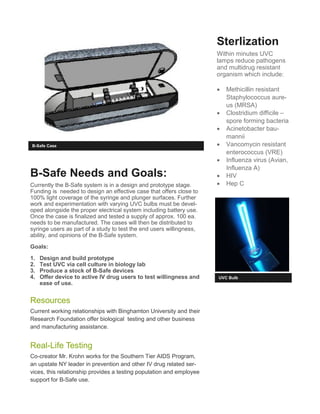
UVC Bulb
B-Safe Case
Background:
When a person injects
any drugs, a small
quantity of blood is
drawn into the syringe
to determine if the nee-
dle has been properly
located in the vein.
Even when person then
injects all of the nee-
dles contents, a small
residue of blood always
remains in the needle
and syringe; which may
not be visible. If a sec-
ond person then uses
this same needle and
syringe for an injection,
any residue in the sy-
ringe and needle may
be transferred into the
second user.
A recent study reported
that each IDU infected
with HCV is likely to
infect about 20 others
and that this rapid
transmission of the dis-
ease occurs within the
first three years of ini-
tial infection.
While current practices
of utilizing bleach and
filters aid in deactivat-
ing viruses they are still
unable to reach all the
locations that blood is
being deposited within
the syringe. Without
making a radical
change in the construc-
tion of a syringe, which
undoubtedly would in-
crease their costs, an
active route must be
found. The B-Safe sys-
tem incorporates a ger-
micidal UVC light to de-
activate any viruses
found within the sy-
ringe.
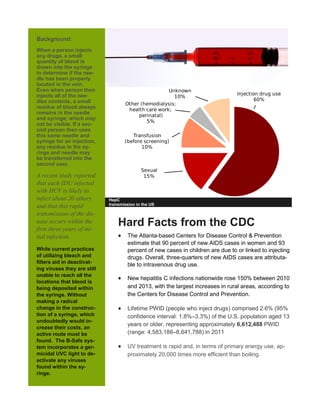
HepC
transmission in the US
Hard Facts from the CDC
 The Atlanta-based Centers for Disease Control & Prevention
estimate that 90 percent of new AIDS cases in women and 93
percent of new cases in children are due to or linked to injecting
drugs. Overall, three-quarters of new AIDS cases are attributa-
ble to intravenous drug use.
 New hepatitis C infections nationwide rose 150% between 2010
and 2013, with the largest increases in rural areas, according to
the Centers for Disease Control and Prevention.
 Lifetime PWID (people who inject drugs) comprised 2.6% (95%
confidence interval: 1.8%–3.3%) of the U.S. population aged 13
years or older, representing approximately 6,612,488 PWID
(range: 4,583,188–8,641,788) in 2011
 UV treatment is rapid and, in terms of primary energy use, ap-
proximately 20,000 times more efficient than boiling.
Contact Us
Give us a call for more infor-
mation about our B-Safe case
B-Safe
161 S. Washington St.
Binghamton, N.Y. 13903
(607) 280-9001
Krohn@GyroHeatTechnologies.com
B-Safe
161 South Washington Street
Binghamton, N.Y. 13903
PLACE
STAMP
HERE
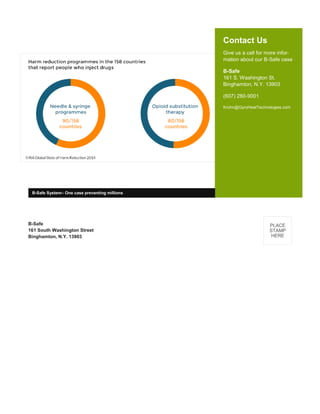
B-Safe System– One case preventing millions

B_Safe System v2

  • 1.
    B-SAFE “..He [Mr. Hodge}says he has injected prescription painkillers as many as 12 times a day over the eight years he has been hooked, often reusing needles more than 100 times and sharing them with two or three people each round.” -Eric Hodge Atlanta Times  As of 2011, CDC estimated that every HIV infec- tion prevented through a needle exchange pro- gram saves an estimated US$178,000+. Problem Statement: The re-use of syringes has led to an increase in communicable viruses due to, in some instances non-visible, blood deposits left in the syringe. B-Safe System: The goal of the B-Safe system is to provide an inex- pensive route for sanitizing syringes during IV drug use with the goal of preventing cross contamination of blood. The B-Safe system incorporates a germi- cidal UVC light to deactivate any viruses found within the syringe. This process happens as the user clos- es B-Safe case, syringe included. Once closed the UVC light is powered on for 5 minutes deactivating any present virus. The user is kept safe from the light as it can only be powered when the case is closed. Project Description May 2016
  • 2.
    B-Safe Needs andGoals: Currently the B-Safe system is in a design and prototype stage. Funding is needed to design an effective case that offers close to 100% light coverage of the syringe and plunger surfaces. Further work and experimentation with varying UVC bulbs must be devel- oped alongside the proper electrical system including battery use. Once the case is finalized and tested a supply of approx. 100 ea. needs to be manufactured. The cases will then be distributed to syringe users as part of a study to test the end users willingness, ability, and opinions of the B-Safe system. Goals: 1. Design and build prototype 2. Test UVC via cell culture in biology lab 3. Produce a stock of B-Safe devices 4. Offer device to active IV drug users to test willingness and ease of use. Resources Current working relationships with Binghamton University and their Research Foundation offer biological testing and other business and manufacturing assistance. Real-Life Testing Co-creator Mr. Krohn works for the Southern Tier AIDS Program, an upstate NY leader in prevention and other IV drug related ser- vices, this relationship provides a testing population and employee support for B-Safe use. Sterlization Within minutes UVC lamps reduce pathogens and multidrug resistant organism which include:  Methicillin resistant Staphylococcus aure- us (MRSA)  Clostridium difficile – spore forming bacteria  Acinetobacter bau- mannii  Vancomycin resistant enterococcus (VRE)  Influenza virus (Avian, Influenza A)  HIV  Hep C UVC Bulb B-Safe Case
  • 3.
    Background: When a personinjects any drugs, a small quantity of blood is drawn into the syringe to determine if the nee- dle has been properly located in the vein. Even when person then injects all of the nee- dles contents, a small residue of blood always remains in the needle and syringe; which may not be visible. If a sec- ond person then uses this same needle and syringe for an injection, any residue in the sy- ringe and needle may be transferred into the second user. A recent study reported that each IDU infected with HCV is likely to infect about 20 others and that this rapid transmission of the dis- ease occurs within the first three years of ini- tial infection. While current practices of utilizing bleach and filters aid in deactivat- ing viruses they are still unable to reach all the locations that blood is being deposited within the syringe. Without making a radical change in the construc- tion of a syringe, which undoubtedly would in- crease their costs, an active route must be found. The B-Safe sys- tem incorporates a ger- micidal UVC light to de- activate any viruses found within the sy- ringe. HepC transmission in the US Hard Facts from the CDC  The Atlanta-based Centers for Disease Control & Prevention estimate that 90 percent of new AIDS cases in women and 93 percent of new cases in children are due to or linked to injecting drugs. Overall, three-quarters of new AIDS cases are attributa- ble to intravenous drug use.  New hepatitis C infections nationwide rose 150% between 2010 and 2013, with the largest increases in rural areas, according to the Centers for Disease Control and Prevention.  Lifetime PWID (people who inject drugs) comprised 2.6% (95% confidence interval: 1.8%–3.3%) of the U.S. population aged 13 years or older, representing approximately 6,612,488 PWID (range: 4,583,188–8,641,788) in 2011  UV treatment is rapid and, in terms of primary energy use, ap- proximately 20,000 times more efficient than boiling.
  • 4.
    Contact Us Give usa call for more infor- mation about our B-Safe case B-Safe 161 S. Washington St. Binghamton, N.Y. 13903 (607) 280-9001 Krohn@GyroHeatTechnologies.com B-Safe 161 South Washington Street Binghamton, N.Y. 13903 PLACE STAMP HERE B-Safe System– One case preventing millions