BASIC
RESEARCH
METHOD
LECTURER: ABDIRAHMAN
M.
About the Course
Basic Research Method
Credit Hrs: 5
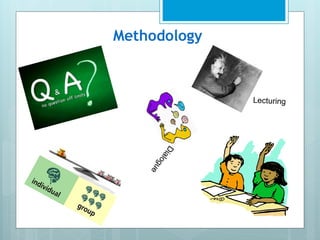
Methodology
Lecturing
D
i
a
l
o
g
u
e
Course Introduction
 Pre-requisite Courses
 Academic Writing or
 Skills of Writing
 Mode of Delivery
 Power Point presentations
 Individual and group presentations
 Discussions
 Class Exercises
Course Design
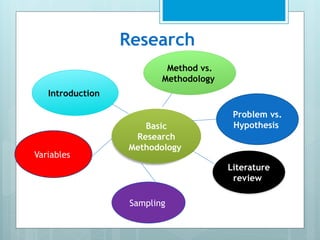
Research
Studies
Practical
Writing
Basic Research
Research
Basic
Research
Methodology
Problem vs.
Hypothesis
Method vs.
Methodology
Introduction
Variables
Literature
review
Sampling
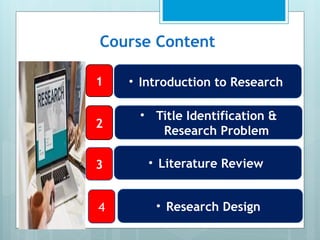
Course Content
1
2
3
4
• Introduction to Research
• Title Identification &
Research Problem
• Literature Review
• Research Design
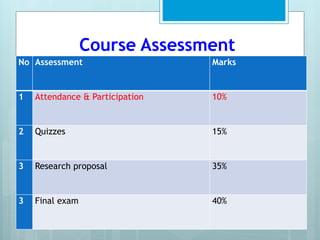
Course Assessment
No Assessment Marks
1 Attendance & Participation 10%
2 Quizzes 15%
3 Research proposal 35%
3 Final exam 40%
Rules of Class
Engagement
SOMALILAND CIVIL SERVICE INSTITUTE
CHAPTER ONE: INTRODUCTION TO RESEARCH
LECTURER: ABDIRAHMAN MOHAMOUD MUHUMED
JAN, 2025
HARGEISA, SOMALILAND
Research More
to Know More!!!
Why Study BR?
Thesis defined
 A thesis is a document that presented to graduate
from a University.
 It starts with writing up a research proposal to
convince reviewers that the researcher is capable
of successfully conducting the proposed research
project.
 It also describes the research problem and its
importance, and gives a detailed account of the
methods that will be used and why they are
appropriate.
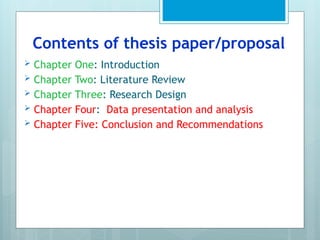
Contents of thesis paper/proposal
 Chapter One: Introduction
 Chapter Two: Literature Review
 Chapter Three: Research Design
 Chapter Four: Data presentation and analysis
 Chapter Five: Conclusion and Recommendations
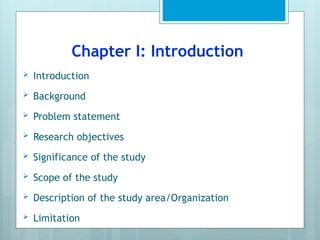
Chapter I: Introduction
 Introduction
 Background
 Problem statement
 Research objectives
 Significance of the study
 Scope of the study
 Description of the study area/Organization
 Limitation
Chapter II: Literature Review
 In this chapter, students are required to define
relevant key concepts.

 It is about to copy and paste, but the purpose is to
review and examine, to some extent.
Chapter III: Methodology of
Research
 Variable Definition/Operationalization of Variables
 Research Types
 Research Approach
 Sample Design
 Population
 Sample size
 Sampling techniques
 Sources of Data
 Data Collection Instruments
 Data Presentation Tools
 Data Analysis and Interpretation
 Ethical Consideration
Research defined…
 Scholars define research in different ways:
 Research is defined as:
 A systematized effort to gain new knowledge.
 A search for knowledge through objective and
systemic method of finding solutions to a problem or
systematic approach concerning generalization and
formulation of a theory.
Why conduct research?
 To discover answers to questions through the
application of scientific procedures.
 To find out the truth which is hidden and which has
not been discovered yet.
Types of Researches
 Types of researches include:
 Descriptive and analytical research.
 Applied research and fundamental research.
 Quantitative research and qualitative research.
 Other types of research.
Descriptive and Analytical researches
 As it implies, descriptive type of research:
 Offers a detailed picture or account of some social
phenomenon, group, etc.
 It includes surveys and fact finding enquiries of
different kinds.
 As its main characteristics, descriptive researches
reports only what has happened or what is
happening.
Cont…
 Analytical research involves the use of facts and
information already available for the researcher and
analyzing it to make critical information of material.
 Analytical refers to establishing why something occurs
or how it came to be.
Applied and Basic researches
 Applied research is a research that discovers a solution
for some pressing practical problem, facing a society,
business organization or country.
 Basic research is also known as pure or fundamental
research.
 It is undertaken for the sake of knowledge without any
intention to apply it in practice.
Cont…
 The distinction between them is in the application.
– Basic research has little application to real world
policy and management but could be done to guide
applied research.
One-time and Longitudinal researches
 One-time research is a research confined to a single
time-period, whereas,
 Longitudinal research is carried on over several time
periods.
Exploratory and formulized researches
 Exploratory research involves Development of
hypothesis rather than their TESTING, whereas,
 Formulized research are those with substantial
structure and Specific Hypothesis to be tested.
Approaches of Research
There are two basic approaches to research namely:
- Quantitative approach
- Qualitative approach
Quantitative Vs. Qualitative Approaches
 Quantitative approach of research involves the
generation of data in quantitative form which can be
subjected to rigorous quantitative analysis in a formal
and rigid fashion.
 Qualitative approach is concerned with subjective
assessment of attitudes, opinions and behavior.
Research in such a situation is a function of
researchers’ insights and impression.
 A mixture of methods may be used.
 Researchers may seek to increase reliability and
validity by using both quantitative and qualitative
approaches. This is called triangulation!.
Similarities
 Both do researches.
 Both methods use observations as their tools.
 Both use sampling procedures.
 Both use interview guide in their research
instruments.
Differences
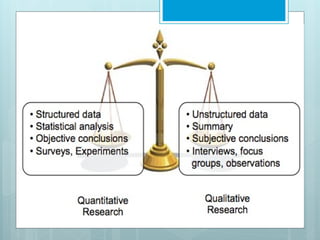
 Information dealt- Quantitative research involve
numerical whereas quantitative are the opposite.
 Methods of analysis- Qualitative researches use
descriptive analysis through words whilst
quantitative researches use statistical analysis.
Research Methods & Research
Methodology
 Research methods are all methods or techniques that
are used for conducting a research.
 Put differently, research method is all about design
of research techniques.
 Methods refers to the techniques researcher use to
collect and analyze data.
 It is the specific techniques, tools or procedures
applied to achieve a given objective.
Cont…
- Research methods can be put into the following three
groups:-
1. Methods concerning with the collection of data.
These methods will be used where the data already
available are not sufficient to arrive at the required
solution.
2. Methods of statistical techniques used for
establishing relationship between the data and the
unknowns.
3. Methods used to evaluate the accuracy of the
results obtained.
Note: The last two groups are generally taken as
“analytical tools of research”
Cont…
 Research methodology studies
 Various steps in studying research problem and logic
behind them.
 Method or technique relevant and which are not.
 Assumptions underlying various techniques.
 Criteria by which researchers can decide that
certain techniques and procedures will be
applicable to certain problem.
 Research methodology has many dimension and
research methods do constitute a part of the research
methodology.
THE END OF CHAPTER ONE!!!

BRM CHAPTER one of basic research m.ppt

  • 1.
  • 2.
    About the Course BasicResearch Method Credit Hrs: 5
  • 3.
  • 4.
    Course Introduction  Pre-requisiteCourses  Academic Writing or  Skills of Writing  Mode of Delivery  Power Point presentations  Individual and group presentations  Discussions  Class Exercises
  • 5.
  • 6.
  • 7.
    Course Content 1 2 3 4 • Introductionto Research • Title Identification & Research Problem • Literature Review • Research Design
  • 8.
    Course Assessment No AssessmentMarks 1 Attendance & Participation 10% 2 Quizzes 15% 3 Research proposal 35% 3 Final exam 40%
  • 9.
  • 10.
    SOMALILAND CIVIL SERVICEINSTITUTE CHAPTER ONE: INTRODUCTION TO RESEARCH LECTURER: ABDIRAHMAN MOHAMOUD MUHUMED JAN, 2025 HARGEISA, SOMALILAND
  • 11.
  • 12.
  • 14.
    Thesis defined  Athesis is a document that presented to graduate from a University.  It starts with writing up a research proposal to convince reviewers that the researcher is capable of successfully conducting the proposed research project.  It also describes the research problem and its importance, and gives a detailed account of the methods that will be used and why they are appropriate.
  • 15.
    Contents of thesispaper/proposal  Chapter One: Introduction  Chapter Two: Literature Review  Chapter Three: Research Design  Chapter Four: Data presentation and analysis  Chapter Five: Conclusion and Recommendations
  • 16.
    Chapter I: Introduction Introduction  Background  Problem statement  Research objectives  Significance of the study  Scope of the study  Description of the study area/Organization  Limitation
  • 17.
    Chapter II: LiteratureReview  In this chapter, students are required to define relevant key concepts.  It is about to copy and paste, but the purpose is to review and examine, to some extent.
  • 18.
    Chapter III: Methodologyof Research  Variable Definition/Operationalization of Variables  Research Types  Research Approach  Sample Design  Population  Sample size  Sampling techniques  Sources of Data  Data Collection Instruments  Data Presentation Tools  Data Analysis and Interpretation  Ethical Consideration
  • 19.
    Research defined…  Scholarsdefine research in different ways:  Research is defined as:  A systematized effort to gain new knowledge.  A search for knowledge through objective and systemic method of finding solutions to a problem or systematic approach concerning generalization and formulation of a theory.
  • 20.
    Why conduct research? To discover answers to questions through the application of scientific procedures.  To find out the truth which is hidden and which has not been discovered yet.
  • 21.
    Types of Researches Types of researches include:  Descriptive and analytical research.  Applied research and fundamental research.  Quantitative research and qualitative research.  Other types of research.
  • 22.
    Descriptive and Analyticalresearches  As it implies, descriptive type of research:  Offers a detailed picture or account of some social phenomenon, group, etc.  It includes surveys and fact finding enquiries of different kinds.  As its main characteristics, descriptive researches reports only what has happened or what is happening.
  • 23.
    Cont…  Analytical researchinvolves the use of facts and information already available for the researcher and analyzing it to make critical information of material.  Analytical refers to establishing why something occurs or how it came to be.
  • 24.
    Applied and Basicresearches  Applied research is a research that discovers a solution for some pressing practical problem, facing a society, business organization or country.  Basic research is also known as pure or fundamental research.  It is undertaken for the sake of knowledge without any intention to apply it in practice.
  • 25.
    Cont…  The distinctionbetween them is in the application. – Basic research has little application to real world policy and management but could be done to guide applied research.
  • 26.
    One-time and Longitudinalresearches  One-time research is a research confined to a single time-period, whereas,  Longitudinal research is carried on over several time periods.
  • 27.
    Exploratory and formulizedresearches  Exploratory research involves Development of hypothesis rather than their TESTING, whereas,  Formulized research are those with substantial structure and Specific Hypothesis to be tested.
  • 28.
    Approaches of Research Thereare two basic approaches to research namely: - Quantitative approach - Qualitative approach
  • 29.
    Quantitative Vs. QualitativeApproaches  Quantitative approach of research involves the generation of data in quantitative form which can be subjected to rigorous quantitative analysis in a formal and rigid fashion.  Qualitative approach is concerned with subjective assessment of attitudes, opinions and behavior. Research in such a situation is a function of researchers’ insights and impression.  A mixture of methods may be used.  Researchers may seek to increase reliability and validity by using both quantitative and qualitative approaches. This is called triangulation!.
  • 31.
    Similarities  Both doresearches.  Both methods use observations as their tools.  Both use sampling procedures.  Both use interview guide in their research instruments.
  • 32.
    Differences  Information dealt-Quantitative research involve numerical whereas quantitative are the opposite.  Methods of analysis- Qualitative researches use descriptive analysis through words whilst quantitative researches use statistical analysis.
  • 34.
    Research Methods &Research Methodology  Research methods are all methods or techniques that are used for conducting a research.  Put differently, research method is all about design of research techniques.  Methods refers to the techniques researcher use to collect and analyze data.  It is the specific techniques, tools or procedures applied to achieve a given objective.
  • 35.
    Cont… - Research methodscan be put into the following three groups:- 1. Methods concerning with the collection of data. These methods will be used where the data already available are not sufficient to arrive at the required solution. 2. Methods of statistical techniques used for establishing relationship between the data and the unknowns. 3. Methods used to evaluate the accuracy of the results obtained. Note: The last two groups are generally taken as “analytical tools of research”
  • 36.
    Cont…  Research methodologystudies  Various steps in studying research problem and logic behind them.  Method or technique relevant and which are not.  Assumptions underlying various techniques.  Criteria by which researchers can decide that certain techniques and procedures will be applicable to certain problem.  Research methodology has many dimension and research methods do constitute a part of the research methodology.
  • 37.
    THE END OFCHAPTER ONE!!!