Bringing knowledge to bear
on commissioning
Sue Lacey Bryant, Chief Knowledge Officer
11th
February 2011
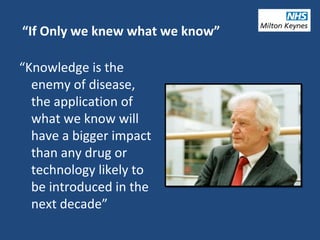
“If Only we knew what we know”
“Knowledge is the
enemy of disease,
the application of
what we know will
have a bigger impact
than any drug or
technology likely to
be introduced in the
next decade”
Who are we?
Your virtual knowledge team:
• Anne Gray – Knowledge Officer,
NHS MK Public Health
• Linda Potter – Primary Care Librarian
Library services via a joint SLA
• Sue Lacey Bryant, Chief Knowledge Officer
plus Steve Hance, Project manager
The programme
1. What is Knowledge Management? Sue
2. KM - an ABC; starting at A Sue
3. KM in practice: informing referrals management Steve
4. KM from B-C Sue
5. Evidence into practice: Making an IMPACTE Linda
6. Informing commissioning decisions Anne
7. Keeping up to date Anne
8. Transferring knowledge Sue
1. What is knowledge management?
• Using knowledge to improve business
performance, reduce costs and improve
quality
• Consciously moving the right knowledge
to the right people at the right time
to be translated into action to improve
organizational performance
Knowledge management is about:
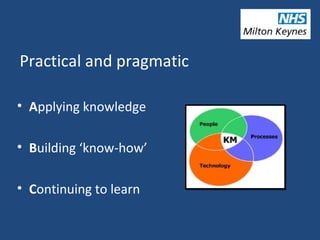
Practical and pragmatic
• Applying knowledge
• Building ‘know-how’
• Continuing to learn
As Chief Knowledge Officer ...
• Ensure strategic and operational activity is informed
by sound evidence
• Ensure information requirements of projects, and of
consortia, are defined
• Ensure the business intelligence team is proactive,
streamlined, focused on users
• Stimulate approaches to capturing knowledge so
that ‘know-how’ is made explicit and transferred
• Manage the Library SLA to deliver proactive services
• Spread and embed good practice
• Support future configurations & current imperatives
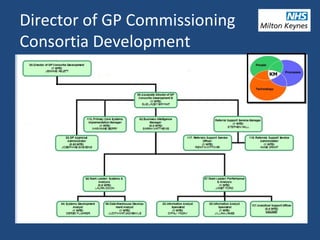
Director of GP Commissioning
Consortia Development
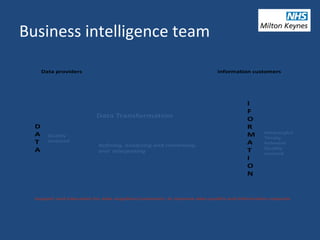
Business intelligence team
Refining, analysing and combining,
and interpreting
D
A
T
A
I
F
O
R
M
A
T
I
O
N
Meaningful
Timely
Relevant
Quality
assured
Information customersData providers
Data Transformation
Support and education for data suppliers/customers, to improve data quality and information requests
Quality
assessed
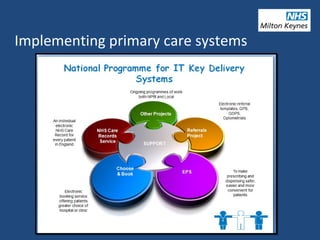
Implementing primary care systems
Knowledge is everyone's business
Across the organisation including -
Communications and Engagement
Corporate Affairs
Human relations & organisational development
Information Technology
Public Health Intelligence
Quality and Standards
System Reform
2. Knowledge management – an ABC
Starting at A
A = Applying knowledge
• Data on activity, cost, outcomes
• Research evidence on clinical outcomes and
cost effectiveness
• “Best practice” including models of service
• Patient experience
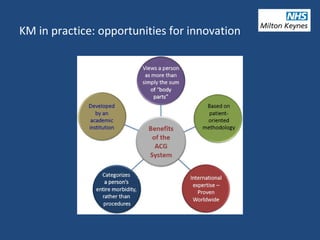
KM in practice: opportunities for innovation
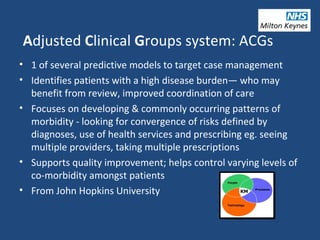
Adjusted Clinical Groups system: ACGs
• 1 of several predictive models to target case management
• Identifies patients with a high disease burden— who may
benefit from review, improved coordination of care
• Focuses on developing & commonly occurring patterns of
morbidity - looking for convergence of risks defined by
diagnoses, use of health services and prescribing eg. seeing
multiple providers, taking multiple prescriptions
• Supports quality improvement; helps control varying levels of
co-morbidity amongst patients
• From John Hopkins University
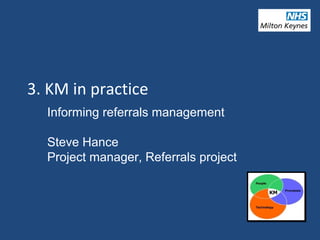
3. KM in practice
Informing referrals management
Steve Hance
Project manager, Referrals project
• The challenge:
Reducing un-warranted variation in activity and
outcomes of care to increase value and
improve quality
• The solution:
“The application of best practice is massively
beneficial to quality and productivity “
David Nicholson . HSJ 10/09/2009
Communication
• So much data: how come I never see it?
• Data : Referral Data, Referral data from Choose & book,
Monthly data report, Practice data, Low priorities data, Audit
data
• Evidence
• Kings Fund report, Understanding patients’ choices at the
point of referral, setting out evidence base and options report
• Communication
• www.qualitymk.nhs.uk , Newsletter – GP Consortia weekly
briefings, Consortia email bulletin, Ad hoc e-mails
Education: Learning opportunities
• Referrals wheel
• Top tips
• GP Referral LES
• Practice visits
• Sharing best practice
• Consortia meetings
• CPD events
Commissioning:
What next? How can we use these data?
• Identify areas which are performing
well/badly
• Formulate action plan to identify why
• Identify ‘spend to save’ opportunities eg
Lesion clinic?
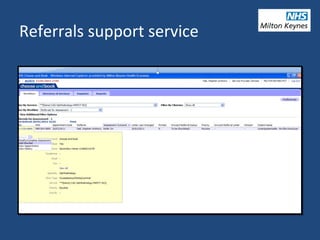
Referrals support service
What works best for you in consortia?
• Reviewing the sample of documents on
referrals –
• How would you prefer to receive this
data/information?
– What format? Media?
– Presentation? Level of detail?
– From whom? Frequency?
• How should it be delivered to give you
maximum benefit?
• What else do you want to see/have available?
4. Knowledge management
from B- C
B = Building Know-How
to improve performance
Establish commissioning
methodology
Commissioning, Disinvestment
and Contracting Manual, July 2010
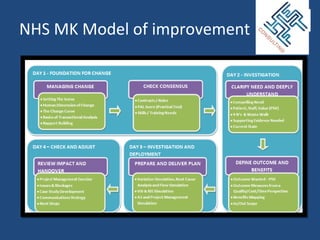
NHS MK Model of improvement
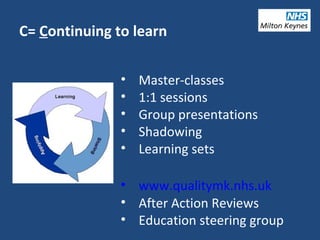
C= Continuing to learn
• Master-classes
• 1:1 sessions
• Group presentations
• Shadowing
• Learning sets
• www.qualitymk.nhs.uk
• After Action Reviews
• Education steering group
www.qualitymk.nhs.uk
5. Evidence into practice
Information specialists: skills
• Information retrieval:
sources, searching and
sourcing
• Information management
• Information skills training
• Research
• Synthesis
• Communications
• Web-editing skills
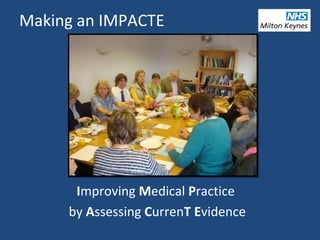
Making an IMPACTE
Improving Medical Practice
by Assessing CurrenT Evidence
6. Informing commissioning
What information do you need?
• Best practice
– guidelines, service specifications, case studies
• How to run a clinical service
– location, processes, workforce, competencies
• Monitoring
– performance, outcomes, audit
• How much does it cost?
– health economics, cost benefit, prioritisation
• Tools
– NICE, DoH, public health
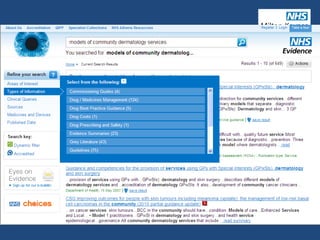
Helping you find the evidence
• NHS Evidence www.evidence.nhs.uk
Helping you find the evidence
• NHS Evidence www.evidence.nhs.uk
– “upgrade” due in April 2011
– Currently paid for though central agreements,
SHA and local libraries
• But there are lots of other resources too..
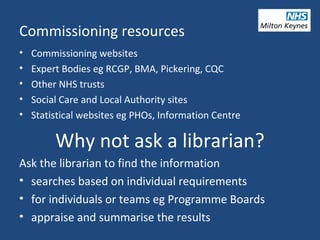
Commissioning resources
• Commissioning websites
• Expert Bodies eg RCGP, BMA, Pickering, CQC
• Other NHS trusts
• Social Care and Local Authority sites
• Statistical websites eg PHOs, Information Centre
Why not ask a librarian?
Ask the librarian to find the information
• searches based on individual requirements
• for individuals or teams eg Programme Boards
• appraise and summarise the results
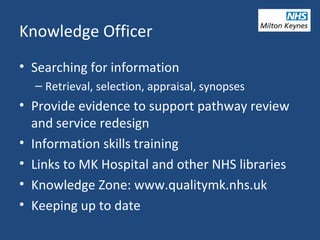
Knowledge Officer
• Searching for information
– Retrieval, selection, appraisal, synopses
• Provide evidence to support pathway review
and service redesign
• Information skills training
• Links to MK Hospital and other NHS libraries
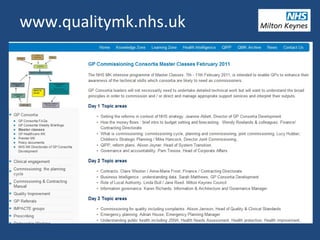
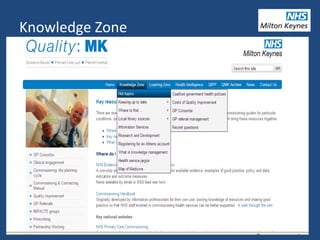
• Knowledge Zone: www.qualitymk.nhs.uk
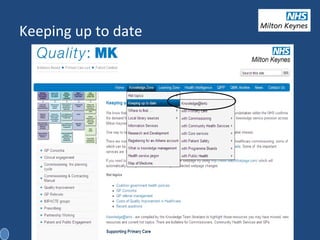
• Keeping up to date
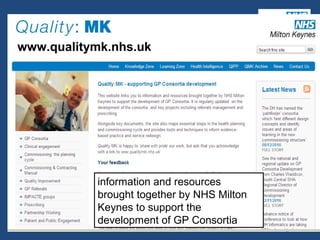
www.qualitymk.nhs.uk
information and resources
brought together by NHS Milton
Keynes to support the
development of GP Consortia
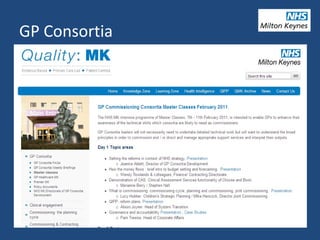
GP Consortia
Knowledge Zone
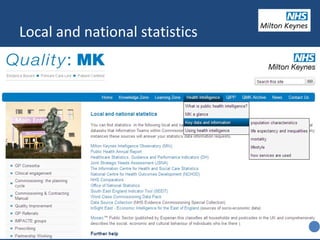
Local and national statistics
7. Keeping up to date
How do you keep up to date?
• Question 1 - How do you keep up to date with
new evidence around clinical practice?
• Question 2 -How will you keep up to date with
new evidence/policies around
commissioning?
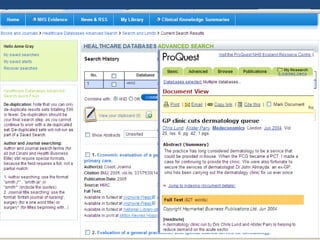
• Answer - Collection of alerting resources on
Quality MK website
Keeping up to date
8. Your Invitation
Transferring knowledge to successor organisations
Workshop objectives
– Protecting knowledge assets
– Mitigate the risk of knowledge drain 2010-13
– Support GP consortia development
– Support system transition
Workshop outputs
– Identifying key assets
– Prioritised list that informs our planning
– Gap analysis of where we lack knowledge to meet our
organisational priorities 2010-13
The future?
• How can we better support current
imperatives?
• Who will manage knowledge in the future?

Bringing knowledge to bear: MK revised Feb 2011 v7

  • 1.
    Bringing knowledge tobear on commissioning Sue Lacey Bryant, Chief Knowledge Officer 11th February 2011
  • 2.
    “If Only weknew what we know” “Knowledge is the enemy of disease, the application of what we know will have a bigger impact than any drug or technology likely to be introduced in the next decade”
  • 3.
    Who are we? Yourvirtual knowledge team: • Anne Gray – Knowledge Officer, NHS MK Public Health • Linda Potter – Primary Care Librarian Library services via a joint SLA • Sue Lacey Bryant, Chief Knowledge Officer plus Steve Hance, Project manager
  • 4.
    The programme 1. Whatis Knowledge Management? Sue 2. KM - an ABC; starting at A Sue 3. KM in practice: informing referrals management Steve 4. KM from B-C Sue 5. Evidence into practice: Making an IMPACTE Linda 6. Informing commissioning decisions Anne 7. Keeping up to date Anne 8. Transferring knowledge Sue
  • 5.
    1. What isknowledge management?
  • 6.
    • Using knowledgeto improve business performance, reduce costs and improve quality • Consciously moving the right knowledge to the right people at the right time to be translated into action to improve organizational performance Knowledge management is about:
  • 7.
    Practical and pragmatic •Applying knowledge • Building ‘know-how’ • Continuing to learn
  • 8.
    As Chief KnowledgeOfficer ... • Ensure strategic and operational activity is informed by sound evidence • Ensure information requirements of projects, and of consortia, are defined • Ensure the business intelligence team is proactive, streamlined, focused on users • Stimulate approaches to capturing knowledge so that ‘know-how’ is made explicit and transferred • Manage the Library SLA to deliver proactive services • Spread and embed good practice • Support future configurations & current imperatives
  • 9.
    Director of GPCommissioning Consortia Development
  • 10.
    Business intelligence team Refining,analysing and combining, and interpreting D A T A I F O R M A T I O N Meaningful Timely Relevant Quality assured Information customersData providers Data Transformation Support and education for data suppliers/customers, to improve data quality and information requests Quality assessed
  • 11.
  • 12.
    Knowledge is everyone'sbusiness Across the organisation including - Communications and Engagement Corporate Affairs Human relations & organisational development Information Technology Public Health Intelligence Quality and Standards System Reform
  • 13.
    2. Knowledge management– an ABC Starting at A
  • 14.
    A = Applyingknowledge • Data on activity, cost, outcomes • Research evidence on clinical outcomes and cost effectiveness • “Best practice” including models of service • Patient experience
  • 15.
    KM in practice:opportunities for innovation
  • 16.
    Adjusted Clinical Groupssystem: ACGs • 1 of several predictive models to target case management • Identifies patients with a high disease burden— who may benefit from review, improved coordination of care • Focuses on developing & commonly occurring patterns of morbidity - looking for convergence of risks defined by diagnoses, use of health services and prescribing eg. seeing multiple providers, taking multiple prescriptions • Supports quality improvement; helps control varying levels of co-morbidity amongst patients • From John Hopkins University
  • 17.
    3. KM inpractice Informing referrals management Steve Hance Project manager, Referrals project
  • 18.
    • The challenge: Reducingun-warranted variation in activity and outcomes of care to increase value and improve quality • The solution: “The application of best practice is massively beneficial to quality and productivity “ David Nicholson . HSJ 10/09/2009
  • 19.
    Communication • So muchdata: how come I never see it? • Data : Referral Data, Referral data from Choose & book, Monthly data report, Practice data, Low priorities data, Audit data • Evidence • Kings Fund report, Understanding patients’ choices at the point of referral, setting out evidence base and options report • Communication • www.qualitymk.nhs.uk , Newsletter – GP Consortia weekly briefings, Consortia email bulletin, Ad hoc e-mails
  • 20.
    Education: Learning opportunities •Referrals wheel • Top tips • GP Referral LES • Practice visits • Sharing best practice • Consortia meetings • CPD events
  • 21.
    Commissioning: What next? Howcan we use these data? • Identify areas which are performing well/badly • Formulate action plan to identify why • Identify ‘spend to save’ opportunities eg Lesion clinic?
  • 22.
  • 23.
    What works bestfor you in consortia? • Reviewing the sample of documents on referrals – • How would you prefer to receive this data/information? – What format? Media? – Presentation? Level of detail? – From whom? Frequency? • How should it be delivered to give you maximum benefit? • What else do you want to see/have available?
  • 24.
  • 25.
    B = BuildingKnow-How to improve performance
  • 26.
  • 27.
    NHS MK Modelof improvement
  • 28.
    C= Continuing tolearn • Master-classes • 1:1 sessions • Group presentations • Shadowing • Learning sets • www.qualitymk.nhs.uk • After Action Reviews • Education steering group
  • 29.
  • 30.
  • 31.
    Information specialists: skills •Information retrieval: sources, searching and sourcing • Information management • Information skills training • Research • Synthesis • Communications • Web-editing skills
  • 32.
    Making an IMPACTE ImprovingMedical Practice by Assessing CurrenT Evidence
  • 33.
  • 34.
    What information doyou need? • Best practice – guidelines, service specifications, case studies • How to run a clinical service – location, processes, workforce, competencies • Monitoring – performance, outcomes, audit • How much does it cost? – health economics, cost benefit, prioritisation • Tools – NICE, DoH, public health
  • 35.
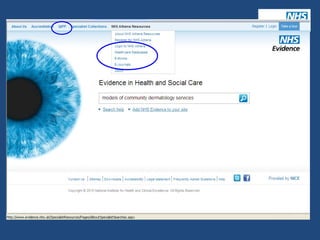
    Helping you findthe evidence • NHS Evidence www.evidence.nhs.uk
  • 39.
    Helping you findthe evidence • NHS Evidence www.evidence.nhs.uk – “upgrade” due in April 2011 – Currently paid for though central agreements, SHA and local libraries • But there are lots of other resources too..
  • 40.
    Commissioning resources • Commissioningwebsites • Expert Bodies eg RCGP, BMA, Pickering, CQC • Other NHS trusts • Social Care and Local Authority sites • Statistical websites eg PHOs, Information Centre Why not ask a librarian? Ask the librarian to find the information • searches based on individual requirements • for individuals or teams eg Programme Boards • appraise and summarise the results
  • 41.
    Knowledge Officer • Searchingfor information – Retrieval, selection, appraisal, synopses • Provide evidence to support pathway review and service redesign • Information skills training • Links to MK Hospital and other NHS libraries • Knowledge Zone: www.qualitymk.nhs.uk • Keeping up to date
  • 42.
    www.qualitymk.nhs.uk information and resources broughttogether by NHS Milton Keynes to support the development of GP Consortia
  • 43.
  • 44.
  • 45.
  • 46.
  • 47.
    How do youkeep up to date? • Question 1 - How do you keep up to date with new evidence around clinical practice? • Question 2 -How will you keep up to date with new evidence/policies around commissioning? • Answer - Collection of alerting resources on Quality MK website
  • 48.
  • 49.
    8. Your Invitation Transferringknowledge to successor organisations Workshop objectives – Protecting knowledge assets – Mitigate the risk of knowledge drain 2010-13 – Support GP consortia development – Support system transition Workshop outputs – Identifying key assets – Prioritised list that informs our planning – Gap analysis of where we lack knowledge to meet our organisational priorities 2010-13
  • 50.
    The future? • Howcan we better support current imperatives? • Who will manage knowledge in the future?

Editor's Notes

  • #7 If Only We Knew What We Know: The Transfer of Internal Knowledge and Best Practice O'Dell & Grayson 1997
  • #10 Healthcare is knowledge-intensive Multiple teams provide information and evidence to bringing knowledge to bear on commissioning – needs assessment, planning, service specification, contract monitoring, health improvements – and I manage these teams directly
  • #11 Business Intelligence team Performance monitoring of PCT and providers Making best use of analytical tools available Informing planning, programmes and projects Defining measures of success – clinical outcomes, quality improvements
  • #15 And training from CRD on cost effectiveness And where can Where can knowledge have the most impact? Commissioning Librarian role; Library SLA inc. primary-care e-learning librarian
  • #26 How can CKOs build the Know-How to improve business performance, reduce costs and improve quality?
  • #27 Commissioning, Disinvestment and contracting manual describes how we manage the journey we experience when commissioning and contracting. It sets out the phases of work (‘Pipeline’ Fig 1.0) through which requests for changes in the services currently being commissioned are steered. Clearly defined processes and standardised documentation support a shared understanding so that we can effectively navigate / steer a proposed commissioning change through to delivery / implementation.
  • #28 Techniques to support while-system approach to service redesign
  • #30 Sharing Know–How, making learning explicit, signposting evidence
  • #32 Skilled and innovative team
  • #37 NICE – collection of health and social care publications Healthcare bibliographic databases Links to online resources eg journals “upgrade” due in April 2011 Currently paid for though central agreements, SHA and local libraries
  • #50 Good information and intelligence lies at the heart of health improvement.  GP consortia will want to be intelligent organisations GP commissioners need to be intelligent users of information Many of the practical challenges we need to address as the Trust is dis-established, and new organisations form, will require the conscious management and transfer of knowledge. As new organisational structure are developed, and we disestablish & hand over responsibilities, we will be taking our corporate memory and relevant aspects of our knowledge base off in different directions, (ie consortia, MKC, NPHS, Commissioning Board). We will also wish to enable successor organisations to accelerate their development, and invite them to build on our learning, if they wish. The aim of this workshop is to look ahead - identify key challenges, prioritise, and consider options and approaches we might take in each key area. Rather than finding that individual managers feel left to work out what is best for one responsibility / resource or another, this is an opportunity to come together as a small group to think ahead, sound out ideas and put in some planning. Outputs Prioritised list that informs our capability and capacity plan Gap analysis of where we lack knowledge to meet our organisational priorities 2010-13 Protecting knowledge; identifying key assets; mitigating knowledge drain 2010-13
  • #51 NLH Licences cut for journals Nat PH service - ? LA service cuts NHS Library services? Internal / local knowledge