The EU ETS: Ex-Post Analysis, 
the Market Stability Reserve and 
Options for a Comprehensive Reform 
Seminar on the EU Emissions Trading System 
Dr. Brigitte Knopf 
Helsinki, 13 November 2014 
Presentation of the Euro-CASE policy brief 
Dr. Brigitte Knopf (PIK)
Scientific Background: New IPCC Report 2014 
• There are multiple mitigation pathways 
that are likely to limit warming to below 
2°C relative to pre-industrial levels. 
• These scenarios […] are characterized by 
40% to 70% global anthropogenic GHG 
emissions reductions by 2050 compared 
to 2010, and emissions levels near zero or 
below in 2100. 
• In the majority of low‐concentration 
stabilization scenarios […] fossil fuel 
power generation without CCS is phased 
out almost entirely by 2100. 
www.mitigation2014.org 
IPCC Synthesis Report (2014) 
Dr. Brigitte Knopf 2
Political Background: The EU 2030 Framework 
• Decision on headline targets by the European Council (23 Oct 2014) 
• “At least 40% domestic” GHG reduction by 2030 
• Binding EU-wide target for renewables of 27% 
• Indicative EU-wide target for energy efficiency of 27% 
• Reform of the EU ETS: 
• January 2014: Legislative proposal for reform of the EU ETS with a 
Market Stability Reserve to start in 2021 
• Council conclusion refer to a „reformed ETS with an instrument to 
stabilise the market in line with the Commission proposal“ 
• Change of linear reduction factor to 2.2% p.a. compared to the current 
1.74% p.a. (accepted by the EU Council) 
• Timing: ENVI Committee is set to vote on 24 Feb. 2015 
Dr. Brigitte Knopf 3
European Council of Academies of Applied Sciences, 
Euro-CASE Policy Position Paper 
Reform Options for the European 
Emissions Trading System (EU ETS) 
Chairs of the Euro-CASE Energy Platform: 
Ottmar Edenhofer, Bo Nordmark, Bernhard Tardieu 
http://www.euro-case.org/images/stories/pdf/position-paper/Euro-CASE-policy-paper-ETS-reform.pdf 
Dr. Brigitte Knopf 
Technologies and Engineering
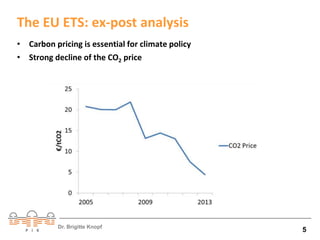
The EU ETS: ex-post analysis 
• Carbon pricing is essential for climate policy 
• Strong decline of the CO2 price 
Dr. Brigitte Knopf 5
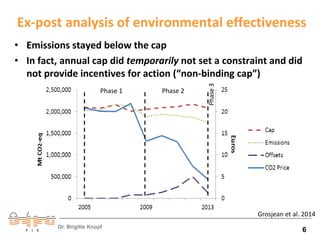
Ex-post analysis of environmental effectiveness 
• Emissions stayed below the cap 
• In fact, annual cap did temporarily not set a constraint and did 
not provide incentives for action (“non-binding cap”) 
Grosjean et al. 2014 
Phase 1 Phase 2 
Phase 3 
Dr. Brigitte Knopf 6
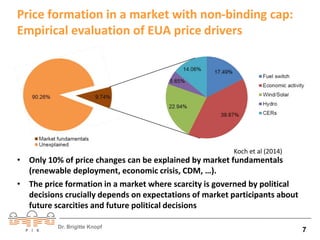
Price formation in a market with non-binding cap: 
Empirical evaluation of EUA price drivers 
Koch et al (2014) 
• Only 10% of price changes can be explained by market fundamentals 
(renewable deployment, economic crisis, CDM, …). 
• The price formation in a market where scarcity is governed by political 
decisions crucially depends on expectations of market participants about 
future scarcities and future political decisions 
Dr. Brigitte Knopf 7
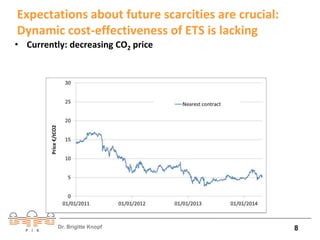
Expectations about future scarcities are crucial: 
Dynamic cost-effectiveness of ETS is lacking 
• Currently: decreasing CO2 price 
Dr. Brigitte Knopf 
EUA nearest contract and Futures 2020 
8
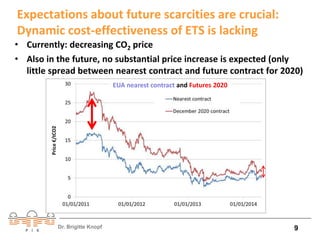
Expectations about future scarcities are crucial: 
Dynamic cost-effectiveness of ETS is lacking 
• Currently: decreasing CO2 price 
• Also in the future, no substantial price increase is expected (only 
little spread between nearest contract and future contract for 2020) 
Dr. Brigitte Knopf 
EUA nearest contract and Futures 2020 
9
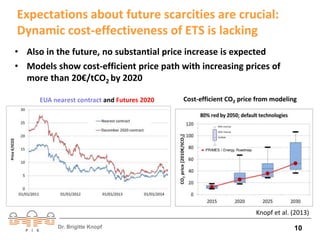
Expectations about future scarcities are crucial: 
Dynamic cost-effectiveness of ETS is lacking 
• Also in the future, no substantial price increase is expected 
• Models show cost-efficient price path with increasing prices of 
EUA nearest contract and Futures 2020 Cost-efficient CO2 price from modeling 
Dr. Brigitte Knopf 
Knopf et al. (2013) 
more than 20€/tCO2 by 2020 
10
The problem with the low price 
• A low price is – in conventional thinking – a sign of a well-functioning 
market. But in this case, it reflects the expectation 
of traders that the oversupply will be sustained even beyond 
the current commitment period. 
• In other words, the EU ETS does not incentivize the search for 
low-cost mitigation options but reflects mainly the 
expectations of traders about future political decisions. 
• The EU ETS has been transformed into a betting shop for the 
commitment period after 2020. 
Dr. Brigitte Knopf 11
Summary of problem analysis 
• The EU ETS is a market where scarcity is governed by political 
decisions and not by natural scarcity. Expectations of market 
participants on future political decisions are crucial 
• Environmental effectiveness of ETS is given. But the cap did not set 
a constraint as emissions stayed below the cap 
• Dynamic cost-effectiveness is not given; prices are not expected to 
increase significantly until 2020 
• Key question and requirements for ETS Reform to address: 
 How to stabilize expectations of market particpants? 
Dr. Brigitte Knopf 12
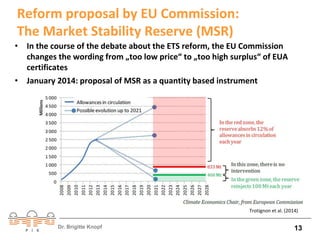
Reform proposal by EU Commission: 
The Market Stability Reserve (MSR) 
• In the course of the debate about the ETS reform, the EU Commission 
changes the wording from „too low price“ to „too high surplus“ of EUA 
certificates 
• January 2014: proposal of MSR as a quantity based instrument 
Dr. Brigitte Knopf 
Trotignon et al. (2014) 
13
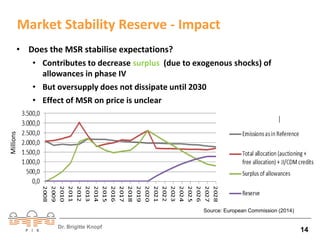
Market Stability Reserve - Impact 
• Does the MSR stabilise expectations? 
• Contributes to decrease surplus (due to exogenous shocks) of 
allowances in phase IV 
• But oversupply does not dissipate until 2030 
• Effect of MSR on price is unclear 
Source: European Commission (2014) 
Dr. Brigitte Knopf 14 
Millions
Market Stability Reserve - Evaluation 
• The MSR does not address the problem of missing long-term cost-effectiveness 
and price uncertainty 
• Choice of quantity instrument is questionable 
• It addresses the existence of a large allowance surplus, but 
oversupply does not dissipate until 2030 
• If hedging is the rationale behind the trigger it should change 
over time 
• The impact is difficult to assess because the rationale behind the 
mechanism is not transparent 
• MSR will have an uncertain impact on low-carbon investment 
• Timing of the effect might be too slow; review phase in 2026 gives 
additional uncertainty 
Dr. Brigitte Knopf 15
Alternative reform proposal by Euro-CASE: 
Instead of a narrow reform of the EU ETS, a fully-fledged reform 
addressing several aspects of carbon pricing is required: 
1. Setting a price collar within the ETS as a hybrid instrument 
2. Sectoral expansion of the EU ETS to enhance the cost 
effectiveness of EU climate policy 
3. Policy instruments in addition to carbon pricing are required 
for stimulating innovation 
4. Addressing carbon leakage 
Dr. Brigitte Knopf 16
1. Setting a price collar 
• Reliable framework for investment decisions; price collar will 
stabilize expectations; dynamic cost effectiveness is assured 
Dr. Brigitte Knopf 17
Advantages of a price collar within the EU ETS 
• General: price collar will stabilize expectations and lead to dynamic cost-effectiveness 
• Price ceiling is motivated by the fact that prices can also increase 
subtantially through shocks. With setting a ceiling this risk is reduced 
symmetrically, what would be important for investors 
• Price floor (auction reserve price) would allow addressing national 
preferences, e.g. more ambitious domestic mitigation goals, without 
undermining the environmental effectiveness of the additional national 
policies 
• Hybrid instrument of ETS and floor price also installed in California and 
other US Regions; might support possibility of linking 
Dr. Brigitte Knopf 18
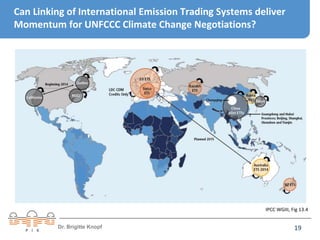
Can Linking of International Emission Trading Systems deliver 
Momentum for UNFCCC Climate Change Negotiations? 
Dr. Brigitte Knopf 
IPCC WGIII, Fig 13.4 
19
2. Sectoral Expansion of the EU ETS 
• The ETS currently covers about 45% of all GHG emissions, but 
all sectors need to significantly reduce GHG emissions. 
• There are different options on how to add further sectors, but 
upstream inclusion is the most favorable. 
• Revenue recycling (auctioning vs free allocation) important 
for sectoral expansion: 
• Possibility of lowering costs to particular industries by 
exemptions and revenue-recycling 
Dr. Brigitte Knopf 20
Example of sectoral coverage of carbon 
markets worldwide 
Worldbank 2013 
Dr. Brigitte Knopf 21 
http://www.worldbank.org/en/news/feature/2013/10/02/carbon-markets-world-view-infographic
3. Instruments in addition to carbon pricing 
• In addition to carbon pricing, other policy instruments for 
innovation and diffusion of low carbon technologies might be 
required 
• There are indications that especially the innovation spillovers are 
Dr. Brigitte Knopf 22 
high 
• R&D policies could therefore support innovation and should be part 
of the portfolio if market failures can be observed
4. Tackling carbon leakage 
• Carbon leakage only affects a few sectors 
• It can be addressed by expanding the group of countries that 
participate in the ETS or by linking it to other regions 
• Within the group, free allocation of some emission permits as well 
as tailor-made trade policies should be considered 
• Lowering costs to particular industries by exemptions and revenue-recycling 
Dr. Brigitte Knopf 23
Increasing the number of ETS worldwide is the 
best way to address carbon leakage 
Dr. Brigitte Knopf 
Worldbank 2013 
http://www.worldbank.org/en/news/feature/2013/10/02/carbon-markets-world-view-infographic
Summary 
• Pricing carbon is essential for climate policy. In the EU ETS emissions 
stayed below the cap, but the EU ETS lacks dynamic efficiency to ensure 
long-term cost-effectiveness. 
• The MSR does not address the current problem. It might turn out to be a 
toothless tiger. 
• Instead, Euro-CASE proposes a reform package with setting a price collar 
as the foremost element and includes a sectoral expansion, policy 
instruments in addition to carbon pricing and addresses carbon leakage. 
• Without a comprehensive reform of the ETS, there is a clear danger of a 
revival of fragmented climate and energy policies across Europe which 
have the potential to increase the costs of climate policy substantially. 
Dr. Brigitte Knopf 25

Brigitte knopf 2014 11-13 helsinki-ets

  • 1.
    The EU ETS:Ex-Post Analysis, the Market Stability Reserve and Options for a Comprehensive Reform Seminar on the EU Emissions Trading System Dr. Brigitte Knopf Helsinki, 13 November 2014 Presentation of the Euro-CASE policy brief Dr. Brigitte Knopf (PIK)
  • 2.
    Scientific Background: NewIPCC Report 2014 • There are multiple mitigation pathways that are likely to limit warming to below 2°C relative to pre-industrial levels. • These scenarios […] are characterized by 40% to 70% global anthropogenic GHG emissions reductions by 2050 compared to 2010, and emissions levels near zero or below in 2100. • In the majority of low‐concentration stabilization scenarios […] fossil fuel power generation without CCS is phased out almost entirely by 2100. www.mitigation2014.org IPCC Synthesis Report (2014) Dr. Brigitte Knopf 2
  • 3.
    Political Background: TheEU 2030 Framework • Decision on headline targets by the European Council (23 Oct 2014) • “At least 40% domestic” GHG reduction by 2030 • Binding EU-wide target for renewables of 27% • Indicative EU-wide target for energy efficiency of 27% • Reform of the EU ETS: • January 2014: Legislative proposal for reform of the EU ETS with a Market Stability Reserve to start in 2021 • Council conclusion refer to a „reformed ETS with an instrument to stabilise the market in line with the Commission proposal“ • Change of linear reduction factor to 2.2% p.a. compared to the current 1.74% p.a. (accepted by the EU Council) • Timing: ENVI Committee is set to vote on 24 Feb. 2015 Dr. Brigitte Knopf 3
  • 4.
    European Council ofAcademies of Applied Sciences, Euro-CASE Policy Position Paper Reform Options for the European Emissions Trading System (EU ETS) Chairs of the Euro-CASE Energy Platform: Ottmar Edenhofer, Bo Nordmark, Bernhard Tardieu http://www.euro-case.org/images/stories/pdf/position-paper/Euro-CASE-policy-paper-ETS-reform.pdf Dr. Brigitte Knopf Technologies and Engineering
  • 5.
    The EU ETS:ex-post analysis • Carbon pricing is essential for climate policy • Strong decline of the CO2 price Dr. Brigitte Knopf 5
  • 6.
    Ex-post analysis ofenvironmental effectiveness • Emissions stayed below the cap • In fact, annual cap did temporarily not set a constraint and did not provide incentives for action (“non-binding cap”) Grosjean et al. 2014 Phase 1 Phase 2 Phase 3 Dr. Brigitte Knopf 6
  • 7.
    Price formation ina market with non-binding cap: Empirical evaluation of EUA price drivers Koch et al (2014) • Only 10% of price changes can be explained by market fundamentals (renewable deployment, economic crisis, CDM, …). • The price formation in a market where scarcity is governed by political decisions crucially depends on expectations of market participants about future scarcities and future political decisions Dr. Brigitte Knopf 7
  • 8.
    Expectations about futurescarcities are crucial: Dynamic cost-effectiveness of ETS is lacking • Currently: decreasing CO2 price Dr. Brigitte Knopf EUA nearest contract and Futures 2020 8
  • 9.
    Expectations about futurescarcities are crucial: Dynamic cost-effectiveness of ETS is lacking • Currently: decreasing CO2 price • Also in the future, no substantial price increase is expected (only little spread between nearest contract and future contract for 2020) Dr. Brigitte Knopf EUA nearest contract and Futures 2020 9
  • 10.
    Expectations about futurescarcities are crucial: Dynamic cost-effectiveness of ETS is lacking • Also in the future, no substantial price increase is expected • Models show cost-efficient price path with increasing prices of EUA nearest contract and Futures 2020 Cost-efficient CO2 price from modeling Dr. Brigitte Knopf Knopf et al. (2013) more than 20€/tCO2 by 2020 10
  • 11.
    The problem withthe low price • A low price is – in conventional thinking – a sign of a well-functioning market. But in this case, it reflects the expectation of traders that the oversupply will be sustained even beyond the current commitment period. • In other words, the EU ETS does not incentivize the search for low-cost mitigation options but reflects mainly the expectations of traders about future political decisions. • The EU ETS has been transformed into a betting shop for the commitment period after 2020. Dr. Brigitte Knopf 11
  • 12.
    Summary of problemanalysis • The EU ETS is a market where scarcity is governed by political decisions and not by natural scarcity. Expectations of market participants on future political decisions are crucial • Environmental effectiveness of ETS is given. But the cap did not set a constraint as emissions stayed below the cap • Dynamic cost-effectiveness is not given; prices are not expected to increase significantly until 2020 • Key question and requirements for ETS Reform to address:  How to stabilize expectations of market particpants? Dr. Brigitte Knopf 12
  • 13.
    Reform proposal byEU Commission: The Market Stability Reserve (MSR) • In the course of the debate about the ETS reform, the EU Commission changes the wording from „too low price“ to „too high surplus“ of EUA certificates • January 2014: proposal of MSR as a quantity based instrument Dr. Brigitte Knopf Trotignon et al. (2014) 13
  • 14.
    Market Stability Reserve- Impact • Does the MSR stabilise expectations? • Contributes to decrease surplus (due to exogenous shocks) of allowances in phase IV • But oversupply does not dissipate until 2030 • Effect of MSR on price is unclear Source: European Commission (2014) Dr. Brigitte Knopf 14 Millions
  • 15.
    Market Stability Reserve- Evaluation • The MSR does not address the problem of missing long-term cost-effectiveness and price uncertainty • Choice of quantity instrument is questionable • It addresses the existence of a large allowance surplus, but oversupply does not dissipate until 2030 • If hedging is the rationale behind the trigger it should change over time • The impact is difficult to assess because the rationale behind the mechanism is not transparent • MSR will have an uncertain impact on low-carbon investment • Timing of the effect might be too slow; review phase in 2026 gives additional uncertainty Dr. Brigitte Knopf 15
  • 16.
    Alternative reform proposalby Euro-CASE: Instead of a narrow reform of the EU ETS, a fully-fledged reform addressing several aspects of carbon pricing is required: 1. Setting a price collar within the ETS as a hybrid instrument 2. Sectoral expansion of the EU ETS to enhance the cost effectiveness of EU climate policy 3. Policy instruments in addition to carbon pricing are required for stimulating innovation 4. Addressing carbon leakage Dr. Brigitte Knopf 16
  • 17.
    1. Setting aprice collar • Reliable framework for investment decisions; price collar will stabilize expectations; dynamic cost effectiveness is assured Dr. Brigitte Knopf 17
  • 18.
    Advantages of aprice collar within the EU ETS • General: price collar will stabilize expectations and lead to dynamic cost-effectiveness • Price ceiling is motivated by the fact that prices can also increase subtantially through shocks. With setting a ceiling this risk is reduced symmetrically, what would be important for investors • Price floor (auction reserve price) would allow addressing national preferences, e.g. more ambitious domestic mitigation goals, without undermining the environmental effectiveness of the additional national policies • Hybrid instrument of ETS and floor price also installed in California and other US Regions; might support possibility of linking Dr. Brigitte Knopf 18
  • 19.
    Can Linking ofInternational Emission Trading Systems deliver Momentum for UNFCCC Climate Change Negotiations? Dr. Brigitte Knopf IPCC WGIII, Fig 13.4 19
  • 20.
    2. Sectoral Expansionof the EU ETS • The ETS currently covers about 45% of all GHG emissions, but all sectors need to significantly reduce GHG emissions. • There are different options on how to add further sectors, but upstream inclusion is the most favorable. • Revenue recycling (auctioning vs free allocation) important for sectoral expansion: • Possibility of lowering costs to particular industries by exemptions and revenue-recycling Dr. Brigitte Knopf 20
  • 21.
    Example of sectoralcoverage of carbon markets worldwide Worldbank 2013 Dr. Brigitte Knopf 21 http://www.worldbank.org/en/news/feature/2013/10/02/carbon-markets-world-view-infographic
  • 22.
    3. Instruments inaddition to carbon pricing • In addition to carbon pricing, other policy instruments for innovation and diffusion of low carbon technologies might be required • There are indications that especially the innovation spillovers are Dr. Brigitte Knopf 22 high • R&D policies could therefore support innovation and should be part of the portfolio if market failures can be observed
  • 23.
    4. Tackling carbonleakage • Carbon leakage only affects a few sectors • It can be addressed by expanding the group of countries that participate in the ETS or by linking it to other regions • Within the group, free allocation of some emission permits as well as tailor-made trade policies should be considered • Lowering costs to particular industries by exemptions and revenue-recycling Dr. Brigitte Knopf 23
  • 24.
    Increasing the numberof ETS worldwide is the best way to address carbon leakage Dr. Brigitte Knopf Worldbank 2013 http://www.worldbank.org/en/news/feature/2013/10/02/carbon-markets-world-view-infographic
  • 25.
    Summary • Pricingcarbon is essential for climate policy. In the EU ETS emissions stayed below the cap, but the EU ETS lacks dynamic efficiency to ensure long-term cost-effectiveness. • The MSR does not address the current problem. It might turn out to be a toothless tiger. • Instead, Euro-CASE proposes a reform package with setting a price collar as the foremost element and includes a sectoral expansion, policy instruments in addition to carbon pricing and addresses carbon leakage. • Without a comprehensive reform of the ETS, there is a clear danger of a revival of fragmented climate and energy policies across Europe which have the potential to increase the costs of climate policy substantially. Dr. Brigitte Knopf 25