Bridging the Gap: Machine Learning for Ubicomp
Thomas Ploetz, Mayank Goel, Nils Hammerla, Anind Dey
— Promises and Pitfalls—
http://d2z6avstustc5t.cloudfront.net/blog/wp-content/uploads/2014/06/millennials_and_it_bridge.jpg
Tutorial @UbiComp 2015
reviewed.c
“Specialized elements of hardware and software, connected by wires, radio waves and
infrared, will be so ubiquitous that no one will notice their presence.”
[Weiser]
2
Key to UbiComp: Sensor Data (Analysis)
UbiComp:
• Opportunistic Capturing of activities & context
• Sensor Data processing
• Automatic Analysis
• [Generate situated support]
http://seouldoll.com/wp-content/uploads/2013/04/ivory-
Focus on Real World Applications &
Systems!
• Positive impact on people’s lives
• Social responsibility
• [More challenging / interesting problems!] http://news.bbcimg.co.uk/media/images/49686000/jpg/_49686250_006806569-1.jpg
3
It’s all about Context!
4
[Schmidt et al., 1999]
How to analyse all this data? 

— Machine Learning!
5
• Develop algorithms (“computer programs” [sic!] …) that adapt
(learn!) towards generalisation through analysing sample data
“Machine learning studies computer algorithms for
learning to do stuff”
[Robert Schapire]
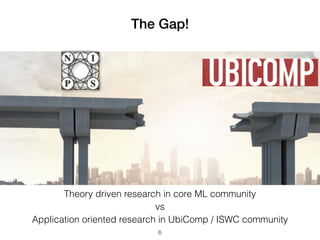
The Gap!
6
Theory driven research in core ML community
vs
Application oriented research in UbiComp / ISWC community
Our Aim: (Start) Bridging the Gap!
7
Bridging the Gap: Machine Learning for Ubicomp

— Promises and Pitfalls—
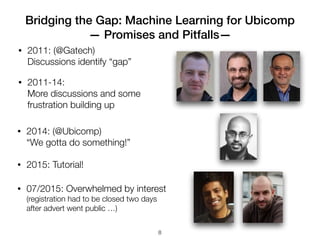
• 2011: (@Gatech) 

Discussions identify “gap”
• 2011-14:

More discussions and some
frustration building up
8
• 2014: (@Ubicomp)

“We gotta do something!”
• 2015: Tutorial!
• 07/2015: Overwhelmed by interest
(registration had to be closed two days
after advert went public …)
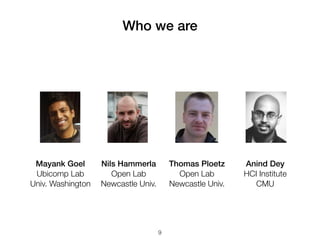
Who we are
9
Mayank Goel
Ubicomp Lab
Univ. Washington
Nils Hammerla
Open Lab

Newcastle Univ.
Thomas Ploetz
Open Lab

Newcastle Univ.
Anind Dey
HCI Institute

CMU
Who you are!
10
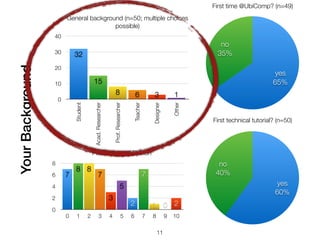
11
General background (n=50; multiple choices
possible)
0
10
20
30
40
Student
Acad.Researcher
Prof.Researcher
Teacher
Designer
Other
1368
15
32
First time @UbiComp? (n=49)
no
35%
yes
65%
First technical tutorial? (n=50)
no
40%
yes
60%
YourBackground
Proficiency w/ Python
0
2
4
6
8
0 1 2 3 4 5 6 7 8 9 10
201
7
2
5
3
7
88
7
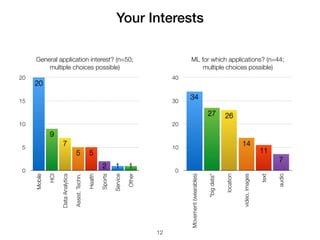
Your Interests
12
General application interest? (n=50;
multiple choices possible)
0
5
10
15
20
Mobile
HCI
DataAnalytics
Assist.Techn.
Health
Sports
Service
Other
112
55
7
9
20
ML for which applications? (n=44;
multiple choices possible)
0
10
20
30
40
Movement(wearables)
"bigdata"
location
video,images
text
audio
7
11
14
2627
34
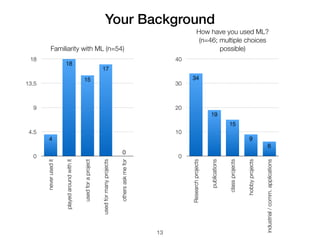
13
Familiarity with ML (n=54)
0
4.5
9
13.5
18
neverusedit
playedaroundwithit
usedforaproject
usedformanyprojects
othersaskmefor
0
17
15
18
4
How have you used ML?
(n=46; multiple choices
possible)
0
10
20
30
40
Researchprojects
publications
classprojects
hobbyprojects
industrial/comm.applications
6
9
15
19
34
Your Background
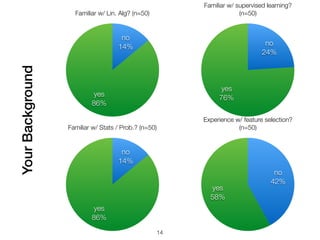
14
Familiar w/ supervised learning?
(n=50)
yes
76%
no
24%
Experience w/ feature selection?
(n=50)
yes
58%
no
42%
Familiar w/ Lin. Alg? (n=50)
yes
86%
no
14%
Familiar w/ Stats / Prob.? (n=50)
yes
86%
no
14%
YourBackground
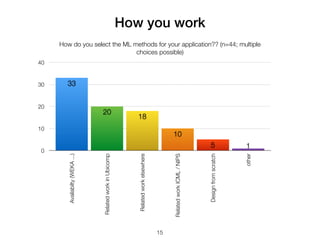
How you work
15
How do you select the ML methods for your application?? (n=44; multiple
choices possible)
0
10
20
30
40
Availabilty(WEKA...)
RelatedworkinUbicomp
Relatedworkelsewhere
RelatedworkICML/NIPS
Designfromscratch
other
15
10
18
20
33
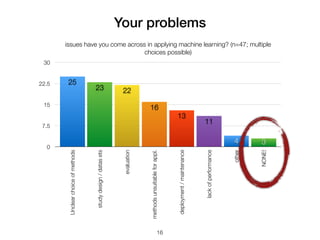
Your problems
16
issues have you come across in applying machine learning? (n=47; multiple
choices possible)
0
7.5
15
22.5
30
Unclearchoiceofmethods
studydesign/datasets
evaluation
methodsunsuitableforappl.
deployment/maintenance
lackofperformance
other
NONE!
34
11
13
16
2223
25
Structure of the Tutorial
17
What? Start? End?
Doors 9:00 AM
Help desk 9:00 AM 9:30 AM
Start 9:30 AM 9:30 AM
Welcome + Intro 9:30 AM 9:40 AM
ML primer + ML applications in Ubicomp 9:40 AM 10:10 AM
Applied ML 10:10 AM 10:30 AM
break 10:30 AM 11:00 AM
Study Design 11:00 AM 11:20 AM
Evaluation 11:20 AM 11:40 AM
Tools? 11:40 AM 12:00 PM
lunch break 12:00 PM 1:30 PM
tasks for hands on 1:30 PM 1:40 PM
hands on 1:40 PM 3:30 PM
break 3:30 PM 4:00 PM
Final Panel 4:00 PM 4:30 PM
End 4:30 PM

Bridging the Gap: Machine Learning for Ubiquitous Computing -- Introduction

  • 1.
    Bridging the Gap:Machine Learning for Ubicomp Thomas Ploetz, Mayank Goel, Nils Hammerla, Anind Dey — Promises and Pitfalls— http://d2z6avstustc5t.cloudfront.net/blog/wp-content/uploads/2014/06/millennials_and_it_bridge.jpg Tutorial @UbiComp 2015
  • 2.
    reviewed.c “Specialized elements ofhardware and software, connected by wires, radio waves and infrared, will be so ubiquitous that no one will notice their presence.” [Weiser] 2
  • 3.
    Key to UbiComp:Sensor Data (Analysis) UbiComp: • Opportunistic Capturing of activities & context • Sensor Data processing • Automatic Analysis • [Generate situated support] http://seouldoll.com/wp-content/uploads/2013/04/ivory- Focus on Real World Applications & Systems! • Positive impact on people’s lives • Social responsibility • [More challenging / interesting problems!] http://news.bbcimg.co.uk/media/images/49686000/jpg/_49686250_006806569-1.jpg 3
  • 4.
    It’s all aboutContext! 4 [Schmidt et al., 1999]
  • 5.
    How to analyseall this data? 
 — Machine Learning! 5 • Develop algorithms (“computer programs” [sic!] …) that adapt (learn!) towards generalisation through analysing sample data “Machine learning studies computer algorithms for learning to do stuff” [Robert Schapire]
  • 6.
    The Gap! 6 Theory drivenresearch in core ML community vs Application oriented research in UbiComp / ISWC community
  • 7.
    Our Aim: (Start)Bridging the Gap! 7
  • 8.
    Bridging the Gap:Machine Learning for Ubicomp
 — Promises and Pitfalls— • 2011: (@Gatech) 
 Discussions identify “gap” • 2011-14:
 More discussions and some frustration building up 8 • 2014: (@Ubicomp)
 “We gotta do something!” • 2015: Tutorial! • 07/2015: Overwhelmed by interest (registration had to be closed two days after advert went public …)
  • 9.
    Who we are 9 MayankGoel Ubicomp Lab Univ. Washington Nils Hammerla Open Lab
 Newcastle Univ. Thomas Ploetz Open Lab
 Newcastle Univ. Anind Dey HCI Institute
 CMU
  • 10.
  • 11.
    11 General background (n=50;multiple choices possible) 0 10 20 30 40 Student Acad.Researcher Prof.Researcher Teacher Designer Other 1368 15 32 First time @UbiComp? (n=49) no 35% yes 65% First technical tutorial? (n=50) no 40% yes 60% YourBackground Proficiency w/ Python 0 2 4 6 8 0 1 2 3 4 5 6 7 8 9 10 201 7 2 5 3 7 88 7
  • 12.
    Your Interests 12 General applicationinterest? (n=50; multiple choices possible) 0 5 10 15 20 Mobile HCI DataAnalytics Assist.Techn. Health Sports Service Other 112 55 7 9 20 ML for which applications? (n=44; multiple choices possible) 0 10 20 30 40 Movement(wearables) "bigdata" location video,images text audio 7 11 14 2627 34
  • 13.
    13 Familiarity with ML(n=54) 0 4.5 9 13.5 18 neverusedit playedaroundwithit usedforaproject usedformanyprojects othersaskmefor 0 17 15 18 4 How have you used ML? (n=46; multiple choices possible) 0 10 20 30 40 Researchprojects publications classprojects hobbyprojects industrial/comm.applications 6 9 15 19 34 Your Background
  • 14.
    14 Familiar w/ supervisedlearning? (n=50) yes 76% no 24% Experience w/ feature selection? (n=50) yes 58% no 42% Familiar w/ Lin. Alg? (n=50) yes 86% no 14% Familiar w/ Stats / Prob.? (n=50) yes 86% no 14% YourBackground
  • 15.
    How you work 15 Howdo you select the ML methods for your application?? (n=44; multiple choices possible) 0 10 20 30 40 Availabilty(WEKA...) RelatedworkinUbicomp Relatedworkelsewhere RelatedworkICML/NIPS Designfromscratch other 15 10 18 20 33
  • 16.
    Your problems 16 issues haveyou come across in applying machine learning? (n=47; multiple choices possible) 0 7.5 15 22.5 30 Unclearchoiceofmethods studydesign/datasets evaluation methodsunsuitableforappl. deployment/maintenance lackofperformance other NONE! 34 11 13 16 2223 25
  • 17.
    Structure of theTutorial 17 What? Start? End? Doors 9:00 AM Help desk 9:00 AM 9:30 AM Start 9:30 AM 9:30 AM Welcome + Intro 9:30 AM 9:40 AM ML primer + ML applications in Ubicomp 9:40 AM 10:10 AM Applied ML 10:10 AM 10:30 AM break 10:30 AM 11:00 AM Study Design 11:00 AM 11:20 AM Evaluation 11:20 AM 11:40 AM Tools? 11:40 AM 12:00 PM lunch break 12:00 PM 1:30 PM tasks for hands on 1:30 PM 1:40 PM hands on 1:40 PM 3:30 PM break 3:30 PM 4:00 PM Final Panel 4:00 PM 4:30 PM End 4:30 PM