Bridging the
Data Governance Chasm
Jay Zaidi
Data Management Advisory & Execution
2
Summary...
1. The modern data ecosystem is very complex. Need to
simplify data governance.
2. Primary governance challenges - Data Security, Data Quality
and Process transparency.
3. A combination of People, Process and Technology is required
to bridge the data governance chasm – using process
framework, agile delivery, standards/policies and
automation.
“The small and big data ecosystems
are complex. This impacts every
organization’s MISSION and poses
huge risks, if not GOVERNED well.”
3
Here’s the problem -
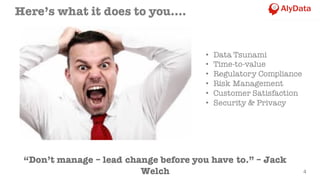
“Don’t manage – lead change before you have to.” – Jack
Welch
• Data Tsunami
• Time-to-value
• Regulatory Compliance
• Risk Management
• Customer Satisfaction
• Security & Privacy
4
Here’s what it does to you….
“GAO took IRS to task for : not implementing security
protocols related to systems storing tax payer data,
failed to integrate multi-factor authentication;
restrict access to servers severely enough;
ensure sensitive user authentication data were
encrypted; and properly limit access to restricted
areas.” – May 2016
5
This is not just a CISO or CIO issue, it is an IT and Data
Governance issue.
Here’s the ramification….
Patterns we see within our customers’
organizations –
• Data Silos (small and big data)
• Lack of data accountability
• Complex organizational structures
• Fragmented data sets
• Agile delivery
• Continuous change
• Too many competing priorities
• Very complex data eco-system
• No big picture view
6
Primary challenges based on surveys- data security, data
quality and process transparency.
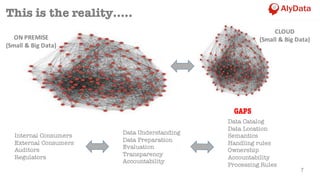
ON	PREMISE
(Small	&	Big	Data)
CLOUD
(Small	&	Big	Data)
Data Catalog
Data Location
Semantics
Handling rules
Ownership
Accountability
Processing Rules
This is the reality…..
Internal Consumers
External Consumers
Auditors
Regulators
Data Understanding
Data Preparation
Evaluation
Transparency
Accountability
GAPS
7
8
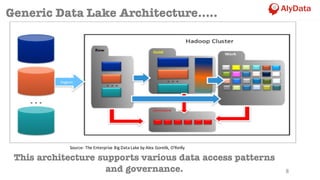
Generic Data Lake Architecture…..
This architecture supports various data access patterns
and governance.
Source:	The	Enterprise	Big	Data	Lake	by	Alex	Gorelik,	O’Reilly
Here’s a 6-step Data Governance
solution – a combination of Process,
People and Technology…..
1. Assess: Data ManagementMaturity Assessmentfocused on Governance, Quality and
Master Data Management.
2. Process: Apply our proprietary SPOCH framework.
3. Agility: Use Agile Data Governance (DG), Data Quality (DQ) and Master Data
Management(MDM) processes.
4. Standards/Policies: Define and monitor compliance.
5. Alignment: Align DG with IT governance.
6. Automation: Implementtools to automate DG processes, DQ profiling, Tagging,
Discovery, etc.
9
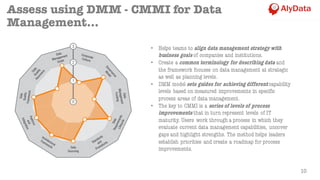
Assess using DMM - CMMI for Data
Management…
• Helps teams to align data management strategy with
business goals of companies and institutions.
• Create a common terminology for describing data and
the framework focuses on data management at strategic
as well as planning levels.
• DMM model sets guides for achieving differentcapability
levels based on measured improvements in specific
process areas of data management.
• The key to CMMI is a series of levels of process
improvements that in turn represent levels of IT
maturity. Users work through a process in which they
evaluate current data management capabilities, uncover
gaps and highlight strengths. The method helps leaders
establish priorities and create a roadmap for process
improvements.
10
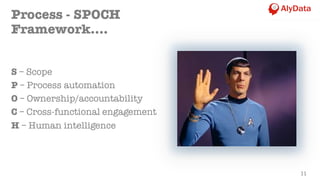
Process - SPOCH
Framework….
S – Scope
P – Process automation
O – Ownership/accountability
C – Cross-functional engagement
H – Human intelligence
11
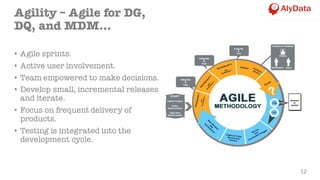
Agility – Agile for DG,
DQ, and MDM…
• Agile sprints.
• Active user involvement.
• Team empowered to make decisions.
• Develop small, incremental releases
and iterate.
• Focus on frequent delivery of
products.
• Testing is integrated into the
development cycle.
12
13
Recap...
1. The modern data ecosystem is very complex. Need to simplify data
governance.
2. Primary governance challenges are in data security, data quality
and process transparency.
3. A combination of People, Process and Technology is requiredto
bridge the data governance chasm – combination of DMM
Assessment followed by SPOCH process framework, Agile data
management, definition of standards and policies, alignment of DG
with IT governance and automation.
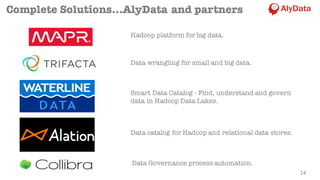
Complete Solutions…AlyData and partners
Data wrangling for small and big data.
Smart Data Catalog - Find, understand and govern
data in Hadoop Data Lakes.
Data catalog for Hadoop and relational data stores.
Data Governance process automation.
Hadoop platform for big data.
14
About me….
Founded AlyData in 2014. Led data management and analytics programs at
Fannie Mae for 13 years prior to that. Was a direct report to the Chief Data
Officer. Principal at PwC and other firms before that.
15
16
Thought
leadership...
“Succeeding with data isn’t just a
matter of putting Hadoop in your
machine room, or hiring some
physicists with crazy math skills. It
requires you to develop a data
culture that involves people
throughout the organization.” - DJ
Patil, Chief Data Scientist of the
U.S.
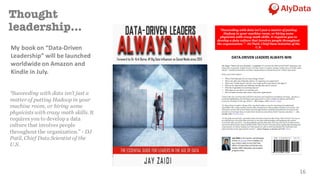
My	book	on	“Data-Driven	
Leadership”	will	be	launched	
worldwide	on	Amazon	and	
Kindle	in	July.
	
DATA-DRIVEN	LEADERS	ALWAYS	WIN	
	
The slogan "Data is the new electricity" is profound! It’s not just the data by itself that’s important, but
being able to generate insights from it. In these times of massive change, leaders have to build a data
culture - transform themselves and their organizations to unleash the power of their data assets.
Some areas you'll explore:
• What is Dark Data and why you must manage it better?
• What is the dark side of Big Data and how it's impacting your organization?
• What is the "Golden Square" and why every leader needs to learn about it and apply it?
• What are the opportunities and challenges that Big Data and IoT present?
• What the 6 ingredients for monetizing data are?
• What steps you can take to win with data, and
• How do leaders develop a data culture within their organizations?
	
“Data is the new currency that will drive business and regulatory compliance strategy. Jay does a
great job highlighting the techniques and approaches to solve complex problems and achieve
corporate strategies in the age of data”. - Ray Vazquez, CEO, Infinitive Insight
	
“In Data-Driven Leaders Always Win, Jay Zaidi makes a case for investing in foundational
capabilities like a data catalog, master data management, data quality and data governance. The
emergence of new self-service data tools and approaches is making it possible for everyone in the
enterprise to leverage data, to make better decisions and achieve better business outcomes.” - Alex
Gorelik, CEO, Waterline Data
	
"In his aptly named book, Jay Zaidi makes the basic argument that being “Data-Driven” has less to
do with having a lot of big data and more to do with understanding and analyzing the context
around the data you have. Jay thoughtfully explains that data, like any other form of information,
cannot be taken at face value and that being “Data-Driven” isn’t just about cycling data though your
organization, it’s about making sure that people are able to both quickly find the right data and
place that data in the appropriate context.” - Satyen Sangani, co-founder and CEO Alation


Jay Zaidi is	the	Founder	and	Managing		
Partner	of	AlyData.	Prior	to	AlyData,	he	
was	a	direct	report	to	the	Chief	Data	
Officer	of	Fannie	Mae	and	led	the	Data	
Quality,	MDM,	Metadata,	and	Analytics	
programs	there.	
“Succeeding with data isn’t just a matter of putting
Hadoop in your machine room, or hiring some
physicists with crazy math skills. It requires you to
develop a data culture that involves people throughout
the organization.” - DJ Patil, Chief Data Scientist of the
U.S.
Email – jayzaidi@alydata.com
LinkedIn - www.linkedin.com/in/javedzaidi
Web – www.alydata.com
17
We’re here to help….
Advise, Train, & Implement.
AlyData specializes in Strategic Information Management, Business
Insights, and Change Management. We help organizations gain a
competitive advantage and achieve their mission, using their most under
utilized, yet strategic assets - Data and Information.

Bridging the Data Governance Chasm

  • 1.
    Bridging the Data GovernanceChasm Jay Zaidi Data Management Advisory & Execution
  • 2.
    2 Summary... 1. The moderndata ecosystem is very complex. Need to simplify data governance. 2. Primary governance challenges - Data Security, Data Quality and Process transparency. 3. A combination of People, Process and Technology is required to bridge the data governance chasm – using process framework, agile delivery, standards/policies and automation.
  • 3.
    “The small andbig data ecosystems are complex. This impacts every organization’s MISSION and poses huge risks, if not GOVERNED well.” 3 Here’s the problem -
  • 4.
    “Don’t manage –lead change before you have to.” – Jack Welch • Data Tsunami • Time-to-value • Regulatory Compliance • Risk Management • Customer Satisfaction • Security & Privacy 4 Here’s what it does to you….
  • 5.
    “GAO took IRSto task for : not implementing security protocols related to systems storing tax payer data, failed to integrate multi-factor authentication; restrict access to servers severely enough; ensure sensitive user authentication data were encrypted; and properly limit access to restricted areas.” – May 2016 5 This is not just a CISO or CIO issue, it is an IT and Data Governance issue. Here’s the ramification….
  • 6.
    Patterns we seewithin our customers’ organizations – • Data Silos (small and big data) • Lack of data accountability • Complex organizational structures • Fragmented data sets • Agile delivery • Continuous change • Too many competing priorities • Very complex data eco-system • No big picture view 6 Primary challenges based on surveys- data security, data quality and process transparency.
  • 7.
    ON PREMISE (Small & Big Data) CLOUD (Small & Big Data) Data Catalog Data Location Semantics Handlingrules Ownership Accountability Processing Rules This is the reality….. Internal Consumers External Consumers Auditors Regulators Data Understanding Data Preparation Evaluation Transparency Accountability GAPS 7
  • 8.
    8 Generic Data LakeArchitecture….. This architecture supports various data access patterns and governance. Source: The Enterprise Big Data Lake by Alex Gorelik, O’Reilly
  • 9.
    Here’s a 6-stepData Governance solution – a combination of Process, People and Technology….. 1. Assess: Data ManagementMaturity Assessmentfocused on Governance, Quality and Master Data Management. 2. Process: Apply our proprietary SPOCH framework. 3. Agility: Use Agile Data Governance (DG), Data Quality (DQ) and Master Data Management(MDM) processes. 4. Standards/Policies: Define and monitor compliance. 5. Alignment: Align DG with IT governance. 6. Automation: Implementtools to automate DG processes, DQ profiling, Tagging, Discovery, etc. 9
  • 10.
    Assess using DMM- CMMI for Data Management… • Helps teams to align data management strategy with business goals of companies and institutions. • Create a common terminology for describing data and the framework focuses on data management at strategic as well as planning levels. • DMM model sets guides for achieving differentcapability levels based on measured improvements in specific process areas of data management. • The key to CMMI is a series of levels of process improvements that in turn represent levels of IT maturity. Users work through a process in which they evaluate current data management capabilities, uncover gaps and highlight strengths. The method helps leaders establish priorities and create a roadmap for process improvements. 10
  • 11.
    Process - SPOCH Framework…. S– Scope P – Process automation O – Ownership/accountability C – Cross-functional engagement H – Human intelligence 11
  • 12.
    Agility – Agilefor DG, DQ, and MDM… • Agile sprints. • Active user involvement. • Team empowered to make decisions. • Develop small, incremental releases and iterate. • Focus on frequent delivery of products. • Testing is integrated into the development cycle. 12
  • 13.
    13 Recap... 1. The moderndata ecosystem is very complex. Need to simplify data governance. 2. Primary governance challenges are in data security, data quality and process transparency. 3. A combination of People, Process and Technology is requiredto bridge the data governance chasm – combination of DMM Assessment followed by SPOCH process framework, Agile data management, definition of standards and policies, alignment of DG with IT governance and automation.
  • 14.
    Complete Solutions…AlyData andpartners Data wrangling for small and big data. Smart Data Catalog - Find, understand and govern data in Hadoop Data Lakes. Data catalog for Hadoop and relational data stores. Data Governance process automation. Hadoop platform for big data. 14
  • 15.
    About me…. Founded AlyDatain 2014. Led data management and analytics programs at Fannie Mae for 13 years prior to that. Was a direct report to the Chief Data Officer. Principal at PwC and other firms before that. 15
  • 16.
    16 Thought leadership... “Succeeding with dataisn’t just a matter of putting Hadoop in your machine room, or hiring some physicists with crazy math skills. It requires you to develop a data culture that involves people throughout the organization.” - DJ Patil, Chief Data Scientist of the U.S. My book on “Data-Driven Leadership” will be launched worldwide on Amazon and Kindle in July. DATA-DRIVEN LEADERS ALWAYS WIN The slogan "Data is the new electricity" is profound! It’s not just the data by itself that’s important, but being able to generate insights from it. In these times of massive change, leaders have to build a data culture - transform themselves and their organizations to unleash the power of their data assets. Some areas you'll explore: • What is Dark Data and why you must manage it better? • What is the dark side of Big Data and how it's impacting your organization? • What is the "Golden Square" and why every leader needs to learn about it and apply it? • What are the opportunities and challenges that Big Data and IoT present? • What the 6 ingredients for monetizing data are? • What steps you can take to win with data, and • How do leaders develop a data culture within their organizations? “Data is the new currency that will drive business and regulatory compliance strategy. Jay does a great job highlighting the techniques and approaches to solve complex problems and achieve corporate strategies in the age of data”. - Ray Vazquez, CEO, Infinitive Insight “In Data-Driven Leaders Always Win, Jay Zaidi makes a case for investing in foundational capabilities like a data catalog, master data management, data quality and data governance. The emergence of new self-service data tools and approaches is making it possible for everyone in the enterprise to leverage data, to make better decisions and achieve better business outcomes.” - Alex Gorelik, CEO, Waterline Data "In his aptly named book, Jay Zaidi makes the basic argument that being “Data-Driven” has less to do with having a lot of big data and more to do with understanding and analyzing the context around the data you have. Jay thoughtfully explains that data, like any other form of information, cannot be taken at face value and that being “Data-Driven” isn’t just about cycling data though your organization, it’s about making sure that people are able to both quickly find the right data and place that data in the appropriate context.” - Satyen Sangani, co-founder and CEO Alation Jay Zaidi is the Founder and Managing Partner of AlyData. Prior to AlyData, he was a direct report to the Chief Data Officer of Fannie Mae and led the Data Quality, MDM, Metadata, and Analytics programs there. “Succeeding with data isn’t just a matter of putting Hadoop in your machine room, or hiring some physicists with crazy math skills. It requires you to develop a data culture that involves people throughout the organization.” - DJ Patil, Chief Data Scientist of the U.S.
  • 17.
    Email – jayzaidi@alydata.com LinkedIn- www.linkedin.com/in/javedzaidi Web – www.alydata.com 17 We’re here to help…. Advise, Train, & Implement. AlyData specializes in Strategic Information Management, Business Insights, and Change Management. We help organizations gain a competitive advantage and achieve their mission, using their most under utilized, yet strategic assets - Data and Information.