Brewery Process Design
BE 4380 - Bioprocess Engineering Design
Dr. Walker
Conor Bury, Jeremiah Davis, Ashleigh Hough, Katie Love, Ian Melville
April 23, 2015
Project Goals
creation of a regional brewery
high quality product
maximum profit
40,000 barrels per year
sustainable manufacturing practices
minimal energy consumption
minimal material waste
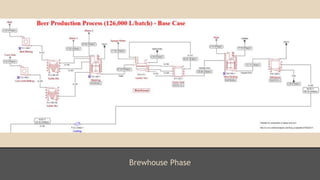
Brewhouse Phase
Mashing - Saccharification Enzymes
Alpha-amylase
- Cuts glucose chains indiscriminately
- Most active between 154 - 162*F
Beta-amylase
- Can only cut branches
of amylopectin
- Creates maltose (2 glucose chain)
Mashing Inputs and Outputs
Overall reaction
9 Starch + 1 Water → 10 Glucose
IN
Starch (Corn Grits) 727.34 g/L 4,379.3 kg/batch
Starch (Malted Barley) 699.4 g/L 8,398.4 kg/batch
Water
51,259 L/batch
OUT
Glucose 204.5 g/L 12,781 kg/batch
Starch 20.45 g/L 1,278 kg/batch
Water 49,806
L/batch
Lauter Tun Grant
Tank
Sparging of remaining grain
Utilizes starch still in grain
Removal of excess used grain
Provides easy transportation of
thicker material
Acts as a holding tank for wort
accumulation
Smooths variable flow rate caused
by lauter process
Boiling Wort
Stoichiometric Equation:
100 Hops → 3 Alpha Acids + 97 Spent Hops
Boiling Wort
min1 + min2 + Q1 + Q2 = mout
min1 = wort in - (129,884.49 L)
min2 = charging wort - 30 kg/min - (min-total 130,283.89 L)
Q1 = preheating (2530339141 kcal/hr)
Q2 = boiling (12093925.34 kcal/hr)
min-total - mvapor vented - mconsumed in rxn = mout
(130,283.89 L - 17276.66 L - 301.73 L = 112,705.5 L)
Whirlpool
Removal of protein
precipitate (trub)
Trub degrades taste
and hinders
fermentation
1st Chiller
Wort: 87% H20, 11% Glucose
Q=U1A1(ΔT)=mCp(ΔT)
ṁ=108.6 m3/batch
ΔT=18-95=-77°C
U=1500 W/m2K
A=54.18 m2
Qin= 5384824 kCal/hr
Qcalc= 4996202 kCal/hr
Qwaste heat= 388622 kCal/hr
Coolant: 100% H20
Q=U1A1(ΔT)=mCp(ΔT)
ṁ=1072201 kg/h
ΔT= 5-10=-5°C
Cp= 4181 J/kg K
Qc= 5361005 kCal/hr
Qc= 6226211 W
Qwort ≈ Qcoolant
5384824 kCal/hr≈ 5361005 kCal/hr
Fermentation & Aging Phase
Wort Oxygenation Yeast
Charge
Oxygen added to wort
at concentration of
0.02 g/L
Necessary for
fermentation
Yeast added to brew
Enables fermentation
process
Fermentation - Stoichiometry
Overall Reaction:
1 C6H12O6 → 2 CO2 + 2 CH3CH2OH
● IN:
○ Glucose: 12396.6 kg/batch → 68870 moles
○ Yeast: 105.52 kg/batch → 44.4 moles
● Out:
○ Glucose: 1487.59 kg/batch → 8264.4 moles
○ Yeast: 622.54 kg/batch → 261.96 moles
○ Ethanol: 5066.75 kg/batch → 110147 moles
○ CO2: 4741.27 kg/batch → 107756 moles
● Reaction acting at 88%
Fermentation - Energy
Reaction Enthalpy:
-500 kcal/kg glucose
Total glucose consumed
10909 kg/batch
Enthalpy Produced:
5.45 * 106 kcal/batch
Total enthalpy into the system
-7.34*105 kcal/batch
Total enthalpy leaving the system
4.29*105 kcal/batch
Filtration
Governing Equation:
Vslurry= A∙Ncycles∙J∙tp = 63.1077 m2 ∙ 1cycle/batch∙ 500 L/m2-hr ∙ 240 min ∙1
hr/60min
Vslurry= 126215.4 L/min-batch
Mass Balance:
min = myeast/trub-out + mfiltered beer-out (126668.576 kg = 1105.235 kg + 12556.341
kg)
Energy Balance:
Hin = Hyeast/trub-out + Hfiltered beer-out (-5160.929 MJ = -44.431 MJ + -5116.499 MJ)
Filling & Packaging Phase
Batch Process Summation
Water: 212,000 kg
Barley Malt: 12,000 kg, Hops: 150 kg, Corn Grits: 6000 kg
9,000 kW-h electricity
Yields:
200,810 12oz.bottles (1 hr gameday weekend)
500 ½ kegs
126,000 kg of delicious, delicious beer
Sustainability
Beer is about 90% water
Need more efficient ways to heat up water during brewing process
Efficient boilers, tankless water heater, solar water heater
Solar/wind power to power brewery
Steam recapture
Rainwater capture - to reduce municipal/local stream water demand
Refrigeration is the largest use of energy in a brewery
Airlocks and proper insulation
Ambient cooling during colder weather
Underground cellar
Social Sustainability
Breweries play important role in moving communities towards sustainability
Sustainable business - provide jobs, put $ into economy, donate goods and expertise
Social sustainability - serve as gathering place where new ideas are generated,
friendships strengthened, and new contacts are made with community members
Social events often occur at a drinking event or involve the consumption of alcohol
All this is an acknowledgment of the type of camaraderie that can develop due in
large part to these social hubs
Economic Analysis: Cost
Capital (initial): $28,000,000
Working Cost per batch:
Brewhouse: $81,899
Fermentation & Aging: $64,780
Filling & Packaging: $32,568
Total: $179, 247
Annual operating cost:
$6,632,000
Cost per bottle: $0.505
Critical Costs:
Stirred Reactor: $ 750,000
Engineering: $ 3,605,000
Operator: $ 46/hr
Aqueous Waste :$42,705/yr
(rinsing and cleaning)
Marketing and transportation costs
not factored in
Economic Analysis: Revenue
Bottles Revenue: 3,715,000 $/yr
Keg Revenue: 371,500 $/yr
Total Revenue: 4,087,000 $/yr
Annual operating cost: 6,632,000
$/yr
Net Profit: -2,545,000 $/yr
Represents failing business
model
Solutions:
Residual materials like trub
could be resold
Sustainability measures not
taken into account
Sale price too low
Fin

Brewery Process Design

  • 1.
    Brewery Process Design BE4380 - Bioprocess Engineering Design Dr. Walker Conor Bury, Jeremiah Davis, Ashleigh Hough, Katie Love, Ian Melville April 23, 2015
  • 2.
    Project Goals creation ofa regional brewery high quality product maximum profit 40,000 barrels per year sustainable manufacturing practices minimal energy consumption minimal material waste
  • 3.
  • 4.
    Mashing - SaccharificationEnzymes Alpha-amylase - Cuts glucose chains indiscriminately - Most active between 154 - 162*F Beta-amylase - Can only cut branches of amylopectin - Creates maltose (2 glucose chain)
  • 5.
    Mashing Inputs andOutputs Overall reaction 9 Starch + 1 Water → 10 Glucose IN Starch (Corn Grits) 727.34 g/L 4,379.3 kg/batch Starch (Malted Barley) 699.4 g/L 8,398.4 kg/batch Water 51,259 L/batch OUT Glucose 204.5 g/L 12,781 kg/batch Starch 20.45 g/L 1,278 kg/batch Water 49,806 L/batch
  • 6.
    Lauter Tun Grant Tank Spargingof remaining grain Utilizes starch still in grain Removal of excess used grain Provides easy transportation of thicker material Acts as a holding tank for wort accumulation Smooths variable flow rate caused by lauter process
  • 7.
    Boiling Wort Stoichiometric Equation: 100Hops → 3 Alpha Acids + 97 Spent Hops
  • 8.
    Boiling Wort min1 +min2 + Q1 + Q2 = mout min1 = wort in - (129,884.49 L) min2 = charging wort - 30 kg/min - (min-total 130,283.89 L) Q1 = preheating (2530339141 kcal/hr) Q2 = boiling (12093925.34 kcal/hr) min-total - mvapor vented - mconsumed in rxn = mout (130,283.89 L - 17276.66 L - 301.73 L = 112,705.5 L)
  • 9.
    Whirlpool Removal of protein precipitate(trub) Trub degrades taste and hinders fermentation
  • 10.
    1st Chiller Wort: 87%H20, 11% Glucose Q=U1A1(ΔT)=mCp(ΔT) ṁ=108.6 m3/batch ΔT=18-95=-77°C U=1500 W/m2K A=54.18 m2 Qin= 5384824 kCal/hr Qcalc= 4996202 kCal/hr Qwaste heat= 388622 kCal/hr Coolant: 100% H20 Q=U1A1(ΔT)=mCp(ΔT) ṁ=1072201 kg/h ΔT= 5-10=-5°C Cp= 4181 J/kg K Qc= 5361005 kCal/hr Qc= 6226211 W Qwort ≈ Qcoolant 5384824 kCal/hr≈ 5361005 kCal/hr
  • 11.
  • 12.
    Wort Oxygenation Yeast Charge Oxygenadded to wort at concentration of 0.02 g/L Necessary for fermentation Yeast added to brew Enables fermentation process
  • 13.
    Fermentation - Stoichiometry OverallReaction: 1 C6H12O6 → 2 CO2 + 2 CH3CH2OH ● IN: ○ Glucose: 12396.6 kg/batch → 68870 moles ○ Yeast: 105.52 kg/batch → 44.4 moles ● Out: ○ Glucose: 1487.59 kg/batch → 8264.4 moles ○ Yeast: 622.54 kg/batch → 261.96 moles ○ Ethanol: 5066.75 kg/batch → 110147 moles ○ CO2: 4741.27 kg/batch → 107756 moles ● Reaction acting at 88%
  • 14.
    Fermentation - Energy ReactionEnthalpy: -500 kcal/kg glucose Total glucose consumed 10909 kg/batch Enthalpy Produced: 5.45 * 106 kcal/batch Total enthalpy into the system -7.34*105 kcal/batch Total enthalpy leaving the system 4.29*105 kcal/batch
  • 15.
    Filtration Governing Equation: Vslurry= A∙Ncycles∙J∙tp= 63.1077 m2 ∙ 1cycle/batch∙ 500 L/m2-hr ∙ 240 min ∙1 hr/60min Vslurry= 126215.4 L/min-batch Mass Balance: min = myeast/trub-out + mfiltered beer-out (126668.576 kg = 1105.235 kg + 12556.341 kg) Energy Balance: Hin = Hyeast/trub-out + Hfiltered beer-out (-5160.929 MJ = -44.431 MJ + -5116.499 MJ)
  • 16.
  • 18.
    Batch Process Summation Water:212,000 kg Barley Malt: 12,000 kg, Hops: 150 kg, Corn Grits: 6000 kg 9,000 kW-h electricity Yields: 200,810 12oz.bottles (1 hr gameday weekend) 500 ½ kegs 126,000 kg of delicious, delicious beer
  • 19.
    Sustainability Beer is about90% water Need more efficient ways to heat up water during brewing process Efficient boilers, tankless water heater, solar water heater Solar/wind power to power brewery Steam recapture Rainwater capture - to reduce municipal/local stream water demand Refrigeration is the largest use of energy in a brewery Airlocks and proper insulation Ambient cooling during colder weather Underground cellar
  • 20.
    Social Sustainability Breweries playimportant role in moving communities towards sustainability Sustainable business - provide jobs, put $ into economy, donate goods and expertise Social sustainability - serve as gathering place where new ideas are generated, friendships strengthened, and new contacts are made with community members Social events often occur at a drinking event or involve the consumption of alcohol All this is an acknowledgment of the type of camaraderie that can develop due in large part to these social hubs
  • 21.
    Economic Analysis: Cost Capital(initial): $28,000,000 Working Cost per batch: Brewhouse: $81,899 Fermentation & Aging: $64,780 Filling & Packaging: $32,568 Total: $179, 247 Annual operating cost: $6,632,000 Cost per bottle: $0.505 Critical Costs: Stirred Reactor: $ 750,000 Engineering: $ 3,605,000 Operator: $ 46/hr Aqueous Waste :$42,705/yr (rinsing and cleaning) Marketing and transportation costs not factored in
  • 22.
    Economic Analysis: Revenue BottlesRevenue: 3,715,000 $/yr Keg Revenue: 371,500 $/yr Total Revenue: 4,087,000 $/yr Annual operating cost: 6,632,000 $/yr Net Profit: -2,545,000 $/yr Represents failing business model Solutions: Residual materials like trub could be resold Sustainability measures not taken into account Sale price too low
  • 23.