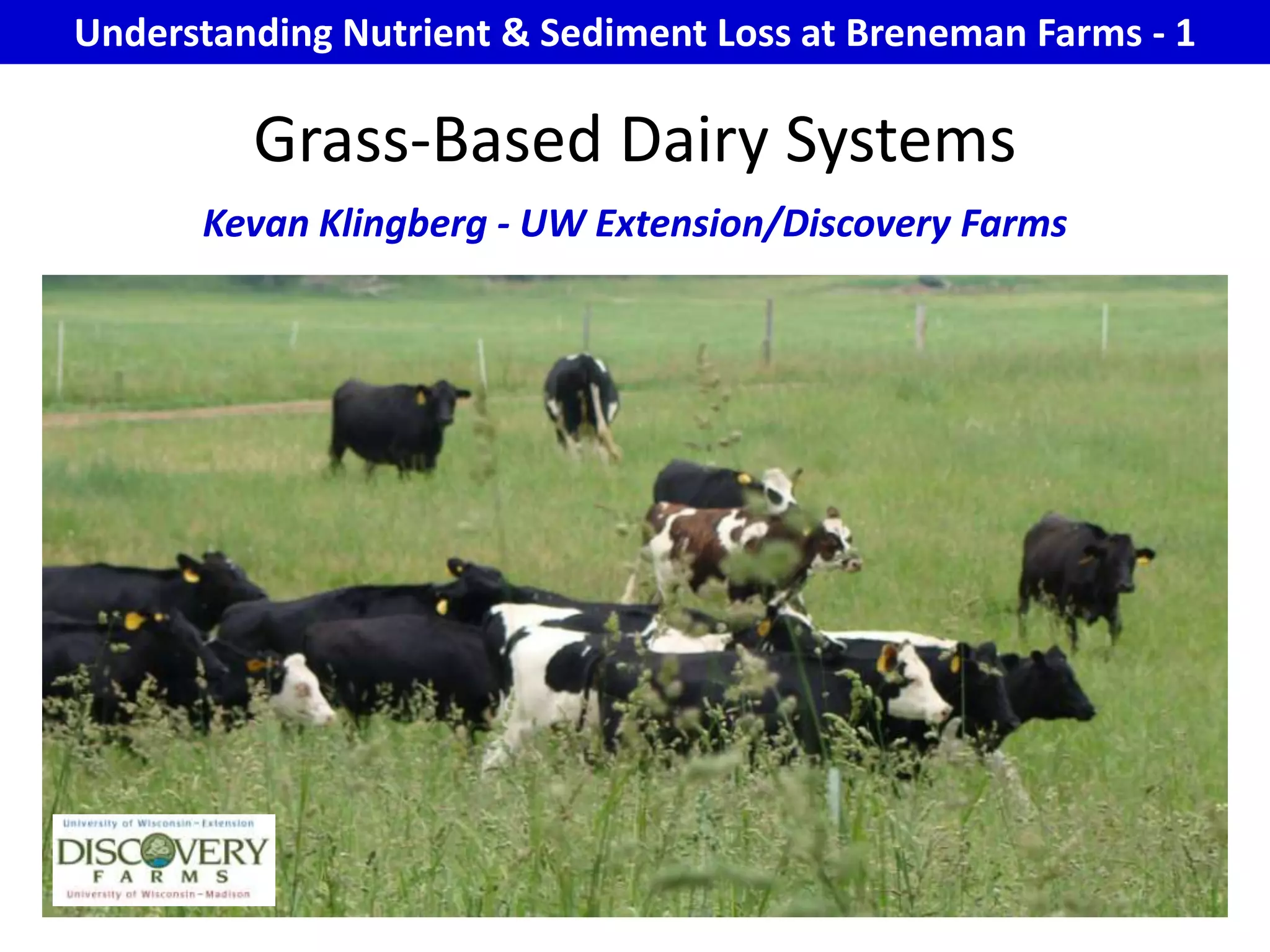
Understanding Nutrient & Sediment Loss at Breneman Farms - 1Grass-Based Dairy SystemsKevan Klingberg - UW Extension/Discovery Farms
Grazing-Based Dairy SystemsGrazing or pasture based dairies have existed in Wisconsin since we began milking cows.While many dairies have moved cattle into confinement facilities.The Wisconsin dairy industry still includes an important and growing group of producers using new techniques and equipment to practice Management Intensive Grazing (MIG).
Grazing-Based Dairy SystemsGrazing systems allow producers to: begin or continue dairying with minimal investment in equipment.focus daily activities on managing grass / legume pasture forage and dairy animals.
Grazing-Based Dairy SystemsVariations to system can include:Frequency of moving cattleTypes of facilities to house and milk cattleOption to produce conventionally vs. organicOthersMIG can be done with dairy cattle, beef, sheep, goats or other livestock capable of utilizing forage diets.
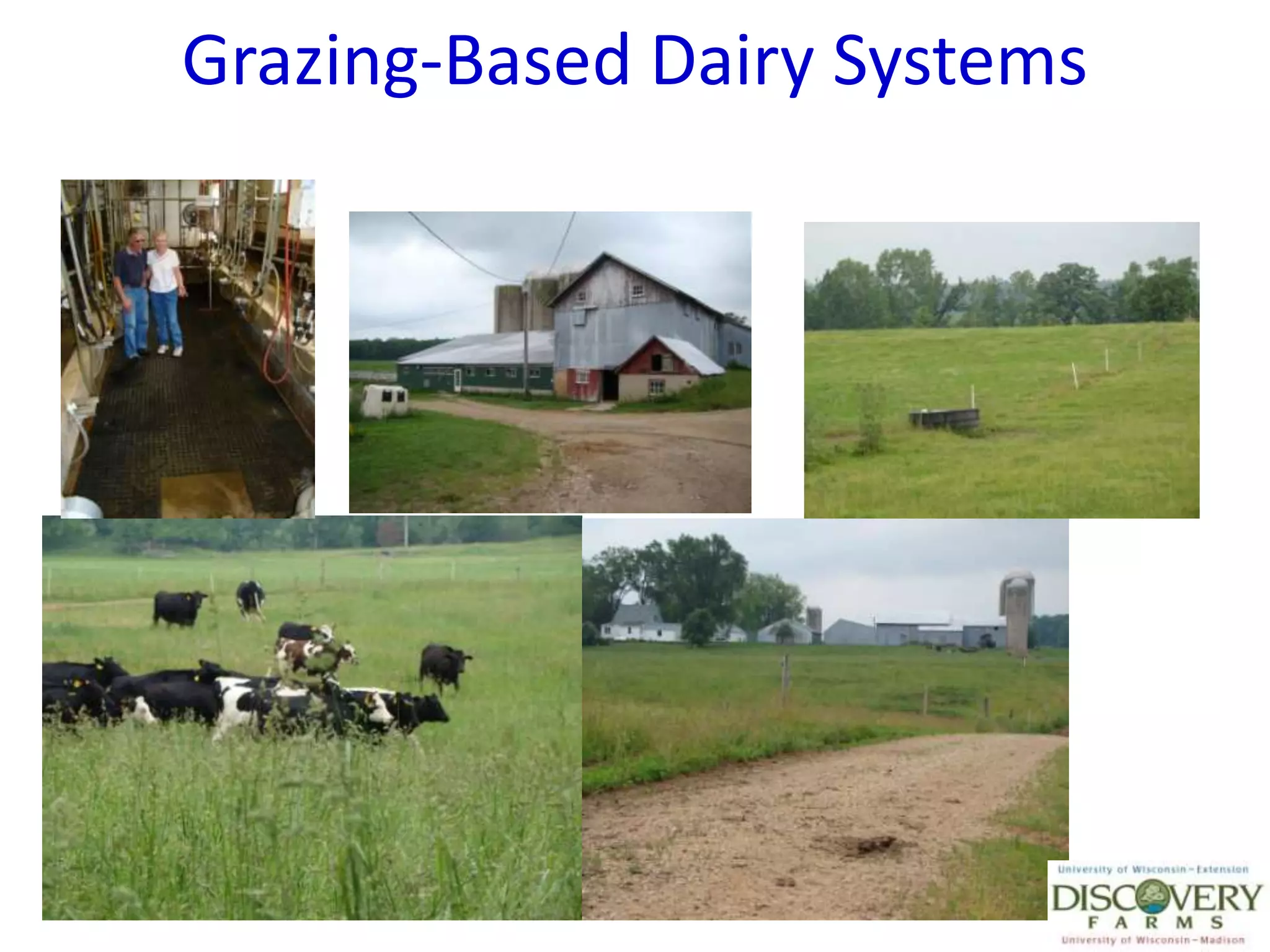
Grazing-Based Dairy SystemsCombination of:Grazing animalsActively growing pasture foragePaddock fencesWatering facilitiesTravel lanesLow-cost housing / milking facilityExisting oldRetrofit oldLow cost newFocus on managing ruminant animals to harvest and eat high quality forage via grazing and spread their own manure in the process.
Grazing-Based Dairy Systems
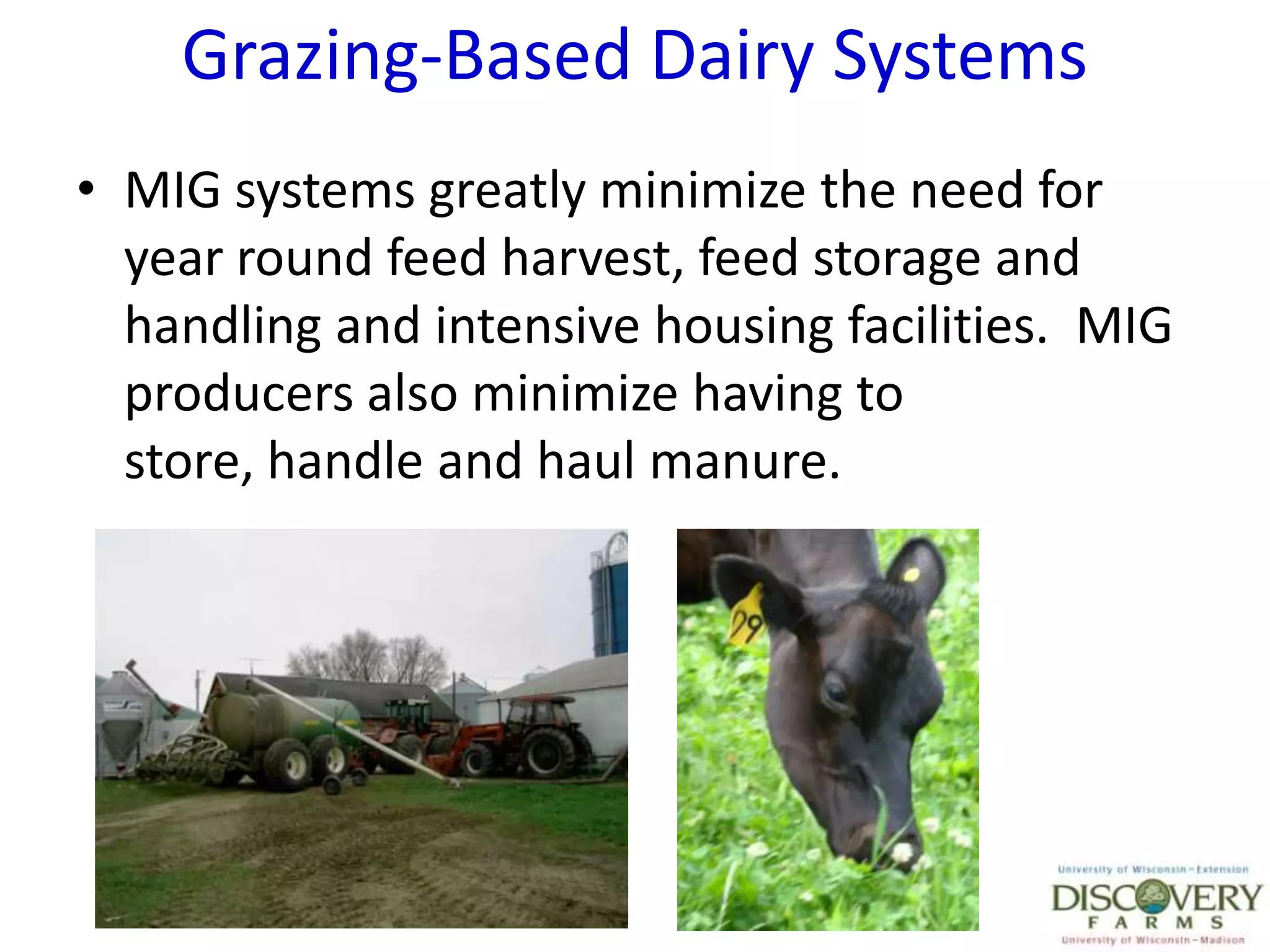
Grazing-Based Dairy SystemsMIG systems greatly minimize the need for year round feed harvest, feed storage and handling and intensive housing facilities.  MIG producers also minimize having to store, handle and haul manure.
Grazing-Based Dairy SystemsDairies practicing MIG report increased profitability as a result of lower feed, equipment, labor and energy costs, as well as improved animal health and lower veterinary costs.Wisconsin studies have shown that when managed correctly, both grazing and confined dairy systems can be profitable.A University of Wisconsin - Center for Dairy Profitability study shows that the nine-year average (1999-2007) total basic costs on grazing dairies was $650 less per cow compared to confinement dairies.Similarly, grazing dairies earned $230 more net farm income per cow compared to confinement operations over the same time period.
Grazing-Based Dairy SystemsPastures are usually delineated by permanent perimeter fences and further subdivided by temporary fencing within the main pastures, allowing cattle controlled access to a small section of pasture at a time.Cattle are systematically moved into and out of paddocks.Good quality fresh pasture is grazed, followed by a rest period that allows adequate time for the perennial grass and legume plants to re-grow before the next grazing cycle.
Grazing-Based Dairy SystemsPastures are often connected by travel lanes with watering systems placed in common areas that serve numerous pastures.
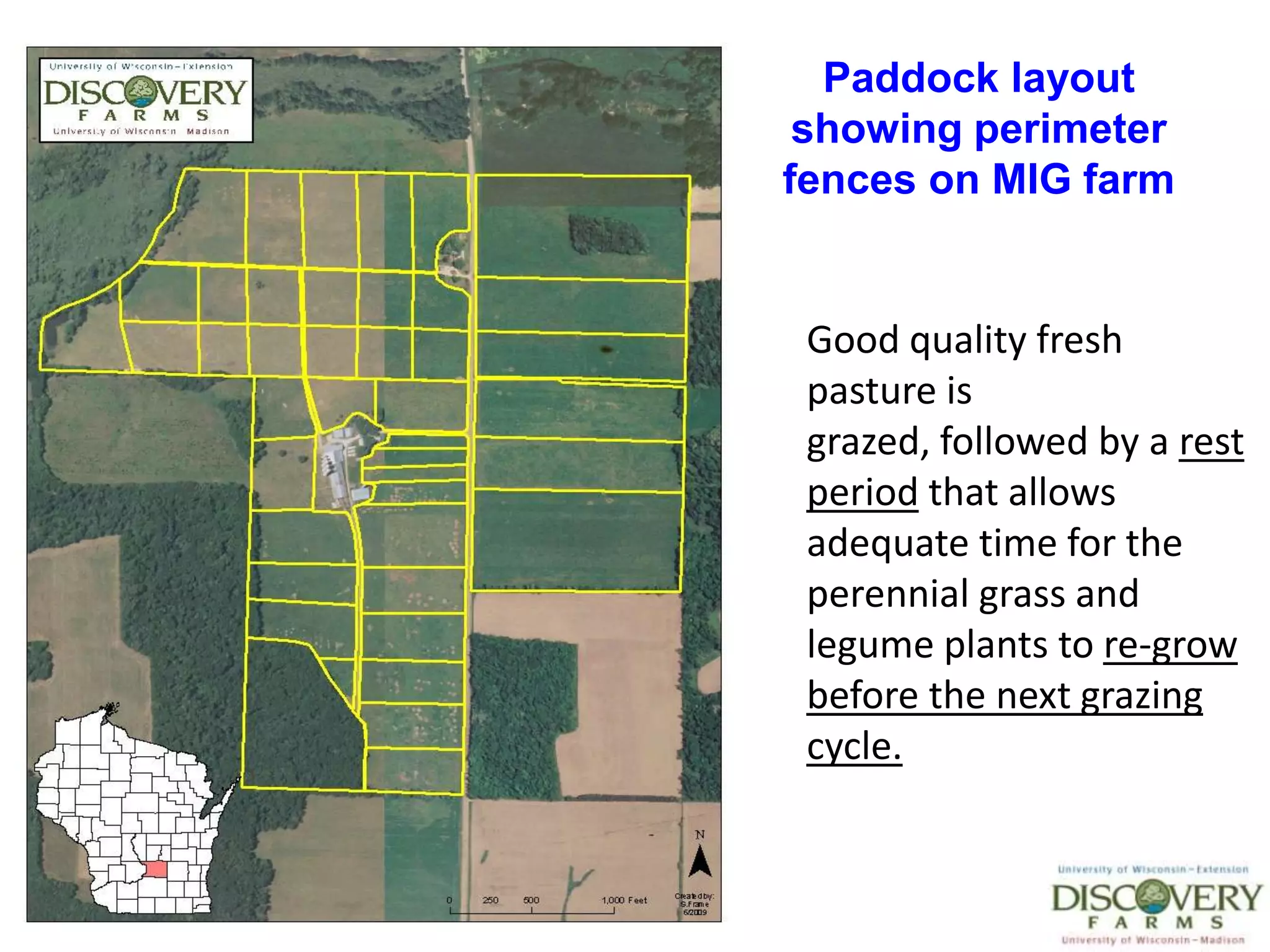
Paddock layout showing perimeter fences on MIG farmGood quality fresh pasture is grazed, followed by a rest period that allows adequate time for the perennial grass and legume plants to re-grow before the next grazing cycle.
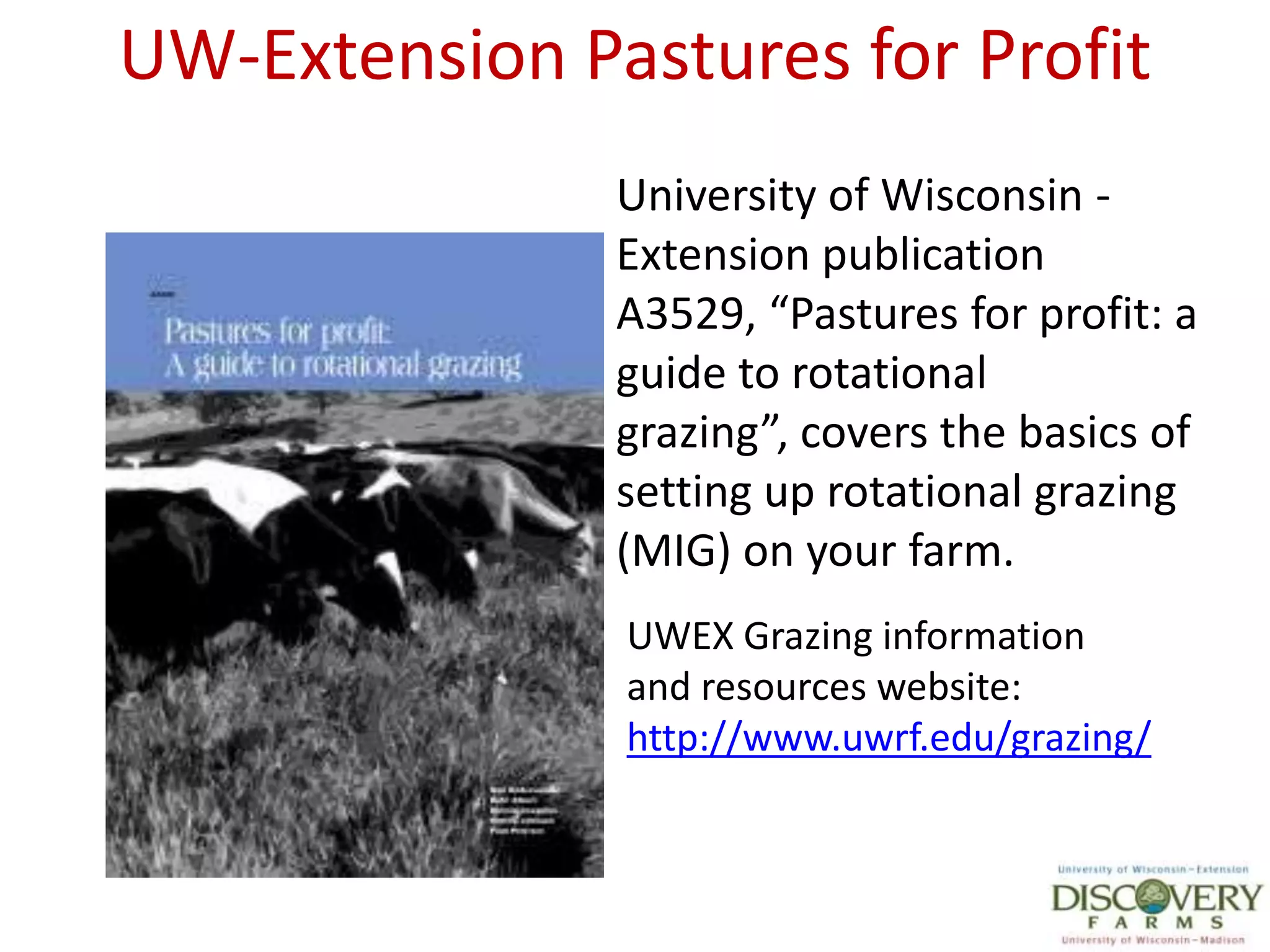
UW-Extension Pastures for ProfitUniversity of Wisconsin - Extension publication A3529, “Pastures for profit: a guide to rotational grazing”, covers the basics of setting up rotational grazing (MIG) on your farm.UWEX Grazing informationand resources website:http://www.uwrf.edu/grazing/
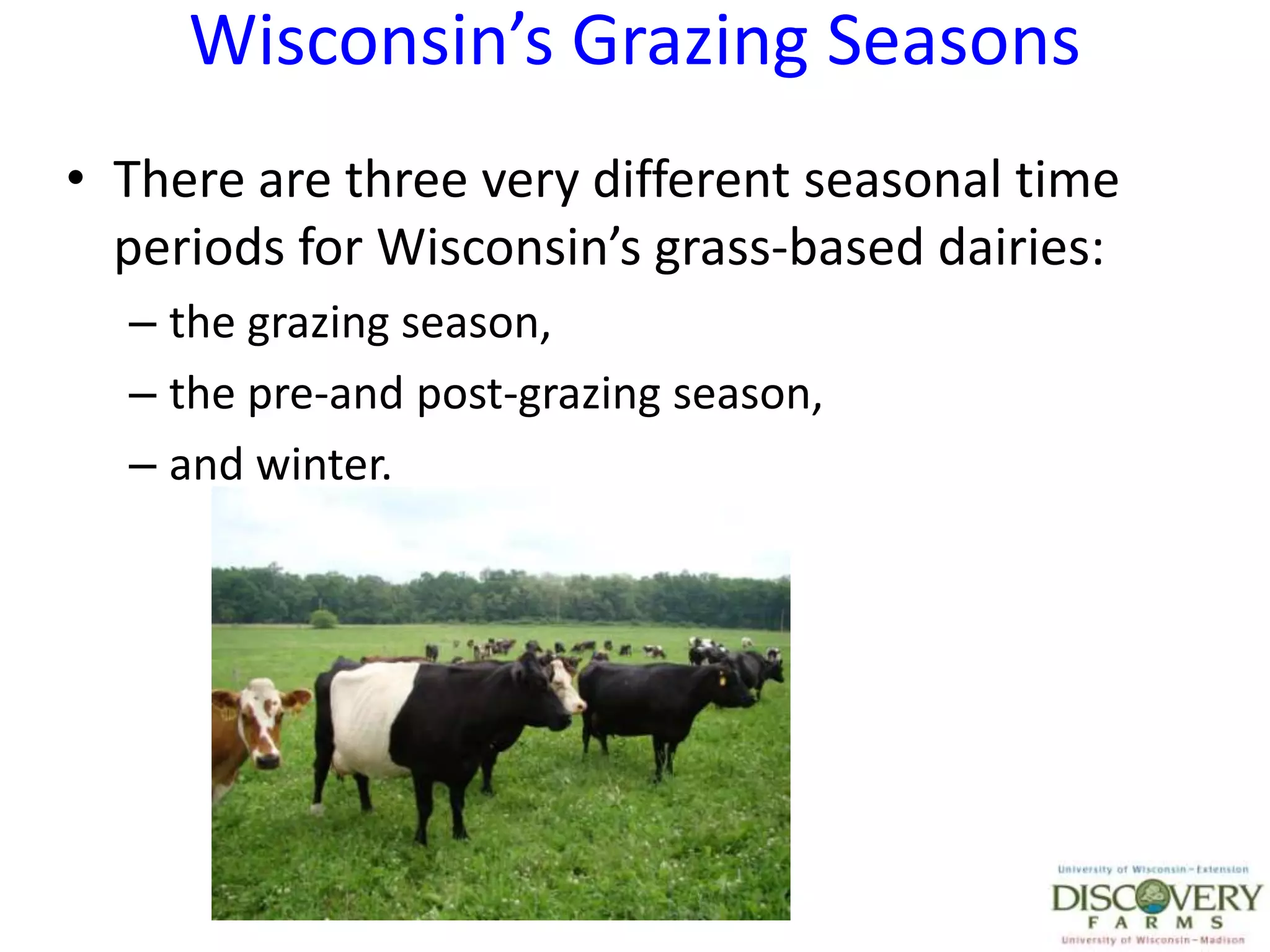
Wisconsin’s Grazing SeasonsThere are three very different seasonal time periods for Wisconsin’s grass-based dairies:the grazing season,the pre-and post-grazing season,and winter.
Wisconsin’s Grazing SeasonsWisconsin’s grazing season is about 180 days, lasting from May to October.There is another 30 days on either side of the growing season (60 days total) where pasture plants are either just beginning to grow or have gone dormant.During this period pastures are mostly free from snow, and the soil is thawed. Forage quality may be limited in the late season as plant growth slows and mature forage is stockpiled to extend the grazing season.Early spring growth is generally very high quality, but limited in quantity and plants are sensitive to hoof damage because of high soil moisture.Generally both the pre-and post-grazing season periods require supplemental feed, which is sometimes delivered and fed within paddocks.
Wisconsin’s Grazing SeasonsDuring the winter (December – March) when Wisconsin pastures are dormant and the soil is mostly frozen and/or snow-covered, grass-based dairies either confine cattle to barns or keep them outside.Out-wintering sites are areas where animals are concentrated and fed on paddocks during this season.
Out-WinteringThere are three general management approaches to out-wintering cattle: 1) Continue rotating cattle through paddocks; 2) Use “sacrifice” paddocks, such that those paddocks get re-seeded the next year; or 3) Designate a paddock or two and develop a bedded pack, which gets cleaned in the spring. Note:  Over- wintering and out-winteringare synonymous terms.
Out-WinteringWhile the perennial sod cover provided by MIG operations protects soil and water quality, areas where cattle are out – wintered have potential risk for negative environmental impacts.To better understand these areas, UW Discovery Farms worked with two farms using MIG systems along with concentrated out-wintering sites.
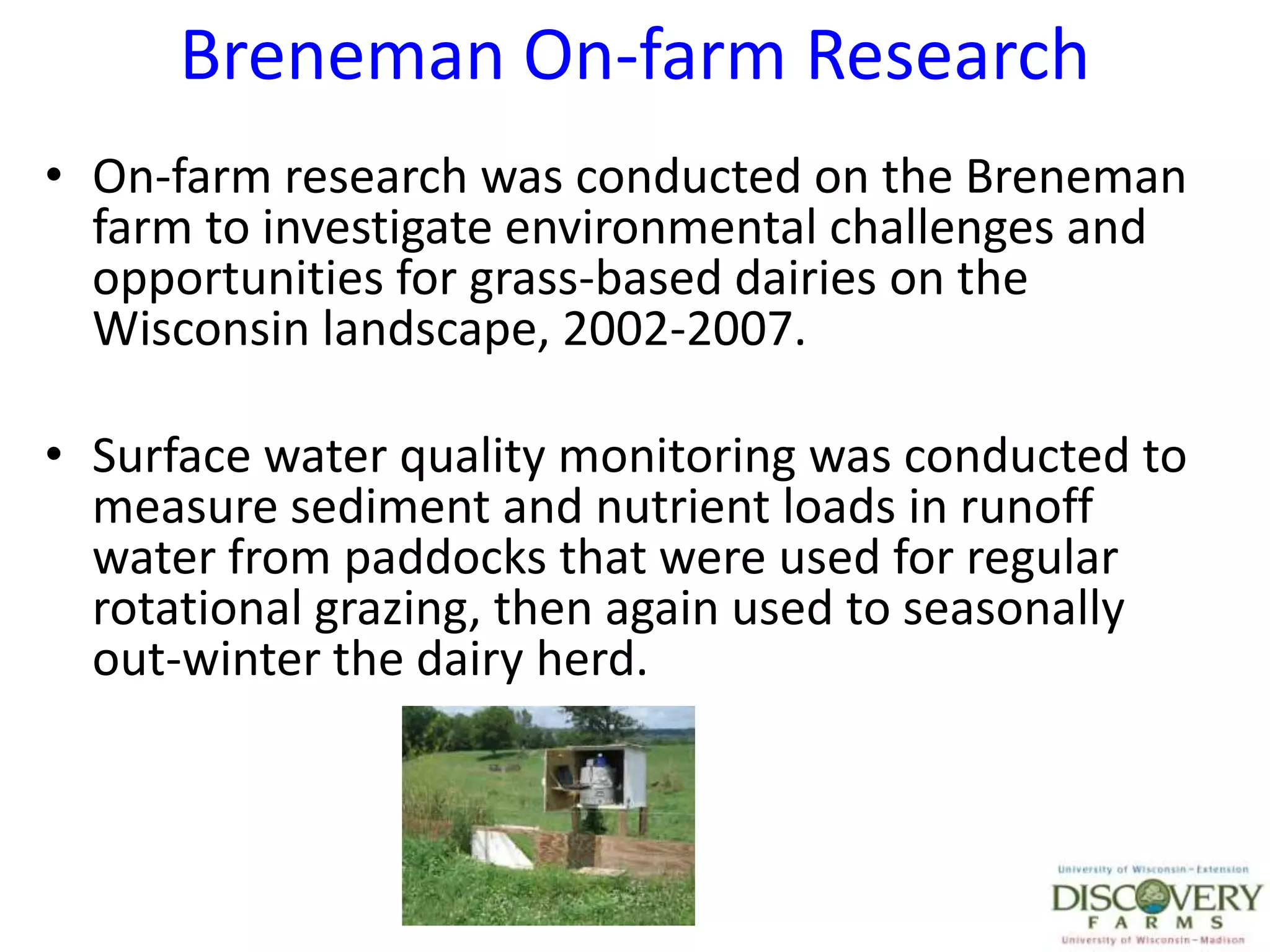
Breneman On-farm ResearchOn-farm research was conducted on the Breneman farm to investigate environmental challenges and opportunities for grass-based dairies on the Wisconsin landscape, 2002-2007.Surface water quality monitoring was conducted to measure sediment and nutrient loads in runoff water from paddocks that were used for regular rotational grazing, then again used to seasonally out-winter the dairy herd.
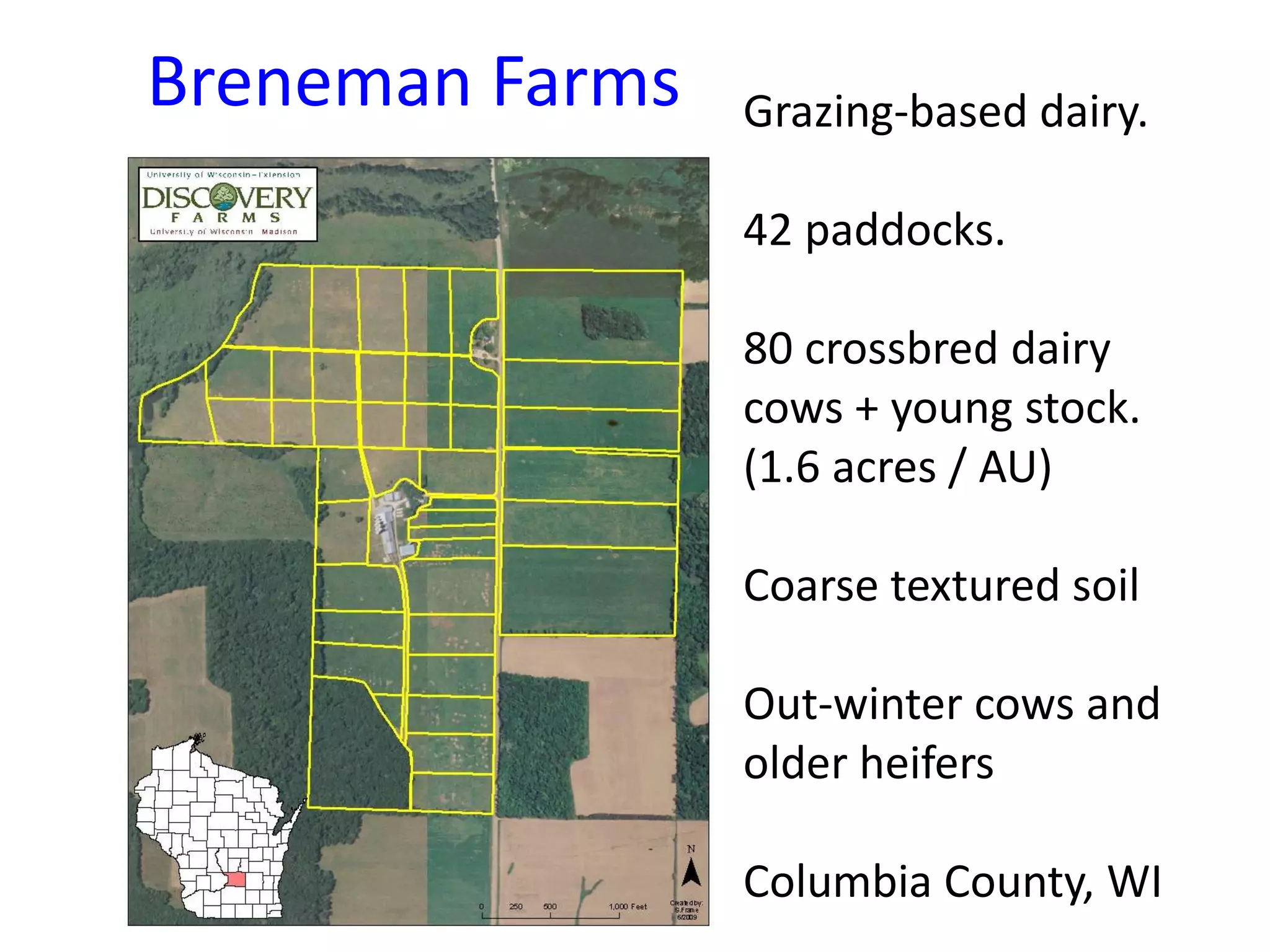
    Breneman FarmsGrazing-based dairy.42 paddocks.80 crossbred dairy cows + young stock.  (1.6 acres / AU)Coarse textured soilOut-winter cows and older heifersColumbia County, WI
Information AvailableSpecific projects that measured and analyzed water quality on this farm include:Crowe, A., Thompson, A., Radatz, T. 2006. Surface Water Quality Impacts of Management Intensive Rotational Grazing.  M.S. Thesis, Biological Systems Engineering, University of Wisconsin-Madison.Turyk, N., McGinley, P., Homan, K. 2007. Phosphorus in Groundwater Below Over-wintering Areas and Seasonally Used Paddocks, University of Wisconsin-Stevens Point.Turyk, N., Browne, B., Russelle, M. 2004. Does Management Intensive Grazing Protect Groundwater Quality by Denitrification? SARE Project LNC01-181, University of Wisconsin-Stevens Point and USDA Agricultural Research Station, St. Paul, MN.
Information AvailableProjects where this farm’s information was used within a larger pool of other statewide farm information include:Kriegel, T. 2007. WI Grazing Dairy Profitability Analysis. Center for Dairy  profitability, University of Wisconsin-Madison.  Popple, T. and Klingberg, K. 2008. A Wisconsin Comprehensive Nutrient Management Plan Development Protocol. University of Wisconsin-Discovery Farms Program.Leverich, J. 2003. On-Farm Energy Usage and Opportunities. University of Wisconsin-Discovery Farms Program. Towns, B. 2004.  Evaluation of Three Farm Nitrogen Balancing Spreadsheets with Wisconsin Dairy Farm Data.  M.S. Thesis, Dairy Science, University of Wisconsin-MadisonCosgrove, D. 2008.  Nutrient Management Planning for Dairy Farms Practicing Management Intensive Rotational Grazing, SARE Project LNC03-237, University of Wisconsin – River Falls.
Information AvailableOther projects: Randy Jackson, UW-Madison Agronomy; Claudio Gratton, UW-Madison Entomology; Michael Bell, UW-Madison Rural Sociology:  Grass Based Livestock Systems Effect on Ecosystem Structure and Function.
Information AvailableThis presentation is the first in a series of seven developed to provide the data and information collected at Breneman Farms.All of the presentations, factsheets and briefs are available on the UW - Discovery Farms website.http://www.uwdiscoveryfarms.org
Information Available  There are seven factsheets available for Breneman Farms.
  There are eight briefs available for Breneman Farms (2 page summaries of the factsheets).

Bren 1 Grazing Based Dairy Systems

  • 1.
    Understanding Nutrient &Sediment Loss at Breneman Farms - 1Grass-Based Dairy SystemsKevan Klingberg - UW Extension/Discovery Farms
  • 2.
    Grazing-Based Dairy SystemsGrazingor pasture based dairies have existed in Wisconsin since we began milking cows.While many dairies have moved cattle into confinement facilities.The Wisconsin dairy industry still includes an important and growing group of producers using new techniques and equipment to practice Management Intensive Grazing (MIG).
  • 3.
    Grazing-Based Dairy SystemsGrazingsystems allow producers to: begin or continue dairying with minimal investment in equipment.focus daily activities on managing grass / legume pasture forage and dairy animals.
  • 4.
    Grazing-Based Dairy SystemsVariationsto system can include:Frequency of moving cattleTypes of facilities to house and milk cattleOption to produce conventionally vs. organicOthersMIG can be done with dairy cattle, beef, sheep, goats or other livestock capable of utilizing forage diets.
  • 5.
    Grazing-Based Dairy SystemsCombinationof:Grazing animalsActively growing pasture foragePaddock fencesWatering facilitiesTravel lanesLow-cost housing / milking facilityExisting oldRetrofit oldLow cost newFocus on managing ruminant animals to harvest and eat high quality forage via grazing and spread their own manure in the process.
  • 6.
  • 7.
    Grazing-Based Dairy SystemsMIGsystems greatly minimize the need for year round feed harvest, feed storage and handling and intensive housing facilities. MIG producers also minimize having to store, handle and haul manure.
  • 8.
    Grazing-Based Dairy SystemsDairiespracticing MIG report increased profitability as a result of lower feed, equipment, labor and energy costs, as well as improved animal health and lower veterinary costs.Wisconsin studies have shown that when managed correctly, both grazing and confined dairy systems can be profitable.A University of Wisconsin - Center for Dairy Profitability study shows that the nine-year average (1999-2007) total basic costs on grazing dairies was $650 less per cow compared to confinement dairies.Similarly, grazing dairies earned $230 more net farm income per cow compared to confinement operations over the same time period.
  • 9.
    Grazing-Based Dairy SystemsPasturesare usually delineated by permanent perimeter fences and further subdivided by temporary fencing within the main pastures, allowing cattle controlled access to a small section of pasture at a time.Cattle are systematically moved into and out of paddocks.Good quality fresh pasture is grazed, followed by a rest period that allows adequate time for the perennial grass and legume plants to re-grow before the next grazing cycle.
  • 10.
    Grazing-Based Dairy SystemsPasturesare often connected by travel lanes with watering systems placed in common areas that serve numerous pastures.
  • 11.
    Paddock layout showingperimeter fences on MIG farmGood quality fresh pasture is grazed, followed by a rest period that allows adequate time for the perennial grass and legume plants to re-grow before the next grazing cycle.
  • 12.
    UW-Extension Pastures forProfitUniversity of Wisconsin - Extension publication A3529, “Pastures for profit: a guide to rotational grazing”, covers the basics of setting up rotational grazing (MIG) on your farm.UWEX Grazing informationand resources website:http://www.uwrf.edu/grazing/
  • 13.
    Wisconsin’s Grazing SeasonsThereare three very different seasonal time periods for Wisconsin’s grass-based dairies:the grazing season,the pre-and post-grazing season,and winter.
  • 14.
    Wisconsin’s Grazing SeasonsWisconsin’sgrazing season is about 180 days, lasting from May to October.There is another 30 days on either side of the growing season (60 days total) where pasture plants are either just beginning to grow or have gone dormant.During this period pastures are mostly free from snow, and the soil is thawed. Forage quality may be limited in the late season as plant growth slows and mature forage is stockpiled to extend the grazing season.Early spring growth is generally very high quality, but limited in quantity and plants are sensitive to hoof damage because of high soil moisture.Generally both the pre-and post-grazing season periods require supplemental feed, which is sometimes delivered and fed within paddocks.
  • 15.
    Wisconsin’s Grazing SeasonsDuringthe winter (December – March) when Wisconsin pastures are dormant and the soil is mostly frozen and/or snow-covered, grass-based dairies either confine cattle to barns or keep them outside.Out-wintering sites are areas where animals are concentrated and fed on paddocks during this season.
  • 16.
    Out-WinteringThere are threegeneral management approaches to out-wintering cattle: 1) Continue rotating cattle through paddocks; 2) Use “sacrifice” paddocks, such that those paddocks get re-seeded the next year; or 3) Designate a paddock or two and develop a bedded pack, which gets cleaned in the spring. Note: Over- wintering and out-winteringare synonymous terms.
  • 17.
    Out-WinteringWhile the perennialsod cover provided by MIG operations protects soil and water quality, areas where cattle are out – wintered have potential risk for negative environmental impacts.To better understand these areas, UW Discovery Farms worked with two farms using MIG systems along with concentrated out-wintering sites.
  • 18.
    Breneman On-farm ResearchOn-farmresearch was conducted on the Breneman farm to investigate environmental challenges and opportunities for grass-based dairies on the Wisconsin landscape, 2002-2007.Surface water quality monitoring was conducted to measure sediment and nutrient loads in runoff water from paddocks that were used for regular rotational grazing, then again used to seasonally out-winter the dairy herd.
  • 19.
    Breneman FarmsGrazing-based dairy.42 paddocks.80 crossbred dairy cows + young stock. (1.6 acres / AU)Coarse textured soilOut-winter cows and older heifersColumbia County, WI
  • 20.
    Information AvailableSpecific projectsthat measured and analyzed water quality on this farm include:Crowe, A., Thompson, A., Radatz, T. 2006. Surface Water Quality Impacts of Management Intensive Rotational Grazing. M.S. Thesis, Biological Systems Engineering, University of Wisconsin-Madison.Turyk, N., McGinley, P., Homan, K. 2007. Phosphorus in Groundwater Below Over-wintering Areas and Seasonally Used Paddocks, University of Wisconsin-Stevens Point.Turyk, N., Browne, B., Russelle, M. 2004. Does Management Intensive Grazing Protect Groundwater Quality by Denitrification? SARE Project LNC01-181, University of Wisconsin-Stevens Point and USDA Agricultural Research Station, St. Paul, MN.
  • 21.
    Information AvailableProjects wherethis farm’s information was used within a larger pool of other statewide farm information include:Kriegel, T. 2007. WI Grazing Dairy Profitability Analysis. Center for Dairy profitability, University of Wisconsin-Madison.  Popple, T. and Klingberg, K. 2008. A Wisconsin Comprehensive Nutrient Management Plan Development Protocol. University of Wisconsin-Discovery Farms Program.Leverich, J. 2003. On-Farm Energy Usage and Opportunities. University of Wisconsin-Discovery Farms Program. Towns, B. 2004. Evaluation of Three Farm Nitrogen Balancing Spreadsheets with Wisconsin Dairy Farm Data. M.S. Thesis, Dairy Science, University of Wisconsin-MadisonCosgrove, D. 2008. Nutrient Management Planning for Dairy Farms Practicing Management Intensive Rotational Grazing, SARE Project LNC03-237, University of Wisconsin – River Falls.
  • 22.
    Information AvailableOther projects:Randy Jackson, UW-Madison Agronomy; Claudio Gratton, UW-Madison Entomology; Michael Bell, UW-Madison Rural Sociology: Grass Based Livestock Systems Effect on Ecosystem Structure and Function.
  • 23.
    Information AvailableThis presentationis the first in a series of seven developed to provide the data and information collected at Breneman Farms.All of the presentations, factsheets and briefs are available on the UW - Discovery Farms website.http://www.uwdiscoveryfarms.org
  • 24.
    Information Available There are seven factsheets available for Breneman Farms.
  • 25.
    Thereare eight briefs available for Breneman Farms (2 page summaries of the factsheets).
  • 26.
    Thereare seven presentations available for Breneman Farms. For Additional Informationhttp://www.uwdiscoveryfarms.orgUW Discovery Farms40195 Winsand DrivePO Box 429Pigeon Falls, WI 54760 1-715-983-5668jgoplin@wisc.edu or drframe@wisc.edu