A Review of CF Lung Disease
                 Seth Walker, MD
Director, Emory Adult CF Program
Outline
 Pathophysiology of lung disease (how things go
  wrong)
 Chronic therapies
 Tracking lung disease
 Chronic infection and sputum cultures
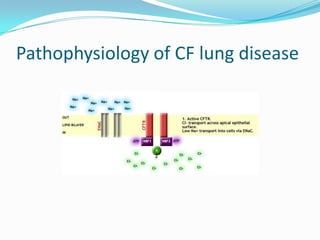
Pathophysiology of CF lung disease
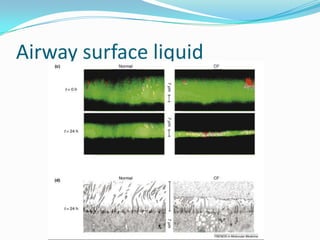
Airway surface liquid
Early lung disease


Asymptomatic 3 month old
                           7 year old, FEV1 96%
Hypertonic saline
 Works to rehydrate mucus and restore airway surface
  liquid
 Effect lasts 6-7 hours
 Studied dose is 7% saline 4 ml nebulized twice daily
Inhaled mannitol (Bronchitol)
 Works similarly to hypertonic saline
 Dry powder inhaler
 400 mg twice daily (but comes in 40-50 mg capsules)
 Can cause wheezing and bronchoconstriction
 Not yet available in the US
rhDNAse (Pulmozyme)
 Breaks up DNA from dead white blood cells
 Thins mucus and improves clearance
 2.5 mg nebulized once daily
Azithromycin
 Impairs neutrophils’ (white blood cells) ability to
  cause inflammation
 500 mg pill three times a week
Inhaled antibiotics
 Aztreonam (Cayston), tobramycin (TOBI), colistin
 All seem effective
 Little head-to-head data
Augmented airway clearance
 Chest physiotherapy with postural drainage (CPT)
 Percussive vest
 Positive expiratory pressure (PEP) with oscillation
    Acapella, flutter device
 Autogenic drainage
 Exercise
Augmented airway clearance
 Significant evidence that chest physiotherapy
  decreases exacerbations and improves/maintains lung
  function
 Small studies show similar efficacy among CPT and
  vest
 Exercise does not seem effective as airway clearance by
  itself
Preventing exacerbations
 Greatest benefit of all chronic therapies?
 Lung function more preserved with less exacerbations
Measuring lung function
FEV1
 Reliable
 Varies up to 10% in people without lung disease
 Peaks at age 25 years
 Differs based on age, gender, ethnicity, and height
 Classifies CF lung disease severity- mild (>70%
 predicted), moderate (40-70%), and severe (<40%)
What should FEV1 be?
 The highest physiologically possible? (One patient
  has had FEV1 148% predicted- should this be the
  standard for everyone?)
 Greater than 80% predicted?
 Greater than 70% predicted?


 The highest possible value for the longest possible
 time
120

       100

       80

FEV1   60           Patient 1
                    Patient 2
       40

       20

        0


             Time
Patient 1
       120

       100

       80
FEV1
       60
                         Patient 1
       40

       20

        0


              Time
Risk factors for FEV1 decline
 Young adulthood
 Higher FEV1
 Higher FEV1 variability
 Chronic infection (inhaled antibiotics)
 Lower BMI/faster rate of BMI decline
 Male sex
Rogers et al, J Clin Microbiol 2004
So why still check a culture?
 Information overload
 Surveillance
 Pseudomonal eradication
 Culture and sensitivities can increase our chance of
 resolving exacerbations
Take Home Points
 CF has progressive lung disease
 Staying healthy is good
 Doing aerosols and airway clearance regularly and
  maintaining healthy weight keep you healthy
 FEV1 trend is more important than number itself
 The airways are teeming with bacteria
 Sputum culture gives only a hint of this, but can be
  useful

Breathe Better 2012

  • 1.
    A Review ofCF Lung Disease Seth Walker, MD Director, Emory Adult CF Program
  • 3.
    Outline  Pathophysiology oflung disease (how things go wrong)  Chronic therapies  Tracking lung disease  Chronic infection and sputum cultures
  • 4.
  • 5.
  • 6.
  • 7.
    Early lung disease Asymptomatic3 month old 7 year old, FEV1 96%
  • 8.
    Hypertonic saline  Worksto rehydrate mucus and restore airway surface liquid  Effect lasts 6-7 hours  Studied dose is 7% saline 4 ml nebulized twice daily
  • 9.
    Inhaled mannitol (Bronchitol) Works similarly to hypertonic saline  Dry powder inhaler  400 mg twice daily (but comes in 40-50 mg capsules)  Can cause wheezing and bronchoconstriction  Not yet available in the US
  • 10.
    rhDNAse (Pulmozyme)  Breaksup DNA from dead white blood cells  Thins mucus and improves clearance  2.5 mg nebulized once daily
  • 11.
    Azithromycin  Impairs neutrophils’(white blood cells) ability to cause inflammation  500 mg pill three times a week
  • 12.
    Inhaled antibiotics  Aztreonam(Cayston), tobramycin (TOBI), colistin  All seem effective  Little head-to-head data
  • 13.
    Augmented airway clearance Chest physiotherapy with postural drainage (CPT)  Percussive vest  Positive expiratory pressure (PEP) with oscillation  Acapella, flutter device  Autogenic drainage  Exercise
  • 14.
    Augmented airway clearance Significant evidence that chest physiotherapy decreases exacerbations and improves/maintains lung function  Small studies show similar efficacy among CPT and vest  Exercise does not seem effective as airway clearance by itself
  • 15.
    Preventing exacerbations  Greatestbenefit of all chronic therapies?  Lung function more preserved with less exacerbations
  • 16.
  • 17.
    FEV1  Reliable  Variesup to 10% in people without lung disease  Peaks at age 25 years  Differs based on age, gender, ethnicity, and height  Classifies CF lung disease severity- mild (>70% predicted), moderate (40-70%), and severe (<40%)
  • 18.
    What should FEV1be?  The highest physiologically possible? (One patient has had FEV1 148% predicted- should this be the standard for everyone?)  Greater than 80% predicted?  Greater than 70% predicted?  The highest possible value for the longest possible time
  • 19.
    120 100 80 FEV1 60 Patient 1 Patient 2 40 20 0 Time
  • 20.
    Patient 1 120 100 80 FEV1 60 Patient 1 40 20 0 Time
  • 21.
    Risk factors forFEV1 decline  Young adulthood  Higher FEV1  Higher FEV1 variability  Chronic infection (inhaled antibiotics)  Lower BMI/faster rate of BMI decline  Male sex
  • 23.
    Rogers et al,J Clin Microbiol 2004
  • 25.
    So why stillcheck a culture?  Information overload  Surveillance  Pseudomonal eradication  Culture and sensitivities can increase our chance of resolving exacerbations
  • 26.
    Take Home Points CF has progressive lung disease  Staying healthy is good  Doing aerosols and airway clearance regularly and maintaining healthy weight keep you healthy  FEV1 trend is more important than number itself  The airways are teeming with bacteria  Sputum culture gives only a hint of this, but can be useful