BREAK-OUT SESSION 1:
DEVELOPING RELEVANT SKILLS
ACROSS THE LIFE COURSE
Southeast Asia Regional Policy Network on Education and Skills
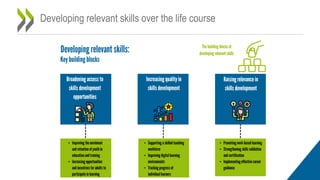
Developing relevant skills over the life course
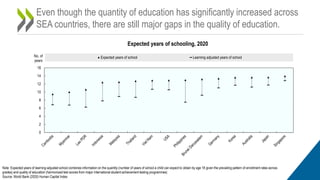
Even though the quantity of education has significantly increased across
SEA countries, there are still major gaps in the quality of education.
Expected years of schooling, 2020
Note: Expected years of learning-adjusted school combines information on the quantity (number of years of school a child can expect to obtain by age 18 given the prevailing pattern of enrollment rates across
grades) and quality of education (harmonized test scores from major international student achievement testing programmes)
Source: World Bank (2020) Human Capital Index
0
2
4
6
8
10
12
14
16
No. of
years
Expected years of school Learning adjusted years of school
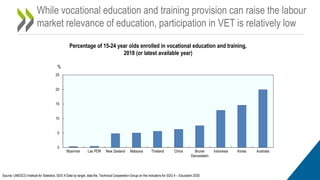
While vocational education and training provision can raise the labour
market relevance of education, participation in VET is relatively low
Percentage of 15-24 year olds enrolled in vocational education and training,
2018 (or latest available year)
Source: UNESCO Institute for Statistics, SDG 4 Data by target, data file, Technical Cooperation Group on the Indicators for SDG 4 – Education 2030
0
5
10
15
20
25
Myanmar Lao PDR New Zealand Malaysia Thailand China Brunei
Darussalam
Indonesia Korea Australia
%
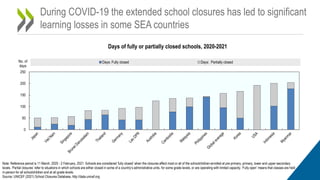
During COVID-19 the extended school closures has led to significant
learning losses in some SEA countries
Days of fully or partially closed schools, 2020-2021
Note: Reference period is 11 March, 2020 - 2 February, 2021. Schools are considered ‘fully closed’ when the closures affect most or all of the schoolchildren enrolled at pre-primary, primary, lower and upper secondary
levels. ‘Partial closures’ refer to situations in which schools are either closed in some of a country’s administrative units, for some grade levels, or are operating with limited capacity. ‘Fully open’ means that classes are held
in-person for all schoolchildren and at all grade levels.
Source: UNICEF (2021) School Closures Database, http://data.unicef.org
0
50
100
150
200
250
No. of
days
Days: Fully closed Days: Partially closed
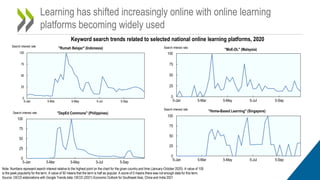
Learning has shifted increasingly online with online learning
platforms becoming widely used
Keyword search trends related to selected national online learning platforms, 2020
Note: Numbers represent search interest relative to the highest point on the chart for the given country and time (January-October 2020). A value of 100
is the peak popularity for the term. A value of 50 means that the term is half as popular. A score of 0 means there was not enough data for this term.
Source: OECD elaborations with Google Trends data. OECD (2021) Economic Outlook for Southeast Asia, China and India 2021
0
25
50
75
100
5-Jan 5-Mar 5-May 5-Jul 5-Sep
Search interest rate
"Rumah Belajar" (Indonesia)
0
25
50
75
100
5-Jan 5-Mar 5-May 5-Jul 5-Sep
Search interest rate
"MoE-DL" (Malaysia)
0
25
50
75
100
5-Jan 5-Mar 5-May 5-Jul 5-Sep
Search interest rate "DepEd Commons" (Philippines)
0
25
50
75
100
5-Jan 5-Mar 5-May 5-Jul 5-Sep
Search interest rate
"Home-Based Learning" (Singapore)
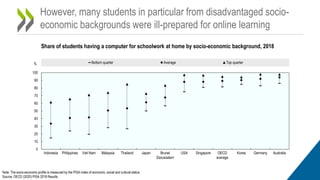
However, many students in particular from disadvantaged socio-
economic backgrounds were ill-prepared for online learning
Share of students having a computer for schoolwork at home by socio-economic background, 2018
Note: The socio-economic profile is measured by the PISA index of economic, social and cultural status.
Source: OECD (2020) PISA 2018 Results
0
10
20
30
40
50
60
70
80
90
100
Indonesia Philippines Viet Nam Malaysia Thailand Japan Brunei
Darussalam
USA Singapore OECD
average
Korea Germany Australia
% Bottom quarter Average Top quarter
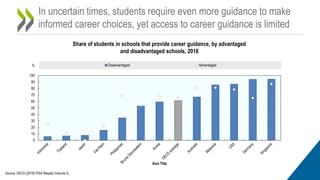
In uncertain times, students require even more guidance to make
informed career choices, yet access to career guidance is limited
Share of students in schools that provide career guidance, by advantaged
and disadvantaged schools, 2018
Source: OECD (2019) PISA Results (Volume II)
0
10
20
30
40
50
60
70
80
90
100
%
Axis Title
Disadvantaged Advantaged
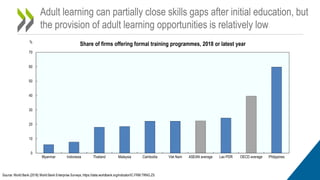
Adult learning can partially close skills gaps after initial education, but
the provision of adult learning opportunities is relatively low
Share of firms offering formal training programmes, 2018 or latest year
Source: World Bank (2018) World Bank Enterprise Surveys, https://data.worldbank.org/indicator/IC.FRM.TRNG.ZS
0
10
20
30
40
50
60
70
Myanmar Indonesia Thailand Malaysia Cambodia Viet Nam ASEAN average Lao PDR OECD average Philippines
%
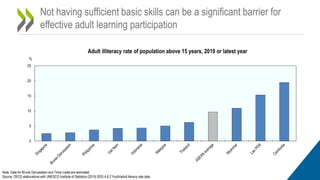
Not having sufficient basic skills can be a significant barrier for
effective adult learning participation
Adult illiteracy rate of population above 15 years, 2019 or latest year
Note: Data for Brunei Darussalam and Timor-Leste are estimated
Source: OECD elaborations with UNESCO Institute of Statistics (2019) SDG 4.6.2 Youth/adult literacy rate data
0
5
10
15
20
25
%
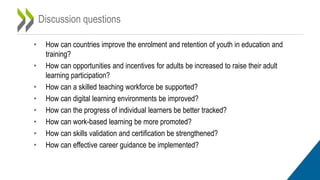
Discussion questions
• How can countries improve the enrolment and retention of youth in education and
training?
• How can opportunities and incentives for adults be increased to raise their adult
learning participation?
• How can a skilled teaching workforce be supported?
• How can digital learning environments be improved?
• How can the progress of individual learners be better tracked?
• How can work-based learning be more promoted?
• How can skills validation and certification be strengthened?
• How can effective career guidance be implemented?
12
Speakers for the session
Ms. Siripan CHOOMNOOM
Member of Vocational Education
Commission and Senior Advisor to the
Office of the Vocational Education
Commission , Thailand
Ms. Laura Pineiro NOGUEIRA
Chief Technical Advisor for TVET/Skills
for Tourism Project, LuxDev
Ms. Gillian ONG
Manager of Strategic Planning Division,
SkillsFuture Singapore

Developing Relevant Skills Across the Life Course

  • 1.
    BREAK-OUT SESSION 1: DEVELOPINGRELEVANT SKILLS ACROSS THE LIFE COURSE Southeast Asia Regional Policy Network on Education and Skills
  • 2.
    Developing relevant skillsover the life course
  • 3.
    Even though thequantity of education has significantly increased across SEA countries, there are still major gaps in the quality of education. Expected years of schooling, 2020 Note: Expected years of learning-adjusted school combines information on the quantity (number of years of school a child can expect to obtain by age 18 given the prevailing pattern of enrollment rates across grades) and quality of education (harmonized test scores from major international student achievement testing programmes) Source: World Bank (2020) Human Capital Index 0 2 4 6 8 10 12 14 16 No. of years Expected years of school Learning adjusted years of school
  • 4.
    While vocational educationand training provision can raise the labour market relevance of education, participation in VET is relatively low Percentage of 15-24 year olds enrolled in vocational education and training, 2018 (or latest available year) Source: UNESCO Institute for Statistics, SDG 4 Data by target, data file, Technical Cooperation Group on the Indicators for SDG 4 – Education 2030 0 5 10 15 20 25 Myanmar Lao PDR New Zealand Malaysia Thailand China Brunei Darussalam Indonesia Korea Australia %
  • 5.
    During COVID-19 theextended school closures has led to significant learning losses in some SEA countries Days of fully or partially closed schools, 2020-2021 Note: Reference period is 11 March, 2020 - 2 February, 2021. Schools are considered ‘fully closed’ when the closures affect most or all of the schoolchildren enrolled at pre-primary, primary, lower and upper secondary levels. ‘Partial closures’ refer to situations in which schools are either closed in some of a country’s administrative units, for some grade levels, or are operating with limited capacity. ‘Fully open’ means that classes are held in-person for all schoolchildren and at all grade levels. Source: UNICEF (2021) School Closures Database, http://data.unicef.org 0 50 100 150 200 250 No. of days Days: Fully closed Days: Partially closed
  • 6.
    Learning has shiftedincreasingly online with online learning platforms becoming widely used Keyword search trends related to selected national online learning platforms, 2020 Note: Numbers represent search interest relative to the highest point on the chart for the given country and time (January-October 2020). A value of 100 is the peak popularity for the term. A value of 50 means that the term is half as popular. A score of 0 means there was not enough data for this term. Source: OECD elaborations with Google Trends data. OECD (2021) Economic Outlook for Southeast Asia, China and India 2021 0 25 50 75 100 5-Jan 5-Mar 5-May 5-Jul 5-Sep Search interest rate "Rumah Belajar" (Indonesia) 0 25 50 75 100 5-Jan 5-Mar 5-May 5-Jul 5-Sep Search interest rate "MoE-DL" (Malaysia) 0 25 50 75 100 5-Jan 5-Mar 5-May 5-Jul 5-Sep Search interest rate "DepEd Commons" (Philippines) 0 25 50 75 100 5-Jan 5-Mar 5-May 5-Jul 5-Sep Search interest rate "Home-Based Learning" (Singapore)
  • 7.
    However, many studentsin particular from disadvantaged socio- economic backgrounds were ill-prepared for online learning Share of students having a computer for schoolwork at home by socio-economic background, 2018 Note: The socio-economic profile is measured by the PISA index of economic, social and cultural status. Source: OECD (2020) PISA 2018 Results 0 10 20 30 40 50 60 70 80 90 100 Indonesia Philippines Viet Nam Malaysia Thailand Japan Brunei Darussalam USA Singapore OECD average Korea Germany Australia % Bottom quarter Average Top quarter
  • 8.
    In uncertain times,students require even more guidance to make informed career choices, yet access to career guidance is limited Share of students in schools that provide career guidance, by advantaged and disadvantaged schools, 2018 Source: OECD (2019) PISA Results (Volume II) 0 10 20 30 40 50 60 70 80 90 100 % Axis Title Disadvantaged Advantaged
  • 9.
    Adult learning canpartially close skills gaps after initial education, but the provision of adult learning opportunities is relatively low Share of firms offering formal training programmes, 2018 or latest year Source: World Bank (2018) World Bank Enterprise Surveys, https://data.worldbank.org/indicator/IC.FRM.TRNG.ZS 0 10 20 30 40 50 60 70 Myanmar Indonesia Thailand Malaysia Cambodia Viet Nam ASEAN average Lao PDR OECD average Philippines %
  • 10.
    Not having sufficientbasic skills can be a significant barrier for effective adult learning participation Adult illiteracy rate of population above 15 years, 2019 or latest year Note: Data for Brunei Darussalam and Timor-Leste are estimated Source: OECD elaborations with UNESCO Institute of Statistics (2019) SDG 4.6.2 Youth/adult literacy rate data 0 5 10 15 20 25 %
  • 11.
    Discussion questions • Howcan countries improve the enrolment and retention of youth in education and training? • How can opportunities and incentives for adults be increased to raise their adult learning participation? • How can a skilled teaching workforce be supported? • How can digital learning environments be improved? • How can the progress of individual learners be better tracked? • How can work-based learning be more promoted? • How can skills validation and certification be strengthened? • How can effective career guidance be implemented?
  • 12.
    12 Speakers for thesession Ms. Siripan CHOOMNOOM Member of Vocational Education Commission and Senior Advisor to the Office of the Vocational Education Commission , Thailand Ms. Laura Pineiro NOGUEIRA Chief Technical Advisor for TVET/Skills for Tourism Project, LuxDev Ms. Gillian ONG Manager of Strategic Planning Division, SkillsFuture Singapore