Bread and Pastry Production
NCII
FOR GRADE 9
Baking Terminologies
• Acid – a substance having a sour or sharp flavor
• Bake- to cook food in a dry heat method inside an
oven
• Batter - a mixture of flours with liquids such as water,
milk, or eggs used to prepare various foods,
• Blend – to combine ingredients and produce a
homogenous mixture
• Coat - to cover with a thin layer of flour, sugar, nuts,
batter, etc.
• Contamination- the state of being contaminated
• Chill – to refrigerate, to reduce the temperature of
food.
• Dough – a soft, thick mass or mixture of dry
ingredients (ex. Flour or meal), and liquid (water, milk,
oil) that is kneaded, shaped, and baked into bread or
pastry.
• Dust – sprinkle the surface with flour to avoid mixture
to stick to it.
•Egg wash – consist of beaten eggs sometimes
mixed with a liquid, usually water or milk, which
is brushed onto the bread or pastry.
•Fermentation- the process of converting sugar
into alcohol to produce carbon dioxide.
•Foaming – to continuously beat egg white
incorporate air until it becomes light and fluffy.
•Gluten –a substance responsible for the elastic
and sticky characteristics of dough
•Grease – to brush pan with shortening
•Knead - to press, stretch and fold the dough
until gluten is developed.
•Line – to put a grease proof paper on the baking
pans or sheets.
•Meringue – a mixture used as a dessert or a
topping made of beaten egg whites and sugar
until smooth, light and fluffy, usually added with
cream of tartar to make it stable
•Mise en Place – French term means “PUT IN
PLACE” that includes assembling all the
necessary ingredients, equipment, and tools and
serving pieces needed to prepare food.
•Mix – to combine ingredients in a way that make
distribution of ingredients evenly.
•Pre-heat – to heat the oven prior to baking to
achieve the required heat.
•Punch down - to deflate the dough to expel
carbon dioxide produced during the
fermentation process to give it a second chance
to rise.
•Scrape – to remove sticky ingredients from the
side of the mixing bowl.
•Stir-in - to add another ingredient into the
mixture
•Syrup – a thick sticky solution of sugar and water
•Whip – to beat rapidly and continuously to aid
incorporation of air as in whipping egg whites to
make meringue and cream.
•Work simplification- performance of a task in the
most efficient way possible
•Yeast – microorganisms that produce carbon
dioxide gas, when it mixes with carbohydrates,
causing the dough to rise.
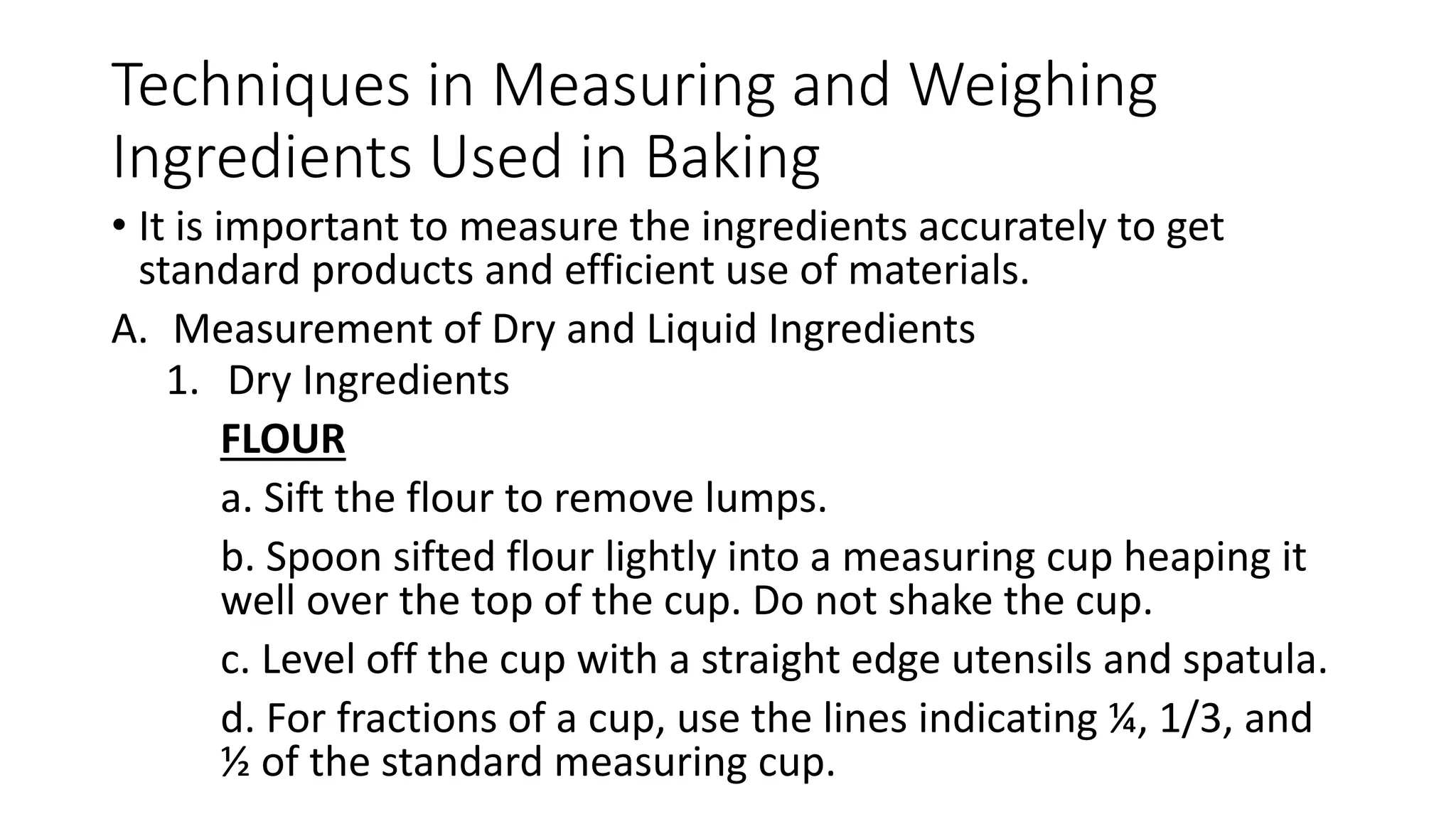
Techniques in Measuring and Weighing
Ingredients Used in Baking
• It is important to measure the ingredients accurately to get
standard products and efficient use of materials.
A. Measurement of Dry and Liquid Ingredients
1. Dry Ingredients
FLOUR
a. Sift the flour to remove lumps.
b. Spoon sifted flour lightly into a measuring cup heaping it
well over the top of the cup. Do not shake the cup.
c. Level off the cup with a straight edge utensils and spatula.
d. For fractions of a cup, use the lines indicating ¼, 1/3, and
½ of the standard measuring cup.
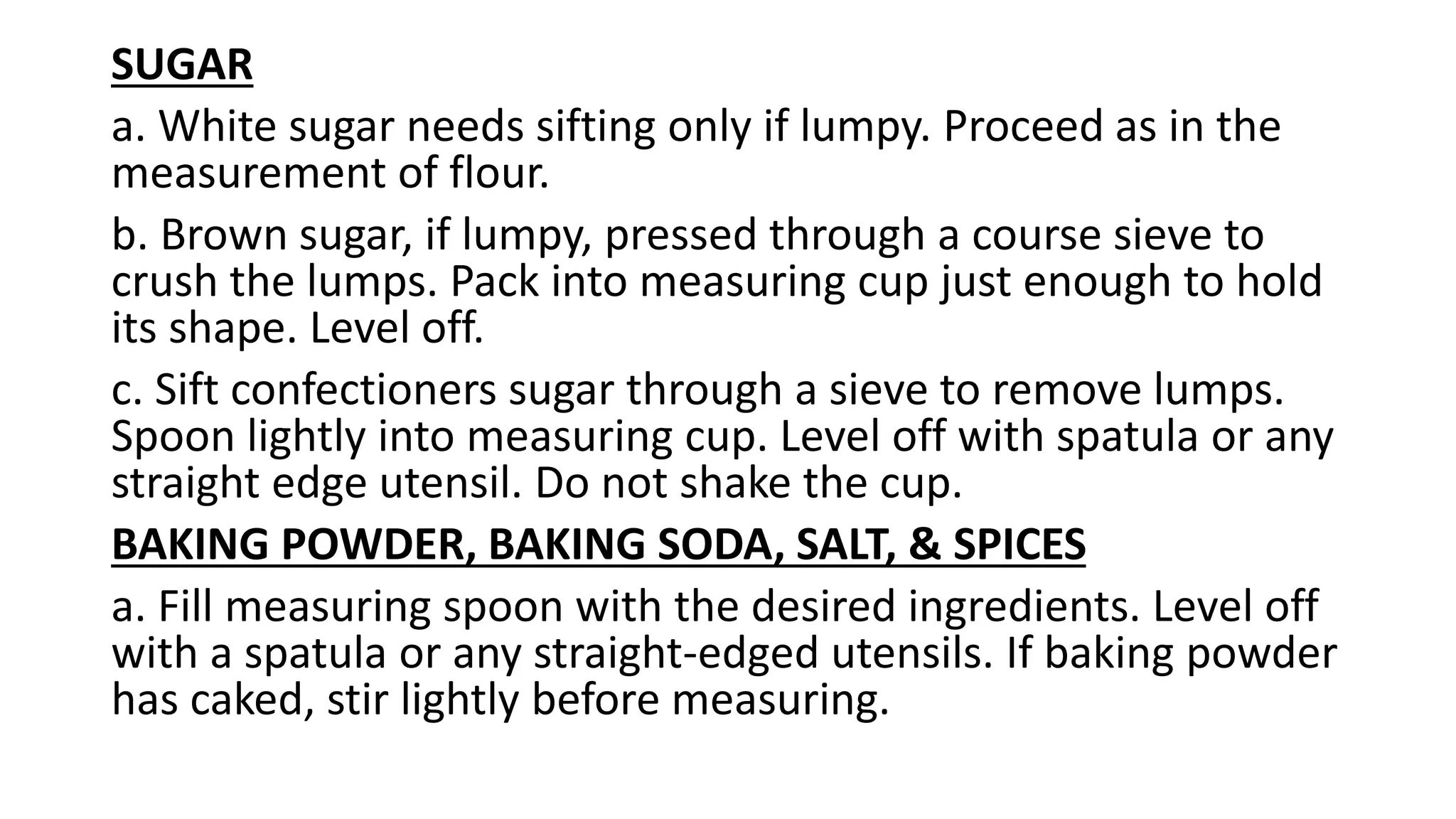
SUGAR
a. White sugar needs sifting only if lumpy. Proceed as in the
measurement of flour.
b. Brown sugar, if lumpy, pressed through a course sieve to
crush the lumps. Pack into measuring cup just enough to hold
its shape. Level off.
c. Sift confectioners sugar through a sieve to remove lumps.
Spoon lightly into measuring cup. Level off with spatula or any
straight edge utensil. Do not shake the cup.
BAKING POWDER, BAKING SODA, SALT, & SPICES
a. Fill measuring spoon with the desired ingredients. Level off
with a spatula or any straight-edged utensils. If baking powder
has caked, stir lightly before measuring.
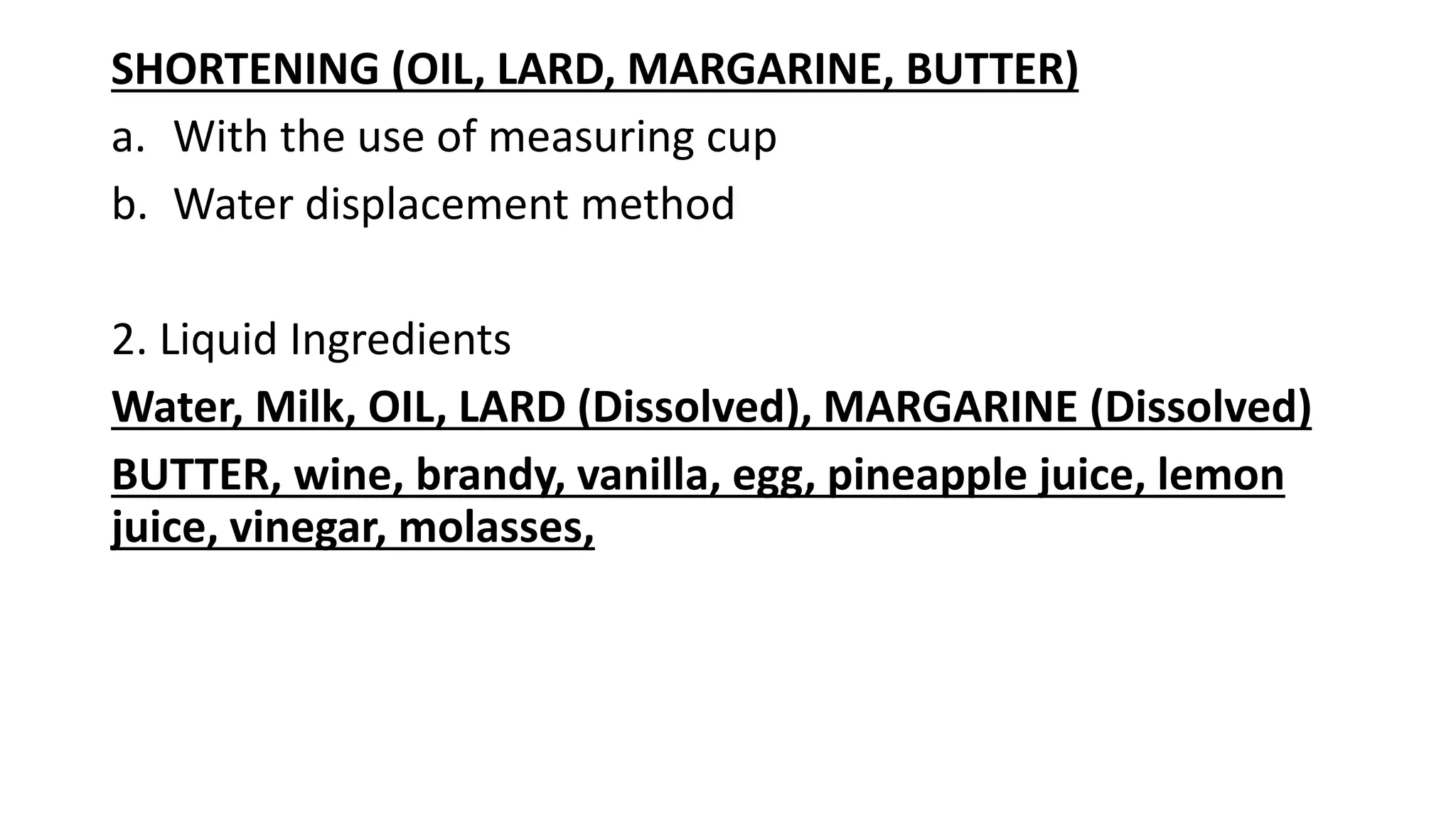
SHORTENING (OIL, LARD, MARGARINE, BUTTER)
a. With the use of measuring cup
b. Water displacement method
2. Liquid Ingredients
Water, Milk, OIL, LARD (Dissolved), MARGARINE (Dissolved)
BUTTER, wine, brandy, vanilla, egg, pineapple juice, lemon
juice, vinegar, molasses,
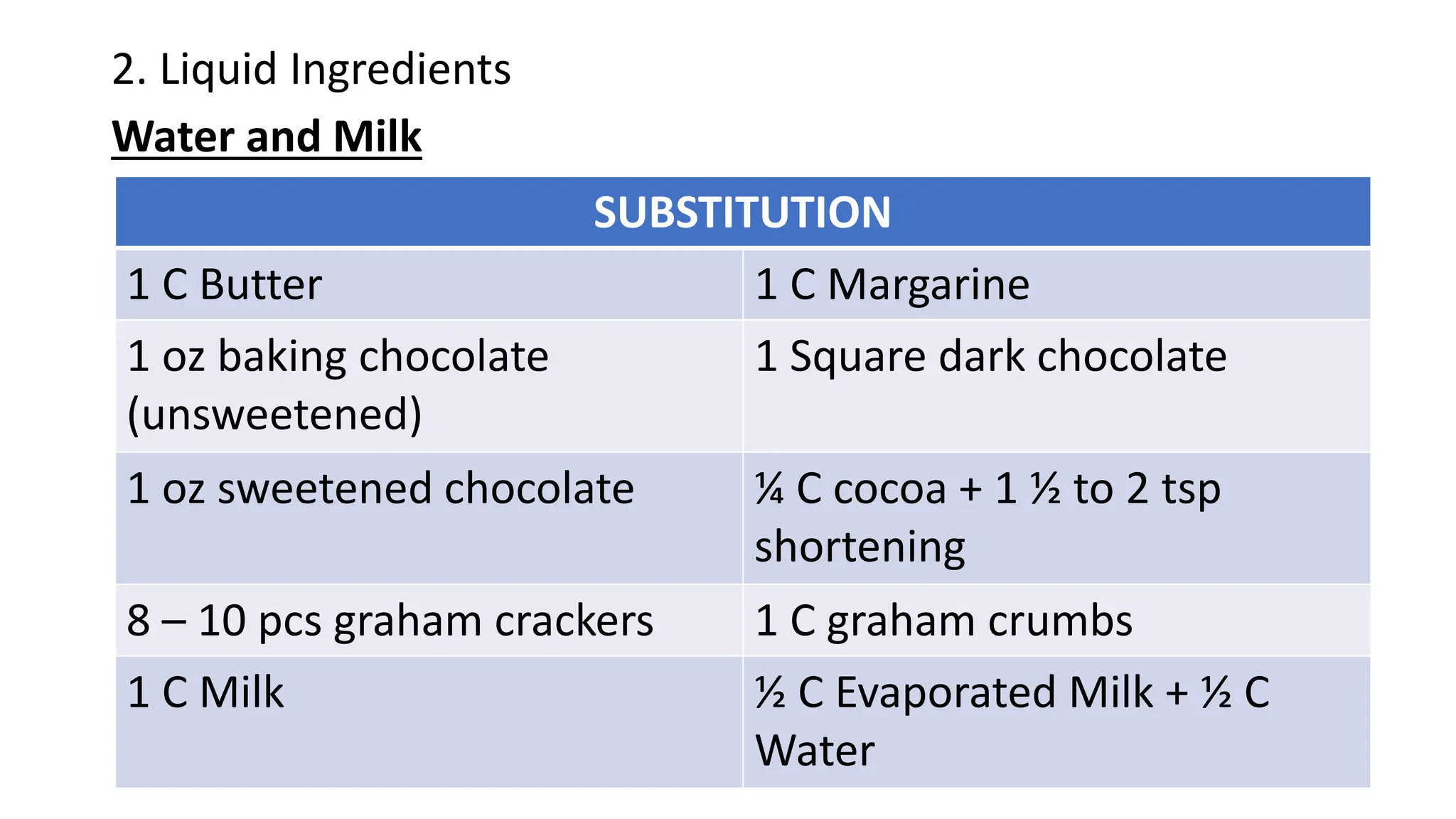
2. Liquid Ingredients
Water and Milk
SUBSTITUTION
1 C Butter 1 C Margarine
1 oz baking chocolate
(unsweetened)
1 Square dark chocolate
1 oz sweetened chocolate ¼ C cocoa + 1 ½ to 2 tsp
shortening
8 – 10 pcs graham crackers 1 C graham crumbs
1 C Milk ½ C Evaporated Milk + ½ C
Water
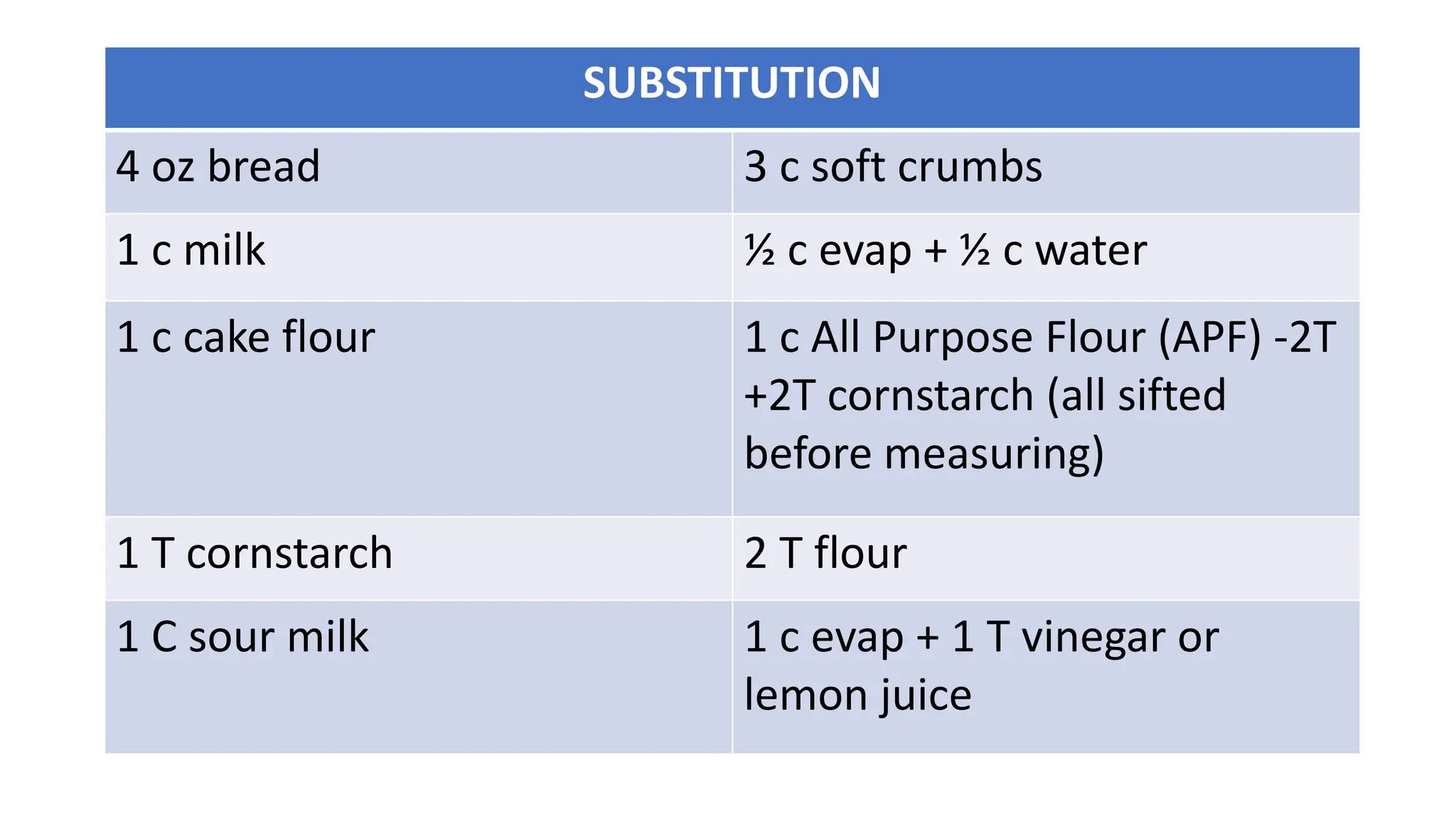
SUBSTITUTION
4 oz bread 3 c soft crumbs
1 c milk ½ c evap + ½ c water
1 c cake flour 1 c All Purpose Flour (APF) -2T
+2T cornstarch (all sifted
before measuring)
1 T cornstarch 2 T flour
1 C sour milk 1 c evap + 1 T vinegar or
lemon juice
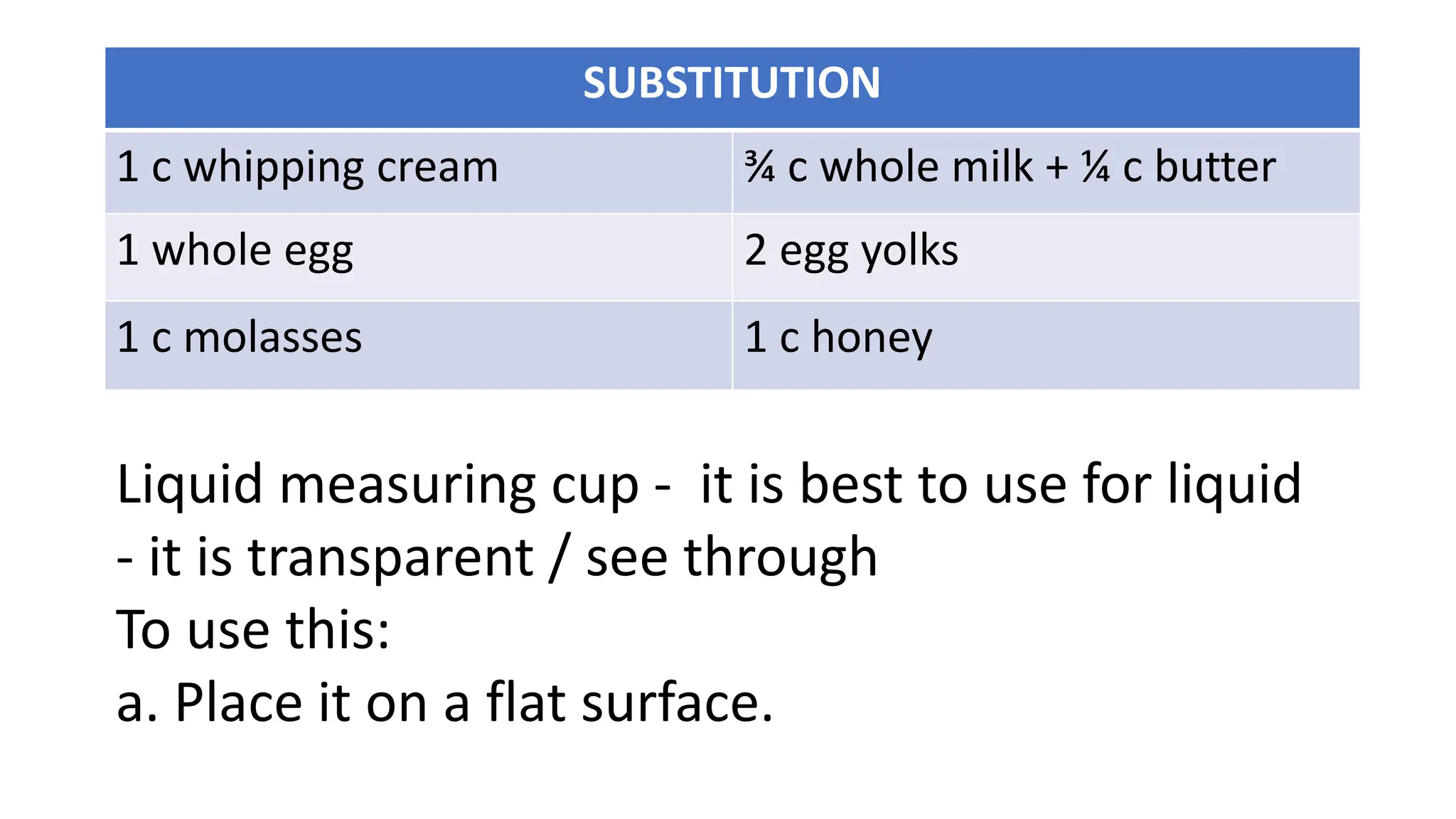
SUBSTITUTION
1 c whipping cream ¾ c whole milk + ¼ c butter
1 whole egg 2 egg yolks
1 c molasses 1 c honey
Liquid measuring cup - it is best to use for liquid
- it is transparent / see through
To use this:
a. Place it on a flat surface.
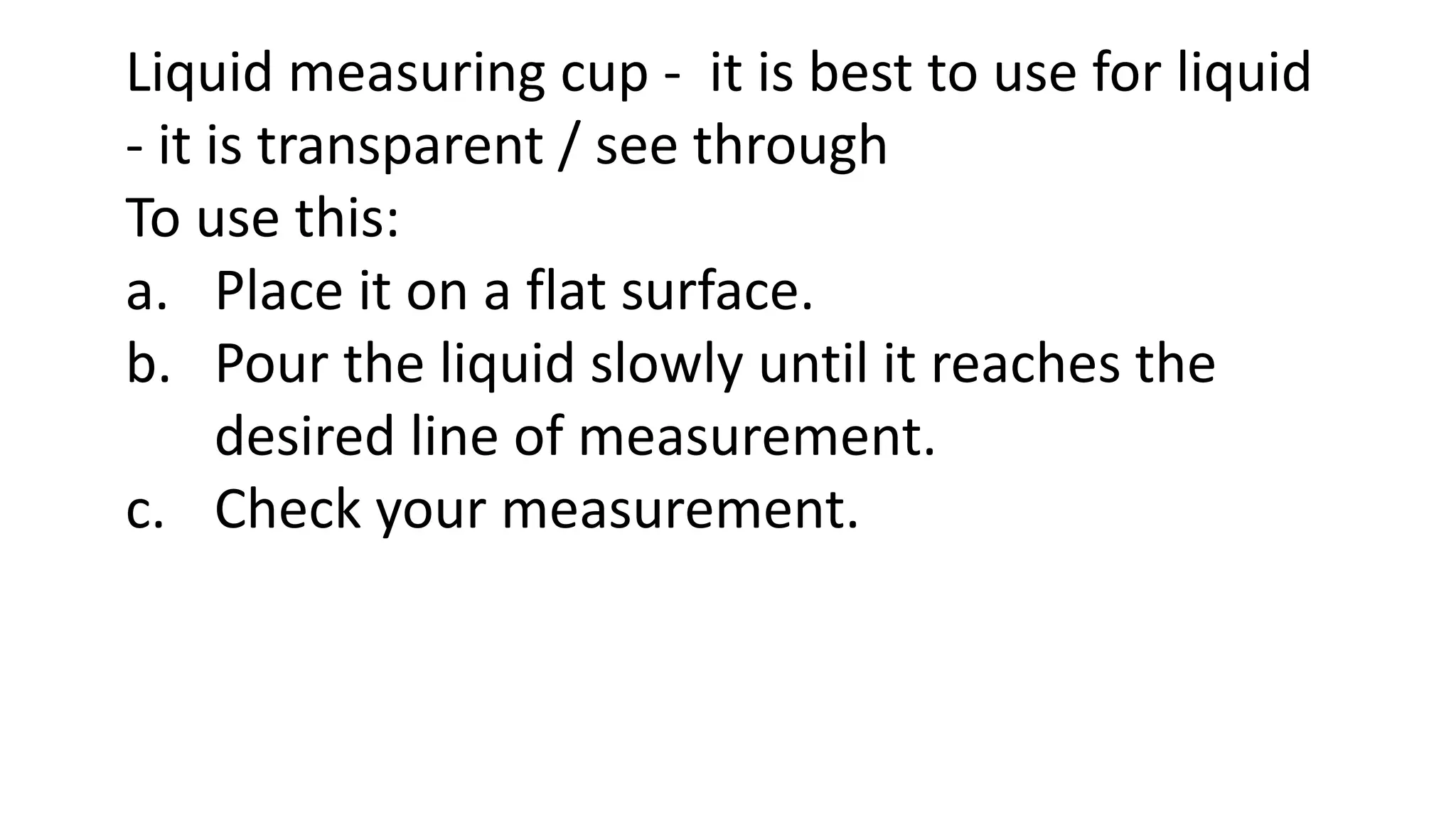
Liquid measuring cup - it is best to use for liquid
- it is transparent / see through
To use this:
a. Place it on a flat surface.
b. Pour the liquid slowly until it reaches the
desired line of measurement.
c. Check your measurement.
Equivalent Weights and Measurements

Bread and Pastry Production NCII - LECTURE 1.pptx

  • 1.
    Bread and PastryProduction NCII FOR GRADE 9
  • 2.
    Baking Terminologies • Acid– a substance having a sour or sharp flavor • Bake- to cook food in a dry heat method inside an oven • Batter - a mixture of flours with liquids such as water, milk, or eggs used to prepare various foods, • Blend – to combine ingredients and produce a homogenous mixture
  • 3.
    • Coat -to cover with a thin layer of flour, sugar, nuts, batter, etc. • Contamination- the state of being contaminated • Chill – to refrigerate, to reduce the temperature of food. • Dough – a soft, thick mass or mixture of dry ingredients (ex. Flour or meal), and liquid (water, milk, oil) that is kneaded, shaped, and baked into bread or pastry. • Dust – sprinkle the surface with flour to avoid mixture to stick to it.
  • 4.
    •Egg wash –consist of beaten eggs sometimes mixed with a liquid, usually water or milk, which is brushed onto the bread or pastry. •Fermentation- the process of converting sugar into alcohol to produce carbon dioxide. •Foaming – to continuously beat egg white incorporate air until it becomes light and fluffy. •Gluten –a substance responsible for the elastic and sticky characteristics of dough
  • 5.
    •Grease – tobrush pan with shortening •Knead - to press, stretch and fold the dough until gluten is developed. •Line – to put a grease proof paper on the baking pans or sheets. •Meringue – a mixture used as a dessert or a topping made of beaten egg whites and sugar until smooth, light and fluffy, usually added with cream of tartar to make it stable
  • 6.
    •Mise en Place– French term means “PUT IN PLACE” that includes assembling all the necessary ingredients, equipment, and tools and serving pieces needed to prepare food. •Mix – to combine ingredients in a way that make distribution of ingredients evenly. •Pre-heat – to heat the oven prior to baking to achieve the required heat.
  • 7.
    •Punch down -to deflate the dough to expel carbon dioxide produced during the fermentation process to give it a second chance to rise. •Scrape – to remove sticky ingredients from the side of the mixing bowl. •Stir-in - to add another ingredient into the mixture •Syrup – a thick sticky solution of sugar and water
  • 8.
    •Whip – tobeat rapidly and continuously to aid incorporation of air as in whipping egg whites to make meringue and cream. •Work simplification- performance of a task in the most efficient way possible •Yeast – microorganisms that produce carbon dioxide gas, when it mixes with carbohydrates, causing the dough to rise.
  • 9.
    Techniques in Measuringand Weighing Ingredients Used in Baking • It is important to measure the ingredients accurately to get standard products and efficient use of materials. A. Measurement of Dry and Liquid Ingredients 1. Dry Ingredients FLOUR a. Sift the flour to remove lumps. b. Spoon sifted flour lightly into a measuring cup heaping it well over the top of the cup. Do not shake the cup. c. Level off the cup with a straight edge utensils and spatula. d. For fractions of a cup, use the lines indicating ¼, 1/3, and ½ of the standard measuring cup.
  • 10.
    SUGAR a. White sugarneeds sifting only if lumpy. Proceed as in the measurement of flour. b. Brown sugar, if lumpy, pressed through a course sieve to crush the lumps. Pack into measuring cup just enough to hold its shape. Level off. c. Sift confectioners sugar through a sieve to remove lumps. Spoon lightly into measuring cup. Level off with spatula or any straight edge utensil. Do not shake the cup. BAKING POWDER, BAKING SODA, SALT, & SPICES a. Fill measuring spoon with the desired ingredients. Level off with a spatula or any straight-edged utensils. If baking powder has caked, stir lightly before measuring.
  • 11.
    SHORTENING (OIL, LARD,MARGARINE, BUTTER) a. With the use of measuring cup b. Water displacement method 2. Liquid Ingredients Water, Milk, OIL, LARD (Dissolved), MARGARINE (Dissolved) BUTTER, wine, brandy, vanilla, egg, pineapple juice, lemon juice, vinegar, molasses,
  • 12.
    2. Liquid Ingredients Waterand Milk SUBSTITUTION 1 C Butter 1 C Margarine 1 oz baking chocolate (unsweetened) 1 Square dark chocolate 1 oz sweetened chocolate ¼ C cocoa + 1 ½ to 2 tsp shortening 8 – 10 pcs graham crackers 1 C graham crumbs 1 C Milk ½ C Evaporated Milk + ½ C Water
  • 13.
    SUBSTITUTION 4 oz bread3 c soft crumbs 1 c milk ½ c evap + ½ c water 1 c cake flour 1 c All Purpose Flour (APF) -2T +2T cornstarch (all sifted before measuring) 1 T cornstarch 2 T flour 1 C sour milk 1 c evap + 1 T vinegar or lemon juice
  • 14.
    SUBSTITUTION 1 c whippingcream ¾ c whole milk + ¼ c butter 1 whole egg 2 egg yolks 1 c molasses 1 c honey Liquid measuring cup - it is best to use for liquid - it is transparent / see through To use this: a. Place it on a flat surface.
  • 15.
    Liquid measuring cup- it is best to use for liquid - it is transparent / see through To use this: a. Place it on a flat surface. b. Pour the liquid slowly until it reaches the desired line of measurement. c. Check your measurement.
  • 16.