BRANCH ACCOUNT
Branch Accounting
Branch accounting is a double-entry bookkeeping technique which is used by
a business or organization to maintain separate accounts for each operating
location or branch. Its goal is to optimize transparency and cash flow and
analyze each branch’s performance and financial standing. In a branch
accounting system, branches create separate balance sheets, trial balances,
and profit and loss account statements.
Balance accounts are typically found in multinational organizations,
geographically dispersed companies, and chain operators. However, after
keeping their books, the branches send them to their head office to combine
them with other units.
Why is it important?
Branch accounting is a useful tool and an important aspect of managing a
business. Using branch accounting helps to improve the transparency and
financial performance of a company. It aids in understanding the profit and
loss produced by the branches. Branch accounting also helps us get a clear
image of the cash position of the branch while giving an idea about the
goods and cash required by the different branches as well.
Knowing the performance and the profitability could help the business
analyse and come up with ideas for expansion of business and tips for
improvement. This could also help meet the requirements of specific
enactments, as each branch account must record all information for audit
purposes.
How does branch accounting work?
In this technique, the branch and head offices are treated as separate
entities, and their accounts are managed separately. Each branch office is
treated as an individual profit or cost center. Every branch opens its nominal
ledger account in which all the account receivables, expenses paid, wages
and incomes are noted down by certified internal auditors and financial
planners.
In simple words, the branch ledger keeps a tally of all the assets and
liabilities, profits and losses, and debits and credits for a specific period. At
the end of this designated accounting period, the branch tallies its figures
and arrives at an ending balance. All the balances are moved to the head
office account. This will leave the branch office with zero balance until and
unless the following financial year begins.
Types of branch accounting
There are four types of branch accounting which are as follows:
1. Dependent branch
these branches do not maintain their own set of books. The head office
collectively manages its profit and loss along with the balance sheet. The
separate branches provide only a few pieces of information like inventory,
cash accounting and debtor accounting.
The head office manages the branch accounts using any of the following
methods:
debtor system
stock and debtors method
wholesale branches method
final accounting method
2. Independent branch
an independent branch maintains its own books, whether it is an overseas
branch or a domestic branch. The technique for calculating the branch
accounts is similar in both cases except when it is located in a foreign
country. The trial balance received in a foreign currency will be converted
to the currency of the country where the head office is located.
3. Foreign branch
the accounting process is similar to that of a home branch. However, in this
case, converting the trial account balance to the home currency is a must.
Entries will be issued for transit goods and transit cash after reviewing the
trial balance receipt.
Advantages of branch accounting
Here are some of the advantages of branch accounting:
It helps in understanding the profit and loss borne by every branch.
Helps in understanding the rent, salary, wages and expenses of each branch
individually.
Guides in understanding the cash position and debtor’s inventory of every branch.
Analyzing the performance and progress of each branch.
Decision-making becomes easier after analysing the branch’s performance.
It helps in the proper operation of the branches.
Disadvantages of branch accounting
Mentioned below are some of the disadvantages of branch accounting:
it involves extra cost and workforce.
Branch accounting requires a separate manager for every branch, and
this can, in turn, lead to mismanagement.
It might lead to delays in decision-making due to the requirement for
extra staff.
Requires extra infrastructure at each location.
Converting the trial balance of every foreign branch might not always
be possible on time.
OVERCOMING
NERVOUSNESS
Confidence-building strategies
ENGAGING THE AUDIENCE
• Make eye contact with your audience to create a sense of intimacy
and involvement
• Weave relatable stories into your presentation using narratives
that make your message memorable and impactful
• Encourage questions and provide thoughtful responses to enhance
audience participation
• Use live polls or surveys to gather audience opinions, promoting
engagement and making sure the audience feel involved
13
SELECTING
VISUAL AIDS
14
Enhancing your presentation
EFFECTIVE DELIVERY
TECHNIQUES
15
This is a powerful tool in
public speaking. It involves
varying pitch, tone, and
volume to convey emotion,
emphasize points, and
maintain interest.
• Pitch variation
• Tone inflection
• Volume control
Effective body language
enhances your message,
making it more impactful
and memorable.
• Meaningful eye contact
• Purposeful gestures
• Maintain good posture
• Control your expressions
NAVIGATING Q&A
SESSIONS
1. Maintaining composure
during the Q&A session
is essential for
projecting confidence
and authority. Consider
the following tips for
staying composed:
2. Stay calm
3. Actively listen
4. Pause and reflect
5. Maintain eye contact
Know your material in advance
Anticipate common questions
Rehearse your responses
16
SPEAKING IMPACT
Your ability to communicate effectively will
leave a lasting impact on your audience
Effectively communicating involves not only
delivering a message but also resonating with
the experiences, values, and emotions of
those listening
17
DYNAMIC DELIVERY
Learn to infuse energy
into your delivery to leave
a lasting impression
One of the goals of
effective communication
is to motivate your
audience
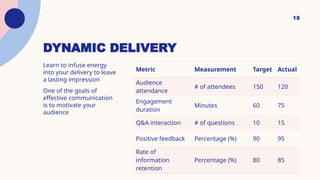
Metric Measurement Target Actual
Audience
attendance
# of attendees 150 120
Engagement
duration
Minutes 60 75
Q&A interaction # of questions 10 15
Positive feedback Percentage (%) 90 95
Rate of
information
retention
Percentage (%) 80 85
18
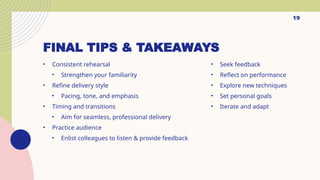
FINAL TIPS & TAKEAWAYS
• Consistent rehearsal
• Strengthen your familiarity
• Refine delivery style
• Pacing, tone, and emphasis
• Timing and transitions
• Aim for seamless, professional delivery
• Practice audience
• Enlist colleagues to listen & provide feedback
• Seek feedback
• Reflect on performance
• Explore new techniques
• Set personal goals
• Iterate and adapt
19
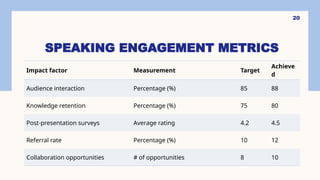
SPEAKING ENGAGEMENT METRICS
Impact factor Measurement Target
Achieve
d
Audience interaction Percentage (%) 85 88
Knowledge retention Percentage (%) 75 80
Post-presentation surveys Average rating 4.2 4.5
Referral rate Percentage (%) 10 12
Collaboration opportunities # of opportunities 8 10
20
THANK
YOU
Brita Tamm
502-555-0152
brita@firstupconsultants.com
www.firstupconsultants.com

BRANCH ACCOUNT ppt.pptx for b.com students

  • 1.
  • 2.
    Branch Accounting Branch accountingis a double-entry bookkeeping technique which is used by a business or organization to maintain separate accounts for each operating location or branch. Its goal is to optimize transparency and cash flow and analyze each branch’s performance and financial standing. In a branch accounting system, branches create separate balance sheets, trial balances, and profit and loss account statements. Balance accounts are typically found in multinational organizations, geographically dispersed companies, and chain operators. However, after keeping their books, the branches send them to their head office to combine them with other units.
  • 3.
    Why is itimportant? Branch accounting is a useful tool and an important aspect of managing a business. Using branch accounting helps to improve the transparency and financial performance of a company. It aids in understanding the profit and loss produced by the branches. Branch accounting also helps us get a clear image of the cash position of the branch while giving an idea about the goods and cash required by the different branches as well. Knowing the performance and the profitability could help the business analyse and come up with ideas for expansion of business and tips for improvement. This could also help meet the requirements of specific enactments, as each branch account must record all information for audit purposes.
  • 4.
    How does branchaccounting work? In this technique, the branch and head offices are treated as separate entities, and their accounts are managed separately. Each branch office is treated as an individual profit or cost center. Every branch opens its nominal ledger account in which all the account receivables, expenses paid, wages and incomes are noted down by certified internal auditors and financial planners. In simple words, the branch ledger keeps a tally of all the assets and liabilities, profits and losses, and debits and credits for a specific period. At the end of this designated accounting period, the branch tallies its figures and arrives at an ending balance. All the balances are moved to the head office account. This will leave the branch office with zero balance until and unless the following financial year begins.
  • 5.
    Types of branchaccounting There are four types of branch accounting which are as follows: 1. Dependent branch these branches do not maintain their own set of books. The head office collectively manages its profit and loss along with the balance sheet. The separate branches provide only a few pieces of information like inventory, cash accounting and debtor accounting. The head office manages the branch accounts using any of the following methods: debtor system stock and debtors method wholesale branches method final accounting method
  • 6.
    2. Independent branch anindependent branch maintains its own books, whether it is an overseas branch or a domestic branch. The technique for calculating the branch accounts is similar in both cases except when it is located in a foreign country. The trial balance received in a foreign currency will be converted to the currency of the country where the head office is located. 3. Foreign branch the accounting process is similar to that of a home branch. However, in this case, converting the trial account balance to the home currency is a must. Entries will be issued for transit goods and transit cash after reviewing the trial balance receipt.
  • 7.
    Advantages of branchaccounting Here are some of the advantages of branch accounting: It helps in understanding the profit and loss borne by every branch. Helps in understanding the rent, salary, wages and expenses of each branch individually. Guides in understanding the cash position and debtor’s inventory of every branch. Analyzing the performance and progress of each branch. Decision-making becomes easier after analysing the branch’s performance. It helps in the proper operation of the branches.
  • 8.
    Disadvantages of branchaccounting Mentioned below are some of the disadvantages of branch accounting: it involves extra cost and workforce. Branch accounting requires a separate manager for every branch, and this can, in turn, lead to mismanagement. It might lead to delays in decision-making due to the requirement for extra staff. Requires extra infrastructure at each location. Converting the trial balance of every foreign branch might not always be possible on time.
  • 12.
  • 13.
    ENGAGING THE AUDIENCE •Make eye contact with your audience to create a sense of intimacy and involvement • Weave relatable stories into your presentation using narratives that make your message memorable and impactful • Encourage questions and provide thoughtful responses to enhance audience participation • Use live polls or surveys to gather audience opinions, promoting engagement and making sure the audience feel involved 13
  • 14.
  • 15.
    EFFECTIVE DELIVERY TECHNIQUES 15 This isa powerful tool in public speaking. It involves varying pitch, tone, and volume to convey emotion, emphasize points, and maintain interest. • Pitch variation • Tone inflection • Volume control Effective body language enhances your message, making it more impactful and memorable. • Meaningful eye contact • Purposeful gestures • Maintain good posture • Control your expressions
  • 16.
    NAVIGATING Q&A SESSIONS 1. Maintainingcomposure during the Q&A session is essential for projecting confidence and authority. Consider the following tips for staying composed: 2. Stay calm 3. Actively listen 4. Pause and reflect 5. Maintain eye contact Know your material in advance Anticipate common questions Rehearse your responses 16
  • 17.
    SPEAKING IMPACT Your abilityto communicate effectively will leave a lasting impact on your audience Effectively communicating involves not only delivering a message but also resonating with the experiences, values, and emotions of those listening 17
  • 18.
    DYNAMIC DELIVERY Learn toinfuse energy into your delivery to leave a lasting impression One of the goals of effective communication is to motivate your audience Metric Measurement Target Actual Audience attendance # of attendees 150 120 Engagement duration Minutes 60 75 Q&A interaction # of questions 10 15 Positive feedback Percentage (%) 90 95 Rate of information retention Percentage (%) 80 85 18
  • 19.
    FINAL TIPS &TAKEAWAYS • Consistent rehearsal • Strengthen your familiarity • Refine delivery style • Pacing, tone, and emphasis • Timing and transitions • Aim for seamless, professional delivery • Practice audience • Enlist colleagues to listen & provide feedback • Seek feedback • Reflect on performance • Explore new techniques • Set personal goals • Iterate and adapt 19
  • 20.
    SPEAKING ENGAGEMENT METRICS Impactfactor Measurement Target Achieve d Audience interaction Percentage (%) 85 88 Knowledge retention Percentage (%) 75 80 Post-presentation surveys Average rating 4.2 4.5 Referral rate Percentage (%) 10 12 Collaboration opportunities # of opportunities 8 10 20
  • 21.