Image Guided
System for
Intracranial
Neurosurgery 1
Project Overview
• Problem:
– Neurosurgery is complicated, expensive, and not fully
accessible
– McKnight Brain Institute developed surgical planning
software that generates a 3D printed mask guide
– Mask cannot be sterilized, software is not accessible
• Solution:
– Create an easy to use, web based interface for software
– Design an articulating arm that can align with position
set by mask and maintain that position after sterilization
2
Software Specifications
• Simple easy to follow user interface
• Web Accessible
• Ability to upload MRI/CT files
• View target and entry point in all three
anatomical planes
• Ability to view 3D model of patient head
3
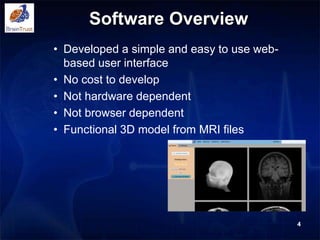
Software Overview
• Developed a simple and easy to use web-
based user interface
• No cost to develop
• Not hardware dependent
• Not browser dependent
• Functional 3D model from MRI files
4
Hardware Specifications
Mechanical interface for positioning of surgical probe
according to target location specified by software-
generated mask:
– Simple, Easy to use articulating arm
• Pneumatic, passively locking device
• Manual manipulation
• Minimize size and weight
• Compatible w/ Medtronic articulating arm
• 5 degrees of freedom
• Maintain sterility: detachable probe head
• Maintain accuracy of probe positioning ~2 mm
5
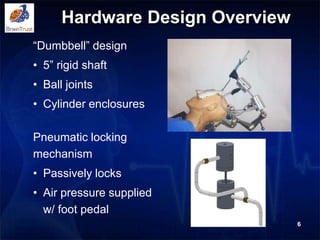
Hardware Design Overview
“Dumbbell” design
• 5” rigid shaft
• Ball joints
• Cylinder enclosures
Pneumatic locking
mechanism
• Passively locks
• Air pressure supplied
w/ foot pedal
6
Pneumatic Locking
Mechanism
• Stacks of washers
and wave springs
clamp ball
• Silicone tubing inflates
to unclamp ball
• Ball freely moves
while air pressure is
supplied
7
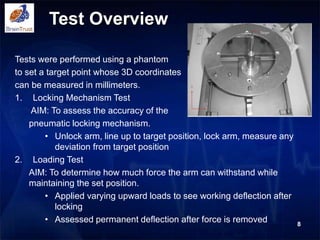
Test Overview
Tests were performed using a phantom
to set a target point whose 3D coordinates
can be measured in millimeters.
1. Locking Mechanism Test
AIM: To assess the accuracy of the
pneumatic locking mechanism.
• Unlock arm, line up to target position, lock arm, measure any
deviation from target position
2. Loading Test
AIM: To determine how much force the arm can withstand while
maintaining the set position.
• Applied varying upward loads to see working deflection after
locking
• Assessed permanent deflection after force is removed 8
Locking Test Results
The average error was
found to be:
• 1.6±0.43 mm in the
x-direction
• 1.15±0.37 mm in the
y-direction
• 0.6±0.4 in the z
direction.
Prototype was
successful in meeting
+/- 2mm accuracy
standard.
9
Loading Test Results
10
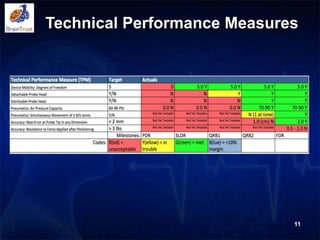
Technical Performance Measures
11
Cost Analysis
12
• Total cost of prototype fabrication was
$754.34
• Substantially cheaper than current system
(roughly $1 Million)
• Improved manufacturing and producing in
bulk could make a device for less than
$100
Recommendations
– Hardware
• Improve accuracy and reduce cost through optimized
manufacturing
– Software
• Allow for multiple trajectories to be set by the surgeon
• Connect to server and perform tests
– Testing
• Increase sample size
• Perform Survey of Surgeons
• Test in operating room
– Product
• File for patent
• FDA 510(k) Acceptance 13
Conclusions
• Successful at creating a functional, two part
image-based guidance system
– Software has high data capacity, user-friendliness, and
accessibility
– Hardware has a working pneumatic locking
mechanism amenable to operating room
• System is close to hoped accuracy
– Errors attributed to manufacturing
• Prototype is approved by consulted surgeons
• Product is much less expensive than the current
standard
14
We would like to
thank:
• Dr. Scott Banks
• Dr. Frank Bova
• Dr. Didier Rajon
• UF Dept. of
Neurosurgery
15
Irene Freire, CSE
Samantha Shuhala, ME
Emily Churchwell, BME
Celeste Rousseau, BE
Medhut Alnadi, BME
Matthew Thrush, ME
16

BrainTrust IPPD Final Presentation

  • 1.
  • 2.
    Project Overview • Problem: –Neurosurgery is complicated, expensive, and not fully accessible – McKnight Brain Institute developed surgical planning software that generates a 3D printed mask guide – Mask cannot be sterilized, software is not accessible • Solution: – Create an easy to use, web based interface for software – Design an articulating arm that can align with position set by mask and maintain that position after sterilization 2
  • 3.
    Software Specifications • Simpleeasy to follow user interface • Web Accessible • Ability to upload MRI/CT files • View target and entry point in all three anatomical planes • Ability to view 3D model of patient head 3
  • 4.
    Software Overview • Developeda simple and easy to use web- based user interface • No cost to develop • Not hardware dependent • Not browser dependent • Functional 3D model from MRI files 4
  • 5.
    Hardware Specifications Mechanical interfacefor positioning of surgical probe according to target location specified by software- generated mask: – Simple, Easy to use articulating arm • Pneumatic, passively locking device • Manual manipulation • Minimize size and weight • Compatible w/ Medtronic articulating arm • 5 degrees of freedom • Maintain sterility: detachable probe head • Maintain accuracy of probe positioning ~2 mm 5
  • 6.
    Hardware Design Overview “Dumbbell”design • 5” rigid shaft • Ball joints • Cylinder enclosures Pneumatic locking mechanism • Passively locks • Air pressure supplied w/ foot pedal 6
  • 7.
    Pneumatic Locking Mechanism • Stacksof washers and wave springs clamp ball • Silicone tubing inflates to unclamp ball • Ball freely moves while air pressure is supplied 7
  • 8.
    Test Overview Tests wereperformed using a phantom to set a target point whose 3D coordinates can be measured in millimeters. 1. Locking Mechanism Test AIM: To assess the accuracy of the pneumatic locking mechanism. • Unlock arm, line up to target position, lock arm, measure any deviation from target position 2. Loading Test AIM: To determine how much force the arm can withstand while maintaining the set position. • Applied varying upward loads to see working deflection after locking • Assessed permanent deflection after force is removed 8
  • 9.
    Locking Test Results Theaverage error was found to be: • 1.6±0.43 mm in the x-direction • 1.15±0.37 mm in the y-direction • 0.6±0.4 in the z direction. Prototype was successful in meeting +/- 2mm accuracy standard. 9
  • 10.
  • 11.
  • 12.
    Cost Analysis 12 • Totalcost of prototype fabrication was $754.34 • Substantially cheaper than current system (roughly $1 Million) • Improved manufacturing and producing in bulk could make a device for less than $100
  • 13.
    Recommendations – Hardware • Improveaccuracy and reduce cost through optimized manufacturing – Software • Allow for multiple trajectories to be set by the surgeon • Connect to server and perform tests – Testing • Increase sample size • Perform Survey of Surgeons • Test in operating room – Product • File for patent • FDA 510(k) Acceptance 13
  • 14.
    Conclusions • Successful atcreating a functional, two part image-based guidance system – Software has high data capacity, user-friendliness, and accessibility – Hardware has a working pneumatic locking mechanism amenable to operating room • System is close to hoped accuracy – Errors attributed to manufacturing • Prototype is approved by consulted surgeons • Product is much less expensive than the current standard 14
  • 15.
    We would liketo thank: • Dr. Scott Banks • Dr. Frank Bova • Dr. Didier Rajon • UF Dept. of Neurosurgery 15
  • 16.
    Irene Freire, CSE SamanthaShuhala, ME Emily Churchwell, BME Celeste Rousseau, BE Medhut Alnadi, BME Matthew Thrush, ME 16