Brainstorming and Concept Maps
Brainstorming and Concept Mapping 
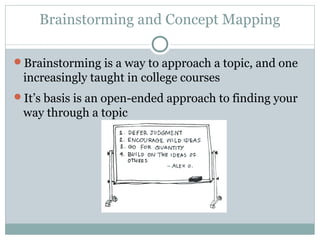
Brainstorming is a way to approach a topic, and one 
increasingly taught in college courses 
It’s basis is an open-ended approach to finding your 
way through a topic
Brainstorming 
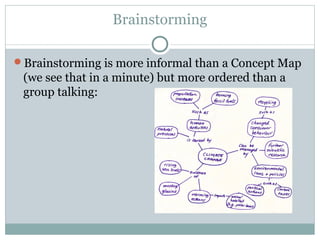
Brainstorming is more informal than a Concept Map 
(we see that in a minute) but more ordered than a 
group talking:
Brainstorming 
Brainstorming works by focusing on a problem, and 
then deliberately coming up with as many solutions 
as possible and by pushing the ideas as far as 
possible. 
A reason it is so effective is that the brainstormers 
not only come up with new ideas in a session, but 
gain from associations with other people's ideas by 
developing and refining them. 
 http://www.nwlink.com/~donclark/perform/brainstorm.html
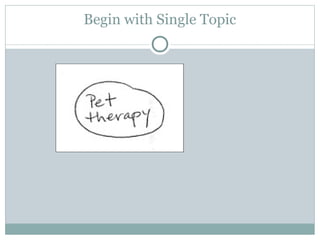
Begin with Single Topic
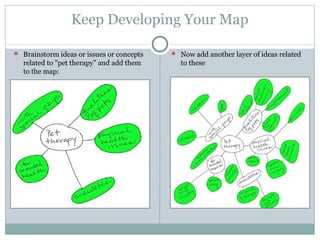
Keep Developing Your Map 
 Brainstorm ideas or issues or concepts 
related to "pet therapy" and add them 
to the map: 
 Now add another layer of ideas related 
to these
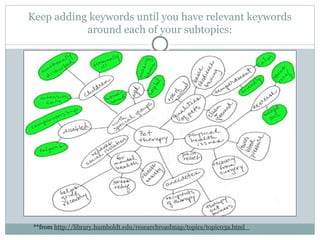
Keep adding keywords until you have relevant keywords 
around each of your subtopics: 
**from http://library.humboldt.edu/researchroadmap/topics/topic03a.html
Concept Maps 
A concept map presents the relationships among a 
set of connected concepts and ideas. 
It is a tangible way to display how your mind sees a 
particular topic. By constructing a concept map, you 
reflect on what you know and what you don't know. 
 http://www.udel.edu/chem/white/teaching/ConceptMap.html
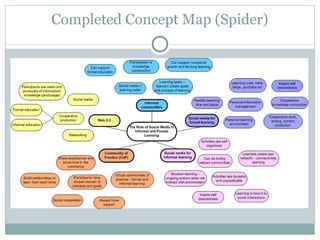
Often by the time you get to the Concept Map, you 
have gone through some initial brainstorming, and 
your ideas have turned into keywords or subtopics, 
and you have a more solid idea of how these relate to 
each other: 
 http://fromthedeskofalifelonglearner.blogspot.com/
Format for Concept Map [Spider]
Completed Concept Map (Spider)
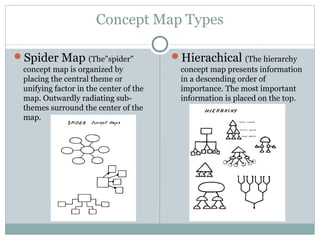
Concept Map Types 
Spider Map (The"spider" 
concept map is organized by 
placing the central theme or 
unifying factor in the center of the 
map. Outwardly radiating sub-themes 
surround the center of the 
map. 
Hierachical (The hierarchy 
concept map presents information 
in a descending order of 
importance. The most important 
information is placed on the top.
Websites for Concept Mapping 
Youtube video: 
 http://www.youtube.com/watch?v=KhgxuNvbNrA 
Brainstorming: 
 http://library.sonoma.edu/howdoi/researchtopic.php# 
(look for the linked sign under 'Brainstorming' nice 
overview of brainstorming process) 
Colorful, simple explanation of Concept Maps: 
 http://www.myteacherpages.com/webpages/BFarkas/files/mind%Nice Easy Explanation of Concept Maps: 
 http://www.virtualcurriculum.com/N3225/ConceptMap2_nursing.

Brainstorming conceptmaps sp_14

  • 1.
  • 2.
    Brainstorming and ConceptMapping Brainstorming is a way to approach a topic, and one increasingly taught in college courses It’s basis is an open-ended approach to finding your way through a topic
  • 3.
    Brainstorming Brainstorming ismore informal than a Concept Map (we see that in a minute) but more ordered than a group talking:
  • 4.
    Brainstorming Brainstorming worksby focusing on a problem, and then deliberately coming up with as many solutions as possible and by pushing the ideas as far as possible. A reason it is so effective is that the brainstormers not only come up with new ideas in a session, but gain from associations with other people's ideas by developing and refining them.  http://www.nwlink.com/~donclark/perform/brainstorm.html
  • 5.
  • 6.
    Keep Developing YourMap  Brainstorm ideas or issues or concepts related to "pet therapy" and add them to the map:  Now add another layer of ideas related to these
  • 7.
    Keep adding keywordsuntil you have relevant keywords around each of your subtopics: **from http://library.humboldt.edu/researchroadmap/topics/topic03a.html
  • 8.
    Concept Maps Aconcept map presents the relationships among a set of connected concepts and ideas. It is a tangible way to display how your mind sees a particular topic. By constructing a concept map, you reflect on what you know and what you don't know.  http://www.udel.edu/chem/white/teaching/ConceptMap.html
  • 9.
    Often by thetime you get to the Concept Map, you have gone through some initial brainstorming, and your ideas have turned into keywords or subtopics, and you have a more solid idea of how these relate to each other:  http://fromthedeskofalifelonglearner.blogspot.com/
  • 10.
    Format for ConceptMap [Spider]
  • 11.
  • 12.
    Concept Map Types Spider Map (The"spider" concept map is organized by placing the central theme or unifying factor in the center of the map. Outwardly radiating sub-themes surround the center of the map. Hierachical (The hierarchy concept map presents information in a descending order of importance. The most important information is placed on the top.
  • 13.
    Websites for ConceptMapping Youtube video:  http://www.youtube.com/watch?v=KhgxuNvbNrA Brainstorming:  http://library.sonoma.edu/howdoi/researchtopic.php# (look for the linked sign under 'Brainstorming' nice overview of brainstorming process) Colorful, simple explanation of Concept Maps:  http://www.myteacherpages.com/webpages/BFarkas/files/mind%Nice Easy Explanation of Concept Maps:  http://www.virtualcurriculum.com/N3225/ConceptMap2_nursing.