INTERHOUSE 
ASTRO QUIZ 
PRELIMS 
ANSWERS 
AT
Q. 1* 
1) Who was the first woman astronomer in 
recorded history ? 
(a) Annie J. Cannon 
(b) Henrietta S. Leavitt 
(c) Caroline Herschel 
(d) Jocelyn Bell
1* 
1) Who was the first woman astronomer in 
recorded history ? 
(a) Annie J. Cannon 
(b) Henrietta S. Leavitt 
(c) Caroline Herschel 
(d) Jocelyn Bell
Q. 2 
2) Where was the world’s first modern 
planetarium installed? 
(a) London 
(b) Moscow 
(c) New York 
(d) Bonn
2 
2) Where was the world’s first modern 
planetarium installed? 
(a) London 
(b) Moscow 
(c) New York 
(d) Bonn
Q. 3 
3) Who was the founder of lunar topography ? 
(a) Johannes Hevelius 
(b) Giovanni Riccioli 
(c) Johann Kepler 
(d) Galileo Galilei
3 
3) Who was the founder of lunar topography ? 
(a) Johannes Hevelius 
(b) Giovanni Riccioli 
(c) Johann Kepler 
(d) Galileo Galilei
Q. 4 
4) Who developed the technique for measuring 
the distance of distant stars? 
a) Edward Pickering 
b) Christian Doppler 
c) Friedrich W. Bessel 
d) Henrietta S. Leavitt
4 
4) Who developed the technique for measuring 
the distance of distant stars? 
a) Edward Pickering 
b) Christian Doppler 
c) Friedrich W. Bessel 
d) Henrietta S. Leavitt
Q.5* 
5) Who discovered Neptune? 
a) J.G.Galle 
b) J.C.Adams 
c) Urbain Leverrer 
d) Clyde Tombaugh
5* 
5) Who discovered Neptune? 
a) J.G.Galle 
b) J.C.Adams 
c) Urbain Leverrer 
d) Clyde Tombaugh
Q. 6 
6) Who discovered the moons of Mars? 
a) Tycho Brahe 
b) Asaph Hall 
c) E.M.Antoniadi 
d) Mikhail Lomonosov
6 
6) Who discovered the moons of Mars? 
a) Tycho Brahe 
b) Asaph Hall 
c) E.M.Antoniadi 
d) Mikhail Lomonosov
Q. 7 
7) Who invented the reflecting telescope? 
a) William Herschel 
b) William Parsons 
c) Isaac Newton 
d) Galileo Galilei
7 
7) Who invented the reflecting telescope? 
a) William Herschel 
b) William Parsons 
c) Isaac Newton 
d) Galileo Galilei
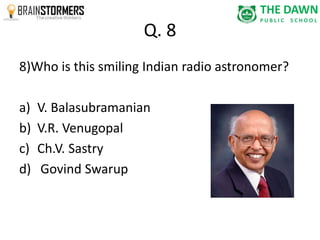
Q. 8 
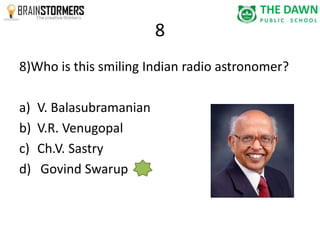
8)Who is this smiling Indian radio astronomer? 
a) V. Balasubramanian 
b) V.R. Venugopal 
c) Ch.V. Sastry 
d) Govind Swarup
8 
8)Who is this smiling Indian radio astronomer? 
a) V. Balasubramanian 
b) V.R. Venugopal 
c) Ch.V. Sastry 
d) Govind Swarup
Q. 9 
9)What is the ideal place for an astronomical 
observatory? 
a) Space 
b) Mountain top 
c) Lakeside 
d) Seashore
9 
9)What is the ideal place for an astronomical 
observatory? 
a) Space 
b) Mountain top 
c) Lakeside 
d) Seashore
Q. 10* 
10) What is a telescope with a convex objective 
and a concave eyepiece known as? 
a) Newtonian telescope 
b) Cassegrain telescope 
c) Hubble telescope 
d) Galilean telescope
10* 
10)What is a telescope with a convex objective 
and a concave eyepiece known as? 
a) Newtonian telescope 
b) Cassegrain telescope 
c) Hubble telescope 
d) Galilean telescope
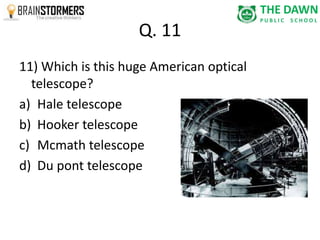
Q. 11 
11) Which is this huge American optical 
telescope? 
a) Hale telescope 
b) Hooker telescope 
c) Mcmath telescope 
d) Du pont telescope
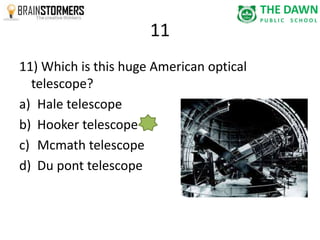
11 
11) Which is this huge American optical 
telescope? 
a) Hale telescope 
b) Hooker telescope 
c) Mcmath telescope 
d) Du pont telescope
Q. 12 
12) Which law in astronomy has yet no scientific 
justification? 
a) Kepler’s law 
b) Newton’s law 
c) Bode’s law 
d) Hubble’s law
12 
12) Which law in astronomy has yet no scientific 
justification? 
a) Kepler’s law 
b) Newton’s law 
c) Bode’s law 
d) Hubble’s law
Q. 13 
13) Which planet has the highest number of 
moons discovered so far ? 
a) Jupiter 
b) Saturn 
c) Uranus 
d) Mars
13 
13) Which planet has the highest number of 
moons discovered so far ? 
a) Jupiter 
b) Saturn 
c) Uranus 
d) Mars
Q. 14 
14) What is the age of the moon? 
a) 4600 million years 
b) 3600 million years 
c) 5600 million years 
d) 2600 million years
14 
14) What is the age of the moon? 
a) 4600 million years 
b) 3600 million years 
c) 5600 million years 
d) 2600 million years
Q.15* 
15) Of the following outer planets, which is the 
odd one out ? 
a) Mars 
b) Earth 
c) Saturn 
d) Neptune
15* 
15) Of the following outer planets, which is the 
odd one out ? 
a) Mars 
b) Earth 
c) Saturn 
d) Neptune
Q. 16 
16) Which planet does not have thunderstorms 
in its atmosphere? 
a) Mars 
b) Venus 
c) Jupiter 
d) Saturn
16 
16) Which planet does not have thunderstorms 
in its atmosphere? 
a) Mars 
b) Venus 
c) Jupiter 
d) Saturn
Q. 17 
17) Which planet has the largest moon in the 
solar system ? 
a) Saturn 
b) Jupiter 
c) Mars 
d) Earth
17 
17) Which planet has the largest moon in the 
solar system ? 
a) Saturn 
b) Jupiter 
c) Mars 
d) Earth
Q. 18 
18) Which gaseous planet has two satellites? 
a) Neptune 
b) Mars 
c) Jupiter 
d) Uranus
18 
18) Which gaseous planet has two satellites? 
a) Neptune 
b) Mars 
c) Jupiter 
d) Uranus
Q. 19 
19) Which constellation is called the 
‘Great Dog’ ? 
a) Canis Major 
b) Canes Venatici 
c) Cepheus 
d) Cetus
19 
19) Which constellation is called the 
‘Great Dog’ ? 
a) Canis Major 
b) Canes Venatici 
c) Cepheus 
d) Cetus
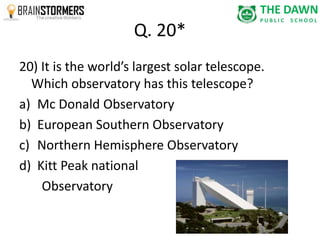
Q. 20* 
20) It is the world’s largest solar telescope. 
Which observatory has this telescope? 
a) Mc Donald Observatory 
b) European Southern Observatory 
c) Northern Hemisphere Observatory 
d) Kitt Peak national 
Observatory
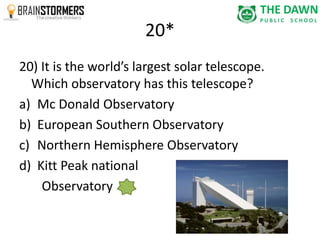
20* 
20) It is the world’s largest solar telescope. 
Which observatory has this telescope? 
a) Mc Donald Observatory 
b) European Southern Observatory 
c) Northern Hemisphere Observatory 
d) Kitt Peak national 
Observatory

Brainstormers astro quiz prelims answer

  • 1.
    INTERHOUSE ASTRO QUIZ PRELIMS ANSWERS AT
  • 2.
    Q. 1* 1)Who was the first woman astronomer in recorded history ? (a) Annie J. Cannon (b) Henrietta S. Leavitt (c) Caroline Herschel (d) Jocelyn Bell
  • 3.
    1* 1) Whowas the first woman astronomer in recorded history ? (a) Annie J. Cannon (b) Henrietta S. Leavitt (c) Caroline Herschel (d) Jocelyn Bell
  • 4.
    Q. 2 2)Where was the world’s first modern planetarium installed? (a) London (b) Moscow (c) New York (d) Bonn
  • 5.
    2 2) Wherewas the world’s first modern planetarium installed? (a) London (b) Moscow (c) New York (d) Bonn
  • 6.
    Q. 3 3)Who was the founder of lunar topography ? (a) Johannes Hevelius (b) Giovanni Riccioli (c) Johann Kepler (d) Galileo Galilei
  • 7.
    3 3) Whowas the founder of lunar topography ? (a) Johannes Hevelius (b) Giovanni Riccioli (c) Johann Kepler (d) Galileo Galilei
  • 8.
    Q. 4 4)Who developed the technique for measuring the distance of distant stars? a) Edward Pickering b) Christian Doppler c) Friedrich W. Bessel d) Henrietta S. Leavitt
  • 9.
    4 4) Whodeveloped the technique for measuring the distance of distant stars? a) Edward Pickering b) Christian Doppler c) Friedrich W. Bessel d) Henrietta S. Leavitt
  • 10.
    Q.5* 5) Whodiscovered Neptune? a) J.G.Galle b) J.C.Adams c) Urbain Leverrer d) Clyde Tombaugh
  • 11.
    5* 5) Whodiscovered Neptune? a) J.G.Galle b) J.C.Adams c) Urbain Leverrer d) Clyde Tombaugh
  • 12.
    Q. 6 6)Who discovered the moons of Mars? a) Tycho Brahe b) Asaph Hall c) E.M.Antoniadi d) Mikhail Lomonosov
  • 13.
    6 6) Whodiscovered the moons of Mars? a) Tycho Brahe b) Asaph Hall c) E.M.Antoniadi d) Mikhail Lomonosov
  • 14.
    Q. 7 7)Who invented the reflecting telescope? a) William Herschel b) William Parsons c) Isaac Newton d) Galileo Galilei
  • 15.
    7 7) Whoinvented the reflecting telescope? a) William Herschel b) William Parsons c) Isaac Newton d) Galileo Galilei
  • 16.
    Q. 8 8)Whois this smiling Indian radio astronomer? a) V. Balasubramanian b) V.R. Venugopal c) Ch.V. Sastry d) Govind Swarup
  • 17.
    8 8)Who isthis smiling Indian radio astronomer? a) V. Balasubramanian b) V.R. Venugopal c) Ch.V. Sastry d) Govind Swarup
  • 18.
    Q. 9 9)Whatis the ideal place for an astronomical observatory? a) Space b) Mountain top c) Lakeside d) Seashore
  • 19.
    9 9)What isthe ideal place for an astronomical observatory? a) Space b) Mountain top c) Lakeside d) Seashore
  • 20.
    Q. 10* 10)What is a telescope with a convex objective and a concave eyepiece known as? a) Newtonian telescope b) Cassegrain telescope c) Hubble telescope d) Galilean telescope
  • 21.
    10* 10)What isa telescope with a convex objective and a concave eyepiece known as? a) Newtonian telescope b) Cassegrain telescope c) Hubble telescope d) Galilean telescope
  • 22.
    Q. 11 11)Which is this huge American optical telescope? a) Hale telescope b) Hooker telescope c) Mcmath telescope d) Du pont telescope
  • 23.
    11 11) Whichis this huge American optical telescope? a) Hale telescope b) Hooker telescope c) Mcmath telescope d) Du pont telescope
  • 24.
    Q. 12 12)Which law in astronomy has yet no scientific justification? a) Kepler’s law b) Newton’s law c) Bode’s law d) Hubble’s law
  • 25.
    12 12) Whichlaw in astronomy has yet no scientific justification? a) Kepler’s law b) Newton’s law c) Bode’s law d) Hubble’s law
  • 26.
    Q. 13 13)Which planet has the highest number of moons discovered so far ? a) Jupiter b) Saturn c) Uranus d) Mars
  • 27.
    13 13) Whichplanet has the highest number of moons discovered so far ? a) Jupiter b) Saturn c) Uranus d) Mars
  • 28.
    Q. 14 14)What is the age of the moon? a) 4600 million years b) 3600 million years c) 5600 million years d) 2600 million years
  • 29.
    14 14) Whatis the age of the moon? a) 4600 million years b) 3600 million years c) 5600 million years d) 2600 million years
  • 30.
    Q.15* 15) Ofthe following outer planets, which is the odd one out ? a) Mars b) Earth c) Saturn d) Neptune
  • 31.
    15* 15) Ofthe following outer planets, which is the odd one out ? a) Mars b) Earth c) Saturn d) Neptune
  • 32.
    Q. 16 16)Which planet does not have thunderstorms in its atmosphere? a) Mars b) Venus c) Jupiter d) Saturn
  • 33.
    16 16) Whichplanet does not have thunderstorms in its atmosphere? a) Mars b) Venus c) Jupiter d) Saturn
  • 34.
    Q. 17 17)Which planet has the largest moon in the solar system ? a) Saturn b) Jupiter c) Mars d) Earth
  • 35.
    17 17) Whichplanet has the largest moon in the solar system ? a) Saturn b) Jupiter c) Mars d) Earth
  • 36.
    Q. 18 18)Which gaseous planet has two satellites? a) Neptune b) Mars c) Jupiter d) Uranus
  • 37.
    18 18) Whichgaseous planet has two satellites? a) Neptune b) Mars c) Jupiter d) Uranus
  • 38.
    Q. 19 19)Which constellation is called the ‘Great Dog’ ? a) Canis Major b) Canes Venatici c) Cepheus d) Cetus
  • 39.
    19 19) Whichconstellation is called the ‘Great Dog’ ? a) Canis Major b) Canes Venatici c) Cepheus d) Cetus
  • 40.
    Q. 20* 20)It is the world’s largest solar telescope. Which observatory has this telescope? a) Mc Donald Observatory b) European Southern Observatory c) Northern Hemisphere Observatory d) Kitt Peak national Observatory
  • 41.
    20* 20) Itis the world’s largest solar telescope. Which observatory has this telescope? a) Mc Donald Observatory b) European Southern Observatory c) Northern Hemisphere Observatory d) Kitt Peak national Observatory