(Brain) Power Breakfast with
Createquity
August 7, 2017
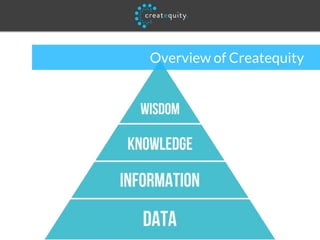
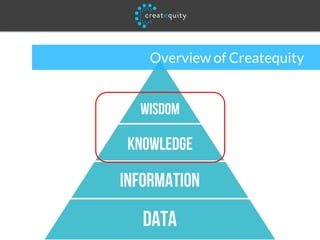
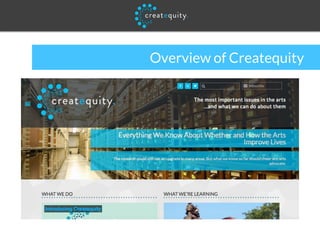
Overview of Createquity
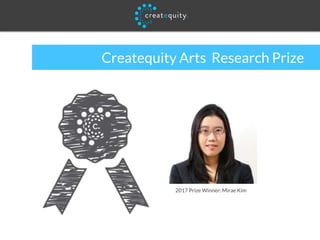
Createquity Arts Research Prize
2017 Prize Winner: Mirae Kim
(Brain) Power Breakfast with
Createquity
August 7, 2017
Arts and Wellbeing
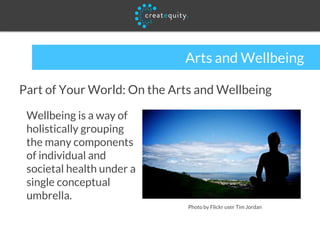
Part of Your World: On the Arts and Wellbeing
Wellbeing is a way of
holistically grouping
the many components
of individual and
societal health under a
single conceptual
umbrella.
Photo by Flickr user Tim Jordan
Arts and Wellbeing
Amartya Sen’s “capability approach”
● Individuals draw varying levels of benefit from the same
resources. Pays more attention to specific states of being
and activities than external inputs.
● Having the freedom to make choices matters. All human
beings should have the knowledge, skills and opportunity
to lead lives “that they have reason to value.”
Arts and Wellbeing
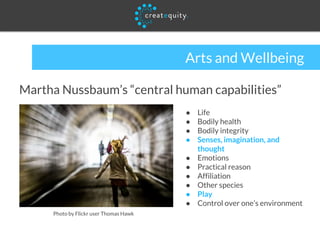
Martha Nussbaum’s “central human capabilities”
● Life
● Bodily health
● Bodily integrity
● Senses, imagination, and
thought
● Emotions
● Practical reason
● Affiliation
● Other species
● Play
● Control over one’s environment
Photo by Flickr user Thomas Hawk
Arts and Wellbeing
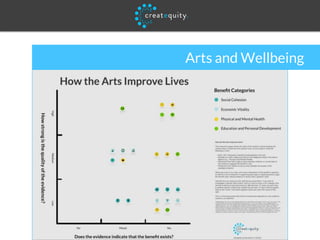
Everything We Know About Whether and How the
Arts Improve Lives
Photo by Flickr user Beyond DC
1. What are particular
claims to the benefits of
arts participation?
1. Does the majority of
available evidence
support each claim?
1. How strong is the
quality of evidence?
Arts and Wellbeing
Arts and Wellbeing
Claims with the strongest evidence
● Participatory arts activities help to maintain the health and quality of
life of older adults.
● Arts therapies contribute to positive clinical outcomes, such as
reduction in anxiety, stress, and pain for patients.
● Arts participation in early childhood promotes social and emotional
development.
● Student participation in structured arts activities enhances cognitive
abilities and social skills that support learning, such as memory,
problem-solving, and communication.
Arts and Wellbeing
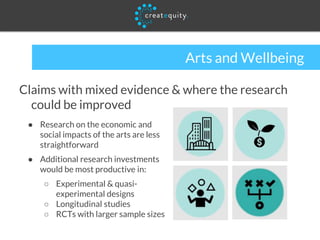
Claims with mixed evidence & where the research
could be improved
● Research on the economic and
social impacts of the arts are less
straightforward
● Additional research investments
would be most productive in:
○ Experimental & quasi-
experimental designs
○ Longitudinal studies
○ RCTs with larger sample sizes
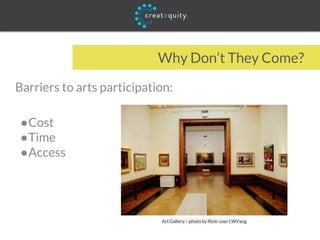
Why Don’t They Come?
●Cost
●Time
●Access
Barriers to arts participation:
Art Gallery – photo by flickr user LWYang
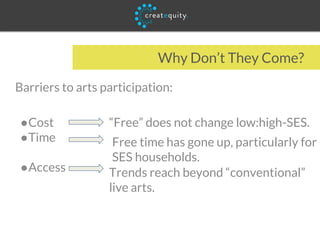
Why Don’t They Come?
●Cost
●Time
●Access Trends reach beyond “conventional”
live arts.
Free time has gone up, particularly for l
SES households.
“Free” does not change low:high-SES.
Barriers to arts participation:
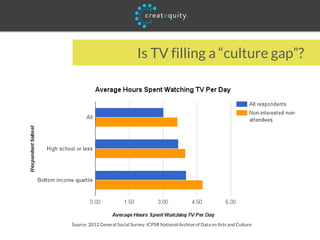
Is TV filling a “culture gap”?
Source: 2012 General Social Survey. ICPSR National Archive of Data on Arts and Culture
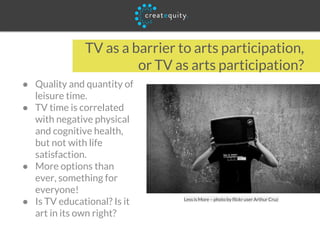
TV as a barrier to arts participation,
or TV as arts participation?
● Quality and quantity of
leisure time.
● TV time is correlated
with negative physical
and cognitive health,
but not with life
satisfaction.
● More options than
ever, something for
everyone!
● Is TV educational? Is it
art in its own right?
Less is More – photo by flickr user Arthur Cruz
Socioeconomic Status & Arts Careers
• Createquity’s Definition of a Healthy
Arts Ecosystem
• Household income during childhood
for artists the same as CEOs and
engineers. Artists were about 70%
more likely than average to have a
mother who attended college.
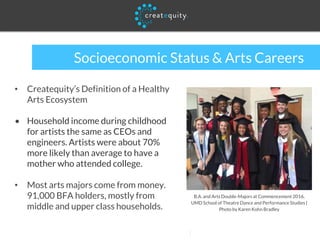
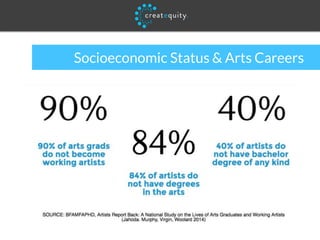
• Most arts majors come from money.
91,000 BFA holders, mostly from
middle and upper class households.
B.A. and Arts Double-Majors at Commencement 2016,
UMD School of Theatre Dance and Performance Studies |
Photo by Karen Kohn Bradley
Socioeconomic Status & Arts Careers
Risk, Wealth, and Choosing Starving Artist?
• Formal arts education helps certain types of artists
pursue successful careers in the arts, at least in Denmark.
• Comparable to entrepreneurship.
• Individuals with low SES may suffer from reduced access
to careers as working artists due to less willingness and
financial ability to assume risk.
Socioeconomic Status & Arts Careers
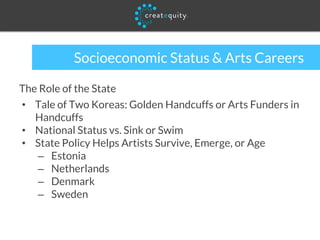
The Role of the State
• Tale of Two Koreas: Golden Handcuffs or Arts Funders in
Handcuffs
• National Status vs. Sink or Swim
• State Policy Helps Artists Survive, Emerge, or Age
– Estonia
– Netherlands
– Denmark
– Sweden
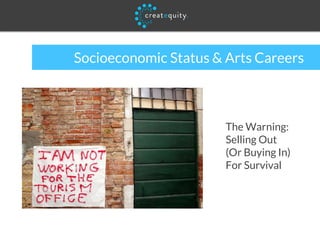
Socioeconomic Status & Arts Careers
The Warning:
Selling Out
(Or Buying In)
For Survival
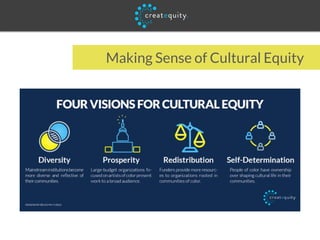
Making Sense of Cultural Equity
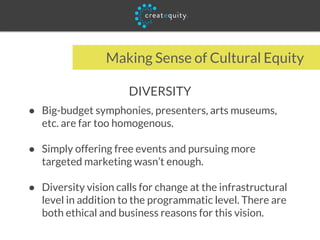
DIVERSITY
● Big-budget symphonies, presenters, arts museums,
etc. are far too homogenous.
● Simply offering free events and pursuing more
targeted marketing wasn’t enough.
● Diversity vision calls for change at the infrastructural
level in addition to the programmatic level. There are
both ethical and business reasons for this vision.
Making Sense of Cultural Equity
PROSPERITY
● Prosperity vision takes Diversity’s belief in the power
of organizational scale and applies it to institutions
started and led by artists of color.
● Seminal organizations like Studio Museum in Harlem,
El Teatro Campesino, Alvin Ailey American Dance
Theater, and Negro Ensemble Company, and others.
● Role of community leaders, patrons and champions.
Making Sense of Cultural Equity
REDISTRIBUTION
● Diversity and Prosperity both embrace the standard
market dynamics of the nonprofit arts sector, in which
a small number of high-profile institutions dominate.
● By contrast, Redistribution favors a larger pool of
recipients for contributed income, particularly from
grantmakers, and focuses on the full ecosystem of
individuals and institutions that comprise a
community.
Making Sense of Cultural Equity
SELF-DETERMINATION
● Full participation in and expression of cultural life for
communities of color through models that are organic
to those communities, where ownership of cultural
decisions is located within the community and
residents themselves get to shape cultural life.
● Look beyond established current nonprofit and
funding system which have a legacy of racism and class
hegemony that is still very much alive today.
Making Sense of Cultural Equity
FAULT LINES
● Role of Race
● Value + Cost of Integration
● Centrality of Institutions (over individuals)
● Cultural Norms
● $$ (capitalism & non-profit market dynamics)
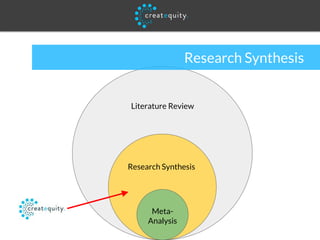
Research Synthesis
Literature Review
Research Synthesis
Meta-
Analysis
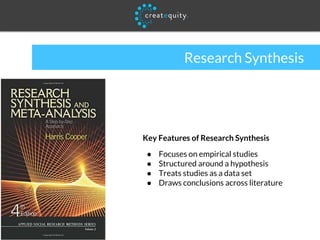
Research Synthesis
Key Features of Research Synthesis
● Focuses on empirical studies
● Structured around a hypothesis
● Treats studies as a data set
● Draws conclusions across literature
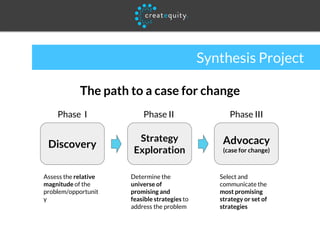
Synthesis Project
The path to a case for change
Strategy
Exploration
Advocacy
(case for change)
Discovery
Phase I Phase II
Assess the relative
magnitude of the
problem/opportunit
y
Determine the
universe of
promising and
feasible strategies to
address the problem
Select and
communicate the
most promising
strategy or set of
strategies
Phase III
(Brain) Power Breakfast with
Createquity
August 7, 2017
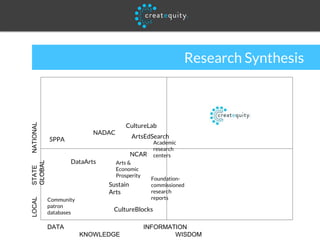
Research Synthesis
DATA INFORMATION
KNOWLEDGE WISDOM
LOCALSTATENATIONAL
GLOBAL
SPPA
Foundation-
commissioned
research
reports
DataArts
NADAC
Arts &
Economic
Prosperity
Sustain
Arts
NCAR
Community
patron
databases
CultureBlocks
Academic
research
centers
ArtsEdSearch
CultureLab

(Brain) Power Breakfast with Createquity

  • 1.
    (Brain) Power Breakfastwith Createquity August 7, 2017
  • 2.
  • 3.
  • 4.
  • 5.
    Createquity Arts ResearchPrize 2017 Prize Winner: Mirae Kim
  • 6.
    (Brain) Power Breakfastwith Createquity August 7, 2017
  • 7.
    Arts and Wellbeing Partof Your World: On the Arts and Wellbeing Wellbeing is a way of holistically grouping the many components of individual and societal health under a single conceptual umbrella. Photo by Flickr user Tim Jordan
  • 8.
    Arts and Wellbeing AmartyaSen’s “capability approach” ● Individuals draw varying levels of benefit from the same resources. Pays more attention to specific states of being and activities than external inputs. ● Having the freedom to make choices matters. All human beings should have the knowledge, skills and opportunity to lead lives “that they have reason to value.”
  • 9.
    Arts and Wellbeing MarthaNussbaum’s “central human capabilities” ● Life ● Bodily health ● Bodily integrity ● Senses, imagination, and thought ● Emotions ● Practical reason ● Affiliation ● Other species ● Play ● Control over one’s environment Photo by Flickr user Thomas Hawk
  • 10.
    Arts and Wellbeing EverythingWe Know About Whether and How the Arts Improve Lives Photo by Flickr user Beyond DC 1. What are particular claims to the benefits of arts participation? 1. Does the majority of available evidence support each claim? 1. How strong is the quality of evidence?
  • 11.
  • 12.
    Arts and Wellbeing Claimswith the strongest evidence ● Participatory arts activities help to maintain the health and quality of life of older adults. ● Arts therapies contribute to positive clinical outcomes, such as reduction in anxiety, stress, and pain for patients. ● Arts participation in early childhood promotes social and emotional development. ● Student participation in structured arts activities enhances cognitive abilities and social skills that support learning, such as memory, problem-solving, and communication.
  • 13.
    Arts and Wellbeing Claimswith mixed evidence & where the research could be improved ● Research on the economic and social impacts of the arts are less straightforward ● Additional research investments would be most productive in: ○ Experimental & quasi- experimental designs ○ Longitudinal studies ○ RCTs with larger sample sizes
  • 14.
    Why Don’t TheyCome? ●Cost ●Time ●Access Barriers to arts participation: Art Gallery – photo by flickr user LWYang
  • 15.
    Why Don’t TheyCome? ●Cost ●Time ●Access Trends reach beyond “conventional” live arts. Free time has gone up, particularly for l SES households. “Free” does not change low:high-SES. Barriers to arts participation:
  • 16.
    Is TV fillinga “culture gap”? Source: 2012 General Social Survey. ICPSR National Archive of Data on Arts and Culture
  • 17.
    TV as abarrier to arts participation, or TV as arts participation? ● Quality and quantity of leisure time. ● TV time is correlated with negative physical and cognitive health, but not with life satisfaction. ● More options than ever, something for everyone! ● Is TV educational? Is it art in its own right? Less is More – photo by flickr user Arthur Cruz
  • 18.
    Socioeconomic Status &Arts Careers • Createquity’s Definition of a Healthy Arts Ecosystem • Household income during childhood for artists the same as CEOs and engineers. Artists were about 70% more likely than average to have a mother who attended college. • Most arts majors come from money. 91,000 BFA holders, mostly from middle and upper class households. B.A. and Arts Double-Majors at Commencement 2016, UMD School of Theatre Dance and Performance Studies | Photo by Karen Kohn Bradley
  • 19.
  • 20.
    Socioeconomic Status &Arts Careers Risk, Wealth, and Choosing Starving Artist? • Formal arts education helps certain types of artists pursue successful careers in the arts, at least in Denmark. • Comparable to entrepreneurship. • Individuals with low SES may suffer from reduced access to careers as working artists due to less willingness and financial ability to assume risk.
  • 21.
    Socioeconomic Status &Arts Careers The Role of the State • Tale of Two Koreas: Golden Handcuffs or Arts Funders in Handcuffs • National Status vs. Sink or Swim • State Policy Helps Artists Survive, Emerge, or Age – Estonia – Netherlands – Denmark – Sweden
  • 22.
    Socioeconomic Status &Arts Careers The Warning: Selling Out (Or Buying In) For Survival
  • 23.
    Making Sense ofCultural Equity
  • 24.
    Making Sense ofCultural Equity DIVERSITY ● Big-budget symphonies, presenters, arts museums, etc. are far too homogenous. ● Simply offering free events and pursuing more targeted marketing wasn’t enough. ● Diversity vision calls for change at the infrastructural level in addition to the programmatic level. There are both ethical and business reasons for this vision.
  • 25.
    Making Sense ofCultural Equity PROSPERITY ● Prosperity vision takes Diversity’s belief in the power of organizational scale and applies it to institutions started and led by artists of color. ● Seminal organizations like Studio Museum in Harlem, El Teatro Campesino, Alvin Ailey American Dance Theater, and Negro Ensemble Company, and others. ● Role of community leaders, patrons and champions.
  • 26.
    Making Sense ofCultural Equity REDISTRIBUTION ● Diversity and Prosperity both embrace the standard market dynamics of the nonprofit arts sector, in which a small number of high-profile institutions dominate. ● By contrast, Redistribution favors a larger pool of recipients for contributed income, particularly from grantmakers, and focuses on the full ecosystem of individuals and institutions that comprise a community.
  • 27.
    Making Sense ofCultural Equity SELF-DETERMINATION ● Full participation in and expression of cultural life for communities of color through models that are organic to those communities, where ownership of cultural decisions is located within the community and residents themselves get to shape cultural life. ● Look beyond established current nonprofit and funding system which have a legacy of racism and class hegemony that is still very much alive today.
  • 28.
    Making Sense ofCultural Equity FAULT LINES ● Role of Race ● Value + Cost of Integration ● Centrality of Institutions (over individuals) ● Cultural Norms ● $$ (capitalism & non-profit market dynamics)
  • 29.
  • 30.
    Research Synthesis Key Featuresof Research Synthesis ● Focuses on empirical studies ● Structured around a hypothesis ● Treats studies as a data set ● Draws conclusions across literature
  • 31.
    Synthesis Project The pathto a case for change Strategy Exploration Advocacy (case for change) Discovery Phase I Phase II Assess the relative magnitude of the problem/opportunit y Determine the universe of promising and feasible strategies to address the problem Select and communicate the most promising strategy or set of strategies Phase III
  • 32.
    (Brain) Power Breakfastwith Createquity August 7, 2017
  • 33.
    Research Synthesis DATA INFORMATION KNOWLEDGEWISDOM LOCALSTATENATIONAL GLOBAL SPPA Foundation- commissioned research reports DataArts NADAC Arts & Economic Prosperity Sustain Arts NCAR Community patron databases CultureBlocks Academic research centers ArtsEdSearch CultureLab